>
I am sure some of you dream of writing a novel but have not found the gumption to do so. Well, here’s something of interest: the National Novel Writing Month, or NaNoWriMo. The idea is that one commits to writing an entire novel in one month. According to the rules that’s 50,000 words in 30 days, or about 1,667 words per day (if my math is correct). It launches November 1st.
Captain Blood My Hero
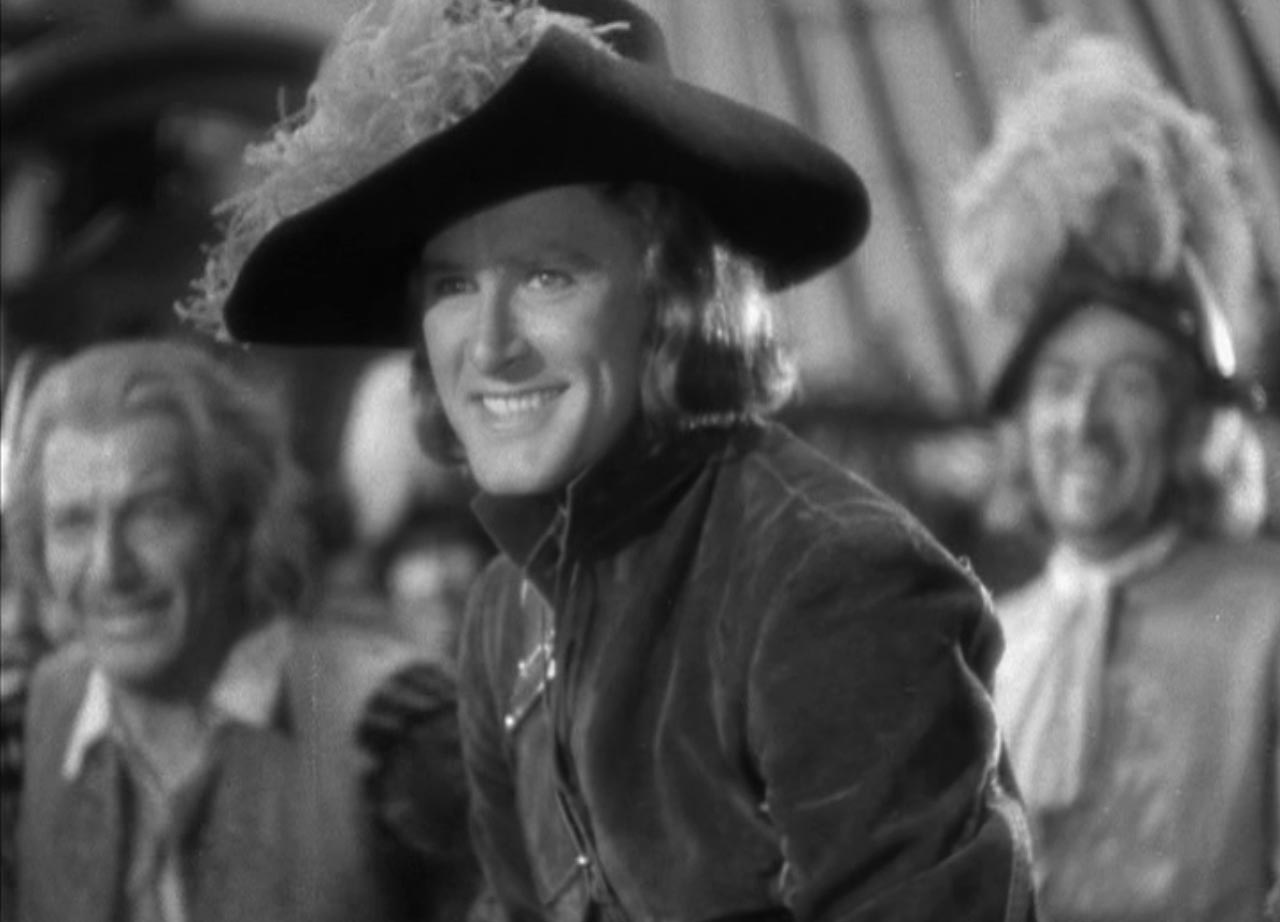
The other night Lily and I watched Captain Blood (1935) and we LOVED it. What a great film. Honestly, I can’t remember if I have ever seen an Errol Flynn movie before (shock & disbelief), and if I have it must have been when I was a kid. Flynn is wonderful. Not only does Flynn live up to his swashbuckling reputation, and not only is he as handsome as any leading man has ever been, he’s quite a good actor. In all Captain Blood was somewhat of a revelation for me.
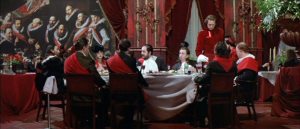
What impressed me the most, however, was the overall craft that went into the creation of the film. Michael Curtiz directed the film, which was also a surprise for me (this shows just how out of touch I am to certain aspects of film history), and I was struck again by what a master he was. Sure, Captain Blood can be considered just another big costume drama with model boats from an era with lots of such films, but, for what it is, it is still a stunner. Here are just a few observations and some favorite images of mine.
The film opens with action, as any good pirate movie should – aaarrggh. The first shot has Blood’s friend Jeremy Pitt (Ross Alexander)* riding his horse at full-speed.
Now this shot was obviously filmed in the studio, which makes it even more remarkable considering the horse has to be running on a horse-sized treadmill. But the dynamic nature of the shot with its combination of rear screen projection and foreground objects flying by, with lighting flashing, and the horse racing, is just a wonderful moment and a great way to set the tone for the story.
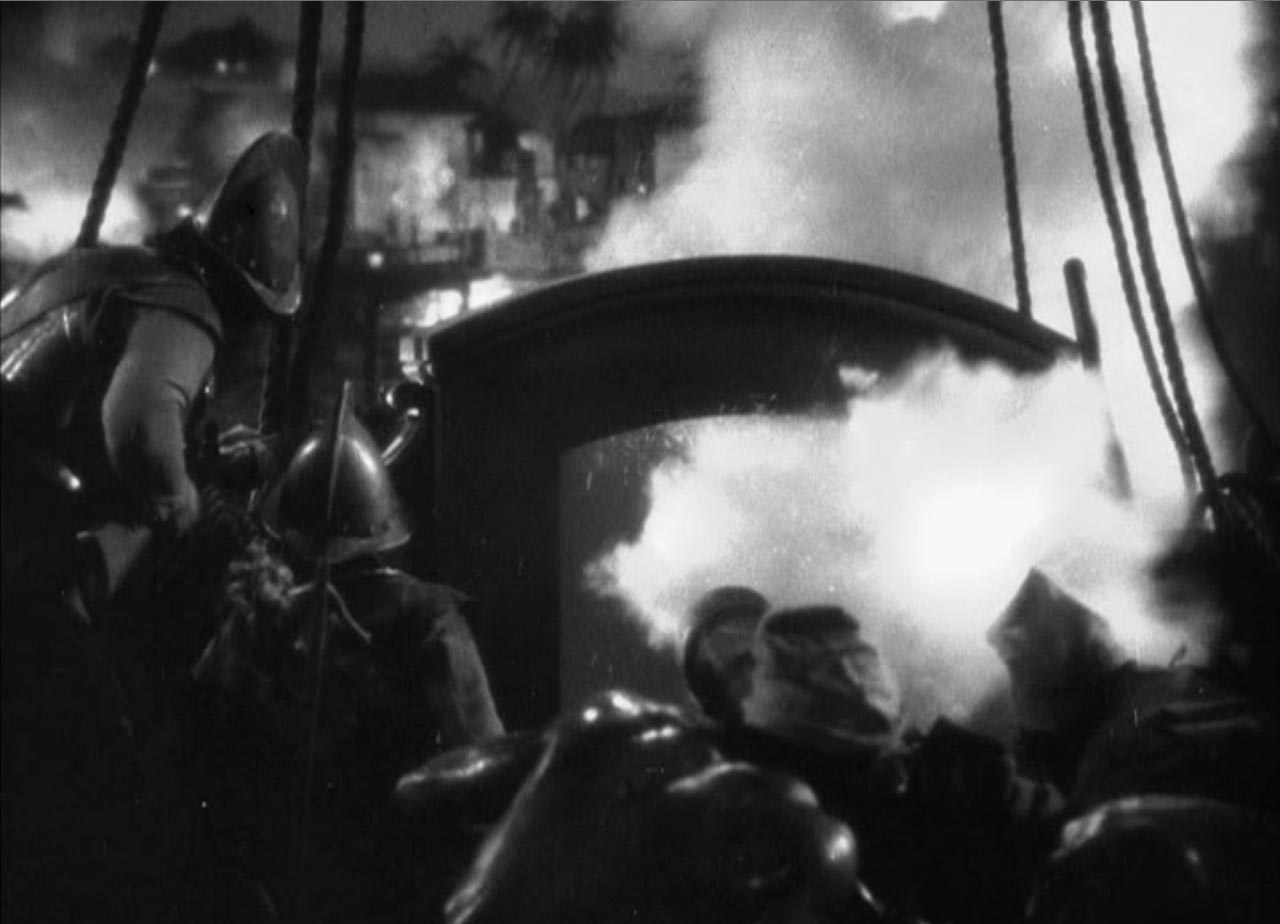
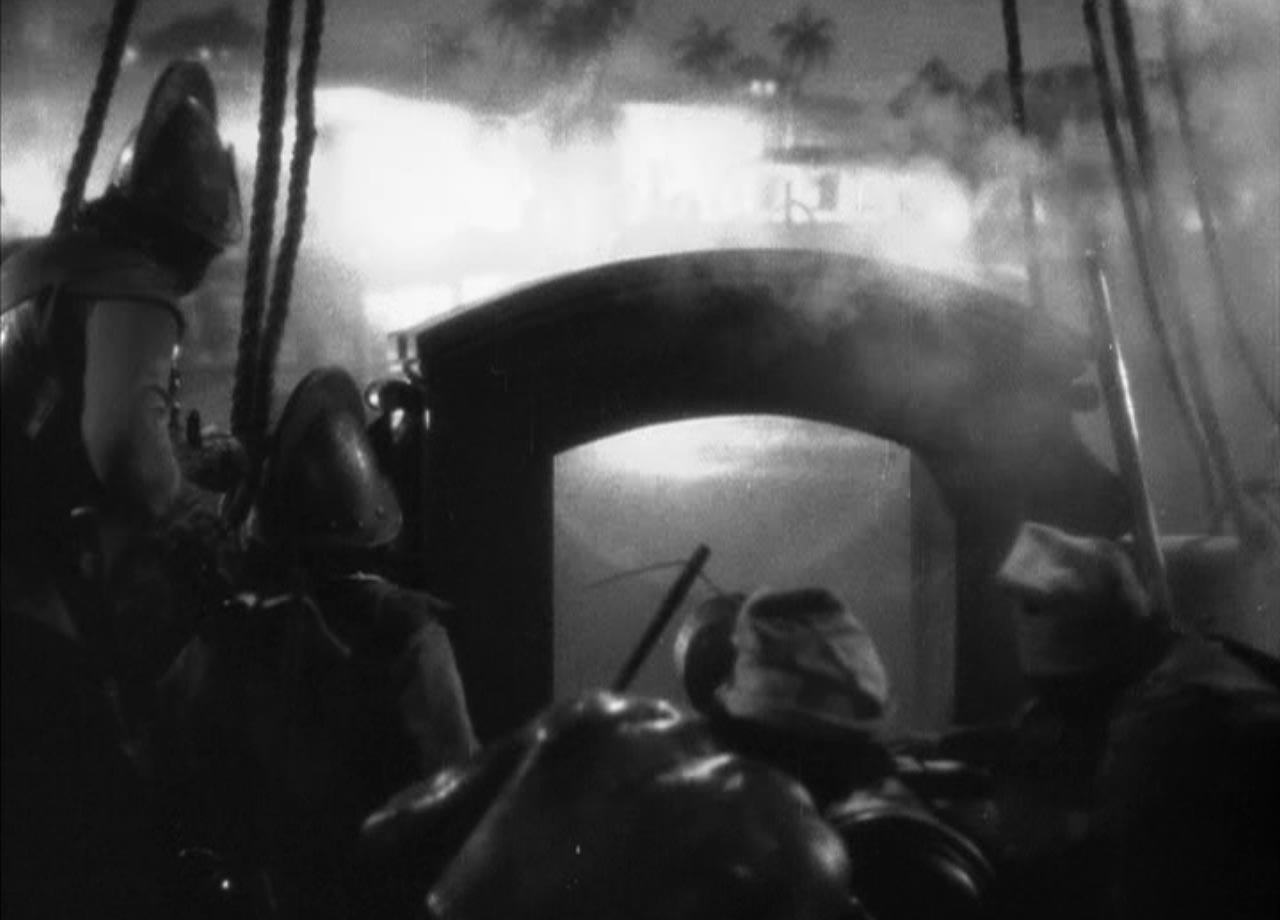
Then the battle scenes are wonderful. Here is a small example of the level of craft in the film. First is a shot from one of the Spanish ships firing on the town of Port Royale. We the have the canon fire with its flash and smoke.
Then, a full second later, we see the flash of an explosion in the distant town.
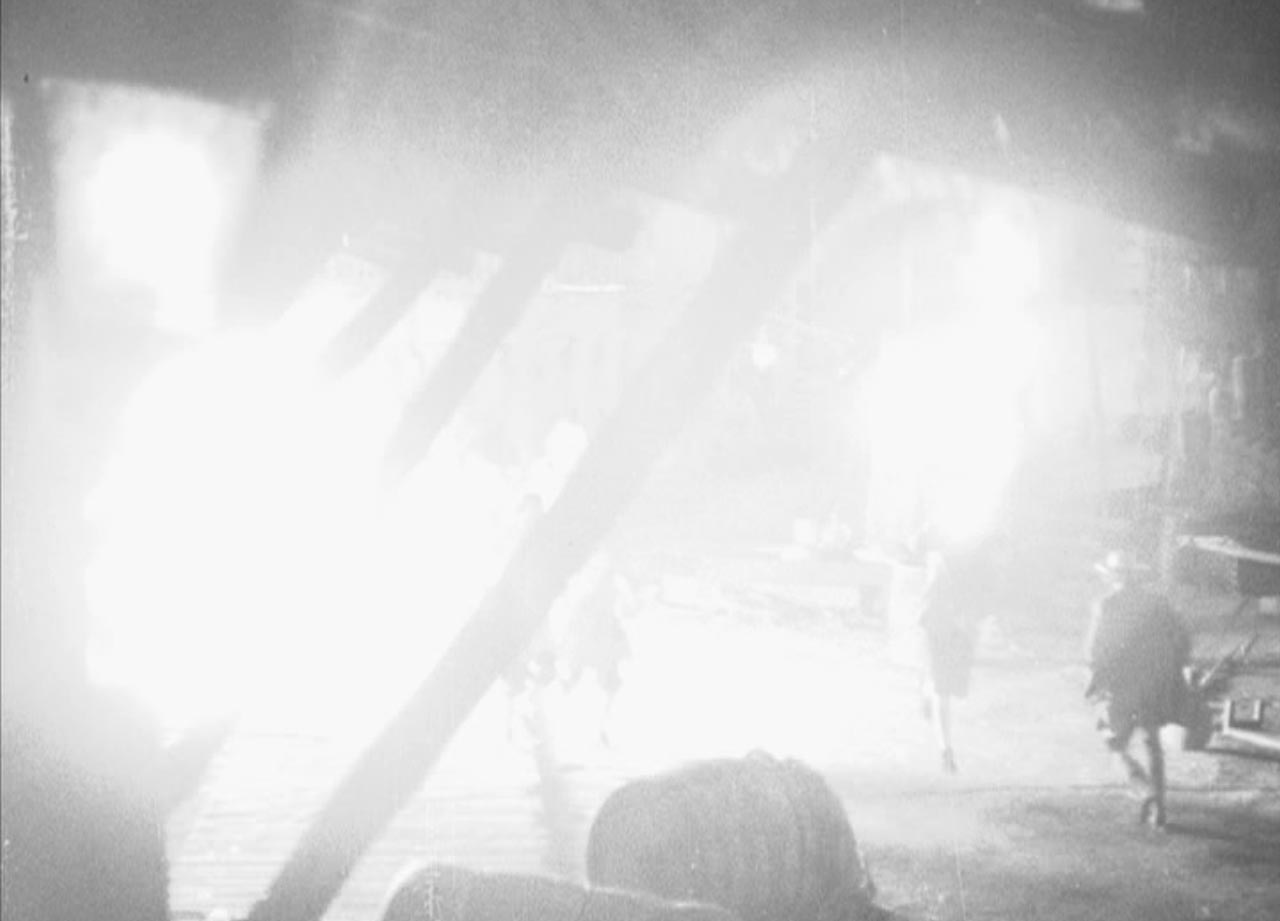
Then we have a match on action (or match on explosion) when we cut in mid flash to the site of the explosion.
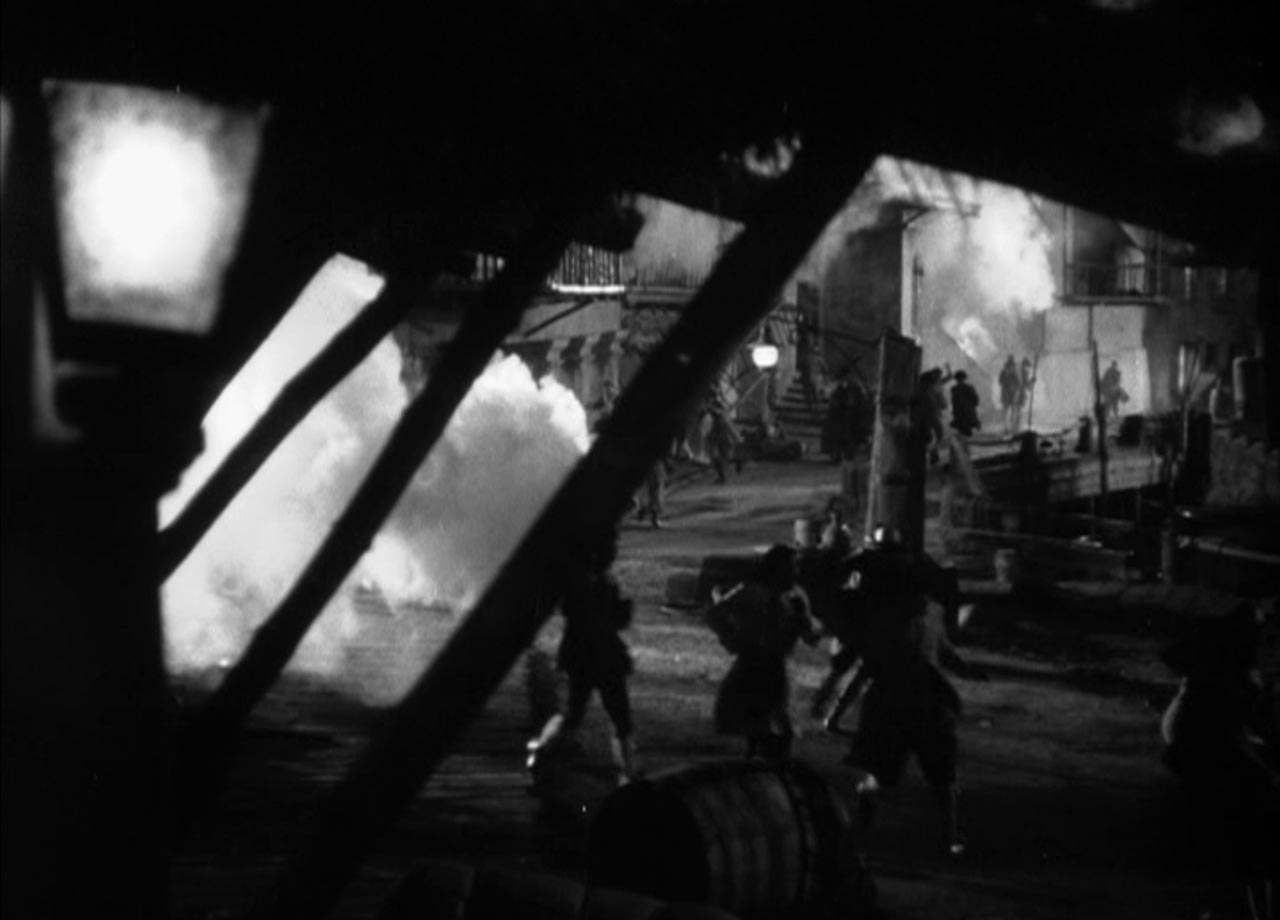
And then we see people running from the blast.
It all happens so fast that one might not notice how well put together these kinds of little moments are throughout the film. It certainly would have been much easier to just show the canon fire then cut to an explosion. But here we have a sense of depth and a holistic world, a world that is made up of real things and flesh and blood, not merely the fabrication of montage. In the age of “montage or bust” Curtiz places his edits within a world of three dimensions.
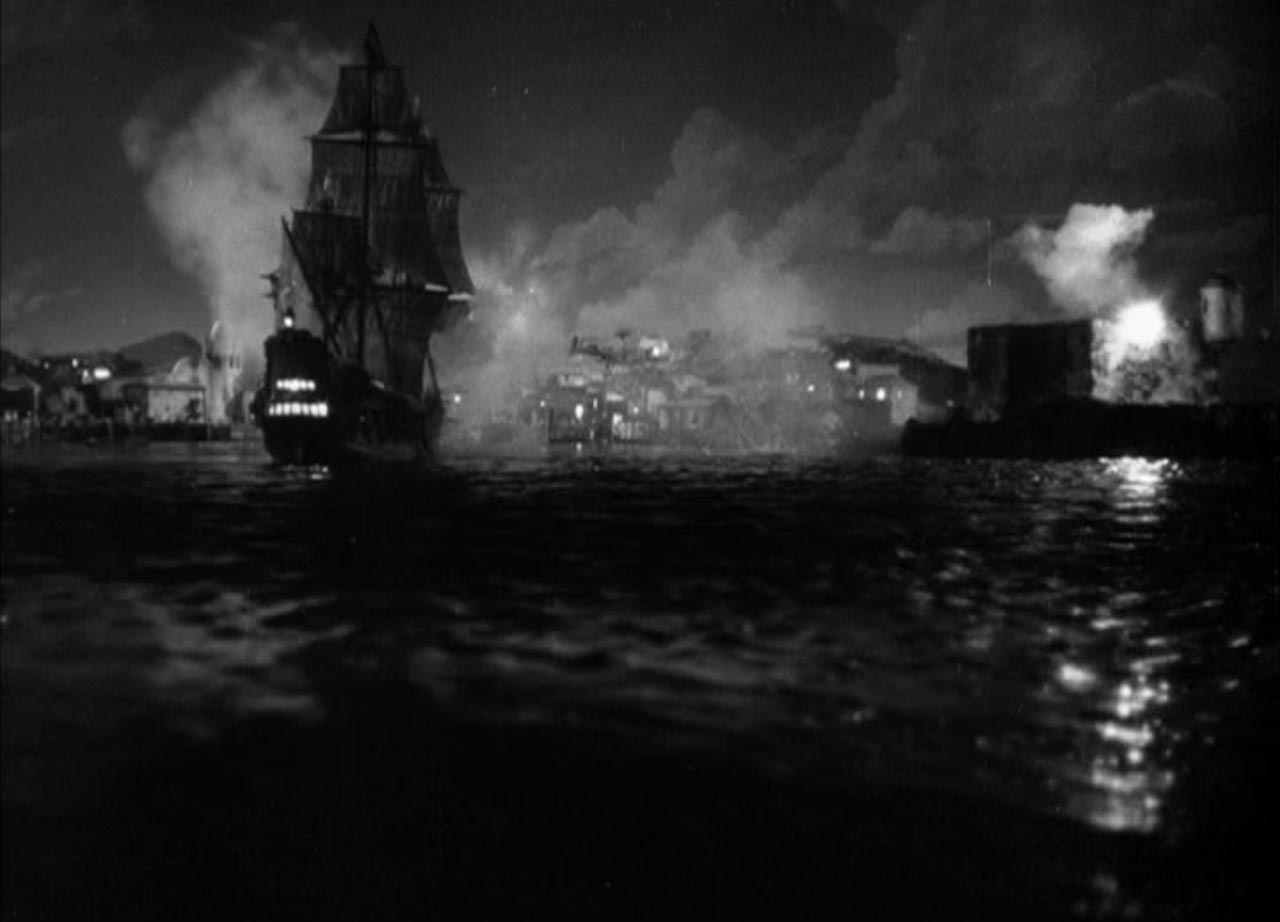
Then we have the model boats. To our eye, and maybe to those of 1935 as well, these shots are clearly made of models and miniature sets. But what a great job. The shots are more than just to create the sense of the battle, they are also works of art. Look at how beautiful they are:
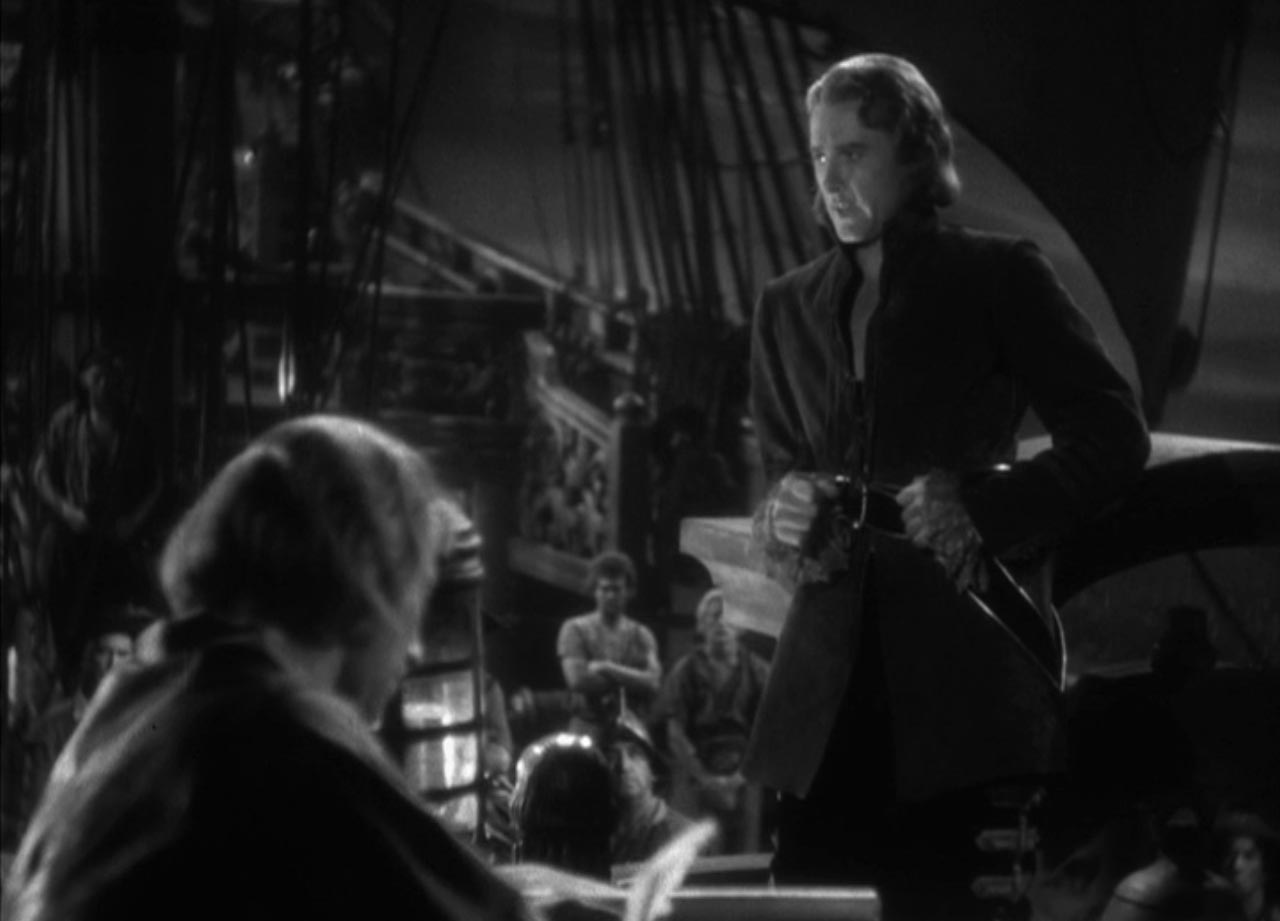
When it comes to filming on the boat with actors, we all know that many of the boat sequences in Jaws (1975) were filmed with a hand-held camera so that the rocking motion of the boat wouldn’t be too much and make the audience sea sick. Well, Captain Blood had the opposite problem. It was filmed without real ships, so how were they going to make the ships have that feeling of actually being on the water? I only noticed the secret when I was fast forwarding through he film with scenes such as this, where Captain Blood dictates the articles of piracy for his crew…
…and it takes place on the studio-bound ship and the action is slow. What Curtiz had his cameras doing was very slowly, almost imperceptibly, dollying back and forth to and from his subjects. It gives the feeling that one is standing there on the ship and subtly adjusting one’s balance as the boat rocks.
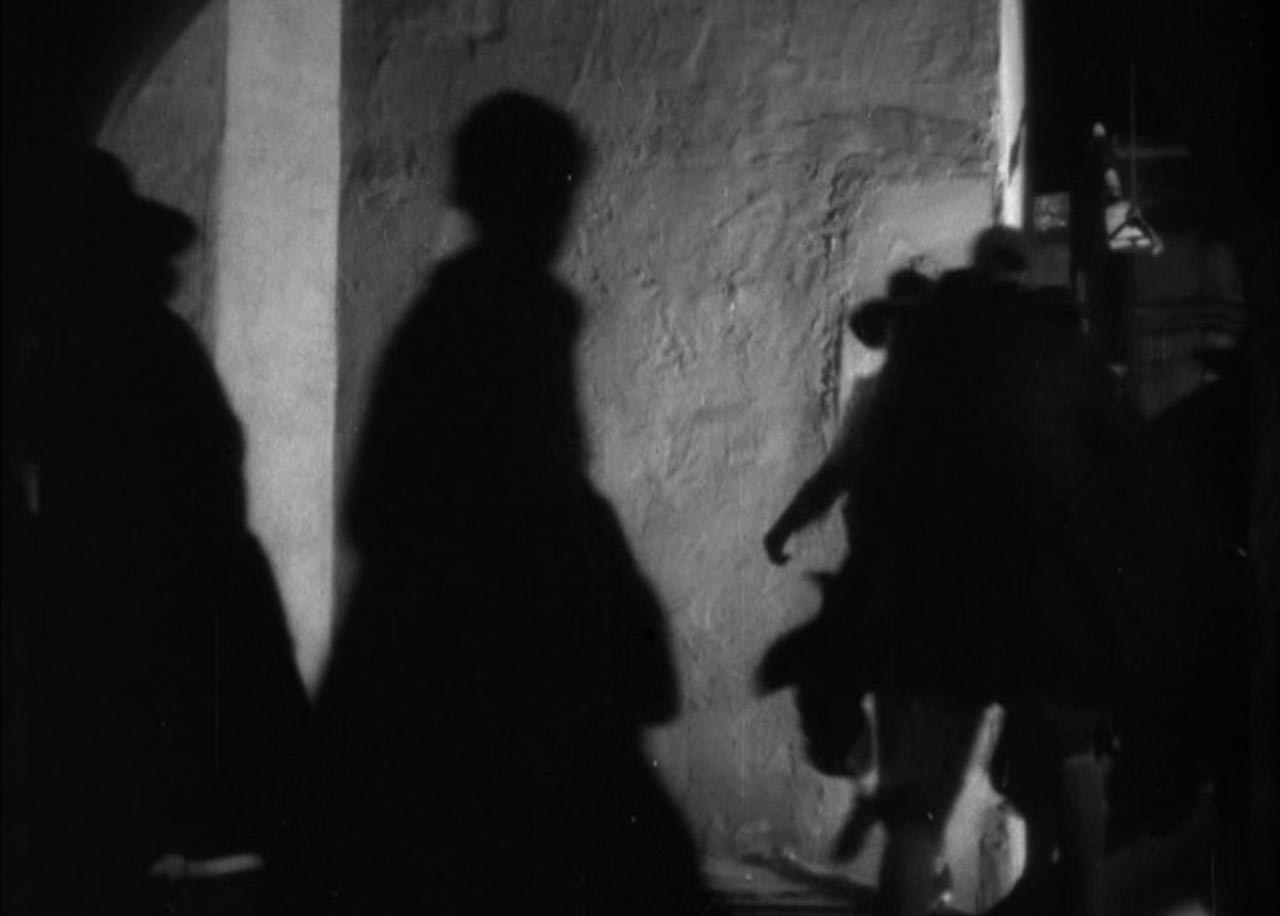
And then there is the use of shadows. German expressionism was still a powerful influence in 1935, and what better scenario to use it than a swashbuckling pirate story? Here a just three such examples:
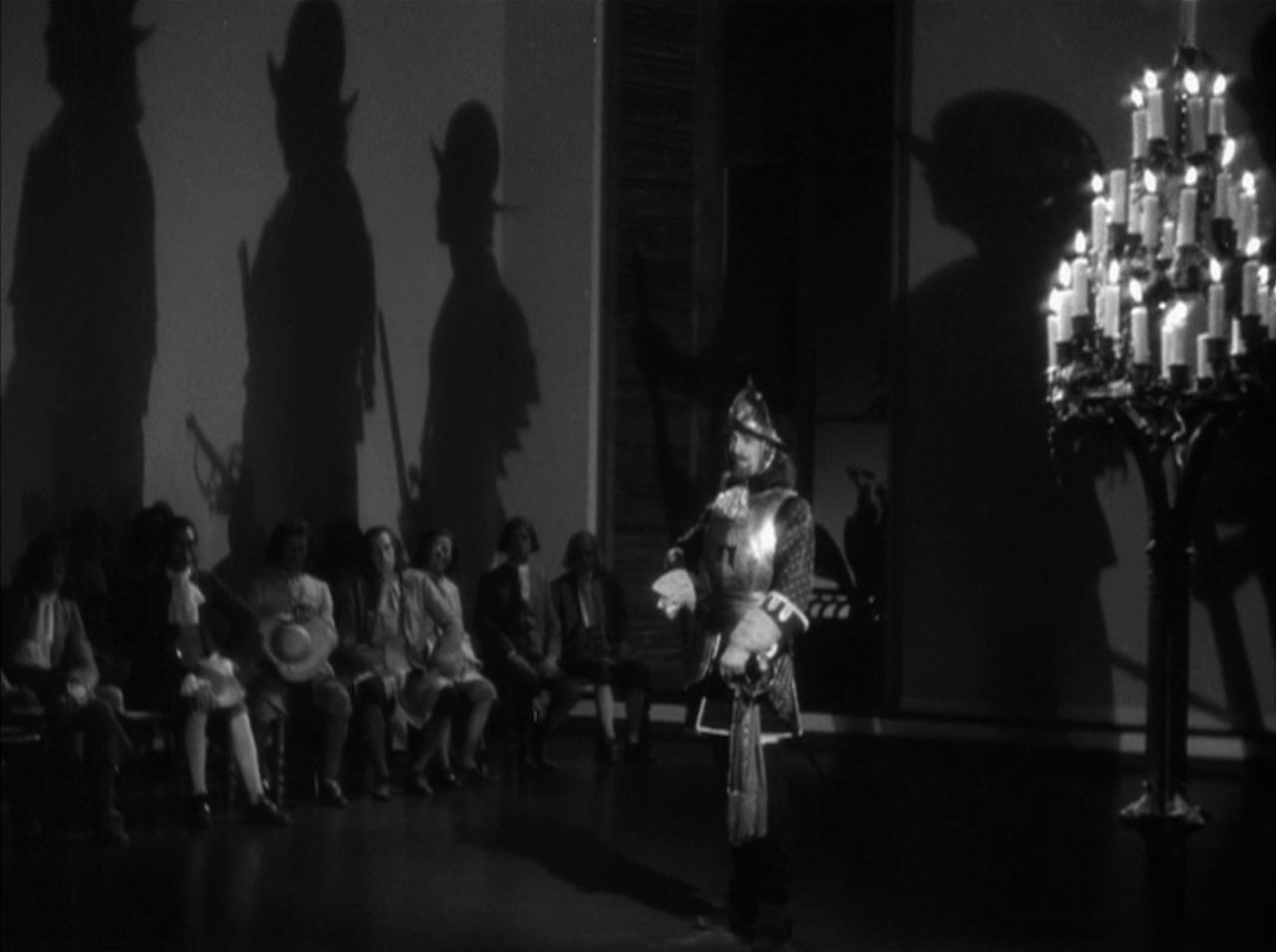
I love this shot too, with the candles placed in the foreground:
Makes me think of Ophüls or von Sternberg.
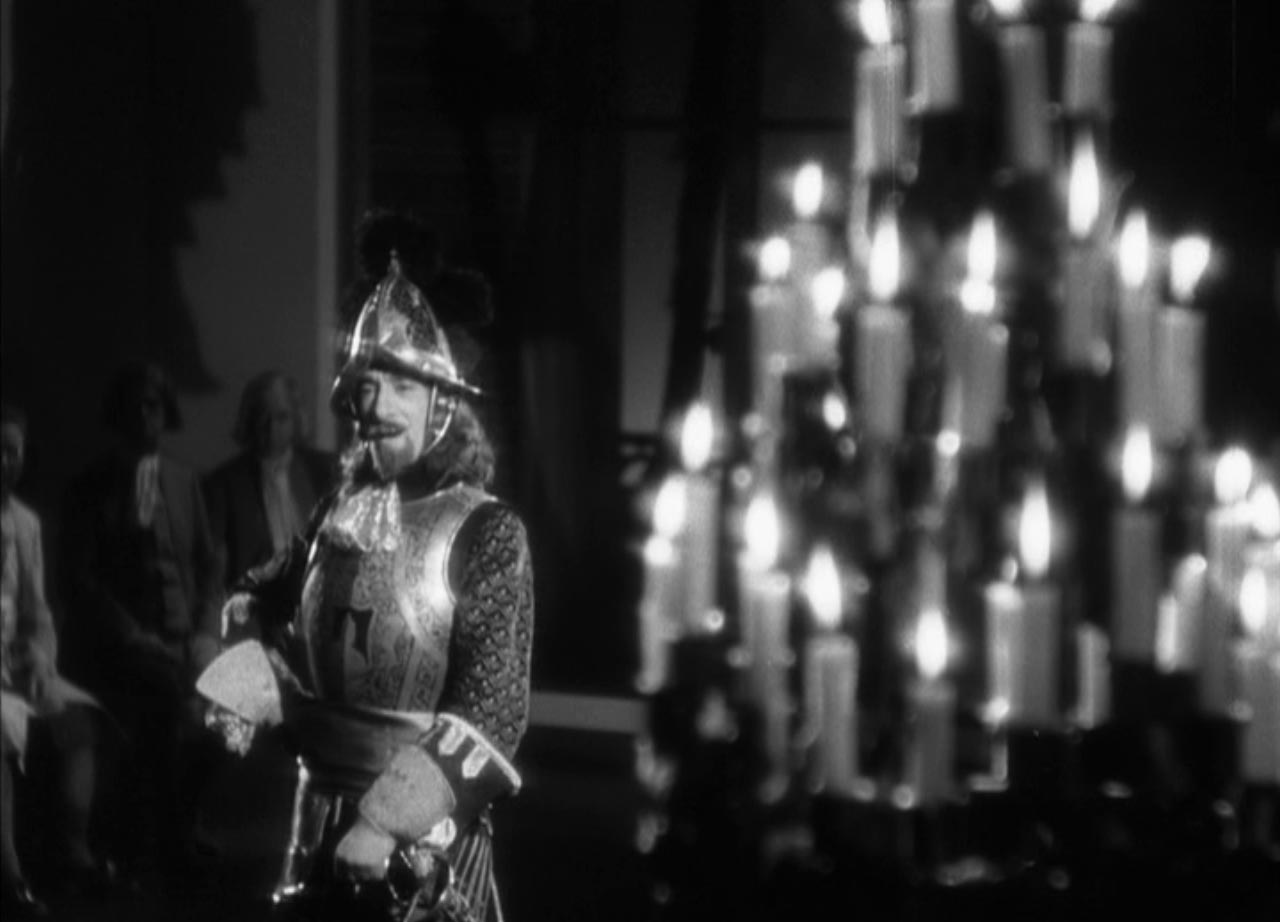
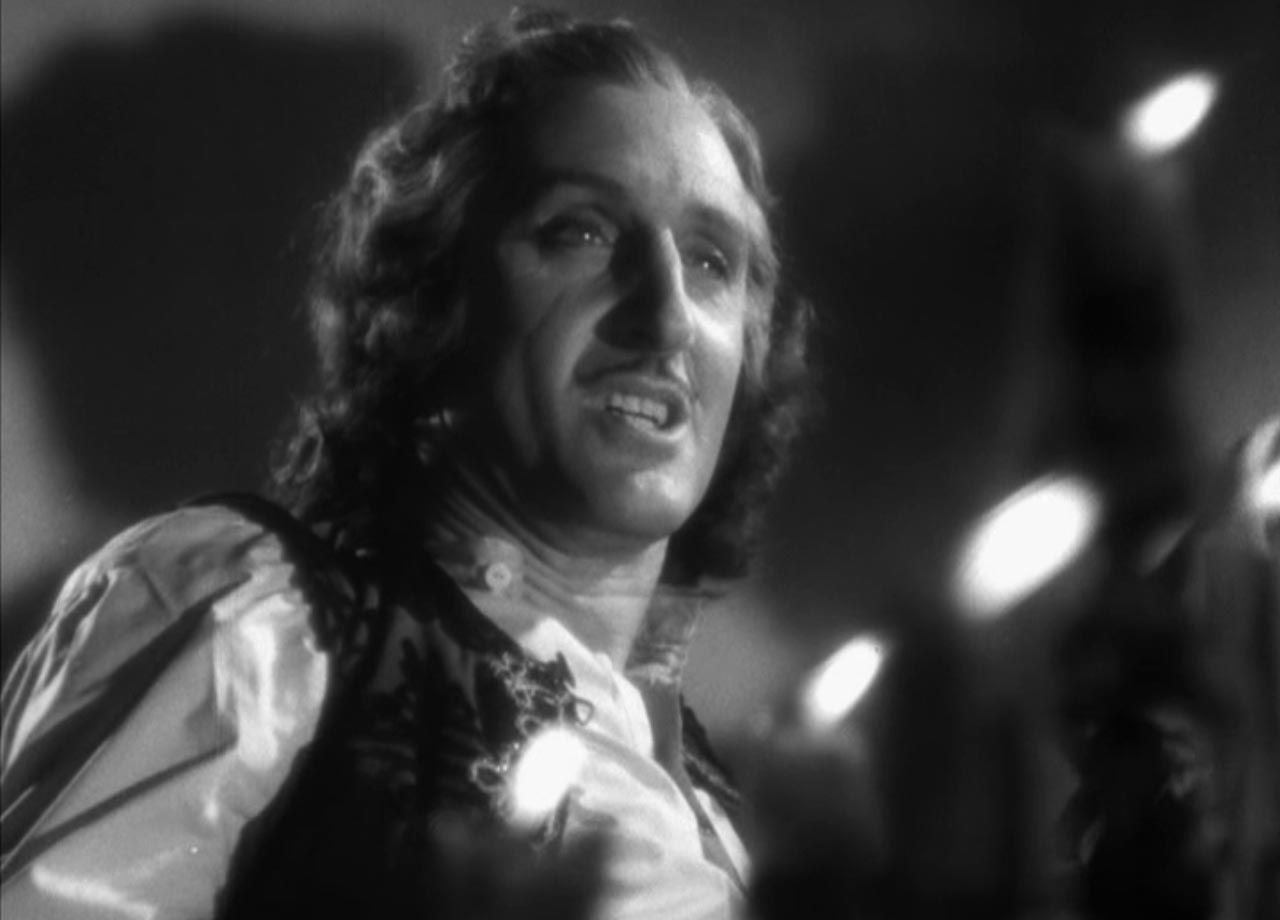
And finally there is the wonderful Basil Rathbone as the dashing pirate Levasseur. Doesn’t he look great in this shot (also with candles in the foreground)? N’est pas?
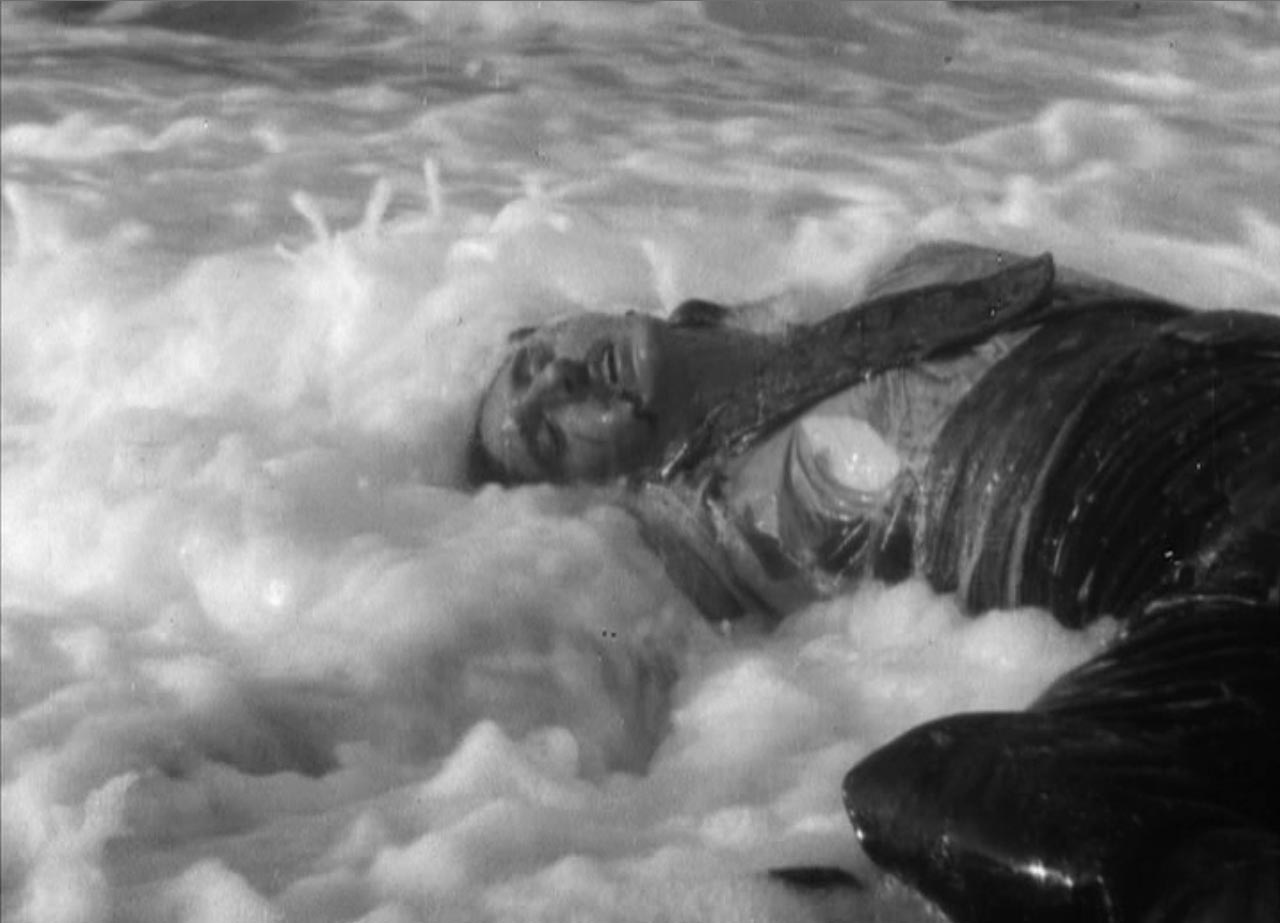
Here is Levasseur dying in the surf, what another beautiful shot.
There are so many more great images and moments in this film. Captain Blood is more than just a pirate film, it is an example that a finely crafted film, with depth and richness, could get made during the studio system by a director under contract – as so many were.
Of course I am always a little worried showing such old films to Lily. Maybe she will be bored. Maybe the films will be too dated to be appreciated. But, not only did she show great interest in the story and even cringe during some scenes, especially the branding of the slaves scenes, but when it was all over she turned to me and said “that was a good movie!” Good job Captain Blood.
_______________________________
*I have linked to Ross Alexander’s story on IMDB because it is fascinating and very tragic. I found his performance compelling in the film and Lily even remembered his character’s name the next day and had to remind me of it.
musings on Jeff Wall and the "cinematic" label
I am always a little curious about non-cinema art that gets labeled “cinematic.” A while ago I posted some thoughts on Cindy Sherman’s Untitled Film Still series. Lately I have been thinking about the staged photographs of Jeff Wall. And I have to say my thoughts are all a’flux.
If you are unfamiliar with Jeff Wall, one of the best overviews of Wall’s work is in this article.
Wall is one of the looming names in contemporary art, and like many artistic luminaries, one either likes his work or doesn’t. I happen to like his work quite a lot, but more from an intellectual curiosity and from being impressed with his virtuosity rather than from emotional engagement. In many ways his photographs seem to be either exercises in meticulous stagecraft or in meticulous banality. One label that has been tossed at Wall’s work is “cinematic” or “movie like.”
One article says the qualities of Wall’s photographs are such “…that the pictures glow like a movie screen.” The article goes on to say that Wall’s images are deeply indebted to cinema, which IS true, especially given that Wall wanted to be a filmmaker at one time. But is his work cinematic? [Other articles that mention the cinematic quality of Wall’s work: here, here, here, here, and here.]
I am inclined to think the label is being misused, but not intentionally so.
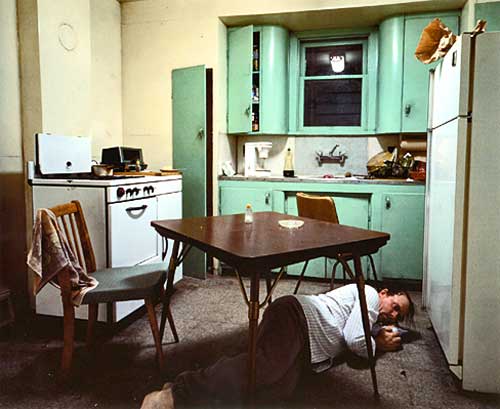
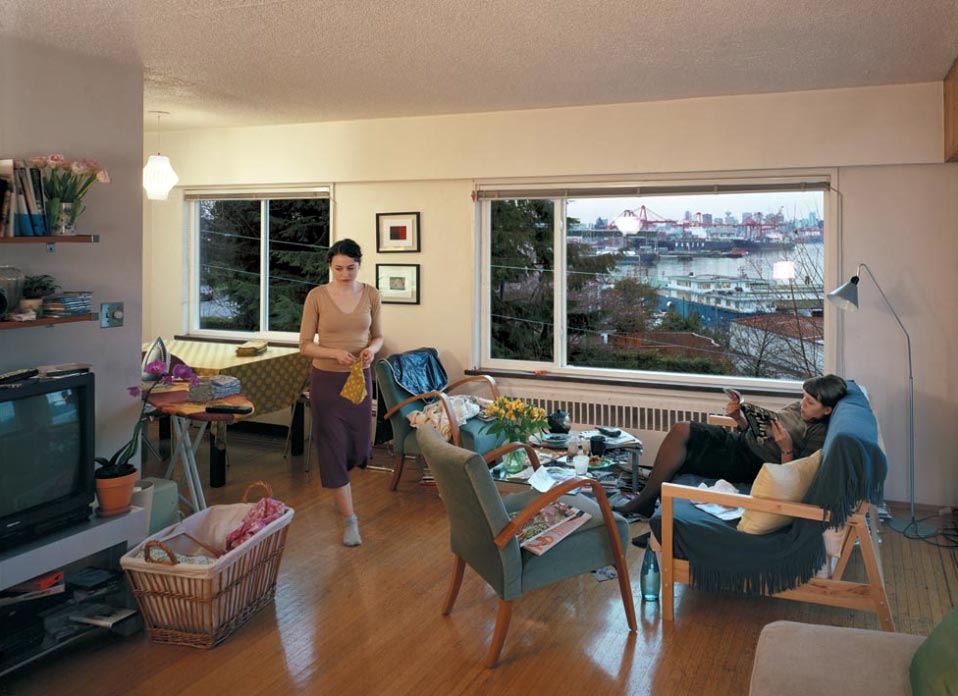
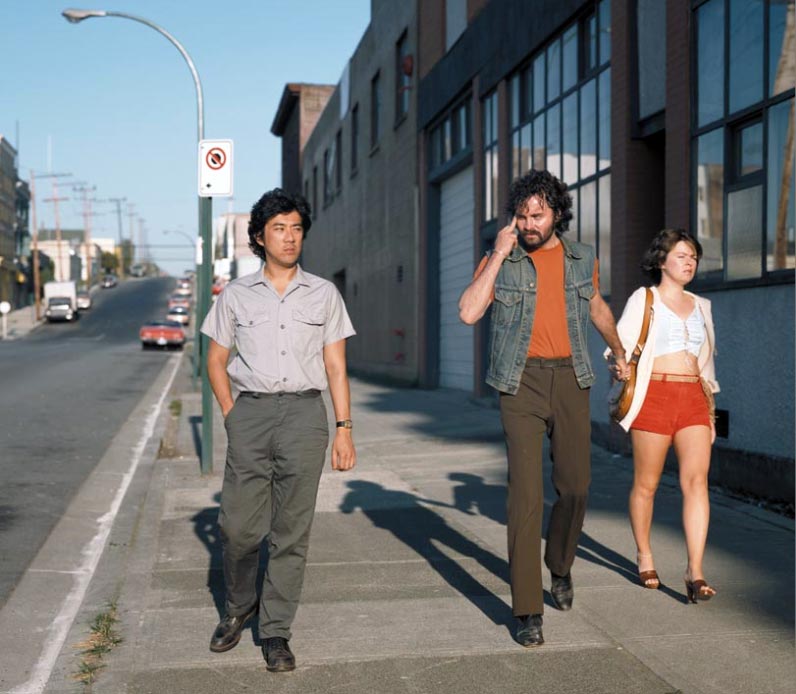
Consider the following four Jeff Wall images*:
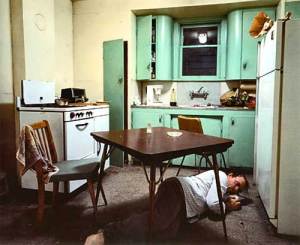
Insomnia, (date ?)
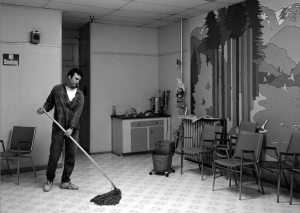
Volunteer, (1996)

A View From An Apartment, (2004-2005)

Rear, 304 E. 20th Ave., May, (1997)
Each of these pictures are obviously staged and photographed with a great deal of control and specificity applied by the artist. And like any photograph with human beings in the frame, there is some sense of narrative. But can we call them cinematic? Is that fair? Is it because the pictures are of people in some kind of “life world” context? That is, do the images seem as though there is some preceding event(s) to the frozen moment, and that that frozen moment will be followed by another?
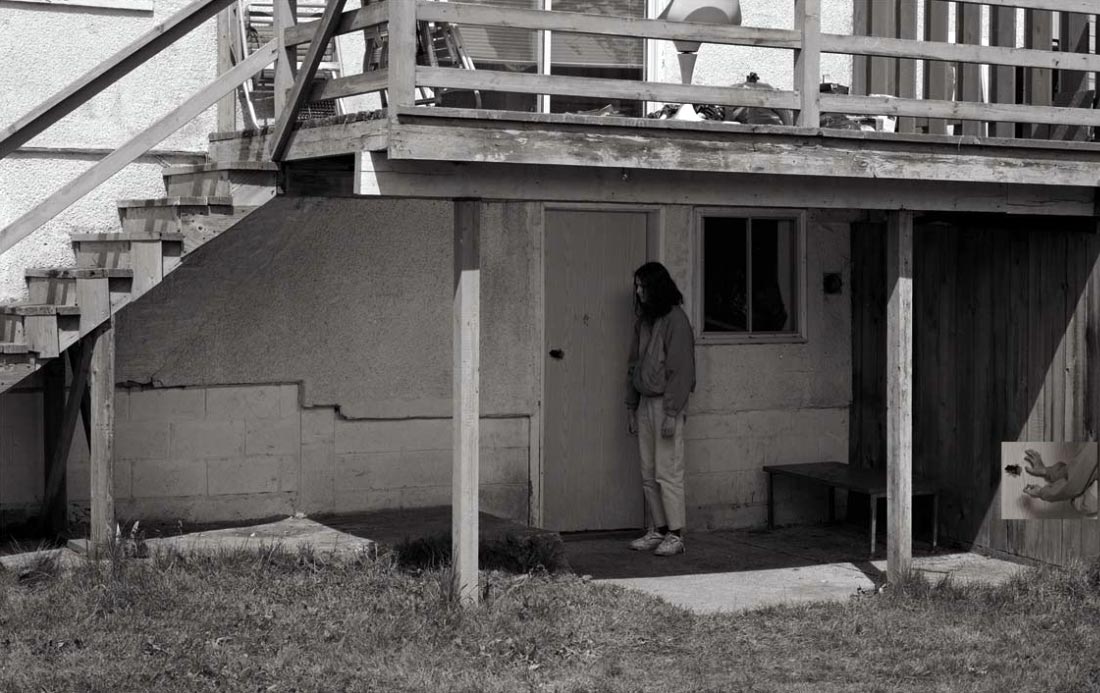
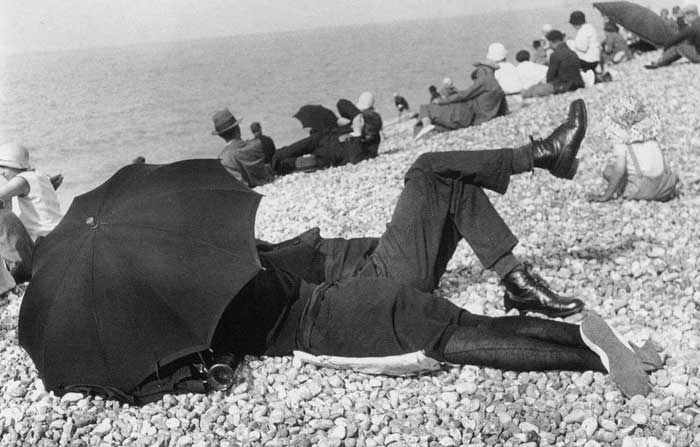
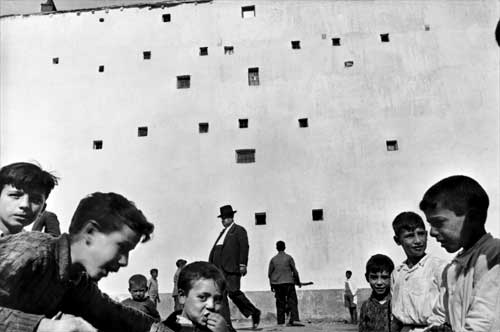
I do not think this is a strong enough argument for the cinematic label. But even if it is, aren’t there many more photographic examples that have richer narrative possibilities? Such as these two, apparently unstaged, photographs from Cartier-Bresson (I don’t have the titles or dates, unfortunately):
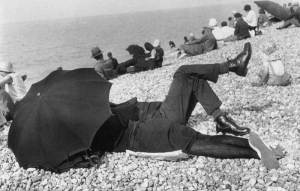
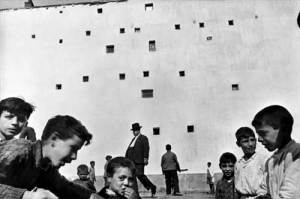
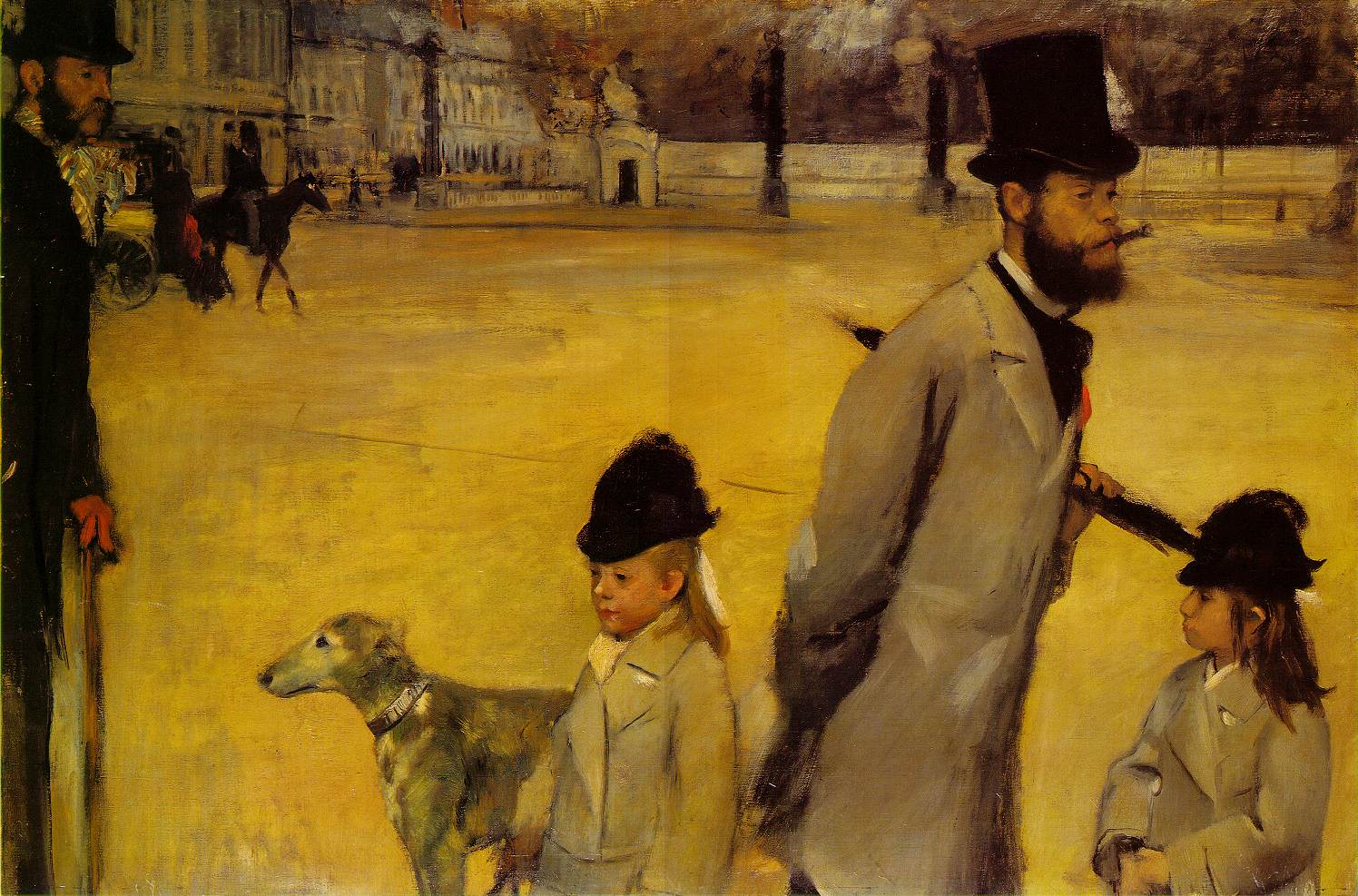
We could say much the same thing about a lot of painting. Consider this paining by Edgar Degas, which has a kind of in media res quality, as well as a sense of the banal.
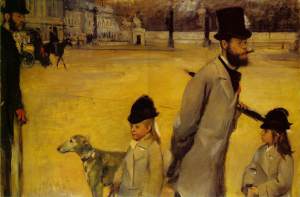
Place de la Concorde, (1875), oil on canvas
Should we consider this Degas to be somewhat cinematic too? If so, then I find Degas to be at least as cinematic as Wall, and maybe more so, which is ironic given that the photographic apparatus is closer to that of cinema.
Maybe, instead, we should consider the typical way Wall’s images are presented to the viewer. Wall’s images are oversized (comparatively) cibachrome enlargements that are placed in lightboxes mounted on the wall. Thus, when one sees a Jeff Wall image in its native setting, one sees a very large photograph that is lit from behind, and therefore glows like a television screen, or, more appropriately, an advertisement light box. In this way Wall’s images have the immensity of a medium-large painting, but with the technical aura and aesthetic more closely aligned with mechanical presentation, i.e. television and cinema. Does that still qualify his work as cinematic? When one sees a lightbox advertisement at a bus stop or a store window does one think “cinematic?” Somehow I doubt it.
This video (below) of the Jeff Wall retrospective at MoMA will give some idea of how the images are presented.
http://www.youtube.com/get_player
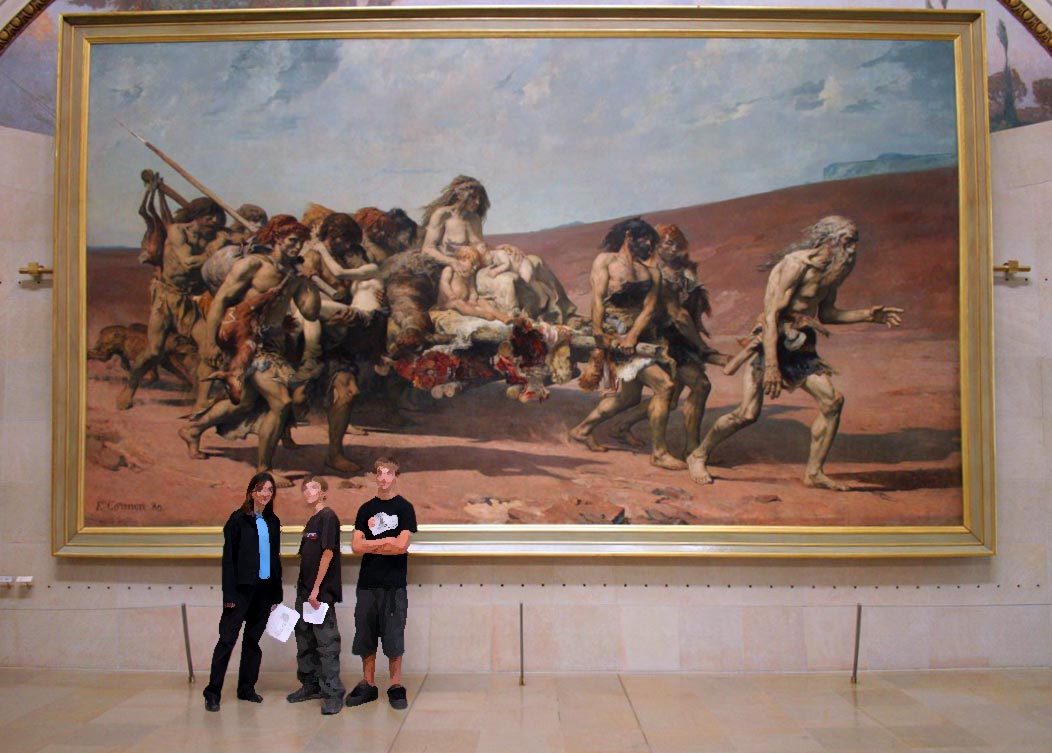
Maybe it’s just the size of Wall’s work. Of course, great big narrative paintings have been around for a long time too. Maybe this painting at the Louvre is somewhat cinematic.
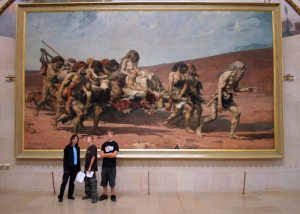
Note: I grabbed this image off the Internets. I don’t know the title or artist of the painting, and I don’t know who took the photo, but I’m sure it’s from someone’s vacation.
It certainly is huge and, although I don’t know its date, it must pre-date the invention of cinema. Does that mean it anticipates the coming of cinema in some way? Maybe, but not likely. Just because a work of art is big and appears to have a story embedded in it doesn’t automatically make it cinematic, seems to me. And, of course, the painting does not glow with its own light source. And yet, maybe it is cinema that is more like oversized genre paintings of the past and not the other way around. Should we label all instances of cinema as cinematic?(!).
Maybe what is most fascinating about Jeff Wall’s work on an immediate level at least, is just how stagey they are. In the history of photography the staged photo has held a lesser place, reserved primarily for advertising, because staging an image apparently undercuts the great achievement of photography: capturing life in a moment, as it is (or was) with no barrier except for the lens and the technical processes. Wall, on the other hand, hires actors, carefully plans and sets up his shots, and probably takes numerous tries to get it just right. Then, of course, he digitally alters them as needed to get what he envisions.
Consider this image:
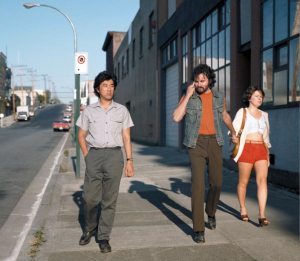
Mimic, (1982)
Here Wall has staged his re-imagined version of a real event which he saw. What hits the viewer, along with the obvious content of the subject, is the fact that this apparent “snapshot” could only exist if it was staged. It’s perfection, its clarity (only achieved with a not-very-portable large format camera sitting on a trip), its careful composition all point to a set-up rather than a lucky shot.
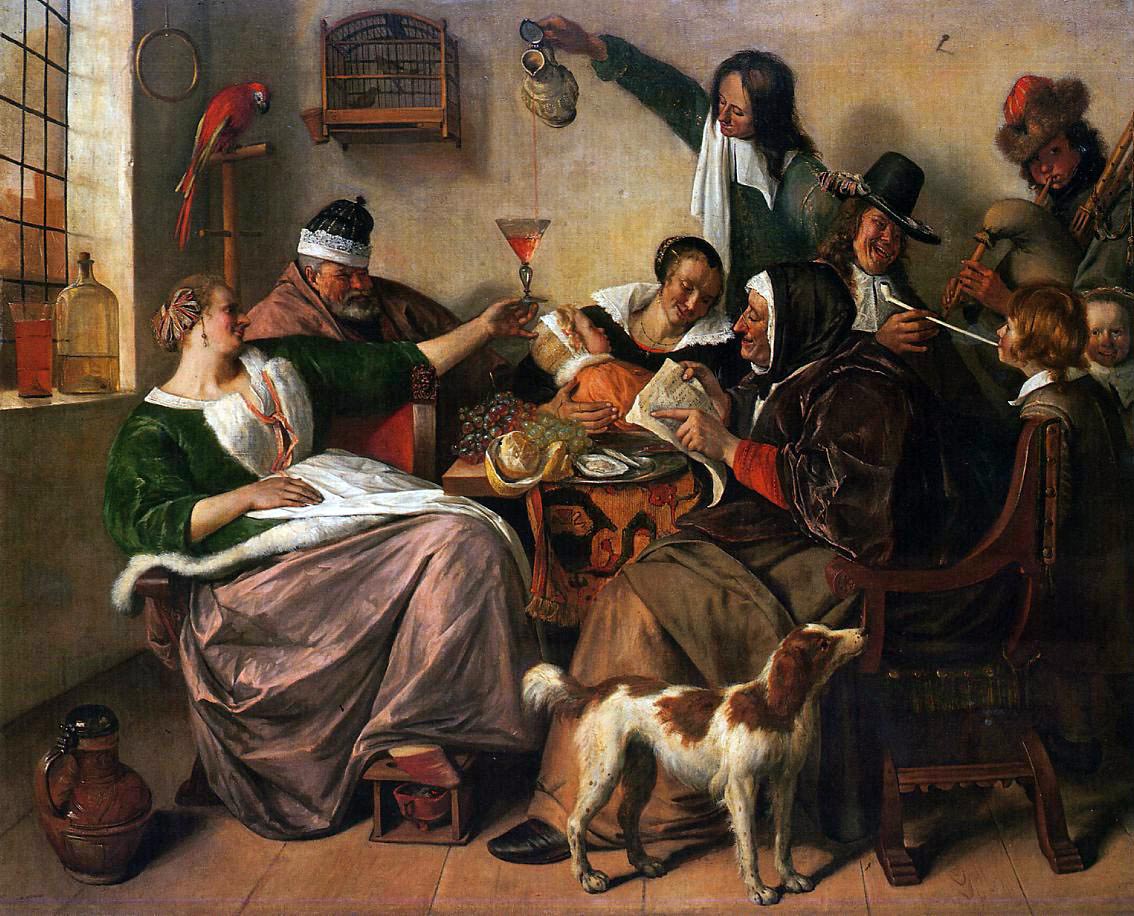
Maybe that staginess is what encourages the cinematic label. But that level of craft and arrangement is not unique to cinema. In most other arts the carefully arranged composition is standard fare. Just consider the genre paintings of Jan Steen:

The Artist’s Family, (c. 1663) Oil on canvas, Mauritshuis, The Hague
In this sense Wall’s work is something more akin to the history of art in general than to photography. The camera is his tool but he is not beholden to the “moment.”
Of course the staging of actors before the lens so that the camera can capture a scene, as it were, is nothing new. Although such staging has played a lesser role in the history of photography, as far as what is considered art is concerned, is has always been present, and maybe more prevalent in the past.
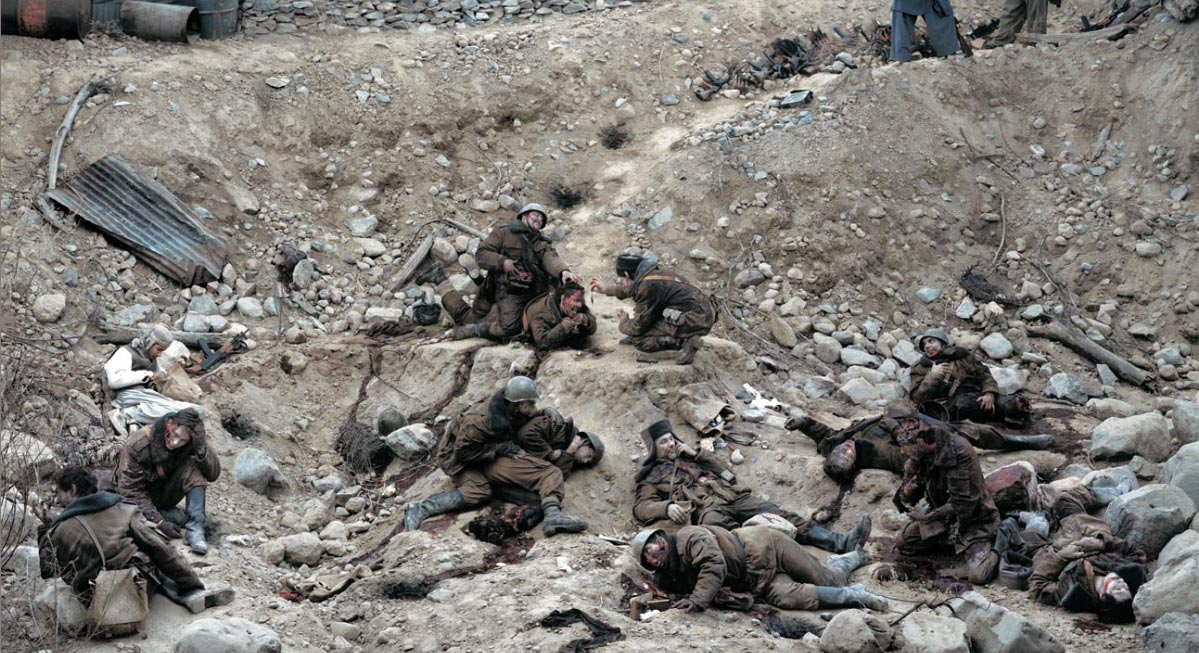
One connection with staging is the idea of the tableau vivant or living picture. Here we have the tableau vivant of Wall’s Dead Troops Talk:
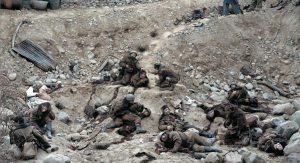
Dead Troops Talk, (1992)
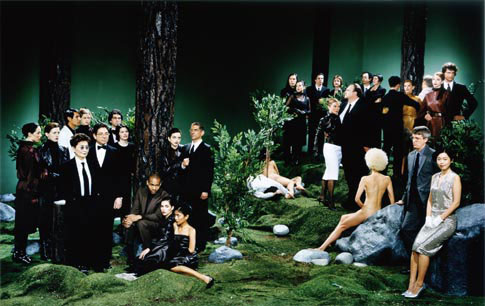
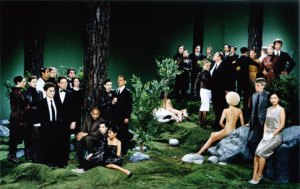
One of the comic ironies of this image is that we have those who are dead animating a tableau vivant. Now here we have an advertisement which appeared in the September 2000 issue of Harper’s Bazaar:
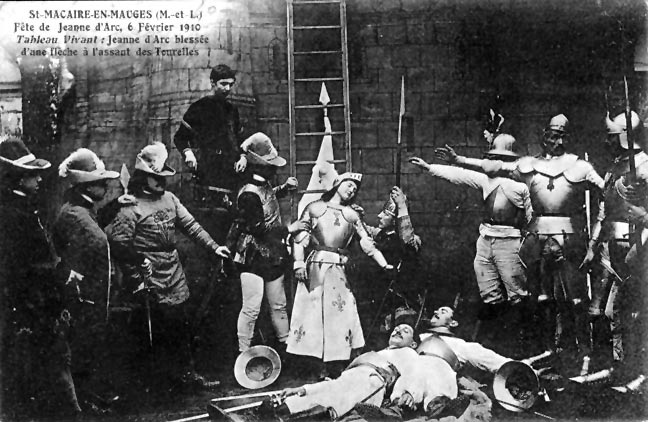
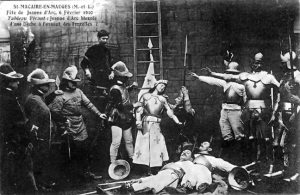
Here we have a tableau vivant from 1910 with actors portraying a scene from the story of Joan of Arc:
And here we have the photographer Hippolyte Bayard circa 1840 playing himself as a drowned man in a very early tableau vivant of sorts:

I find these kinds of connections fascinating, but nothing here suggests that Wall’s work is cinematic. In fact, the tableau vivant is more of a theater convention than that of cinema. Certainly Wall’s images have ties to photography, painting and theater that are at least as strong, and probably more so, than to cinema.
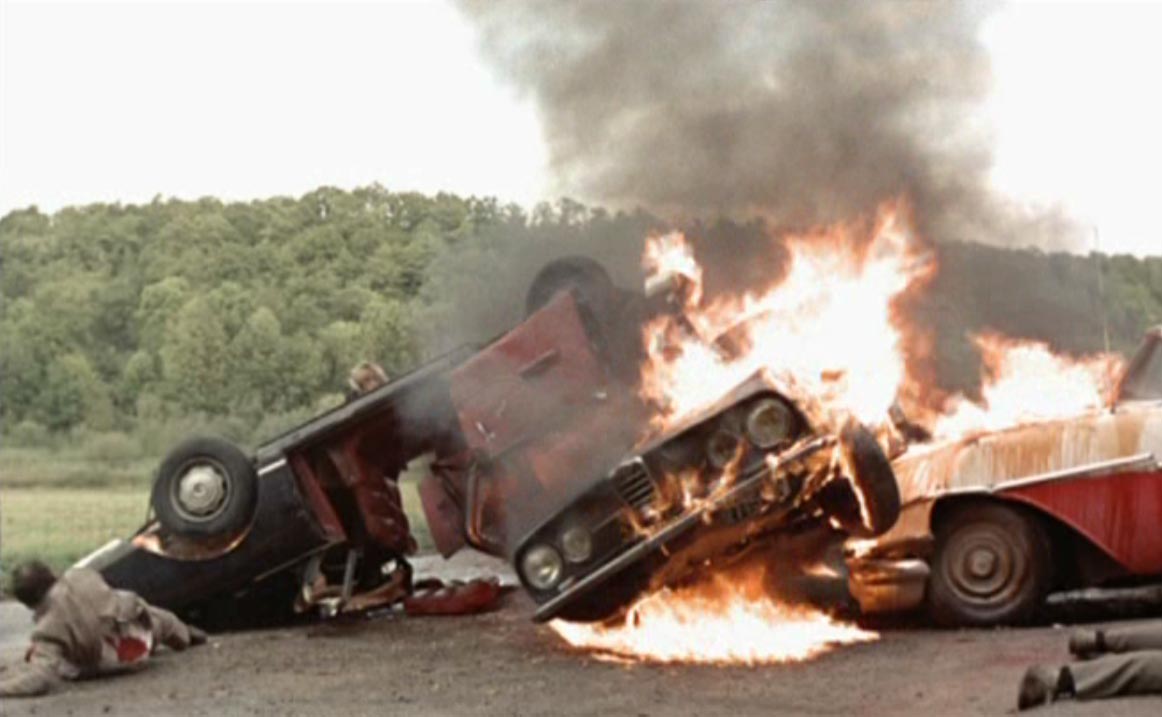
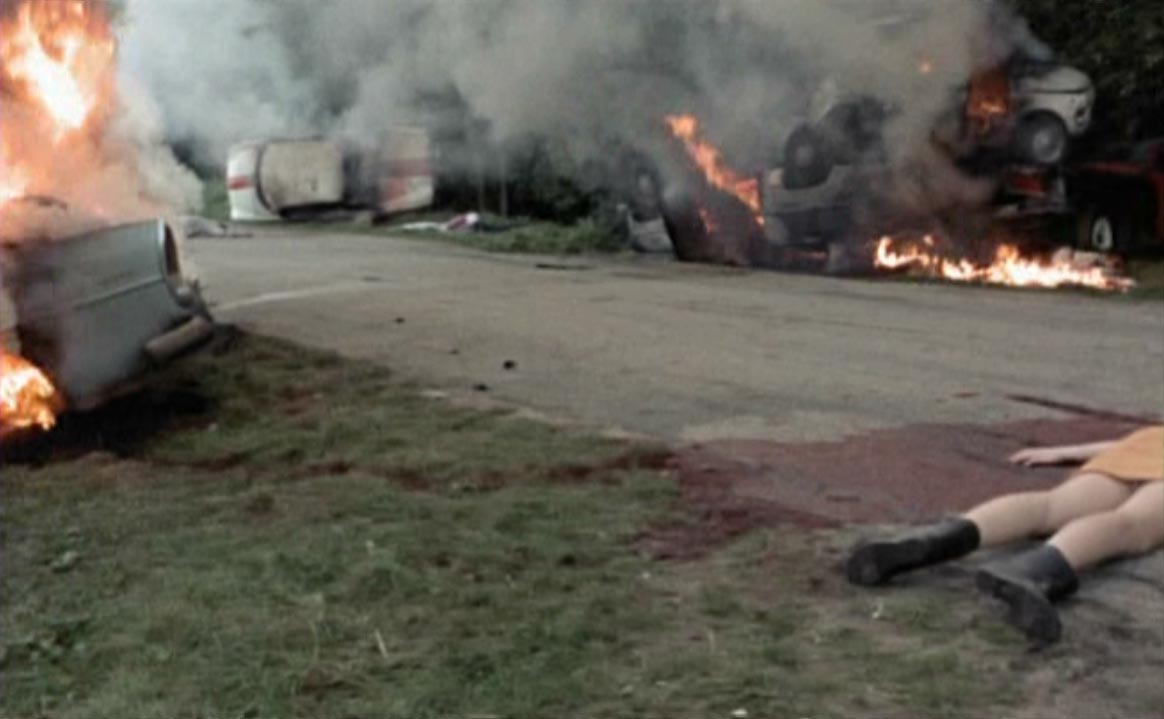
One thing to ponder is that some films do use tableaus to create their meanings. In other words, it is not uncommon for filmmakers to stage relatively static mise en scène for effect, rather than exploit the more cinematic capabilities of the technology. For example, consider these two images from Godard’s Weekend (1967):
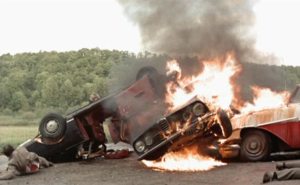

Although the burning wrecks are dramatic, and the flames do move, the scenes are obviously carefully constructed piles of autos set aflame and presented to the viewer as a kind of emotional tableau on modernism – even humorous if one can see Godard winking.
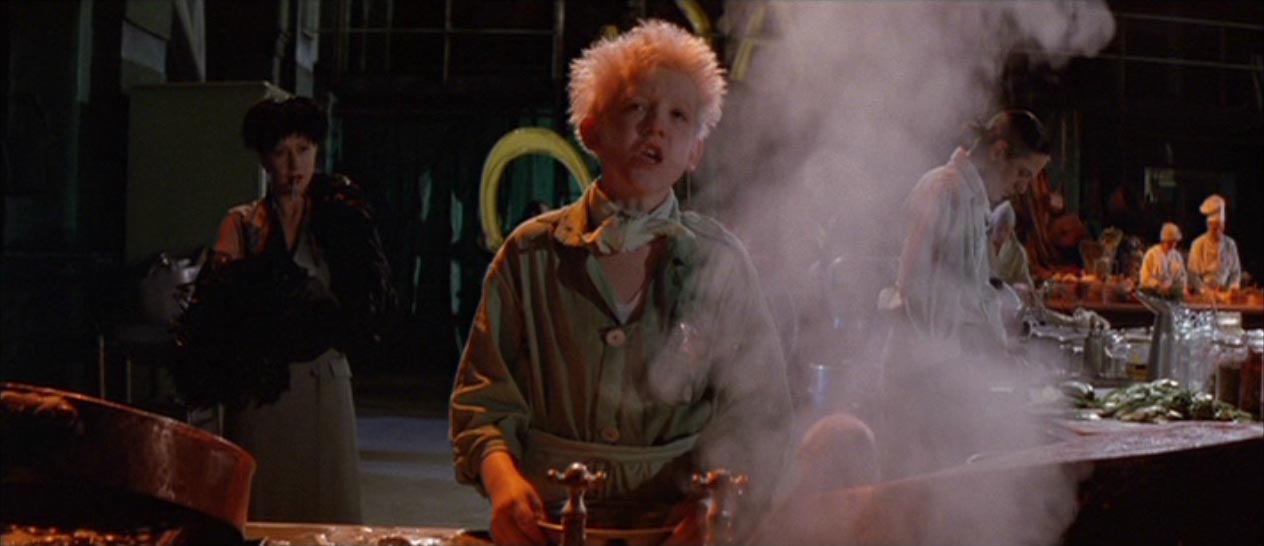
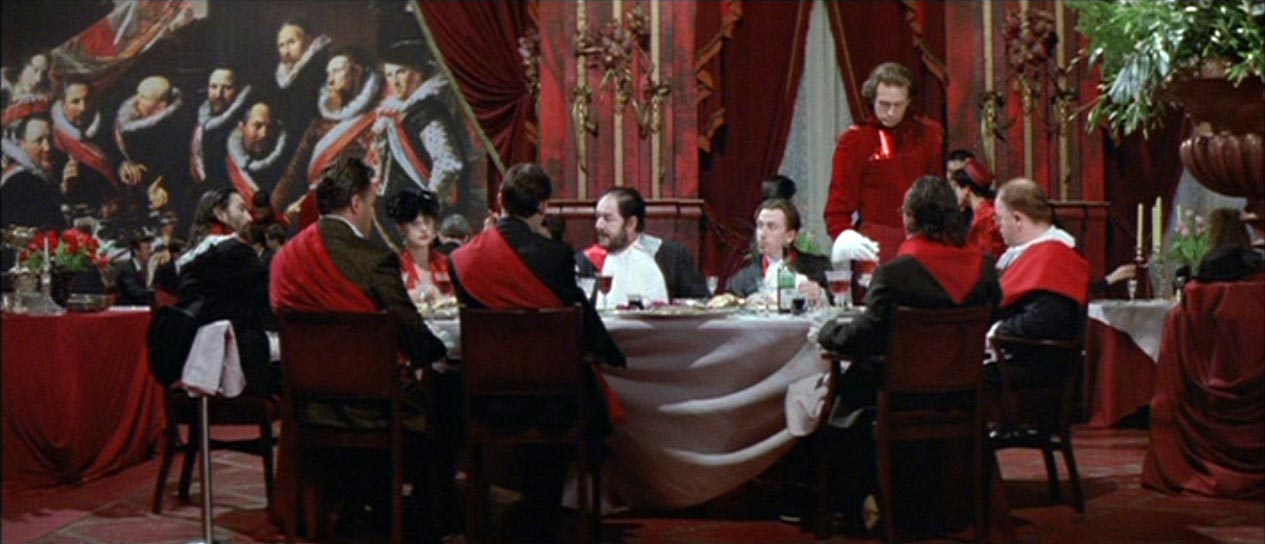
Or consider these two images from Greenaway’s The Cook, The Thief, The Wife, and Her Lover (1989):
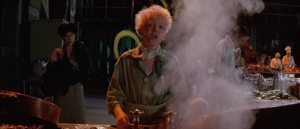
What makes tableau’s work in a cinema context is the fact that they are not cinematic in their qualities. There is something particularly “wrong” with them in the context that then draws our attention to their existence and therefore to our viewing.
And yet, though maybe not examples of the “cinematic,” what makes these images from Weekend and The Cook (et al) cinema is that, regardless of their tableau qualities, they exist in time and they have motion, and they are part of wholes that exist in time and have motion. Unlike the Jeff Wall images, these screengrabs are false images in a way, for the originals (and original intentions) are not of static moments, rather they move: the flames ascend, the steam rises, the camera pans and trucks.
And movement is the one thing photography lacks. But photography can suggest movement by capturing a thing in motion and presenting it as such. For example, this image:

Milk, (1984)
Here Wall has created a particularly enigmatic image of a man crouching on a sidewalk or path with milk shooting out of the bottle for some mysterious reason. At least one thing that makes this image interesting is the fact that the milk is in an impossible position. Liquid does not hang suspended in the air like that. Photography provides a unique ability to capture such images
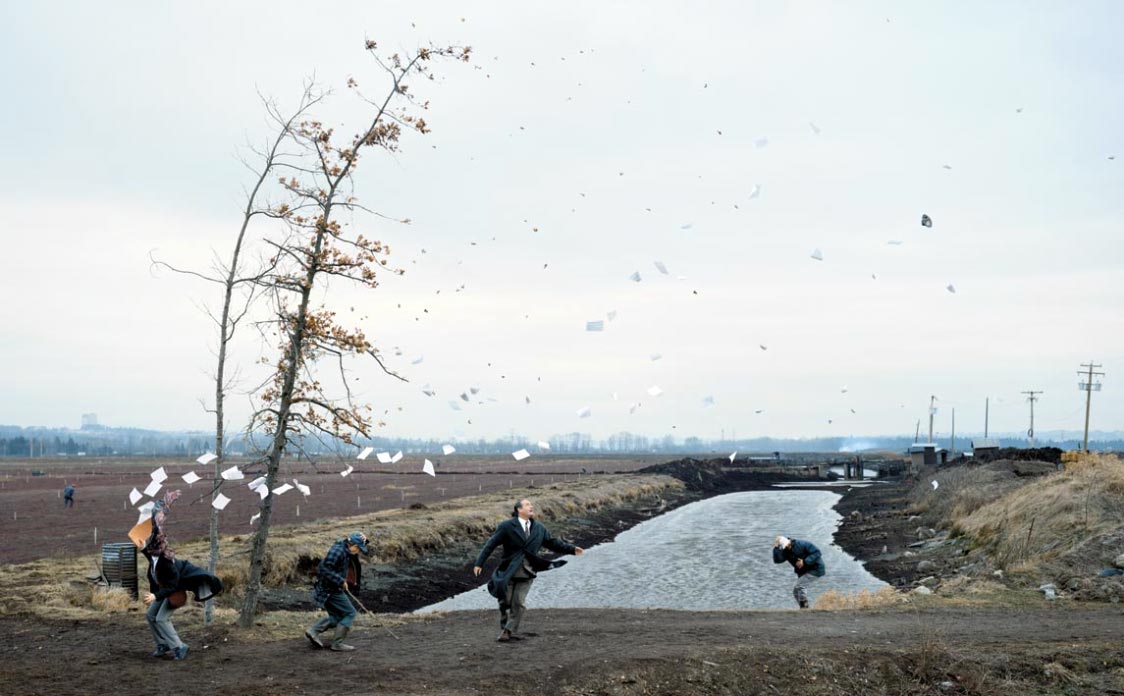
But Wall also works on a grander scale with imaging movement. Consider this image:
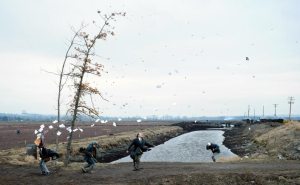
I would consider A Sudden Gust of Wind to look the most like a still from some film, maybe an Eastern European film. But of course this image is not the progeny of cinema. It is a re-imaging of a famous Japanese print:

This print is from Hokusai’s 36 Views of Mount Fuji. Hokusai lived from 1760 to 1849, before the invention of cinema.
So even when we get close to something that might be cinematic there are specific non-cinema connection that pull us back. What then is cinematic? What are its qualities?
I am going to say that cinematic is a feeling more than a set of specific characteristics. The reason being that cinema has so many characteristics that a mere listing, and then tagging, would be an almost endless task. But feelings come from somewhere, are grounded in something, and I believe to feel that a work of non-cinema is cinematic must be based in some sense of what makes a movie a movie and not something else.
Cinema’s greatest strength lies with its unique abilities to manipulate the image in time and space. But it is important to realize that there are so many connections with other arts and with the varieties of human expertise that strict demarcations are impossible. Regardless, the cinematic image is an image that moves and that exists in time. One could add montage to the list, but one can find montage in all the arts – even Eisenstein argued for that. There is great power in the combination of film images, but “[t]he dominant, all-powerful factor of the film image is rhythm, expressing the course of time within the frame.” – Tarkovsky, Sculpting in Time, p. 113.
But it is important to make a distinction. The time within the image is not the same as the time of the viewer even if they both tic off the same number of seconds. An artist creates a world and presents it to the viewer or reader. To receive the work is to enter into that world. With cinema one enters the image, as it were, and into the time of the story – into the world of the work. Cinema, unlike photography, can carry one along inside the image, inside the created world. The static photographic image, regardless of its qualities, can only go so far in this regard.
All arts create their worlds. What makes cinema cinematic is the ability to do so with greater power than other visual artforms, and in particular photography. Which brings us back to Jeff Wall.
There are aspects of Wall’s photographs that have kinship to cinema. But there is also a pushing back. The careful and obvious staginess, the frozen moment, the artificiality at times seem to undercut the cinematic label, even deny it. One may chaff at the mystery and long for more of a story, but Wall’s images, in that sense, are dead ends. Very quickly one realizes there really isn’t a story in the images because they are purely fabricated moments. They are not part of a rhythm. And thus, I see Wall’s works to be humorous in this regard: They draw one into an expectation of the cinematic but deliver something else. That something else is a mystery of Jeff Wall’s.
_____________________________________
*I have “screen grabbed” Jeff Wall’s images, except one, from the Jeff Wall Online Exhibition at the MoMA web site. Needless to say, the images here are not quite as good as they are on the MoMA site, and nothing compared to the real thing.

>another little video
>
Several weeks ago I posted about an experience my family had with a video production crew entering our house to shoot part of their video there. Well my wife was in the video, I was taking care of the baby, so I gave my seven year old daughter Lily our family video camera and said “go make a movie.” So Lily started shooting, using up all the rest of our available video tape, and basically enjoying herself. She is now obsessed with making movies.
So… I started going through what she had shot. Needless to say I will work with her on how to shoot for editing, amongst other things. But I still couldn’t help myself and I had to edit her shots together.

http://www.youtube.com/get_player
Like previous editing attempts on this computer, I’m using the free Windows Movie Maker program, stringing the shots together, and adding music*. I need to get us a better editing program as well as some better audio gear so we can get usable audio. I am also a little surprised at how much the quality of the video degrades during the uploading process, not that I’m starting with much quality in the first place. Maybe my file was too big and Blogger reduced the amount of information in order to take up less space on their servers. Of course, we’re just amateurs.
_________________________
*With some trepidation I am using a song from the Silversun Pickups. Trepidation not because of content, but because of copyright. I personally don’t have a big issue with grabbing some music from my iTunes collection and using it for a personal family video, but some might.
>rationing
>I have several posts backing up but I just started a new job – same company, new job – and have been swamped with training and doing. So things might be, and have been, a little slim around here – excluding me, of course. So I am rationing my time a bit more these days.
And speaking of rationing…
I have watched a bit of Ken Burns’ The War. Although it isn’t the final word on WWII, and not without its controversy, I find it quite powerful. Even though I hate war, and I find the current Iraq war to be wrong on so many levels, I still get choked up over stories of WWII, and especially ones like those on which Burns focuses, namely, the very human drama of suffering, loss, and true heroics born out of profound fear and deeply felt necessity.
I was also struck by a statement that Burns recently made in an interview with John Stewart that there is no such thing as a good war. That all war is bad, and that he hopes his film will provide some perspective. Certainly I can say my suffering is minuscule compared to those who struggle(d) to live through war. Any thoughts?
Here are some thoughts on the topic from Bill Moyers.
>improving a corner of town (hopefully)
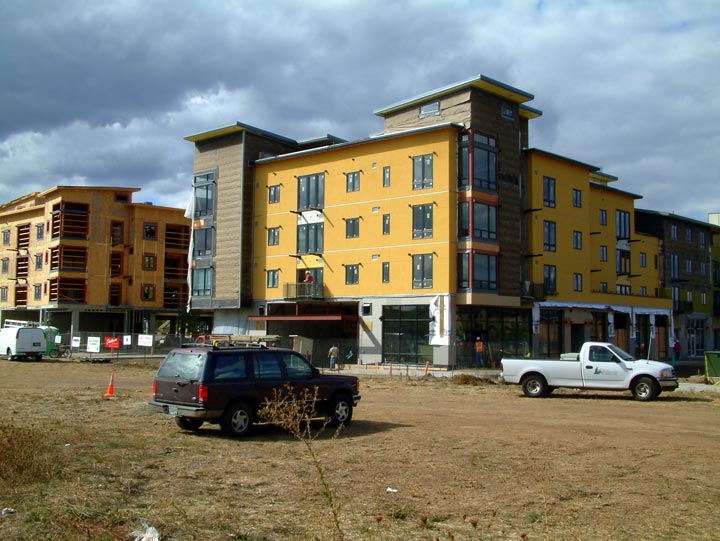
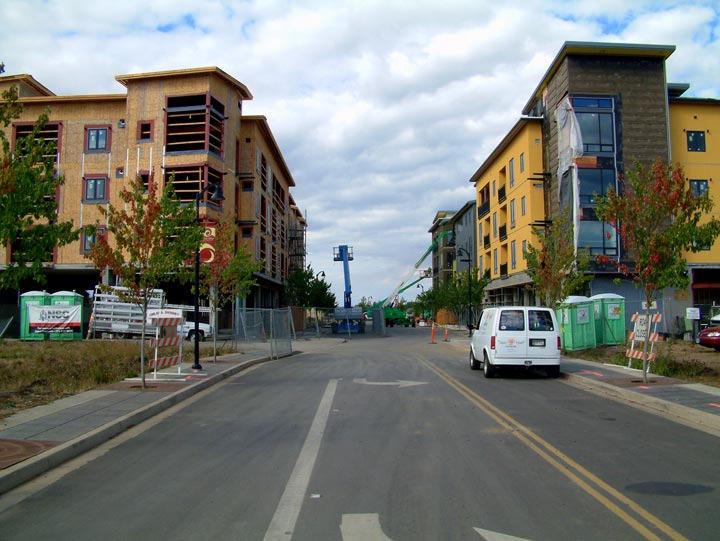
>In an old farmer’s field some new development has been raising buildings along a route I often take from work when I want to drop off my dry cleaning. Years ago this part of town was in the country. Now it is a growing area with a Costco nearby and new houses springing up. I find it amazing how building can completely transform a piece of land, and by how much I often like the transformation.
I am an advocate for more concentrated urban development and less sprawl, that is, development that brings together working and living spaces into near proximity while discouraging the growth of suburbia. But I also believe mere concentration is not enough. People need good design, which includes both well-thought functionality and beauty. So my eye has been caught by this new construction, which seems to border on sprawl, but is far more concentrated and aesthetically pleasing than most of its surroundings.
I felt not a little conspicuous walking around the construction site snapping a few pictures, so I only took a handful and left quickly. But I think these will provide enough of an idea and to what is going on.
On the one hand there is nothing very special about these buildings. Exciting and daring design doesn’t happen around these parts very often, and this is not particularly exciting and daring. But there is something about the design that has a post-modern-lite feeling, which is basically a simple modernism with post-modern trim (although I make no claims to really know what I am talking about). Regardless, this is a good thing. Most of the construction nearby is either concrete-tilt-up boxes (Costco, etc.) or 1960s suburbia houses.
The buildings are also multi-use: stores below, offices and apartments above. Plus, by creating nearly identical structures on both sides of the street, they approximate a classic-style “strolling” street with a slight European flare. I wish the street was narrower. That would make it a little more human in scale, rather than scaled for autos. But if they did that it would be downright un-American.
As part of the overall development, there is a row of new houses going up as well.
If you want one, they start at $475k. Which means you won’t see me lining up just yet.
My hope, as it is with all new construction around these parts, is that it elevate the prevailing assumptions about how people can live and work. We’ll see. My curiosity is piqued. Now they just have to make it more affordable.
>just another sunday (not)
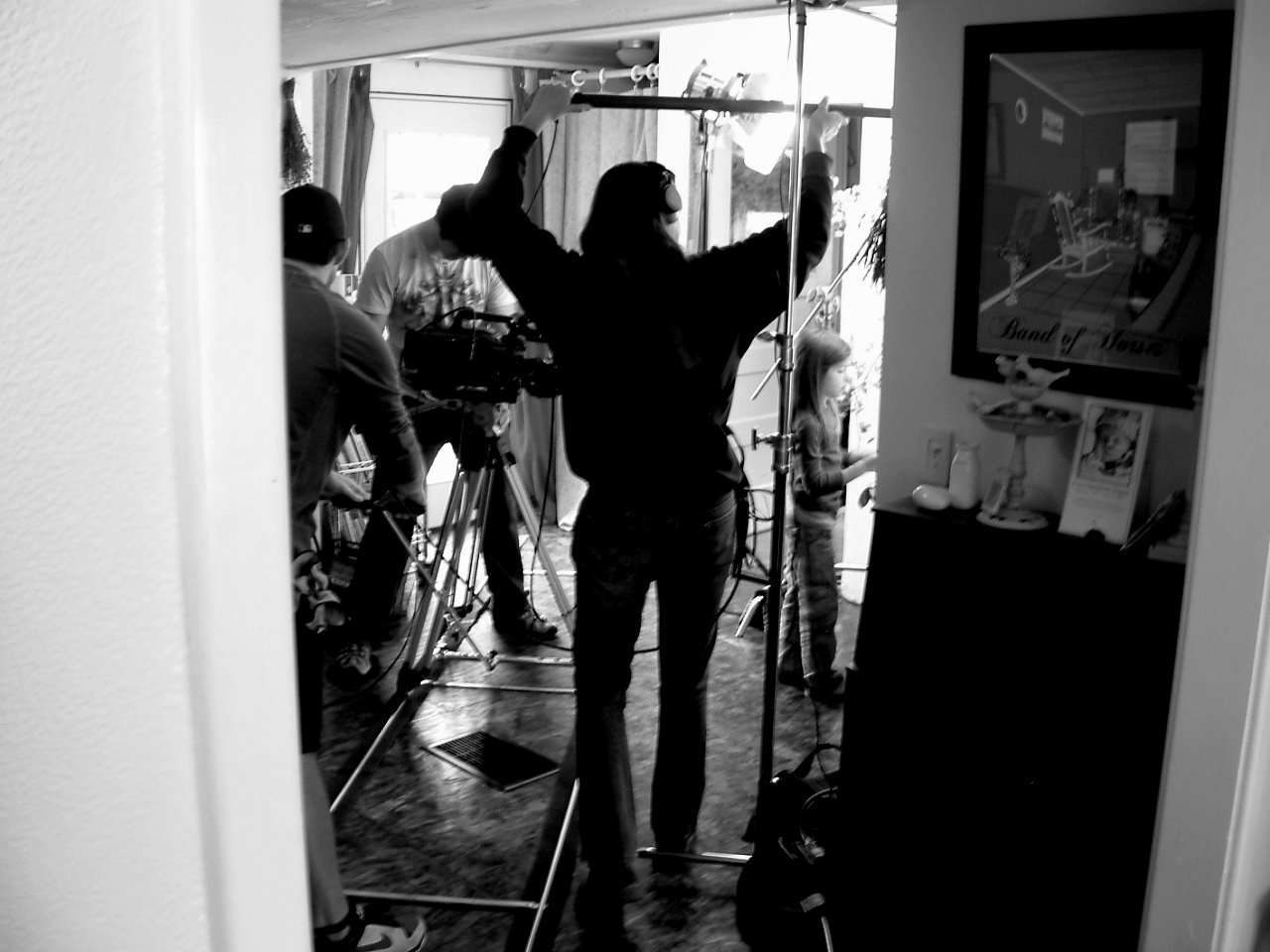
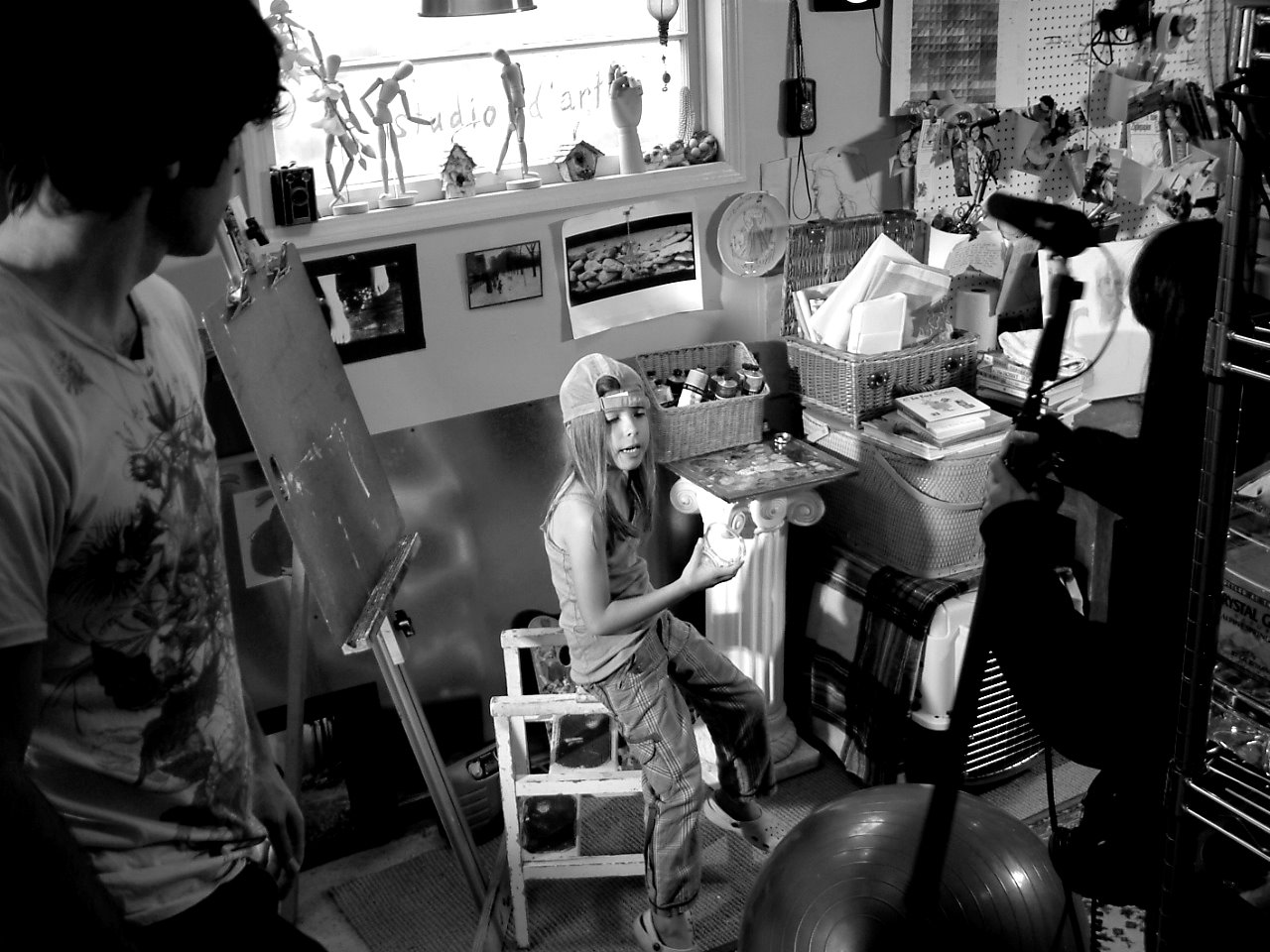
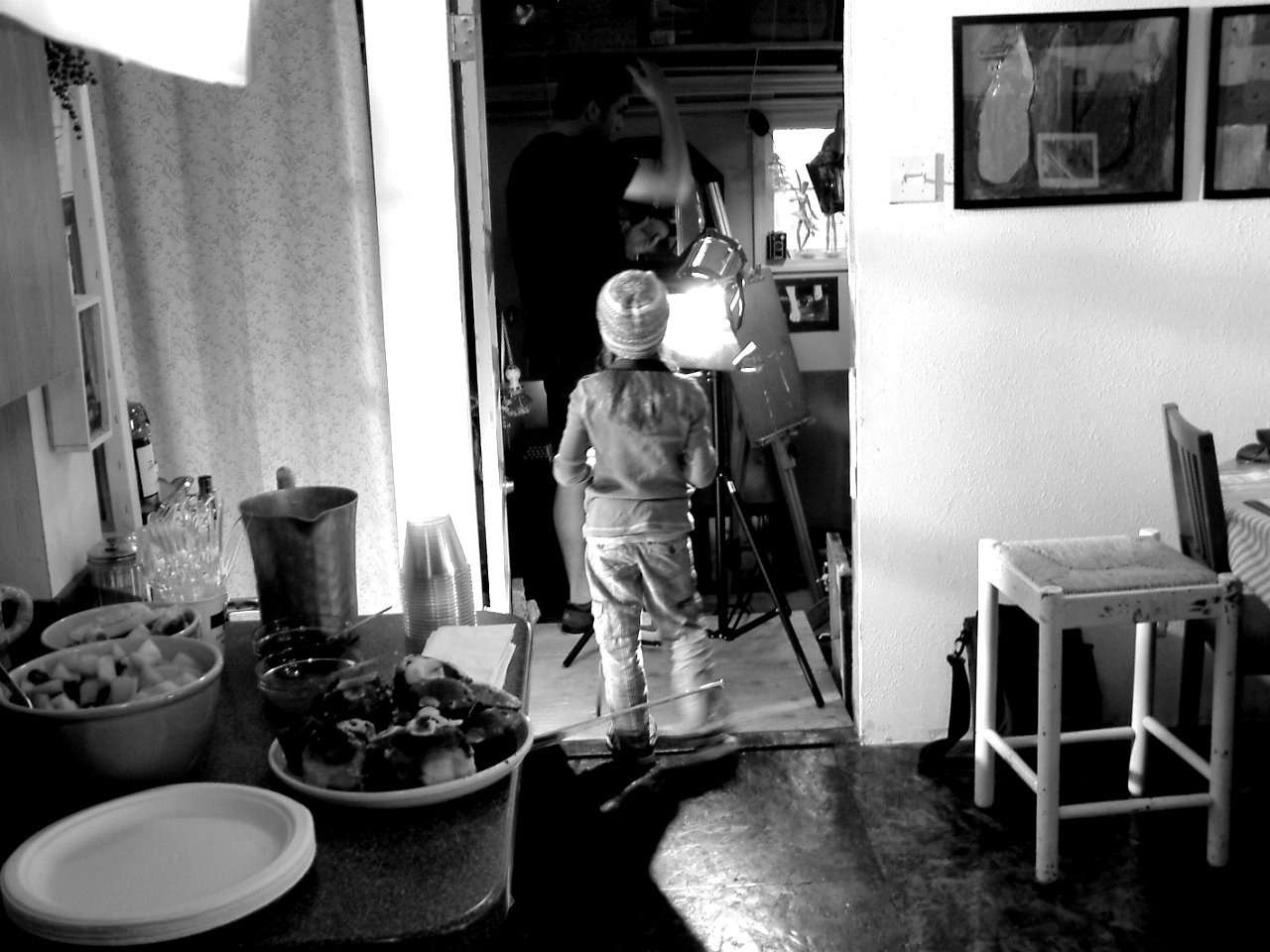
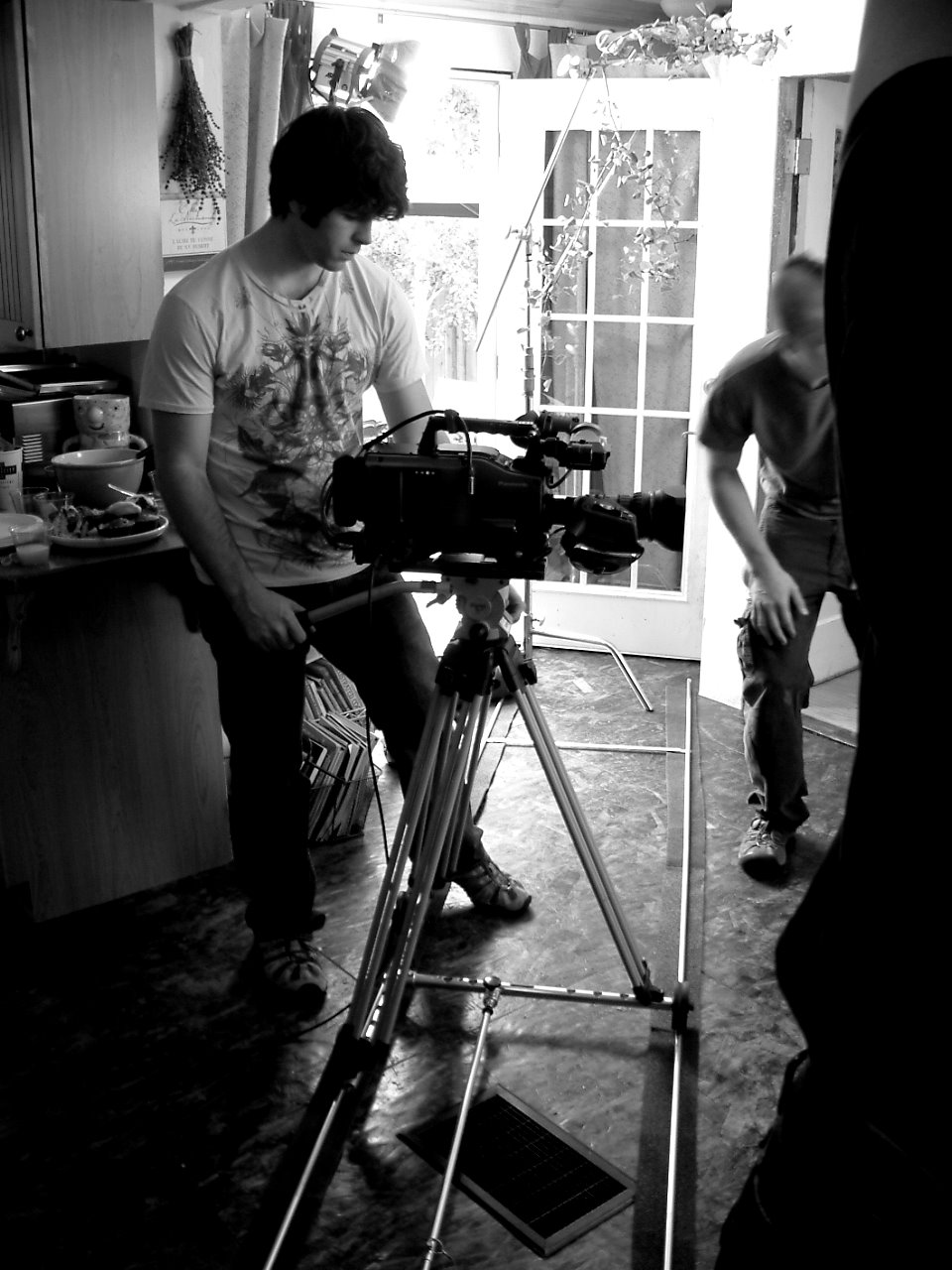
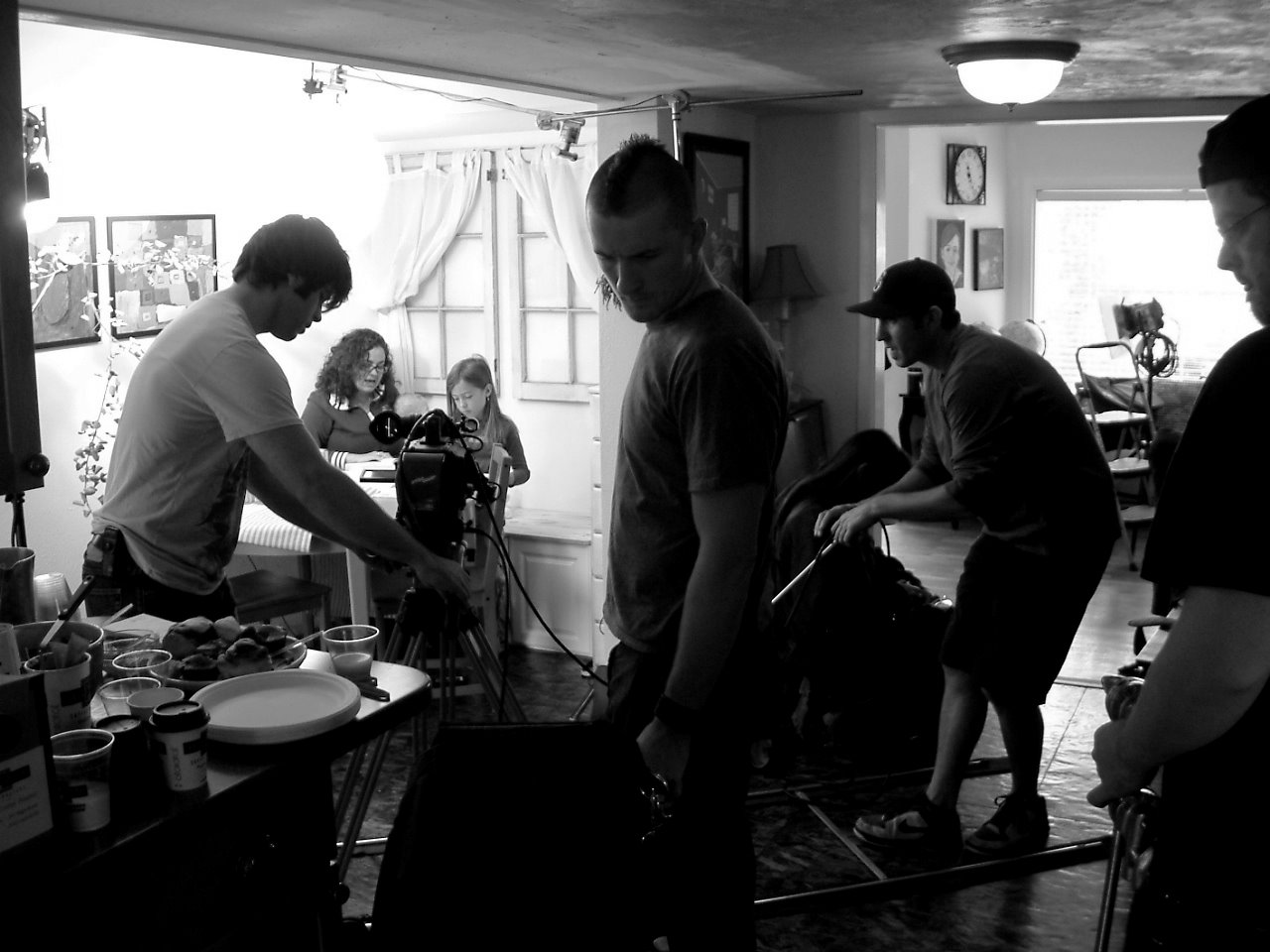
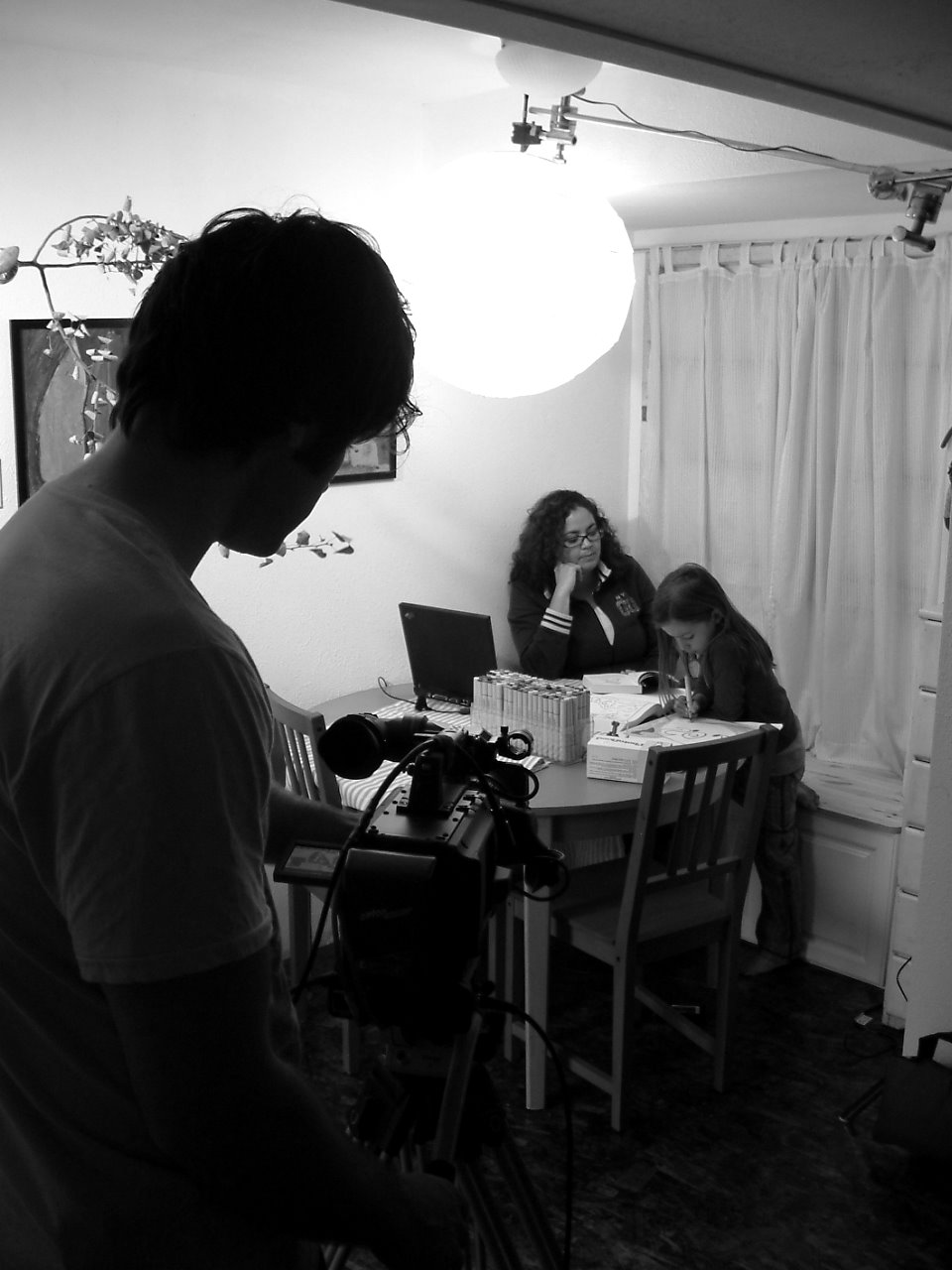
>This morning we participated in a video project for a friend’s video production company. The crew came into our house at around 7:30 AM and left at around Noon. The product will be a training video for a marketing company. My wife was the main participant from our end. I watched the baby, and then had a small role. My daughter Lily was in some of it as well and video taped a bunch with our camera. She and I will edit her video in the near future. The crew then went on to a couple of other locations and will be in post-production the rest of the week.
Below are a few stills I took (baby in left hand, camera in right) during the shoot.


Although such activities lend a certain amount of craziness to our lives, it was also fun, a good excuse to clean the house, and a learning experience for all of us – especially for Lily. I also found it interesting to watch the crew do their work since I used to do video/film production years ago. Not much has changed except for some of the technology. I found myself longing to do production once again, particularly directing. Hmmm… now that’s a nice idea.
convictions and confessions
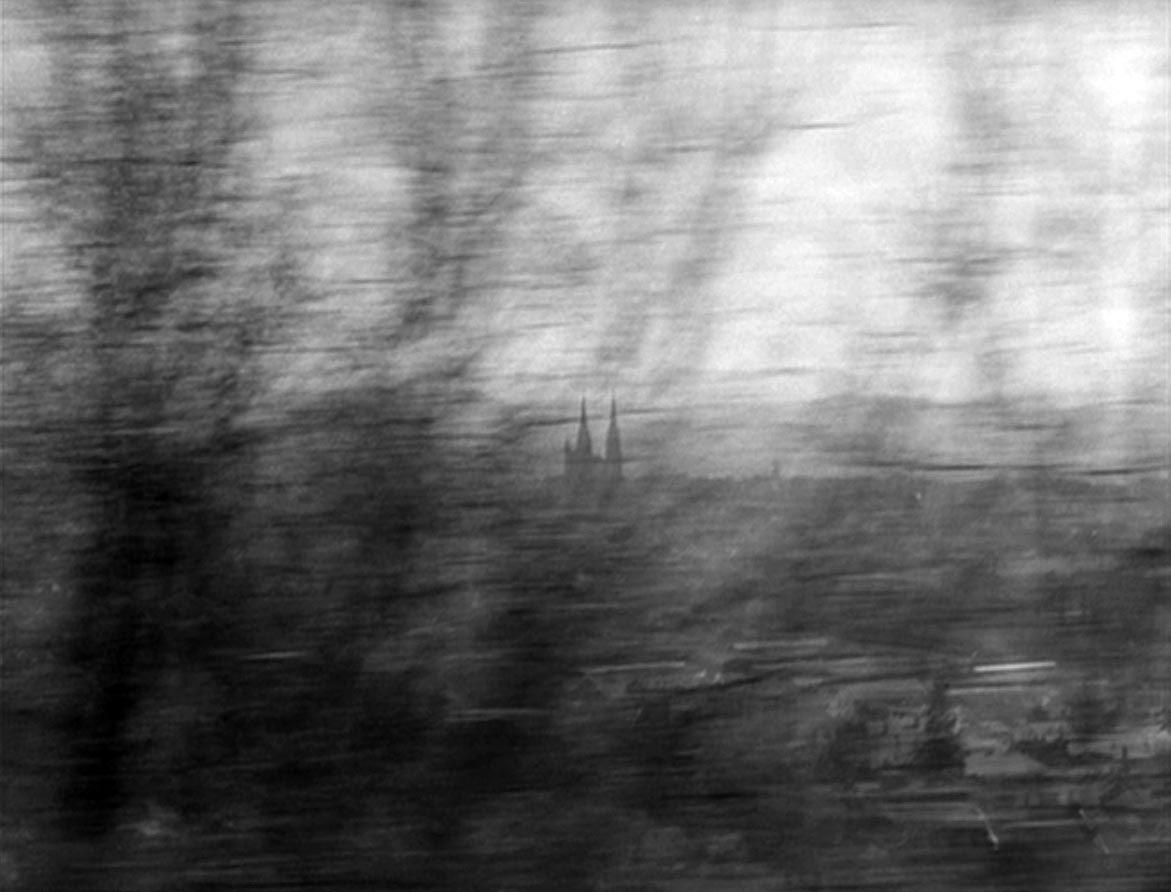
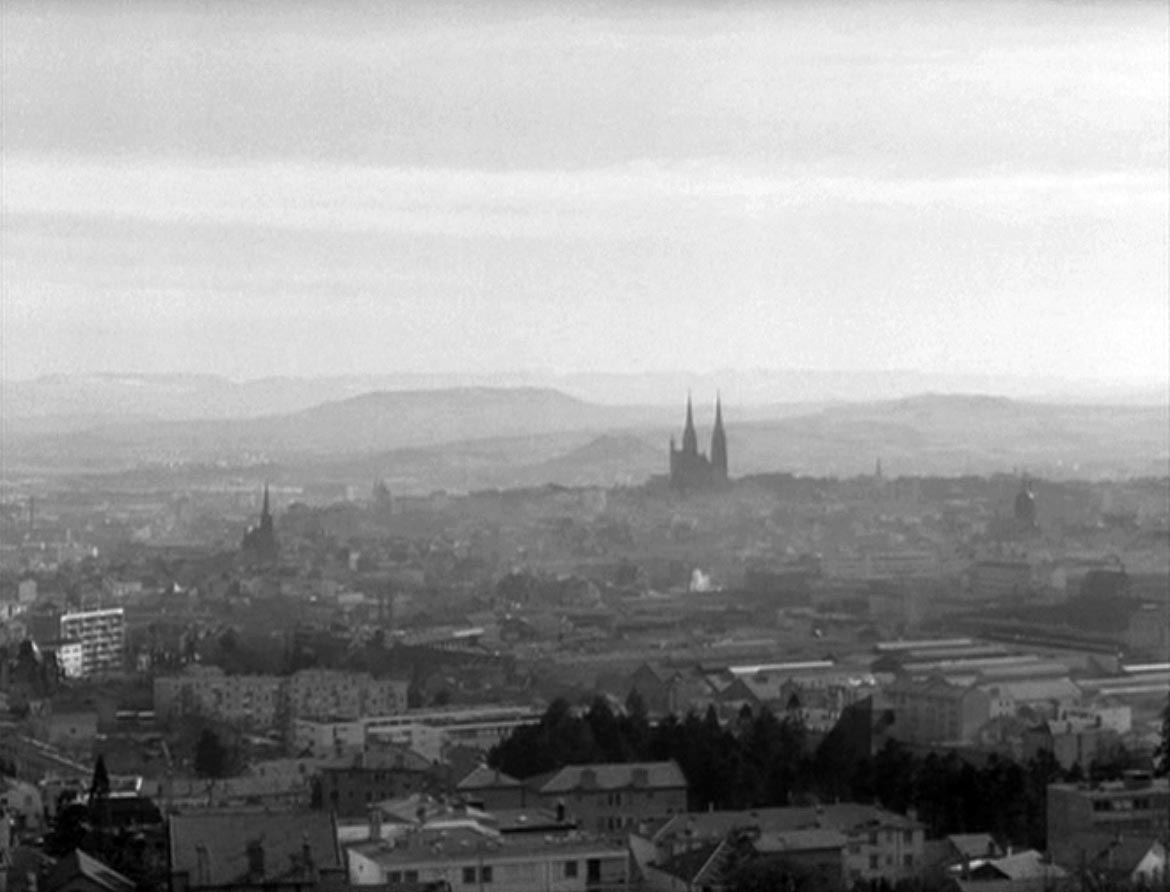
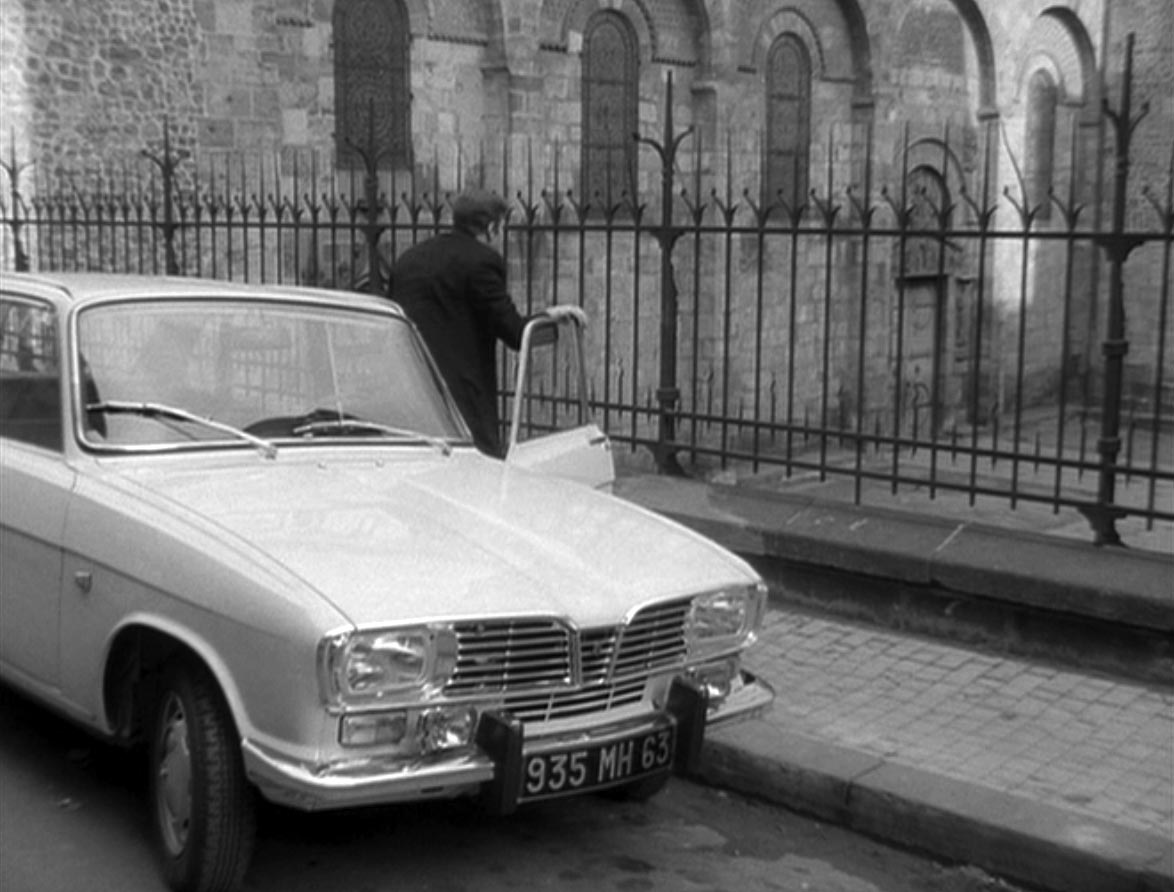
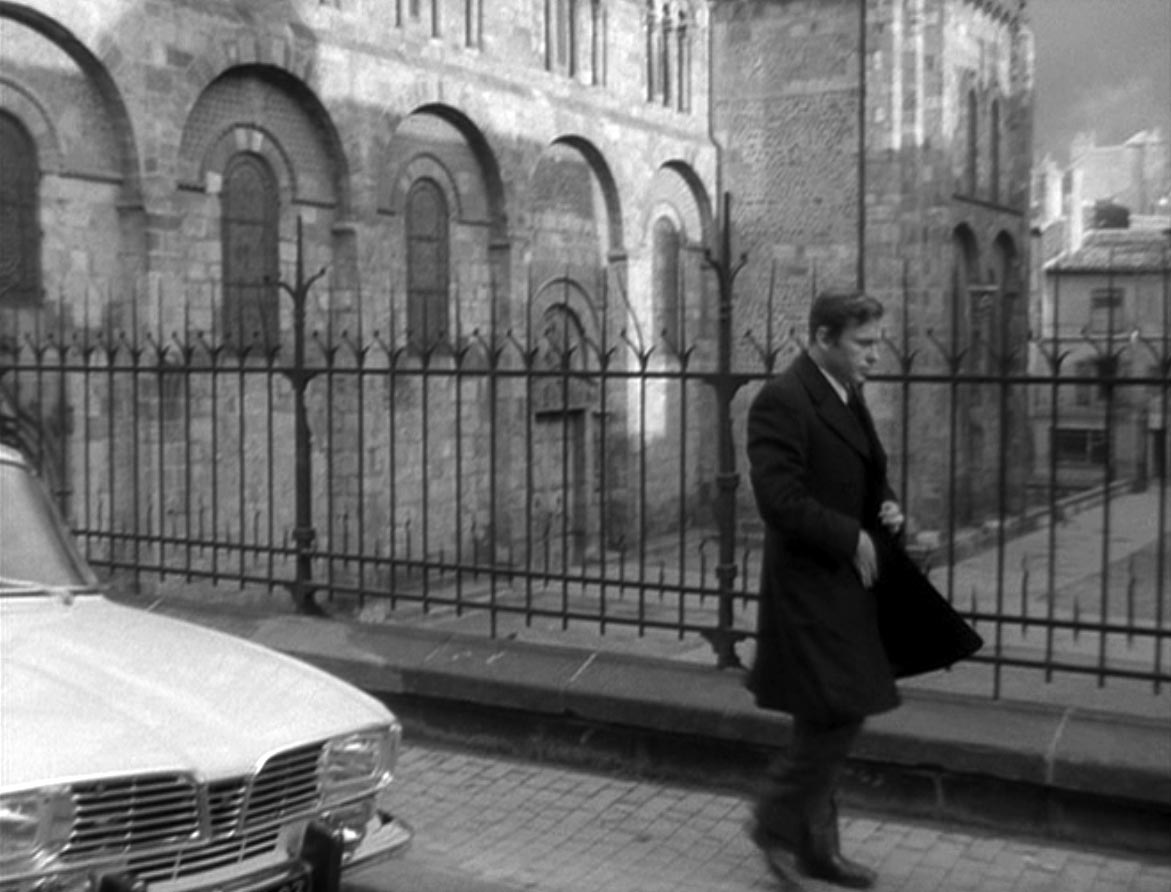
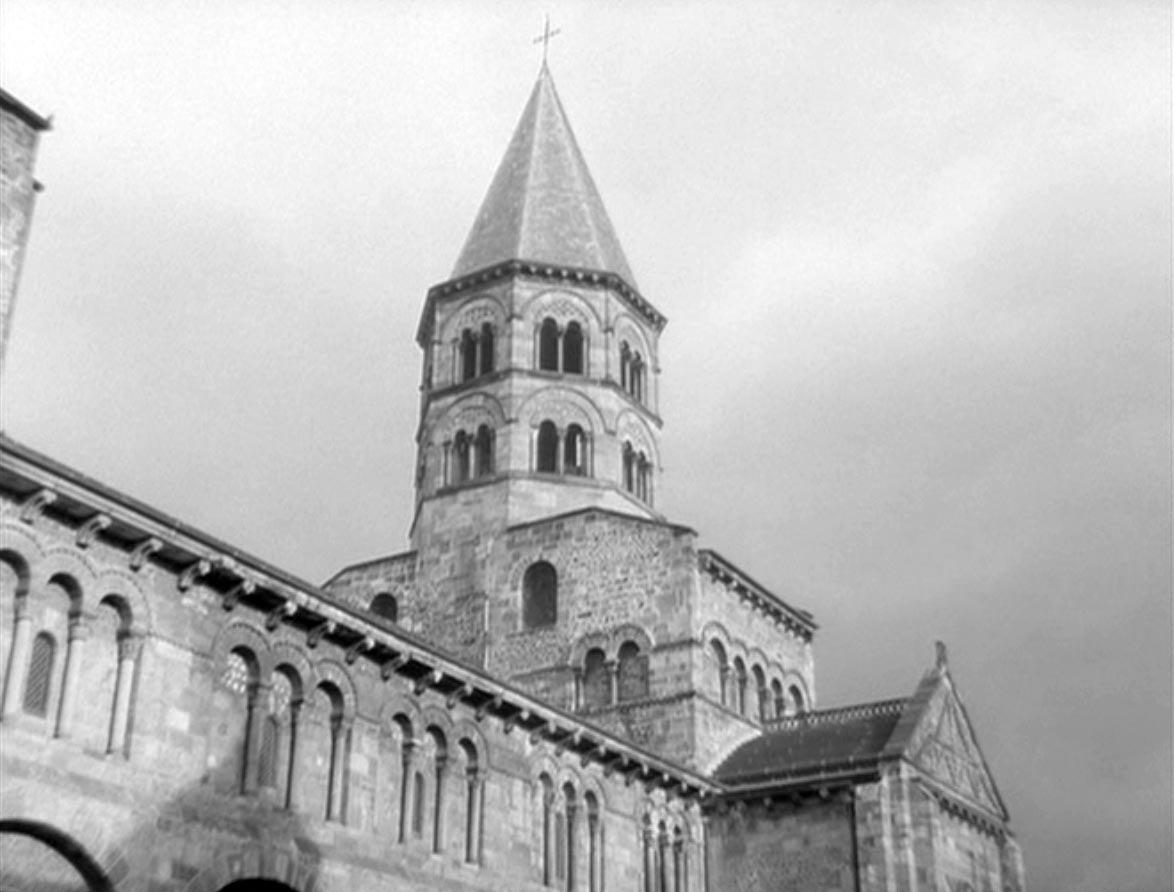
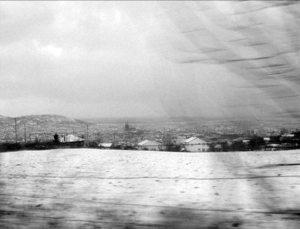
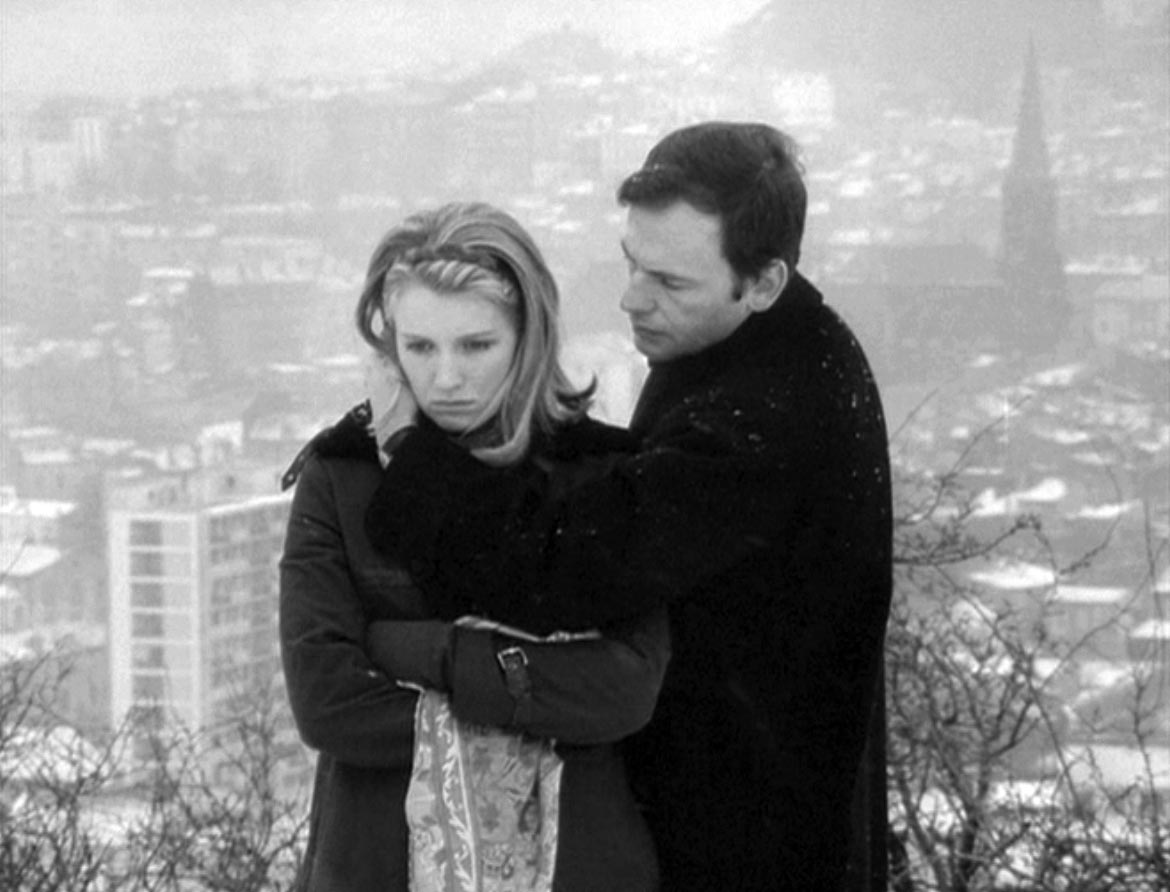
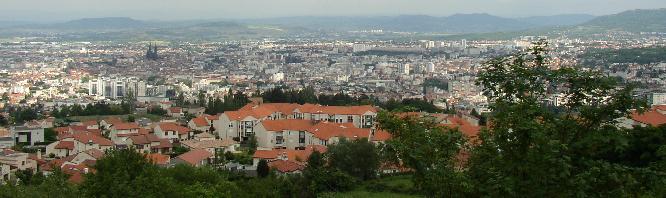
Near the beginning of Ma nuit chez Maud (1969, dir. Eric Rohmer) our hero Jean-Louis (Jean-Louis Trintignant) drives into the city of Clermont. On the way we are shown images out the car window. At one point we see the spires of the church, known as the Cathédrale Notre-Dame-de-l’Assomption de Clermont-Ferrand, a.k.a. Clermont-Ferrand Cathedral, a.k.a. the black cathedral because it is made of black volcanic stone.
The Brangwens had lived for generations on the Marsh Farm, in the meadows where the Erewash twisted sluggishly through alder trees, separating Derbyshire from Nottinghamshire. Two miles away, a church-tower stood on a hill, the houses of the little country town climbing assiduously up to it. Whenever one of the Brangwens in the fields lifted his head from his work, he saw the church-tower at Ilkeston in the empty sky. So that as he turned again to the horizontal land, he was aware of something standing above him and beyond him in the distance.D.H. Lawrence, The Rainbow, 1915

That is why Rohmer’s films can be so transfixing even though so little appears to be happening. Rohmer is a lover of people. Human nature, and especially the human heart, is Rohmer’s subject, and he find his subject infinitely fascinating. And isn’t it?! Some films claim a level of excitement for all their action, clear goals, and simplistic characters defeating their enemies. But there is no subject as fascinating as the human being.
Finally, Jean-Louis, and the woman of his desire, Françoise (Marie-Christine Barrault), salvage their tenuous relationship in full view of the church spire by confessing their sins to each other.
>a little volunteer, a lot of golf
>
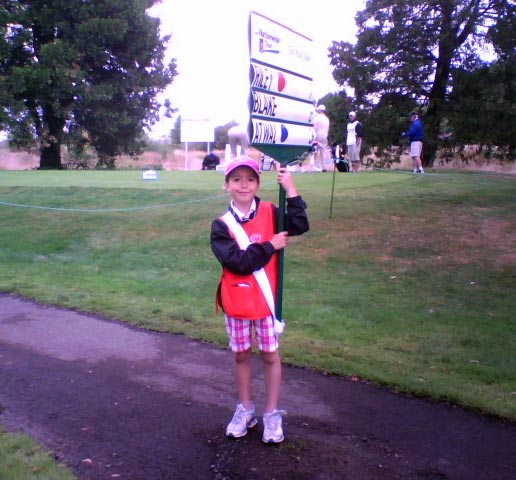
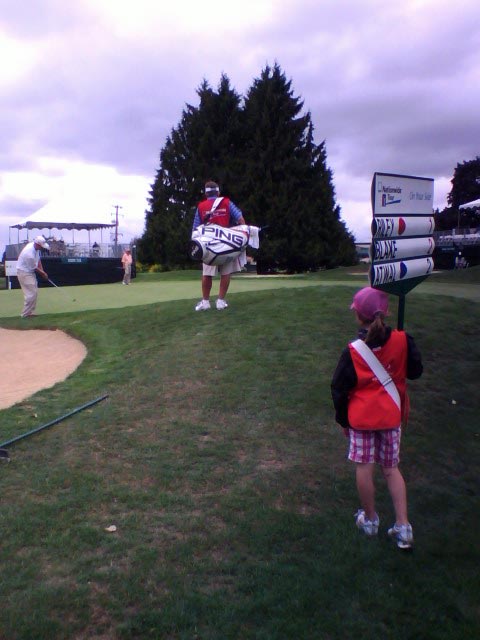
Today was the first day of The Oregon Classic golf tournament. My daughter, Lily, is a member of The First Tee, and the kids were asked if they wanted to be volunteers at the tournament. She held the sign that displayed the player’s scores. We were with Arjun Atwal, Chris Riley, and Jay Don Blake.
Here’s Lily watching Chris Riley chip onto the green.
The day was much colder and the sign much heavier than we expected. Needless to say, Lily got a little exhausted from the experience. But we had a great time anyway. It is amazing to watch these pro golfers up close. It is also fun to be able to walk inside the ropes with the players (or, not exactly with them, but somewhat near them and not in their way). Golf is an amazing and humbling sport.
>summer day
down below the canopy
queuing like 405 traffic
silver backs undulate
bank to bank
others
buoyed by
desperate instincts
thrash and wheel
in heavy currents
picture book glory
ephemeral beauty
more eternal
with each frantic arc
and we breathed it deep
we came from above
through tall grasses
along the Russian’s
tumbling beauty
and now
standing in soft gravel
gripping poles
like sacred staffs
we enter in
-1998