>This amazing little video shows how consistently “on message” political candidates can be.
Category: Politics
>voting the lesser of two evils?
>
the politicians all make speeches
while the news men all take notes
and they exaggerate the issues
as they shove them down our throats
is it really up to them
whether this country sinks or floats
well I wonder who would lead us
if none of us would vote~ Larry Norman, from The Great American Novel
I’ve heard it said about every presidential election I can remember.
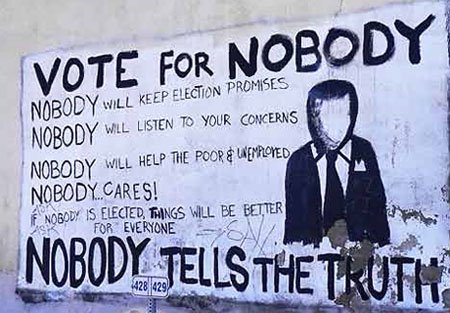
Along with saying they might not vote at all, I have heard a number of people refer to voting the lesser of two evils in this upcoming election. This seems to be said mostly in reference to voting for Barack Obama. I tend to agree, but not because I think Obama merely represents a lesser evil*, but because voting is largely about voting for which elite do I want to be in power. I want to pick the elite that will do the most good over time for the country – even though I don’t really want to pick any elite.
I don’t like the idea of this thing we call democracy being about elites ruling the masses. It doesn’t sound right. But it’s what we got. It was built into our system by the “founding fathers.” That may be why so many people feel disconnected from being able to affect much change – it’s because we are. But not entirely. Voting does matter, and voting for the lesser of two evils does matter. In fact, it’s a good thing.
For a little perspective here’s Noam Chomsky talking about choosing the lesser of two evils, and why this is the system we have:
http://therealnews.com/permalinkedembed/mediaplayer.swf
This clip is from The Real News Network
So, if I can help it (read: do my homework and make an informed choice), I will try to NOT vote for the greater of two evils. I am disinclined to vote outside the two most prominent choices because to do so is to inadvertently support whoever wins, and that could be the greater of the two evils. And yet I believe one should vote one’s conscience, so I consider all candidates as my potential choice.
* I want to be clear. This is not about which person is the lesser of two evils. I don’t think Obama or McCain are personally more or less evil than anyone else. What we have is a system of slight, but ultimately significant differences. Which faction of of the “business party” is in power is important – over time.
>Walter Wink on Nonviolence for the Violent
>I knew next to nothing about Walter Wink until recently. Now I have become a fan.
>What some voters believe (and the Penguin)
>I love elections, and I can’t stand them. Elections bring out the best and worst in us. They also stir the pot, which often brings to the surface what isn’t that far below.
I know there are people who don’t believe Obama’s confession of faith is genuine and that McCain’s is. Personally I have the opposite perspective. This does not mean I agree with everything Obama says or promotes, but then I have many disagreements with lots of people who call themselves Christians. C’est la vie. What I am surprised by, however, is the obviously outrageous beliefs about Obama that people hold in all sincerity. I guess that’s just life too. Regardless, I was struck by this news clip:
Elections teach us a lot about ourselves and our neighbors.
And then there’s the debates, which I enjoy. I doubt the debates really have much affect on which way people vote. Of course, what we have seen in the recent debates (and campaign speeches) is not unprecedented. I wonder which team has taken its cues from the Penguin:
Beautiful.
>voting my conscience
>
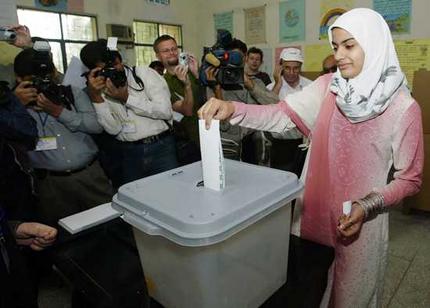
Democratic elections in Afghanistan reminds me of
how precious and hard won is the right to vote.
Like you I’ve been curious about the upcoming presidential vote. I think Obama is going to win. It’s not a forgone conclusion, but it’s heading in that direction, which is fine by me, all things considered. There are many things that will not change if Obama gets into the oval office, and there are some that will. I hope many things with our foreign policy changes. I hope we focus more on helping the poor and downtrodden rather than the rich. I hope we restore basic human rights, like the right to habeas corpus. We’ll see.
For too many, though, it still comes down to uncritical perceptions and single issues.
I have noticed that many conservative Christians – those who supported G.W. Bush because he is a “strong Christian man” – are now finding no clear choice in this election. They don’t really like McCain, but they feel they can’t vote for Obama. I have heard a few say they are not going to vote at all, which is good for Obama and bad for the democratic process. One of the biggest reasons conservative Christians would cast a vote for McCain is because of his supposedly “pro-life” stance. I think McCain is lying, but that’s beside the point. Christians are just as Pavlovian as everyone else. If a candidate says he’s pro-life he will automatically get votes from many who are single issue voters or those who think abortion is a hugely critical issue and they can’t find any other issues in this election to care about.* It allows people to vote their conscience, which is something we all should do, but just how informed are we? If one is pro-life (which I am) and one wants to vote her or his conscience, where should one cast their vote?
I can only answer for myself. I believe Obama is more consistently pro-life than McCain. That may sound strange to say, but there are good reasons. McCain, apart from merely using a new-found pro-life stance to get votes, has a decidedly less pro-life stance when it comes to a holistic evaluation of his platform. Obama, on the other hand, has done more, and is for more, in terms of changing and dealing with the multiplicity of issues that make unwanted pregnancies a sad fact in this country. Obama is also someone who, much more than McCain (whose enthusiasms tends toward ‘us’ and ‘them’ scenarios), seeks to affirm the value of the whole person and a world of hope. Hope, as I see it, can be a kind of antidote to unwanted pregnancies as much as addressing poverty. That doesn’t solve the problem of abortion, but it seems clear to me that no final or complete solution is coming from this election.
Maybe it’s ironic, but Christians may find a more Christ-like platform with Obama than McCain.** I am becoming more convinced that’s true. I also am not a “single issue” person. If it were even possible for me to speak for God, I would say God is not “single issue” either.
Of course I certainly do not speak as an expert, just an ordinary citizen schmuck like you. I am trying to get myself informed. You may disagree with me on this or other issues. If you do then vote your conscience, but try, as I will, to get the whole picture. That’s the least we can do, really.If you have the time and inclination, read these two articles by pro-life voters who are both voting for Obama precisely because they’re pro-lifers:
I’m Catholic, staunchly anti-abortion, and support Obama Why I’m Pro-life and Pro-ObamaIn conclusion, I have to say that image at the beginning of this post of the first democratic elections in Afghanistan challenges me of how much we take voting for granted. I know that being a good citizen is more than only voting every four years, but I am also reminded of just how precious is a cast vote. If you don’t like the two candidates that are getting all the headlines, then vote for someone else. There are a lot to chose from.
* I must say that abortion is a very serious issue for many reasons. One can easily trot out a laundry list of reasons that show abortion for what it is – evil. But one can also do the same for war, especially preemptive wars that kills hundreds of thousands of innocent lives (including many thousands of children) for the sake of “peace” and oil. One can also make laundry lists for poverty, greed, lying, capital punishment, denying basic rights, spying, and the ruthless craving of power. There are so many important issues to care about. Regardless, abortion is undoubtedly an important issue.
* * I want to be clear that I do not see Obama, or any politician as a “savior.” Salvation, on almost any level, is not coming with this election. We still, however, should do everything we can to move in the right direction. For me that includes moving towards ending wars, ending poverty, and helping those at the bottom of society, including the disenfranchised and socially outcast. It also includes trying to love my neighbor as myself in the most tangible and meaningful ways that I can. I think we find greater hints at that kind of thinking in Obama’s platform than we do in either McCain’s or Bush’s.
>Christ for President (so say the troubadours)
>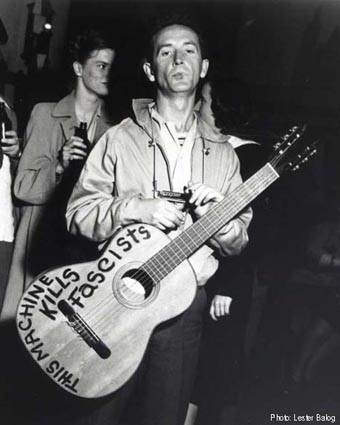
Woody Guthrie being himself
Now that we’ve barely survived two major party national conventions, heard more than enough speeches to gag, soaked up heaps of blather, waded through veritable swamps of pontification, are reeling from more Wall Street and White House crap, and are wondering who really has got the answers and/or the wherewithal to affect change, I seem to remember a song with lyrics by Woody Guthrie and music/performance by Wilco.
Let’s have Christ our President
Let us have him for our king
Cast your vote for the Carpenter
That they call the Nazarene
The only way
We could ever beat
These crooked politician men
Is to cast the moneychangers
Out of the temple
Put the Carpenter in
Oh it’s Jesus Christ our President
God above our king
With a job and pension for young and old
We will make hallelujah ring
Every year we waste enough
To feed the ones who starve
We build our civilization up
And we shoot it down with wars
But with the Carpenter
On the seat
Way up in the capitol town
The USA
Be on the way
Prosperity bound
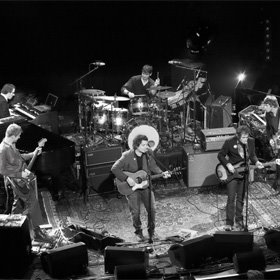
Wilco somewhere
A different time, a different era, but all the same.
>just another week in pepper spray history
>I’m getting a kick out of watching the “other” news of the RNC, that is, the protests outside the convention that are not really being covered much by the mainstream news. But first, here’s a recruitment video made by the RNC Welcoming Committee (an anarchist/anti-authoritarian organizing body) prior to the convention:
http://video.google.com/googleplayer.swf?docid=1982101605603600567&hl=en&fs=true
I love it. Fun, goofy, and it indicates a major aspect of the protests, that is, they’re thrilling to do. In other words, being a protester, though driven by apparently deeper meanings, is also something people do because it’s an exciting form of entertainment – like playing sports, but more important. I have to say that after watching the following videos I would much rather be with the protesters than inside the convention, though I am not so anarchist in my philosophy, or so anti-authoritarian in my reactions – though I am a little of both.
This video also highlights the reality that contemporary political/social movements are leveraging new media forms with aplomb. Modern protests are far more organized and prepared than they used to be, but so is the response.
[Side Note: So far eight members of the RNC Welcoming Committee have been arrested and charged as terrorists. Plus the I-Witness Video Collective has been evicted from their offices after police raided their building on what look to be trumped up charges. That group was responsible for videotaping much of the 2004 RNC protests and those videos led to most of the cases against the arrested protesters to be dropped. Apparently case after case the videos showed the police officers had lied. That may be why the police don’t want cameras taping them this time around.]
Now that it’s been a couple of days since the initial protests outside the RNC a number of videos have been appearing online. The first three below are video/photo collages that offer some overview of what is going on. There is some overlapping content between the three videos. At a minimum these collages offer some interesting psychological and sociological data to consider.
Finally, here is one of the most interesting, entertaining, and low quality (read verité) videos from the protests. I love the personal commentary.
Of course, one has to ask if any of these protests, violent or peaceful, have any objective value beyond the personal sense of making a statement. It is important to make statements, to carry signs and rant, to march and, hopefully, get on the news, but what is actually accomplished? The RNC continued on as though no one is protesting, as though the protests are so insignificant and inconsequential as to not even warrant a sideways glance. I also believe some of the same protests were deserved at the DNC, but I don’t remember if there were any.
I am reminded of two quotes by Mahatma Gandhi:
“It is better to be violent, if there is violence in our hearts, than to put on the cloak of nonviolence to cover impotence.”
“Victory attained by violence is tantamount to a defeat, for it is momentary.”
These quotes underline the balancing acts in both effective protesting and in cracking down on protesters. Both sides have to live with the consequences of their actions, and ask the question “what really was accomplished.” I cannot help but think the actions and the style of the police will only lay the foundation for more of the same, and then bigger and more substantial protests. In the end the police, and those who back them, will likely lose the battle. In the mean time I fear many citizens will be hurt.
>Profile: Noam Chomsky
>I have mentioned Noam Chomsky before on this site. Here’s a profile of the man:
http://video.google.com/googleplayer.swf?docid=676452061991429040&hl=en&fs=true
There is no need to say that Chomsky is a controversial figure in the world of ideas. One thing for sure, his ongoing critique of power is as relevant today as it was when he began; all the more so this heightened political season. I want change, and will vote for change in one way or another, but I am also interested in knowing exactly what it is I will be voting for: What kind of power, who will have it, how will it be used, and to what ends? These are questions I think about all the time.
>those troubling red letters
>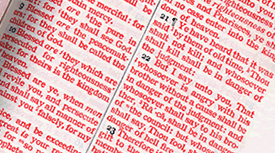 There is an interesting religious movement going on in the U.S. today. Maybe “religious” is too strong of a word. Better might be “not-so-religious” movement. Some are calling it Red-Letter Christianity. Simply, it is a reaction to the hijacking of Christianity by right-wing politics and culture. More complex and profound is its focus on the teachings of Jesus as its foundation, which may sound like a strange differentiation among groups calling themselves Christian. This movement stands in sharp contrast to the often less-than-Biblical Christianity of many high-profile Christian leaders today.* Many non-Christians like to point the finger at Christianity and call out how bad it is. My gut response is to say, “you don’t even know the half of it.” I say this as a committed Christian who desperately seeks to follow Jesus in who I am and all that I do.
The focus on “red letters” comes from the fact that in many older bibles the words of Jesus are printed in red ink. Those who are part of this movement are calling themselves Red-Letter Christians.**
We live in a post-Christian world, sociologically and culturally speaking. In recent years (read decades) Christianity has been tagged as anything from intolerant to irrelevant. Many feel that Christians are merely self-righteous demagogues who say they love others as they condemn them. Unfortunately, this is often the case (but it is not always the case, as the Red-Letter Christians are trying to emphasize). The following video, rather pointedly, gets at part of the problem, at least, that Red-Letter Christians are confronting:
One of the problems, of course, is the problematic “need” to be morally superior in place of the more difficult task of truly loving others as oneself. This is a human condition, a result of what we are at our core. So it is part of my condition. Jesus’ harshest words were for the self-righteous religious leaders of his day. Lest we forget, these were the properly behaved and “family values” people of his day. Jesus’ softest words were for those whom the religious leaders condemned. If Jesus is our example then we should try and act as he acted. Somehow many Christian leaders, who have studied those same red letters, do not see the irony staring back at them.
But there is another problem with mainstream evangelical Christianity in America, that is its slavish and embedded relationship to American right-wing politics. Religion and politics have always gone together in this country, but the past twenty years have seen a radical increase in the way evangelical Christianity and the political right have forged a power-focussed agenda. This very interesting report below takes a look at that relationship and some alternatives that are bulbing around the fringes of mainstream Christianity:
In that video there was mention of Shane Claiborne. His book The Irresistible Revolution: Living as an Ordinary Radical is a very interesting and challenging read, especially if you’ve grown up in a conservative Christian environment. I enjoyed it very much and it has contributed to my current views.
 So then, what is Red Letter Christinaity? Here and here (in an interview from 2004) Tony Campolo, sociologist and Christian apologist, explains what Red-Letter Christianity is all about.
Why does this interest me? I have a long history with Christianity. I have wrestled with its truths and its sub-cultures. More than ever I believe in those truths, and more than ever I have issues with its sub-cultures. Red-letter Christianity is not the complete answer (I am wary of any “brand” of Christianity that includes an additional label), but it does call attention to the way Christianity has always tended to deviate from its core truths.
Humans want to be God and call the shots, but Christians know they can’t be God, so they tend to invent a version of God they can believe in, say He’s on their side, say He wants them to establish His kingdom, and say that kingdom looks like an American BBQ with nice people wearing flag pins and hating liberals. (I joke, but it really is worse than that.) But I also find in myself a tendency to excuse a life of selfishness and pragmatic expediency by pushing forward a kind of self-righteousness. In other words, I don’t follow the teachings of Jesus very well and I’m rather good at pointing out how others are failing. Yet, deep in my heart, I want to be challenged and reminded of what is truly important – to love my neighbor as myself, to care for the poor and the suffering, and to not let politics or social norms get in the way.
Of course we are in a political season (in some ways we always are) and we have troops overseas killing and getting killed (which always raises deep issues of faith and morality). There is no wonder that religion is playing a big part in the various debates going on around these topics. In part two of the video above Avi Lewis interviews Tony Campolo about religion and politics, and interviews a military chaplain about the tension between war and the Christian commandment to turn the other cheek:
I cannot unequivocally endorse Red-Letter Christianity, if only because I still need to take a closer look, but I love it just the same. At a minimum it offers a kind of antidote to the radical/worldly tendencies of popular evangelicalism. I say this because, at heart, I am an evangelical and I want to live out those troubling red letters.
Critics*** say that to only focus on the red letters is to miss the totality of the Bible. But this sounds to me like a false criticism, and I suspect it comes from a heart of self-justifications. If the teachings of Jesus say to feed the poor, turn the other cheek, be humble, and love one’s enemies, do we find the rest of the Bible contradicting Jesus? That would seem to be the position of the critics, but I suspect they don’t believe they mean it that way. What the critics of Red-Letter Christianity appear to be doing is trying to shift the argument away from the real implications of Jesus’ teaching because they want to hold on to a position that wants to claim Jesus didn’t mean exactly what he said, that he was speaking metaphorically. The truth is the Gospel (the good news of God become man, etc. etc.) is the most inconvenient of truths. My observations and personal experience tells me that established Christianity (the so-called visible church) often doesn’t really like that truth. Fortunately, the spirit of God works on the heart, and through the hearts of the meek, of the humble, of the kindhearted, of those who thirst, of those who weep. I pray I am such a person.
*Some of the reaction comes from taking a hard look at the way Christianity has been used and abused by those less loving than Jesus yet claiming a high level of personal righteousness. A recent example might be Dr. James Dobson’s criticizing Obama, saying Obama has a “fruitcake interpretation” of the Constitution. I don’t know what Obama’s interpretation of the Constitution is, and I am not endorsing Obama here, but I do know that Dobson is very publicly being unloving towards Obama and his supporters. It is as though Dobson, while claiming a position of righteousness, has written off Obama as the “enemy” and therefore as someone to condemn rather than love. Dobson could have said he disagreed with how Obama was interpreting the Constitution and then given some clear reasons why. Calling anyone’s interpretation of the Constitution “fruitcake” is demeaning. Is this the proper behavior of a Christian leader? Dobson could also have declared that he is neither a Constitutional lawyer or Constitutional scholar and then phrase his comments accordingly. And then Dobson should go feed the hungry, visit the sick, help the needy, and stop being so concerned about playing to his constituency. Of course, I could go do the same, which I do not do as I should. So, when I point the finger, it points back at me as well.
**I am not writing this to promote Red-Letter Christianity so much as to begin the process of examining what it is the red letter Christians have to say. I am curious and seeking.
***I am referring to Christian critics, that is, those who would claim their take on Christianity is fundamentally more correct than that of the red letter Christians. Their focus is on right doctrine, which is very important, but often forget what it says in 1 Corinthians 13:13, “But now faith, hope, love, abide these three; but the greatest of these is love.”
>other candidates, other voices
>So who are you voting for? My vote is still in “wait and see” mode, though I much prefer change over status quo. In that sense I would be for Obama (some change) over McCain (more of the same). But these two are not our only choices. Here is a list of who’s running for president. It is interesting and disconcerting that there are so many candidates, so many hopeful and, dare I say, brazen individuals who would seek the highest office in the land and yet their voices are almost completely silenced by corporate media. Most U.S. citizens only know of McCain and Obama, and some additionally know of Nader. What of the others? Below are videos of just three of those “other” candidates.
Gloria LaRiva: Party for Socialism and Liberation
Bob Barr: Libertarian Party
Kat Swift: Green Party
It is easy to dismiss any presidential candidate who does not stand a significant chance to win. There are many who will vote for Obama because he appears to represent something very different than the current administration and because he has a chance to win. In all likelihood, though, Obama will not bring about the kind of change this country truly needs, but he will likely be a superior president than Bush.
There is still a big problem in U.S. politics, for what we have in our nation’s capitol is more like a single party with two factions than any substantial differences. That party, whether it’s the Democrat faction or the Republican faction, is still pro big business, pro lobbyists, pro U.S. imperialism (rough and tough, or kinder gentler), and pro power politics. We are told to love our country, but should not the command to love one’s neighbor ultimately triumph over love of country?
The truth is, the revolution that started this country, and has continued in one form or another (abolition, suffrage, labor rights, civil right, etc.), is a threat to the current status quo. How much of that revolution are we willing to give up as long as we are promised personal peace and prosperity? How long will we continue to describe our form of government as a democracy but desire that someone else do the heavy lifting? Are we willing to both seek and accept real change? Personally I find this a real challenge, and I don’t have any clear answers. Which begs the question: Who (and what) are you voting for?
[I’m not really asking for your answer here, I’m just posing the the question as a thought experiment.]
 pilgrimakimbo