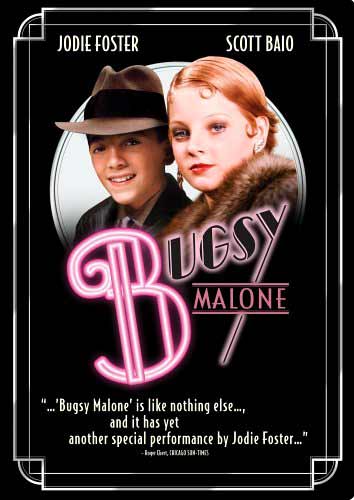
A different high school musical: Bugsy Malone

We own both High School Musical (2006) and High School Musical 2 (2007). I have to say that I like both of them quiet a lot, because they’re so perfectly goofy and I like to see that musicals just might make a comeback. And they tend to get played over and over again in our house. This is, of course, because my eldest daughter loves the films.

I remember (or rather I reminisce) many years ago I was similarly taken with another musical featuring high school aged kids rather than adults. In this case, though, the kids played dress up, apparently raiding the old clothes trunk in their grandparent’s attic. I am referring to the musical Bugsy Malone (1976).

Bugsy Malone was directed by Alan Parker. Interestingly, his next film was Midnight Express (1978). I can’t think to two more diametrical opposed films. The story of Bugsy Malone takes place during prohibition. There are gangsters and gals, rich and poor, big song numbers, lots of dancing, and a pie fight. It’s just good fun, thought it may be a bit dated by now.

The songs were written by Paul Williams. I think it represents some of his best work. Here is the final big number:

One aspect of Bugsy Malone that I alway appreciated was it’s look at all strata of society – or at least a picture of our greater society presented as its simplified “world.” In many ways this is a very mature film, especially given that it’s a musical performed by kids. Here is one of my favorite numbers:

And, in case you didn’t know, Bugsy Malone featured a great performance by a young Jodie Foster:

I don’t have any idea what the future of the musical will be, but I have to say I don’t think it is a dead genre. And I don’t think musicals have to be only animated features. The two High School Musical films show that good songs, good performances, good choreography, and shiny happy people can still make for a fun time.

Finally, if you’ve got nothing better to do at work, here’s the complete Bugsy Malone (complete with Swedish? or Norwegian? subtitles too).

http://video.google.com/googleplayer.swf?docId=-2544817728959240414&hl=en

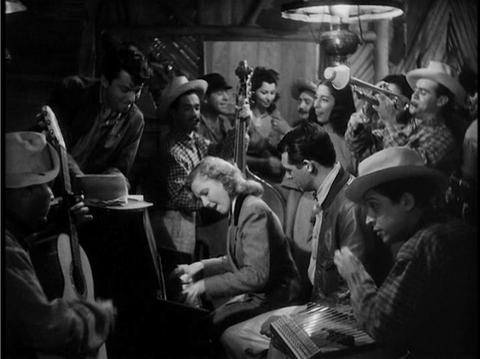
Only Angels Have Wings

Recently I’ve been introducing Lily to the films of Howard Hawks, which is also an excuse (not that I needed one) to watch some of my favorite films. So far we’ve seen Bringing Up Baby (1938) – which I mentioned in my previous post – His Girl Friday (1940), and last night, Only Angels Have Wings (1939).

Only Angels Have Wings was my introduction to Howard Hawks as a director and, as such, it holds a sentimental place in my cinephilia. I probably saw some of his other films earlier in my life, but in the grand cinema survey course I took in college this film was the Hawks film we saw. And that’s when I really began to learn about Hawks. At that time I was blown away by the film. I don’t know if I was just in the right mood then, even so I still love the film today.

I have been trying to find a DVD version of the film, but haven’t. I did find, to my delight, that TCM was showing it and it was listed in the Comcast on-demand free movies. So, voila!

For me the critical scene is when, after a pilot has died upon crash landing his plane, some of the men divide up his few things – trinkets really: his wallet, some coins, maybe a ring. In effect that scene boils down the value of a person’s life to a few insignificant things. For Hawks life was like a pick-up song among strangers in the midst of a crazy world. One can choose to live a life of courage or of safety. In the end it’s not what one left behind so much as how one is remembered, and even that is mostly vapor because behind it all is an unknowable absurdity.

This is in stark contrast to the films of John Ford.

Ford saw great value in the traditions of society: weddings, burials, a man taking his hat off when going indoors, etc., and these things symbolize the significance of human beings, their actions, and the society they create. Hawks, or at least his characters, valued courage, but did not overly emphasize the inherent worth of a human being. Ford was more the romantic, Hawks more the existentialist. (Note: I write this off the cuff without having examined these two director side by side for 20 years, so I am happy to be corrected.)

Of course, I love the films of both directors. They both speak to the human situation, but from different angles.

And speaking of John Ford, soon on the docket for Lily and I are Stagecoach (1939) and Young Mr. Lincoln (1939). Wasn’t 1939 just an amazing year for cinema?!

>We love Nick & Nora

>The other night we finished After the Thin Man (1936). I have seen them all before, but this was a chance to introduce Lily to these classic comedies. She liked it a lot. We had already seen the original The Thin Man (1934) a couple months ago.

What a fun, goofy film, even with all its plot holes and jumps in logic. I have to ask myself if these films could be re-made. If so, who would play the central parts?

And we love Jimmy Stewart. After the Thin Man provided Stewart his first substantial part in a film. Here he is, the kind, lovable Jimmy that we have come to know and love:

And here he is turned into the maniacal killer soon to be apprehended:

It was great to see Stewart transform from kind man to killer. He was already showing us his wonderful talents. Maybe I shouldn’t say we love Jimmy Stewart, Lily is not sure if she does after only seeing him play the bad guy. Now I will have to show her some of his other films.

* * * * * * *

I have to say that we have been watching a few other films lately, but I have not been writing about them. Lily LOVED Bringing Up Baby (1938). We also just saw Jason and the Argonauts (1963), which she also loved. A couple days later she had a friend over and they decided to watch Jason. Lily’s friend had never heard of the film. At one point I overheard Lily saying “Harryhausen” and I knew I had done my job. Last night we also watched about 45 minutes of Aguirre, the Wrath of God (1972). I had to help her with some of the subtitles, but Lily was transfixed. So was I, even though I’ve see the film several times.

>may the force be with you / and also with you

>In 1977 I turned twelve years old and I saw Star Wars twelve times in the theater that year (six times in the first week of the film’s release). I was gaga over the film and so were my friends.

I was also attending a Christian grade school at the time. One day a friend of mine wore his Star Wars shirt to school. It was one of those all black t-shirts with the phrase “may the force be with you” emblazoned across the front. We all thought it was a cool shirt. The school principal did not.

My friend was asked to go home and change his shirt before he came back to school. “May the force be with you” was, apparently, not appropriate for a Christian school.

The truth is, I get it.

Star Wars is not a Christian film (whatever that is). Along with the hero with a thousand faces story arc, Star Wars is loaded with Americanized fast-food style Eastern philosophical concepts. To me it all fits perfectly into what G. Lucas was doing, but I also understand how it conflicts with traditional, Biblical Christianity. And maybe the school principal made the right decision at the time, but I can’t help but think he could, and should, have done a better job by going about it differently. One thing I know is that he lost his influence with some of the students who, although they could not articulate it, would have responded more positively to a reasoned argument along with thoughtful discussion. Kids are not as simpleminded as many educators suppose, and they can be just as deeply passionate as adults. The pricipal had the right to assert his authority, but he may have “lost” some souls that day. Such is the power of our commitments to our popular cultures.

Which gets me thinking of how we engage others around areas of faith, truth, and popular culture, especially at those points were our beliefs conflict with other’s. This is particularly important to me when it comes of movies. Years ago a friend of mine and I saw The Last Temptation of Christ. We watched it, in part, because we were living in a loosely Christian community and when the film came out we heard of many Christians actually picketing outside movie theaters against the film. So we had to see it for ourselves. When some of our friends found out they were a little shocked. How could we have seen that film. My conclusion was that Last Temptation was a rather mediocre film that, nonetheless, should be seen by Christians and then discussed. In other words, there are some important ideas in that film that would be good for Christians to seriously engage, even if only to ultimately refute. Even then, I did not find the film offensive, though I found it both wrongheaded and poorly realized.

I admire the passions of those who stand up for their beliefs, even if it means they are derided or spit upon or slandered. Sometimes one has to be a fool for one’s beliefs. And, at any given point in history, there will be some points of view that are scorned even though they are legitimate. But there is the question of tactics. How does one get others to truly engage with foreign ideas? Consider this guy:

This is actually a joke, but it’s too close to reality to pass up. The picketer is acting the same as a lot of true zealots and street preachers do. I find it actually hard to laugh because it’s too close to reality. Remember that hundreds of Christians literally picketed outside of theaters against The Last Temptation of Christ, which was their right, but only further alienated them from the world of others. Be a fool, but don’t be foolish.

Okay, there, now I can laugh. And may the force be with you, brother.

>Larry Norman: Rest In Peace

>Larry Norman has died.

Maybe you don’t know who he was. Sometimes called the father (and later grandfather) of Christian rock music, and inducted into the Gospel Hall of Fame in 2001, Larry Norman was a seminal figure in many people’s lives for nearly 4-plus decades. You can read about him on Wikipedia and elsewhere. For me, his passing draws me back to my childhood when I was looking for artistic expressions of the ideas and passions within me.

The first “rock” album I ever bought was Only Visiting This Planet, released in 1972.
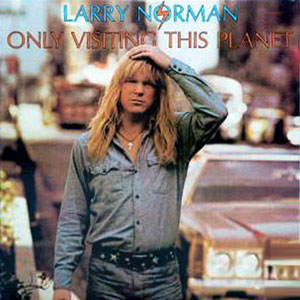
I’m guessing I got it in 1975 or 1976. When I first put it on I was a little concerned. The first song, Why Don’t You Look Into Jesus, shocked me. Here are the opening lyrics:

Sippin’ whiskey from a paper cup.
You drown your sorrows till you can’t stand up.
Take a look at what you’ve done to yourself.
Why don’t you put the bottle back on the shelf.
Yellow fingered from your cigarettes.
Your hands are shakin’ while your body sweats.

CHORUS:
Why don’t you look into Jesus,
He’s got the answer.

As a kid I didn’t quite know what to do with this album. Funny, but I was worried my parents would hear it and make me turn it off because of the “offensive” lyrics. But I kept listening, and soon it took hold of me. Because of that album, with its Christian lyrics that didn’t fit into the Christian sub-culture I grew up in, and with its sometimes driving, sometimes beautiful melodies, my perspectives on what it meant to be human and to engage with the world developed and matured.

Here is Norman performing Why Don’t You Look Into Jesus. The clip begins with some early/mid-seventies studio version and then cuts to a live performance, probably from the eighties:

One of the best songs from that album is The Great American Novel. There was nothing typically “Christian” about this song, and yet I can help but think this is one of the truest Christian songs I ever heard. Here are the lyrics:

i was born and raised an orphan
in a land that once was free
in a land that poured its love out on the moon
and i grew up in the shadows
of your silos filled with grain
but you never helped to fill my empty spoon

and when i was ten you murdered law
with courtroom politics
and you learned to make a lie sound just like truth
but i know you better now
and i don’t fall for all your tricks
and you’ve lost the one advantage of my youth

you kill a black man at midnight
just for talking to your daughter
then you make his wife your mistress
and you leave her without water
and the sheet you wear upon your face
is the sheet your children sleep on
at every meal you say a prayer
you don’t believe but still you keep on

and your money says in God we trust
but it’s against the law to pray in school
you say we beat the russians to the moon
and i say you starved your children to do it

you are far across the ocean
but the war is not your own
and while you’re winning theirs
you’re gonna lose the one at home
do you really think the only way
to bring about the peace
is to sacrifice your children
and kill all your enemies

the politicians all make speeches
while the news men all take note
and they exagerate the issues
as they shove them down our throats
is it really up to them
whether this country sinks or floats
well i wonder who would lead us
if none of us would vote

well my phone is tapped and my lips are chapped
from whispering through the fence
you know every move i make
or is that just coincidence
well you try to make my way of life
a little less like jail
if i promise to make tapes and slides
and send them through the mail

and your money says in God we trust
but it’s against the law to pray in school
you say we beat the russians to the moon
and i say you starved your children to do it
you say all men are equal all men are brothers
then why are the rich more equal than others
don’t ask me for the answer i’ve only got one
that a man leaves his darkness when he follows the Son

It is likely that I can trace my own cultural and political leanings, not to mention spiritual understanding, in part to this song, which I listened to, and pondered over, as a child. Needless to say, songs like this put Norman outside the conventional Christian culture. It is amazing how applicable this song still is today.

This clip of Let That Tape Keep Rolling shows how Norman could really rock back in the day:

Finally, I have to say that Larry Norman was not a perfect man. He had his troubles and failings like all of us. So often we look to religious figures (artists, preachers, gurus) to somehow be exemplary in their behavior. We want to believe it is possible for a human to achieve true holiness or moral perfection, but this never really happens this side of eternity. Norman was exemplary, though, as an honest musician who held on to his faith in the midst of this often messy and ugly thing we call life. And in that one can find encouragement and hope.

Rest in peace.

>the long axis & the interpretive camera

>Alexander Mackendrick was a noted filmmaker and an influential teacher. Below are a couple of clips that focus on his teaching and some of his ideas.

“If a film works it is never simply because it followed the rules. If it fails, however, it is almost certainly that the breaking of one or more rules is the root cause.”

~Alexander Mackendrick

I am only now learning about Mackendrick. These clips, however, remind me so much of my days at university. I love this stuff.

>wee D. Lynch bits

>
There is a lot of David Lynch on the Internets. Here are some clips I found interesting.

D. Lynch does not want New Yorkers to litter:

D. Lynch used an original Lumière brothers’ camera (that’s the story) to make this short:
http://video.google.com/googleplayer.swf?docId=147636485853600786&hl=en

D. Lynch sells cigarettes:

D. Lynch almost says billion years, but says trillion years instead (pardon the language):

I don’t know if I am a fan of David Lynch, but I think he is a genius of sorts. Every time I see one of his films I feel as though there is no one else on the planet making films like his. And typically his films are truly stunning as mind-bending artifacts of his transcendental meditation activities. On the other hand, each time I see one of his films I feel as though I have not really seen anything of consequence, almost as though I have wasted my time a little bit (but not entirely). I think that is because I can never really answer the question, “what’s the point?”

I am a spiritual person. I am because I cannot help but be spiritual, and I also choose to be. I know that David Lynch is into transcendental meditation. I think that is fine of course, to each his own, and yet I can’t help myself but see transcendental meditation as a kind of low-orbit spirituality. It may be a great tool for creativity and stress reduction and other things, but I don’t see it going deep enough or high enough. Maybe that is why I find Lynch’s work so creative on the one hand, and finally so shallow on the other. Still, in our age of so much hyped mediocrity, Lynch’s work, love it or hate it, is a kind of gauntlet thrown down before the pretenders who populate much of the art world.

>Hooper

>In 1978 I was one of those stinky young Junior High boys with bad hair and ratty shoes who dreamed of being in the movies. In fact, I really wanted to be a stunt man because stunt men are cool and can claim bragging rights for doing cool things like crashing cars and falling off buildings.

In 1978 the movie Hooper was released. Hooper is about stunt men.

A friend of mine and I decided to see Hooper because it looked cool. I mentioned my viewing experience in this post. I must say that for better or for worse Hooper is seared into my consciousness and is a part of who I am today.

The film’s climax

Hooper is a Burt Reynolds film and Hooper is Burt. And Burt is a MAN. I am glad (maybe) I did not become a stunt man, but Hooper taught me how to be a certain kind of man. And I’ve been trying to put that behind me ever since.

This post fulfills my non-obligation to contribute to the Burt Reynold-A-Thon.

>more snow

>

3 videos from Michael Snow . . .

Four and a half minutes of Back and Forth (1969):

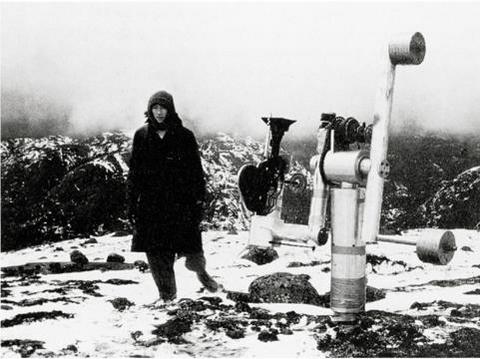
Almost ten minutes from La Région Centrale (1971):

The entire Wavelength (1967):http://video.google.com/googleplayer.swf?docId=-3009876496807585942&hl=en

With Wavelength one of the starting ideas was to be able to see a zoom, to experience a zoom from a kind of analytical “inside a zoom” position, and it seemed to me that could not be fast. I thought it would be interesting to have it big enough so that it is monumental, that is weight in a way, and so it ended up being 45 minutes, but it could have been 15 minutes.


Snow on location for La Région Centrale

P.S. We are back to 36 degrees and rain. Snow is disappearing.

>when the young flee to a happy place

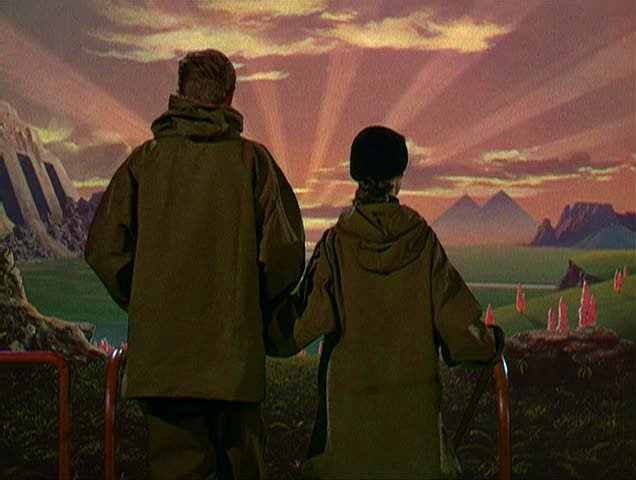
>Lily and I just watched the 1951 film When Worlds Collide. I had never seen the film before and I have to say it’s quite unintentionally funny from our vantage point today.


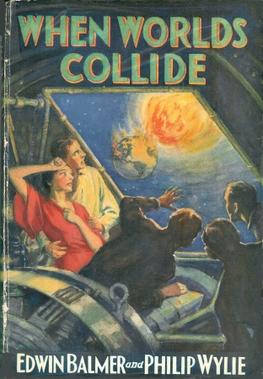
Cover art from the 1933 novel

I liked how the planet Zyra, to which the forty humans have fled for their survival, looks more like a Walt Disney planet than someplace interesting. I was a little disappointed when no bunnies and other woodland creatures were to be seen.

Finally, I couldn’t help but remember a poem from my youth:

The Land of Happy

Have you been to the land of happy,
Where everyone’s happy all day,
Where they joke and they sing
Of the happiest things,
And everything’s jolly and gay?
There’s no one unhappy in Happy
There’s laughter and smiles galore.
I have been to The Land of Happy-
What a bore

~Shel Silverstein, from Where the Sidewalk Ends

P.S. I do have to say, however, that deep down I really love this kind of classic science fiction. There is something passionate and hopeful in it. And When Worlds Collide is, in many ways, a great example of its time and genre.