
>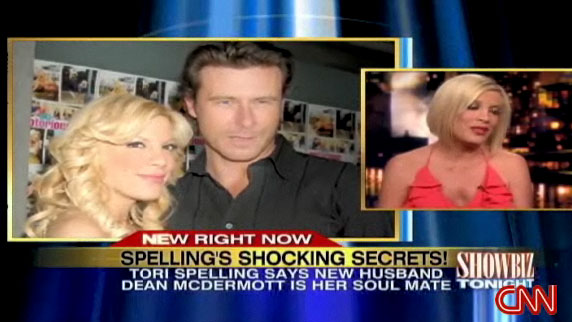
Recently Showbiz Tonight’s AJ Hammer did a story/interview with Tori Spelling. Below is some of the transcript of that segment from CNN.com.
HAMMER: [W]ith everyone talking about sex scandals right now, here’s one I just had to ask about, Tori cheated on her husband number one with now husband number two. I asked Tori point blank if she ever stopped to think about the damage she was doing not only to her marriage but to her now husband’s marriage as well.
SPELLING: That was the hardest thing for both of us is that there were children involved. There were two other people innocently involved. You know, whether they were happy marriages, whether they were meant to work out, it’s still at the end of the day people are going to get hurt. And that was the hardest thing about that whole situation. But, you know, in life you have to really – you have to look out for yourself and I found my soulmate and I couldn’t deny love. So what was I supposed to do?
First of all, GAG!
Second, what a tragedy of morals, not merely in her actions, but more remarkably in her truly sad and hurtful philosophy. I say this not to aim barbs at Ms. Spelling per se, because she is fundamentally no worse than any one else. We all have dark and selfish hearts. But I say it because it is true, and it is so starkly presented by her words.
There are few projects in all of human existence more difficult than marriage. Marriages fail all the time. There is nothing surprising in that.
What I find shocking (but am I really shocked?) is how openly she excuses her actions by saying: “You know, whether they were happy marriages, whether they were meant to work out, it’s still at the end of the day people are going to get hurt.” Yes, people got hurt, by her actions. And that language of “meant to work out” sounds like marriages are fated, that their success or dissolution are matters ultimately beyond anyone involved, that there really is no persons to blame or praise, just luck.
She then says: “And that was the hardest thing about that whole situation.” From what I can tell it looks like she’s over that now. Any bad stuff is apparently all in the past. Clearly the hardest part is not facing into her moral failings or the ongoing effects of two broken marriages.
Finally, to cap it off she says: “But, you know, in life you have to really – you have to look out for yourself and I found my soulmate and I couldn’t deny love. So what was I supposed to do?” Short answer: honor your commitments,love your husband, repent. I didn’t realize that looking out for oneself trumps all other considerations, as though with a wave of the hand it absolves all other choices.
Maybe I’m being too snippy. I know marriages are complex relationships, and the reasons they succeed or fail are also complex. There are no easy answers. There are no quick solutions. Sometimes, even, it is best for a marriage to end. I have a feeling that there was a lot more to the whole affair than Ms. Spelling is saying. I know nothing of her life. But I have to say that it is sad to hear such bald faced excusing and unashamed selfishness presented as a matter of course.
Finally, it is interesting that she says, “I couldn’t deny love.” What does this mean? It sounds as though she understands love to be something outside herself, a kind of force that is undeniable, unstoppable, untamable. But that is not love she is giving in to, that is romance, and romance is a good, but fleeting thing.
Romance is like a drug, it wears off after time. Love, on the other hand, is a choice, a series of actions, an orientation on one’s character towards another. Love is something you don’t feel as much as something you do, for love bears all things, believes all things, hopes all things, and endures all things. Love isn’t here and then gone. One has to work at it, choose it, make the effort, and seek to be the kind of person who loves. Love often (usually?) involves sacrifice, giving of oneself, even denying of oneself and one’s desires.
But, like Tori Spelling, we live for ourselves. In that sense we are all soulmates.
I can see the same tendencies in both myself and in others all the time. In one way or another we all choose to love ourselves more than we love others, and then we all make excuses for it. We tell ourselves stories, and then we actually believe the stories. Now that’s something to really make you weep, if you have eyes to see.
Blesssed are those who mourn . . .

























 pilgrimakimbo