>Band of Horses: Is There a Ghost

>Band of Horses is a guitar band through and through. Cease to Begin is their most recent album. Is There a Ghost is a song from that album.

So, just in case you might be interested. . .

Here’s what they look like on Letterman:

Here’s what they look like when you go see them:

And here’s the music video:

I am going to get the album.

>wee D. Lynch bits

>
There is a lot of David Lynch on the Internets. Here are some clips I found interesting.

D. Lynch does not want New Yorkers to litter:

D. Lynch used an original Lumière brothers’ camera (that’s the story) to make this short:
http://video.google.com/googleplayer.swf?docId=147636485853600786&hl=en

D. Lynch sells cigarettes:

D. Lynch almost says billion years, but says trillion years instead (pardon the language):

I don’t know if I am a fan of David Lynch, but I think he is a genius of sorts. Every time I see one of his films I feel as though there is no one else on the planet making films like his. And typically his films are truly stunning as mind-bending artifacts of his transcendental meditation activities. On the other hand, each time I see one of his films I feel as though I have not really seen anything of consequence, almost as though I have wasted my time a little bit (but not entirely). I think that is because I can never really answer the question, “what’s the point?”

I am a spiritual person. I am because I cannot help but be spiritual, and I also choose to be. I know that David Lynch is into transcendental meditation. I think that is fine of course, to each his own, and yet I can’t help myself but see transcendental meditation as a kind of low-orbit spirituality. It may be a great tool for creativity and stress reduction and other things, but I don’t see it going deep enough or high enough. Maybe that is why I find Lynch’s work so creative on the one hand, and finally so shallow on the other. Still, in our age of so much hyped mediocrity, Lynch’s work, love it or hate it, is a kind of gauntlet thrown down before the pretenders who populate much of the art world.

>last night’s lunar eclipse

>

It is difficult to get a good picture of a lunar eclipse with a standard camera and no tripod. Plus there was a lot of city light flooding in. Regardless, pic or no pic, you “had to be there” anyway. I hope you were. It was beautiful.

The Chess Player Stripped Bare: Marcel Duchamp (Even)

Chess players are madmen of a certain quality, the way the artist is supposed to be, and isn’t, in general.

~ Marcel Duchamp

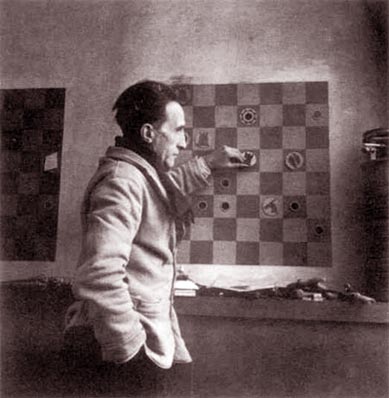
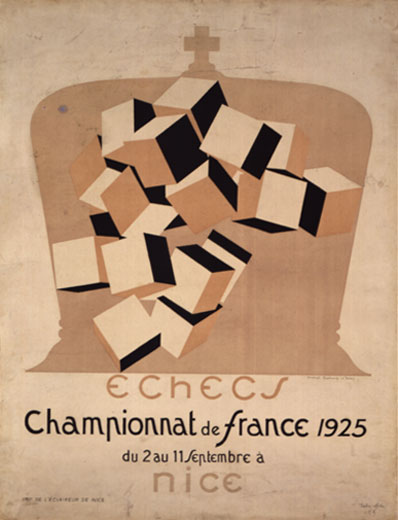
The artist Marcel Duchamp was virtually unmatched in his role in changing the course of art history in the 20th Century. I’m inclined to believe he was even more important, in the long run, than Picasso. Duchamp was brilliant, innovative, avant-garde, challenging, and extremely witty. And yet, at the peak of his art career he decided to walk away from the life of the artist and dedicate his life to playing chess. He was on the French team for the chess Olympiads of 1928-1933. He designed the poster for the French Chess Championship of 1925 (below). He was gaga over chess.

I find it no wonder that Duchamp’s art had such an analytical and intellectual bent. Much of the art that preceded him, like the Fauves and Blaue Rider group, or the French post-impressionists, or even, to some degree, the Futurists, relied on a more visceral and emotional response. Duchamp’s work was emotional, certainly, but he also was a challenger to received ideas, including the very idea of Art itself. He expected the viewer to use her brain as well as her heart as she engaged with the work. Those who took up the challenge were never quiet the same. I find it no wonder that his art was such because I now know of his passion for chess, a game that obviously places demands on the brain, and yet is also an art. Art is an idea, and chess is an art.

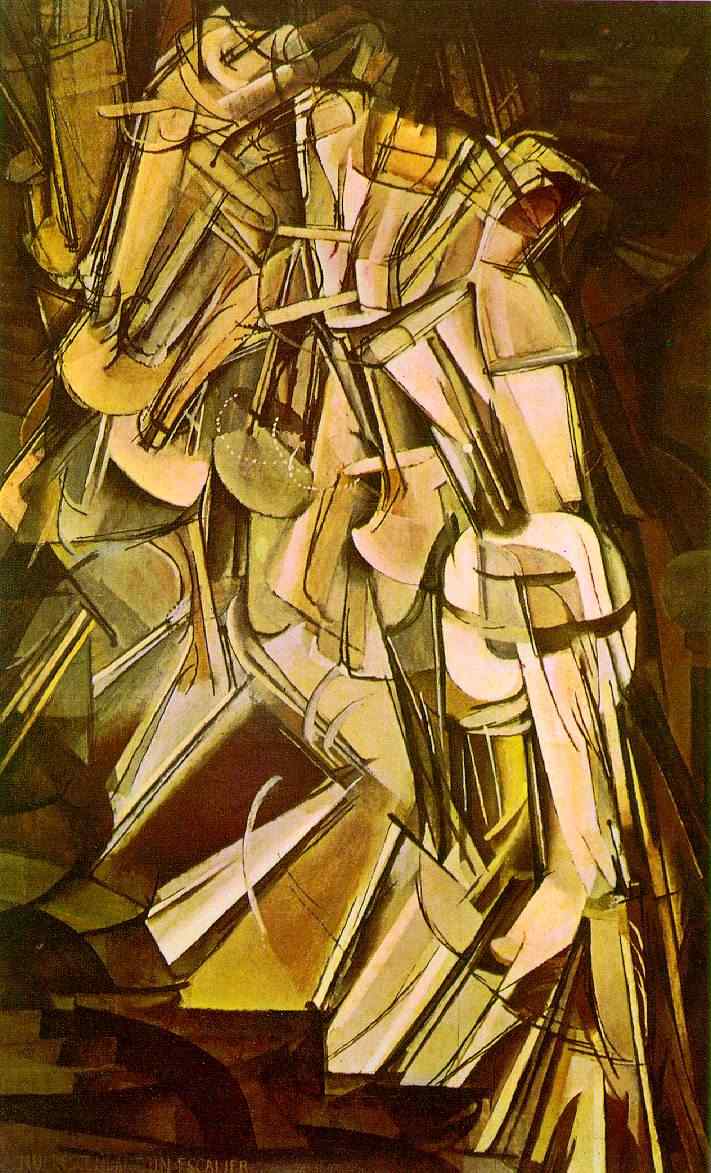
The earliest of Duchamp’s famous works, Nude Descending a Staircase, one sees the intellectual tendency in full. In the same vein as the cubists, Nude Descending calls on the viewer immediately to analysis, and not just of the work as a work, but to what it is doing in the larger context of art.

Later Duchamp to this thrust further with his readymades. With his readymades Duchamp moved art into the almost entirely conceptual. He was moving away from the visual, or “retinal” kind of art, to the mental. “…it was always the idea that came first, not the visual example”, he said, “…a form of denying the possibility of defining art.” (from Wikipedia)

I would argue that Duchamp’s love of chess fueled his interest in the mental aspect of art for two reasons. One: Chess is very much a challenge of the brain, and yet chess has a broad cultural and historical pedigree, like art. Two: I see Duchamp looking at the art world, at the machinations of style and theory and money and self-satisfaction, and he saw all the pieces interlocking like a chess board. I imagine he was looking for that move that puts his opponent back on his heels through cleverness and surprise. Art, even it all its seriousness, is a game. We are still living in the aftermath of how Duchamp envisioned and played that game.


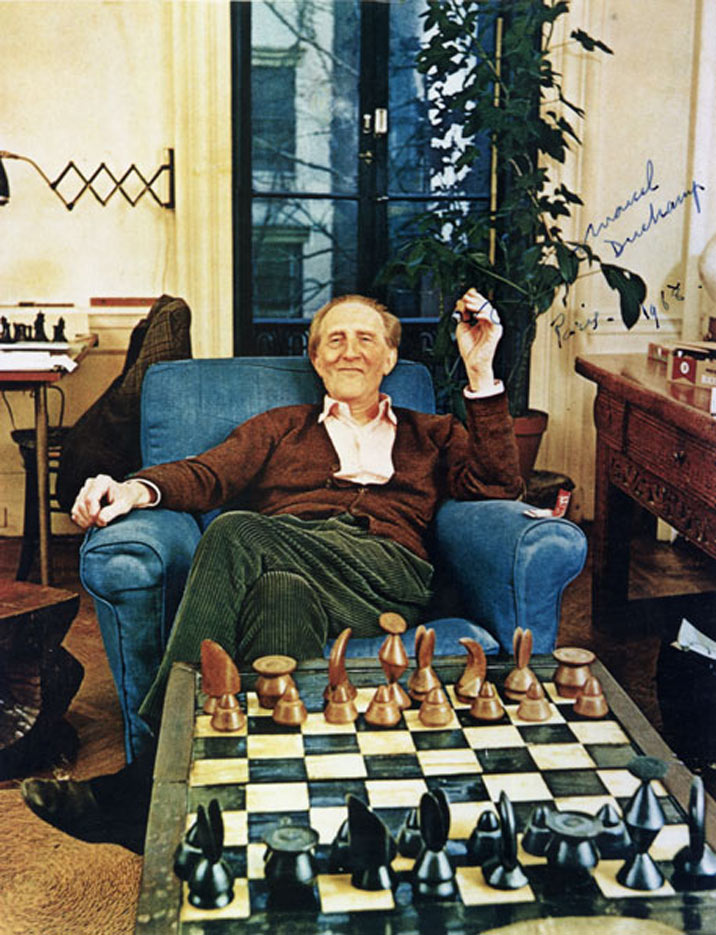
Duchamp, in his later years, smug and happy with his chess set.

>how should we then live

>I grew up in a Christian home. Consequently Christianity has had a profound affect on my life. When I was a kid I became frustrated with the overly simplistic and emotional approaches to truth that has come to be a part of so much of Christianity. I began to seek out Christians who used their brains and valued rationality. In my teens I came across the philosophical writings of C. S. Lewis. I also came across the writings of Francis Schaeffer. These men, and others like them, helped me to see that faith and reason can, and should, go together. They helped set me on a better course in my search for truth.

Francis Schaeffer (1912-1984) was an interesting character and noted Christian apologist. He, and his wife Edith, were the founders of L’Abri in Switzerland. For a while in the 1970s, because of his stance against Roe v. Wade, he was lumped together with the far right-wing Christian camp. Later, in conversation with his son Frank, he said those people are crazy, or something to that effect. His thinking was far to deep and far too wide ranging to be pegged by any narrow and rather dogmatic camp.


Schaeffer writing

Francis Schaeffer wrote a number of books including, How Should We Then Live: The Rise and Decline of Western Thought and Culture (1976), which was then made into a film. One of Schaeffer’s key critiques was of the personal peace and prosperity ideology that has come to mark much of Western culture, including Christianity. Thanks to YouTube I get to “re-live” a moment from my formative years. Here is a part of that somewhat clunky, but still interesting film:

One of his statements always catches my attention. He says he wept when the sixties gave way to the seventies and the radical cultures that were seeking truth gave way to mere hedonism. Although he did not agree with many of the conclusions of the sixties protesters, he saw their project as valid, which was a different stance to take than that of mainstream Christianity at the time. I wonder what he would have thought of the WTO protests we first witnessed in 1999 in Seattle. I think he might have applauded.

>dreaming

>. . . some simple juxtapositions:

Sight grows dim, my strength
is two occult, adamantine darts
Hearing weavers for my father’s house
breathes distant thunder
The tissues of hard muscles weaken
like hoary oxen at the plough
and no longer when night falls
do two wings gleam behind me

During the party, like a candle I wasted away
Gather up at dawn my melted wax
and read in it whom to mourn, what to be proud of
How, by donating the last portion of joy
to die lightly
and in the shelter of a makeshift roof
to light up posthumously, like a word

~ from Nostalgia (a poem by Arseniy Tarkovsky; Andrey’s father)

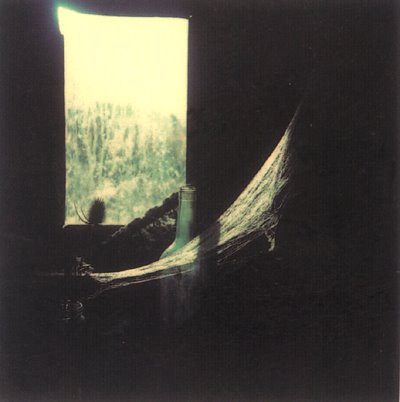
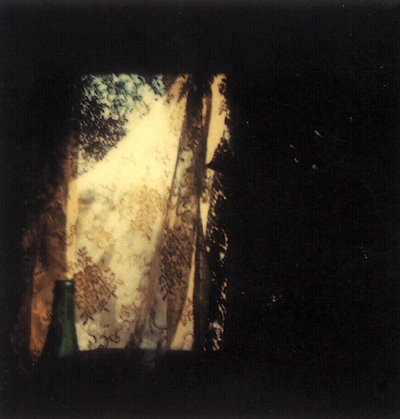
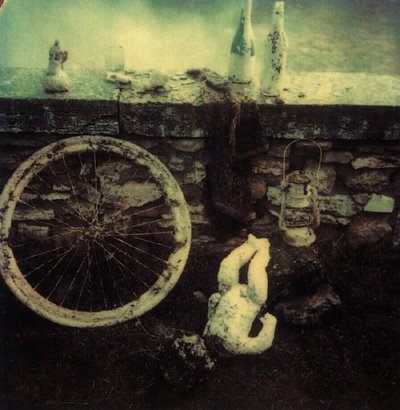
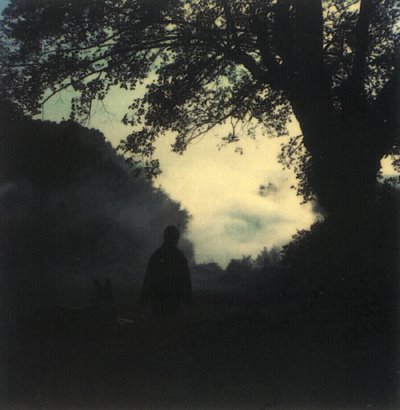
Polaroid images by Andrey Tarkovsky:

Voice over from Tarkovsky’s The Mirror:

I keep having the same dream. It seems to be forcing me to return to the bittersweet site of my grandfather’s house, where I was born on the table forty years ago. Something always prevents me from entering. I keep having this dream. When I dream of the log walls and dark pantry, I sense that it’s only a dream. Then my joy is clouded for I know I’ll wake up. Sometimes something happens, and I stop dreaming of the house and the pines by the house of my childhood. Then I grieve and wait for the dream that will make me a child again, and I’ll be happy again, knowing that all still lies ahead, and nothing is impossible.

>training the brain | teaching the heart

>We homeschool our kids. This is not an easy task. It takes a lot of work and a lot of patience, and most of the burden falls on my wife’s shoulders. As much as I can I try to do my part. One thing I’ve started doing is teaching my seven year old how to play chess. I am not a gifted, or even a good, chess player. And I can’t say I’m that good of a teacher. But I know how the pieces move and I love playing the game. So far my daughter seems to like chess as well.

Chess is one of those interesting mental games that is both fun and educational. Just like playing sports is a more enjoyable way to get exercise than going to the gym, so playing chess is a more enjoyable way to exercise the brain than some other kinds of mind-training.

But all this chess playing has got me thinking: What is the relative value of educating a child from the perspective of well-roundedness versus specification? In other words, is it better to “create” a well-rounded person, or a person with great abilities in a specific area, such as chess or ballet? Why am I asking this question? In part because of my own personal discovery of László Polgár and his daughters Zsuzsa (Susan), Zsófia (Sofia), and Judit, and their incredible abilties at the chess board.

In reseatching this topic I came across this fascinating film clip, which focuses on Susan Polgar. The film provides some insight to the idea of specializing a child’s education and how it affects the brain:

http://video.google.com/googleplayer.swf?docId=-6378985927858479238&hl=en

In general I have always been a fan of the liberal education, and have sought that for myself. But, strangely, I have always been extremely fascinated with the so-called genius. I am amazed by the abilities of the great athlete, the great musician, the great mathematician, the great architect, etc, etc. And very often the genius is not the product of a liberal education, rather a specialized education. Most individuals who achieve some level of greatness in one thing do so by an intense single-mindedness applied over a lengthy period of time in such a way that the rest of us rarely experience. This seems to be true of just about any area of achievement.

Recently I have some across this “magic” number of 10,000. That number refers the amount of hours of practice the typical expert has to do to become an expert. In an article on the Polgar sisters the author cites some important research on the topic of “creating” a genius by Anders Ericsson:

[…]Ericsson is only vaguely familiar with the Polgars, but he has spent over 20 years building evidence in support of Laszlo’s theory of genius. Ericsson, a professor of psychology at Florida State University, argues that “extended deliberate practice” is the true, if banal, key to success. “Nothing shows that innate factors are a necessary prerequisite for expert-level mastery in most fields,” he says. (The only exception he’s found is the correlation between height and athletic achievement in sports, most clearly for basketball and volleyball.) His interviews with 78 German pianists and violinists revealed that by age 20, the best had spent an estimated 10,000 hours practicing, on average 5,000 hours more than a less accomplished group. Unless you’re dealing with a cosmic anomaly like Mozart, he argues, an enormous amount of hard work is what makes a prodigy’s performance look so effortless.

This makes sense to me. When I was an undergrad I knew a young woman who, as a first year student, qualified to be the second chair violinist in the university’s orchestra. She was an amazingly talented violinist. She was also someone with limited social skills, though she was a nice person. I once asked her to tell me what she did for practicing. She said she would go out to an empty room in the back of the building she was living in as a student, set up her music stand, a chair, and a timer. She would stand and practice for exactly 55 minutes, then sit down and rest for 5 minutes, then stand and practice another 55 minutes, etc. This would go on for anywhere between 3 to 6 hours at a time depending on her other schoolwork. She also said that ever since she was a young girl she had always practiced for hours at a time and often her parents would have to curtail how many hours in a day she could practice. In some ways she was socially and interpersonally naive, she also did not convey a sense of much knowledge outside of music, but she was brilliant at violin. After two years at the state university she received a full-ride scholarship to Juilliard.

The simple fact is there are no natural prodigies. All are created through hard work. One hopes that as a child takes on the hard task of practicing something that the child also truly loves the subject at hand and enjoys seeing the results of hard work. But, as I hear the girl in the following video speak I can’t tell if she is happy or not, and I am a little concerned about her social and intellectual life beyond music:

At the same time I know that in many societies parents emphasize their desire for their children to succeed, and in the U.S. parents emphasize their children’s happiness. One is a focus on doing and the other is a focus on being. I don’t know which is better. I do know that I want my children to grow up and be good, that is, of good character rather than merely good at doing something, or even just good mannered. Overarching the question of liberal versus specialization is the fundamental goal that education is primarily about character development rather than knowledge or action.

Another factor is the strangeness of even thinking about raising and training our children to be truly great at one thing. Neither my wife or I grew up in families that had that kind of focus. Sure, there was pressure to do well in school, but neither of us were driven to excel at any one thing the way we witness a few others excelling at what they do. We watch the Olympics, or listen to a concert, or hear about the next youngest chess champion, and we are amazed at the stunning accomplishments of those involved. And then we turn away, possibly assuming that that level of accomplishment is not for us or our kids. I don’t think turning away is necessarily a bad thing, but I wonder if we turn away too easily. I don’t have an answer.

So now we are trying to create the best, well-rounded, liberal education for our children while wondering about the values of specialization. I am going to continue to teach my kids chess, and they will continue to take ballet and swimming, learn math and science, reading and writing, art and history, piano and soccer, and hopefully they will also grow to be good people. My hope is that we will know when we should push and when we should step back. Most importantly, we must keep in perspective the very relative benefits of being great at any one thing. Even the genius has achieved very little if she has a heart of stone.
>Hooper

>In 1978 I was one of those stinky young Junior High boys with bad hair and ratty shoes who dreamed of being in the movies. In fact, I really wanted to be a stunt man because stunt men are cool and can claim bragging rights for doing cool things like crashing cars and falling off buildings.

In 1978 the movie Hooper was released. Hooper is about stunt men.

A friend of mine and I decided to see Hooper because it looked cool. I mentioned my viewing experience in this post. I must say that for better or for worse Hooper is seared into my consciousness and is a part of who I am today.

The film’s climax

Hooper is a Burt Reynolds film and Hooper is Burt. And Burt is a MAN. I am glad (maybe) I did not become a stunt man, but Hooper taught me how to be a certain kind of man. And I’ve been trying to put that behind me ever since.

This post fulfills my non-obligation to contribute to the Burt Reynold-A-Thon.

>more snow

>

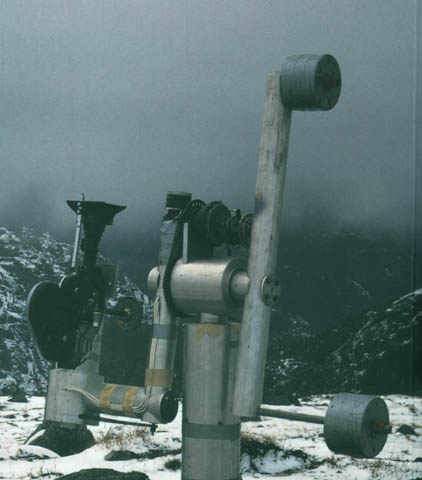
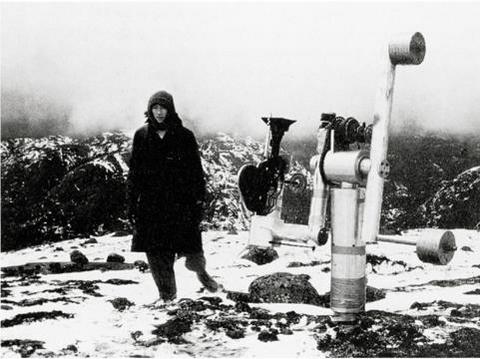
3 videos from Michael Snow . . .

Four and a half minutes of Back and Forth (1969):

Almost ten minutes from La Région Centrale (1971):

The entire Wavelength (1967):http://video.google.com/googleplayer.swf?docId=-3009876496807585942&hl=en

With Wavelength one of the starting ideas was to be able to see a zoom, to experience a zoom from a kind of analytical “inside a zoom” position, and it seemed to me that could not be fast. I thought it would be interesting to have it big enough so that it is monumental, that is weight in a way, and so it ended up being 45 minutes, but it could have been 15 minutes.


Snow on location for La Région Centrale

P.S. We are back to 36 degrees and rain. Snow is disappearing.

>snow this morning

>

I know for some of you this is no big deal. You already have snow and probably want it to finally go away. But for us, this is an event.