>The challenge of July 4th

>

Make sure you’ve got on your flag pin.

When I think about celebrating this Fourth of July, I find myself wondering about where we are and what has got us here. What most fascinates me, and what I am most amazed by, are the stories of people like you and me who have fought for freedom. I don’t necessarily mean soldiers, but ordinary people who became extraordinary because of circumstances. I mean those who stood up against slavery, stood up for women’s right to vote, stood up for workers’ rights, stood up for civil rights, stood up for you and me.

One of the finest works of historical investigation and writing is Howard Zinn’s remarkable A People’s History of the United States. Throughout that book there are challenges on every page, challenges that remind us what freedom really means and what it takes for people to be free, and just how much freedom is truly a deep, deep longing.

Recently there have been public readings of that book. Here are some excerpts:

Brain Jones reads Frederick Douglass

Lili Taylor reads Susan B. Anthony

Steve Earl reads Joe Hill

This country has always been an experiment. Our freedoms are probably more tenuous than we tend to believe. We have freedoms because they were fought for, because they are still being fought for. Those freedoms will, I’m sure, need to be fought for again. I believe the Fourth of July should be more than a commemoration of 1776. I want to remember how so many ordinary people all along the way have struggled to achieve this country’s ideals. And how many still do. Every Fourth reminds us of how we too are part of this on-going experiment. It is a challenge to each of us to do the work of freedom. I do not want to forget that.

May you have a great Fourth of July!

>Chomsky on the U.S. elections, oil politics, and the current state of resistence

>Inside USA, an English language program on Al Jazeera recently did an interview with Noam Chomsky. I have never watched or read anything from Al Jazeera, that I know of. I did not realize they had an English version, but I guess that makes sense.

From the website, Inside USA says this about its mission:

Inside USA’s mission is to strip away the spin, and highlight some of the real issues in America – poverty, violence, race, health, and immigration.

We will be speaking to people on the ground – not television pundits, but real people with stories to tell – a full spectrum assault of American voices -young, old, white, black, immigrant, rich, and poor.

Here is the interview with Noam Chomsky:

Part one:

Part two:

I have always found Chomsky fascinating. His work on East Timor and Latin America is groundbreaking. So is his work on US politics. Maybe his biggest contribution is his relentless focus on power, that is, political, social, imperial, military power, and its role in shaping how the world functions. This focus puts him somewhere else than simply “left” in terms of politics. The great irony is that although he most likely should be labeled as a radical his views are very close to what most ordinary people think, even if they think they must disagree with Chomsky.

La Chinoise & The Weather Underground

The other day I inadvertently created one of the best double features that I’ve ever seen: First, the fictional narrative La Chinoise (1967) and then, second, the documentary The Weather Underground (2002), based on the revolutionary group of that name.

Silhouetted hands in La Chinoise.

What makes this double features so powerful? We live in an age where violence against human beings in the name of some cause (religious jihad, war on terror, patriotism, personal peace and prosperity, etc.) is accepted by many generally reasonable people. The U.S. government and TV pundits are currently debating whether torture is okay, or whether certain kinds of torture can be called something else to get around legal requirements. Some argue that extreme force, including the killing of innocent people (collateral damage) in order to send a message (to those who would dare to use violence as a means of sending a message), is an acceptable response to terrorist acts – in other words, matching fatal violence with increased levels of the same.

But does violence work? I suppose it depends on what are one’s goals. In general, though I would argue, violence does not incite peace.

La Chinoise plays out the philosophical debates underlying these issues within a somewhat humorous and heavily symbolic world that might be called godardian. La Chinoise is a fictional tale of what underlies potential violent action, and of political idealism amongst the educated children of the bourgeois. La Chinoise is also considered to have presaged (and possibly encouraged) the student protests in Paris that occurred exactly one year after the film’s release.

The Weather Underground, on the other hand, exposes the reality of those actions and their implications by showing what actually played out in the U.S. In other words La Chinoise says “suppose” and The Weather Underground says “regard.”

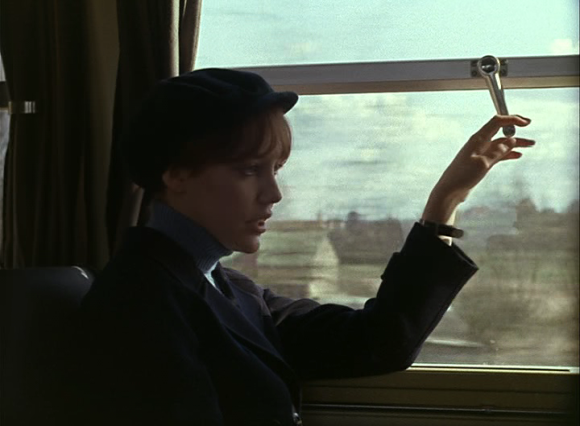
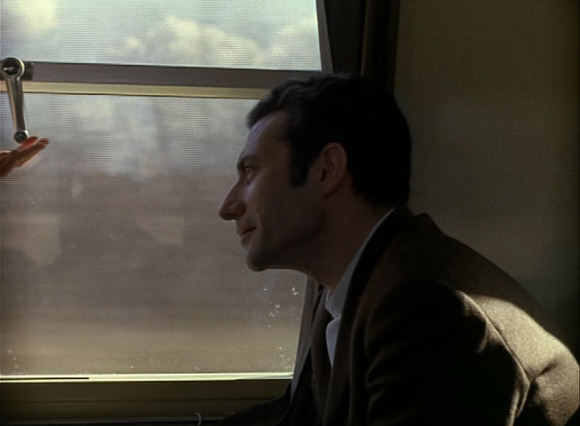
La Chinoise is a kind of remarkable film. I say kind of remarkable because it is also enigmatic and therefore its remarkableness is still very much open to interpretation and evaluation (but isn’t most Godard?). One asks is Godard serious or making fun? Is the film a polemic or a comedy? Is it meaningful or ultimately empty? I can’t say. Many others have done a far better job than I at exegeting the film. But I can say there is one scene I believe is the centerpiece of the film, at least philosophically. That scene is the discussion on the train between Veronique and Blandine Jeanson (playing himself).

Veronique argues for violence.

In that scene they talk about the value and implications of using terrorism in the service of a cause. Veronique, and the revolutionary cell of which she is a part, is planning on using a bomb to kill some students and teachers at the university in order to jump-start a revolution. She argues that the bomb will convince others of the seriousness of their cause. Jeanson argues that violence will not produce the results she is looking for. In fact, killing others will only cause everyone to turn against her and her political group.

Jeanson argues for non-violence.

From my perspective Veronique seems very naive. However, many people felt similarly in the 1960s and early 1970s. I suppose some still do. What would drive a person to such conclusions as Veronique? The Weather Underground explores just such a question.

Haskell Wexler films the Underground.

The activist group The Weather Underground began as the Weathermen, a radical outgrowth of Students for a Democratic Society. The film The Weather Underground is a history of that group and the times in which it functioned. It is one of the best documentaries I have seen.

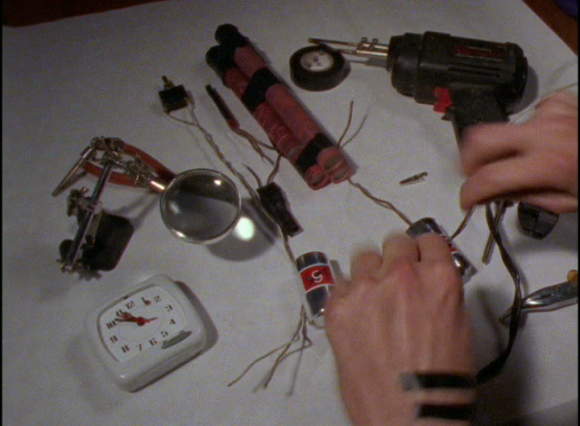
Bomb making.

What drove the Weathermen was a desire to change the world. Frustration in the slowness of change, and even the continued deterioration of certain concerns (such as the escalating war against the Vietnamese), gradually led the group down the path toward violent action.

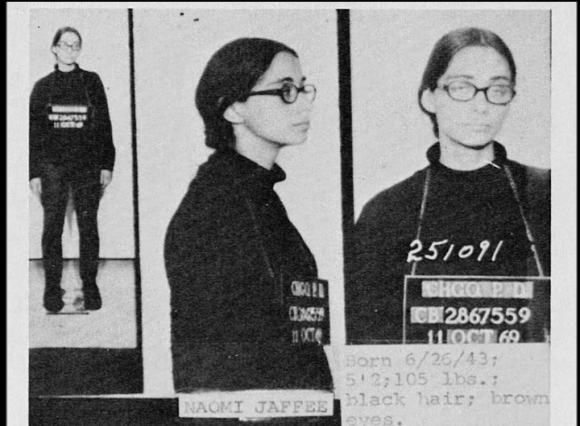
A revolutionary gets nabbed.

Much of the film includes interviews with former members of the group. It is fascinating to hear them describe what choices they made, why they made those choices, and what they think of them now. There is a lot of regret for some of the former members. In a sense the film pulls back the romantic veneer of the 1960s anti-war movement and shows a more realistic complexity. What we get is something that makes La Chinoise appear to be both more profound and more like a cartoon of itself.

>modern agitprop and youtube

>From the words “agitation” and “propaganda” we get agitprop. Because this word first showed up in connection with the Bolsheviks it has always had a leftist sense about it. But it really can be applied to just about anything that is about disseminating ideas with the desire to change consciousness and encourage action against the forces of power, blah, blah. From what I can tell today most agitprop, though often leftist in tenor, is mostly about challenging dominant paradigms of power and hegemony. That I can get behind.

It also seems today YouTube is becoming the location of much agitprop.

Here is a provocative and fascinating juxtaposition of images and stereotypes of women and cultures that confront our assumptions of dangerous differences, amongst other things:

Who can forget this amazing anti-war video (a great example of détournement) produced by the Guerrilla News Network only a year into the Iraq War. It is still powerfully relevant and devastating today:

The Billboard Liberation Front “improves” an AT&T advertisement in 2008:

Or this video made by anarchists on how to get the message out (agitprop about doing agitprop):

The question, of course, is how much actual action do things like these produce? For the most part I hope a lot (at least non-violent action), but I fear that YouTube clips may, in fact, exacerbate inaction. It may be “the medium is the message” kind of problem. Sitting at one’s computer and surfing video clips, even agitprop pieces like the ones above, is not the same as doing something. It’s too easy to go to the next clip.

And it’s often unclear what one’s actions should be. This is where the third clip above might be the most effective in encouraging action. People often already have strong emotions about the world they live in, but they don’t always know what to do. Of course, not just anyone is going to be swayed by anarchists and their ilk.

Regardless, getting “the message” out, whatever that message is, is important for the grand dialog. YouTube (and all Internet media) has been affecting the landscape of ideas for a while now. Feel free to add your thoughts.


* * * SPECIAL BONUS * * *

A trip down agitprop memory lane provided at no extra charge.

An excerpt from Ant Farm’s 1975 performance of Media Burn. The original “kill your t.v.” message:

1998 performance of the end of Orwell’s “1984” by The Surveillance Camera Players:

Go to Track Meet, shake Obama’s hand

Friday night we got three free tickets to go to a track meet. We love track meets. If you live anywhere else in the U.S. then you might not know how a local, low-key track meet can still be an exciting event that even produces world-class results and brings out over 5,000 fans. It helps that the location is the famous Hayward Field – site of the upcoming U.S. Olympic Trials.
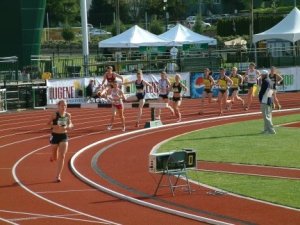

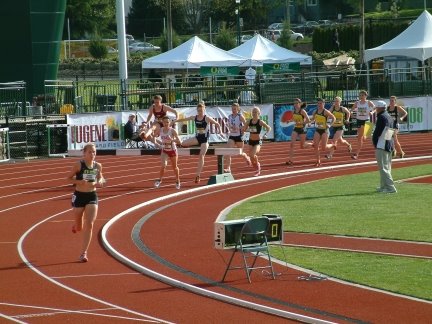
That’s Carrie Vickers leading the Women’s 3,000 meters steeplechase, which she won in a meet record of 9:51.08. It takes a time of 10:00.00 to qualify for the “A” field for the Olympic trials.
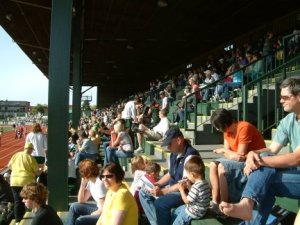

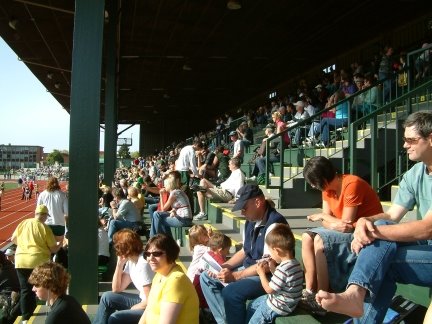
The East grandstands – where I’ve sat through many track meets, including three previous Olympic Trials (1972, 1976, 1980 – yes that dates me), and watched the marvelous Steve Prefontaine, amongst other greats.
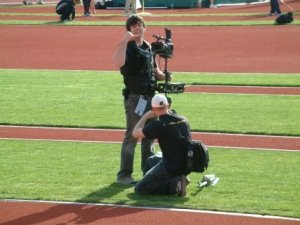

That my friend Jayson with the steadycam asking me to call him to see if I’m available to help him. I wasn’t. Family and friends took precedence, but Jayson did a great job on his own anyway.
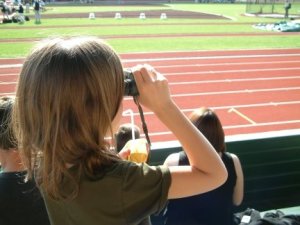

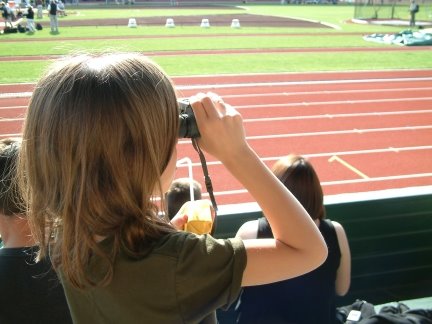
Lily juggled the binoculars and the stopwatch before we met up with friends. Then she mostly ran around and played.


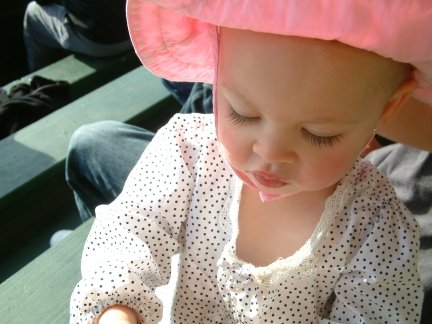
Wilder didn’t really know what was going on, but she liked clapping for the runners and eating all her snacks.

So then . . .

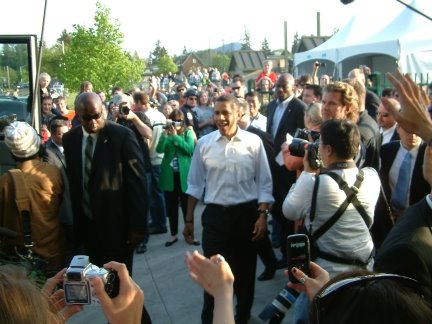
About mid-way through the track meet several big buses and a string of police motorcycles passed by on the street behind us. We immediately knew it was Barack Obama (he was to speak at the UofO later that day). After a few minutes Obama came out onto the opposite end of the track from us. As any political candidate would do, he shook hands, congratulated some athletes, held babies, and waved to the crowd. Then he began to leave, which took a while.

My wife asked if I would go back to the car and get the stroller. Wilder was getting tired. I carried Wilder in the kiddie backpack and Lily asked to come along. When we turned the corner of the grandstands there were the buses. Lily said maybe we could see Obama. So we hurriedly walked down and stood in the crowd next to the bus. Here’s the picture: People crowding around, police and secret service everywhere, I’m holding Lily in one arm as high as I can get her, my camera is in my other hand, Wilder is in the backpack. We stood there for 15-20 minutes, with my arm going numb and Wilder beginning to fuss. But then Obama came by.

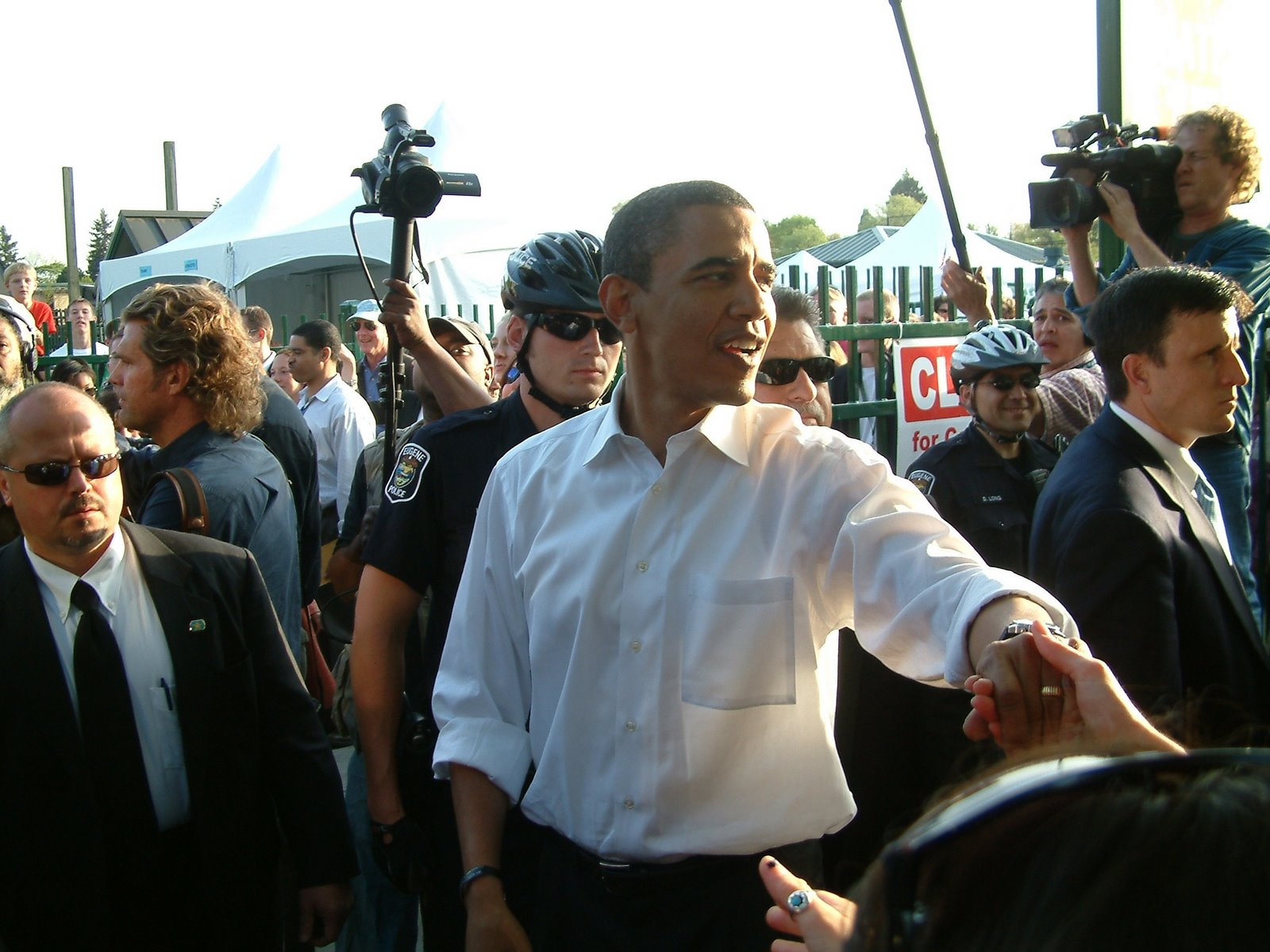
He shook my hand, he shook Lily’s hand, and then he looked at Wilder and then said something like “Who is that beautiful baby?” or “That’s the cutest baby!” We can’t remember exactly what he said because we were in a bit of a daze.
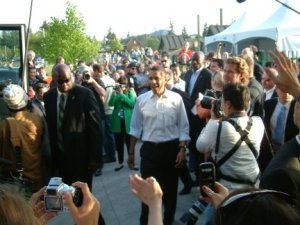

Obama looking relaxed.
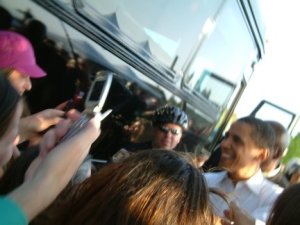

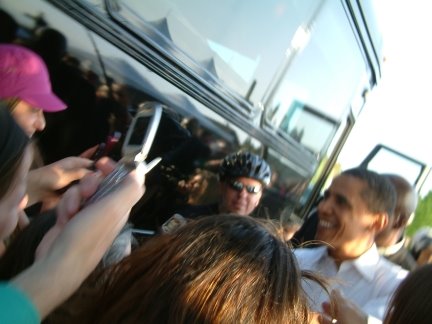
Action shot. That’s what I call an off balance, out of focus, blurry shot.
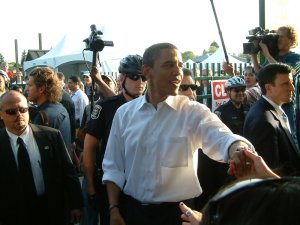

My final shot turned out okay. Card full.

Overall a fun experience and a great memory

I am rather cynical about politics, but I will say this: There is something different about Obama than Clinton or McCain. He seems to be more easy going, less divisive, more hopeful, and somewhat visionary, at least in his tone. He seems to speak beyond, or above, the normal talking points of the left/right political split. I don’t know if he really has the ability to affect positive change, I don’t know if he can actually get anything done, and I don’t have many delusions about what politics and politicking really means. But I will say on the surface he exudes a kind of character decidedly different than his opponents. Quite possibly that is the kind of character this country needs in its leader right now.

One other thing: Seeing a person up close and shaking their hand creates an interesting perspective. I only had a few seconds to see Obama up close, but I was close enough to look into his eyes and get a very brief sense of the man. He exudes confidence without arogance, and strength without desperation. Sure, every politician wants power, but some seem to be desperate about it and others seem to seem to know it will come when it’s time. I can’t see into his heart, but Obama appears to have a good one. I hope he is not merely a great actor. That would be a tragedy for us and for him. And I have to say, what we don’t need is another actor in the White House.

We missed his speech, but here’s an amateur clip of some of the event:

and another:

In the presidential campaign it appears Obama is the rock star. But I have to say the best part of the day was being with my family and friends on a beautiful day at the track meet.
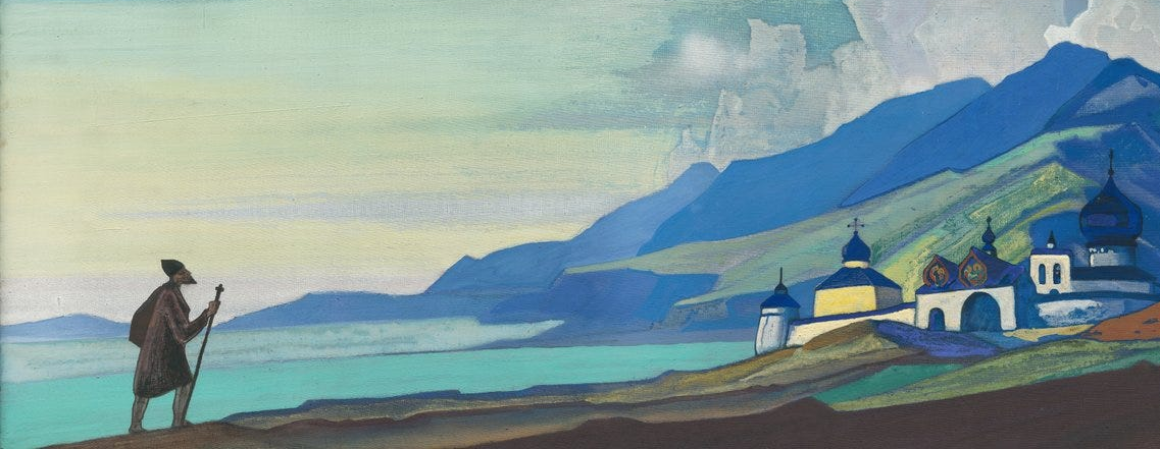
Mai 68

Lest we forget, 40 years ago this month it was “Mai 68”, that is, it was May 1968.

For most Americans (like me) the protests and riots that raged in France in 1968 are largely unknown. Like many protests of the 1960s there are questions as to their ultimate effectiveness. Certainly de Gaul was eventually pushed out, signaling a change from conservatism to liberalism. And, of course, Langlois was restored to his position, which was a part of the whole Mai 68 thing, though protests on his behalf started even earlier than May. But who really knows if any particular protest changed anything that would not have inevitably been changed anyway. And yet, those were glorious days, so I have read.

Here is a nice overview of some key elements of Mai 68:

My français is a bit rusty, but this is a nice retrospective timeline from French television:

There is a part of my soul that loves those protests in France, much like I love the protests in the U.S. in the 60s, or the anti-war protests and anti-globalization protests in recent years. Protesting is so romantic. Many cinephiles may not know that filmmakers shut down the Cannes festival (mentioned in the overview piece above) in 1968 as well.


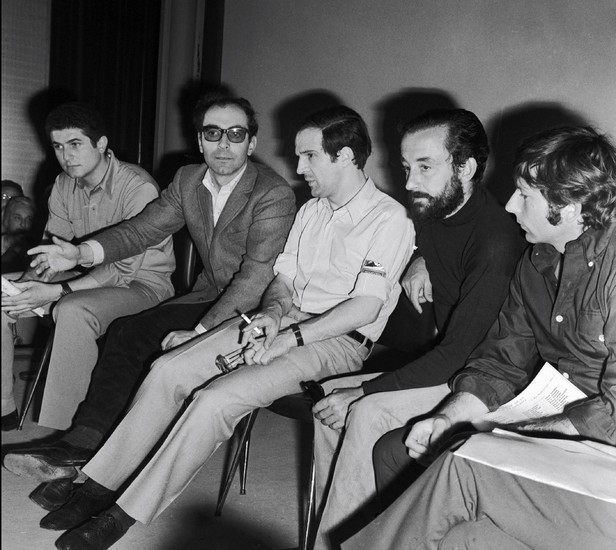
The gang’s all here. Can you name each filmmaker in the photo?

This is a wonderful verité piece showing the debates among the filmmakers at Cannes deciding what their protest was going to mean and what actions that would require:

The fact that Cannes was closed down in 1968 shows that, as a film festival, it had clout, that it was important, and that films were important. I would love to see the Oscars shut down in protest to any number of things, such as the war in Iraq. But that would mean the Oscars are important and are we ready to admit that?

Special bonus: Captain Beefheart live in 1968 on the beach in Cannes.

*Filmmakers in the photo, left to right: LELOUCH, GODARD, TRUFFAUT, MALLE, POLANSKI

>the youtube elections

>YouTube has been upon us for some time. Now it is playing a big role (maybe?) in the current U.S. presidential elections. Combined with the real possibility for some changes in U.S. governance, not a few have been inspired to create videos for YouTube (et al). These videos range from the well produced, pro-Obama music video Yes we can to a lot of poorly produced detritus.

Below are two of the most creative pieces* I’ve seen so far.

Maybe we are entering the age of the “super-mashup”. Whatever it is I have to say I want to see more of this kind of thing. And yet, it will be interesting to know if the viral video will truly tip the scales to any one candidate. I have to say it must be a bit more scary to be in politics today because of the viral video.

*I know the clips and links in this post are all pro-Obama. I am not, however, intending to promote Obama more than he deserves.

>I’m voting Kierkegaard in ’08!

>Politicians come and go, but philosophers linger. Which one will you vote for? Remember: A vote not cast is a vote for the winner!

Below are three adds for Kant, Nietzsche, and Kierkegaard respectively.

How can I not vote for a philospher who says:

I begin with the principle that all men are bores. Surely no one will prove himself so great a bore as to contradict me in this.

~Soren Kierkegaard

>Buckley & Chomsky (plus a poet)

>I always found William F. Buckley Jr. (1925 – 2008) mesmerizing, and frequently infuriating. When I was younger I liked his politics. As I became older, not so much. But he was so good at what he did. And when one looks at clips from his show, one cannot help but remark that he was a unique individual and brilliant spokesman for his team. He was also much into sailing, which I can appreciate. And he was a devoutly religious man (so I’ve read) which bodes well for him.

Although these clips of Buckley are posted plenty elsewhere, I figure if I can get in a clip of Noam Chomsky (another mesmerizing and infuriating person who I like very much) at the same time I will. Here Buckley debates Chomsky:

Part 1

Part 2

It is rather frightening just how relevant their discussion is today.

Interestingly, for all his ego and need to dominate in the area of ideas, Buckley was also a gentle person who could be rather long suffering. Here he is suffering through Allen Ginsberg (a mesmerizing and infuriating poet, who I also like very much, up to a point):

Classic.

>Semiotics of the Kitchen

>

As a matter of fact one is continuously anticipating expressions, filling up the empty spaces in a text with the missing units, forecasting a lot of words that the interlocutor may have said, could have said, will certainly say, or has never said.

>>Umberto Eco, A Theory of Semiotics 1979, p. 136

After reading Tram’s post (see: A Room of One’s Own) regarding Chantal Akerman’s Jeanne Dielman (1976), I was reminded of another famous examination of domestic life, Semiotics of the Kitchen (1975) by Martha Rosler. The first time I saw this short film I was in college studying film theory and loving it. I was blown away by Rosler’s piece, not merely because it was an exploration of the very of the concepts I had been studying, but also that she found a way to make semiotics funny (in a dry humor sort of way). Semiotics of the Kitchen was considered a seminal work of the period and shown for years in college film departments and media studies classes, etc. I wonder if it is still watched much anymore.

Semiotics of the Kitchen