Who inherits the earth?


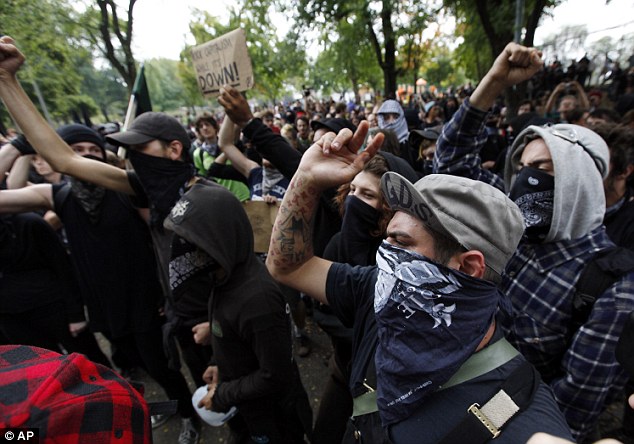
Protesters outside the G20 in Pittsburgh
demanding fundamental change.

Consider these quotes:

“The great and chief end…of men’s uniting into commonwealths and putting themselves under government, is the preservation of their property.”

~ John Locke, 1689

“But as the necessity of civil government gradually grows up with the acquisition of valuable property, so the principal causes which naturally introduce subordination gradually grow up with the growth of that valuable property.”

~ Adam Smith, 1776

“Till there be property there can be no government, the very end of which is to secure wealth, and to defend the rich from the poor.”

~ Adam Smith, 1776
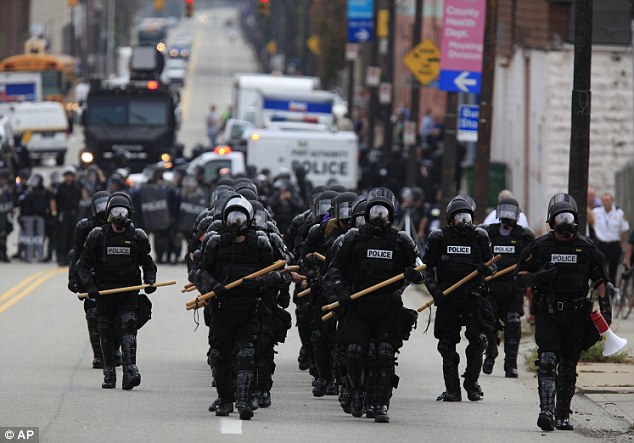

Pittsburgh police, defending the rich
from the poor at the G20.

If you didn’t know who wrote these words you might think they were from the pen of Karl Marx. Interesting. More substantive than economic systems and their ideologies (and their debates) is the concentration of power and its supporting hegemonies. In other words its all about who inherits the earth and how they keep it. Little do they know…

“Blessed are the gentle, for they shall inherit the earth. ”

~ Jesus, c. 30

The gentle, or meek, have a different relationship to property and wealth than those who climb over others to make the world their own. It is not that they do not want the world, it is that they recognize having the world for their own is not worth being the kind of person who has no interest in loving others as their primary motivation. To love the world is to give up loving people. It is not a good trade – no matter how free the market. Gaining the world is not worth a lousy character, and no amount of economic ideology can convince otherwise.
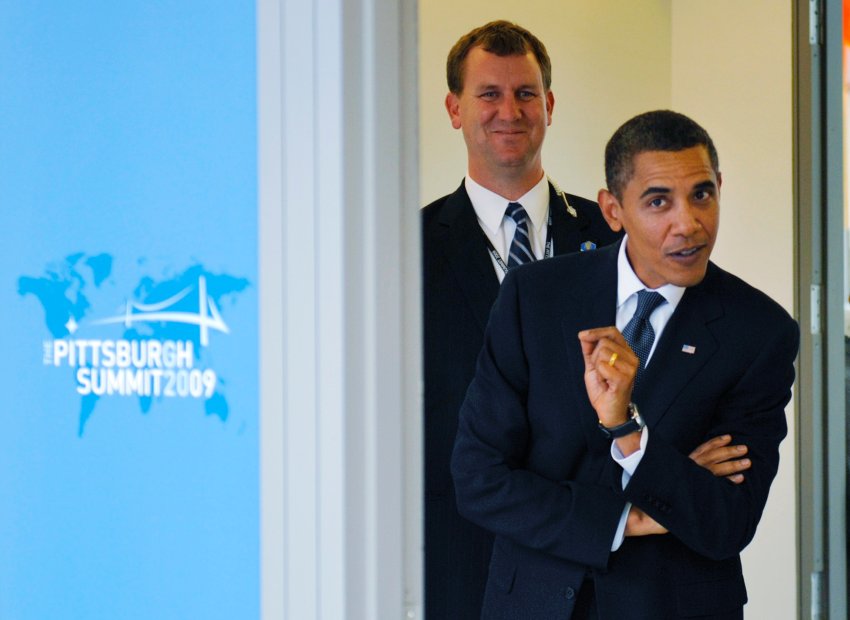

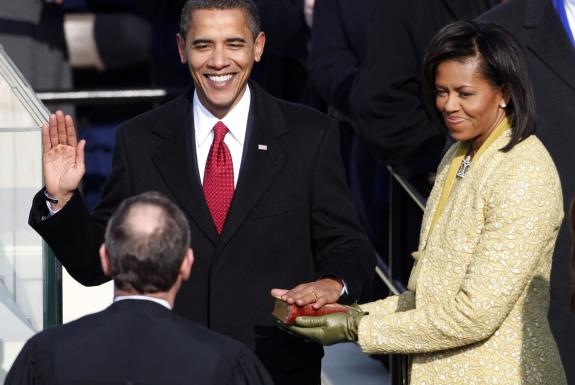
Mr. Obama hamming at the G20.

Questions of character are always personal, but what about our institutions of power? We live in a world that places a kind of sacred halo around the idea of private property. We know that the Declaration of Independence almost contained the phrase “life, liberty and the protection of property.” I don’t want anyone to take my home away from me, but I have to think that the ownership of property and all its attendant rights (real or perceived) only gets understood as sacred in a world that has turned its back on truth. The irony is not merely that to gain the whole world is to lose one’s soul, but also to gain one’s soul is to gain the world.

There is that old adage that all governments lie. It is just as true that governments, first and foremost, exist to protect the haves and the things they own. Only secondarily, and usually through great struggle, are benefits secured for the have-nots.

I stand, in spirit, with the protesters who call for change and accountability from our governments and the captains of industry. I stand against the obvious seeking of power and influence for selfish ends. I stand against clearcutting forests and mountain top removal mining, and against the pollution of our air and water, and against insurance companies managing our healthcare, and subsidies to weapons manufacturers and to farmers of vast genetically modified monocultures. And I stand against the use of violence to solve problems, such as the wars in Iraq and Afghanistan. (The list can go on and on.) On the other hand, I cannot demand that those in power give up the world, as it were, so that I might have it instead. Though my power and influence is small, I am not morally superior than they. Rather, they must give up the world because it does not belong to them.

>the more things change…

>Consider the following paragraph below. It is from an introduction to Karl Marx’s Capital Volume 1. It was written in 1976 by Ernest Mandel. I was struck by how much it describes our current day.

Periodically the bourgeois class and its ideologues have thought they have found the stone of wisdom; have felt able, accordingly, to announce the end of crises and socio-economic contradictions in the capitalist system. But despite Keynesian techniques, notwithstanding all the various attempts to integrate the working class into late capitalism, for over a decade now the system has appeared if anything more crisis-ridden than when Marx wrote Capital. From the Vietnam war to the turmoil on the world monetary system; from the upsurge of radical workers’ struggles in Western Europe since 1968 to the rejection of bourgeois values and culture by large numbers of young people throughout the world; from the ecology and energy crises to the recurrent economic recessions; there is no need to look very far for indications that capitalism’s heyday is over. Capital explains why the sharpening contradictions of the system were as inevitable as its impetuous growth. In that sense, contrary to a generally accepted belief, Marx is much more an economist of the twentieth century than of the nineteenth. Today’s Western world is much nearer to the ‘pure’ model of Capital than was the world in which it was composed.

Of course, capitalism has had a few more years of its so-called “heyday” since 1976. But maybe we are seeing bigger cracks in the system today than in the past. And yet I don’t think we’ve seen the last of capitalism for a long time now. Marxists have been saying for more than 150 years that capitalism is going to collapse any day now, but it keeps trudging along – making some rich beyond measure.

I must also say that it was fun typing this up while listening the the soundtrack from Repo Man.

>What is Democracy? Beyond Elections documentary

>Democracy is one of those words, like love or justice, that we all know intuitively what it means, but then again we don’t really know as well as we think. I am often surprised by how much I don’t understand democracy and its implications, let alone how it plays out in different parts of the world. Below is the the first part of a documentary on the topic of democracy in the Americas. This might be a good place to start re-examining what democracy is all about.

You see the rest of the documentary here.

>Capitalism Hits the Fan

>Professor Rick Wolff is a passionate and animated lecturer. He is also a Socialist. With all the discussion these days about the supposed Socialist solution proposed by the Bush/Obama power brokers, it might be worth understanding what an actual Socialist perspective is all about. (This video was recorded before Obama was sworn in as president.) I have to say Wolff’s analysis is, at least, fascinating and worth thinking about. Truth is, Karl Marx’s understanding of Capitalism is a powerful critique and possibly more important than ever.

http://vimeo.com/moogaloop.swf?clip_id=1962208&server=vimeo.com&show_title=1&show_byline=1&show_portrait=0&color=00ADEF&fullscreen=1

As with most Socialist/Communist proposed “solutions” to things like economic crises, labor issues, government regulations, market fluctuations, and the like, I am not sure where I stand. I am not yet a Socialist, but can’t say I’m a Capitalist either. Wolff’s conclusions in this video also seem somewhat simplistic to me, but that might be because he had limited time to speak. My guess is that given more time he could give much more detail and answer objections.

>a curious absence

>I am curious and concerned about the popular reaction in the U.S. to the economic crisis. The reaction seems to be a combination of moral outrage and complete acquiescence to the “current financial situation,” or whatever we’re calling it. The American people (including myself) are complaining a lot and doing little.

Publicly protesting is not a complete solution by a long shot, but it can be an important element in changing our society for the better. In numerous places around the world over the past several months there have been protest and strikes in response to the global economic meltdown and various governments’ actions. Here are some:

Protests in Eastern & Central Europe

Protests in France

Protests in Greece

So where are the protests in the U.S.? This is the country most responsible for the problem. This is the country doling out the largest dose of corporate welfare (in an already corporate welfare state) in world history to those companies most culpable. This is the country in which those government leaders and those captains of Wall Street who created the policies that made the collapse as easy as possible, are the same one’s now hired to fix the problem. There is a lot of outrage for sure, and many ordinary Americans have played their part in the mess as well, but it seems everyone is just sitting by hoping things will get better.

It appears to me the fundamental issues underlying the problem are moral and systemic. Both of which should send people into the streets. But, so far, not in this country. Any thoughts?

>Reading Marx’s Capital with David Harvey

>For forty years David Harvey has been teaching Karl Marx’s Das Capital. Recently his 13 part (two hours each) lecture series has been made available through iTunes. [Go to iTunes/iTunes Store and search for either “Reading Marx’s Capital” or “David Harvey.” You can choose either the video version or the audio only version.]

Harvey’s goal is to truly understand what Marx was saying rather than preach some standard line about Marx. He is a fan of Marx and so one could label him a Marxist, but his studies often end up undercutting the popular myths about Marx. As one would expect, that undercutting is one of the benefits of a close reading.

The first 5 or 6 of the lectures are also available on Google video. Here’s #1:

http://video.google.com/googleplayer.swf?docid=-5820769496384969148&hl=en&fs=true

>Conquered and held by free men…

>Happy 150th Birthday Oregon.

Of course, I find it rather troubling to live in a state that exists, in large part, because the indigenous peoples who were living here were conquered. But then, so exists the U.S.

>Hauerwas on Bonhoeffer

>I have been reading Stanley Hauerwas’ book The Peaceable Kingdom: A Primer in Christian Ethics and I love it. I must say that this book, along with some others, are encouraging my views to change (views that were trained into me by the chistianity in which I grew up) regarding politics, faith, and action. In other words, I am slowly shedding my Baptist/Evangelical acceptance (dare I say love) of “righteous violence” and “just war” for a more pacifist perspective.

Because I know little of Hauerwas I went looking for him on the Interwebs. I came across this lecture of Hauerwas speaking on Dietrich Bonhoeffer’s perspective on truth. It is excellent.

>Occupation

>

When it comes the plight of the Palestinians I don’t trust what I hear coming from either the Israeli government or the U.S. government – and not merely because governments lie. And, of course, I certainly do not support the actions of any group that uses terror against civilians to push forward their political goals. So, that means I don’t support Hamas. But it also means that I don’t support the Israeli government in its present form very much. But it is hard for me to have an opinion, being so far away geographically, socially, and informationally.

If you are like me then you probably don’t know a lot about the Israeli occupation of the West Bank and the roots of the recent Israeli invasion of Gaza. If I have learned anything about what is going on over in Gaza and the West Bank, as well as the rest of the Middle East, it is that I am quite ignorant of the facts. I am not willing anymore to parrot the typical American refrain that “those people have been fighting forever and they will always fight.” (I have become increasing wary of the term “those people” however it’s used.) If they have always been fighting then it follows they were fighting during the time of Christ, and if that is true then the admonition to love one’s neighbor as oneself, or the story of the good Samaritan, or the conversation Jesus had with the woman at the well are meaningless if there is no hope for peace.

The two videos below take a look at life under occupation from a particular and personal perspective. These videos were made before the recent invasion of Gaza and the war against the Palestinian people. Although the audio is sometimes rough this is the kind of news/reporting/insight that the rest of the world needs even if only as a kind of starting point to begin discussing the issues rather than falling into the typical stereotypes and worn out stigmatizations. It is particularly important for American Christians to view, for they are some of the most ideologically driven and yet least informed people when it comes to Israel.
http://vimeo.com/moogaloop.swf?clip_id=2726126&server=vimeo.com&show_title=1&show_byline=1&show_portrait=0&color=00ADEF&fullscreen=1
http://vimeo.com/moogaloop.swf?clip_id=2864803&server=vimeo.com&show_title=1&show_byline=1&show_portrait=0&color=ff9933&fullscreen=1

There is mention of the organization Breaking the Silence. Their web site is here.

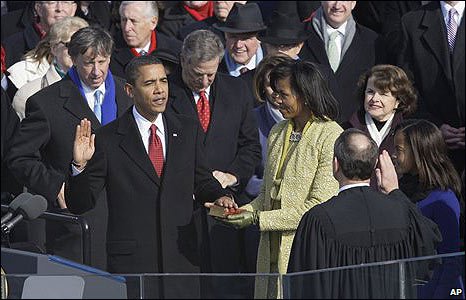
>BHO

>It is difficult for words to express what this truly means.

There is a kind of glory happening here. This, of course, is not really about Obama, rather it is a claiming of that which we know is a better idea, a nobler nature, and a call to a higher goal. While not forgetting the reality of the world we inhabit, including our own corruption, let us promote this experiment we call freedom and seek to love each other better.

I have to say this makes me happy.