>The Video New Wave (as of 1973)

>

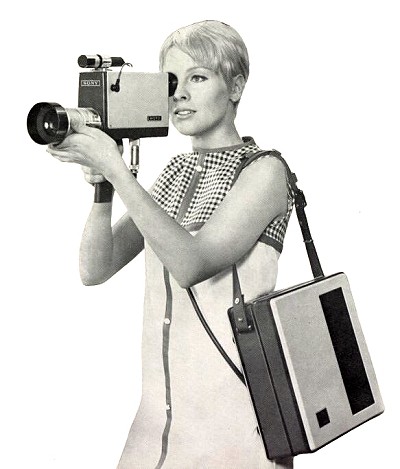
The portable video camera changed everything. In 1967 Sony introduced its DV-2400 Portapack (the Video Rover) and video production was placed in the hands of ordinary people, almost. It was still expensive, but universities could get the technology and students could take it out and start shooting. This camera system great contributed to the growth of video as an expressive and personal art form. Of course, many still used studio technology as well. By 1973 the form was established and growing, enough so that WGBH in Boston created a show on the topic (see clips below). Now our cell phones create digital videos that can instantly span the globe, or be posted online. But it all started somewhere.

1.

2.

3.

4.

5.

6.

Maybe what is most fascinating about these kinds of technologies (and I include the Internet, mobile phones, etc.) is their democratic nature. Throughout the 1970s and 1980s there was a feeling that video, because it was so portable and instantaneous, could be at the vanguard of personal expression, the interchange of ideas, and forging new ways of seeing ourselves, and thus creating a better world. And it was, though a better world has proven to be elusive. In the 1990s those hopes shifted over towards the Internet, which has proved to be even more conducive to the spread of ideas. But our heritage includes a heavy (by today’s standards), black-and-white, reel-to-reel, portable video tape recorder and camera system invented in the 1960s by a Japanese corporation that would later give us the Walkman, Compact Disc, and DVD.

>…they’ll be dancin’ in the streets (and elsewhere)

>Did you ever have a goofy idea that turned into something really grand? One reason I love the Internet is how it gets people jazzed about producing and posting things that would otherwise have been just another “wouldn’t it be cool” idea discussed over beers.

Example: This guy made this video:

If you want to watch it in Hi-Res, go here and choose the “watch in high quality” link under the video.

I should add this was sent to me by my friend Brian. Thanks Brian!

>i met the walrus

>If you were 14 years old, had a tape recorder, and was able to sneak into John Lennon’s hotel room to ask him some questions, what would you ask?

If you still had that tape recording 38 years later, what would you do with it?

>hazmat

>

Fortunately I had already left the building before the fun began. A couple days ago someone at my work received a letter that was intended as a threat (or maybe a joke, but if so, it was a dumb joke). Apparently the letter claimed to contain anthrax. It turned out to be granulated sugar, but until that was confirmed the situation was taken very seriously. The building was locked down. About 800+ employees still in the building had to remain until 8:00 PM. The local hazmat team (pictured above – taken by a co-worker) arrived and did their thing. The FBI showed up too, as well as police. The whole thing was on the local news. No one yet knows who sent the letter or why.

Advice: Leave work before the mail is delivered.

>last night’s lunar eclipse

>

It is difficult to get a good picture of a lunar eclipse with a standard camera and no tripod. Plus there was a lot of city light flooding in. Regardless, pic or no pic, you “had to be there” anyway. I hope you were. It was beautiful.

>some (not-personally-related-to-me) events that happened new year’s

>Two things you might have missed New Year’s Eve, each important (and not important) in their own way:

1. The new Radiohead concert film Scotch Mist

Okay, so it’s not A Hard Day’s Night, but I love these guys, and this kind of thing truly inspires me. I’ve got to do a better job of learning to play my telecaster!

2. The new record for the longest motorcycle jump

My first thought was “get thee to a James Bond movie.” Don’t you think Bond films should once again set the standards for record breaking stunts? Sign this guy up.

Xala, imperialism, and bottled water

About two days before the great African filmmmaker, Ousmane Sembène, passed away on June 9th of this year, I got the urge to watch one of his masterpieces, Xala (1975). Recently I also watched one of his earlier films, Black Girl, and wrote about it here. Needless to say I was surprised at his death. And I have been thinking of Xala ever since, and in particular two structurally and thematically intertwined scenes that feature the use of bottled water.

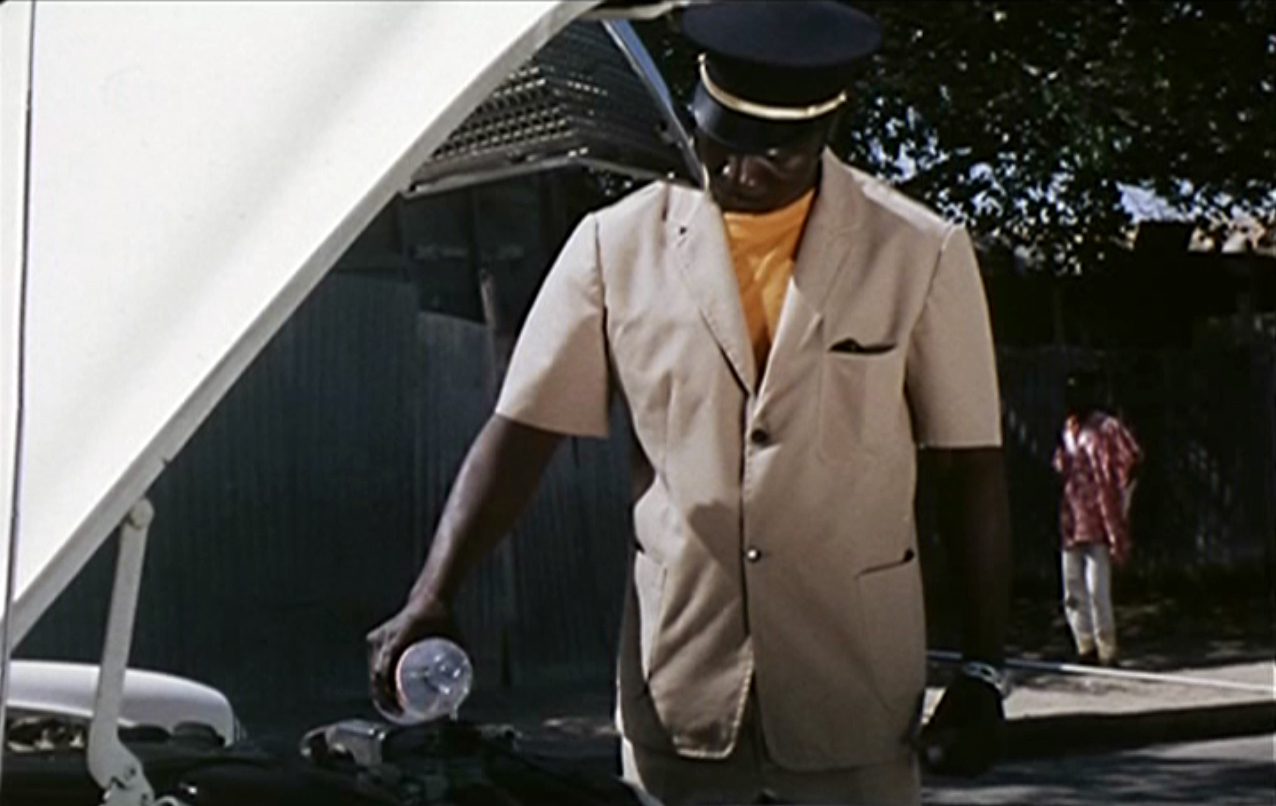
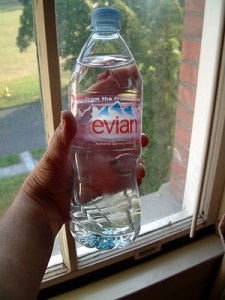
Here we have the chauffeur pouring a bottle of Evian (a French imported water) into a bucket so that a street beggar can make a buck washing the car:

Here the chauffeur pours another bottle into the car’s radiator:

These shots are meant to display a kind of ambivalence towards the product (Evian).

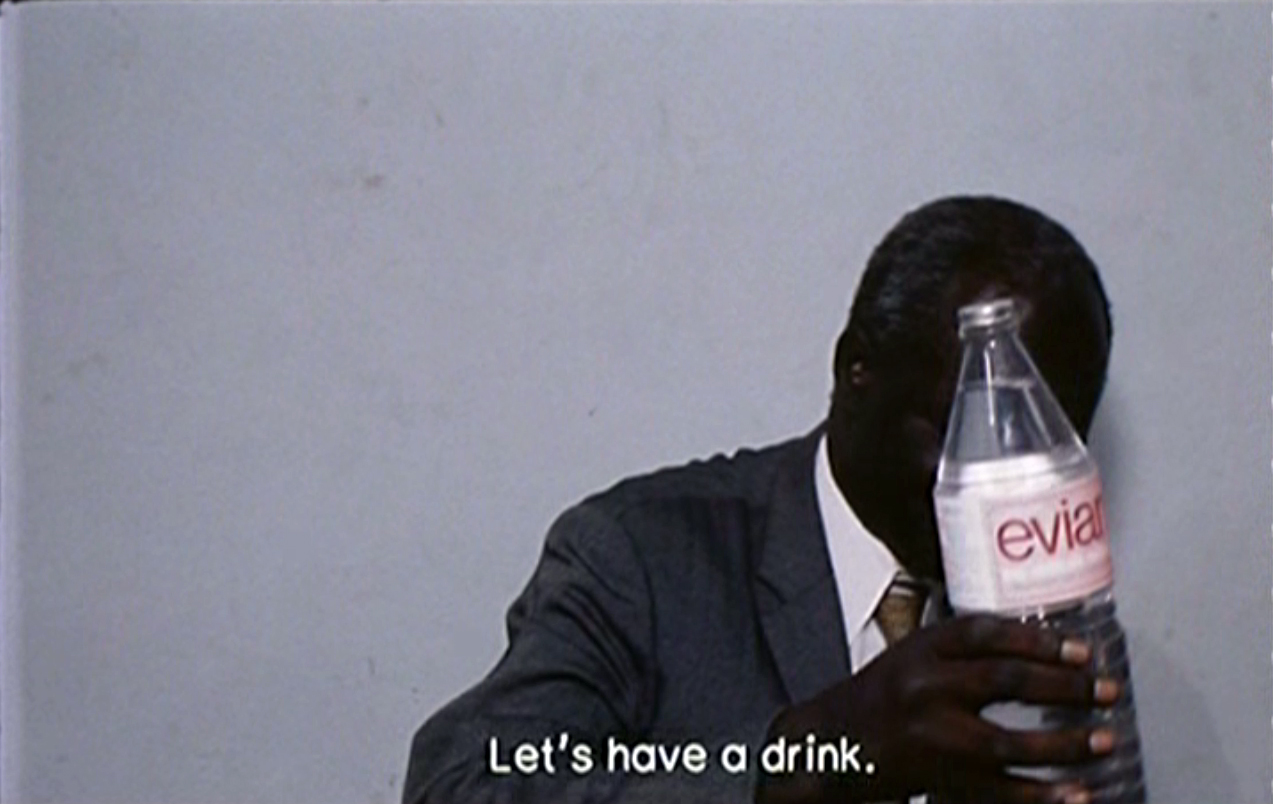
Here we have government minister Hadji Aboucader Beye (the main character if one does not count Africa itself as the main character) offering some Evian to his daughter who has visited him in order to confront him about his marrying a third wife:

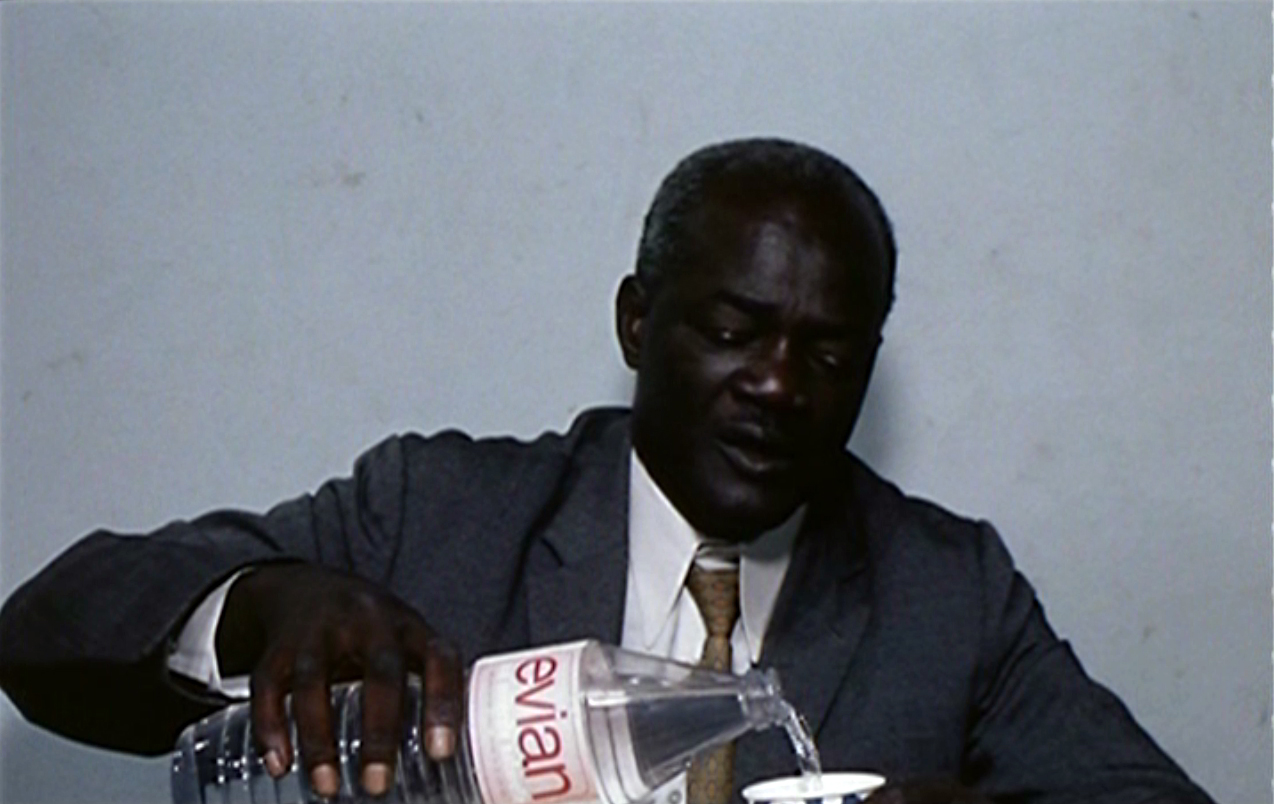
We watch Beye pour himself a drink – the daughter declines:

Emphasis is placed on Beye’s preference for Evian:

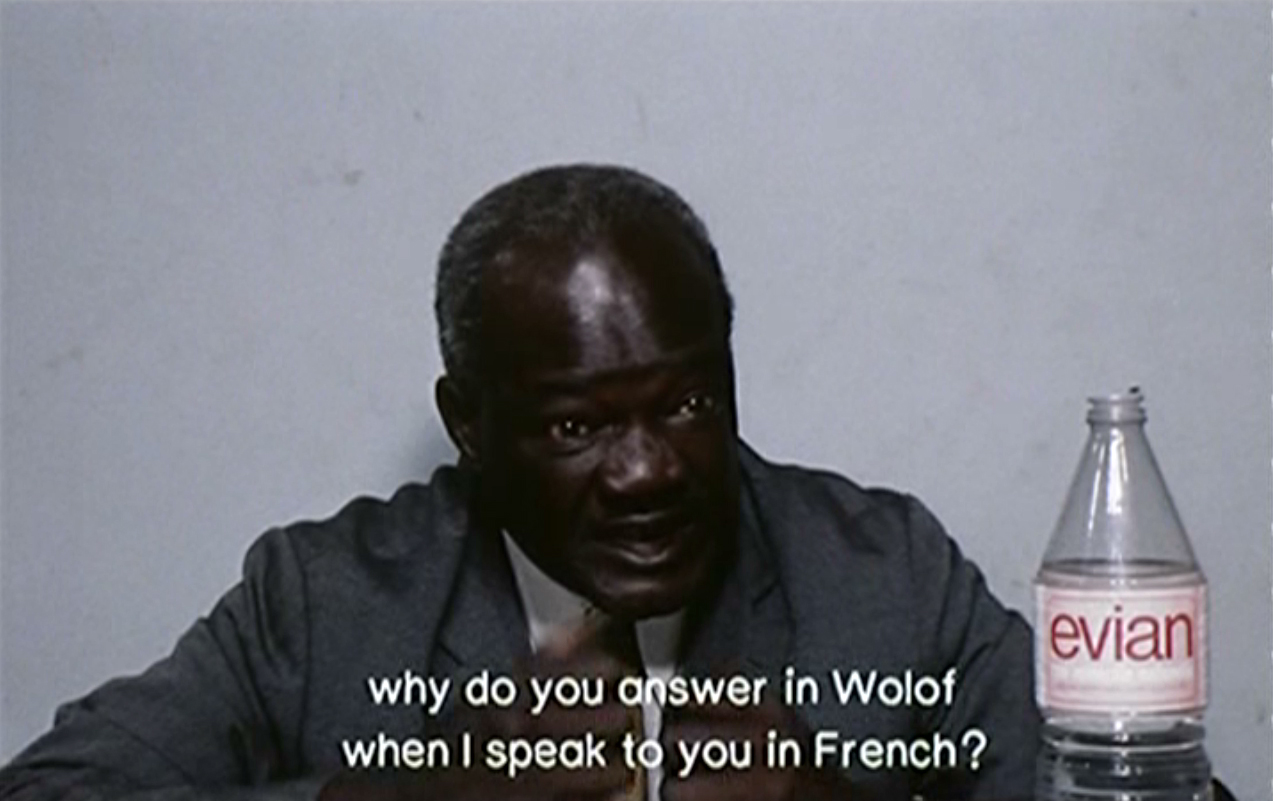
Beye speaks to his daughter in French. His daughter speaks to him in the native Senegalese language of Wolof – which upsets Beye:

In these two scenes an apparently innocuous product, a bottle of Evian water, is used as a kind of metaphorical device standing for the continuing hegemonic power of colonial imperialism, even when the former colony has now gained its Independence. Senegal had been a French colony from about the 1850s until 1960. Xala pokes very serious fun at how the newly elected leaders of Senegal ruled for their own self interests, were corrupt, and were still trying to emulate their former masters.

The bottle of Evian also raises the issue of how products play a role in defining cultures and individuals. As consumers we make choices based on needs and desires. Our choices say a lot about who we are and what we value. Just as when we speak our native tongue, or that of another, the products we buy have a kind of symbolic language that is both an expression of who we are and changes (even slightly) the world in which we live. Brands can have real power in the world, but that power is given to them, not inherent to them. In Xala we find that products are not disconnected from culture or power. Not surprising coming from a Marxist like Sembène.

Needless to say, I like Evian, and probably a lot of other products emblematic of imperialism, free trade, and neo-classical economics – for example: Nike, Coke, iPods, low prices, instant gratification, and even organic food grown on farms around the world using low-cost labor. I like to think I am independent of those products, but am I really?

Some good examinations of Xala:
Symbolic Impotence: Role Reversal in Sembene Ousmane’s Xala
Xala at Louis Proyect
The Guardian review

>the six degrees of a Russian camera

>

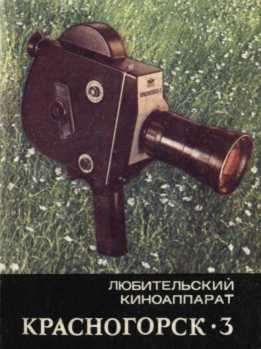
I used to own a camera like the one above. It did not, however, become my ticket to fame and fortune. And yet…

Degree 1: Kevin Bacon was in Mystic River with Tim Robbins.
Degree 2: Tim Robbins was in The Shawshank Redemption with Morgan Freeman.
Degree 3: Morgan Freeman was in The Sum of All Fears with Ben Affleck.
Degree 4: Ben Affleck was in Chasing Amy with Mike Allred.
Degree 5: Mike Allred directed (and stared in) Astroesque with Shane Hawks as Executive Producer.
Degree 6: Shane Hawks borrowed my 16mm camera (a Krasnogorsk-3; see camera above) to shoot second unit shots for Astroesque – although I don’t know if they really used it. (I also went to college with Shane and we both worked at the local NBC affiliate together, but shooting movies is cooler.)


And that’s how Kevin Bacon and I are nearly friends.

P.S. I never considered this before today when a guy I work with mentioned the connection for himself – he was in Astroesque (which I did not previously know) – and then I said to myself “Ah ha!”
P.P.S. I wish I still had the camera, but I don’t want to pay for 16mm processing.

>found object(ive)

>I love images like this one.

click to enlarge

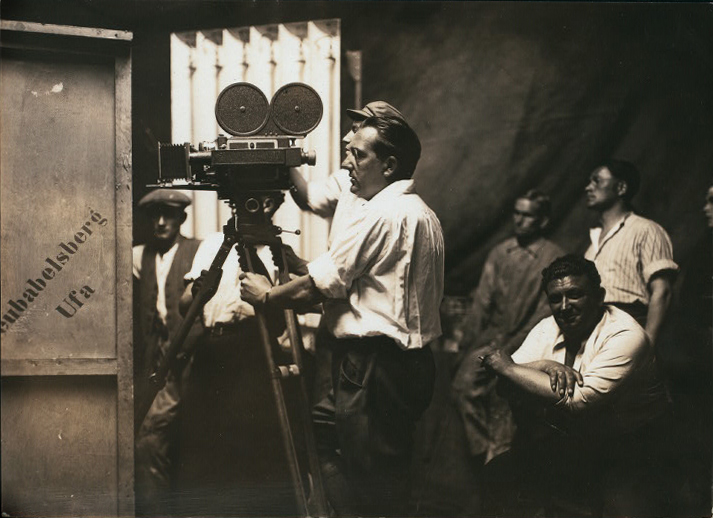
I found this image at the NYPL Digital Library. As far as I can tell, it’s just a snap shot, probably from the 1920’s, of a film crew on the set in the midst of their work. As with all film sets, there are some people working and some people standing around, but everyone wants to be there (I’m projecting my own experience and desires onto the image I admit).

This image had no information attached to it; no film name, no director name, no year, etc. However, it seems to me that the person standing closest to the camera (to us) is the director, and it looks like that person has a monocle. Plus, it’s an Ufa set. Could this be F. Lang? As it turns out, it is Lang, according to this site. But I still don’t know what film they are making. Any ideas?

Anyhow, I have this image set as my computer desktop background for now. Helps to keep me sane.

>R is for Rubik, F is for Fake

>For some reason I love this kind of thing…

Michel Gondry, filmmaker and music video director, known for such films as The Science of Sleep (2006) and Eternal Sunshine of the Spotless Mind (2004), recently made a video in which he deftly solves a Rubik’s Cube with his feet and posted it to YouTube. See Video 1:

Video 1

I really enjoy seeing filmmakers being a little weird of goofy in their “spare” time. I am not surprised the person who directed Eternal Sunshine of the Spotless Mind would be able to solve a Rubik’s Cube with his feet.

And then someone noticed… (that someone being Scott Macaulay at Filmmaker http://www.filmmakermagazine.com/ magazine) and created a video response to Gondry’s video, and posted it on YouTube. See Video 2:

Video 2


I have to say that I love what Gondry has done even more. This is just pure fun. It’s great to see a feature filmmaker having fun. It also humorously highlights that fact that all filmmaking is a kind of illusion in one way or another.