>some snaps from our vacation…

>

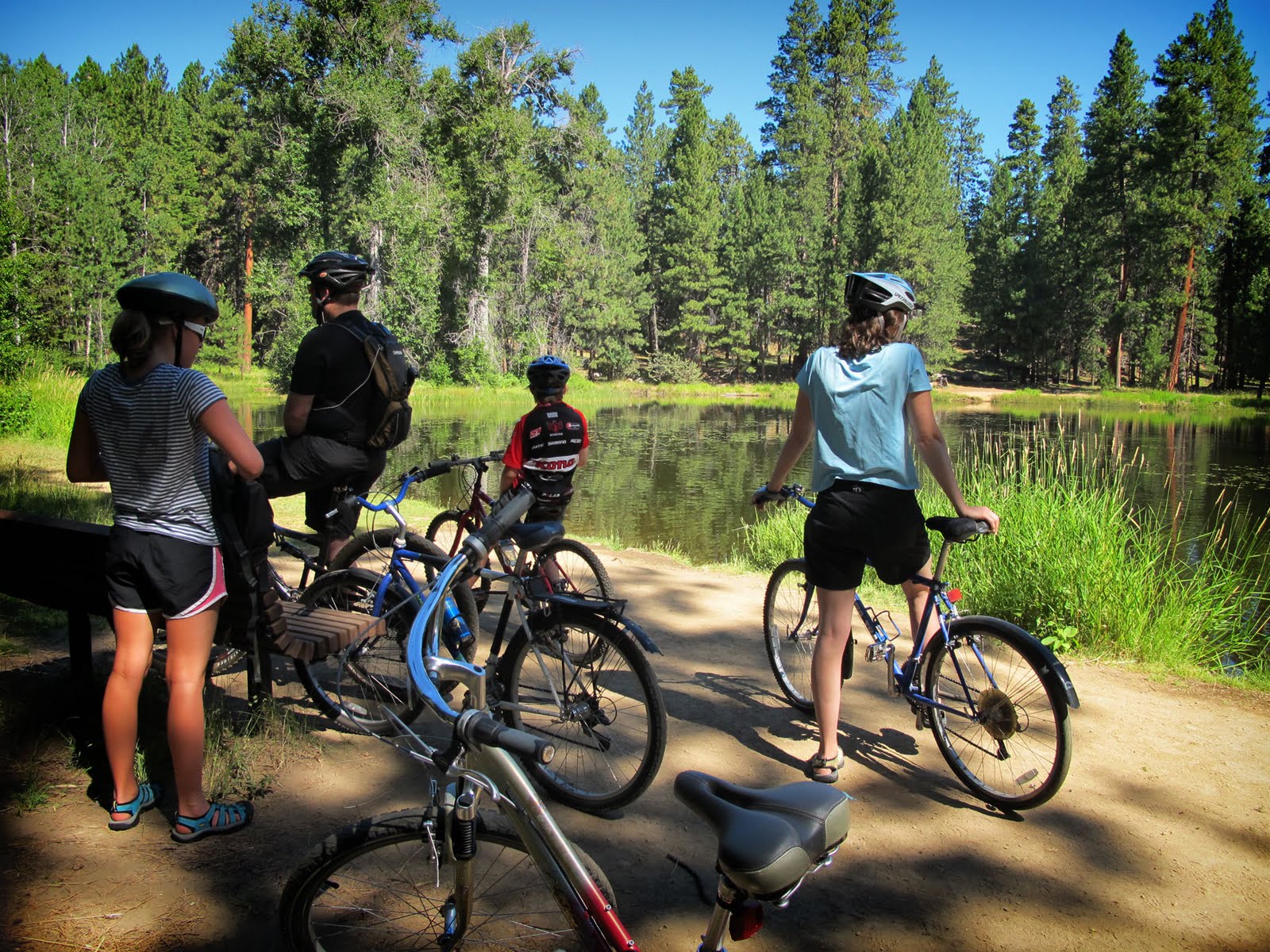
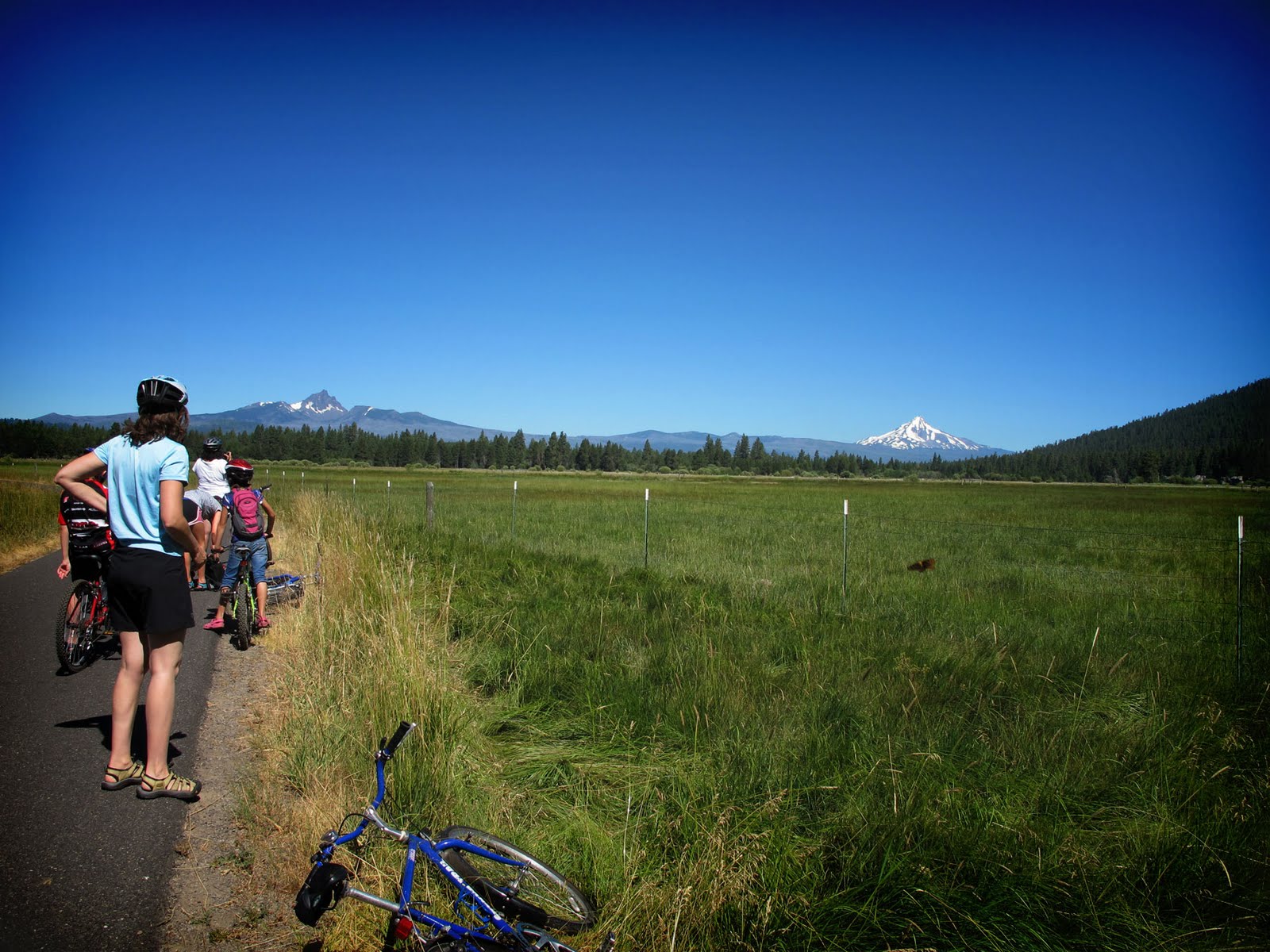
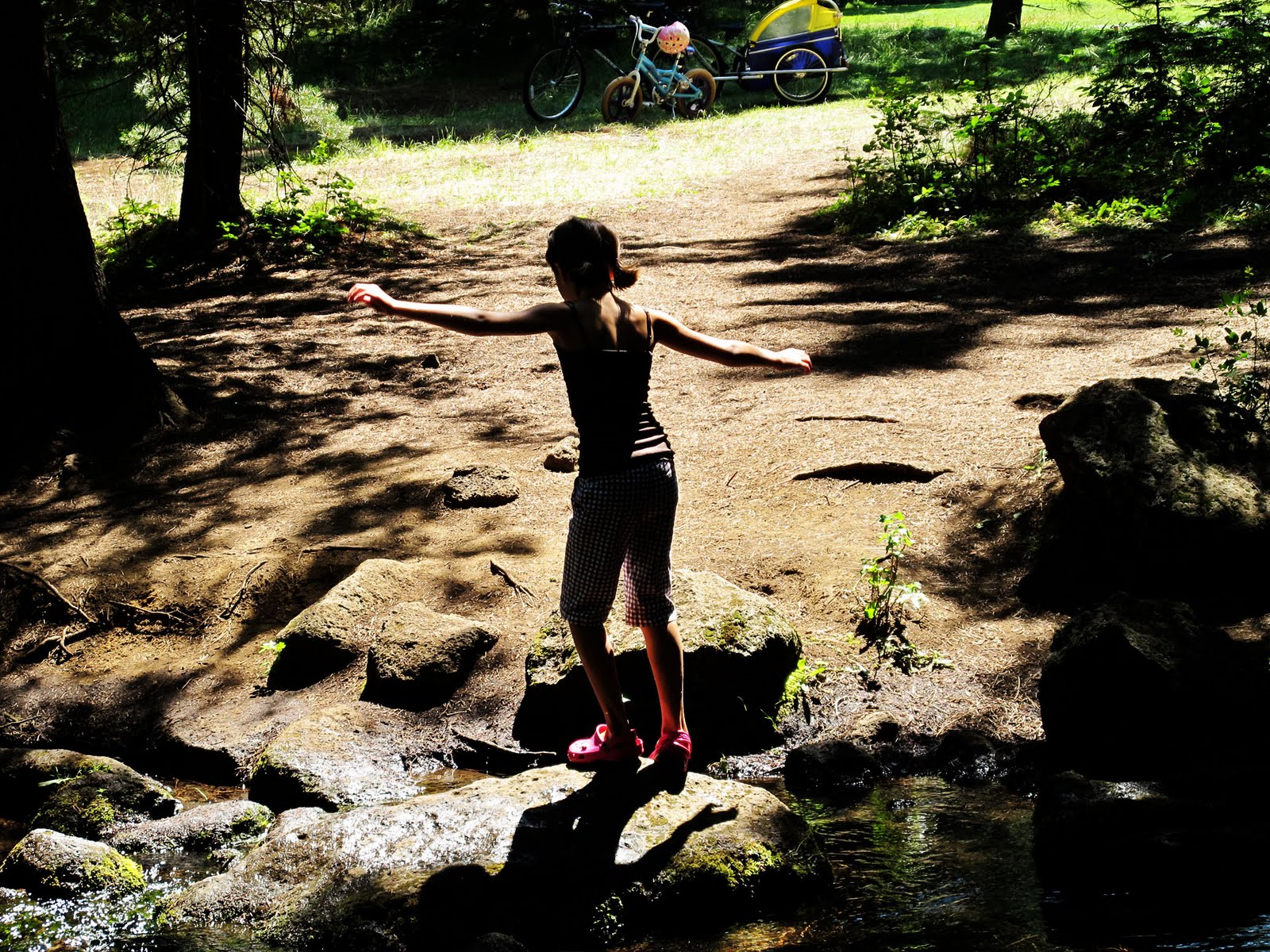
These were taken at Black Butte Ranch.

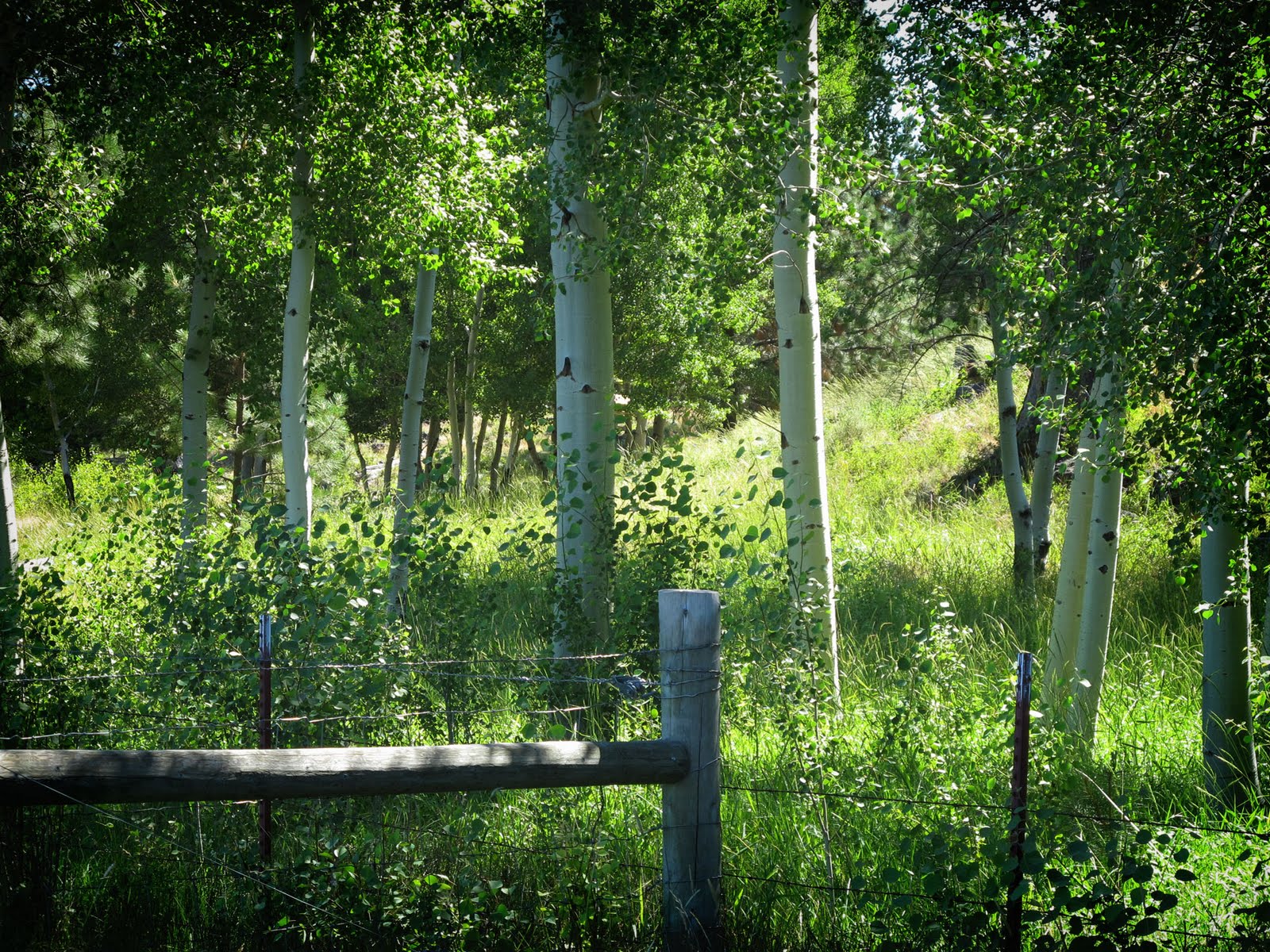
A grove of aspens.
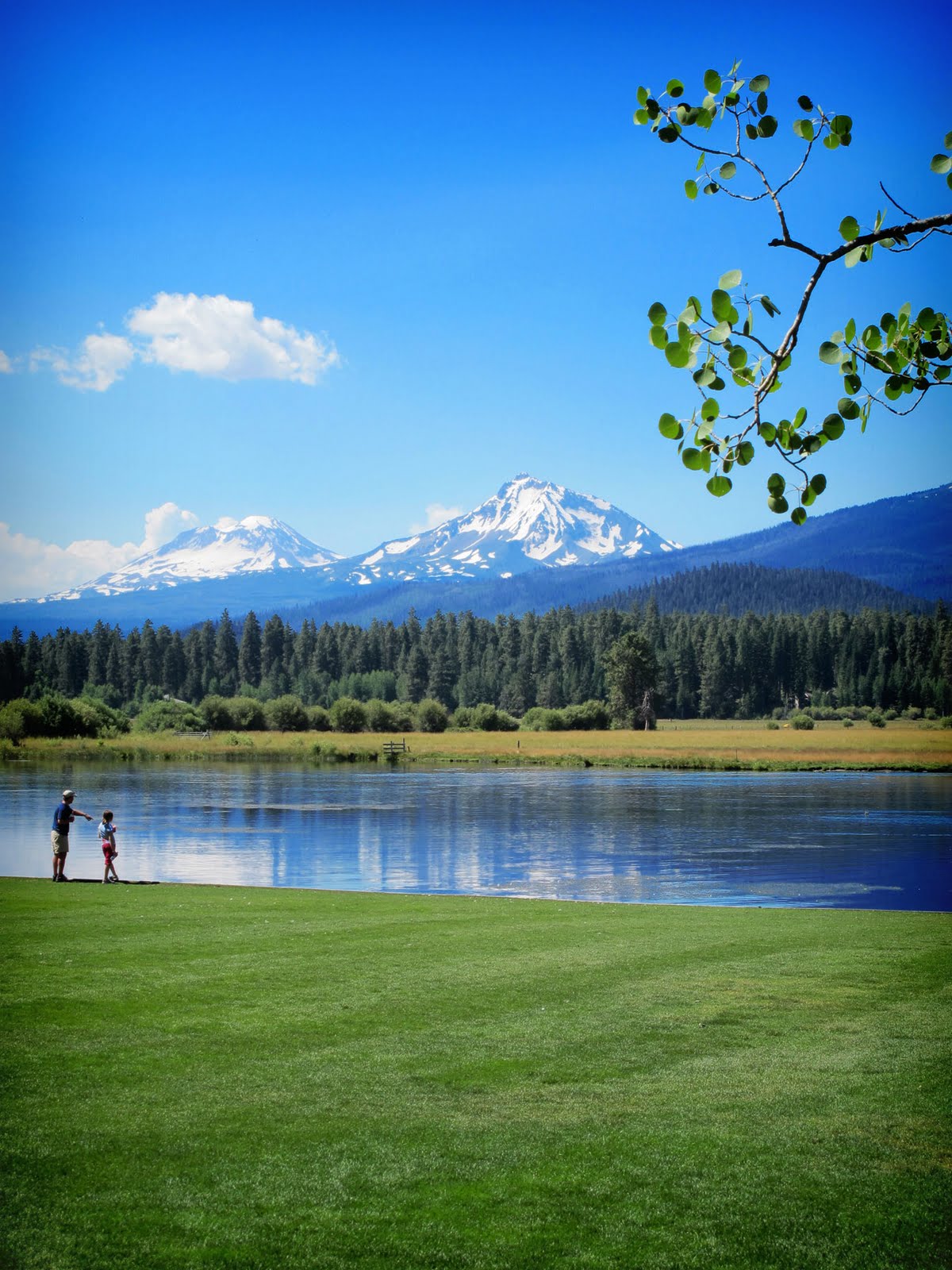
Two of the the Three Sisters rise above the lake at the lodge.
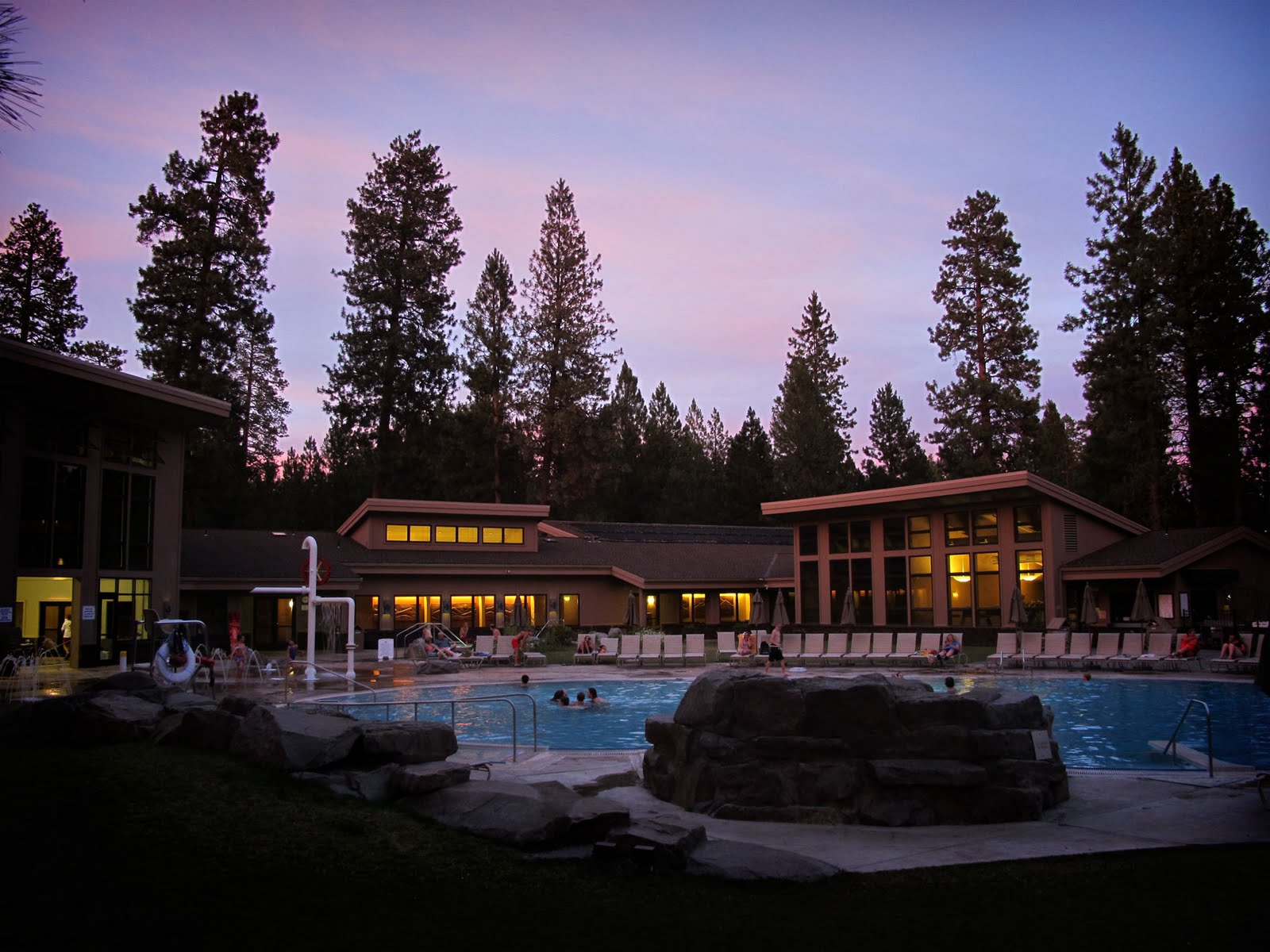
The pool at evening.
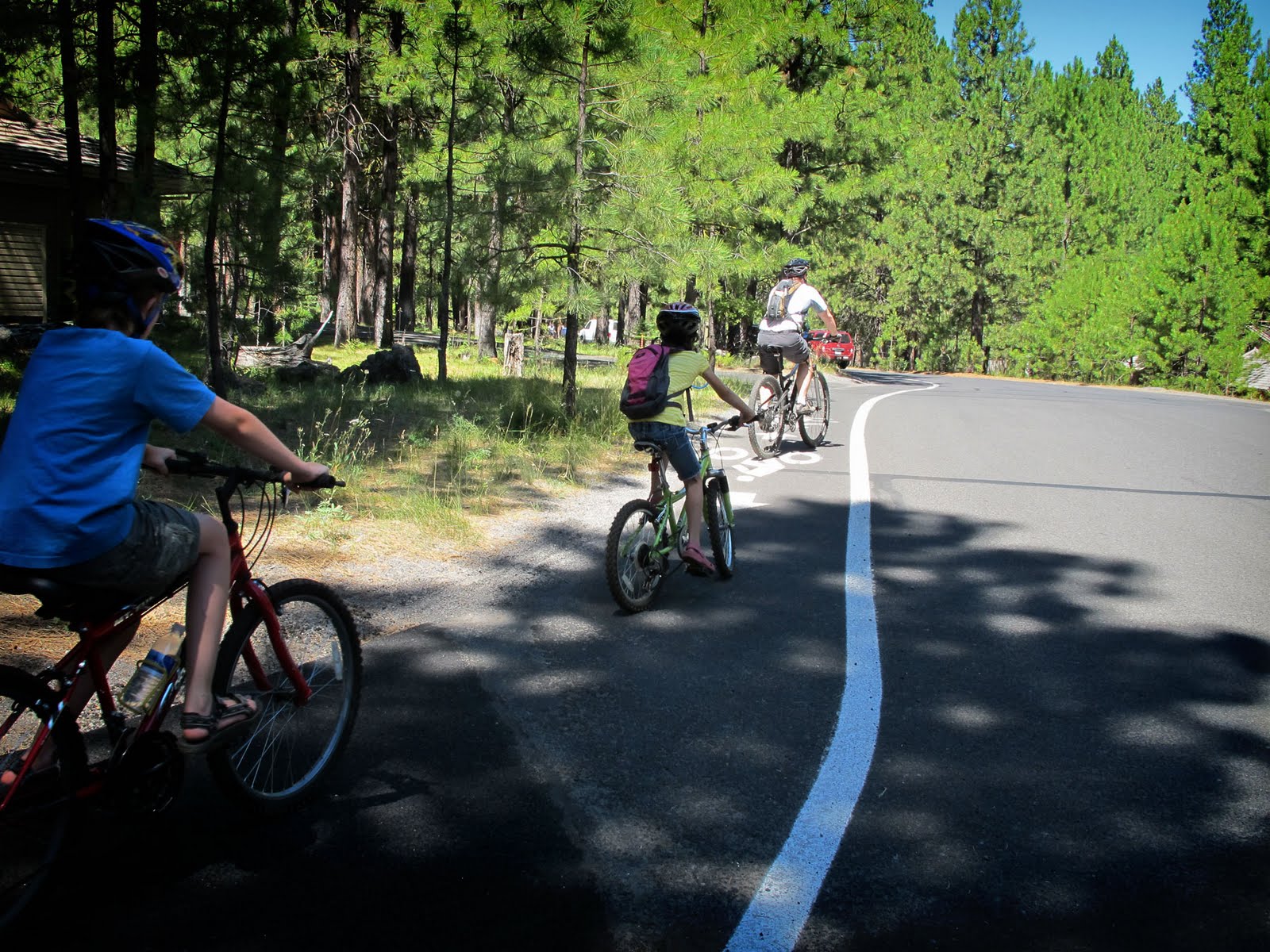
On our bikes.
Stopping by Aspen Lake.
Three Fingered Jack and Mt. Jefferson in the distance.
At the spring.

>bikes & cars

>I feel I must write this.

Yesterday I went on a bike ride (23 miles) that took me through the country. It was a beautiful morning and the ride was great. But there was an incident that got me mad. I was on a straight stretch of country road with no usable shoulder. This meant I had to ride just to the left of the white line. Everything was going well until a loan motorist decided to come as close as he could to me (about 6 inches) at 60+ mph and then blare his horn as he passed. Then as he barreled down the road his hand came out of his window and flipped me off. I did not get his license plate number. If I had I might have called the police to say the motorist tried to kill me. My speed increased by almost 2 miles an hour for about 15 minutes as my anger boiled inside me. Then my rage subsided and I rode home. Except for that one motorist it was a truly great ride. However, in the future I will consider riding with a local bike group rather than alone.

What I find interesting is that in the past two weeks I’ve had two other “incidents” with cars on my daily commute to and from work. The first was a woman in a white Lexus SUV (I’m sure she takes it 4-wheelin’ on the weekends) who was talking on her cell phone and waiting to enter traffic. As I came down the street in the bike lane she looked right at me and then decide to pull out into traffic anyway. I had to hit my brakes hard in order not to hit her. The other was about four days ago. Another woman on a cell phone in another SUV. I was entering the crosswalk on my bike. The light was in my favor. She came up on my left and then made a sudden right hand turn right in from of me through the crosswalk, cutting off my path and forcing me to hit my brakes. I missed hitting her by only a couple of inches. In all three of these cases I was in the right, playing by the rules, and if the situations had been even slightly different I would be dead or very injured. Being in the right doesn’t mean much for the cyclist when the other vehicle is a car or truck.

What is going on?

I see other signs of bicycle disregard. Cars park in bike lanes. Road crews use bike lanes to put out their road construction signs. Bike lanes are perennially filled with debris or resident’s garbage cans or piles of leaves. Cars pull into bike lanes to make turns. The list goes on. But of course I live in a country that is designed to get a car within at least 50 feet of anyplace a person might want to go. Our houses look like they are made for cars to live in along with their servants. Our lives are designed around cars. Our cities are designed around cars. Our economy is designed around cars. And yet we suffer in many ways because of cars. Don’t get me wrong. I have a car and use it. I need it, in fact. But I recognize our society’s mindset is wrapped around the supremacy of the automobile. It only takes a few days of commuting on a bike to realize that fact.

I read a recent article that compared the general attitude towards cyclists in the U.S. and Europe. The article used the interesting fact that in Europe truckers encourage cyclists to grab on to their rigs and get pulled over hills, whereas in the U.S. truckers try to run cyclists off the road. The article went on to say this is because in Europe professional cycling is seen as a working class option to “get out” and improve one’s life – kind of like boxing in the U.S. But there is more I think. There are just more people on bicycles in Europe. It’s part of their culture and part of their economy. In the U.S. bicycling is for kids and joyriding adults. It’s not serious or necessary to either life or our economy. This means, in part, that bicyclists don’t have to be taken seriously. I live in a city that is considered bike friendly. Yet sometimes I get the impression that many think the bike lanes are their as a courtesy and us cyclists should be grateful that at least we are allowed to exist at the margins.

Studies have shown that motorists tend to view cyclists as an “out group”. Put simply, motorists subconsciously see themselves as part of a group (motorists) and they hold negative views of a group they view is inferior (cyclists). This is a typical minimal group paradigm scenario.1 Not all motorists do this, but the majority do so subconsciously. Other studies have shown that the provision of bicycle lanes appears to “increase driver confidence and, hence, potentially risky behaviour, such as higher vehicle speeds and less speed reduction when encountering cyclists.”2 In other words, motorists tend to drive faster and with less regard for cyclists if the cyclists have their own lane. This may seem to make sense until one considers the consequences of a human body and a three ton car. Plus bike lanes are often inadequate, too narrow, and don’t interface well with the rest of traffic. If one is pulling a bike trailer carrying children then bike lanes are far too narrow. This is not good if motorists think the road belongs solely to them and it is the cyclist’s job to keep out of the way.3

I am not an angry person and I tend to say live and let live. But I am beginning to think of getting the license plate number of every driver who is reckless around non-reckless bicyclists and calling it in.

1 Part of this paradigm is to attribute the negative behavior of a few to all. Sometimes a person will claim that bicyclists are the ones at fault because they are reckless, don’t stop at lights, weave around in traffic, etc. But most cyclists follow the rules very well. And don’t forget those rules are, in large part, designed around the needs of automobiles and to control reckless motorists (of which there are many) rather than cyclists. Also, there is a world of difference between the mother riding safely in the bike lane, pulling her trailer with her kids, and the 20 something joyriding derelict recklessly cutting off cars. Yet many motorists don’t, or can’t, make the distinction – all cyclist are the same in many people’s eyes, they are part of that “out group”.

2 Basford, L; Reid, S; Lester, T; Thomson, J (2002), Drivers’ perceptions of cyclists, Report, 549, TRL Limited, pp. 38, OCLC 51283575

3 Years ago, when I first began commuting on a bike to work, I noticed myself becoming much more aware of cyclists whenever I drove my car. I was surprise by how much I previously did not care about, or even notice cyclists or their needs. It was a kind of paradigm shift for me. I came to the conclusion that everyone should commute in their city some of the time in order to reorient their minds to the greater word they live in.

>fast bikes

>The fastest I ever went on a bicycle was 56.5 miles per hour (according to my bike computer). That was going down a long, steep hill racing some friends. That was also on a road bike back in the day when almost nobody wore helmets. If you’ve got a ten dollar head buy a ten dollar helmet; if you’re 20 years old you don’t need a helmet, you’re invincible.

What is it about us humans that we like to see how fast we can go piloting some vehicle? I know the thrill and the challenge is a big part of it. Maybe foolishness is also a fundamental element of the Universe. I wrecked a motorcycle once at 80+ mile per hour. We measured the distance from where my motorcycle and me left the ground to where we came to a stop. It was about a 100 feet. I’m lucky I only broke my foot and got a few bruises.

Recently some cyclists have sought to set the all-time speed record for mountain bikes. I can’t say that either of them are very smart, but one comes away better than the other.

http://www.veoh.com/veohplayer.swf?player=videodetailsembedded&type=v&permalinkId=v678920NaGbASwT&id=anonymous

Well, I guess that’s all for now.

>crashing

>

Character cannot be developed in ease and quiet. Only through experience of trial and suffering can the soul be strengthened, vision cleared, ambition inspired, and success achieved.

~ Helen Keller

We can discover this meaning in life in three different ways: (1) by doing a deed; (2) by experiencing a value; and (3) by suffering.

~ Victor Frankl

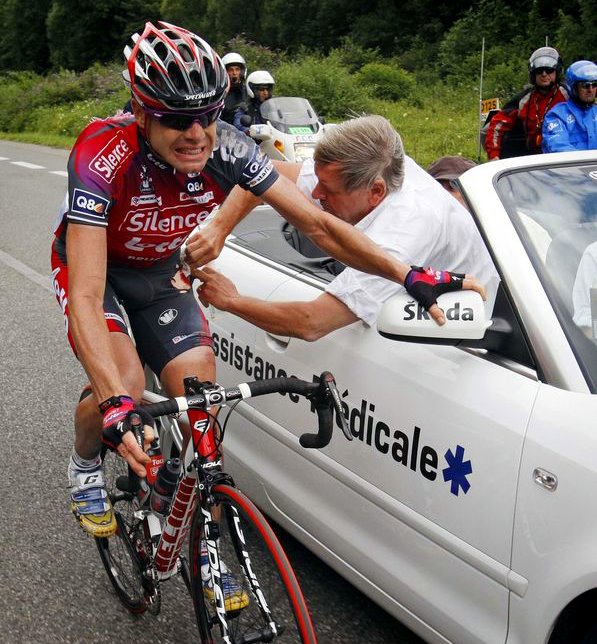
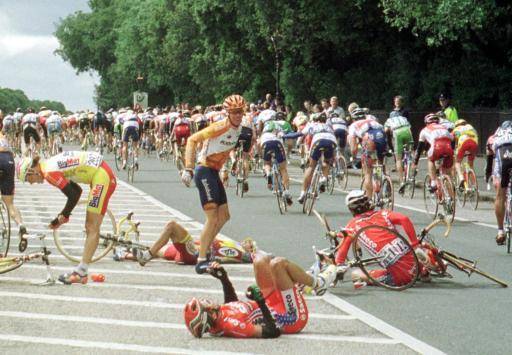
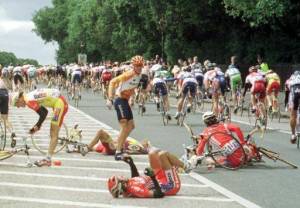
I have been riding bikes for years and have had a few crashes. Fortunately nothing serious. I am also a fan of bike racing, and especially the Tour de France, were serious crashes are all too common. Recently I was watching this year’s Tour and saw the rider Cadel Evens being treated by the race doctor for a bad tumble. Evans was scraped up on his leg, his hip, his elbow, and his back. His jersey was shredded and his shorts were ripped open. He was bleeding from multiple locations. He was also showing some concern for his left collar bone, which he has broken five different times from bike crashes. But the race didn’t stop and Evans was treated while still on the bike. (photo at left)

This got me thinking about how biking is something like life. We don’t think we will crash. Crashing is for other guys. Another word for crashing is suffering.

When bike racers start a race they do not anticipate crashing. They can’t. They must stay focused on the task at hand, that is, racing. They go forth with high hopes, knowing that they might crash, even get seriously hurt, but they don’t believe they will. The only protection they have between them and the pavement is a thin layer of Lycra.

In life we start each day with hope. We hope the day will go well, we hope the day will fulfill us and make us happy. And we tend to believe our hopes. But at any minute we can crash, literally or figuratively. Crashes can be financial or relational. They can be physical ailments or injuries. They can be the loss of a family member or friend, or the loss of a job.
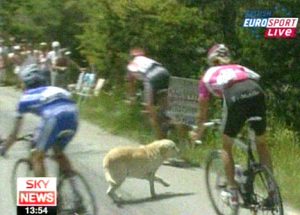
Often the cause of the crash is our own fault: We don’t take care of things we need to take care of, we don’t prepare well enough, we make choices out of selfishness or ignorance. But often the cause of the crash is something out of our control, something that comes at us and hits us, as it were, broadside.
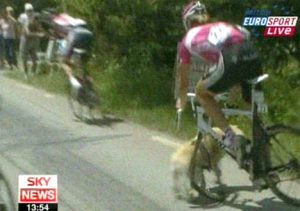
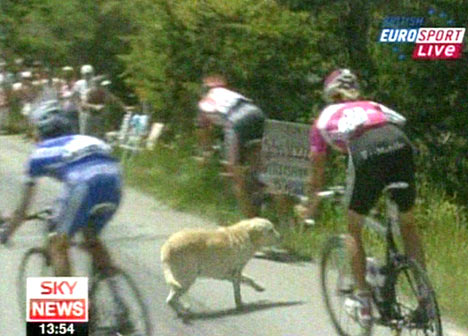
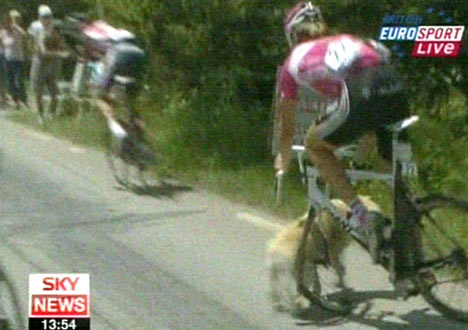
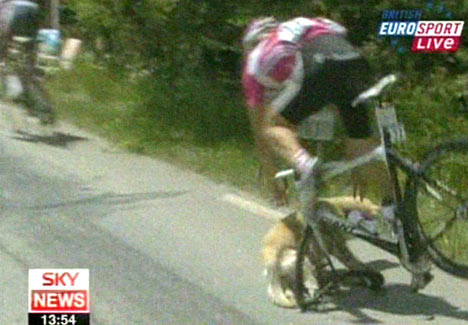
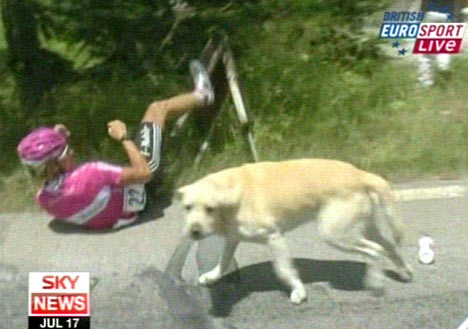
Or, if you are riding in the Tour de France, it might be a dog that walks in front of your bike, as it happened in the 2007 Tour.
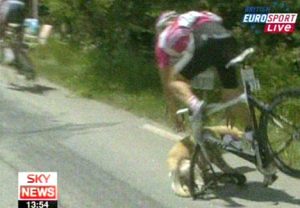
Life does not stop coming at us. Time does not stand still. We eat and then we get hungry again. We pay bills and then we pay them again. And most days are like the days before. When we do crash, life still keeps moving. Often the only protection we have against crashing is the thinnest of layers: Some insurance, a credit card, the help of a friend, luck.

We know all this, but we still get up each day and dive in to life. I guess it is just human nature to keep moving forward and and think maybe tomorrow will be better.
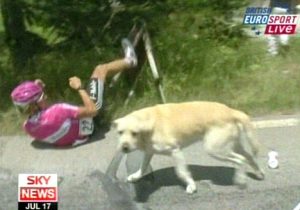
As I watch this year’s Tour I know those guys have a choice to ride or not ride. But as I look at my life, which includes responsibilities to myself and and my family, I know I don’t have the option to live or not live. I must live and hope that each day will bring forth life. I’ve got to show up, as do we all. So I keep moving, living as though it won’t be me that crashes today, and knowing that crashing is a part of life too. In fact, it is often through accepting the truth of our reality that we have any hope for joy.

When I think of my girls growing up and living life to its fullest, I also know they will have crashes. My job is not fundamentally about keeping them from crashing, but to give them the right perspective on life so they can deal with their crashes, although I also do not want them to crash.

It is strange how something so trivial as a bike race can spark thoughts on one of the deeper issues of life.
>morning ride

>

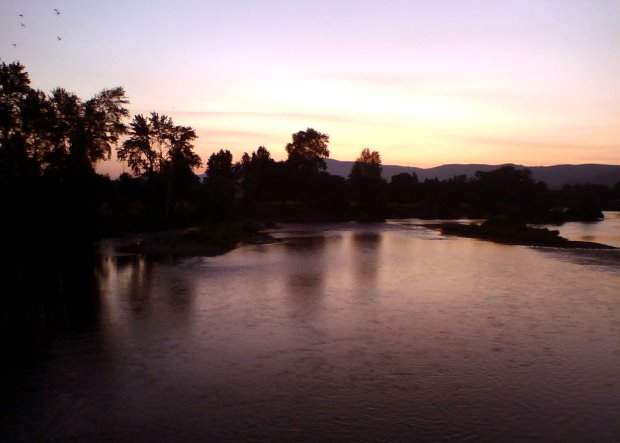
After a week off from riding my bike to work I am back in the saddle. The route I take includes a bridge that crosses a river. Yesterday I pulled out my phone and took a picture. The air was cool at 5:45 AM. Birds were swirling and diving around me. The sky was beautiful, and the river, as always, was sublime.

>Those were the days: LeMond, Hinault, Fignon, and my introduction to the great race.

>So the Tour de France is on! Yes!

I love the Tour, it’s one of the greatest sporting events anywhere. It is a crazy festival of sport and speculation. The Tour has been racked by doping the last few years, which is unfortunate. I suppose doping has been a part of processional cycling for decades, but nothing like it’s been that last ten years.

I became a fan of the Tour, however, in the 1980s when Greg LeMond was the great American hopeful and doping was a minor issue. LeMond, the first American to even win a tour de France, eventually won three Tours.

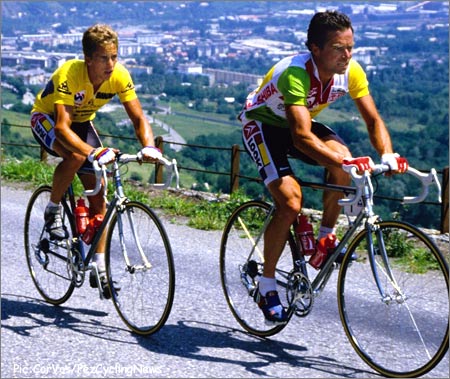
The 1986 Tour de France was LeMond’s first win. Here LeMond races with his teammate Bernard Hinault (five-time winner of the Tour and one of my cycling heroes) up the infamous Alpe d’Huez:

Hinault had set an almost suicidal pace and only Lemond could stay with him. They crossed the line together hand-in-hand. LeMond let Hinault cross the line slightly ahead of him, so Hinault was credited with the stage win. But there was a lot of tension between LeMond and Hinault, which played itself out in the French newspapers. Hinault had apparently said he would help LeMond win that year, but then he raced like he was going to win himself. LeMond whined. I always appreciated how great a cyclist LeMond was, but I thought he carried too much of a victim complex around with him. Regardless, I was hooked. Cycling was the bomb.

Then LeMond was in a hunting accident. He was shot by a shotgun fired by his brother-in-law. He almost didn’t make it and his recovery took a long time. He still has pellets in his body. He came back and won Tour again in 1989, and again in 1990. To me that’s nearly as remarkable as Armstrong’s victories after fighting cancer.

That 1989 Tour had the closest finish in Tour history. Laurent Fignon, the great French cyclist, was ahead of Lemond by only 50 seconds going into the last day of the Tour. That day the race organizers decided it would be an individual time trial rather than the typical group finish. Here is that finish:

LeMond won the Tour by only 8 seconds! That’s after 22 days of racing. Never again has the Tour finished with a time trial.

>biking to work

>Two weeks ago I started biking to work. It makes sense given gas prices, but my main reason is to make concrete choices to get healthier. I want to be a more active person, do more outdoor activities, play with my kids, live longer, and have more energy. Biking to work seemed to be a good place to start.

The trip takes about 30 minutes. So I get an hour of cardio workout each day. I have to say that I do feel better. I can tell that the riding is helping. I also have to say that a big extra for me is just getting outside. I work in an office all day. Riding my bike puts my face into the wind. I see the morning arrive, I see the city wake up, I feel closer to nature which is good for the soul.

Also, I do like sticking it to the gas companies. I just know they began trembling in their oil-soaked boots as soon as I began riding my bike. Can’t you hear their gnashing of teeth?

My goal is to become a long-term bike commuter. I want biking to become a normal, everyday part of my life year-round. I don’t see gas prices ever going back to where they were, and maybe they shouldn’t. Where prices are now is probably closer to what they actually should be. Regardless, biking doesn’t require gas, nor does it produce carbon dioxide.

If there is a downside it’s that I need to get to work by 6:00 AM. But that’s not really so bad. I’m used to it, and I get done with work by 3:00 PM. Of course I do get sleepy around 8:00 PM.

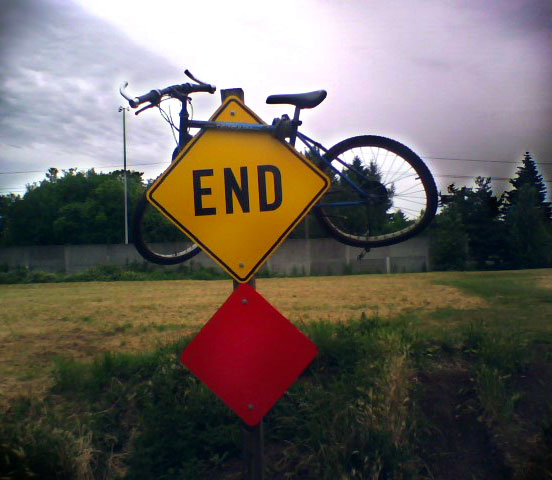
I took the picture above yesterday. I would like to believe every end is also a beginning, but I think that bike really has met its end.