>that wonderful uncle

>

I am reminded again why Jacques Tati is one of my favorite filmmakers. Recently I sat down with my daughter Lily and we watched Mon Oncle (1958). This film is considered Tati’s best film by many, and it truly is a masterwork of the artform. Although my heart leans more towards Monsieur Hulot’s Holiday (1953), I still love Mon Oncle – and so does Lily. I must say both films are glorious.

As I was pondering why Tati’s films endear themselves to my sensibilities so, I thought of Jean Renoir. Renoir may be my favorite director, if I could actually have such a thing. What grabs me and holds me fast about Renoir’s film is their unabashed portrayal and love of humanity. Tati, though more stylized in his aesthetic, has the same generous and loving characteristic. Tati’s characters are closer to types than Renoir’s, but they are types as only the French can do them – a kind of multifaceted simplicity of forgiven sinners.

With this love of humanity in mind I was struck afresh by the opening credits. They stand out as an example of creatively dealing with two problems: 1) How can the credits actually be an entertaining part of the film rather than something merely tacked on? and 2) How can the credits actually contribute to the meaning of the film?


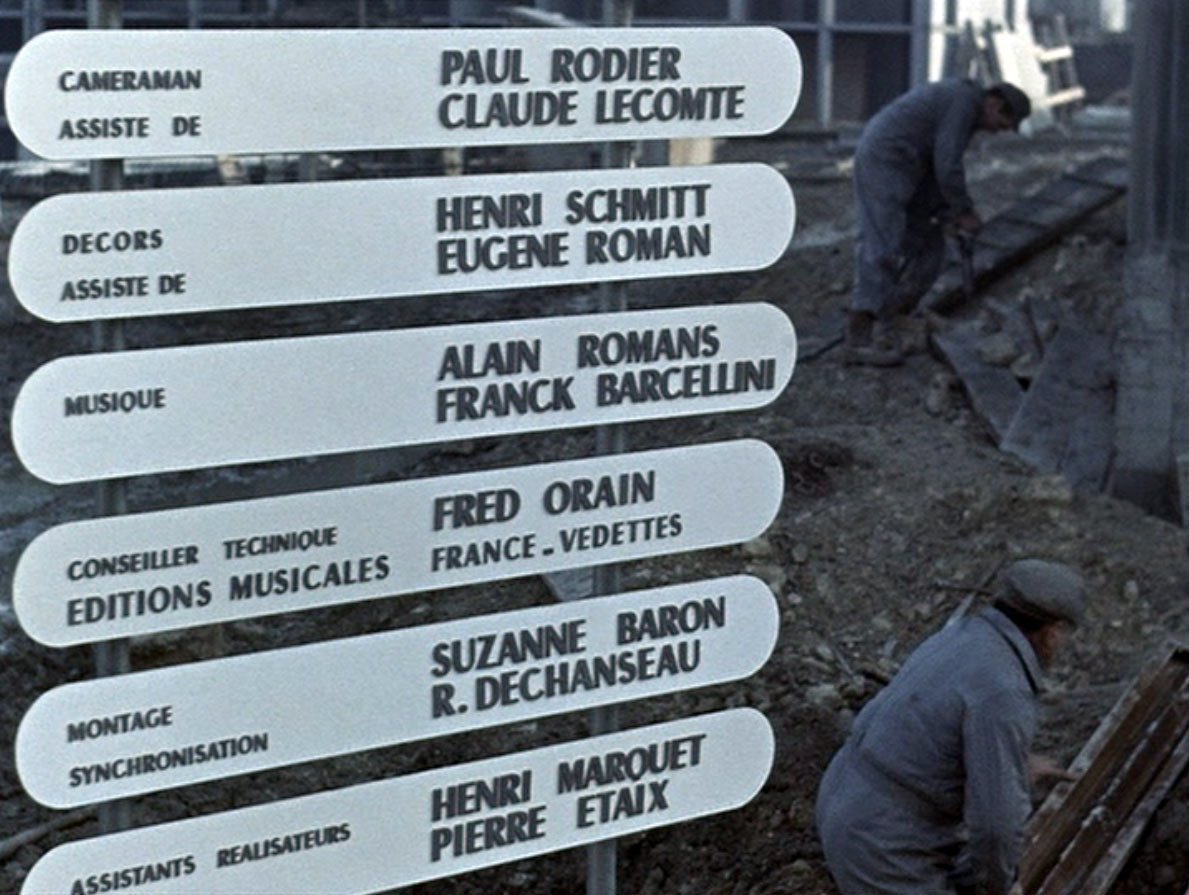
Workers labor, as do the filmmakers

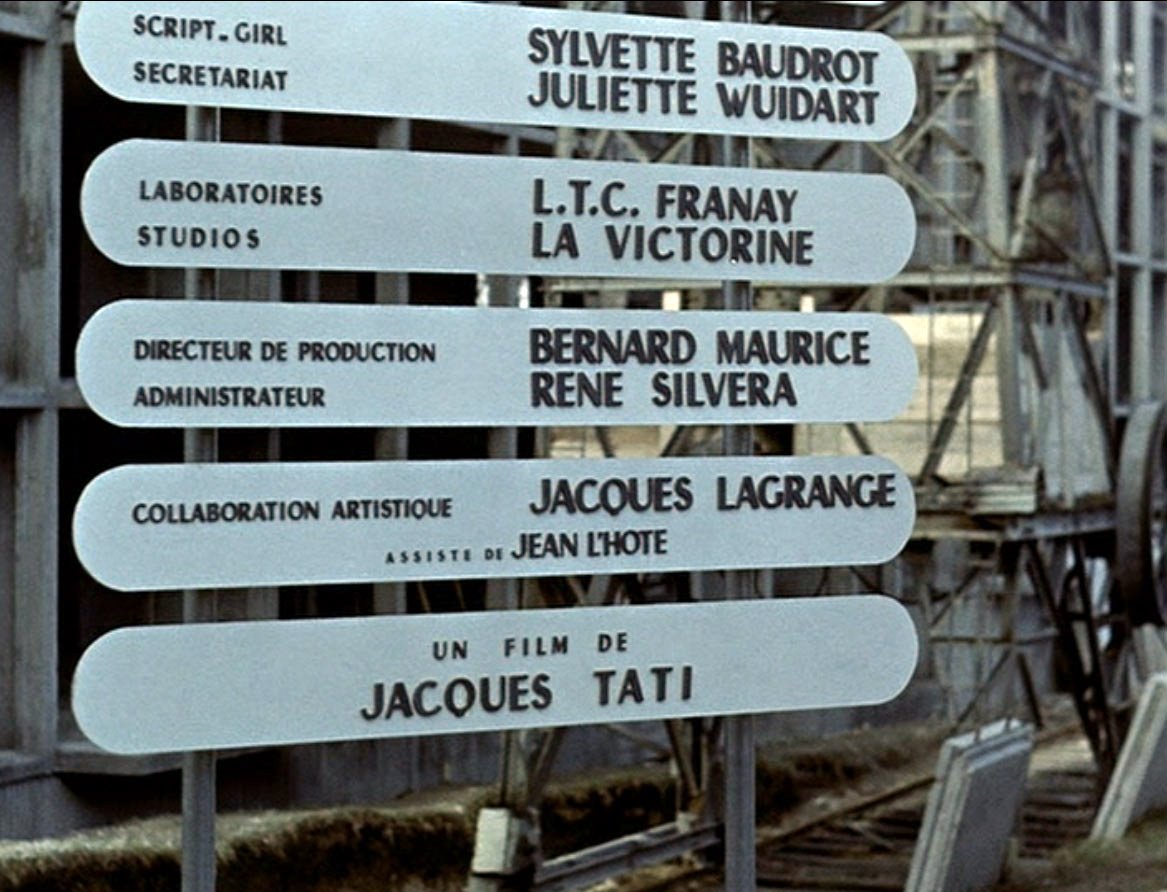
As the film opens we catch a glimpse of a construction site and hear construction noises. In the left foreground are signs with name on them. As I understand it, these signs correspond to the common practice of placing signs with the architect’s name and builder’s name on the construction site. We soon realize these names, however, are of the “architects” and “builders” of the film we are watching. It is both a clever and interesting way to present the film’s credits. It also says something about the story we are about to see and the kind of filmmaker who is giving us this film.


Tati’s name is last, and no more prominent

By juxtaposing the film’s “construction crew” with an actual building construction site the viewer is asked to see the film’s crew as laborers and collaborators. This film is a product of human effort, creativity, sacrifice, and love. Tati’s name is last, but not last as it is with most films for the purpose of being more prominent. Tati has set himself within the circle of collaborators. Yes, it is his film, but it is their film too.

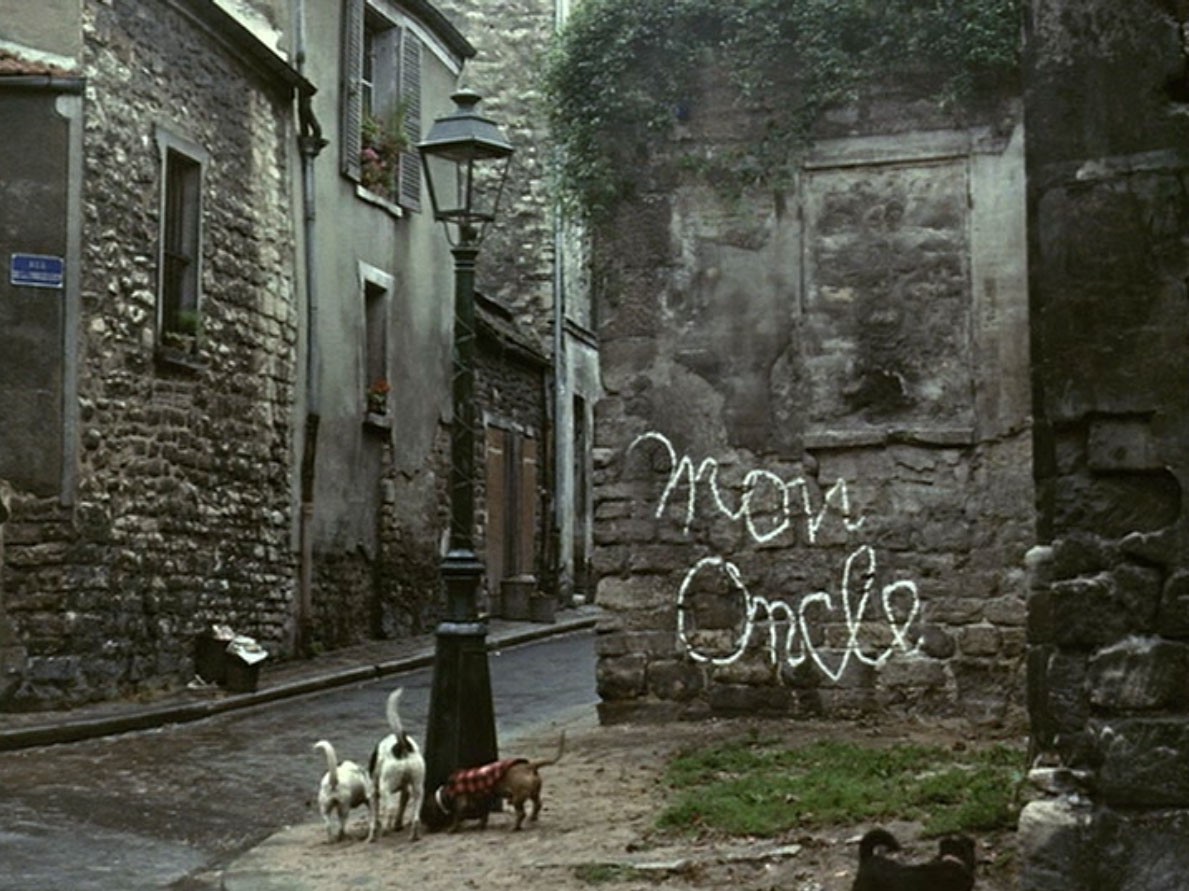
And then we cut to this:

The other world: Decay as Life

To my mind this is one of the great edits in cinema. Still within the credit sequence, we have the juxtaposition of this shot with the previous which loads it up with meaning – a meaning that the rest of the film will explore. We have gone from the new to the old, from a world of freshly built to a world of decay, from life as death to death as life – for it is in this world of decay that we witness the vibrant bustle of humanity interacting with itself rather than with machines and objects. Mon Oncle is a meditation on these two worlds. As we will see, buildings and houses, which are evidences of human activity and intention, seem to stand for the people who inhabit them. In other words, the artifice becomes the humanity. Thus, this run down street, which exudes a deep and flawed beauty, is the truer humanity.

Tati plays Hulot, and one can assume Tati loves Hulot for all his bumbling and goodheartedness. But Tati’s name, as per the credits, is associated with the new, the world of construction and building, the forever present. Hulot, the oncle of the title, is instantly associated with the old and crumbling. It is as though Tati recognizes that he lives and works in the modern world but finds himself reaching back vicariously to another, more romantic time and place. Hulot then may be his avatar as well as his clown.

I’m not the only fan of Jacques Tati. So is Frank Black:

I will now consider Frank a close friend.

>british blues legthigh blues

>So you want to play the blues? It’s easy, just do as Clapton does (or did more than thirty years ago):

Yeah, just do that. And wow, I want that guitar.

And as a bonus I give you this:

Thank you Winston Legthigh & The Dirty Mac. Now to the rest of you, go forth and play the blues.

>NaNoWriMo

>oh Lord, it’s happening again.

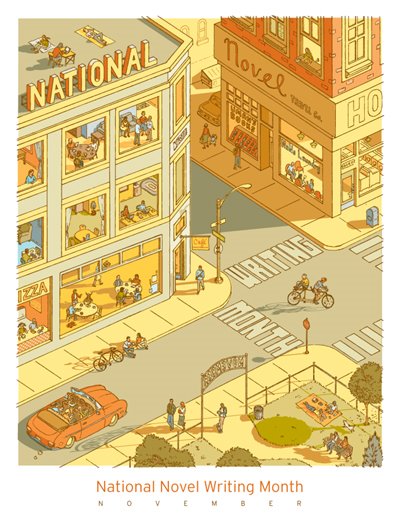
That’s right, November is National Novel Writing Month. You’ve got four weeks now to get yourself ready.

I’m thinking of doing this. I haven’t been able the last three years because of school pressures, but now… maybe. Are you??

>Rauschenberg dies, his art lives

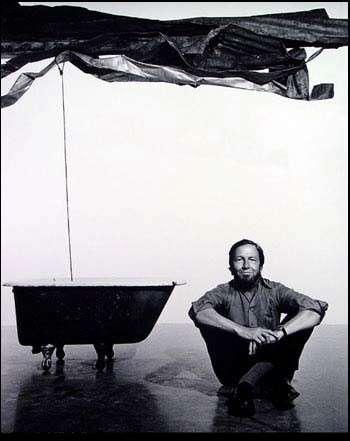
>I just saw that Robert Rauschenberg died on May 12th. He was one of the giants of 20th Century American art. He was also one of my “art” heroes.

Rauschenberg reminisces about his seminal “combine” artwork Monogram (1955):

Rauschenberg discusses his famous artwork, Erased de Kooning Drawing (1953), that consisted of erasing an artwork of another famous artist:

Excerpt from Rauschenberg’s 1967 film Linoleum:

Rest in peace.

My Darling Clementine: John Ford telling stories

Can a work of art tell us something about the character of the artist?

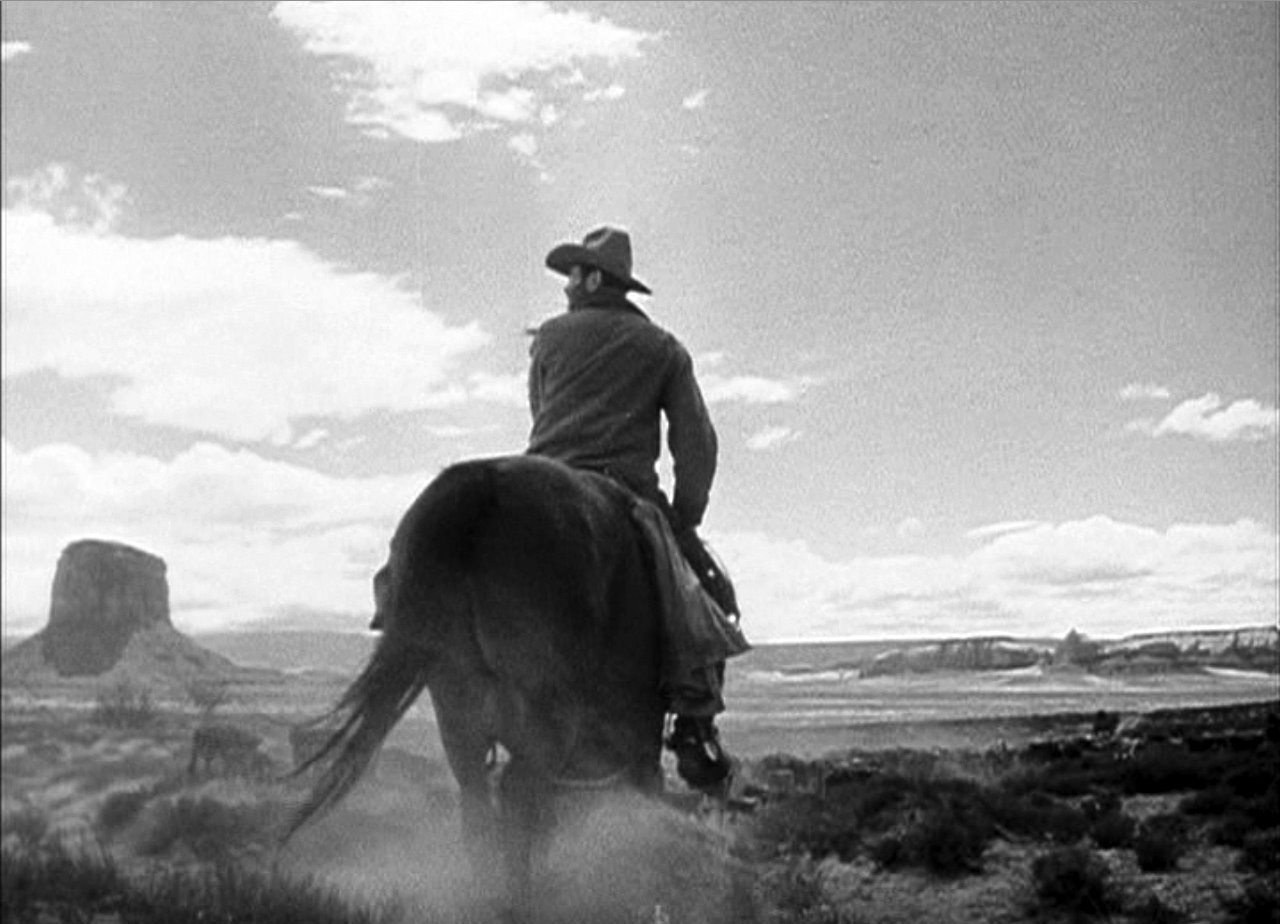
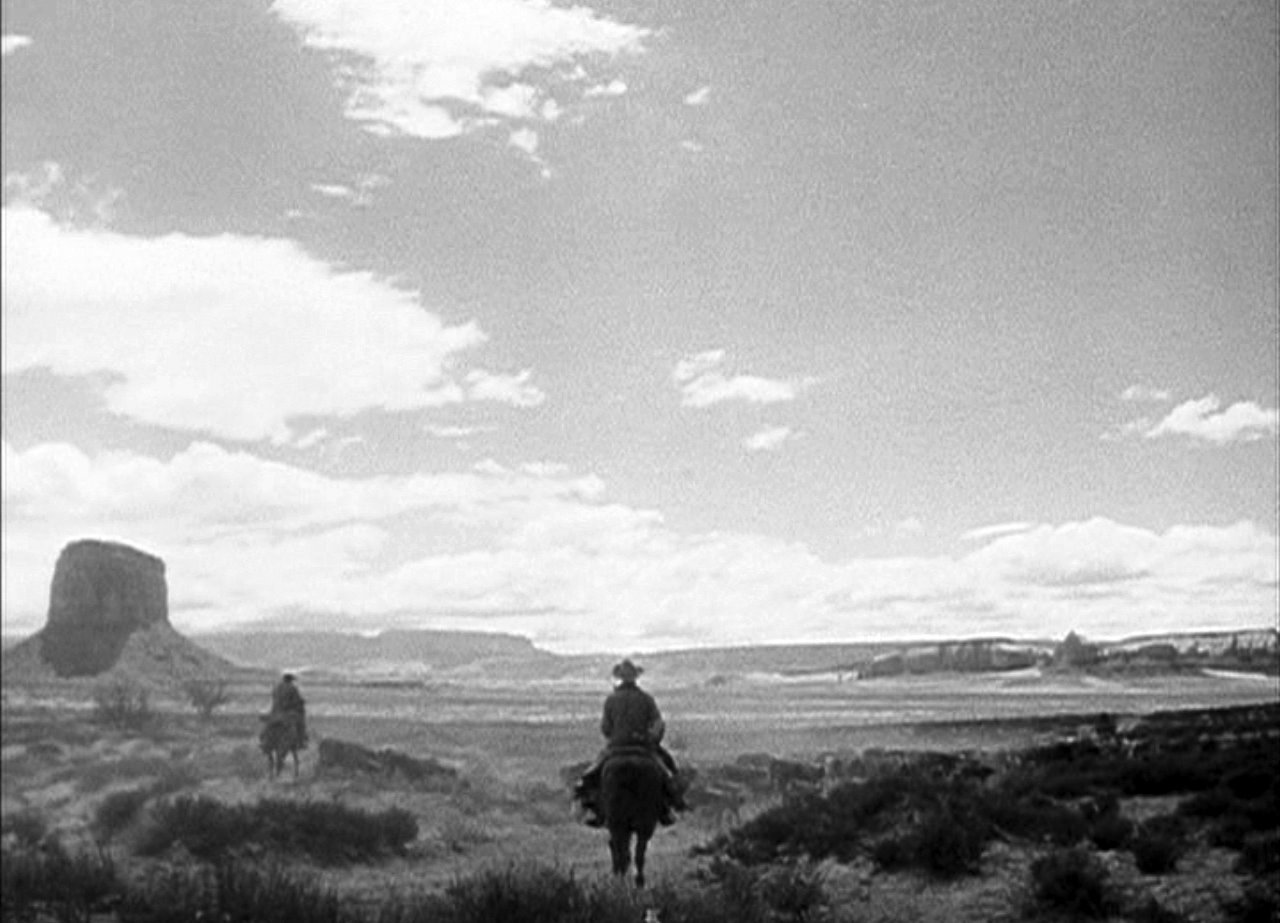
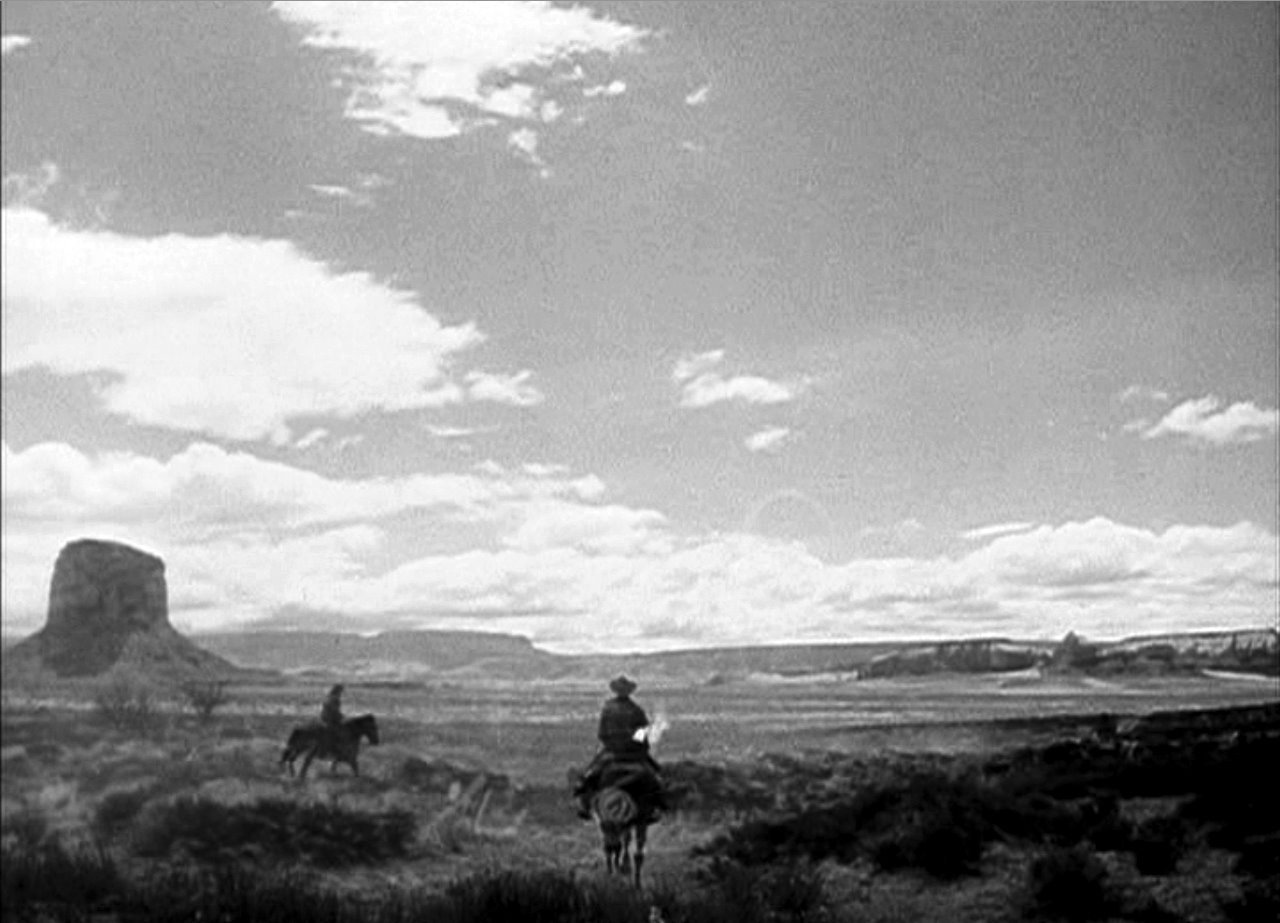
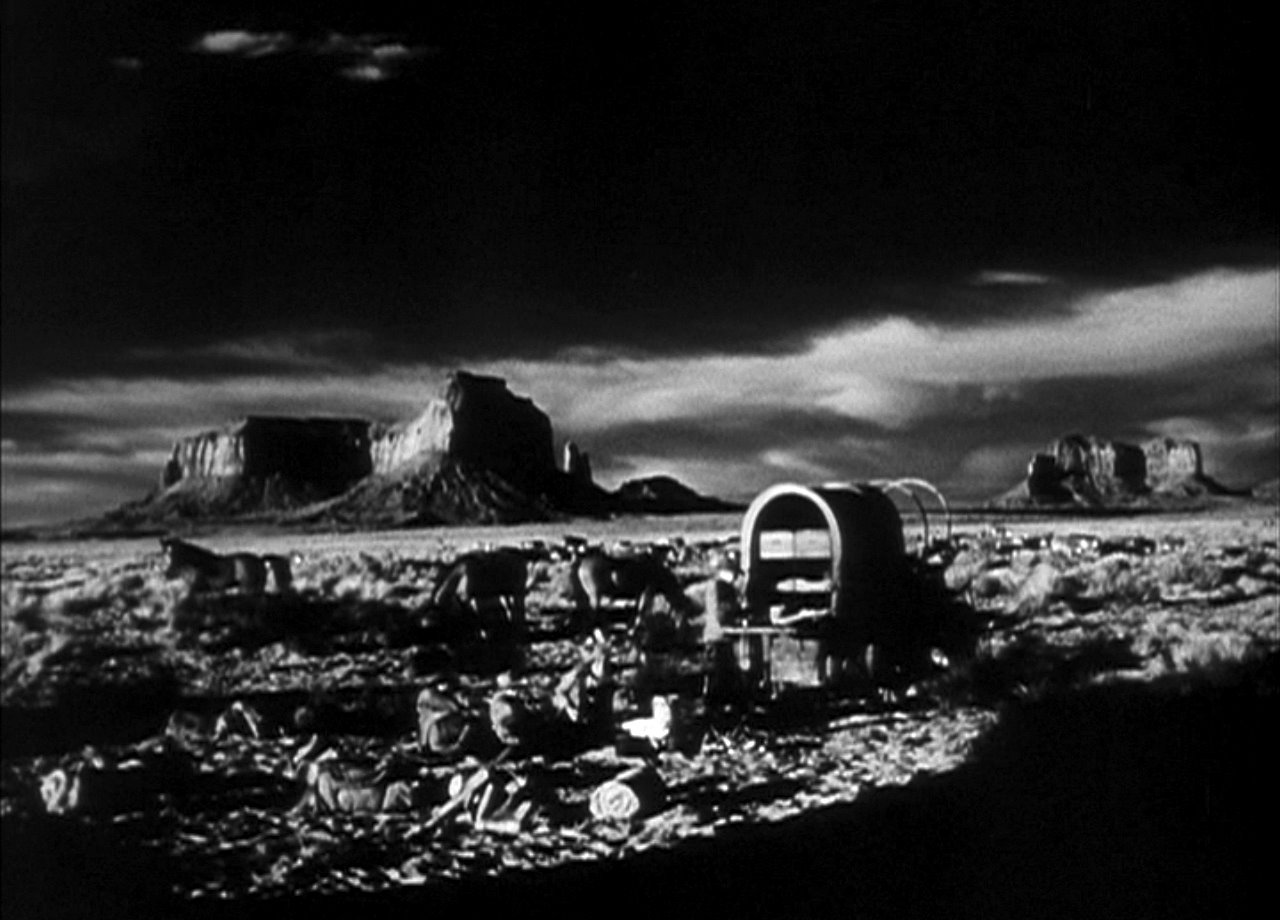
At the beginning of John Ford’s My darling Clementine (1946) there is an interaction between Wyatt Earp (Henry Fonda) and Old Man Clanton (Walter Brennan) that portends things to come. At the end of that conversation Earp rides his horse away and Clanton presumably drives his wagon away. Ford adds a wonderful little sequence of images and sounds at this point that, in effect, sums up the entire film. It goes like this:

Clanton uses his whip to get his horses going. We see the motion of his arm and the curling of the whip in the air.

We then hear the loud, sharp crack of the whip as we cut to Earp riding away.

Earp continues to ride quietly away.

Then, as the shot is beginning to dissolve to the next, we see a fire burning as though it is Earp on fire.

Once the dissolve is complete we discover the fire is the campfire of the Earp’s camp.

The story has Clanton and his sons stealing the Earp brothers’ cattle and killing the youngest brother. This action brings Wyatt Earp out of retirement. In order to mete out justice and get revenge, Earp takes over the recently vacated marshal job for Tombstone.

What I love about this little cinematic moment is the way Ford subtly used the language of cinema to tell a story within the story. The juxtaposition of the whip crack with the image of Earp, and then the fire growing within Earp, tells us what the story arc will be. What I also love is how Ford, in my opinion, frequently demonstrated, with moments like this, that he was every bit the filmmaker of Welles, but that he didn’t care for so much bravado as we find in Kane. He was servant, as it were, to the art & craft of cinema rather than to his ego. He was a master storyteller more about the story than the teller.

Both Welles and Ford needed and respected their audiences, for sure, but Ford’s respect was more self-effacing, more about others than about himself. At least that is what I take from their works of art. Am I right? You tell me.

>"Hello, I’m Amy Walker. I’m twenty five…"

>I remember some college friends of mine studying the theater arts back in the day. Along with being amazed at their ability to memorize lines and produce wonderful performances, I also enjoyed their audition tapes (I believe this that’s what they were called). These friends of mine would put together audio tapes of themselves doing a variety of voices and dialects in order to demonstrate their range and talent. Often the tapes were very funny and quite good.

Of course today the audio cassette tape has gone the way of the pet rock. Now it’s all video, YouTube, etc. That’s what I assume this is:

I have to say I think that’s a lot of fun, and excellent.

>more snow

>

3 videos from Michael Snow . . .

Four and a half minutes of Back and Forth (1969):

Almost ten minutes from La Région Centrale (1971):

The entire Wavelength (1967):http://video.google.com/googleplayer.swf?docId=-3009876496807585942&hl=en

With Wavelength one of the starting ideas was to be able to see a zoom, to experience a zoom from a kind of analytical “inside a zoom” position, and it seemed to me that could not be fast. I thought it would be interesting to have it big enough so that it is monumental, that is weight in a way, and so it ended up being 45 minutes, but it could have been 15 minutes.


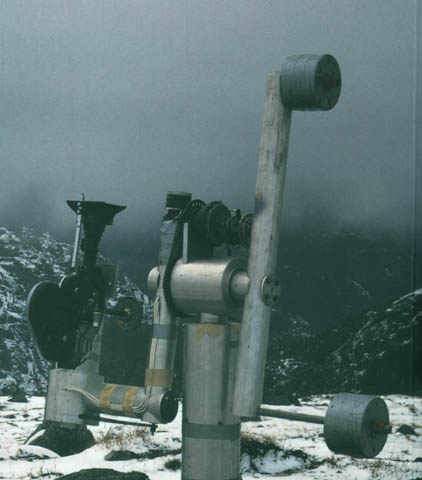
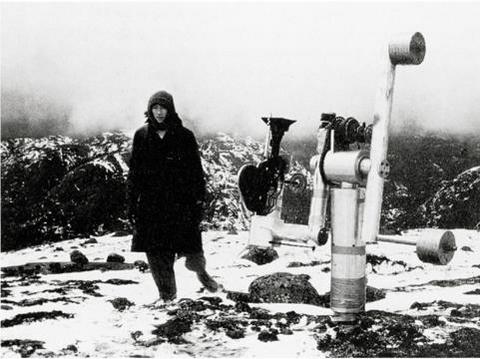
Snow on location for La Région Centrale

P.S. We are back to 36 degrees and rain. Snow is disappearing.

>Time, Memory, Mystery, Narrative

>

Stavrogin
…in the Apocalypse the angel swears that there’ll be no more time.

Kirillov
I know. It’s quite true, it’s said very clearly and exactly. When the whole of man has achieved happiness, there won’t be any time, because it won’t be needed. It’s perfectly true.

Stavrogin
Where will they put it then?

Kirillov
They won’t put it anywhere. Time isn’t a thing, it’s an idea. It’ll die out in the mind.

-F. Dostoievsky, The Possessed

There are few filmmakers, if any, who have philosophized as deeply about the nature of time as Andrey Tarkovsky. Time, as a philosophical concept, has been examined in depth by many, but rarely do filmmakers seem to step, philosophically or artistically, beyond commonly accepted film school concepts of time. In other words, for most filmmakers time is a concrete conceptual medium which one manipulates with accepted narrative forms according to common schemata in order to tell a clearly defined and easily understood cause and effect story. But that is not really time itself.

from Stalker (1979)

What do we talk about when we talk about time? For the most part we talk of time’s effects, of managing time, of the past or the future, of what could have happened or what did, of how one thing led to another. But time is none of these things in itself. Time is a mystery, and we relate to time in ways far more complex than the march of cause and effect. When we bring in the relationship of memory to time, and we dig into the nature of reality and its relationship to truth, we begin to exponentially expand the concept of time. Because memory is related to morality, time can also be understood as a spiritual concept.

from Mirror (1975)

In his book Sculpting in Time (pp. 57-8), Tarkovsky says this about time:

Time is necessary to man, so that, made flesh, he may be able to realize himself as a personality. But I am not thinking of linear time, meaning the possibility of getting something done, performing some action. The action is a result, and what I am considering is the cause which makes man incarnate in a moral sense.

History is still not Time; nor is it evolution. They are both consequences. Time is a state: the flame in which there lives the salamander of the human soul.

Time and memory merge into each other; they are like the two side of a medal. It is obvious enough that without Time, memory cannot exist either. But memory is something so complex that no list of all its attributes could define the totality of the impressions through which it affects us. Memory is a spiritual concept! For instance, if somebody tells us of this impressions of childhood, we can say with certainty that we shall have enough material in our hands to form a complete picture of that person. Bereft of memory, a person becomes the prisoner of an illusory existence; falling out of time he is unable to seize his own link with the outside world–in other words he is doomed to madness.

As a moral being, man is endowed with memory which sows in him a sense of dissatisfaction. It makes us vulnerable, subject to pain.

Cinema has a unique relationship with time. Of all the art forms only film can capture time, as it were, and preserve it. Tarkovsky says this as critical. Here he talks of this unique aspect of cinema around the time of filming The Sacrifice (1986):


His speech begins at 5:37 into the piece.

To think of time as a state, as that flame in the soul, and of action as merely a result of time, and to think of cinema as a medium that preserves time, provides the foundation upon which a different kind of film can be constructed. Different, not in the sense of odd or misshapen, but different from the conventions and expectations of what we have typically received. The history of cinema is replete with action driven plots, with stories that emerge from a fascination with time’s results, the effects of time. When the underlying state of time is manifest, if at all, it is too often the representation of shrunken persons and truncated souls.


from Nostalgia (1983)

What then is the role, even responsibility of cinema? Or of the filmmaker? The role of cinema has necessarily changed over the years. In years past the mere existence of a short film brought about wonderment, and sometimes caused viewers to run for the exits. But cinema has changed, and so have we. Tarkovsky writes:

Cinema is therefore evolving, its form becoming more complex, its arguments deeper; it is exploring questions which bring together widely divergent people with different histories, contrasting characters and dissimilar temperaments. One can no longer imagine a unanimous reaction to even the least controversial artistic work, however profound, vivid or talented. The collective consciousness propagated by the new socialist ideology has been forced by the pressures of real life to give way to personal self-awareness. The opportunity is now there for filmmaker and audience to engage in constructive and purposeful dialogue of the kind that both sides desire and need. The two are united by common interests and inclinations, closeness of attitude, even kinship. Without these things even the most interesting individuals are in danger of boring each other, of arousing antipathy or mutual irritation. That is normal; it is obvious that even the classics do not occupy an identical place in each person’s subjective experience.

Sculpting in Time (pp. 84-85)

Tarkovsky goes on to say about the filmmaker’s responsibility:

Directing in the cinema is literally being able to ‘separate light from darkness and dry land from the waters’. The director’s power is such that it can create the illusion for him of being a kind of demiurge; hence the grave temptations of his profession, which can lead him very far in the wrong direction. Here we are face with the question of the tremendous responsibility, peculiar to cinema, and almost ‘capital’ in its implications, which the director has to bear. His experience is conveyed to the audience graphically and immediately, with photographic precision, so that the audience’s emotions become akin to those of a witness, if not actually of an author.

Sculpting in Time (p. 177)

from The Sacrifice (1986)

In a sense the filmmaker is the creator of time. The audience enters into the world of the film, the mental/emotional space circumscribed by the filmmaker, and lives, as it were, in that space for at least the duration of screen time, if not on some level for ever after. Clearly this has implications for issues of responsibility, both for filmmaker and audience. But this kind of thinking opens up possibilities for ‘approach’ as well. In other words, to think of time as “the cause which makes man incarnate in a moral sense” is to confront something living rather than a mere object of manipulation. This approach is what turns Tarkovsky’s film into what they are: films that contemplate the deeper truths of the soul and call us to do the same. This approach is also the antidote to the ‘boring art film’ in that it does not allow for the mere application of style for artistic effect. And it can, at times, be as a kind of lens that helps reveal the more profound aspects of one’s soul.

*All quotes come from Sculpting in Time by Andrey Tarkovsky, trans. Kitty Hunter-Blair, University of Texas Press, 1986.
postmodern notebook

We have learned to trust the photographic image. Can we trust the electronic image? With painting everything was simple. The original was the original, and each copy was a copy – a forgery. With photography and then film that began to get complicated. The original was a negative. Without a print, it did not exist. Just the opposite, each copy was the original. But now with the electronic, and soon the digital, there is no more negative and no more positive. The very notion of the original is obsolete. Everything is a copy. All distinctions have become arbitrary. No wonder the idea of identity finds itself in such a feeble state. Identity is out of fashion.

~Wim Wenders, 1989

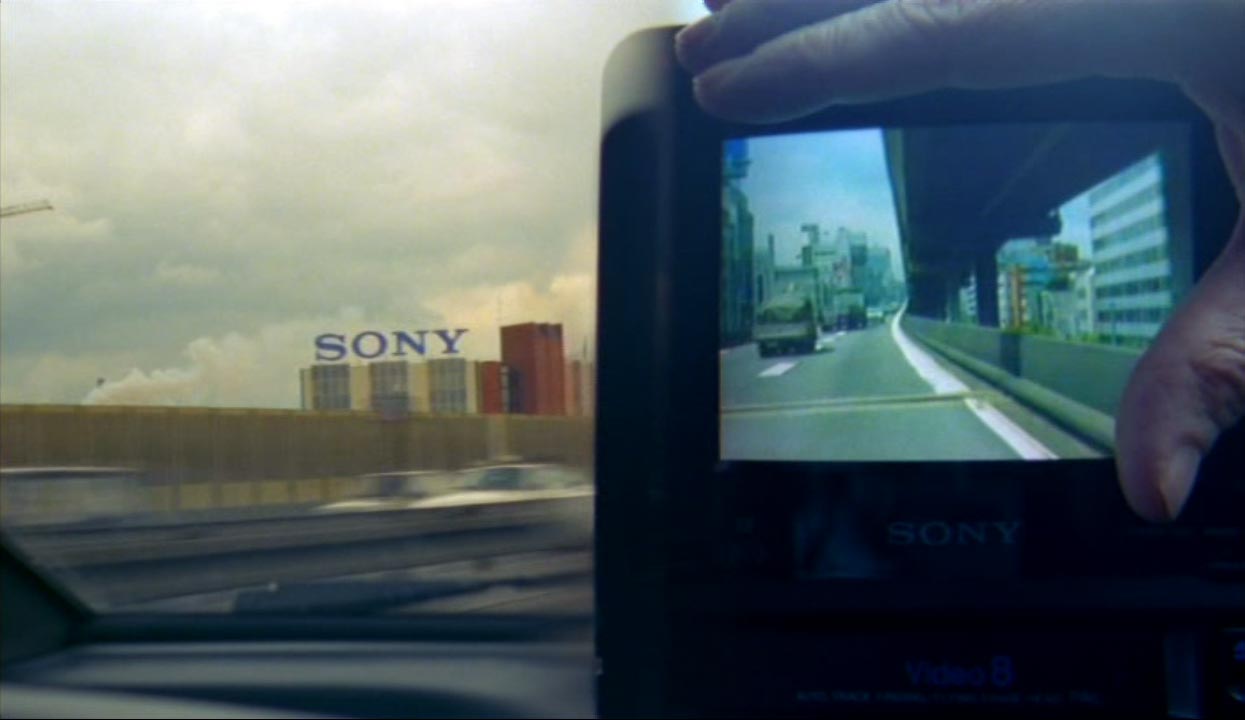
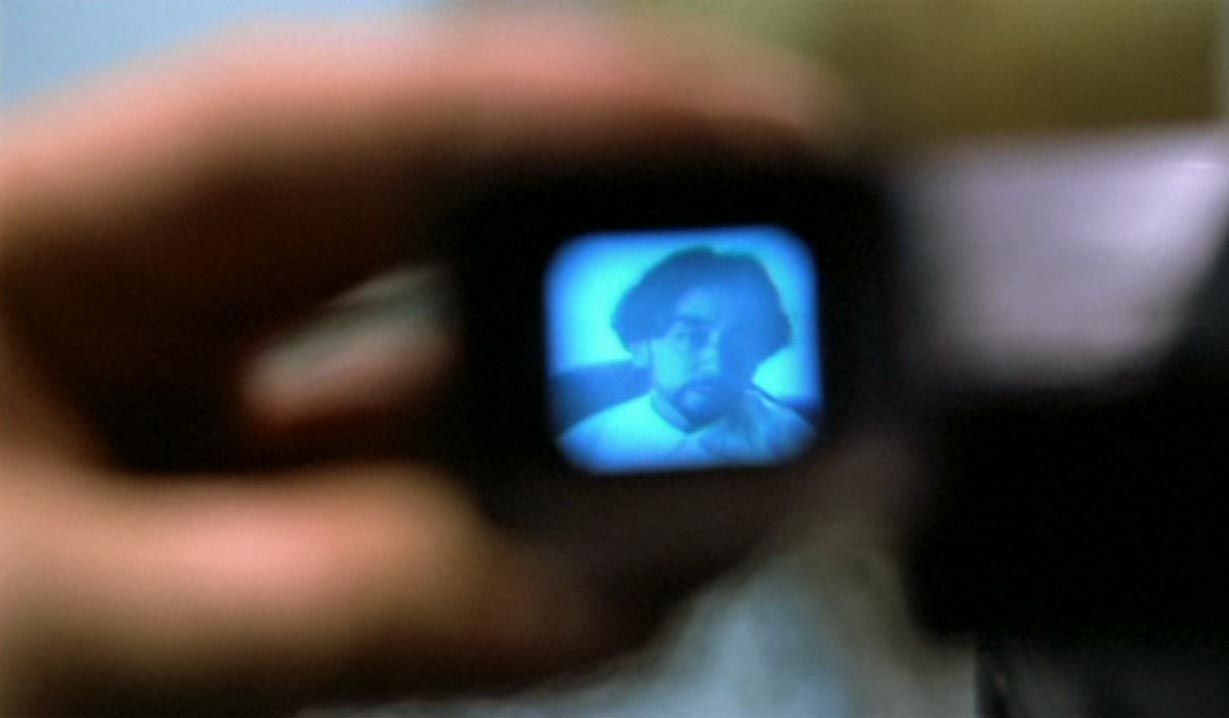
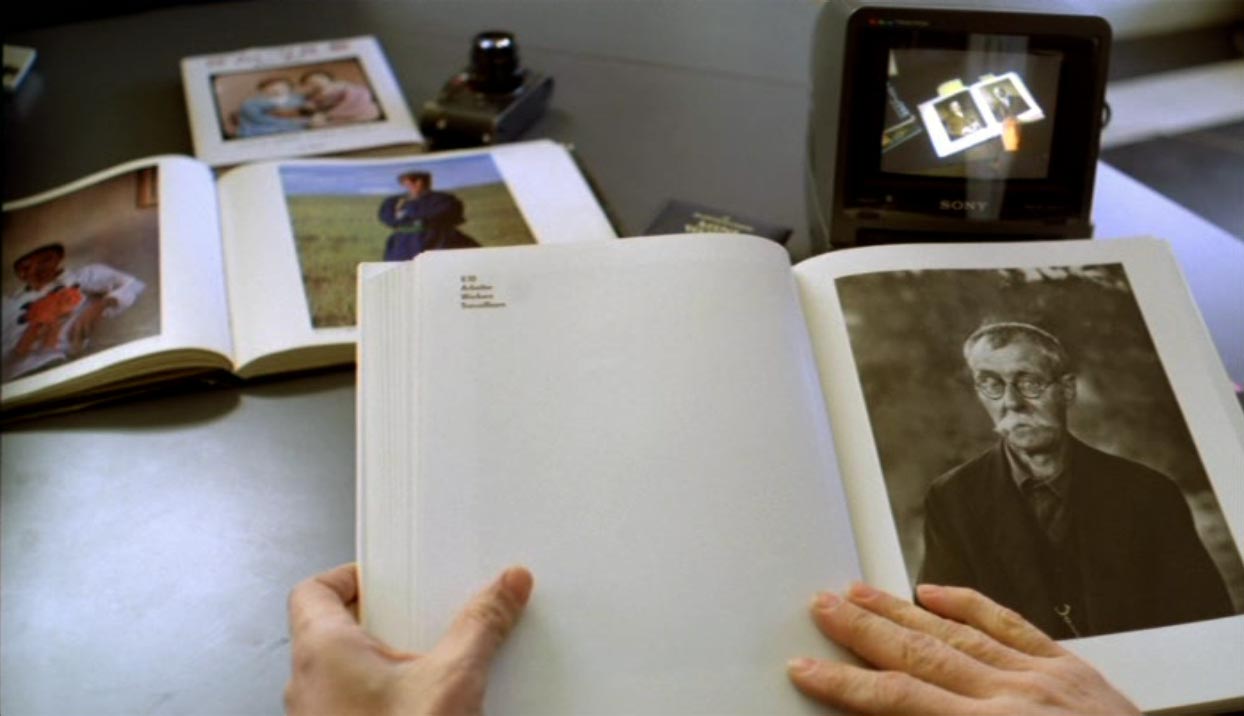
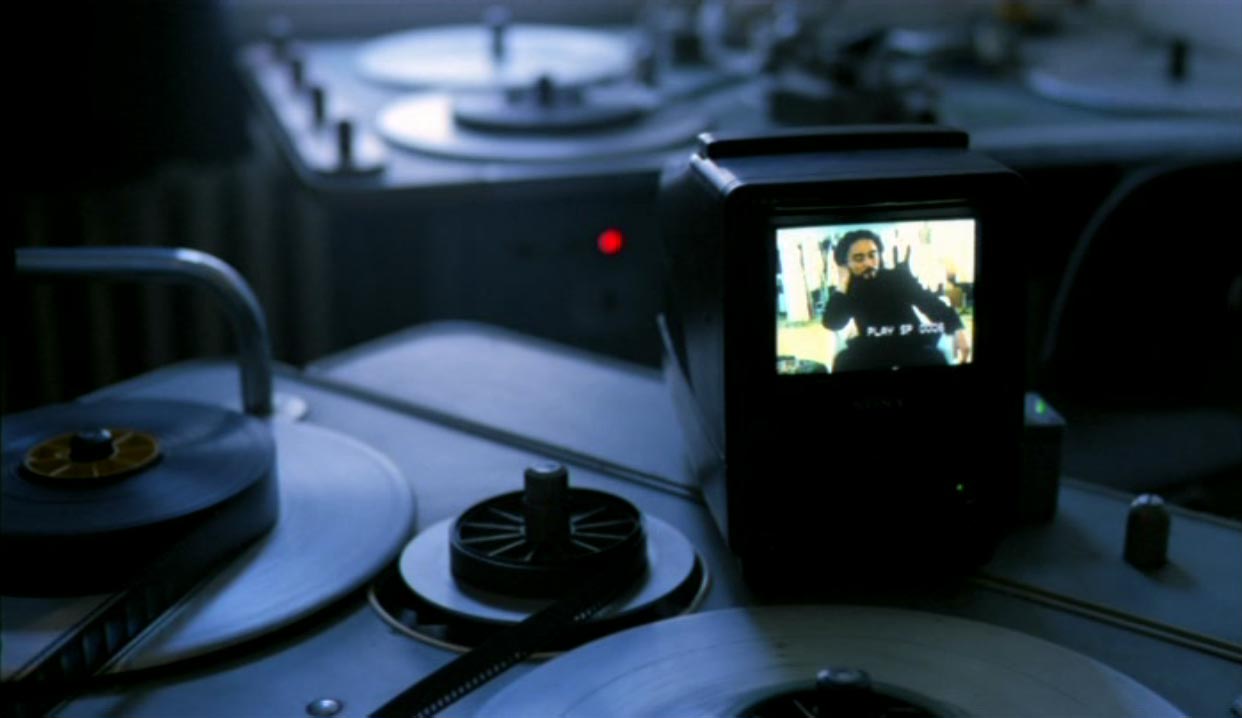
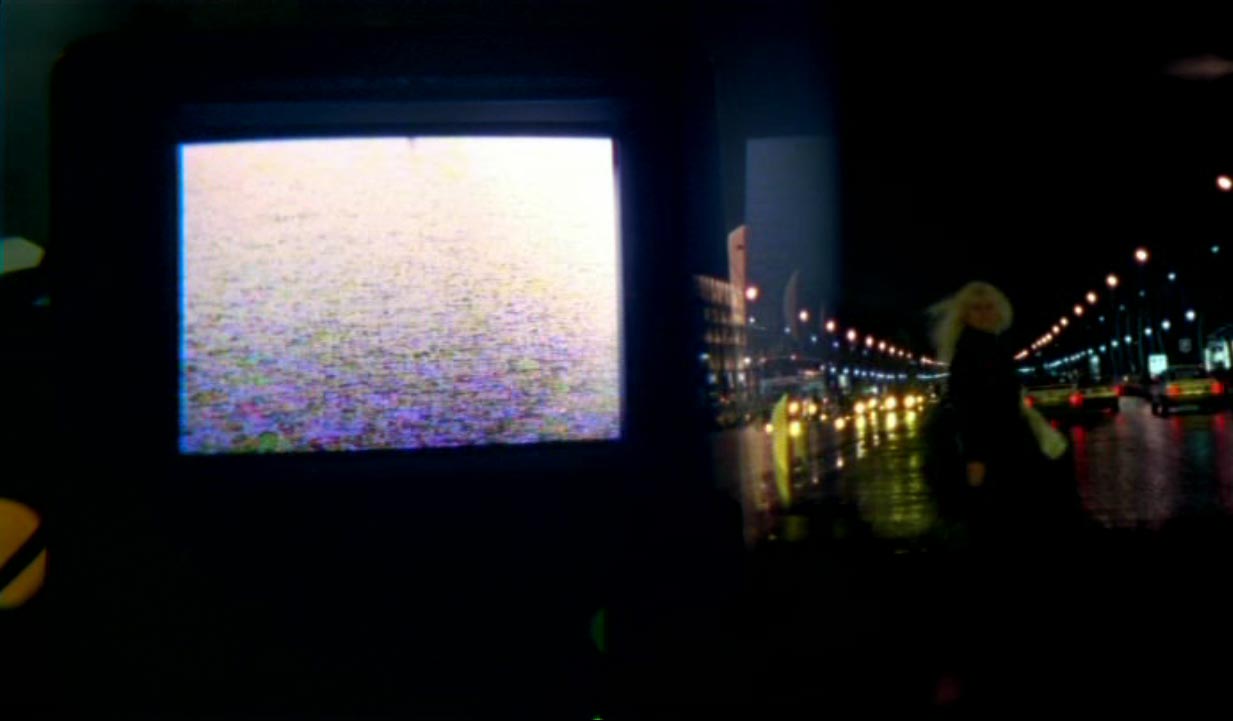
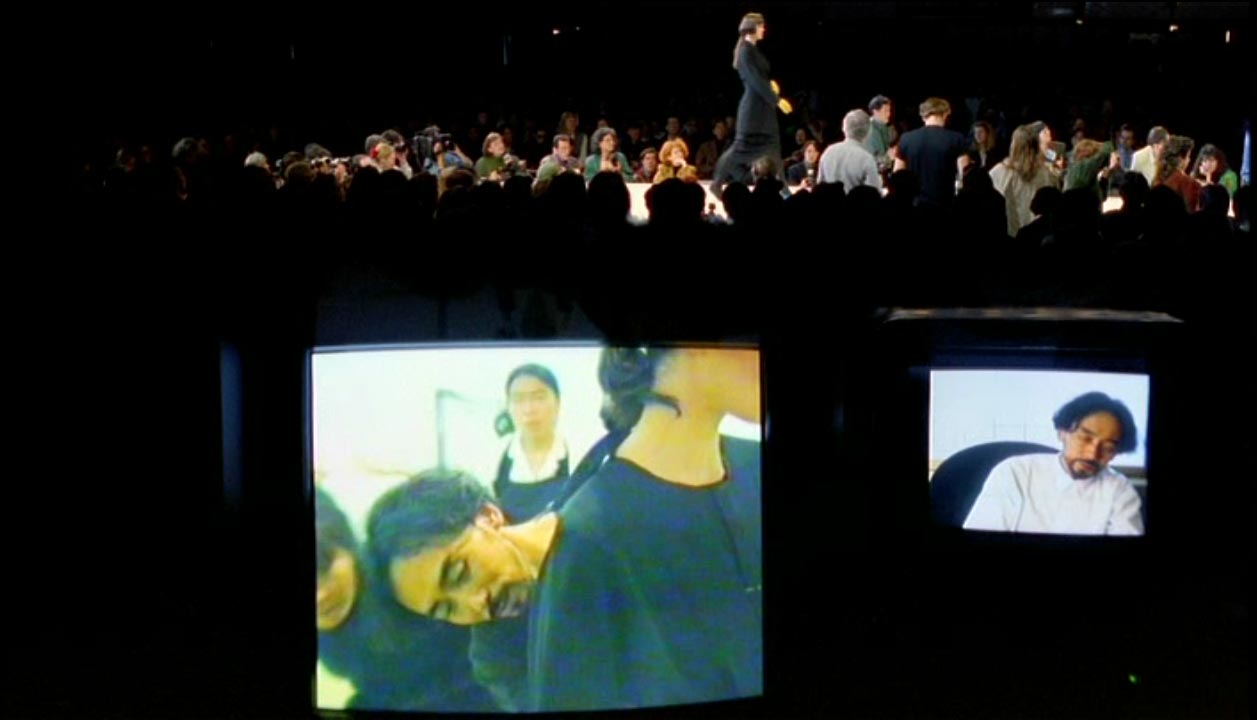
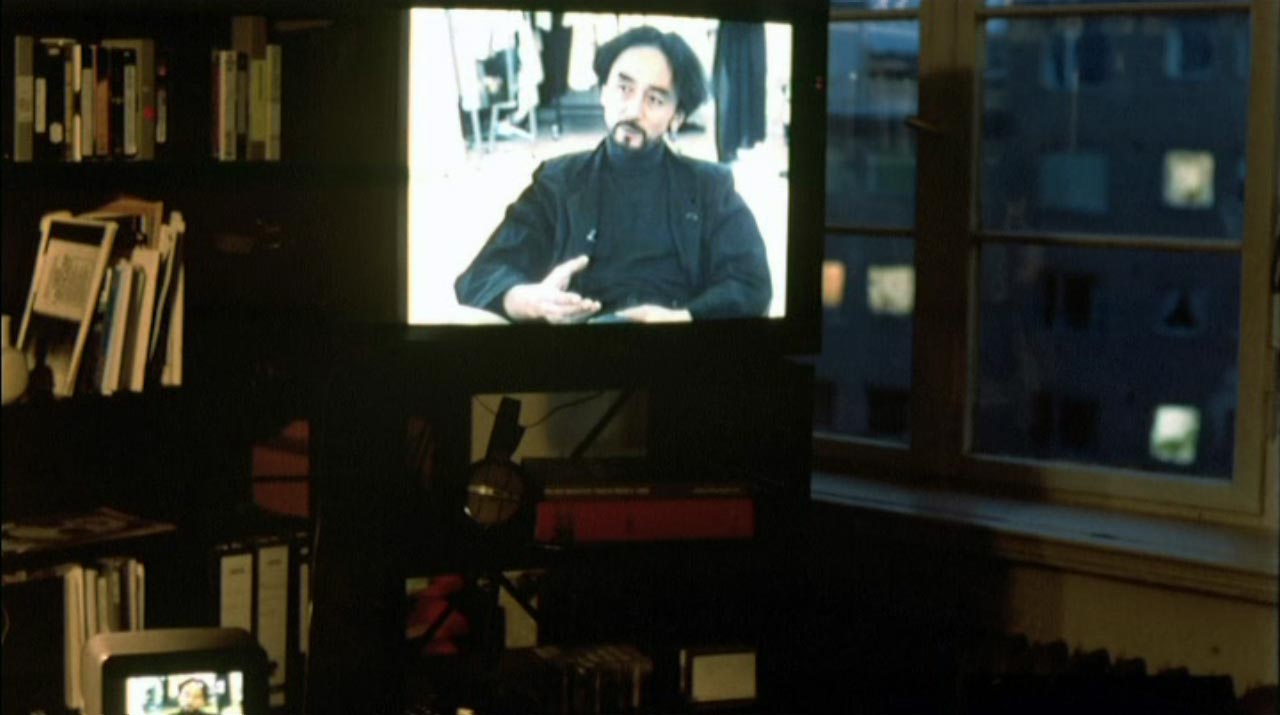
The following screengrabs are from Wenders’ film Notebook on Cities and Clothes (1989). They are all of images within images, and represent/re-present places within places and ideas within ideas.

My mind wanders over these images and then wanders beyond them, both outside their frames and to my own presuppositions and fetishes, and I think of Baudrillard’s quote:

It is perhaps not a surprise that photography developed as a technological medium in the industrial age, when reality started to disappear. It is even perhaps the disappearance of reality that triggered this technical form. Reality found a way to mutate into an image.

-from Photography, or the Writing of Light (2000)

Of course Baudrillard is wrong if we take him literally. Reality has not disappeared. But Baudrillard is right, as all postmodernists are, that the way we understand reality is heavily mediated for us (and by us) to the effect that reality, or “reality”, would seem to be an image created for us, is an image presented to us, is an image we carry with us, is an image we remember, and is an image we create. And, as an image is worth a thousand words, or a million, and therefore images are stories, fragmented or otherwise, connected and intersecting with other stories, stories referencing other stories, images referencing other images, we can apparently say all is reference. With Wenders we have the added question of the ever changing and never original (or always original) electronic image coupled with the question of what is fashion.

I suppose this blog plays a part in how I mediate the world for myself. I write for an audience, largely imaginary, but I also write for myself. Subconsciously, and maybe sometimes consciously, I write so that I can understand the world and my place in it. In this sense I can say that I have my take on reality. But the question is, are all distinctions truly arbitrary? And can this notion apply beyond the world of images to the rest of life?

So some degree Wender’s position hearkens back to his explorations in such films as Paris Texas and Wings of Desire. In those films we see characters struggling to communicate across great barriers (physical, psychological, spiritual) with those whom they love, or believe they love. In Wings of Desire the barrier is the difference between the world of human beings and the world of angels. The film’s story revolves around the idea that to become fully human one has to give up being merely an observer and enter in, that is, to immerse oneself in the tangible messy world we humans call reality. To cross that chasm is to take a leap of faith.

But is faith a leap? In the so-called Western/Christian tradition the word faith has a lot of gravity. Faith is one of those words, like love and happiness, whose meaning we all know and yet can never seem to finally pin down. For many the word has precisely to do with some kind of existential or spiritual leap. And for some that leap is a leap into the unknown or the unsure, or even the absurd. Interestingly, when we read the word faith used by the early Christian writers, such as the Apostles Paul or Peter or John, it is, in fact, the ordinary Greek word for belief. It does not appear that the Apostle’s intentions were to convey any idea of a leap of faith, or of faith being a kind of spiritual ecstasy. For what I can tell they were merely telling others to continue to believe what they have heard about Jesus because it is true, and that they can know it is true because the Apostles were eye witnesses.

Which brings us back to Notebook on Cities and Clothes and the idea of mediation and its relationship to truth. The fact is we are immersed in a world of images, and we seem to understand our world more and more in terms of those images rather than words, and those images are increasingly potentially untrustworthy. We are also in a world in which, while many of the barriers between people and cultures still remain, we are intersecting more and more with an increasingly broader scope of people(s) and a multiplicity of voices. Which means that we live in a world of references, that is, a world in which everything begins to reference something else and is built upon other references.

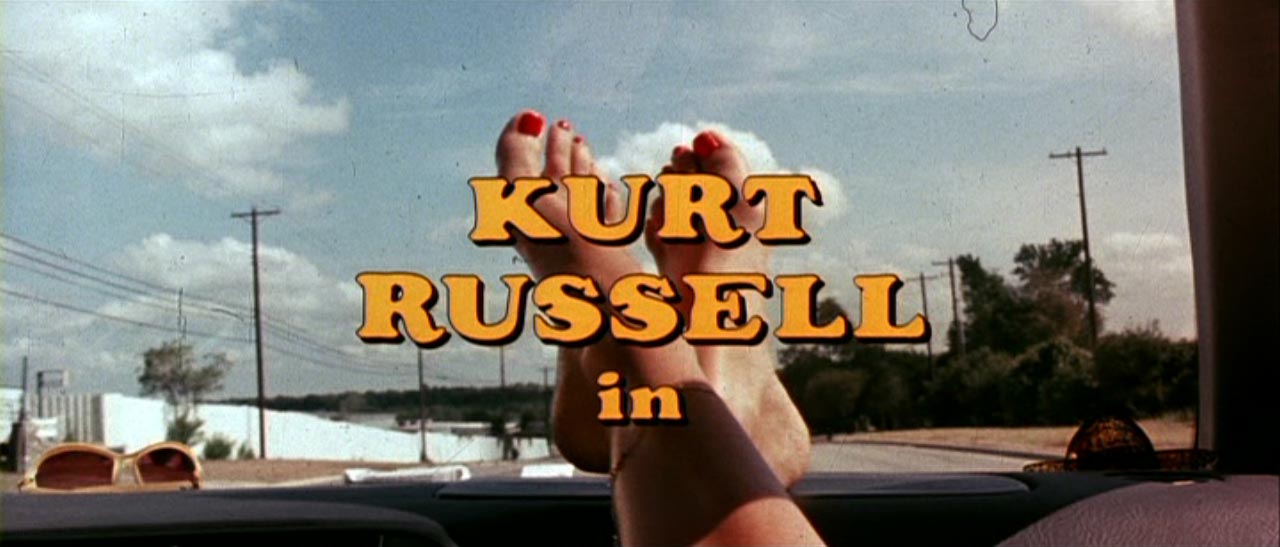
Maybe no other living filmmaker has more fun with playing with references than Quentin Tarantino. Part one of Death Proof immerses the viewer in a 1970s pastiche, full of faux antiquing of the film, samples from 1970s films, and stylistic choices right out of now classic B-movie road and slasher films. The film is designed to draw attention to itself. Tarantino winks at the audience and the audience winks back, along with the occasional high-five and an “oh yeah!” If a drinking game were devised for Death Proof, where viewers had to down a shot for every meant-to-be-obvious filmic reference, players would die of alcohol poisoning after ten minutes.

Examples include this appropriated “restricted” card from the early days of the MPAA rating system:

And this created title that looks like it came directly out of an early 1970s Disney film starring you know who:

Other examples include faux scratches and dust on the film and numerous jump-cuts that simulate a worn out film jumping in the projector gate because of splices and damaged sprocket holes.

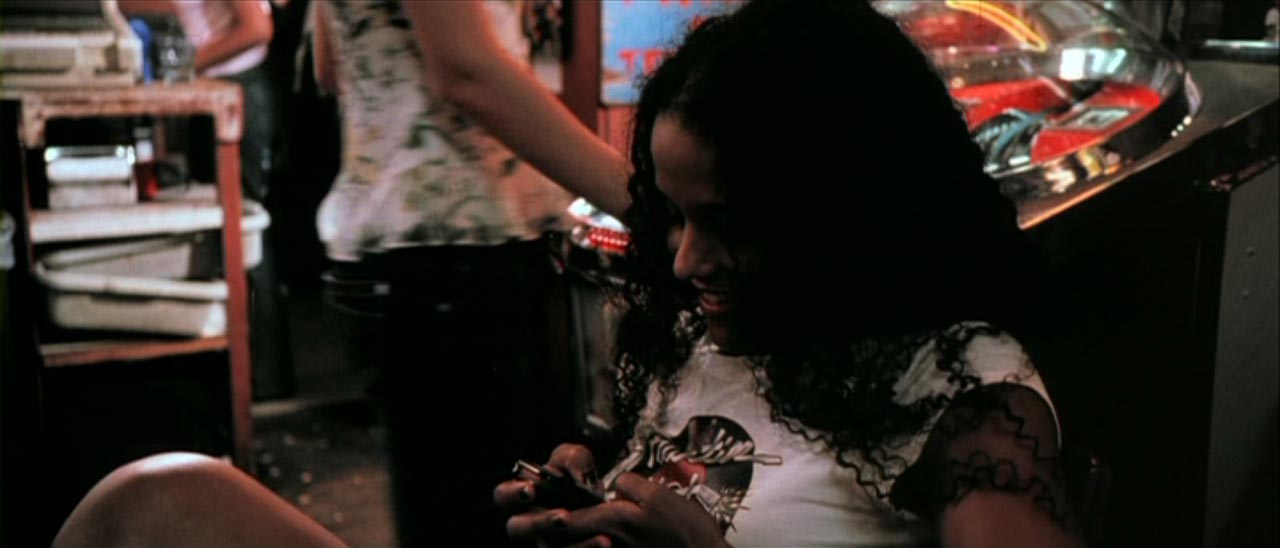
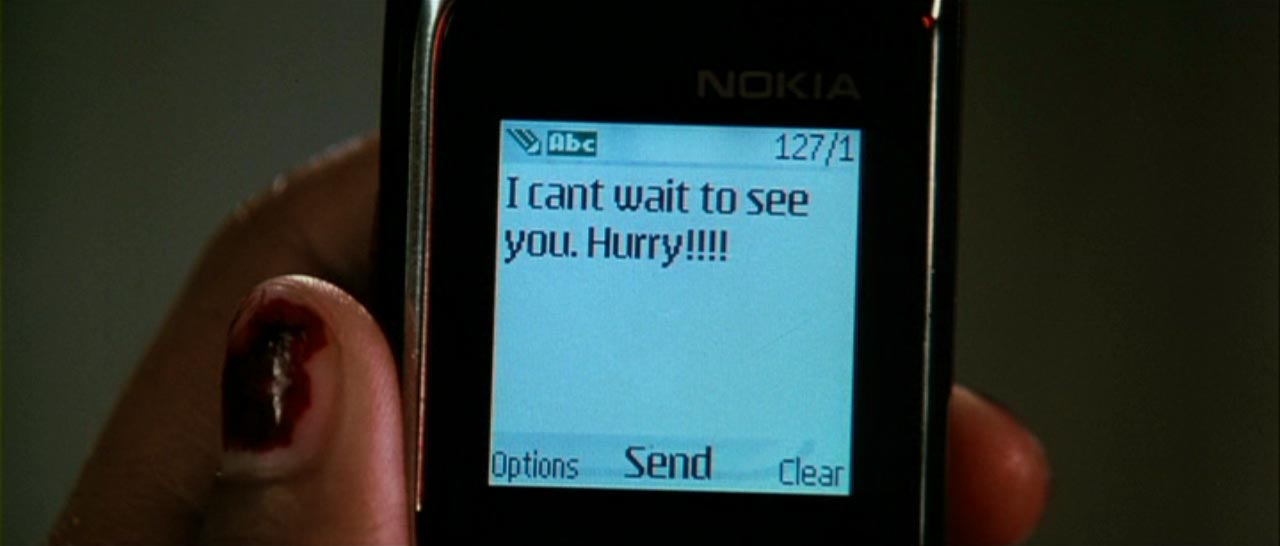
But what is so fascinating is that Tarantino is not making a 70s film. He is making modern film. Consider that while the characters seem to live and play in a archetypal film of a previous era, and while the film makes a point of looking aged and worn out, characters still drive modern cars and use cell phones – like Jungle Julia below.

And yet, I doubt many viewers found this disconcerting, or even noticed, because there are no longer any meaningful distinctions (apparently). For a director like Tarantino there are no boundaries between films or genres or eras, there is only the magnificent cloth of cinema where every film participates in the weave, connecting and intersecting in the psychic playground cinephilia. For Tarantino, I would argue, faith is not a belief in what is true, but in what is cool and can be appropriated. And cool is another word for fashion.

In such a world where does one find one’s identity? Might one say that we are all only references built up from other references? That is the postmodern perspective, and it is the current version of “God is dead.” But is it true? I would say no. Ultimately there is no such world of only references, and we do not live our lives as though such a world were true. Wisdom would say one should always recognize the potential fallibility of our sacred ideas, but we are all creatures of faith, and faith knows there is a final reality that, at least, haunts us. Maybe, as we are immersed more and more in images, so increases the haunting.

>another little video

>

Several weeks ago I posted about an experience my family had with a video production crew entering our house to shoot part of their video there. Well my wife was in the video, I was taking care of the baby, so I gave my seven year old daughter Lily our family video camera and said “go make a movie.” So Lily started shooting, using up all the rest of our available video tape, and basically enjoying herself. She is now obsessed with making movies.

So… I started going through what she had shot. Needless to say I will work with her on how to shoot for editing, amongst other things. But I still couldn’t help myself and I had to edit her shots together.

http://www.youtube.com/get_player

Like previous editing attempts on this computer, I’m using the free Windows Movie Maker program, stringing the shots together, and adding music*. I need to get us a better editing program as well as some better audio gear so we can get usable audio. I am also a little surprised at how much the quality of the video degrades during the uploading process, not that I’m starting with much quality in the first place. Maybe my file was too big and Blogger reduced the amount of information in order to take up less space on their servers. Of course, we’re just amateurs.

_________________________
*With some trepidation I am using a song from the Silversun Pickups. Trepidation not because of content, but because of copyright. I personally don’t have a big issue with grabbing some music from my iTunes collection and using it for a personal family video, but some might.