the personal library (get thee organized)

“Beware the person of one book” ~Latin proverb


Charles H. Spurgeon’s personal library (19th century)

As I figure it, if you own a book, and you put that book somewhere in your house (or even your car), then you have a personal library. Of course, some libraries are bigger and some are better than others, for any number of reasons. I have been to homes, even homes with kids, that appeared to have no books in them, not a one. Maybe they were hidden. Maybe the family felt they should keep them out of sight in case someone might think they were intellectuals (oops, no chance there). Maybe books are just messy things and I didn’t know. Those families tend to emphasize sports or video games anyway.

I love books. I probably check out over 1,000 books from the public library every year just to keep my costs down. And then, of course, I buy books. I have always been this way. As a child I hoarded the family’s books in my room. My philosophy is that if one is deciding between buying new clothes or old books, buy the books. Maybe I’ve got problems. hhmmm

I am curious about great personal libraries. I know of one guy who has thousands of books. In order to keep track of his mass of books he has implemented a cataloging database that tracks all his books, indexes them, cross-references them, and makes it all quickly searchable. I wonder if he did all the database entries himself.

We only have hundreds of books. We are thinking of putting a bunch of books in storage just to get organized. I need to get our books organized. Maybe I should try LibraryThing. Looks promising.

Or I could build a nice new little library room, complete with a dog.

I or maybe not like that.

Of course any advice is welcome. There are tips on-line if you can’t figure out how to organize your books on your own.

hhhhmmmmm

I think one’s personal library says a lot about oneself. A messy library is like a messy desk, a sign of a very creative and possibly brilliant person who would rather just stack books right where they are rather than re-shelve them. Just my opinion. The kinds of books one has obviously says a lot too. Some prefer non-fiction over fiction, some philosophy over car repair. Our library says we like art, history, philosophy, gardening, classic novels, poetry, and lots more. But it takes a while to find any particular book because we are not organized. Getting organized is one of our next projects. And then we will really enjoy our personal library.

Don’t you all wish everyone had their own personal library and could enjoy it in their own special way?

Now that’s livin’! And look how organized is his library!

poem:
I used to need somebody
To sit and read to me.
I’d look at every page they read
And listen carefully.
But now that I am in first grade,
I’m filling up a shelf
With stories, poems, and other books
That I can read myself.

Great kid, but don’t forget to organize your books.

>I’m voting Kierkegaard in ’08!

>Politicians come and go, but philosophers linger. Which one will you vote for? Remember: A vote not cast is a vote for the winner!

Below are three adds for Kant, Nietzsche, and Kierkegaard respectively.

How can I not vote for a philospher who says:

I begin with the principle that all men are bores. Surely no one will prove himself so great a bore as to contradict me in this.

~Soren Kierkegaard

>may the force be with you / and also with you

>In 1977 I turned twelve years old and I saw Star Wars twelve times in the theater that year (six times in the first week of the film’s release). I was gaga over the film and so were my friends.

I was also attending a Christian grade school at the time. One day a friend of mine wore his Star Wars shirt to school. It was one of those all black t-shirts with the phrase “may the force be with you” emblazoned across the front. We all thought it was a cool shirt. The school principal did not.

My friend was asked to go home and change his shirt before he came back to school. “May the force be with you” was, apparently, not appropriate for a Christian school.

The truth is, I get it.

Star Wars is not a Christian film (whatever that is). Along with the hero with a thousand faces story arc, Star Wars is loaded with Americanized fast-food style Eastern philosophical concepts. To me it all fits perfectly into what G. Lucas was doing, but I also understand how it conflicts with traditional, Biblical Christianity. And maybe the school principal made the right decision at the time, but I can’t help but think he could, and should, have done a better job by going about it differently. One thing I know is that he lost his influence with some of the students who, although they could not articulate it, would have responded more positively to a reasoned argument along with thoughtful discussion. Kids are not as simpleminded as many educators suppose, and they can be just as deeply passionate as adults. The pricipal had the right to assert his authority, but he may have “lost” some souls that day. Such is the power of our commitments to our popular cultures.

Which gets me thinking of how we engage others around areas of faith, truth, and popular culture, especially at those points were our beliefs conflict with other’s. This is particularly important to me when it comes of movies. Years ago a friend of mine and I saw The Last Temptation of Christ. We watched it, in part, because we were living in a loosely Christian community and when the film came out we heard of many Christians actually picketing outside movie theaters against the film. So we had to see it for ourselves. When some of our friends found out they were a little shocked. How could we have seen that film. My conclusion was that Last Temptation was a rather mediocre film that, nonetheless, should be seen by Christians and then discussed. In other words, there are some important ideas in that film that would be good for Christians to seriously engage, even if only to ultimately refute. Even then, I did not find the film offensive, though I found it both wrongheaded and poorly realized.

I admire the passions of those who stand up for their beliefs, even if it means they are derided or spit upon or slandered. Sometimes one has to be a fool for one’s beliefs. And, at any given point in history, there will be some points of view that are scorned even though they are legitimate. But there is the question of tactics. How does one get others to truly engage with foreign ideas? Consider this guy:

This is actually a joke, but it’s too close to reality to pass up. The picketer is acting the same as a lot of true zealots and street preachers do. I find it actually hard to laugh because it’s too close to reality. Remember that hundreds of Christians literally picketed outside of theaters against The Last Temptation of Christ, which was their right, but only further alienated them from the world of others. Be a fool, but don’t be foolish.

Okay, there, now I can laugh. And may the force be with you, brother.

>the trolley problem

>

Original version:
A trolley is running out of control down a track. In its path are 5 people who have been tied to the track by a mad philosopher. Fortunately, you can flip a switch which will lead the trolley down a different track to safety. Unfortunately, there is a single person tied to that track. Should you flip the switch?

Fat man version:
As before, a trolley is hurtling down a track towards five people. You are on a bridge under which it will pass, and you can stop it by dropping a heavy weight in front of it. As it happens, there is a very fat man next to you – your only way to stop the trolley is to push him over the bridge and onto the track, killing him to save five. Should you proceed?

Postscript: Hypothetical ethical dilemmas provide great opportunities to stretch one’s brain. But they can also encourage one to veer away from greater questions by emphasizing the apparent plausibility that truth is finally unknowable and that ethical dilemmas are purely rational formulations. Neither of which are true.

But to continue, what if there are five people on one track and your child is the one on the other? How does that change your decision? Or five very old people one the one track and a young person on the other. Does that change it? Or what if you were one of the five, but still the sole person who could the trolley’s direction. This is rather tricky now.

A different scenario puts you in the position to save both the trolley and all the people on the track if you sacrifice your own life in saving theirs. Would you be willing to do that? What if you did not know those people? What if they were, in fact, your enemies? This is a greater question. However, it is still rather hypothetical.

What if the scenario was not life and death, but benefit and loss? What if you could give someone else a better life if you would give up your own happiness? Is this not a “laying down” of one’s life for another’s? What if the scenario was that you had to give up your pride, be humble, and serve another for their benefit and you get nothing of comparable consequence in return? This is less hypothetical. In fact, it can be part of every relationship, increasing in intensity the closer the relationship.

In terms of profit and loss, what the trolley problem does not ask (maybe it’s assumed) is which decision is better for the decision maker, in terms of damage caused. The scenario assumes that the only consequence is one of numbers of human lives, but there is also the fact that it sets the state of one human soul (the decision maker) against the physical deaths of one to five human beings. The real power of this problem is not in which solution could you better defend in a court room, it is in which decision is truly right, is righteous, which makes it a potentially spiritual problem in a conundrum’s clothing. Thus, the utilitarian solution, which most people say they would choose may, in fact, still create a kind of long-term “haunting” in the decision maker’s soul because there are no good options. This is often a problem in war, where soldiers have to face into the personal ramifications of making terribly unfair choices because the situations themselves provide no other real options. Making such a decision is more than a matter of pure ethics or brain chemistry. In fact, it may have a great deal to do with the state and story of one’s soul.

A humorous take on these kind of ethical conundrums (click to enlarge):

>Buckley & Chomsky (plus a poet)

>I always found William F. Buckley Jr. (1925 – 2008) mesmerizing, and frequently infuriating. When I was younger I liked his politics. As I became older, not so much. But he was so good at what he did. And when one looks at clips from his show, one cannot help but remark that he was a unique individual and brilliant spokesman for his team. He was also much into sailing, which I can appreciate. And he was a devoutly religious man (so I’ve read) which bodes well for him.

Although these clips of Buckley are posted plenty elsewhere, I figure if I can get in a clip of Noam Chomsky (another mesmerizing and infuriating person who I like very much) at the same time I will. Here Buckley debates Chomsky:

Part 1

Part 2

It is rather frightening just how relevant their discussion is today.

Interestingly, for all his ego and need to dominate in the area of ideas, Buckley was also a gentle person who could be rather long suffering. Here he is suffering through Allen Ginsberg (a mesmerizing and infuriating poet, who I also like very much, up to a point):

Classic.

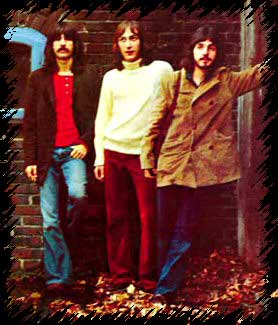
>vintage Glass Harp

>My last post was about the passing of musician Larry Norman. That post got me thinking about my interest in Christian music back in the 1970s. Back then the pickings were rather slim. But there were a few individuals and bands that stood out. One of those individuals was guitarist Phil Keaggy

There is a story (myth?) about Phil Keaggy that goes something like this: Jimmy Hendrix was asked once how it felt to be the world’s greatest guitar player. Hendrix is reported to have replied, “I don’t know, why don’t you go ask Phil Keaggy?” If that is true (it’s probably urban legend) it would have occurred when Keaggy played for the band Glass Harp. Regardless, Keaggy has had a long reputation as one of the best, if not as well known, guitarists in the world.

Glass Harp was not a “Christian” band (whatever that is), and eventually Keaggy left the band to pursue music in the, then new, contemporary Christian music scene. Remarkably, here is a rare clip of Glass Harp (from a once lost 1972 PBS broadcast?) with Keaggy on lead guitar:

One reason I post this is that in the late 1970s and early 1980s my friends and I used to talk about Glass Harp as though it was some golden chalice. We had never heard Glass Harp and we could not get hold of any ablums. We only had stories and rumors. Glass Harp was this great mystery we imagined. Now, to my surprise and pleasure, I find Glass harp on YouTube!

Phil Keaggy is still jamming. And now, again, is Glass Harp with Keaggy.

>Larry Norman: Rest In Peace

>Larry Norman has died.

Maybe you don’t know who he was. Sometimes called the father (and later grandfather) of Christian rock music, and inducted into the Gospel Hall of Fame in 2001, Larry Norman was a seminal figure in many people’s lives for nearly 4-plus decades. You can read about him on Wikipedia and elsewhere. For me, his passing draws me back to my childhood when I was looking for artistic expressions of the ideas and passions within me.

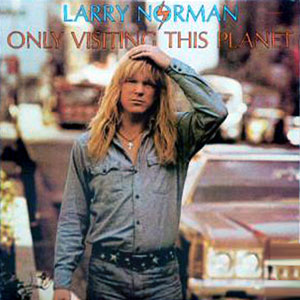
The first “rock” album I ever bought was Only Visiting This Planet, released in 1972.

I’m guessing I got it in 1975 or 1976. When I first put it on I was a little concerned. The first song, Why Don’t You Look Into Jesus, shocked me. Here are the opening lyrics:

Sippin’ whiskey from a paper cup.
You drown your sorrows till you can’t stand up.
Take a look at what you’ve done to yourself.
Why don’t you put the bottle back on the shelf.
Yellow fingered from your cigarettes.
Your hands are shakin’ while your body sweats.

CHORUS:
Why don’t you look into Jesus,
He’s got the answer.

As a kid I didn’t quite know what to do with this album. Funny, but I was worried my parents would hear it and make me turn it off because of the “offensive” lyrics. But I kept listening, and soon it took hold of me. Because of that album, with its Christian lyrics that didn’t fit into the Christian sub-culture I grew up in, and with its sometimes driving, sometimes beautiful melodies, my perspectives on what it meant to be human and to engage with the world developed and matured.

Here is Norman performing Why Don’t You Look Into Jesus. The clip begins with some early/mid-seventies studio version and then cuts to a live performance, probably from the eighties:

One of the best songs from that album is The Great American Novel. There was nothing typically “Christian” about this song, and yet I can help but think this is one of the truest Christian songs I ever heard. Here are the lyrics:

i was born and raised an orphan
in a land that once was free
in a land that poured its love out on the moon
and i grew up in the shadows
of your silos filled with grain
but you never helped to fill my empty spoon

and when i was ten you murdered law
with courtroom politics
and you learned to make a lie sound just like truth
but i know you better now
and i don’t fall for all your tricks
and you’ve lost the one advantage of my youth

you kill a black man at midnight
just for talking to your daughter
then you make his wife your mistress
and you leave her without water
and the sheet you wear upon your face
is the sheet your children sleep on
at every meal you say a prayer
you don’t believe but still you keep on

and your money says in God we trust
but it’s against the law to pray in school
you say we beat the russians to the moon
and i say you starved your children to do it

you are far across the ocean
but the war is not your own
and while you’re winning theirs
you’re gonna lose the one at home
do you really think the only way
to bring about the peace
is to sacrifice your children
and kill all your enemies

the politicians all make speeches
while the news men all take note
and they exagerate the issues
as they shove them down our throats
is it really up to them
whether this country sinks or floats
well i wonder who would lead us
if none of us would vote

well my phone is tapped and my lips are chapped
from whispering through the fence
you know every move i make
or is that just coincidence
well you try to make my way of life
a little less like jail
if i promise to make tapes and slides
and send them through the mail

and your money says in God we trust
but it’s against the law to pray in school
you say we beat the russians to the moon
and i say you starved your children to do it
you say all men are equal all men are brothers
then why are the rich more equal than others
don’t ask me for the answer i’ve only got one
that a man leaves his darkness when he follows the Son

It is likely that I can trace my own cultural and political leanings, not to mention spiritual understanding, in part to this song, which I listened to, and pondered over, as a child. Needless to say, songs like this put Norman outside the conventional Christian culture. It is amazing how applicable this song still is today.

This clip of Let That Tape Keep Rolling shows how Norman could really rock back in the day:

Finally, I have to say that Larry Norman was not a perfect man. He had his troubles and failings like all of us. So often we look to religious figures (artists, preachers, gurus) to somehow be exemplary in their behavior. We want to believe it is possible for a human to achieve true holiness or moral perfection, but this never really happens this side of eternity. Norman was exemplary, though, as an honest musician who held on to his faith in the midst of this often messy and ugly thing we call life. And in that one can find encouragement and hope.

Rest in peace.

>Improv Everywhere

>Every once in a while I come across something that really makes me smile, chortle even.

Thanks to the Internets I now know about Improv Everywhere, a New York based arts group that uses public spaces and a little fun deviousness to create art “events.” Below are two recent acts of art perpetrated by Improv Everywhere. There are is a lot more to see on their site.

What makes me happy about this kind of art is its subversive playfulness, and that the “viewer” is also a true participant.

Slo-Mo Home Depot:
http://flash.revver.com/player/1.0/player.swf?mediaId=81017&affiliate=33106

No Pants 2k8:
http://flash.revver.com/player/1.0/player.swf?mediaId=619852&affiliate=33106

>the long axis & the interpretive camera

>Alexander Mackendrick was a noted filmmaker and an influential teacher. Below are a couple of clips that focus on his teaching and some of his ideas.

“If a film works it is never simply because it followed the rules. If it fails, however, it is almost certainly that the breaking of one or more rules is the root cause.”

~Alexander Mackendrick

I am only now learning about Mackendrick. These clips, however, remind me so much of my days at university. I love this stuff.

Lasker & Capablanca

As I teach (and prepare to teach) my daughter how to play chess, I am teaching myself. The more I examine the game the more I am fascinated with its history and the numerous characters that have populated that history.

One of those characters was the great chess master Emanuel Lasker (b. 1868, d. 1941). Lasker was the world chess champion for 27 years until he lost his position to the brilliant José Raúl Capablanca. To be a world chess champion for that long is a stunning achievement. But he was much more than a chess player.

Lasker was a brilliant mathematician and a noted philosopher. He was a friend of Albert Einstein and was a passionate bridge player. Most importantly, Lasker was a humanitarian with a focus on education.


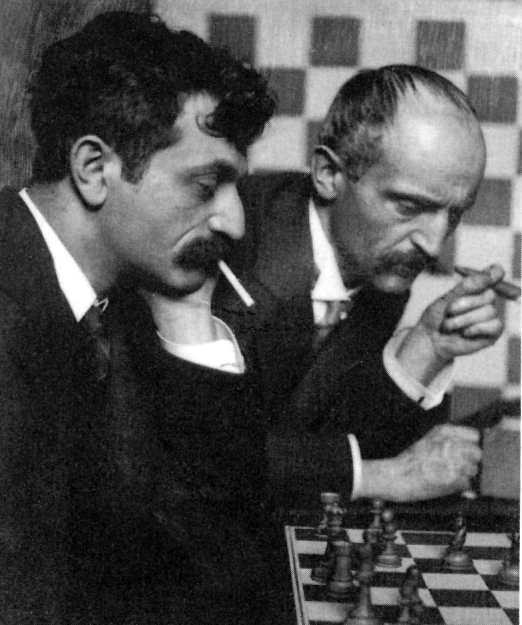
Lasker (left) and his brother

Lasker lost his world title in 1921 to the young Capablanca. There is no doubt that Capablanca was a genius at chess. But it was no so much that Capalanca took the world chess title from Lasker, as it was Lasker gave up the title knowing that Capablanca would win. This may sound like a contradiction, but it seems clear that Lasker had been champion so long and had moved on to other things. He became increasingly interested in the betterment of others and the development of a better world. His humanitarian goals began to outweigh his chess goals. To me this is by far the greater goal than being a chess champion. Though I want my daughter to enjoy playing chess, and if she becomes a great chess player that’s fine to, but I hope that she (and myself) grow to become the kinds of people who love others and seek their good. That is Lasker’s true legacy.


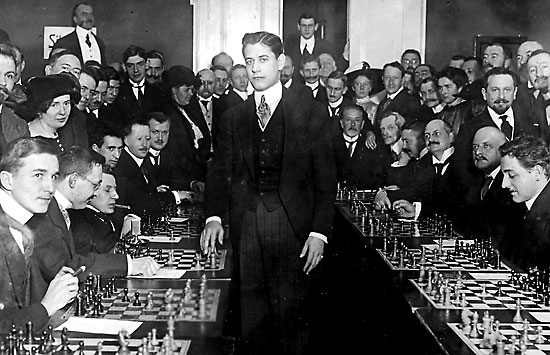
Capablanca giving a simultaneous exhibition

One of Lasker & Capablanca’s great games.