>Good Journalism

>Amy Goodman & Robert Sheer on the state of journalism and its implications:

I have become increasingly convinced that the state of mainstream journalism in the U.S. today is lousy. If we do not take the time to find and engage with good journalism, rather than merely consuming the mainstream media, then we are and will remain ignorant and potentially very foolish.

>The Crisis Now: Harman & Harvey on our (re)current economic troubles

>Given our current economic crisis (haven’t we been here before?) maybe this would be a good time to see what the communists have to say.

Here is Chris Harman speaking on how we got into this stinking mess:

Harman references several times the talk given by David Harvey. Here is Harvey:

I have to say I like a lot of what they say (in fact I think they are often spot on), but at times they come across a little too simplistic and a little too much like they are preaching to the choir (but Harman is a hoot, ain’t he). This is where some good reading will help. This last weekend I spent about ten hours on American Airlines reading Das Capital. It’s both great and a slog. Many pages left to get through that beast. Then on to other books and more perspectives. Bye for now comrades.

>Fault Lines on Healthcare Reform

>I am increasingly pro single-payer healthcare. I have not entirely made up my mind because I am somewhat overwhelmed by all the issues and technical details, but it is becoming clearer to me a comprehensive government system would be miles ahead of where we are today. Calling it socialist healthcare is fine with me as well, in fact, I’m beginning to think it has a nice ring to it. Videos like the one below testify to our current crisis and the difficulty of getting good ideas heard when the rich will do anything to keep those ideas from being heard.

Part 1

Part 2

>some favorite sites

>My sidebar keeps growing. I want to reduce the number of links, but I just can’t. So here are a few I like the most.

Recently I discovered Bike Snob NYC. This has got to be one of the funniest blogs I have come across – a little ‘off color’ (whatever that means) but at least I laugh and that’s what matters.

For those of you who like to jerry-rig broken things or laugh at those who do, I highly recommend There, I Fixed It. This blog is a testament to the incredible variety of human creativity when it is combined with idiocy.

Ever wonder why you feel a little at odds with the ‘exciting’ world of retail marketing? Well, you should check out Retail Anarchy. I find myself slightly aghast at what we have come to accept as ordinary: horrible products and horrible marketing ideas.

Somewhere between There, I Fixed It and Retail Anarchy is Item Not As Described. I guess one could say this is a kind of salute to Craig’s list, only not a salute.

If there is any blog where you can spend most of your life laughing, cringing, (once again) and aghast it’s at the Fail Blog. This is truly one of the best blogs in the universe of bloginess.

I’ll be back some other time with more links, but these will suffice for now.

>bikes & cars

>I feel I must write this.

Yesterday I went on a bike ride (23 miles) that took me through the country. It was a beautiful morning and the ride was great. But there was an incident that got me mad. I was on a straight stretch of country road with no usable shoulder. This meant I had to ride just to the left of the white line. Everything was going well until a loan motorist decided to come as close as he could to me (about 6 inches) at 60+ mph and then blare his horn as he passed. Then as he barreled down the road his hand came out of his window and flipped me off. I did not get his license plate number. If I had I might have called the police to say the motorist tried to kill me. My speed increased by almost 2 miles an hour for about 15 minutes as my anger boiled inside me. Then my rage subsided and I rode home. Except for that one motorist it was a truly great ride. However, in the future I will consider riding with a local bike group rather than alone.

What I find interesting is that in the past two weeks I’ve had two other “incidents” with cars on my daily commute to and from work. The first was a woman in a white Lexus SUV (I’m sure she takes it 4-wheelin’ on the weekends) who was talking on her cell phone and waiting to enter traffic. As I came down the street in the bike lane she looked right at me and then decide to pull out into traffic anyway. I had to hit my brakes hard in order not to hit her. The other was about four days ago. Another woman on a cell phone in another SUV. I was entering the crosswalk on my bike. The light was in my favor. She came up on my left and then made a sudden right hand turn right in from of me through the crosswalk, cutting off my path and forcing me to hit my brakes. I missed hitting her by only a couple of inches. In all three of these cases I was in the right, playing by the rules, and if the situations had been even slightly different I would be dead or very injured. Being in the right doesn’t mean much for the cyclist when the other vehicle is a car or truck.

What is going on?

I see other signs of bicycle disregard. Cars park in bike lanes. Road crews use bike lanes to put out their road construction signs. Bike lanes are perennially filled with debris or resident’s garbage cans or piles of leaves. Cars pull into bike lanes to make turns. The list goes on. But of course I live in a country that is designed to get a car within at least 50 feet of anyplace a person might want to go. Our houses look like they are made for cars to live in along with their servants. Our lives are designed around cars. Our cities are designed around cars. Our economy is designed around cars. And yet we suffer in many ways because of cars. Don’t get me wrong. I have a car and use it. I need it, in fact. But I recognize our society’s mindset is wrapped around the supremacy of the automobile. It only takes a few days of commuting on a bike to realize that fact.

I read a recent article that compared the general attitude towards cyclists in the U.S. and Europe. The article used the interesting fact that in Europe truckers encourage cyclists to grab on to their rigs and get pulled over hills, whereas in the U.S. truckers try to run cyclists off the road. The article went on to say this is because in Europe professional cycling is seen as a working class option to “get out” and improve one’s life – kind of like boxing in the U.S. But there is more I think. There are just more people on bicycles in Europe. It’s part of their culture and part of their economy. In the U.S. bicycling is for kids and joyriding adults. It’s not serious or necessary to either life or our economy. This means, in part, that bicyclists don’t have to be taken seriously. I live in a city that is considered bike friendly. Yet sometimes I get the impression that many think the bike lanes are their as a courtesy and us cyclists should be grateful that at least we are allowed to exist at the margins.

Studies have shown that motorists tend to view cyclists as an “out group”. Put simply, motorists subconsciously see themselves as part of a group (motorists) and they hold negative views of a group they view is inferior (cyclists). This is a typical minimal group paradigm scenario.1 Not all motorists do this, but the majority do so subconsciously. Other studies have shown that the provision of bicycle lanes appears to “increase driver confidence and, hence, potentially risky behaviour, such as higher vehicle speeds and less speed reduction when encountering cyclists.”2 In other words, motorists tend to drive faster and with less regard for cyclists if the cyclists have their own lane. This may seem to make sense until one considers the consequences of a human body and a three ton car. Plus bike lanes are often inadequate, too narrow, and don’t interface well with the rest of traffic. If one is pulling a bike trailer carrying children then bike lanes are far too narrow. This is not good if motorists think the road belongs solely to them and it is the cyclist’s job to keep out of the way.3

I am not an angry person and I tend to say live and let live. But I am beginning to think of getting the license plate number of every driver who is reckless around non-reckless bicyclists and calling it in.

1 Part of this paradigm is to attribute the negative behavior of a few to all. Sometimes a person will claim that bicyclists are the ones at fault because they are reckless, don’t stop at lights, weave around in traffic, etc. But most cyclists follow the rules very well. And don’t forget those rules are, in large part, designed around the needs of automobiles and to control reckless motorists (of which there are many) rather than cyclists. Also, there is a world of difference between the mother riding safely in the bike lane, pulling her trailer with her kids, and the 20 something joyriding derelict recklessly cutting off cars. Yet many motorists don’t, or can’t, make the distinction – all cyclist are the same in many people’s eyes, they are part of that “out group”.

2 Basford, L; Reid, S; Lester, T; Thomson, J (2002), Drivers’ perceptions of cyclists, Report, 549, TRL Limited, pp. 38, OCLC 51283575

3 Years ago, when I first began commuting on a bike to work, I noticed myself becoming much more aware of cyclists whenever I drove my car. I was surprise by how much I previously did not care about, or even notice cyclists or their needs. It was a kind of paradigm shift for me. I came to the conclusion that everyone should commute in their city some of the time in order to reorient their minds to the greater word they live in.
>the call of the marathon

>Why do people run marathons? I don’t know.


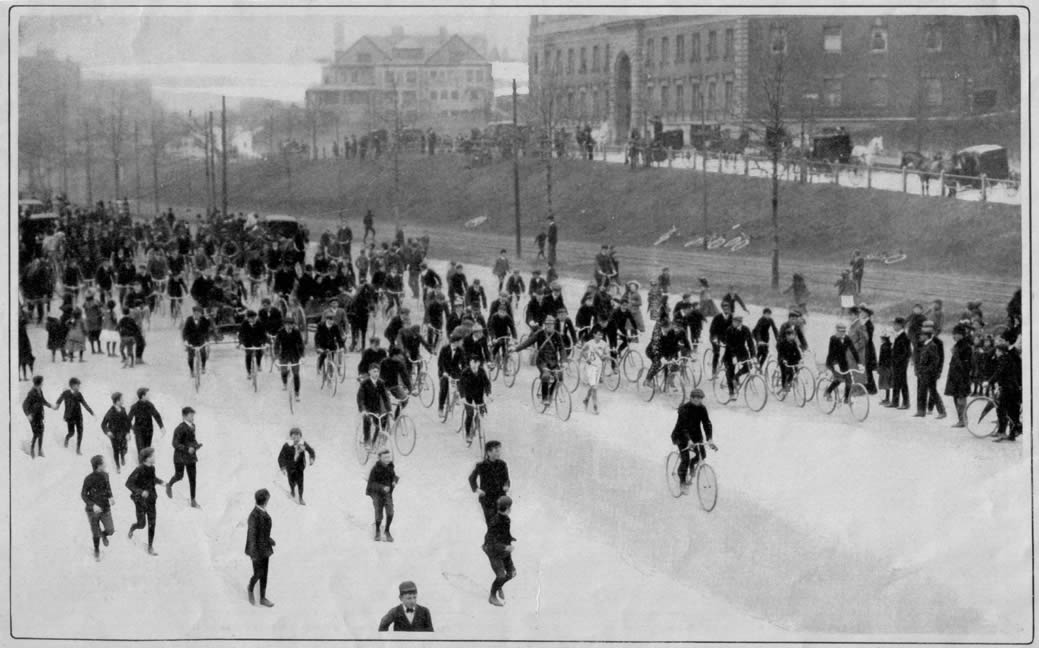
Fans surround race leader in 1904 Boston Marathon.

I’ve been thinking about running a marathon some day. I’m a long way from being ready or able to do so (a very long way), but it is a kind of dream of mine. I may never run one, we’ll see. But I’ve also been thinking about the early marathons, that is, those around 100ish years ago. When we think of running a marathon as a formal organized race, that idea has only been around about 120 years even though the inspiration goes back to ancient Greece. In the early days the typical distance was around 25 miles. The thing that has got me thinking is the fact that at a certain point marathons were something new – a novelty in fact. I am reminded of when triathlons were the new thing, especially the Ironman*, which seemed impossible in length yet many people got excited to try it – whether they were ready or not – even though it was like staring into the unknown.


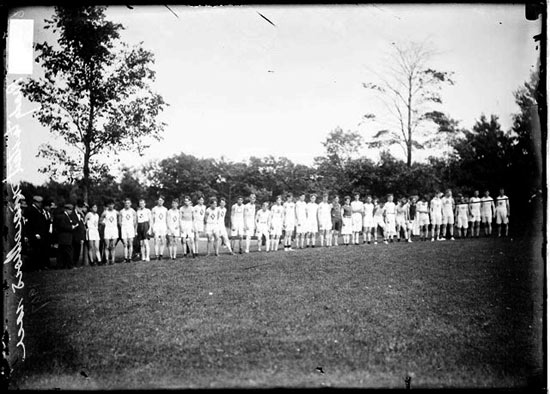
Runners line up before the 1907 Illinois Athletic Club Marathon.

Why do people get excited to run a marathon? I want to run one and even I can’t answer that except in vague terms of personal challenge. But I also have the advantage of knowing that many thousands of marathons have been run by millions of people. Still, for me, the idea of running a marathon is like staring into the unknown with a mixture of fascination, desire, fear, and wonder.

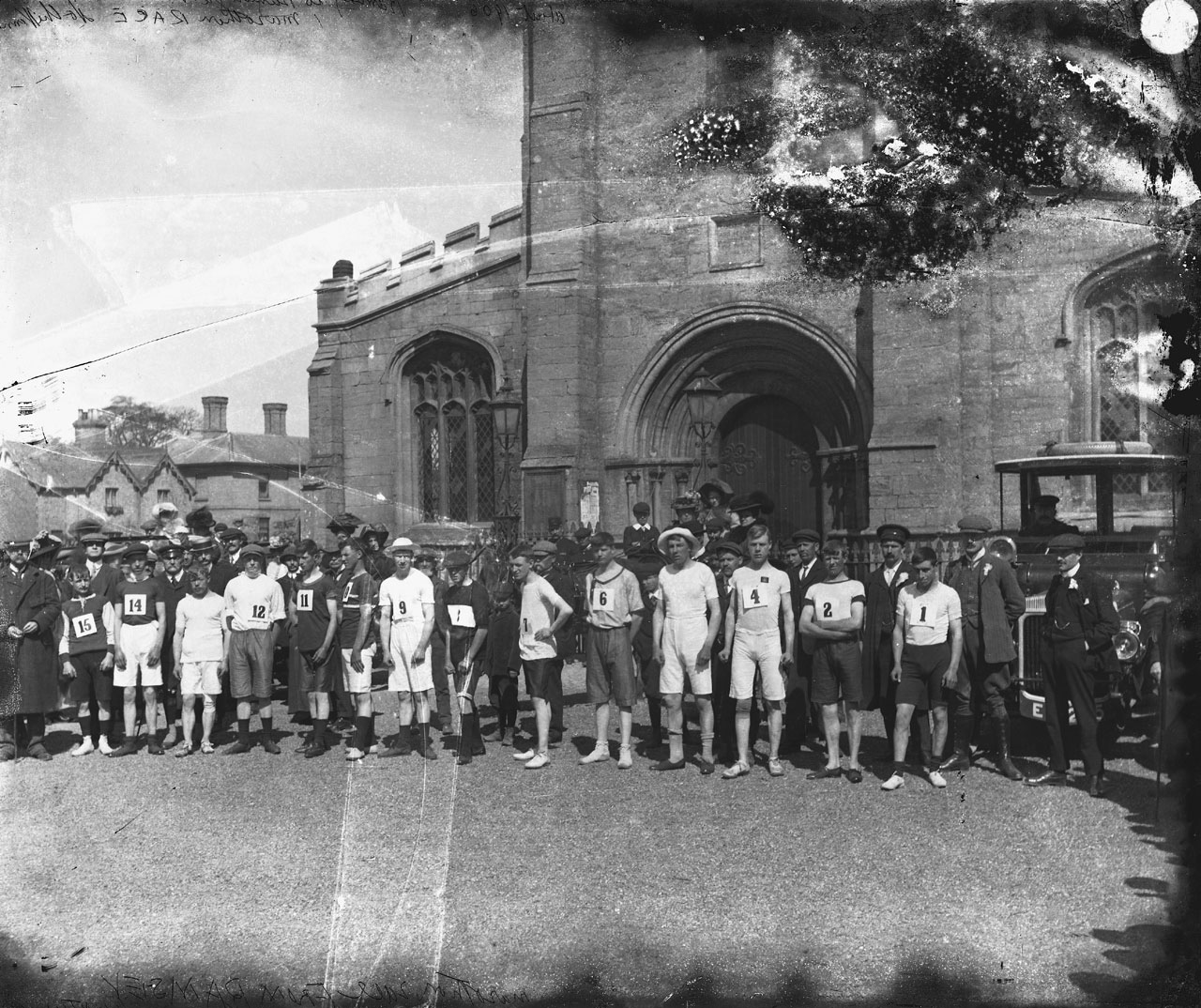
A hundred years ago marathons were still somewhat unknown. People did not know much about training for them or the physiology of endurance sports. The clothing they wore, especially the shoes, was not suited to running in the the way we expect today. And, I would assume, that the races themselves were not as well managed or supported as they are today. But still runners (only men for years) lined up at starting lines with high hopes and anticipation.


Runners line up before the 1909 Ramsey to Huntingdon marathon.

What I find curious is the ways people think about marathons. For many it is a kind of ultimate personal challenge that calls to them. To others they roll their eyes and say they can’t imagine why anyone would even try. I’m closer to the first group, though I have never run a marathon, and looking at me one might think I never will. For many the distance (26.2 miles today) is an kind of impossible distance. Yet I recently posted about a 135 mile ultramarathon race through Death Valley in the middle of July every year – and people show up, run it, and finish. So what is it that attracts people to do seemly crazy endurance events and enjoy them?

Those early marathoners were staring into the unknown to some degree. Running 25+ miles was thought to bring one closer to death, a test of one’s willingness to push oneself to the limit. Today we know more, and it’s amazing how many “non-runners” aim for completing one. Yet, even with the huge numbers of people running marathons, and the increase in marathon choices, it is still a mystery why many of us find ourselves desiring to join the fray – even if in the most humble way.

* First run in Hawaii in 1978, the Ironman Triathlon consists of swimming 2.4 miles in the ocean, followed by biking 112 miles, and then running a marathon, raced in that order and without a break.

>fears of the homeschooler

>Homeschooling is not for everyone. Though more parents might try it if they thought they could. A number of people have told me they are considering homschooling but are not sure it’s for them. They have fears and worries about taking on more than they can handle or want to handle. The reality is that homeschooling is not easy. In fact, it is quite difficult. In a way it’s impossible. What do I mean?

I want to approach my answer in two ways: 1) The 40,000 foot level, and 2) specific fears.

Homeschooling is a little like jumping off a cliff or a leap into the unknown. It’s a big bite to chew, a heavy load to carry, a constant worry of sorts. The goal of the homeschooler is to educate their own children, for any number of reasons, such that they grow up better educated in some way than they would have from other educational methods or systems. How homeschoolers define better is varied and debated, and sometimes better isn’t better. And even if one has hit upon something better one faces into the daunting task of implementing that method or system. Thus, while one is struggling in the midst of the implementation, one is often haunted by lingering thoughts about the solidity of the chosen method or system.

But consider the flip side. Deciding which school your child goes to is not the end of your responsibility for your child’s education. Sending your kid to the school bus with a warm coat, their bag of books, reams of completed homework, and their lunch box is not the end of your responsibility either. We have inherited historically recent ideas of what education is and how it should be done. Our society tends to believe that education, like medicine, should only be done by professionals. This is both a fallacy, based largely on incorrect and incomplete ideas of what education is, and a false hope, based largely on misunderstandings of learning processes. Professional educators are generally quite good and many are excellent. But they also struggle with both method and implementation. There is virtually no consensus in the politically charged world of public education on which method is best. There are many competing ideas (sometimes changing from year to year in schools) that fight for support and funding. Putting those ideas into practice is also fraught with peril. Schools often have to settle for a compromise between the latest educational ideas and maintaining adequate control of 20+ different personalities and learning styles in the classroom. I have written about some of these perils previously here. My own experience, and much of what I have observed of others, shows me that both method and implementation are the great bugaboos of all education. And private school education may be only slightly better than public at a much greater cost.

Therefore, in regards to the difficulty of homeschooling, as seen from the 40,000 foot level, I would say that to not homeschool is at least as difficult if one takes one’s responsibility seriously. There is a lot of pressure to see homeschooling as an aberration, but it is not a true aberration. All educational choices have some validity in certain contexts. And public schooling is, historically, an aberration of sorts, designed to accommodate the needs of the industrial revolution and the barest requirements of democracy – both recent events in Western culture. Homeschooling, on the other hand, has been around for millennia. For the thinking and loving parent the choice, and maybe the inevitability, of public school for one’s children is not an easy one. From the perspective of the parent who is homeschooling, or trying to do so, the choice to not go with public school can be seen as difficult a choice in that there are no perfect alternatives, no obviously correct methods, and implementation troubles all teachers. Thus, the homeschooling parent can at least be confident that choosing to homeschool is not harder than choosing public schooling, though we have been conditioned to falsely see the public schooling choice as the easy one.

But then there are the specific fears of homeschooling that may cause prospective homeschoolers to shy away from making that choice. The fact is there are no easy answers or secret shortcuts. I have listed some of those fears below, but I know there are many more.

  • Are you truly qualified? I wrote about this in a previous post. The short answer is there is no one more qualified to teach your own children than you. Does this mean you will be the perfect teacher? No. But no one else, even a state accredited teacher, is more qualified than you.
  • Can you teach your child to read? Yes. Children have a remarkable, God given capacity for learning. Like with most skills one learns to read through repetition and taking small steps day after day. As a parent you can guide your child uniquely to their learning style and speed. There are many excellent resources to use as well.
  • What about subjects in which you are weak? Remember you are teaching a child. In no way do you need to be a master of any subject in order to teach it to a child. The most important quality is a passion for learning. Plus, taking on a subject that you don’t know well, say science or math for example, gives you to chance to learn it yourself. The best way to learn a subject is having to teach it to another. Remember, most public school teachers were not experts in the subjects they teach at the beginning, and many never gain true expertise. Again, there are many excellent resources to pick from.
  • Can you manage it? This is a bigger question beyond merely the teaching of specific subjects or making sure your child makes it to the next grade. Homeschooling is a total family kind of project. Educating your child does not get separated from the rest of life, including cleaning the house, running errands, and everything else. If one has more than one child, especially little ones that need a lot of attention, management becomes rather challenging. From my own experience, and more so from observing my wife, the answer is yes you can manage it. That is not to say it will be easy, and sometimes you may want to throw in the towel. Most likely you won’t throw in the towel because you have bigger reasons for homeschooling. Remember you set the schedule. If it gets too tough, take a break and do something else for the rest of the day, or even the week.
  • Will your own flaws get in the way? Yes. You are far from being a perfect person. You do not have as much patience or kindness or strength as you need to do everything you wish you could. Neither does anyone else who might educate your child. It’s called being human, which includes both our finite capacities and our sinfulness. Since there is no getting away from your flaws then it’s a mute point in a way. You are who you are, the key is to seek wisdom and love and forgiveness in the midst of homeschooling. Ironically, your flaws may provide one of the better opportunities for teaching those things that are most valuable.
  • Do you know where to begin, and then where to go from there? Maybe not, but you can find out. One of the most surprising aspects of homeschooling is the plethora of teaching materials, curricula, and advice. In fact it may be too much. There are complete programs that send you a box with everything you will need for an entire school year, including all the books, science materials, worksheets, and even pencils. There are curriculum guides that lay out courses of study and require you to then pick and choose what materials work best for you. And then there are tons, and I mean tons, of great teaching aids that can be used to supplement any subject, any teaching style, any learning style, and everything else.
  • Won’t you be stuck at home all day, every day? One of the big surprises of homeschooling is how much one is not actually at home. Homeschooling is about learning, not about staying at home. Field trips are common. Doing lessons with other homeschooling families is also common. There are many resources for education outside the home, including homeschooling co-ops in many areas.
  • Will you have the support you need? That depends. The answer is, you can if you seek it out. Homeschoolers tend to be a supportive kind of people. Maybe it’s because they recognize they don’t fit into more common educational and societal categories. Regardless, it’s not hard to find others who homeschool, especially online. There are no guarantees you will have the support of your extended family, or that you will want to hang out with the other homeschoolers you meet. But that’s life. The key is to know why you have chosen to homeschool, cling to that in times you don’t have support, and be able to articulate your position to others who may then see the light and become supportive.
  • Won’t it be hard? Yes. That old platitude is very true – anything truly worth doing is never easy. But the fact is, life is hard. You don’t get away from “hard” by not homeschooling.
  • Will I be denying my kids a fuller educational experience? This is a question to ponder. The short answer is no, but a more substantial answer has everything to do with unpacking the idea of “experience” and how the homeschooling experience creates a different experience than public education. Much of it depends on one’s reason for homeschooling. I wrote about a disagreeable trend in homeschooling that sees pulling one’s children out of public school as a retreating from the world on the whole. But one can choose otherwise. Homeschooling can, in fact, provide a much richer, much fuller, less damaging and less demeaning experience that other options.

There are many more reasons that parents might have fears about homeschooling. There is no way I can either address them all, or address them adequately. Maybe most of my thoughts above are inadequate. But I see the fear to homeschool being similar to the fear of being in relationship with another, or taking on a new job, or having a child. What is remarkable is how often we take on big, scary projects in stride – and even come more “alive” in the process. The truth is, one’s love of one’s children is a powerful motivator for the homeschooler. Homeschooling is a monumental task, even impossible in some ways, but it is a privilege to do and a challenge worth embracing.

>Badwater (yikes! cool!)

>I have always had a fascination with endurance sports – from the sidelines that is. One of the gnarliest is the Badwater Ultramarathon. The race consists of running 135 miles through Death Valley in the middle of July – which means this year’s race just finished a few days ago. This year’s men’s winner did it in 22:51:29. The women’s winner came in at 26:51:33. But of course, anyone who finishes is a winner in this kind of race. Heck, even just giving it a serious go counts as a win in my book.

Here is the post-race interview with the women’s winner:

I wish I looked that good after running three miles.

Here is a look at the race:

Notice how they all start with lots of enthusiasm and then some start looking a bit ragged. I doubt I would ever be able to run even half that distance, even with years of training, but I wish I could.

>good job boys

>

40 years ago today human beings set foot on the moon. It is still awesome.

>40 years ago today…

>

Apollo 11 left the Earth and entered the history books as the first mission to put a man on the moon. Still staggering after 40 years.

The launch of Apollo 11: