Two Analogies of Freedom

Beautiful snow-capped mountain peaks jut into a glorious blue sky. Climbers, dark silhouettes in the clear air, make their way up a ridge on their way to the summit. Their movements are slow and methodical yet graceful. Distant peaks ring the horizon like stunning diamonds. This is an image of freedom. In fact, one of the most popular mountaineering books in English is called “Mountaineering: The Freedom of the Hills.”

Alison Hargreaves in 1986 on a first ascent of a hard route on Kangtega (6779), Nepal. Hargreaves was one of the most accomplished high alpine climbers with a stunning carreer. In 1995 she would die at age 33 while descending K2, thje second highest mountain in the world, leaving behind a husband and two children.
Source: https://alpinist.com/features/freedom-in-the-hills/

A sailboat glides along the rolling waves of a blue sea under bright sunny skies. The sails are full of wind and the boat leans gracefully as it moves quickly through the water. The crew sits along the windward rail as they scan the undulating surface of the sea. This too is an image of freedom. In fact, “freedom” is a common word in sailing book titles, sailing social media account names, boat names, and sailing videos.

Morning Cloud 3, 45ft ocean racing yacht, beginning her fateful voyage in 1974, The yacht was severely damaged by two mammoth waves off the coast of West Sussex. Two of the seven crew members would not return alive.
Source: https://www.pbo.co.uk/seamanship/lessons-learned-from-the-sinking-of-morning-cloud-3-88859

When I was younger I climbed mountains and I am still an armchair mountaineer. But these days you will more often find me and my family on our little sailboat at our local lake. From experience I can attest to the beauty of these sports. I can also attest to what freedom actually means when climbing mountains and sailing boats. It’s not exactly the romantic image of freedom of the book cover or poster. And here lies a lesson on true freedom compared to the popular libertine and libertarian concepts of liberty we often find today.

Both of these analogies of freedom offer us images of people who have left behind the cares of the world. Life is more simple, it seems, when one hikes the hills and sails the seas. In a real sense that is true. But it’s also deceptive. At every moment the mountains and the seas put up challenges and dangers that are very real and often require strict movements and calculated responses. In fact, each sport has its own highly specific tools, knowledge, actions, and language. Make a mistake and one will suffer, perhaps even die. That sounds rather harsh but it is, in fact, part of the appeal. It is also, ironically, where one finds freedom.

These little scenes are much like life, but we often don’t see it that way. Freedom, we are told, is to be able to do whatever one wants without restrictions. Yet this kind of freedom quickly becomes a form of slavery to one’s passions. True freedom comes from stripping away everything that is unnecessary, everything that is unfruitful. But that only makes sense when one seeks a goal of great value.

Around 600 A.D., John Climacus wrote his famous ascetical treatise, The Ladder of Divine Ascent, outlining thirty steps upwards towards the perfect model of perfection, Jesus Christ. Those steps are the virtues that counter the passions, and by overcoming the passions we increase in righteousness and begin, by God’s grace through the saving actions of Jesus Christ, to enter into the process of theosis. That ascetical work, hard as it is, leads us towards the freedom from sin and into the joy of union with God. That ascetical work is like the limitations self imposed by the mountaineer and sailor done to ensure success.

The 12th century Ladder of Divine Ascent icon (Saint Catherine’s Monastery, Sinai Peninsula, Egypt) showing monks, led by John Climacus, ascending the ladder to Jesus, at the top right.
Source: https://en.wikipedia.org/wiki/The_Ladder_of_Divine_Ascent

For the Christian the goal of great value, also called the pearl of great price, is theosis. More than being free of sin and going to Heaven, although that is part of it, theosis is about partaking in the Divine Life. We are told by Christ that the first shall be last, that only the man who gives up his life will find it, that the seed must die in order for the tree to grow, to take up our crosses and follow Him. Emptying ourselves we will receive a fullness beyond compare. Only in giving up our freedom will we receive true freedom. These are hard words to take. In fact, they are impossible to accept unless the Holy Spirit softens our hearts because it is so unnatural to us sinners.

If we are to be like God, to partake of the Divine Life, then we must give up everything that is not a part of God. We must give up our passions, that is our pride, anger, vanity, lusts, and self-centeredness. We must become poor in spirit, mourn, be meek, hunger and thirst for righteousness, be merciful, be pure in heart, be peacemakers, be willing to be persecuted because of righteousness, and accept that others will insult us falsely say all kinds of evil against us. In broad strokes this is the “ladder” we must climb if we are to reach the summit.

Although we need to be reminded of this regularly we also know it to be true, our consciences bearing this out. If we reject our consciences then we are rejecting our salvation. This is the height of foolishness. We become like ships that founder and sink.

This charge I commit to you, Timothy, my son, in accordance with the prophetic utterances which pointed to you, that inspired by them you may wage the good warfare, holding faith and a good conscience. By rejecting conscience, certain persons have made shipwreck of their faith[.] (1 Timothy 1:18-19)

Mountaineers and sailors know that accepting severe limits on their freedom within the context of mountaineering and sailing is the only way to achieve true freedom and thus true joy in those endeavors. Only through sever limits do we truly live. By analogy it is also the way for the disciple of Christ, the one who takes up their cross and follows Him.
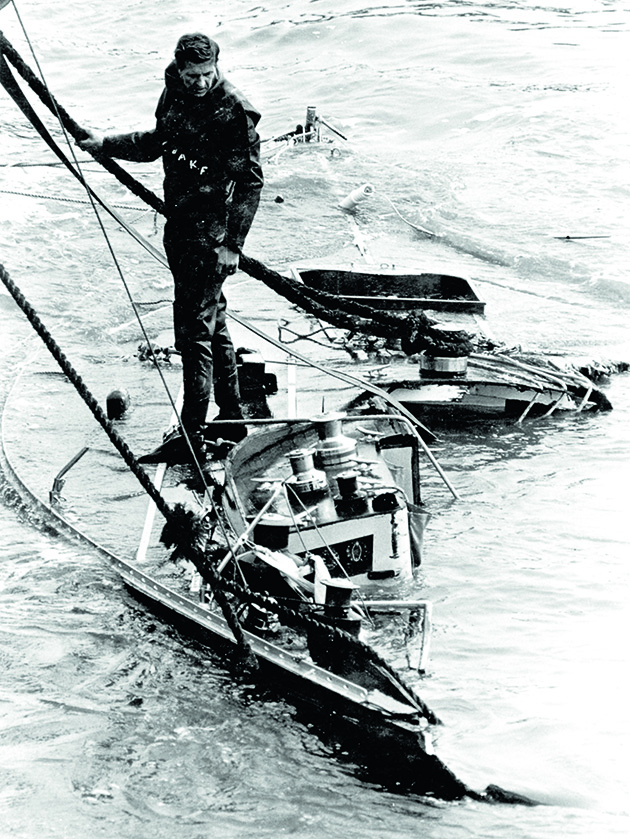
G345XN AJAX NEWS PHOTOS – 10TH SEPTEMBER,1974. SHOREHAM, ENGLAND. – WRECK SALVAGED – 741009/741109/GR1. A DIVER FROM THE SALVAGE BARGE SURVEYS ALL THAT REMAINS OF THE HULL OF MR HEATH’S YACHT MORNING CLOUD AS SHE WAS BROUGHT INTO SHOREHAM HARBOUR. THE £45,000 OCEAN RACER, THE THIRD WHICH MR HEATH HAS OWNED, WAS WRECKED IN A GALE OFF THE SUSSEX COAST ON SEPT 2ND,1974. TWO MEN LOST THEIR LIVES IN THE TRAGEDY. A YACHT SURVEYOR AT THE SCENE IN SHOREHAM SAID THE BOAT WAS A TOTAL LOSS. MOST OF THE STARBOARD SIDE WAS MISSING AND THE MAST AS WELL AS THE ENGINE HAD GONE.
PHOTO:JONATHAN EASTLAND/AJAX
REF:7410. Image shot 1974. Exact date unknown.
Source: https://www.pbo.co.uk/seamanship/lessons-learned-from-the-sinking-of-morning-cloud-3-88859
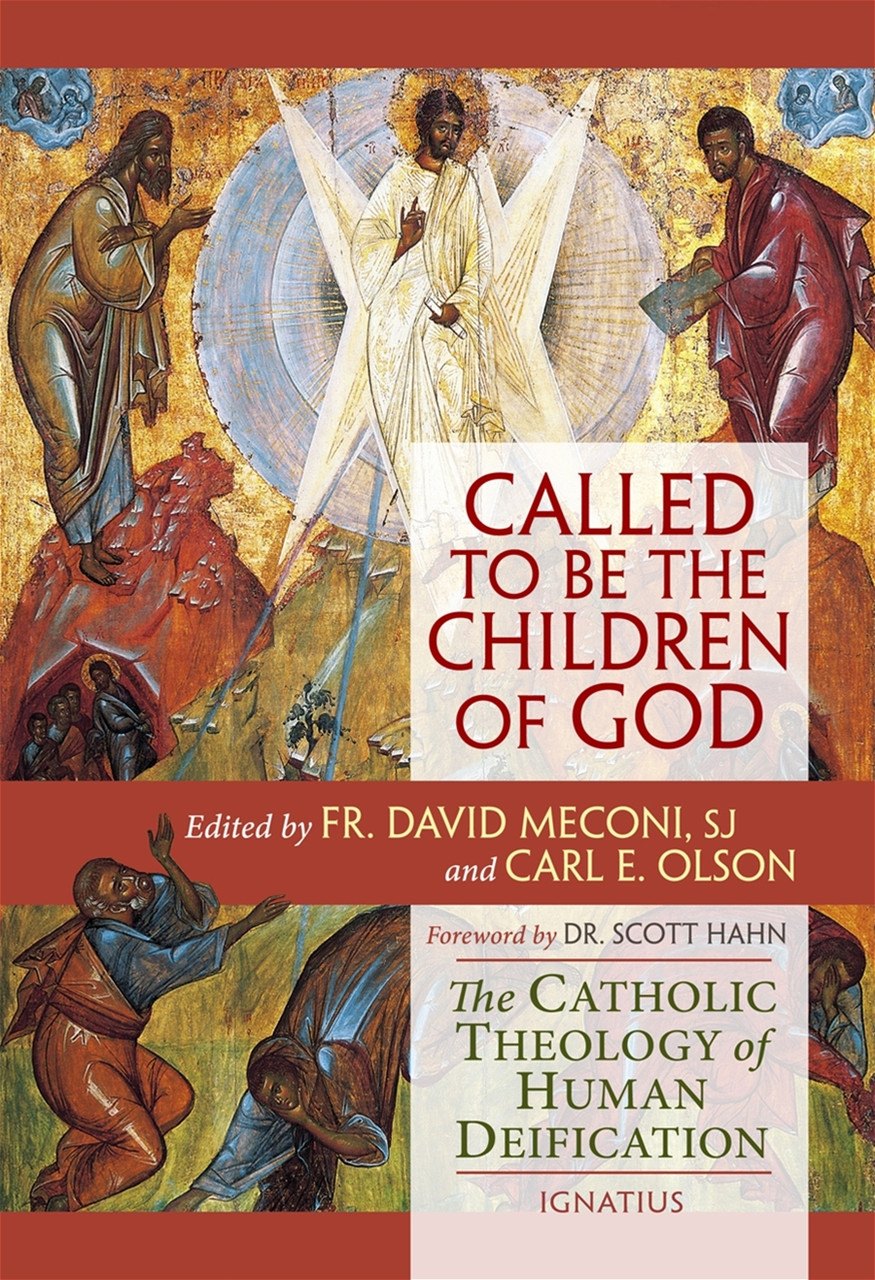
Becoming Divine

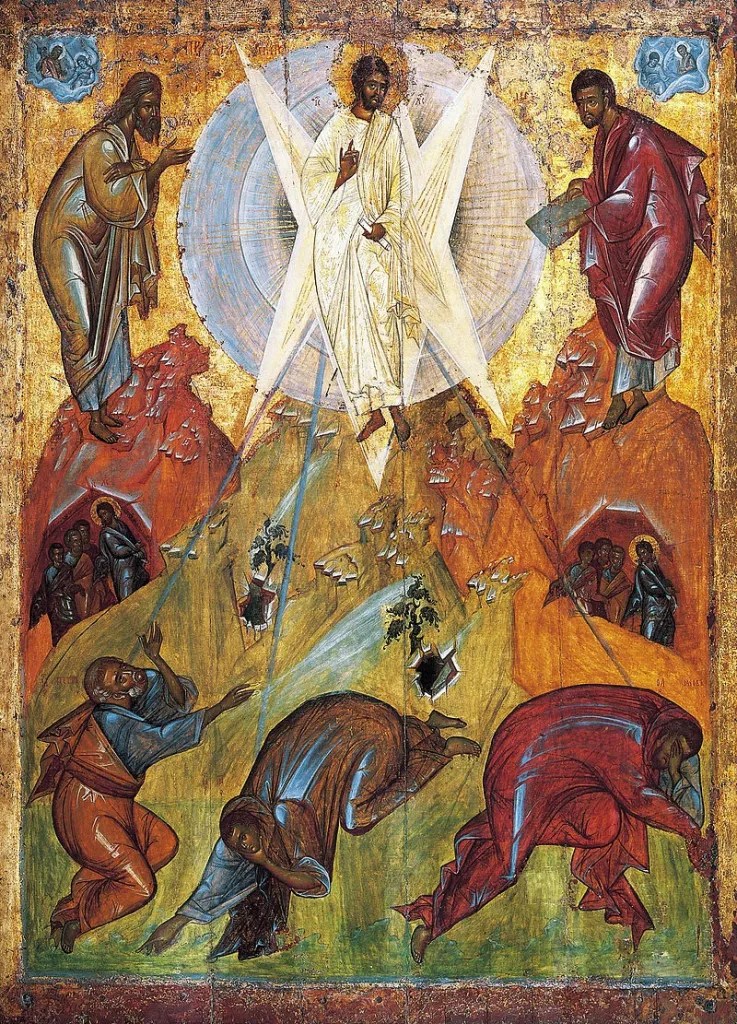
The icon of the Transfiguration by Theophan the Cretan depicts the event where Jesus Christ is transformed, revealing his divine glory to his disciples, Peter, James, and John, on Mount Tabor. Theophan the Cretan, also known as Theophanes the Greek, was a renowned iconographer of the late 14th and early 15th centuries. His Transfiguration icon is known for its use of color, particularly warm earth tones and gold, to unify the heavenly and earthly realms depicted in the scene.

May grace and peace be multiplied to you in the knowledge of God and of Jesus our Lord. His divine power has granted to us all things that pertain to life and godliness, through the knowledge of him who called us to his own glory and excellence, by which he has granted to us his precious and very great promises, that through these you may escape from the corruption that is in the world because of passion, and become partakers of the divine nature. (2 Peter 1:2–4)

Many times I read over these words from Saint Peter but I never paused to contemplate the phrase “become partakers of the divine nature.” The very idea of becoming partakers of the divine nature, though boldly stated here, was never a topic of preaching or teaching in my Protestant upbringing. And later, when I first heard the words of Saint Athanasius below, I was shocked.

“God became man so that man might become god” (St. Athanasius, On the Incarnation 54:3)

These words have rung like a bell down through the history of the apostolic Church(es) ever since they were penned in the 4th century. Alas, they have also been forgotten by many who call themselves Christian and some have even felt themselves scandalized by those words. I know the Protestant world from which I came would have rejected such ideas. And yet…

Be imitators of me, as I am of Christ. (1 Corinthians 11:1)

Are we not to be imitators of Christ? Yes! Is He not the Son of God? Of course! But these words roll off our tongues too easily. Have we not become complacent, given over to excuses? I have.

If imitation of Christ is about checking the boxes of moral perfection it’s easy to back away a bit. No one can reasonably expect me to actually check all those boxes. Right? But if imitation is to become divine… that sounds very interesting.

“You, therefore, must be perfect, as your heavenly Father is perfect.” (Matthew 5:48)

But what is this perfection? I was always taught being a good Christian is to seek moral perfection. And that is true but that is only part of the picture. When something is perfect it is, in the ancient and Biblical sense, to be brought to its proper end, to be finished, completed, lacking in nothing. For humans it means to be what a human is meant to be, that is, fully human as God intends. This is the telos of salvation. To seek it is to seek God, to desire to be like God, to be the Image of God finally and fully realized. So yes, it does mean moral perfection because it means total perfection, to be as God is, perfect.

This is theosis. This is what being a disciple of Christ is all about. This is the pearl of great price.

I’m not writing this to say anything new or profound, rather I want to point to a book and two videos that have helped me to understand that the burning in my soul is my desire for theosis.

The book is: Called to Be the Children of God: The Catholic Theology of Human Deification Edited by a friend of mine, this book looks at the concept of theosis/deification/divinization from the Old Testament down through the centuries, much of it as understood within the Catholic Church. It’s an excellent overview with countless quotes from the Bible and Church history. For a Christian not familiar with the concept of theosis (so easy to be ignorant these days) this book might blow their mind.

The videos, which are from the Eastern Orthodox viewpoint and are also excellent, are here:

Blessings to you.

[Third Sunday After Pentecost, Feast of Saints Peter and Paul, Apostles]

I want to live in a union of love with God

Alleluia! The Spirit of the Lord has filled the whole world.
Come, let us adore him, alleluia.

Apologetics played a big part in my conversion but they always left me wanting. In the end I wanted not an argument or a logical proof of the Church’s validity and authenticity, rather I wanted to become a different person. I wanted deification, theosis, divinization. I do find this concept within Catholicism but it is from the Eastern Orthodox and Byzantine Catholicism that one find deification emphasized. In short, I want nothing else than to experience God, to be united with God.

I’ve been reading The Mountain of Silence: A Search for Orthodox Spirituality by Kyriacos C. Markides. In it I find this wonderful exchange:

“So, when during the liturgy we recite the prayer “I believe in one God…,” Father Maximos went on after I shifted to second gear, “we try in reality to move from an intellectual faith in God to the actual vision of God. Faith become Love itself. The Creed actually mean ‘I live in a union of love with God.’ This is the path of the saints. Only then can we say that we are true Christians. This is the kind of Faith that the saints possess as direct experience. Consequently they are unafraid of death, of war, of illness, or anything else of this world. They are beyond all worldly ambition, of money, fame, power, safety, and the like. Such person transcend the idea of God and enter into the experience of God.”

“But how many people can really know God that way?” I complained.

“Well, as long as we do not know God experientially then we should at least realize that we are simply ideological believers,” Father Maximos relied dryly. “The ideal and ultimate form of true faith means having direct experience of God as a living reality.”

This morning I recited the Creed with a group of local believers as we celebrated Pentecost Sunday and I thought about those Christians two thousand years ago experiencing God come upon them and transform them. The world has not ever been the same since.

[Pentecost Sunday]