>little boats & troubled dreams

>I am drawn to mystery.


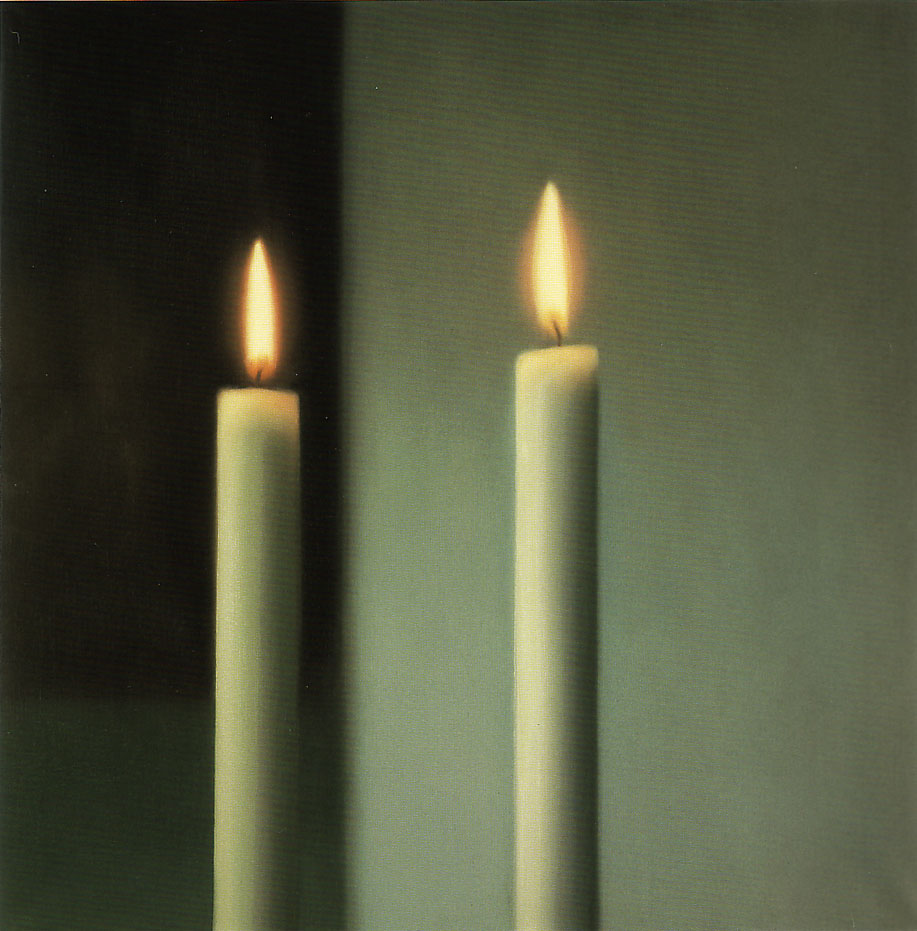
Gerhard Richter Two Candles 1982 Oil on canvas
55 1/8″ x 55 1/8″ (140 x 140 cm) Private collection

I have often wondered what it is about films that I love so much, and what it is that draws me towards particular films. I believe that the kinds of films one seeks out and enjoys is directly related to why one watches films in the first place. In other words, for some watching films has everything to do with lighthearted, end-of-the-day escapism. For others it may be a kind of testosterone drug fix. And for others it might be some kind of romantic battery re-charging. And, of course, for most of us it is a combination of many reasons. But I have to say that over and over I find myself seeking certain kinds of films and certain kinds of films experiences. Much of the time these experiences, at least the ones that stay with me long after the immediate viewing is over, are what I might call earthily transcendent, or sublime. Another way of saying it might be the more one digs into the realities of life, death, love, and suffering, the more one keeps coming up against mystery. This mystery is not a Gnostic sort of knowledge only for a select few, only for those with the “secret knowledge,” rather the mystery is there for everyone to experience and contemplate; it is fundamentally human.

Some might say this mystery is the experience of getting a kind of translucent glimpse of the hand of God creating everything, including us, moment by moment. Others might say it is the place where the limits of reason and emotion converge at a kind of metaphysical precipice. Or it could be the place where one has the feeling of overshooting one’s rationality only to discover rationality is a bigger thing than one previously imagined. And maybe, finally, the goal is about arriving where one started and knowing that place as though for the first time.


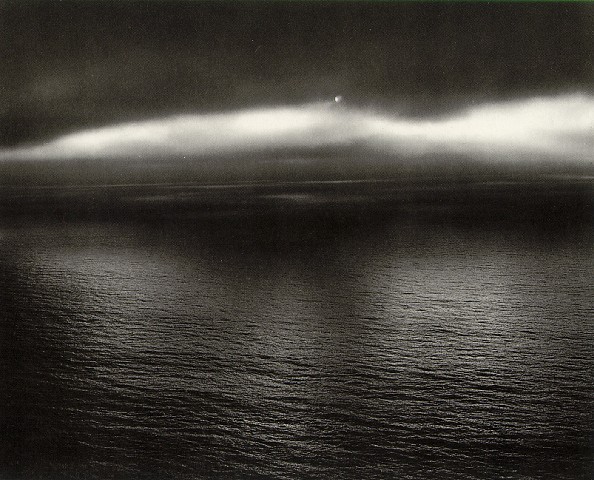
What fascinates me is the ability of artforms, in particular cinema, but also poetry, photography, music, etc., to evoke mystery. Some examples for me include the painting by Gerhard Richter at the beginning of this post and the photograph below by Minor White. But there really are countless examples. Why is it that certain images can bring about deep, almost indescribable emotions from within my soul?
Minor White Pacific, Devil’s Slide, California 1947

In my opinion a great example of a film that does this for/to me is Tarkovsky’s Andrey Rublyov (1969). There are so many powerful images from that film, and so many moments that produce powerful feelings that I will just encourage watching or re-watching the film. This post is not a review of Rublyov. My point is to say that art works can evoke strong feelings of mystery that seem to point to more important aspects of human existence, but do so via a kind of internal mystery, a mystery inherent within art itself. Again, that mysteriousness one finds in certain films is one of the powerful cinematic draws for me.

I am troubled, I must say, at trying to explain this sense of mystery in art. I have come to believe, however, that maybe it arise from the tension between life and death, and the reality that life comes from death. In art we often refer to beauty. But what is beauty and does it have a place anymore in art? As a kind of doorway to an answer, I like this quote from an interview with Andrei Tarkovsky about his, as then yet to be made, film Andrey Rublyov:

I am not going to say anything directly about the bond between art and people, this is obvious in general and, I hope, it’s obvious in the screenplay. I would only like to examine the nature of beauty, make the viewer aware that beauty grows from tragedy, misfortune, like from a seed. My film certainly will not be a story about the beautiful and somewhat patriarchal Rus, my wish is to show how it was possible that the bright, astonishing art appeared as a “continuation” of the nightmares of slavery, ignorance, illiteracy. I’d like to find these mutual dependencies, to follow birth of this art and only under those circumstances I’d consider the film a success. (from Nostalghia.com)

Maybe it is only through suffering that mystery in or through art appears. I don’t know.
If I could point to an artwork that, at least for me, offers one of the best examples of the mystery of art, the feeling of mystery in the receiver of that art work, and also describes the feeling of overshooting one’s rationality or coming into contact with some kind of cosmic mystery, it would be from a tiny section from William Wordsworth’s great autobiographical poem, The Prelude. The first time I read this section I was floored. I continue to be floored each time I read it, but I also recognize that my response is a personal one. And so will be yours.

One summer evening (led by her) I found
A little boat tied to a willow tree
Within a rocky cave, its usual home.
Straight I unloosed her chain, and stepping in
Pushed from the shore. It was an act of stealth
And troubled pleasure, nor without the voice
Of mountain-echoes did my boat move on;
Leaving behind her still, on either side,
Small circles glittering idly in the moon,
Until they melted all into one track
Of sparkling light. But now, like one who rows,
Proud of his skill, to reach a chosen point
With an unswerving line, I fixed my view
Upon the summit of a craggy ridge,
The horizon’s utmost boundary; far above
Was nothing but the stars and the grey sky.
She was an elfin pinnace; lustily
I dipped my oars into the silent lake,
And, as I rose upon the stroke, my boat
Went heaving through the water like a swan;
When, from behind that craggy steep till then
The horizon’s bound, a huge peak, black and huge,
As if with voluntary power instinct,
Upreared its head. I struck and struck again,
And growing still in stature the grim shape
Towered up between me and the stars, and still,
For so it seemed, with purpose of its own
And measured motion like a living thing,
Strode after me. With trembling oars I turned,
And through the silent water stole my way
Back to the covert of the willow tree;
There in her mooring-place I left my bark,–
And through the meadows homeward went, in grave
And serious mood; but after I had seen
That spectacle, for many days, my brain
Worked with a dim and undetermined sense
Of unknown modes of being; o’er my thoughts
There hung a darkness, call it solitude
Or blank desertion. No familiar shapes
Remained, no pleasant images of trees,
Of sea or sky, no colours of green fields;
But huge and mighty forms, that do not live
Like living men, moved slowly through the mind
By day, and were a trouble to my dreams.
from The Prelude
William Wordsworth
first published in 1850

I can think of no better way to express why it is I am drawn towards some kinds of films more than others, why it is I love the mystery of art, and why it is I come away from some films with the film still burning in my soul.

A personal response to Children of Men

Another movie night with the family. So, every time a dog barked in the film, which seemed to happen frequently, our dog barked, and the baby, our baby, had a hard time getting to sleep and kept crying. That was part of my experience in watching Children of Men (2006) for the first time the other night. I keep running into people who either have seen the film or have been planning to see the film and just haven’t got around to doing so. I think that is true of many “must see” films. People often intend to see them but don’t do so for a long time. Maybe it’s the felt pressure of knowing one is going to see an “important” film that such films get temporarily pushed aside for lighter fair. My wife rented it and, although I had planned on finishing Viridania (1961), we watched Children of Men. Anyway, I finally saw the film and I liked it very much, although I was not “blown away” as I thought I might be.

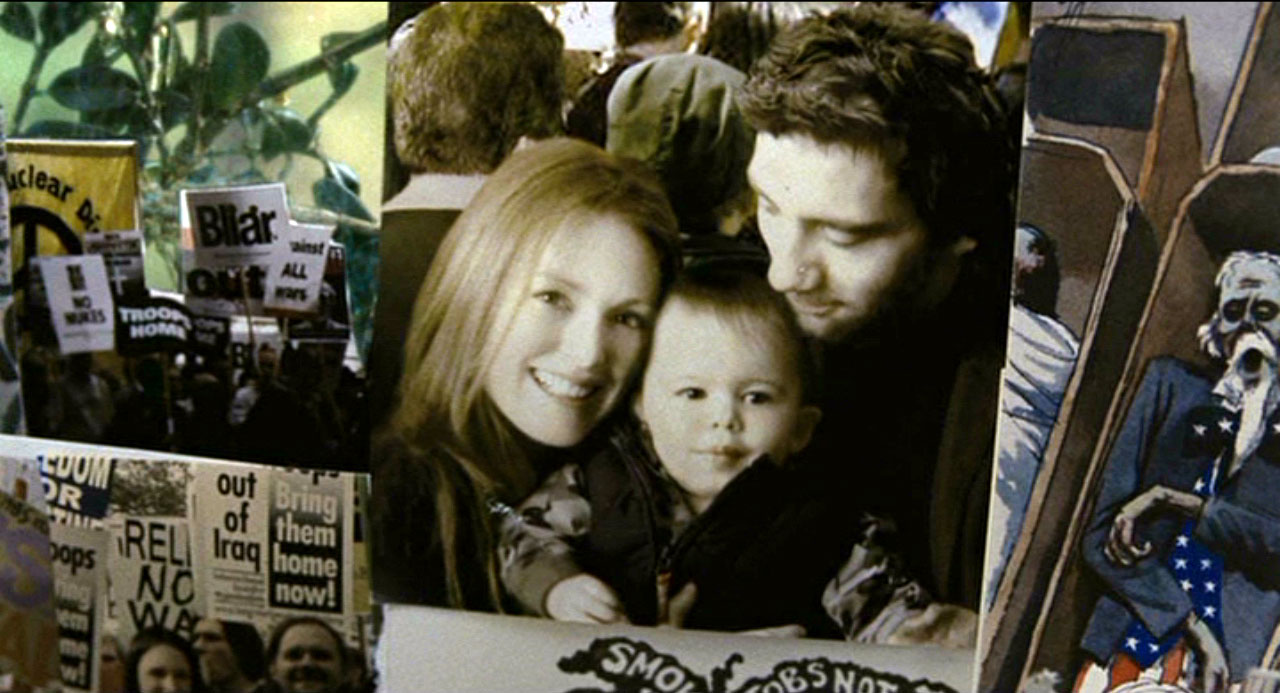
Rather than a review I want to make a couple of observations. The first has to do with fascism. I am inclined to think Children of Men has less to do with science fiction or infertility than it has to do with the human heart and humankind’s tendency towards fascism in the face of dire social conditions. The story in the film takes place in the future, but there are visual references to our own time and then to another darker period in our not too distant past. In a very visual and layered film, such as Children of Men, one often finds many interesting juxtapositions and subtle references. That is certainly the case here. Take for example this image:

Here we have the final image of a series of images that has told us a fair amount of backstory, especially regarding Jasper Palmer’s (Michael Caine) past as a political cartoonist, and the torture (by the British government) of his war photographer wife, who is now catatonic. The camera has been panning across these visual nuggets as the camera did in Rear Window showing us who Jimmy Stewart’s character was. But with this image we now see something of Theo Faron’s (Clive Owen) past life – namely his wife and child. But notice the references to Tony Blair and to the protesting of the Iraq war. One wonders if Alfonso Cuarón is intending for us to make a connection with the world we live in now, including the choices of our governments, and this grim world of the future. I cannot help but think that is the case.

Next consider this image:
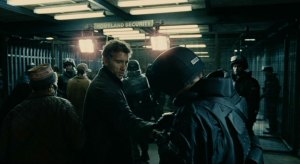
Here our hero, and somewhere ahead the woman Kee with her miracle baby, are being herded towards the Bexhill refugee internment camp. Notice the sign above Owen’s head. It reads Homeland Security. I believe this reference is not a cheeky wink wink to the audience, but a chilling statement (in the context of the film) on what the present U.S. (I don’t know if there is a British equivalent) version of Homeland Security fundamentally is based on and where it will logically lead. I remember when the name “Homeland Security” was first rolled out publicly. My first thought was, “Doesn’t that sound a little too close to ‘fatherland’? And wasn’t that a favorite invocation made by Hitler and his cronies?” My second thought was a sinking feeling in my gut. But again, I digress.

I must say that none of this information is hidden within the film. It is designed to be noticed. I am also not the first person to comment on these things. (see the Children of Men link above)

Then consider this image:
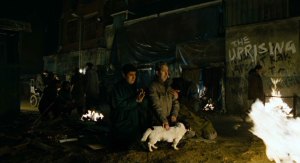
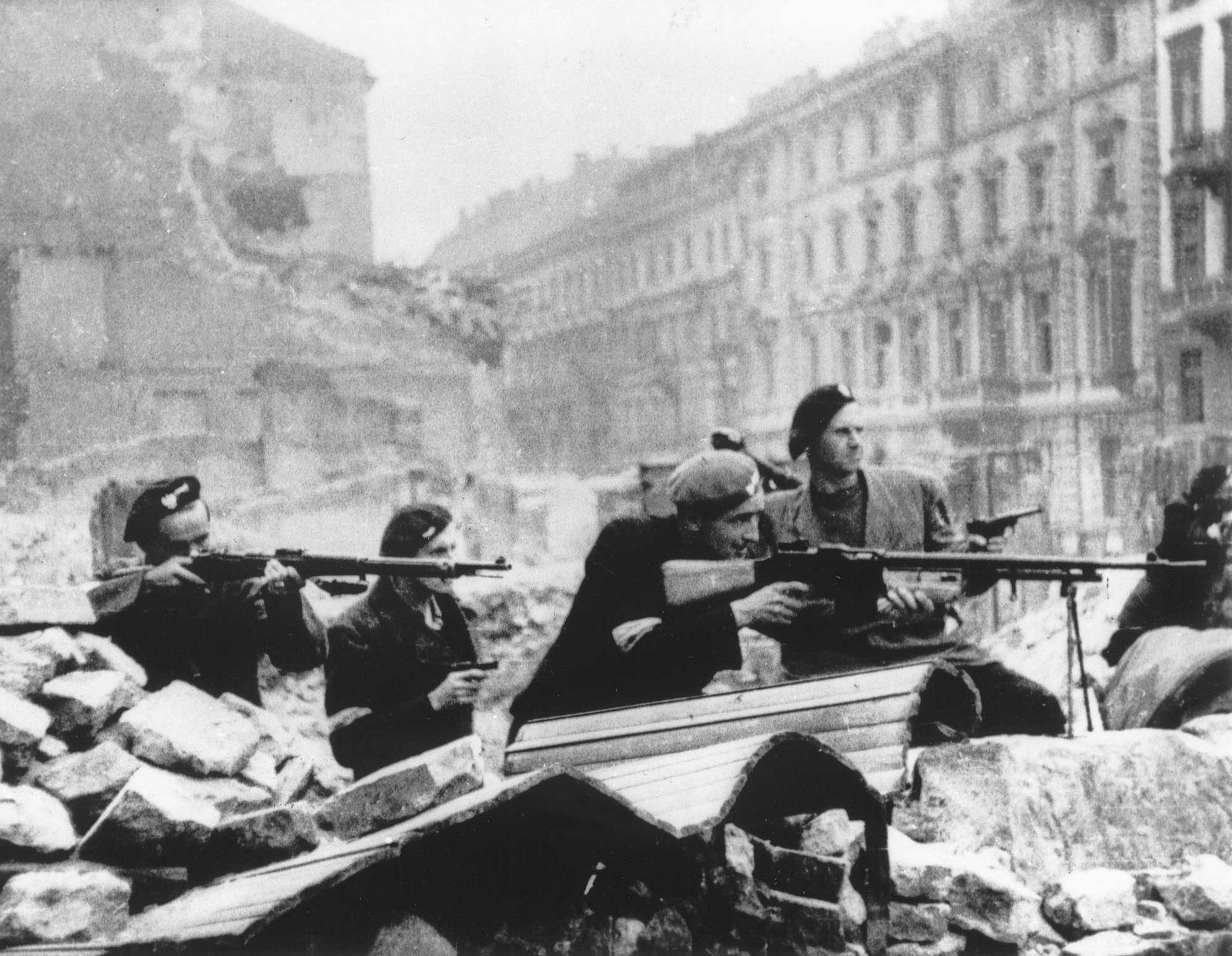
Here we are now in the Bexhill refugee internment camp. Bexhill-on-Sea, or just Bexhill, is the name of a sea-side retirement community in Southern England, actually having the highest retired population of any town in the UK today. In the film Bexhill is a town/city that has been converted into a prison for immigrants, somewhat invoking Abu Ghraib prison or Guantánamo Bay detainment camp, as some have argued. In an extremely nationalistic country being an immigrant is not a positive situation. Bexhill, in this context, makes sense given a world in which no one has been born in 18 years. If it is a retirement community today, it may likely be a largely unpopulated community in two decades. But I digress. Notice the graffiti on the wall: “THE UPRISING.” Immediately I thought of another walled off city (or portion of a city) used to imprison unwanted foreigners and one that had its own uprising. I am thinking of the Warsaw Ghetto during WWII. Modern references to Abu Ghraib prison and Guantánamo Bay make some sense, but not as much as the Warsaw Ghetto, which was an even fuller expression of fascist terror (assuming Abu Ghraib prison and Guantánamo Bay are examples of modern fascism, which they may be), and included a brave uprising on the part of the few remaining Jews. I see the image below of the Jewish fighters (soon to all be dead) and the next image of German soldiers standing watching the buildings of the Warsaw Ghetto burning and I see something much more like the ghetto in Children of Men than a modern political prison.
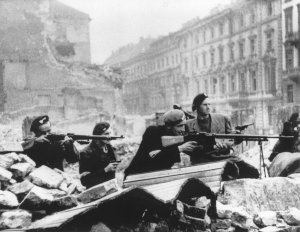
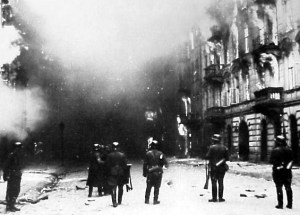
So here we have references to a growing fascism today and a full-blown fascism of our past within a story set in a possible(?) future. The question for me is, what am I to make of this? I believe Cuarón is asking me to make these kinds of connections, to see that the future is born out of the present, and to be aware of the darker implications of the choices we make or accept today. I fear the world we live in is bordering on fascism again. Remember fascism as we think of it – Hitler, Mussolini, etc. – was not a local thing. Fascism was popular around the world in those days. It was popular in the U.S. as well, especially before it was “tainted” with associations with our enemies and later with the Shoah. But fascism is not all Nazi flags and jackboots. Fascism tends to emerge when times are tough, when economies are poor, when immigrants pose a threat, when nationalism and patriotism seem noble, and when the world seems out of control and scary. One of the biggest boosts to a growing right-wing fascism in the U.S. was 9/11. But, let us not forget that the threat to jobs from immigration is a boost to a kind of left-wing fascism. Some have said fascism is neither right or left politically, but is proposed as an alternate third way. Regardless, fear and uncertainly is as much a tool in the hands of political opportunists as it is something to solve. I am reminded of that famous quote from Nazi leader Hermann Goering: [T]he people can always be brought to the bidding of the leaders. That is easy. All you have to do is tell them they are being attacked, and denounce the peacemakers for lack of patriotism and exposing the country to danger. It works the same in any country.

The ideas in that quote were, in a sense, famously (and earlier) countered by FDR in his first inaugural address in 1933, made during a time of great fear and uncertainty. In that speech he had the line: The only thing we have to fear is fear itself. FDR helped to keep fascism somewhat at bay in the U.S. while it flourished in Europe and elsewhere. Fear is a powerful corrosive. People often make decisions out of fear that they regret later – like locking up people without charges, without representation, and even without a trial. Or throwing away habeas corpus. Or like going hastily to war and then denouncing those who oppose the war as being unpatriotic and unsupportive of the troops.

As I see it, if the fundamental elements of fascism are nationalism, authoritarianism, militarism, corporatism, collectivism, totalitarianism, anti-communism, and opposition to economic liberalism and political liberalism, then only an opposition to economic liberalism is absent from U.S. society. And even that is not entirely true. Economic liberalism largely means free trade and open markets in order for the haves and have-nots to grow farther apart. It is also a foundation of the modern form of aristocracy known as the divine right of capital. I don’t mean to rant, but to me this is all rather frightening. It is no wonder that the rebels portrayed in the film look somewhat like some of the protesters we saw in Seattle in 1999, and at other similar protests around the world. I fear the crazy future world depicted in Children of Men is not as far fetched as it seems. My desire is that I don’t let my fear rule my choices, and that I don’t cavalierly throw the word “fascist” around without truly considering its meaning and implications.

So, back to the film…

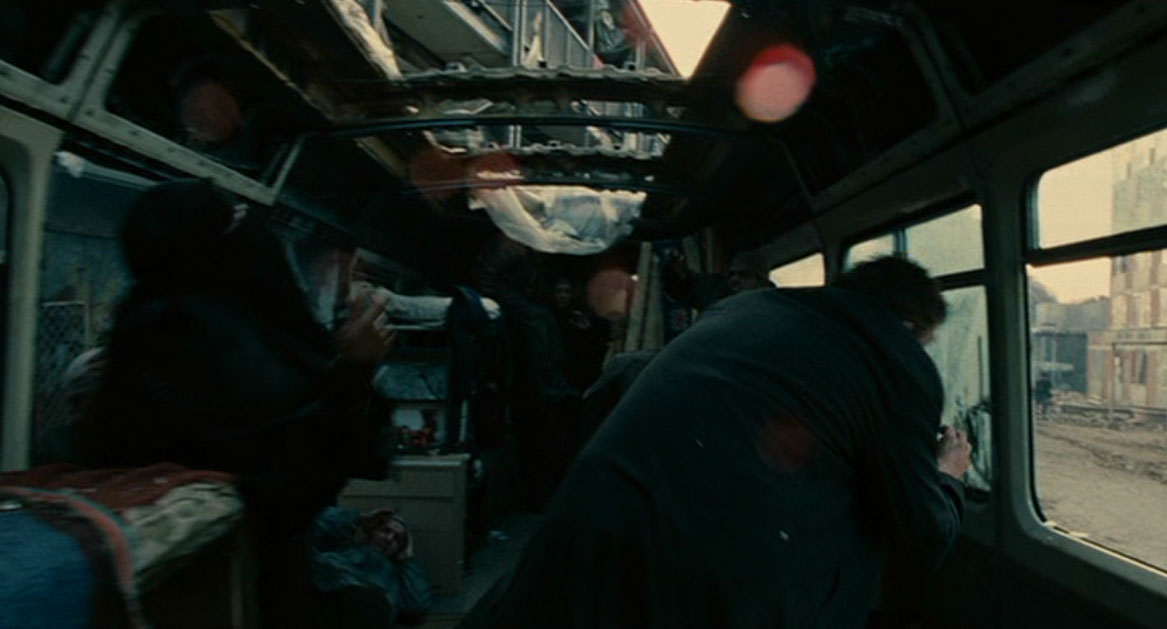
The second observation I want to make has to do with cinéma vérité and camera/digital trickery. Children of Men is a wonderfully photographed film. Much has been made of the virtuosic use of camera, staging, and mise en scene. One scene in particular is the long, uncut episode where Theo is working his way through the rubble and gun fire of the Bexhill uprising to try and find Kee and the baby. This scene is several minutes long (I did not count) and is presented as though it was shot in one long take. In fact it “was filmed in five separate takes over two locations and then seamlessly stitched together to give the appearance of a single take.” (from Wikipedia) If this is true, that is just about as remarkable as if it was actually filmed in a single take. But what I want to discuss is the blood splatter on the camera lens. It begins here:

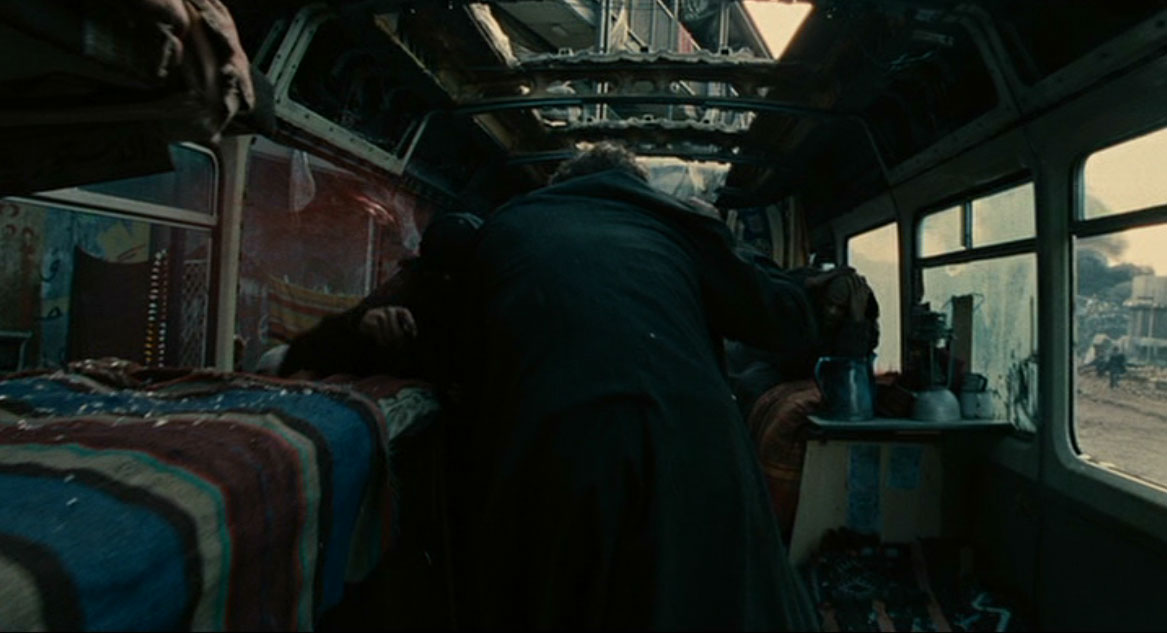
Theo has just run into a broken down bus to avoid gun fire, but the shooters see him and spray the bus with bullets. A person next to Theo is hit and blood sprays (à la Kurosawa in Seven Samurai) from the bullet wound. The spray of blood is barely visible in the left half of the image above.

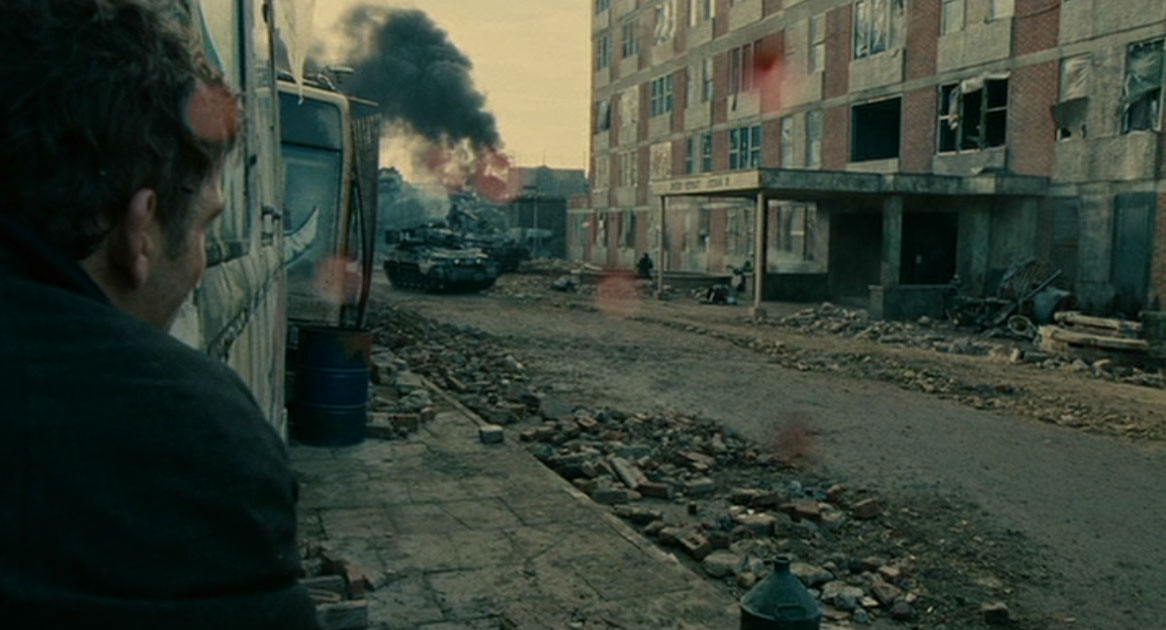
Then we get this image:
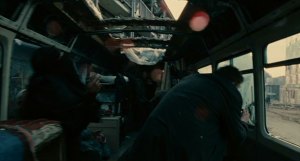
Droplets of blood are now visible on the camera lens. And those droplets remain on the lens as the camera follows Theo through the war torn landscape:
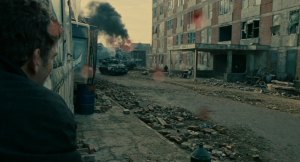


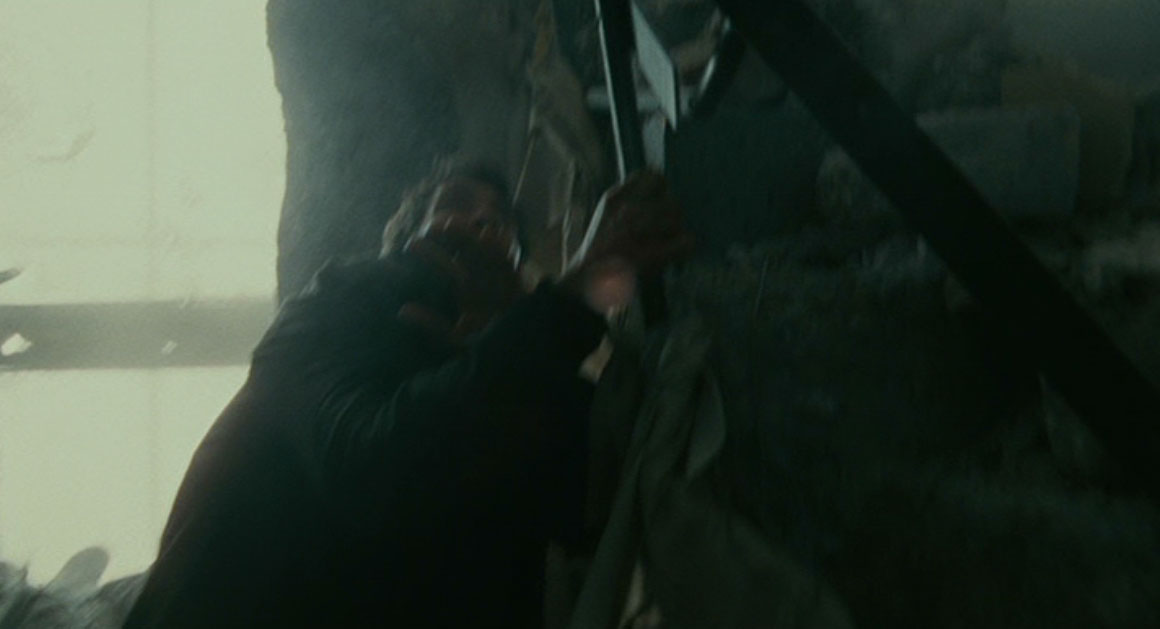
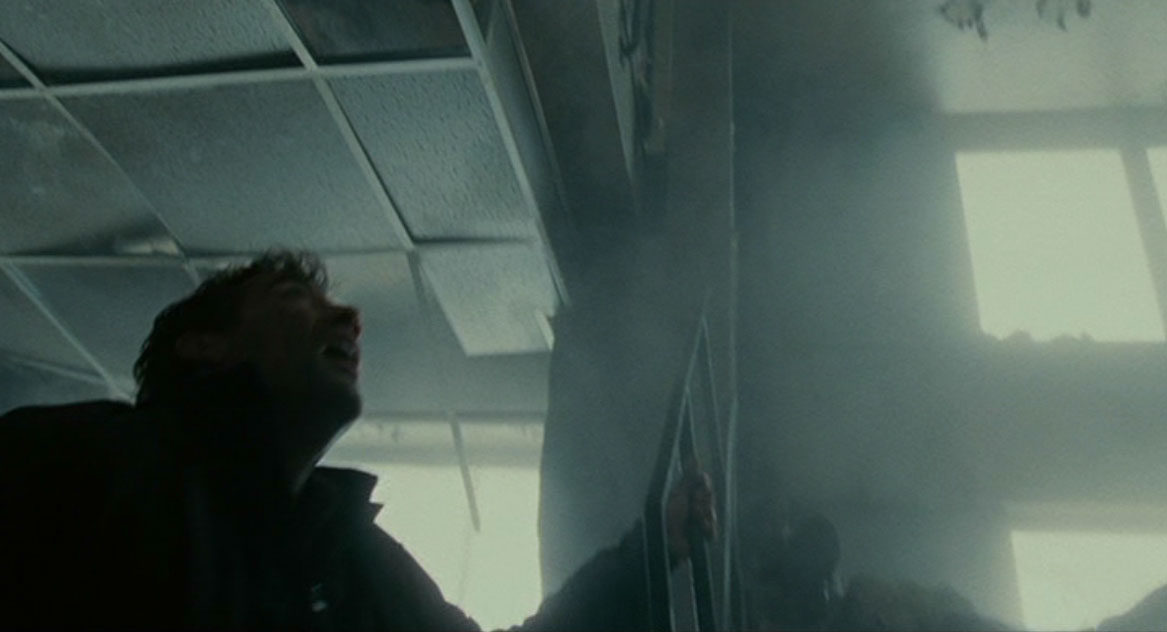
Eventually (minutes later, blood still on the lens) Theo enters a building. Bullets are still flying and he cowers momentarily near a stairwell:
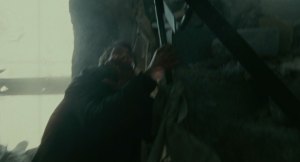


You can still see a drop of blood on the lens. All this you have likely noticed.

I am a big fan of cinéma vérité in general. I should note, however, that nowhere in Children of Men do we see any “complete” use of cinéma vérité, but we do see strong elements, not least of which is the brilliant use of hand-held camera and, in this scene, blood splattered on the lens. My first impression was “that’s cool!” Later I had second thoughts. Sometimes it makes a lot of sense for a film to draw attention to itself; think of Don’t Look Back (1967) or Harlan County U.S.A. (1976) – both used cinéma vérité techniques to underscore the intrusion of the filming process into the world of their subjects. This makes sense in some documentary filmmaking – a tilt of the hat, so to speak, to Heisenberg’s uncertainty principle put into ethnographic terms. But cinéma vérité is a little more tricky in fictional narratives. Here, in Children of Men, the filmmakers have gone a little to far. The blood on the lens only draws attention to the fact that someone is holding a camera on their shoulder (or a steadycam) and following Clive Owen as he follows the complicated stage directions. Now this would not be such a bad thing if the rest of the film had the same aesthetic. But it doesn’t. At times the films is quite conventional. But in this scene suddenly we are watching a “documentary” that draws attention to its own existence. The audience is now not in the film with Theo, they are watching a film being filmed, they are “unsutured.” In other words, this little piece is “coolness” helps to undercut an otherwise brilliant and almost uncanny bit of filmmaking.

But that’s not all. Notice the last image above. Why does it have less blood splatter than the previous images? Where have those other blood droplets gone? Interesting the blood droplets have been gradually and subtly disappearing from the lens as the scene has progressed.

Now consider this image:
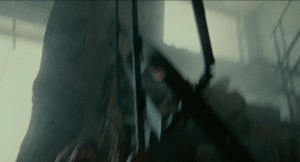


Notice the one last blood spot just slightly off-center right. This shot is in the middle of a whip-tilt up from Theo to the stairwell.

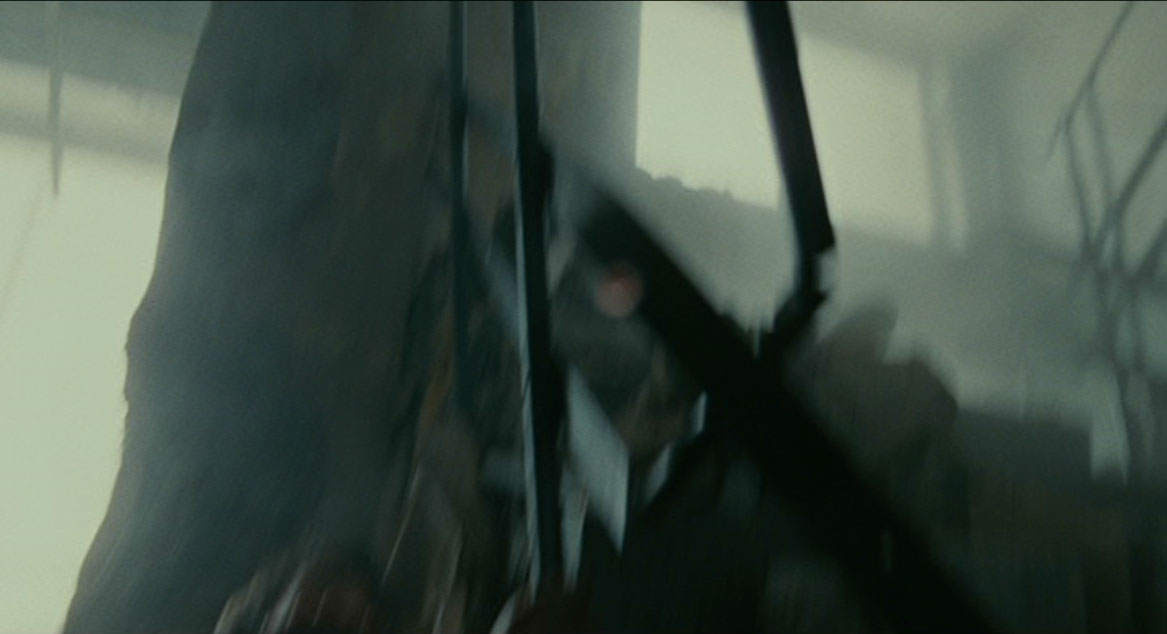
Now look at this image:


About one or two frames later the blood spot has disappeared. It disappears when the spot passes in front of the dark line of the handrail. Then we pan back to Theo:


Not a single blood spot left. This got my attention and it got me wondering. Were these spots added in later for effect? Were they digital creations? Or did they start as real splatter, then gradually get changed, maybe digitally, over the course of the scene until they are conveniently “disappeared” so as not to interfere with the remainder of the scene (when Theo finally finds Kee and the baby). I find it interesting that this change is the opposite of cinéma vérité.

So what does this all mean? Obviously no film exists apart from its creation. Films are created artifacts, and questions of truth, reality, verisimilitude, artifice, etc., abound. Films are also spiritual to the degree that they tap into and reflect both the spirit of the age and the human spirit. In narrative film there is always a tension between what is up there on the screen (the plot) and what is going on in one’s head (the story). Stories are universal, to some degree, but films as artifacts are particular. Children of Men tells a universal story of fear, cruelty, the will to survive, hope, and salvation (Theo, Kee, and the baby are a kind of futuristic Holy family. The birth scene is powerfully remeniscient of classic Nativity stories). In this sense the film is spiritual. Sure, the film is a fantasy about the future, but it also highlights important ideas about our present and our past, issues that are more important than this particular film. The film, as plot, however, presents that story in such a way that questions are raised regarding the honesty of the film’s (or filmmaker’s) intentions. I say this because I am always suspicious of communication that is full of rhetorical and stylistic flourishes.

Children of Men may be a film as much about virtuosic filmmaking (and about drawing attention to itself as such) as it is about deeper themes of fasiscm and fear. My contention is that the film’s deeper messages may have become clouded in the whirlwind of intense faux vérité and the foregrounding of its own artifice. In other words, just at the moment when the viewer should be thrust into the film’s thematic climax, a little flag (read: blood splatter on the camera lens) is waved saying “don’t forget how brilliant this filmmaking is and who made it!” For me that is why, when the credits rolled at the end of the film, I felt the film had let me down, just a little.
>my own film challenge

>Film lists are inherently (maybe by design intentionally so) controversial. Who can really rank aesthetic objects? Well… I think there is more to doing good criticism than mere opinion, and therefore maybe it is possible to legitimately rank films, up to a point. Regardless, I find lists to be like suggestions for viewing – even so-called film cannons. The better the list the more closely the viewing suggestions are to the ideal list of “the best films.” If I go to a well-round film scholar/historian/critic and ask the question: “If I wanted to teach myself the history of film, what are the best 100 films I should see so that I may begin my quest?” I would then expect that scholar/historian/critic to produce a rather good list that approximates that ideal “best” films of all time list. But of course the list would still be highly debatable and, if honest, constantly being revised. The question could also be for the best films of the decade, or from Hong Kong, or Film Noir, etc.

This post, however, is not about cannons but about making a concerted effort on my part to see more great films. So I took a look at the They Shoot Pictures, Don’t They?’s top 100 films list to see what I have missed. I don’t think the list adequately answers the question I posed above, but it is a good list. I’ve put their list below and highlighted the ones I have either not seen or have not fully finished and should. My goal is to work my way through these remaining films and write about them in some fashion. I don’t expect to say anything new or profound, but I do hope to grow in my understanding and convey something of that understanding. Fortunately the number of films I haven’t seen from the list are only 14, so I’ll still be able to work on other things (like grad school and my thesis!).

So, here’s the list:

1 Citizen Kane (Welles, Orson; 1941; US)
2 Rules of the Game, The/La Regle du jeu (Renoir, Jean; 1939; France)
3 Vertigo (Hitchcock, Alfred; 1958; US)
4 2001: A Space Odyssey (Kubrick, Stanley; 1968; UK)
5 8½ (Fellini, Federico; 1963; Italy)
6 Seven Samurai, The (Kurosawa, Akira; 1954; Japan)
7 Godfather, The (Coppola, Francis; 1972; US)
8 Tokyo Story/Tokyo monogatari (Ozu, Yasujiro; 1953; Japan)
9 Searchers, The (Ford, John; 1956; US)
10 Singin’ in the Rain (Donen, Stanley/Gene Kelly; 1952; US)
11 Sunrise (Murnau, F.W.; 1927; US)
12 Battleship Potemkin/Potemkin (Eisenstein, Sergei; 1925; Russia)
13 Lawrence of Arabia (Lean, David; 1962; UK)
14 Passion of Joan of Arc, The (Dreyer, Carl; 1928; France)
15 Rashomon (Kurosawa, Akira; 1950; Japan)
16 L’Atalante (Vigo, Jean; 1934; France)
17 Bicycle Thieves/The Bicycle Thief (De Sica, Vittorio; 1948; Italy)
18 Godfather Part II, The (Coppola, Francis; 1974; US)
19 Raging Bull (Scorsese, Martin; 1980; US)
20 Third Man, The (Reed, Carol; 1949; UK)
21 City Lights (Chaplin, Charles; 1931; US)
22 Touch of Evil (Welles, Orson; 1958; US)
23 La Dolce Vita (Fellini, Federico; 1960; Italy)
24 Les Enfants du Paradis/Children of Paradise (Carne, Marcel; 1945; France)
25 Casablanca (Curtiz, Michael; 1942; US)
26 La Grande Illusion/Grand Illusion (Renoir, Jean; 1937; France)
27 General, The [1926] (Keaton, Buster/Clyde Bruckman; 1926; US)
28 Sunset Blvd. (Wilder, Billy; 1950; US)
29 Psycho [1960] (Hitchcock, Alfred; 1960; US)
30 Breathless/A Bout de Souffle (Godard, Jean-Luc; 1959; France)
31 L’Avventura (Antonioni, Michelangelo; 1960; Italy-France)
32 Some Like it Hot (Wilder, Billy; 1959; US)
33 Jules et Jim (Truffaut, Francois; 1961; France)
34 Persona (Bergman, Ingmar; 1966; Sweden)
35 Dr. Strangelove (Kubrick, Stanley; 1964; UK)
36 Seventh Seal, The (Bergman, Ingmar; 1957; Sweden)
37 Gold Rush, The (Chaplin, Charles; 1925; US)
38 Andrei Rublev (Tarkovsky, Andrei; 1966; Russia)
39 Taxi Driver (Scorsese, Martin; 1976; US)
40 Chinatown (Polanski, Roman; 1974; US)
41 Ordet (Dreyer, Carl; 1955; Denmark)
42 Pather Panchali (Ray, Satyajit; 1955; India)

43 It’s a Wonderful Life (Capra, Frank; 1946; US)
44 Apocalypse Now (Coppola, Francis; 1979; US)
45 Rear Window (Hitchcock, Alfred; 1954; US)
46 Intolerance (Griffith, D.W.; 1916; US)
47 Ugetsu Monogatari/Ugetsu (Mizoguchi, Kenji; 1953; Japan)
48 400 Blows, The/Les Quatre Cents Coups (Truffaut, Francois; 1959; France)
49 Contempt/Le Mepris (Godard, Jean-Luc; 1963; France-Italy)
50 Au Hasard, Balthazar/Balthazar (Bresson, Robert; 1966; France)
51 Magnificent Ambersons, The (Welles, Orson; 1942; US)
52 Night of the Hunter, The (Laughton, Charles; 1955; US)
53 M (Lang, Fritz; 1931; Germany)
54 Wild Strawberries/Smultronsället (Bergman, Ingmar; 1957; Sweden)
55 Wild Bunch, The (Peckinpah, Sam; 1969; US)
56 Modern Times (Chaplin, Charles; 1936; US)
57 Wizard of Oz, The (Fleming, Victor; 1939; US)
58 Conformist, The (Bertolucci, Bernardo; 1969; Italy-France-Germany)
59 La Strada (Fellini, Federico; 1954; Italy)
60 Mirror, The/Zerkalo (Tarkovsky, Andrei; 1976; Russia)
61 Nashville (Altman, Robert; 1975; US)
62 Fanny and Alexander (Bergman, Ingmar; 1982; Sweden)

63 North by Northwest (Hitchcock, Alfred; 1959; US)
64 Greed (von Stroheim, Erich; 1924; US)
65 Metropolis (Lang, Fritz; 1926; Germany)
66 Blade Runner (Scott, Ridley; 1982; US)
67 Rio Bravo (Hawks, Howard; 1959; US)
68 Earrings of Madame de…/Madame de… (Ophuls, Max; 1953; France-Italy)
69 Sherlock, Jr. (Keaton, Buster; 1924; US)
70 Pickpocket (Bresson, Robert; 1959; France)
71 Playtime (Tati, Jacques; 1967; France)
72 L’Age d’Or (Bunuel, Luis; 1930; France)
73 Ikiru/To Live/Doomed/Living (Kurosawa, Akira; 1952; Japan)
74 All About Eve (Mankiewicz, Joseph L.; 1950; US)
75 Voyage in Italy/Viaggio in Italia/Journey to Italy (Rossellini, Roberto; 1953; Italy)
76 Apartment, The (Wilder, Billy; 1960; US)
77 Viridiana (Bunuel, Luis; 1961; Spain)
78 Aguirre: The Wrath of God (Herzog, Werner; 1972; Germany)
79 Barry Lyndon (Kubrick, Stanley; 1975; UK)
80 On the Waterfront (Kazan, Elia; 1954; US)
81 Pierrot le fou (Godard, Jean-Luc; 1965; France-Italy)
82 Man with a Movie Camera, The (Vertov, Dziga; 1929; USSR)
83 Blue Velvet (Lynch, David; 1986; US)
84 Nosferatu (Murnau, F.W.; 1922; Germany)
85 Leopard, The (Visconti, Luchino; 1963; Italy)
86 Notorious (Hitchcock, Alfred; 1946; US)
87 Once Upon a Time in the West (Leone, Sergio; 1968; Italy-US)
88 Gone with the Wind (Fleming, Victor; 1939; US)
89 Sansho the Bailiff/Sansho Dayu (Mizoguchi, Kenji; 1954; Japan)
90 His Girl Friday (Hawks, Howard; 1940; US)
91 Last Year at Marienbad (Resnais, Alain; 1961; France-Italy)
92 My Darling Clementine (Ford, John; 1946; US)
93 Clockwork Orange, A (Kubrick, Stanley; 1971; UK)
94 Dekalog/Decalogue (Kieslowski, Krszystof; 1988; Poland)
95 Letter from an Unknown Woman (Ophuls, Max; 1948; US)
96 King Kong [1933] (Cooper, Merian C./Ernest B. Schoedsack; 1933; US)
97 Amarcord (Fellini, Federico; 1973; Italy)
98 Duck Soup (McCarey, Leo; 1933; US)
99 Stagecoach (Ford, John; 1939; US)
100 Man Who Shot Liberty Valance, The (Ford, John; 1962; US)

One last thing: working through a list like this reminds me a book I’ve been wanting to read – Julie and Julia: 365 Days, 524 Recipes, 1 Tiny Apartment Kitchen. In other words, I would love to take this list, or any other similar list, and concertedly work my way through, maybe from the back to the front. Two a week would only take a year. What a year. I know you understand.

educating Lily, educating myself

This blog has languished for lack of time and an abundance of guilt.

Pressures of grad school have kept my head down, which is a good thing since I do need to be working on my thesis – and the thesis is coming along, somewhat. I have several potential posts that I want to write, but they have been pushed aside. I have been reflecting a bit on what this blog is for me and what I want it to be going forward. I don’t have an answer yet. But, at least, it is a chronicle of some features of my life, including my relationship to movies.

Several times on this blog I have mentioned watching movies with my six (going on seven) year old daughter Lily. I consider these movie viewings part (a fun part) of her education as much as an entertaining evening. Recently we saw Some Like It Hot (1959) and she loved it. Now some might say that my daughter is a bit young for this film, that, even though it is nearly 50 years old, the content needs some explaining about some things that a parent might not want to discuss with a six-year-old.

But she gets it – not all of it of course – but she understands that a couple of guys trying to walk in high heels and pretending to be women as they run away from some gangsters is funny. She also reacted strongly to Sugar Kane Kowalczyk’s (Marilyn Monroe’s) dress in the night-club performance scenes. Lily thought the dress was rather too much. And she was humorously shocked by the famous last line: “nobody’s perfect.” The look on her face was priceless – even better than Jack Lemmon’s. In fact, the parts I had to explain had to do with Spats Colombo and prohibition – which she thought was crazy. Of course, she also liked the fact that the director’s last name is Wilder, and that being the name of her little baby sister, Wilder Rose.

Why do I write all this? For me watching movies is a very personal joy. I’m sure you understand. Certainly films are objects out there in the world, separate from me, with a life of their own. And films are also a way to connect with others, such as through film blogs, etc. But films are also remarkable objects that include the viewer in their existence. I am a part of every film I watch because part of a film’s reality includes my watching of it. Cinema is also one of the most remarkable of human creations – maybe the most powerful art form so far. The life of a film includes the affects it has on and through its viewers. I can say many films have become deeply rooted in my conscious and subconscious. I see films being a personal thing for my daughter as well. She loves movies, as does most everyone. I want her to know the greatness of film, of how wonderful it is, and that it is worth the effort to think about what one watches – in other words, the best films really pay off, and the good ones pay off too.

So then we watched North by Northwest (also 1959). Recently we have seen Rear Window (1954) and To Catch a Thief (1955). I have been picking Hitchcock from the 1950s because these are great films to understand how “classic” Hollywood narrative works while also being introduced to one of the great directors. These films give me the chance to point out things to Lily about filmmaking without getting too involved. There probably aren’t too many six-year-olds who can tell you about Hitchcock, but Lily can (a little).

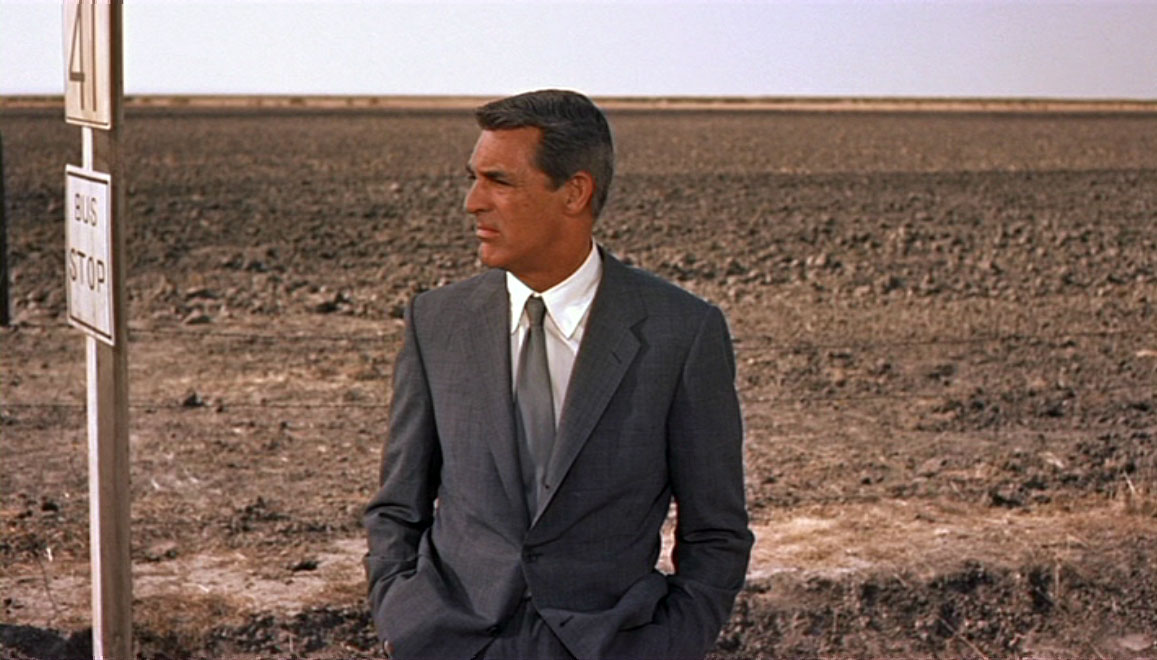
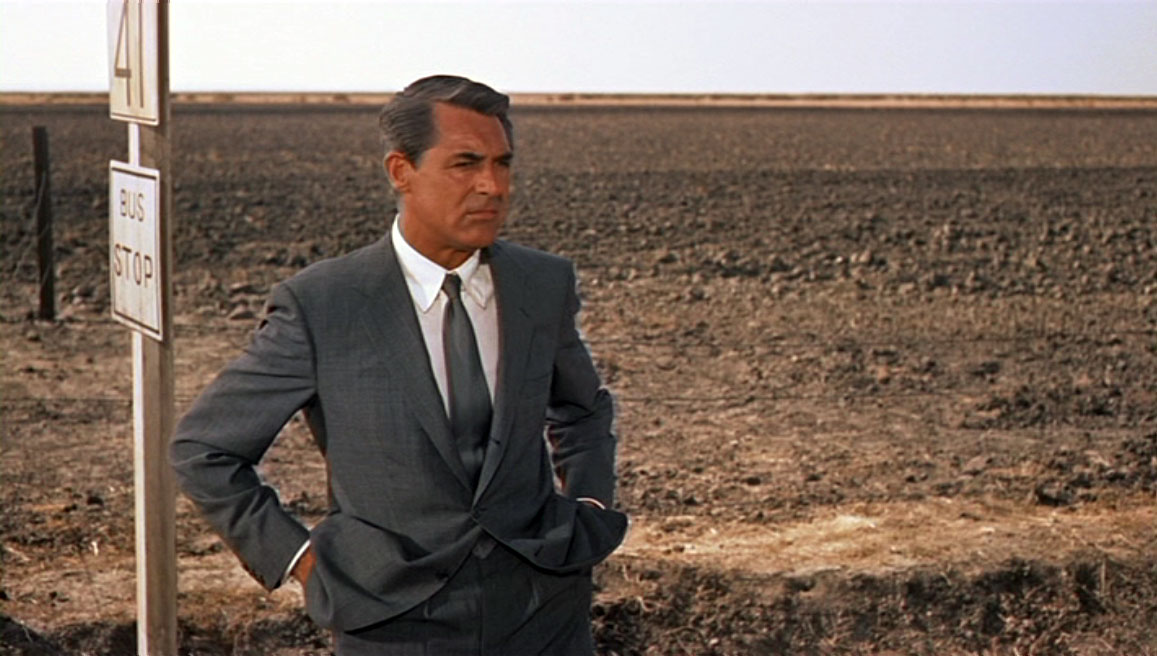
Speaking of North by Northwest, something caught my eye that I really liked. You remember the crop duster scene – it’s so famous that many people know all about it who have never seen the film itself. Well the scene is set up wonderfully, beginning with Roger O. Thornhill (Cary Grant) being dropped off the bus in the middle of nowhere.

He then proceeds to watch cars go by as he waits for George Kaplan (a person who does not exist) to arrive.

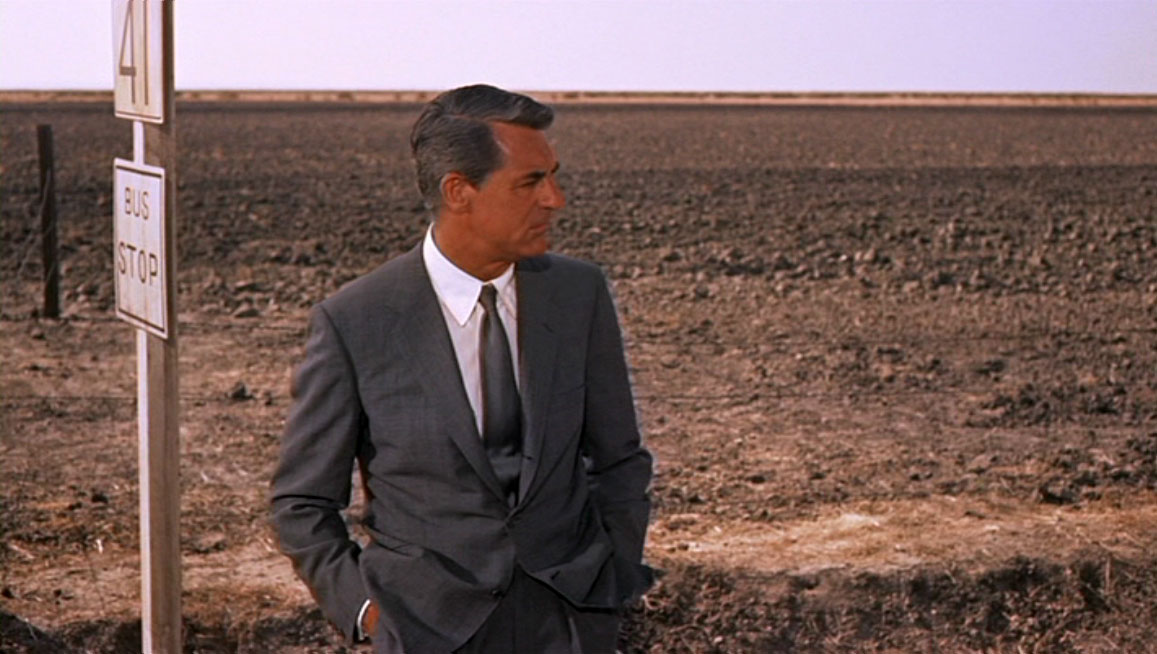
This is what I liked: As he waits, Thornhill sees a car coming, he thinks it might stop, but it goes on by. Cary Grant plays it almost as though it was a silent film.

Grant watches the car coming…


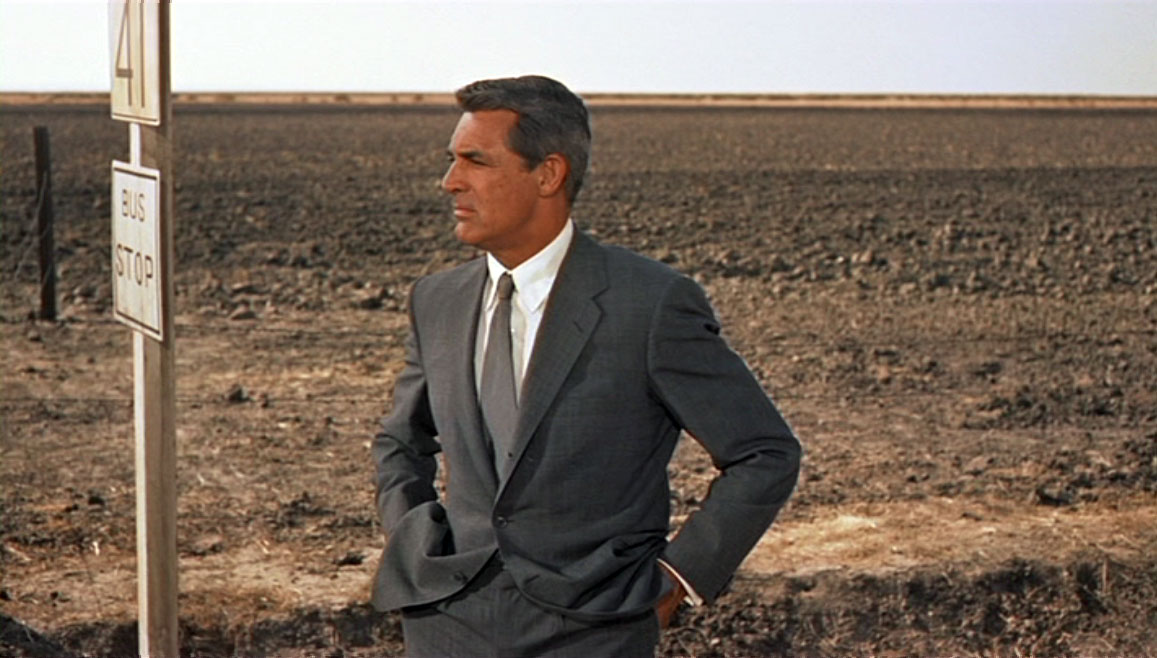
…the car gets closer and he raises his arms, but keeps his hands in his pockets…


…arms still raise, hands still in pockets, he follows the car with his gaze…


…he then lowers his hands back down into his pockets…

…signaling that the car is not stopping and he is still waiting for Kaplan.

To me this is pure Cary Grant school of acting: simple, physical, perfect, and always with an undercurrent of comedy even when he’s playing it straight. I can imagine Grant being told to stand on the X so they can get the focus fixed, then he is told to pretend a car drives by and he is to find some way to indicate the car has come and gone, and that once again his character is disappointed and perplexed. Grant was a master at this subtle, physical kind of acting; he could do zany pretty well too.

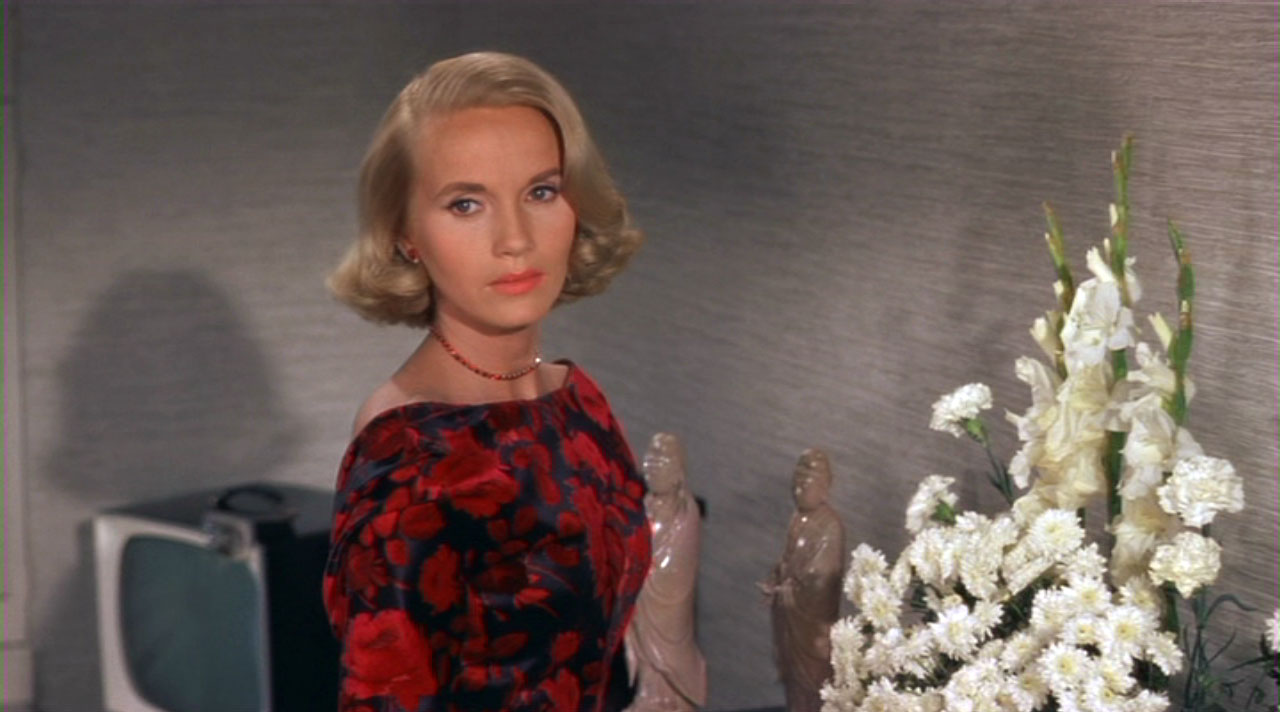
And I just love this shot:


It is so quintessential late 1950s, and it is beautiful while being ordinary. Having been on film and television sets, I know that even such a simple shot as this took a while to make as each little detail was put in its place, as Eva Marie Saint was told exactly where and how to stand, and how to turn toward the camera. This shot is common – especially then – for female leads, with her torso facing to one side of the camera and her gaze going in the other direction.

So then last night we watched Sullivan’s Travels (1941). It was good to see it again. Lily loved it, as I thought she would. The film also gave us some things to talk about, like what was the lesson that Sullivan learned? How did he learn it? etc. I don’t have any thing to say here about the film except that if you have not seen it, you should. I have The Miracle of Morgan’s Creek (1944), also by Sturges, on the docket for a near future viewing with Lily as well. Now I do feel a little bad because Lily had wanted to see (and show me) Milo and Otis (1986) but I pushed for Sullivan’s Travels. I guess it’s parent’s privilege, but now I have to make it up to her. Fortunately she does watch a fair number of “kids” films and current films, so it’s not all Papa’s stodgy old films.

As a side note on Sturges, I don’t know very much about him as a director or his personal life, but the DVD contained an interesting American Experience documentary that made a connection for me. Years ago I read a wonderful little book titled Sylvia Beach and the Lost Generation: A History of Literary Paris in the Twenties and Thirties by Noel Riley Fitch (1983). [Sylvia Beach was a famous expatriate in Paris between WWI and WWII. She owned the bookstore Shakespeare and Company and hung out with the likes of Hemingway, Fitzgerald, and was the publisher of Joyce’s Ulysses.] In Fitch’s book I read about Isadora Duncan, the famous and flamboyant dancer (some say she was the mother of modern dance). She died tragically in a freak automobile accident in 1927 when her long silk scarf got caught in the spoked wheels of the open-cockpit Amilcar she was riding in. Well, that scarf was given to Duncan by her friend Mary Desti who was, as I found out, the mother of Edmund Preston Biden, later know as Preston Sturges. Incidentally, the accident gave rise to Gertrude Stein‘s mordant remark that “affectations can be dangerous.”

Finally, I mentioned earlier that introducing Lily to these great films is part of her education. This is true, but not because it’s a good thing to understand the history of film or to recognize a Hitchcock film against any other film (although there is some value in all that). The fundamental goal, for me, is the ancient idea of a liberal education: an education that seeks to fulfill one’s human nature; an education that asks what it means to be human; and an education that creates a lifelong autonomous seeker. We, my wife and I, have taken on the task of educating our children. This is not easy work. Being an educator is a demanding job that takes great patience and lots of love. Although I am an adherent to the idea of a classical education, one that relies on the written word more than the image, I think some proponents of a classical education wrongly vilify the image more than is warranted. In fact, the tension is not really between word and image. The real issue, as I see it, is a lack of passion for learning. I believe we live in a world that often encourages a kind of “closemindedness” that leads to, or is born out of, fear. What I hope to instill in my daughters is a critical open-mindedness, a perspective on life that seeks understanding and finds real joy in doing so; and is not afraid to do so. So, when I sit down with Lily and watch a film, and while we are having fun watching the film, and when we then discuss the film, I know she is learning about thinking, about pondering what it is films are trying to say to her, and about how fascinating and complex a film can be as it presents its story to her.

So I see this blog as part of an ongoing exploration into my life as a lover of films, as a husband and parent, as an educator, and as someone seeking to be a lifelong autonomous seeker. How often I update it will depend on many things.

>2006 National Film Challenge Winners announced

>Just a quick post: the 2006 National Film Challenge Winners have been announced. You can see the winners, and watch the videos here.

The film was awarded Best Directing (Phil Gerke directed it) and Best Production Design.

I wrote about this project, of which I played a very tiny part, before at: thinking & making & thinking.

Some images I snapped during the production can be viewed
here.

>I “love” that dog wherever he is

>“For some reason I’ve just remembered how I lost the script of Rublyov (when I had no rough draft). I left it in a taxi at the corner of Gorky Street (opposite the National). The taxi drove off. I was so miserable I went and got drunk. An hour later I came out of the National and went towards the All-Union Theatre Society. Two hours after that, as I came down again to the corner where I had lost the manuscript, a taxi stopped (breaking the law) and the driver handed me my manuscript through the window. It was miraculous.”

6 April 1973


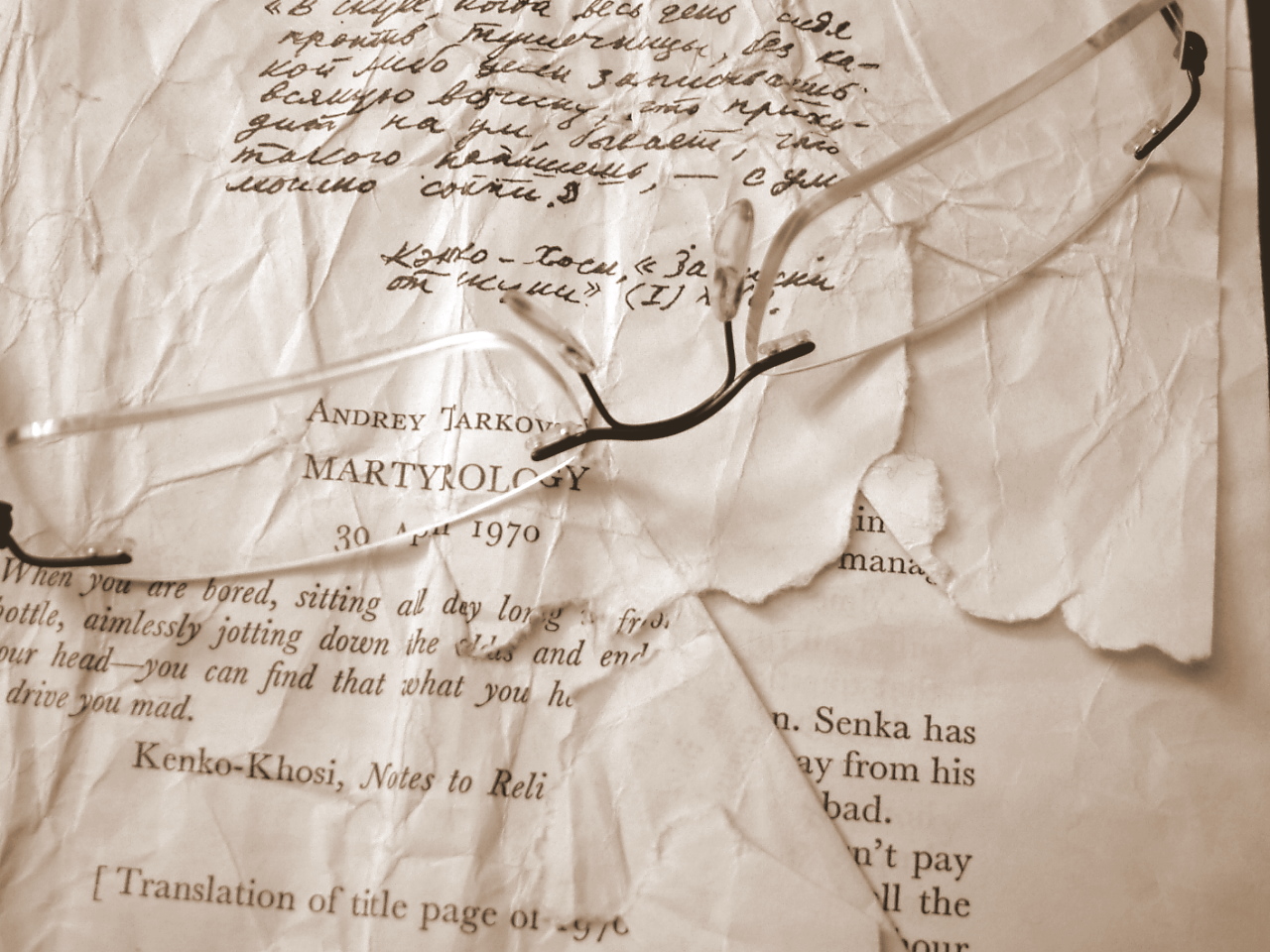
I’m looking over at a copy of Tarkovsky’s diaries (Martyrology), or what’s left of it. Years ago I purchased a used hardbound version of the book. Reading it was a kind of revelation for me. Although Tarkovsky complains mostly throughout the book, something I related to being a frustrated artist myself, I found the book to be a delight. Like any collection of journal entries the book is frustratingly incomplete regarding the kinds of information one might want to know, like insight into the directing or editing processes of specific films, etc. But one gets something better. [If one wants to know the process of making a work of art then one needs to make a work of art, and then do it again, and then again. The knowledge comes with doing because making art is like a spiritual practice in that sense.] What Tarkovsky gave us in his diaries is a view into his humanity. He was a remarkable man, but just a man like me. That kind of perspective is infinitely more valuable than “what were you thinking when you made that shot?”


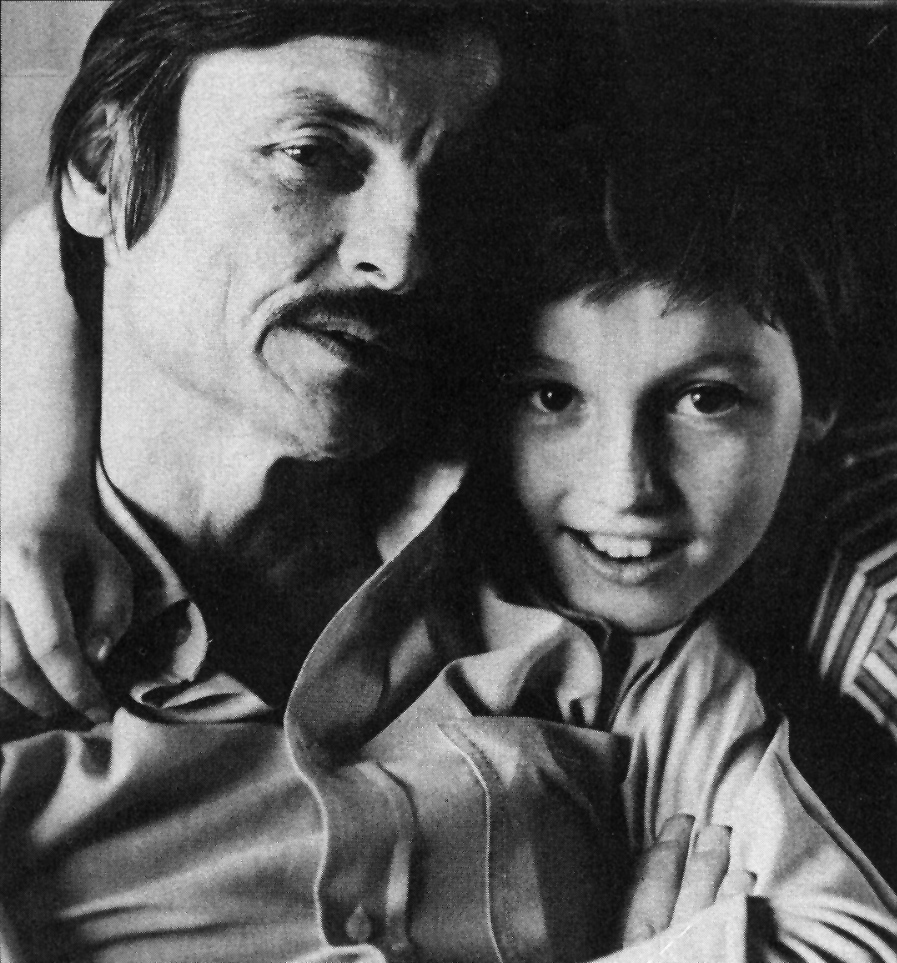
father and son

So the book. Well (and this was a few years ago), I had not read the book in quite a while so I decided to pull it off the shelf, dust it off, and put it on the coffee table to remind myself to pick it up when I came home from class. I was gone for only about a hour, came back and the book was not on the coffee table any longer. Hhhmmmm. Then I saw it. Across the room was the book, but now missing its cover. Remember, it was a hardbound book. After I began to investigate and put 2 and 2 together, I realized that the dog, a Labrador of course, had ripped off the cover and completely consumed it – later to end up in the yard (I’ll save you the description). Boy was I mad. And yet, how fitting. In a small way I was subjected to a “Tarkovsky moment” that is, a moment where all is not lost, but the path one is on has just taken a turn for the worse and one has to look inside to find the deeper value of the moment.
Now the book, coverless and a little tattered, lies on the bookshelf, the dog really belonged to some friends after all and is now somewhere I don’t know, and I’m thinking of pulling that book off the shelf and putting it on the coffee table to remind myself to pick it up again. And this time we have a Pug, so it’ll be alright. Then again, that little dog does get a sneaky gleam in his eye from time to time.

>is that the sun? yes dear

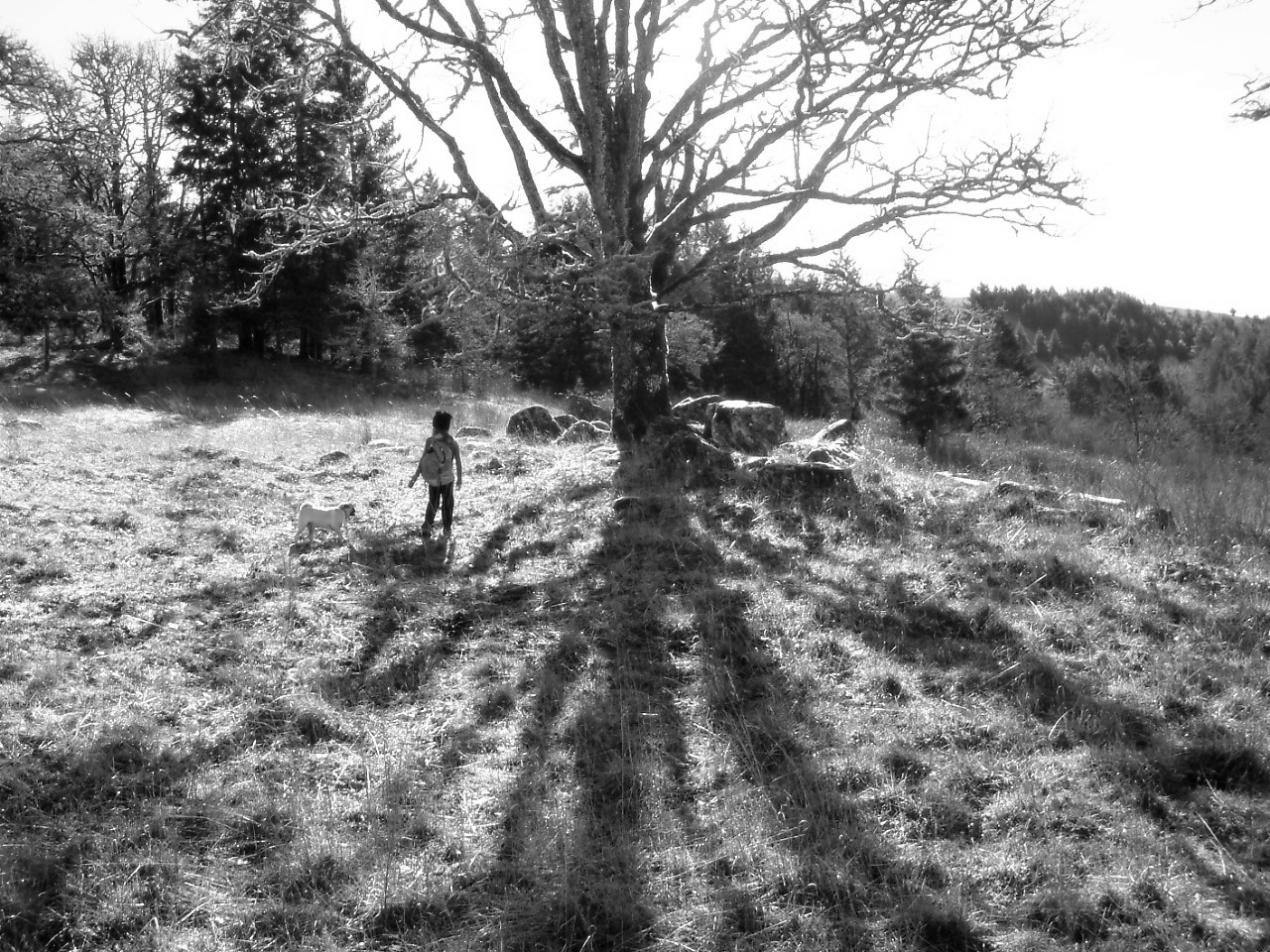
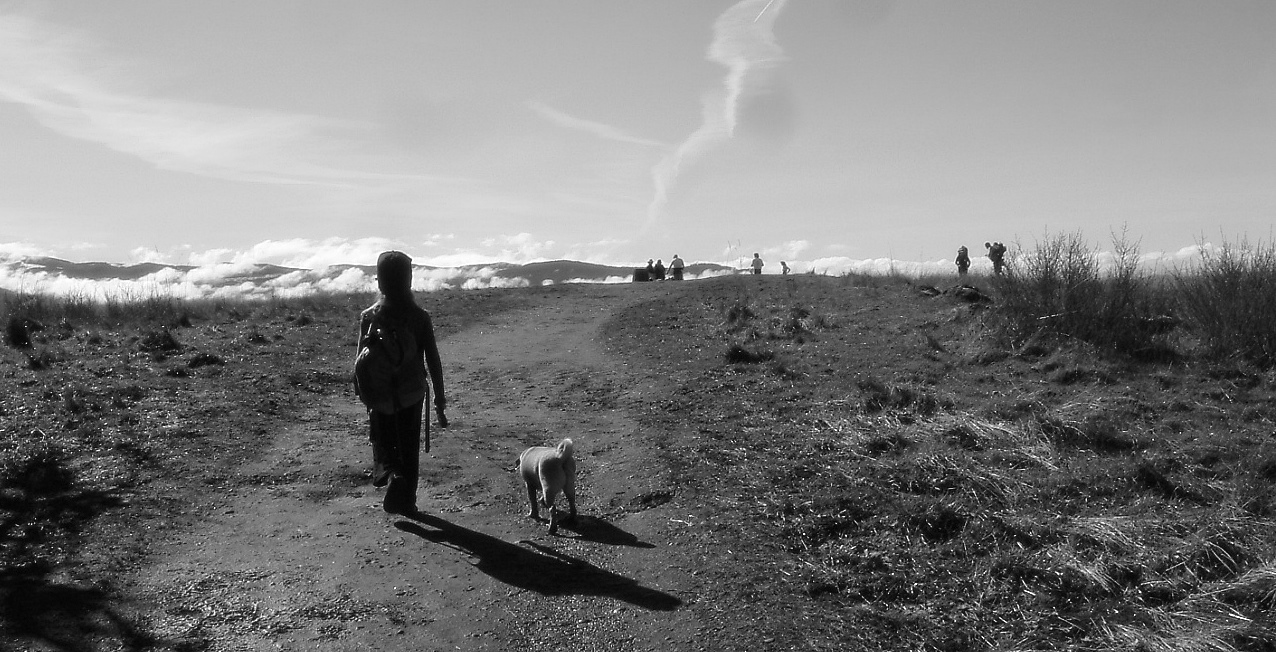
>Today was one of the first sunny days around these parts in quite a while. So instead of staying indoors and watching a film, Lily and I went for a hike up a local mount.

At one point Lily had to take the dog (Aloysius Bonaventure) over to see a tree..

…and many other things for that matter.

There’s nothing quite like getting outdoors after a long, dark, soggy winter and seeing a little blue sky. Even though I have a stack of films I mean to get to, and I should really be writing my thesis anyway, I need the balance of getting away from the city, even if only for a couple of hours.

Sometimes the best work of art is life itself.

Anyhow, we saw our latest film last night – The Return of the Pink Panther (1975) – which she loved, and even my wife laughed out loud at its cornball humor, and I remembered having seeing it over and over as a kid, memorizing all of Clouseau’s lines. I have to say much of my comedic education came from watching Peter Sellers many years ago. In fact, it reminded me that, although I have a fair amount of formal education under my belt, so much of what I have learned in life, and so much of who I am, has come from watching films.

>why is a long movie?

>This article Long flicks: To cut or not to cut? got me thinking.

I am curious as to why, when discussing the length of movies, 2 hours seems to be the key marker. In other words, a film that is over 2 hours automatically becomes a target for questioning the validity of its length while a film shorter than 2 hours rarely comes under such scrutiny. I understand the argument that theaters can get in more screenings per day with a shorter film, but a typical critique of film length rarely includes theater owners. Most of the time it is a critic who argues that a film is too long, and not for financial reasons, of course, but on the film’s artistic merits. But why is 2 hours the demarcation point? Why not 3 hours? Or 4? Is it the momentum of tradition, the weight of expectation, cultural conditioning, the limits of the human psyche or attention span?

I find this topic interesting because I tend to like lengthier films. I also like slow moving, contemplative films. Therefore, a film that I find just perfect may be far too long for another viewer. I also like tightly crafted shorter-length films. However, I am more likely to criticise a film for not taking the extra time to properly develop the story or key characters than argue a film is too long. Those who see films with me may notice that when it comes to films I really like I will often say I would have liked the film to be longer, to keep going. Maybe I’m just quirky.

One maybe-not-so-serious thought: I wonder if the length of films is more closely tied to biological reasons, such as the average size of the human bladder, than anything else. Isn’t that the real reason for those big epic films of yesteryear providing the audience with an intermission? (Also, so the filmgoers might purchase more concessions?) If a film is dragging a bit and you’ve consumed all your Pepsi, you’re probably more likely to become frustrated with the filmmaker for making you suffer. If that is true, then I think an interesting study would take a look at the perceptions of appropriate film length between those who watched a film in the theater and those who watched the same film on DVD (where you can pause the film for various reasons).

So what then is a long movie? Is there a “magic” length? Does length have a bearing on a film’s quality?

>The Year’s BIG Laugh, Music and Girl Show! of 1937

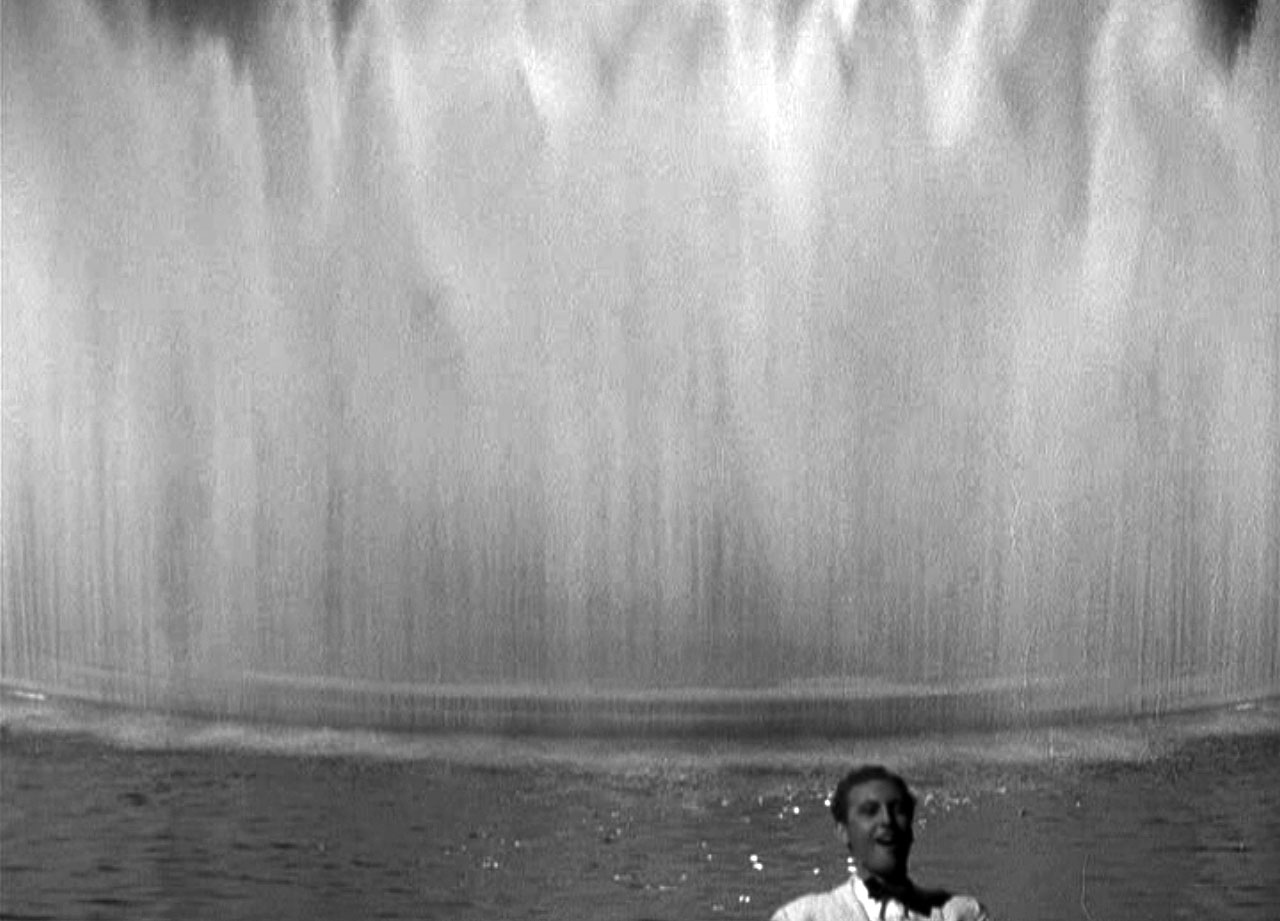
>So we watched A Day at the Races (1937) the other night. Lily liked it. There was one image that caught my attention because it is just so weird.


This shot comes during the big song and dance number at the Blue Venetian Waters (some kind of cabaret/night club). The singers are on a boat and the boat moves slowly toward the camera until the singers exit the bottom of the frame. The camera does not follow the singers but stays on the fountain. I don’t know why they chose to do this, but it certainly created a briefly funny visual moment. I don’t think the humor was intentional even though the film is a comedy. Anyway, I laughed.

a woman in need of a dangerous man

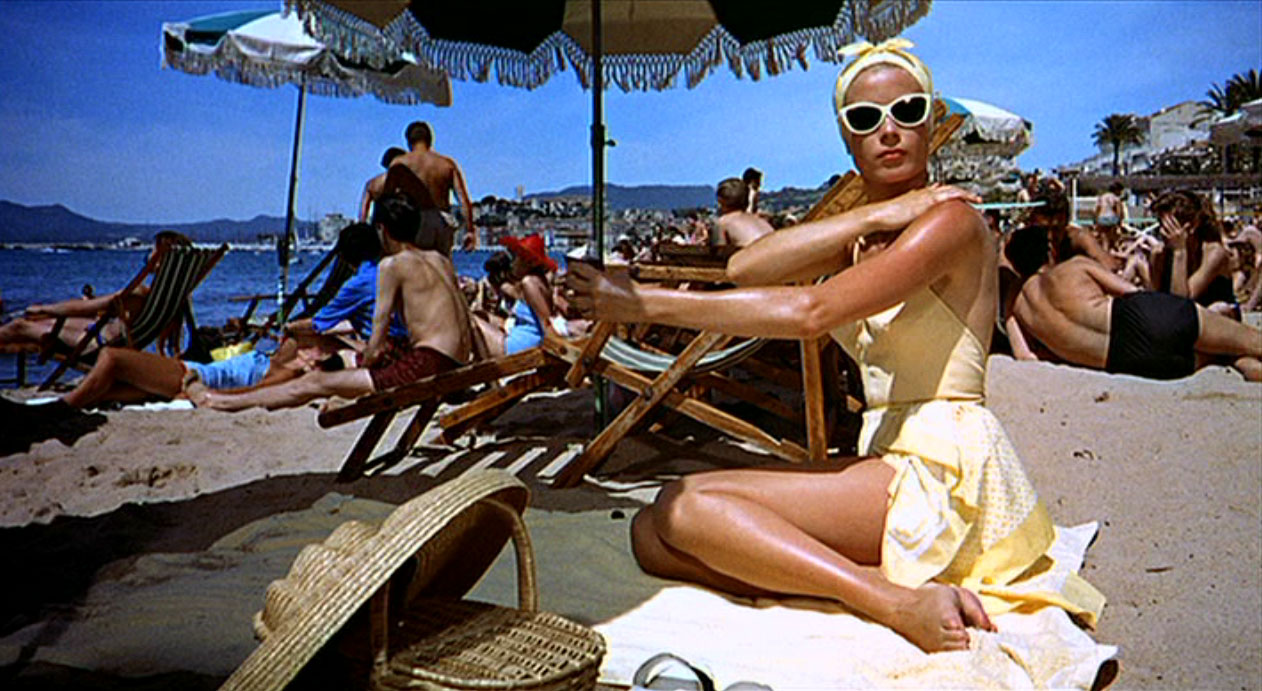
So, we continued our little unofficial Hitchcock class with a viewing of To Catch a Thief (1955). Lily’s first Hitchcock was Rear Window (1954), which we saw a couple of weeks ago, and she loved it, and had to the see the ending again immediately, and the special features. To Catch a Thief is not as good a film in my opinion, but we also loved it. The plot is somewhat interesting, but I find the film’s strength to be its wonderful visuals. Some of my favorite images from the film are as follows:

Compared to how Grace Kelly’s character was “introduced” in Rear Window, this is decidedly different. If one didn’t know better, it would be hard to know for sure that it was her.

This image also conveys less of the glamorous beauty one first gets of her in Rear Window and instead shows her as both sexy and mysterious. Her mysteriousness hides her, make her more impenetrable, and places her in the same visual context as some of the other characters from John Robie’s (Cary Grant) criminal past. In other words, we are not entirely sure who she is, maybe she is Grace Kelly but those glasses, etc., make it hard to know. Maybe she is another of those people who are looking for/searching for John Robie. Who knows. Her sexiness is also a kind of self-absorbed narcissism, played out more so later in the film, but here shown via her sun-worshiping attitude. She is not the soft, gentle, open, warm, beautiful Grace Kelly we saw in Rear Window. She is a distant, protected, maybe a little critical, and “boy” watching Grace Kelly here.

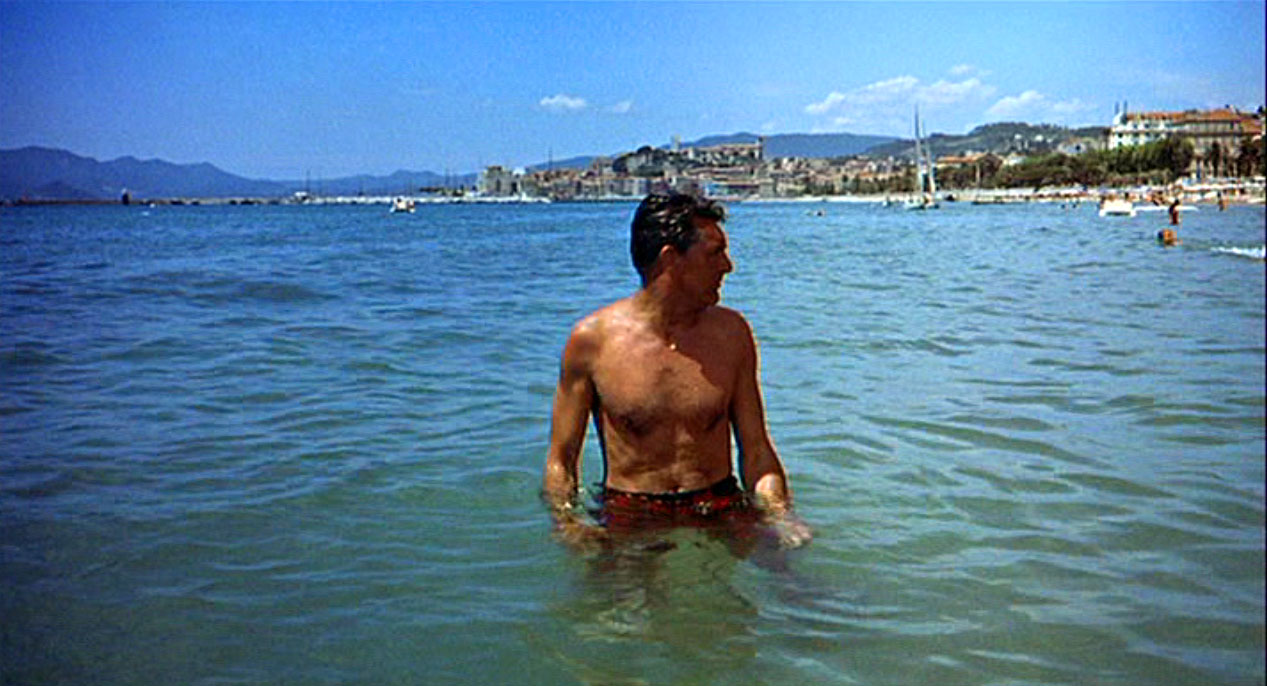
This shot seems very modern to me – like something one would expect from Soderbergh (of course instead of Grant it would be George Clooney).

But I also like it because it is so simple, a shot anyone of us could do really, and yet here it is in the midst of a star-vehicle Hitchcock film. There’s no fancy lighting, framing, certainly no effects – it’s just a straightforward shot, but there is something about it that is perfect. It also anticipates the kind of “out in the open” vulnerability Hitchcock would put Cary Grant in four years later, as Roger O. Thornhill in North by Northwest (1959), in the famous crop duster scene. Here nothing happens to him, though. Plus, I just love the image for its great colors and the fact that Hitch places Grant right in the center of the frame (compare with the off-center placing in image of Kelly above) which creates almost a snap-shot feel to it. If he would just turn towards the camera and smile then it could be a photo from our vacation.

And finally…

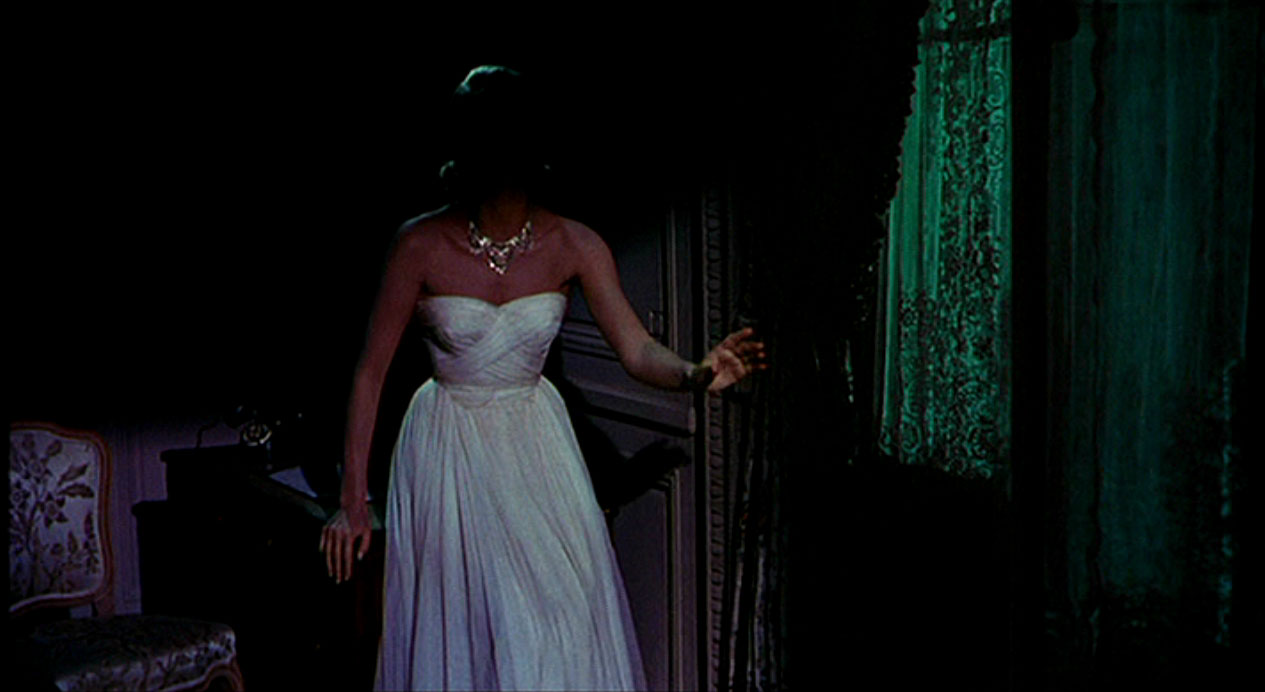
I just love this image — maybe the best of the film. It is from the scene when Frances tries to elicit a response from Robie in regards to the fabulous necklace she wears. She wants him to feel the pull of the diamonds because she believes that, as a former cat burglar, he cannot resist, but she also wants to be desired herself, maybe even ravaged. This is a very different Kelly character than the self-confident one in Rear Window. Here Kelly plays a desperate girl in search of a dangerous thrill. She plays a confident person on the outside, as though she is in control, but doesn’t realize that Robie is really the only one truly in control throughout the story. And of course Hitchcock hides Kelly’s face in shadows to emphasize the jewels — this screen grab doesn’t do justice to how they sparkle in the film. Could it be this hiding of the face makes the supposed desire of of the necklace concurrent with a desire for her body. In other words, both are presented as objects by the visual “decapitation.” If this is true, could it be that an undercurrent of the story is the overcoming of this base desire with a higher level of desire, a more romantic desire possibly, and maybe even higher still?

What makes the story interesting is that it is she who needs to change, who needs to learn her concepts of love for the thrill are not the same as genuine love. She needs a “dangerous” man, not so much to tame her as to draw out of her the authentic self she is seeking. We don’t see this kind of theme in films today as then, and for good reasons, but also Hitchcock, every being playful with his audience, never lets the film tie itself up so neatly, even though the plot gets wrapped up with a bow.