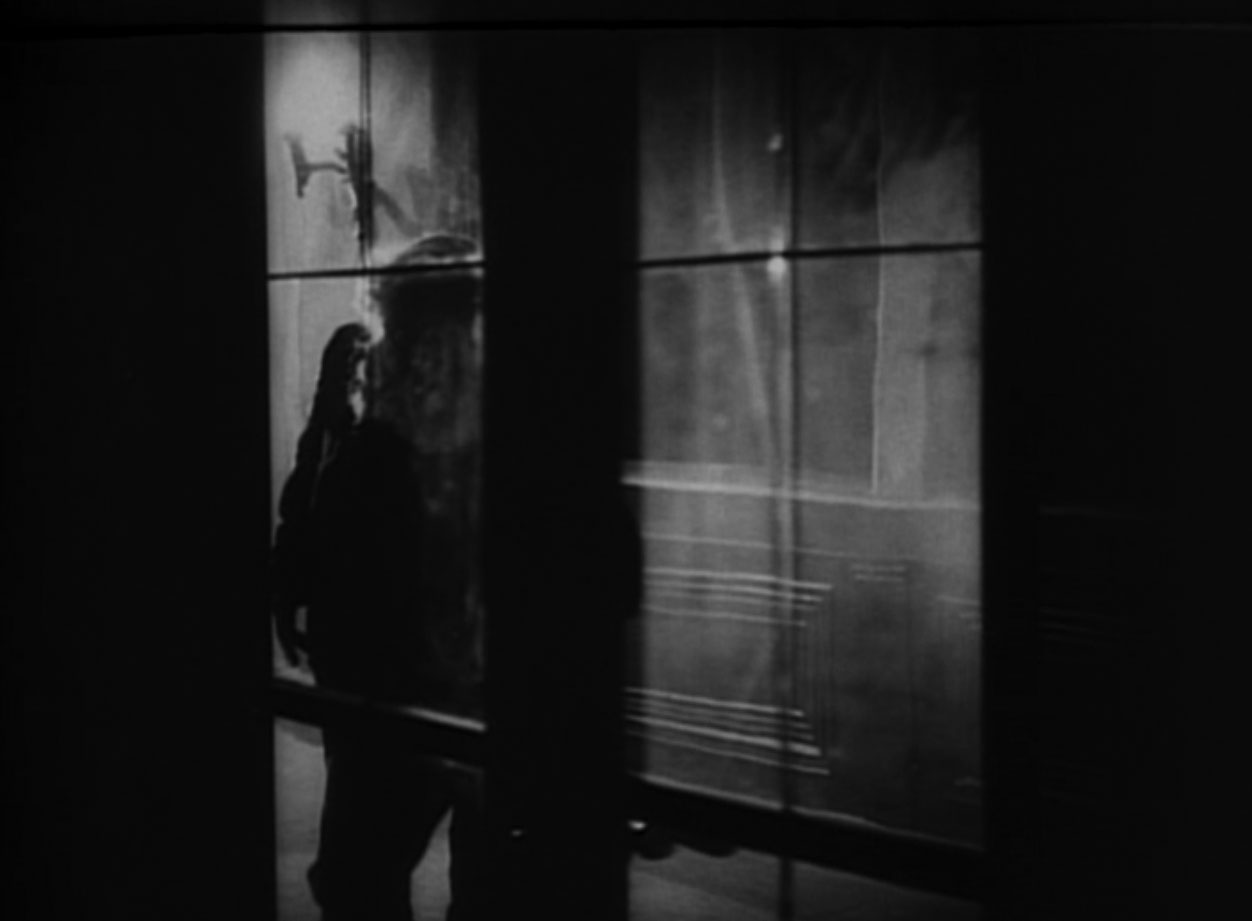
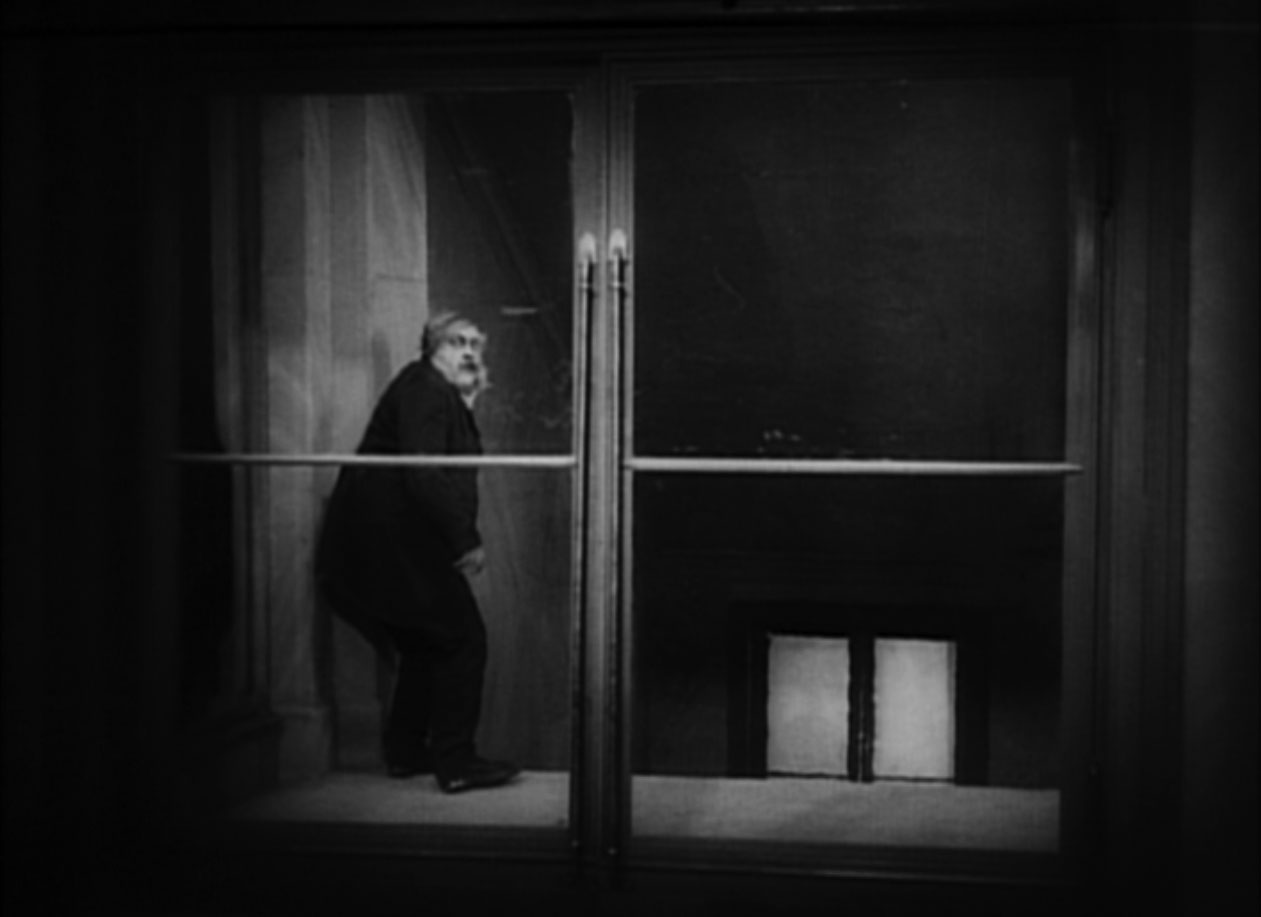
>Film Music & Architecture (metaphorically)

>

Preface: I had anticipated this to be a much longer and more involved posting for the Filmmusic blog-a-thon over at Damian’s great blog, Windmills of My Mind. But alas, life does not permit me, so I’ve decided to post more of a question than a statement. I will formulate my half-baked ideas as I go. And, of course, in typical PilgrimAkimbo style I will use the Filmmusic blog-a-thon to write about something other than film music.

* * * * * * * * * *

If you are not a true film music aficionado, as I am not, I would guess you do not select your films primarily based on who created the score. And yet, if you find a film compelling, if you become emotionally involved watching a film, if a film haunts you or stays with you, very likely the film’s music played a significant role in helping you to end up where you did. We all know this to be true. It may also be true that a film’s musical soundtrack actually helps one to merely understand the film at all.

I want to propose a very simple metaphor for considering the role that film music plays in our experience of films. I propose that film music is like architecture. My question: does this make sense? When I say architecture, I do not mean the structural aspect of a film, such as editing, rather I am thinking of the way the design of a building or house or room affects one as one enters that room and lives out the story of one’s life. Maybe a better way of saying it is that film music is architectural. And maybe there’s a better word.

My argument:
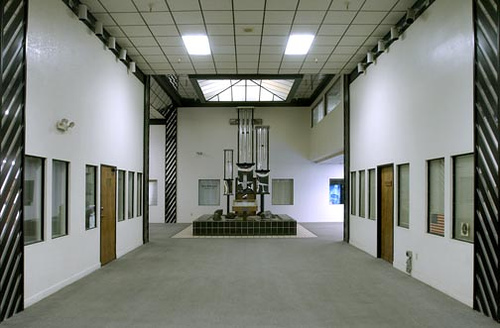
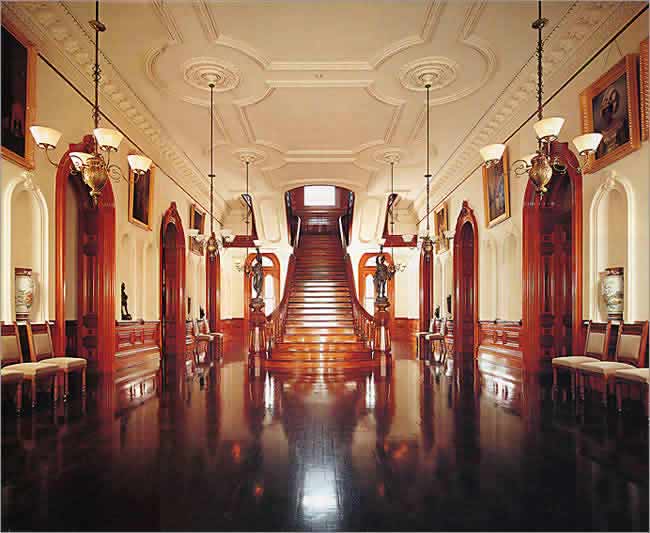
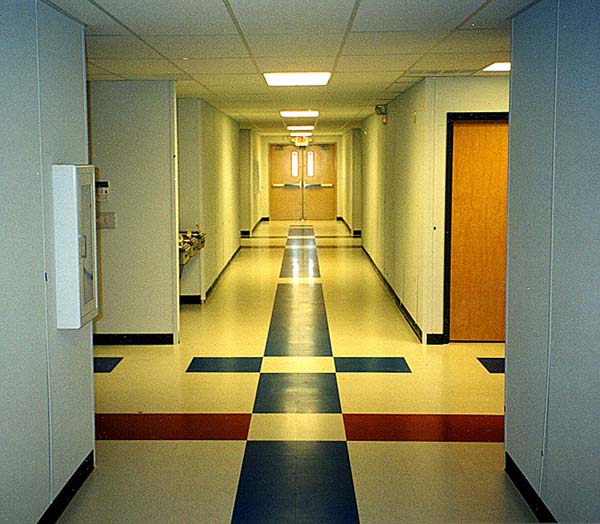
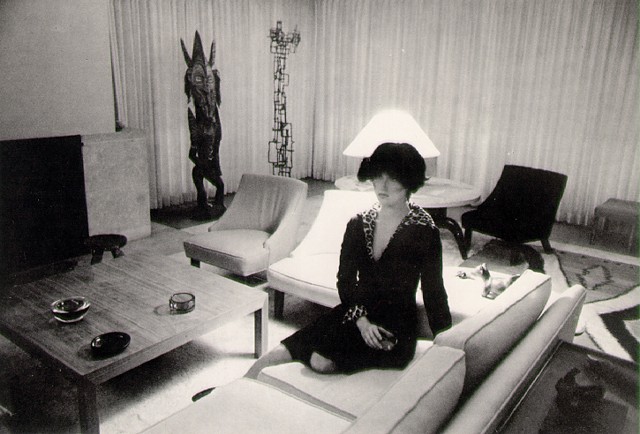
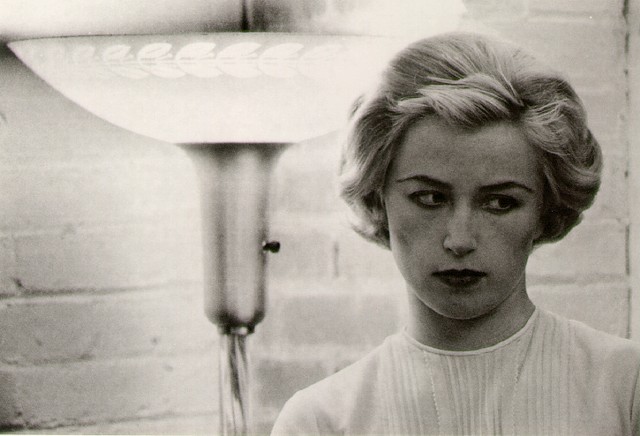
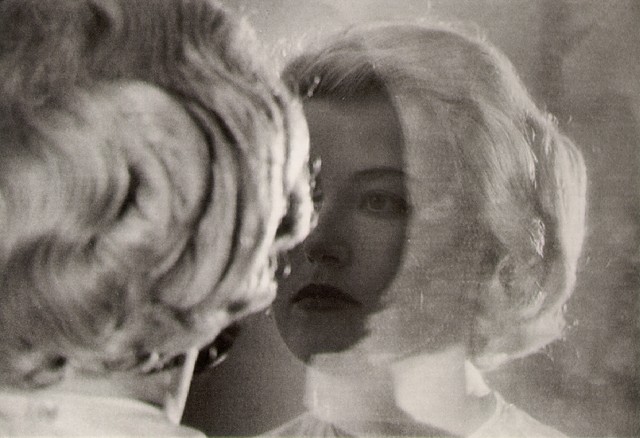
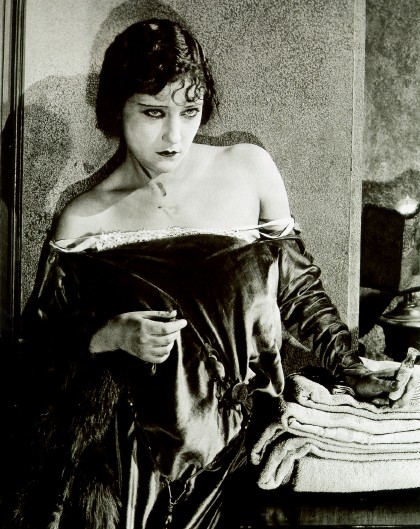
Consider these three images of three very different interior spaces:

I have no idea where these interiors come from other than random images I gathered from the Internet. But it is clear that each are of clearly defined interior spaces, and that each space, though photographed from essentially the same angle, produce very different feelings. One can imagine a story taking place in each one, for example a scene of a father and son arguing over an inheritance, or a romantic kiss, or a burglary – it doesn’t matter. But more importantly, if one were to visit these places one would expect different things. In other words, the spaces themselves convey meaning about their use and their purpose. They would imply different narratives.

Now, if one were to meet someone and have a conversation in each of these spaces, though the denotative content of each conversation would be the same, the connotative meanings might take on slightly different shades due to the context of the rooms. This is one of the things film music can do for a film.

This point, though I admit it is meager, just might be more profound than it appears to the casual observer. To emphasize this point a little more, I like the following quote (from The most Beautiful House in the World by Witold Rybczynski) about how architecture speaks to us and guides us:

The symbolic meaning of architecture can be profound, as it is in the case with places of worship and important public monuments. But the language of buildings can also convey more mundane messages: where to go, what is important, how the building is to be used. It is easiest to discern this function if it absent or if it is misinterpreted. The stock scene in movie comedies in which a flustered visitor wishing to leave a strange home finds himself in the clothes closet illustrates precisely such a confusion. Like all humor, it is an exaggeration of the familiar; we have all had frustrating encounters with doors – not only identifying the right one but opening it once we found it. There is a bank entrance that I go through frequently but which always manages to confound me. The door is made of plate glass, and its pristine beauty is unsullied by visible hinges or pillars; the elegant handle extends the full width of the door. I always have a small struggle going through that door – sometimes I pull instead of push, sometimes I push against the hinge. I feel like taping a sign to the door – PUSH HERE.

Could we then think of film music as being, at least in part, like the sign that says “push here”? In other words, film music is an integral part of guiding us, like architecture does in the physical world, through the mental world of film perception. In a sense, film music can tell us “how to use” a film.

Architecture, that is, the aesthetic design of the spaces we live in – not merely their structural dimensions, produces an often taken-for-granted effect on our lives. In other words, the design of the buildings we inhabit affects the way we live, the way we think, our emotions, and the way we relate to others, and it does these things in often quiet and subtle ways, and sometimes in obvious and loud ways. As we act out our lives in and around man made structures we act within a kind of context circumscribed, and even proscribe to some degree, by these structures. They give us a context within which to act. I argue that film music performs much the same function. Like the overwhelming feeling one gets when first entering a cathedral so are the opening chords of John Williams’ Star Wars theme. The music not merely gets one’s emotions going, but it also tells us a lot of critical information about what we are about to see and how we should think about/approach the story.

If this is true, then film music is not merely an add-on to dress up a film, though it can be that for some films. Rather, film music is an integral part of how a film, as a whole, conveys its meaning(s). As one’s brain engages with the constructive nature of piecing together the film’s narrative from the various clues provided, the music colors that narrative and provides a kind of context for the descriptive, interpretive, and evaluative processes. But, because film music is typically not central to the story in the same way as is the acting or the cinematography, and because film music is typically non-diegetic (not really part of the story at all), that is why I am using the metaphor of architecture. Film music acts as a kind of “space” in which a story is played out. Change the music and you affect the story.

One could say that film music, though typically non-diegetic and non-visual, is similar to the film’s mise-en-scène. Visually films cue the viewer to mentally construct the story from all the visual clues presented. Do not films also do this with music? Of course they do. But the musical soundtrack does more than merely cuing the viewer to think of a particular scene as being romantic or frightening. Music can play a role in the overall “sense” of a film, such as time period, genre, etc. And like many other things in a film, music can act like a relatively open ended set of “codes” that both support and work counter to the desires of the filmmaker.

Once, when my wife took me to see a film of her choosing, one that I did not know about, I had a strong sense of what the film was going to be about from the moment of the opening chords of the film’s musical soundtrack. I leaned over to my wife and said something like: “Okay, so I can tell this film will be about X, and then X will happen, and then X and X and X, and finally it will end with X.” All that from the film’s music combined with the opening credits. And I was right.

Maybe the most fundamental aspect of music is its connection with human imagination. Music can enlarge the imagination by drawing out of it intuitive connections to the world and experience. To keep with the architecture analogy, consider the following two images of famous architectural settings:

Both of these constructions are highly evocative. They draw one into their spaces and they draw out of one’s mind certain emotions and feelings. A film’s camerawork can do the same thing, but so can its music, maybe more so. Now imagine having a conversation with a friend in either of these locations. The same conversation would not be the same given the change in surroundings, even if the differences are subtle. It is this way because of our “aesthetic sense”, that is, our innate ability to respond, even sub-consciously, to aesthetic objects and nuances.

About 13 years ago I wrote these words:

To say that the couch in your living room or the pictures on your walls have a profound effect upon your life may sound strange. But they do. The things we surround ourselves with, from the films we watch to the color and texture of our bathroom tile, influence the way we think and feel. The nature of this influence may be enigmatic, but we know it is there. We know that the aesthetics of MTV, its look and feel, influence the youth of our world. We know that the aesthetics of an art gallery encourage quiet contemplation, whereas the aesthetics of a video arcade do not. And we know that living in an apartment with dark brown walls has a decidedly different feel than living in an apartment with white walls. The look, texture, and sound of our surroundings influences us because of our aesthetic sense.

I believe that in the mental world of film watching, the film’s musical score can be much like that art gallery or those apartment walls. If this is true, then the decisions facing the filmmaker regarding the musical score are critical.

I am sure there are some who might consider non-diegetic film music to be nothing more than a kind of wallpaper – something to pretty up a film, to give it that extra something. For some films this may be true I have no doubt, but in general I think this position is wrong, for fimmakers and for viewers. On the other hand, film music is there to serve the film. For most films the story comes first and all the rest follows, often with the music being included last. I personally believe that filmmakers should not think of music as an “add on” to a film. Film music should do more than merely prop up existing scenes. Rather, film music should be a fundamentally integral part of film. Maybe directors should have the composers be a part of the scriptwriting process. I’m sure some do.

And there it is as promised: some half-baked ideas on architecture for the film music blog-a-thon. I only hope it isn’t so half-baked as to be like a pancake that is burned black on the outside and still runny gooey on the inside. But maybe it’s still just a pancake nonetheless.

>TechnoGander: Photosynth

>

If you are like me, you’ve grown up in an essentially visual world, and you probably think visually more than not. One of the reasons I started blogging was because I could include images and graphics in my blog as well as design the look and feel of the whole thing (practically – I am using Blogger after all).

Where is this post leading? I have seen and experienced first-hand the great changes in photography – really from photography as we used to think about it to imaging as it is today. I cut my teeth on caustic emulsions and techniques born in the 19th century and then, in what seemed like no time at all, changed into a digital technology user and quiet fanatic. I was using Photoshop from version 2.0 and scanned in my prints to create desktop publishing documents – the scanner has now been collecting dust for some time. I am still amazed almost every day by what people are doing with current technology and what other are doing to create new technology. Take, for example, Photosynth. If you have not heard of Photosynth, or have not seen what it does and how it looks, take a look at the videos linked below

Videos: Blaise Aguera y Arcas: Jaw-dropping Photosynth demo at the TED conference and the Microsoft promo video of Photosynth.

So this post is not really about movies, but it’s related in a way, and I have to say, Photosynth is cool.

>where life is…

>

My life, metaphorically speaking, is a large stove with three or four big burners up front and about twenty or thirty back burners. There are many things, good things, wonderful things, important things that I have to put on those back burners when the big pots on the front burners start a’rumblin’. (I see you nodding your heads.) PilgrimAkimbo, this little corner of my creative world, has been languishing somewhat on one of those back burners with the heat set on medium-low. It will stay there for a while still, poor little blog, with the occasional bubble and pop.

The front burners are:

  • I am in the final throws of my MBA wrestling match. One more class to go, then finish my thesis. The pressure is on from all fronts.
  • Hey, I have a family! Wow, and they’re still here. Happy Father’s Day! Needless to say, families are big priorities and having a baby in the house adds to the level of constant investment. Big events so far this year: Wilder is born; Lily learns to ride a bike; Maricel starts painting again; Lily finishes 1st grade; Wilder keeps growing…
  • My paying job, you know the one that helps us buy food and shelter, is particularly stressful these days. No blogging at work!
  • Once I finish the MBA we will be looking for a way to make it pay for itself, and then some. Who knows, we could be moving sometime in the next several months. Yay & ugh!

In the mean time, I’ve been thinking about this blog, what it is, how it looks, how it could be organized better, and what content it should purvey. Here are some thoughts:

  • I have added a food blogroll, Viands & Victuals, I am looking for more good food related links. And I plan to populate PilgrimAkimbo with food related writing, including some of my favorite recipes and meals – but that’s down the road. When I will have the time to do some food writing I do not know – even my magic eight ball isn’t being helpful.

  • I plan on revamping my whole approach to tags. For those of you who witnessed my last tag fiasco the answer is “yes, I am not too bright, but I know I can learn, I have a masters degree.”

  • I will likely change some of the look-and-feel of the enterprise, but mostly keep it the same. I am a visual person and the style of PilgrimAkimbo only pleases me a little, but I have not had time to affect any changes. And, I am often impressed with the design of other blogs, but it takes time to get to that level. We’ll see.

So, I will still put up a post here and there, makes a few changes when I can, and suffer, as all bloggers must, with priorities. But not suffer too much.

Oh yes, a film…

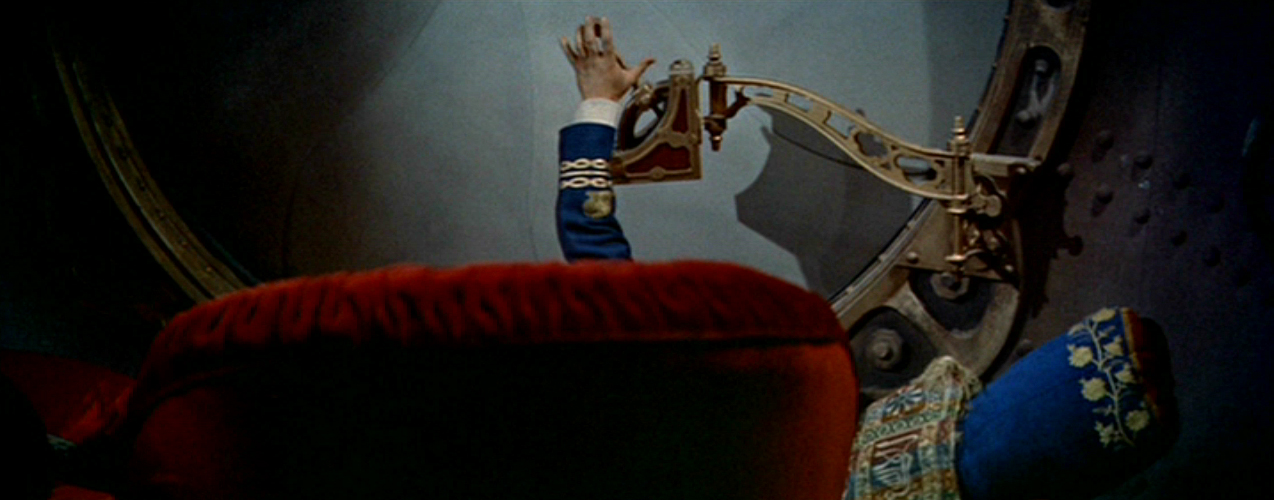
Last night, continuing Lily’s cinematic education, we watched 20,000 Leagues Under the Sea (1954). Lily found the film very moving and was greatly saddened when Captain Nemo died. I found the film better than I had remembered. This film was my favorite film when I was a kid, but in recent years I had come to believe that the film was a bit outdated. After watching it last night I have changed my views and consider it wonderful.

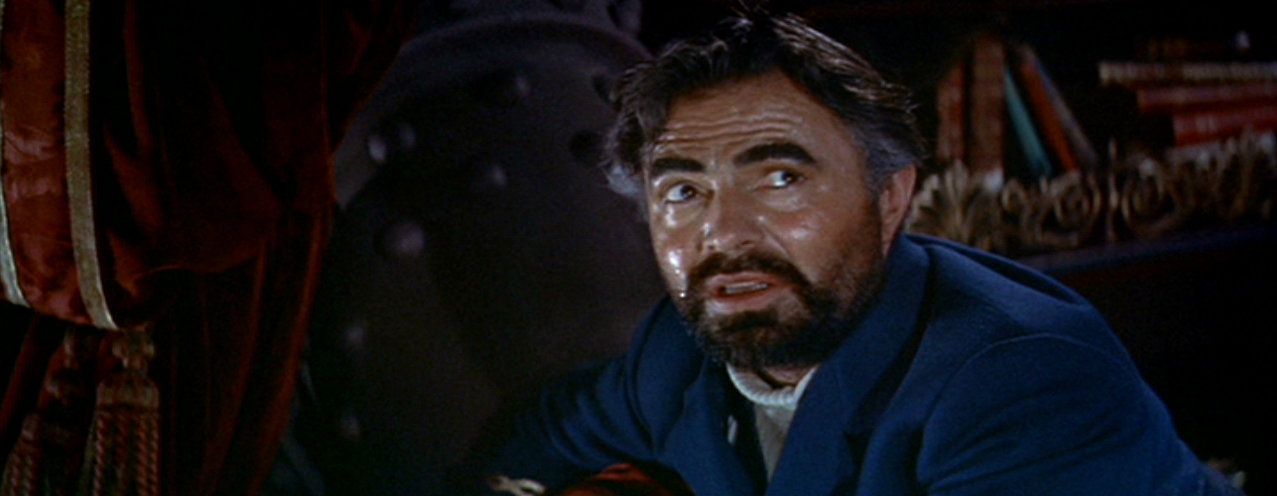
Recently I posted something on watching Treasure Island with Lily. In that post I mentioned the moral conflicts posed by the existence of the Long John Silver character. There is a similar ambiguity with Captain Nemo. As a kid (and still as an adult) I found Nemo (Latin for “no one”) to be both frightfully dark and exhilaratingly compelling. James Mason is wonderful in the part. He is both evil and good, a villain who cares for the oppressed and hates violence, yet uses violence to get revenge. I did not know exactly how to deal with Nemo. Should I like him or hate him? I saw the same tension within Lily. She knew he was bad, and yet she almost cried when he died. In fact, while we were watching the “making of” documentary on the DVD she did not want to see the crew filming the scene where Nemo is shot. I don’t blame her. For me that is a tragic moment as well, even though I know he is getting what he deserves. In this way Nemo is a little like all of us. We (speaking on individual terms) judge the world and others and yet we deserve to be judged ourselves. We (speaking in terms of “humanity”) all too often use evil in the name of good, justifying our actions because we elevate our own personal stories above those of others. Nemo is the evil and self-righteous genius who believes in the goodness of his own heart. I’m no genius, but I know what it is like to experience the rest.

Note: I absolutely loved the look of pure excitement and amazement on Lily’s face when Nemo says “You may call me Captain Nemo.” For a kid who has grown up with Nemo being a cartoon fish, it was great to see her get truly excited about the origins of “Nemo.”

Extra: you can see the 1916 version of 20,000 Leagues Under the Sea here.

Herakles

Roads disappear
Into umbral expanses,
And half lying
In corpulent darkness,
I grasp your body.

I am a child
Between spheres.

Your members,
Knitted
Above Juniper silhouettes,
Bring forth evocations
And visions.

Drawing backwards,
Anamnesis in immature eyes,
I behold cities
Glowing beneath us,
Extending flowers of fire
Beyond the plane’s wingtips,
Drawing farther still
I wake to see horses
Standing asleep,
The starlight so bright
I hold heaven and earth
In both hands.

I was made for questions
And spirits.
And now,
Before your
Flung figure,
Sand strewn across
Infinite obsidian,
Holding within me
Mystery and eternity,
I am cast upward.

-August, 1998

untitled film post


I was always glued to the television when I was a kid, and I loved movies. There was one show, The Million Dollar Movie, that played the same film over and over every night for a week, so you could really know it by heart. I remember stumbling across a bizarre futuristic film that was made up of nothing but still images except for one of the final scenes, which moved: it was Chris Marker’s La Jetée, which must have been on PBS when I was a teenager. I didn’t know it was meant to be science fiction, it was just very weird. Another time I had to go with my parents to a dinner party and wound up watching TV in the basement, eating my little dinner alone watching Hitchcock’s Rear Window while the adults partied upstairs. I loved all those vignettes Jimmy Stewart watches in the windows around him–you don’t know much about any of those characters so you try to fill in the pieces of their lives.

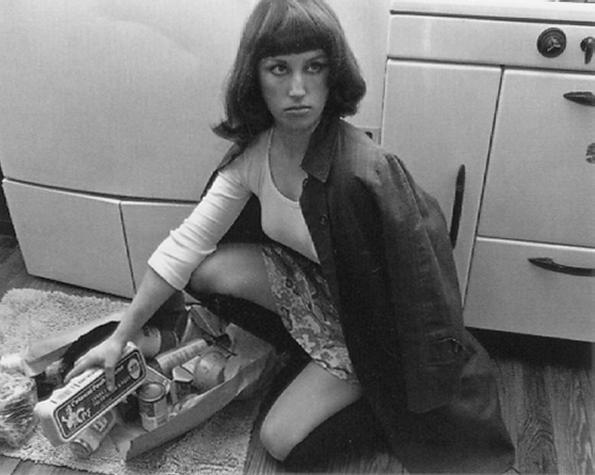
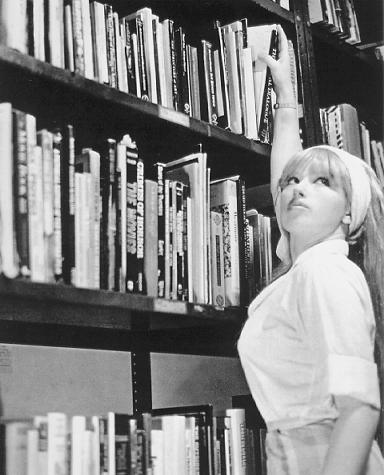
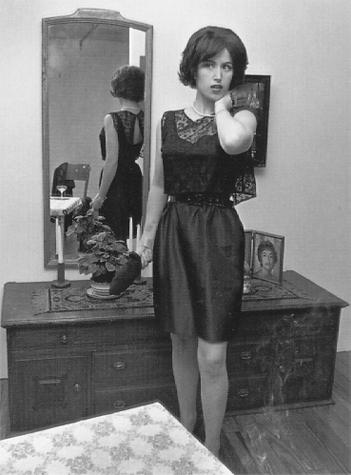
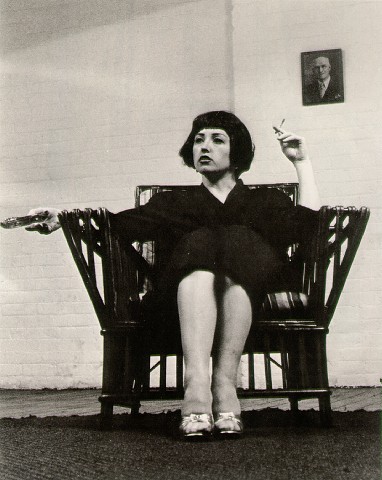
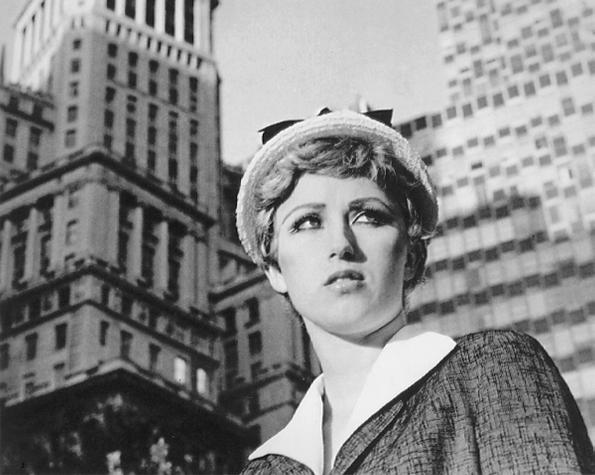
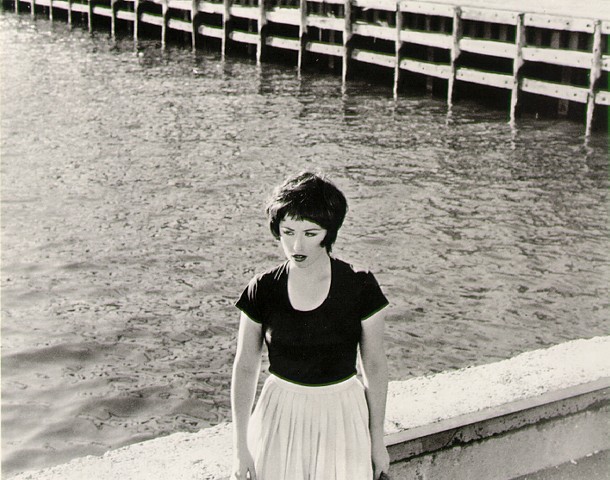
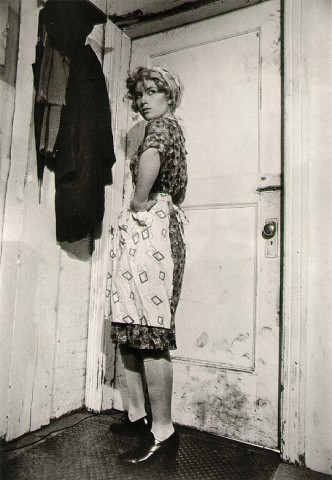
Cindy Sherman, The Complete Untitled Film Stills, MoMA 2003


For years I have been fascinated by Cindy Sherman’s famous/infamous Untitled Film Stills series of photographs. I am still fascinated.


#7, 1978


I have wondered if the pictures truly represent established stereotypes of female identity and societal norms for some serious artistic purpose, or are really the end-product of just having fun. I am inclined to think that they really are about having fun, about dressing up, about the strange joy of having one’s picture taken, and about having some control over that picture taking, and, of course, about pretending to be someone else. I am inclined to think the pictures do invite a more contemplative attitude, but are first and foremost about play. Then again, I might be wrong.

#10, 1978

A gang of artists would converge there to watch Saturday Night Live or Mary Hartman, Mary Hartman. I’d be in my studio making up a character and then go out in character to join the party. I’d have put in all this energy into the makeup and I’d think, Why waste it. There’s a photo of me as Lucille Ball from that time: I had a wig that reminded me of her hairstyle.

Cindy Sherman, The Complete Untitled Film Stills, MoMA 2003

Then again, I might be right.

#13, 1978

Her fascination with self-transformation extended to her frequent trips to thrift stores, where she purchased vintage clothes and accessories, which suggested particular characters to her: “So it just grew and grew until I was buying and collecting more and more of these things, and suddenly the characters came together just because I had so much of the detritus from them.” Sherman began wearing these different costumes to gallery openings and events in Buffalo. For example, to attend a gallery opening, she dressed up as a pregnant woman. While there was an obvious performative element to this practice, Sherman never considered these outings “performances” in an artistic sense because she was “not maintaining a character” but simply “getting dressed up to go out.”

Amada Cruz, Movies, Monstrosities, and Masks: Twenty Years of Cindy Sherman, (2003)


#14, 1978

I didn’t want to make “high” art, I had no interest in using paint, I wanted to find something that anyone could relate to without knowing about contemporary art. I wasn’t thinking in terms of precious prints or archival quality; I didn’t want the work to seem like a commodity.

Cindy Sherman

#15, 1978


Ultimately, as I have experienced it, Sherman’s practice participates in what I have argued to be the opening of the subject to otherness (the baring of the circuits of desire connecting self and other in a dynamic of intersubjectivity) that gives what we might call postmodernism its most remarkable and particular antimodernist thrust. In feminist and phenomenological terms, the body, which instantiates the self, is a “modality of reflexivity,” posing the subject in relation to the other in a reciprocal relationship; through gendered/sexual performances of the body, the subject is situated and situates herself through the other.

Amelia Jones, Tracing the Subject with Cindy Sherman (2003)

#16, 1978

The subject, then, is never complete within itself but is always contingent on others, and the glue of this intersubjectivity is the desire binding us together (the projective gaze is one mode of intersubjectivity but functions specifically to veil this contingency by projecting lack onto the other rather than admitting its own). It is the intersubjective dimension of Sherman’s work that has largely been ignored (not surprisingly, since it exposes the investedness and contingency of every reading of her pictures – including this one).

Amelia Jones, Tracing the Subject with Cindy Sherman (2003)

#21, 1978


The work is what it is and hopefully it’s seen as feminist work, or feminist-advised work, but I’m not going to go around espousing theoretical bullshit about feminist stuff.

Cindy Sherman

#25, 1978


The still must tease with the promise of a story the viewer of it itches to be told.

Cindy Sherman

#35, 1979

I find it interesting that many of Sherman’s Untitled Film Stills do not follow any standard film aspect ratios: #35 above for example. I believe that one might almost not notice this fact because of the naturally evocative power of the image, and all her images. We are given the title and accept it as though it were from a film. We know it is not; we know it is entirely contrived; but then again, we know that all film is entirely contrived, that images of women (and men, and of ethnicity, etc.) are all contrived, all reductions in one sense of another. Sherman is giving us our stereotypes, our comfort and our curse. While we are looking at her, at her dressing up before the camera as though she were not herself, we are looking at ourselves. It does not matter whether one is a woman or a man, when one looks at the image, one is looking at oneself. That is why we do not see the faulty aspect ratio. There is nothing more fascinating to oneself than oneself.

#48, 1979

Why do images #48 and #50 remind me so much of David Lynch?

#50, 1979

The text between these images you can take it or leave it. If the images contradict the text, the images win.


#53, 1979

Men look at women. Women watch themselves being looked at.

John Berger, Ways of Seeing (1972)

I always though Berger was right. But I’m no longer so sure. And yet, I don’t doubt Berger.

#56, 1980

Not a final word: What is it I see in myself when I look at Sherman’s Untitled Film Stills?

I see myself looking at myself looking at a photograph of a woman knowing that I am looking not at herself, but at her creation. I see my psychologiocal self swimming in a sea of signifiers. I see myself as a moral agent who makes choices to believe, or not believe. I see that I, as a singular individual, am plural.

Before and After: A Sample

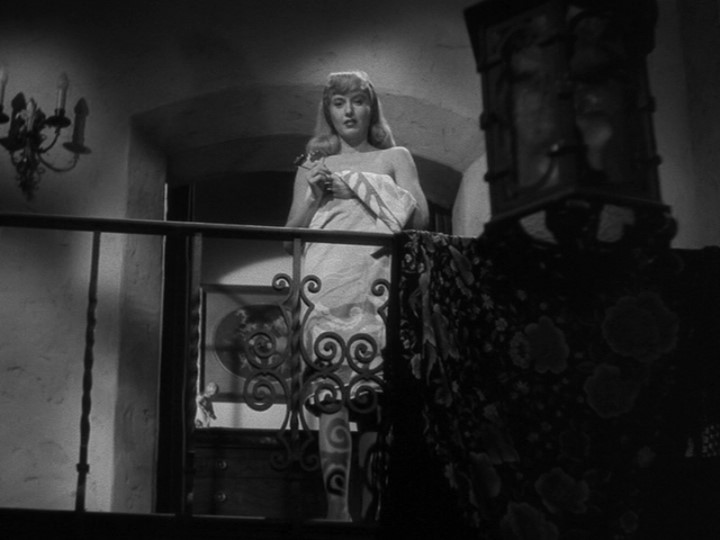
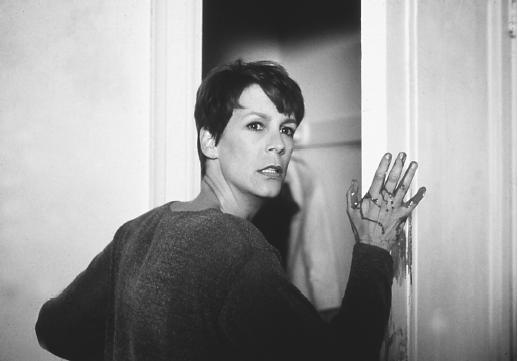
Gloria Swanson: before

Barbara Stanwyck: before
Jamie Lee Curtis: after


You know the rest.

a glimpse at a mystery

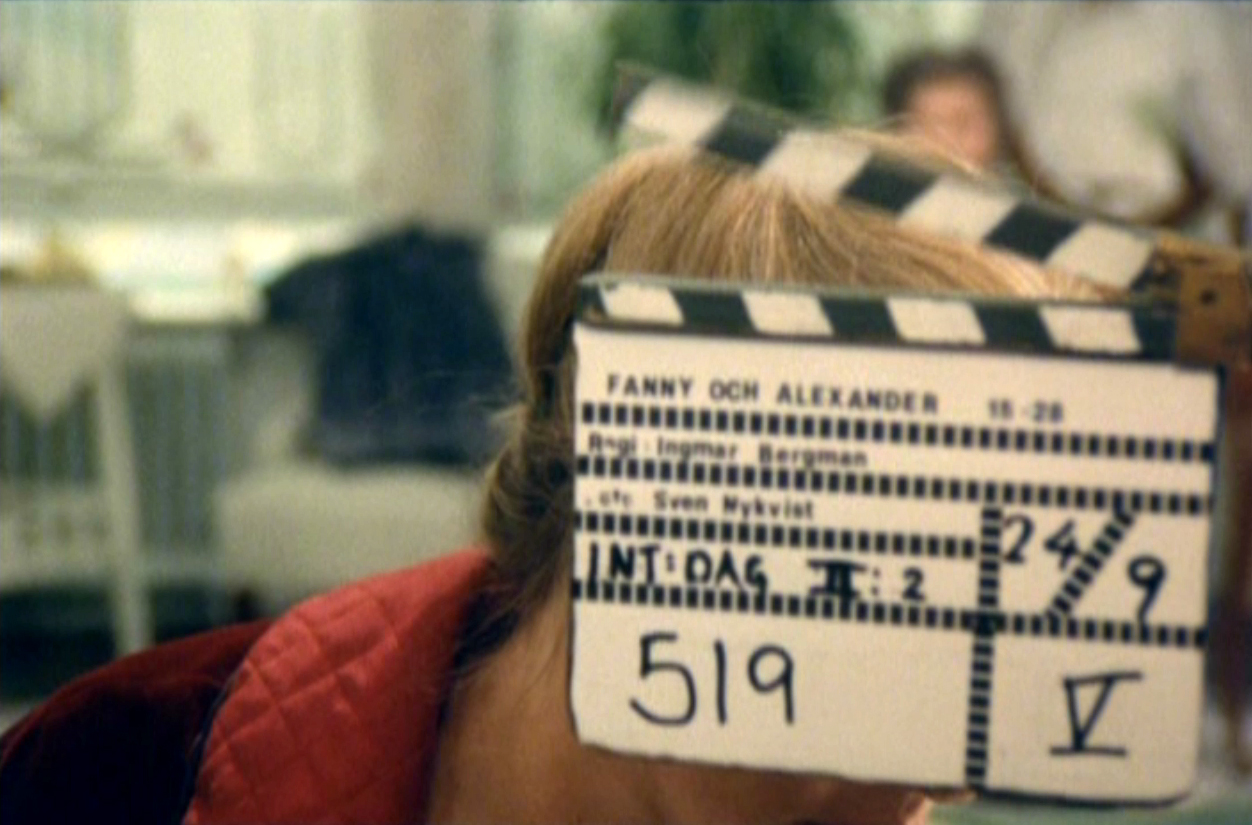
In Dokument Fanny och Alexander (1986) – a.k.a. The Making of Fanny & Alexander – the camera (our camera) observes the film crew at work. We are as a fly on the wall, and yet closer still. Like many great documentaries, this film is premised on letting the subject reveal itself over time, naturally, without manipulation. Except for brief intertitles offering some explanation (and providing section headings) the film merely observes the activities of shooting a film, and especially of the director interacting with his actors and crew. The film is a subtle and intimate look into the relationships formed between these individuals.

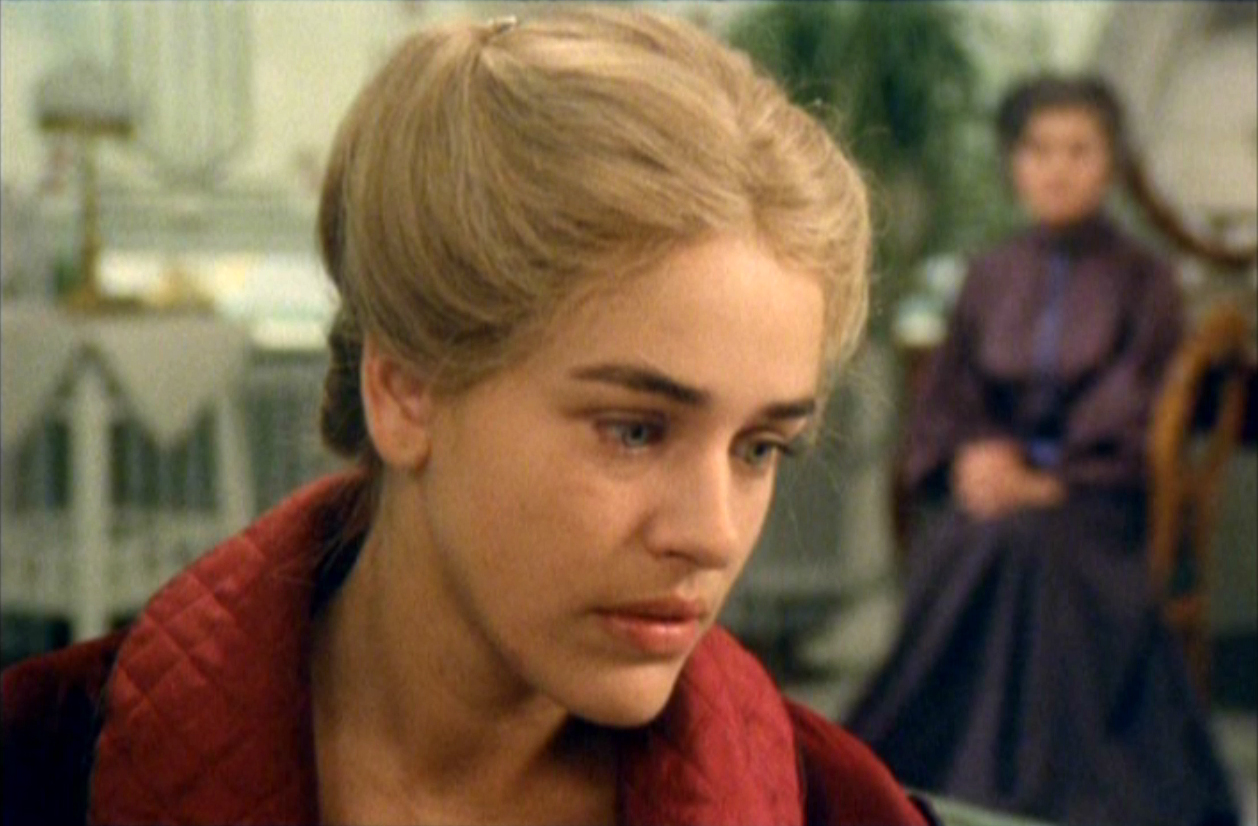
I was struck by the film’s beauty and power. For example, I love the moment when filming the deathbed scene where Emilie Ekdahl (Ewa Fröling) comes to view the body of her husband. We get to see the scene being filmed from different angles, with the director, Ingmar Bergman, working with his actors and cinematographer, Sven Nykvist, on pacing and blocking. We get a glimpse at the insides, as it were, of a masterpiece – as though we were visiting the construction site of a cathedral and were seeing stone set upon stone.

What is so remarkable about a work of art is that there is often something transcendent and unexplainable about the final product, and yet the making is just people doing what they do. Artmaking may be a calling, a gift, a burden, but it is also a very human, even ordinary, activity.

Here we have Emilie Ekdahl looking at her husband.

And here we have Bergman looking at Ewa Fröling as she plays Emilie.

One might think that an actor would struggle with the director being only a couple of inches out of frame watching every movement one makes, but Bergman’s actors seem to thrive on that intimacy. Bergman develops a trusting relationship with his key actors to such a depth that their acting and his directing work symbiotically, organically, fully in the moment. And yet, what one sees in this documentary are the functional, goal oriented, working relationships coming together to finish a project and create a product.

If one looks for a mystical connection flowing between director and actor one finds nothing – for we really only see, because the camera can only see, the surface of things. But, if one looks for pointers to the mystery of filmmaking, they are everywhere, and they all point to the end-product, Fanny och Alexander (1982) – a.k.a. Fanny & Alexander.

a considered bibliography

I entered the University or Oregon’s film studies department (Dept. of Telecommunication and Film) in 1984. During that period I took classes from Prof. William Cadbury who, in my opinion, was a great teacher and one of my favorites. In one of his classes he handed out a booklist that I have kept with me all these years. I have re-typed it below (any misspellings are my own). There was also a classical music list, but I have not included it.
The list was created by Prof. Cadbury and his wife, the poet Maxine Scates, for her niece Tracy (hence Tracy’s Booklist), who was entering UCLA as a freshman. The list first appeared in 1980 and was then updated. This is the 2nd edition.

The premise of the list is as follows:

“People are rarely told an opinion of the actual bibliography of fictions (mostly novels, a few stories), of which a cultured person in modern America is master. The following is an opinion of that bibliography. It suggests: don’t waste your time reading lesser books when you read; always have at least one book that you’re in the middle of, and usually have it be one of these. The list is divided into translations and English language originals; it is presented in full awareness of the presumption in doing so, and in the hope that the utility will override the presumption.”

(from the introduction)

Naturally, this list is a personal one, and one might feel it is a bit dated (but not very much). The non-fiction section is also skewed towards the arts, which is okay by me. And for myself this list represents the considered opinion of an older and wiser person who, after engaging for many years both intellectually and emotionally with college students felt the neccessity to impart some idea of what it means to be a cultured person – not in totality, but at least a slice of that ideal.

If you see any misspellings, etc., please let me know.
Tracy’s Booklist: 2nd Edition
BOOKS ORIGINALLY NOT IN ENGLISH
Balzac, Honoré de: Eugénie Grandet; Old Goriot; Lost Illusions
Borges, Tomas: Labyrinths
Borowski, Tadeusz: This Way for the Gas, Ladies and Gentlemen
Camus, Albert: The Stranger; The Plague
Cervantes, Miguel: Don Quixote
Chekhov, Anton: The Lady with the Dog and Other Stories
Colette: My Mother’s House; Sido
Condé, Maryse: Segu
Cortazar, Julio: Blow-Up
Döblin, Alfred: Berlin Alexanderplatz
Dostoyevsky, F.: The Brothers Karamozov; Crime and Punishment; The Idiot; Notes from Underground
Eco, Umberto: The Name of the Rose
Flaubert, Gustave: Madame Bovary
Garcia Marquez, G.: 100 Years of Solitude
Kafka, Franz: The Trial; The Castle; “Metamorphosis”; “In the Penal Colony”
Levi, Primo: If Not Now, When?; The Periodic Table
Lustig, Arnost: Night and Hope; The Unloved
Mahfouz, Naguib: The Thief and the Dogs;
Miramar
Malraux, André: Man’s Fate
Mann, Thomas: Death in Venice; The Magic Mountain; Joseph and His Brothers
Murasaki, Lady: The Tale of Genji
Nabakov, Vladimir: Pale Fire
Narayan, R. K.: The Financial Expert; The Man-Eater of Malgudi
Pavese, Cesare: The Moon and the Bonfire
Proust, Marcel: Remembrance of Things Past
Rulfo, Juan: Pedro Paramo
Schwartz-Bart, André: The Last of the Just
Sembene, Ousmane: God’s Bits of Wood
Stendhal: The Red and the Black; The Charterhouse of Parma
Tolstoy, Leo: War and Peace; Anna Karenina

ENGLISH LANGUAGE:
Achebe, Chinua: Things Fall Apart
Amis, Kingsley: Lucky Jim
Arnow, Harriet: The Dollmaker
Austen, Jane: Mansfield Park; Emma; Pride and Prejudice; Persuasion
Baldwin, James: Go Tell It On the Mountain; Another Country;
Tell Me How Long the Train’s Been Gone
Brontë, Charlotte: Jane Eyre
Brontë, Emily: Wuthering Heights
Brooks, Gwendolyn: Maud Martha
Carroll, Lewis: Alice in Wonderland
Cather, Willa: My Anatonia; A Lost Lady
Chandler, Raymond: The Big Sleep; The Long Goodbye
Cherryh, C. J.: “The Chanyr Saga”; the “Cyteen” books
Chopin, Kate: “The Storm” and other stories
Cisneros, Sandra: The House on Mango Street
Conrad, Joseph: Lord Jim; Heart of Darkness; Nostromo
Daley, Grace: Enormous Changes at the Last Moment
Darganyemba, Tsiti: Nervous Conditions
Dickens, Charles: Bleak House; Great Expectations; Hard Times
Eliot, George: Middlemarch
Ellison, Ralph: The Invisible Man
Emecheta, Buchi: In the Ditch
Erdrich, Louise: Love Medicine
Faulkner, William: The Sound and the Fury; Absalom, Absalom
Fielding, Joseph: Tom Jones
Fitzgerald, F. Scott: The Great Gatsby
Ford, Ford Madox: Parade’s End
Forster, E. M.: A Passage to India; Howards End
Fowles, John: The French Lieutenant’s Woman
Glasgow, Ellen: Barren Earth
Golding, William: Lord of the Flies
Gordimer, Nadin: Burgher’s Daughter; Occasion for Loving; July’s People
Green, Graham: The Heart of the Matter; Brighton Rock
Hagedorn, Jessica:
Dogeaters
Hammett, Dashiel: The Thin Man
Hardy, Thomas: Tess of the D’Urbervilles; Jude the Obscure
Hawthorne, Nathaniel: The Scarlet Letter
Head, Bessie: When Rain Clouds Gather
Heller, Joseph: Catch 22
Hemingway, Ernest: The Sun Also Rises
Hogan, Linda: Mean Spirit
Hurston, Zora Neale: Their Eyes Were Watching God
James, Henry: The Ambassadors; The Golden Bowl
Jen, Gish: Typical American
Jones, Gayl: Corregidora
Joyce, James: Portrait of the Artist as a Young Man; Ulysses; Dubliners
Karbo, Karen, The Diamond Lane
Karmel, Ilona: An Estate of Memory
Kincaid, Jamaica: Annie John
Kingston, Maxine Hong:
China Men
Kogawa, Joy: Obasan
Lawrence, D. H.: Sons and Lovers; Women in Love
Lessing, Doris: The Marriage Between Zone 3, 4, and 5; The Golden Notebook;
Shikasta
Lesueur, Meridel: Ripening
Loge, David: Small World
Mansfield, Katharine: Collected Stories
Marshall, Paule: Brown Girl, Brown Stones; Praise Song for the Widow
McCuller, Carson: The Heart is a Lonely Hunter
Melville, Herman: Moby Dick
Meredith, George: The Egoist
Milne, A. A.: Winnie-the-Pooh; The House at Pooh Corner
Momada, N. Scott: House Made of Dawn
Morrison, Toni: Beloved; Sula
O’Brien, Tim: The Things They Carried
O’Connor, Flannery: Wise Blood; The Violent Bear It Away
Olson, Tillie: Tell Me A Riddle
Orwell, George:
1984
Paton, Alan: Cry the Beloved Country
Petry, Ann: The Street
Porter, Katharine Anne: Collected Stories; Ship of Fools
Pratchett, Terry: Moving Pictures
Pynchon, Thomas: Gravity’s Rainbow; V
Rhys, Jean: After Leaving Mr. MacKenzie
Roth, Phillip: Portnoy’s Complaint
Saki (H. H. Munro): The Short Stories of Saki
Salinger, J. D.: The Catcher in the Rye; Nine Stories
Schwartz, Lynne Sharon: Disturbances in the Field; Leaving Brooklyn
Scott, Sir Walter: Rob Roy; The Heart of Midlothian
Silko, Leslie Marmon: Ceremony
Singer, Isaac Bashevis: The Family Moskat; The Magic of Lublin
Stein, Gertrude: The Autobiography of Alice B. Toklas; The Lives
Swift, Jonathan: Gullivers Travels
Tan, Amy: Joy Luck Club
Thackeray, William M.: Vanity Fair
Thomas, D. M.: The White Hotel
Tolkien, J. R. R.: Lord of the Rings
Toomer, Jean: Cane
Trollope, Anthony: Barchester Towers; Phineas Finn
Tutuola, Amos: The Palm-Wine Drinkard
Twain, Mark: Huckleberry Finn
Updike, John: Rabbit Run
Wachtel, Chuck: Joe the Engineer
Walker, Alice: The Color Purple; Meridian; The Short Life of Grange Copeland
Waugh, Evelyn: Vile Bodies; Brideshead Revisited
Welty, Eudora: Collected Stories
West, Nathaneal: The Day of the Locust; Miss Lonelyhearts
White, T. H.: The Sword in the Stone
Wodehouse, P. G.: Blandings Castle
Wolfe, Thomas: Look Homeward Angel
Woolf, Virginia: Mrs. Dalloway; To the Lighthouse; The Waves; Orlando
Wright, Richard: Native Son
Wharton, Edith: The House of Mirth; The Age of Innocence

NON-FICTION:
Baritz, Loren: Backfire
Baxandall, Michael: Painting and Experience in 15th Century Italy
Beardsley, Monroe: Aesthetics
Berger, John: The Success and Failure of Picasso
Bernstein, Leonard: The Unanswered Question
Campbell, Joseph: The Mythic Image
Chomsky, Noam: Language and Mind; Turning the Tide
Des Pres, Terrence: The Survivor: An Anatomy of Life in the Death Camps;
Writing Into the World
Eriksen, Erik H.: Childhood and Society
Freire, Paulo: Pedagogy of the Oppressed
Frye, Northrop: Anatomy of Criticism
Gombrich, E. H.: Art and Illusion
Hacker, Andrew: Two Nations: Black and White, Separate and Unequal
Harding, Vincent: There is a River
Hauser, Arnold: The Social History of Art
Herbert,, Robert L.: Impressionism: Art, Leisure, and Parisian Society
Hollander, Anne: Seeing Through Clothes
Hyde, Lewis: The Gift
Jencks, Charles: Postmodernism
Johnson, Paul: The Birth of the Modern
Kegan, John: The Face of Battle; The Price of Admiralty
Kozol, Jonathan: Illiterate America; Savage Inequalities; Rachel and Her Children
Levi, Primo: Survival at Auschwitz
Monod, Jacques: Chance and Necessity
Neisser, Ulrich: Cognition and Reality
Robert, J. M.: The Pelican History of the World
Schama, Simon:
Citizens
Schell, Jonathan: The Fate of the Earth
Sheehan, Neal: A Bright Shining Lie: John Paul Vann and America in Vietnam
Spiegelman, Art: Maus; Maus II
Weismann, Donald L.: The Visual Arts as Human Experience
Williams, Juan: Eyes on the Prize
Zinn, Howard: People’s History of the United States

I’ve been thinking of adding to this list myself. There are at least a few books I would consider. Suggestions are welcome.
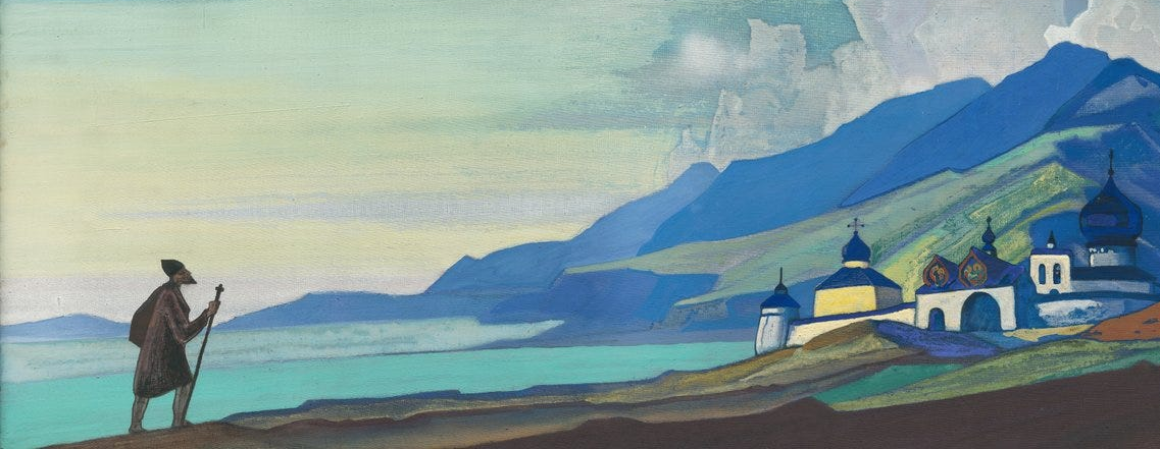

Chasing Rain

From Palomar we raced lighting;
Thunderhead pounding summer heat,
Electric thrust of pure chaos
Striping the blasted plateau.

With the wind we bolted,
Chasing the rain,
Urgent, irrational intentions;
Our heads out the windows,
Dashes swerving beneath us,
Birds absent from charged ether,
Dark sheets in the distance.

Droplets gathered like old friends,
Dust-caked wipers turning wet;
Dry indelible desert
Melting away.

And the sage carpet,
Transmuted to blue-green
Beneath the hulking sky,
Blurred at the edges
Of our pursuit.

Wide-eyed, mouths open, we reveled.
Our desires quickening
Life into sharp relief,
Anticipation formed into
Pure emotion.

And then, at the edge
Of the long descent,
We stood at the viewpoint,
Above the arid valley,
Stretching our coats like sails,
The wind nearly uprooting us,
Rain on our faces like tears
Of ecstatic joy.

We longed for the rain,
Like wild men look for God,
Like there was nothing else.

-June 1998/May 2007

der letzte kameramann

I recently “discovered,” to both my delight and chagrin, Karl Freund. Who was Karl Freund? Just one of the most influential cinematographers, ever. And I, hack cinephile, had never heard of him. So probably what I am so excited about is old news for most. Anyway…

My search began when I decided to start writing about some of my favorite cinematographers. For some reason (or whim) I wanted to find out who shot Der Letzte Mann (1924), American title: The Last Laugh – a great, great film by F. W. Murnau and a stunning example of German Expressionism. I love that film, but I did not know who shot the thing. So I went looking, and that’s how I found K. Freund.


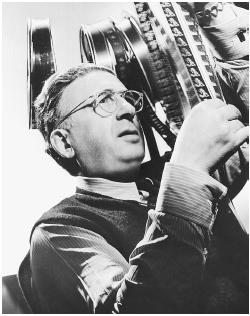
Publicity shot of Karl Freund (date?)

Somehow I feel as though I have stumbled upon a lost or forgotten treasure. And yet, I have come to realize my discovery is really no discovery at all, rather my stumbling is the product of not having paid attention.

Karl Freund (b.1890, d.1969) was one of the most significant and talented cinematographers of all time. His influence probably cannot be measured because it would be impossible to calculate such a force. And yet, I’m sure he does not get the kind of recognition heaped upon more modern cinematographers. Merely taking a look at the list of films he shot conveys a remarkable career.

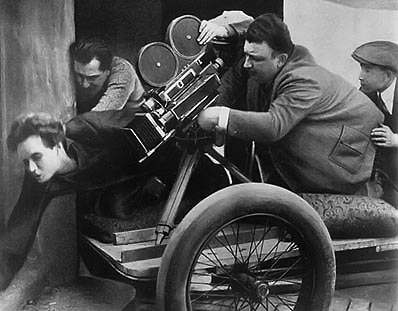
Freund and crew in action (Metropolis?!)

For starters, he began his career as a cinematographer in Yugoslavia in 1912 on the film Jadna majka. He was twenty-two years old at the time. That is the same year that the pioneering cinematographer G. W. Bitzer shot The Musketeers of Pig Alley (aside: Bitzer shot a remarkable 68 films in 1912. Whew!).

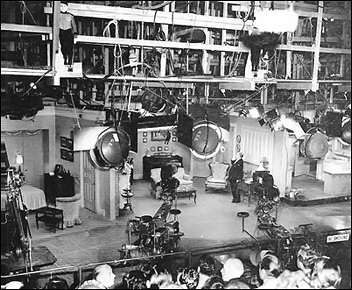
Freund finished out his career developing the three-camera method for live television on the pioneering television show I Love Lucy (for thirteen episodes from 1951 to 1956).

Freund on the set of I Love Lucy checking light
levels before an evening’s shoot.
In between working the earlier days of silent film in Yugoslavia to working during the golden age of television in Hollywood, Freund created an illustrious career. Consider just this sample of films for which he is credited with having shot: The Golem (1920), Chained (1924), The Last Laugh (1924), Metropolis (1927), All Quiet on the Western Front (1930), Dracula (1931), Murders in the Rue Morgue (1932), The Good Earth (1937) for which he won an academy award, and Key Largo (1948). There are many more (133 total) excellent, and average, films he shot not listed here. He also directed several films, including The Mummy (1932).

Something I found interesting is that on Freund’s last film he helmed, Mad Love (1935) he worked with a thirty-one year old cinematographer by the name of Gregg Toland. As we all know, Toland became most famous for his collaboration with Orson Welles on Citizen Kane (1941). But what I also found interesting is that, prior to Kane, Toland had already been nominated for an academy award in cinematography in 1938 for Dead End (1937). And he lost that year to Freund! I think it may be fair to say that Kane‘s stylistic and thematic influences, so obviously rooted in German Expressionism, can be traced back, in part, to Freund’s influence on Toland, both through collaboration and through friendly competition.

We should never forget how brilliant many filmmakers were even though they worked within studio systems and not as so-called “free” artists. Freund made his career with studios such as UFA, Universal Pictures, MGM, Warner Brothers Pictures, and CBS Television. And yet, he seemed to find his own way and produce great work.
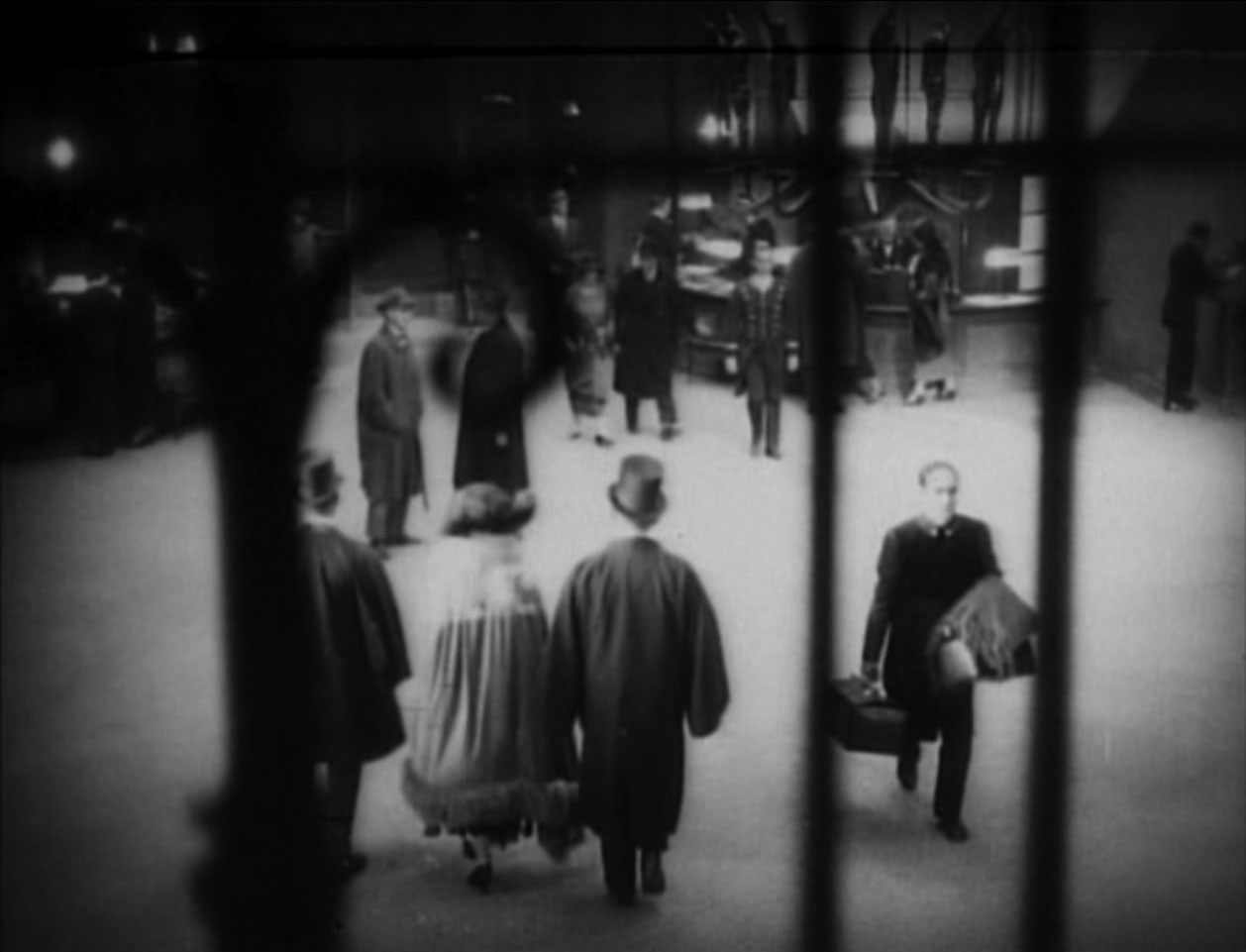
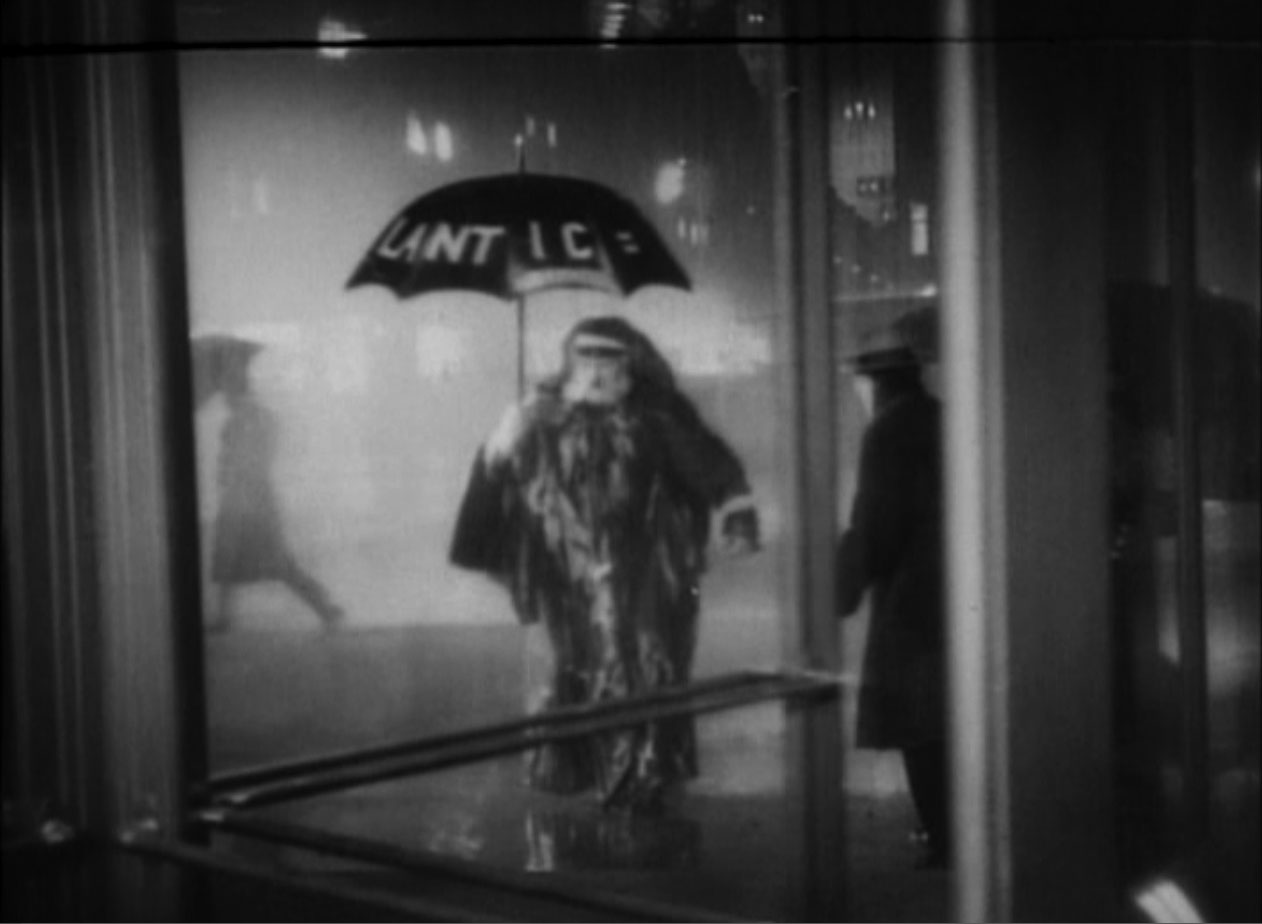
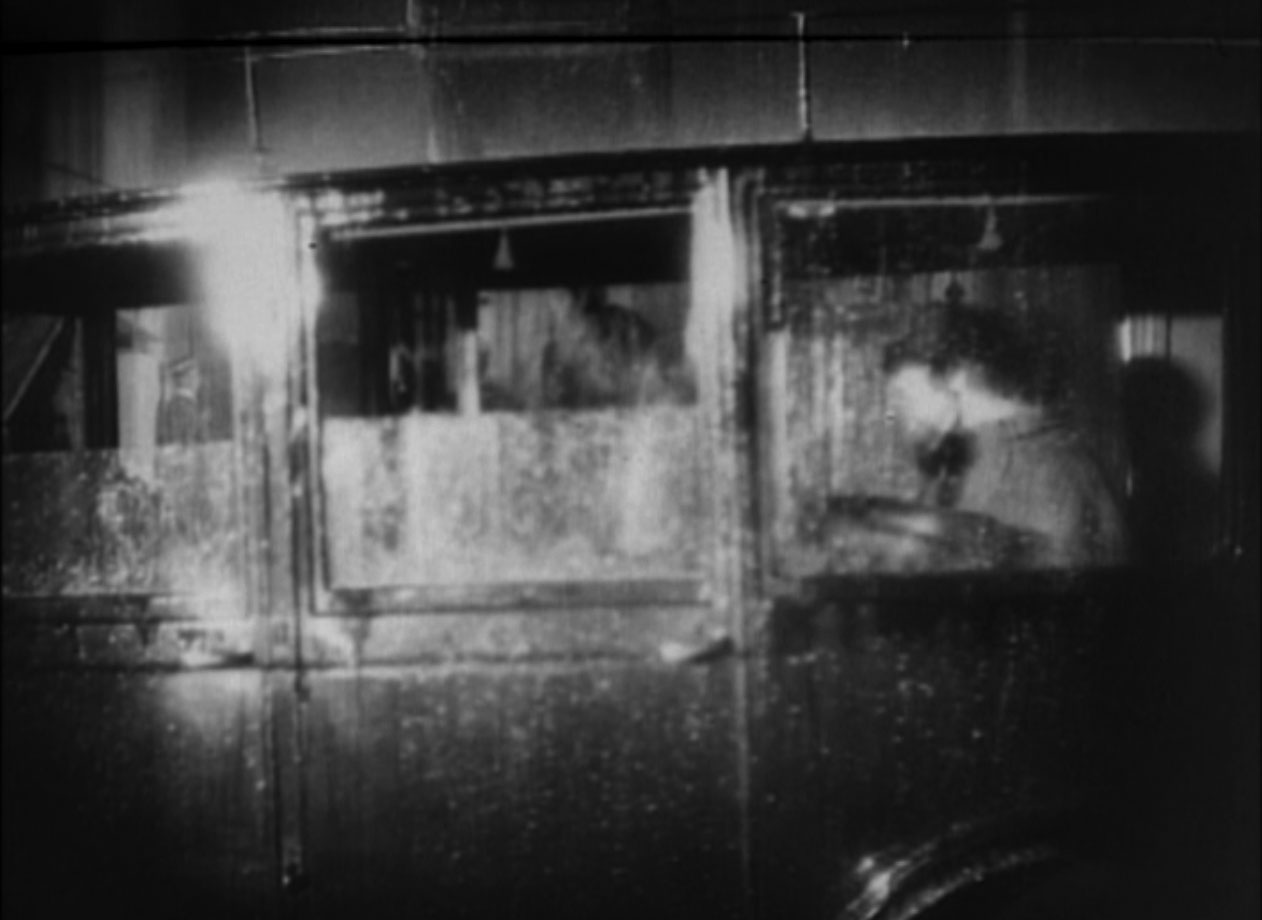
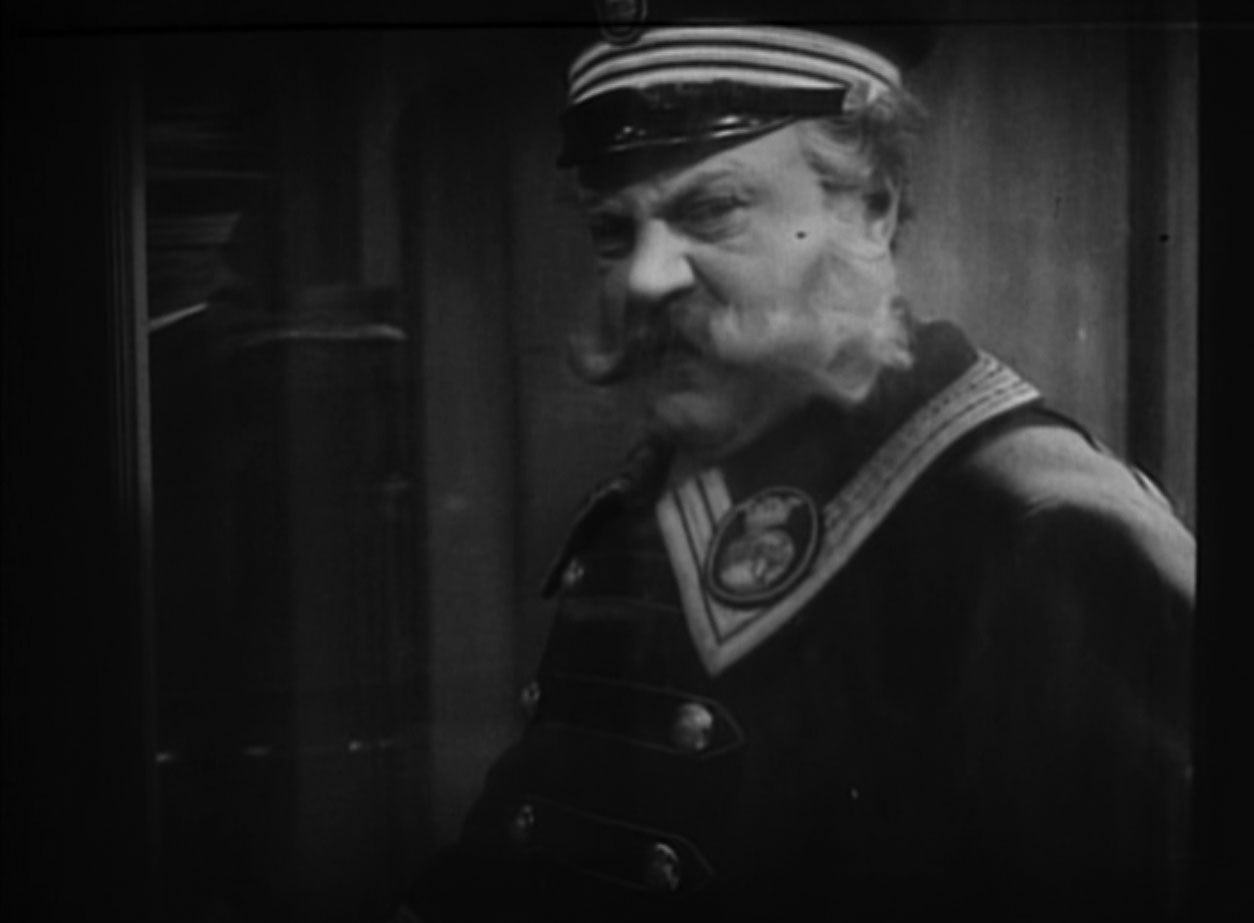
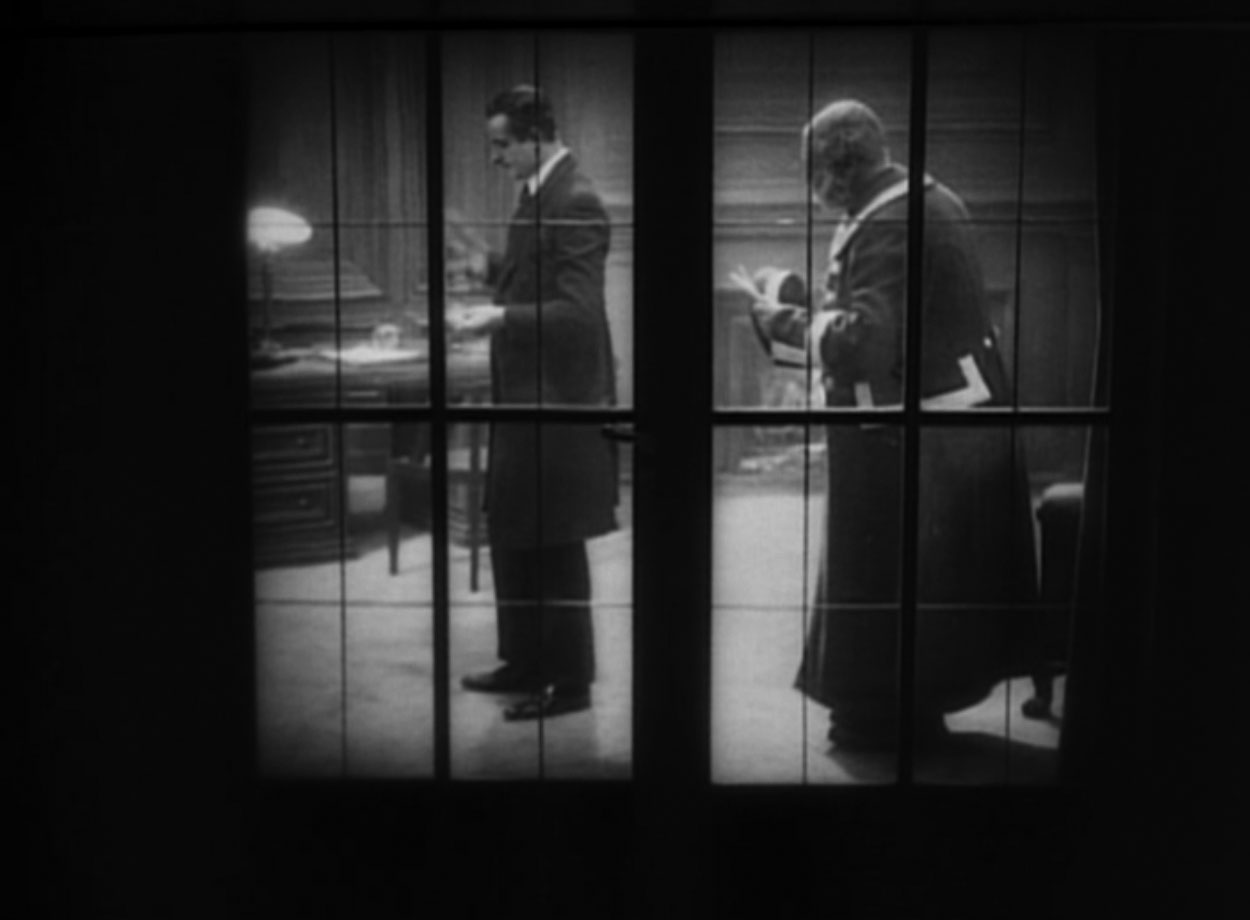
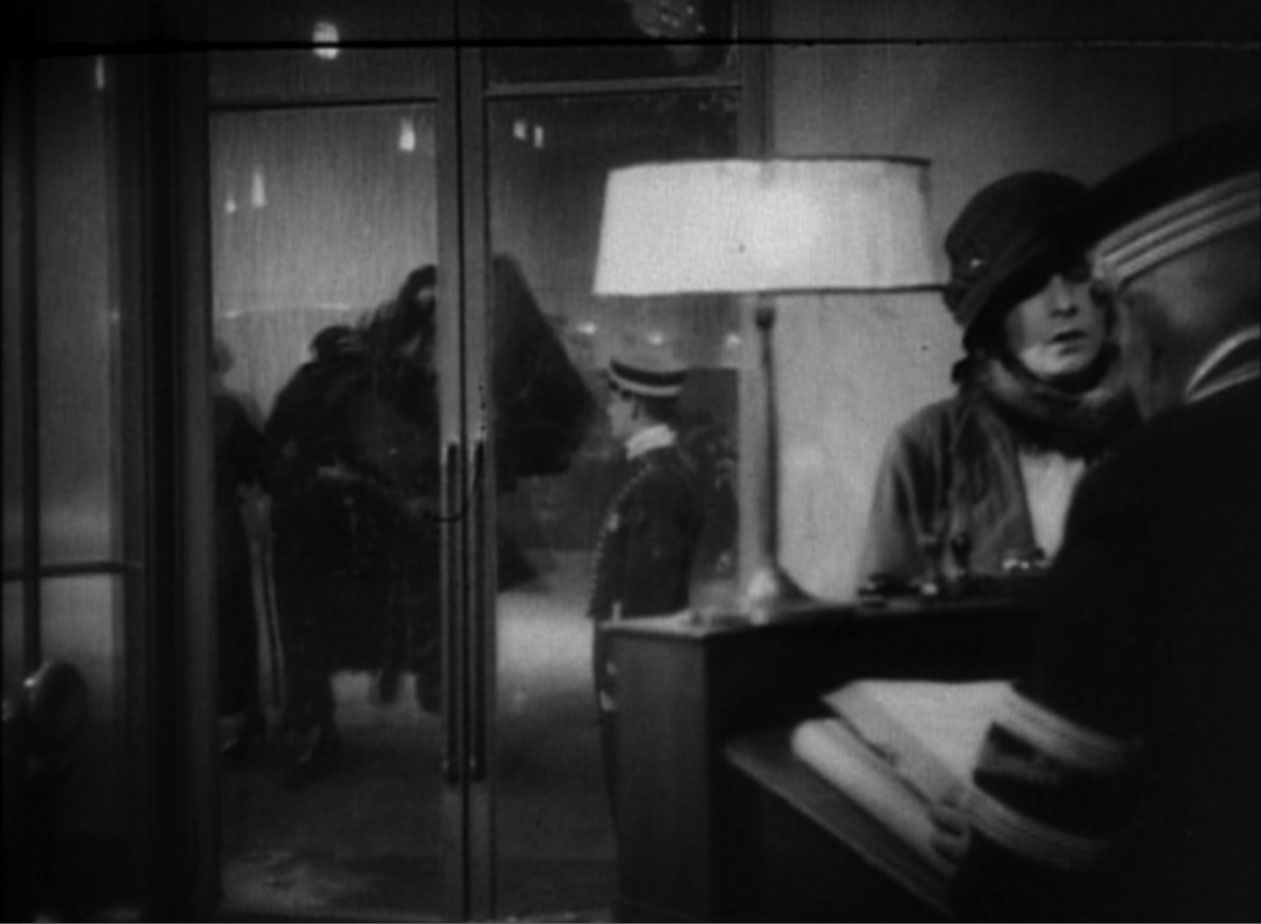
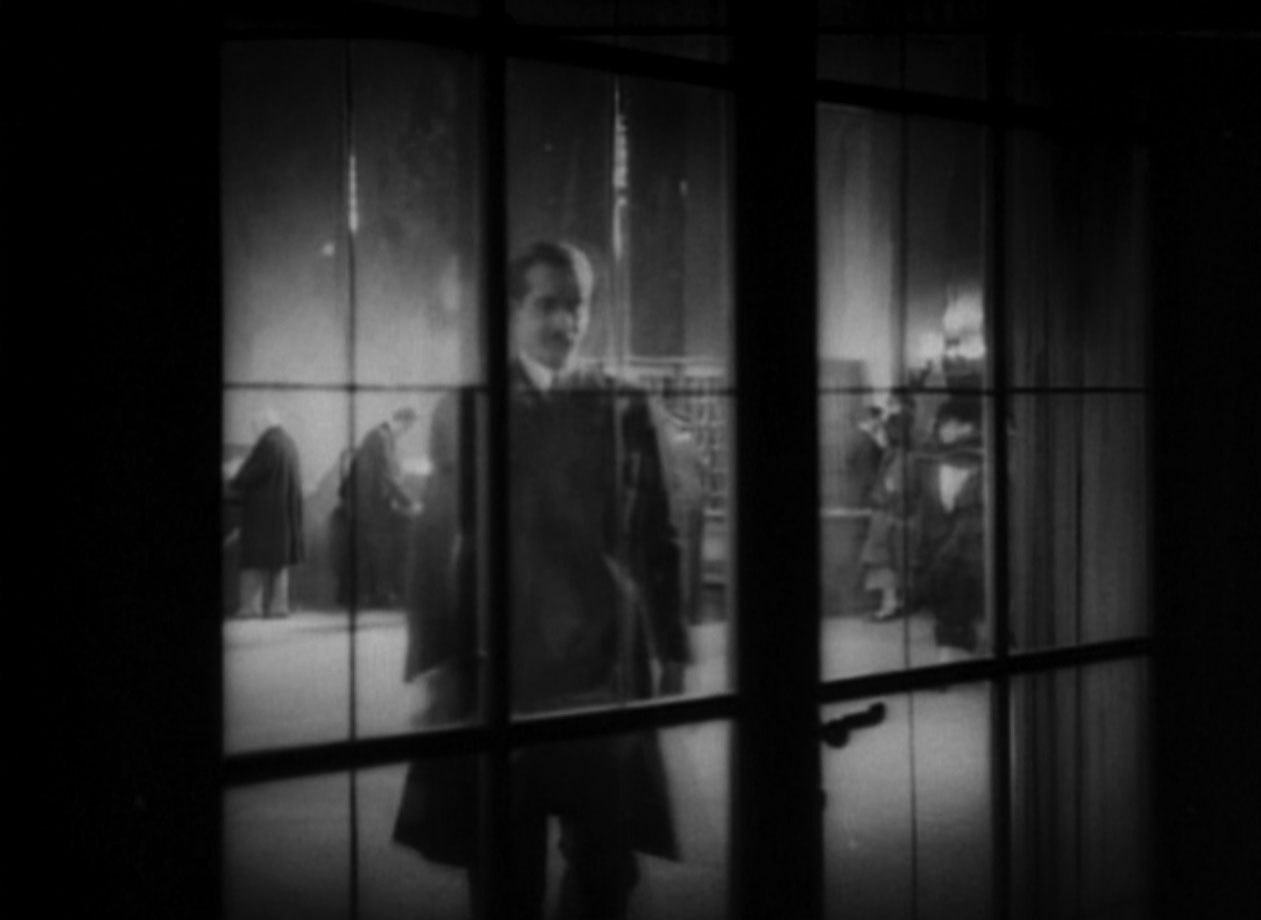
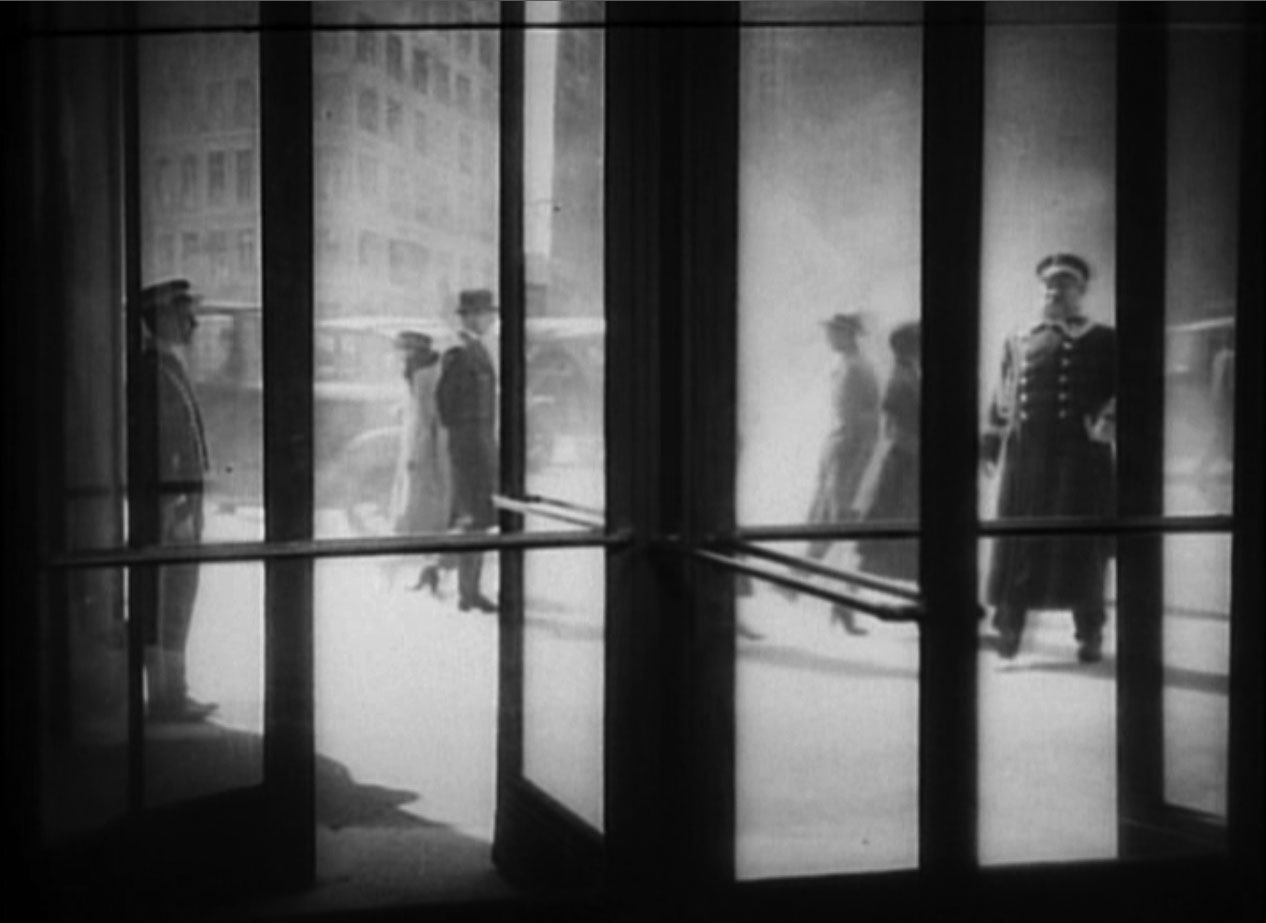
In Der Letzte Mann (or The Last Laugh) Karl Freund produced many beautiful and stunning images, including wonderful camera movements and complicated tracking shots. One thing I noticed was how much of the film is photographed looking through things: glass, rain, smoke, railings, etc. The following are twelve quick screen grabs showing this “looking through” aesthetic.

The film opens with the camera riding down in an elevator to the lobby of the Hotel Atlantic.

A number of shots feature the great revolving glass door of the hotel entrance.

Here we see both through the rain glistened windows of the automobile and through the open window to the other side.

A shot in depth with our hero struggling with a heavy steamer trunk outside the hotel doors.

The hotel manager walking back to his office.

The revolving doors again, during the day time.

Our hero walking through the revolving doors. Notice the subtle reflections on the glass.

Our hero being given his walking papers by the hotel manager.
Our hero sneaking in to the hotel at night.
Shadow images of people through frosted glass.
Our hero sneaking out of the hotel.
The hotel dining room with diners in the distance behind frosted glass.
One of my majors in college was Art History. During that time I studied the grand sweep of artistic production from pre-historical cave paintings to post-modern art. On a time-line, cinema is almost just a blip, a little over a hundred years old. What I find so interesting is that with an artform of such limited history, there is still so much to discover and re-discover. For me, the personal discovery of Karl Freund is a real treat.

100 Spiritual Films

When I was a boy I went to a summer camp that was run by the Baptist church of which my family was a part. At that camp I saw the famous/infamous Christian exploitation (christploitation?) film A Thief in the Night (1972). I say exploitation film for two reasons: (1) the film has that kind of low-budget, relentless, somewhat campy style one finds in other exploitation films, and (2) the film clearly falls into the category of the “scare them to Jesus” works of “art.” Certainly I was a scared little boy. For years I was haunted by that film. Fortunately I have grown up and only carry the scars.

When I was in college I lived in a couple of different co-op living places (20-25 students, loosely managed, trying to get along, etc.). I remember some of the the best times were watching great films and then having long discussions after. What I discovered during that time was the spiritual nature and power of films. A power, and I should say truth, significantly deeper and more profound than with films such as A Thief in the Night. In particular, I remember some great discussions around Grand Canyon (1991), Mindwalk (1990), Henry V (1989), The Last Temptation of Christ (1988), and Drugstore Cowboy (1989).

Recently I came across the Art & Faith forum site and noticed the biggest category of discussion centers around film. They even have a Top 100 Spiritual Films list, which I have reproduced below. The link for each film will take you to the Art & Faith write-up of that film. As one would expect from a Christianity-based site called Art & Faith, there are some particularly “christian” films, like the obvious films about Jesus and saints (some of which are excellent – Pasolini’s version of the Gospel story, for example). But there are also some films one might not expect, like those by Kieslowski, or by Rossellini, or films from Japan, etc. For me, I don’t see any contradictions, but for some Christians this list might be a bit of a shock. That is one reason I list the Top 100 Spiritual Films list here:

1 Ordet (aka The Word)
2 Le Fils (aka The Son)
3 The Miracle Maker (aka The Miracle Maker: The Story of Jesus)
4 The Gospel According to Matthew (aka Il Vangelo Secondo Matteo)
5 The Diary of a Country Priest (aka Le Journal D’un Curé De Campagne)
6 The Passion of Joan of Arc (aka La Passion De Jeanne D’arc)
7 The Decalogue (aka Dekalog)
8 Babette’s Feast (aka Babettes Gæstebud)
9 A Man Escaped (aka Un condamné à mort s’est échappé ou Le vent souffle où il veut)
10 Andrei Rublev (aka Andrey Rublyov)
11 Balthazar (aka Au Hasard Balthazar)
12 The Seventh Seal (aka Det Sjunde Inseglet)
13 Ikiru (aka To Live)
14 Winter Light (aka Nattvardsgästerna)
15 The Mission
16 The Apostle
17 Three Colors Trilogy
18 Jesus of Nazareth
19 Jesus of Montreal (aka Jésus De Montréal)
20 The Flowers of St. Francis (aka Francesco, giullare di Dio)
21 Dead Man Walking
22 Stalker
23 Magnolia
24 La Promesse
25 Sunrise: A Song of Two Humans
26 Tender Mercies
27 A Man for All Seasons
28 Wings of Desire (aka Der Himmel über Berlin)
29 Day of Wrath (aka Vredens dag)
30 Yi Yi: A One and a Two (aka Yi yi)
31 The Hiding Place
32 Wild Strawberries (aka Smultronstället)
33 Rosetta
34 After Life (aka Wandafuru raifu)
35 The Sacrifice (aka Offret – Sacrificatio)
36 To End All Wars
37 Chariots of Fire
38 Shadowlands
39 The Big Kahuna
40 Not of This World (aka Fuori dal mondo)
41 Schindler’s List
42 Millions
43 The Straight Story
44 A Taste of Cherry (aka Ta’m e guilass)
45 The Passion Of The Christ
46 Becket
47 Wit
48 Open City (aka Roma, città aperta)
49 Nazarin (aka Nazarín)
50 Secrets & Lies
51 Romero
52 Places in the Heart
53 It’s A Wonderful Life
54 Ponette
55 Les Misérables
56 Luther
57 Tokyo Story (aka Tokyo Monogatari)
58 Hell House
59 Breaking The Waves
60 Crimes And Misdemeanors
61 To Kill a Mockingbird
62 The Mirror (aka Zerkalo)
63 The Last Temptation Of Christ
64 The Gospel of John
65 Hotel Rwanda
66 Fearless
67 Solaris (aka Solyaris)
68 The Night Of The Hunter
69 Cries and Whispers (aka Viskningar och rop)
70 Stromboli
71 Stevie
72 Dogville
73 My Night at Maud’s (aka Ma nuit chez Maud)
74 Black Robe
75 Close-Up (aka Nema-ye Nazdik)
76 The Apu Trilogy
77 Werckmeister Harmonies (aka Werckmeister harmóniák)
78 Waking Life
79 Koyaanisqatsi (aka Koyaanisqatsi – Life Out of Balance)
80 Peter and Paul
81 13 Conversations About One Thing
82 The Sweet Hereafter
83 Dersu Uzala
84 Trial of Joan of Arc (aka Procès de Jeanne d’Arc)
85 Summer (aka Le Rayon vert)
86 Fiddler on the Roof
87 The Bicycle Thief (aka Ladri di biciclette)
88 The Year Of Living Dangerously
89 Money (aka L’Argent)
90 The Elephant Man
91 Faust
92 Molokai: The Story of Father Damien
93 A Moment of Innocence (aka Nun va Goldoon)
94 Jean de Florette / Manon of the Spring (aka Jean de Florette / Manon des Sources)
95 Sansho the Bailiff (aka Sanshô dayû)
96 Lilies of the Field
97 The Wind Will Carry Us (aka Bad ma ra khahad bord)
98 The Addiction
99 The Song of Bernadette
100 Tales of Ugetsu (aka Ugetsu monogatari)

I have not seen all the films of this list, in fact there are a lot I have not seen. But I will say that the ones I have seen are all great for those late-night discussions around the core issues of living and being human. And some of the films offer great opportunities to discuss the power of art and film – as a kind of bonus. In general, I think this is a great list.