Goodnight September Eleventh

“In a Parish” by Czesław Miłosz, trans. from the Polish by Miłosz and Robert Hass. Read by Haas on Fresh Air on NPR remembering 9/11.


Were I not frail and half broken inside I wouldn’t be thinking of them who are like me half broken inside. I would not climb the cemetery hill by the church to get rid of my self pity. Crazy Sophies, Michaels who lost every battle, self-destructive Agathas lie under crosses with their dates of birth and death. And who is going to express them. Their mumblings, weepings, hopes, tears of humiliation in hospital muck and the smell of urine with their weak and contorted limbs and eternity close by, improper indecent like a dollhouse crushed by wheels, like an elephant trampling a beetle, an ocean drowning an island. Our stupidity and childishness do nothing to fit us for this variety of last things. They had no time to grasp anything of their individual lives. Any principiam individuaisonous(ph) nor do I grasp, yet what can I do enclosed all my life in a nutshell trying in vain to become something completely different from what I was. Thus we go down into the earth, my fellow parishioners, with the hope that the trumpet of judgment will call us by our names instead of eternity, greenness and the movement of clouds they rise then thousands of Sophies, Michaels, Matthews, Marias, Agathas, Bartholomews so at last they know why and for what reason.


>Noam Chomsky: The Stony Brook Interviews Part Two

>

>Noam Chomsky: The Stony Brook Interviews Part One

>

>Lord, Save Us From Your Followers

>

This is a plug for a little documentary/polemic that I found myself truly enjoying. I meant to post this months ago, but it got lost in the shuffle somehow.

Recently I watched a documentary three times in rather short succession; first by myself, then with my wife, then again with my daughter. (And then I loaned it out to someone, but I can’t remember who.) Each time it has challenged me, at moments moved me to tears, brought about conviction, made me laugh, and truly encouraged me. The film is Lord, Save Us from Your Followers by Dan Merchant (Writer/Director/Producer) and Jeff Martin (Executive Producer).

A large part of the film is an overview of how Christians are viewed in popular culture. This overview includes interviews and television clips of many people, including Bill Maher, John Stewart, Bill O’Reilly, and many others. Many of these clips are priceless and spot on. Dan Merchant also walked the streets in his bumper-sticker suit interviewing people.

Although the suit is a bit of a stunt, it did help people open up their thoughts.

Many ordinary people said, in short, that they like and admire Jesus, but they don’t like Christians very much. Funny thing, I am a Christian and I generally feel the same way. Tony Campolo had some of the best moments in the film. He is a devoted Christian who wonderfully discussed this contradiction we call Christianity. He states how all too often the “church” is an exemplar of hypocrisy while still being the “vessel” that has carried the gospel and preserved the Bible.

But what got me the most are the four end segments that focus on the ways some Christians have set aside all the garbage of the “Christian right” and looked instead to Jesus as their example.

Helping rebuild after hurricane Katrina:

Seeking forgiveness for the way Christians
have treated (and still treat) gays and lesbians:

Bringing help to starving communities, and
especially children, in Africa by bringing food,
medicine, and planting crops:

Comforting and helping the homeless:

Each of these segments brought tears to my eyes and deeply convicted me for my selfishness and self-absorption. They also challenged me to consider the kind of community, Christian or otherwise, I want to live in and how I might help make it happen.

I will recommend this film for anyone, but in particular for Christians. My suggestion is to watch it with a group and then discuss its implications afterwards. I don’t typically plug films on my blog, but I have to say this little, low budget film is worth seeing.

>christian imperfect subjunctive

>I grew up going to church. I still attend a church, but it is not the same kind I grew up with. I see a lot of that happening with Christians; growing up in one kind of church and/or denomination and switching to another as adults.
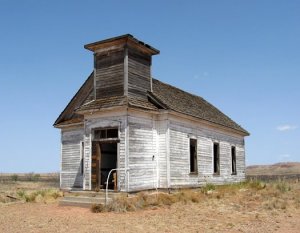
I’m sure there are as many reasons as there are individuals who make the switch. And there are are some big trends that have been well documented, such as Protestants converting to the Roman Catholic or Eastern Orthodox churches, and vice versa. For me, I can only account for my own experience.

I grew up in a Baptist church, a church that my family, including grandparents, had been long time members. That church experience has had a long term and profound affect on my life, including my theological propensities. As a kid I was very interested in sorting out many theological and Christian questions. I wanted to know who God was, how I was supposed to live, what it meant to be a Christian in this world, what values should be at the top on my list, and so on. I am still sorting out those things. The fact that I am still “in process” as it were would not bode well in the church of my youth, though that church as it is today may have changed.

There were a number of beliefs and actions that Baptist church emphasized, including the importance of being a member of the church, the importance of being baptized, the importance of bringing one’s Bible to church, and the importance of attending church. Other things included the importance of one’s “walk” with God, one’s personal relationship with Jesus, consistently having a “quiet time,” developing a life of prayer, reading the Bible for oneself on a regular basis, and evangelizing others. Underlying all these things were fundamental beliefs in the presence of a personal God, the lordship of Jesus, the inerrancy of the Bible, and the need for salvation of each individual, and so on.

There was also the culture which contained, maintained, and pushed certain ideas that, if directly challenged, would have produced some backpedalling and heavy qualifications but, nonetheless, were corporately held. Such as the demonization of Catholicism, and the strong sense that we’re still fighting the Reformation, and maybe most of all, and almost entirely unrecognized, the blending of apologetics & hermeneutics with the Enlightenment project (the belief in the power of human rationality apart from God to establish reliable, universally recognized scientific and moral knowledge).

My perspectives have changed on those beliefs and actions. Some I still hold to firmly, others I do not. More importantly to my personal journey of faith, I would say the definitions have shifted. For an example, most Christians believe reading the Bible is important. It is common for Baptists to feel the weighty expectation of bringing one’s own Bible to church on Sunday. But what does this really mean? As part of the Protestant tradition the Bible, read by the individual in the vernacular on a regular basis, is of the highest importance. What I found, however, was the tendency of those church members (including myself) to read their Bible frequently, but to understand it to say those things they have already been taught. In other words, the apparent act of reading had everything to do with merely reaffirming held doctrine rather than letting the text say what it means. To let the text say what it says is hard enough without the pressure and example of a subculture encouraging one to read, essentially, closed-mindedly. This is one of the biggest and most serious problems in Christianity as far as I’m concerned. Later, toward the end of my college years, I began to understand what it really meant to read the Bible with a mindset that would allow for my held beliefs to be substantially challenged, and it blew my mind, not to say rearranged my life as well – and I’m still not that good at it.

The reasons for my change is a long and involved story, but in short I can say that I was a person with many questions, in the midst of a crisis of religion (but not of faith oddly enough), I valued rationality as well as process, and then I found myself almost accidentally in a community that was committed to the radical pursuit of truth. I say radical because I have come to believe commitment to truth no matter where it may lead is fundamentally discouraged in Christendom and its numerous permutations. I must emphasize the critical thinking nature of this community because my shift was not so much about interpersonal relationships. Where I was coming from was loaded with good people and good relationships. I was not running from failed relationships or because I did not like the people with whom I was fellowshiping. My need to get away had everything to do with getting my head on straight and re-examining my theological assumptions and my worldview.

This community where I ended was called McKenzie Study Center and it is still around in some fashion. It was not unlike the famous L’Abri Fellowship. What that place taught me, or I should say the staff taught me, was a different philosophy of ministry, and that made all the difference. Because of my own experience I tend to think of my philosophies of ministry in terms of the “old way” and the “new way”, but the “old way” is still the primary approach in most churches I am sure. The old way has several characteristics that I dislike. These include: 1) the belief that all theological questions have already been answered, 2) apparent theological conundrums are mysteries and therefore touchpoints of our faith, 3) the role of the preacher is to proclaim the truth with passion, emotion, and rhetorical skills such that the listener is “moved” closer to God and truth, 4) a church service is not a place for questions or dialog – the preacher preaches and you listen, 5) struggling to understand and digest church doctrine is a sign of immaturity in the faith, 6) church is about an experience – created and carefully controlled by professionals, 7) the arts have a place in Christian life and culture as long as they are “in service” to God (if you have acting skills you can perform skits in the youth group, or music skills you can lead worship, etc.), 8) pastors are not to be “in process” about either their faith or their understanding of the the Bible, 9) in fact, the goal is that each of us get beyond being “in process” as quickly as possible because being a mature Christian is to have no more doubts or questions, and 10) going to church, reading the Bible every day, and praying a lot with conviction is critical for the life of any Christian.

I have just said a mouthful, and I know many Christians would take issue with some of these points. But my experience, and the experience of many others, confirms these things to be true. If a pastor or ardent churchgoer tells you otherwise they are confused or lying. There are many other aspects of our Christian culture, both present and past, that are un-Biblical and abhorrent. The wonderful irony, and what gives me much hope for myself and others, is that many, many people who regularly attend church and are immersed in the Christian subculture are people dedicated to knowing God, loving others, and working out their faith everyday in fear and trembling. And the church I currently attend is far from perfect, though it suits many of my preferences better than my old church. It’s not really about church anyway, it’s what underlies the reasons we get together and what it is we are trying to encourage.

I also must conclude by saying that not only is my journey far from over, and my seeking far from completed, but that my present “clarity” about Christianity is just as much run through with my own sinfulness as it ever was. I have come to believe that just about the dumbest thing Christians could ever do is hold themselves up as a model of righteousness or even of right living. What I hope for Christianity is that it would move out of the swamp and into a place where 1) we know that theology is an ongoing process and many questions must still be answered, 2) that “believing anyway” even though something doesn’t make sense is not a touchstone of faith but an issue to resolve, 3) that pastors must be committed to truth more than their charisma, 4) that church should be a place where questions are welcome and pastors will even stop their sermon to recognize a raised hand, 5) that the struggling to understand doctrine may be both a sign of maturity as well as confusing doctrine, 6) that church is a place for all of us to contribute in creative and different ways, that authenticity is far more valuable than professionalism, and that worship is not singing songs in church, 7) that the arts need no justification, 8) that pastors must be “in process” both personally and theologically, and that process should be made known and not hidden, 9) that our goal is not to get beyond being “in process” but that our process is the working out of our faith, including our doctrines, and 10) that our lives as Christians are first and foremost the work of God in us, all the rest is just extra.

If I had an eleventh point it would be that there are no formulas, including the list above, to making Christianity, or one’s journey in faith, better. There is only life and faith and God and us.

Peace.

>The New Religious Landscape (with Tony Jones)

>Here are a couples on links regarding the changing landscape of Christianity in the U.S. The first is a video clip with Tony Jones speaking of the Emergent Church. The second is a recent link to Tony’s blog regarding some new statistics about religion in the U.S.

This video first aired in 2008.

http://video.google.com/googleplayer.swf?docid=-1959894145232313198&hl=en&fs=true

From Tony’s bog: The Rise of the “Nones”

>Πάσχα

>
“The tomb is empty.”

The eyewitness John wrote:

Now on the first day of the week Mary Magdalene came early to the tomb, while it was still dark, and saw the stone already taken away from the tomb. So she ran and came to Simon Peter and to the other disciple whom Jesus loved, and said to them, “They have taken away the Lord out of the tomb, and we do not know where they have laid Him.” So Peter and the other disciple went forth, and they were going to the tomb. The two were running together; and the other disciple ran ahead faster than Peter and came to the tomb first; and stooping and looking in, he saw the linen wrappings lying there; but he did not go in. And so Simon Peter also came, following him, and entered the tomb; and he saw the linen wrappings lying there, and the face-cloth which had been on His head, not lying with the linen wrappings, but rolled up in a place by itself. So the other disciple who had first come to the tomb then also entered, and he saw and believed. For as yet they did not understand the Scripture, that He must rise again from the dead. So the disciples went away again to their own homes.

But Mary was standing outside the tomb weeping; and so, as she wept, she stooped and looked into the tomb; and she saw two angels in white sitting, one at the head and one at the feet, where the body of Jesus had been lying. And they said to her, “Woman, why are you weeping?” She said to them, “Because they have taken away my Lord, and I do not know where they have laid Him.” When she had said this, she turned around and saw Jesus standing there, and did not know that it was Jesus. Jesus said to her, “Woman, why are you weeping? Whom are you seeking?” Supposing Him to be the gardener, she said to Him, “Sir, if you have carried Him away, tell me where you have laid Him, and I will take Him away.” Jesus said to her, “Mary!” She turned and said to Him in Hebrew, “Rabboni!” (which means, Teacher). Jesus said to her, “Stop clinging to Me, for I have not yet ascended to the Father; but go to My brethren and say to them, ‘I ascend to My Father and your Father, and My God and your God.’” Mary Magdalene came, announcing to the disciples, “I have seen the Lord,” and that He had said these things to her.

Paul wrote to the church in Corinth:

Now if Christ is preached, that He has been raised from the dead, how do some among you say that there is no resurrection of the dead? But if there is no resurrection of the dead, not even Christ has been raised; and if Christ has not been raised, then our preaching is vain, your faith also is vain. Moreover we are even found to be false witnesses of God, because we testified against God that He raised Christ, whom He did not raise, if in fact the dead are not raised. For if the dead are not raised, not even Christ has been raised; and if Christ has not been raised, your faith is worthless; you are still in your sins. Then those also who have fallen asleep in Christ have perished. If we have hoped in Christ in this life only, we are of all men most to be pitied. But now Christ has been raised from the dead, the first fruits of those who are asleep. For since by a man came death, by a man also came the resurrection of the dead. For as in Adam all die, so also in Christ all will be made alive.

Christ is risen! Happy Easter. May God bless you this day.

(Top image from a 2007 performance of the Turramurra Passion in Australia – no, I have not been. The texts are from the Gospel of John, chapter 20:1-18, and 1st Corinthians, chapter 15:12-22, New American Standard version.)

Good Friday

Today is a day of sober remembering. It is also a day of greatest thanks.

Pilate saith unto them, What then shall I do unto Jesus who is called Christ? They all say, Let him be crucified. And he said, Why, what evil hath he done? But they cried out exceedingly, saying, Let him be crucified. So when Pilate saw that he prevailed nothing, but rather that a tumult was arising, he took water, and washed his hands before the multitude, saying, I am innocent of the blood of this righteous man; see ye to it. And all the people answered and said, His blood be on us, and on our children.


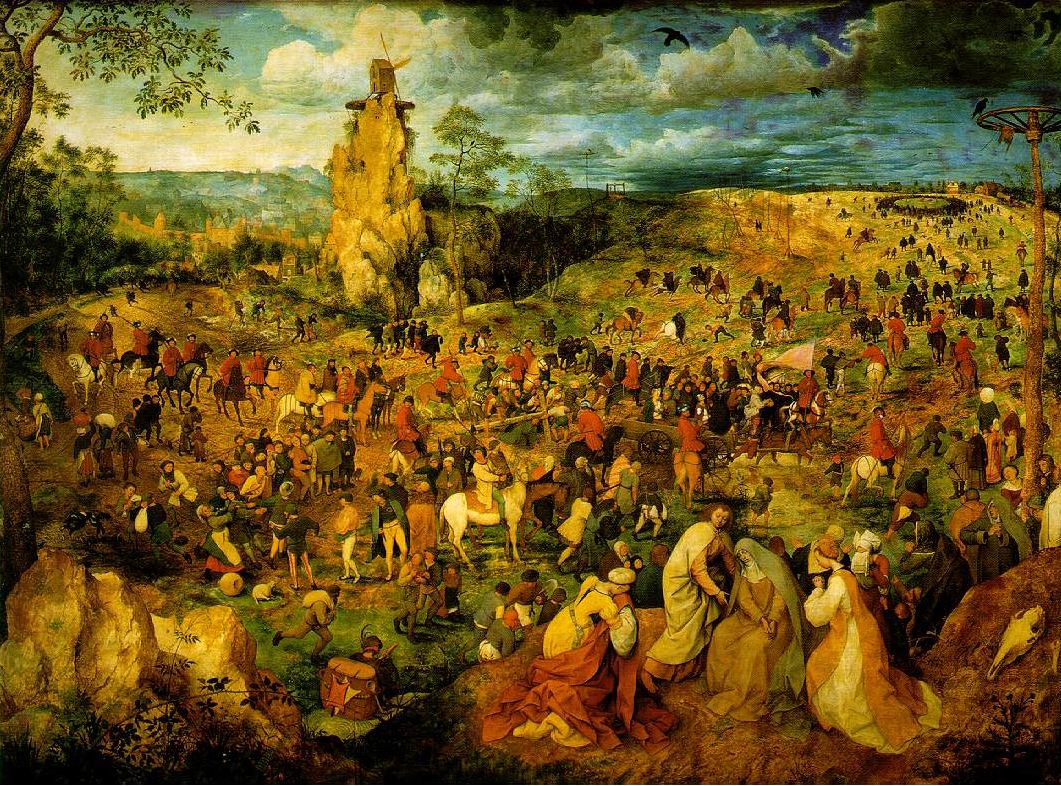
The Procession to Calvary
Pieter Bruegel the Elder, 1564

Then the soldiers of the governor took Jesus into the Praetorium, and gathered unto him the whole band. And they stripped him, and put on him a scarlet robe. And they platted a crown of thorns and put it upon his head, and a reed in his right hand; and they kneeled down before him, and mocked him, saying, Hail, King of the Jews! And they spat upon him, and took the reed and smote him on the head. And when they had mocked him, they took off from him the robe, and put on him his garments, and led him away to crucify him.

Later…

And Jesus cried again with a loud voice, and yielded up his spirit. And behold, the veil of the temple was rent in two from the top to the bottom; and the earth did quake; and the rocks were rent; and the tombs were opened; and many bodies of the saints that had fallen asleep were raised; and coming forth out of the tombs after his resurrection they entered into the holy city and appeared unto many. Now the centurion, and they that were with him watching Jesus, when they saw the earthquake, and the things that were done, feared exceedingly, saying, Truly this was the Son of God.

May God bless you today. Have a good Good Friday.

(Bible passages from the Gospel of Matthew, chapter 27, American Standard Version.)

>Terry Eagleton – brilliant!

>If you have spent any time in post-baccalaureate English/cultural/media-studies environs then you know of the brilliant Terry Eagleton – that noted literary critic and author of the beloved grad-school crutch, Literary Theory: An Introduction (1983). Recently Mr. Eagleton gave four lectures at Yale University. For most Americans these lectures will both fascinating and seemingly impenetrable. We are not so used to the higher levels of British academia. But they are worth taking the time, and ultimately thoroughly enjoyable – not least of which because Eagleton has a wry sense of humor.

These lectures are probably most famous for the term “Ditchkins.”

“…someone like Richard Dawkins or Christopher Hitchens, a couplet I will henceforth reduce to the solitary signifier Ditchkins…”

Of course there is much more than that in the lectures. Below are video versions, but they are also available through iTunes.

just another word of encouragement

A few days ago I had some fun posting and commenting on various “alternative” images of Jesus that have become increasingly popular on the Internet. I titled that post another jesus. If you follow this blog at all you know I occasionally write on religious topics, mainly because I am a Christian trying to sort out the differences of my cultural Christianity from my faith. This is part of my overall journey in search of Truth, wisdom, and an authentic Christianity. So with that in mind, I had a recently amusing and disconcerting experience the other day which has prompted me to change my comments policies for now (they’re now moderated).

On that “another jesus” post I got the following comments (I made some slight changes to make it less offensive. I apologize if any here are offended.):

Hello i dont know who ur but i warn u if u display such kind of pictures and if u display jesus in very wrng ting…if u do this i will kick ur a** through visiting ur place ur mother f**ker….jesus is real son of a god he cures us and he helps every moments and loves us all the times…..f**k i kill u …ur a** f**ker….contact me if u have guts rohith_fancy25585@yahoo.com

Apart from the fact that this is actually a death threat if taken seriously, there are a lot of things one could say about these comments. At first I thought it might be a joke. In my experience such comments are so the opposite of what a Christ follower would say or do that I just new they couldn’t be serious. But then I realized, no, this commenter thinks he/she is defending Jesus. I could be wrong – maybe someone knows different.

Regardless, this commenter’s thoughts/assumptions/insults have given me some pause. Here are some attempts at understanding this helpful soul:

  • The commenter means to be giving me a word of encouragement, but the only English he knows was learned from watching Quentin Tarantino films. I realize Rohith is an Indian name. It could just be a “cultural divide” kind of thing. I need to be more sensitive to these things.
  • Maybe I should have known that “jesus is real son of a god he cures us and he helps every moments and loves us all the times” means we personally don’t have to worry about curing, helping, or loving – since he does that for us. That must be why he can immediately follow that sentence with “f**k i kill u.” It’s because of the freedom he has in Christ.
  • But then, he does say “son of a god” – a god. Which god does he mean? How many gods are we talking about here? I will try to keep an open mind.
  • If I don’t email him back do I not “have guts”? Is that what it takes these day to be evangelized? To “have guts”? I’m assuming here that what he really means by wanting me to contact him is so he can let me know God loves me and has a wonderful plan for my life.
  • It could be that he really is not a Christian (surprise) but is, in fact, a new-age dialecticist who is hoping to create some new religious synthesis through confrontation and this is just his way of inviting me to his new religion. So this could be a very sophisticated Hegelian tactic, just cleverly disguised as something opposite.
  • Grammatical clarification: Can “ur” mean both “you are” and “your” in the same comment? Is that legal? It certainly makes it difficult to understand what exactly he means by “ur a** f**ker.” Of course, if I had guts I would just ask him.

Maybe you have some additional thoughts. Maybe you “have guts” to contact Mr. Fancy25585 and carry on a meaningful dialog. Let me know how it goes. As for my part, I’m already on to other things.