Grieving the Loss of the Spirit of Vatican II (or not)

In 2020 I posted this essay on another blog but I think it is still relevant and a very live issue today. I repost it here with a number of changes.
Not long ago I had the opportunity to read an email that had been sent by a parishioner to his priest and also to members of that parish’s pastoral council, of which I was a member. I’ve removed the parishioner’s name, the name of the priest, and the name of the parish for reasons of confidentiality. I believe there is something important in this letter and I feel the need to pass it on. In particular, I believe the sentiments expressed are common to many Catholics, and not merely older Catholics, the so called “boomer” Catholics, who lived through and promoted the changes after Vatican II. Here is the letter:

Dear Fr. [REDACTED],

I have made the decision to leave [REDACTED] Parish. Please accept my resignation from the Pastoral Council, the Lectors, and Sunday Hospitality. Additionally, please stop my Sunday envelopes.

I am sixty-six years old. I was an altar boy during the sixties. I remember the pre-Vatican2 church. It has been over fifty years that the institutional Church , as we know it, has functioned in the light of the Second Vatican Council. Yet, since coming to [REDACTED] and belonging to [REDACTED], I am slowly watching the institutional Church in our Parish retreating backward as demonstrated in the frequent Latin Masses, the men’s Schola, the effort to re-locate the tabernacle back to the center of the sanctuary (at an exorbitant cost, I might add), and … now you speak of reinstalling the communion rail. I don’t see myself participating in any of it. I happen to appreciate the Church for what it is. I considered doing research to dissuade you from the path you are on but then I realized the voices you are listening to are louder than mine. In my opinion what you are doing is not in the spirit of Vatican 2 and that grieves me.

Thank you for the rich homilies; they offer the Parish more that you may think.

Respectfully,
[REDACTED]

Before I comment I should say that the church did eventually move the old and beautiful marble altar and tabernacle, which had been moved out of the sanctuary in the early 1970s, back to the center of the sanctuary for a very reasonable cost and, by the way, at the request of the bishop. (But what is cost when compared to reverence for our Lord? We could ask the woman with the alabaster box.) Altar rails, which had been removed in the early 1970s, were also eventually reinstalled. The men’s Schola ceased during Covid and has not restarted. Regardless, it was a wonderful opportunity for men of the church to gather, fellowship, and sing old hymns and chant at the 7:30 AM Sunday Mass. (Why this is an issue I don’t know, except that they did sing old songs and prayers.) I know I was deeply blessed to be in the Schola. And there was never “frequent Latin Masses” at this parish. At most there was, perhaps, a couple of Novus Ordo masses done in Latin, and never on Sunday mornings, and never an actual TLM.

There are many Catholics, especially those older Catholics who lived through the changes of the post-Vatican II era, and who are still active Catholics (of course, a staggering number left the Church since the council), who look back fondly on that era and still believe to this day that those radical changes were the best thing to ever happen to the Church. As they see it, the spirit of Vatican II is wonderful, and they love that the barriers came down, the stuffy altar was replaced by the communion table, the priest finally turned to face the people who could now see what he was doing, and they even love its music, fondly humming its (objectively) poor and insufferable tunes. Many of these Catholics are looked down on and summarily dismissed as “boomers” (a term used pejoratively) by so many today including members of the so-called traditionalist movement. And many traditionalists are waiting for that generation to die off so the Church can finally return to its roots and become more traditional again. Personally, I don’t like this attitude. I think many older parishioners, like this man above, probably sharply feel that dismissive sentiment aimed squarely at them and that their voices are ignored.

The documentary “Rebel Hearts,” directed by Pedro Kos, tells the story of the Sisters of the Immaculate Heart of Mary, an order that thrived in the nineteen-sixties.It is a fascinating documentary and provides great insight to the Spirit of Vatican II in action. Source: https://www.newyorker.com/news/daily-comment/is-the-vatican-finally-ready-to-get-serious-about-women-in-the-church

I believe this parishioner’s frank frustration, blunt verbiage, and his sudden resignation is exactly the kind of reaction that many Novus Ordo but tradition-leaning priests fear. There are very few parishes in the world today that are not fundamentally “spirit of Vatican II churches,” that is, they have been built on the modernist traditions of the past 50 years (and arguably the past 200 years). It is what they know, it is their life as it were. This means that any priest who discovers the rich traditions of the Church and comes to see the need to reintroduce those traditions into their parish, and then tries to bring changes to his parish in light of those traditions, is likely to have at least some, and perhaps many, parishioners reacting as our letter-writer did. Or perhaps the frustrated parishioners don’t leave the parish; perhaps they even don’t let the priest know how they feel. They may instead just work to undermine his efforts in any number of ways and eventually get him ousted. I imagine this letter cut to the heart of the priest and was grieved over. I do not know the outcome of what happened next. I hope reconciliation can happen. I doubt it will. But I do appreciate letter-writer’s forthrightness.

I believe the Traditional Latin Mass is fundamentally and in nearly every way far superior than the Novus Ordo. I am even inclined to believe the Church has substantially and spiritually suffered because of the Novus Ordo. However, I am not a RadTrad as some traditionalists call themselves positively and others call them pejoratively. In fact, I go to both the TLM and the Novus Ordo for various reasons (mostly availability) and I have been blessed by both. [Note: lately I’ve been attending a Byzantine Catholic church and loving the Divine Liturgy, which is even older than the TLM.]

I have never been someone who loves tradition either merely for aesthetic or nostalgic reasons. I’m not into tradition in the way some men love 1957 Chevys or others collect vintage radios. I came to a love for tradition because my life’s journey took me, as a parent, through the world of Christian classical homeschooling, which begins with the nature of man and his purpose in relation to God. I began to critique my presuppositions in light of my experience of living in a post-modern world, growing up Baptist/evangelical, and being curious about history, philosophy, and the arts. Within the Protestant milieu I experienced an anemic stance towards holiness, a total absence of the concept of theosis, personally fashioned images of Jesus, and a profoundly false anthropology. I experienced worship redefined as pop-music and sentimentalism rather than sacrifice. Of course, I didn’t know that at the time. Then I came into the Church (God be praised!) and I saw this same spirit of the modern Protestant and American culture substantially infused (though often as a poor imitation) syncretically throughout the local parishes I visited. The leaven of the modernist world had worked its way into so much of the Church. (Forgive me if I come across as though I view myself as an expert in these matters. I am not.)

I also noticed both a mix of blindness to the syncretism and a thorough love of it. Parishioners were not chafing under the weight of modernism corrupting the Church, they were loving it. Or, at least, that’s how it looked to me. And remember, people can believe and be committed to any number of half-truths, lies, and crazy ideas and still be the most wonderful people in the world.
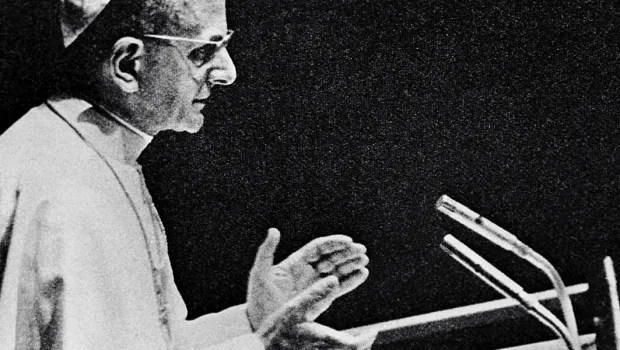
Pope Paul VI: “We would say that, through some mysterious crack—no, it’s not mysterious; through some crack, the smoke of Satan has entered the Church of God.”

I felt like the bank teller who has learned to identify counterfeit bills by first becoming highly familiar with the real thing, but in this case I knew the counterfeit all too well and was only coming to learn of the real thing. I was just so happy to be in the true Church that I let a lot slide for a while— and I still do, and I’m still happy. I love being Catholic, not merely for the joy I find, but because Catholicism is true. Also, I am no expert. And who am I anyway? And yet, I feel that God has given me the eyes I have, formed on the journey I’ve traveled, to see some things that others might not; perhaps especially so-called cradle Catholics. I believe that the long tradition of the Church, especially that old “stuffy” Latin Mass, lived out in love and relying on the Holy Spirit, is an antidote needed for the world today — not just the for the Church, but for the world.

Thus I am bothered by the letter above. I see it run through with problems, false assumptions, ignorance, and immaturity. I want to be dismissive.

And yet, and yet…

Two things: First we must look for the silver linings. In many ways the Church needed to be challenged. Before the Spirit of Vatican II there was the Spirit of the Counter Reformation. This spirit built a powerful, almost fortress-like Church. But, I believe, it was becoming hollow within. Bishops were used to being unchallenged and, it seems to me, too often didn’t distinguish between the core faith that could not be changed and cultural norms that could. Many men became priests and young women nuns for cultural reasons. Prayers were recited because that’s what had always been done. When I hear about bishops sometimes ruling over over nuns in harsh and tone-deaf ways and then those nuns pushing back I tend to side with the nuns. I believe the Church needed to be shook up. The question is how far does one go with that shaking?

Second, I (and we) must have compassion for those who love the Novus Ordo and its music and its culture. For that’s what it is, a culture and it has shaped them. Culture arises from cultus. How we worship, including the nuts and bolts of our liturgies, form us. Lex orandi, lex credendi. Even what direction the priest faces during the Liturgy works within us at such a deep level and in such a precognitive way that the simple fact of orientation teaches us about God and man, saying one thing or another thing. How we receive the Blessed Sacrament, whether on the tongue or in the hand, whether standing or kneeling, teaches (instilling within us) us at a deeply subconscious level knowledge (true or false) of Christ and our relationship to Him, saying one thing and not another thing. At the end of Mass, when we are told to go out into the world, we take with us that cultus which has formed deep within us, formed even minutes before, and so deeply that much of it is subconscious and intuitive and works on our minds to such a degree that what seems right to us seems so as though from the foundations of the earth. But this is not the same thing as being right, for we can be formed by a bad cultus just as easily as a good cultus. And even the best Catholic cultus has to contend with the world’s cultus, which smothers us nearly every minute.

The power of formation is not primarily at the conscious level. Much like the bank teller intuitively knowing a good bill from a false one, the well formed Catholic recognizes truth and error, depth and shallowness, beauty and mediocrity, faith and sentimentality, in an almost precognitive manner. (Oh that we were all that well formed!) Overwhelming evidence declares that Catholics can be poorly formed. Our sensibilities can lead us to wrong understandings, poor interpretations, and misguided evaluations. And our conclusions will feel absolutely right. We almost can’t help it; no one knowingly believes falsehoods, we can only believe what we believe is true. Therefore, we must have compassion and empathy for others. We must seek humility. Our true battle is not over liturgy, or tradition, or theology. Our true battle is against Satan and his devils, against the forces of sin within us, and against the temptations of the world. We are in a profound spiritual, physical, and metaphysical battle for our faith, the Church, and our souls. That battle, of course, plays out much of the time within the physical realm, including the realm of liturgy, culture, and even politics, but we must seek to have eyes that see and ears that hear, we must seek soft hearts and and sensitive souls, so that we may know where the real battle lies, otherwise we will miss it — perhaps even joining an enemy who tricks and beguiles us.

Lord Jesus Christ, Son of God, have mercy on me a sinner.

If you watch documentaries about the 1960s, such as Ken Burns film The Vietnam War, especially the parts that focus on the homefront in the US, or the PBS documentary Woodstock: Three Days that Defined a Generation, you can’t help but feel for the youth caught up in the spirit(s) of the age. There was little chance of any young Catholic at that time, living in the midst of that culture, who would not have also interpreted the post-Vatican II changes, especially those done under the spirit of Vatican II mantra, as utterly comprehensible and necessary. Many of these young Catholics supported refocusing the Church towards the burning issues of the day and, more importantly, defining the approach to those issues in the same terms used by the campus radicals, the feminists, the neo-socialists, and especially those of the anti-war and civil rights movements.

Consider this truly amazing time-capsule below from 1968. This NBC documentary shows us the world in which our letter writer above was formed and of which he clearly is still fond, much like an old man remembering the glory days of his youth. Keep in mind that the Novus Ordo was not promulgated until 1969, so this is even before the new Mass radically changed the Church.

This video feels like a crash in slow motion. I am aghast at the naivete and delirious utopianism expressed, and yet… I too would have likely joined in with enthusiasm if I had been a young adult Catholic at that time. But this is where we need to understand clearly that what is often called the “spirit of Vatican II” was really just the spirit of the age. What was new and “alive” then seems dated and, at best, quaint today. But let’s not be too sentimental, it was also a tragedy in the making.

The goal wasn’t just a matter of getting rid of what was old. Underneath it was the belief that what we call traditional Catholicism was being fundamentally incompatible with the modern age and, thus, being a barrier to spiritual growth, a meaningful relationship with Christ, evangelization, and even authentic Catholicism (nevermind the saints, great and small, who knew nothing else but traditional Catholicism because it was just Catholicism). Traditional priestly garb and religious habits began to look more and more like anachronistic costumes, almost laughable; Latin like a language mummified. The key word in the documentary is “relevant.” The Church must become relevant. The disease of relevancy infected the Protestant world too, something I experienced growing up.

As a side note: Look up each priest and bishop interviewed in the documentary above and see how many were eventually laicized and got married in less than ten years of this film.

With time, statistics, and much wide-eyed hand wringing we have come to see that the radical experiments of the 1960s and 1970s largely failed and a great deal has been lost, not least are increasingly diminishing numbers of faithful Catholics in the pews and vocations to the priesthood and religious life. But also so much depth and richness has been lost. It was, it would appear, the Church declaring that the Real Presence was dogma but not really true, and that faith was merely a matter of personal preference after all. Our priests, by no longer having the Traditional Latin Mass available to them, perhaps have suffered the most for they are no longer being fed daily on the more nourishing food of tradition (such as the profoundly rich prayers of the Extraordinary Form) but rather “eating” a less spiritually enriching fair that is bound to leave one at the very least rather anemic. And if one has never eaten from the sumptuous feast’s table one will neither know the riches available or the true depth of satiation.

The Novus Ordo is a living culture and it produces sons and daughters of itself. It is an engine of formation. I believe that many priests have gone into the priesthood thinking and hoping that within the Novus Ordo culture they will become the kind of men that only a TLM culture can produce. (I experienced something similar coming into the Church as a convert.) Many, many things went terribly amiss during the frantic hubbub of the radical sixties. Much good has been destroyed. In one generation enough destruction and spiritual darkness was unleashed that it may take five generations to recover. The “good” bishops and popes have been trying to fix it ever since — tinkering here, adjusting there, moving slowly out of caution? concerns? fear? Of course, I don’t have the answer, and who am I anyway?

The “boomers” and the rest of the Novus Ordo crowd (I also frequently attend the Novus Ordo and just missed being called a boomer by only one year, and not all boomers are pro-Novus Ordo culture) are not the enemy. Even if you are a staunch traditionalist you ought to see them as our brothers and sisters in Christ. One might choose to “fight” for the great traditions of the Church, especially the Traditional Latin Mass, to return in a big way, but one must not fall into a hardened “us and them” mentality. And you ought to love them. They have been taught and formed by the Church and their culture, just as we all have. Their formation, good or bad, falls largely upon the shoulders of those bishops who had that responsibility and who eagerly welcomed the spirit of the age into the Church and often veered wildly beyond the councils documents.

Our job is to love God and each other. We are to seek unity in love, with humility, and with total faith in God — which means we need patience and know that it is God who fights our battles. But the older crowd are not the only ones who love the Novus Ordo more than the TLM. Even many younger folks do so as well, for reasons I can’t quite fathom. People love things for different reasons. And they don’t love other things for different reasons; sometimes merely out of ignorance, sometimes because of their formation, and sometimes for good reasons. But this is a larger topic.

I feel for the man who wrote the letter above. I believe he wrote honestly from his heart. I believe his grievances came from real grieving. I also wonder, without wanting to psychoanalyze him, if his grieving doesn’t come from having had a kind of “mountain top” experience in his youth (think of those in the 1968 documentary above), being caught up in the spirit of the age and feeling like he had truly received a “new Pentecost,” which has stayed with him and sustained him for many years, and now he feels it’s being taken away. I’m sure he’s not alone.

But I don’t feel too sorry for the guy. His letter is also an expression of ignorance, selfishness and shows lack of empathy for those suffering under the revolution he so loves. That parish he left was very accommodating and, it turns out, he wasn’t. His letter was heartfelt and honest but it is also an expression of myopic self-centeredness. I hope* he found a parish with the felt banners and Marty Haugen hymns he’s used to, and with the tabernacle hidden somewhere to the side so as not to conflict with the worship. I’m sure he did, there’s still a lot of them around.

*Not really.
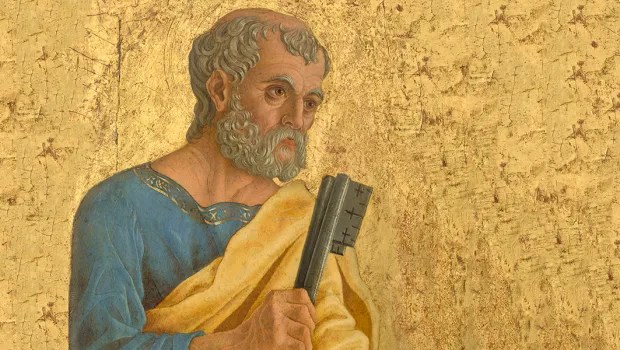
Biblical references for the unique role and responsibility the Apostle Peter

I first published this post in 2012, just one year before I officially converted to the Catholic Church. My journey up to that point had included a possible conversion to Eastern Orthodoxy but I first had to sort out my thinking on the Pope. This post was a piece of that process.

The Apostle Peter is a fascinating man in the New Testament. In the Protestant world it is common for pastors to say they love Peter because he was such a  goof-up. Peter gives us all kinds of hope that any of us can be saved. But anyone who has grown up in, or spent a lot of time in, the Protestant world and worldview knows it is Paul who is Apostle number one. There are at least two good reasons for this. One is that Paul wrote those books of the Bible that are most central for Protestants: Romans, Galatians, 1 Corinthians, etc. Second is that Protestants are wary of Peter because Catholics say the true Church founded by Christ was founded upon Peter (the rock) as the first of the apostles, as the first “pope”. Get too close to Peter and one might be tempted to think Catholics are on to something.

But Peter is a big deal. To my count Peter is mentioned in the New Testament something like 155 times, whereas the rest of the apostles combined are only mentioned around 130 times. Of course mere numbers don’t necessarily add up to importance. It’s how Peter is mentioned, what he does, what he says, what others say about him, and especially what Christ says to Peter that show Peter is the central Apostle, the key figure of the New Testament Church. As we look at the Biblical references to Peter the picture begins to fill out.

An aside: I have heard many Protestant teachings on the famous Matthew 16:18 passage where Jesus says “upon this rock I will build My church.” That passage in isolation can be taken any number of ways. But after looking at a more complete picture of Peter as the New Testament writers saw him, I must say the Roman Catholic understanding of Peter as the Rock upon which Christ will build His Church makes the most sense. In fact, even without this particular passage, the other passages below add up to the same idea. Rather than seeing the Catholic position as some kind of crazy overlay to this passage, it now seems clear to me that it is the Protestants who must come up with a better argument. So far I have not heard anything better. Of course, this makes me, an old Protestant, very curious.

Below are the New Testament references I was able to find regarding Peter. I have tried to group them a bit, and added a few of my thoughts. I have not ranked them in any particular order. I’m sure I’ve made some mistakes. All quotations are from the New American Standard Bible.

Peter listed/mentioned first with the apostles

Peter being mentioned or listed first among the apostles:

Matt. 10:2  Now the names of the twelve apostles are these: The first, Simon, who is called Peter, and Andrew his brother; and James the son of Zebedee, and John his brother;
Mark 1:36  Simon and his companions searched for Him;
Mark 3:16  And He appointed the twelve: Simon (to whom He gave the name Peter),
Luke 6:14-16  Simon, whom He also named Peter, and Andrew his brother; and James and John; and Philip and Bartholomew;  and Matthew and Thomas; James the son of Alphaeus, and Simon who was called the Zealot; Judas the son of James, and Judas Iscariot, who became a traitor.
Acts 2:37  Now when they heard this, they were pierced to the heart, and said to Peter and the rest of the apostles, “Brethren, what shall we do?”
Acts 5:29  But Peter and the apostles answered, “ We must obey God rather than men.

Peter is first when entering upper room after our Lord’s ascension:

Acts 1:13  When they had entered the city, they went up to the upper room where they were staying; that is, Peter and John and James and Andrew, Philip and Thomas, Bartholomew and Matthew, James the son of Alphaeus, and Simon the Zealot, and Judas the son of James.

Peter leads the fishing and his net does not break. According to Catholics, the boat (the “barque of Peter”) is seen as a metaphor for the Church:

John 21:2-3  Simon Peter, and Thomas called Didymus, and Nathanael of Cana in Galilee, and the sons of Zebedee, and two others of His disciples were together. Simon Peter said to them, “I am going fishing.” They said to him, “We will also come with you.” They went out and got into the boat; and that night they caught nothing.
John 21:11  Simon Peter went up and drew the net to land, full of large fish, a hundred and fifty-three; and although there were so many, the net was not torn.

Though Peter and John are both very important figures in the early church, Peter is always mentioned before John:

Luke 8:51  When He came to the house, He did not allow anyone to enter with Him, except Peter and John and James, and the girl’s father and mother.
Luke 9:28  Some eight days after these sayings, He took along Peter and John and James, and went up on the mountain to pray.
Luke 22:8  And Jesus sent Peter and John, saying, “Go and prepare the Passover for us, so that we may eat it.”
Acts 1:13  When they had entered the city, they went up to the upper room where they were staying; that is, Peter and John and James and Andrew, Philip and Thomas, Bartholomew and Matthew, James the son of Alphaeus, and Simon the Zealot, and Judas the son of James.
Acts 3:1-4  Now Peter and John were going up to the temple at the ninth hour, the hour of prayer. And a man who had been lame from his mother’s womb was being carried along, whom they used to set down every day at the gate of the temple which is called Beautiful, in order to beg alms of those who were entering the temple. When he saw Peter and John about to go into the temple, he began asking to receive alms. But Peter, along with John, fixed his gaze on him and said, “Look at us!”
Acts 3:3  When he saw Peter and John about to go into the temple, he began asking to receive alms.
Acts 3:11  While he was clinging to Peter and John, all the people ran together to them at the so-called portico of Solomon, full of amazement.
Acts 4:13  Now as they observed the confidence of Peter and John and understood that they were uneducated and untrained men, they were amazed, and began to recognize them as having been with Jesus.
Acts 4:19  But Peter and John answered and said to them, “ Whether it is right in the sight of God to give heed to you rather than to God, you be the judge;
Acts 8:14  Now when the apostles in Jerusalem heard that Samaria had received the word of God, they sent them Peter and John,

Peter is mentioned first as going to mountain of transfiguration. He is also the only disciple to speak at the transfiguration:

Luke 9:28  Some eight days after these sayings, He took along Peter and John and James, and went up on the mountain to pray.
Luke 9:33  And as these were leaving Him, Peter said to Jesus, “ Master, it is good for us to be here; let us make three tabernacles: one for You, and one for Moses, and one for Elijah”— not realizing what he was saying.

Peter is the first of the apostles to confess the divinity of Christ:

Matt. 16:16  Simon Peter answered, “You are the Christ, the Son of the living God.”
Mark 8:29  And He continued by questioning them, “But who do you say that I am?” Peter answered and said to Him, “You are the Christ.”
John 6:69  We have believed and have come to know that You are the Holy One of God.”

Peter ranked(?) higher than John

John arrived at the tomb first but stopped and waited for Peter. Peter then arrived and entered the tomb first:

Luke 24:12  But Peter got up and ran to the tomb; stooping and looking in, he saw the linen wrappings only; and he went away to his home, marveling at what had happened.
John 20:4-6  The two were running together; and the other disciple ran ahead faster than Peter and came to the tomb first; and stooping and looking in, he saw the linen wrappings lying there; but he did not go in. And so Simon Peter also came, following him, and entered the tomb; and he saw the linen wrappings lying there,

It is Peter that is named as the eye witness even though both Peter and John had seen the risen Jesus the previous hour:

Luke 24:34  saying, “ The Lord has really risen and has appeared to Simon.”

Peter seen as the Leader of the Apostles

In the garden of Gethsemane, Jesus asks Peter, and no one else, why he was asleep. It would seem Peter is held accountable, on behalf of the apostles, for their actions:

Mark 14:37  And He came and found them sleeping, and said to Peter, “Simon, are you asleep? Could you not keep watch for one hour?

Peter is designated (called out) by an angel as unique among the apostles:

Mark 16:7  But go, tell His disciples and Peter, ‘ He is going ahead of you to Galilee; there you will see Him, just as He told you.’”

Peter receiving Special Instruction and Revelation

Peter alone is told he has received special, divine revelation from God the Father:

Matt. 16:17  And Jesus said to him, “Blessed are you, Simon Barjona, because flesh and blood did not reveal this to you, but My Father who is in heaven.

Jesus instructs the disciples by specifically instructing Peter to let down their nets for a catch. Peter specifically is told he will be a “fisher of men”:

Luke 5:4,10  When He had finished speaking, He said to Simon, “Put out into the deep water and let down your nets for a catch… and so also were James and John, sons of Zebedee, who were partners with Simon. And Jesus said to Simon, “ Do not fear, from now on you will be catching men.”

Peter speaking/Asking on Behalf of the Disciples

Peter asks Jesus about the rule of forgiveness. Peter frequently takes a leadership role among the apostles in seeking understanding of Jesus’ teachings:

Matt. 18:21  Then Peter came and said to Him, “Lord, how often shall my brother sin against me and I forgive him? Up to seven times?”

Peter speaks on behalf of the apostles by telling Jesus that they have left everything to follow Him:

Matt. 19:27  Then Peter said to Him, “Behold, we have left everything and followed You; what then will there be for us?”

Peter speaks for the disciples on their following Jesus:

Mark 10:28  Peter began to say to Him, “Behold, we have left everything and followed You.”

Peter speaks for the disciples about their witnessing Jesus’ curse on the fig tree:

Mark 11:21  Being reminded, Peter said to Him, “ Rabbi, look, the fig tree which You cursed has withered.”

Peter functions as the spokesman or representative (or vicar, to use popular a Catholic term) for Jesus:

Matt. 17:24-25  When they came to Capernaum, those who collected the two-drachma tax came to Peter and said, “Does your teacher not pay the two-drachma tax?” He *said, “Yes.” And when he came into the house, Jesus spoke to him first, saying, “What do you think, Simon? From whom do the kings of the earth collect customs or poll-tax, from their sons or from strangers?”

When Jesus asked who touched His garment, it is Peter who answers:

Luke 8:45  And Jesus said, “Who is the one who touched Me?” And while they were all denying it, Peter said, “Master, the people are crowding and pressing in on You.”

It is Peter who seeks clarification of a parable on behalf on the disciples:

Luke 12:41  Peter said, “Lord, are You addressing this parable to us, or to everyone else as well?”

After many of the disciples leave Jesus, it is Peter who speaks on behalf of the remaining disciples and confesses their belief in Christ after the Eucharistic discourse:

John 6:68 Simon Peter answered Him, “Lord, to whom shall we go? You have words of eternal life.

Peter as Christ’s Representative on Earth

Protestants debate this, but it would seems that Jesus builds the Church primarily (only?) on Peter, the rock:

Matt. 16:18  I also say to you that you are Peter, and upon this rock I will build My church; and the gates of Hades will not overpower it.

Only Peter receives the keys of the kingdom of heaven:

Matt. 16:19  I will give you the keys of the kingdom of heaven; and whatever you bind on earth shall have been bound in heaven, and whatever you loose on earth shall have been loosed in heaven.”

Peter, by paying the tax for both Jesus and himself, is acting Christ’s “representative” on earth:

Matt. 17:26-27  When Peter said, “From strangers,” Jesus said to him, “Then the sons are exempt. However, so that we do not offend them, go to the sea and throw in a hook, and take the first fish that comes up; and when you open its mouth, you will find a shekel. Take that and give it to them for you and Me.”

Peter given charge/care of the other disciples

Jesus prays specifically for Peter, that his faith may not fail, and charges him to strengthen the rest of the apostles:

Luke 22:31-32  “Simon, Simon, behold, Satan has demanded permission to sift you like wheat; but I have prayed for you, that your faith may not fail; and you, when once you have turned again, strengthen your brothers.”

In front of the apostles, Jesus asks Peter if he loves Jesus “more than these,” which likely refers to the other apostles. Peter has a special role regarding the apostles:

John 21:15  So when they had finished breakfast, Jesus said to Simon Peter, “Simon, son of John, do you love Me more than these?” He said to Him, “Yes, Lord; You know that I love You.” He said to him, “Tend My lambs.”

Jesus charges Peter to “feed my lambs,” “tend my sheep,” “feed my sheep.” Sheep appears to mean all people (or all believers), including the apostles:

John 21:15-17  So when they had finished breakfast, Jesus said to Simon Peter, “Simon, son of John, do you love Me more than these?” He *said to Him, “Yes, Lord; You know that I love You.” He said to him, “Tend My lambs.” He said to him again a second time, “Simon, son of John, do you love Me?” He said to Him, “Yes, Lord; You know that I love You.” He said to him, “ Shepherd My sheep.” He said to him the third time, “Simon, son of John, do you love Me?” Peter was grieved because He said to him the third time, “Do you love Me?” And he said to Him, “Lord, You know all things; You know that I love You.” Jesus said to him, “ Tend My sheep.


Peter Leading the Early Church

Peter initiates the selection of a successor to Judas immediately after Jesus ascended into heaven. Note: This passage also supports (or establishes) the concept of apostolic succession:

Acts 1:15  At this time Peter stood up in the midst of the brethren (a gathering of about one hundred and twenty persons was there together), and said,

Peter is the first apostle to preach the Gospel:

Acts 2:14  But Peter, taking his stand with the eleven, raised his voice and declared to them: “Men of Judea and all you who live in Jerusalem, let this be known to you and give heed to my words.

Peter is the first to preach on repentance and baptism in the name of Jesus Christ:

Acts 2:38  Peter said to them, “ Repent, and each of you be baptized in the name of Jesus Christ for the forgiveness of your sins; and you will receive the gift of the Holy Spirit.

Peter performs the first healing miracle of the apostles:

Acts 3:6-7  But Peter said, “I do not possess silver and gold, but what I do have I give to you: In the name of Jesus Christ the Nazarene—walk!” And seizing him by the right hand, he raised him up; and immediately his feet and his ankles were strengthened.

Peter is the first to teach that there is no salvation other than through Christ:

Acts 3:12-26  But when Peter saw this, he replied to the people, “Men of Israel, why are you amazed at this, or why do you gaze at us, as if by our own power or piety we had made him walk? The God of Abraham, Isaac and Jacob, the God of our fathers, has glorified His servant Jesus, the one whom you delivered and disowned in the presence of Pilate, when he had decided to release Him. But you disowned the Holy and Righteous One and asked for a murderer to be granted to you, but put to death the Prince of life, the one whom God raised from the dead, a fact to which we are witnesses. And on the basis of faith in His name, it is the name of Jesus which has strengthened this man whom you see and know; and the faith which comes through Him has given him this perfect health in the presence of you all. And now, brethren, I know that you acted in ignorance, just as your rulers did also. But the things which God announced beforehand by the mouth of all the prophets, that His Christ would suffer, He has thus fulfilled. Therefore repent and return, so that your sins may be wiped away, in order that times of refreshing may come from the presence of the Lord; and that He may send Jesus, the Christ appointed for you, whom heaven must receive until the period of restoration of all things about which God spoke by the mouth of His holy prophets from ancient time. Moses said, ‘ The Lord God will raise up for you a prophet like me from your brethren; to Him you shall give heed to everything He says to you. And it will be that every soul that does not heed that prophet shall be utterly destroyed from among the people.’ And likewise, all the prophets who have spoken, from Samuel and his successors onward, also announced these days. It is you who are the sons of the prophets and of the covenant which God made with your fathers, saying to Abraham, ‘ And in your seed all the families of the earth shall be blessed.’ For you first, God raised up His Servant and sent Him to bless you by turning every one of you from your wicked ways.”

Acts 4:8-12  Then Peter, filled with the Holy Spirit, said to them, “Rulers and elders of the people, if we are on trial today for a benefit done to a sick man, as to how this man has been made well, let it be known to all of you and to all the people of Israel, that by the name of Jesus Christ the Nazarene, whom you crucified, whom God raised from the dead—by this name this man stands here before you in good health. He is the stone which was rejected by you, the builders, but which became the chief corner stone. And there is salvation in no one else; for there is no other name under heaven that has been given among men by which we must be saved.”

Peter resolves the first doctrinal issue on circumcision at the Church’s first council at Jerusalem, and no one questions him. After Peter the Papa spoke, all were kept silent:

Acts 15:7-12  After there had been much debate, Peter stood up and said to them, “Brethren, you know that in the early days God made a choice among you, that by my mouth the Gentiles would hear the word of the gospel and believe. And God, who knows the heart, testified to them giving them the Holy Spirit, just as He also did to us; and He made no distinction between us and them, cleansing their hearts by faith. Now therefore why do you put God to the test by placing upon the neck of the disciples a yoke which neither our fathers nor we have been able to bear? But we believe that we are saved through the grace of the Lord Jesus, in the same way as they also are.” All the people kept silent, and they were listening to Barnabas and Paul as they were relating what signs and wonders God had done through them among the Gentiles.

Only after Peter finishes speaking do Paul and Barnabas speak in support of Peter’s definitive teaching:

Acts 15:12  All the people kept silent, and they were listening to Barnabas and Paul as they were relating what signs and wonders God had done through them among the Gentiles.

The church prayed for Peter while he was in prison:

Acts 12:5  So Peter was kept in the prison, but prayer for him was being made fervently by the church to God.

Peter acts as the chief elder (or bishop?) by exhorting all the other elders of the Church:

1 Peter 5:1  Therefore, I exhort the elders among you, as your fellow elder and witness of the sufferings of Christ, and a partaker also of the glory that is to be revealed,

Peter brings the Gospel to the Gentiles

Peter is first Apostle to teach that salvation is for all, both Jews and Gentiles:

Acts 10:34-48 Opening his mouth, Peter said: “I most certainly understand now that God is not one to show partiality, but in every nation the man who fears Him and does what is right is welcome to Him. The word which He sent to the sons of Israel, preaching peace through Jesus Christ (He is Lord of all)— you yourselves know the thing which took place throughout all Judea, starting from Galilee, after the baptism which John proclaimed. You know of Jesus of Nazareth, how God anointed Him with the Holy Spirit and with power, and how He went about doing good and healing all who were oppressed by the devil, for God was with Him. We are witnesses of all the things He did both in the land of the Jews and in Jerusalem. They also put Him to death by hanging Him on a cross. God raised Him up on the third day and granted that He become visible, not to all the people, but to witnesses who were chosen beforehand by God, that is, to us who ate and drank with Him after He arose from the dead. And He ordered us to preach to the people, and solemnly to testify that this is the One who has been appointed by God as Judge of the living and the dead. Of Him all the prophets bear witness that through His name everyone who believes in Him receives forgiveness of sins.” While Peter was still speaking these words, the Holy Spirit fell upon all those who were listening to the message. All the circumcised believers who came with Peter were amazed, because the gift of the Holy Spirit had been poured out on the Gentiles also. For they were hearing them speaking with tongues and exalting God. Then Peter answered, “ Surely no one can refuse the water for these to be baptized who have received the Holy Spirit just as we did, can he?” And he ordered them to be baptized in the name of Jesus Christ. Then they asked him to stay on for a few days.

Acts 11:1-18  Now the apostles and the brethren who were throughout Judea heard that the Gentiles also had received the word of God. And when Peter came up to Jerusalem, those who were circumcised took issue with him, saying, “ You went to uncircumcised men and ate with them.” But Peter began speaking and proceeded to explain to them in orderly sequence, saying, “ I was in the city of Joppa praying; and in a trance I saw a vision, an object coming down like a great sheet lowered by four corners from the sky; and it came right down to me, and when I had fixed my gaze on it and was observing it I saw the four-footed animals of the earth and the wild beasts and the crawling creatures and the birds of the air. I also heard a voice saying to me, ‘Get up, Peter; kill and eat.’ But I said, ‘By no means, Lord, for nothing unholy or unclean has ever entered my mouth.’ But a voice from heaven answered a second time, ‘ What God has cleansed, no longer consider unholy.’ This happened three times, and everything was drawn back up into the sky. And behold, at that moment three men appeared at the house in which we were staying, having been sent to me from Caesarea. The Spirit told me to go with them [m] without misgivings. These six brethren also went with me and we entered the man’s house. And he reported to us how he had seen the angel standing in his house, and saying, ‘Send to Joppa and have Simon, who is also called Peter, brought here; and he will speak words to you by which you will be saved, you and all your household.’ And as I began to speak, the Holy Spirit fell upon them just as He did upon us at the beginning. And I remembered the word of the Lord, how He used to say, ‘ John baptized with water, but you will be baptized with the Holy Spirit.’ Therefore if God gave to them the same gift as He gave to us also after believing in the Lord Jesus Christ, who was I that I could stand in God’s way?” When they heard this, they quieted down and glorified God, saying, “Well then, God has granted to the Gentiles also the repentance that leads to life.”

Peter binds and looses

Peter exercises his binding authority by declaring the first anathema of Ananias and Sapphira (which is ratified by God):

Acts 5:3  But Peter said, “Ananias, why has Satan filled your heart to lie to the Holy Spirit and to keep back some of the price of the land?

Peter again exercises his binding and loosing authority by casting judgment on Simon’s quest for gaining authority through the laying on of hands:

Acts 8:20-23  But Peter said to him, “May your silver perish with you, because you thought you could obtain the gift of God with money! You have no part or portion in this matter, for your heart is not right before God. Therefore repent of this wickedness of yours, and pray the Lord that, if possible, the intention of your heart may be forgiven you. For I see that you are in the gall of bitterness and in the bondage of iniquity.”

Peter heals others

Peter’s own shadow has healing power:

Acts 5:15  to such an extent that they even carried the sick out into the streets and laid them on cots and pallets, so that when Peter came by at least his shadow might fall on any one of them.

Peter is mentioned first among the apostles and works the healing of Aeneas:

Acts 9:32-34  Now as Peter was traveling through all those regions, he came down also to the saints who lived at Lydda. There he found a man named Aeneas, who had been bedridden eight years, for he was paralyzed. Peter said to him, “Aeneas, Jesus Christ heals you; get up and make your bed.” Immediately he got up.

Peter is mentioned first among the apostles and raises Tabitha from the dead:

Acts 9:38-40  Since Lydda was near Joppa, the disciples, having heard that Peter was there, sent two men to him, imploring him, “Do not delay in coming to us.” So Peter arose and went with them. When he arrived, they brought him into the upper room; and all the widows stood beside him, weeping and showing all the tunics and garments that Dorcas used to make while she was with them. But Peter sent them all out and knelt down and prayed, and turning to the body, he said, “ Tabitha, arise.” And she opened her eyes, and when she saw Peter, she sat up.

Angels are active in Peter’s life and ministry

Cornelius is told by an angel to call upon Peter. Peter was granted this divine vision:

Acts 10:5  Now dispatch some men to Joppa and send for a man named Simon, who is also called Peter;

Peter is freed from jail by an angel. He is the first Apostle to receive direct divine intervention:

Acts 12:6-11  On the very night when Herod was about to bring him forward, Peter was sleeping between two soldiers, bound with two chains, and guards in front of the door were watching over the prison. And behold, an angel of the Lord suddenly appeared and a light shone in the cell; and he struck Peter’s side and woke him up, saying, “Get up quickly.” And his chains fell off his hands. And the angel said to him, “Gird yourself and put on your sandals.” And he did so. And he said to him, “Wrap your cloak around you and follow me.” And he went out and continued to follow, and he did not know that what was being done by the angel was real, but thought he was seeing a vision. When they had passed the first and second guard, they came to the iron gate that leads into the city, which opened for them by itself; and they went out and went along one street, and immediately the angel departed from him. When Peter came to himself, he said, “Now I know for sure that the Lord has sent forth His angel and rescued me from the hand of Herod and from all that the Jewish people were expecting.”

Other Apostles Testify to Peter’s Teaching and Leadership

James speaks to acknowledge Peter’s definitive teaching. “Simeon” is a reference to Peter:

Acts 15:13-14  After they had stopped speaking, James answered, saying, “Brethren, listen to me. Simeon has related how God first concerned Himself about taking from among the Gentiles a people for His name.

Paul says he doesn’t want to build on “another man’s foundation” which may refer to Peter and the church Peter may have built in Rome:

Rom. 15:20  And thus I aspired to preach the gospel, not where Christ was already named, so that I would not build on another man’s foundation;

Paul distinguishes Peter from the rest of the apostles and brethren:

1 Cor. 9:5  Do we not have a right to take along a believing wife, even as the rest of the apostles and the brothers of the Lord and Cephas?

Paul distinguishes Jesus’ post-resurrection appearances to Peter from those of the other apostles:

1 Cor. 15:4-8  and that He was buried, and that He was raised on the third day according to the Scriptures, and that He appeared to Cephas, then to the twelve. After that He appeared to more than five hundred brethren at one time, most of whom remain until now, but some have fallen asleep; then He appeared to James, then to all the apostles; and last of all, as to one untimely born, He appeared to me also.

Paul spends fifteen days with Peter privately before beginning his ministry. This comes even after Christ’s revelation to Paul. Paul needed Peter’s acceptance and blessing:

Gal. 1:18  Then three years later I went up to Jerusalem to become acquainted with Cephas, and stayed with him fifteen days.

Interesting

Peter is the only man to walk on water other than Christ:

Matt. 14:28-29  Peter said to Him, “Lord, if it is You, command me to come to You on the water.” And He said, “Come!” And Peter got out of the boat, and walked on the water and came toward Jesus.

Jesus teaches from Peter’s boat. The boat may be a metaphor for the Church, the so-called “barque of Peter”:

Luke 5:3  And He got into one of the boats, which was Simon’s, and asked him to put out a little way from the land. And He sat down and began teaching the people from the boat.

Peter speaks out to the Lord in front of the apostles concerning the washing of feet:

John 13:6-9  So He came to Simon Peter. He said to Him, “Lord, do You wash my feet?” Jesus answered and said to him, “What I do you do not realize now, but you will understand hereafter.” Peter said to Him, “Never shall You wash my feet!” Jesus answered him, “ If I do not wash you, you have no part with Me.” Simon Peter *said to Him, “Lord, then wash not only my feet, but also my hands and my head.”

Only Peter got out of the boat and ran to the shore to meet Jesus:

John 21:7  Therefore that disciple whom Jesus loved said to Peter, “It is the Lord.” So when Simon Peter heard that it was the Lord, he put his outer garment on (for he was stripped for work), and threw himself into the sea.

Jesus predicts Peter’s death:

John 13:36  Simon Peter said to Him, “Lord, where are You going?” Jesus answered, “ Where I go, you cannot follow Me now; but you will follow later.”
John 21:18  Truly, truly, I say to you, when you were younger, you used to gird yourself and walk wherever you wished; but when you grow old, you will stretch out your hands and someone else will gird you, and bring you where you do not wish to go.”

Peter is mentioned first in conferring the sacrament of confirmation:

Acts 8:14  Now when the apostles in Jerusalem heard that Samaria had received the word of God, they sent them Peter and John,

Peter was most likely in Rome. “Babylon” was often used as a code word for Rome:

1 Peter 5:13  She who is in Babylon, chosen together with you, sends you greetings, and so does my son, Mark.

Peter writes about Jesus’ prediction of Peter’s death:

2 Peter 1:14  knowing that the laying aside of my earthly dwelling is imminent, as also our Lord Jesus Christ has made clear to me.

Peter makes a judgement of Paul’s letters:

2 Peter 3:16  as also in all his letters, speaking in them of these things, in which are some things hard to understand, which the untaught and unstable distort, as they do also the rest of the Scriptures, to their own destruction.

Peter was the first among the Apostles, perhaps struggled with that position at times, but proved to be the servant of all:

Matt. 23:11  But the greatest among you shall be your servant.
Mark 9:35  Sitting down, He called the twelve and *said to them, “ If anyone wants to be first, he shall be last of all and servant of all.”
Mark 10:44  and whoever wishes to be first among you shall be slave of all.

true reformation

And I tell you, you are Peter, and on this rock I will build my church, and the gates of hell shall not prevail against it. (Matthew 16:18)

Could it be that when Christ says about His Church that “the gates of hell shall not prevail against it” He does so because there will be many times that it seems like the gates of hell are prevailing, or nearly so? Perhaps we should see the history of Christ’s Church to be somewhat like the history of Israel, with many ups and downs, and often more difficult times than others, and most often the problems will be with lack of faith and pursuing false gods than from outside attacks. If this is so, and it seems at least likely, then what should our response be to “the church” when we see or experience the downturns? It may do us well to consider the prophets in Israel, how they spoke the word of God, and how they chastised and often wept, but also how they did not abandon Israel because they loved Israel and they could not go against God’s chosen people even if the people had turned from God. And some even paid for their commitment to Israel with their lives.

If this is true, then it may shine a light into what we call the Protestant Reformation. There have been many reformations, and many reformers throughout the entire history of the Church. Reformation is an ongoing aspect of Christian sanctification, both personally and corporately. It seems that Christians are always falling away and coming back, in a kind of constant flux—and it seems that’s God’s design, something we should expect. If this is true, then perhaps we should see the Protestant Reformation as a kind of necessary prophetic judgement on the Church—something difficult but welcome to those who have eyes to see. But then what do we do with the fact that soon the reformers turned away from the Church entirely, calling her the whore of Babylon and the pope the Antichrist? Strong language is the purview of prophets, but abandoning the beloved is not.

And what should those of us do who have grown up within this abandonment; accepting the mantle of prophets when, in fact, we may not have been called to be prophets in that way or to that degree; living into the “protestation” when we should be submissive; and even elevating disunity as a sign of faith? Perhaps the next step for us “Protestants”, if we are to be truly reformed, is to take up the second step and come back to the Church. That may be what will finally make the Protestant Reformation truly a reformation.

rule in hell or obey in heaven?

A common Catholic criticism of Protestantism and its legacy is that ever since the reformers opened the flood gates of their “rebellion” there has been an unstoppable and uncontrollable multiplication of claims to the truth, followed by ever increasing splits and disunity. The Protestant counter-criticism says Catholics cannot think for themselves and merely follow the Roman Church and its Pope like dumb sheep. The late Richard John Neuhaus, in his book Catholic Matters: Confusion, Controversy, and the Splendor of Truth, says this about the reason to trust Christ and the Church he founded:

We obey because we trust the words of Christ to his apostles and to their successors who are the bishops in union with the bishop of Rome. We obey because the ministry of the Magisterium is the ministry of unity, and unity is part of the truth that Christ wills for his Church. The alternative to obedience is to turn the conversation into a cacophony of Christians making it up as they go along. Obedience does not come easily for there is in all of us the rebellious spirit of John Milton’s Satan, who would rather rule in hell than obey in heaven. If we will not have obedience, if we will not abide the self-discipline that is involved in sentire cum ecclesia,† then we would be well advised to make our acquaintance with the innumerable denominations and sects, or start one of our own.

Increasingly, I find Neuhaus’ argument compelling. What for so long seemed to me like the spirit of integrity appears now more and more like the spirit of rebellion. But it is so ingrained, so deeply loved, so much a part of the water we drink and air we breathe, that this rebellious spirit looks not only normative, but even honorable. I find that frightening, but not surprising. Perhaps I am mistaken. Perhaps I am merely projecting my own issues—I know some of that must be true—but I have been thinking about these things for more than twenty-seven years (since my days on the college group ministry team at a large Baptist church) that I don’t believe I am being reactionary.

I was trained to have a strong allergic reaction to words like “successors”, “bishops” and “Rome.” I was not trained to react against “Magisterium” because I’d never heard that word until recent years. Implied in all this, and what I now see more clearly, is the strong Protestant allergy to the word “obedience.” Protestantism is founded on disobedience (and so is the American spirit). Protestants will say, however, that they have merely changed their obedience from the church to the Bible, from man to God, from blindness to truth. I wish that were true, but I believe it is the popular myth animating Protestantism. I fear, and what perhaps seems clear to me now, is that Protestantism is the tangible, historical expression of “John Milton’s Satan, who would rather rule in hell than obey in heaven.” This is a very provocative thing to say, and of course any Protestant would disagree with that charge (I would have not long ago). But the disunity produced and maintained by Protestantism is a grave testimony of a turning away from Christ—at least in some significant and undeniable way. But Protestantism also provides a handy method of denial: just point your finger at everyone else, everyone not part of your denomination, or even your little local band of “believers,” and say it is they who have turned from Christ, not us.

In one way or another we all “think with the church,” or “a” church anyway, and none of us are as independent as we want to believe. We cannot help but think with a given set of ideas. I am not a Catholic, not yet anyway, but I have lived most of my life as a Protestant, and I know that Protestants are as bound and confined by traditions, presuppositions, confessions, hermeneutical methodologies, and mythologies, as anyone else. Can it be that the issue is not whether one “thinks with the church” but rather which church? If so, then which church?

Can it be that Protestantism, even in light of much that can be said to be good, and even in light of the many good Christians that populate its commonwealth, is essentially the wholesale embracing of the first century Corinthian church and its worldview—a worldview promoting factions and disunity? Remember, Paul is not calling the Corinthians apostate and declaring them non-Christian (though he comes close), rather Paul says, “To the church of God which is at Corinth, to those who have been sanctified in Christ Jesus, saints by calling, with all who in every place call on the name of our Lord Jesus Christ, their Lord and ours: Grace to you and peace from God our Father and the Lord Jesus Christ.” Paul loves the Corinthians, and therefore he calls them back to unity. Is it time for Protestants to be called back to unity? to obey in heaven?

But I wonder, when Paul asked the Corinthians, “Has Christ been divided?” How many said, “It’s not my fault,” and blamed the others?


† to think with the Church