>it’s quite, uh, possible the revolution will not be televised, or entirely coherent… um

>Why do I love this video below? I love how it is so odd (from an American perspective): A famous French philosopher gives a lecture into which a young “revolutionary” storms, creates a scene (and a mess), makes some kind of protest statement, and then the philosopher responds. All along the audience watches and occasionally applauds. It’s like a piece of performance art staged for the chic intellectual cohort.

http://video.google.com/googleplayer.swf?docid=2536229376237496553&hl=en&fs=true

The philosopher is Jacques Lacan. The year is 1972 (not really surprising).

Only in France is all I have to say. And yet, sometimes I wish I lived in a country that would take philosophy, and its philosophers, as seriously. On the other hand, for all his unintended humor, the young radical in this clip may be the more honest of the two.

>Jacques Ellul and The Treachery of Technology

>

>Žižek!

>If there is a rock star in the world of contemporary philosophy it might be Slavoj Žižek. But I don’t even know what that means, except that, unlike most philosophers, he seems to engender a kind of rapture amongst his followers. Reviews of his books on Amazon are rarely uniform. They always included raves and pans. There is little neutrality. I think this should be the case with every philosopher.

Here is the documentary Žižek! (2005). Watch it an you will agree with me, there is no one like Žižek.

http://video.google.com/googleplayer.swf?docid=-6597950490592250178&hl=en&fs=true

Okay, I am new to Žižek. I’ve seen his name for a while, but I don’t know his work as much as would like. From what little I do know about him I think he and I are in very different camps ideologically. The video above, though, is one of the more fascinating things I’ve seen lately. What a fascinating character he is.

I have no interest in addressing anything within the video per se, but I am fascinated that a philosopher shows up at a speaking engagement and even the standing room is overflowing. This is an extremely rare kind of happening in the U.S. – maybe with someone like Noam Chomsky, but even then not for his talks on linguistics as much as those on U.S. foreign policy. I also love that he has a sense of humor and love movies.

>What is Democracy? Beyond Elections documentary

>Democracy is one of those words, like love or justice, that we all know intuitively what it means, but then again we don’t really know as well as we think. I am often surprised by how much I don’t understand democracy and its implications, let alone how it plays out in different parts of the world. Below is the the first part of a documentary on the topic of democracy in the Americas. This might be a good place to start re-examining what democracy is all about.

You see the rest of the documentary here.

>God help us to be human: Happy Birthday Cesar Chavez

>

Today is the birthday of activist Cesar Chavez.

>Capitalism Hits the Fan

>Professor Rick Wolff is a passionate and animated lecturer. He is also a Socialist. With all the discussion these days about the supposed Socialist solution proposed by the Bush/Obama power brokers, it might be worth understanding what an actual Socialist perspective is all about. (This video was recorded before Obama was sworn in as president.) I have to say Wolff’s analysis is, at least, fascinating and worth thinking about. Truth is, Karl Marx’s understanding of Capitalism is a powerful critique and possibly more important than ever.

http://vimeo.com/moogaloop.swf?clip_id=1962208&server=vimeo.com&show_title=1&show_byline=1&show_portrait=0&color=00ADEF&fullscreen=1

As with most Socialist/Communist proposed “solutions” to things like economic crises, labor issues, government regulations, market fluctuations, and the like, I am not sure where I stand. I am not yet a Socialist, but can’t say I’m a Capitalist either. Wolff’s conclusions in this video also seem somewhat simplistic to me, but that might be because he had limited time to speak. My guess is that given more time he could give much more detail and answer objections.

Outside looking at another outside: Thoughts sparked by Wajda’s Man of Marble

In the middle of Andrzej Wajda’s Man of Marble (1976) there is a brief moment when the young filmmaker Agnieszka (played by Krystyna Janda in her first film role) is chastised by her producer (played by Boguslaw Sobczuk in his first film role). Agnieszka has been trying to do an investigative piece on a once praised bricklayer, Mateusz Birkut – the man of marble – who was hailed in the 1950s as an example of the communist ideal and then fell out of favor with the government and has since disappeared. Agnieszka has had some difficulty getting the footage and information she needs to tell the story, so she has reverted to subversive techniques – hidden camera and microphone – for an interview with a strip club manager to get material for her film. In the process she is caught and loses her film from that interview. Her producer argues with her about her lack of material and includes the comment: “Besides, this isn’t America, these aren’t the methods to use…”
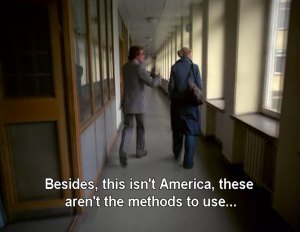
For some reason this comment seemed to jumped out at me on this second viewing (not so 20 years ago). I have come across similar comments from other Soviet bloc films and books. Maybe my interest was piqued because I’ve grown more sensitive to historical and political issues. Maybe it’s because I’ve read Russian artists who chaffed under the Soviet system, yet they still expressed disdain for the U.S. system and the ugly realities of capitalism. If you are a U.S. citizen of long standing then, like me, you were well trained to despise everything Soviet, to see the CCCP as wildly oppressive, to know the Russians stood against “everything we hold dear”, and tag them as the evil empire (as one populist demagogue once put it).

I am glad I did not grow up anywhere in the Soviet bloc. But I also see the game. We are trained to fear other political and economic systems by those who have a vested interest in us being fearful. I think this is true in many countries. Power seeks to remain in power, and does so in part by being the controller of ideas. Even a person such as myself who tries to think critically about these things is still like a fish trying to see the water – I am profoundly influenced by the limited world in which I live. We like to think the world of ideas is unlimited, that we have equal access to any idea or concept, but unless we do the hard work of seeking out alternative ideas, and then really digging deep into them with the goal of understanding, we will tend toward uncritically believing the ideas which are closest and most prevalent.

So it is interesting to me to hear a line spoken in a 1976 Polish film (a film made by a director who’s own career shortly came to a standstill because of support for the solidarity movement) by a government authority holding the high ground morally regarding U.S. society. I don’t know if the producer’s opinion was right or wrong, or if Wajda intended this as a joke, but it is interesting to get a glimpse from the other side as it were. What we sometimes find when we pull back the curtain on communist countries is not always a longing for western style capitalism and U.S. style democracy, but either a desire for their own government to behave rightly in light of the stated goals of their own system, or for the system to change to a more democratically oriented socialism with improved human rights. I found similar sentiments from Tarkovsky in his diaries. That surprised me given my ideological training.

By the end of the film’s story the investigative implications point to a dark end for Agnieszka’s subject. Mateusz Birkut ended up in Gdańsk working at the Lenin Shipyard, where he died. Those shipyards were the birthplace of the solidarity movement. They were also the place where many were killed by the secret police and one of the locations of the infamous 1970 protests. Very likely Mateusz was killed by the secret police in Gdańsk, this would have been something the audience would presumably understood, but Wajda leaves that an open conclusion – but not entirely open as he took up the story again in Man of Iron (1981) in which the protagonist is Birkut’s son.

I don’t typically give reviews, and this isn’t one, but I will recommend this film. Man of Marble has two qualities: 1) The film is clearly the work of a master filmmaker who has developed into a mature storyteller, and 2) The film feels like a rough around the edges independent film that vibrates with life. It is not like American films, and therefore worth seeing for that reason, but it is more. Man of Marble is a window into another world, two worlds in fact. But it is also a kind of window into our world, for it raises universal questions of official truth and the value of investigative journalism, two things we could use more of today.

>a curious absence

>I am curious and concerned about the popular reaction in the U.S. to the economic crisis. The reaction seems to be a combination of moral outrage and complete acquiescence to the “current financial situation,” or whatever we’re calling it. The American people (including myself) are complaining a lot and doing little.

Publicly protesting is not a complete solution by a long shot, but it can be an important element in changing our society for the better. In numerous places around the world over the past several months there have been protest and strikes in response to the global economic meltdown and various governments’ actions. Here are some:

Protests in Eastern & Central Europe

Protests in France

Protests in Greece

So where are the protests in the U.S.? This is the country most responsible for the problem. This is the country doling out the largest dose of corporate welfare (in an already corporate welfare state) in world history to those companies most culpable. This is the country in which those government leaders and those captains of Wall Street who created the policies that made the collapse as easy as possible, are the same one’s now hired to fix the problem. There is a lot of outrage for sure, and many ordinary Americans have played their part in the mess as well, but it seems everyone is just sitting by hoping things will get better.

It appears to me the fundamental issues underlying the problem are moral and systemic. Both of which should send people into the streets. But, so far, not in this country. Any thoughts?

>Reading Marx’s Capital with David Harvey

>For forty years David Harvey has been teaching Karl Marx’s Das Capital. Recently his 13 part (two hours each) lecture series has been made available through iTunes. [Go to iTunes/iTunes Store and search for either “Reading Marx’s Capital” or “David Harvey.” You can choose either the video version or the audio only version.]

Harvey’s goal is to truly understand what Marx was saying rather than preach some standard line about Marx. He is a fan of Marx and so one could label him a Marxist, but his studies often end up undercutting the popular myths about Marx. As one would expect, that undercutting is one of the benefits of a close reading.

The first 5 or 6 of the lectures are also available on Google video. Here’s #1:

http://video.google.com/googleplayer.swf?docid=-5820769496384969148&hl=en&fs=true

>Hauerwas on Bonhoeffer

>I have been reading Stanley Hauerwas’ book The Peaceable Kingdom: A Primer in Christian Ethics and I love it. I must say that this book, along with some others, are encouraging my views to change (views that were trained into me by the chistianity in which I grew up) regarding politics, faith, and action. In other words, I am slowly shedding my Baptist/Evangelical acceptance (dare I say love) of “righteous violence” and “just war” for a more pacifist perspective.

Because I know little of Hauerwas I went looking for him on the Interwebs. I came across this lecture of Hauerwas speaking on Dietrich Bonhoeffer’s perspective on truth. It is excellent.