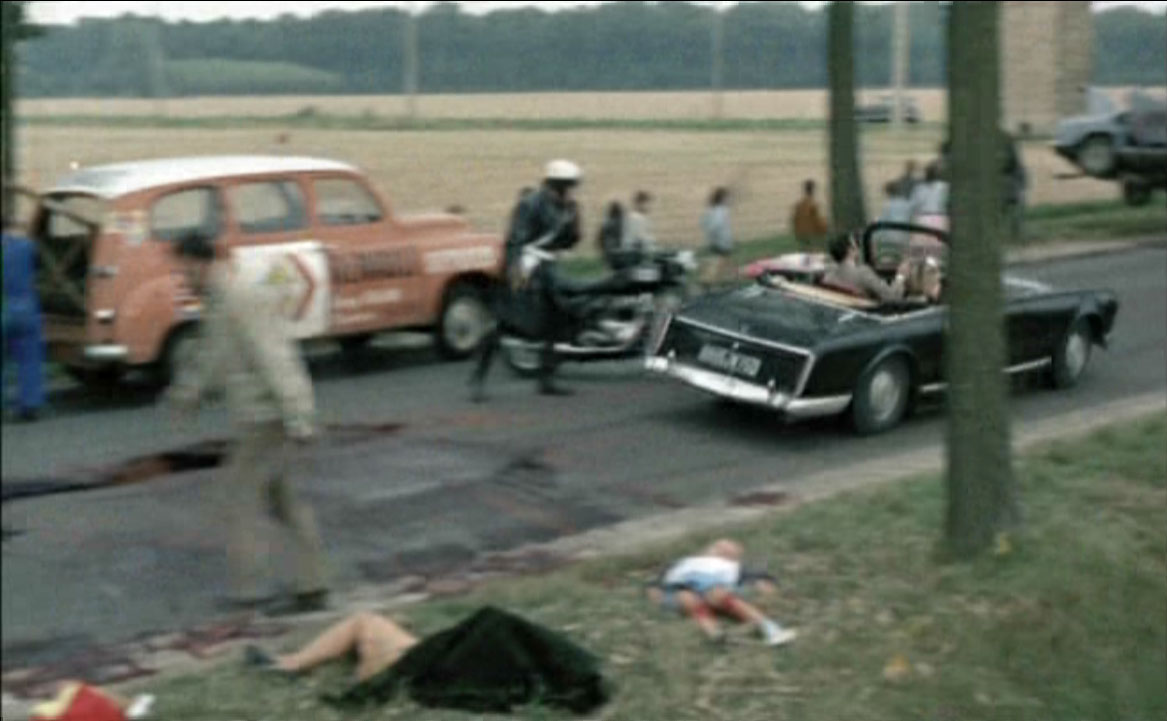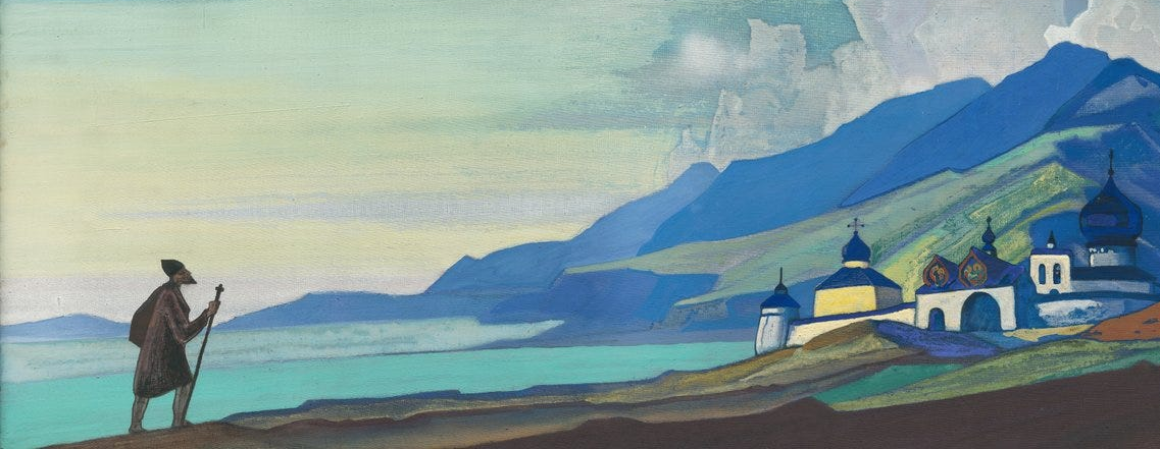
theology and the narrative arts

[In this post I ruminate on the relationship of art to our belief, or absence of belief, in God, god, or gods. As is typical for me, my train of thought is more lurching than steady, and my end goal is more personal than pedagogical.]

Our lenses
I love Pasolini’s seminal filmIl Vangelo secondo Matteo (1964). It is a work of great and simple beauty. It is also a powerful film that flies in the face of the overly sentimentalized and often lifeless versions of Jesus’ life that came before. And yet, Pasolini, though he seems to be taking the story directly from the words on the page (the Gospel of St. Matthew), understands Christ through his own political and personal commitments. In other words, Pasolini, the devout Marxist, unabashed homosexual, and hater of the Catholic Church, saw a Christ that was thoroughly materialist (philosophically) and politically radical (of the socialist ilk).
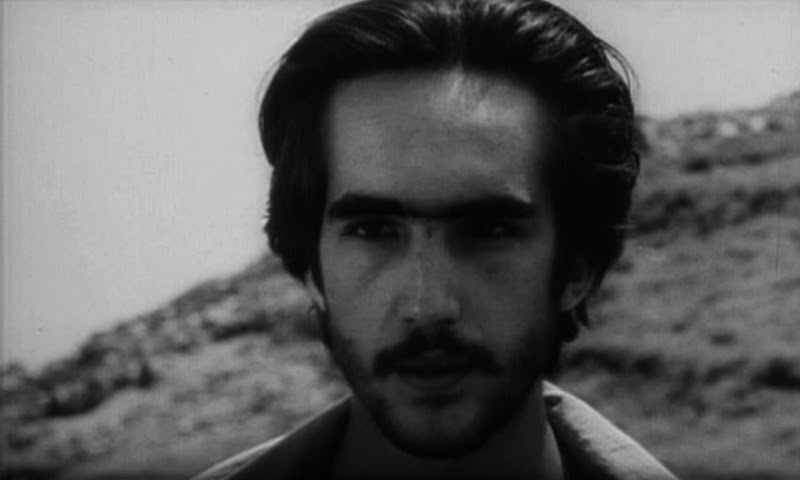

An earthy, socialist Christ
Enrique Irazoqui as Jesus
from
Il Vangelo secondo Matteo (1964)

As I understand it, for Pasolini, Jesus was a kind of pre-incarnate Karl Marx (rather than the incarnate God) who challenged the status quo of his day, and died as the earliest socialist martyr. Pasolini’s belief in the non-existence of God played a big part in how he saw Jesus and why he made the film. In a sense one could say Il Vangelo secondo Matteo is a kind of materialist corrective to the church’s position.

As I said, I love Pasolini’s film, but he got it wrong. I say this because of my own beliefs about God and about Jesus which, though personal on the one hand, I believe are also objectively true. My understanding of God is integral to the set of the “lenses” through which I look at the world. In other words, the difference between me and Pasolini is not really about any of his films, rather our differences go back to our presuppositions about God, truth, and the goals of human existence – even if we may agree on many things, and no doubt I am generally in awe of him as an artist.

Certainly great works of art are not, in our experience, predicated on any particular belief about God.

The God Who Is There
I have been thinking lately (and off and on for a long time) of the role that theology plays, or does not play, in how one approaches watching a film, looking at a painting, listening to a piece of music, or reading a book. So much of what we get out of a work of art comes from what we are able to bring to it, especially what it is we want from that particular work of art, and of art in general. What we want, I believe, is deeply affected by, and even grows out of, whether or not we are convinced of the existence of God, or god, or many gods, or none at all. So much depends on whether we are convinced of some ultimate meaning in the Universe, or whether we believe there is no ultimate meaning. And so much depends on how honest, even ruthlessly honest, we are with ourselves about these issues and their implications.

I use the word theology specifically. The term “theology” is a compound of two Greek words, θεος (theos: god) and λογος (logos: rational utterance). What I am interested in is a reasoned and rational examination of God, not merely of some vague spirituality (but that’s another presupposition isn’t it). What I find critical is the blunt question: Do you (do I) believe in God? How one answers that question has profound implications.

But the question is already on the table. We have inherited it. We can’t get away from it, just as we can’t get away from a myriad of other questions. And how we live our lives, including the art we make, is directly related to our answer. Art is a part of how we live our lives and, in many ways, emerges from the very heart of the matter. This is as true for Pasolini as it is for Spielberg as it is for Tarantino.

Often a work of art has, embedded within it, the answer to the question. Sometimes that answer is obvious. More often the answer is like backstory, a kind of presupposition that sits in the background and informs the art out front, as it were.

Moral Objects
A work of art is, in some ways, a mysterious thing. Like love, we know what art is, but we can’t always nail it down and give it a clear definition and well defined boundaries. Art emerges from deep within our humanness. Every culture and society has organically produced art, that is, art which emerges naturally from withing that culture or society. When I was an art history major many years ago I was introduced to many ancient works of art, via slides of course, like this exciting number:


Seated female, Halaf; 7th–6th millennium B.C., Mesopotamia or Syria
Ceramic, paint; H. 5.1 cm, W. 4.5 c
m
Metropolitan Museum of Art

This little statuette dates from nearly nine thousand years ago. Most likely it is a symbol of fertility. And most likely it was part of the symbolic rites and proto-religious system of that time. Many thousands of figures like this one have been unearthed. This little object speaks volumes about what was important to that ancient culture, like the importance of fertility to agrarian societies, and the importance of sexuality, and the very human need to supplicate before a god for one’s well-being. It also speaks of the human tendency to create symbols and to understand the world in terms of abstractions.

What I find interesting is how ancient and deeply ingrained is the human need to grasp at metaphysical solutions to the everyday muck of life problems, fears, and desires. I also find it fascinating that humans have to make physical objects that express the metaphysical, the ontological, the teleological, etc.

Even the Israelites, who had seen the ten plagues on Egypt, who had witnessed the parting of the Red Sea, who had the pillar of fire and the pillar of smoke in the wilderness, who had seen the walls of Jericho miraculously fall, and who had seen many other wonders of Yahweh, still created the golden calf, and still kept idols of other gods in their houses, and still built or maintained the high places (religious sites on hilltops to worship gods other than Yahweh). Today we have our idols and gods too – witness the way we worship our sports teams, or entertainers, our possessions, ourselves, for example.

Moral Stories
What humans have always seemed to enjoy are stories of moral dilemmas played out in both mundane and fantastical ways. Consider the medieval mystery plays. These were more than merely pedagogical in nature, they were social events that brought people together and incorporated some audience participation, including talking back to the characters during the performance, etc.

I hear that in some movie theaters in other countries (I write from the U.S.) audiences are very vocal and even talk to the screen, as it were, and critique out loud the actions of the characters while the film is playing. Regardless, quiet or vocal, we all seem to gravitate toward the moral. We like passing judgment, we like justice, and, interestingly, we like wickedness too. However, without some kind of absolute from which morality emanates, having a moral opinion is, in final terms, as much comic as it is tragic.
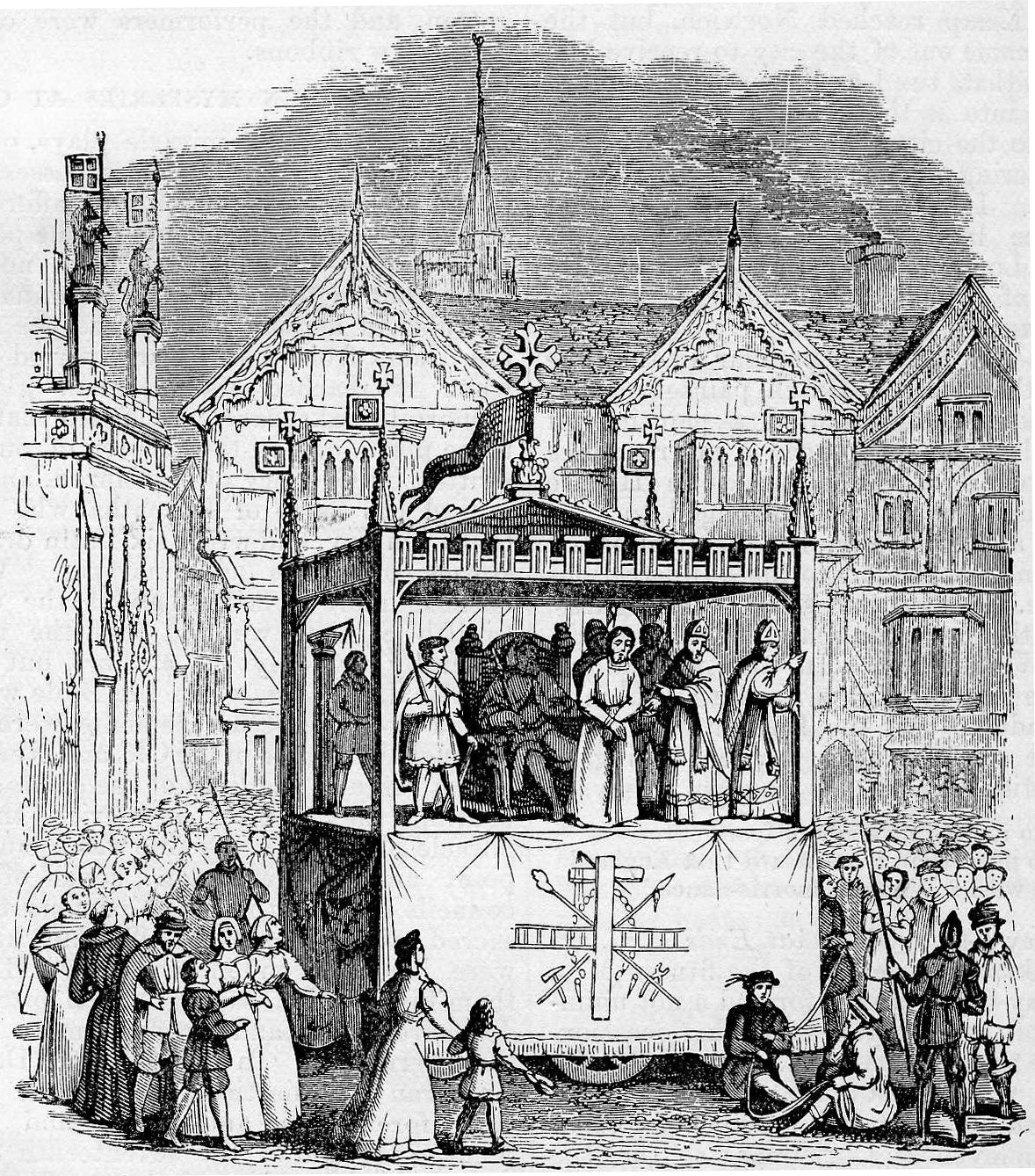

Medieval Mystery Play

So why do we continue to hold moral positions in a morally relativistic and credulistic world? If I had a clear answer I could probably chair some philosophy or psychology department somewhere. My guess, though, is that we will invent an absolute if we can’t find one. In other words, if one doesn’t believe in moral absolutes, or in something big enough (God for example), then one will invent a substitute absolute, for example: an economic or political system, or a biological and physical set of laws, or maybe an absolute that claims there are no absolutes. Regardless, the moral story still digs deep into our souls.

Even the most mundane and vapid kinds of films have some moral content which can be understood within a larger framework of meaning. Consider this audio review of the recent film Tranformers by a pastor at Mars Hill Church in Seattle. (The review is at the end of that post.)

Only Physical, or Metaphysical?
As I take a look at the popular art of today, that is, television shows (i.e. CSI, Survivor, et al) and film (i.e. Michael Clayton, Enchanted, et al), I see worlds presented that do not include God, or any so-called traditional god, that is, a creator deity with whom our destiny lies. These are materialistic worlds, worlds in which stuff is the ultimate reality, no final truth, and no source of meaning. Interestingly, the goals of the characters are all about meaning, and soul searching, and truth.

The characters or contestants are driven forward by things or ideas that they deem important. This is basic story telling. This is fundamental script writing. But it doesn’t make sense if there is no final meaning in the universe, otherwise it’s just a cruel game. Why should we care that someone is searching for something that doesn’t exist? Or even if, for some untenable reason, we do care, why should they search? Consider this quote regarding the modern predicament:

The quality of modern life seemed ever equivocal. Spectacular empowerment was countered by a widespread sense of anxious helplessness. Profound moral and aesthetic sensitivity confronted horrific cruelty and waste. The price of technology’s accelerating advance grew ever higher. And in the background of every pleasure and every achievement loomed humanity’s unprecedented vulnerability. Under the West’s direction and impetus, modern man had burst forward and outward, with tremendous centrifugal force, complexity, variety, and speed. And yet it appeared he had driven himself into a terrestrial nightmare and a spiritual wasteland, a fierce constriction, a seemingly irresolvable predicament.

~Richard Tarnas, The Passion of the Western Mind
What does one do with this? How does one come to terms with a spiritual wasteland, or an irresolvable predicament? Is it so that rational human beings must suffer the conflict of a great desire for meaning in a world that has no ultimate meaning? Is religion an answer or a placebo? No matter what we do we do not get away from these questions. How we solve them, or come to terms with them, is a big deal (or maybe it is also meaningless). My contention is that there is a God, that that God is there, and that that God is knowable. But am I deluded? I don’t think so. And the person who thinks I am deluded believes from a place of conviction as well. I find this more than fascinating.

Michael Clayton

What most recently sparked my thinking about all this God and art stuff was a recent viewing of Michael Clayton. The story in this film plays itself out in a Western (geographically & conceptually), materialistic world where there is no transcendent god. It is a thoroughly modern view of human existence. There are no moral absolutes. And yet, Clayton is a man in search of himself. He is in desperate need of a positive existential moment. He needs to make a self-defining, self-actualizing choice so that he can move beyond his cliff-edge existence and become who he should be. He needs to make the right choice even if it is difficult and painful, even if it means giving up who he has been. There is nothing narratively original in this aspect of the story. It is as timeless as a Greek tragedy.

The story revolves around a legal battle in which a company is being sued for its harmful actions. Arthur Edens (Tom Wilkinson) is the attorney working the case. Unfortunately for his law firm and for his client he is deeply troubled by the case. He feels he is defending murder, in a sense. The firm sends Michael Clayton (George Clooney) to talk with Edens. Part of that conversation goes like this:

Michael Clayton: You are the senior litigating partner of one of the largest, most respected law firms in the world. You are a legend.
Arthur Edens: I’m an accomplice!
Michael Clayton: You’re a manic-depressive!
Arthur Edens: I am Shiva, the god of death
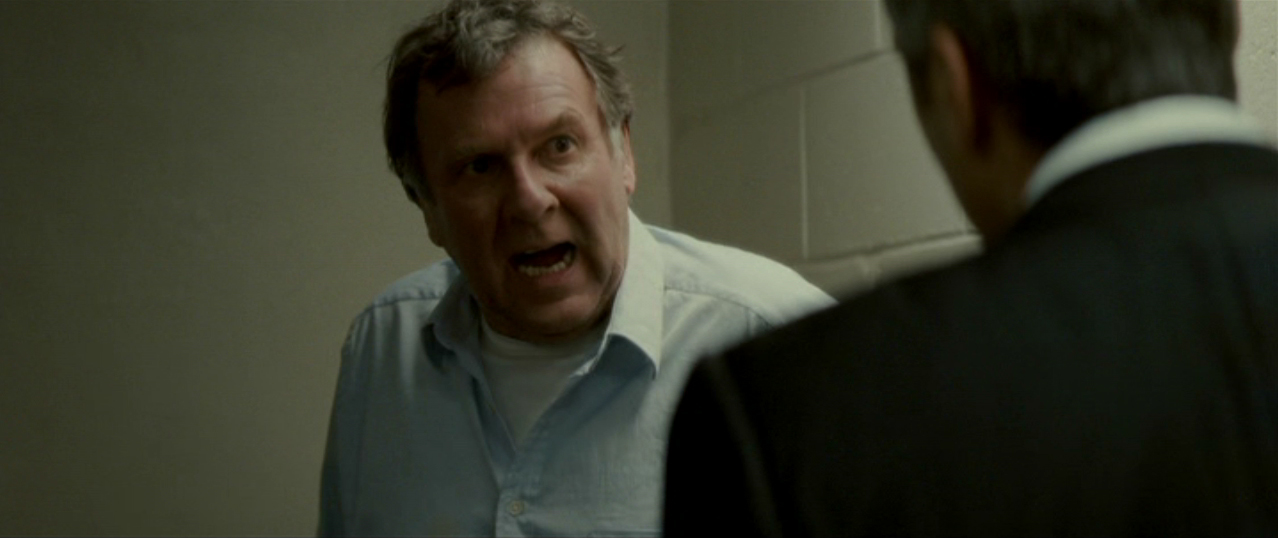

“I am Shiva, the god of death.”

Wow. Where did that come from? Shiva, the god of death? It certainly grabs one’s attention, and it sounds rather cool, but why, in this film, out of nowhere make a reference to one of the principal deities of Hinduism? I say “nowhere” because there is no indication throughout the film that any of the characters believe in any kind of god or religion. In fact, it could be argued that the problem facing all the characters is that, because there is no god, no ultimate reality to which they are finally accountable, they are lost in a sea of moral floundering. Morality becomes personal preference, personal conviction, and power.

Making a reference to Shiva, the destroyer and transformer Hindu god, makes some sense then. First, Edens feels like a destroyer, or at least one who defends the destroyer. He has personal convictions of wrongdoing and it is eating away his soul. Second, in a world personal morality one can choose, as one needs or sees fit, any god that works for the moment, so why not Shiva? Shiva becomes Eden’s god of choice because the concept of Shiva explains his convictions somehow. Shiva is his self-image for the moment. Tomorrow it might be a different god. Maybe Vishnu or Brahma. Or maybe a Sumerian god.

Interestingly the reference to Shiva comes up again. Once Clayton confronts Karen Crowder (Tilda Swinton) with the fact that he has carried out Eden’s plan to expose the company, we get this bit of dialog:

Karen Crowder: You don’t want the money?
Michael Clayton: Keep the money. You’ll need it.
Don Jefferies: Is this fellow bothering you?
Michael Clayton: Am I bothering you?
Don Jefferies: Karen, I’ve got a board waiting in there. What the hell’s going on? Who are you?
Michael Clayton: I’m Shiva, the God of death.


“I am Shiva, the god of death.”

Again it’s Shiva, the god of death, and this time the line is used as a final punctuation to the film’s climax. However, unlike Eden, Clayton uses the line more for its effect on Crowder and Jefferies than from a sense of personal identification. What might that effect be? Within the context of the film, and within the context of a largely non-Hindu society, this line comes as a kind of shock, a non-sequitur of sorts, that specifically draws attention to itself. I imagine the filmmakers intend the line to read something like “I am the fictional, mythological god Shiva (in a metaphorical sense of course) who is bringing about a kind of death to you, a death that you are powerless to avoid.” In other words, we are not to assume that the filmmakers or the characters actually believe in the existence of Shiva, rather the idea of Shiva is appropriated in order to convey something meaningful.

To the person who does not believe in Shiva, such a line might merely have a kind of cool factor. To a devout Hindu this line might be somewhat disconcerting – I don’t know because I am not a Hindu. What is interesting is that none of the characters have made a conversion to any religion, or even gone through any particularly religious experience. Edens has had mental breakdown because of deep moral tensions. Clayton has crossed over into a personally powerful existential decision. But neither have obviously embraced Hinduism. (If I missed something, let me know.)

Interestingly, the narrative arc of Michael Clayton follows a traditional Western style morality tale. And yet, one could say the characters, who do not overtly believe in any god, still wrestle with issues that derive their moral content from a Judeo-Christian heritage, and then, ironically, symbolically claim a Hindu god as justification for their actions. I find this both puzzling and not surprising. It is exemplary of the pluralistic/post-modern society that I live in.

In the film’s final shot we see Clayton riding alone in the back of a taxi. It is a meditative shot. He does not look happy or fulfilled. Maybe he is, but his countenance is rather sullen. Has he saved himself by his actions? Has he found redemption for who he was? How can he be sure he has actually changed as a person? None of these questions are answered. One could say that finally he made the right decision after a life of bad ones, and that is good. But one could say that he still has not solved the deeper question of his existence.

The radical truth is that in a world without a God that stands as an ultimate source of meaning then any decision made by Clayton does not really have any meaning. His final decision, though it may resonate powerfully within us the viewers, doesn’t really matter, no matter how personally, existentially transforming it may be for him. At best one can say he made his decision, so what. Any decision would have had the same value. But, of course, we know deep down that can’t be true. We live knowing there is right and wrong, and what we believe we believe to be true.

Crimes and Misdemeanors
Consider the film Crimes and Misdemeanors, Woody Allen’s brilliant 1989 film about morality, choice, and justice. In this film Allen explores how morality flows from where one begins, that is, from the set of presuppositions one claims about God, the universe, our existence, meaning, etc. He also seriously toys with our expectations (our need) for justice to win out.

The film is also very much about the existence, or non-existence, of God, and what that means. I love this quote from Judah Rosenthal:

I remember my father telling me, “The eyes of God are on us always.” The eyes of God. What a phrase to a young boy. What were God’s eyes like? Unimaginably penetrating, intense eyes, I assumed. And I wonder if it was just a coincidence I made my specialty ophthalmology.

There is something both sinister and humorous about it. It also represents our modern tendency to analyze ourselves and mistrust our motives.

But there is so much more to consider in this quote and in this film. The following two part video analysis is an excellent overview of the film’s themes:

When I first saw Crimes and Misdemeanors I was both stunned and thrilled. At the end I thought “perfect”, that’s how it should end, with him getting away with murder, not because I wanted him to, but because I so expected him to get caught and I liked the irony. Allen turns everything on it head and gets us to think. Thinking is a good thing, especially about truth and morality.

Our view of God has a great deal to do with how we understand and appreciate Crimes and Misdemeanors. If there is no God are the characters and their actions meaningless? Is our desire for justice merely a temporary chemical reaction to a situation that emerged from the chance combination of sub-atomic particles? Or do we live as though our desire comes from someplace more profound?

[Side note: In Star Wars, when the Death Star blows up the planet Alderaan, do we merely observe the rearranging of material particles (something of ultimate inconsequence), or do we assume that blowing up a planet and its inhabitants is an act of evil? Get over it old man Kenobi, you moralist! That was no tremor in the force. Probably just gas.]

Finally

I am inclined to think there is no such thing as a narrative without some moral content.
Either a series of events are purely a-moral, an arbitrary grouping of cause and effect acts without meaning, or they are, in some way, the result of decisions. If decisions are involved then those actions have meaning and therefore have a moral dimension. I see narrative as being fundamentally the result of decisionsand therefore fundamentally moral.

But as soon as well make a moral claim we assume an absolute. We might say our claim is purely cultural or situational or merely a personal decision, but we don’t really live that way. When we say war is wrong, or rape is wrong, or Nazi death camps are wrong, we assume a universal. And if we claim universals then what is our foundation? This is the very point at which our belief or non-belief in God, god, or gods, has the most gravity.

Woody Allen leaves the question open in Crimes and Misdemeanors, but he is relying on the fact that we cannot. He creates in us a tension, and something to talk about. Michael Clayton leaves us somewhat satisfied, yet under its surface there is no final meaning, its only opinion. What is great about both of these films is how they tap into the very human predicament of having to sort out the deep questions of how we are to live our lives and upon what are we going to base our choices.

I can be in awe of an artist even though our beliefs about God may differ. What we have is a common humanity, which is a truly profound connection. Even so, it is worth calling out our differences as well, not for the sake of creating divisions, but of understanding each other and seeking the truth. For we are, by nature, truth seekers. But then that’s another universal I am claiming.

>the trolley problem

>

Original version:
A trolley is running out of control down a track. In its path are 5 people who have been tied to the track by a mad philosopher. Fortunately, you can flip a switch which will lead the trolley down a different track to safety. Unfortunately, there is a single person tied to that track. Should you flip the switch?

Fat man version:
As before, a trolley is hurtling down a track towards five people. You are on a bridge under which it will pass, and you can stop it by dropping a heavy weight in front of it. As it happens, there is a very fat man next to you – your only way to stop the trolley is to push him over the bridge and onto the track, killing him to save five. Should you proceed?

Postscript: Hypothetical ethical dilemmas provide great opportunities to stretch one’s brain. But they can also encourage one to veer away from greater questions by emphasizing the apparent plausibility that truth is finally unknowable and that ethical dilemmas are purely rational formulations. Neither of which are true.

But to continue, what if there are five people on one track and your child is the one on the other? How does that change your decision? Or five very old people one the one track and a young person on the other. Does that change it? Or what if you were one of the five, but still the sole person who could the trolley’s direction. This is rather tricky now.

A different scenario puts you in the position to save both the trolley and all the people on the track if you sacrifice your own life in saving theirs. Would you be willing to do that? What if you did not know those people? What if they were, in fact, your enemies? This is a greater question. However, it is still rather hypothetical.

What if the scenario was not life and death, but benefit and loss? What if you could give someone else a better life if you would give up your own happiness? Is this not a “laying down” of one’s life for another’s? What if the scenario was that you had to give up your pride, be humble, and serve another for their benefit and you get nothing of comparable consequence in return? This is less hypothetical. In fact, it can be part of every relationship, increasing in intensity the closer the relationship.

In terms of profit and loss, what the trolley problem does not ask (maybe it’s assumed) is which decision is better for the decision maker, in terms of damage caused. The scenario assumes that the only consequence is one of numbers of human lives, but there is also the fact that it sets the state of one human soul (the decision maker) against the physical deaths of one to five human beings. The real power of this problem is not in which solution could you better defend in a court room, it is in which decision is truly right, is righteous, which makes it a potentially spiritual problem in a conundrum’s clothing. Thus, the utilitarian solution, which most people say they would choose may, in fact, still create a kind of long-term “haunting” in the decision maker’s soul because there are no good options. This is often a problem in war, where soldiers have to face into the personal ramifications of making terribly unfair choices because the situations themselves provide no other real options. Making such a decision is more than a matter of pure ethics or brain chemistry. In fact, it may have a great deal to do with the state and story of one’s soul.
A humorous take on these kind of ethical conundrums (click to enlarge):

>how should we then live

>I grew up in a Christian home. Consequently Christianity has had a profound affect on my life. When I was a kid I became frustrated with the overly simplistic and emotional approaches to truth that has come to be a part of so much of Christianity. I began to seek out Christians who used their brains and valued rationality. In my teens I came across the philosophical writings of C. S. Lewis. I also came across the writings of Francis Schaeffer. These men, and others like them, helped me to see that faith and reason can, and should, go together. They helped set me on a better course in my search for truth.

Francis Schaeffer (1912-1984) was an interesting character and noted Christian apologist. He, and his wife Edith, were the founders of L’Abri in Switzerland. For a while in the 1970s, because of his stance against Roe v. Wade, he was lumped together with the far right-wing Christian camp. Later, in conversation with his son Frank, he said those people are crazy, or something to that effect. His thinking was far to deep and far too wide ranging to be pegged by any narrow and rather dogmatic camp.


Schaeffer writing

Francis Schaeffer wrote a number of books including, How Should We Then Live: The Rise and Decline of Western Thought and Culture (1976), which was then made into a film. One of Schaeffer’s key critiques was of the personal peace and prosperity ideology that has come to mark much of Western culture, including Christianity. Thanks to YouTube I get to “re-live” a moment from my formative years. Here is a part of that somewhat clunky, but still interesting film:

One of his statements always catches my attention. He says he wept when the sixties gave way to the seventies and the radical cultures that were seeking truth gave way to mere hedonism. Although he did not agree with many of the conclusions of the sixties protesters, he saw their project as valid, which was a different stance to take than that of mainstream Christianity at the time. I wonder what he would have thought of the WTO protests we first witnessed in 1999 in Seattle. I think he might have applauded.

postmodern notebook

We have learned to trust the photographic image. Can we trust the electronic image? With painting everything was simple. The original was the original, and each copy was a copy – a forgery. With photography and then film that began to get complicated. The original was a negative. Without a print, it did not exist. Just the opposite, each copy was the original. But now with the electronic, and soon the digital, there is no more negative and no more positive. The very notion of the original is obsolete. Everything is a copy. All distinctions have become arbitrary. No wonder the idea of identity finds itself in such a feeble state. Identity is out of fashion.

~Wim Wenders, 1989

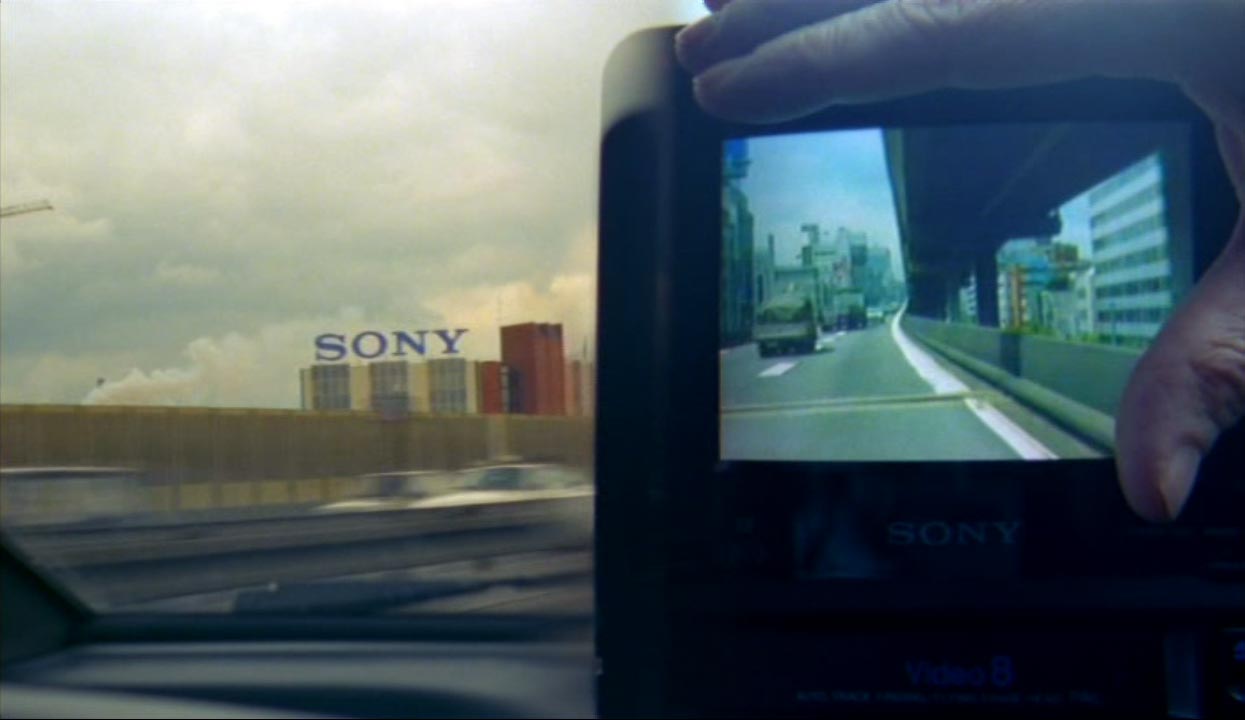
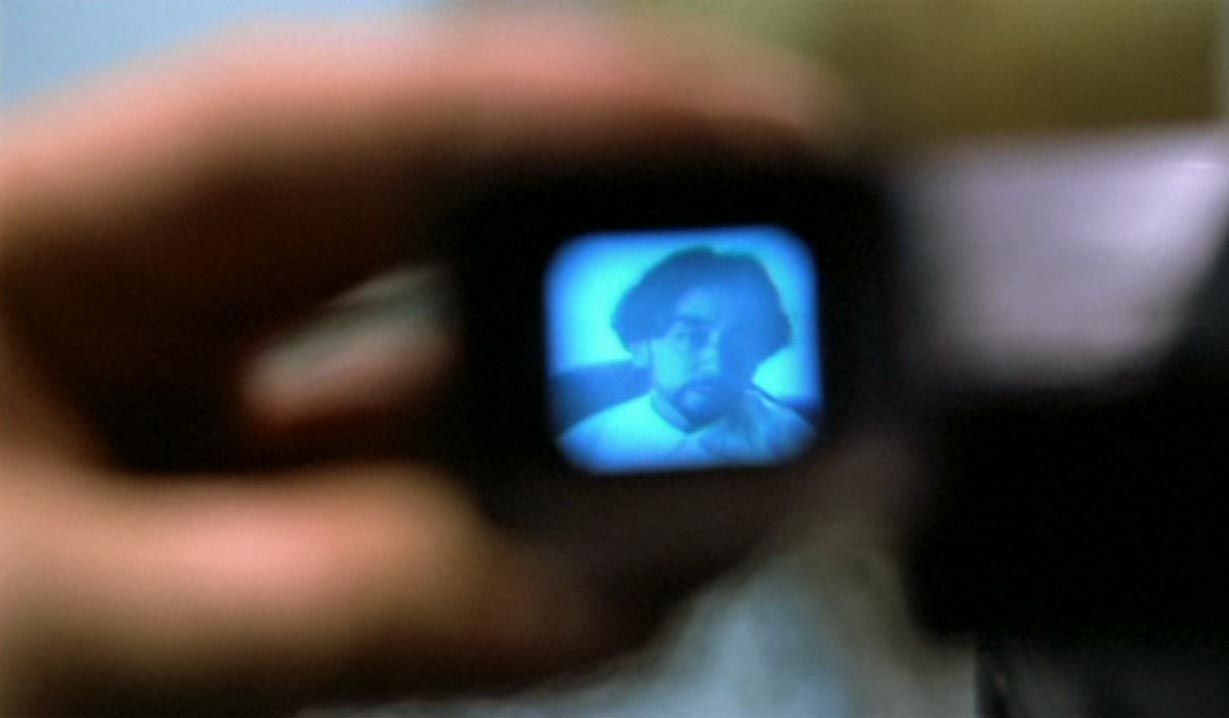
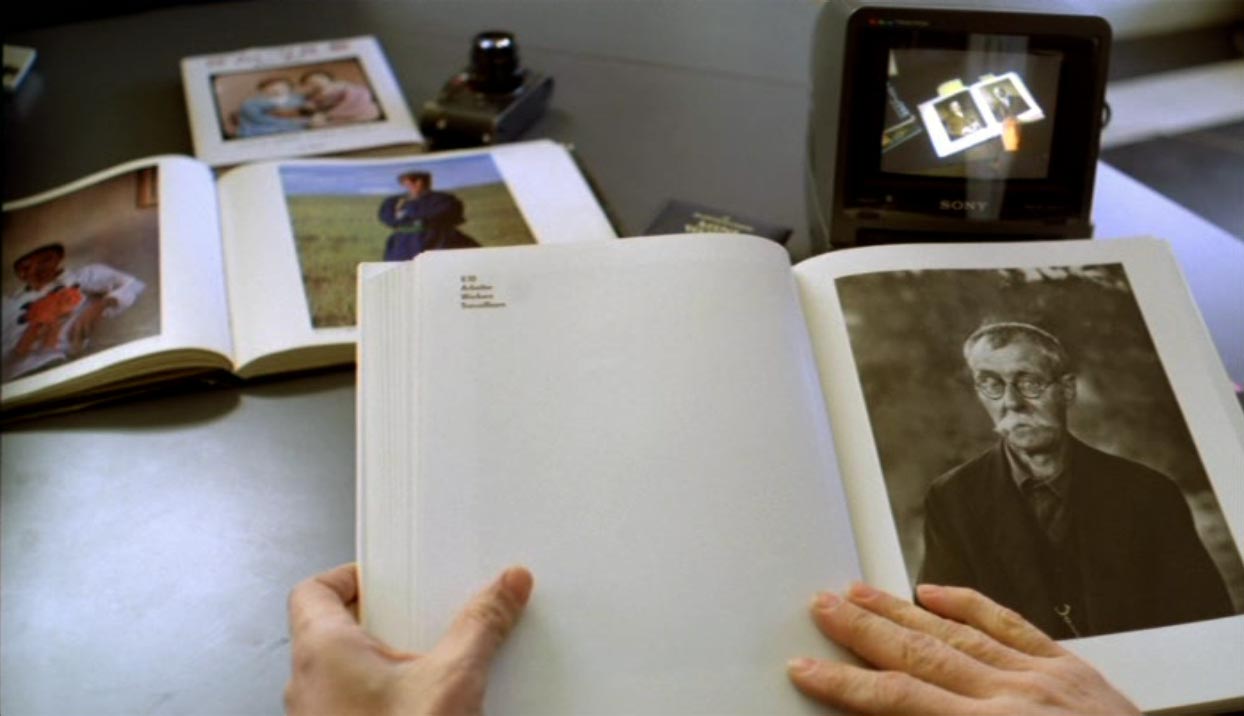
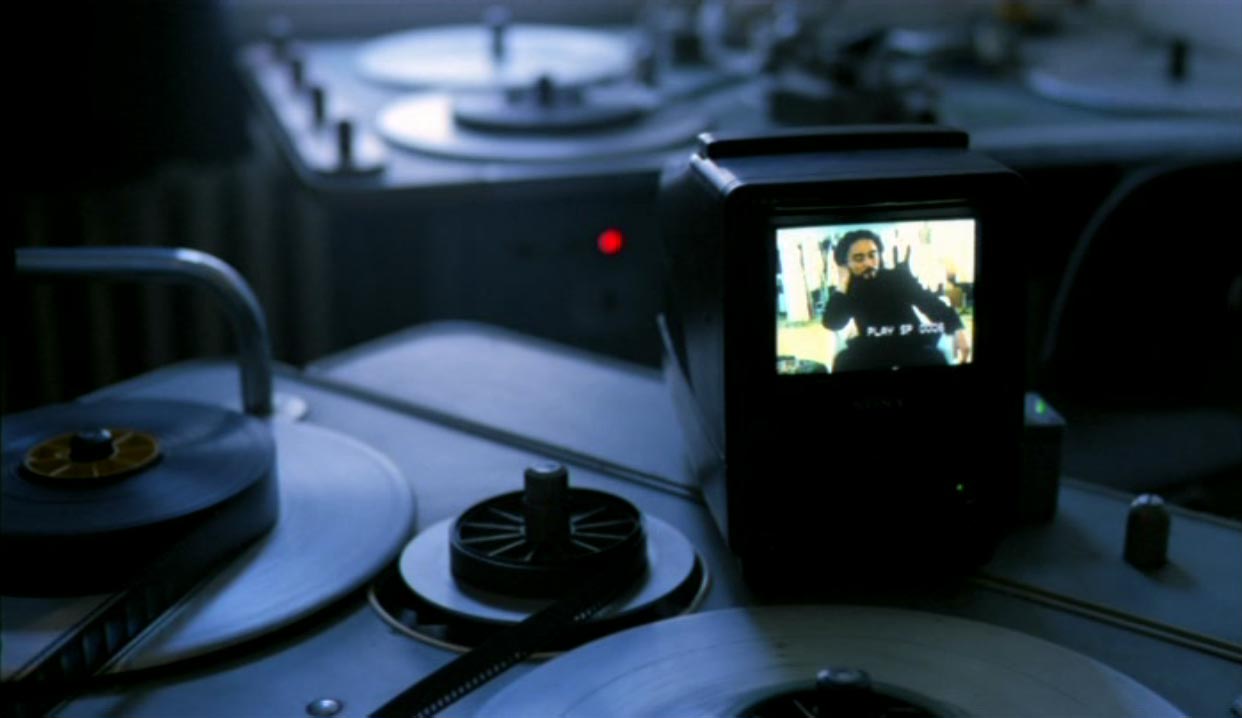
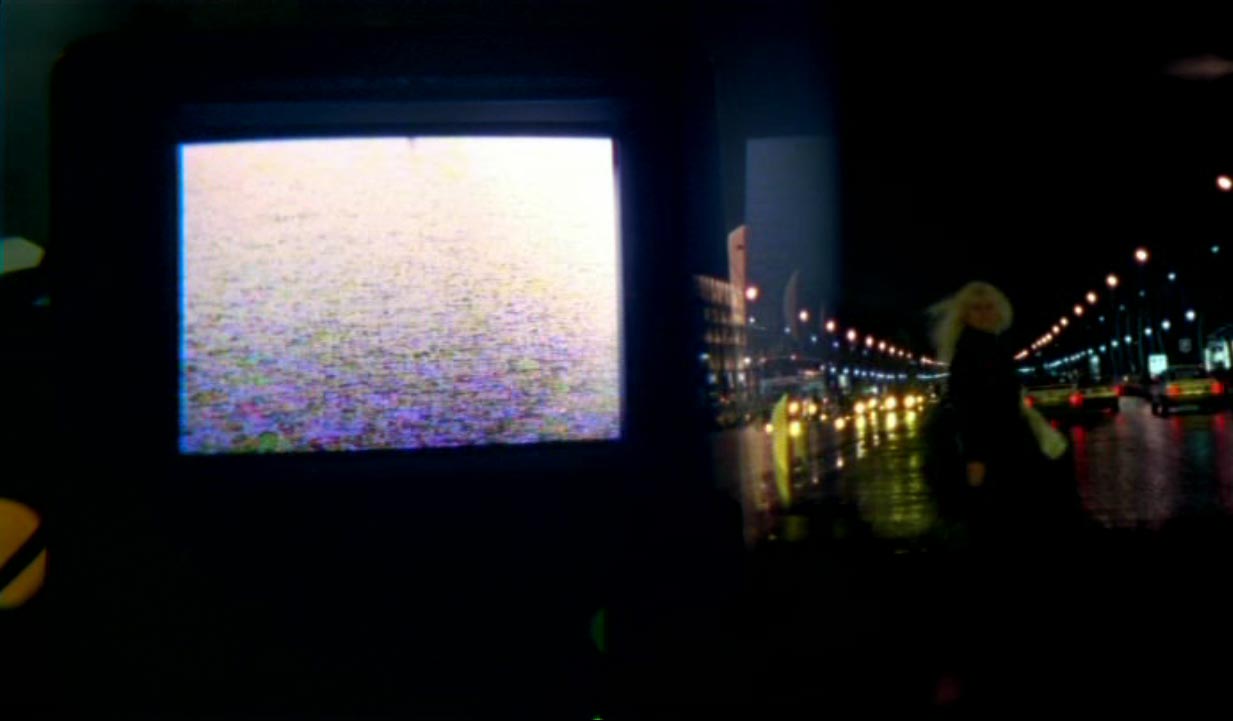
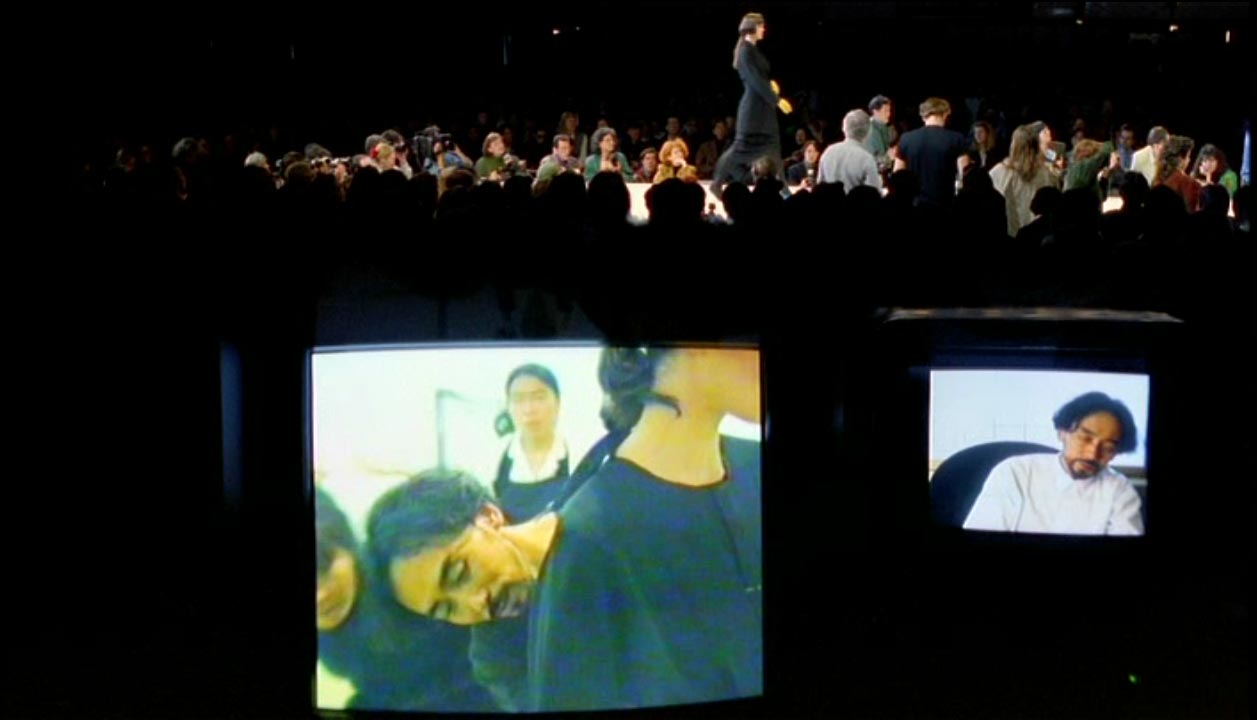
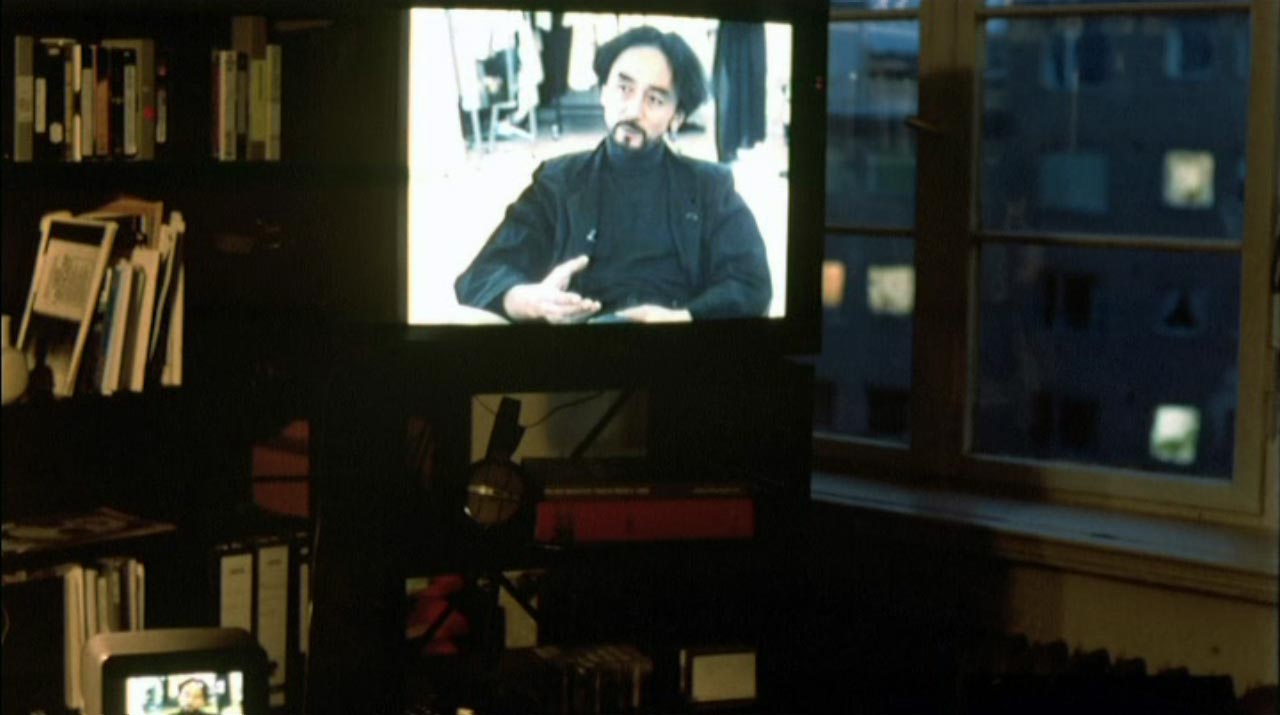
The following screengrabs are from Wenders’ film Notebook on Cities and Clothes (1989). They are all of images within images, and represent/re-present places within places and ideas within ideas.

My mind wanders over these images and then wanders beyond them, both outside their frames and to my own presuppositions and fetishes, and I think of Baudrillard’s quote:

It is perhaps not a surprise that photography developed as a technological medium in the industrial age, when reality started to disappear. It is even perhaps the disappearance of reality that triggered this technical form. Reality found a way to mutate into an image.

-from Photography, or the Writing of Light (2000)

Of course Baudrillard is wrong if we take him literally. Reality has not disappeared. But Baudrillard is right, as all postmodernists are, that the way we understand reality is heavily mediated for us (and by us) to the effect that reality, or “reality”, would seem to be an image created for us, is an image presented to us, is an image we carry with us, is an image we remember, and is an image we create. And, as an image is worth a thousand words, or a million, and therefore images are stories, fragmented or otherwise, connected and intersecting with other stories, stories referencing other stories, images referencing other images, we can apparently say all is reference. With Wenders we have the added question of the ever changing and never original (or always original) electronic image coupled with the question of what is fashion.

I suppose this blog plays a part in how I mediate the world for myself. I write for an audience, largely imaginary, but I also write for myself. Subconsciously, and maybe sometimes consciously, I write so that I can understand the world and my place in it. In this sense I can say that I have my take on reality. But the question is, are all distinctions truly arbitrary? And can this notion apply beyond the world of images to the rest of life?

So some degree Wender’s position hearkens back to his explorations in such films as Paris Texas and Wings of Desire. In those films we see characters struggling to communicate across great barriers (physical, psychological, spiritual) with those whom they love, or believe they love. In Wings of Desire the barrier is the difference between the world of human beings and the world of angels. The film’s story revolves around the idea that to become fully human one has to give up being merely an observer and enter in, that is, to immerse oneself in the tangible messy world we humans call reality. To cross that chasm is to take a leap of faith.

But is faith a leap? In the so-called Western/Christian tradition the word faith has a lot of gravity. Faith is one of those words, like love and happiness, whose meaning we all know and yet can never seem to finally pin down. For many the word has precisely to do with some kind of existential or spiritual leap. And for some that leap is a leap into the unknown or the unsure, or even the absurd. Interestingly, when we read the word faith used by the early Christian writers, such as the Apostles Paul or Peter or John, it is, in fact, the ordinary Greek word for belief. It does not appear that the Apostle’s intentions were to convey any idea of a leap of faith, or of faith being a kind of spiritual ecstasy. For what I can tell they were merely telling others to continue to believe what they have heard about Jesus because it is true, and that they can know it is true because the Apostles were eye witnesses.

Which brings us back to Notebook on Cities and Clothes and the idea of mediation and its relationship to truth. The fact is we are immersed in a world of images, and we seem to understand our world more and more in terms of those images rather than words, and those images are increasingly potentially untrustworthy. We are also in a world in which, while many of the barriers between people and cultures still remain, we are intersecting more and more with an increasingly broader scope of people(s) and a multiplicity of voices. Which means that we live in a world of references, that is, a world in which everything begins to reference something else and is built upon other references.

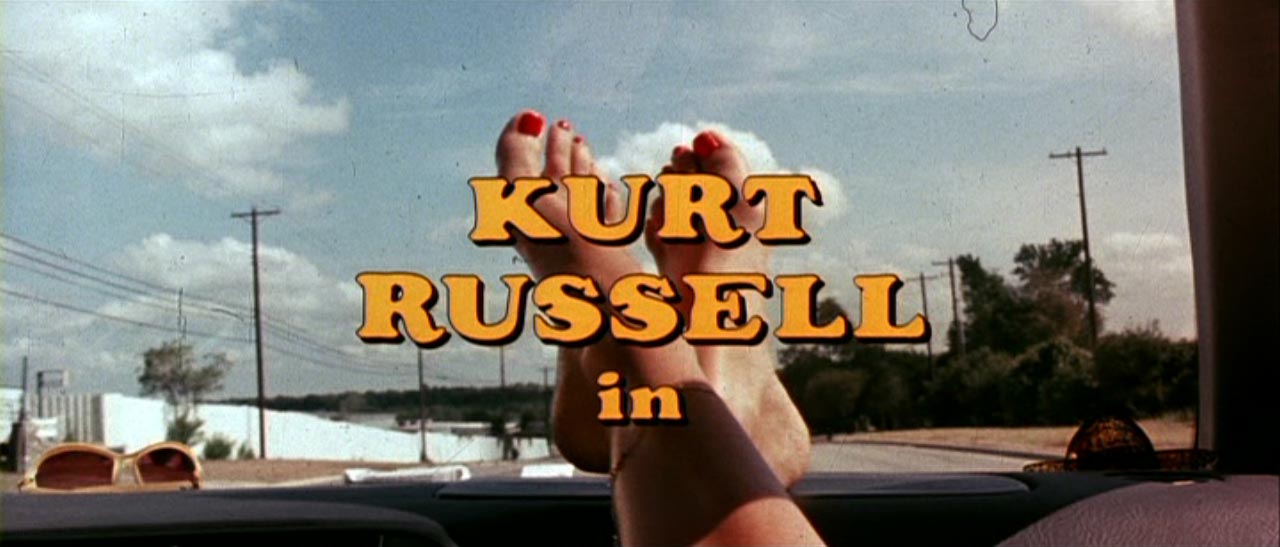
Maybe no other living filmmaker has more fun with playing with references than Quentin Tarantino. Part one of Death Proof immerses the viewer in a 1970s pastiche, full of faux antiquing of the film, samples from 1970s films, and stylistic choices right out of now classic B-movie road and slasher films. The film is designed to draw attention to itself. Tarantino winks at the audience and the audience winks back, along with the occasional high-five and an “oh yeah!” If a drinking game were devised for Death Proof, where viewers had to down a shot for every meant-to-be-obvious filmic reference, players would die of alcohol poisoning after ten minutes.

Examples include this appropriated “restricted” card from the early days of the MPAA rating system:

And this created title that looks like it came directly out of an early 1970s Disney film starring you know who:

Other examples include faux scratches and dust on the film and numerous jump-cuts that simulate a worn out film jumping in the projector gate because of splices and damaged sprocket holes.

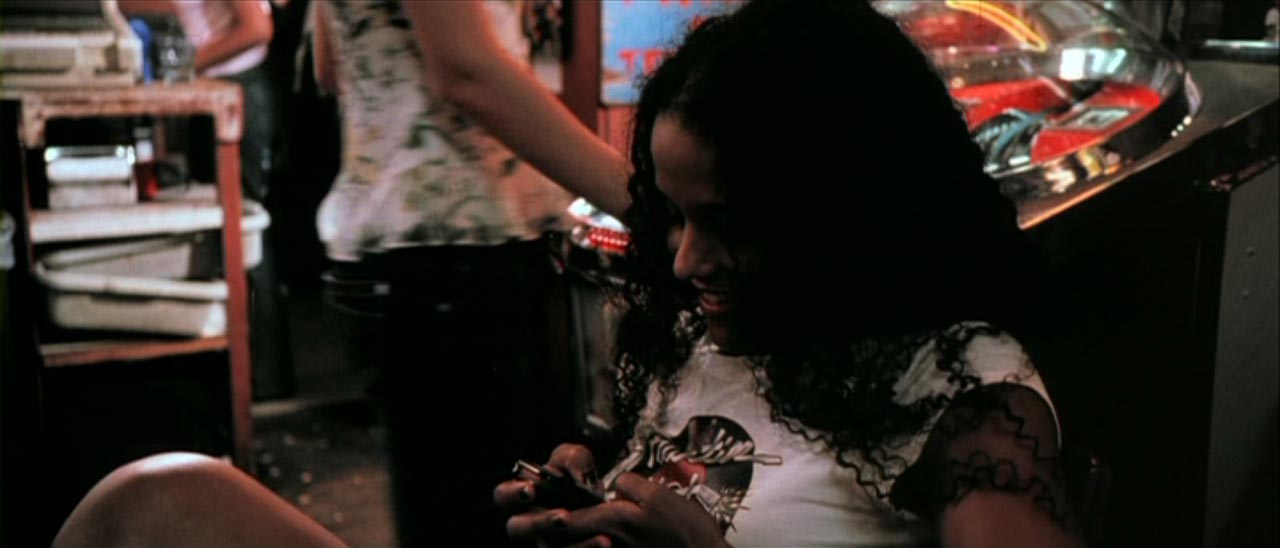
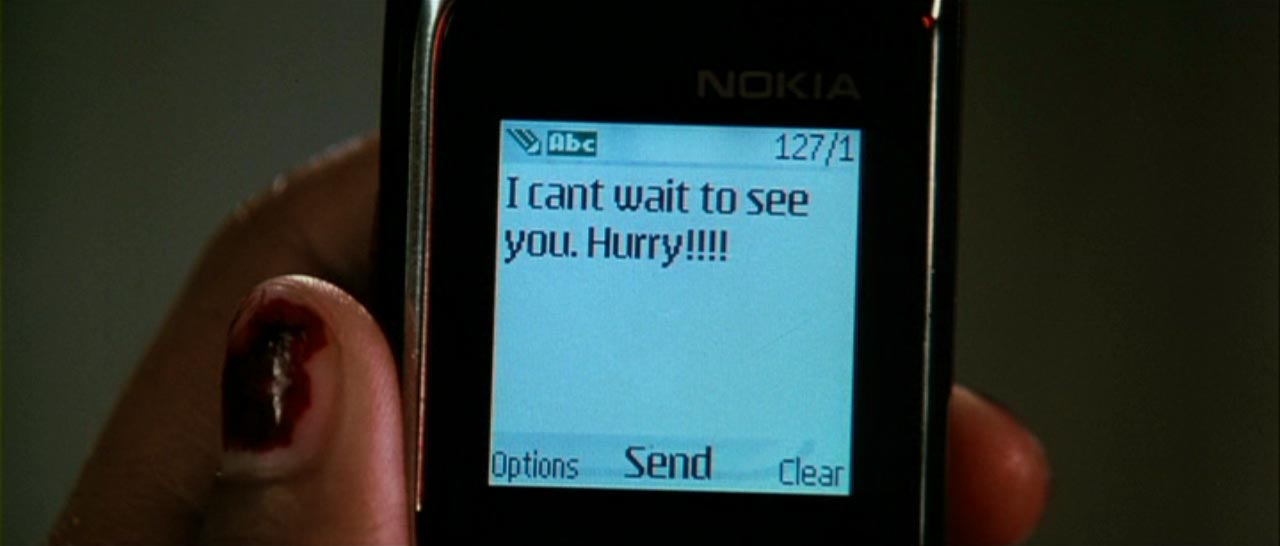
But what is so fascinating is that Tarantino is not making a 70s film. He is making modern film. Consider that while the characters seem to live and play in a archetypal film of a previous era, and while the film makes a point of looking aged and worn out, characters still drive modern cars and use cell phones – like Jungle Julia below.

And yet, I doubt many viewers found this disconcerting, or even noticed, because there are no longer any meaningful distinctions (apparently). For a director like Tarantino there are no boundaries between films or genres or eras, there is only the magnificent cloth of cinema where every film participates in the weave, connecting and intersecting in the psychic playground cinephilia. For Tarantino, I would argue, faith is not a belief in what is true, but in what is cool and can be appropriated. And cool is another word for fashion.

In such a world where does one find one’s identity? Might one say that we are all only references built up from other references? That is the postmodern perspective, and it is the current version of “God is dead.” But is it true? I would say no. Ultimately there is no such world of only references, and we do not live our lives as though such a world were true. Wisdom would say one should always recognize the potential fallibility of our sacred ideas, but we are all creatures of faith, and faith knows there is a final reality that, at least, haunts us. Maybe, as we are immersed more and more in images, so increases the haunting.
convictions and confessions

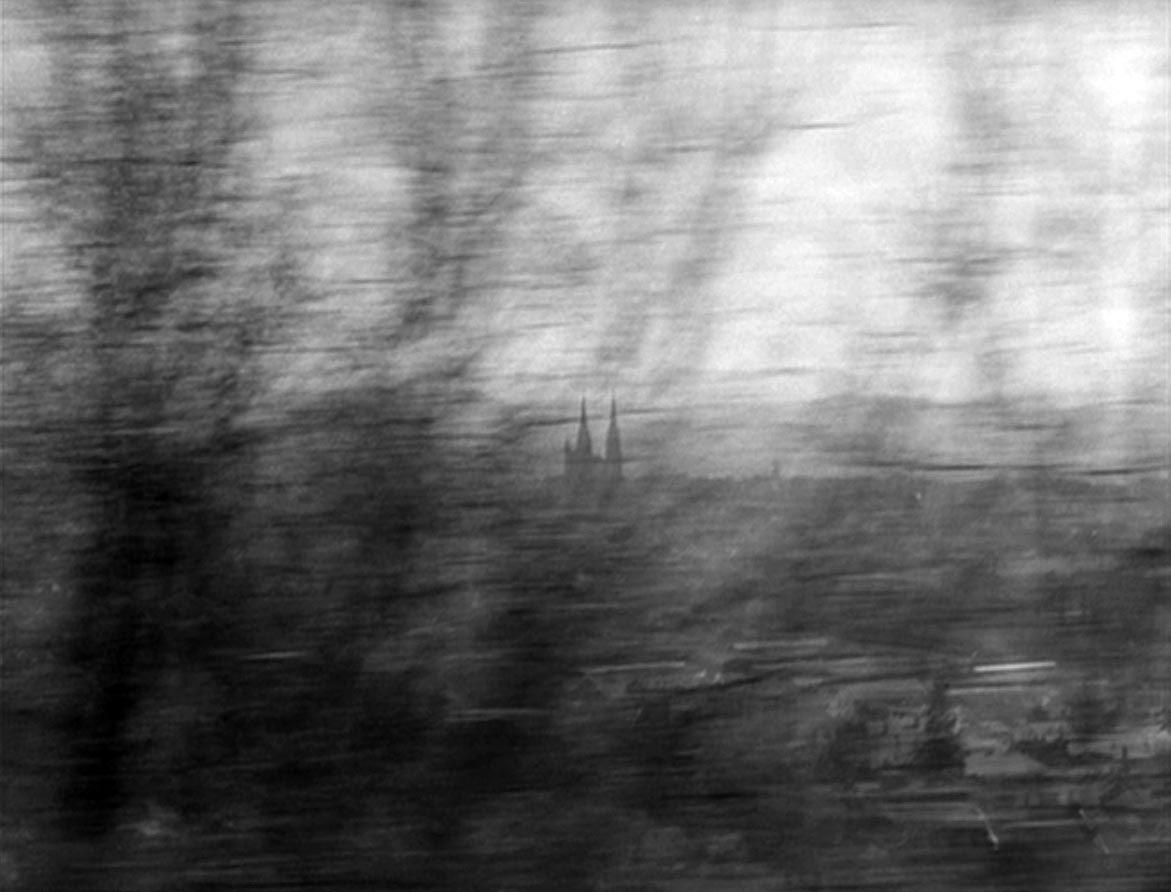
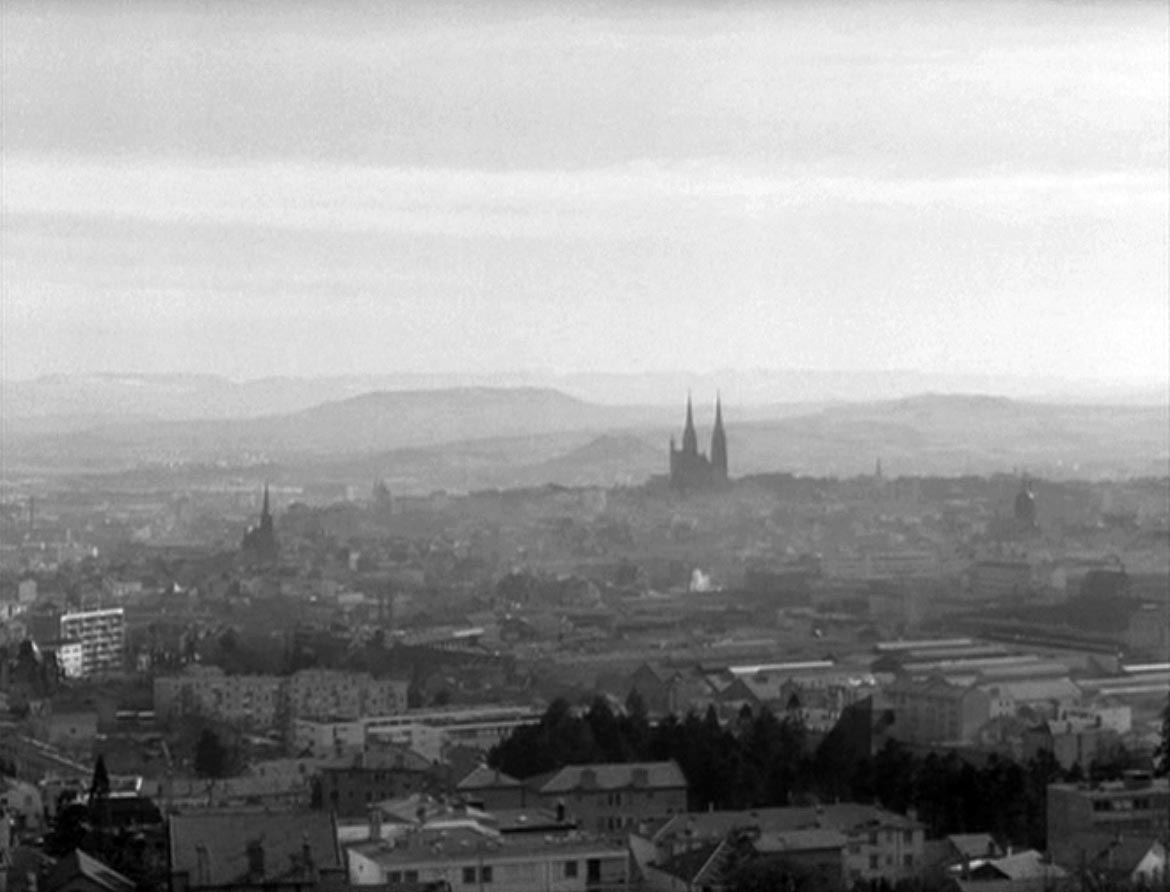
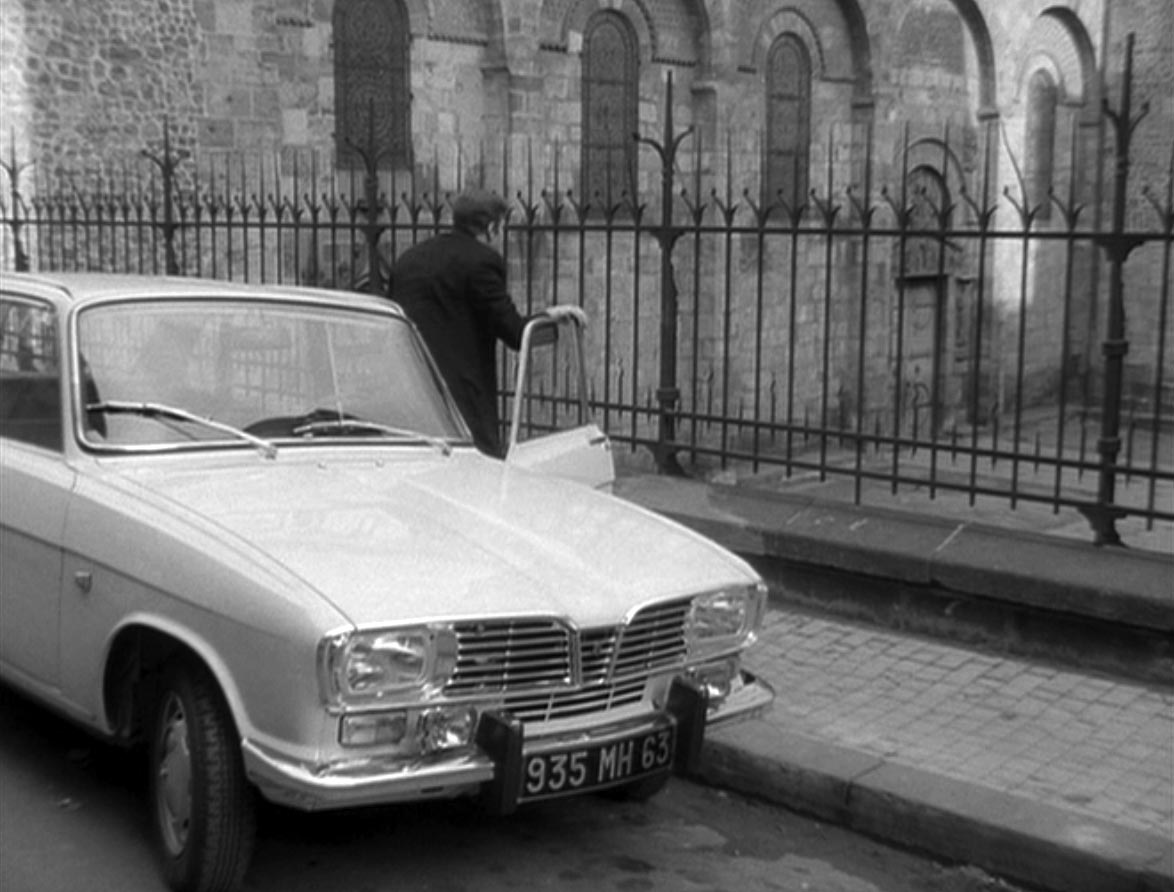
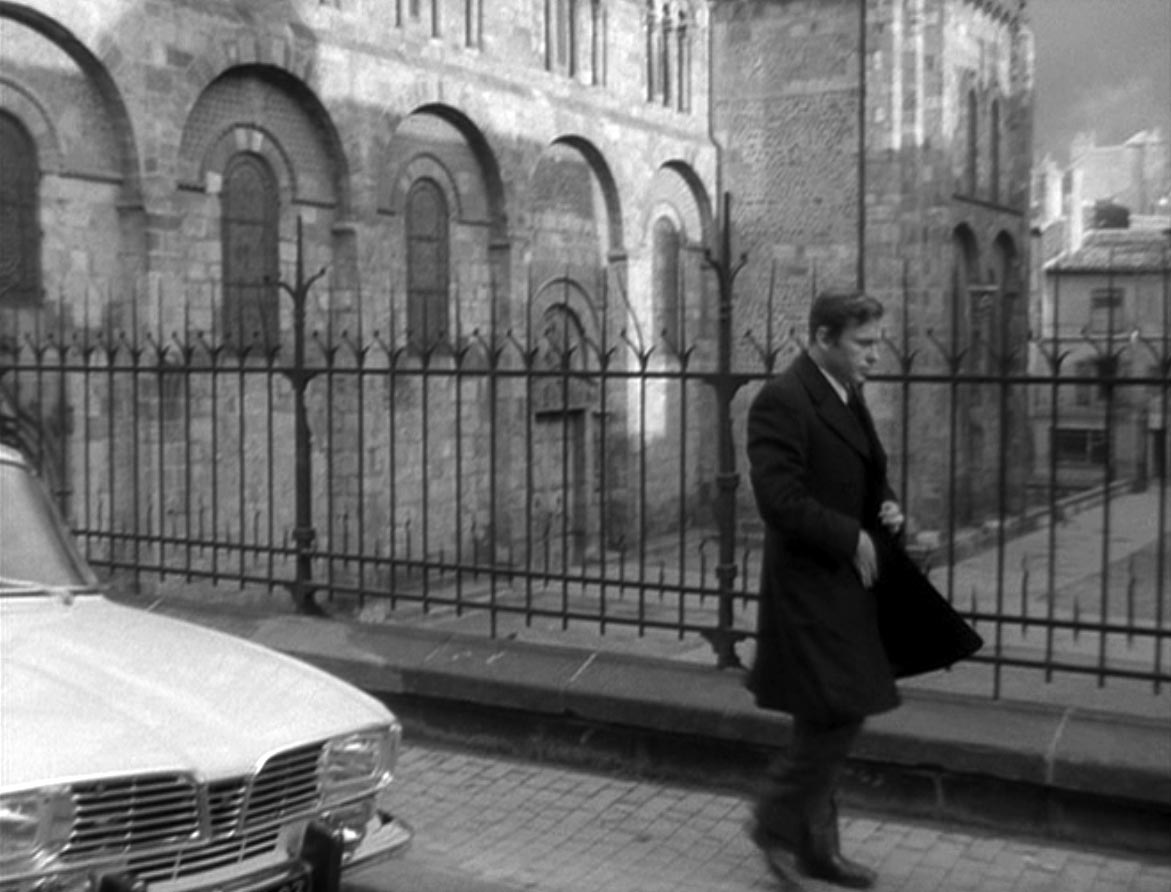
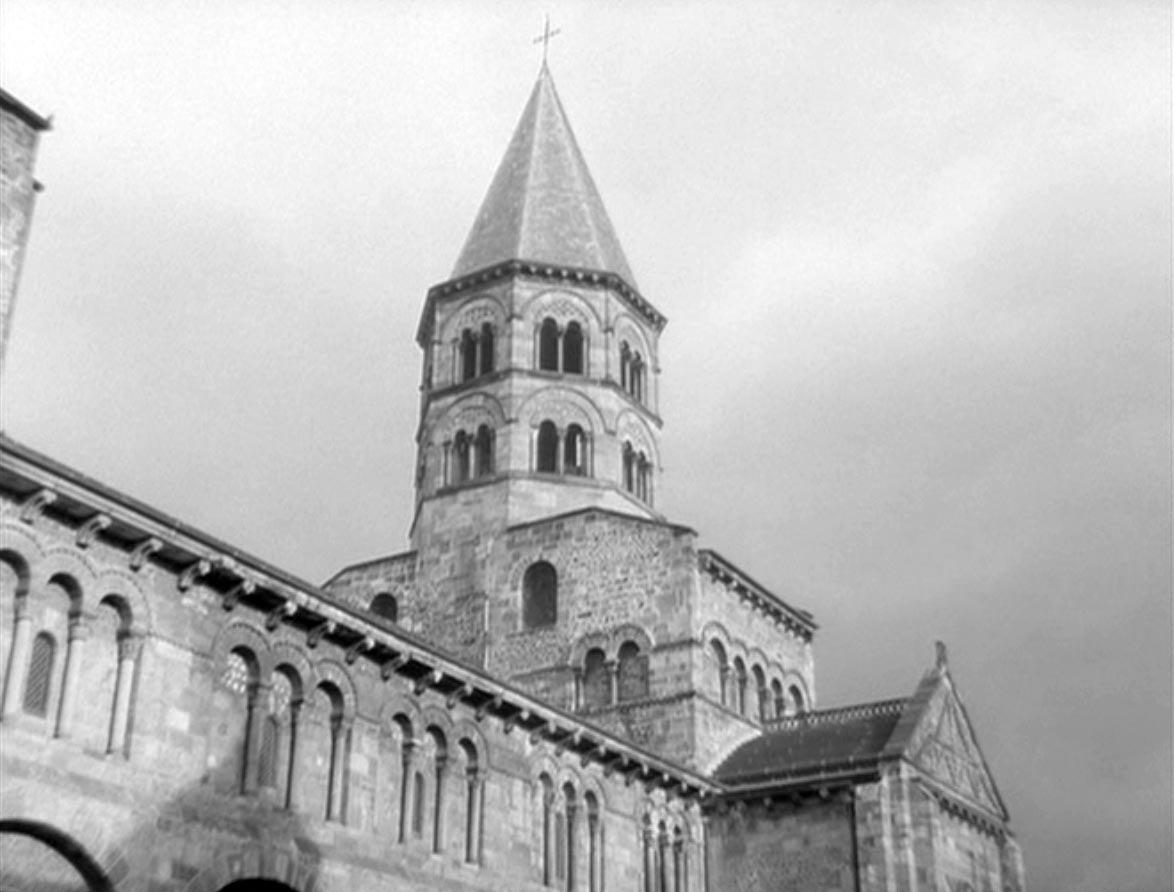
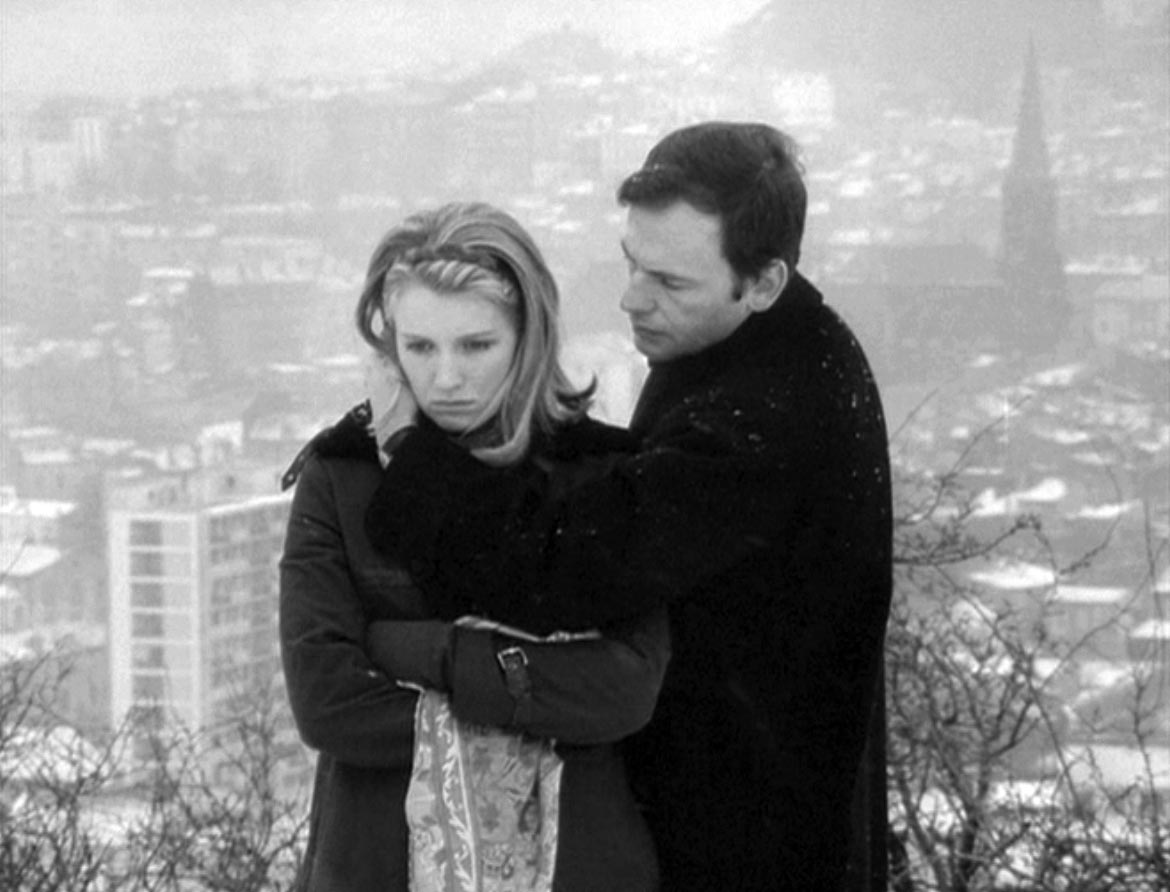
Near the beginning of Ma nuit chez Maud (1969, dir. Eric Rohmer) our hero Jean-Louis (Jean-Louis Trintignant) drives into the city of Clermont. On the way we are shown images out the car window. At one point we see the spires of the church, known as the Cathédrale Notre-Dame-de-l’Assomption de Clermont-Ferrand, a.k.a. Clermont-Ferrand Cathedral, a.k.a. the black cathedral because it is made of black volcanic stone.

At first we see the cathedral spires (96.2 meters tall) partially hidden behind the trees which line the road into the city.
Then suddenly we see the church revealed in the winter sunlight, standing powerfully above the city. We now also see the spire of Notre-Dame du Port, the other famous church in Clermont.
From this image we cut to Jean-Louis getting out of his car. The sound of church bells pealing occur with the edit, almost as though the edit is signaled by the sound of the bells, further drawing a connection between the previous image of the church and Jean-Louis.
Jean-Louis walks away from the car. The camera pans to follow him.
Jean-Louis walks out of the frame and the camera tilts up to reveal a portion of the Notre-Dame du Port roof line.
The connection is clear from a narrative point of view. The church, and more specifically, The Catholic Church (of course post Vatican II, but also in terms of its philosophical heritage), will dominate this story in some significant way. The next scene has our hero attending mass, drawing us even further into a religious context.
As I watched this opening I was reminded of one of my favorite opening paragraphs in a novel:
The Brangwens had lived for generations on the Marsh Farm, in the meadows where the Erewash twisted sluggishly through alder trees, separating Derbyshire from Nottinghamshire. Two miles away, a church-tower stood on a hill, the houses of the little country town climbing assiduously up to it. Whenever one of the Brangwens in the fields lifted his head from his work, he saw the church-tower at Ilkeston in the empty sky. So that as he turned again to the horizontal land, he was aware of something standing above him and beyond him in the distance.
D.H. Lawrence, The Rainbow, 1915
This idea of a distant and looming “something” over one’s life is a powerful concept. It may be true that each of us has something bigger than ourselves looming over us with which we judge ourselves and judge others. If it is not the church, or our families, or our culture, then it is probably the weight of our own existence. There really is no escape. Where is it that we get our convictions? That is a far more complicated question than it might appear. For Jean-Louis the answer includes his Catholicism.
Rohmer placed his story’s time and place at Christmas in Clermont. Christmas raises the issue of Christianity quite large, and it gives Jean-Louis an excuse to go to mass, which is important to the story. We don’t know how regularly he goes to mass, but he does at least on Christmas eve. Clermont is also the birthplace of Blaise Pascal, the Christian philosopher who looms so large (like a cathedral spire) in the story. Pascal’s wager is a critical theme in the film.
I also find it interesting that Clermont was the city profiled by Ophüls in Le Chagrin et la pitié (1969). WWII was not all that distant from 1969 France. Huge moral questions of complicity with the Nazi’s during those horrendous times still plagued many individuals in France even 25 years later. What one does with one’s moral past is an interesting dilemma.
Later in the film Jean-Louis drives again into town and we see the cathedral spires in the distance. This moment comes after he has spent the night at Maud’s.
It is almost as if the spires were calling to Jean-Louis to stay true to his convictions. Or, maybe they are gently taunting his frailty. In either case, they stand above him and beyond him in the distance. There is something interesting in the contrast between the immobility of the church, and all that it represents, and the mobility of our hero driving his car. Maybe that is one of the reasons he finds some solace in being a devout (relatively so) Catholic; when all is in flux, one seeks a handle to grasp. Ideally, that handle is not false.
One of cinema’s greatest strengths, maybe its greatest, is its ability to move. Naturally, car chases, space ships, and explosions often get top billing. But one of cinema’s greatest, often unheralded capabilities, is its ability to dig into the human soul and explore the recesses of the heart. It accomplishes this because cinema can not only move, but consequently it unfolds in time. In this sense cinema is much like literature. But unlike literature, cinema reveals its narrative secrets immediately in a kind of focused reality. A camera pointed long enough at its subject will eventually reveal something true about that subject. Or, one could say, the subject will reveal itself because it cannot help but do so. Cinema also has the ability, in time, to display the rhythm of human nature, especially as individual shots slowly divulge their secrets.
That is why Rohmer’s films can be so transfixing even though so little appears to be happening. Rohmer is a lover of people. Human nature, and especially the human heart, is Rohmer’s subject, and he find his subject infinitely fascinating. And isn’t it?! Some films claim a level of excitement for all their action, clear goals, and simplistic characters defeating their enemies. But there is no subject as fascinating as the human being.

Finally, Jean-Louis, and the woman of his desire, Françoise (Marie-Christine Barrault), salvage their tenuous relationship in full view of the church spire by confessing their sins to each other.

Because they take the plunge, as it where, and tell each other of their past infidelities, they are able to move forward, marry and start a family.
I do not know if Rohmer is a Roman Catholic, but I do see him exploring rather deep issues of confession and reconciliation. To take a position towards the church that leaves questions open for the audience and does not denigrate received tradition, moral or otherwise, demonstrates Rohmer’s sophistication as a filmmaker.
 
Today the black cathedral still towers over the residents of Clermont, alternately challenging and inspiring.
 

>back to the basics

>

The other night I introduced my daughter Lily to the film Back to the Future (1985). Which she loved, even though some of it she didn’t entirely understand. I don’t think I had seen it for twenty years (which kinda blows me away). The truth is, although the story is deeply flawed in many ways, the film is a wonderful, maybe even great, film. One of the parts that make the film so good is the brilliant performance of Crispin Glover.

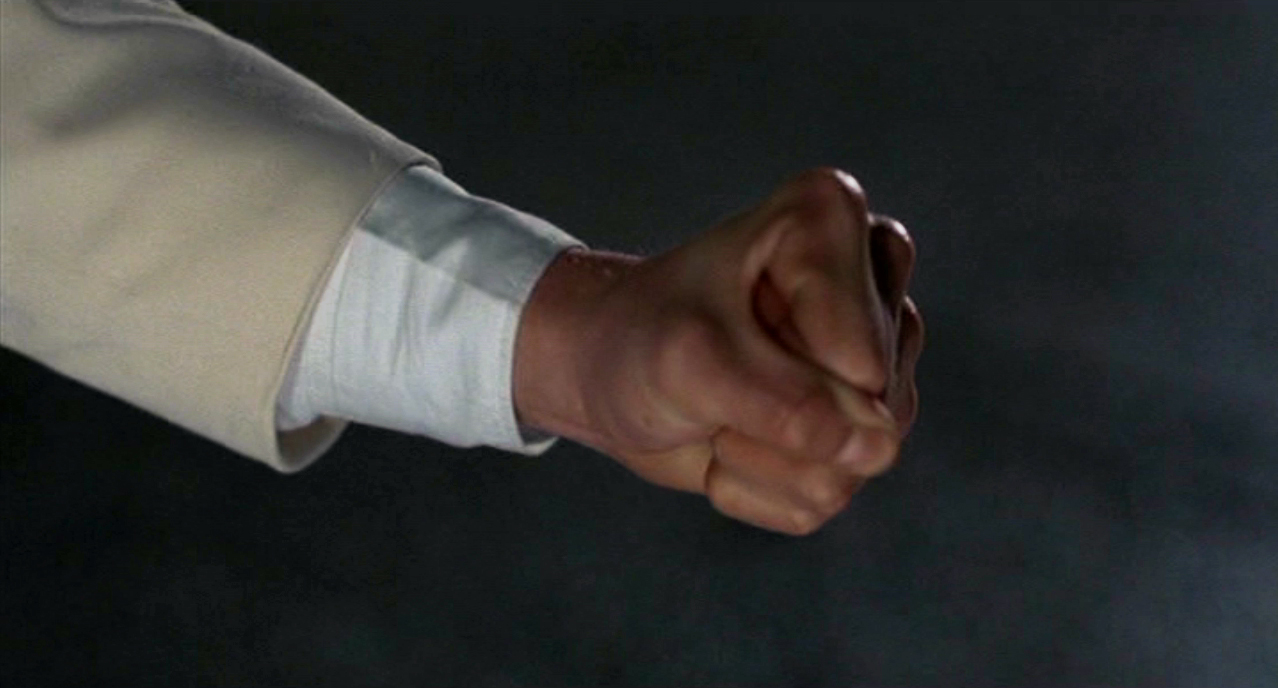
Here is an example of Glover’s acting, at the critical moment George McFly (Glover) has just punched and knocked out Biff (Thomas Wilson). In a matter of just seconds we see George reacting to the punch with a combination of surprise, elation, and pain.


Then George notices Lorraine (Lea Thompson), whom he has just protected from Biff.


George is almost giddy with excitement that he has knocked out Biff and looks to Lorraine for confirmation.


But then he realizes that she has been pushed down to the ground by Biff.


George composes himself and extends a chivalrous hand to Lorraine.


In about 5 seconds we see Glover portray a range of emotions that are not only convincing and seemingly effortless, they also have their own little narrative structure.

As I look at the various awards and nominations for the film, I see some directed toward Fox but none for Glover. This is unfortunate, especially given that Fox’s acting is good, but pedestrian, whereas Glover’s is a tour de force.

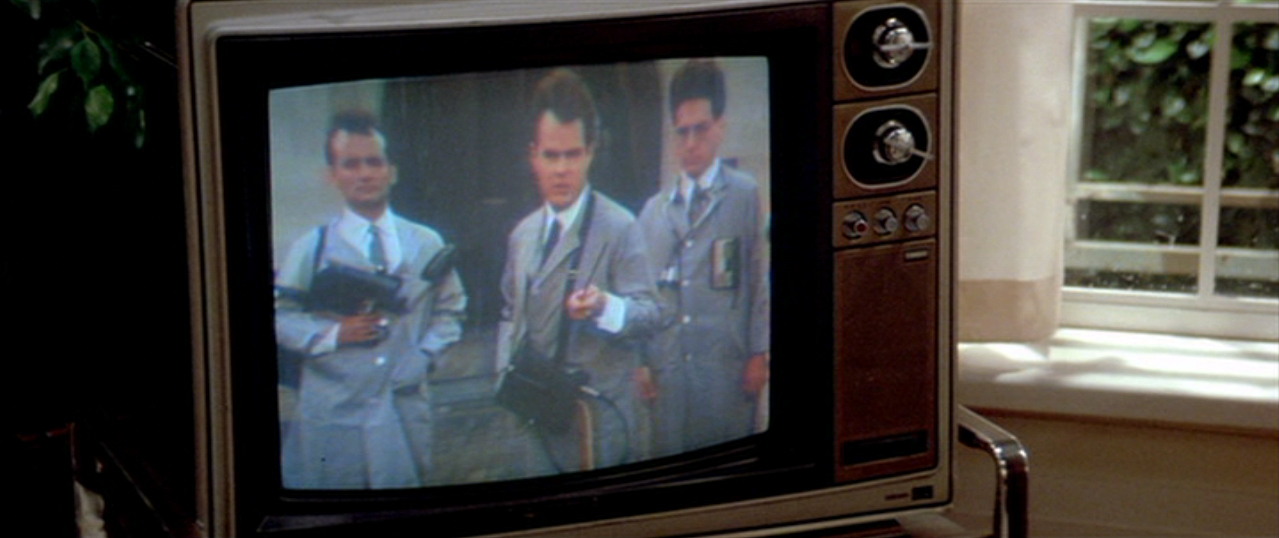
Then Lily and I watched Ghost Busters (1984).


I have to say that the film, though still somewhat fun, does not stand up to the test of time as well as Back to the Future. Why? One key reason is the lack of craftsmanship. Although the film was creatively conceived it lacks the kind of carefully crafted story telling that one finds in Back to the Future. The camera work is largely uninspired, the editing is rather mundane, and apart from its somewhat unique concept, the story arc and pacing are very predictable. What keeps it entertaining are the performances of the principle actors.

I suppose the difference in quality of the two films can be summed merely by pointing to the directors. Zemeckis, though not a genius, is a big step or two above Reitman – in my humble opinion.

* * * * * * * * * * * * * * *


So… is the watching of movies really an education? Can it be counted as such? I have been introducing various films to my seven year old daughter for the sake of her “education.” Is this really valid or am I deluding myself? As far as I know the State doesn’t test for movie knowledge. Proponents of “no child left behind” would just laugh at me. If you want to get some education then hit the books, so the thinking often goes. If you want to “check out” from the day’s troubles and turn off your brain then watch a movie.

If you are a regular reader of this blog then you know my answer already.

I am a bookaholic, and I am a believer in the idea of a classical education. But I believe that a classical education is not only about reading old books. It is really about seeking answers to fundamental questions, such as:
1) What is prime reality – the really real?
2) What is the nature of external reality, that is, the world around us?
3) What is a human being?
4) What happens to a person after death?
5) Why is it possible to know anything at all?
6) How do we know what is right and wrong?
7) What is the meaning of history?

All of us act from within a set of answers, more or less coherent, to these questions. Our answers, or worldview, are like a set of lenses through which we view the world and our place in it. Every film, also, is born out of a set of answers to these questions. In fact, film is one of the best mediums with which to express and explore a worldview. When I watch a film with my daughter I get to discuss with her what the filmmaker is trying to do, trying to say, and wants us to know. Sometimes the films are light and fun, like those mentioned in this post, and the discussion is somewhat light as well. Often we talk about the filmmaking process, and she then learns that films are created things that she can have an opinion about – more than just the “I like it” opinion, which isn’t actually an opinion but an uncritical reaction. Overall, films, being powerful cultural and personal artifacts, are great doorways into important discussions about all that it means to be human, and that is a good place to begin a life of learning.

* * * * * * * * * * * * * *

I would like to say that my blog postings have slowed down because I am on Summer vacation. Fact is, I’m not vacationing, just trying to get my thesis written, remodel the house, spend more time with the family, and well, it’s just more difficult for me to watch films when it’s still sunny outside in the evening. Plus I’ve been watching the Tour de France in my “extra” time.

>Regardless of my opinion…

>can a movie be good, I mean really good?

Or is it a matter of taste?

I have come to the conclusion that the single biggest issue regarding film criticism has to do with the subjective/objective split. In other words, can we say meaningful statements about a given film that are not ultimately subjective, and therefore just a matter of opinion? Much of the debate around how criticism should be done stems from issues regarding this split. And it is an age-old split. In particular because when it comes to art what we all want to know, at some deep level, is whether the work is any good.

We can describe the characteristics of a film all we want, and that is a fundamental part of criticism, but finally we want to know if all that description points to something of value, or not. And if one makes the case that a film has value, is good and not bad, then we want to know the criteria being applied. Or, maybe more commonly, we assume that the criteria doesn’t really matter because film criticism, no matter how detailed, educated, in depth, and carefully referenced, is still merely a matter of personal taste. But is this true?

I plan on writing about this topic in greater detail in the future, but I have been curious about the objective/subjective split elsewhere. At the Amateur Gourmet there is a similar debate going on regarding food. I am interested in what people think, after reading that piece, if the same issues apply to film. Is the objective/subjective split hopelessly unresolvable? Is film criticism really just about carefully crafted opinion?

>Semiotics of the Kitchen

>

As a matter of fact one is continuously anticipating expressions, filling up the empty spaces in a text with the missing units, forecasting a lot of words that the interlocutor may have said, could have said, will certainly say, or has never said.

>>Umberto Eco, A Theory of Semiotics 1979, p. 136

After reading Tram’s post (see: A Room of One’s Own) regarding Chantal Akerman’s Jeanne Dielman (1976), I was reminded of another famous examination of domestic life, Semiotics of the Kitchen (1975) by Martha Rosler. The first time I saw this short film I was in college studying film theory and loving it. I was blown away by Rosler’s piece, not merely because it was an exploration of the very of the concepts I had been studying, but also that she found a way to make semiotics funny (in a dry humor sort of way). Semiotics of the Kitchen was considered a seminal work of the period and shown for years in college film departments and media studies classes, etc. I wonder if it is still watched much anymore.

Semiotics of the Kitchen

what is stranger than fiction?


The Father [mellifluously]
Oh sir, you know well that life is full of infinite absurdities,
which, strangely enough, do not even need to appear plausible,
since they are true.
The Manager
What the devil is he talking about?

from: Six Characters in Search of an Author
by Luigi Pirandello (1921)

Harold Crick
This may sound like gibberish to you, but I think I’m in a tragedy.

from: Stranger Than Fiction (2006)

With apologies to those who get tired reading overly long posts, let’s get a little bit theological for a moment. I know I don’t have to ask you if you have ever considered what you would do if you were God (creator god, god of the universe, etc.). I’m sure you have at some point in your life. You have probably thought you would change the world, make it free of war and suffering, take away every tear and heal every wounded heart (I’m giving you/me the benefit of the doubt). And you would be doing good. Maybe, however, you have also considered what you would do if you were truly and completely a creature, that is, one who has a creator, a real being of some sort, not time+matter+chance. As a creature you would be contingent, that is, you would exist only because another being exists. You would breathe because another being gives you breath. You would awake each day because your creator gave you another day. And even your thoughts would be given to you by this creator or yours. Your creator would necessarily reside at a higher order of existence than you. In Medieval terminology, your creator would be more real than you. Compared to all of creation the creator God would be the most real being.

Heady stuff, but those are the kinds of ideas underlying the film Stranger Than Fiction (I am assuming you’ve seen the film), a film that explores the relationship between character and author. This is not a review of the film, but an exploration into its major theme.

When an author writes a novel, that author creates a world, a fictional world, but a world nonetheless. The characters in the novel are not real compared to you and me, but they are real compared to each other. They exist on a different, less real plane of existence than we do, but they are real (I realize this takes some mental gymnastics, but it makes sense, no really). If an author has a character killed in her novel she is not sent to jail, for that character is not real in comparison to us, but if that character has been murdered we readers want justice to be meted out within the context of the story. The author, also, is not beholden to the character. That character cannot legitimately hold the author accountable for anything.

But what if you were that character, and you had the knowledge of being that character, and therefore knew of your creator in some way? Maybe even got to meet your author? How would you feel then?

For centuries now there has been a passage (one of many, in fact) in the Christian New Testament scriptures that has driven Christians crazy. So much so that many (maybe most) Christians probably avoid it altogether. It goes like this:


But who are you, o man, to answer back to God? Will what is molded say to its molder, “Why have you made me thus?” Has the potter no right over the clay, to make out of the same lump one vessel for beauty and another for menial use?

The idea here is that a creator (here it is God, creator of everything) has complete decision-making control over the thing created, without impunity. Out of the same lump of clay a potter can make a beautiful vase for the mantle or a chamber pot for functional use. I do not know if there is a similar concept in other religions or worldviews. I grew up in a Christian tradition, so that’s what I know. Help me out if you know of any others. One thing I do believe is that we all (at least at times) tend to look at God, even if we don’t believe in a god, and deny God’s rule over us – certainly any kind of absolute rule. We sometimes also hold God (even if we don’t believe in a god) accountable for the state of the world, and may find ourselves saying that if we were God we would do things differently.

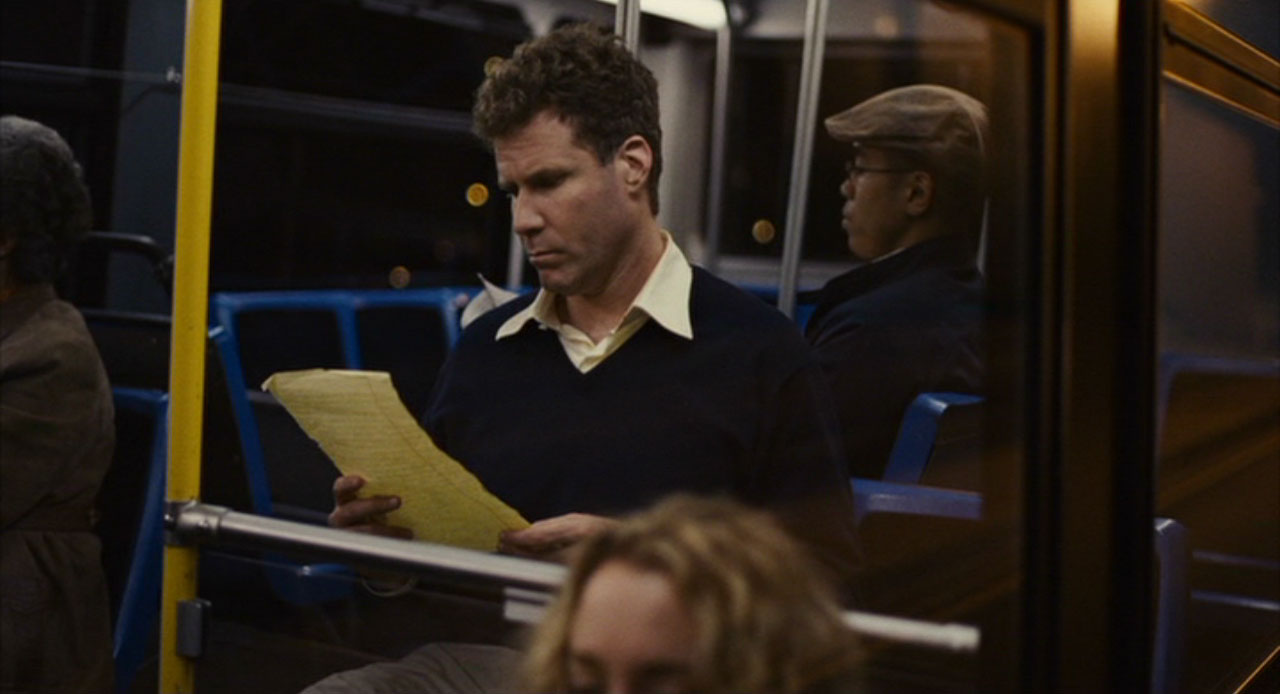
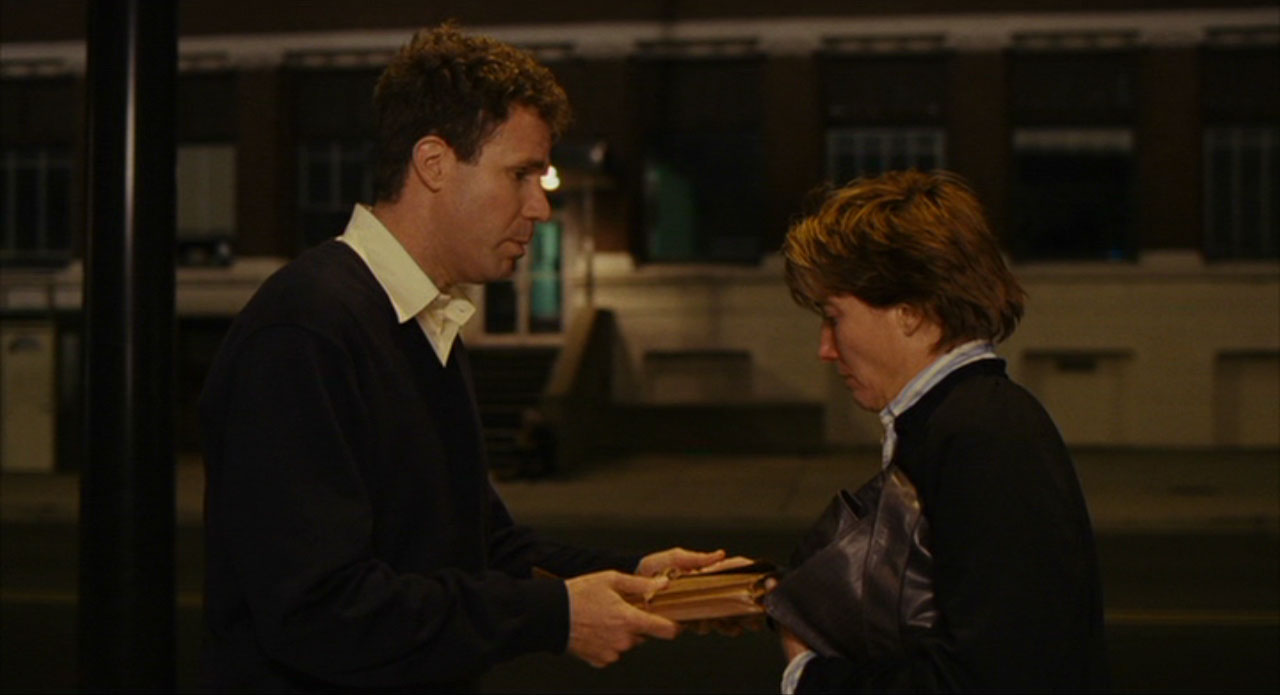
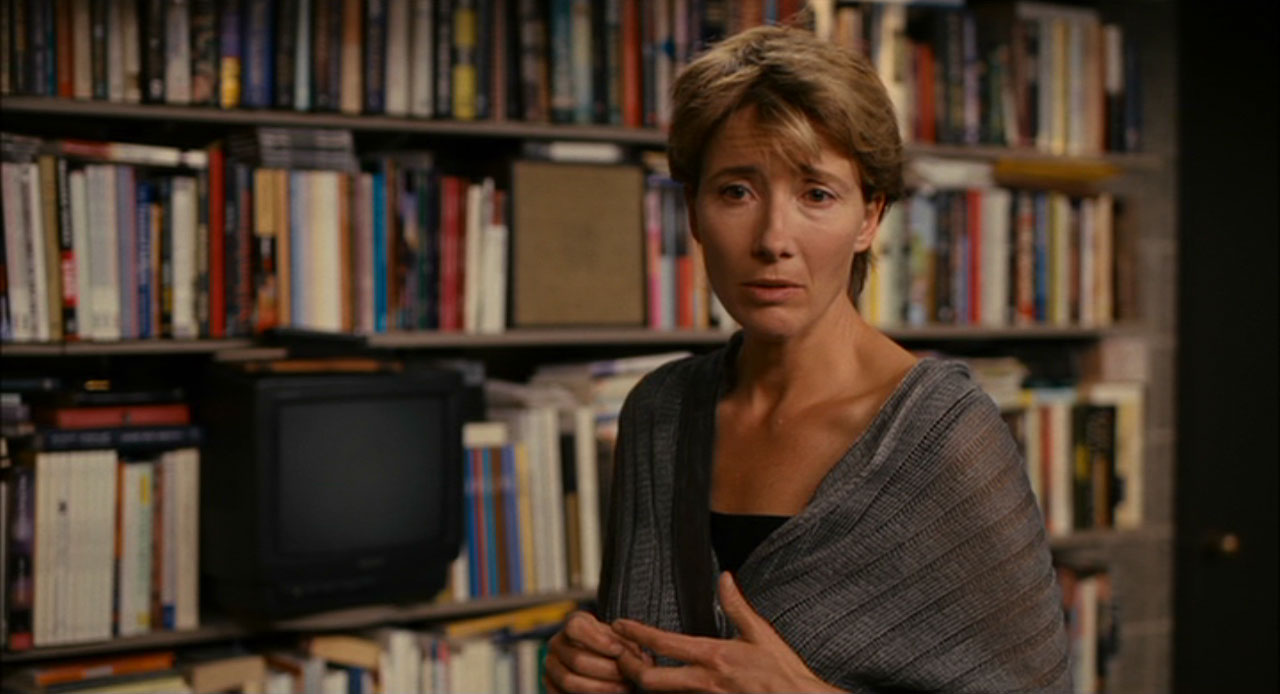
The issue, of course, is sovereignty. Who has ultimate control over your life? You, God, fate, nothing? In Stranger Than Fiction, Harold Crick (Will Ferrell) must come to terms with the fact that he is the literary creation of an author, that his existence is contingent upon the artistic desires of his author, Karen Eiffel (Emma Thompson). Now there are a host of unexplained issues, like how can Crick be a fictitious character interacting with the same world as his creator who should be on a different level of existence, etc., but the film doesn’t care to explain them. (I figure it’s like trying to figure out the implication of time travel in The Terminator films – at a certain point you just let it go.) For the most part, however, the film is not concerned with technicalities, but with the nature of contingency and authorship. The crux of the film comes when Crick finally reads the (his) story which has not yet been finished – the last few pages still handwritten, not yet typed, which would make them final and seal his fate. These last few pages are critical for Crick because they tell of his death. Crick has known he is going to die for part of the film already, and has been trying to avoid that, but now he reads what his author has planned for him and discovers his end.


Discovering the end of the story.

These are internal and sobering moments for Crick. By discovering the end of his story he has a context for his existence, he sees his purpose, his reason for being. Fortunately for him he reads of a noble end – dying saving the life of someone else. (What the film doesn’t explore is the possibility of him dying for not so noble reasons.) He is now no longer in the position of needing to know why he is here and where he is going. In this sense the film is fundamentally existential. The question of his existence is solved for him.

Now he gives the story back to his author, and surprisingly, he says that she should not change anything. In other words, it is the right thing for the story to end the way she has envisioned it, for him to die. She tries to protest, but he insists, and then walks away.


Thy will be done.

I cannot help but think of the moment, on the night before Jesus of Nazareth was killed by the Romans, when Jesus prays in the garden and confronts God the Father in his prayer. Now it would be wrong to make too much of the parallels, but in the story we find Jesus saying to God that he would prefer to not have to die, to not go through with it, but he then says whatever Gods wishes he himself also wishes. He says “Thy will be done.” For Crick, he has come to the conclusion that the story of his life, even if it entails him dying long “before his time” is okay with him. His words to his creator might just have well been, “Thy will be done.”


The intellectual doesn’t like it.

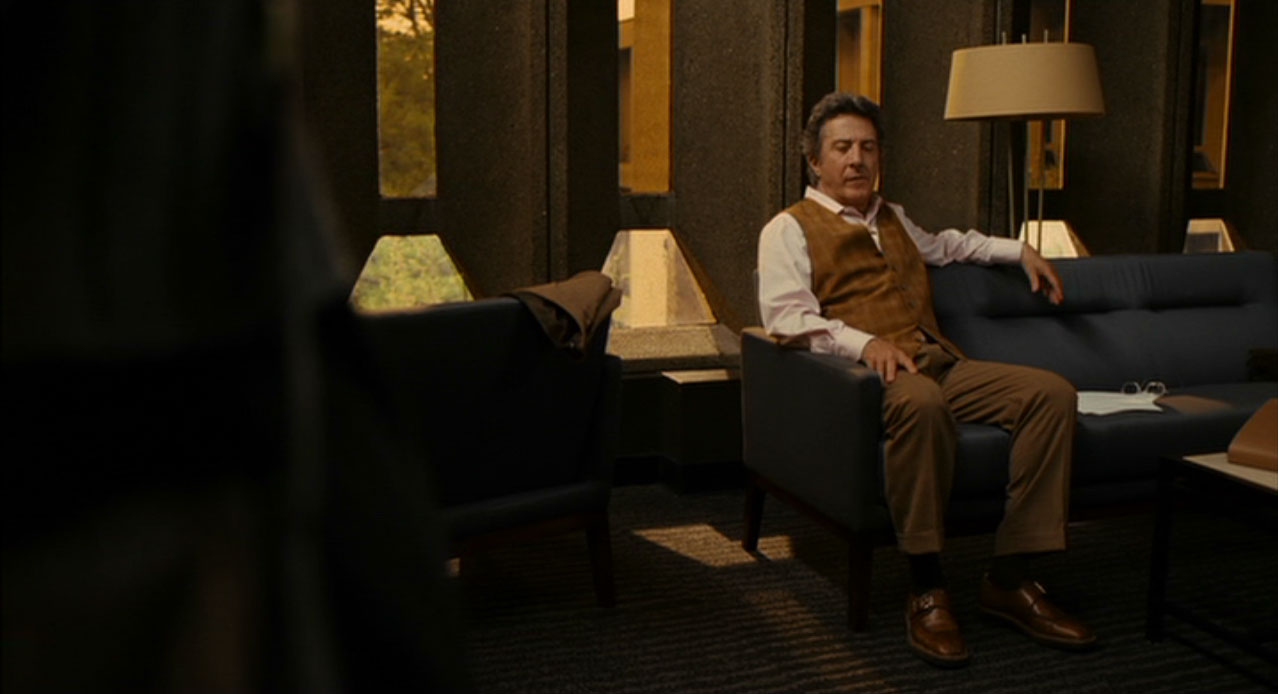
Interestingly, when the book is finished, and we follow Crick through what would have been the last moments of his life, we discover that his author has spared his life. Sure, Crick does save the boy from being hit by the bus, and Crick is then hit by the bus himself, but Crick lives. Badly banged up for sure, but alive nonetheless. Professor Jules Hilbert (Dustin Hoffman) does not like the new ending. He believes Crick’s death would make the book one of the best he has ever read, but now it’s just “okay.” Clearly, Hilbert is in a position to question the artistic choices of Eiffel, for he is an expert, a professor of literature. In some ways Hilbert stands for the tendency in all of us to look at the world and question the creator’s decisions.


“I mean, isn’t that the type of man you want to keep alive?”

When Hilbert asked why Eiffel changed the ending and kept Crick alive, she responds:

“Because it’s a book about a man who doesn’t know he’s about to die. And then dies. But if a man does know he’s about to die and dies anyway. Dies- dies willingly, knowing that he could stop it, then- I mean, isn’t that the type of man who you want to keep alive?”

Here we have the key line of the film. Crick’s destiny is changed because of a truly selfless act. He willingly laid down his life because he saw the true good of doing so. He sacrificed himself for the salvation of someone else, and because he knew that was what it was all about, that that was the telos of his life, he decided to choose what was good, not what was merely convenient for him. And then, because he was willing to be such a person his creator spares his life.

Harold Crick was a man in search of his author. Finding his author gave him the opportunity to know a little more about what his life was all about, He then had to choose whether to accept or reject his fate, to trust or reject his creator. Regardless, his fate was inevitably in the hands of his creator. He chose to accept it, not out of resignation, but out of the realization that his death was a good thing, really that his life had a purpose, was existentially valuable. He had a profound change of heart. And then he discovered that by accepting his fate he saved his life after all.

There are many accounts of human beings pleading with God. One such event was when God came to Moses and said he was so angry at the Israelites for turning their backs on him that he was going to destroy them all and start all over with Moses. Moses pleads with God to spare the Israelites and God does. But we also have the story above of Jesus pleading with God for another way and God does not spare him. It’s not about finding the right formula to effectively twist God’s arm to get what one wants. It’s about a true change of heart, a deep fundamental change at the core of one’s being, and then taking whatever comes. One may not be “happy” with what comes, but one might, just might find some level of contentment, as does Harold Crick.

What the film implies, but does not make explicit, is that for all his anxiety, Harold Crick is blessed. For most people the hardships and struggles of life come without explanation. We experience tragedy, or see others do so, without knowing what it is all about or if there is any purpose behind it. Crick gets to see his purpose. And when he does it makes sense to him, maybe not complete sense, but his life is not meaningless absurdity. This does not mean he is happy about it, but sometimes just knowing what it’s all about is all one needs. In fact, that might be what everyone desires after all – just to know what it’s all about.

I suppose that at some point all of us are faced with believing or not believing in a god. I grew up in a Christian tradition and have always believed in God. My theology has changed over the years (I’ll spare you the details), but I have always believed there is a purpose underlying my existence (and everyone else’s). This belief, though, has not made life easier for me. On the contrary, it has often made life harder, but better as well.

towards an exploration of contemplative cinema

Here are some of my thoughts on the concept and/or reality of contemplative cinema. I am writing this in response to the contemplative cinema blogathon . I must include that I don’t know if I will produce any clarity around the subject. I merely hope to explore some possibilities for approaching the topic.

The folks at the blogathon are loosely defining contemplative cinema thus:
contemplative cinema: the kind that rejects conventional narration to develop almost essentially through minimalistic visual language and atmosphere, without the help of music, dialogue, melodrama, action-montage, and star system.

Or, one could say “boring art films,” as so many do.

And so I dive (or flop) in…

What is going on in a film in which nothing is going on? As I ponder this question I cannot help but ponder a seemingly unrelated question, but one which is actually fundamental: Where is the film?

The contemplative film is, as it is with any film, both up there on the screen and in here – inside my head, and inside yours. That is why we can have very different subjective experiences of a very real aesthetic object – even disagreeing about seemingly basic aspects of the object itself. So, while we are conversing about those specific contemplative films out there in the world in which we can all share, we are also talking about the contemplative films which we construct in our heads. [Note: I won’t pretend to be either a seasoned film critic or professional philosopher, but I will try to make myself clear as best I can.]

In other words, a film is a complex combination of a number of things: images, sounds, editing, beginnings and endings, scenes, characters, music, etc. These complex combinations are organized in such a way that the viewer is encouraged to create a mental construction that is, in a sense, a mental version of the film, or what we might call the “true” film. This so called “true film” or mental film is the goal of the creator (or creators) of the film that is up on the screen. And films are made knowing that you the viewer have the capacity to “put it all together.” [It should be obvious on this point that I am siding with the Russian constructivist theorists via David Bordwell’s great book Narration in the Fiction Film (1985).]

An obvious question, then, is what are the cues being given us by contemplative films that other films do not provide, or provide differently? I believe the answer to this question could be long and debatable, even more so than a list of typical genre characteristics. However, I will posit that what makes a contemplative film one as such, is that the process of cueing the viewer is for producing two effects: (1) break the tendency to forget the brain is constructing the film – an act of distanciation, and (2) with a view to effect number one, to encourage the viewer to go beyond narrative construction into a higher plane of self-awareness. The first is about inviting the viewer to move beyond expectations of mere narrative construction, and the second is about inviting the viewer to become a conscious and personal participant in the film experience.

That’s all fine and good, but one could say the same thing about some of the not-so-boring art films, say Weekend by Godard (at least I don’t find the film boring or slow). Having the film push one away from itself, so to speak, for the purpose of thinking about something other than an imaginary story one can escape into, is a fundamental characteristic of modern art as a whole – to make strange, the “shock of the new,” etc. What then makes contemplative cinema unique? Or, maybe a better question is: What is it that we are contemplating? The film, ourselves, a cosmic spiritual dimension, the nature of film itself? In this sense I believe that intent comes into play, but I do no propose that we try to read any director’s mind. No, I believe that the intent of a film will emerge from its own qualities to suggest and imply a certain approach. Contemplative cinema, it seems to me, calls us to a mental state that is not always easy to clearly defined, yet we know it when we experience it, like love or ennui.

So then, what is going on in a film in which nothing is going on? A great deal. First, the mind is fully capable of being as active as it is with any other film regardless of pace or general “boringness.” However, with a contemplative film one might ask if a greater burden (or a more substantial request) is being placed on the constructive activities of the mind. This may be so. Certainly it appears that less is present on the screen so the brain may have to work harder (that is debatable). Second, one might ask if a contemplative film relies on more than just the mind to do the constructive task. This is the key question, I believe. In other words, might the intent of a contemplative film be to activate the soul as well as the mind?

So then, where is the film? It is up there on the screen, in my head, and, if I let it, in my soul. [Note: I am using “soul” rather loosely. I do not intend to dive deeper into a discussion of metaphysics per se.] Contemplative cinema is a cinema of the soul. That is its intent.

Of course, watching some contemplative films may feel a little like staring at one’s navel. And yet, a powerful film in this vein may, in fact, produce a powerful and profound spiritual experience for the viewer. [I am using “spiritual” rather loosely as well.] One might say that a “successful” contemplative film moves along a path from objective film to subjective film to spiritual film. But I want to be careful with the term “spiritual.” I do not mean to imply that such films transport one to a different plane, or that one, via the film, will somehow transcend this existence. No, contemplative film is not about an “out there” or “up there” or even cosmic gesture. I see the soul as being deeply rooted in this existence, in this world. In fact, one could say the intent of contemplative film is to strip away much of the artificiality found in mainstream cinema in order to encourage the viewer to more fully engage with reality.

Finally, if what I have laid out (and I admit not very well) is true, then what one brings to the film at hand is paramount – and I’m not talking about the popcorn. On the other hand, I don’t believe there is a formula or list for what one should bring. But it seems to me that a person who is inclined to explore deeper existential questions, who is inclined to see life as a journey, and who finds the quieter moments in life to be valued, may have brought the right things.

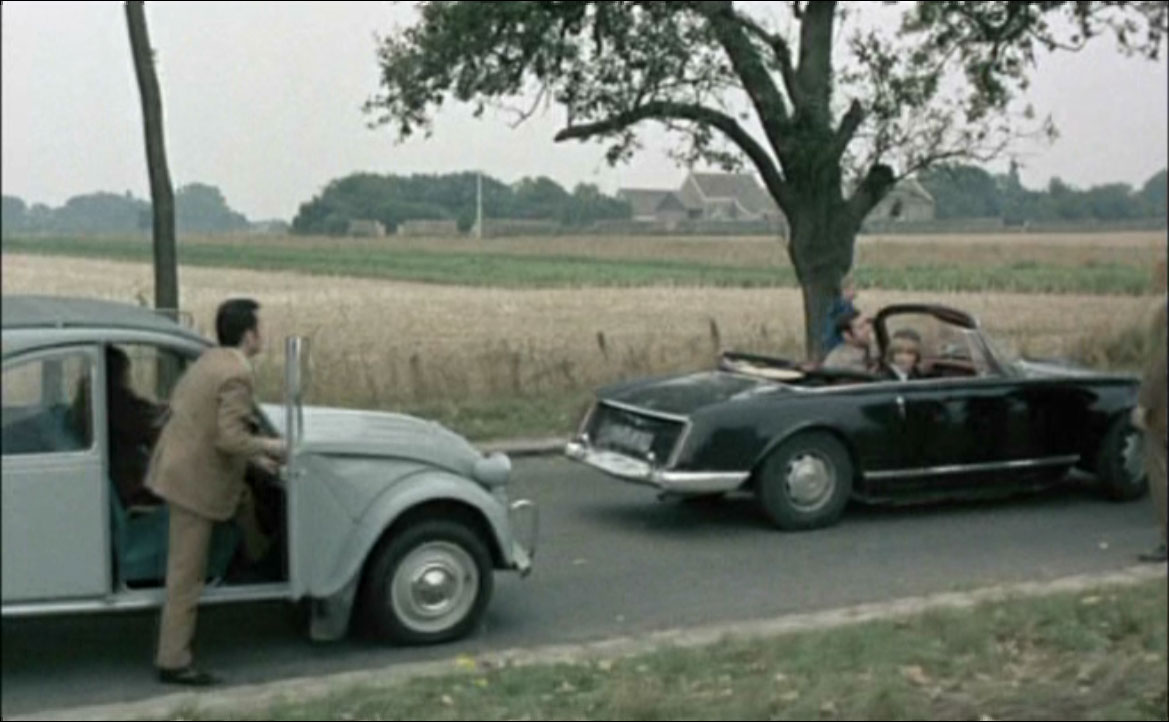
By way of example, a comparison might be in order – in this case Godard and Tarkovsky. I have already mentioned Weekend as a film which has some qualities found in contemplative cinema, yet does not, in my opinion, qualify as a contemplative film. In Weekend there is a famous tracking shot that follows a car driven by the two main characters as they try to pass a long line of cars on a country road.

The camera follows the progress of the car as it passes the other cars in the traffic jam…


…and continues past a number of social vignettes…


…plus a couple of titles…

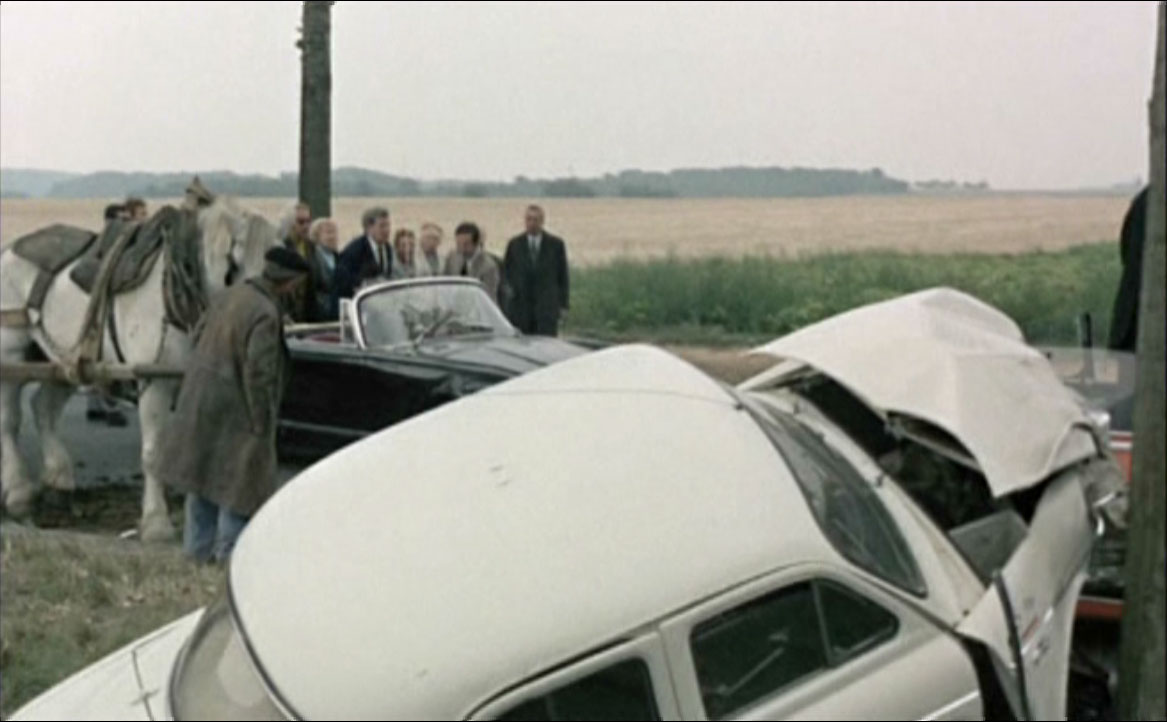
…until we see the reason for the traffic jam, a bloody, gruesome accident…

…which our characters speed by without a care.

This shot takes up around 9 minutes (if I am not mistaken) and feels longer. Clearly the viewer is asked to consciously participate in the film in a way different from a more typical, seamless narrative structure. Godard does not seem to care if one becomes more attuned to one’s soul, he is concerned about the viewer being more aware of the film in the world (and the viewer in the world). This has a more critical arch to it and less of a contemplative arch as I am describing above

On the other hand, another film and another wonderful tracking shot. Stalker by Tarkovsky has this long and contemplative scene in which “nothing happens”:
There is a rhythm to this scene that is entirely different to the one from Weekend. Here we have three men – one could say three souls – traveling into The Zone for personal reasons of discovery (I will not try to explain the film here). The qualities of this scene draws the viewer into a more contemplative mode. As the scene goes on for several minutes the viewer may begin to feel the sense of “watching” the film, and yet there is not the same kind of distance one gets from Godard. Here Tarkovsky is, in fact, inviting us to put aside our sometimes frenetic need for narrative and remember the deeper rhythms of the soul.

…and so I humbly submit