no country for classical narrative

Without an element of cruelty at the root of every spectacle, the theater is not possible. In our present state of degeneration it is through the skin that metaphysics must be made to re-enter our minds

~Antonin Artaud, Theatre and its Double (1938)

To interpret a text is not to give it a (more or less justified, more or less free) meaning, but on the contrary to appreciate what plural constitutes it.

~Roland Barthes, S/Z, (1970, trans. 1974)

You have seen No Country for Old Men and you liked it. You have read the reviews and their obligatory references to Javier Bardem’s hairdo. You may have even noticed how much this film draws from all the other Coen brothers’ films, both stylistically and thematically. But what is most interesting to my limited sensibilities is the film’s ability to give us something that seems entirely new while yet existing within the conventions of classical Hollywood narrative.

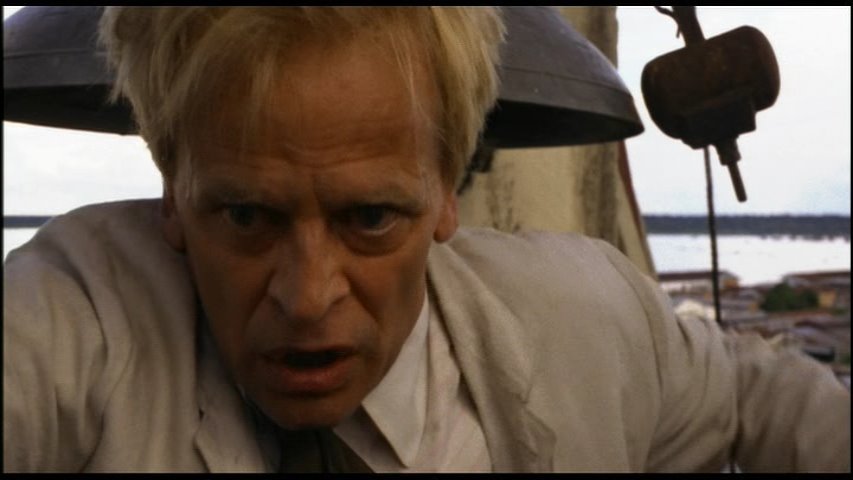
And then, on the other hand, No Country for Old Men gains power by thwarting classical narrative through subversions to plot expectations, through dreams, and through the character of Anton Chigurh (Javier Bardem). Chigurh is a driving force, like the character of Frank Miller in High Noon (1952) who is coming to bring death upon the marshall, or General Zaroff in Connell’s The Most Dangerous Game (1924) who relentlessly hunts his human prey, or the terminator in The Terminator (1984) bent only on the destruction of Sarah Connor. Chigurh is also a psychological enigma, like Norman Bates of Psycho (1960) or Michael Myers in Halloween (1978). It is this second aspect, that of the psychological enigma, that thwarts the narrative.

For classical narrative to function it requires characters who can be understood, both in terms of their psychologies and in terms of their actions. According to Bordwell (1985):

The classical Hollywood film presents psychologically defined individuals who struggle to solve a clear-cut problem or to attain specific goals. In the course of this struggle, the characters enter into conflict with others or with external circumstances. The story ends with a decisive victory or defeat, a resolution of the problem and a clear achievement or nonachievement of the goals. The principle causal agency is thus the character, a discriminated individual endowed with a consistent batch of evident traits, qualities, and behaviors. (p. 157)

Llewelyn Moss (Josh Brolin) is our protagonist. He is the most specified character and the primary causal agent. He is who the audience identifies with, and for whom the audience roots. His actions, that of finding the satchel of drug money and deciding he could take it and get away with it, are what compel the story forward. His hold on the satchel is not unlike the monkey who puts his hand in the jar, grabs the shiny object, and then cannot get his fist out of the narrow opening. Chigurh is the antagonist. He exists to thwart Moss. He is the relentless, unstoppable force. But his psychological makeup is a mystery. We have trouble guessing what he might be thinking. As sheriff Ed Tom Bell says, Chigurh is more like a ghost than anything.

After we have been introduced to the landscape via the beautiful opening shots of the film, and after we have been introduced to the killer Chigurh, we are introduced to Llewelyn Moss. The landscape proscribes the stage on which the action begins. It also functions as the “undisturbed stage” (Bordwell, 1985, p. 157) from which “the disturbance, the struggle, and the elimination of the disturbance” issue forth. Chigurh has, so far, only been shown as a killer. As he strangles the deputy we see Chigurh’s face ecstatic to the point of rapture. One might conclude Chigurh’s ecstasy is psychologically defining, that may be, but he remains, in narrative terms, a simple character. Llewelyn Moss, on the other hand, is given carefully determined narrational moments that flesh out who he is, what kind of person he is, and define him as more fully human rather than as a stock protagonist.

When we first see Llewelyn Moss he is hunting antelope. This is how the film introduces us to Moss:

Moss looks through the scope of his hunting rifle. He has a seriousness about him. He is a hunter. He aims for the largest of the male antelopes. He shoots, but the animals run away. Now he has to track them.

The fact that he is using a traditional hunting rifle says a lot. In our world of available hi-tech weaponry where men are typically fascinated with military-style armaments, Moss caries a rifle from another world. This rifle has a wood stock, is bolt action, and mounts a typical hunting scope. It is also a .270 caliber, which is a classic round for antelope hunting.

Here is the description from the book by Cormac McCarthy:

The rifle strapped over his shoulder with a harnessleather sling was a heavybarreled .270 on a ’98 Mauser action with a laminated stock of maple and walnut. It carried a Unertl telescopic sight of the same power as the binoculars. The antelope were a little under a mile away.

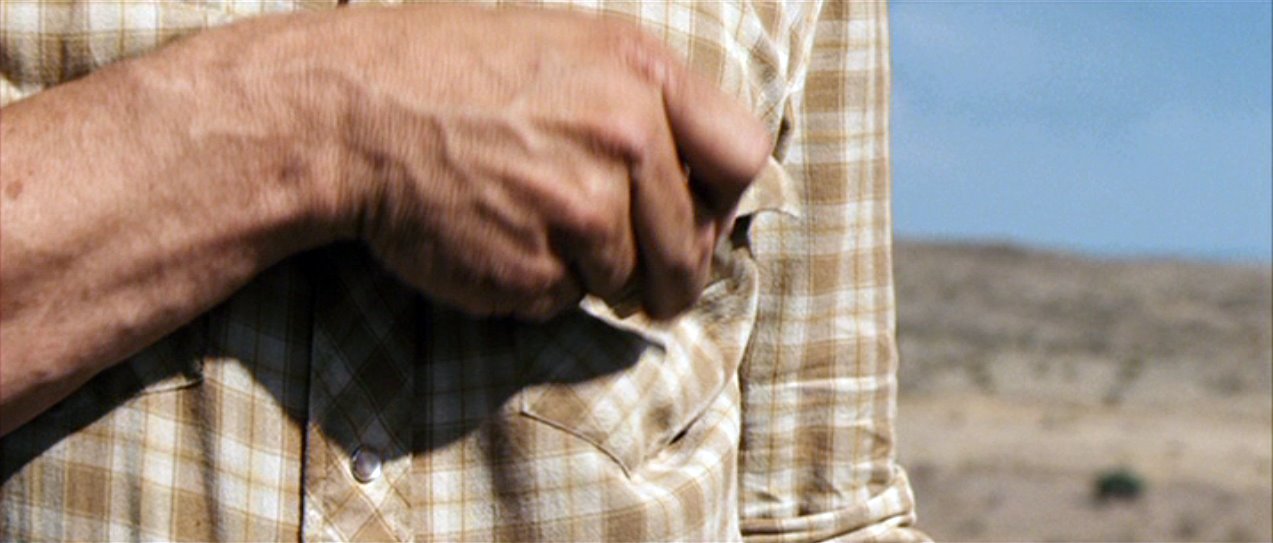
Moss wears a plaid shirt with sleeves rolled up. He is working class in appearance. The color of his shirt, skin, and rifle blend in with the light brown of the desert landscape. He is a man in his element. There is something about him and this desert environment that are similar.

He also wears a white hat. In the tradition of the western genre there is no wardrobe choice more conspicuous than the white hat for the good guy and the black hat for the bad guy. Ghigurh does not wear a hat, but he sports and undeniably conspicuous hairdo that effectively functions as a “black hat.”

The hat (hats have played significant roles in other Coen films) situates Moss in the mythological West. Moss is presented as a kind of cowboy. Chigurh is presented as something other. This contrast will feel a little like that of the old world versus the new world in Lonely are the Brave (1962) and, like the story in that film, the cowboy loses.

It must be highlighted that our first glimpse of Moss has him with a gun. This denotes him as a killer. Moss “as killer” is a critical characteristic. The contrast between the killer Moss and the killer Chigurh will become the ground for the narrative’s causality.
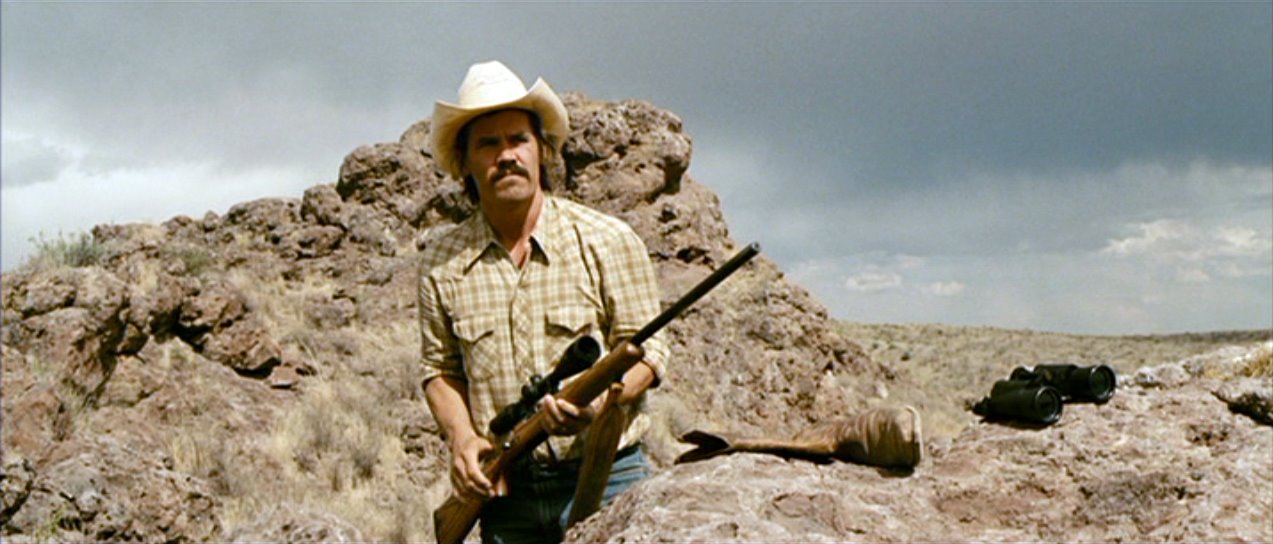
This scene also denotes Moss as hunter, which is different than killer. The story will turn this characteristic on it head and makes Moss the hunted. We might assume, then, that Moss will become something like Rambo in First Blood (1982).

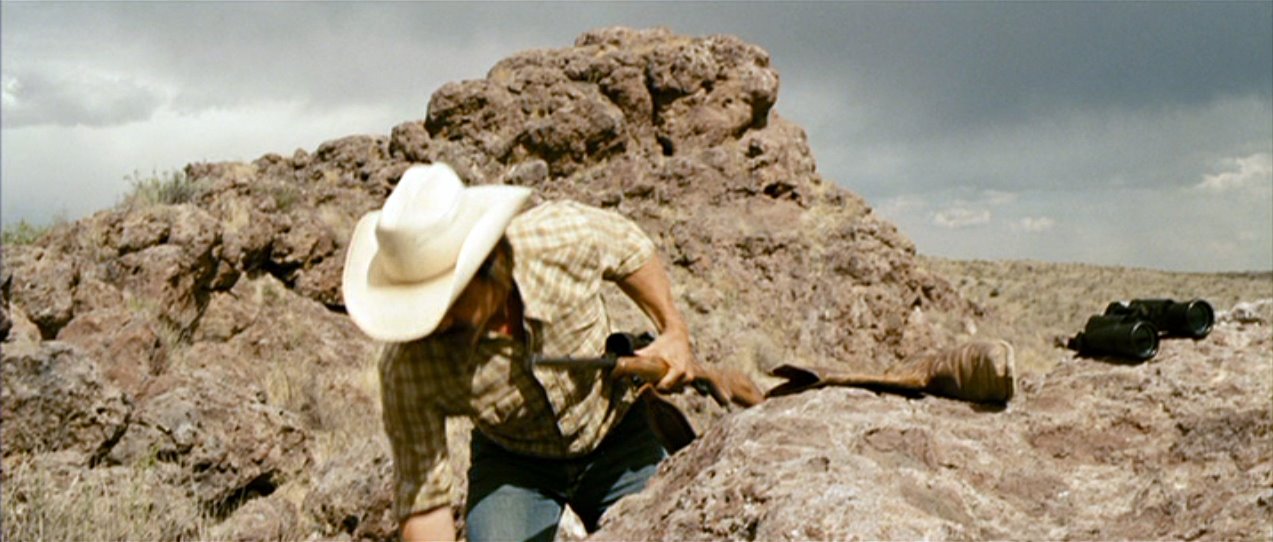
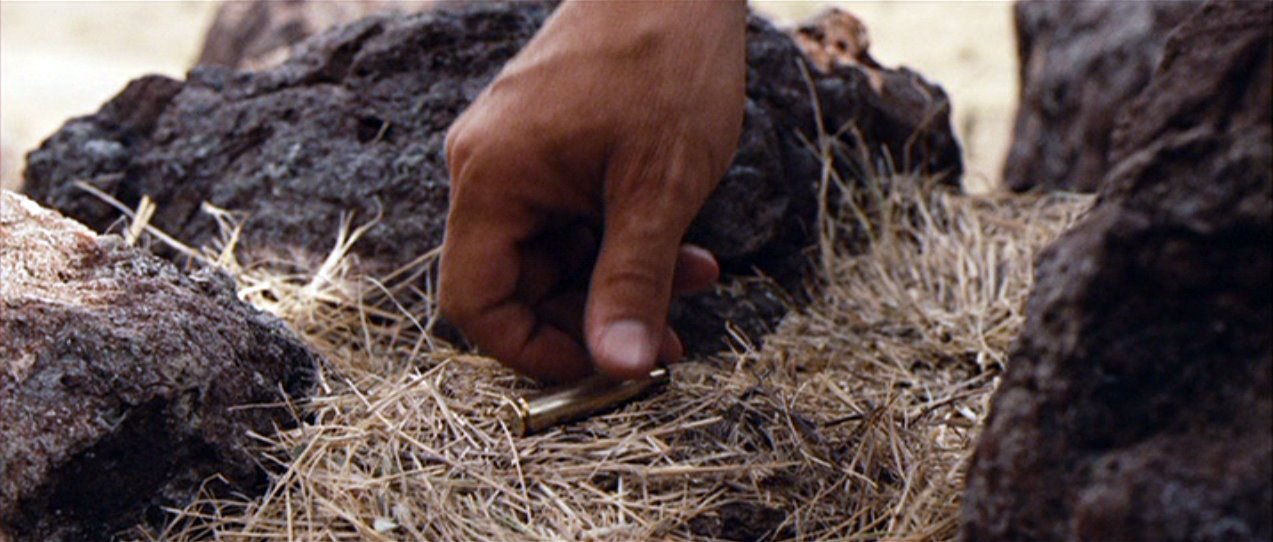
After Moss fires his shot the antelope run away. He stands up and watches them run off. He then does something interesting. He bends over, picks up the empty shell from his expended round and puts the shell in his shirt pocket.
My father is a hunter. I grew up hunting with him, although I personally haven’t hunted in years. My father is the kind of hunter who likes tradition and economy. He likes true hunting rifles rather than the popular militaristic styles. He saves his shell casings so he can reload his own rounds. He will carefully measure the gunpowder into each shell casing and then seat a particular bullet into the shell. Notes are taken for future adjustments. Quality and exactness are critical. Different kinds of bullet and powder combos are tested. Choices are made based on what game will be in the sights. It is a kind of primal craft, something from the past. My father has often said he was born a hundred years too late.

Moss represents that past. He is the archetype of the self-sufficient, frontier man who can live off the land, live by his wits, and take care of himself no matter what comes. He is the man’s man of the Zane Grey novel or John Ford film. He is the dream of the West. He is an incarnation of John McClane (Die Hard). His character remains consistent throughout the film to that archetype.

The simple detail of Moss picking up the shell and putting it in his pocket tells us a lot about him. He is a kind of craftsman. He is thoughtful and meticulous. He lives out a kind of economy of not wasting even the littlest thing. This economy will make him a formidable foe for Chigurh. Unfortunately for him, his wife, and others, Chigurh is more than just a bad guy – he is a force of nature, like the coming of darkness or the second law of thermodynamics.

But what makes up this darkness? Death eventually comes to all. Chigurh does not increase death, for death is total for every generation. But Chigurh is relentless. He is, in Lyotard’s words, a monad – a self-contained entity only aware of his own concerns. Lyotard (1991) says of the monad: “When the point is to extend the capacities of the monad it seems reasonable to abandon, or even actively to destroy, those parts of the human race which appear superfluous, useless for that goal. For example the populations of the Third World” (p. 76-77). In this sense Chigurh might be seen as symbolic of larger cultural forces, such as the ruthless drive of capitalism or empire. Or he might be just a tornado.

It is not merely that Chigurh is a bringer of death. Or even that he is like the character of Death in Bergman’s The Seventh Seal (1957), which he also is. Chigurh represents the deep human fear of chance as destiny. With Chigurh every choice becomes and existential choice, and the chooser never has all the information. Characters have choices, but those choices, like all choices, are ultimately about who one is and who one will be. However, those characters don’t always realize the profound nature of their choices. All to often human beings live their lives as though in a dream. Consider this famous scene:

Anton Chigurh
Call it.

Gas Station Proprietor
Call it?

Anton Chigurh
Yes.

Gas Station Proprietor
For what?

Anton Chigurh
Just call it.

Gas Station Proprietor
Well, we need to know what we’re calling it for here.

Anton Chigurh
You need to call it. I can’t call it for you. It wouldn’t be fair.

Gas Station Proprietor
I didn’t put nothin’ up.

Anton Chigurh
Yes, you did. You’ve been putting it up your whole life you just didn’t know it. You know what date is on this coin?

Gas Station Proprietor
No.

Anton Chigurh
1958. It’s been traveling twenty-two years to get here. And now it’s here. And it’s either heads or tails. And you have to say. Call it.

Gas Station Proprietor
Look, I need to know what I stand to win.

Anton Chigurh
Everything.

“You’ve been putting it up your whole life you just didn’t know it.” That just might be the most important line of the film. A man’s life is a story, true, but it is a mix of choice and chance. Like the journey of the coin, and of what the coin represents: a choice between heads or tales. But what kind of choice is that? One chooses, but chance decides. The gas station proprietor chooses heads and it is heads. He gets to keep on living for now. Does he know the nature of his choice? Do we know the nature of our choices? Of course, like Lazarus being raised from the dead, the gas station proprietor has not been save from death, it will still come, it is inevitable.

So where does this leave us? No Country for Old Men gives us a story of characters, of the choices they make, of the consequences of those choices, all set within a consistently circumscribed world. And yet, at the end, where are we?

Sheriff Ed Tom Bell is our narrator. Llewelyn Moss is our protagonist. Anton Chigurh is our antagonist. The stage was undisturbed, a disturbance occurred, and struggle ensued. But the classical narrative runs dry; it does not seem to be able to sustain itself. Why? There are at least three reasons.

1) Moss, rather suddenly, ends up dead. After following his struggle so closely and with so much detail the narration leaves out his last struggle. We do not see him die. His corpse lies on the floor of his hotel room before the film is finished with its story. This death, though later in the story than the death of Marion Crane in Psycho (1960), still comes too early to be a climax. And yet it would seem the final confrontation between Chigurh and Moss was what the film was building up to. But no, the audience is left hanging, as it were, in the wind.

2) Chigurh is a cypher, a ghost. We know he is odd, probably psychotic. We know he is a ruthless killer. We know he is tough and maybe impossible to kill. But what do we really know about him? Almost nothing. What is his motivation? Money? No. Power? Maybe. Principles? We are told yes, but are we sure, and what principles exactly? And is he really a part of the world as presented to us? Or is he part of a different world? On more than one occasion the lives of those who come in contact with Chigurh depend on whether they “see” him.

Nervous Accountant
Are you going to shoot me?

Anton Chigurh
That depends. Do you see me?
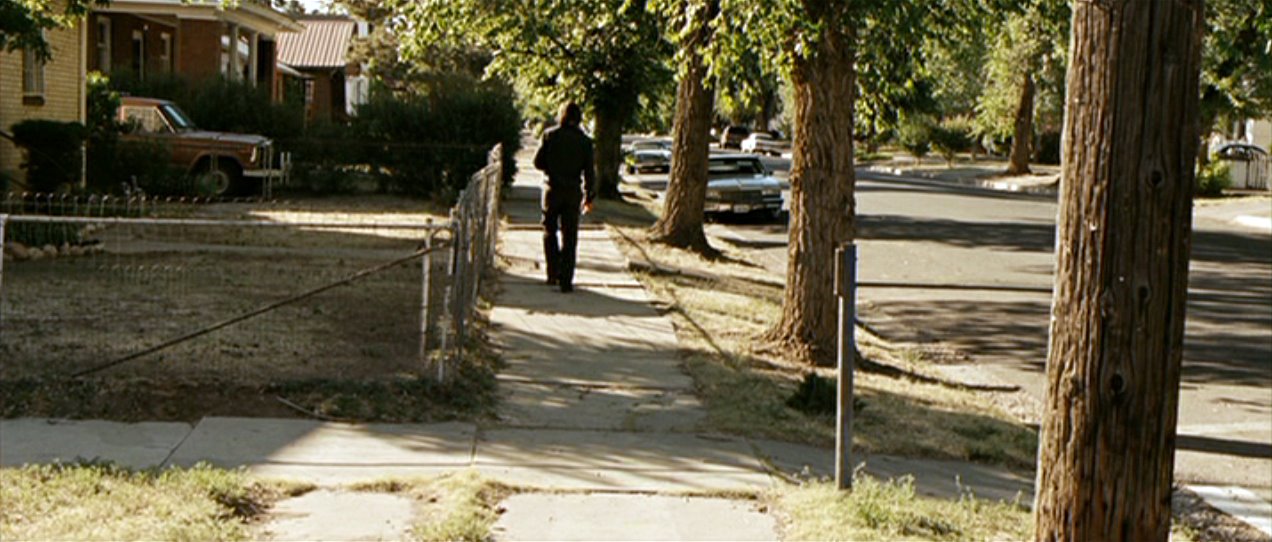
One could take this to mean that if one does not talk one lives. On the other hand, to see Chigurh is to believe in ghosts. The last shot of him shows him walking away down a sidewalk. We know he is sure to get away, he always does.

What an interesting shot. It is so bland, so ordinary, just an ordinary street. He is the figure of death resuming his journeys. This last image of Chigurh then slowly dissolves to a profoundly troubled and puzzled Ed Tom Bell.
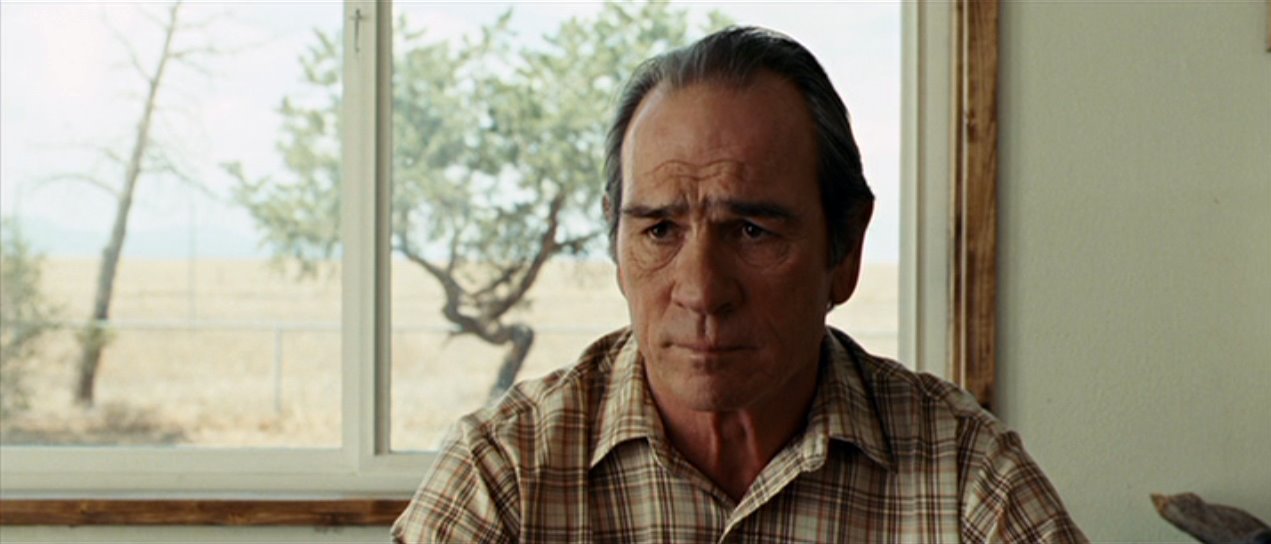
3) Ed Tom Bell’s has two dreams. It is possible that just about anything is easier to interpret and understand than a person’s dreams. Ending the film with two (not just one) dreams produces a number of potentialities of meanings upon meanings. Certainly there is a weight to the dreams, but they are naturally vague and open. The film stands at the precipice of being plural, that is, it hinges on the possibility of an infinity of meanings, which means it could have no meaning. Consider the dreams:

Loretta Bell
How’d you sleep?

Ed Tom Bell
I don’t know. Had dreams.

Loretta Bell
Well you got time for ’em now. Anythin’ interesting?

Ed Tom Bell
They always is to the party concerned.

Loretta Bell
Ed Tom, I’ll be polite.

Ed Tom Bell
Alright then. Two of ’em. Both had my father in ’em . It’s peculiar. I’m older now then he ever was by twenty years. So in a sense he’s the younger man. Anyway, first one I don’t remember to well but it was about meeting him in town somewhere, he’s gonna give me some money. I think I lost it. The second one, it was like we was both back in older times and I was on horseback goin’ through the mountains of a night. Goin’ through this pass in the mountains. It was cold and there was snow on the ground and he rode past me and kept on goin’. Never said nothin’ goin’ by. He just rode on past… and he had his blanket wrapped around him and his head down and when he rode past I seen he was carryin’ fire in a horn the way people used to do and I could see the horn from the light inside of it. ‘Bout the color of the moon. And in the dream I knew that he was goin’ on ahead and he was fixin’ to make a fire somewhere out there in all that dark and all that cold, and I knew that whenever I got there he would be there. And then I woke up.

What do we have here? I believe there is meaning here. I believe that we can tease out what McCarthy and what the Coens are getting at. But we do so without finality. We find layers, complexity, multiplicities, and contradictions. In other words No Country for old Men ends but it does not resolve. Lack of a clear resolution saws off, as it were, the possibility of a classical narrative ending.

In structure No Country for Old Men proceeds largely by way of a classical narrative, but it also has elements of, and ends by way of art-cinema narration. These two narrational modes are logically at odds with each other. According to Bordwell (1985):

For the classical cinema, rooted in the popular novel, short story, and well-made drama of the late nineteenth century, “reality” is assumed to be a tacit coherence among events, a consistency and clarity of individual identity. Realistic motivation corroborates the compositional motivation achieved through cause and effect. But art-cinema narration, taking its cue from literary modernism, questions such a definition of the real: the world’s laws may not be knowable, personal psychology may be indeterminate. (p. 206)

Ed Tom Bell’s confusion at the end is also our confusion. What disturbs him is not merely the extreme violence he has witnessed. He is confounded by his inability to understand the world anymore. He has assumed, and been hoping for, a clear resolution to life. He has taken for granted a meaning to the universe and come up woefully short.

“And then I woke up.” Ed Tom Bell is how awake. He has been living in a kind of dream his whole life. He has been wagering his existence his whole life and he just didn’t know it. Now he knows it, but he has no answers. His eyes are finally open but the scene before him is indecipherable. The extreme violence he has witnessed compares to the narrative violence, that is, to the deep rupture to the classical narrative expectations he was expecting. These two violences have caused metaphysics, as it were, to re-enter his mind. His presuppositions have been stripped. He sees life for what it is not. He is lost in a world of choice and chance.

. . . and that’s one way of looking at this polysemous film.

References:
Bordwell, D. (1985). Narration in the fiction film. Madison, WI: The University of Wisconsin Press.

Lyotard, J. F. (1991). The inhuman: Reflections on time. (trans. G. Bennington & R. Bowlby). Oxford: Blackwell.

My Darling Clementine: John Ford telling stories

Can a work of art tell us something about the character of the artist?

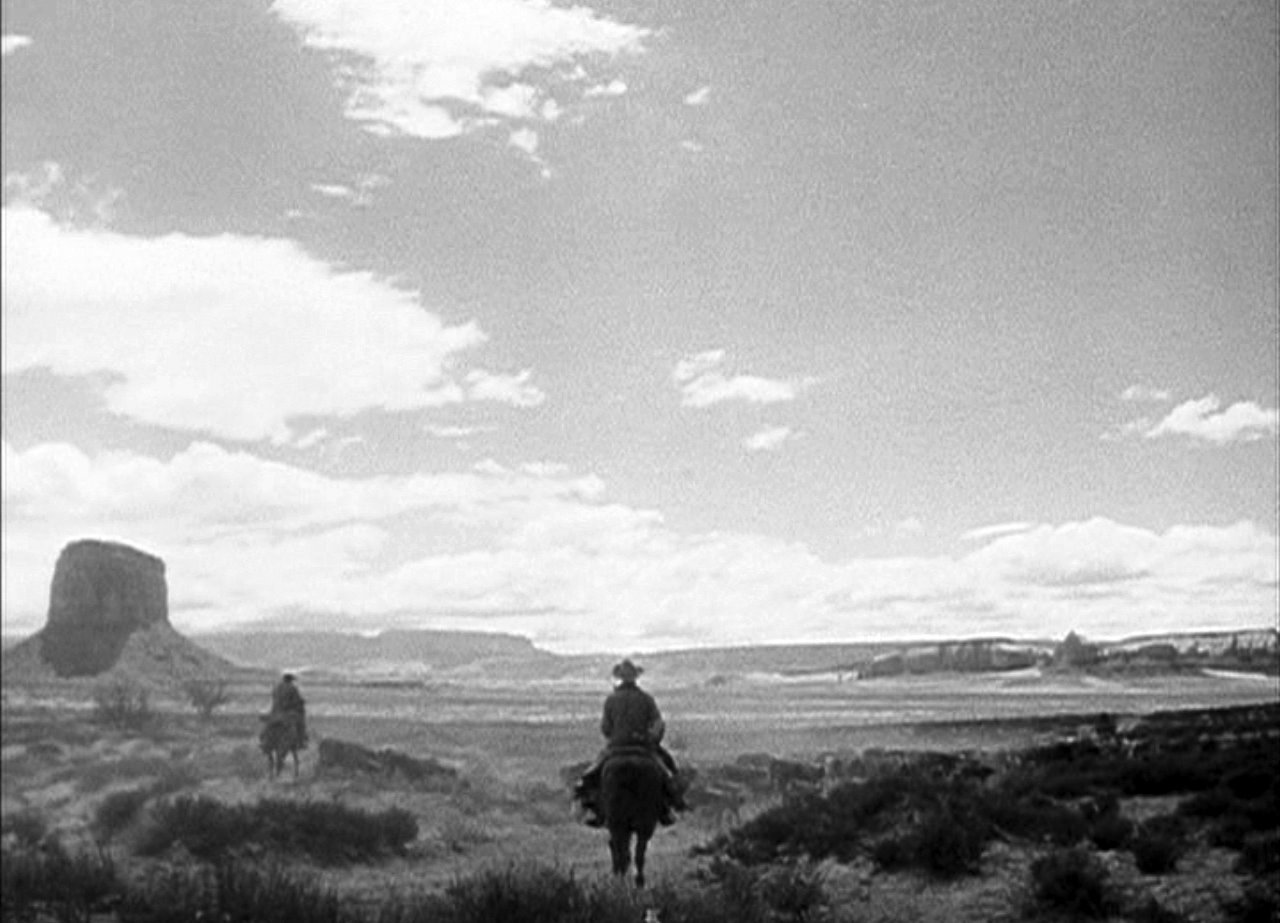
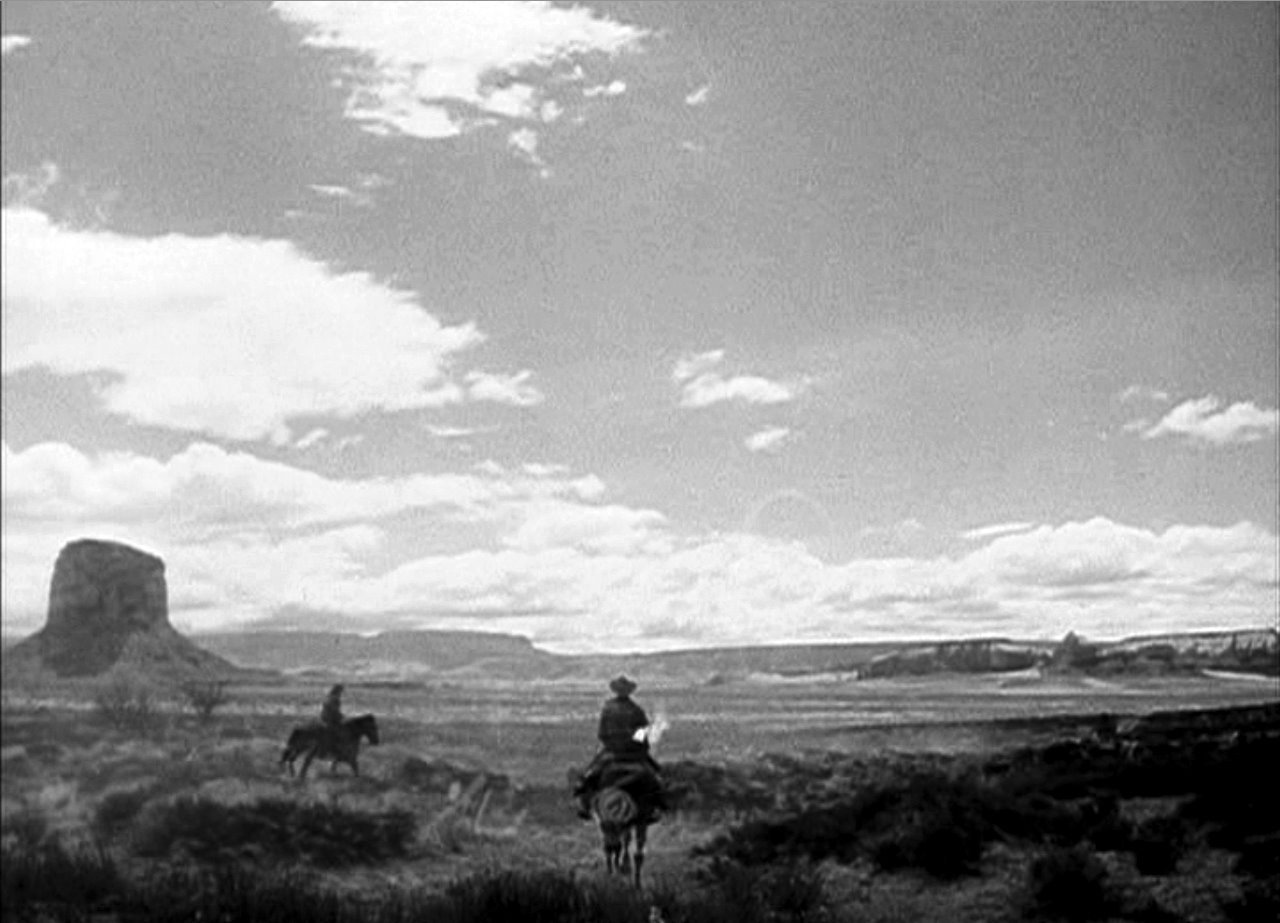
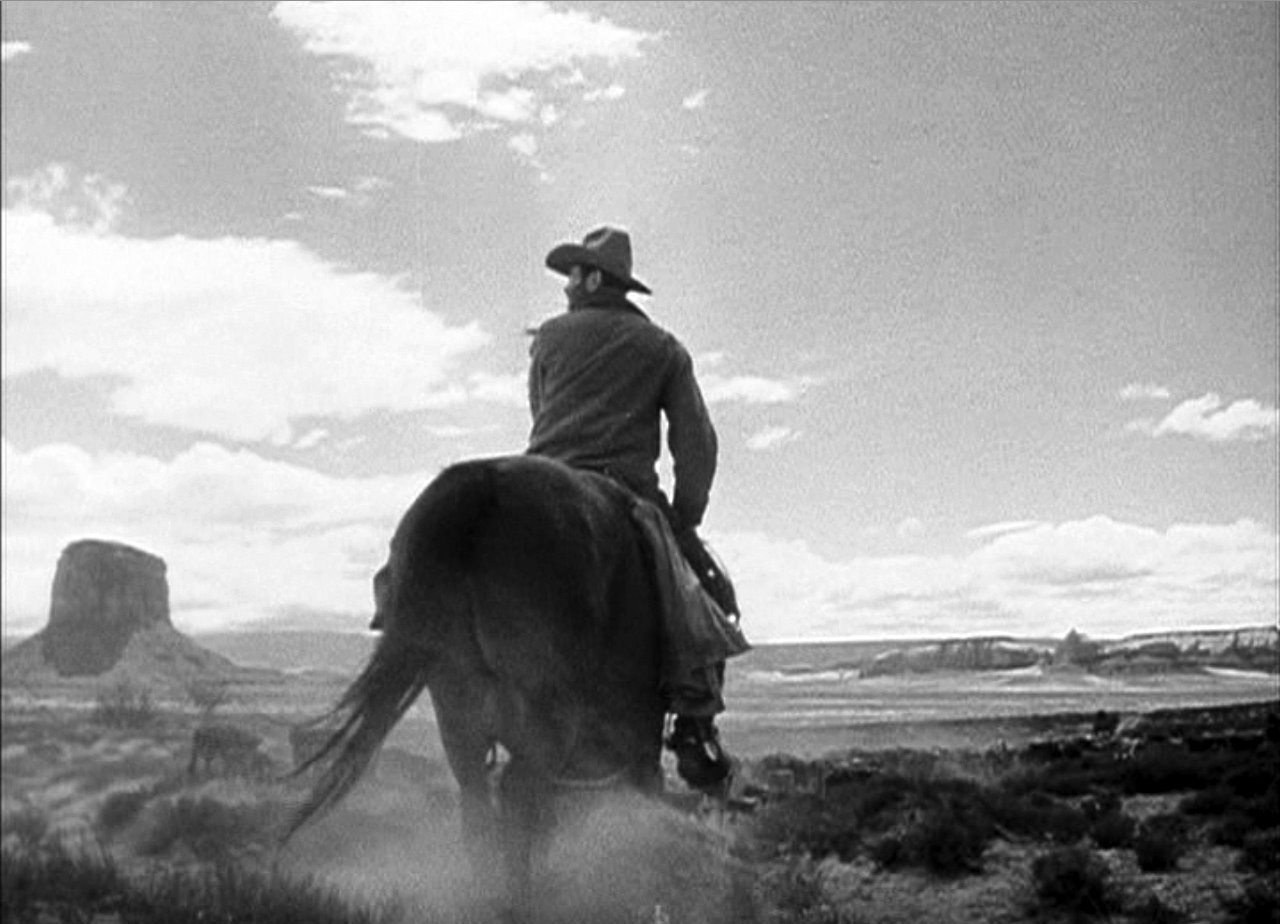
At the beginning of John Ford’s My darling Clementine (1946) there is an interaction between Wyatt Earp (Henry Fonda) and Old Man Clanton (Walter Brennan) that portends things to come. At the end of that conversation Earp rides his horse away and Clanton presumably drives his wagon away. Ford adds a wonderful little sequence of images and sounds at this point that, in effect, sums up the entire film. It goes like this:

Clanton uses his whip to get his horses going. We see the motion of his arm and the curling of the whip in the air.

We then hear the loud, sharp crack of the whip as we cut to Earp riding away.

Earp continues to ride quietly away.

Then, as the shot is beginning to dissolve to the next, we see a fire burning as though it is Earp on fire.

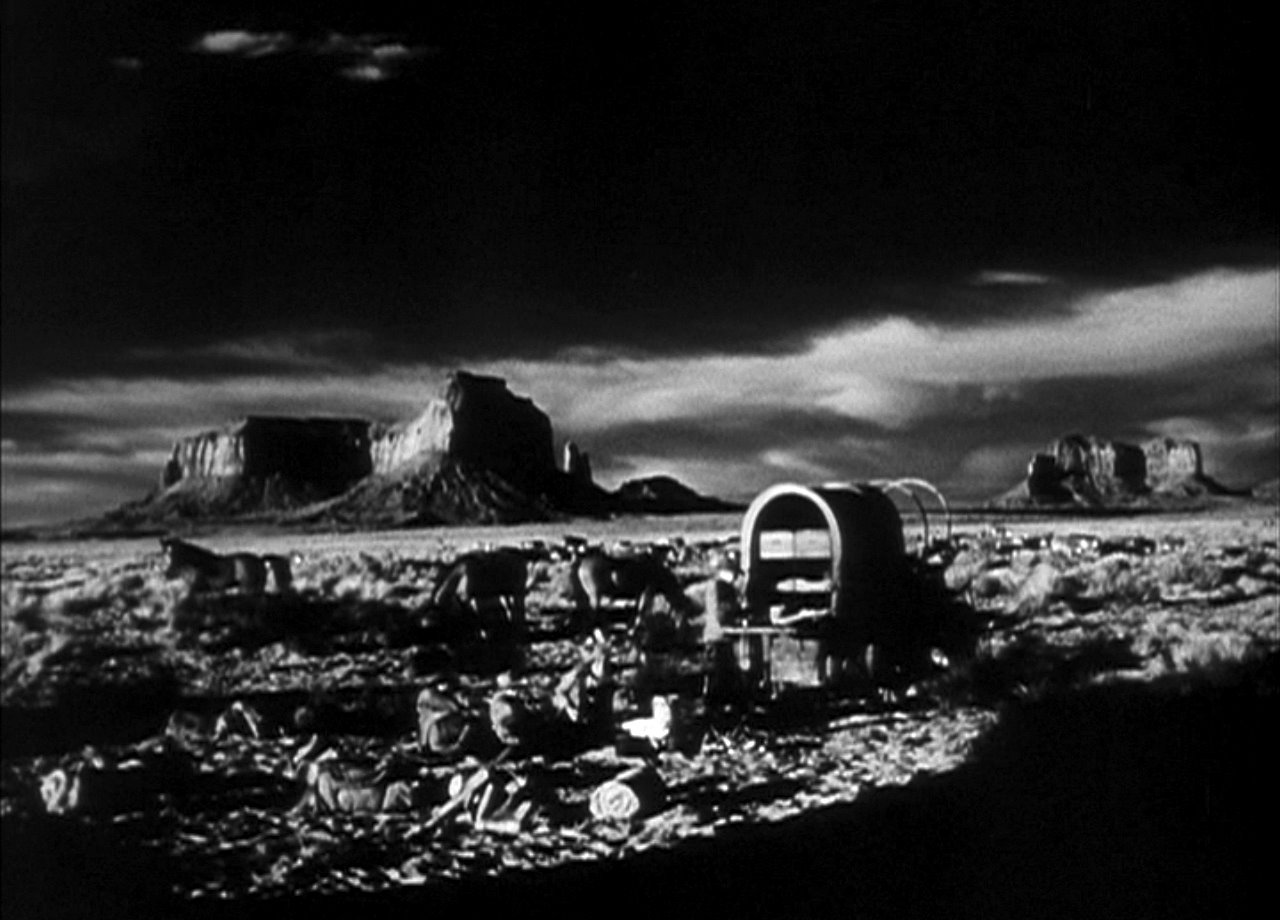
Once the dissolve is complete we discover the fire is the campfire of the Earp’s camp.

The story has Clanton and his sons stealing the Earp brothers’ cattle and killing the youngest brother. This action brings Wyatt Earp out of retirement. In order to mete out justice and get revenge, Earp takes over the recently vacated marshal job for Tombstone.

What I love about this little cinematic moment is the way Ford subtly used the language of cinema to tell a story within the story. The juxtaposition of the whip crack with the image of Earp, and then the fire growing within Earp, tells us what the story arc will be. What I also love is how Ford, in my opinion, frequently demonstrated, with moments like this, that he was every bit the filmmaker of Welles, but that he didn’t care for so much bravado as we find in Kane. He was servant, as it were, to the art & craft of cinema rather than to his ego. He was a master storyteller more about the story than the teller.

Both Welles and Ford needed and respected their audiences, for sure, but Ford’s respect was more self-effacing, more about others than about himself. At least that is what I take from their works of art. Am I right? You tell me.

Mai 68

Lest we forget, 40 years ago this month it was “Mai 68”, that is, it was May 1968.

For most Americans (like me) the protests and riots that raged in France in 1968 are largely unknown. Like many protests of the 1960s there are questions as to their ultimate effectiveness. Certainly de Gaul was eventually pushed out, signaling a change from conservatism to liberalism. And, of course, Langlois was restored to his position, which was a part of the whole Mai 68 thing, though protests on his behalf started even earlier than May. But who really knows if any particular protest changed anything that would not have inevitably been changed anyway. And yet, those were glorious days, so I have read.

Here is a nice overview of some key elements of Mai 68:

My français is a bit rusty, but this is a nice retrospective timeline from French television:

There is a part of my soul that loves those protests in France, much like I love the protests in the U.S. in the 60s, or the anti-war protests and anti-globalization protests in recent years. Protesting is so romantic. Many cinephiles may not know that filmmakers shut down the Cannes festival (mentioned in the overview piece above) in 1968 as well.


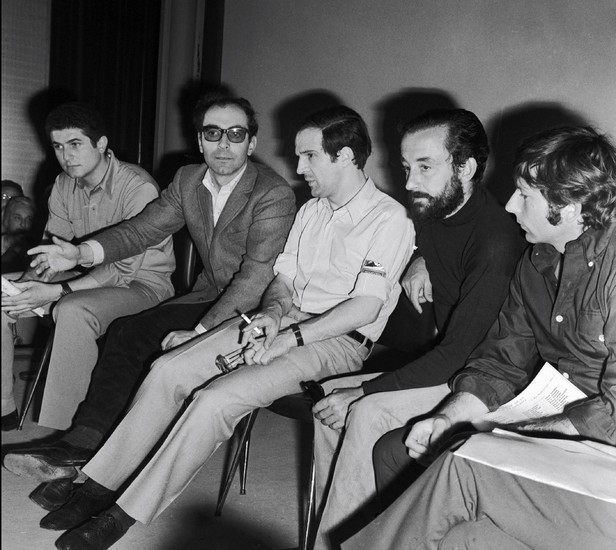
The gang’s all here. Can you name each filmmaker in the photo?

This is a wonderful verité piece showing the debates among the filmmakers at Cannes deciding what their protest was going to mean and what actions that would require:

The fact that Cannes was closed down in 1968 shows that, as a film festival, it had clout, that it was important, and that films were important. I would love to see the Oscars shut down in protest to any number of things, such as the war in Iraq. But that would mean the Oscars are important and are we ready to admit that?

Special bonus: Captain Beefheart live in 1968 on the beach in Cannes.

*Filmmakers in the photo, left to right: LELOUCH, GODARD, TRUFFAUT, MALLE, POLANSKI

a quick, short list of films recently viewed with Lily (and sometimes the rest of the family)

My posts have been few lately. Life is full.

The following films I have recently viewed with my daughter Lily, and occasionally the rest of the family. As I have mentioned several times before, I am introducing Lily to the history of film as part of her education. I have been making an effort to teach her about key directors as much as is reasonable.

So far we have been focusing on Hitchcock, Ford, and Hawks. But, of course, we have been watching films outside of that list of directors as well. I have also been trying to include a documentary or two.

We have also been working our way through some genres. I am introducing her to westerns, musicals, and mysteries.

Fiction:
Young Sherlock Holmes (1985) I remember seeing this film when it first came out on video. Though it is not a great film, I find it thoroughly enjoyable for what it is. Lily is into mysteries at the moment, so I figured this might be a good choice. She loved it. Also, recently we saw some of the Jeremy Brett Sherlock Holmes stories, which Lily loved, and I love too. Those are the best Holmes adaptations in my book.

The Lady Vanishes (1938) In my attempts to educated Lily (and re-educate myself) in film language, we are watching some films from the 1930s and 1940s as a kind of level-set. Hitchcock is, of course, great for film language, story construction, and the thriller genre. The Lady Vanishes is a classic spy thriller at a time when some saw the coming troubles in Europe and others were dragging their heals.

Red River (1948) I have felt the need to introduce Lily to the Western genre. It is a genre so embedded within the American psyche. Red River is amazing; beautifully shot, acted, and paced. The ending comes up a little short, but overall a great example of the Western. This was Lily’s introduction to the Duke as well.

Jamaica Inn (1939) On a whim I threw this film in the list. It’s a great example of Hitchcock from his “British” period before moving to Hollywood. One can tell it is not a Hollywood film merely by how dark in tone and image it is. Lily found it interesting that she had already seen the two principle actors (Laughton and O’Hara) in The Hunchback of Notre Dame, especially that Laughton looks so different.

To Catch a Thief (1955) I have already written a post on To Catch a Thief when Lily and I watched it before. She wanted to see it again, so we watched it again. I like this film more and more with each viewing. Though it is often considered a more lightweight film from Hitchcock, I think there is a lot more there than at first glance.

Non-Fiction:
For All Mankind (1989) Documentary on the Apollo program.

Baseball parts I, II & III (1994) Ken Burns film on “America’s pastime.” The first several parts are the most interesting in my opinion.

The Endurance (2000) The story of Ernest Shackleton’s amazing test of fortitude.

Also, recently I showed Lily several episodes of The Muppet Show, which she had never seen. She has seen a couple of the Muppet films, but never the show. She was going “what is this?!” She loved it. I used to love it too (and still do), but I forgot just how brilliant it was.

In the dock we have more westerns: My Darling Clementine, Stagecoach, The Man from Snowy River, and High Noon. I am also wanting to introduce her to film noir. I’m looking for suggestions as well.

I see two temporary problems going forward, however. First, the weather is getting better and the days are getting longer. This means it is becoming harder to put in a movie at 6PM or 7PM so we can make bedtime on time. We still want to enjoy the light outside. Second, it’s baseball season. I’m not a baseball nut. I don’t yet have a favorite team, I don’t play fantasy baseball, and I don’t do stats, but I just love the game. And I particularly like MLB on hi-def. Sometimes it’s better to enjoy the pleasant mindless joy of baseball viewing than a mind-engaging film.

theology and the narrative arts

[In this post I ruminate on the relationship of art to our belief, or absence of belief, in God, god, or gods. As is typical for me, my train of thought is more lurching than steady, and my end goal is more personal than pedagogical.]

Our lenses
I love Pasolini’s seminal filmIl Vangelo secondo Matteo (1964). It is a work of great and simple beauty. It is also a powerful film that flies in the face of the overly sentimentalized and often lifeless versions of Jesus’ life that came before. And yet, Pasolini, though he seems to be taking the story directly from the words on the page (the Gospel of St. Matthew), understands Christ through his own political and personal commitments. In other words, Pasolini, the devout Marxist, unabashed homosexual, and hater of the Catholic Church, saw a Christ that was thoroughly materialist (philosophically) and politically radical (of the socialist ilk).


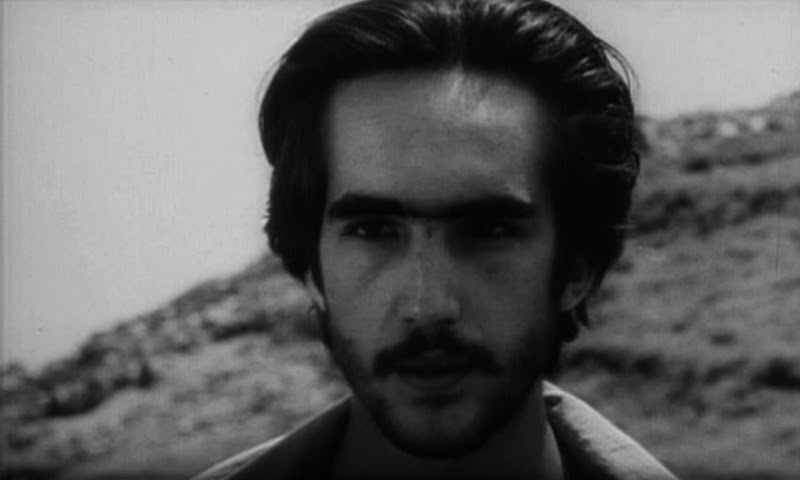
An earthy, socialist Christ
Enrique Irazoqui as Jesus
from
Il Vangelo secondo Matteo (1964)

As I understand it, for Pasolini, Jesus was a kind of pre-incarnate Karl Marx (rather than the incarnate God) who challenged the status quo of his day, and died as the earliest socialist martyr. Pasolini’s belief in the non-existence of God played a big part in how he saw Jesus and why he made the film. In a sense one could say Il Vangelo secondo Matteo is a kind of materialist corrective to the church’s position.

As I said, I love Pasolini’s film, but he got it wrong. I say this because of my own beliefs about God and about Jesus which, though personal on the one hand, I believe are also objectively true. My understanding of God is integral to the set of the “lenses” through which I look at the world. In other words, the difference between me and Pasolini is not really about any of his films, rather our differences go back to our presuppositions about God, truth, and the goals of human existence – even if we may agree on many things, and no doubt I am generally in awe of him as an artist.

Certainly great works of art are not, in our experience, predicated on any particular belief about God.

The God Who Is There
I have been thinking lately (and off and on for a long time) of the role that theology plays, or does not play, in how one approaches watching a film, looking at a painting, listening to a piece of music, or reading a book. So much of what we get out of a work of art comes from what we are able to bring to it, especially what it is we want from that particular work of art, and of art in general. What we want, I believe, is deeply affected by, and even grows out of, whether or not we are convinced of the existence of God, or god, or many gods, or none at all. So much depends on whether we are convinced of some ultimate meaning in the Universe, or whether we believe there is no ultimate meaning. And so much depends on how honest, even ruthlessly honest, we are with ourselves about these issues and their implications.

I use the word theology specifically. The term “theology” is a compound of two Greek words, θεος (theos: god) and λογος (logos: rational utterance). What I am interested in is a reasoned and rational examination of God, not merely of some vague spirituality (but that’s another presupposition isn’t it). What I find critical is the blunt question: Do you (do I) believe in God? How one answers that question has profound implications.

But the question is already on the table. We have inherited it. We can’t get away from it, just as we can’t get away from a myriad of other questions. And how we live our lives, including the art we make, is directly related to our answer. Art is a part of how we live our lives and, in many ways, emerges from the very heart of the matter. This is as true for Pasolini as it is for Spielberg as it is for Tarantino.

Often a work of art has, embedded within it, the answer to the question. Sometimes that answer is obvious. More often the answer is like backstory, a kind of presupposition that sits in the background and informs the art out front, as it were.

Moral Objects
A work of art is, in some ways, a mysterious thing. Like love, we know what art is, but we can’t always nail it down and give it a clear definition and well defined boundaries. Art emerges from deep within our humanness. Every culture and society has organically produced art, that is, art which emerges naturally from withing that culture or society. When I was an art history major many years ago I was introduced to many ancient works of art, via slides of course, like this exciting number:


Seated female, Halaf; 7th–6th millennium B.C., Mesopotamia or Syria
Ceramic, paint; H. 5.1 cm, W. 4.5 c
m
Metropolitan Museum of Art

This little statuette dates from nearly nine thousand years ago. Most likely it is a symbol of fertility. And most likely it was part of the symbolic rites and proto-religious system of that time. Many thousands of figures like this one have been unearthed. This little object speaks volumes about what was important to that ancient culture, like the importance of fertility to agrarian societies, and the importance of sexuality, and the very human need to supplicate before a god for one’s well-being. It also speaks of the human tendency to create symbols and to understand the world in terms of abstractions.

What I find interesting is how ancient and deeply ingrained is the human need to grasp at metaphysical solutions to the everyday muck of life problems, fears, and desires. I also find it fascinating that humans have to make physical objects that express the metaphysical, the ontological, the teleological, etc.

Even the Israelites, who had seen the ten plagues on Egypt, who had witnessed the parting of the Red Sea, who had the pillar of fire and the pillar of smoke in the wilderness, who had seen the walls of Jericho miraculously fall, and who had seen many other wonders of Yahweh, still created the golden calf, and still kept idols of other gods in their houses, and still built or maintained the high places (religious sites on hilltops to worship gods other than Yahweh). Today we have our idols and gods too – witness the way we worship our sports teams, or entertainers, our possessions, ourselves, for example.

Moral Stories
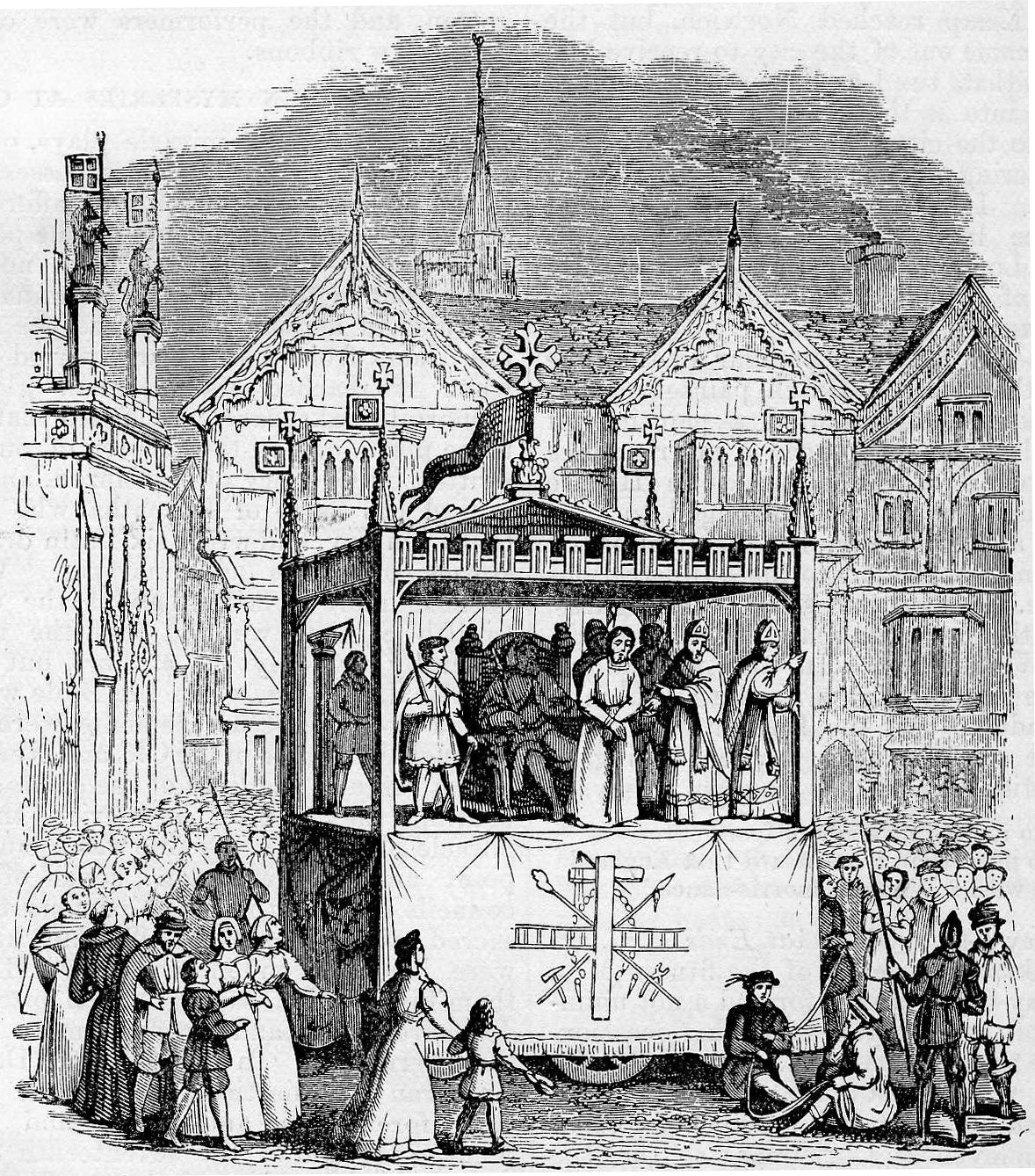
What humans have always seemed to enjoy are stories of moral dilemmas played out in both mundane and fantastical ways. Consider the medieval mystery plays. These were more than merely pedagogical in nature, they were social events that brought people together and incorporated some audience participation, including talking back to the characters during the performance, etc.

I hear that in some movie theaters in other countries (I write from the U.S.) audiences are very vocal and even talk to the screen, as it were, and critique out loud the actions of the characters while the film is playing. Regardless, quiet or vocal, we all seem to gravitate toward the moral. We like passing judgment, we like justice, and, interestingly, we like wickedness too. However, without some kind of absolute from which morality emanates, having a moral opinion is, in final terms, as much comic as it is tragic.


Medieval Mystery Play

So why do we continue to hold moral positions in a morally relativistic and credulistic world? If I had a clear answer I could probably chair some philosophy or psychology department somewhere. My guess, though, is that we will invent an absolute if we can’t find one. In other words, if one doesn’t believe in moral absolutes, or in something big enough (God for example), then one will invent a substitute absolute, for example: an economic or political system, or a biological and physical set of laws, or maybe an absolute that claims there are no absolutes. Regardless, the moral story still digs deep into our souls.

Even the most mundane and vapid kinds of films have some moral content which can be understood within a larger framework of meaning. Consider this audio review of the recent film Tranformers by a pastor at Mars Hill Church in Seattle. (The review is at the end of that post.)

Only Physical, or Metaphysical?
As I take a look at the popular art of today, that is, television shows (i.e. CSI, Survivor, et al) and film (i.e. Michael Clayton, Enchanted, et al), I see worlds presented that do not include God, or any so-called traditional god, that is, a creator deity with whom our destiny lies. These are materialistic worlds, worlds in which stuff is the ultimate reality, no final truth, and no source of meaning. Interestingly, the goals of the characters are all about meaning, and soul searching, and truth.

The characters or contestants are driven forward by things or ideas that they deem important. This is basic story telling. This is fundamental script writing. But it doesn’t make sense if there is no final meaning in the universe, otherwise it’s just a cruel game. Why should we care that someone is searching for something that doesn’t exist? Or even if, for some untenable reason, we do care, why should they search? Consider this quote regarding the modern predicament:

The quality of modern life seemed ever equivocal. Spectacular empowerment was countered by a widespread sense of anxious helplessness. Profound moral and aesthetic sensitivity confronted horrific cruelty and waste. The price of technology’s accelerating advance grew ever higher. And in the background of every pleasure and every achievement loomed humanity’s unprecedented vulnerability. Under the West’s direction and impetus, modern man had burst forward and outward, with tremendous centrifugal force, complexity, variety, and speed. And yet it appeared he had driven himself into a terrestrial nightmare and a spiritual wasteland, a fierce constriction, a seemingly irresolvable predicament.

~Richard Tarnas, The Passion of the Western Mind
What does one do with this? How does one come to terms with a spiritual wasteland, or an irresolvable predicament? Is it so that rational human beings must suffer the conflict of a great desire for meaning in a world that has no ultimate meaning? Is religion an answer or a placebo? No matter what we do we do not get away from these questions. How we solve them, or come to terms with them, is a big deal (or maybe it is also meaningless). My contention is that there is a God, that that God is there, and that that God is knowable. But am I deluded? I don’t think so. And the person who thinks I am deluded believes from a place of conviction as well. I find this more than fascinating.

Michael Clayton

What most recently sparked my thinking about all this God and art stuff was a recent viewing of Michael Clayton. The story in this film plays itself out in a Western (geographically & conceptually), materialistic world where there is no transcendent god. It is a thoroughly modern view of human existence. There are no moral absolutes. And yet, Clayton is a man in search of himself. He is in desperate need of a positive existential moment. He needs to make a self-defining, self-actualizing choice so that he can move beyond his cliff-edge existence and become who he should be. He needs to make the right choice even if it is difficult and painful, even if it means giving up who he has been. There is nothing narratively original in this aspect of the story. It is as timeless as a Greek tragedy.

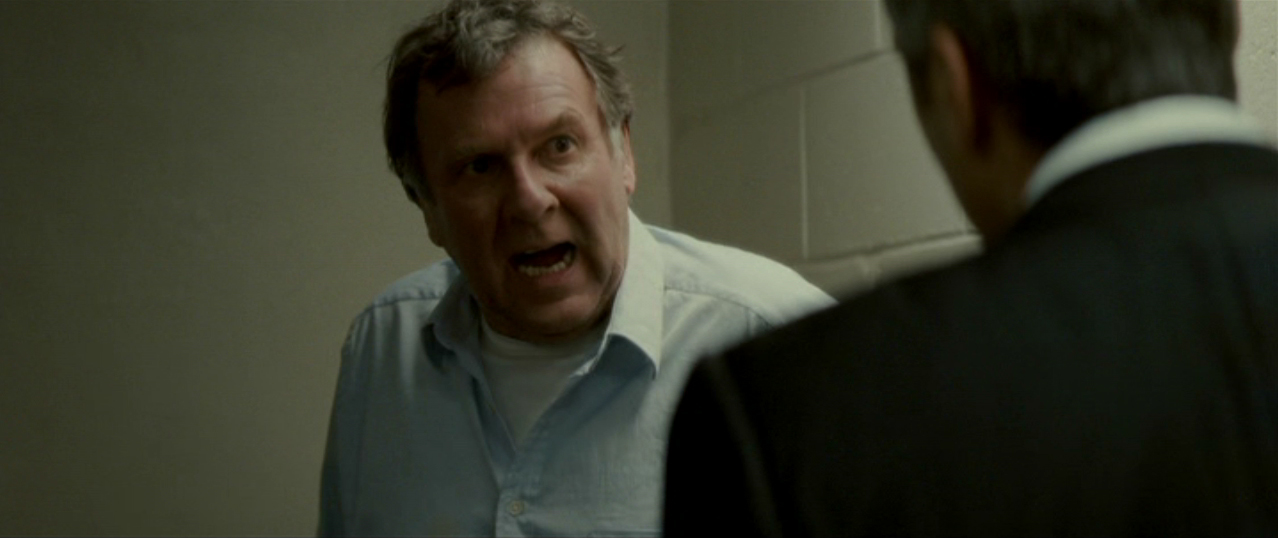
The story revolves around a legal battle in which a company is being sued for its harmful actions. Arthur Edens (Tom Wilkinson) is the attorney working the case. Unfortunately for his law firm and for his client he is deeply troubled by the case. He feels he is defending murder, in a sense. The firm sends Michael Clayton (George Clooney) to talk with Edens. Part of that conversation goes like this:

Michael Clayton: You are the senior litigating partner of one of the largest, most respected law firms in the world. You are a legend.
Arthur Edens: I’m an accomplice!
Michael Clayton: You’re a manic-depressive!
Arthur Edens: I am Shiva, the god of death


“I am Shiva, the god of death.”

Wow. Where did that come from? Shiva, the god of death? It certainly grabs one’s attention, and it sounds rather cool, but why, in this film, out of nowhere make a reference to one of the principal deities of Hinduism? I say “nowhere” because there is no indication throughout the film that any of the characters believe in any kind of god or religion. In fact, it could be argued that the problem facing all the characters is that, because there is no god, no ultimate reality to which they are finally accountable, they are lost in a sea of moral floundering. Morality becomes personal preference, personal conviction, and power.

Making a reference to Shiva, the destroyer and transformer Hindu god, makes some sense then. First, Edens feels like a destroyer, or at least one who defends the destroyer. He has personal convictions of wrongdoing and it is eating away his soul. Second, in a world personal morality one can choose, as one needs or sees fit, any god that works for the moment, so why not Shiva? Shiva becomes Eden’s god of choice because the concept of Shiva explains his convictions somehow. Shiva is his self-image for the moment. Tomorrow it might be a different god. Maybe Vishnu or Brahma. Or maybe a Sumerian god.

Interestingly the reference to Shiva comes up again. Once Clayton confronts Karen Crowder (Tilda Swinton) with the fact that he has carried out Eden’s plan to expose the company, we get this bit of dialog:

Karen Crowder: You don’t want the money?
Michael Clayton: Keep the money. You’ll need it.
Don Jefferies: Is this fellow bothering you?
Michael Clayton: Am I bothering you?
Don Jefferies: Karen, I’ve got a board waiting in there. What the hell’s going on? Who are you?
Michael Clayton: I’m Shiva, the God of death.


“I am Shiva, the god of death.”

Again it’s Shiva, the god of death, and this time the line is used as a final punctuation to the film’s climax. However, unlike Eden, Clayton uses the line more for its effect on Crowder and Jefferies than from a sense of personal identification. What might that effect be? Within the context of the film, and within the context of a largely non-Hindu society, this line comes as a kind of shock, a non-sequitur of sorts, that specifically draws attention to itself. I imagine the filmmakers intend the line to read something like “I am the fictional, mythological god Shiva (in a metaphorical sense of course) who is bringing about a kind of death to you, a death that you are powerless to avoid.” In other words, we are not to assume that the filmmakers or the characters actually believe in the existence of Shiva, rather the idea of Shiva is appropriated in order to convey something meaningful.

To the person who does not believe in Shiva, such a line might merely have a kind of cool factor. To a devout Hindu this line might be somewhat disconcerting – I don’t know because I am not a Hindu. What is interesting is that none of the characters have made a conversion to any religion, or even gone through any particularly religious experience. Edens has had mental breakdown because of deep moral tensions. Clayton has crossed over into a personally powerful existential decision. But neither have obviously embraced Hinduism. (If I missed something, let me know.)

Interestingly, the narrative arc of Michael Clayton follows a traditional Western style morality tale. And yet, one could say the characters, who do not overtly believe in any god, still wrestle with issues that derive their moral content from a Judeo-Christian heritage, and then, ironically, symbolically claim a Hindu god as justification for their actions. I find this both puzzling and not surprising. It is exemplary of the pluralistic/post-modern society that I live in.

In the film’s final shot we see Clayton riding alone in the back of a taxi. It is a meditative shot. He does not look happy or fulfilled. Maybe he is, but his countenance is rather sullen. Has he saved himself by his actions? Has he found redemption for who he was? How can he be sure he has actually changed as a person? None of these questions are answered. One could say that finally he made the right decision after a life of bad ones, and that is good. But one could say that he still has not solved the deeper question of his existence.

The radical truth is that in a world without a God that stands as an ultimate source of meaning then any decision made by Clayton does not really have any meaning. His final decision, though it may resonate powerfully within us the viewers, doesn’t really matter, no matter how personally, existentially transforming it may be for him. At best one can say he made his decision, so what. Any decision would have had the same value. But, of course, we know deep down that can’t be true. We live knowing there is right and wrong, and what we believe we believe to be true.

Crimes and Misdemeanors
Consider the film Crimes and Misdemeanors, Woody Allen’s brilliant 1989 film about morality, choice, and justice. In this film Allen explores how morality flows from where one begins, that is, from the set of presuppositions one claims about God, the universe, our existence, meaning, etc. He also seriously toys with our expectations (our need) for justice to win out.

The film is also very much about the existence, or non-existence, of God, and what that means. I love this quote from Judah Rosenthal:

I remember my father telling me, “The eyes of God are on us always.” The eyes of God. What a phrase to a young boy. What were God’s eyes like? Unimaginably penetrating, intense eyes, I assumed. And I wonder if it was just a coincidence I made my specialty ophthalmology.

There is something both sinister and humorous about it. It also represents our modern tendency to analyze ourselves and mistrust our motives.

But there is so much more to consider in this quote and in this film. The following two part video analysis is an excellent overview of the film’s themes:

When I first saw Crimes and Misdemeanors I was both stunned and thrilled. At the end I thought “perfect”, that’s how it should end, with him getting away with murder, not because I wanted him to, but because I so expected him to get caught and I liked the irony. Allen turns everything on it head and gets us to think. Thinking is a good thing, especially about truth and morality.

Our view of God has a great deal to do with how we understand and appreciate Crimes and Misdemeanors. If there is no God are the characters and their actions meaningless? Is our desire for justice merely a temporary chemical reaction to a situation that emerged from the chance combination of sub-atomic particles? Or do we live as though our desire comes from someplace more profound?

[Side note: In Star Wars, when the Death Star blows up the planet Alderaan, do we merely observe the rearranging of material particles (something of ultimate inconsequence), or do we assume that blowing up a planet and its inhabitants is an act of evil? Get over it old man Kenobi, you moralist! That was no tremor in the force. Probably just gas.]

Finally

I am inclined to think there is no such thing as a narrative without some moral content.
Either a series of events are purely a-moral, an arbitrary grouping of cause and effect acts without meaning, or they are, in some way, the result of decisions. If decisions are involved then those actions have meaning and therefore have a moral dimension. I see narrative as being fundamentally the result of decisionsand therefore fundamentally moral.

But as soon as well make a moral claim we assume an absolute. We might say our claim is purely cultural or situational or merely a personal decision, but we don’t really live that way. When we say war is wrong, or rape is wrong, or Nazi death camps are wrong, we assume a universal. And if we claim universals then what is our foundation? This is the very point at which our belief or non-belief in God, god, or gods, has the most gravity.

Woody Allen leaves the question open in Crimes and Misdemeanors, but he is relying on the fact that we cannot. He creates in us a tension, and something to talk about. Michael Clayton leaves us somewhat satisfied, yet under its surface there is no final meaning, its only opinion. What is great about both of these films is how they tap into the very human predicament of having to sort out the deep questions of how we are to live our lives and upon what are we going to base our choices.

I can be in awe of an artist even though our beliefs about God may differ. What we have is a common humanity, which is a truly profound connection. Even so, it is worth calling out our differences as well, not for the sake of creating divisions, but of understanding each other and seeking the truth. For we are, by nature, truth seekers. But then that’s another universal I am claiming.

The River

“…that’s the well that doesn’t dry up, is the Renoir cinema.”

~ Martin Scorsese

Jean Renoir is my favorite filmmaker. I say that knowing my preferences could change, and I also have deep currents of love for the work of several other filmmakers, but each time I watch a Renoir film I am reminded why I like his work so much. There are so many obvious qualities to his films, but with Renoir there are also qualities that seem impossible to define and yet you know they are there; something in your heart or gut tells you so. I think this is because his filmmaking is rooted first and foremost in his interest for humanity over and above filmmaking. Filmmaking is Renoir’s tool, but humanity is his subject.


Renoir on the set of The River

In 1951 Renoir shot his first color film, The River. The story is set in India and is based on an autobiographical novel (and screenplay) by Rumer Godden. The story is a coming of age tale about three young women as told by one. It is also a tale of life in India as told by the child of a British colonialist family. And it is a moral tale of priorities, of a tragedy when infatuation trumps love.

I don’t write film reviews, and I am not a critic in any formal sense. I do, however, want to draw some attention to a scene that is so perfectly Renoir in its timing, tone, and love for his characters.

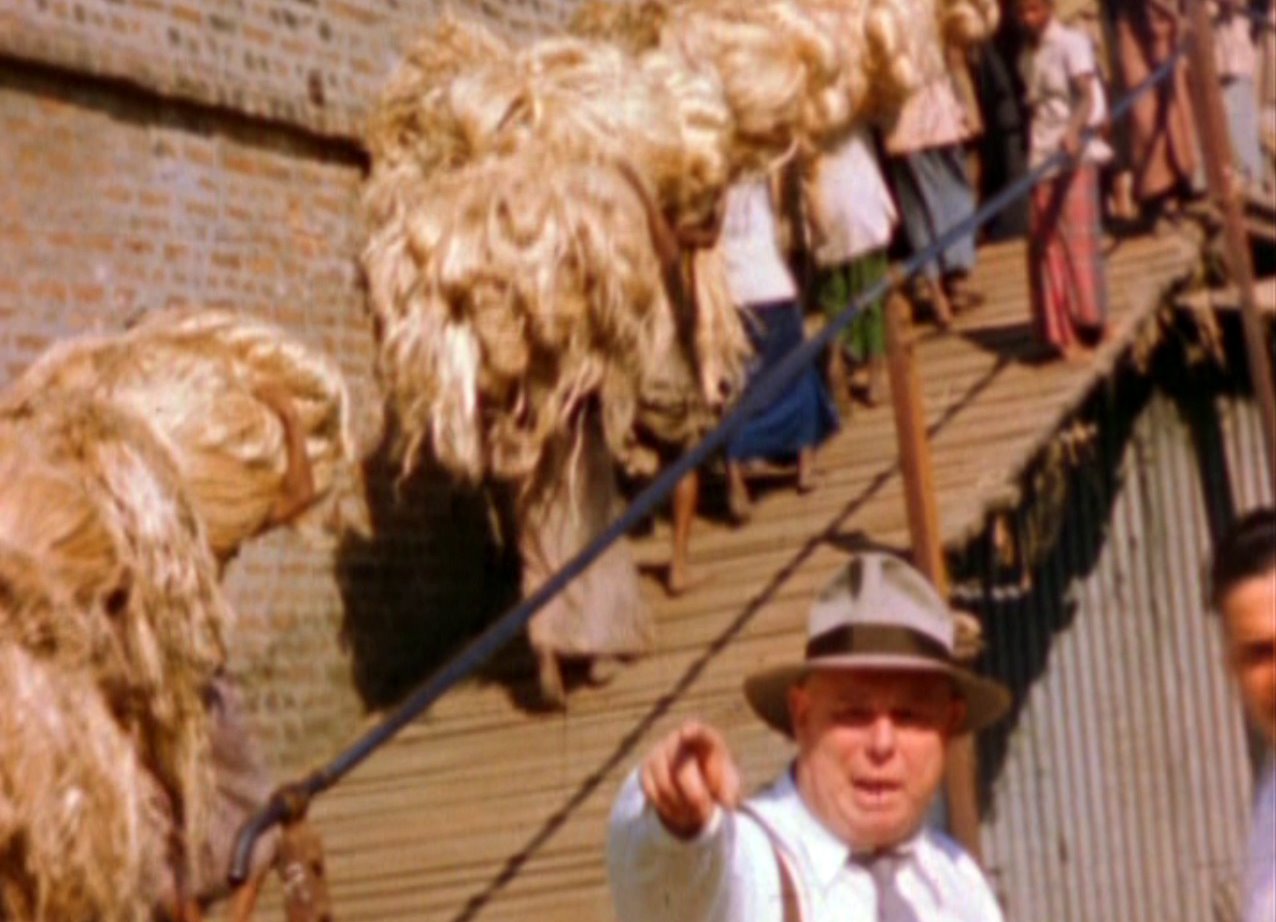
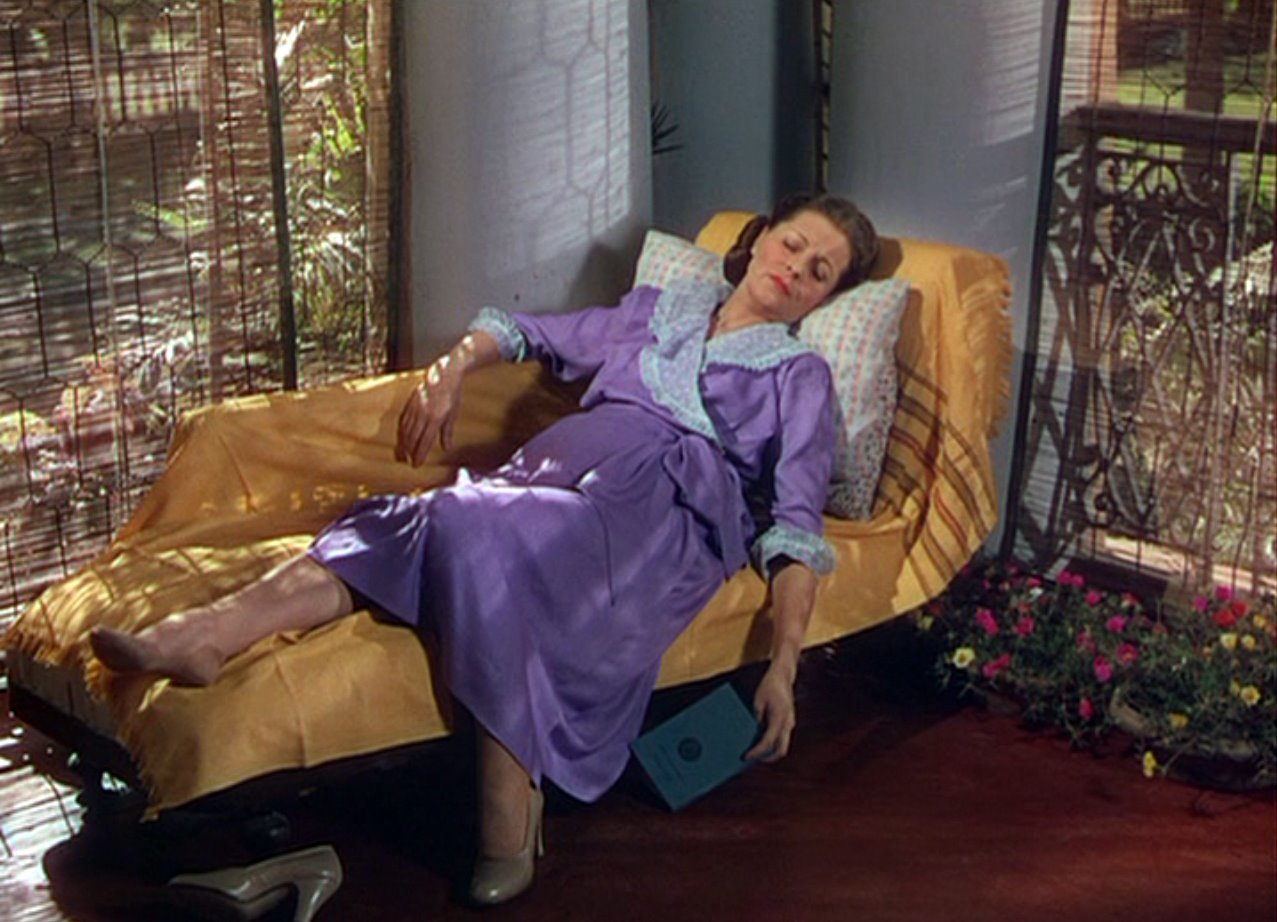
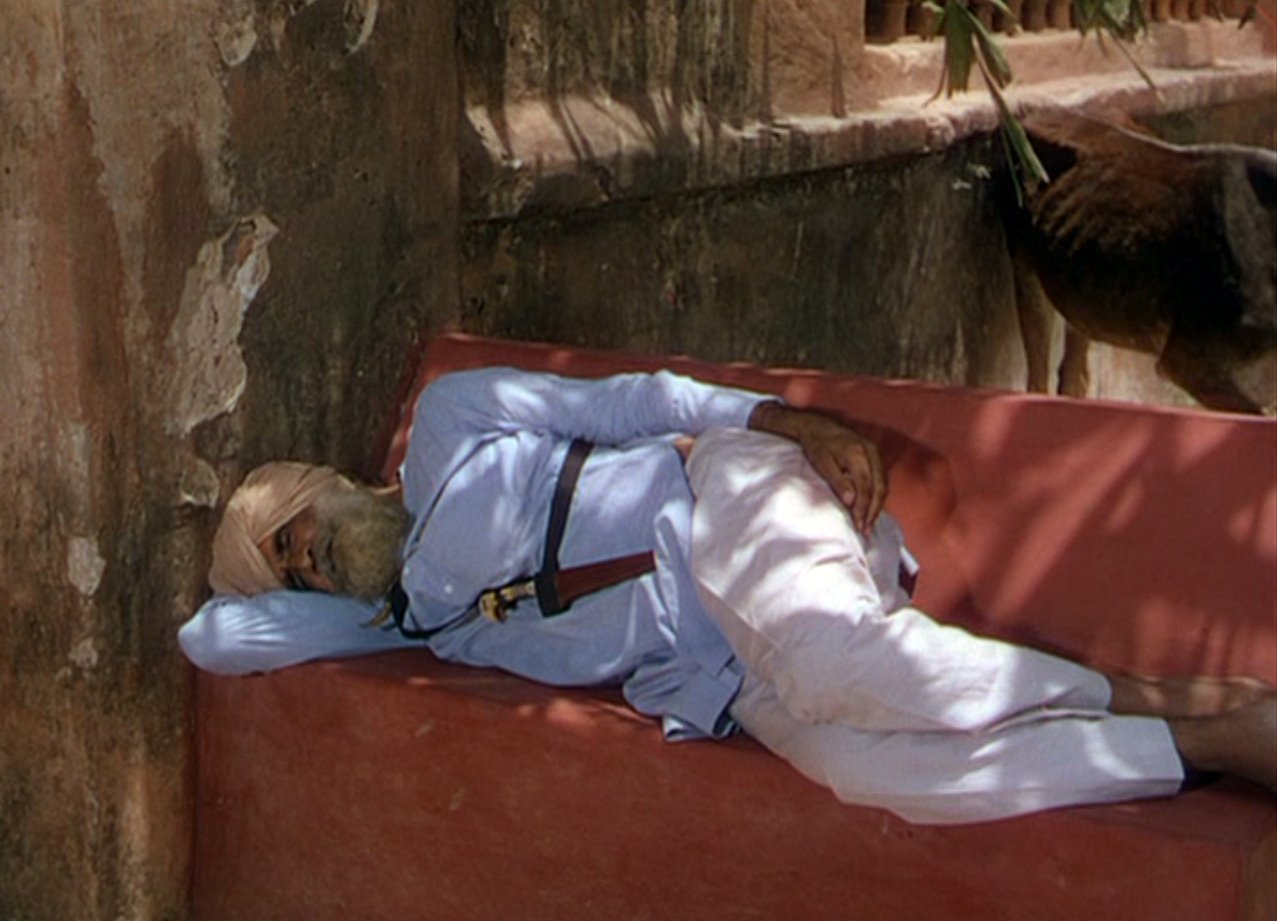
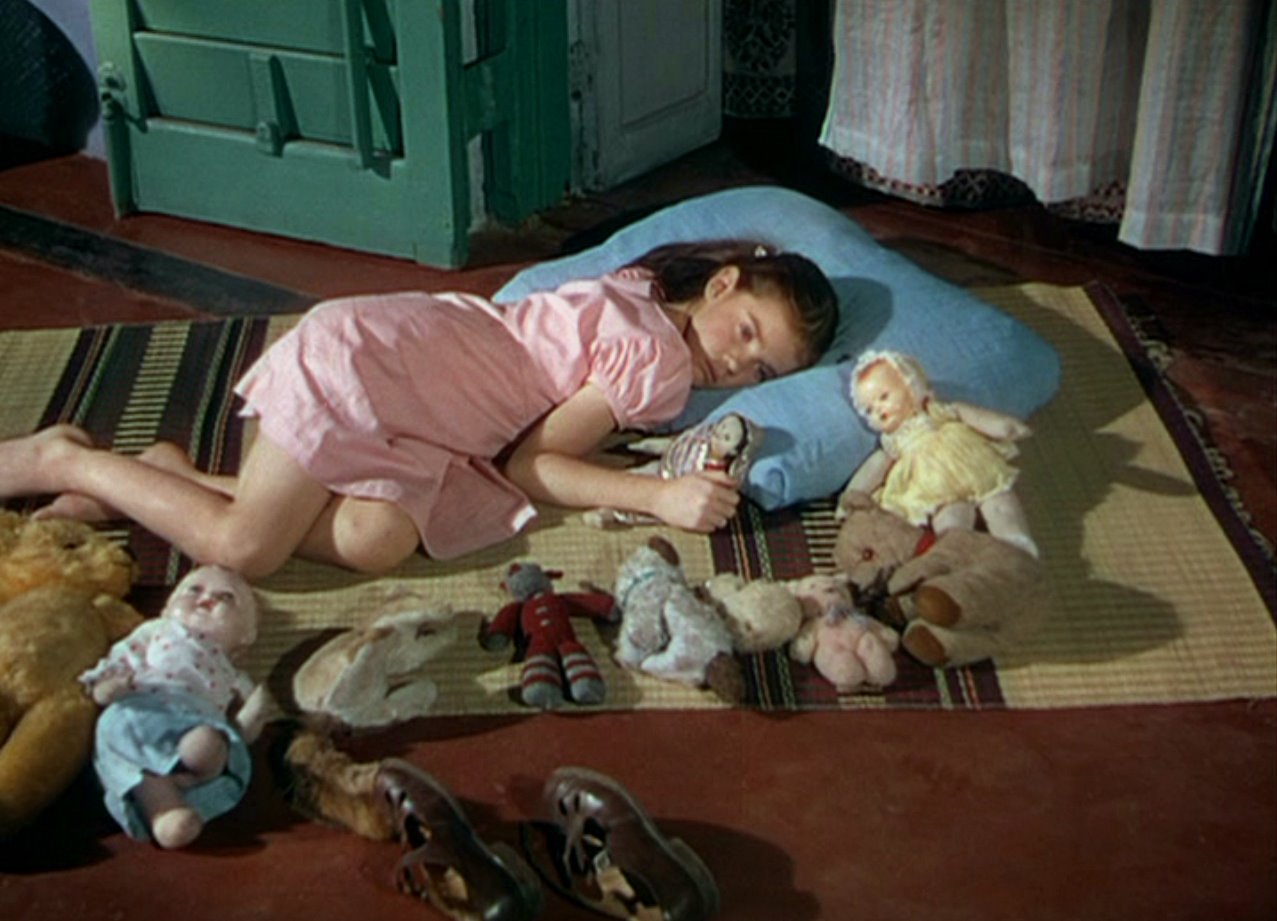
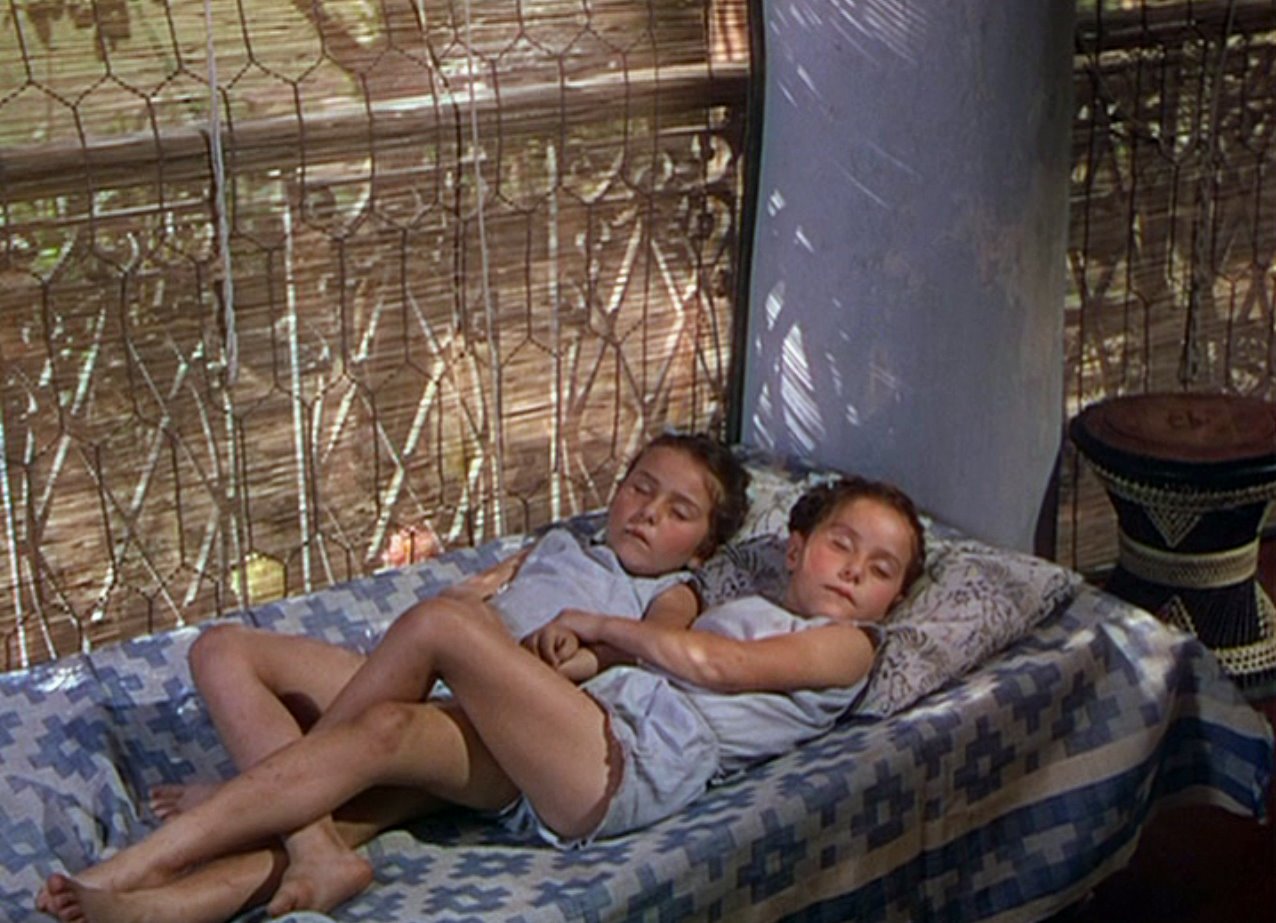
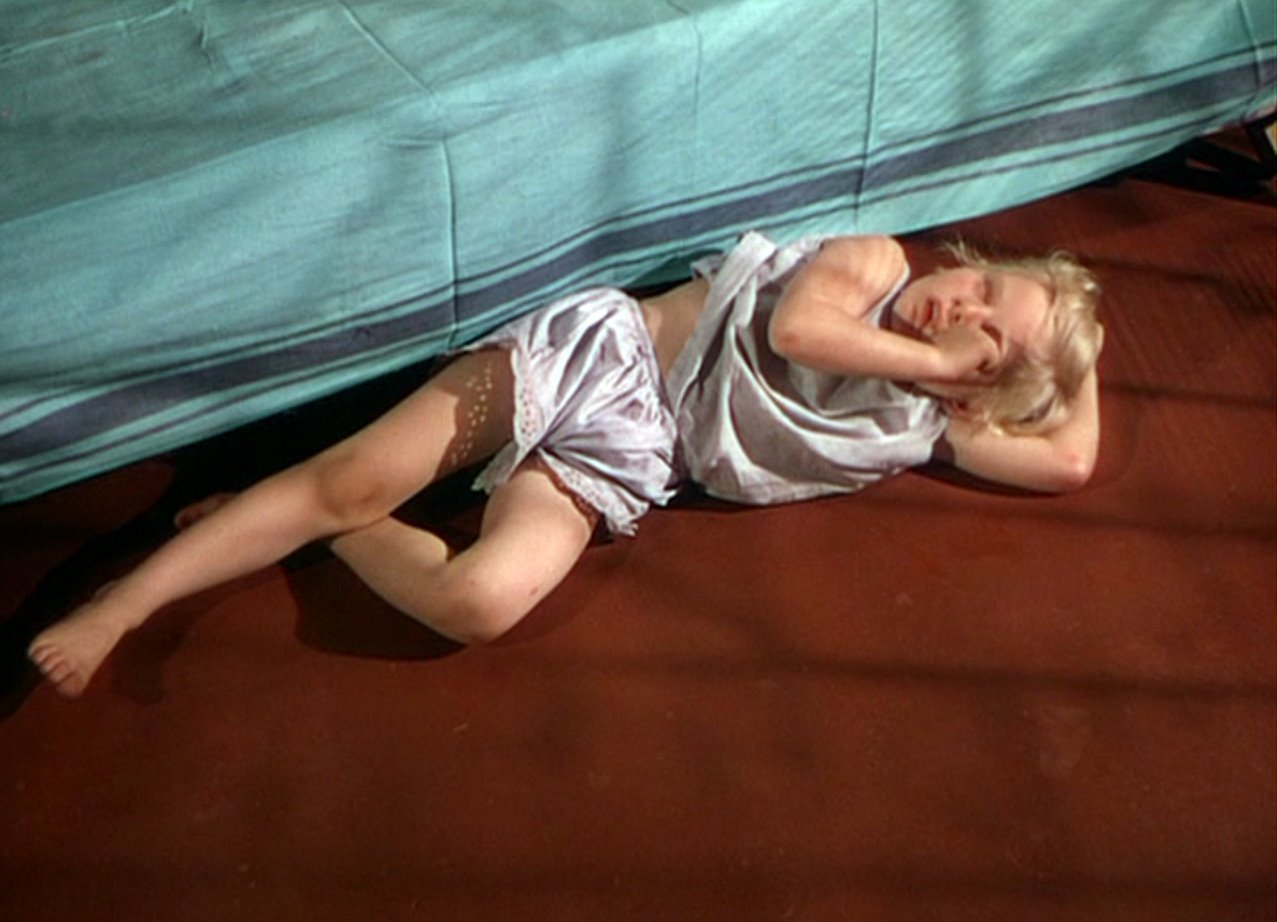
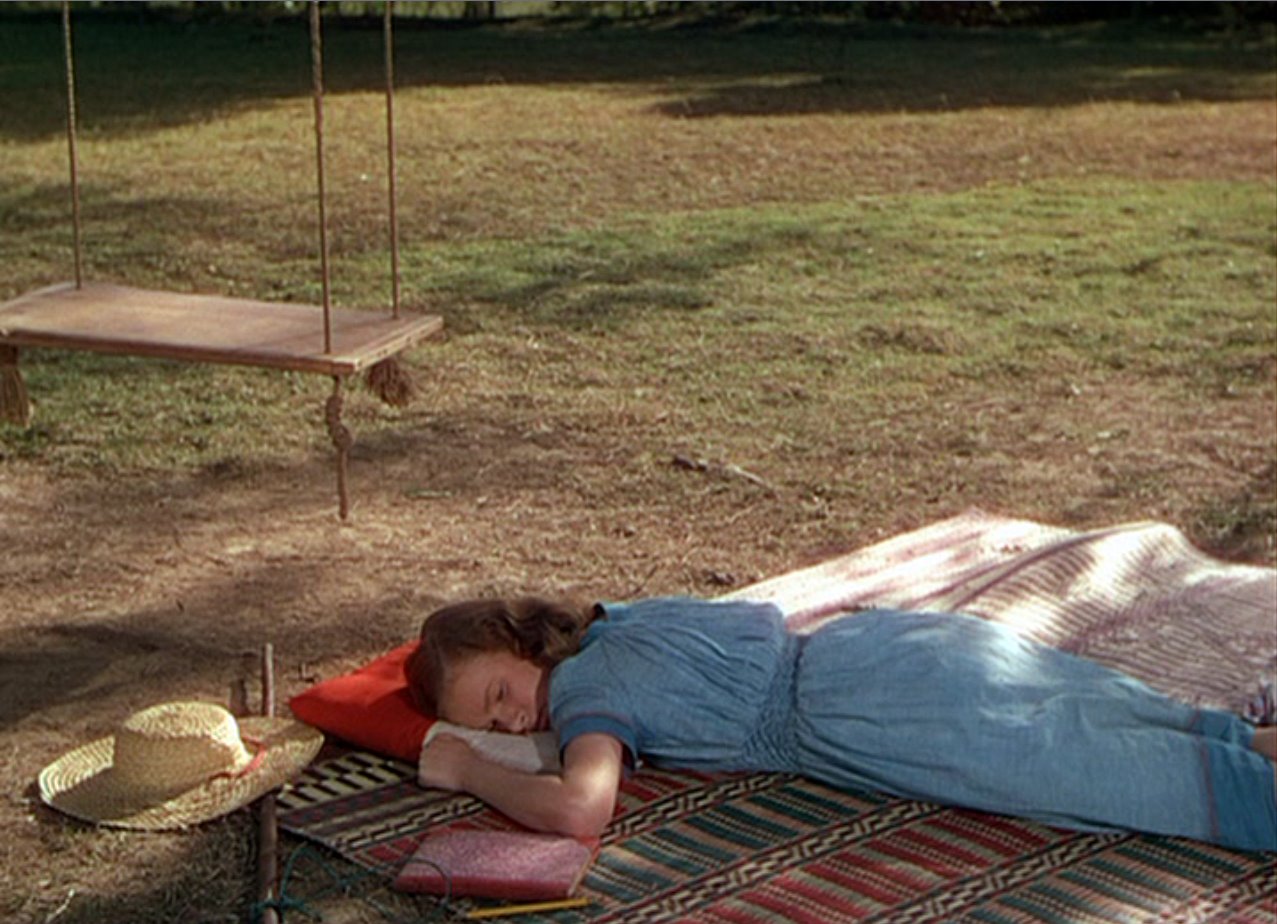
One can argue that the scene is the climactic scene of the the film, although it is not the only climax. The scene consists of a series of vignettes of the family and its servants asleep in the heat of midday. In each shot the camera either dollies in or out (so the screengrabs don’t do them justice), giving each shot a kind of dreamy movement concomitant with the subject, which includes both the individuals sleeping and a picture of a particular kind of life.

Here we have the pregnant mother:

Doesn’t that image, the way she is posed, the book dropped to the floor but still in her hand, the warm colors, evoke the kinds of images Renoir’s father used to paint?

The rest of the vignettes are similar.

Each of these vignettes has the camera moving in and through the image, composing as it goes, drawing our attention more deeply into the world of the characters. The stringing together of these shots also sets up a kind of emotional pacing that then “pays off” when a horrible tragedy is discovered, a tragedy that was set up earlier in the film and then reinforced just before this series of shots. [I would say more, but I don’t want to spoil the film, even though great films truly cannot be spoiled.]

There is something marvelous in the way Renoir sets up the tragedy. One could say that death comes because others are not paying attention, that they are thinking of themselves. And that is true. But Renoir never finds too much fault in his characters. Renoir’s humanism is one of subtlety and mercy. He finds both righteousness and sinfulness in all his characters. I wrote some about this in my post on Renoir’s Boudu Saved from Drowning.

Renoir was a master filmmaker. His two touted masterpieces, The Rules of the Game (1939) and The Grand Illusion (1937), show him at a summit of sorts. And yet, take a look at his other films, The Golden Coach (1953) for example, or French Cancan (1954), or films such as The Crime of Monsieur Lange (1936), and one finds additional riches from a great cinematic story teller. There is so much in the Renoir vault. Renoir is truly a well that doesn’t dry up.

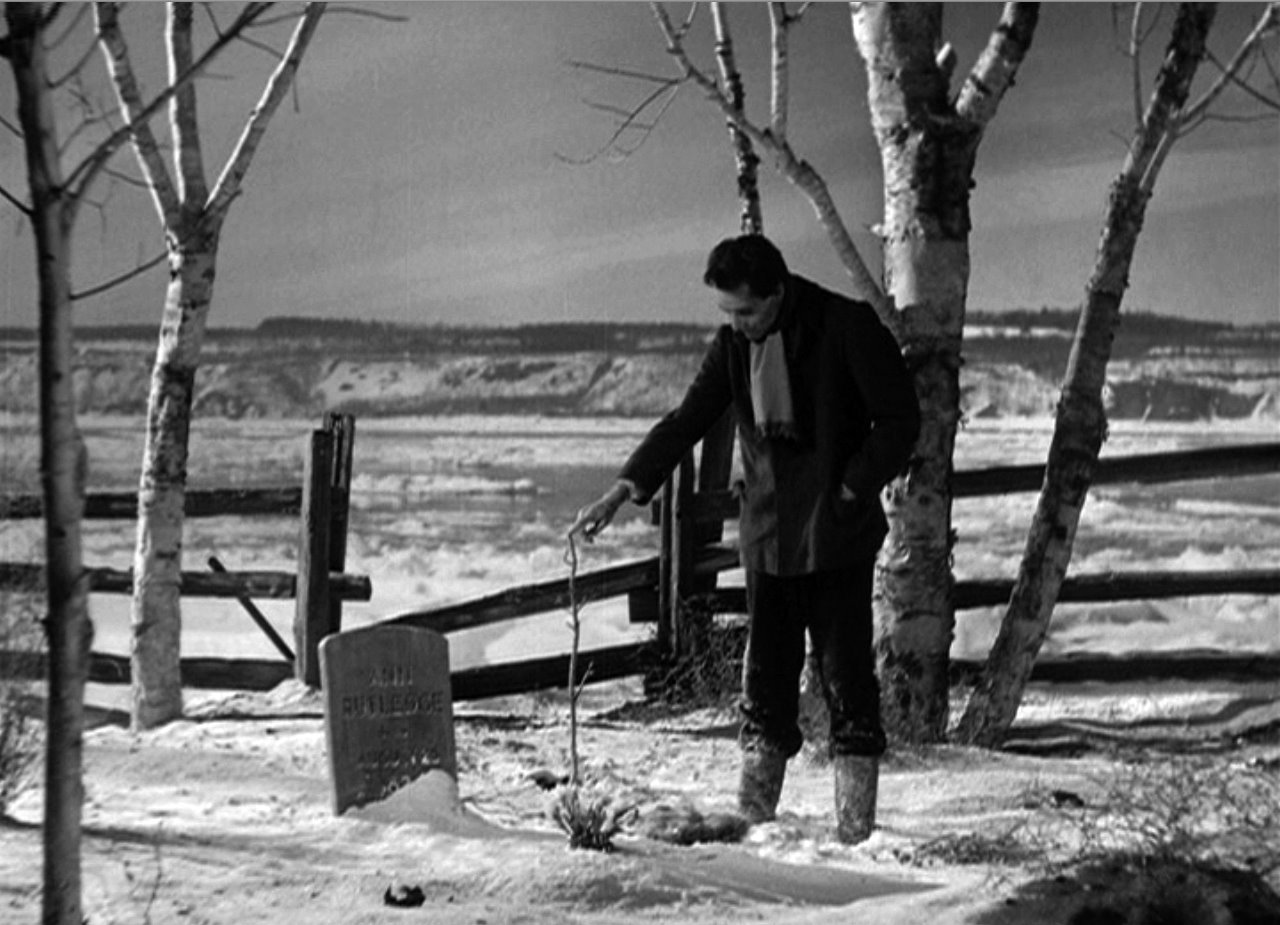
Young Mr. Lincoln

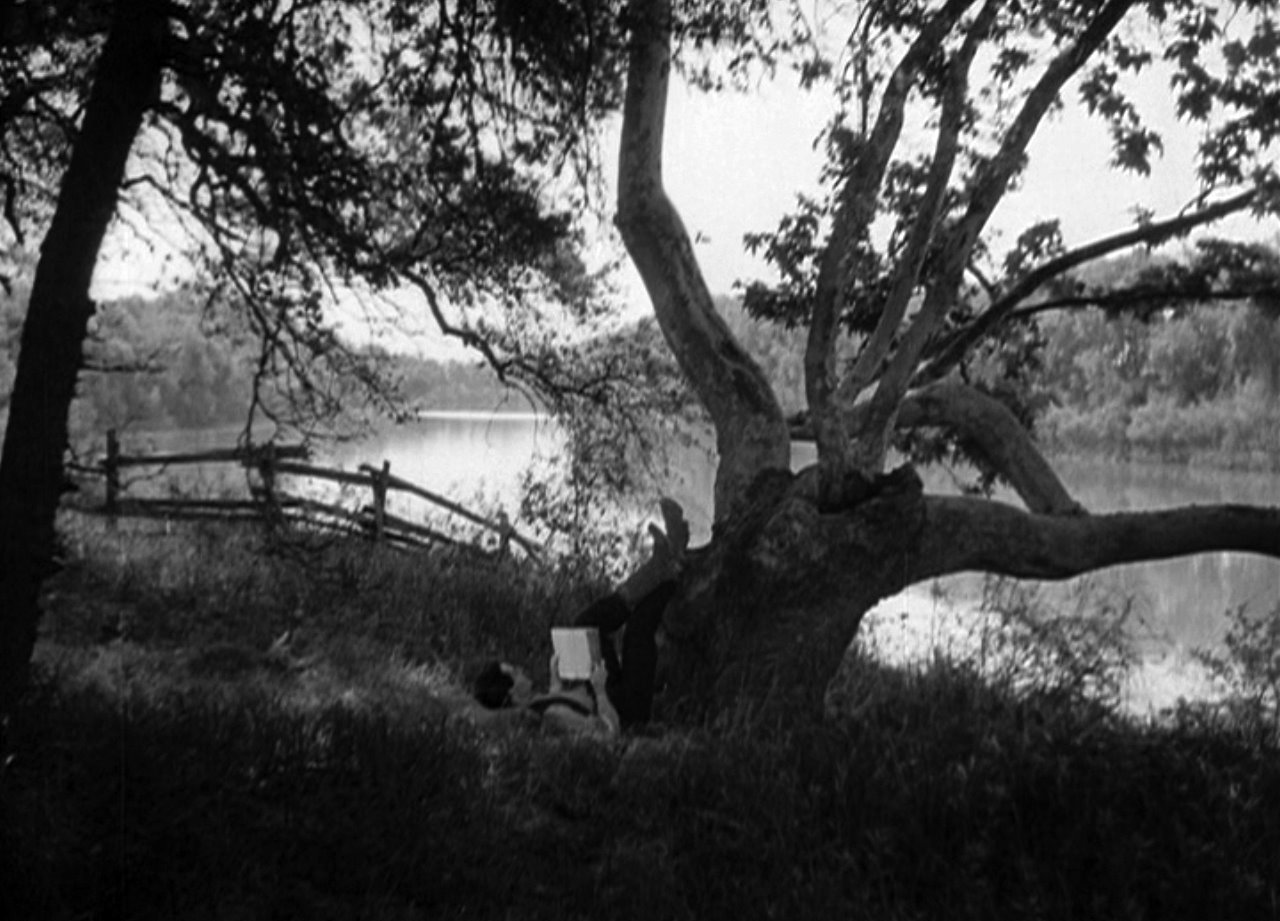
The other night I introduced my daughter to John Ford and Henry Fonda by way of Young Mr. Lincoln (1939). She was excited because Abraham Lincoln is one of her heroes (mine too). The image above, which comes early in the film, caught her interest. Lily loves books and she said the image was where she wants to be: Under a big tree along a river bank on a warm day in a cool breeze reading a book. I couldn’t agree more.

I am convinced that much less attention would be given Young Mr. Lincoln if it were not for that seminal article by the editors of Cahiers du cinéma. Regardless, the film has loads of qualities that would draw anyone into its orbit.

What is so wonderful about Young Mr. Lincoln is how perfectly mythical it all is. Lincoln was a truly unique individual in American history. His life did, in fact, take on the character of myth at times. However, many have added additional myths to his story, as though just the plain truth is not enough. This film is no exception. And yet, Young Mr. Lincoln gives us what we want, at least it gives me what I want: A good myth told well.

I love the idea that the fate of this nation, and by implication, the whole world, hinges on which way a stick will fall.

But isn’t that how life really is so many times? The great sweep of human events is mostly out of the hands of any particular person, but frequently (and curiously) it is the individual who makes the difference. And sometimes it is the flip of a coin, or the missed train, or the letter delivered too late, or the accident, or the small good deed that makes all the difference in the world. I like that kind of story. I like the twin ideas that the individual can make a difference and that sometimes it is the littlest things that cause the greatest effect. I think this is a very American preference, though not entirely unique to America.

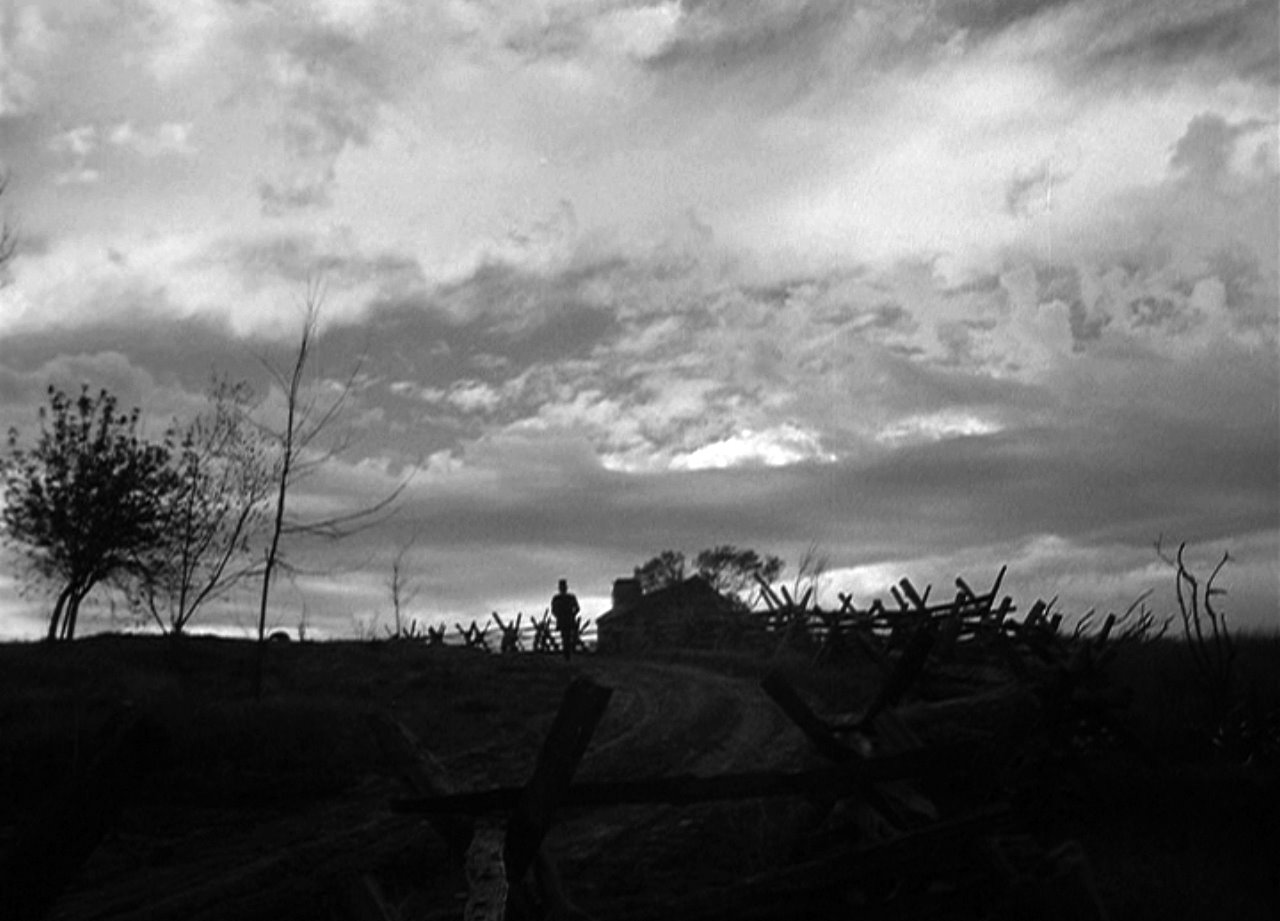
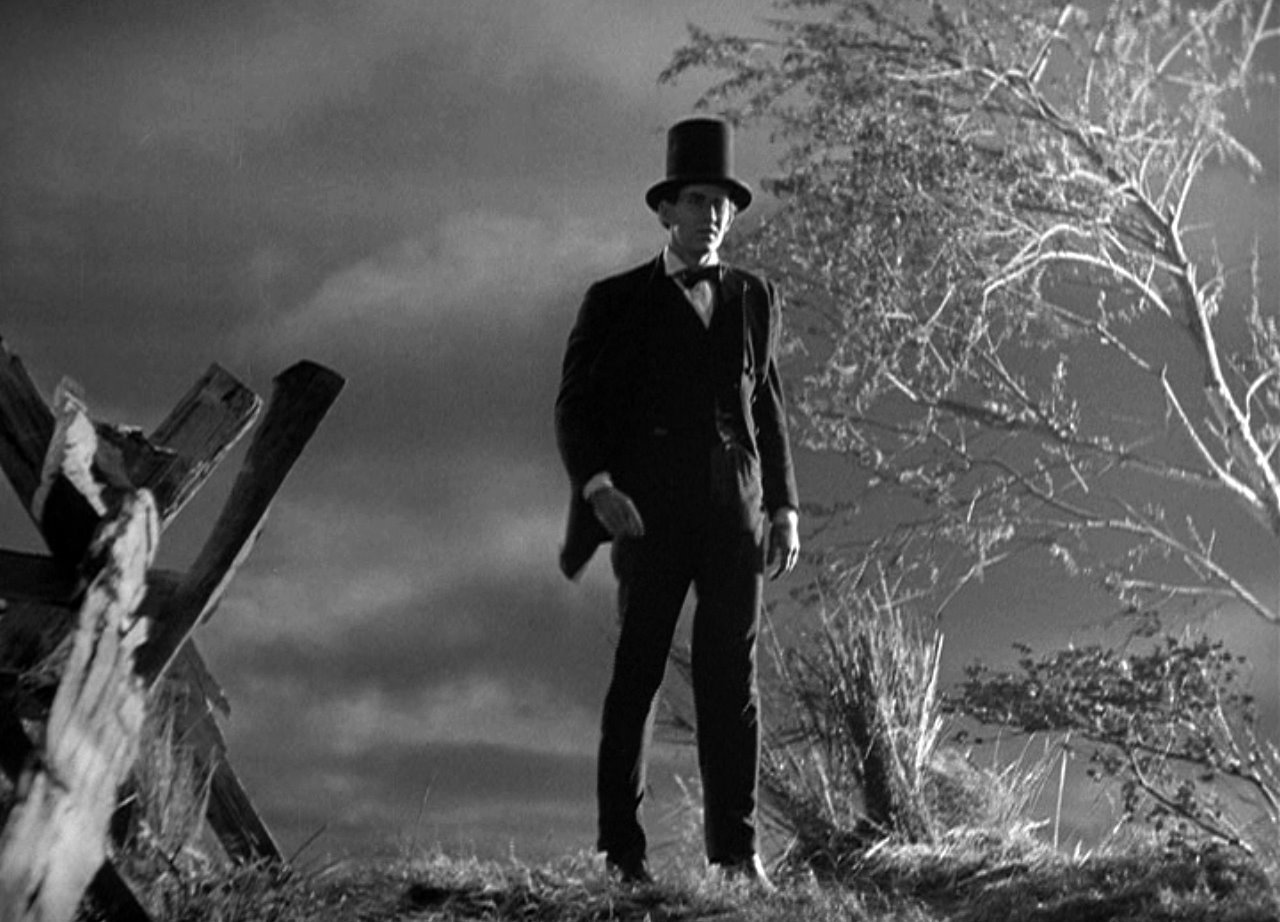
And who could forget the last few images of Young Mr. Lincoln? Two stand out for me.

Lincoln walks alone up the hill. His tall figure, with its oddly tall stovetop hat, stands in silhouette against a beautiful cloudy sky. This image portends his future journey into America’s uncertain future, and all that that will mean.

Then Lincoln crests the hill. Lightening flashes. He pauses and looks ahead, maybe to the top of the next hill. He then walks out of the frame. Heavy rain begins to fall. This portends his future as well, but this time the future becomes more specifically defined. His future will be stormy. But he still faces it and walks into it without fear. He is the local hero still yet to become the great hero. He is the young Mr. Lincoln.

* * * * * * * * * *

The beginning of the film includes a portion of the following poem by Rosemary Benét about Lincoln’s mother (Nancy Hanks Lincoln) who died when he was a boy. After we finished the film Lily wanted to go back and read the poem. Then she just had to copy it out by hand. I love that about Lily.

If Nancy Hanks
Came back as a ghost,
Seeking news
Of what she loved most,
She’d ask first
“Where’s my son?
What’s happened to Abe?
What’s he done?”

“Poor little Abe,
Left all alone
Except for Tom,
Who’s a rolling stone;
He was only nine
The year I died.
I remember still
How hard he cried.”

“Scraping along
In a little shack,
With hardly a shirt
To cover his back,
And a prairie wind
To blow him down,
Or pinching times
If he went to town.”

“You wouldn’t know
About my son?
Did he grow tall?
Did he have fun?
Did he learn to read?
Did he get to town?
Do you know his name?
Did he get on?”

>The indomitable Fitzcarraldo

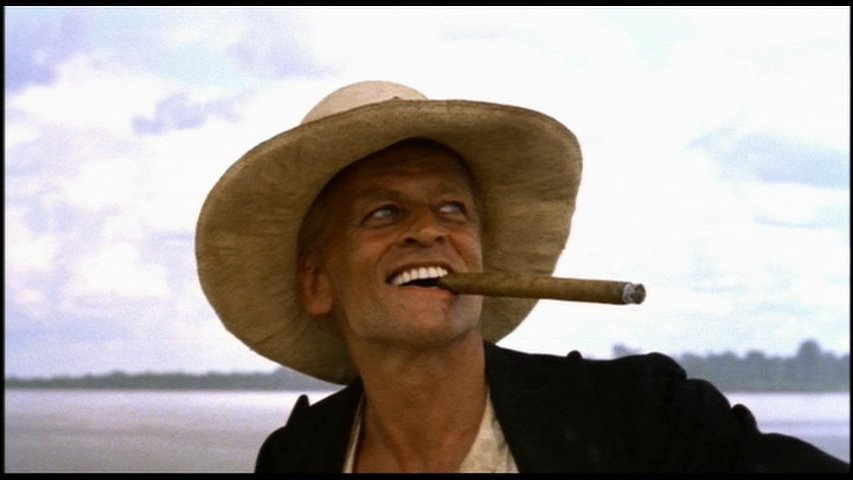
>At the end of Fitzcarraldo (1982), after so much effort has come to nothing, the title character still finds joy. He is a successful loser. A man of dreams and the joy of dreams. I want to be like Fitzcarraldo. I want to be indomitable.

I love this film. It is bizarre and amazing. It is also a wild and woolly romp into the insanity of making the impossible come to life, like the modern Prometheus’ dream. This is true for both Fitzcarraldo and for Herzog, the true Fitzcarraldo. But I want to be Fitzcarraldo. I want to be Herzog. I want to take on the big dream and live through it.

Or more importantly, I wan to be the successful loser. Not that I want to be a loser. But I know that I will lose. I am already a loser of sorts. I have already lost many things, sometimes volitionally, sometimes not. But I want, I need, to find joy in whatever I do and wherever I end up.

Remember where Fitzcarraldo started. He was a man close to incurable insanity. The scales had nearly tipped against him. His dream ate at him, tormented him, nearly destroyed him.

And yet, when he actually did what was insane, what was the process of his dream, he found joy. There is a lesson here. Fitzcaraldo did what he was made to do. He plunged in to the substance of his existence. He lived out his fate. He lost. He found joy. In this sense one could say that Fitzcarraldo’s dream was a kind of grace, a blessing as it were, bestowed upon him like near death experience brings about a new love of life.

And then, when he returned, Fitzcarraldo found, once again, another uncertain future, but that’s another story. And that is life, and maybe opera.

Rear Window Sandwich

The other day my daughter Lily asked to see Rear Window again and I was happy to oblige. In fact I was thrilled. I’ve seen the film many times. She had only seen it once before (she’s not yet eight, there’s plenty of time).

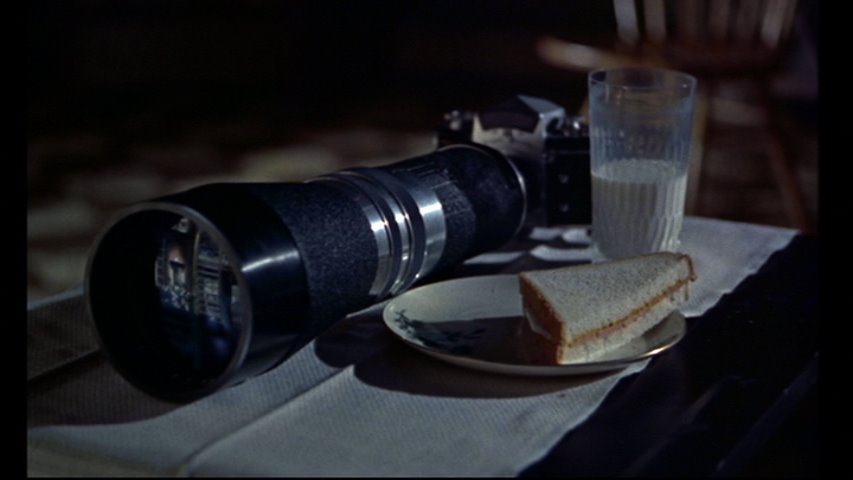
I haven’t thought much about Rear Window, or read much about it either. I just love it and watch it periodically. This time something caught my eye that I hadn’t really thought of before: The analogy between L. B. Jefferies’ consuming fascination with what is happening outside his rear window and his biological need for food.

Here is the scene that caught my eye:

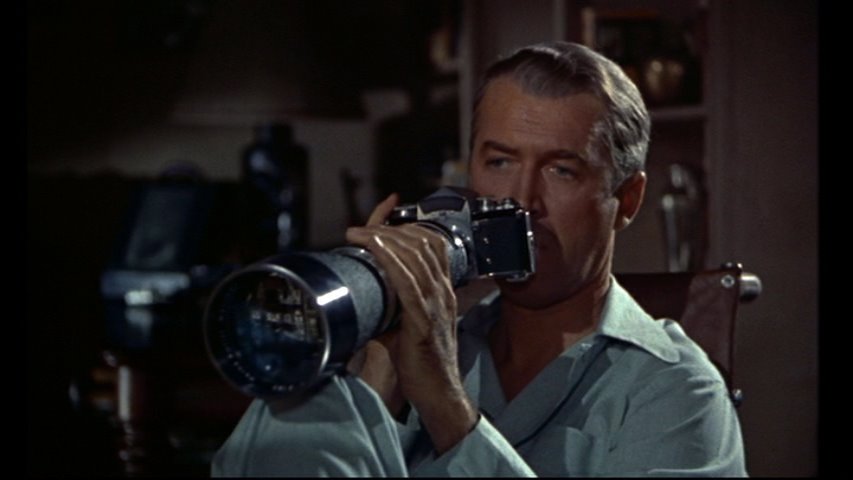
In the half light of evening we see an image of a half of a sandwich, a glass of milk, and a 35mm SLR camera with a large telephoto lens.

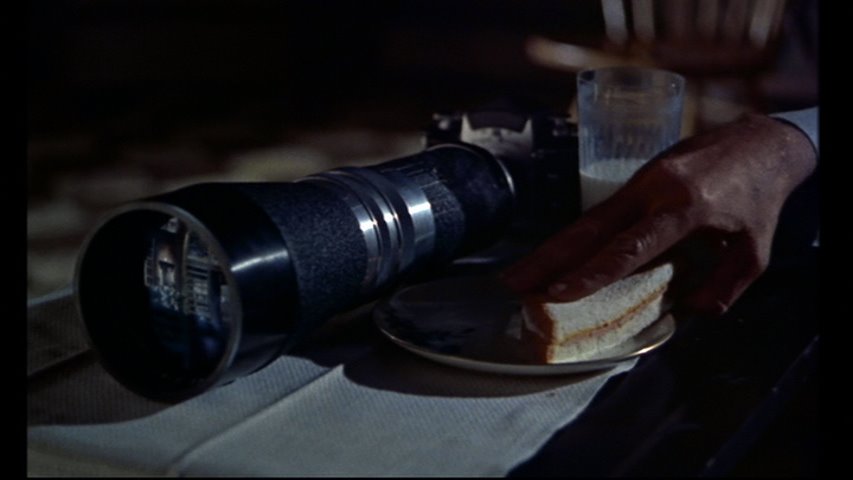
Then we see Jefferies’ hand reach for the sandwich.

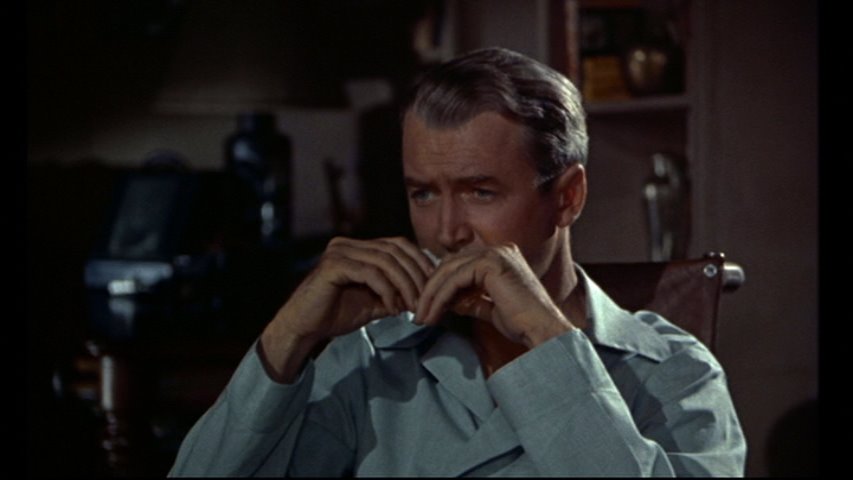
From the context we know that Jefferies is sitting in his wheelchair, looking out the window, and looking at his neighbors.

We cut to Jefferies eating.

Interestingly, he holds his sandwich much like we’ve seen him hold his binoculars.

Of course this won’t last for long. He switches out his sandwich for his camera and telephoto lens.

I’m sure someone has written in depth about this already, but anyhow as I see it, Jefferies, being human, of course needs food to sustain him physically, but in the same way, he needs to spy on his neighbors for another kind of sustenance. His obsession with his neighbors, and in particular Thorwald and Thorwald’s wife, provide mental nourishment while he is couped up in his apartment with his broken leg. In this sense his voyeurism, and ours by implication, is really no more unusual than his hunger for a sandwich. It is basic to his nature, almost as though it is biological and involuntary.

But is Hitchcock right to make this connection? Is voyeurism merely biological and involuntary? Or is it a moral issue? Or is it both?

>Nowa Książka (New Book)

>Over at Andy Horbal’s blog he discusses, among other things, the Polish filmmaker Zbigniew Rybczynski. Andy’s post reminded me of Rybczynski’s 1975 short film New Book (Nowa Książka), which is a film I showed in a media studies course about 18 years ago. I had almost forgotten that wonderful little experimental film.

Here is the film. It might take a while to load because it is coming from a Chinese web site.

One thing that makes this film technically remarkable is the fact that this was made before the advent of digital video or non-linear editing systems. Each of the nine individual screens had to be synced up with each other without (I presume) the benefit of timecode. One can see how the action will sometimes speed up or slow down just slightly in individual screens as though being adjusted for the pacing of the other screens. I also love the soundtrack.

More importantly, New Book is an interesting look, albeit limited, at life in communist Poland in the mid 1970s (and not that I know much about that). As one follows the man in the red coat through the various screens from the upper left to the lower right and back, one also watches his apartment while he is gone. Who is the man in the red coat? What is this new book he is carrying? What is going on in his apartment while he is away?