>William Friedkin interviewed Fritz Lang in 1975 (according to the closing credits of the video below*). Lang died in 1976. This is a wide ranging, reminiscing kind of interview. Lang was an interesting guy. Sometimes I think the last person one should talk to regarding works of art is the artist; as Lang himself says in the end of the interview a film should speak for itself. On the other hand, as I encounter works of art that I love I can’t help but wonder at who the artist is or was, not merely as an artist, but as a person. I am interested in the artist’s character. I believe character is far more important than any specific ways of thinking artistically, though I also believe they are linked. I am curious what this interview says/shows of Lang’s character. Do we think about character all that much these days?
The opening titles misspell Friedkin’s name, but oh well.
* Maybe the interview was in 1974, like the Vimeo title says. “VOSTFR” stands for “Version Originale – Sous-Titre Français,” which is French for “Original Version – French Sub Titles.”
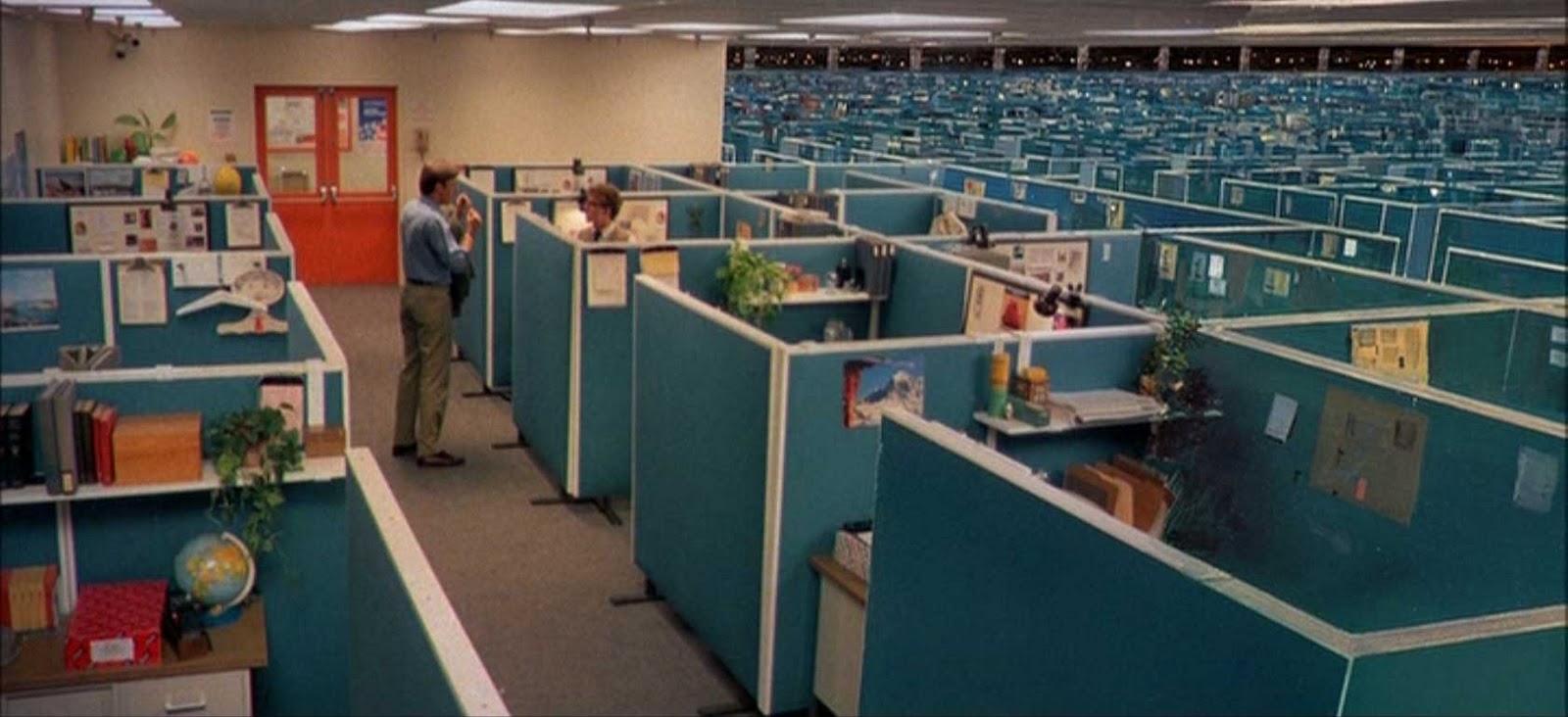
In the summer of 1982 I was living in a small log cabin along the banks of the Kenai River, a few miles upriver from Soldatna, AK. I was working in fish canneries and my father was trying to start a new business. My father was also a pilot and we would often fly across the inlet from Soldatna to Anchorage on the weekends to eat fast food and catch a movie. One of those weekends we saw TRON. I loved TRON. I thought it a somewhat strange, but fascinating film. The early CGI graphics were very cool. But much of the underlying content of computers and computing was foreign to me. I had used computers a little (Commodore Pet computers in 9th grade for some BASIC programming which I didn’t really understand). I knew nothing of the Silicon Valley and its burgeoning culture. I knew nothing of RAM, or CPUs, or IBM. And don’t forget, the first Macintosh computer did not arrive until 1984, the very mediocre Windows OS 2.0 arrived in 1987, and the Internet did not go “public” until the 1990s, and wasn’t commonplace until 1996 (commonplace being a relative term). To my surprise I began working at a software company in 2000. That was the first time I got a job with an international corporation and worked in an environment that made the comic strip Dilbert seem more like a documentary than fictional comedy. I did customer service, tech support, and sales. I am still with the company and currently work on backend data issues. Recently I saw TRON again and was intrigued with its visual depiction of a work environment in a large computer company in the early eighties. TRON is famous for its highly imaginative vision of the virtual world inside computers. The idea seems to contrast with the reality of the homogenized office world seen in this image:
I worked in such an environment, just different color cube walls
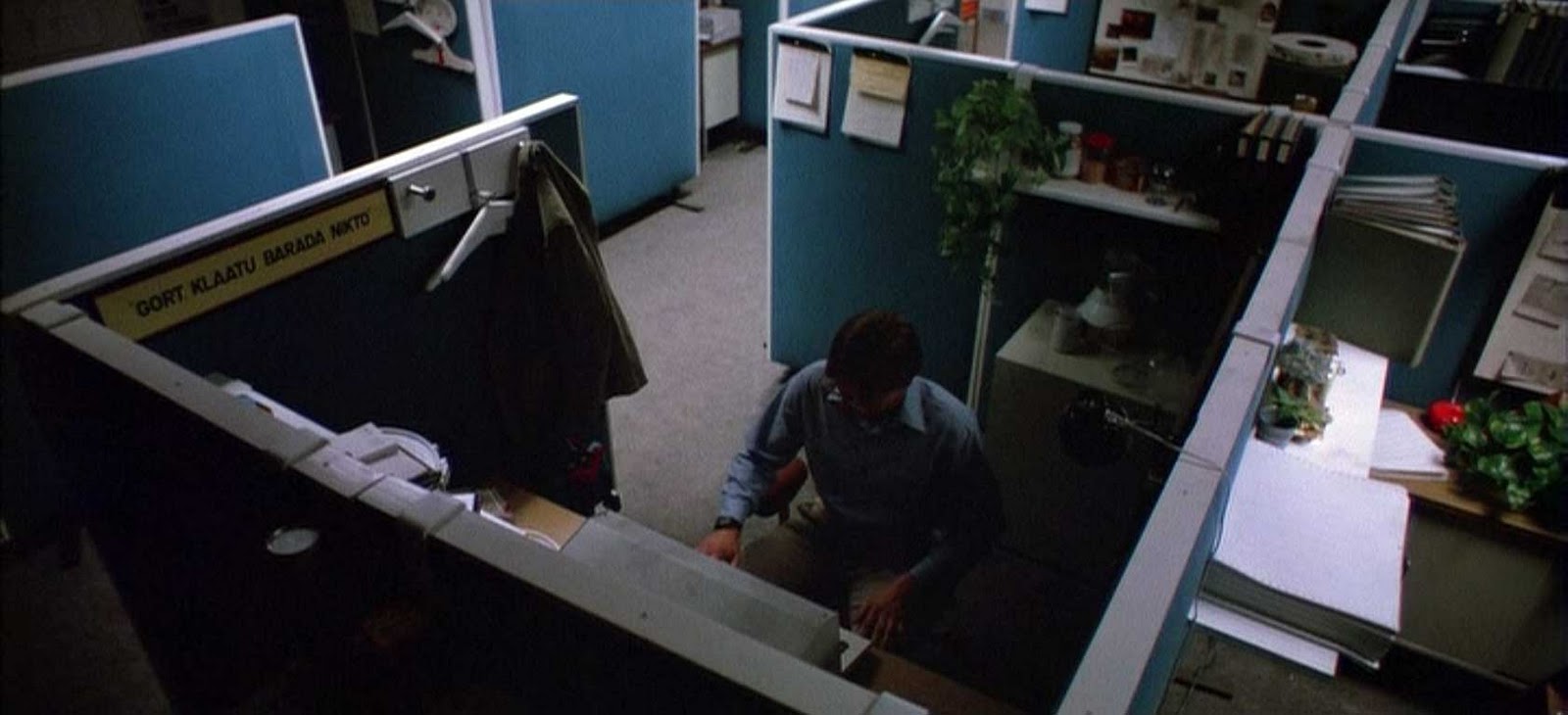
The sea of cubicles, likely enhanced by some fancy matte painting, speaks volumes about modern corporate life. Even in the modern world of computer programming it comes down to controlling costs and harnessing the labor of others. These cubicles represent a darker turn from the original concept of the Action Office. The idea of the Action Office is to create an environment where creative people can interact with each other more freely. What we ended up with was the cubicle. Today it is much the same. However, there is a trend to do away with the cubicle and just give workers a place to set their laptops; no walls, no personal space, just completely open. Not surprisingly it is called the Open Office concept. One other thing caught my eye. In the cube in the image below we see the sign on the left that says, “GORT, KLAATU BARADA NIKTO.”
A “personalized” cube
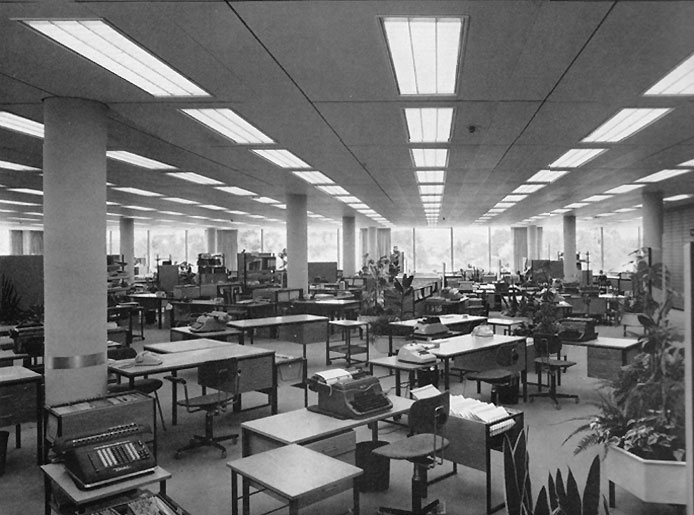
Some things never change. You will find similar signs where I work today. What I have noticed, though, is that the blue hue of the cubes (many cubes then were also orange, green, etc.) have given way to taupe and beige and gray in order to create a more pleasant atmosphere. What is also interesting is how fashions have come full circle. In the nineties the style was baggy shorts, flip flops, and other goofy attire. Now the trend is back toward business casual. Back to office design. In the 1950s Quickborner, a German design group, tried to improve the typical large office space with something they called Bürolandschaft, or “office landscape”.
office “landscape”
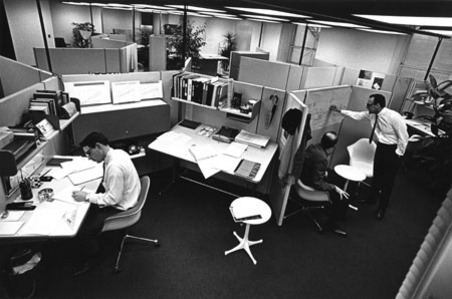
Then in the 1960’s the American design company, Herman Miller, invented the Action Office concept and furniture. This concept was to get away from the Open Office concept on the one hand, and the individual closed-off office on the other. The goal was to create an environment that was more private that a completely open design, but was also more human and flexible to the needs of workers.
Action Office by Herman Miller, 1960s
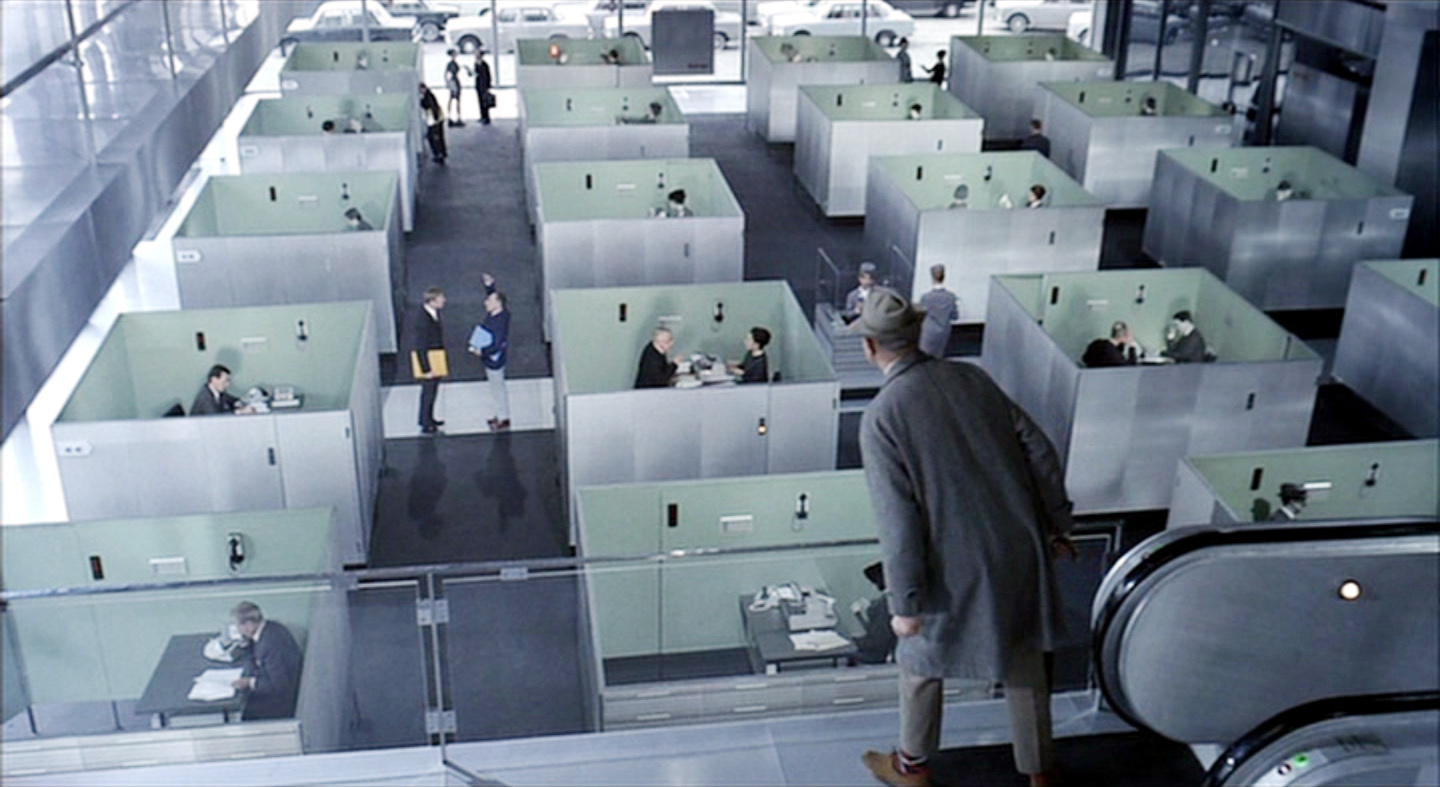
Companies, however, began to cherry-pick the various components of the Action Office suite (from Herman Miller and other purveyors) based on the desires of the finance office and share holders. We ended up with large cube farms that were more like something from a science fiction film about a dystopian future. Of course, it did not take long for the idea to be parodied.
Still from Playtime (1967) by Jacques Tati
The theatrical release of TRON lies about halfway between the advent of the modern office and our present day. So much has changed—the Internet, mobile phones, iTunes, more than one economic recession—and yet so much remains the same. The fundamental concepts of so much business, its methods, its modus operandi, and its questionable ethics, are all still with us, and so is the cube.
PilgrimAkimbo has been unfocused for quite some time, nearly as unfocused as it author. When I started this blog in late 2006 I meant to focus my writing on cinema, along with some forays into other arts. Very quickly my focus expanded, but for the most part I blogged a lot about film. Then I got tired of that. Cinema is only one of many interests that grab my attention. I also have a family with young and very young kids. I can’t seem to get myself out to the theaters anymore (it’s actually been a long time). Many of the films I want to see my kids can’t yet see, so that makes it hard to see much at home other than family-friendly movies (many of which I do like). And then I fall asleep anyway reading to my kids when I put them to bed. Plus, years have passed since I relied on film references to define my life. I have become less and less interested in following trends or keeping up on the latest films. Bla, bla bla. So that’s that.
Well, it’s been a long time since I focused on writing anything about cinema, film, movies, or whatnot. But now I plan on changing that somewhat. However, the last thing I want to be is another one of those bloggers who announce their intentions on their blog and then take no further action toward those ends. So I am not announcing that I will now refocus PilgrimAkimbo and make it a film blog again. But maybe, just maybe, you will find me writing my thoughts on cinema and art here more often once more.
So that’s that. Any questions? Don’t forget your reading for next week.
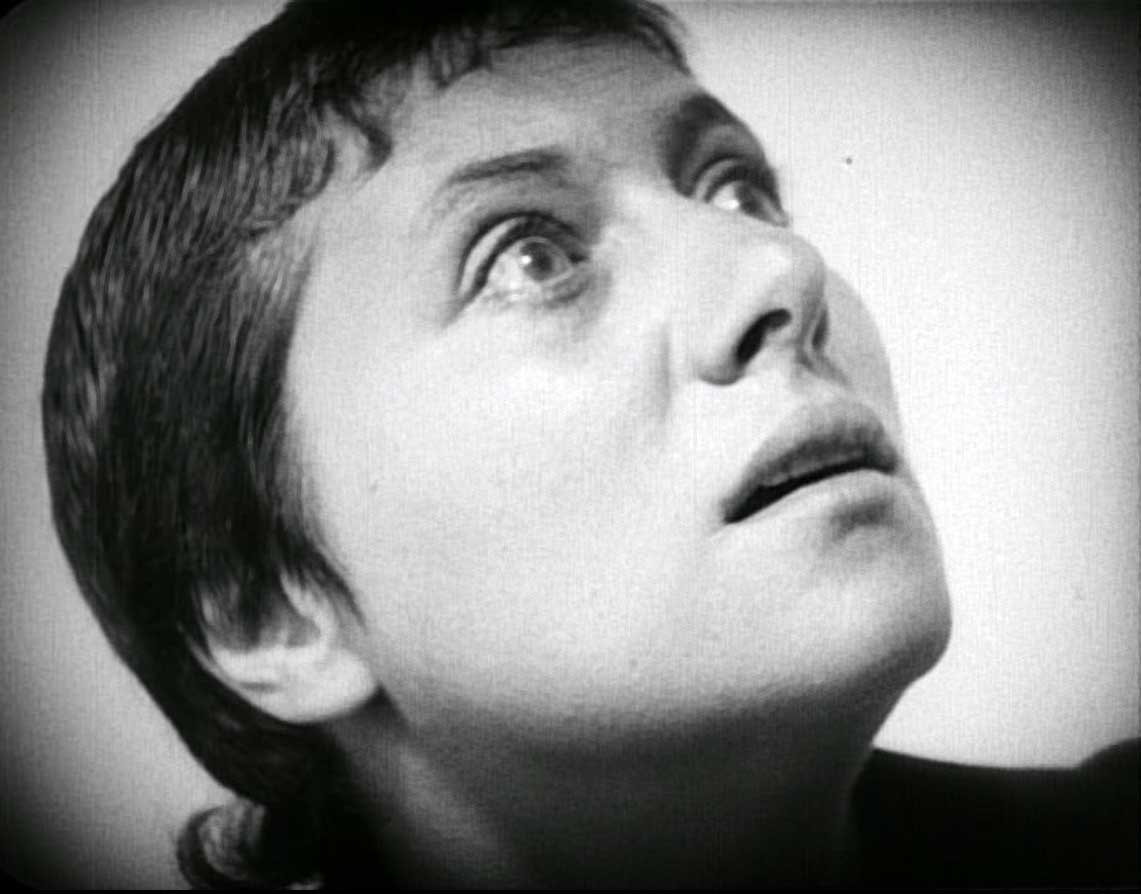
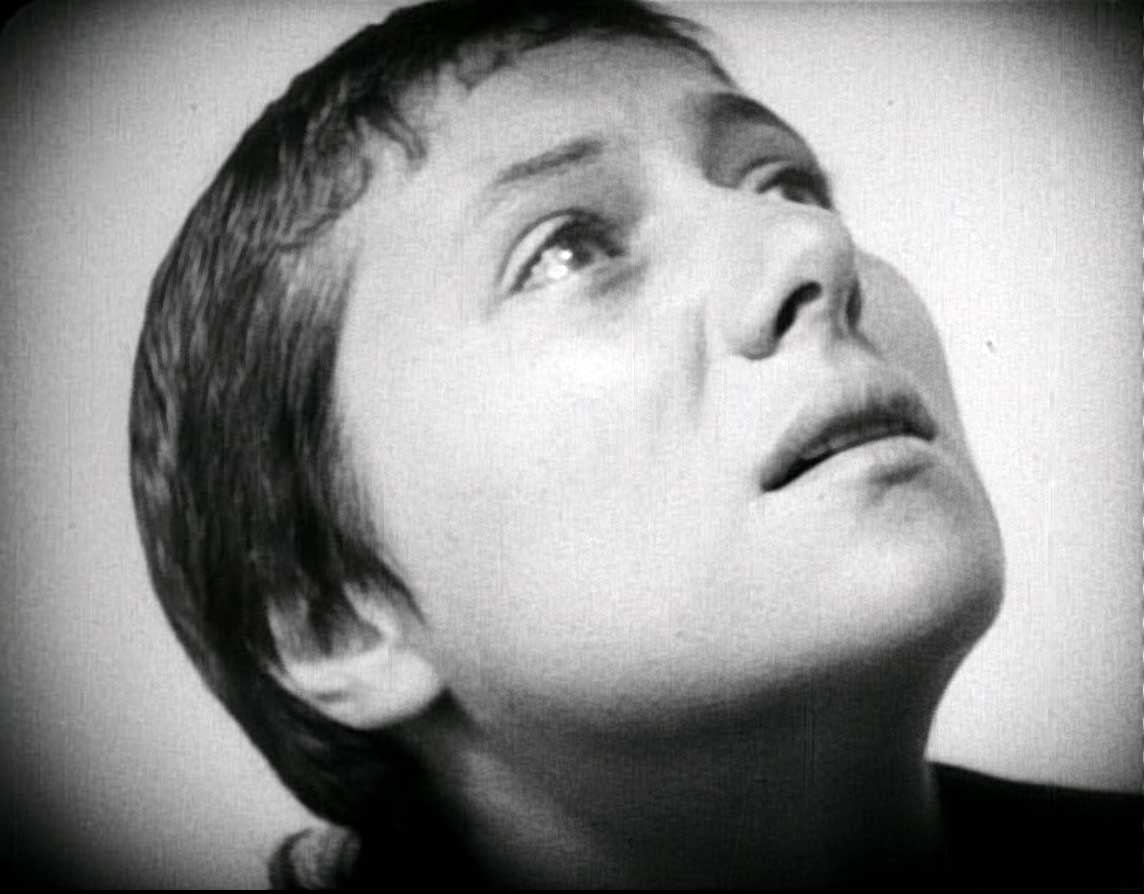
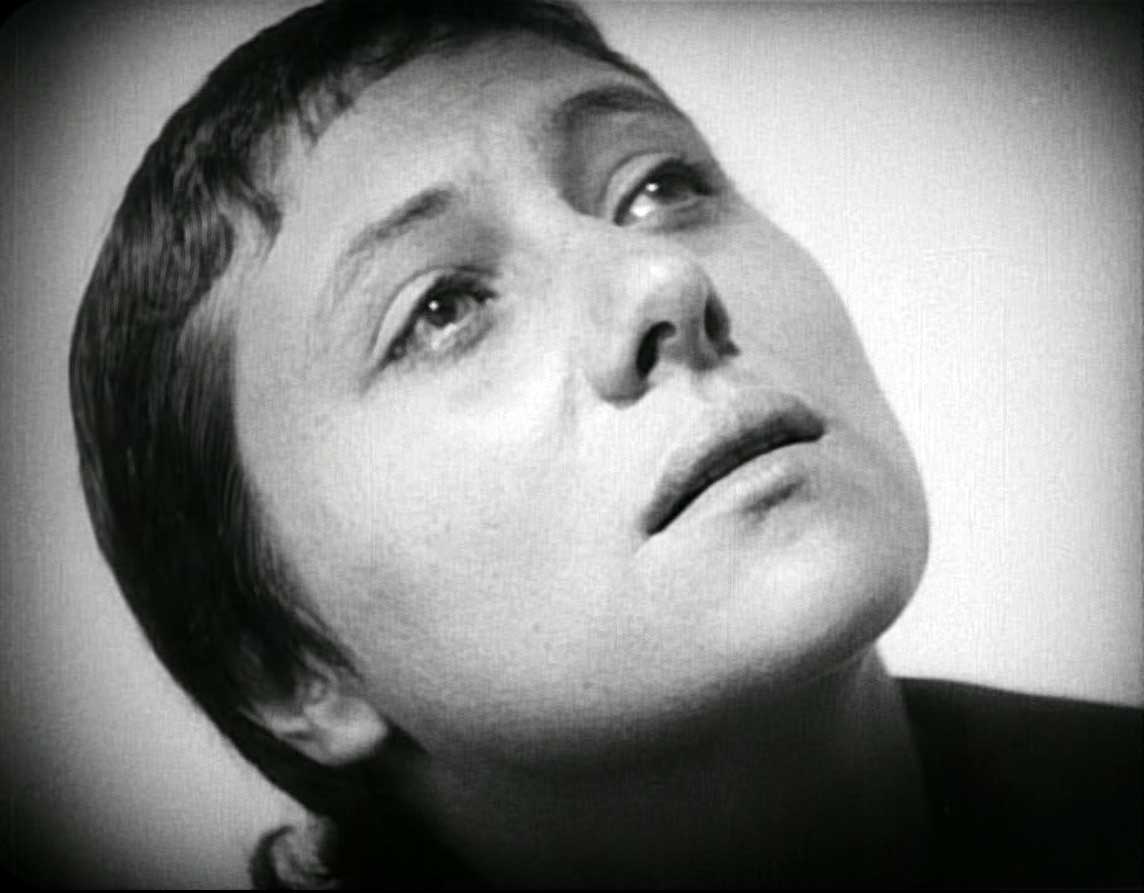
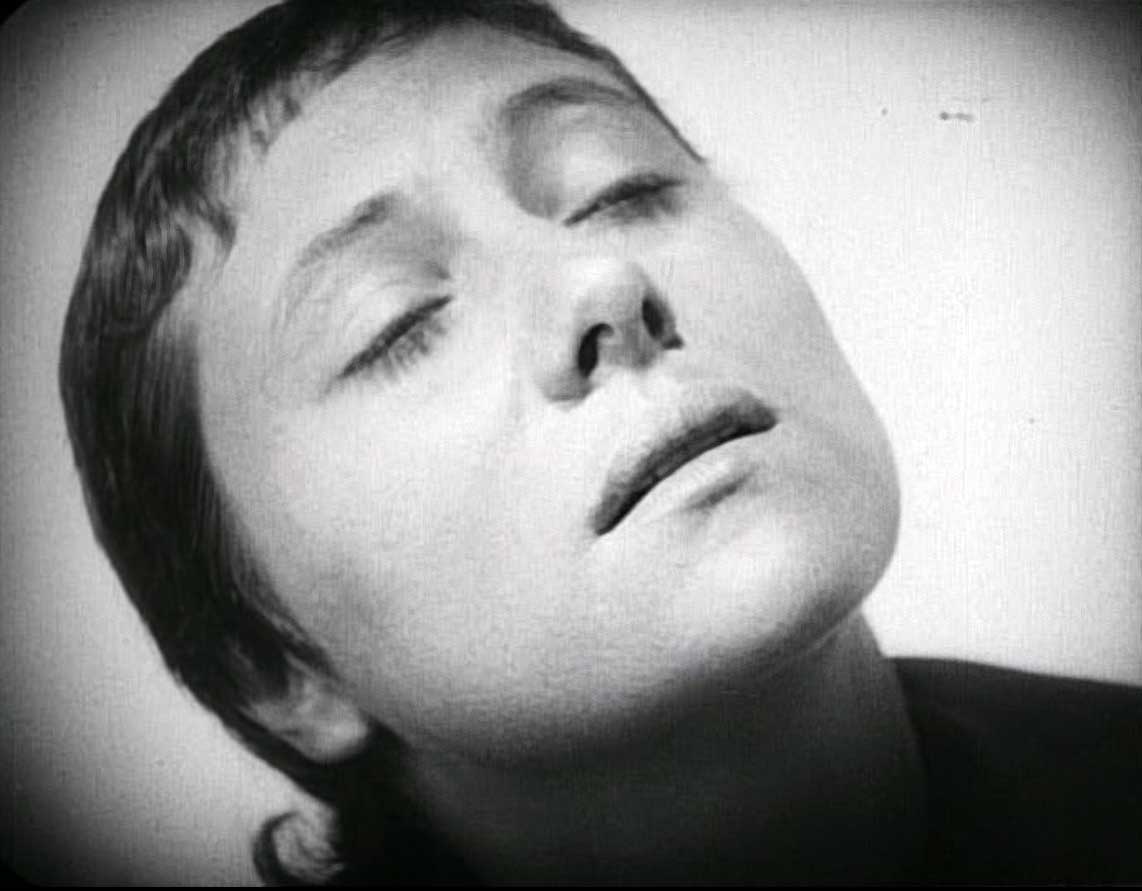
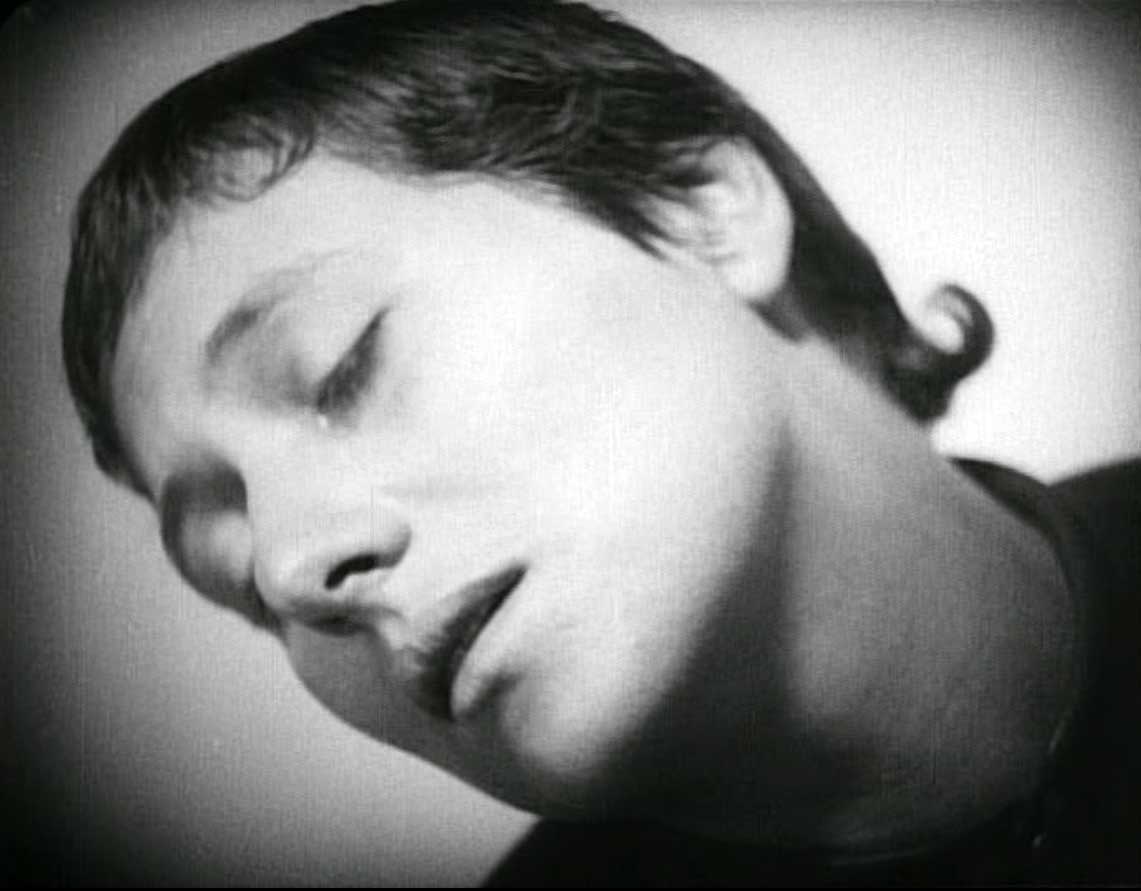
The following seven frames are from Dreyer’s La Passion de Jeanne d’Arc (1928). They occur just after Joan has been told that she will not be allowed to attend mass.
There are so many memorable moments in this incredible film that it is hard to pick out any one, but this brief moment caught me emotionally. It seems to exemplify the role that religion so often plays in claiming rights it can only pretend to own.
>Disneyland Dream (1956) http://www.archive.org/flow/flowplayer.commercial-3.2.1.swf In July 1956, the five-member Barstow family of Wethersfield, Connecticut, won a free trip to newly-opened Disneyland in Anaheim, California, in a nationwide contest. This 30-minute amateur documentary film tells the fabulous story of their fun-filled, dream-come-true, family travel adventure, filmed on the scene at Walt Disney’s “Magic Kingdom” by Robbins Barstow. In December 2008, “Disneyland Dream” was named to the National Film Registry by the Librarian of Congress. Note: The first uncredited screen appearance by Steve Martin occurs in the film at around the 20:20 mark – very brief, in the lower right corner. He is the 11 year old in pink shirt, black vest and top hat, hawking guidebooks.
Found at the Internet Archive. Robbins Barstow, the creator of (and the dad in) the film died in November of this year. His obit is here.
>I love this well known interview with Orson Welles. He comes across as affable and even sweet. It makes so much sense, after all that’s been said, that he refers to “rosebud” as a tawdry device. It was always obviously so, but what a wonderful tawdry device.
I also find it interesting what he says about great tragic roles being somewhat impossible for any actor to perform. I just heard a talk today in which the speaker said King Lear was an impossible play to act; that one watched performances, read the play, watched again, read again, and each time got more from it, but never all of it. It’s just too rich and powerful for anyone to act it or take it in as a complete work.
From 1968 to 1973, [Jean-Luc Godard] stated repeatedly that he was working collectively. He was never tied to a party or a Maoist group, although the politics evidenced in his films seem loosely “Maoist.” For about three years he drastically reduced the technical complexity and expense of his filming, lab work, compositions, and sound mix. Partly he wanted to demonstrate that anyone could and should make films. He did not concern himself with creating a parallel distribution circuit. He said most political films were badly made, so the contemporary political filmmakers had a twofold task. They had to find new connections, new relations between sound and image. And they should use film as a blackboard on which to write analyses of socio-economic situations. Godard rejected films, especially political ones, based on feeling. People, he said, had to be led to analyze their place in history.
1972: Jean-Luc speaks on intellectuals making films for the oppressed…
Are not these questions still relevant today? Possibly today there are more alternative voices being committed to various media because the means of production (e.g. ultra-lightweight HD cameras and laptop editing) and the means of distribution (e.g. the Internet) make it possible to do so. However, the questions facing media producers have not significantly changed. As Godard states, making a film “in the name of…” comes with a host of issues that, though intentions are good, may sabotage from within and without the film and its message. In the U.S. we are less likely to call filmmakers “intellectuals.” Certainly, U.S. filmmakers may not be intellectuals to the same degree (or as obviously so) as those in France once were. On the other hand, anyone who actively seeks to understand the world beyond the given and controlled ideological constructs we all inherit should be called an intellectual. Many social documentary filmmakers, it could be argued, fall into that category.
There is a trap, however, for contemporary would-be revolutionaries (filmmakers or otherwise) to borrow from the past what should be left in the past. The struggles of the 1960s (the period from 1956 to 1974) are inspiring and worth studying, but today’s struggles must be dealt with directly and not through a process of memory and hagiography. Today’s issues require their own terms. On the other hand, it is worth noting that (probably) all revolutions/reformations start from a re-examination and re-interpretation of the past – in particular the primary documents of the past.
In 1972 Godard had just completed Tout va bien. The interview above was made in relation to the film. Here is the “supermarket scene” from the film:
On a side note, doesn’t Godard (in the interview clip above) look like a slightly crazed hipster? I mean it’s apparent he just had a double cappuccino before the interview and afterward will ride away on his fixed gear. Also, is that a red bathrobe he is wearing? Marxist morning dress? Leftist lounge wear? *From Jump Cut, no. 28, April 1983, pp. 51-58 copyright Jump Cut: A Review of Contemporary Media, 1983, 200. This is a great article on Godard’s movement from his Nouvelle Vague and more popular period of 1960-1968 to his more overtly political and less popular (but maybe more interesting) period of 1968-1973. Note: Julia Lesage was my thesis committee chair for my MA.
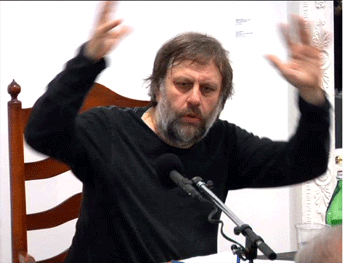
I wrote a Personal Response to Children of Men, which has received quite a few hits since its posting. I recently came across Slavoj Žižek’s brief commentary on the film here. I think you will find it interesting at least. Žižek is a fascinating cat and one of the more entertaining philosophers.



 pilgrimakimbo