>my own film challenge

>Film lists are inherently (maybe by design intentionally so) controversial. Who can really rank aesthetic objects? Well… I think there is more to doing good criticism than mere opinion, and therefore maybe it is possible to legitimately rank films, up to a point. Regardless, I find lists to be like suggestions for viewing – even so-called film cannons. The better the list the more closely the viewing suggestions are to the ideal list of “the best films.” If I go to a well-round film scholar/historian/critic and ask the question: “If I wanted to teach myself the history of film, what are the best 100 films I should see so that I may begin my quest?” I would then expect that scholar/historian/critic to produce a rather good list that approximates that ideal “best” films of all time list. But of course the list would still be highly debatable and, if honest, constantly being revised. The question could also be for the best films of the decade, or from Hong Kong, or Film Noir, etc.

This post, however, is not about cannons but about making a concerted effort on my part to see more great films. So I took a look at the They Shoot Pictures, Don’t They?’s top 100 films list to see what I have missed. I don’t think the list adequately answers the question I posed above, but it is a good list. I’ve put their list below and highlighted the ones I have either not seen or have not fully finished and should. My goal is to work my way through these remaining films and write about them in some fashion. I don’t expect to say anything new or profound, but I do hope to grow in my understanding and convey something of that understanding. Fortunately the number of films I haven’t seen from the list are only 14, so I’ll still be able to work on other things (like grad school and my thesis!).

So, here’s the list:

1 Citizen Kane (Welles, Orson; 1941; US)
2 Rules of the Game, The/La Regle du jeu (Renoir, Jean; 1939; France)
3 Vertigo (Hitchcock, Alfred; 1958; US)
4 2001: A Space Odyssey (Kubrick, Stanley; 1968; UK)
5 8½ (Fellini, Federico; 1963; Italy)
6 Seven Samurai, The (Kurosawa, Akira; 1954; Japan)
7 Godfather, The (Coppola, Francis; 1972; US)
8 Tokyo Story/Tokyo monogatari (Ozu, Yasujiro; 1953; Japan)
9 Searchers, The (Ford, John; 1956; US)
10 Singin’ in the Rain (Donen, Stanley/Gene Kelly; 1952; US)
11 Sunrise (Murnau, F.W.; 1927; US)
12 Battleship Potemkin/Potemkin (Eisenstein, Sergei; 1925; Russia)
13 Lawrence of Arabia (Lean, David; 1962; UK)
14 Passion of Joan of Arc, The (Dreyer, Carl; 1928; France)
15 Rashomon (Kurosawa, Akira; 1950; Japan)
16 L’Atalante (Vigo, Jean; 1934; France)
17 Bicycle Thieves/The Bicycle Thief (De Sica, Vittorio; 1948; Italy)
18 Godfather Part II, The (Coppola, Francis; 1974; US)
19 Raging Bull (Scorsese, Martin; 1980; US)
20 Third Man, The (Reed, Carol; 1949; UK)
21 City Lights (Chaplin, Charles; 1931; US)
22 Touch of Evil (Welles, Orson; 1958; US)
23 La Dolce Vita (Fellini, Federico; 1960; Italy)
24 Les Enfants du Paradis/Children of Paradise (Carne, Marcel; 1945; France)
25 Casablanca (Curtiz, Michael; 1942; US)
26 La Grande Illusion/Grand Illusion (Renoir, Jean; 1937; France)
27 General, The [1926] (Keaton, Buster/Clyde Bruckman; 1926; US)
28 Sunset Blvd. (Wilder, Billy; 1950; US)
29 Psycho [1960] (Hitchcock, Alfred; 1960; US)
30 Breathless/A Bout de Souffle (Godard, Jean-Luc; 1959; France)
31 L’Avventura (Antonioni, Michelangelo; 1960; Italy-France)
32 Some Like it Hot (Wilder, Billy; 1959; US)
33 Jules et Jim (Truffaut, Francois; 1961; France)
34 Persona (Bergman, Ingmar; 1966; Sweden)
35 Dr. Strangelove (Kubrick, Stanley; 1964; UK)
36 Seventh Seal, The (Bergman, Ingmar; 1957; Sweden)
37 Gold Rush, The (Chaplin, Charles; 1925; US)
38 Andrei Rublev (Tarkovsky, Andrei; 1966; Russia)
39 Taxi Driver (Scorsese, Martin; 1976; US)
40 Chinatown (Polanski, Roman; 1974; US)
41 Ordet (Dreyer, Carl; 1955; Denmark)
42 Pather Panchali (Ray, Satyajit; 1955; India)

43 It’s a Wonderful Life (Capra, Frank; 1946; US)
44 Apocalypse Now (Coppola, Francis; 1979; US)
45 Rear Window (Hitchcock, Alfred; 1954; US)
46 Intolerance (Griffith, D.W.; 1916; US)
47 Ugetsu Monogatari/Ugetsu (Mizoguchi, Kenji; 1953; Japan)
48 400 Blows, The/Les Quatre Cents Coups (Truffaut, Francois; 1959; France)
49 Contempt/Le Mepris (Godard, Jean-Luc; 1963; France-Italy)
50 Au Hasard, Balthazar/Balthazar (Bresson, Robert; 1966; France)
51 Magnificent Ambersons, The (Welles, Orson; 1942; US)
52 Night of the Hunter, The (Laughton, Charles; 1955; US)
53 M (Lang, Fritz; 1931; Germany)
54 Wild Strawberries/Smultronsället (Bergman, Ingmar; 1957; Sweden)
55 Wild Bunch, The (Peckinpah, Sam; 1969; US)
56 Modern Times (Chaplin, Charles; 1936; US)
57 Wizard of Oz, The (Fleming, Victor; 1939; US)
58 Conformist, The (Bertolucci, Bernardo; 1969; Italy-France-Germany)
59 La Strada (Fellini, Federico; 1954; Italy)
60 Mirror, The/Zerkalo (Tarkovsky, Andrei; 1976; Russia)
61 Nashville (Altman, Robert; 1975; US)
62 Fanny and Alexander (Bergman, Ingmar; 1982; Sweden)

63 North by Northwest (Hitchcock, Alfred; 1959; US)
64 Greed (von Stroheim, Erich; 1924; US)
65 Metropolis (Lang, Fritz; 1926; Germany)
66 Blade Runner (Scott, Ridley; 1982; US)
67 Rio Bravo (Hawks, Howard; 1959; US)
68 Earrings of Madame de…/Madame de… (Ophuls, Max; 1953; France-Italy)
69 Sherlock, Jr. (Keaton, Buster; 1924; US)
70 Pickpocket (Bresson, Robert; 1959; France)
71 Playtime (Tati, Jacques; 1967; France)
72 L’Age d’Or (Bunuel, Luis; 1930; France)
73 Ikiru/To Live/Doomed/Living (Kurosawa, Akira; 1952; Japan)
74 All About Eve (Mankiewicz, Joseph L.; 1950; US)
75 Voyage in Italy/Viaggio in Italia/Journey to Italy (Rossellini, Roberto; 1953; Italy)
76 Apartment, The (Wilder, Billy; 1960; US)
77 Viridiana (Bunuel, Luis; 1961; Spain)
78 Aguirre: The Wrath of God (Herzog, Werner; 1972; Germany)
79 Barry Lyndon (Kubrick, Stanley; 1975; UK)
80 On the Waterfront (Kazan, Elia; 1954; US)
81 Pierrot le fou (Godard, Jean-Luc; 1965; France-Italy)
82 Man with a Movie Camera, The (Vertov, Dziga; 1929; USSR)
83 Blue Velvet (Lynch, David; 1986; US)
84 Nosferatu (Murnau, F.W.; 1922; Germany)
85 Leopard, The (Visconti, Luchino; 1963; Italy)
86 Notorious (Hitchcock, Alfred; 1946; US)
87 Once Upon a Time in the West (Leone, Sergio; 1968; Italy-US)
88 Gone with the Wind (Fleming, Victor; 1939; US)
89 Sansho the Bailiff/Sansho Dayu (Mizoguchi, Kenji; 1954; Japan)
90 His Girl Friday (Hawks, Howard; 1940; US)
91 Last Year at Marienbad (Resnais, Alain; 1961; France-Italy)
92 My Darling Clementine (Ford, John; 1946; US)
93 Clockwork Orange, A (Kubrick, Stanley; 1971; UK)
94 Dekalog/Decalogue (Kieslowski, Krszystof; 1988; Poland)
95 Letter from an Unknown Woman (Ophuls, Max; 1948; US)
96 King Kong [1933] (Cooper, Merian C./Ernest B. Schoedsack; 1933; US)
97 Amarcord (Fellini, Federico; 1973; Italy)
98 Duck Soup (McCarey, Leo; 1933; US)
99 Stagecoach (Ford, John; 1939; US)
100 Man Who Shot Liberty Valance, The (Ford, John; 1962; US)

One last thing: working through a list like this reminds me a book I’ve been wanting to read – Julie and Julia: 365 Days, 524 Recipes, 1 Tiny Apartment Kitchen. In other words, I would love to take this list, or any other similar list, and concertedly work my way through, maybe from the back to the front. Two a week would only take a year. What a year. I know you understand.
educating Lily, educating myself

This blog has languished for lack of time and an abundance of guilt.

Pressures of grad school have kept my head down, which is a good thing since I do need to be working on my thesis – and the thesis is coming along, somewhat. I have several potential posts that I want to write, but they have been pushed aside. I have been reflecting a bit on what this blog is for me and what I want it to be going forward. I don’t have an answer yet. But, at least, it is a chronicle of some features of my life, including my relationship to movies.

Several times on this blog I have mentioned watching movies with my six (going on seven) year old daughter Lily. I consider these movie viewings part (a fun part) of her education as much as an entertaining evening. Recently we saw Some Like It Hot (1959) and she loved it. Now some might say that my daughter is a bit young for this film, that, even though it is nearly 50 years old, the content needs some explaining about some things that a parent might not want to discuss with a six-year-old.

But she gets it – not all of it of course – but she understands that a couple of guys trying to walk in high heels and pretending to be women as they run away from some gangsters is funny. She also reacted strongly to Sugar Kane Kowalczyk’s (Marilyn Monroe’s) dress in the night-club performance scenes. Lily thought the dress was rather too much. And she was humorously shocked by the famous last line: “nobody’s perfect.” The look on her face was priceless – even better than Jack Lemmon’s. In fact, the parts I had to explain had to do with Spats Colombo and prohibition – which she thought was crazy. Of course, she also liked the fact that the director’s last name is Wilder, and that being the name of her little baby sister, Wilder Rose.

Why do I write all this? For me watching movies is a very personal joy. I’m sure you understand. Certainly films are objects out there in the world, separate from me, with a life of their own. And films are also a way to connect with others, such as through film blogs, etc. But films are also remarkable objects that include the viewer in their existence. I am a part of every film I watch because part of a film’s reality includes my watching of it. Cinema is also one of the most remarkable of human creations – maybe the most powerful art form so far. The life of a film includes the affects it has on and through its viewers. I can say many films have become deeply rooted in my conscious and subconscious. I see films being a personal thing for my daughter as well. She loves movies, as does most everyone. I want her to know the greatness of film, of how wonderful it is, and that it is worth the effort to think about what one watches – in other words, the best films really pay off, and the good ones pay off too.

So then we watched North by Northwest (also 1959). Recently we have seen Rear Window (1954) and To Catch a Thief (1955). I have been picking Hitchcock from the 1950s because these are great films to understand how “classic” Hollywood narrative works while also being introduced to one of the great directors. These films give me the chance to point out things to Lily about filmmaking without getting too involved. There probably aren’t too many six-year-olds who can tell you about Hitchcock, but Lily can (a little).

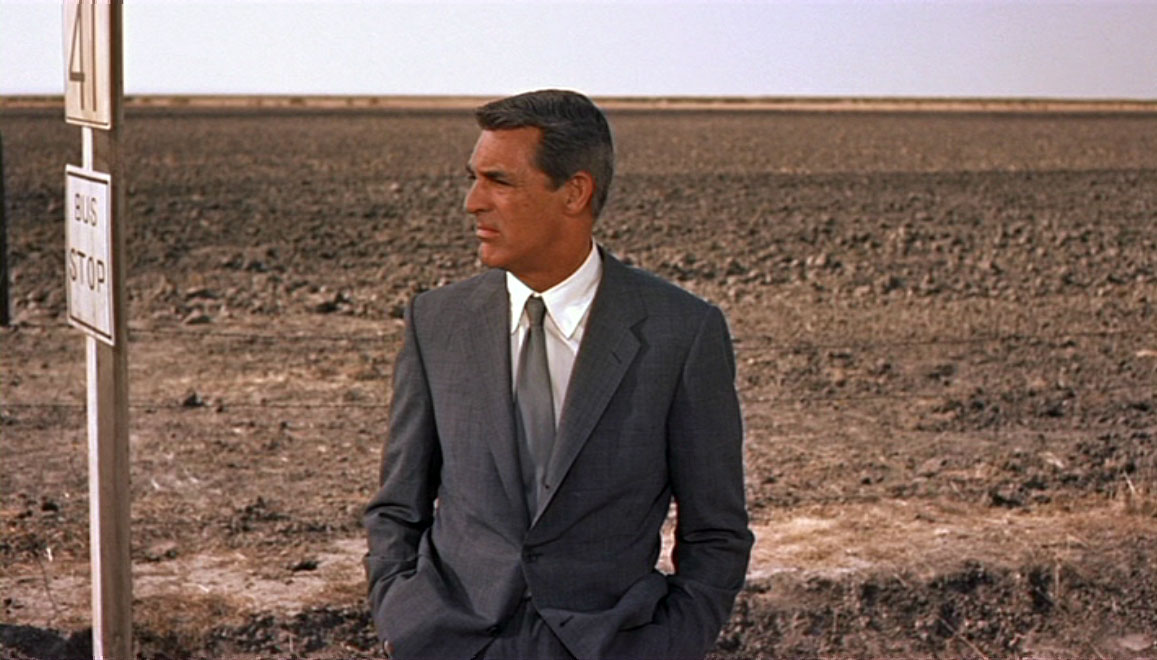
Speaking of North by Northwest, something caught my eye that I really liked. You remember the crop duster scene – it’s so famous that many people know all about it who have never seen the film itself. Well the scene is set up wonderfully, beginning with Roger O. Thornhill (Cary Grant) being dropped off the bus in the middle of nowhere.

He then proceeds to watch cars go by as he waits for George Kaplan (a person who does not exist) to arrive.

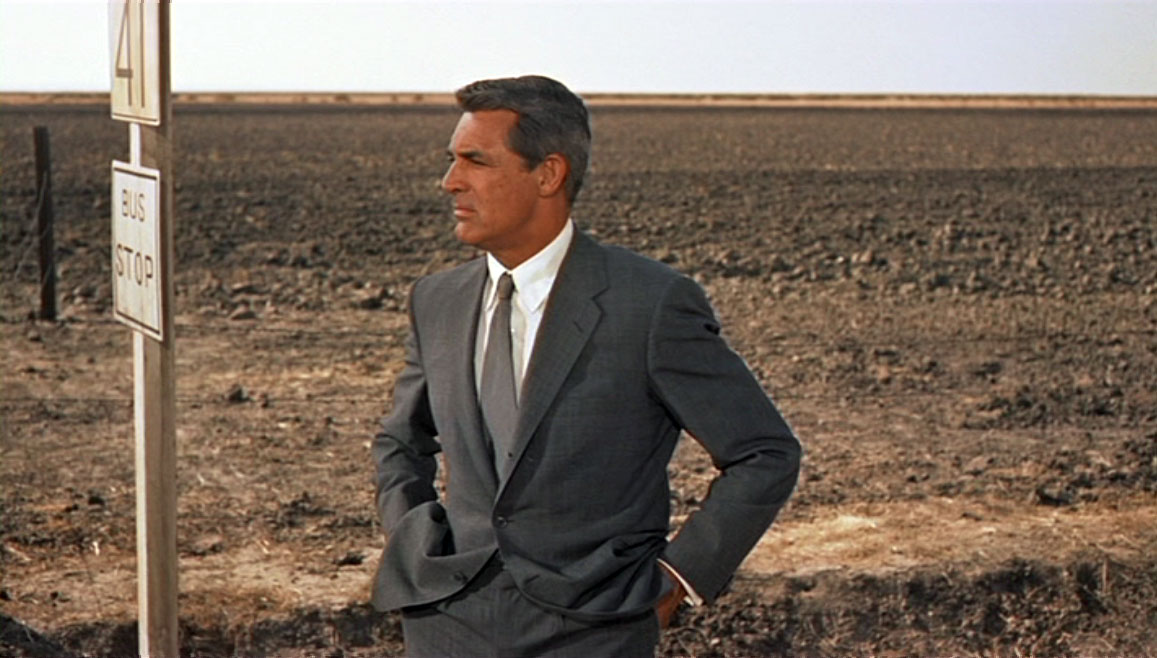
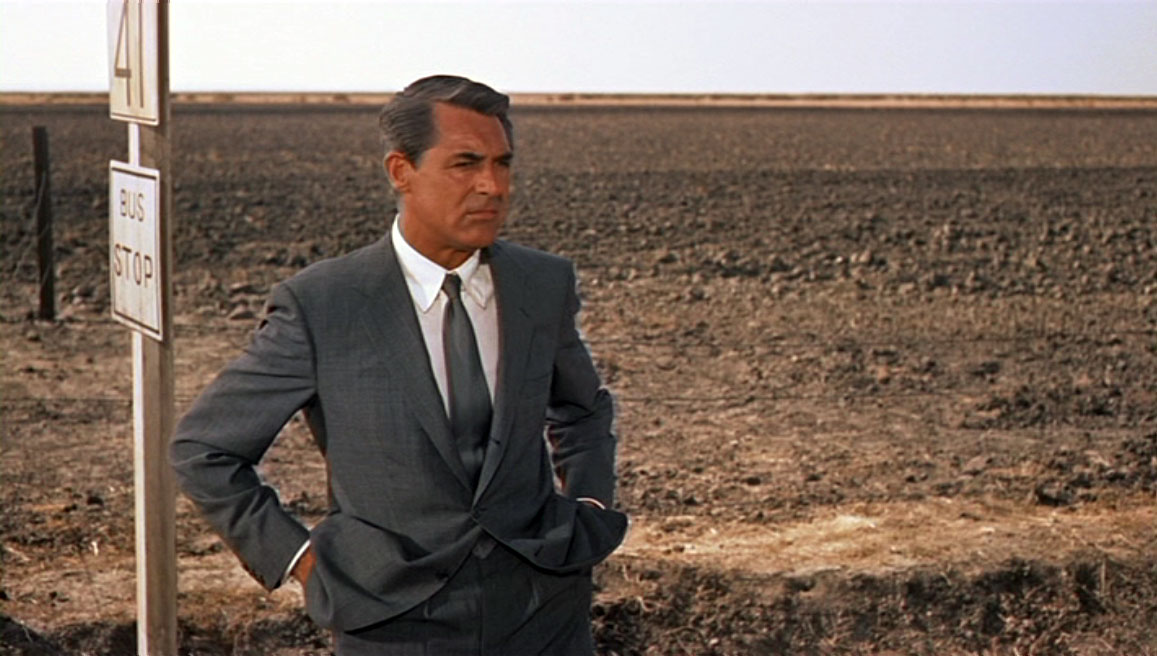
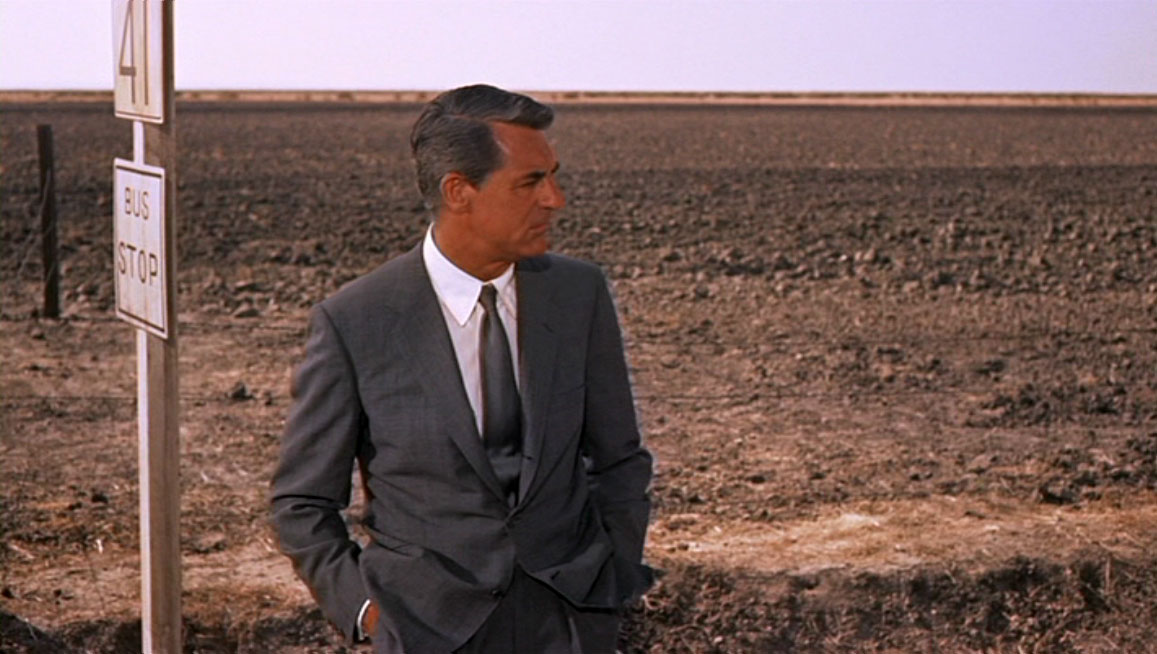
This is what I liked: As he waits, Thornhill sees a car coming, he thinks it might stop, but it goes on by. Cary Grant plays it almost as though it was a silent film.

Grant watches the car coming…


…the car gets closer and he raises his arms, but keeps his hands in his pockets…


…arms still raise, hands still in pockets, he follows the car with his gaze…


…he then lowers his hands back down into his pockets…

…signaling that the car is not stopping and he is still waiting for Kaplan.

To me this is pure Cary Grant school of acting: simple, physical, perfect, and always with an undercurrent of comedy even when he’s playing it straight. I can imagine Grant being told to stand on the X so they can get the focus fixed, then he is told to pretend a car drives by and he is to find some way to indicate the car has come and gone, and that once again his character is disappointed and perplexed. Grant was a master at this subtle, physical kind of acting; he could do zany pretty well too.

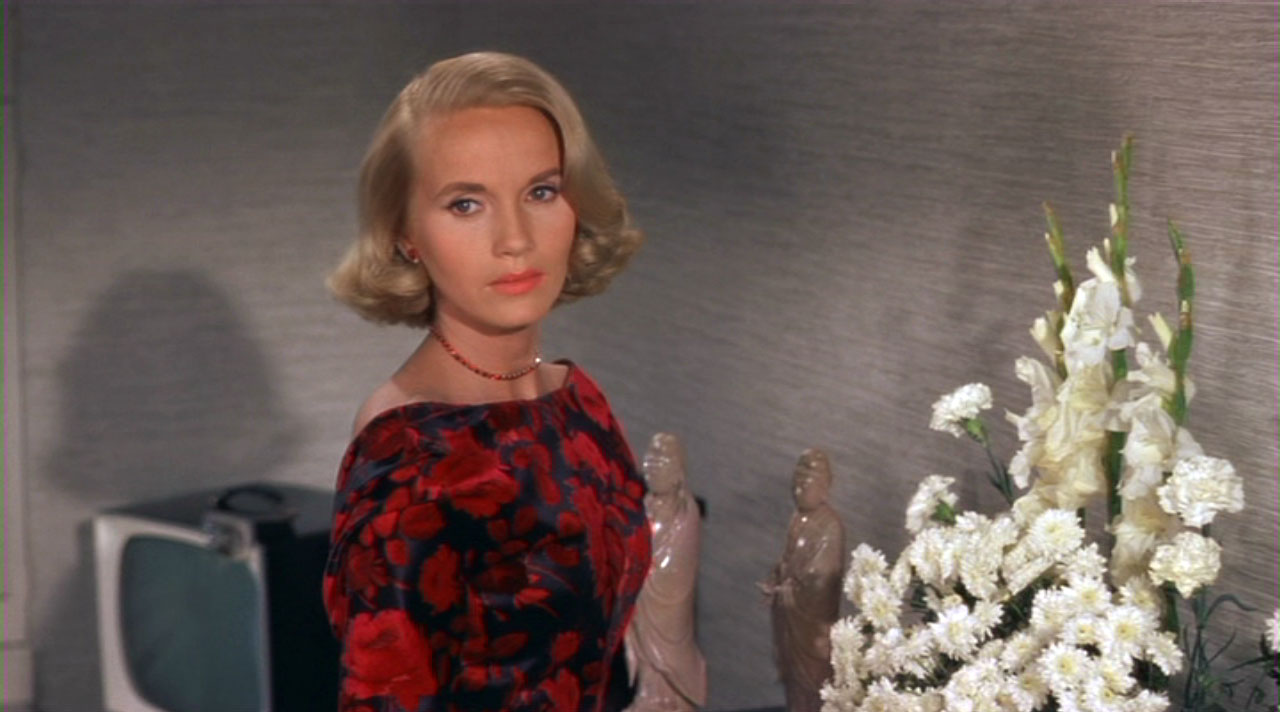
And I just love this shot:


It is so quintessential late 1950s, and it is beautiful while being ordinary. Having been on film and television sets, I know that even such a simple shot as this took a while to make as each little detail was put in its place, as Eva Marie Saint was told exactly where and how to stand, and how to turn toward the camera. This shot is common – especially then – for female leads, with her torso facing to one side of the camera and her gaze going in the other direction.

So then last night we watched Sullivan’s Travels (1941). It was good to see it again. Lily loved it, as I thought she would. The film also gave us some things to talk about, like what was the lesson that Sullivan learned? How did he learn it? etc. I don’t have any thing to say here about the film except that if you have not seen it, you should. I have The Miracle of Morgan’s Creek (1944), also by Sturges, on the docket for a near future viewing with Lily as well. Now I do feel a little bad because Lily had wanted to see (and show me) Milo and Otis (1986) but I pushed for Sullivan’s Travels. I guess it’s parent’s privilege, but now I have to make it up to her. Fortunately she does watch a fair number of “kids” films and current films, so it’s not all Papa’s stodgy old films.

As a side note on Sturges, I don’t know very much about him as a director or his personal life, but the DVD contained an interesting American Experience documentary that made a connection for me. Years ago I read a wonderful little book titled Sylvia Beach and the Lost Generation: A History of Literary Paris in the Twenties and Thirties by Noel Riley Fitch (1983). [Sylvia Beach was a famous expatriate in Paris between WWI and WWII. She owned the bookstore Shakespeare and Company and hung out with the likes of Hemingway, Fitzgerald, and was the publisher of Joyce’s Ulysses.] In Fitch’s book I read about Isadora Duncan, the famous and flamboyant dancer (some say she was the mother of modern dance). She died tragically in a freak automobile accident in 1927 when her long silk scarf got caught in the spoked wheels of the open-cockpit Amilcar she was riding in. Well, that scarf was given to Duncan by her friend Mary Desti who was, as I found out, the mother of Edmund Preston Biden, later know as Preston Sturges. Incidentally, the accident gave rise to Gertrude Stein‘s mordant remark that “affectations can be dangerous.”

Finally, I mentioned earlier that introducing Lily to these great films is part of her education. This is true, but not because it’s a good thing to understand the history of film or to recognize a Hitchcock film against any other film (although there is some value in all that). The fundamental goal, for me, is the ancient idea of a liberal education: an education that seeks to fulfill one’s human nature; an education that asks what it means to be human; and an education that creates a lifelong autonomous seeker. We, my wife and I, have taken on the task of educating our children. This is not easy work. Being an educator is a demanding job that takes great patience and lots of love. Although I am an adherent to the idea of a classical education, one that relies on the written word more than the image, I think some proponents of a classical education wrongly vilify the image more than is warranted. In fact, the tension is not really between word and image. The real issue, as I see it, is a lack of passion for learning. I believe we live in a world that often encourages a kind of “closemindedness” that leads to, or is born out of, fear. What I hope to instill in my daughters is a critical open-mindedness, a perspective on life that seeks understanding and finds real joy in doing so; and is not afraid to do so. So, when I sit down with Lily and watch a film, and while we are having fun watching the film, and when we then discuss the film, I know she is learning about thinking, about pondering what it is films are trying to say to her, and about how fascinating and complex a film can be as it presents its story to her.

So I see this blog as part of an ongoing exploration into my life as a lover of films, as a husband and parent, as an educator, and as someone seeking to be a lifelong autonomous seeker. How often I update it will depend on many things.

>I “love” that dog wherever he is

>“For some reason I’ve just remembered how I lost the script of Rublyov (when I had no rough draft). I left it in a taxi at the corner of Gorky Street (opposite the National). The taxi drove off. I was so miserable I went and got drunk. An hour later I came out of the National and went towards the All-Union Theatre Society. Two hours after that, as I came down again to the corner where I had lost the manuscript, a taxi stopped (breaking the law) and the driver handed me my manuscript through the window. It was miraculous.”

6 April 1973


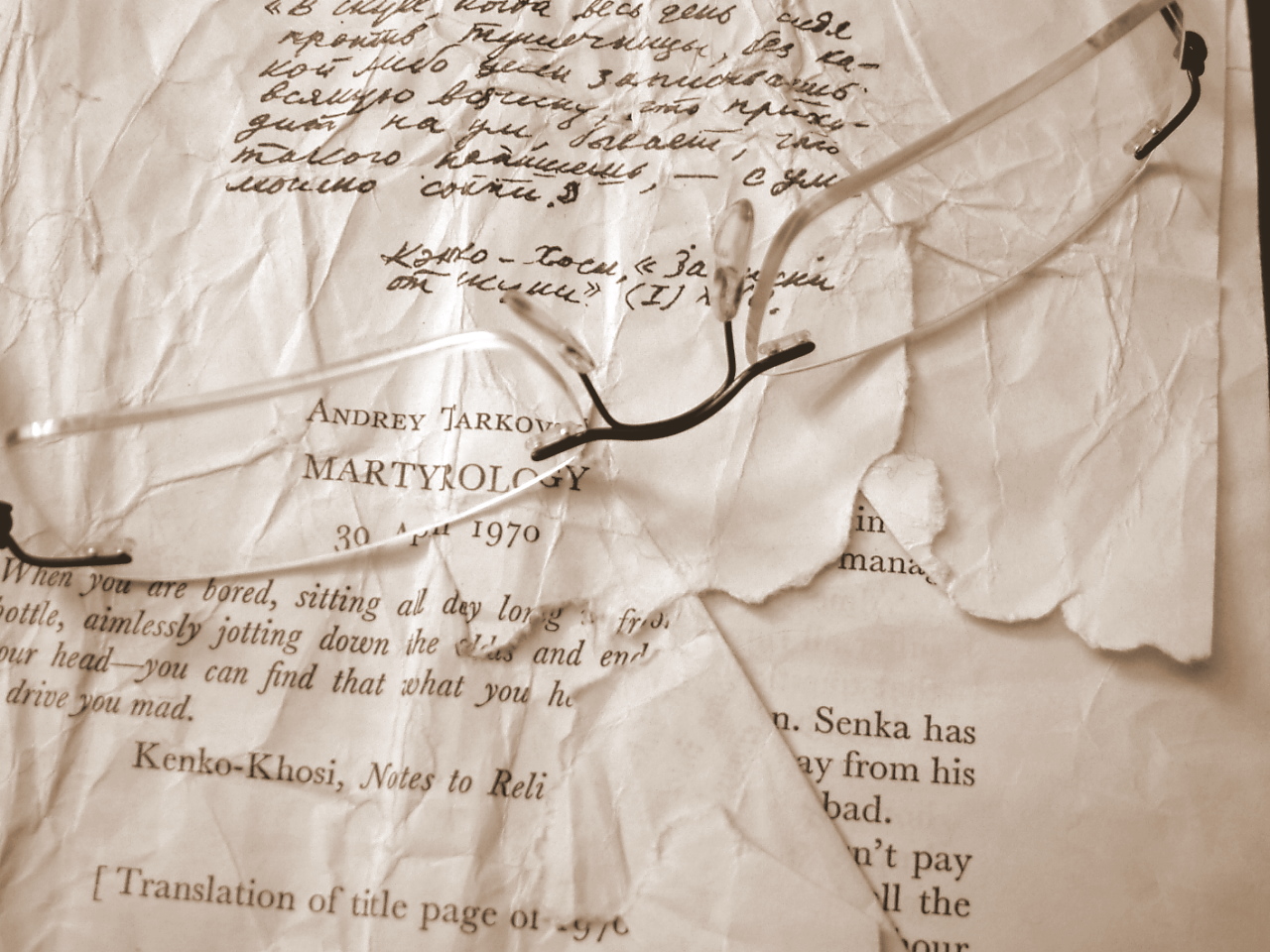
I’m looking over at a copy of Tarkovsky’s diaries (Martyrology), or what’s left of it. Years ago I purchased a used hardbound version of the book. Reading it was a kind of revelation for me. Although Tarkovsky complains mostly throughout the book, something I related to being a frustrated artist myself, I found the book to be a delight. Like any collection of journal entries the book is frustratingly incomplete regarding the kinds of information one might want to know, like insight into the directing or editing processes of specific films, etc. But one gets something better. [If one wants to know the process of making a work of art then one needs to make a work of art, and then do it again, and then again. The knowledge comes with doing because making art is like a spiritual practice in that sense.] What Tarkovsky gave us in his diaries is a view into his humanity. He was a remarkable man, but just a man like me. That kind of perspective is infinitely more valuable than “what were you thinking when you made that shot?”


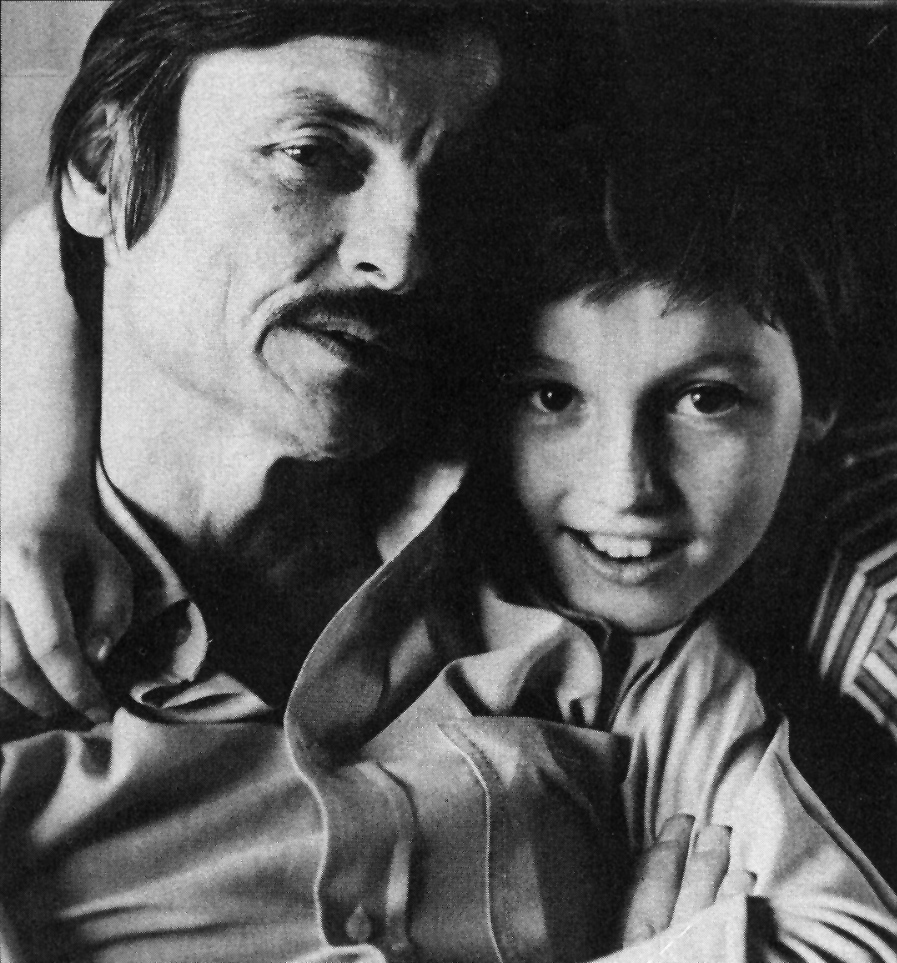
father and son

So the book. Well (and this was a few years ago), I had not read the book in quite a while so I decided to pull it off the shelf, dust it off, and put it on the coffee table to remind myself to pick it up when I came home from class. I was gone for only about a hour, came back and the book was not on the coffee table any longer. Hhhmmmm. Then I saw it. Across the room was the book, but now missing its cover. Remember, it was a hardbound book. After I began to investigate and put 2 and 2 together, I realized that the dog, a Labrador of course, had ripped off the cover and completely consumed it – later to end up in the yard (I’ll save you the description). Boy was I mad. And yet, how fitting. In a small way I was subjected to a “Tarkovsky moment” that is, a moment where all is not lost, but the path one is on has just taken a turn for the worse and one has to look inside to find the deeper value of the moment.
Now the book, coverless and a little tattered, lies on the bookshelf, the dog really belonged to some friends after all and is now somewhere I don’t know, and I’m thinking of pulling that book off the shelf and putting it on the coffee table to remind myself to pick it up again. And this time we have a Pug, so it’ll be alright. Then again, that little dog does get a sneaky gleam in his eye from time to time.

>is that the sun? yes dear

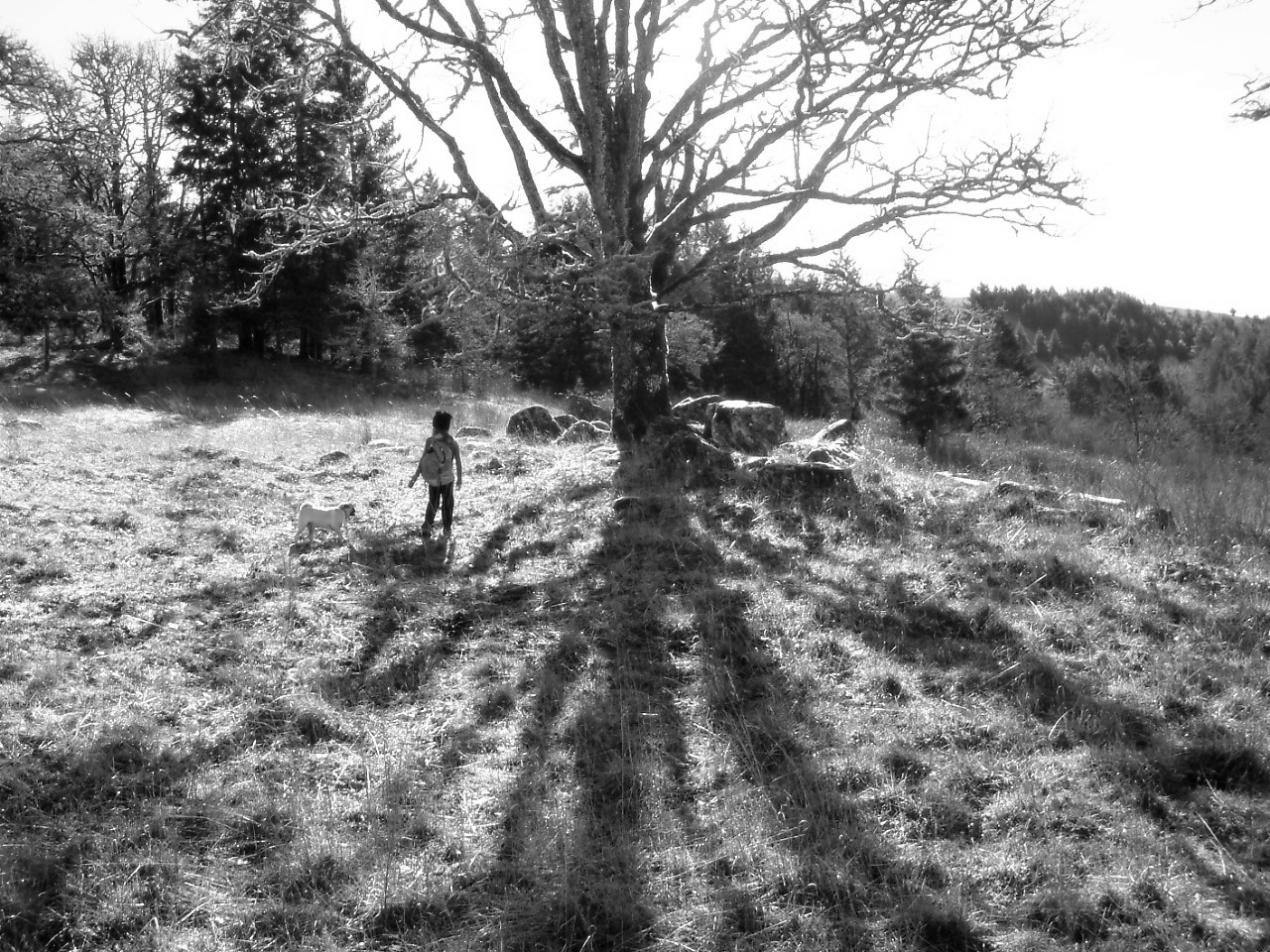
>Today was one of the first sunny days around these parts in quite a while. So instead of staying indoors and watching a film, Lily and I went for a hike up a local mount.

At one point Lily had to take the dog (Aloysius Bonaventure) over to see a tree..

…and many other things for that matter.

There’s nothing quite like getting outdoors after a long, dark, soggy winter and seeing a little blue sky. Even though I have a stack of films I mean to get to, and I should really be writing my thesis anyway, I need the balance of getting away from the city, even if only for a couple of hours.

Sometimes the best work of art is life itself.

Anyhow, we saw our latest film last night – The Return of the Pink Panther (1975) – which she loved, and even my wife laughed out loud at its cornball humor, and I remembered having seeing it over and over as a kid, memorizing all of Clouseau’s lines. I have to say much of my comedic education came from watching Peter Sellers many years ago. In fact, it reminded me that, although I have a fair amount of formal education under my belt, so much of what I have learned in life, and so much of who I am, has come from watching films.

>why is a long movie?

>This article Long flicks: To cut or not to cut? got me thinking.

I am curious as to why, when discussing the length of movies, 2 hours seems to be the key marker. In other words, a film that is over 2 hours automatically becomes a target for questioning the validity of its length while a film shorter than 2 hours rarely comes under such scrutiny. I understand the argument that theaters can get in more screenings per day with a shorter film, but a typical critique of film length rarely includes theater owners. Most of the time it is a critic who argues that a film is too long, and not for financial reasons, of course, but on the film’s artistic merits. But why is 2 hours the demarcation point? Why not 3 hours? Or 4? Is it the momentum of tradition, the weight of expectation, cultural conditioning, the limits of the human psyche or attention span?

I find this topic interesting because I tend to like lengthier films. I also like slow moving, contemplative films. Therefore, a film that I find just perfect may be far too long for another viewer. I also like tightly crafted shorter-length films. However, I am more likely to criticise a film for not taking the extra time to properly develop the story or key characters than argue a film is too long. Those who see films with me may notice that when it comes to films I really like I will often say I would have liked the film to be longer, to keep going. Maybe I’m just quirky.

One maybe-not-so-serious thought: I wonder if the length of films is more closely tied to biological reasons, such as the average size of the human bladder, than anything else. Isn’t that the real reason for those big epic films of yesteryear providing the audience with an intermission? (Also, so the filmgoers might purchase more concessions?) If a film is dragging a bit and you’ve consumed all your Pepsi, you’re probably more likely to become frustrated with the filmmaker for making you suffer. If that is true, then I think an interesting study would take a look at the perceptions of appropriate film length between those who watched a film in the theater and those who watched the same film on DVD (where you can pause the film for various reasons).

So what then is a long movie? Is there a “magic” length? Does length have a bearing on a film’s quality?

>The Year’s BIG Laugh, Music and Girl Show! of 1937

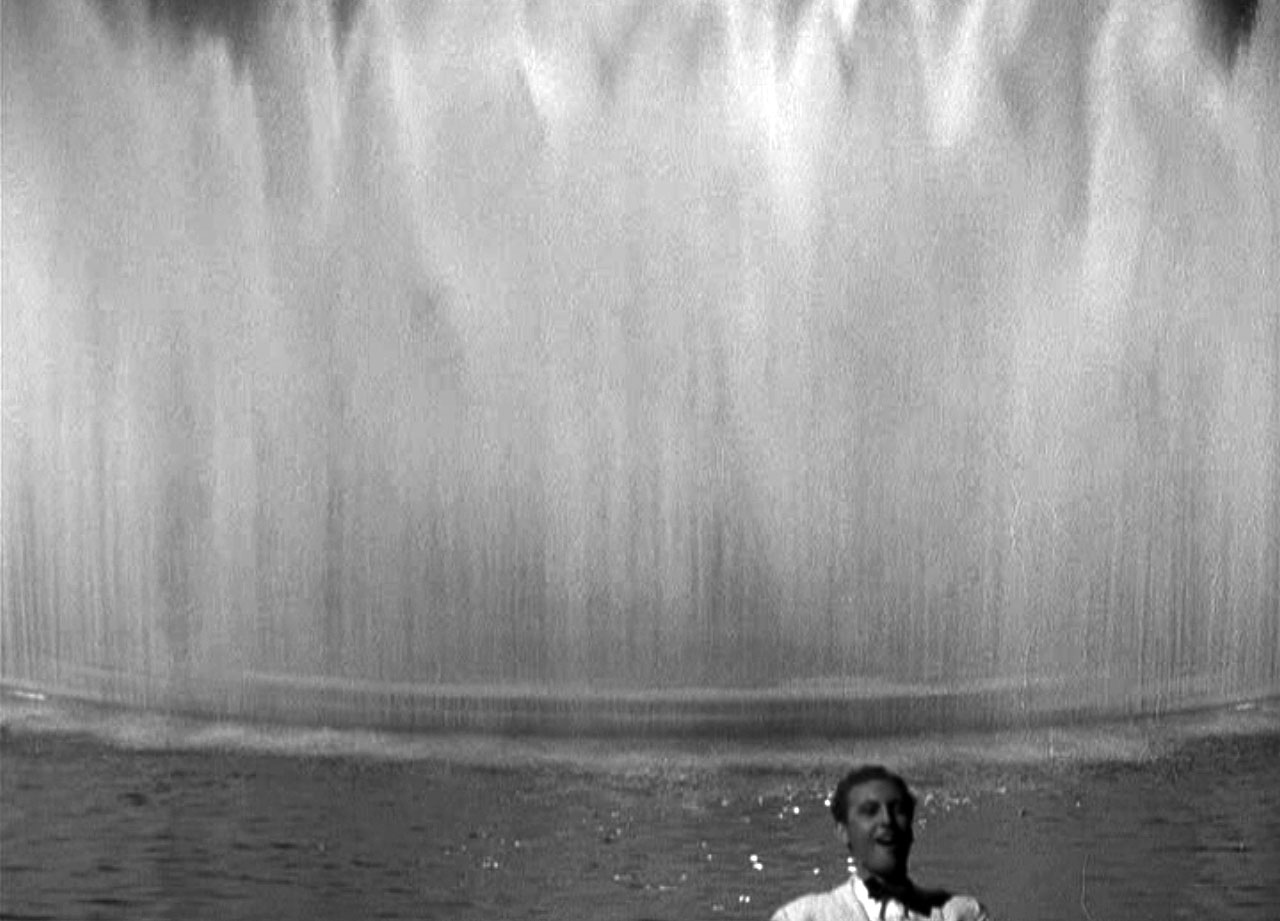
>So we watched A Day at the Races (1937) the other night. Lily liked it. There was one image that caught my attention because it is just so weird.


This shot comes during the big song and dance number at the Blue Venetian Waters (some kind of cabaret/night club). The singers are on a boat and the boat moves slowly toward the camera until the singers exit the bottom of the frame. The camera does not follow the singers but stays on the fountain. I don’t know why they chose to do this, but it certainly created a briefly funny visual moment. I don’t think the humor was intentional even though the film is a comedy. Anyway, I laughed.

a woman in need of a dangerous man

So, we continued our little unofficial Hitchcock class with a viewing of To Catch a Thief (1955). Lily’s first Hitchcock was Rear Window (1954), which we saw a couple of weeks ago, and she loved it, and had to the see the ending again immediately, and the special features. To Catch a Thief is not as good a film in my opinion, but we also loved it. The plot is somewhat interesting, but I find the film’s strength to be its wonderful visuals. Some of my favorite images from the film are as follows:

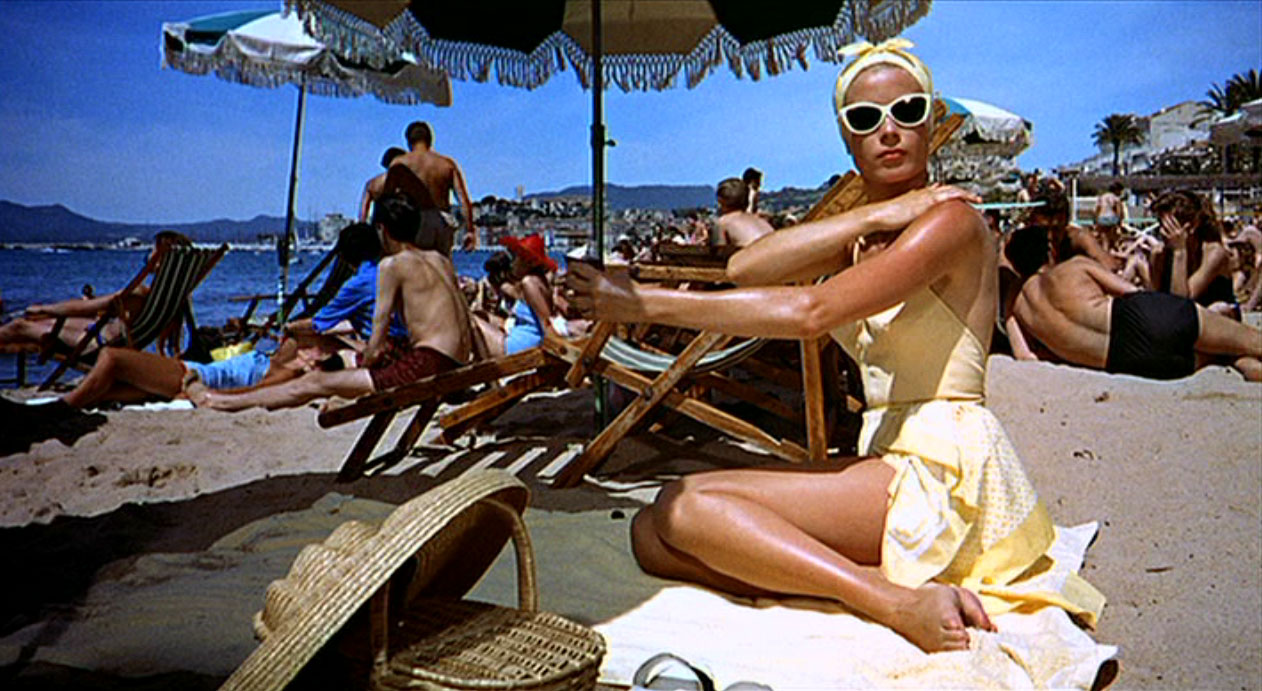
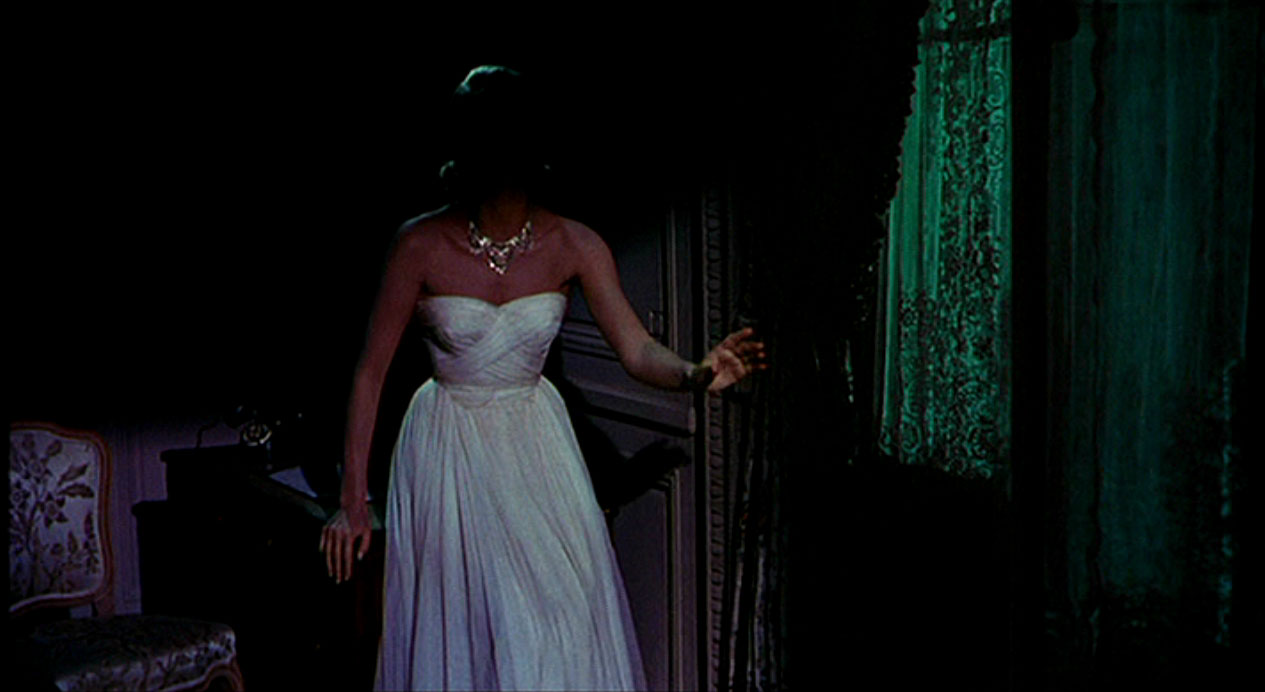
Compared to how Grace Kelly’s character was “introduced” in Rear Window, this is decidedly different. If one didn’t know better, it would be hard to know for sure that it was her.

This image also conveys less of the glamorous beauty one first gets of her in Rear Window and instead shows her as both sexy and mysterious. Her mysteriousness hides her, make her more impenetrable, and places her in the same visual context as some of the other characters from John Robie’s (Cary Grant) criminal past. In other words, we are not entirely sure who she is, maybe she is Grace Kelly but those glasses, etc., make it hard to know. Maybe she is another of those people who are looking for/searching for John Robie. Who knows. Her sexiness is also a kind of self-absorbed narcissism, played out more so later in the film, but here shown via her sun-worshiping attitude. She is not the soft, gentle, open, warm, beautiful Grace Kelly we saw in Rear Window. She is a distant, protected, maybe a little critical, and “boy” watching Grace Kelly here.

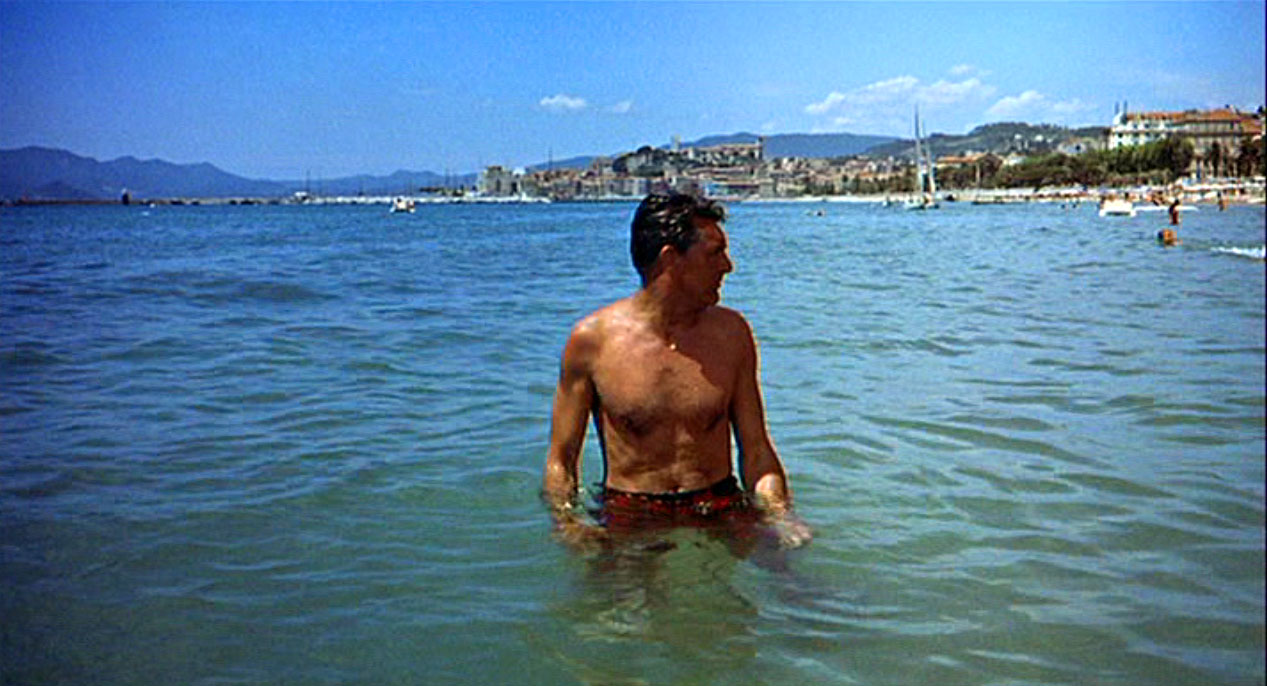
This shot seems very modern to me – like something one would expect from Soderbergh (of course instead of Grant it would be George Clooney).

But I also like it because it is so simple, a shot anyone of us could do really, and yet here it is in the midst of a star-vehicle Hitchcock film. There’s no fancy lighting, framing, certainly no effects – it’s just a straightforward shot, but there is something about it that is perfect. It also anticipates the kind of “out in the open” vulnerability Hitchcock would put Cary Grant in four years later, as Roger O. Thornhill in North by Northwest (1959), in the famous crop duster scene. Here nothing happens to him, though. Plus, I just love the image for its great colors and the fact that Hitch places Grant right in the center of the frame (compare with the off-center placing in image of Kelly above) which creates almost a snap-shot feel to it. If he would just turn towards the camera and smile then it could be a photo from our vacation.

And finally…

I just love this image — maybe the best of the film. It is from the scene when Frances tries to elicit a response from Robie in regards to the fabulous necklace she wears. She wants him to feel the pull of the diamonds because she believes that, as a former cat burglar, he cannot resist, but she also wants to be desired herself, maybe even ravaged. This is a very different Kelly character than the self-confident one in Rear Window. Here Kelly plays a desperate girl in search of a dangerous thrill. She plays a confident person on the outside, as though she is in control, but doesn’t realize that Robie is really the only one truly in control throughout the story. And of course Hitchcock hides Kelly’s face in shadows to emphasize the jewels — this screen grab doesn’t do justice to how they sparkle in the film. Could it be this hiding of the face makes the supposed desire of of the necklace concurrent with a desire for her body. In other words, both are presented as objects by the visual “decapitation.” If this is true, could it be that an undercurrent of the story is the overcoming of this base desire with a higher level of desire, a more romantic desire possibly, and maybe even higher still?

What makes the story interesting is that it is she who needs to change, who needs to learn her concepts of love for the thrill are not the same as genuine love. She needs a “dangerous” man, not so much to tame her as to draw out of her the authentic self she is seeking. We don’t see this kind of theme in films today as then, and for good reasons, but also Hitchcock, every being playful with his audience, never lets the film tie itself up so neatly, even though the plot gets wrapped up with a bow.

>love film love film criticism love

>I have been thinking lately of the responsibility of film criticism. In regards to film (and other arts), my own training includes both criticism and production. So when it comes to thinking about film criticism I find myself often of two minds. I love to examine, think about, discuss, and write about works of art. I also know a little of what it is like to produce works of art and present them to the world (mine is a rather small world at this point) for examination, thought, discussion, and whatever else. There is a certain amount of vulnerability in being an artist, or creating a film, or singing a song. And yet, I believe works of art (film included, of course) should be critiqued. I believe this because it is, or can be, good for the artist, good for the critic, and good for anyone else who participates. Art criticism is a natural, human endeavour that is a vital part of how we “make” the world in which we live. I also believe that criticism is, or should be, a part of how we do something else that is vital to our existence, that is, to love each other.

To love each other, that is the underlying, fundamental, deeply purposeful project of criticism – even though it may not look that way on its surface.

Love, in this context, is not necessarily emotional, nor is it a cheap sentimentality, and certainly it is not romantic love. This kind of love comes from the realization that to love each other, that is, to care for the well being, the goodness, the growth of another person (of all persons) is the right thing to do. It is a way of behaving, a way of considering, a choice. All too often film criticism, and just about any kind of criticism, emerges from a desire to be clever, or witty, or an intellectual, or just plain right. All of these desires are not wrong in and of themselves, but they can have negative ramifications when uncoupled from a desire for the progress and betterment of the artist, the reader, and even of oneself (the critic). Remember each film, each work of art, is a manifestation of a moment in the artist’s ongoing process as an artist (and as a human being). Consider the following quote from Art & Fear: Observations on the Perils (and Rewards) of Artmaking by David Bayles & Ted Orland:

Filmmaker Lou Stouten tells the painfully unapocryphal story about hand-carrying his first film (produced while he was still a student) to the famed teacher and film theorist Slavko Vorkapitch. The teacher watched the entire film in silence, and as the viewing ended rose and left the room without uttering a word. Stouten, more than a bit shaken, ran out after him and asked, “But what did you think of my film?” Replied Vorkapitch, “What film?”

The lesson here is simply that courting approval, even that of peers, puts a dangerous amount of power in the hands of the audience. Worse yet, the audience is seldom in a position to grant (or withhold) approval on the one issue that really counts – namely, whether or not you’re making progress in your work. They’re in a good position to comment on how they’re moved (or challenged or entertained) by the finished product, but have little knowledge or interest in your process. Audience comes later. The only pure communication is between you and your work.

I am sure Stouten’s experience is rather common, in one way or another. I am also sure that the advice given by Bayles and Orland is a typical defense mechanism born out of numerously painful experiences. The truth is, Vorkapitch had an opportunity to take this young filmmaker and help him grow into a better filmmaker, but Vorkapitch chose to love himself, his status, or whatever, rather than Stouten. What Vorkapitch failed to realize is that it is not the film that matters, not really, it is people that matter. Even if Vorkapitch felt he had wasted and hour or two of his life watching a film that he thought was terrible, he still had the responsibility to act as he should, and he didn’t.

To be a loving critic may require one to say hard things, to point out that a work of art is quite bad (and why), to get in an artist’s face and and say she is wrong. Honesty is fundamental to love. But there is a big difference between saying such things as a means of truly participating in an artist’s process, and saying such things as a way to place oneself “above” the artist. Filmmaking (and art-making) is a truly great thing – a kind of gift as it were – and no critic would have a film to judge were it not for the difficult labor of the filmmaker. I frequently need to remind myself of this. I also need to remember that the critic provides (or has the opportunity to provide) an invaluable service to the artist and the art making process. If we want to speak of the responsibility of film criticism, let’s begin with that.

Oui Monsieur!

Recently I had le plaisir of introducing my daughter to Monsieur Hulot. I knew that the film Les Vacances de Monsieur Hulot (1953) would work for her since it is essentially a silent film with sound effects – much like Chaplin’s City Lights (1931). Lily (said daughter, 6 yrs old) loved it, and I loved it again. I really should have a reoccurring feature: “Watching movies with Lily”!

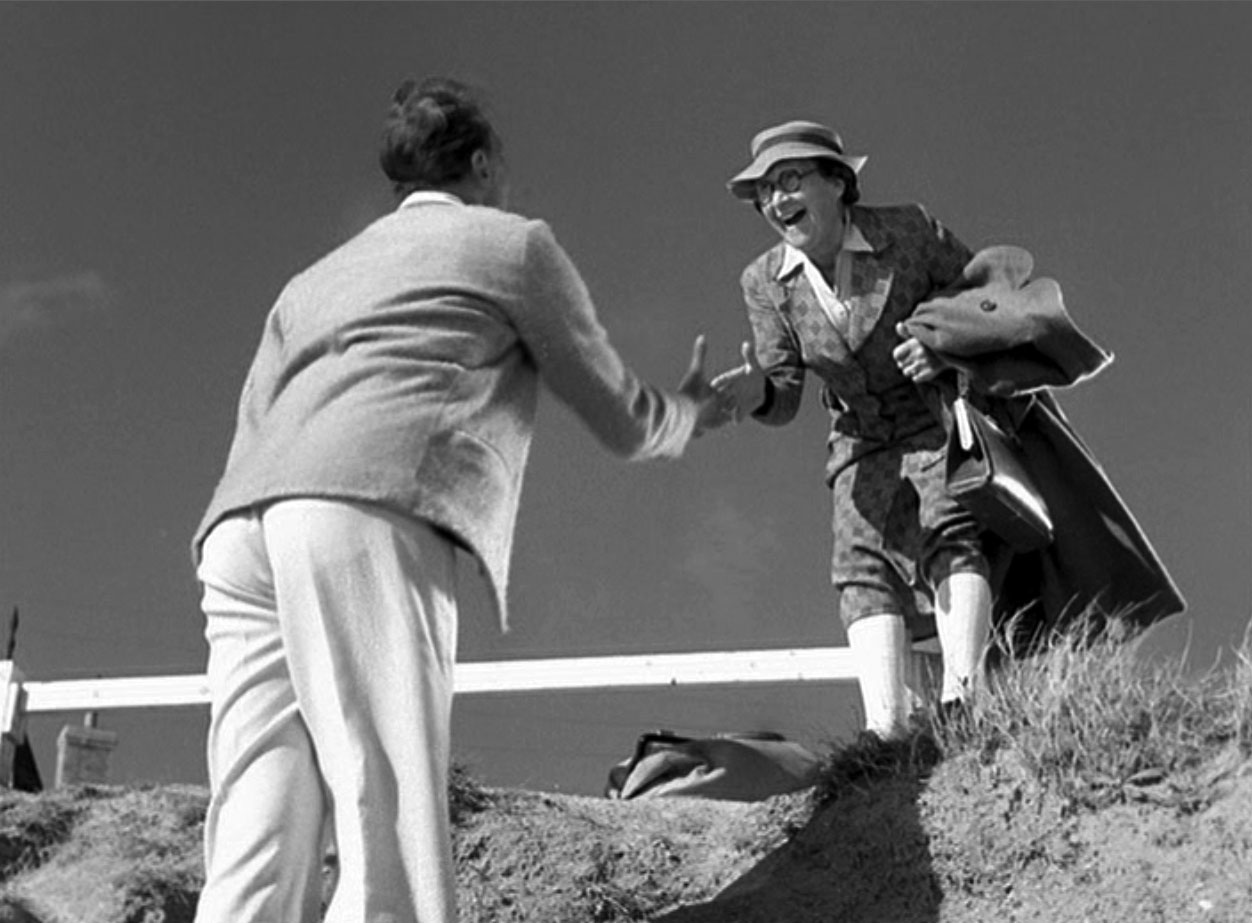
I have been thinking about how this story, which is more a series of light comedy vignettes, ultimately ties together. Now, on second viewing, it seems clear to me that the key is in answering the question: who is it that bothers to say goodbye to Hulot at the end of the film? Of all the characters in the film only two say goodbye to Hulot – the Englishwoman (played by Valentine Camax)…

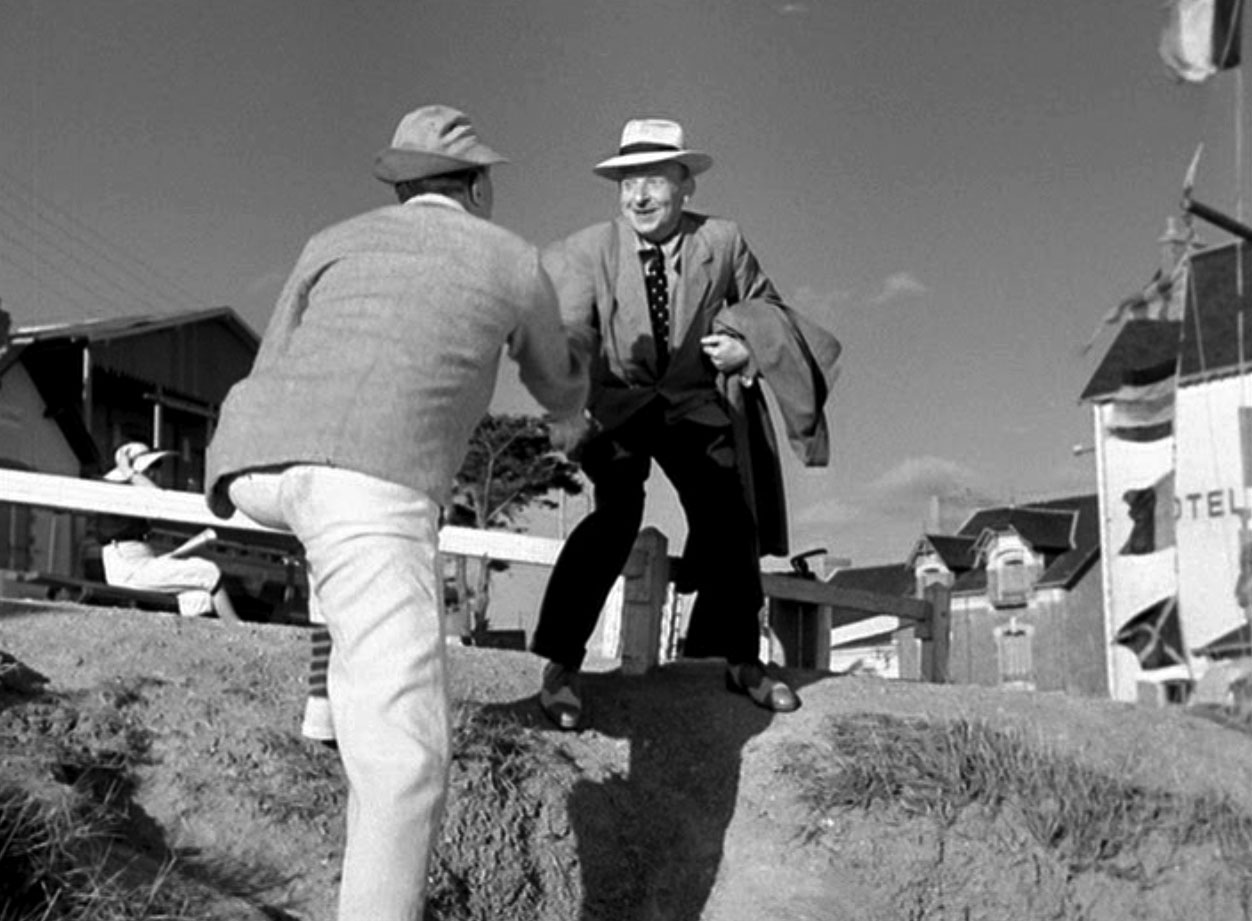
…and the Strolling Man (played by René Lacourt).

Both of these characters are, in some way, outsiders, either by being culturally different (the Englishwoman) or by being a henpecked observer (the Strolling Man). And, of course, Hulot is an outsider in so many ways. I believe that Jacques Tati sees Hulot as a kind of tonic, or a moment of trueness, for those who have hearts capable of responding.

I find this scene to be one of those wonderful moments because it is so matter-of-fact on the surface, and yet a little melancholy underneath. The scene also speaks volumes in regards to Hulot’s position in society and Tati’s perspective of French (and modern) society as a whole.

>I want to thank everyone who made this possible

>

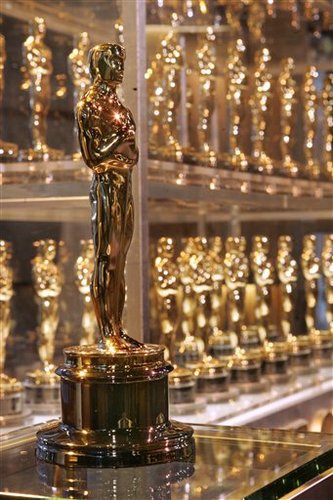
The Oscars are almost upon us and I am excited. Yeah!


[note: most of the text in this post I lifted from comments I made over at Jim Emerson’s Scanners blog.]

Okay, I do have to say that I love watching the Oscars. I know that it is essentially a gimmick (the industry awarding itself, the ceremony invented to promote film and increase sales, etc.) and I know that the best don’t always (usually?) win, nor are the right films always nominated. I know there are lots of issues and problems with the Oscars, and at one level I poo poo them. And yet, there I am, planted in front of the television from the first pre-Oscar broadcast to the final post-Oscar interviews, commenting and cringing, laughing and teary-eyed, annoyed and elated. And I have to confess that each year, from since I was a boy, I have imagined myself up there getting my award, etc. I certainly can’t stand shameless self-promotion, even at the Oscars, but I do love the whole spectacle. One reason is that it is amazing to see so many filmmakers in one place. I just want to say, “those are my peeps!” and give them hugs and handshakes, and have them acknowledge me, and be important enough to acknowledge them, etc. Of course, from the safe distance of the television broadcast and my comfy couch, though. Oh, and I have to admit that I really get into the whole “who’s wearing who” thing. I’m not a fashion/haute couture kinda guy, but it’s my one time each year to let myself go, so to speak. To put it in perspective for me: if I watch the Superbowl I feel as though I’ve wasted my whole day, however, when I watch the Oscars I actually feel like I’ve added something to my life, even if that something is a little too smug, a little too glitzy, and little too shallow at times. Maybe I’m just sappy.


Of course, when I win my Oscar, and I’ve been planning to do so for a long time, I will try to keep my composure, be humble, and be honest. I have my speech all planned:

I want to thank you all for coming here tonight. Ever since my acting teacher, Ms. Johnson, said I didn’t have the talent to win an Oscar I set out to prove her wrong. And that’s why I became a director. So there is wonderfulness in this crazy old world. And this (I hold up my Oscar) proves that God does love those who sacrifice everything for the pursuit of their craft, and a few other things. I want to thank those who have been with me through thick and thin, like my dog and the Starbucks drivethrough. I also want to thank the following people… (I pull out a long, long list and then break down weeping hysterically. This list falls to the floor. I continue to cry. The exit music begins. Immediately I stop crying and regain my composure.) Filmmakers, all of us, have a duty (at this point I get louder to talk over the music) to bring some happiness into the little lives of humdrum people and maybe change the world just a little bit for the better. I know that didn’t come out right, but I know you’ll forgive me, and you’ll forgive me for saying (louder still) that I’m so glad to get something I truly deserve! Not just I, but also those who lost. Take that Ms. Johnson! Thank you all again. Directing is a humble profession! (I hold up the Oscar.) This is for all of you! I love you all, I truly do! Goodni…! (Cut to commercial).

Honestly, I can hardly wait for my Oscar.