>Howard Zinn gave a talk just after the presidential election. It is worth listening to. The audio/picture don’t quite match in the video in the intro, but the rest looks okay.
>I am fascinated by what the world is thinking about the outcome to the U.S. presidential election. There have been many reports of people celebrating from around the world, which is rather amazing. Those celebrations should remind us of how important the U.S. and it’s foreign policies are to people everywhere. I find it both remarkable and sobering.
There are also concerns from various quarters. Does an Obama presidency truly mean change? What about the Palestinians when Obama selects a hard-line Zionist as his chief of staff? Is he really going to end the war in Iraq or develop diplomatic ties with Iran? Is it even possible to fulfill those promises? Below is a four part discussion from Al Jaeera that looks at U.S. foreign policy, Obama as president, and the future from the outside. I found it fascinating and worth taking the time to watch.
>I’m getting a kick out of watching the “other” news of the RNC, that is, the protests outside the convention that are not really being covered much by the mainstream news. But first, here’s a recruitment video made by the RNC Welcoming Committee (an anarchist/anti-authoritarian organizing body) prior to the convention:
I love it. Fun, goofy, and it indicates a major aspect of the protests, that is, they’re thrilling to do. In other words, being a protester, though driven by apparently deeper meanings, is also something people do because it’s an exciting form of entertainment – like playing sports, but more important. I have to say that after watching the following videos I would much rather be with the protesters than inside the convention, though I am not so anarchist in my philosophy, or so anti-authoritarian in my reactions – though I am a little of both.
This video also highlights the reality that contemporary political/social movements are leveraging new media forms with aplomb. Modern protests are far more organized and prepared than they used to be, but so is the response.
[Side Note: So far eight members of the RNC Welcoming Committee have been arrested and charged as terrorists. Plus the I-Witness Video Collective has been evicted from their offices after police raided their building on what look to be trumped up charges. That group was responsible for videotaping much of the 2004 RNC protests and those videos led to most of the cases against the arrested protesters to be dropped. Apparently case after case the videos showed the police officers had lied. That may be why the police don’t want cameras taping them this time around.]
Now that it’s been a couple of days since the initial protests outside the RNC a number of videos have been appearing online. The first three below are video/photo collages that offer some overview of what is going on. There is some overlapping content between the three videos. At a minimum these collages offer some interesting psychological and sociological data to consider.
Finally, here is one of the most interesting, entertaining, and low quality (read verité) videos from the protests. I love the personal commentary.
Of course, one has to ask if any of these protests, violent or peaceful, have any objective value beyond the personal sense of making a statement. It is important to make statements, to carry signs and rant, to march and, hopefully, get on the news, but what is actually accomplished? The RNC continued on as though no one is protesting, as though the protests are so insignificant and inconsequential as to not even warrant a sideways glance. I also believe some of the same protests were deserved at the DNC, but I don’t remember if there were any.
I am reminded of two quotes by Mahatma Gandhi:
“It is better to be violent, if there is violence in our hearts, than to put on the cloak of nonviolence to cover impotence.”
“Victory attained by violence is tantamount to a defeat, for it is momentary.”
These quotes underline the balancing acts in both effective protesting and in cracking down on protesters. Both sides have to live with the consequences of their actions, and ask the question “what really was accomplished.” I cannot help but think the actions and the style of the police will only lay the foundation for more of the same, and then bigger and more substantial protests. In the end the police, and those who back them, will likely lose the battle. In the mean time I fear many citizens will be hurt.
There is no need to say that Chomsky is a controversial figure in the world of ideas. One thing for sure, his ongoing critique of power is as relevant today as it was when he began; all the more so this heightened political season. I want change, and will vote for change in one way or another, but I am also interested in knowing exactly what it is I will be voting for: What kind of power, who will have it, how will it be used, and to what ends? These are questions I think about all the time.
When I think about celebrating this Fourth of July, I find myself wondering about where we are and what has got us here. What most fascinates me, and what I am most amazed by, are the stories of people like you and me who have fought for freedom. I don’t necessarily mean soldiers, but ordinary people who became extraordinary because of circumstances. I mean those who stood up against slavery, stood up for women’s right to vote, stood up for workers’ rights, stood up for civil rights, stood up for you and me.
One of the finest works of historical investigation and writing is Howard Zinn’s remarkable A People’s History of the United States. Throughout that book there are challenges on every page, challenges that remind us what freedom really means and what it takes for people to be free, and just how much freedom is truly a deep, deep longing.
Recently there have been public readings of that book. Here are some excerpts:
Brain Jones reads Frederick Douglass
Lili Taylor reads Susan B. Anthony
Steve Earl reads Joe Hill
This country has always been an experiment. Our freedoms are probably more tenuous than we tend to believe. We have freedoms because they were fought for, because they are still being fought for. Those freedoms will, I’m sure, need to be fought for again. I believe the Fourth of July should be more than a commemoration of 1776. I want to remember how so many ordinary people all along the way have struggled to achieve this country’s ideals. And how many still do. Every Fourth reminds us of how we too are part of this on-going experiment. It is a challenge to each of us to do the work of freedom. I do not want to forget that.
>Inside USA, an English language program on Al Jazeera recently did an interview with Noam Chomsky. I have never watched or read anything from Al Jazeera, that I know of. I did not realize they had an English version, but I guess that makes sense.
From the website, Inside USA says this about its mission:
Inside USA’s mission is to strip away the spin, and highlight some of the real issues in America – poverty, violence, race, health, and immigration.
We will be speaking to people on the ground – not television pundits, but real people with stories to tell – a full spectrum assault of American voices -young, old, white, black, immigrant, rich, and poor.
Here is the interview with Noam Chomsky:
Part one:
Part two:
I have always found Chomsky fascinating. His work on East Timor and Latin America is groundbreaking. So is his work on US politics. Maybe his biggest contribution is his relentless focus on power, that is, political, social, imperial, military power, and its role in shaping how the world functions. This focus puts him somewhere else than simply “left” in terms of politics. The great irony is that although he most likely should be labeled as a radical his views are very close to what most ordinary people think, even if they think they must disagree with Chomsky.
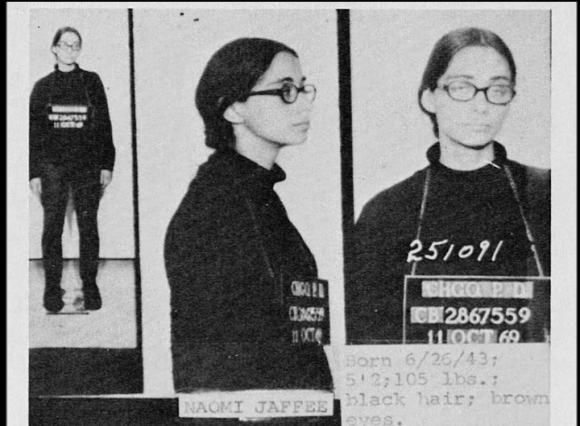
The other day I inadvertently created one of the best double features that I’ve ever seen: First, the fictional narrative La Chinoise (1967) and then, second, the documentary The Weather Underground (2002), based on the revolutionary group of that name.
Silhouetted hands in La Chinoise.
What makes this double features so powerful? We live in an age where violence against human beings in the name of some cause (religious jihad, war on terror, patriotism, personal peace and prosperity, etc.) is accepted by many generally reasonable people. The U.S. government and TV pundits are currently debating whether torture is okay, or whether certain kinds of torture can be called something else to get around legal requirements. Some argue that extreme force, including the killing of innocent people (collateral damage) in order to send a message (to those who would dare to use violence as a means of sending a message), is an acceptable response to terrorist acts – in other words, matching fatal violence with increased levels of the same.
But does violence work? I suppose it depends on what are one’s goals. In general, though I would argue, violence does not incite peace.
La Chinoise plays out the philosophical debates underlying these issues within a somewhat humorous and heavily symbolic world that might be called godardian. La Chinoise is a fictional tale of what underlies potential violent action, and of political idealism amongst the educated children of the bourgeois. La Chinoise is also considered to have presaged (and possibly encouraged) the student protests in Paris that occurred exactly one year after the film’s release.
The Weather Underground, on the other hand, exposes the reality of those actions and their implications by showing what actually played out in the U.S. In other words La Chinoise says “suppose” and The Weather Underground says “regard.”
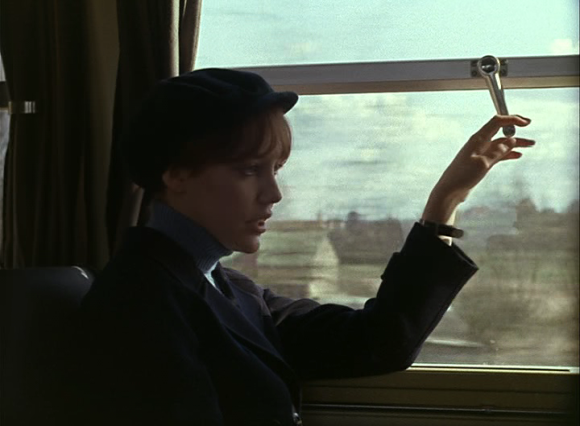
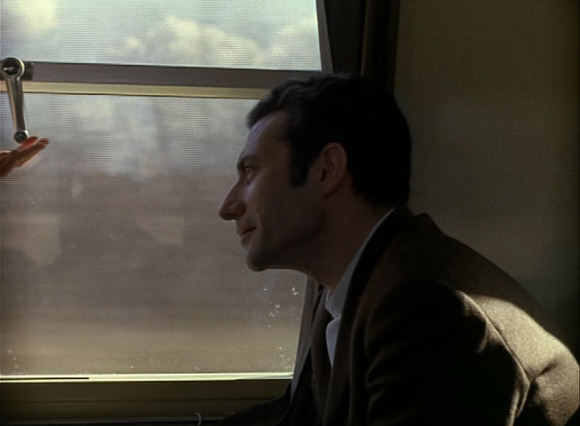
La Chinoise is a kind of remarkable film. I say kind of remarkable because it is also enigmatic and therefore its remarkableness is still very much open to interpretation and evaluation (but isn’t most Godard?). One asks is Godard serious or making fun? Is the film a polemic or a comedy? Is it meaningful or ultimately empty? I can’t say. Many others have done a far better job than I at exegeting the film. But I can say there is one scene I believe is the centerpiece of the film, at least philosophically. That scene is the discussion on the train between Veronique and Blandine Jeanson (playing himself).
Veronique argues for violence.
In that scene they talk about the value and implications of using terrorism in the service of a cause. Veronique, and the revolutionary cell of which she is a part, is planning on using a bomb to kill some students and teachers at the university in order to jump-start a revolution. She argues that the bomb will convince others of the seriousness of their cause. Jeanson argues that violence will not produce the results she is looking for. In fact, killing others will only cause everyone to turn against her and her political group.
Jeanson argues for non-violence.
From my perspective Veronique seems very naive. However, many people felt similarly in the 1960s and early 1970s. I suppose some still do. What would drive a person to such conclusions as Veronique? The Weather Underground explores just such a question.
Haskell Wexler films the Underground.
The activist group The Weather Underground began as the Weathermen, a radical outgrowth of Students for a Democratic Society. The film The Weather Underground is a history of that group and the times in which it functioned. It is one of the best documentaries I have seen.
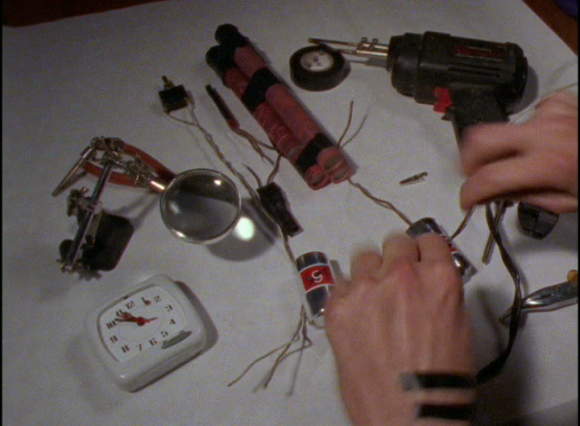
Bomb making.
What drove the Weathermen was a desire to change the world. Frustration in the slowness of change, and even the continued deterioration of certain concerns (such as the escalating war against the Vietnamese), gradually led the group down the path toward violent action.
A revolutionary gets nabbed.
Much of the film includes interviews with former members of the group. It is fascinating to hear them describe what choices they made, why they made those choices, and what they think of them now. There is a lot of regret for some of the former members. In a sense the film pulls back the romantic veneer of the 1960s anti-war movement and shows a more realistic complexity. What we get is something that makes La Chinoise appear to be both more profound and more like a cartoon of itself.
Lest we forget, 40 years ago this month it was “Mai 68”, that is, it was May 1968.
For most Americans (like me) the protests and riots that raged in France in 1968 are largely unknown. Like many protests of the 1960s there are questions as to their ultimate effectiveness. Certainly de Gaul was eventually pushed out, signaling a change from conservatism to liberalism. And, of course, Langlois was restored to his position, which was a part of the whole Mai 68 thing, though protests on his behalf started even earlier than May. But who really knows if any particular protest changed anything that would not have inevitably been changed anyway. And yet, those were glorious days, so I have read.
Here is a nice overview of some key elements of Mai 68:
My français is a bit rusty, but this is a nice retrospective timeline from French television:
There is a part of my soul that loves those protests in France, much like I love the protests in the U.S. in the 60s, or the anti-war protests and anti-globalization protests in recent years. Protesting is so romantic. Many cinephiles may not know that filmmakers shut down the Cannes festival (mentioned in the overview piece above) in 1968 as well.
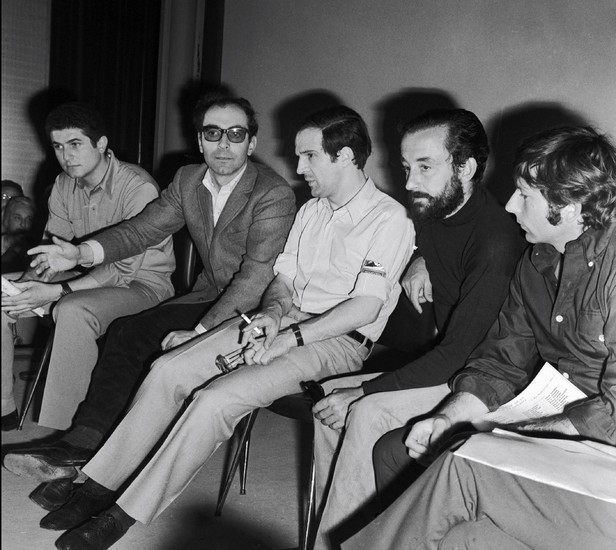
The gang’s all here. Can you name each filmmaker in the photo?
This is a wonderful verité piece showing the debates among the filmmakers at Cannes deciding what their protest was going to mean and what actions that would require:
The fact that Cannes was closed down in 1968 shows that, as a film festival, it had clout, that it was important, and that films were important. I would love to see the Oscars shut down in protest to any number of things, such as the war in Iraq. But that would mean the Oscars are important and are we ready to admit that?
Special bonus: Captain Beefheart live in 1968 on the beach in Cannes.
*Filmmakers in the photo, left to right: LELOUCH, GODARD, TRUFFAUT, MALLE, POLANSKI




 pilgrimakimbo