>Film Music & Architecture (metaphorically)

>

Preface: I had anticipated this to be a much longer and more involved posting for the Filmmusic blog-a-thon over at Damian’s great blog, Windmills of My Mind. But alas, life does not permit me, so I’ve decided to post more of a question than a statement. I will formulate my half-baked ideas as I go. And, of course, in typical PilgrimAkimbo style I will use the Filmmusic blog-a-thon to write about something other than film music.

* * * * * * * * * *

If you are not a true film music aficionado, as I am not, I would guess you do not select your films primarily based on who created the score. And yet, if you find a film compelling, if you become emotionally involved watching a film, if a film haunts you or stays with you, very likely the film’s music played a significant role in helping you to end up where you did. We all know this to be true. It may also be true that a film’s musical soundtrack actually helps one to merely understand the film at all.

I want to propose a very simple metaphor for considering the role that film music plays in our experience of films. I propose that film music is like architecture. My question: does this make sense? When I say architecture, I do not mean the structural aspect of a film, such as editing, rather I am thinking of the way the design of a building or house or room affects one as one enters that room and lives out the story of one’s life. Maybe a better way of saying it is that film music is architectural. And maybe there’s a better word.

My argument:
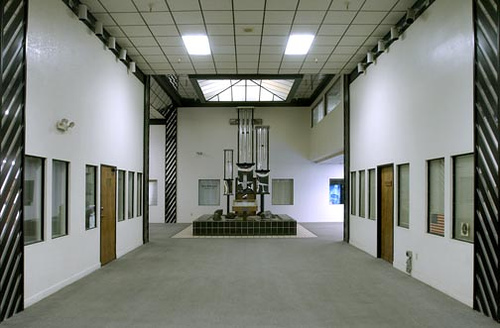
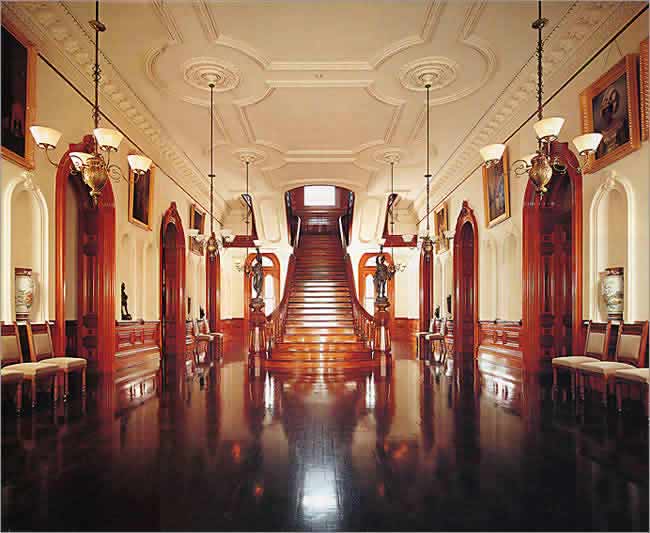
Consider these three images of three very different interior spaces:

I have no idea where these interiors come from other than random images I gathered from the Internet. But it is clear that each are of clearly defined interior spaces, and that each space, though photographed from essentially the same angle, produce very different feelings. One can imagine a story taking place in each one, for example a scene of a father and son arguing over an inheritance, or a romantic kiss, or a burglary – it doesn’t matter. But more importantly, if one were to visit these places one would expect different things. In other words, the spaces themselves convey meaning about their use and their purpose. They would imply different narratives.

Now, if one were to meet someone and have a conversation in each of these spaces, though the denotative content of each conversation would be the same, the connotative meanings might take on slightly different shades due to the context of the rooms. This is one of the things film music can do for a film.

This point, though I admit it is meager, just might be more profound than it appears to the casual observer. To emphasize this point a little more, I like the following quote (from The most Beautiful House in the World by Witold Rybczynski) about how architecture speaks to us and guides us:

The symbolic meaning of architecture can be profound, as it is in the case with places of worship and important public monuments. But the language of buildings can also convey more mundane messages: where to go, what is important, how the building is to be used. It is easiest to discern this function if it absent or if it is misinterpreted. The stock scene in movie comedies in which a flustered visitor wishing to leave a strange home finds himself in the clothes closet illustrates precisely such a confusion. Like all humor, it is an exaggeration of the familiar; we have all had frustrating encounters with doors – not only identifying the right one but opening it once we found it. There is a bank entrance that I go through frequently but which always manages to confound me. The door is made of plate glass, and its pristine beauty is unsullied by visible hinges or pillars; the elegant handle extends the full width of the door. I always have a small struggle going through that door – sometimes I pull instead of push, sometimes I push against the hinge. I feel like taping a sign to the door – PUSH HERE.

Could we then think of film music as being, at least in part, like the sign that says “push here”? In other words, film music is an integral part of guiding us, like architecture does in the physical world, through the mental world of film perception. In a sense, film music can tell us “how to use” a film.

Architecture, that is, the aesthetic design of the spaces we live in – not merely their structural dimensions, produces an often taken-for-granted effect on our lives. In other words, the design of the buildings we inhabit affects the way we live, the way we think, our emotions, and the way we relate to others, and it does these things in often quiet and subtle ways, and sometimes in obvious and loud ways. As we act out our lives in and around man made structures we act within a kind of context circumscribed, and even proscribe to some degree, by these structures. They give us a context within which to act. I argue that film music performs much the same function. Like the overwhelming feeling one gets when first entering a cathedral so are the opening chords of John Williams’ Star Wars theme. The music not merely gets one’s emotions going, but it also tells us a lot of critical information about what we are about to see and how we should think about/approach the story.

If this is true, then film music is not merely an add-on to dress up a film, though it can be that for some films. Rather, film music is an integral part of how a film, as a whole, conveys its meaning(s). As one’s brain engages with the constructive nature of piecing together the film’s narrative from the various clues provided, the music colors that narrative and provides a kind of context for the descriptive, interpretive, and evaluative processes. But, because film music is typically not central to the story in the same way as is the acting or the cinematography, and because film music is typically non-diegetic (not really part of the story at all), that is why I am using the metaphor of architecture. Film music acts as a kind of “space” in which a story is played out. Change the music and you affect the story.

One could say that film music, though typically non-diegetic and non-visual, is similar to the film’s mise-en-scène. Visually films cue the viewer to mentally construct the story from all the visual clues presented. Do not films also do this with music? Of course they do. But the musical soundtrack does more than merely cuing the viewer to think of a particular scene as being romantic or frightening. Music can play a role in the overall “sense” of a film, such as time period, genre, etc. And like many other things in a film, music can act like a relatively open ended set of “codes” that both support and work counter to the desires of the filmmaker.

Once, when my wife took me to see a film of her choosing, one that I did not know about, I had a strong sense of what the film was going to be about from the moment of the opening chords of the film’s musical soundtrack. I leaned over to my wife and said something like: “Okay, so I can tell this film will be about X, and then X will happen, and then X and X and X, and finally it will end with X.” All that from the film’s music combined with the opening credits. And I was right.

Maybe the most fundamental aspect of music is its connection with human imagination. Music can enlarge the imagination by drawing out of it intuitive connections to the world and experience. To keep with the architecture analogy, consider the following two images of famous architectural settings:

Both of these constructions are highly evocative. They draw one into their spaces and they draw out of one’s mind certain emotions and feelings. A film’s camerawork can do the same thing, but so can its music, maybe more so. Now imagine having a conversation with a friend in either of these locations. The same conversation would not be the same given the change in surroundings, even if the differences are subtle. It is this way because of our “aesthetic sense”, that is, our innate ability to respond, even sub-consciously, to aesthetic objects and nuances.

About 13 years ago I wrote these words:

To say that the couch in your living room or the pictures on your walls have a profound effect upon your life may sound strange. But they do. The things we surround ourselves with, from the films we watch to the color and texture of our bathroom tile, influence the way we think and feel. The nature of this influence may be enigmatic, but we know it is there. We know that the aesthetics of MTV, its look and feel, influence the youth of our world. We know that the aesthetics of an art gallery encourage quiet contemplation, whereas the aesthetics of a video arcade do not. And we know that living in an apartment with dark brown walls has a decidedly different feel than living in an apartment with white walls. The look, texture, and sound of our surroundings influences us because of our aesthetic sense.

I believe that in the mental world of film watching, the film’s musical score can be much like that art gallery or those apartment walls. If this is true, then the decisions facing the filmmaker regarding the musical score are critical.

I am sure there are some who might consider non-diegetic film music to be nothing more than a kind of wallpaper – something to pretty up a film, to give it that extra something. For some films this may be true I have no doubt, but in general I think this position is wrong, for fimmakers and for viewers. On the other hand, film music is there to serve the film. For most films the story comes first and all the rest follows, often with the music being included last. I personally believe that filmmakers should not think of music as an “add on” to a film. Film music should do more than merely prop up existing scenes. Rather, film music should be a fundamentally integral part of film. Maybe directors should have the composers be a part of the scriptwriting process. I’m sure some do.

And there it is as promised: some half-baked ideas on architecture for the film music blog-a-thon. I only hope it isn’t so half-baked as to be like a pancake that is burned black on the outside and still runny gooey on the inside. But maybe it’s still just a pancake nonetheless.

a glimpse at a mystery

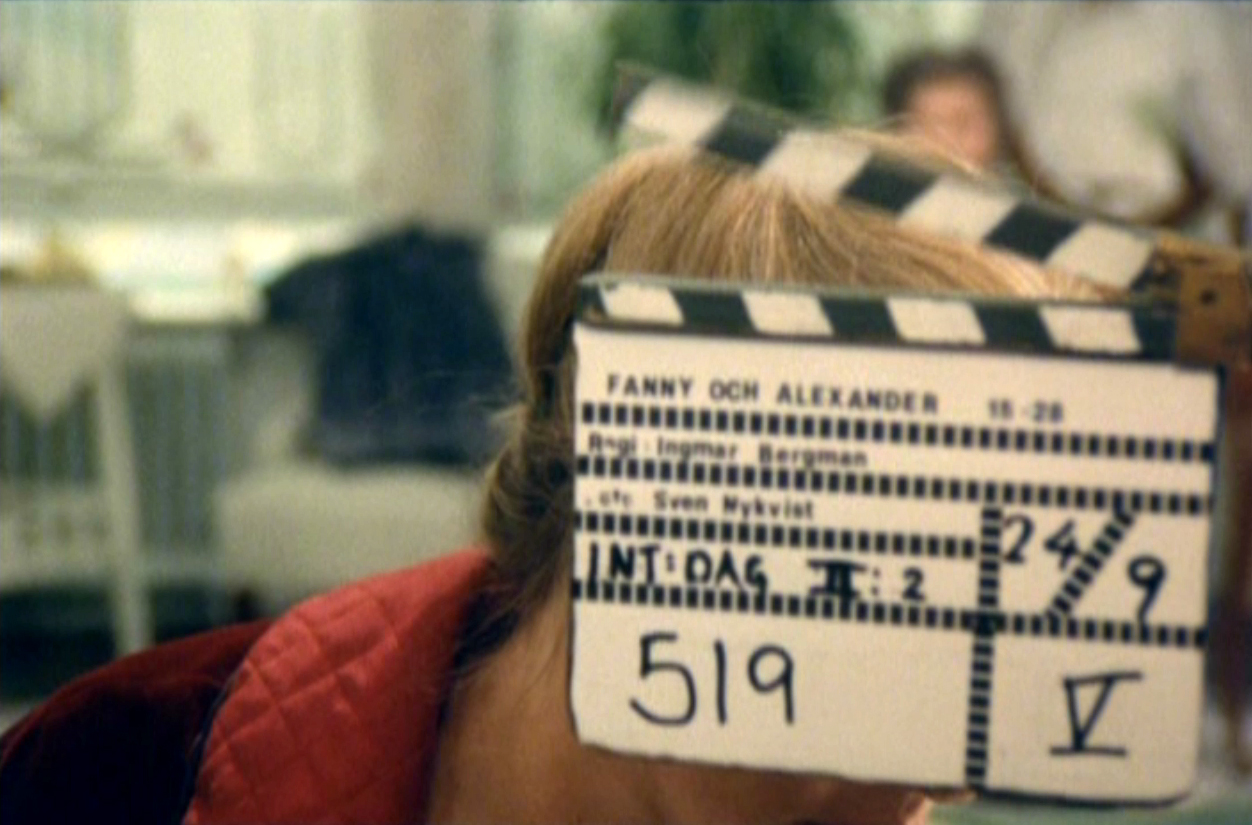
In Dokument Fanny och Alexander (1986) – a.k.a. The Making of Fanny & Alexander – the camera (our camera) observes the film crew at work. We are as a fly on the wall, and yet closer still. Like many great documentaries, this film is premised on letting the subject reveal itself over time, naturally, without manipulation. Except for brief intertitles offering some explanation (and providing section headings) the film merely observes the activities of shooting a film, and especially of the director interacting with his actors and crew. The film is a subtle and intimate look into the relationships formed between these individuals.

I was struck by the film’s beauty and power. For example, I love the moment when filming the deathbed scene where Emilie Ekdahl (Ewa Fröling) comes to view the body of her husband. We get to see the scene being filmed from different angles, with the director, Ingmar Bergman, working with his actors and cinematographer, Sven Nykvist, on pacing and blocking. We get a glimpse at the insides, as it were, of a masterpiece – as though we were visiting the construction site of a cathedral and were seeing stone set upon stone.

What is so remarkable about a work of art is that there is often something transcendent and unexplainable about the final product, and yet the making is just people doing what they do. Artmaking may be a calling, a gift, a burden, but it is also a very human, even ordinary, activity.

Here we have Emilie Ekdahl looking at her husband.

And here we have Bergman looking at Ewa Fröling as she plays Emilie.

One might think that an actor would struggle with the director being only a couple of inches out of frame watching every movement one makes, but Bergman’s actors seem to thrive on that intimacy. Bergman develops a trusting relationship with his key actors to such a depth that their acting and his directing work symbiotically, organically, fully in the moment. And yet, what one sees in this documentary are the functional, goal oriented, working relationships coming together to finish a project and create a product.

If one looks for a mystical connection flowing between director and actor one finds nothing – for we really only see, because the camera can only see, the surface of things. But, if one looks for pointers to the mystery of filmmaking, they are everywhere, and they all point to the end-product, Fanny och Alexander (1982) – a.k.a. Fanny & Alexander.

>2006 National Film Challenge Winners announced

>Just a quick post: the 2006 National Film Challenge Winners have been announced. You can see the winners, and watch the videos here.

The film was awarded Best Directing (Phil Gerke directed it) and Best Production Design.

I wrote about this project, of which I played a very tiny part, before at: thinking & making & thinking.

Some images I snapped during the production can be viewed
here.

>the six degrees of a Russian camera

>

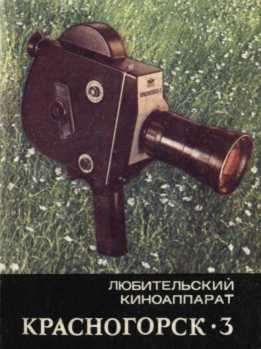
I used to own a camera like the one above. It did not, however, become my ticket to fame and fortune. And yet…

Degree 1: Kevin Bacon was in Mystic River with Tim Robbins.
Degree 2: Tim Robbins was in The Shawshank Redemption with Morgan Freeman.
Degree 3: Morgan Freeman was in The Sum of All Fears with Ben Affleck.
Degree 4: Ben Affleck was in Chasing Amy with Mike Allred.
Degree 5: Mike Allred directed (and stared in) Astroesque with Shane Hawks as Executive Producer.
Degree 6: Shane Hawks borrowed my 16mm camera (a Krasnogorsk-3; see camera above) to shoot second unit shots for Astroesque – although I don’t know if they really used it. (I also went to college with Shane and we both worked at the local NBC affiliate together, but shooting movies is cooler.)


And that’s how Kevin Bacon and I are nearly friends.

P.S. I never considered this before today when a guy I work with mentioned the connection for himself – he was in Astroesque (which I did not previously know) – and then I said to myself “Ah ha!”
P.P.S. I wish I still had the camera, but I don’t want to pay for 16mm processing.

>love film love film criticism love

>I have been thinking lately of the responsibility of film criticism. In regards to film (and other arts), my own training includes both criticism and production. So when it comes to thinking about film criticism I find myself often of two minds. I love to examine, think about, discuss, and write about works of art. I also know a little of what it is like to produce works of art and present them to the world (mine is a rather small world at this point) for examination, thought, discussion, and whatever else. There is a certain amount of vulnerability in being an artist, or creating a film, or singing a song. And yet, I believe works of art (film included, of course) should be critiqued. I believe this because it is, or can be, good for the artist, good for the critic, and good for anyone else who participates. Art criticism is a natural, human endeavour that is a vital part of how we “make” the world in which we live. I also believe that criticism is, or should be, a part of how we do something else that is vital to our existence, that is, to love each other.

To love each other, that is the underlying, fundamental, deeply purposeful project of criticism – even though it may not look that way on its surface.

Love, in this context, is not necessarily emotional, nor is it a cheap sentimentality, and certainly it is not romantic love. This kind of love comes from the realization that to love each other, that is, to care for the well being, the goodness, the growth of another person (of all persons) is the right thing to do. It is a way of behaving, a way of considering, a choice. All too often film criticism, and just about any kind of criticism, emerges from a desire to be clever, or witty, or an intellectual, or just plain right. All of these desires are not wrong in and of themselves, but they can have negative ramifications when uncoupled from a desire for the progress and betterment of the artist, the reader, and even of oneself (the critic). Remember each film, each work of art, is a manifestation of a moment in the artist’s ongoing process as an artist (and as a human being). Consider the following quote from Art & Fear: Observations on the Perils (and Rewards) of Artmaking by David Bayles & Ted Orland:

Filmmaker Lou Stouten tells the painfully unapocryphal story about hand-carrying his first film (produced while he was still a student) to the famed teacher and film theorist Slavko Vorkapitch. The teacher watched the entire film in silence, and as the viewing ended rose and left the room without uttering a word. Stouten, more than a bit shaken, ran out after him and asked, “But what did you think of my film?” Replied Vorkapitch, “What film?”

The lesson here is simply that courting approval, even that of peers, puts a dangerous amount of power in the hands of the audience. Worse yet, the audience is seldom in a position to grant (or withhold) approval on the one issue that really counts – namely, whether or not you’re making progress in your work. They’re in a good position to comment on how they’re moved (or challenged or entertained) by the finished product, but have little knowledge or interest in your process. Audience comes later. The only pure communication is between you and your work.

I am sure Stouten’s experience is rather common, in one way or another. I am also sure that the advice given by Bayles and Orland is a typical defense mechanism born out of numerously painful experiences. The truth is, Vorkapitch had an opportunity to take this young filmmaker and help him grow into a better filmmaker, but Vorkapitch chose to love himself, his status, or whatever, rather than Stouten. What Vorkapitch failed to realize is that it is not the film that matters, not really, it is people that matter. Even if Vorkapitch felt he had wasted and hour or two of his life watching a film that he thought was terrible, he still had the responsibility to act as he should, and he didn’t.

To be a loving critic may require one to say hard things, to point out that a work of art is quite bad (and why), to get in an artist’s face and and say she is wrong. Honesty is fundamental to love. But there is a big difference between saying such things as a means of truly participating in an artist’s process, and saying such things as a way to place oneself “above” the artist. Filmmaking (and art-making) is a truly great thing – a kind of gift as it were – and no critic would have a film to judge were it not for the difficult labor of the filmmaker. I frequently need to remind myself of this. I also need to remember that the critic provides (or has the opportunity to provide) an invaluable service to the artist and the art making process. If we want to speak of the responsibility of film criticism, let’s begin with that.

>Thinking of you, Conrad Hall (a random observation about a film he didn’t shoot)

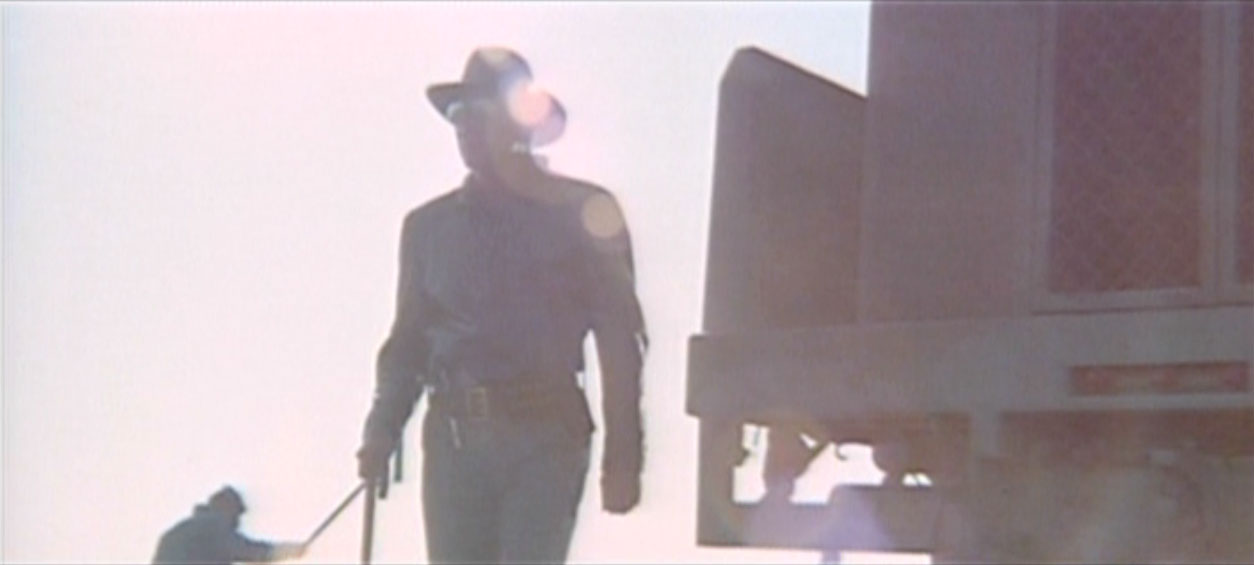
>In the documentary Visions of Light (1992), cinematographer Conrad Hall makes the claim that he contributed to making “mistakes” acceptable. In other words, the kinds of photographic gaffes, such as light flaring in the lens, which previously would have required a retake, began to become expressive filmmaking elements, even normative. The example used in the film was Cool Hand Luke (1967) – a film he did photograph:


This particular scene from Cool Hand Luke is one of the hot “chain gang” moments in which the sun beats down on the convicts slaving away along the road. Certainly, one of the aesthetic goals of the camera work was to create the sense of the sun’s heat and glare. Having the sun’s light flare in the lens helped to create that sense. The danger of this technique is that it may foreground the presence of the camera too much such that the viewer momentarily is drawn out of the narrative and the “fourth wall” is revealed. What cinematographers like Conrad Hall (and director Stuart Rosenberg) understood, however, was that in the photographic world outside of feature filmmaking, especially in journalism, a lens flare is not only commonplace, but may in fact encourage a feeling verisimilitude. Hall, and others, realized that audiences were (maybe always have been) ahead of conventions, and he went for it.

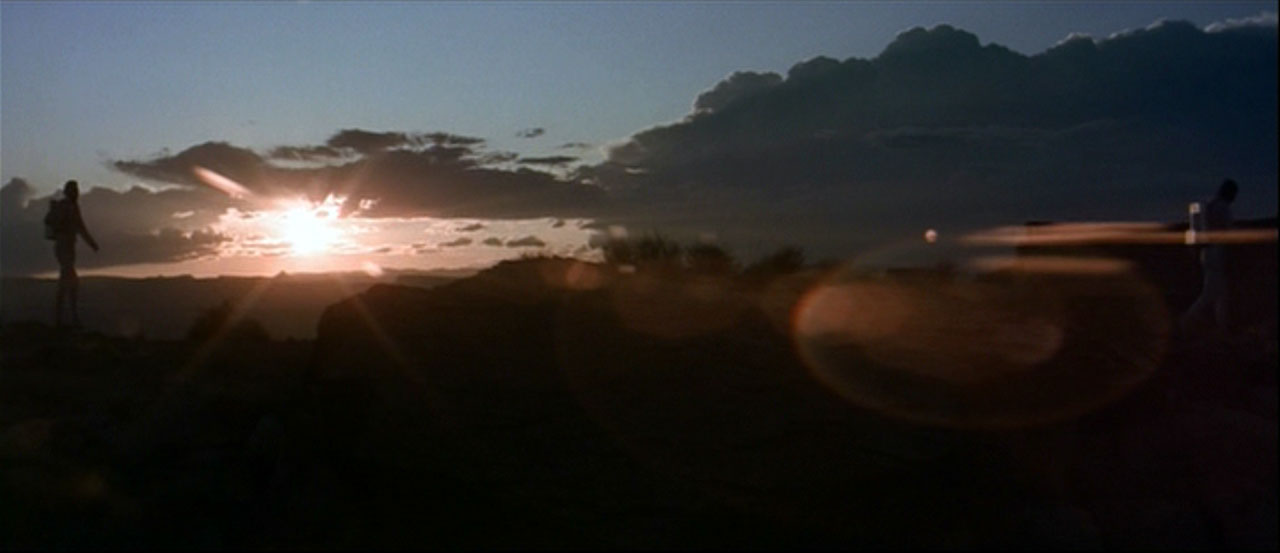
So where in the world does this post really originate? Last night I showed Planet of the Apes (1968) [photographed by Leon Shamroy – a rather accomplished cinematographer] to my daughter (6 yrs old, going on 7). Early in the film, when the three survivors of the crashed spaceship are wandering through the desert (the forbidden zone – as we find out later), I noticed the following shot:


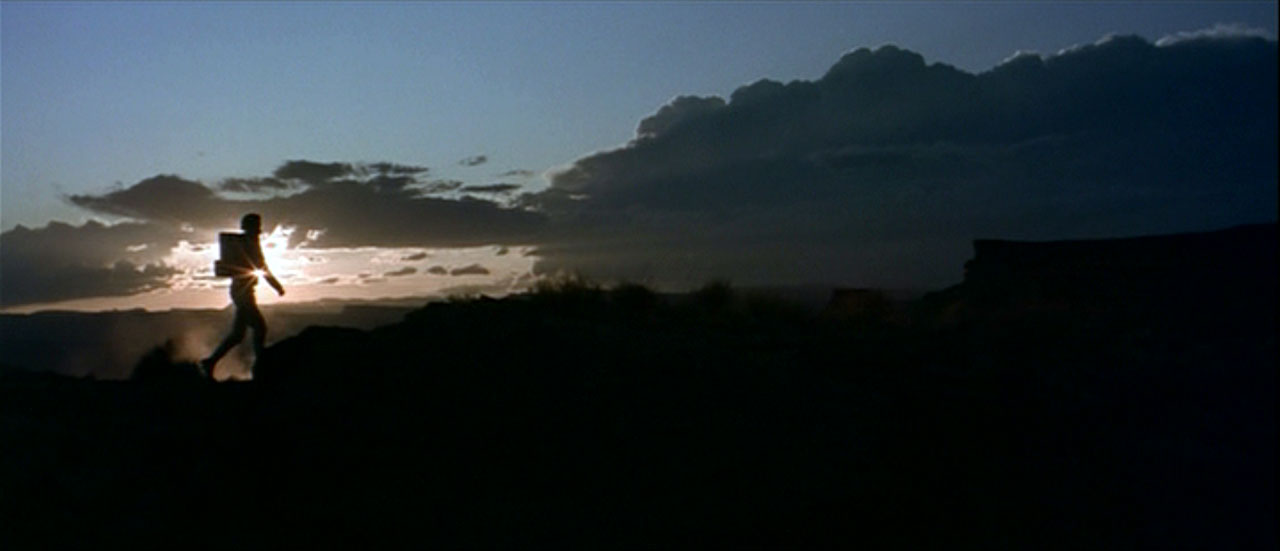
Here we have clear an obvious lens flare. In fact, the lens flare is placed such that it has a visual weight that structurally balances the image. Planet of the Apes was released only a year after Cool Hand Luke, and here Shamroy unflinchingly uses this “new” language of acceptable mistakes. [note: the film was shot in 2:35.1 aspect ratio which only adds to the epic nature of the story and makes the use of such cinematic techniques that more thought-provoking, in my opinion.]

In fact, the way the shot is used we see one of the characters walk in front of the setting sun causing the lens flare to disappear…

…and then re-appear again…

…thus emphasizing the technique even more.

What I find most interesting is the fact that the use of this technique in Planet of the Apes seems to have little functional, thematic, or narrative purpose compared to that in Cool Hand Luke. Nor does it go with much of the rest of the film’s cinematography, which is very good, but rather conventional. In fact, it seems to be used here merely because it is the new thing – a ’60’s thing maybe. Could it be that only a year after Conrad Hall was helping to pioneer new cinematographic horizons that those horizons had now become conquered, colonized, and kitsch-ified? That may too strong of a word. In fact, personally I like the shot in Planet, but I just find the connection a curiosity, and the predictive process of how art affects art typical.

btw, my daughter loved the film. She was fascinated by the ending. Tonight she saw The Princess Bride (1987) for the first time, which she also loved. I have to say, I get a kick out of introducing her to great and fun films.

Cinema Sublime: considering contemplative cinema’s relationship to the infinite

Okay, the contemplative cinema blogathon is voodoo. I mean, I have been thinking about it too much when I should be working on my thesis. Bad, bad, bad. So here are more of my thoughts:

Contemplative cinema seems to have certain aesthetic traits. An excellent overview of the most obvious traits can be found at The Listening Ear: Defining Contemplative Cinema (Bela Tarr). I have also tried to triangulate somewhat on the traits with these posts on “Art Cinema” Narration: Part One, Part Two, and Part Three. Then I tried, somewhat unsuccessfully, to describe the distancing aspect of contemplative cinema by way of contrast here. And finally, I tried, feebly, to find some links to 20th century painting and contemplative cinema here. In some ways I feel my posts have only been scratchings at the surface and not really getting at the heart of the matter. I anticipate this post will also add to the scratching. Probably because I do not see a “solution” to the question of contemplative cinema, merely a myriad of signifiers in an ever expanding galaxy of meaning.

I firmly believe that contemplative cinema is not the sum of a set of unique traits – the long shot, narrative in the background, etc. – although there certainly are unique traits. Contemplative cinema must, I believe, come from a set of ideas – loosely organized and very arguable for sure. What those ideas are is too big of a topic for this post, but I have an idea that the ideas behind and underneath contemplative cinema are complex, very human, and have deep roots planted long before cinema was born.

Here’s just one possible approach to one kind of contemplative cinema.

The concept of the sublime and contemplative cinema
In the 17th and 18th centuries our (richer) predecessors trudged through Europe on their grand tours seeking that fullness of experience that would round out their lives and, if young, complete their educations. When confronted with the awesome grandeur of the Swiss Alps, these trekkers gaped in fearful admiration at nature’s terrifying and beautiful power. Trying to give name to the strange and conflicting experience of fearfulness and mutual attraction, philosophers gave it the name “sublime,” and then set out to argue about it from then until now. Edmund Burke and Emmanuel Kant both dove masterfully into the subject, but it is Schopenhauer who may have clarified it best for us when he listed off the stages of going from mere beauty to the fullest feeling of the sublime (taken from Wikipedia):

Feeling of Beauty – Light is reflected off a flower. (Pleasure from a mere perception of an object that cannot hurt observer).

Weakest Feeling of Sublime – Light reflected off stones. (Pleasure from beholding objects that pose no threat, yet themselves are devoid of life).

Weaker Feeling of Sublime – Endless desert with no movement. (Pleasure from seeing objects that could not sustain the life of the observer).

Sublime – Turbulent Nature. (Pleasure from perceiving objects that threaten to hurt or destroy observer).

Full Feeling of Sublime – Overpowering turbulent Nature. (Pleasure from beholding very violent, destructive objects).

Fullest Feeling of Sublime – Immensity of Universe’s extent or duration. (Pleasure from knowledge of observer’s nothingness and oneness with Nature).

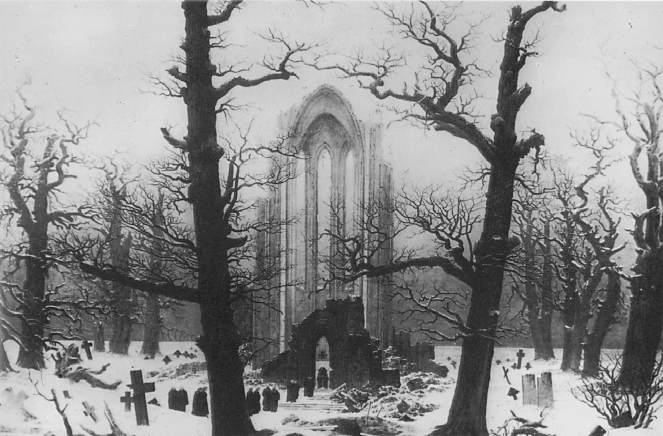
For examples in painting we might look at Caspar David Friedrich’s Cloister Cemetery in the Snow (1817-1819)…


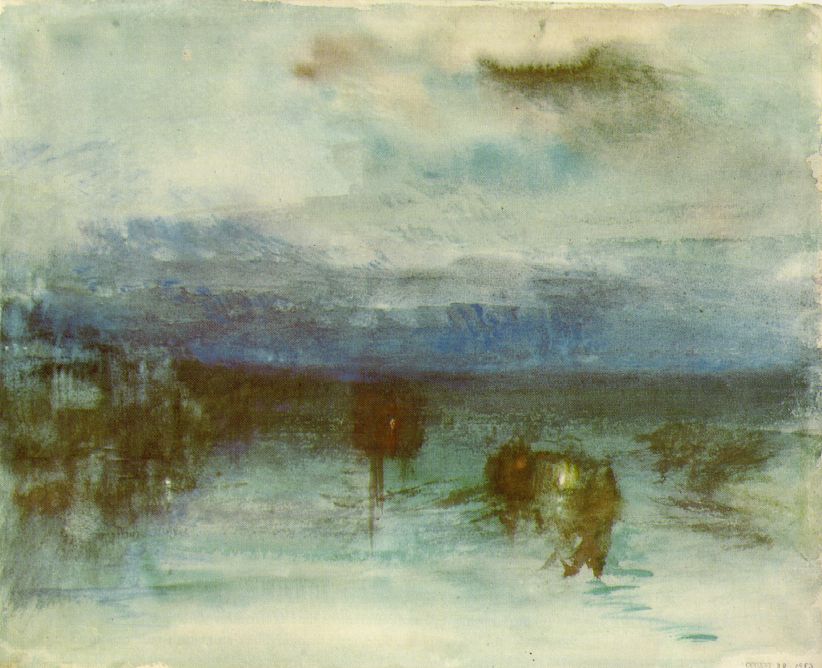
…or at JMW Turner’s Moonlight (1840)

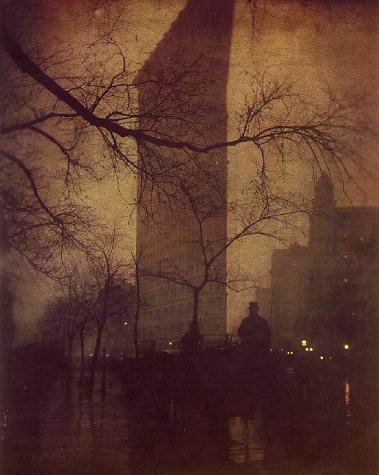
In photography we might consider Edward Steichen’s The Flatiron (1905)…

…or Minor White’s Pacific, Devil’s Slide, California (1947)


I believe we can use these examples from other arts as part of the groundwork in understanding how the sublime might function within contemplative cinema.

Prior to the 20th century the sublime was found mostly in nature, which, for all its potential danger, is fundamentally morally neutral. But in the 20th century unimagined horrors were foisted on humankind – trench warfare in WWI, the Nazi genocide of European Jews, the atomic bombs dropped on Japan, and the list continues. I would argue that a shift occurred in the concept of the sublime to include the fact that human beings commit such horrors, both consciously and subconsciously, and that that inclusion has had a significant affect on the arts including cinema. In other words, one could extend concepts of turbulent nature, overpowering turbulent nature, and the immensity of the universe’s extent to the apparently overpowering aspects of human desire, the power of technology, and human evil. A fully engaged response to this reality could include a scientific approach where one just has to face up to the emptiness of human existence in a world created by time + matter + chance, or it could explore the soul as though on a sea of meaning both frightening and hopeful.

What I am saying is nothing new. However, I think the modern concept of the sublime, with its roots going back to 17th century, may offer pointers towards an understanding of contemplative cinema. For example, it is obvious the Bergman’s The Silence or Resnais’ Hiroshima mon amour are artistic explorations of a human response to the modern world from within a position of the nihilistic universe, but a more sublime film, such as Tarkovsky’s Stalker, might address the same concerns, but from a different vantage point. I would argue that that vantage point is not the scientific perspective of the individual in a cold universe, but the soul in relation to the infinite. This is not to say the Bergman or Resnais (in these examples) did not make contemplative films, but they do so by rooting the viewer in the narrative process and therefore in a materialistic world. I propose a sublime contemplative film calls the viewer beyond the narrative – and to me this seems to be a higher level of contemplation.

Another angle on the sublime might be:
The experience of the sublime involves a self-forgetfulness where personal fear is replaced by a sense of well-being and security when confronted with an object exhibiting superior might, and is similar to the experience of the tragic. The “tragic consciousness” is the capacity to gain an exalted state of consciousness from the realization of the unavoidable suffering destined for all men and that there are oppositions in life that can never be resolved, most notably that of the “forgiving generosity of deity” subsumed to “inexorable fate”. (also taken from

Wikipedia )

In this sense the sublime is an almost religious concept – one might think of the concept of fearing God (a combination of love, reverence, and trembling), for example. A contemplative film which has its roots in the sublime might then call on the viewer to transcend narrative construction (mentally speaking) in order to enter into a feeling of the “tragic consciousness” of the universe, and thus transcend narrative climax. The potential issue with this way of thinking, however, is the reality that the viewer’s response is personal, which is unique for each viewer. That is why I cannot go so far as to say the characteristics of contemplative cinema are a set of particular visual or narrative cues. But there may be characteristic goals.

Does it make sense to see contemplative film, then, as primarily non-narrative? One might consider Love Song (2001) by Stan Brakhage, an abstract, undulating, “hand-painted visualization of sex in the mind’s eye.” No doubt this short, purely abstract film seeks to produce an effect within the viewer. No doubt it calls of the viewer to be open to exploration of the self in some capacity. But what can we really say about it? In my opinion, sublime contemplative film still needs something more tangible to hang on to, and part of that tangibility is narrative, even while seeking to transcend narrative.

Love Song (2001)


Of course, a question raised by considering a film such as Love Song is whether or not sublime contemplative cinema succeeds by accurately representing something that is already sublime, or whether by using cinematic means, however so, to induce a feeling of the sublime in the viewer.

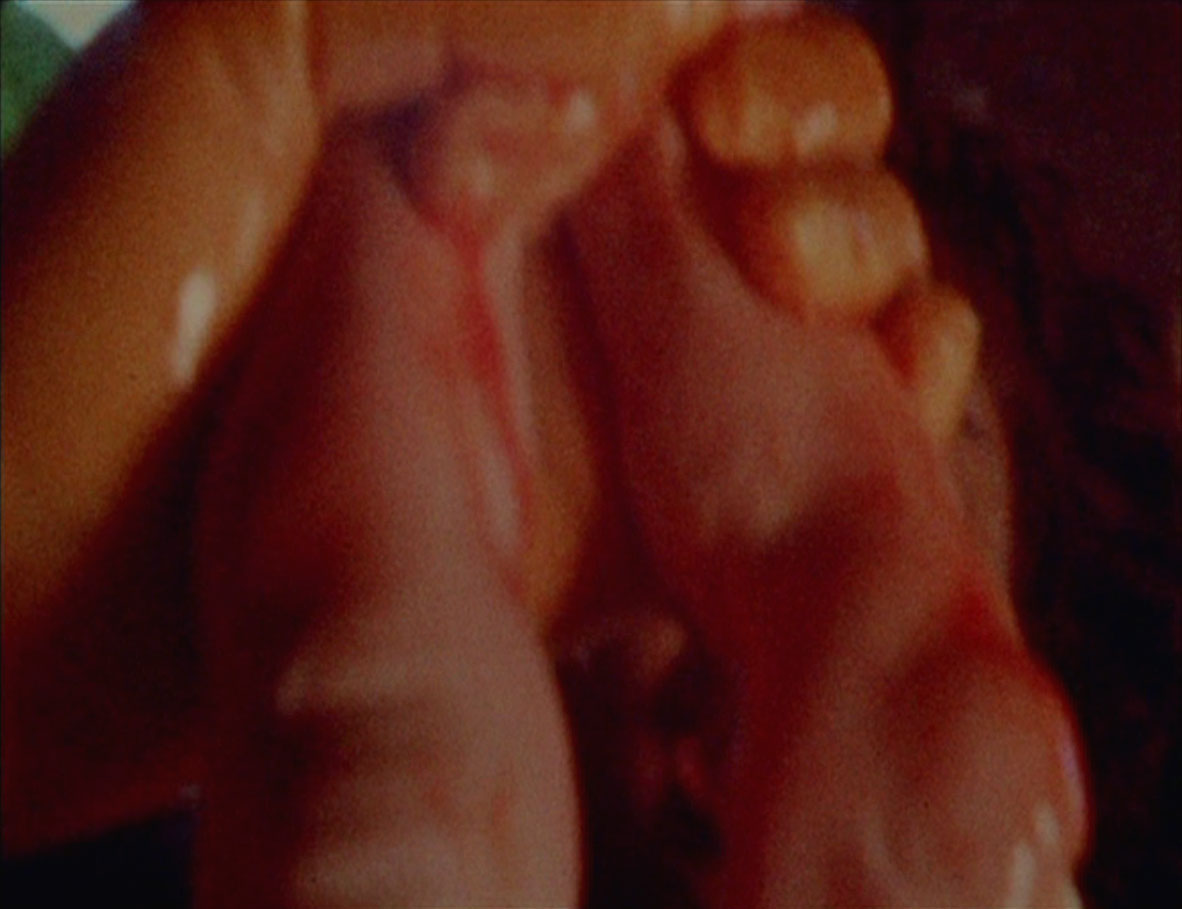
A better option may be to consider another Stan Brakhage film, Window Water Baby Moving (1962). In this powerful short film about the birthing process there is the natural narrative of the birth. Although told unconventionally, there is enough of a narrative, and just enough balance between abstraction and reality, that one can “enter” into the film more fully. This entering process then allows the transcending process to be more substantial, that is, it seems more likely that the viewer will end up in a different place at the end than at the start, psychologically and spiritually speaking. The sublime nature of the piece shines through in the combination of the beauty of body, life, and love with the graphic intensity of actual birth in bloody closeup.

Window Water Baby Moving (1962)

Interesting, Window Water Baby Moving is constructed via the often rapid juxtaposition of many different images, and thus potentially subverts the idea that contemplative film is necessarily and characteristically made of lengthy shots in which very little action takes place.

Finally, a cinema of the sublime is not a genre or style or even a set of aesthetic choices so much as it is a particular attitude to the place of human beings in the universe. How this plays out in the arts can be varied and fascinating. I believe the concept of contemplative film includes the concept of the sublime whether is is of primary emphasis or resides in the background. I’m sure much more can be said, but I will leave it there.

les carabiniers and the death dance of imperialism

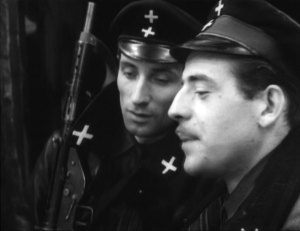
Several days ago I watched les carabiniers (Godard, 1963) and I have not been able to get it out of my head since. I won’t go into the details of the story since it’s a film widely known, and I know I should have seen it ages ago, but it’s one of those films that I just passed over, until now. I truly enjoyed the film and I was struck by one scene, for me the most important scene of the film, and the mental connections it produced for me.
 
[Side note: One thing that I find somewhat interesting is that when one is analyzing a Godard film, one is aware that Godard knows you are analyzing it.]
 
The scene is where the carabiniers execute the young Marxist woman. Now this film is a dark comedy, and is obnoxiously (but I love it!) so throughout, but this particular scene has a moment of real pathos and poignancy.
 
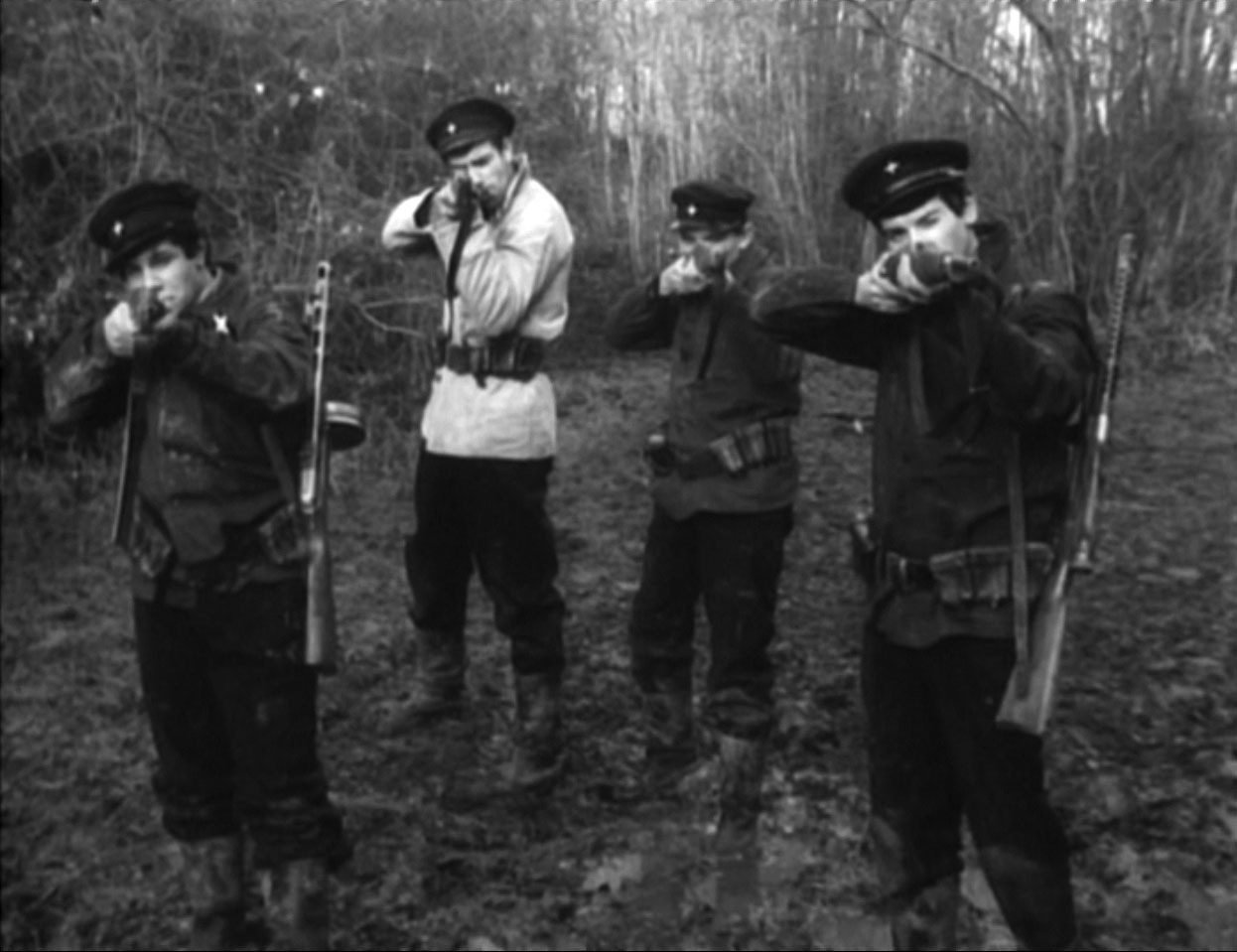
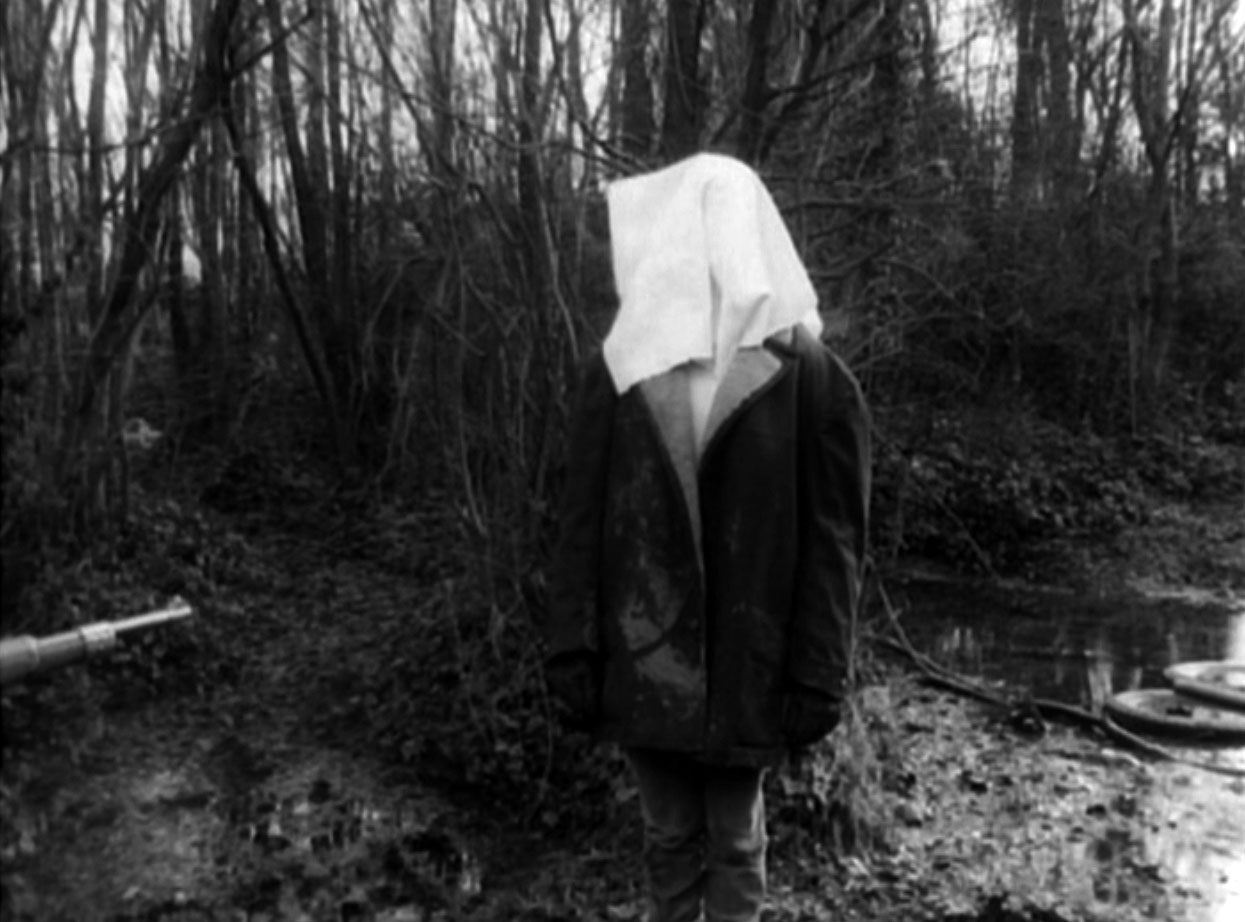
The young woman has been caught by the carabiniers and is put in front of the ad hoc firing squad. She has already had a chance to espouse some Marxist philosophy only to make the commander upset. The men raise their rifles and get ready to shoot.
 
However, the woman, with her head covered by a handkerchief, begins to repeat slowly “brothers,” “brothers,” “brothers,” “brothers.”
 
The men have trouble with her simple pleas. Several times their guns waver. Something inside them responds to the reality that they are all brothers in a bigger struggle. The handkerchief is then taken off her head and she recites a parable from Mayakovsky. But finally, they shoot and she is dies. But she doesn’t die quick enough, so as she lies on the ground a soldiers says she is still moving…
 
…while another repeatedly pulls the trigger.

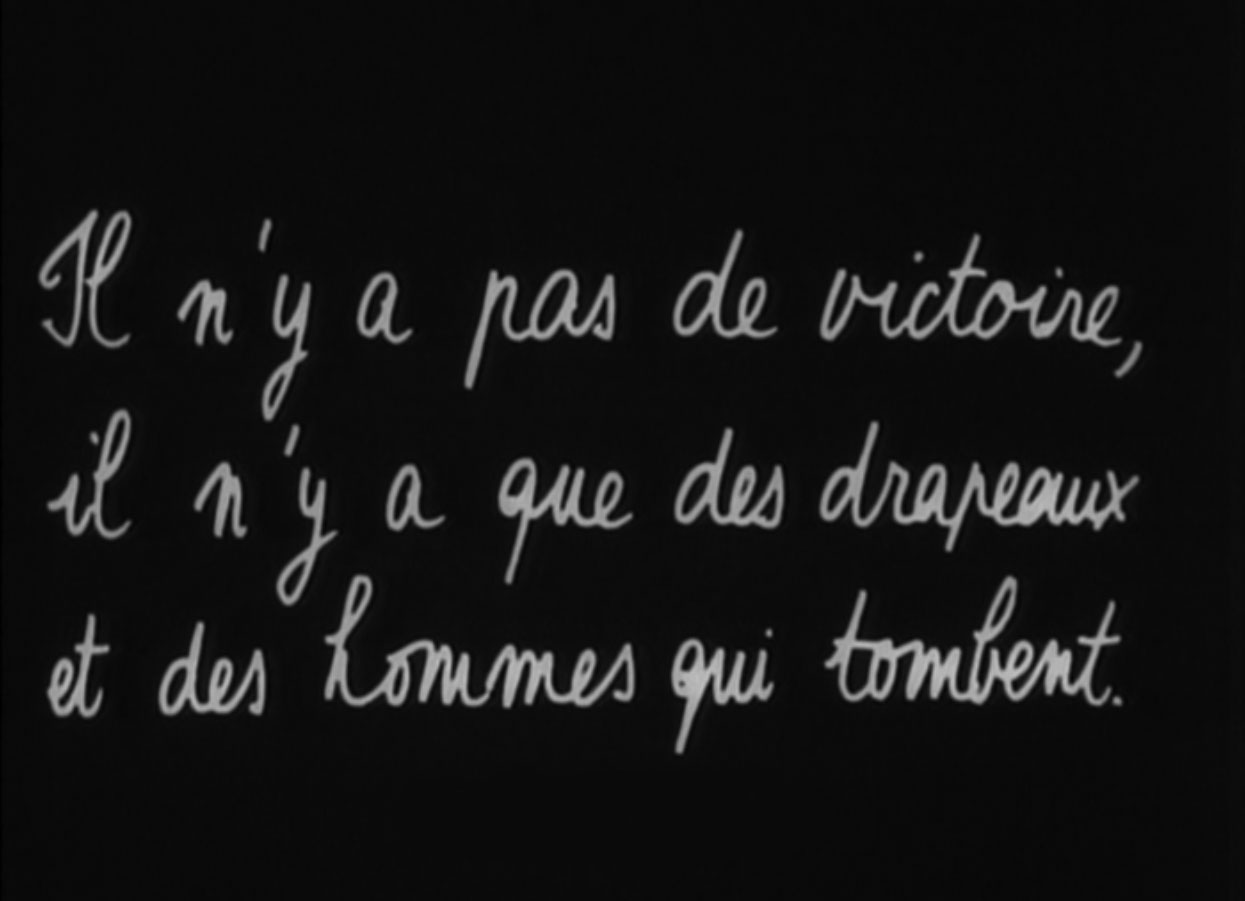
Finally, the scene ends with this quote:
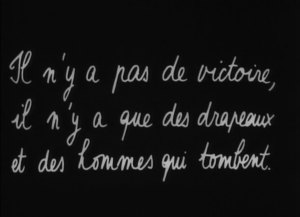
il n’y a pas de victoire
il n’y a que de drapeaux
et des hommes qui tombe

“There is no victory
There are only flags
and fallen men”

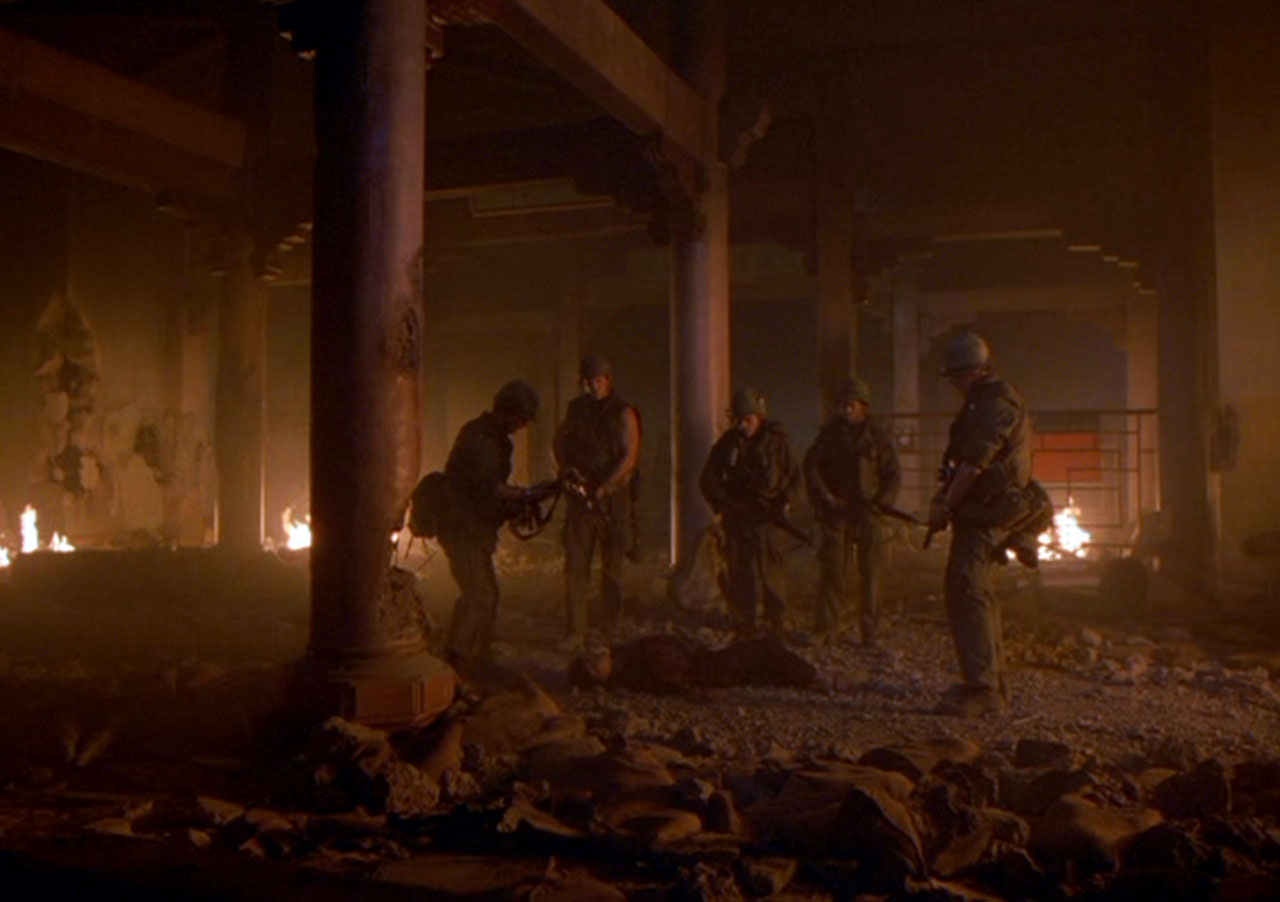
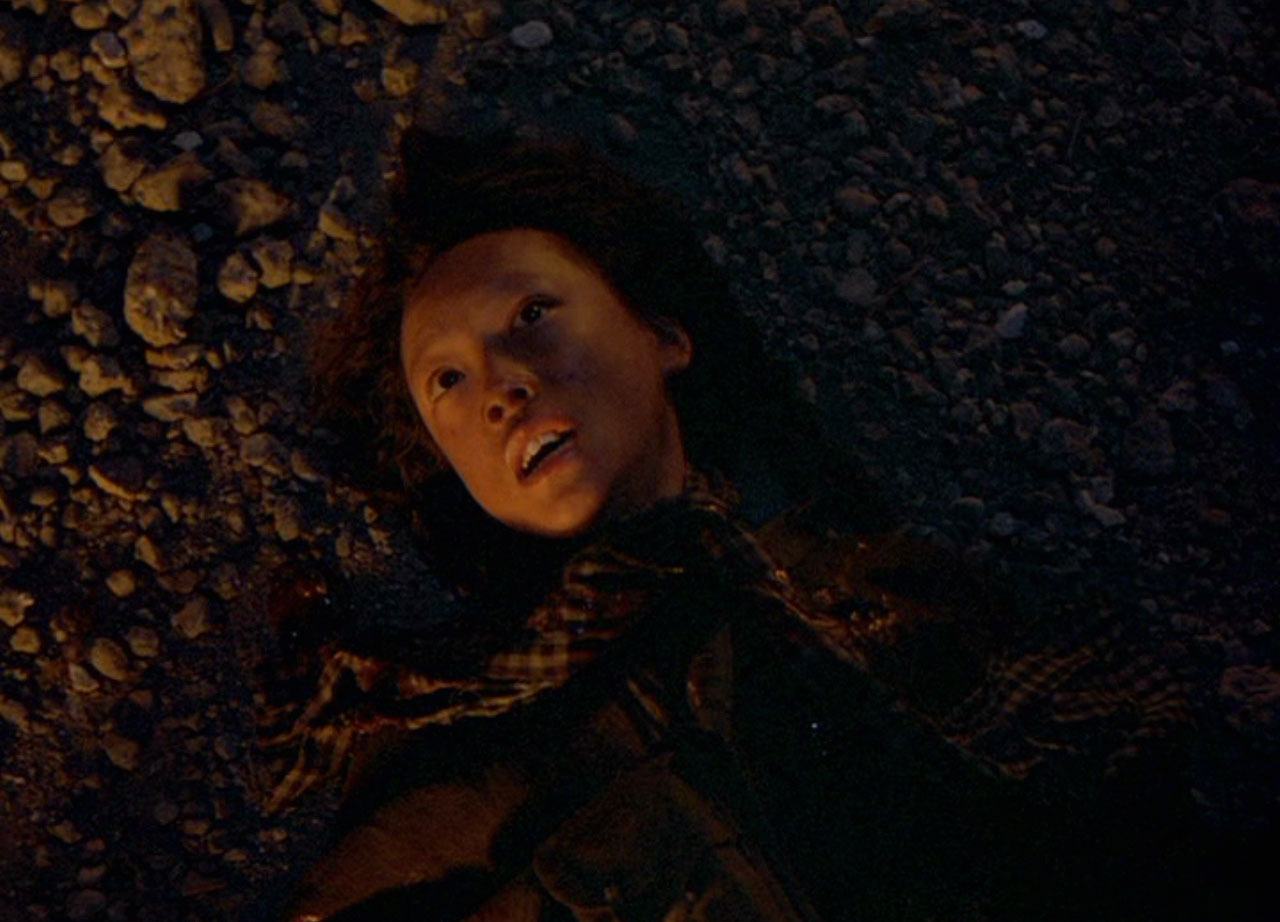
In the context of the film this scene shows the extent to which the carabiniers have been brainwashed by their government – the king himself has asked them to do what they do, or so they believe. The scene also extends outward to the whole reality of war, of cinematic depictions of war, and to our present day. For me there is a mental connection with the final scene in Full Metal Jacketwhen the American soldiers come face to face with the young female Vietnamese sniper. As she lies on the floor of the shattered building, mortally wounded and writhing in pain, the soldiers stand around discussing her fate.
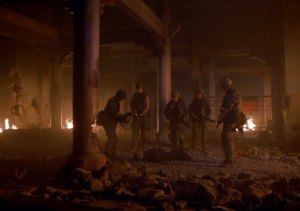
 

A portion of that scene goes like this:

The SNIPER gasps, whimpers.


DONLON stares at her.

DONLON
What’s she saying?

JOKER
(after a pause)
She’s praying.

T.H.E. ROCK
No more boom-boom for this baby-san. There’s

nothing we can do for her. She’s dead meat.

ANIMAL MOTHER stares down at the SNIPER.

ANIMAL MOTHER
Okay. Let’s get the f**k outta here.

JOKER
What about her?

ANIMAL MOTHER
F**k her. Let her rot.

The SNIPER prays in Vietnamese.

JOKER
We can’t just leave her here.

ANIMAL MOTHER
Hey, asshole … Cowboy’s wasted. You’re fresh out

of friends. I’m running this squad now and

I say we leave the gook for the mother-lovin’ rats.

JOKER stares at ANIMAL MOTHER.

JOKER
I’m not trying to run this squad. I’m just

saying we can’t leave her like this.

ANIMAL MOTHER looks down at the SNIPER.

SNIPER
(whimpering)
Sh . . . sh-shoot . . . me. Shoot . . . me.

ANIMAL MOTHER looks at JOKER.

ANIMAL MOTHER
If you want to waste her, go on, waste her.

JOKER looks at the SNIPER.

The four men look at JOKER.

SNIPER
(gasping)
Shoot . . . me . . . shoot . . . me.

JOKER slowly lifts his pistol and looks into her eyes.

SNIPER
Shoot . . . me.

JOKER jerks the trigger.


BANG!

The four men are silent.

JOKER stares down at the dead girl.

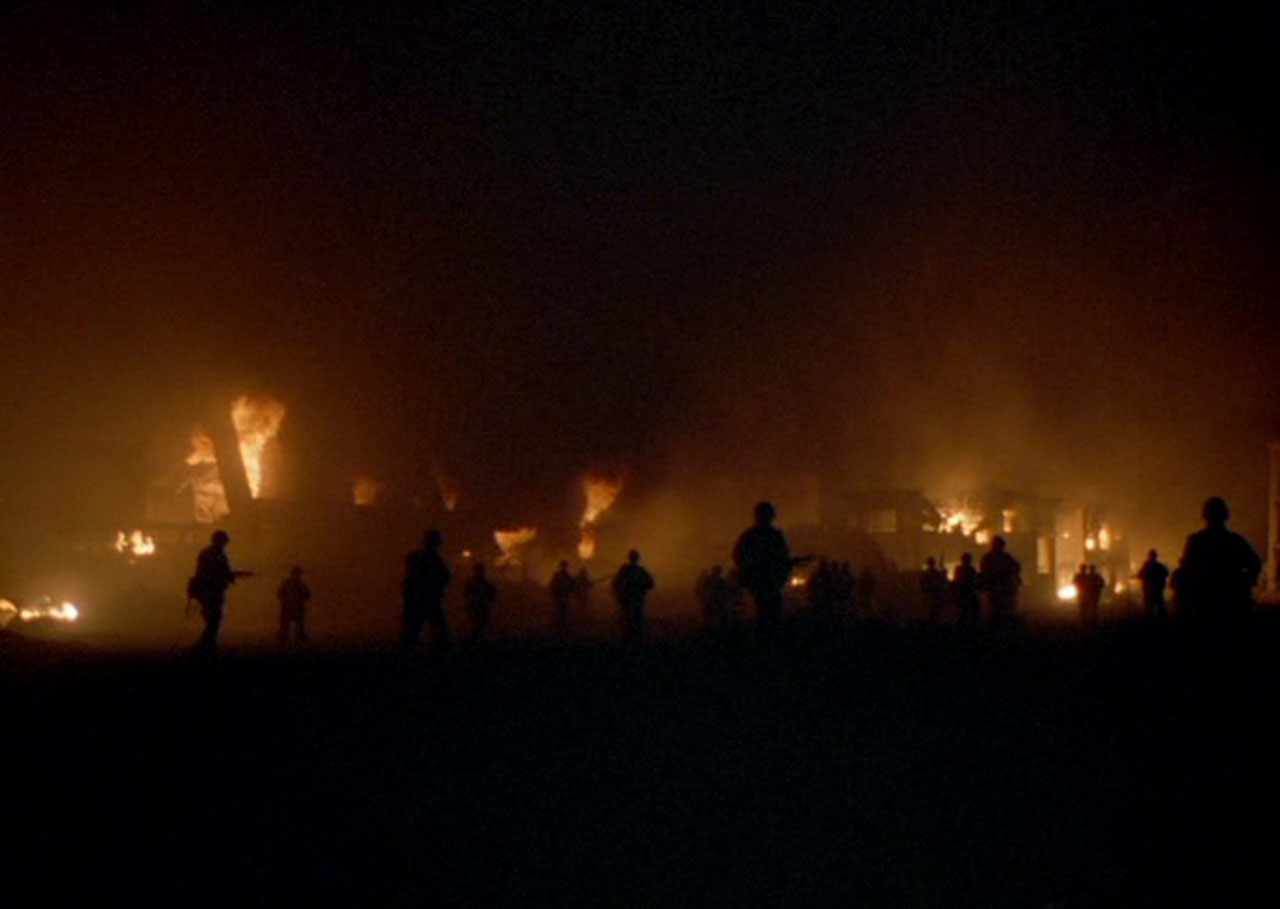
There is a bit more dialogue, and then the final scene is of the soldiers walking through the war ravaged terrain singing the theme from the Mickey Mouse Club.
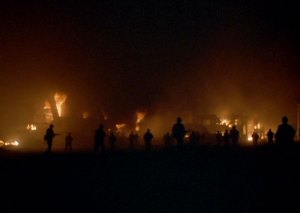
 

The connection with les carabiniers is not merely that you have a bunch of men killing a solitary, young female. Although that is both powerful and telling in each case. For me the connection is the fact that in each film the female represents a person of character, not necessarily for good or evil, but for something higher and bigger than either the shallow materialistic goals of the soldiers in les carabiniers, or the shallow and aimless goals(?) of the soldiers in Full Metal Jacket. In les carabiniers the young revolutionary quotes Lenin and Mayakovsky. She appeals to their common brotherhood. She willing goes to her death (maybe she didn’t have a choice). In Full Metal Jacket the young sniper is in her own country, fighting for her beliefs and, most telling, she prays. The soldiers of Full Metal Jacket, as is made clear throughout the film, are almost soulless products of American consumer culture fighting from within their own nihilistic world. This contact they have with a soulful, spiritual human being has no impact on them.
 
What I believe is happening here in Full Metal Jacket is a description of how horrible and damaging war is to the soldiers who are involved – not just physically, but spiritually. A more typical modern interpretation of the experience of war is what we find in Platoon. In that film the characters witness the horrors of war, and yet the film still manages to find a way for those involved to grow as people. The Charlie Sheen character speaks of at least learning something valuable at the end, regardless of how bad it got. Full Metal Jacket does not grant such notions. Here soldiers are emotionally and psychologically damaged, just as though they have lost limbs. There is no going back. There is no coming to terms with what they have done, or are doing. I find this perspective to be rather profound, especially in light of a number of the stories coming out of the U.S. occupation of Iraq.
 
Then there is another connection in the web of meaning, that is the film Why We Fight (2005) which I also watched recently and highly recommend. Could it be that today (maybe always) war is a financial venture on the part of big business in collusion with big government? For those who have been paying attention, this is an old question. But just in case anyone missed it, Why We Fight takes a close look at the hows and whys of war-mongering.
 
Some salient points in the film:
A slightly younger Dick Cheney hammering out U.S. foreign policy and pulling political strings:
 
 
Cheney then gets hired as CEO of Halliburton. His personal wealth skyrockets from less than a million $ to many, many millions of $$$ in just three years. He uses his political connections to get business for Halliburton.
 
 
The defense industry makes it money from war mongering – as long as politicians are for war then the defense contractors make their money, and apparently they like lots of money.
 
Now Cheney is Vice President. The people of the U.S. elected a defense contractor as second in command!
 
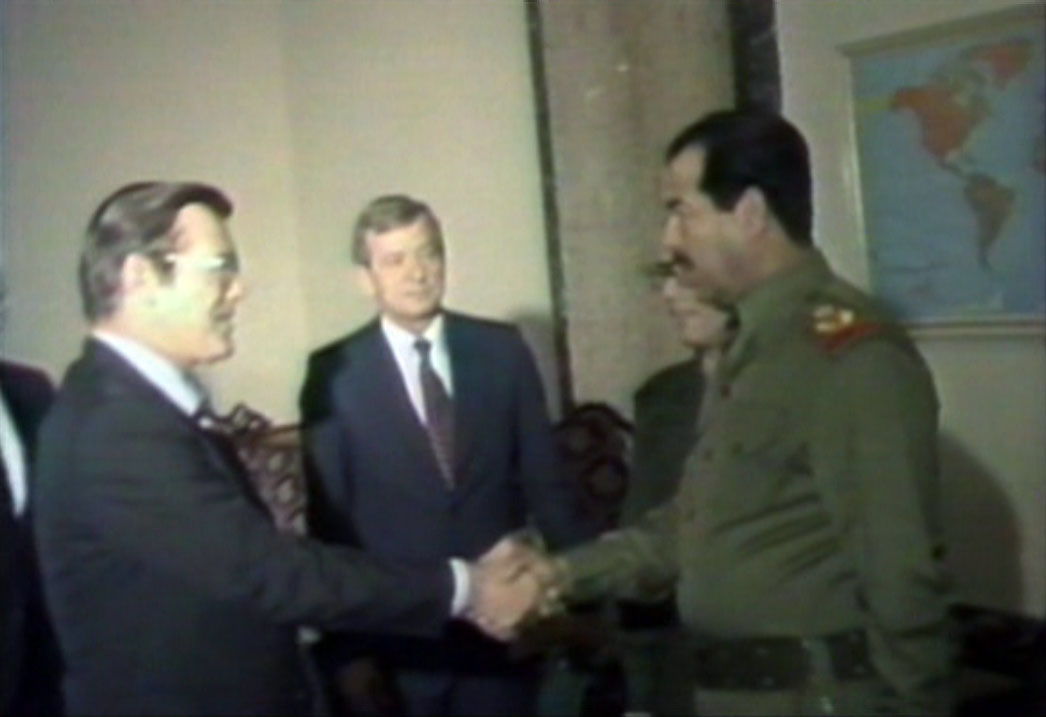
Donald Rumsfeld greets Saddam Hussein, promising friendship, political backing, and weapons of mass destruction for the war against Iran.
 
 
[The popular saying in Washington D.C. before no weapons of mass destruction were found in Iraq was, “We know he has weapons of mass destruction, we have the receipts.”]
 
Just a few years later tens of thousands of Iraqi civilians die, and many more are seriously wounded, by the U.S. military “shock and awe” strike against the Iraqi people – including thousands of children.
 
 
And the only true interest the U.S. has in the region is the vast oil reserves.
 
Now Iran is in the crosshairs.
 
I cannot help but think that those who are willing to sacrifice something while being sent off to war are caught between mythologies of nobility and the real motivations of those who send them off to war. Are not modern “carabiniers” promised much the same kinds of things promised to those in les carabiniers? Are these not the realities of “surge” and “sacrifice?” Is it not, truly, a dance of death?
 
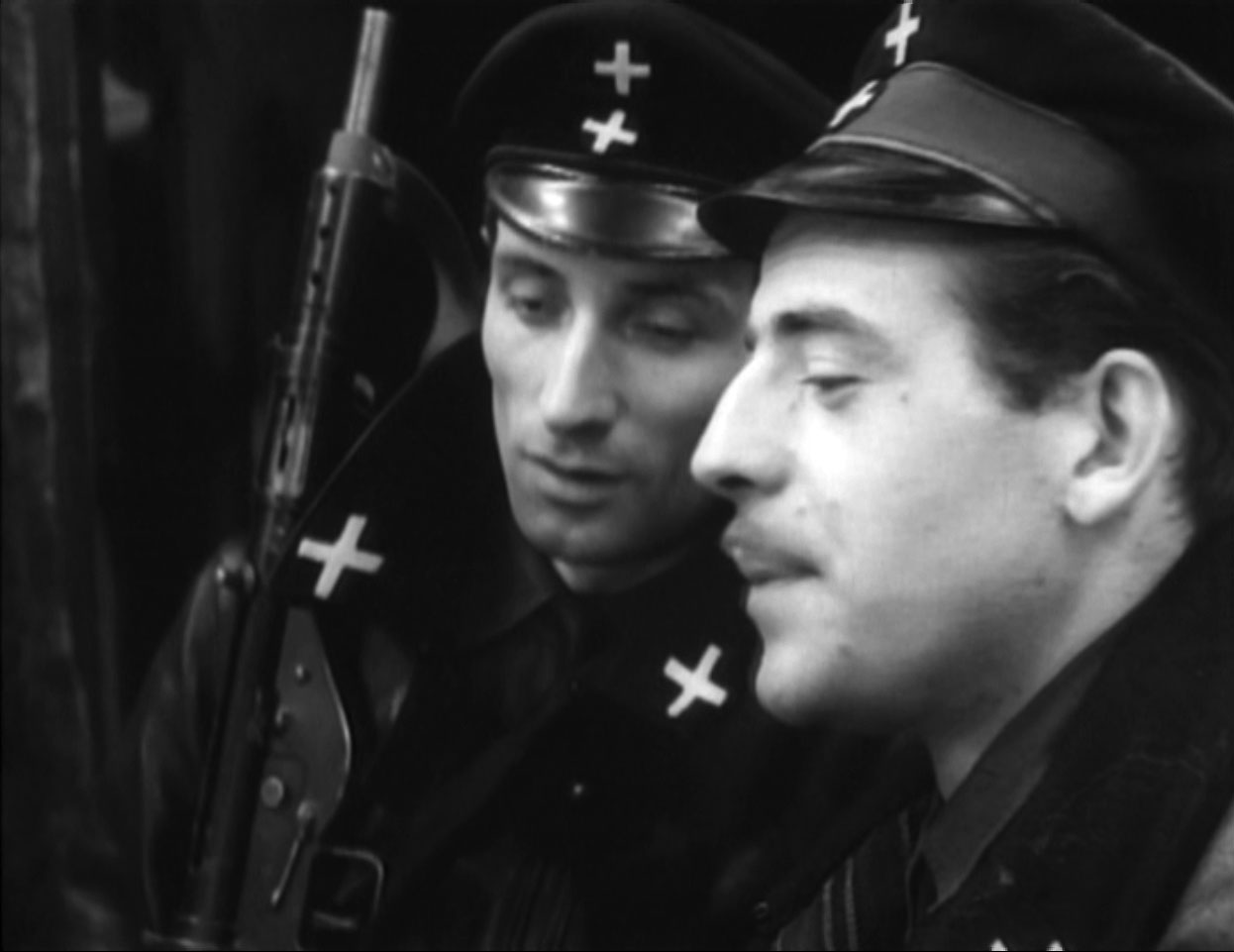
A final note: I love the connection that Godard makes with Chaplin’s The Great Dictator. Notice the sign of the “Double Cross” on the dictator’s hat with the crosses on the hats of the carabiniers in the image at the beginning of this post. Wonderful!

 

>found object(ive)

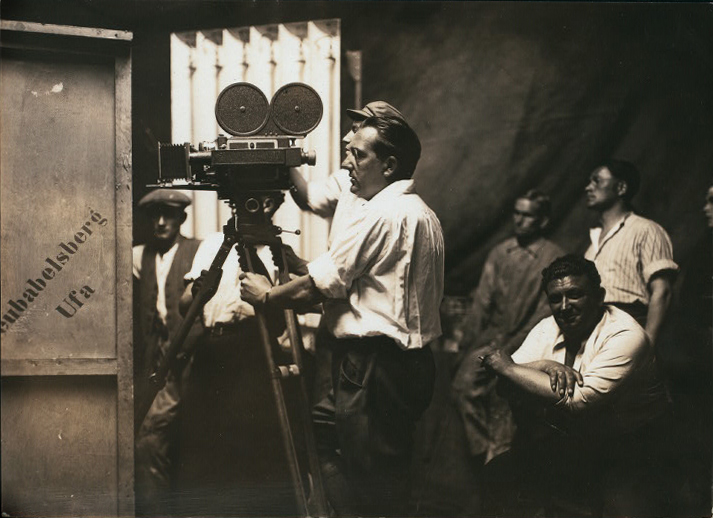
>I love images like this one.

click to enlarge

I found this image at the NYPL Digital Library. As far as I can tell, it’s just a snap shot, probably from the 1920’s, of a film crew on the set in the midst of their work. As with all film sets, there are some people working and some people standing around, but everyone wants to be there (I’m projecting my own experience and desires onto the image I admit).

This image had no information attached to it; no film name, no director name, no year, etc. However, it seems to me that the person standing closest to the camera (to us) is the director, and it looks like that person has a monocle. Plus, it’s an Ufa set. Could this be F. Lang? As it turns out, it is Lang, according to this site. But I still don’t know what film they are making. Any ideas?

Anyhow, I have this image set as my computer desktop background for now. Helps to keep me sane.

>thinking & making & thinking

>Some unformed thoughts on the relationship between film criticism and film making, followed by a shameless plug.

Here’s the theory:
I am convinced it is good that those who think & write about films & filmmaking (including video/tv production) should also have some hand in actually doing the “making”; not in the specific film beings critiqued, but in the general process of filmmaking. My thought is this: Filmmaking is a complex craft, often collaborative and impossible to grasp all at once. The end product of filmmaking, the film, is also complex and impossible to grasp all at once. One has to focus on parts and try to related them to wholes. By dealing with the filmmaking process one may become more sensitive to the multiplicity of signifiers (to throw in a little semiotics) up there on the screen.

The interplay between the making and what is made is a fascinating topic, but that is not my point here. I believe that to be a good critic it may be helpful, not necessary but helpful, to have been a part of the process of solving the kinds of problems faced by filmmakers. I say not “not necessary” because any film under scrutiny must be taken as it is regardless of its means of production or even the intention of the filmmaker. The critic must attend to the film before her/him. However, production brings one closer the fact that filmmaking is a very human endeavor.

Unfortunately, I am unable to provide an example here of any “better than typical” criticism by someone who has also done significant production. So maybe my idea is bunk.

But I have to say production (film or video) is a hoot.

Now for my own shameless plug:
Years ago I used to make my living with film and television production. I have always wanted to get back into it, but for various reason have not.

Recently, however, I had the privilege of “tagging along” on the crew of a recent video production – I handled script continuity and took a number of production photos. The video is called All Sales Final and it was part of the 2006 National Film Challenge – The Premise: Participating teams have just one weekend to write, shoot and edit a short film or video. To make things interesting, each team is given a genre for its film, and a character, prop and line of dialogue that must appear in each team’s movie.

The National Film Challenge: http://www.filmchallenge.com/index.htm

You can see my production photos here:
http://picasaweb.google.com/cineboy65/AllSalesFinalFilmChallenge2006

All Sales Final