Category: filmmaking
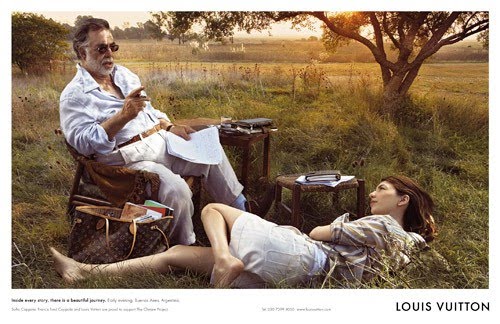
Two Coppolas…
…and one Letterman, 22 years apart.
Francis Ford Coppola promoting One from the Heart:
Sofia Coppola promoting Lost in Translation:
As a father of three kids, two daughters and a son, I am curious, maybe a little frightened by the realities of my influence, intended and unintended, upon them. I am fascinated by the relationship of Francis and Sofia Coppola. There is something really great there. I realize that their relationship is mostly unknown by me and everyone else. But the public image, and what we can infer, suggests that they have a good relationship, that Francis has been a good father, and that Sofia has been willing to be influenced and guided by her father while also forging her own, unique life.
Finally, I love this image:
Jean Renoir parle de son art
“…the arrival of perfect realism coincided with perfect decadence.”
“…whether man’s gift for beauty isn’t in spite of himself.”
“I don’t believe we create our lives. Our lives create us.”
Rusty dollies and floating cranes: Bergman on making films in Sweden
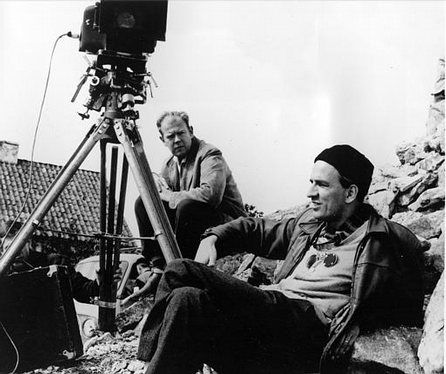
“During the shooting of The Virgin Spring, we were up in the northern province of Dalarna in May and it was early in the morning, about half past seven. The landscape there is rugged, and our company was working by a little lake in the forest. It was very cold, about 30 degrees, and from time to time a few snowflakes fell through the gray, rain-dimmed sky. The company was dressed in a strange variety of clothing—raincoats, oil slickers, Icelandic sweaters, leather jackets, old blankets, coachmen’s coats, medieval robes. Our men had laid some ninety feet of rusty, buckling rail over the difficult terrain, to dolly the camera on. We were all helping with the equipment—actors, electricians, make-up men, script girl, sound crew—mainly to keep warm. Suddenly someone shouted and pointed toward the sky. Then we saw a crane floating high above the fir trees, and then another, and then several cranes, floating majestically in a circle above us. We all dropped what we were doing and ran to the top of a nearby hill to see the cranes better. We stood there for a long time, until they turned westward and disappeared over the forest. And suddenly I thought: this is what it means to make a movie in Sweden. This is what can happen, this is how we work together with our old equipment and little money, and this is how we can suddenly drop everything for the love of four cranes floating above the tree tops.”
– From the introduction to Four Screenplays of Ingmar Bergman, 1960, Simon and Schuster
“This is the enemy” — Godard on the disgusting culture of…
Jean-Luc Godard in 1988 at a press conference in Cannes after the first screening of the first two episodes of his very personal documentary, Histoire(s) du Cinema.
This video clip from Godard, which is not altogether clear, but which nonetheless resonates for me, reminded me of Neil Postman’s 1985 book Amusing Ourselves to Death in which he states:
[W]hat I am claiming here is not that television is entertaining but that it has made entertainment itself the natural format for the representation of all experience. Our television set keeps us in constant communion with the world, but it does so with a face whose smiling countenance is unalterable. The problem is not that television presents us with entertaining subject matter but that all subject matter is presented as entertaining, which is another issue altogether.
To say it still another way: Entertainment is the supra-ideology of all discourse on television. No matter what is depicted or from what point of view, the overarching presumption is that it is there for our amusement and pleasure. That is why even on news shows which provide us daily fragments of tragedy and barbarism, we are urged by the newscasters to “join them tomorrow. What for? One would think that several minutes of murder and mayhem would suffice as material for a month of sleepless nights. We accept the newscaster’ invitation because we know that the “news” is not to be taken seriously, that it is all in fun, so to say. Everything about a news show tells us this—the good looks and amiability of the cast, their pleasant banter, the exciting music that opens and closes the show, the vivid footage, the attractive commercials—all these and more suggest that what we have just seen is no cause for weeping. (p 87)
>Two JLG interviews from 1980
>I used to be so non-plussed whenever I heard Godard speak. Now he makes more sense to me. In fact, he’s one of the few voices that seem to cut through much of the blather so typically understood as “talking about film.”
I like Dick Cavett, but I find his questions here to be only okay. Still, it is interesting to hear Godard talk about his work, etc.
This video is a bit more pedagogical and Godard is a bit more commanding. Still, it is quite interesting. Godard typically makes statements that are clearly designed to be slightly shocking, and he does that here, but I find his statements to ring truer now than I once did. Not sure why.
R. Bresson interrogation
This interview with Robert Bresson is both fascinating and disconcerting. It it set up (mise-en-scène) and conducted more like an interrogation than an interview. I love to hear Bresson talk about his work. I am also annoyed by some of the questions, or at least the way they are delivered. I feel as though I want to jump in as a friend and say to Bresson, “Come, forget about them. Let’s go get a drink.”
I imagine the producers of this show thought it would be more interesting if they umped on the “Pickpocket” theme and did the interview as though Bresson was being questioned by the police. What we get, though, is a couple of nobodies (let me know if you know otherwise) coldly demanding answers from a kind and thoughtful Bresson. I like the answers given by Bresson, but he could have been asked better questions.
>A conversation with Fritz Lang
>William Friedkin interviewed Fritz Lang in 1975 (according to the closing credits of the video below*). Lang died in 1976. This is a wide ranging, reminiscing kind of interview. Lang was an interesting guy. Sometimes I think the last person one should talk to regarding works of art is the artist; as Lang himself says in the end of the interview a film should speak for itself. On the other hand, as I encounter works of art that I love I can’t help but wonder at who the artist is or was, not merely as an artist, but as a person. I am interested in the artist’s character. I believe character is far more important than any specific ways of thinking artistically, though I also believe they are linked. I am curious what this interview says/shows of Lang’s character. Do we think about character all that much these days?
The opening titles misspell Friedkin’s name, but oh well.
* Maybe the interview was in 1974, like the Vimeo title says. “VOSTFR” stands for “Version Originale – Sous-Titre Français,” which is French for “Original Version – French Sub Titles.”
>The ultimate family vacation super-8 movie
>Disneyland Dream (1956)
http://www.archive.org/flow/flowplayer.commercial-3.2.1.swf
In July 1956, the five-member Barstow family of Wethersfield, Connecticut, won a free trip to newly-opened Disneyland in Anaheim, California, in a nationwide contest. This 30-minute amateur documentary film tells the fabulous story of their fun-filled, dream-come-true, family travel adventure, filmed on the scene at Walt Disney’s “Magic Kingdom” by Robbins Barstow.
In December 2008, “Disneyland Dream” was named to the National Film Registry by the Librarian of Congress.
Note: The first uncredited screen appearance by Steve Martin occurs in the film at around the 20:20 mark – very brief, in the lower right corner. He is the 11 year old in pink shirt, black vest and top hat, hawking guidebooks.
Found at the Internet Archive.
Robbins Barstow, the creator of (and the dad in) the film died in November of this year. His obit is here.
>Tuesday 3:00 PM Jean-Luc Godard…
>
From 1968 to 1973, [Jean-Luc Godard] stated repeatedly that he was working collectively. He was never tied to a party or a Maoist group, although the politics evidenced in his films seem loosely “Maoist.” For about three years he drastically reduced the technical complexity and expense of his filming, lab work, compositions, and sound mix. Partly he wanted to demonstrate that anyone could and should make films. He did not concern himself with creating a parallel distribution circuit. He said most political films were badly made, so the contemporary political filmmakers had a twofold task. They had to find new connections, new relations between sound and image. And they should use film as a blackboard on which to write analyses of socio-economic situations. Godard rejected films, especially political ones, based on feeling. People, he said, had to be led to analyze their place in history.
~ Julia Lesage in Godard and Gorin’s left politics, 1967-1972*
1968: Godard films some events…

(Photo by Serge Hambourg, Hood Museum of Art)
1972: Jean-Luc speaks on intellectuals making films for the oppressed…
Are not these questions still relevant today? Possibly today there are more alternative voices being committed to various media because the means of production (e.g. ultra-lightweight HD cameras and laptop editing) and the means of distribution (e.g. the Internet) make it possible to do so. However, the questions facing media producers have not significantly changed. As Godard states, making a film “in the name of…” comes with a host of issues that, though intentions are good, may sabotage from within and without the film and its message. In the U.S. we are less likely to call filmmakers “intellectuals.” Certainly, U.S. filmmakers may not be intellectuals to the same degree (or as obviously so) as those in France once were. On the other hand, anyone who actively seeks to understand the world beyond the given and controlled ideological constructs we all inherit should be called an intellectual. Many social documentary filmmakers, it could be argued, fall into that category.
There is a trap, however, for contemporary would-be revolutionaries (filmmakers or otherwise) to borrow from the past what should be left in the past. The struggles of the 1960s (the period from 1956 to 1974) are inspiring and worth studying, but today’s struggles must be dealt with directly and not through a process of memory and hagiography. Today’s issues require their own terms. On the other hand, it is worth noting that (probably) all revolutions/reformations start from a re-examination and re-interpretation of the past – in particular the primary documents of the past.
In 1972 Godard had just completed Tout va bien. The interview above was made in relation to the film. Here is the “supermarket scene” from the film:
On a side note, doesn’t Godard (in the interview clip above) look like a slightly crazed hipster? I mean it’s apparent he just had a double cappuccino before the interview and afterward will ride away on his fixed gear. Also, is that a red bathrobe he is wearing? Marxist morning dress? Leftist lounge wear?
*From Jump Cut, no. 28, April 1983, pp. 51-58 copyright Jump Cut: A Review of Contemporary Media, 1983, 200. This is a great article on Godard’s movement from his Nouvelle Vague and more popular period of 1960-1968 to his more overtly political and less popular (but maybe more interesting) period of 1968-1973. Note: Julia Lesage was my thesis committee chair for my MA.
*From Jump Cut, no. 28, April 1983, pp. 51-58 copyright Jump Cut: A Review of Contemporary Media, 1983, 200. This is a great article on Godard’s movement from his Nouvelle Vague and more popular period of 1960-1968 to his more overtly political and less popular (but maybe more interesting) period of 1968-1973. Note: Julia Lesage was my thesis committee chair for my MA.
 pilgrimakimbo