This is a human powered vehicle – in other words one pedals to make it go. The chassis is aluminum. The first one was designed and handbuilt in the 1980s. Since then several models have been developed, including one with a carbon fiber chassis. They are built in Europe, but kits can be ordered to build one yourself. Unfortunately, they are far too expensive for my budget, but I can dream can’t I?
>I just wrote a post on bicycle speed records and the really cool human powered streamliners. That got me remembering to my childhood and one of the most amazing accomplishments that got my attention – human powered flight and specifically the Gossamer Condor. I want a plane like that.
That was in 1977. It’s amazing how far we’ve come in technology in general since those days, yet the Gossamer Condor still look state-of-the-art.
>I remember when John Howard broke the land speed record for a bicycle in 1985. I thought that was the coolest thing ever at the time. He did it by having a modified car tow him up to a minimum speed so his high gearing could begin to work and having the car block the wind for him while he pedaled in the still air just behind the car. He reached an amazing 152.2 MPH. That record was broken later by another cyclist using the same basic technique.
But what if no fossil fuels were present? What if one had to start from zero without being pulled up to a ‘starting speed,’ and then continue pushing through the wind yourself? That is the real test for bicycle and human powered vehicle speed records.
82.3 MPH on a bicycle:
Trying to break the record:
I have to say I would LOVE to ride in one of these bikes. Years ago I once rode a recumbent. It was a lot of fun, but a little strange too. Nowadays I see lots of recumbents and human powered vehicles. But it would be so cool to pedal a streamliner bicycle, even if there’s not much practical application beyond mere speed.
>I am curious and concerned about the popular reaction in the U.S. to the economic crisis. The reaction seems to be a combination of moral outrage and complete acquiescence to the “current financial situation,” or whatever we’re calling it. The American people (including myself) are complaining a lot and doing little.
Publicly protesting is not a complete solution by a long shot, but it can be an important element in changing our society for the better. In numerous places around the world over the past several months there have been protest and strikes in response to the global economic meltdown and various governments’ actions. Here are some:
Protests in Eastern & Central Europe
Protests in France
Protests in Greece
So where are the protests in the U.S.? This is the country most responsible for the problem. This is the country doling out the largest dose of corporate welfare (in an already corporate welfare state) in world history to those companies most culpable. This is the country in which those government leaders and those captains of Wall Street who created the policies that made the collapse as easy as possible, are the same one’s now hired to fix the problem. There is a lot of outrage for sure, and many ordinary Americans have played their part in the mess as well, but it seems everyone is just sitting by hoping things will get better.
It appears to me the fundamental issues underlying the problem are moral and systemic. Both of which should send people into the streets. But, so far, not in this country. Any thoughts?
When we had better cable TV I used to love watching those Biblical histories, those “other” gospels stories, and the various histories of Christianity shows on the History & Discovery channels. A frequent guest interviewee on almost all these programs is John Dominic Crossan, one of the founders of The Jesus Seminar, and an interesting cat. I don’t know much about The Jesus Seminar, and I have nothing new to say about it, but the more I look at it the more fascinated I become. However, the more I look at it the more I also think it represents an entirely wrong way of reading the Bible, or really any work of literature, fiction or non-fiction. This is not to dispute the level of intense scholarship that some of its members achieve, nor the brilliance of individuals such as Crossan. Nor do I wish to dismiss the fundamental questions that it tries to answer.
John Dominic Crossan
One thing I find interesting and troubling is that the members of the Jesus Seminar vote on the authenticity of various saying and passages from the Bible. Voting isn’t a bad thing, and it can be a very good way of seeing which way the wind is blowing, as it were. But voting is neither proof nor argument, and thus it can muddy waters already in need of clarity. Voting is also a good way to have one’s say while hiding within a group. Of course Crossan does not hide his thoughts. And to that point I have to say that upon hearing Crossan talk about Jesus I don’t think he fully gets him. Crossan likes to point out that Jesus came to show us a different way to peace, the way of non-violence. Certainly Jesus taught non-violence, but that was a secondary purpose. He was an example for certain, but he was first a priest, and a sacrifice, and an advocate, and a king. He fulfilled a functional role in the story of this world, a role all about our relationship to God first, and then our relationship to each other.
I am not a defender of traditional orthodoxy per se. This is not say that I don’t believe in truth or in the veracity of the Bible, but I do know that there are a lot of “untouchable” doctrines that should be re-examined, even if only to more fully establish their validity. Christianity is a history of doctrines, among other things, and history has a way of entrenching ideas such that they have the appearance of immovability. There is a tendency among all of us to see what we want to see, which includes what we expect to see. With that in mind I welcome challenges to orthodoxy as catalysts toward truth. But it seems to me that voting on the authenticity of Bible passages is a sure way to see what one wants to see and expects to see. It’s a good way to see what it is a group of people generally want to believe. It is not necessarily the truth, or any closer to the truth. And it is not an argument for the truth.
Here are some examples of how the votes have played out regarding some of the most famous sayings of Jesus:
And sometimes I discover that I am not late, in fact I’m very early, I just didn’t realize it was going to be a party. So has it been with me and emerging Christianity.
As I continue to dive deeper into what the emerging/emergent church is all about I am finding that there are a lot of voices opposed to much or all of the whole shebang. This is old news. These voices have been around for a long time, even decades before the term “emerging” was applied to Christianity. YouTube is full of them. Some rant, some blather, some are articulate, and some of these voices come from individuals I respect. I must consider those voices I respect. These voices include R. C. Sproul and Ravi Zacharias – who represent for me a kid of “old guard” of apologists – and Mark Driscoll, who represents a younger generation of reformed preachers. All of these men I have heard and/or read their teaching and greatly appreciate what they do and their contributions to the Church and the furtherance of the Gospel.
But I am not entirely convinced by these guys. I am interested in your thoughts as well.
Here are a couple of clips about the emerging/emergent movement from those concerned voices. This first clip is of Mark Driscoll explaining how he understands this thing called emerging/emergent, and what he sees as deeply troubling problems:
Driscoll was part of the emerging/emergent conversation a decade ago, but he split away largely over doctrinal differences. I am not entirely in his camp. I love that he is a champion for truth, but some of his doctrinal positions are ones that I have wrestled with for more than 20 years and my beliefs have subtly changed over the years and are still in flux. I do know, however, that Driscoll does his homework and is worth listening to.
This second clip is of a conversation with R. C. Sproul, Ravi Zacharias, plus Vance Havner and Al Mohle (both of whom I have not heard before):
These guys are heavy hitters in the world of Christian apologetics and evangelism. I appreciate their perspectives on the topic at hand. I have some of the same concerns as they do, but I am also concerned they may be confusing their entrenchment in reformed theology and a modernist Christianity with defending the truth of the Bible. I don’t say this lightly. Such entrenchment is one of my personal concerns and something I have been working through for a long time – and I’m still in process.
Side note: I cannot help but see four old guys in suits and ties. There is nothing wrong with that of course, but it doesn’t help quell my thoughts that these guys are from a different generation, a different era, and a different world. None of that means they don’t know what is true, but I have concerns that the Christianity they preach is a mix of Truth and the culture in which their understanding was formed.
As I said, I feel the need to take all these guys seriously and consider what they say. The fact is, I already have been taking these topics seriously for a quite a while. I am someone who became a Christian at an early age and then within several years became intellectually interested in theology, history, philosophy, the pursuit of Truth, the nature of ministry and evangelism, and in what it means to work out one’s salvation with fear and trembling. I would pinpoint my first rumblings of emerging to circa 1986. soon after I joined a community that has many “emerging” characteristics – though we’ve never used that term.
I know the guys in the clips above do their homework for sure, they love God, and they pursue Truth, but I am not convinced they have Truth cornered.One of my biggest concerns with what these guys are saying is the way they brush off postmodernism as merely another form of liberalism and truth evasion. I have begun to dive into postmodernism again, after having done so years ago in grad school. This time I am finding much more. Postmodernism, we know, is not a school of thought, rather it is a recognition that we are in an age that is beyond modernism, which opens up lots of possibilities and re-evaluations of much of what has been considered the sacred cows of Christianity (I love that expression – I just made it up).
What I am trying to do is actually look to the sources – the Bible first of course, and then some of the writers who either claim or are tagged with being emerging/emergent or postmodern. My desire in the midst of this process is a combination of open-mindedness and discernment.
>I mentioned in an earlier post that I’m looking into the phenomena of the emerging church, and its related emergent aspects. Recently, however, there is a slight trending away from those terms. Dan Kimball at Vintage Faith writes about his recent thoughts on how the terms have changed over the years and what that means for him. He cites three other articles/blog posts that also deal with the continued relevance of “emerging/emergent.”
Of course, the realities that underly these terms are still there, though they have been changing, and will continue to do so. Maybe “emerging” and “emergent” will wane in their cultural currency, but we are still living in a post-modern (and possibly post-Christendom) world in which the need to re-examine what it means to be a Christian is critically relevant. One thing to consider, as well, is the relative newness of those terms to much of Christianity. That alone will keep the terms alive for a while, even if their progenitors have moved elsewhere.
As for me, my study has just begun. In fact, I feel like I am doing a lot of catching up. On the other hand, it occurred to me the other day that I began my own “emerging” process back around 1986 when I began to have serious issues with my church’s philosophy of ministry and approach to both culture and theology/doctrine. And really my searching began back in the 1970s as I read authors like C. S. Lewis and Francis Schaeffer in my adolescent grasping for something more than what I was getting at church. A lot of water has gone under the bridge (a story I might relate here sometime), and I’m still sorting it out.
>I am beginning a study of something called the “emergent church.” I grew up in a Christian tradition and, in some ways, I still claim that pedigree. This emergent thing, however, is something different than what I’m used to. It’s not exactly new, but it’s newish. It also has various aspects, some of which look very appealing to me, and others look potentially troubling. I am hoping to sort it out for myself. I may post some of my thoughts and conclusions here at PilgrimAkimbo from time to time.
Here are a couple of videos that try to get at what underlies the emergent church.
The reason people find it so hard to be happy is that they always see the past better than it was, the present worse than it is, and the future less resolved than it will be.
~ Marcel Pagnol
This post is about dreaming…
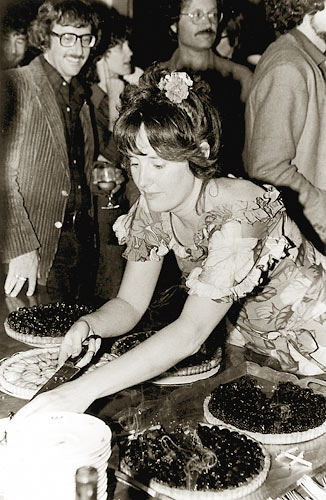
Alice Water in early 1970s.
Image by Charles Shere.
If you are a food lover then you’ve heard of Alice Waters. What I had never heard was the story behind the name of her famous restaurant, Chez Panisse. In the forward to the English translation of Marcel Pagnol‘s My Father’s Glory and My Mother’s Castle, Waters writes the following words:
Fifteen years ago, when I was making plans to open a café and restaurant in Berkeley, my friend Tom Luddy took me to see a Marcel Pagnol retrospective at the old Surf Theater in San Francisco. We went every night and saw about half the movies Pagnol made during his long career: The Baker’s Wife and Harvest, taken from novels by Jean Giono, and Pagnol’s own Marseille trilogy—Marius, Fanny, and César. Every one of these movies about life in the south of France fifty years ago radiated wit, love for people, and respect for the earth. Every movie made me cry.
Vahala a.k.a. Chez Panisse Image by Aya Brackett
She goes on:
My partners and I decided to name our new restaurant after the widower Panisse, a compassionate, placid, and slightly ridiculous marine outfitter in the Marseille trilogy, so as to evoke the sunny good feelings of another world that contained so much that was incomplete or missing in our own—the simple wholesome good food of Provence, the atmosphere of tolerant camaraderie and great lifelong friendships, and a respect for both the old folks and their pleasures and for the young and their passions. Four years later, when our partnership incorporated itself, we immodestly took the name Pagnol et Cie., Inc., to reaffirm our desire of recreating an ideal reality where life and work were inseparable and the daily pace left you time for the afternoon anisette or the restorative game of pétanque, and where eating together nourished the spirit as well and the body—since the food was raised, harvested, hunted, fished, and gathered by people sustaining and sustained by each other and by the earth itself.
This little passage was a revelation for me. I am a fan of Waters and her vision. I love the slow food movement and community supported agriculture (though I need to put by enthusiasms more into practice). I had no idea of her love for Pagnol’s films or how Chez Panisse got its name. Maybe I am the last to know.
A video look at Chez Panisse.
I was searching the library catalog for the films My Father’s Glory and My Mother’s Castle, but the library only had the book, so I checked it out. Originally published in 1960 (in French of course) the Alice Waters’ foreword is from a 1986 edition.
Alice Waters today.
Image by David Sifry.
Two of my favorites things in this world – the kinds of things that makes me say “there is a god” – are great films and great food. I was so pleased to read those words from Alice Waters. Here is someone who is famous for her restaurant, her cook books, her simple, earthy philosophy – all of which I admire – and yet she displays a deeply felt response to cinema. And then she creates a permanent connection between the two great arts. That is the kind of human action of which we need more.
Marcel Pagnol looking suave.
I am now in the hunt for the Marseilles Trilogy (a.k.a. The Fanny Trilogy). I see that is is available on DVD. Since my local library doesn’t have it this might be the final straw that gets me to sign up for Netflix (you’re wondering why I haven’t already). I know very little of Pagnol’s work, but I have a feeling I will love it. I would hazard a guess that he was an interesting individual and a great filmmaker.
The day would turn enchanting when Marcel arrived, unheralded, in the middle of our boring summer holidays in La Treille. From then on, our day was filled with unusual commotion as my brother would immediately stage some activity: long hikes in the hills, picnics, highbrow conversations way off our usual chattering.
~ René Pagnol, Marcel Pagnol’s brother
One day, I saw La femme du boulanger (“The Baker’s Wife”)… It was a shock. This movie is as powerful as a film by Capra, John Ford and Truffaut altogether. Pagnol must have been an outstanding man.
~ Steven Spielberg
Here is a three part homage to Pagnol and the world he inhabited, wrote about, and filmed:
I began this post by saying it was about dreaming. I dream of visiting southern France (where I’ve never been), of making films and writing books (which I’ve only done on the smallest scale), of cooking gourmet meals (which I’ve done many times, but there’s always more), and of eating at Chez Panisse (which I’ve also yet to do). These dreams, and others, keep me alive.





 pilgrimakimbo