>Bluegrass time capsule

>This is a clip from a film on American bluegrass culture – its music, its dance, and the people who created it. I love being able to find gems like this.

Here is the blurb about this piece:

Way back in 1964, New York filmmaker, David Hoffman was headed down with his new 16mm hand help camera (weight 49 lbs!) to spend three weeks driving the backcountry around Madison County, North Carolina, in the center of Appalachia, with the 82 year old founder of the pioneer Asheville Mountain Music and Dance Festival, Bascom Lamar Lunsford. The resulting film, “Bluegrass Roots” lets you hear and experience the hard scrabbling, dirt road real people sounds that dominated the back country of the southern mountains 40 years ago. It presents a string of the most extraordinary singers, players and dancers the BlueGrass Mountains had to offer. Many later became famous. Some were never heard from again. Most of the songs are classics, including Lunsford’s own tune, “Mountain Dew.” This scene was filmed at Bascom’s home with a local dance group came to dance in Bascom’s living room.

When this film aired on Public Television in 1965, TV Guide gave it a full-page positive review, because Americans had never seen a documentary on the roots of Bluegrass and Country music. Today, the dirt roads and the moonshine counties are largely modernized, and Bluegrass Roots, stands as a record of a uniquely talented group of people at a time just before the coming of television, changed them.

More can be found at the film’s official web site.

>John Zerzan: On Modernity & the Technosphere*

>John Zerzan lives in Eugene, Oregon. He is an author, speaker, and the host of AnarchyRadio. I have only recent discovered Zerzan, but I like a lot of where he is coming from.

Here is a lecture from Binghamton University on April 2, 2008.

* Grabbed from Essential Dissent. Discovered by way of Jesus Radicals.

>How to report the news

>I used to teach television production to college students, and later directed live newscasts for a local station. I find this piece brilliant, but then, it doesn’t take a once-upon-a-time professional to know what’s really going on…

Perfect.

>Terry Eagleton – brilliant!

>If you have spent any time in post-baccalaureate English/cultural/media-studies environs then you know of the brilliant Terry Eagleton – that noted literary critic and author of the beloved grad-school crutch, Literary Theory: An Introduction (1983). Recently Mr. Eagleton gave four lectures at Yale University. For most Americans these lectures will both fascinating and seemingly impenetrable. We are not so used to the higher levels of British academia. But they are worth taking the time, and ultimately thoroughly enjoyable – not least of which because Eagleton has a wry sense of humor.

These lectures are probably most famous for the term “Ditchkins.”

“…someone like Richard Dawkins or Christopher Hitchens, a couplet I will henceforth reduce to the solitary signifier Ditchkins…”

Of course there is much more than that in the lectures. Below are video versions, but they are also available through iTunes.

>opera, more opera, and choices worth making

>

If you are like me then your knowledge of opera is largely limited to a few Looney Tunes cartoons (Long-Haired Hare & Rabbit of Seville). I think that’s a bad thing, though I love those cartoons. Recently we got a CD of songs from various operas, sung in English, and geared towards kids – though adults will enjoy them as well. We have been listening to these songs in the car and the girls love them. Our two year old shouts out after each song, “again!”

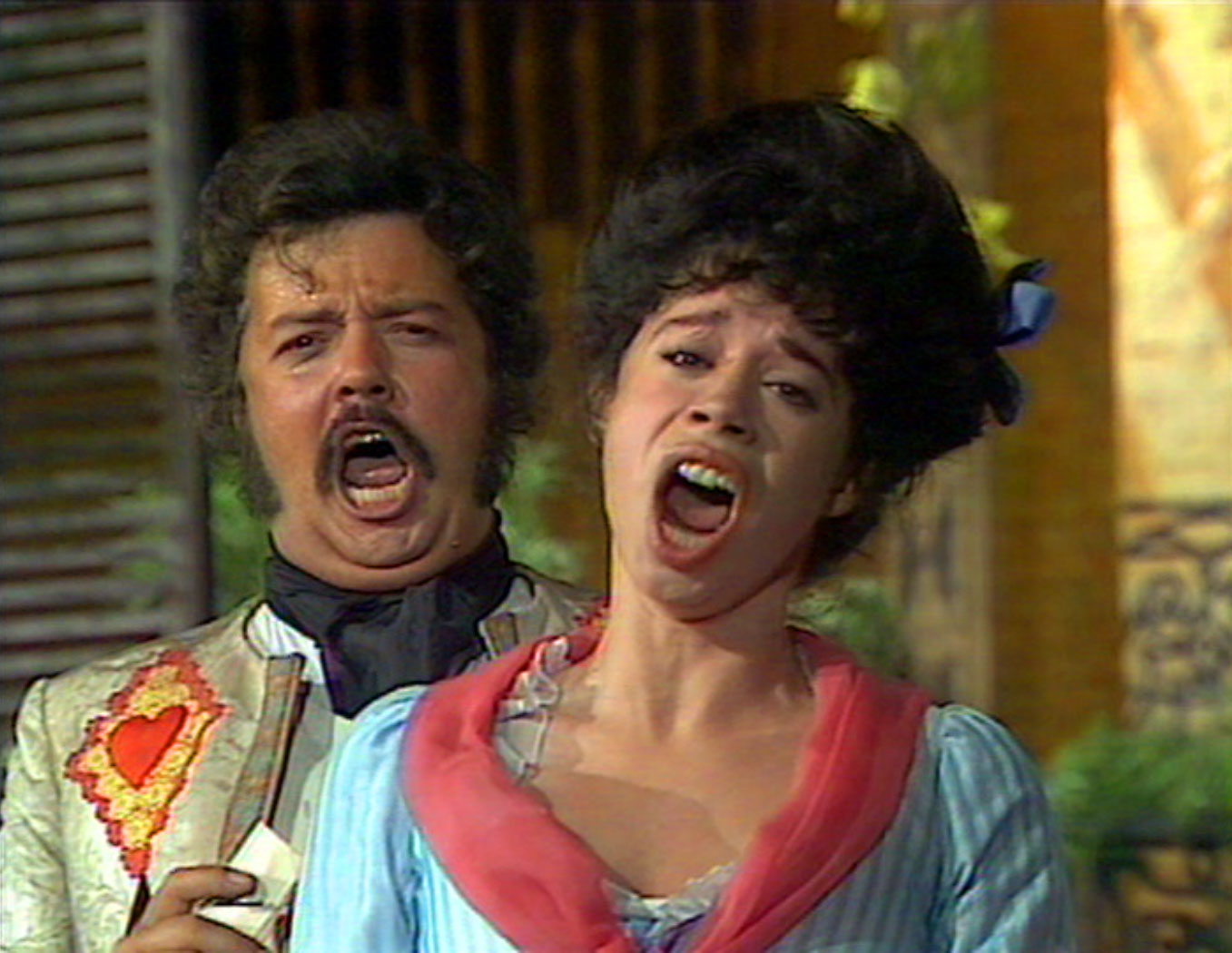
With this in mind I have checked out some operas on DVD from the library and we just finished The Barber of Seville. We loved it. This is the 1982 version made for television and starring John Rawnsley as Figaro and Maria Ewing as Rosina.


Figaro will help Rosina

I was not sure how the kids would take to watching an Italian opera, first performed almost two hundred years ago, now made for 1982 television, with English subtitles, and more than 2.5 hours long. To my surprise and joy they were enraptured. Even our two year old would sit and watch it (sometimes transfixed), then clap at the end of each song. My eight year old watched intently and did not want to spread the viewing over three nights – which we did due to bedtimes.

What a great show. There is no need for me to go into the plot, or say how good the music is, or describe the performances. All that is well known and I am not yet knowledgeable enough to say much, except to say I think it is all really, really good. I can also say that I loved it and so did my family.


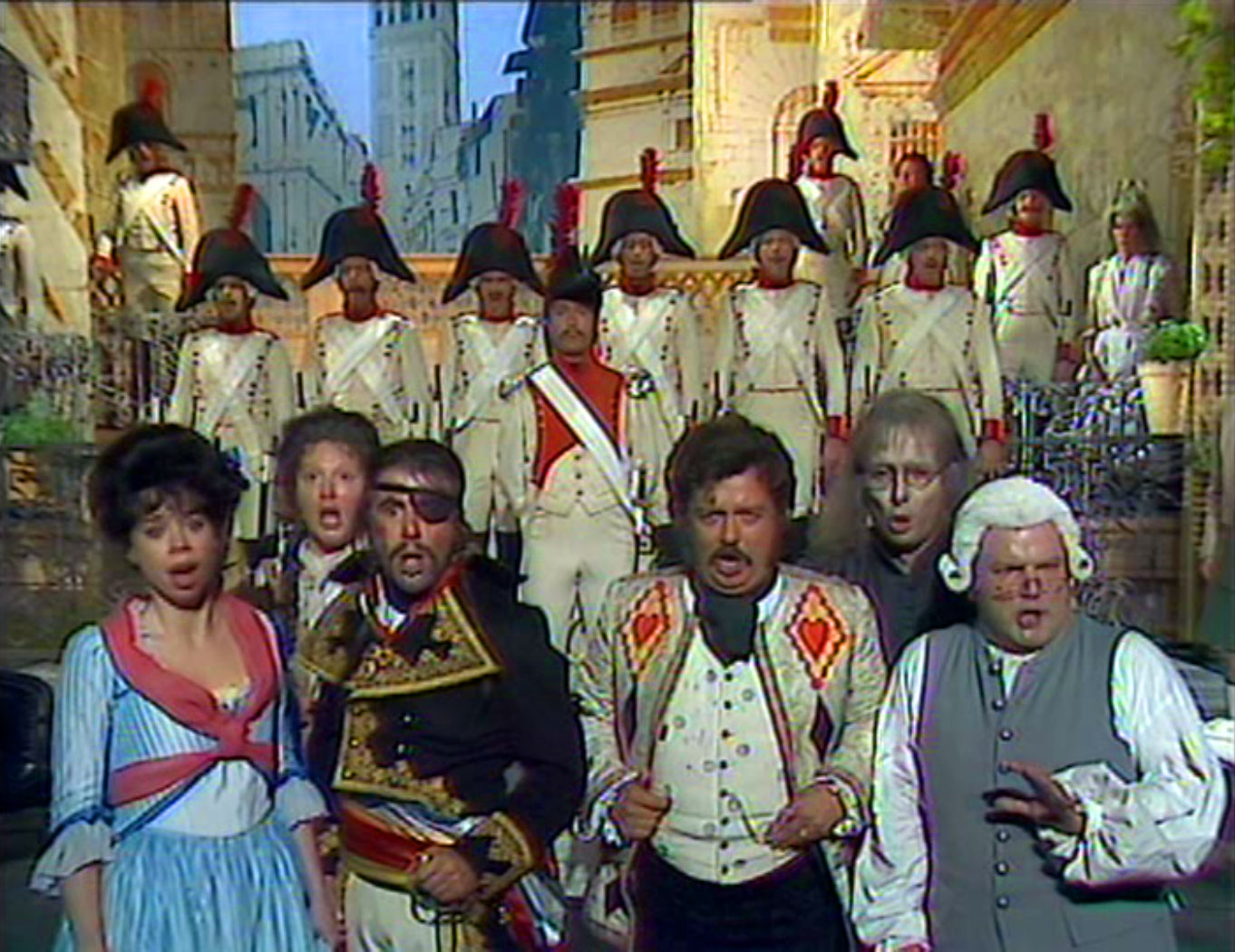
Everybody sings: Mi par d’esser con la testa
in un’orrida fucina
“My head seems to be
in a fiery smithy”

I can’t think of anything like opera. I am beginning to see why some people become smitten with opera. I think I could go down that path as well. But it was not always the case. Like most Americans I grew up absorbing our typical dislike of opera. It’s not that we Americans hate opera, though some do. It’s more that we (I mean most Americans of course) think it is funny and corny, something to make fun of and lambaste. It’s good for cartoons and occasionally setting the mood in a film, but not for putting on the car stereo or playing on the radio by the pool, or taking the time to go and see a performance. But for me that is changing.


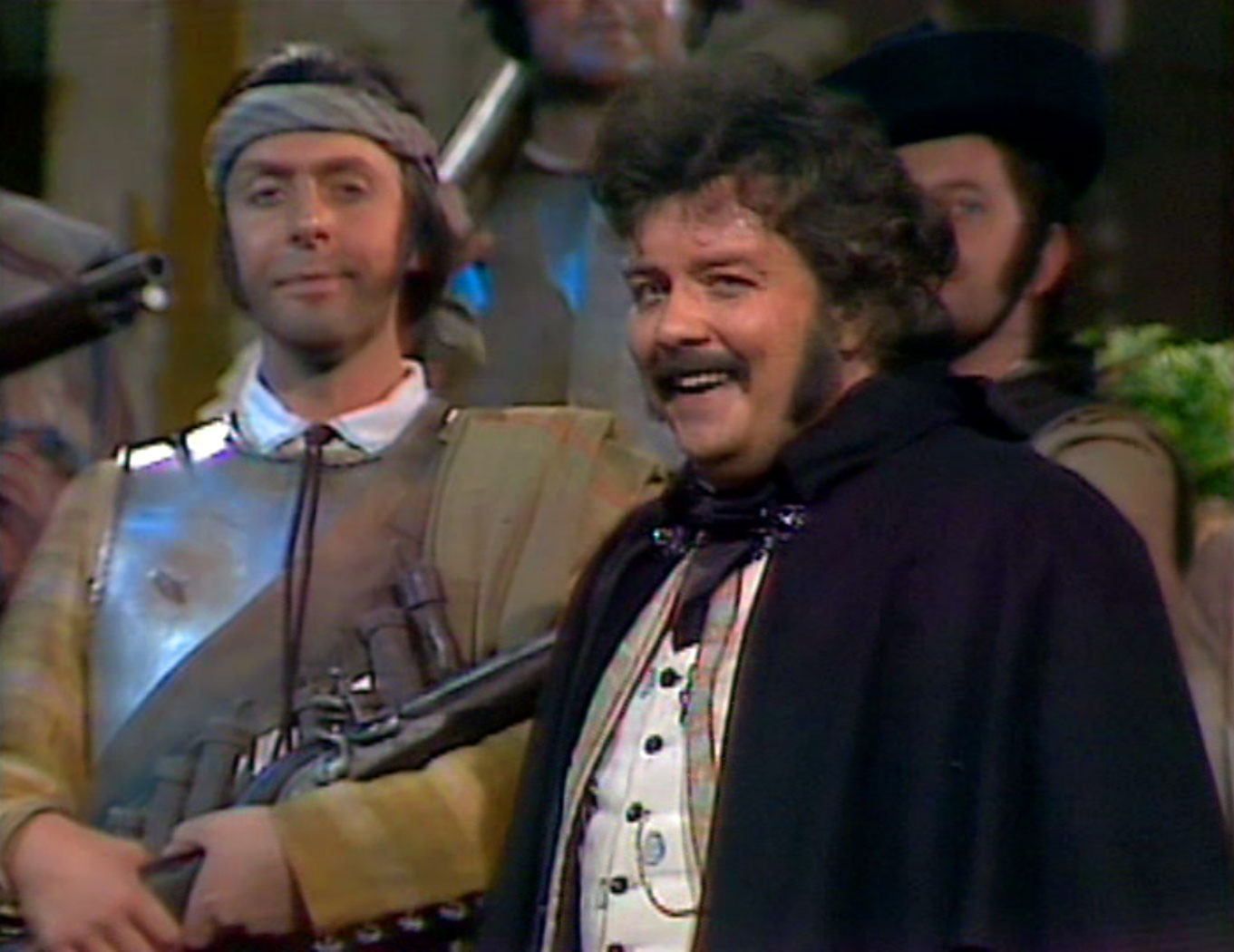
Figaro has triumphed

The triumph of Figaro is my triumph too. By the end of The Barber of Seville I was thinking that more opera is in my future – and my kid’s future.

Years ago I saw a stage production of Bizet’s Carmen, which I loved. I don’t know why or how I got to the the theater. I only remember the music and the sets, which were wonderful. I had the same experience with Puccini’s La bohème. Why I did not see more opera’s I do not know. More recently I posted briefly on watching Das Rheingold on DVD. We still haven’t made it through that one. I realize now I need to see more opera’s more often.

Finally a note on parenting and some choices worth making. My desire is that my kids grow up loving good art, whatever the form or genre. I hope they love opera. At least they will have had some introduction to it. But whether they love opera or not is not really my concern. I am often taken aback by how many parents limit their kids knowledge and appreciation of art merely because those parents have limited themselves. Parents should continue to expand their own horizons, even get out of their comfort zone, not merely for their own pleasure and personal growth, but also because it will expand their children’s horizons as well. Kids are very attuned to what their parents are doing. So often when we don’t choose the choice is made for us. There are plenty of mediocre cultural products lying around for easy consumption. If we don’t make good choices about the art in our lives then our culture will supply us with mediocrity. That is, unfortunately, the default setting. As a parent I want my kids to know that there are great choices out there and that those choices are worth making – whether it’s about opera or anything else.

>Jesus, the event within

>

Would Jesus endorse Christianity as we know it? Would he say, “Yeah, that’s it. You got it.”? Or would he surprise us all by not fitting into our concepts of who he is? I think we all know the answer.

Since the beginning of Christianity there has been the need for reform of one kind or another of the church. The letters of Paul attest to that. Some would argue, and I would generally agree, that refocusing on Jesus as the foundation of Christianity (are not Christians followers of the Christ?) is the most direct and most powerful catalyst for change and reform. This concept interests me a great deal. I am fascinated by the idea of setting aside much of what we Christians cling to and then turning only to Jesus and, with him as our sole example, examine our lives, actions, and worship. With this in mind I give you two quotes to ponder:

A great deal would have been achieved if it were remembered today also that Christianity is obviously not some sort of world view nor a kind of idealist philosophy, but has something to do with a person called Christ. But memories can be painful, as many politicians have discovered when they wanted to revise a party program. In fact, memories can even be dangerous. Modern social criticism has again drawn our attention to this fact: not only because generations of the dead control us, have their part in determining every situation in which we are placed and to this extent man is predefined by history, but also because recollection of the past brings to the surface what is still unsettled and unfulfilled, because every society whose structures have grown rigid rightly fear the “subversive” contents of memory.

Hans Küng, On Being a Christian, 1974, p. 120

In deconstruction, one sets out in search of, or rather, one is oneself searched out or called on by whatever is unconditional, or undeconstructible, in a given order, and it is precisely in virtue of this undeconstructible x, which does not exist, which does does not exist yet, which never quite exists, that everything that does exist in that order is deconstructible. Whatever exists, whatever is present, is contingent, historical, constructed under determinate conditions—like the church or the Sabbath—and as such is inwardly disturbed by the undeconstructible, unconditional impulse that stirs within it—which for the church is the event that occurs in the name of Jesus. To “deconstruct” is on the one hand to analyze and criticize but also, on the other hand, and more importantly, to feel about for what is living and stirring within a thing, that is, feeling for the event that stirs within the deconstructible structure in order to release it, to set it free, to give it a new life, a new being, a future.

John D. Caputo, What Would Jesus Deconstruct?, 2007 p. 68


Rembrandt van Rijn, Holy Family, 1640
Oil on wood, 16 1/4 x 13 1/2″ (41 x 34 cm)
Musée du Louvre, Paris

I like Küng’s concept of the ‘”subversive” contents of memory.’ That there is something subversive in the very person and teachings of Jesus is a powerful idea. What would the church (I recognize that’s an unwieldy and overly broad term) do with Jesus today? In my more cynical moments I am inclined to believe he would be crucified again and again. Though the name of Jesus is prominent in Christian churches I doubt that name represents the true Jesus as much as one might assume. My fear is that I would be part of the mob that called for his death. My desire is that I would know the truth instead, that my life would be conformed to Jesus’ example and, if faced with the physical (living, breathing, walking, talking) Jesus, there would resonate deep within my soul an unqualified and unchangeable “YES!”

Of course, in a profound way we do have Jesus among us. Remember the words of Jesus, like in the following famous passage from Jesus speaking to his disciples:

“Then the King will say to those on His right, ‘Come, you who are blessed of My Father, inherit the kingdom prepared for you from the foundation of the world. For I was hungry, and you gave Me something to eat; I was thirsty, and you gave Me something to drink; I was a stranger, and you invited Me in; naked, and you clothed Me; I was sick, and you visited Me; I was in prison, and you came to Me.'”

“Then the righteous will answer Him, ‘Lord, when did we see You hungry, and feed You, or thirsty, and give You something to drink? And when did we see You a stranger, and invite You in, or naked, and clothe You? When did we see You sick, or in prison, and come to You?'”

“The King will answer and say to them, ‘Truly I say to you, to the extent that you did it to one of these brothers of Mine, even the least of them, you did it to Me.'”

To me this is kind of sneaky, in a good way. We can easily be knocked off kilter and sent spinning if we think we have Jesus pegged. What I find interesting is that the above passage always surprises me even though I have been familiar with it for decades.

How is it that Jesus is a subversive force within the church? In films like Lord, Save Us From Your Followers: Why is the Gospel of Love Dividing America?, and books like They Like Jesus but Not the Church: Insights from Emerging Generations we find that most people have a fondness for Jesus, though many express a dislike for Christians or Christianity or organized religion in general (most especially if it’s Christian). This makes sense to me, but I know there is a difference between a “Jesus is my homeboy” approach and a “Jesus is my lord” approach. I understand the dichotomy, but I also know that those outside the church will just as likely have wrong ideas about Jesus as those within.

If Jesus is subversive then he must challenge the very foundations of the “truths” we cling to, of that with which we are comfortable, of what we claim even in his name. If Jesus is a comfortable idea then we have missed who he is. The irony of modern evangelization is that to begin with Jesus straight away may be the path of least resistance, and yet many Christians may mean something entirely wrongheaded when using that name. This I cannot say for sure, but my intuition says it must be likely.


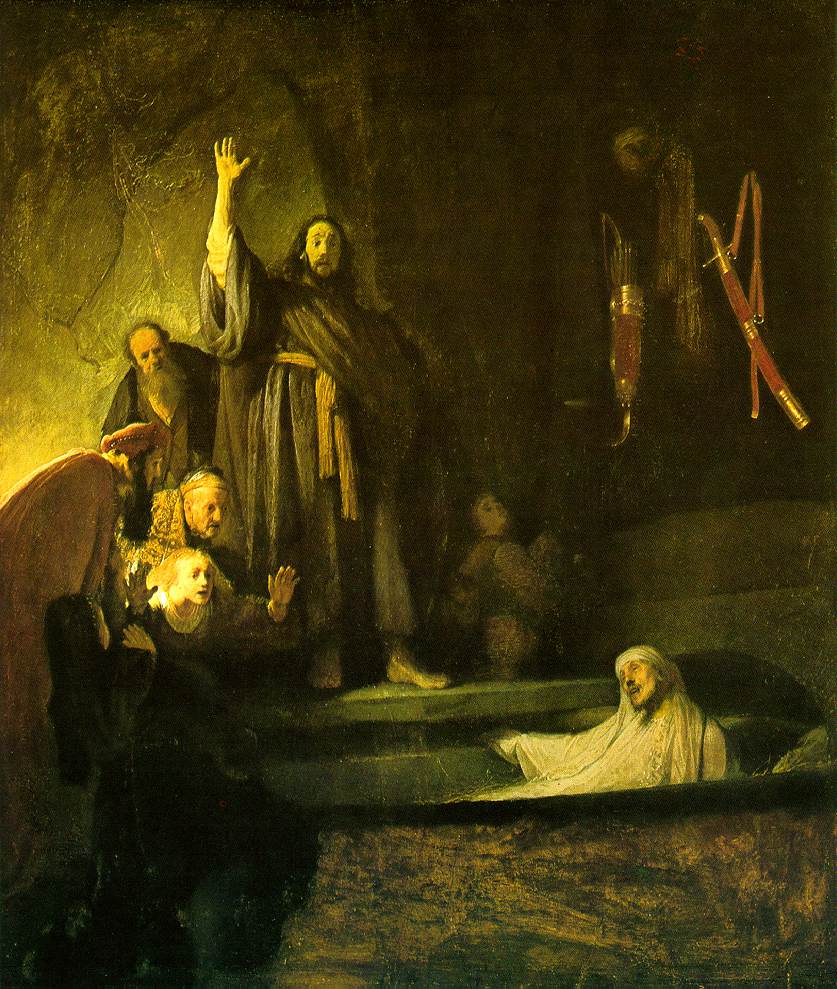
Rembrandt van Rijn, The raising of Lazarus, c. 1630
Oil on panel96.2 x 81.5 cm
Los Angeles County Museum of Art

Caputo argues for Jesus as a kind of deconstructing force within the church. When I set Jesus and the church side by side in my mind and ponder the connection, I cannot think of a better concept than deconstruction with which to understand the force of Christ amongst our religious structures. Caputo sees Jesus as “the event” within the word Christianity. (I know I am not doing the depth of his argument justice.) The idea of “the event” he takes from the French philosopher Jacques Derrida. Think of the word “democracy.” There are democracies and then there is democracy the ideal (not in a Platonic sense, but in a Derridian sense). That ideal calls to us when we think about, speak of, or participate in doing democracy. We don’t ever see the ideal, but we know it is there. Democracy the ideal is the event within the word Democracy. Think of Jefferson Smith (Jimmy Stewart) in the film Mr. Smith Goes to Washington. He is a kind of force, a man who quotes Lincoln and Washington while entering the cynical world of real politik. In the end he becomes a kind of savior-like figure who sacrifices his life for what he knows to be true. Jesus, who’s name is spoken countless times in churches around the world is like Mr. Smith. But rather than just speaking of the truth, he is the truth, he is the image of God, he is the event within the word Christianity.*


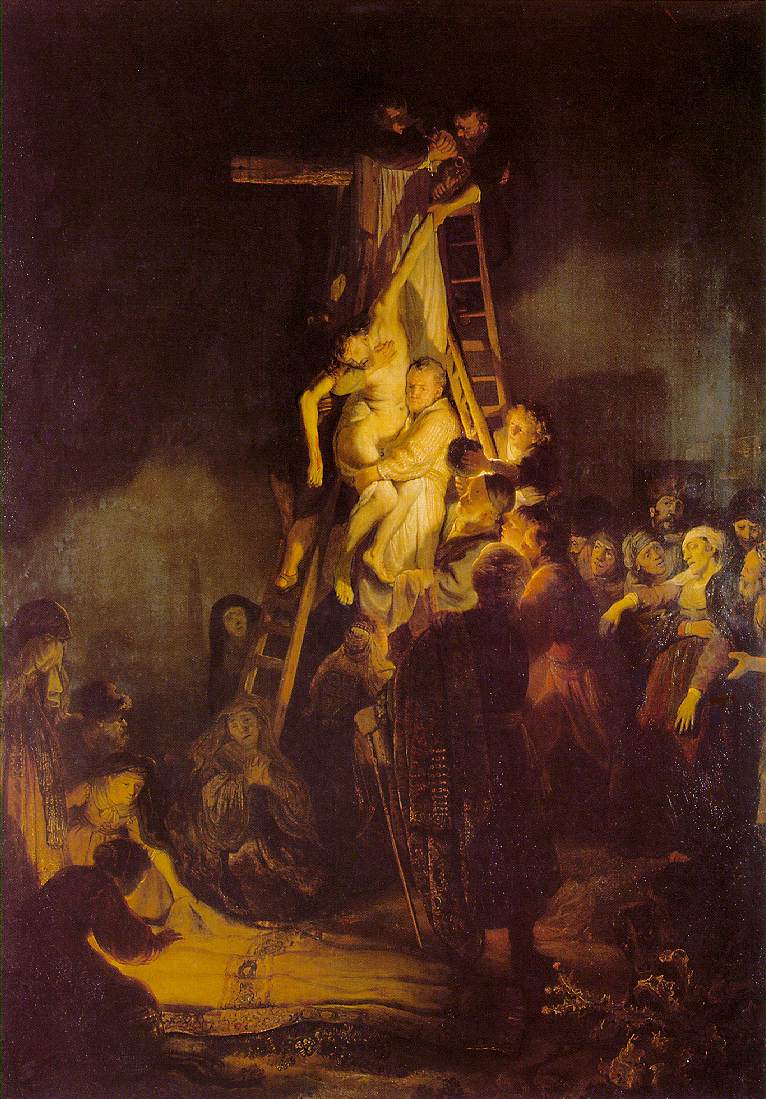
Rembrandt van Rijn, Descent from the Cross, 1634
Oil on canvas, 62 x 46 in. (158 x 117 cm)
Hermitage, St. Petersburg

What I fear is that I live my whole life as a “good Christian” only to one day confront the actual event (Jesus) within this thing (Christianity) I am doing, and to be told “I never knew you.” The fact is I confront the event every day. The question that I must answer is to what am I finally committed, Christianity or the event within.

Back to my original questions. I don’t think Jesus would give our organized versions of Christianity the thumbs up, though I don’t think he would give the thumbs down to all of it. I do think, however, that we would all be surprised by his presence beyond reasons of “wow, he exists!”. I think he would challenge us deeply in ways that get at those very things that we use to convince ourselves of our own wisdom. I think those individuals and groups deeply embedded within the church would have trouble with Jesus on many levels. And I’m not referring to the obvious examples of those who claim Christianity but spew hatred. I am referring to the good, ordinary, run-of-the-mill Christians who try to live good lives and get along with others. They would have trouble with Jesus as much as anybody. But I also think those outside the church, who say they like Jesus but not Christians, would also have trouble with Jesus. Jesus hung around with sinners but he was not their homeboy. He was not their revolutionary either. He is God’s revolutionary, whatever that means – which is something we could spend the rest of our lives figuring out.

* This is one of the reasons I don’t like seeing a U.S. flag prominently displayed in a church. The event within democracy is not the same event as that within Christianity. The event within the U.S. flag is something closer to patriotism than democracy, and it is miles from Christ. With our tendency to focus on Christianity rather than the true Christ already in play, why jeopardize our profound and constantly reforming need for truth that much more with connecting faith to patriotism?

>Christmas Eve

>The kids are excited. We parents are thinking of all we still have to do. Friends are coming over for dinner and celebration this evening. I hope you too are having a good Christmas Eve.


Vintage 1950s Soviet Christmas card

Lot’s more of those here.

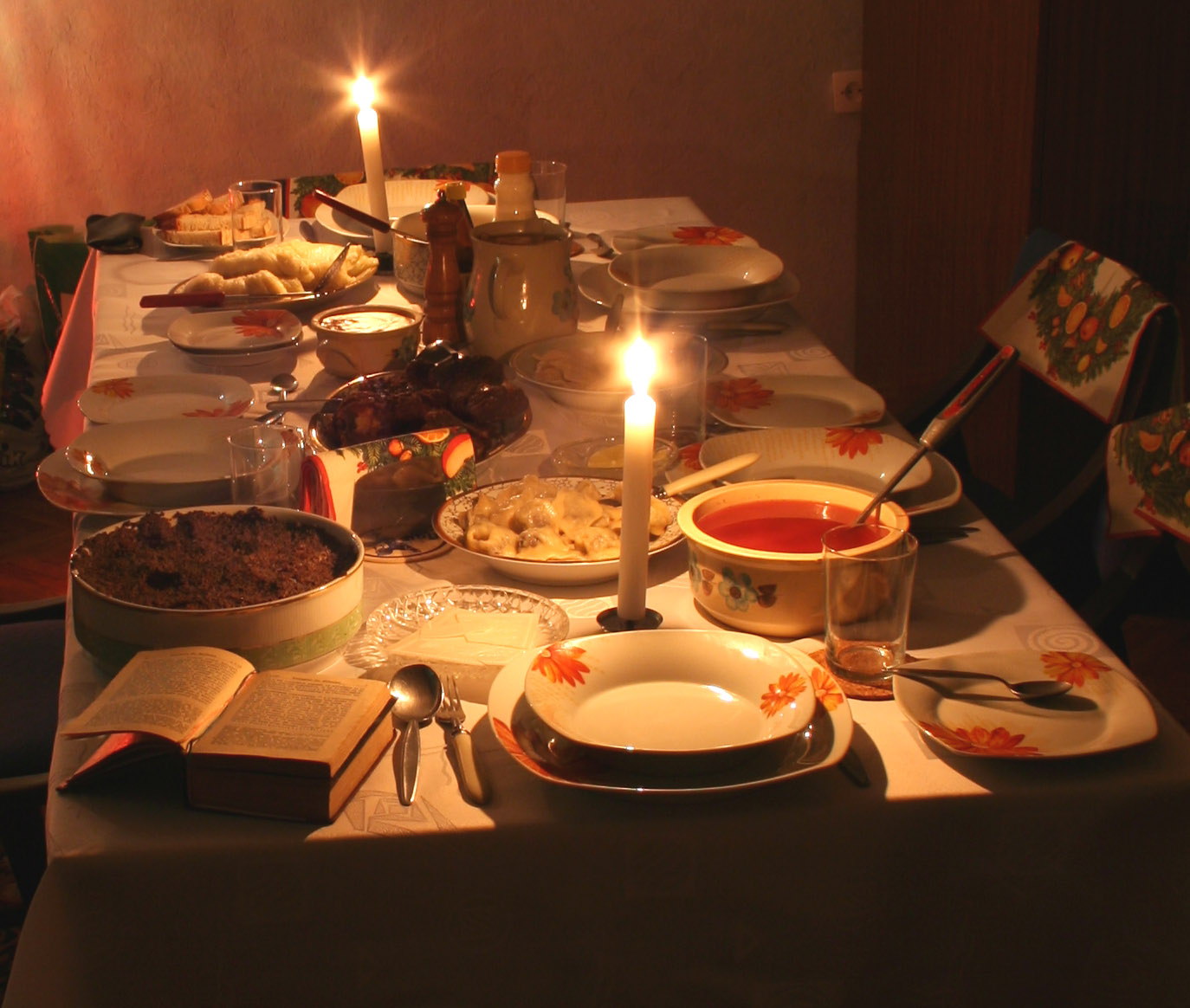
An image of a Polish table spread for a Christmas Eve feast:

I don’t know why I picked this image. We are not Polish. But we are having a feast tonight.

Special Christmas Eve bonus video:

>against emerging/emergent: voices of concern and opposition

>

Sometimes I feel like I am late to the party.

And sometimes I discover that I am not late, in fact I’m very early, I just didn’t realize it was going to be a party. So has it been with me and emerging Christianity.

As I continue to dive deeper into what the emerging/emergent church is all about I am finding that there are a lot of voices opposed to much or all of the whole shebang. This is old news. These voices have been around for a long time, even decades before the term “emerging” was applied to Christianity. YouTube is full of them. Some rant, some blather, some are articulate, and some of these voices come from individuals I respect. I must consider those voices I respect. These voices include R. C. Sproul and Ravi Zacharias – who represent for me a kid of “old guard” of apologists – and Mark Driscoll, who represents a younger generation of reformed preachers. All of these men I have heard and/or read their teaching and greatly appreciate what they do and their contributions to the Church and the furtherance of the Gospel.

But I am not entirely convinced by these guys. I am interested in your thoughts as well.

Here are a couple of clips about the emerging/emergent movement from those concerned voices. This first clip is of Mark Driscoll explaining how he understands this thing called emerging/emergent, and what he sees as deeply troubling problems:

http://www.dailymotion.com/swf/k5uCtJSQH2XqQ3vUVQ

Driscoll was part of the emerging/emergent conversation a decade ago, but he split away largely over doctrinal differences. I am not entirely in his camp. I love that he is a champion for truth, but some of his doctrinal positions are ones that I have wrestled with for more than 20 years and my beliefs have subtly changed over the years and are still in flux. I do know, however, that Driscoll does his homework and is worth listening to.

This second clip is of a conversation with R. C. Sproul, Ravi Zacharias, plus Vance Havner and Al Mohle (both of whom I have not heard before):

These guys are heavy hitters in the world of Christian apologetics and evangelism. I appreciate their perspectives on the topic at hand. I have some of the same concerns as they do, but I am also concerned they may be confusing their entrenchment in reformed theology and a modernist Christianity with defending the truth of the Bible. I don’t say this lightly. Such entrenchment is one of my personal concerns and something I have been working through for a long time – and I’m still in process.

Side note: I cannot help but see four old guys in suits and ties. There is nothing wrong with that of course, but it doesn’t help quell my thoughts that these guys are from a different generation, a different era, and a different world. None of that means they don’t know what is true, but I have concerns that the Christianity they preach is a mix of Truth and the culture in which their understanding was formed.

As I said, I feel the need to take all these guys seriously and consider what they say. The fact is, I already have been taking these topics seriously for a quite a while. I am someone who became a Christian at an early age and then within several years became intellectually interested in theology, history, philosophy, the pursuit of Truth, the nature of ministry and evangelism, and in what it means to work out one’s salvation with fear and trembling. I would pinpoint my first rumblings of emerging to circa 1986. soon after I joined a community that has many “emerging” characteristics – though we’ve never used that term.

I know the guys in the clips above do their homework for sure, they love God, and they pursue Truth, but I am not convinced they have Truth cornered. One of my biggest concerns with what these guys are saying is the way they brush off postmodernism as merely another form of liberalism and truth evasion. I have begun to dive into postmodernism again, after having done so years ago in grad school. This time I am finding much more. Postmodernism, we know, is not a school of thought, rather it is a recognition that we are in an age that is beyond modernism, which opens up lots of possibilities and re-evaluations of much of what has been considered the sacred cows of Christianity (I love that expression – I just made it up).

What I am trying to do is actually look to the sources – the Bible first of course, and then some of the writers who either claim or are tagged with being emerging/emergent or postmodern. My desire in the midst of this process is a combination of open-mindedness and discernment.

Books I’m reading related to the topic:

When Jesus Became God: The Struggle to Define Christianity during the Last Days of Rome, by Richard E. Rubenstein

Who’s Afraid of Postmodernism: taking Derrida, Lyotard, and Foucault to Church, by James K. A. Smith

What Would Jesus Deconstruct: The Good News of Postmodernism for the Church, by John D. Caputo

They Like Jesus But Not The Church: Insights from Emerging Generations, by Dan Kimball

Listening to the Beliefs of Emerging Churches: Five Perspectives, ed. Robert Webber

Jesus for President: Politics for Ordinary Radicals, by Shane Claiborne & Chris Haw

>emerging church: call it what you will

>I mentioned in an earlier post that I’m looking into the phenomena of the emerging church, and its related emergent aspects. Recently, however, there is a slight trending away from those terms. Dan Kimball at Vintage Faith writes about his recent thoughts on how the terms have changed over the years and what that means for him. He cites three other articles/blog posts that also deal with the continued relevance of “emerging/emergent.”

Of course, the realities that underly these terms are still there, though they have been changing, and will continue to do so. Maybe “emerging” and “emergent” will wane in their cultural currency, but we are still living in a post-modern (and possibly post-Christendom) world in which the need to re-examine what it means to be a Christian is critically relevant. One thing to consider, as well, is the relative newness of those terms to much of Christianity. That alone will keep the terms alive for a while, even if their progenitors have moved elsewhere.

As for me, my study has just begun. In fact, I feel like I am doing a lot of catching up. On the other hand, it occurred to me the other day that I began my own “emerging” process back around 1986 when I began to have serious issues with my church’s philosophy of ministry and approach to both culture and theology/doctrine. And really my searching began back in the 1970s as I read authors like C. S. Lewis and Francis Schaeffer in my adolescent grasping for something more than what I was getting at church. A lot of water has gone under the bridge (a story I might relate here sometime), and I’m still sorting it out.

Books I am reading related to the topic:
A New Kind of Christian, by Brian McLaren
The Future of Religion, by Richard Rorty & Gianni Vattimo, ed. Santiago Zabala

Books I’m glancing at:
Spiritual Direction, by Henri Nouwen
Dialogue with Nietzsche, by Gianni Vattimo
Basic Writings, by Martin Heidegger

And I have on order a few more books. I welcome any suggestions.

>Democracy at a Crossroads: Structures of Power Outside the RNC

>We know this country has become polarized on multiple levels. We know that a thriving democracy is a struggle. But we also know that there is a difference between the messiness of democratic action and the actions of heavy handed social control. Sometimes (usually) messiness is better, though it is unpredictable.

With this in mind I have been curious about the two big political party conventions and the manner in which those with the guns and body armor are going to support democracy. The Democratic National Convention seemed to go off without a hitch. They even opened up a giant stadium to let in everyone they could. The Republican National Convention (RNC) is another story. So far there have been numerous riots, police violence, and arrests.

Question: Should police use force against peaceful political protesters? I can understand trying to stop violent protesters from hurting others or damaging property – though property is not so nearly as sacred as human life or well being. Although I am against violence I am not against being rowdy and noisy for important social and political concerns. Consider this video* of police attacking apparently peaceful protesters at the RNC:

What you see in this clip are people walking along a street. What you also see and hear are heavily armored police officers shooting some of the walkers with rubber bullets, which is even more aggressive than hitting someone with a baton in my opinion. The police also use tear gas to split up the crowd. I cannot tell exactly what is was these particular walkers were doing that was so bad, but I doubt rubber bullets and tear gas was necessary… unless the goal is to make sure, with complete certainty, that the hierarchies of power remain intact and understood.

Or consider this video clip that hearkens back to those flower-power protest images from the 1960s:

http://www.indybay.org/js/flowplayer/FlowPlayer.swf?config=%7BvideoFile%3A%27http%3A%2F%2Fwww%2Eindybay%2Eorg%2Fuploads%2F2008%2F09%2F01%2Fpepper%2Empg%5Fpreview%5F%2Eflv%27%2CsplashImageFile%3A%27http%3A%2F%2Fwww%2Eindybay%2Eorg%2Fim%2Fplay%2Dbutton%2D328x240%2Ejpg%27%2Cloop%3Afalse%2CautoPlay%3Afalse%2CautoBuffering%3Afalse%2CbufferLength%3A5%2CinitialScale%3A%27fit%27%2CbaseURL%3A%27http%3A%2F%2Fwww%2Eindybay%2Eorg%2Fjs%2Fflowplayer%27%2Cembedded%3Atrue%7D

I cannot say the woman in the green tank-top is acting in the most wise manner (at least for her own safety), but take a moment to compare the dress and collective action of the two different kinds of people in this video. One group seems rather loosely organized at best, wearing ordinary street clothes, and looking much like you and your friends. The other group is clad head-to-toe in black armor (rainbow plaid armor is not nearly as menacing), is fully organized into a phalanx, and is looking like extras from a Robocop movie. Honestly, I bet they love putting on that stuff.

Democracy is messy. Protest are necessary. Violence should be avoided. And people should be able to march up and down the streets without fear of tear gas, rubber bullets, or menacing storm troopers inciting violence. (I say inciting because their very presence, demeanor, and visual appearance is designed to be threatening.) I cannot help but think of some police officer yelling “This is no time for democracy, this the the Republican National Convention!” Or, the police thinking these protesters are stupid idiots for showing up with flowers to a tear gas fight.

But other interesting things have been happening related to the RNC. These include the raiding of homes of “suspected” protesters, such as in this video:

In light of that video remember these important words:

The right of the people to be secure in their persons, houses, papers, and effects, against unreasonable searches and seizures, shall not be violated, and no Warrants shall issue, but upon probable cause, supported by Oath or affirmation, and particularly describing the place to be searched, and the persons or things to be seized. (Amendment 4 to the U.S. Constitution)

Has line been crossed here? I can’t say for sure, but seems likely. I doubt there was probable cause.

And there was the raiding of homes of “suspected” journalists (who WERE journalists), such as in this video:

In light of this raid consider these important words:

Congress shall make no law respecting an establishment of religion, or prohibiting the free exercise thereof; or abridging the freedom of speech, or of the press; or the right of the people peaceably to assemble, and to petition the Government for a redress of grievances. (Amendment 1 of the U.S. Constitution)

Has line been crossed here? Looks probable.

Police also confiscated citizen journalists’ cameras and computers, as described in this video:

What is going on here? What is the answer to the question: Why are these police actions necessary? What is being protected? What is gained?

Not necessarily more important than the above situations and police actions, but certainly very critical when it comes to the importance and necessity of a free press in a democracy, here is a clip of the intrepid Amy Goodman of Democracy Now being arrested for investigating the brutal arrest of her producers Sharif Abdel Kouddous and Nicole Salazar:

And here is the video taken by Nicole Salazar as she was beaten and thrown to the ground by police even though she was telling them she was Press and was clearly wearing her Press card around her neck.

One can only conclude one of three things: 1) The safety of the police and of others was so grave that the police had no other choice but to treat her that way, 2) the police became so angry that their emotions made them act irrationally, or 3) there is a planned and concerted effort to intimidate and control any media that does not conform to the predictable and safe (to the established hierarchy of power) norms as exhibited by the major networks. The first choice is, at best, a stretch, and mostly likely ludicrous. The second choice is probably partly true, but too many law enforcement individuals were involved for it to merely be runaway emotions. The third is the most likely scenario, and is born of fear. And fear is one of the greatest threats to democracy.

A whole lot of questions are raised by these video clips, and there are many more videos of the same. I would argue that we are witnessing a time in which a sector of the population is living in fear that their world will not last, and that sector are those currently in positions of power. This may or may not be true. I also believe, however, that this is really nothing new. We have seen this many times before in this country in many different forms. In fact, that is part and parcel of the story of humankind.

Keep this in mind, if a free press is critical for a thriving democracy then it will, by definition and implication, be a threat to someone. If a democracy is threatening to those who need predictable power to get and keep what they want, then, logically a free press is a threat to those people. What do we have if we don’t have a free press? Do we have a democracy?

* Several of the video clips above were produced by The Uptake.