God be praised


I love my wife and daughters. I begin this post with one of my wife’s favorite quotes:

This life is not godliness, but growth in godliness; not health, but healing; not being, but becoming; not rest, but exercise. We are not now what we shall be, but we are on the way; the process is not yet finished, but it has begun; this is not the goal, but it is the road; at present all does not gleam and glitter, but everything is being purified.

~ Martin Luther

I decided a couple of weeks ago to stop posting for a while because life has been too busy and more important things needed to be done. Now I think it is time to post again.

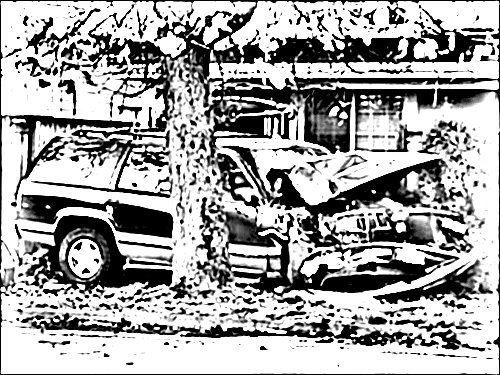
On Monday last my wife was walking our youngest daughter along a sidewalk near our house when a large SUV jumped the curb and struck them. The story is an interesting one that involves a convicted felon fleeing the scene and hiding from police for 24 hours. The local news was all over that. My wife ended up with a fractured pelvis and multiple scrapes and bruises. But the crux of the story is the way death came by so close and did not stay.


It is hard for me to imagine my wife dying. She is in a lot of pain right now, but she is still alive. I praise God every minute for that. We are so fragile and so mortal, and yet life is so powerful and meaningful. When a couple gets married they are theoretically in it for the long haul. Marriage is not a game and it can sometimes bring a lot of heartache, not least when the other suffers. I do not like to see Maricel suffer. We got married just over 17 years ago. Sometimes it seems like a long time somethings its seems like only yesterday. We have lived much of our lives in shared communion and experience. If God were to take her away from me I could not describe the vastness of the hole that would be left in my life.

My daughter Wilder also nearly died. She was in her stroller when it was throw almost 40 feet down the sidewalk. The stroller tumbled but acted like a roll cage and my daughter came away with hardly a scratch. It is also hard for me to imagine her dying. In this case, though, I know what it is like to lose a child. My daughter Coco died in my arms nearly three years ago. I don’t know how I would go through that again. Children are amazing. They are truly gifts that should be loved and cherished at all times. My daughters are brilliant lights in my life. They gleam like stars. I do not want to ever lose one.

My eldest daughter Lily has been through a lot in her 8 years. Her uncle died of cancer, her grandmother was severely burned in a car accident, her baby sister died, her mother and other sister nearly died this week, and her mother is now in the hospital with a broken pelvis. She is a beautiful and tenderhearted girl who can sometimes be too stoic for her own good. I can’t blame her. She has been through a lot.
A friend of mine asked me a couple days ago if I was angry – angry at the driver of the car that struck my wife and child, angry at the situation. I was taken aback because being angry hadn’t even entered my mind, yet I felt at that moment that maybe I should be. Why wasn’t I angry? It’s strange to think about. I certainly don’t think it has anything to do with some kind of moral nobility. I am just like everyone else. I still want justice, I still want the driver to get what he deserves, but I don’t have those burning emotions of anger. And it’s not because I don’t think anger has its place. The only explanation I can come up with is that my experiences have put within me the idea that this is what we should expect from life, the bad with the good, and that people will do bad things because they are sinners like me. If I am mad at anyone else I need to reserve some of that anger for myself too. We are made of the same stuff.

For many the real issue on the table is what to do with all this in light of God. Why would God allow this to happen? Believing that God would actively bring suffering like this into one’s life is not an option for many people. God, they might say, does not create suffering, he only allows it. But God does create suffering, as he creates all things. The question I face is whether I will trust a God who would bring this upon my wife and family. If one does not believe in God then suffering is absurdity. It is when one believes in God that suffering takes on the difficult sheen of meaning and purpose. Suffering glares in one’s eyes. It doesn’t call out to you, it invades your life and, sometimes, it makes itself at home. Suffering forces your hand and makes you lay your cards face up on the table. Suffering tells you what you are made of. Knowing what you are made of is a great gift, and not an easy gift. If God is good, I would expect him to bring suffering into the lives of those he loves. I have struggled with this in my life and I will continue to struggle. But I have come to know that suffering is not the end of life, rather life is the end of suffering.
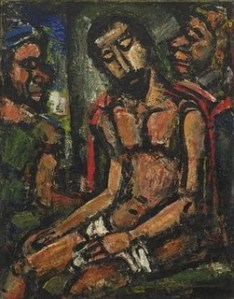
I am not one to quote pithy Bible verses about suffering or the goodness of God. And if someone tells me what stage in the grieving process I am in, or how God must be trying to tell me something, or how everything works for good, etc., I just smile and nod my head. I believe those verses and I know everything works for good, and I appreciate the reminders, but outside voices only go so far compared to the inside groanings. I know it’s not really a matter of the head at this point, it’s a matter of the heart – and I mean that place in the heart where all sentimentality and saccharine spirituality is stripped away. This really has everything to do with who we are and where we are going.

The best I can do is look at the Bible as a whole and wonder at all the suffering between its pages. I don’t see anywhere in the Bible where God says this life will be free from suffering. I don’t see the health and wealth gospel or the prosperity gospel. But I do see that my savior suffered, and that many of the early Christians suffered, and that to be a Christ follower is to take up one’s cross daily. All this does not provide an easy answer to to why we suffer. At least I can say that to suffer is, in some way, to be like Jesus. I can also say that if one is worried if their friendly, easy faith truly has legs then suffering will let them know. But then that faith will no longer be so friendly or easy. Genuine faith lives in that world of both terrifying reality and unfathomable hope. No wonder we are called to love and encourage each other. The more I live the more I know this to be true. When we are told to work out our faith with fear and trembling I know a little more each day about what that means.
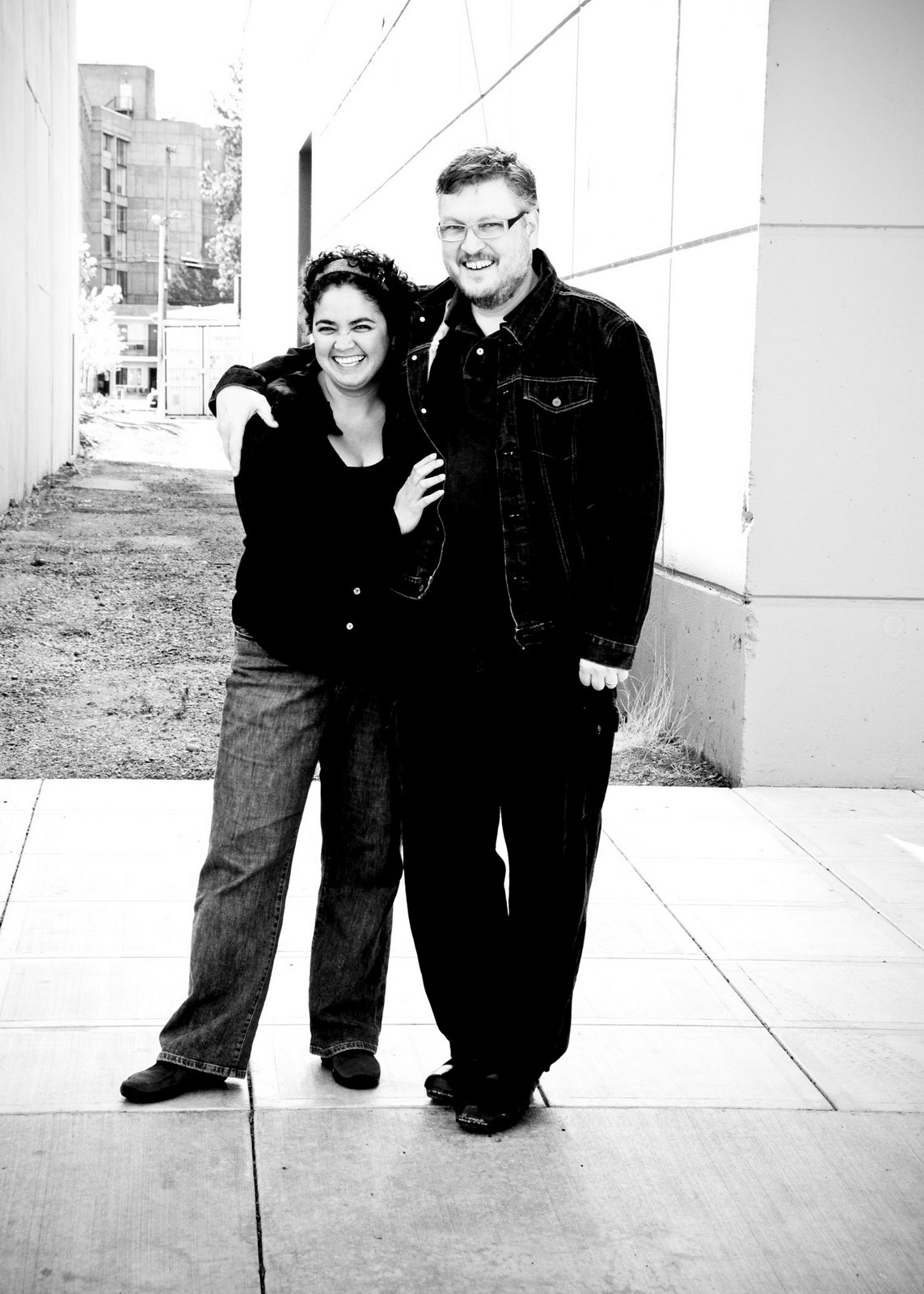

My wife and family have a long road ahead, but don’t we all. I know that God is good, but I also know that God is God and I must ask myself if I still trust God to be good when I, or my family goes through suffering. What I pray for is that God will heal my wife soon and completely. I also pray that God will continue to be faithful to love us and that we will continue to trust in him. What is so amazing is to see my wife go through her ordeal with courage and good spirits. She has had a lot of support from so many people. Her hospital room is filled with flowers and cards. She is an amazing woman. Seeing all the love extended toward her is a testament to that.

I said I am not one for pithy Bible verses, but I have to say that many passages in the Bible take on deeper meanings in light of suffering. I can’t help but be reminded of what Jesus did. And I rejoice in his example, though I fail at living up to it. So I quote a couple verses from Philippians:

Have this attitude in yourselves which was also in Christ Jesus, who, although He existed in the form of God, did not regard equality with God a thing to be grasped, but emptied Himself, taking the form of a bond-servant, and being made in the likeness of men. Being found in appearance as a man, He humbled Himself by becoming obedient to the point of death, even death on a cross.

If Christ be my example, then how can I fear suffering or death? And yet, words cannot describe how grateful I am that death did not stay this week. God be praised.
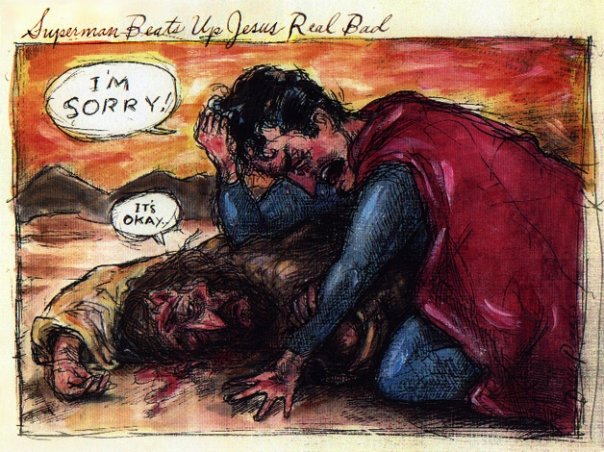
>Superman Beats Up Jesus Real Bad

>Without his permission I am posting one of my favorite cartoons by my good friend Dan.


click to enlarge

Thanks Dan.

>Happy All Saints Day

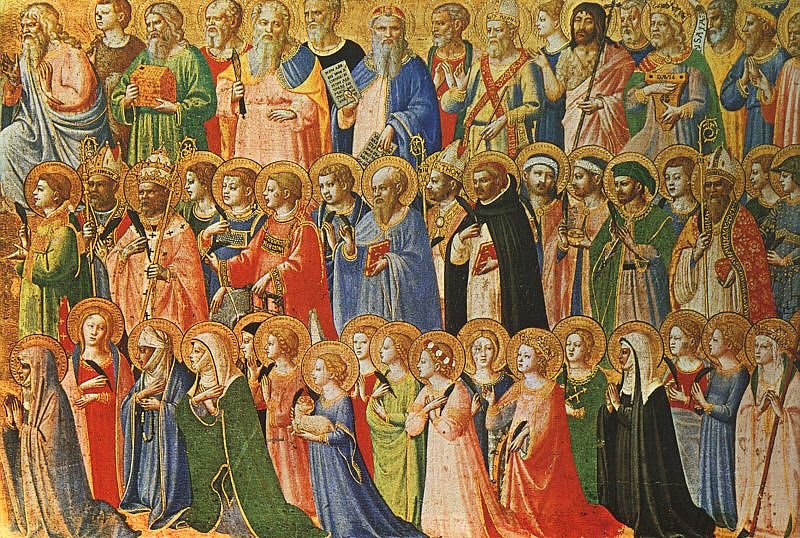
>Halloween is a fun celebration. The kids love it of course. But we move on. Today is All Saints Day.


Painting by Fra Angelico, 15th century

Often I wish my religious background included the “religious calendar” one finds in Catholicism. Being a Protestant by birth and training, and not just a Protestant but a Baptist no less, I was frequently taught how wrong those Catholics are. Sharp lines were drawn and divisions articulated, sometimes with great emotion. Maybe those Catholics are wrong in some things, but I know too, as I have fled much of my religious roots, that those Baptists are wrong in many things as well. Now I have Catholic friends of whose faith I have no doubts. I have looked more closely at Catholic teaching and practices and I find much there that I like and wish were part of my life. My Catholic friends would say “why don’t you become Catholic then?” Not now friends. But I do think much was thrown out with the bathwater by the reformers. Some would say not enough, but I think there is a middle ground somewhere. One thing lost is a sense of history and the richness of the lives of the saints. I know that all believers are saints, but there are also those who inspire. They are like heroes. I’m not convinced that praying to the saints is Biblical, but I do think honoring them is a good thing, even if it’s merely for our own encouragement. But growing up Protestant and continuing in that tradition to some degree, I have no social context in which to do such celebrating. That is something I will continue to explore. For now I just say have a great All Saints Day and may you be encouraged.

I must say, as well, that today is my wife’s birthday. She is most definitely a saint in my book.

What is All Saints Day? Here’s the low down:

>Walter Wink on Nonviolence for the Violent

>I knew next to nothing about Walter Wink until recently. Now I have become a fan.

>are you religious?

>

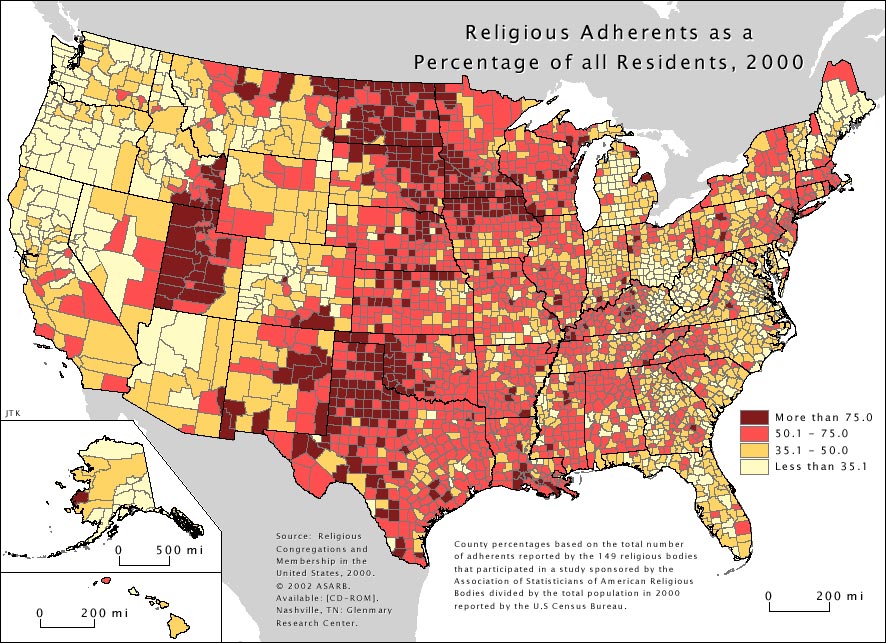
I live in the least religious region of the United States.

The map above (click to enlarge) is from a 2000 study of religious population densities in the U.S. I live in the upper left area, the Northwest, which has the largest percentage of “un-churched” people per-capita in the country. Because I have, for the most part, lived my entire life in this area of the country I am curious as to how the religious make-up of my regional culture has played a part in my formation as a thinking/feeling person. I have always thought of myself as a person of faith, even propositional faith, but not as particularly religious in an external sense. Regardless, I think I would be called religious in light of these demographics. But I find myself to be rather un-dogmatic as well as prone to questioning even long-held Christian doctrines – not because I think they are necessarily wrong, but because I value critical thinking and I don’t place much value in tradition when it comes to truth, except as a catalyst.

Then I look at the rest of the country and I wonder what set of beliefs, what religious and philosophical values I would have if I had lived elsewhere. Look at those red and deep red areas of the map. What kind of choices, what kind of pressure would I have experienced if I had grown up there. I don’t know. Maybe you know. What I do know is that in the West and Northwest there is a trend toward “missional” churches, that is churches who are built around the idea that the very cities in which they exist are every bit as much mission fields as anywhere else in the world. Mars Hill Church in Seattle is particularly committed to reaching out to its un-churched city (I don’t attend Mars Hill, but I listen sometimes to their podcasts).

What is remarkable is how religious, and in particular how Christian, is the U.S. Not long ago many predicted the collapse of religion in the U.S., instead it has flourished. I wish I could say Christianity has always been a source of light in this country, but that has not been the case. The present political season is evidence enough. But Christians are really no different than anyone else who holds to a set of beliefs about the world, about right and wrong, and about the future. What is all to evident, however, is the fact that Christians are specifically called to love their neighbor as themselves and they fail in big ways. Of course, so does everyone else. You can certainly count me in that number.

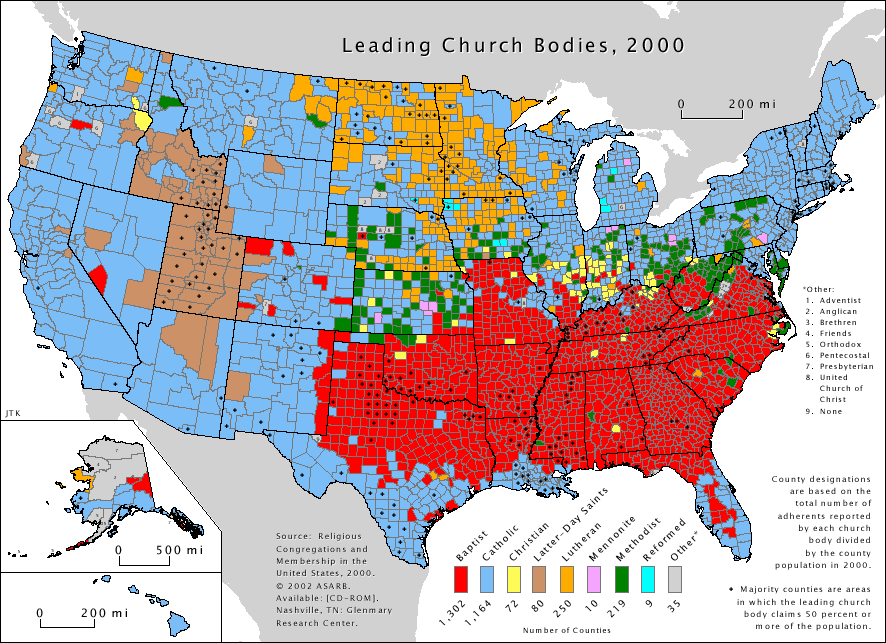
Here’s another map I find interesting. Of those who are religious, and again its mostly Christian in this country, this is how they break down geographically by basic religious groups:

What is interesting for me is that I grew up a red (Baptist on the map) but not in the Southeast. Later in college I left “redworld,” but my faith deepened and grew as I became, for lack of a better description, a non-denominational Christian. I began residing at McKenzie Study Center, which was conveniently close to the campus (I was an undergrad), but was also a place that allowed me to ask tough questions about my faith. I was given room to actually think outside the box. Far too often one is only allowed to lightly question approved doctrines in traditional churches as long as there is no chance that one will actually disagree with those doctrines. Freedom to think is often perceived as a threat to religion, but it is central to faith. 20 years later, and a lot of water under the bridge, I am still plugging along, sorting out my faith (with fear and trembling) and seeking to love others regardless of what or who the maps say I am.

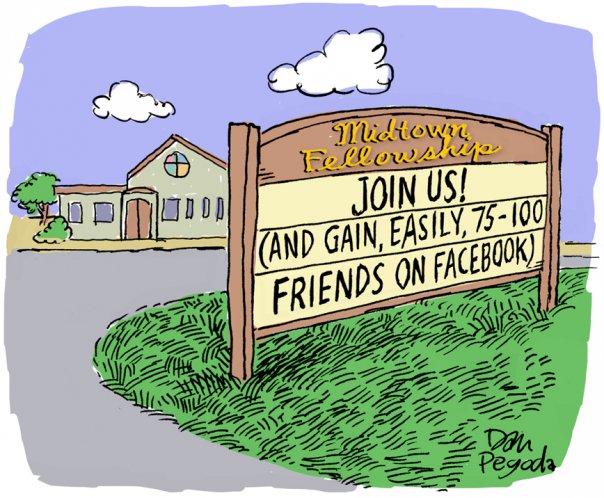
>facebook church

>The following cartoon is from my friend Dan.

It’s really what church is all about, isn’t it.

>against emerging/emergent: voices of concern and opposition

>

Sometimes I feel like I am late to the party.

And sometimes I discover that I am not late, in fact I’m very early, I just didn’t realize it was going to be a party. So has it been with me and emerging Christianity.

As I continue to dive deeper into what the emerging/emergent church is all about I am finding that there are a lot of voices opposed to much or all of the whole shebang. This is old news. These voices have been around for a long time, even decades before the term “emerging” was applied to Christianity. YouTube is full of them. Some rant, some blather, some are articulate, and some of these voices come from individuals I respect. I must consider those voices I respect. These voices include R. C. Sproul and Ravi Zacharias – who represent for me a kid of “old guard” of apologists – and Mark Driscoll, who represents a younger generation of reformed preachers. All of these men I have heard and/or read their teaching and greatly appreciate what they do and their contributions to the Church and the furtherance of the Gospel.

But I am not entirely convinced by these guys. I am interested in your thoughts as well.

Here are a couple of clips about the emerging/emergent movement from those concerned voices. This first clip is of Mark Driscoll explaining how he understands this thing called emerging/emergent, and what he sees as deeply troubling problems:

http://www.dailymotion.com/swf/k5uCtJSQH2XqQ3vUVQ

Driscoll was part of the emerging/emergent conversation a decade ago, but he split away largely over doctrinal differences. I am not entirely in his camp. I love that he is a champion for truth, but some of his doctrinal positions are ones that I have wrestled with for more than 20 years and my beliefs have subtly changed over the years and are still in flux. I do know, however, that Driscoll does his homework and is worth listening to.

This second clip is of a conversation with R. C. Sproul, Ravi Zacharias, plus Vance Havner and Al Mohle (both of whom I have not heard before):

These guys are heavy hitters in the world of Christian apologetics and evangelism. I appreciate their perspectives on the topic at hand. I have some of the same concerns as they do, but I am also concerned they may be confusing their entrenchment in reformed theology and a modernist Christianity with defending the truth of the Bible. I don’t say this lightly. Such entrenchment is one of my personal concerns and something I have been working through for a long time – and I’m still in process.

Side note: I cannot help but see four old guys in suits and ties. There is nothing wrong with that of course, but it doesn’t help quell my thoughts that these guys are from a different generation, a different era, and a different world. None of that means they don’t know what is true, but I have concerns that the Christianity they preach is a mix of Truth and the culture in which their understanding was formed.

As I said, I feel the need to take all these guys seriously and consider what they say. The fact is, I already have been taking these topics seriously for a quite a while. I am someone who became a Christian at an early age and then within several years became intellectually interested in theology, history, philosophy, the pursuit of Truth, the nature of ministry and evangelism, and in what it means to work out one’s salvation with fear and trembling. I would pinpoint my first rumblings of emerging to circa 1986. soon after I joined a community that has many “emerging” characteristics – though we’ve never used that term.

I know the guys in the clips above do their homework for sure, they love God, and they pursue Truth, but I am not convinced they have Truth cornered. One of my biggest concerns with what these guys are saying is the way they brush off postmodernism as merely another form of liberalism and truth evasion. I have begun to dive into postmodernism again, after having done so years ago in grad school. This time I am finding much more. Postmodernism, we know, is not a school of thought, rather it is a recognition that we are in an age that is beyond modernism, which opens up lots of possibilities and re-evaluations of much of what has been considered the sacred cows of Christianity (I love that expression – I just made it up).

What I am trying to do is actually look to the sources – the Bible first of course, and then some of the writers who either claim or are tagged with being emerging/emergent or postmodern. My desire in the midst of this process is a combination of open-mindedness and discernment.

Books I’m reading related to the topic:

When Jesus Became God: The Struggle to Define Christianity during the Last Days of Rome, by Richard E. Rubenstein

Who’s Afraid of Postmodernism: taking Derrida, Lyotard, and Foucault to Church, by James K. A. Smith

What Would Jesus Deconstruct: The Good News of Postmodernism for the Church, by John D. Caputo

They Like Jesus But Not The Church: Insights from Emerging Generations, by Dan Kimball

Listening to the Beliefs of Emerging Churches: Five Perspectives, ed. Robert Webber

Jesus for President: Politics for Ordinary Radicals, by Shane Claiborne & Chris Haw

>emerging church: call it what you will

>I mentioned in an earlier post that I’m looking into the phenomena of the emerging church, and its related emergent aspects. Recently, however, there is a slight trending away from those terms. Dan Kimball at Vintage Faith writes about his recent thoughts on how the terms have changed over the years and what that means for him. He cites three other articles/blog posts that also deal with the continued relevance of “emerging/emergent.”

Of course, the realities that underly these terms are still there, though they have been changing, and will continue to do so. Maybe “emerging” and “emergent” will wane in their cultural currency, but we are still living in a post-modern (and possibly post-Christendom) world in which the need to re-examine what it means to be a Christian is critically relevant. One thing to consider, as well, is the relative newness of those terms to much of Christianity. That alone will keep the terms alive for a while, even if their progenitors have moved elsewhere.

As for me, my study has just begun. In fact, I feel like I am doing a lot of catching up. On the other hand, it occurred to me the other day that I began my own “emerging” process back around 1986 when I began to have serious issues with my church’s philosophy of ministry and approach to both culture and theology/doctrine. And really my searching began back in the 1970s as I read authors like C. S. Lewis and Francis Schaeffer in my adolescent grasping for something more than what I was getting at church. A lot of water has gone under the bridge (a story I might relate here sometime), and I’m still sorting it out.

Books I am reading related to the topic:
A New Kind of Christian, by Brian McLaren
The Future of Religion, by Richard Rorty & Gianni Vattimo, ed. Santiago Zabala

Books I’m glancing at:
Spiritual Direction, by Henri Nouwen
Dialogue with Nietzsche, by Gianni Vattimo
Basic Writings, by Martin Heidegger

And I have on order a few more books. I welcome any suggestions.

>emerge oh church, emerge

>I am beginning a study of something called the “emergent church.” I grew up in a Christian tradition and, in some ways, I still claim that pedigree. This emergent thing, however, is something different than what I’m used to. It’s not exactly new, but it’s newish. It also has various aspects, some of which look very appealing to me, and others look potentially troubling. I am hoping to sort it out for myself. I may post some of my thoughts and conclusions here at PilgrimAkimbo from time to time.

Here are a couple of videos that try to get at what underlies the emergent church.

http://video.google.com/googleplayer.swf?docid=-8802026530343805467&hl=en&fs=true

What do you think? I am interested in hearing your thoughts, especially if you participate in an emergent church.

>those troubling red letters

>There is an interesting religious movement going on in the U.S. today. Maybe “religious” is too strong of a word. Better might be “not-so-religious” movement. Some are calling it Red-Letter Christianity. Simply, it is a reaction to the hijacking of Christianity by right-wing politics and culture. More complex and profound is its focus on the teachings of Jesus as its foundation, which may sound like a strange differentiation among groups calling themselves Christian. This movement stands in sharp contrast to the often less-than-Biblical Christianity of many high-profile Christian leaders today.* Many non-Christians like to point the finger at Christianity and call out how bad it is. My gut response is to say, “you don’t even know the half of it.” I say this as a committed Christian who desperately seeks to follow Jesus in who I am and all that I do.

The focus on “red letters” comes from the fact that in many older bibles the words of Jesus are printed in red ink. Those who are part of this movement are calling themselves Red-Letter Christians.**

We live in a post-Christian world, sociologically and culturally speaking. In recent years (read decades) Christianity has been tagged as anything from intolerant to irrelevant. Many feel that Christians are merely self-righteous demagogues who say they love others as they condemn them. Unfortunately, this is often the case (but it is not always the case, as the Red-Letter Christians are trying to emphasize). The following video, rather pointedly, gets at part of the problem, at least, that Red-Letter Christians are confronting:

One of the problems, of course, is the problematic “need” to be morally superior in place of the more difficult task of truly loving others as oneself. This is a human condition, a result of what we are at our core. So it is part of my condition. Jesus’ harshest words were for the self-righteous religious leaders of his day. Lest we forget, these were the properly behaved and “family values” people of his day. Jesus’ softest words were for those whom the religious leaders condemned. If Jesus is our example then we should try and act as he acted. Somehow many Christian leaders, who have studied those same red letters, do not see the irony staring back at them.

But there is another problem with mainstream evangelical Christianity in America, that is its slavish and embedded relationship to American right-wing politics. Religion and politics have always gone together in this country, but the past twenty years have seen a radical increase in the way evangelical Christianity and the political right have forged a power-focussed agenda. This very interesting report below takes a look at that relationship and some alternatives that are bulbing around the fringes of mainstream Christianity:


In that video there was mention of Shane Claiborne. His book The Irresistible Revolution: Living as an Ordinary Radical is a very interesting and challenging read, especially if you’ve grown up in a conservative Christian environment. I enjoyed it very much and it has contributed to my current views.

So then, what is Red Letter Christinaity? Here and here (in an interview from 2004) Tony Campolo, sociologist and Christian apologist, explains what Red-Letter Christianity is all about.

Why does this interest me? I have a long history with Christianity. I have wrestled with its truths and its sub-cultures. More than ever I believe in those truths, and more than ever I have issues with its sub-cultures. Red-letter Christianity is not the complete answer (I am wary of any “brand” of Christianity that includes an additional label), but it does call attention to the way Christianity has always tended to deviate from its core truths.

Humans want to be God and call the shots, but Christians know they can’t be God, so they tend to invent a version of God they can believe in, say He’s on their side, say He wants them to establish His kingdom, and say that kingdom looks like an American BBQ with nice people wearing flag pins and hating liberals. (I joke, but it really is worse than that.) But I also find in myself a tendency to excuse a life of selfishness and pragmatic expediency by pushing forward a kind of self-righteousness. In other words, I don’t follow the teachings of Jesus very well and I’m rather good at pointing out how others are failing. Yet, deep in my heart, I want to be challenged and reminded of what is truly important – to love my neighbor as myself, to care for the poor and the suffering, and to not let politics or social norms get in the way.

Of course we are in a political season (in some ways we always are) and we have troops overseas killing and getting killed (which always raises deep issues of faith and morality). There is no wonder that religion is playing a big part in the various debates going on around these topics. In part two of the video above Avi Lewis interviews Tony Campolo about religion and politics, and interviews a military chaplain about the tension between war and the Christian commandment to turn the other cheek:

I cannot unequivocally endorse Red-Letter Christianity, if only because I still need to take a closer look, but I love it just the same. At a minimum it offers a kind of antidote to the radical/worldly tendencies of popular evangelicalism. I say this because, at heart, I am an evangelical and I want to live out those troubling red letters.

Critics*** say that to only focus on the red letters is to miss the totality of the Bible. But this sounds to me like a false criticism, and I suspect it comes from a heart of self-justifications. If the teachings of Jesus say to feed the poor, turn the other cheek, be humble, and love one’s enemies, do we find the rest of the Bible contradicting Jesus? That would seem to be the position of the critics, but I suspect they don’t believe they mean it that way. What the critics of Red-Letter Christianity appear to be doing is trying to shift the argument away from the real implications of Jesus’ teaching because they want to hold on to a position that wants to claim Jesus didn’t mean exactly what he said, that he was speaking metaphorically. The truth is the Gospel (the good news of God become man, etc. etc.) is the most inconvenient of truths. My observations and personal experience tells me that established Christianity (the so-called visible church) often doesn’t really like that truth. Fortunately, the spirit of God works on the heart, and through the hearts of the meek, of the humble, of the kindhearted, of those who thirst, of those who weep. I pray I am such a person.

*Some of the reaction comes from taking a hard look at the way Christianity has been used and abused by those less loving than Jesus yet claiming a high level of personal righteousness. A recent example might be Dr. James Dobson’s criticizing Obama, saying Obama has a “fruitcake interpretation” of the Constitution. I don’t know what Obama’s interpretation of the Constitution is, and I am not endorsing Obama here, but I do know that Dobson is very publicly being unloving towards Obama and his supporters. It is as though Dobson, while claiming a position of righteousness, has written off Obama as the “enemy” and therefore as someone to condemn rather than love. Dobson could have said he disagreed with how Obama was interpreting the Constitution and then given some clear reasons why. Calling anyone’s interpretation of the Constitution “fruitcake” is demeaning. Is this the proper behavior of a Christian leader? Dobson could also have declared that he is neither a Constitutional lawyer or Constitutional scholar and then phrase his comments accordingly. And then Dobson should go feed the hungry, visit the sick, help the needy, and stop being so concerned about playing to his constituency. Of course, I could go do the same, which I do not do as I should. So, when I point the finger, it points back at me as well.

**I am not writing this to promote Red-Letter Christianity so much as to begin the process of examining what it is the red letter Christians have to say. I am curious and seeking.

***I am referring to Christian critics, that is, those who would claim their take on Christianity is fundamentally more correct than that of the red letter Christians. Their focus is on right doctrine, which is very important, but often forget what it says in 1 Corinthians 13:13, “But now faith, hope, love, abide these three; but the greatest of these is love.”