>recent chess win

>I was playing black.

http://www.chessworld.net/chessclubs/PGNViewer/pgnboard.asp?from=489318&bv=1&bgcolor=000000&fontcolor=ffffff&PgnMoveText=%5B%5B1.e3%20e5%202.Bc4%20Qe7%203.Nc3%20b6%204.Nh3%20Nc6%205.Nb5%20d6%206.Nc3%20g6%207.a3%20Nf6%208.Bb5%20Bd7%209.e4%20Bg7%2010.Qf3%20O-O%2011.d3%20Nd4%2012.Qd1%20Nxb5%2013.Ne2%20d5%2014.a4%20Nd6%2015.Qd2%20Bxa4%2016.Rxa4%20a6%2017.b3%20b5%2018.Ra2%20c5%2019.b4%20c4%2020.d4%20Ng4%2021.dxe5%20Bxe5%2022.Qxd5%20Rad8%2023.Qd2%20Nxe4%2024.Qh6%20Bc3+%2025.Kf1%20Rd1+%5D

1.e3 e5 2.Bc4 Qe7 3.Nc3 b6 4.Nh3 Nc6 5.Nb5 d6 6.Nc3 g6 7.a3 Nf6 8.Bb5 Bd7 9.e4 Bg7 10.Qf3 O-O 11.d3 Nd4 12.Qd1 Nxb5 13.Ne2 d5 14.a4 Nd6 15.Qd2 Bxa4 16.Rxa4 a6 17.b3 b5 18.Ra2 c5 19.b4 c4 20.d4 Ng4 21.dxe5 Bxe5 22.Qxd5 Rad8 23.Qd2 Nxe4 24.Qh6 Bc3+ 25.Kf1 Rd1+ {White king mated} 0-1

I think my opponent was trying a slightly tricky opening, but it allowed for me to develop my pieces into a more formidable structure. His pieces tended to be more scattered and isolated. By move 23 he was still hanging in there, but then his Qh6 move proved fatal. His ranking is lower than mine (which doesn’t always mean a lot) so I was ‘predicted’ to win, but I’m just glad to get a win.

This game was played at chessworld.net

>Chessworld.net

>I been playing chess on line for about a year now. I don’t play a lot because life is too busy, but I always like to have at least one game going. The place I play is chessworld.net. You can sign up as a guest for free (or pay an annual fee if you want more features).

The basic premise is based on correspondence chess, that is, you make a move and your opponent has a set number of days in which to reply. Typically it’s up to 5 days per move, but it can be anywhere from 1 to 15+ days per move. This means there’s no pressure to make your move right away. It also means you can easily have more than one game going at a time.

Below is the first game I won on chessworld.net. I was playing black. You can use the controls to watch each move.

http://www.chessworld.net/chessclubs/PGNViewer/pgnboard.asp?from=489318&bv=1&bgcolor=000000&fontcolor=ffffff&PgnMoveText=1.e4c52.Bc4e63.Qf3d54.exd5Nf65.h3Bd66.g4O-O7.g5Nxd58.Qe4f59.Qf3Nc610.h4Nd411.Qd3Nb412.Qc3Re813.a3Nd514.Bxd5exd5+15.Kf1f416.Nf3Qe717.d3Qe2+18.Kg2Qxf3+19.Kg1Qd1+20.Kg2f3+

I certainly did not play all that well, but I was able to take advantage of his scattered pawn structure and the fact that he brought out his queen too early which forced him into some backpedaling.

If you are at all curious about playing chess online, I would encourage you to check out chessworld.net

Online chess

>Anand defends his title

>In case you hadn’t heard…


photo by Torsten Behl

Viswanathan Anand successfully defended his title yesterday as the reigning World Chess Champion.


photo by Torsten Behl

I have to say it was a lot of fun to follow the championship. Anand is playing brilliantly these days and I hope he continues to do well.

>Kramnik still in the hunt

>Vladimir Kramnik still has a slim chance to win back his title as World Chess Champion after taking his first win against Viswanathan Anand in game ten of the World Chess Championship. In order for Kramnik to win the whole shootin’ match he needs to win the next two games and then go on to win the tiebreak. Slim chances for sure, but he seems to have the fire finally after a mediocre start. Anand, on the other hand, has been playing wonderfully and needs only a draw to retain his title. My money in on Anand, but I would like to see it go to the tiebreak for the same reasons I want the World Series to go a full seven games.


Video from Europe Echecs

I find it interesting that chess seems to be a big deal in most of the world, but not so much in the U.S. Not that chess doesn’t have it’s appeal here, but culturally we don’t praise the intellect as much as others do. Then again, it is interesting how popular soccer (football, futball) is in the rest of the world and not so much here.

>Chess World Championship 2008 in progress

>Since we’re in the middle of college football season I thought it appropriate to bring you some chess highlights.

Vladimir Kramnik, World Chess Champion from 2000 to 2007 is trying to regain his former glory by playing the current World Chess Champion Viswanathan Anand, who beat Kramnik for the title in 2007. The two are currently battling it out in a 12 game World Championship series being held in Bonn, Germany. Official site. Regardless of who wins, the prize money will be split between the players. The amount is roughly 2.1 million U.S. dollars.

So far the games have gone like this:
Game 1: tie
Game 2: tie
Game 3: Anand wins
Game 4: tie
Game 5: Anand wins
Game 6: Anand wins
Game 7: they play today

It’s not looking good for Kramnik, but there’s a lot of chess left and it’s not unusual for a player at his level to rally. On the other hand, Anand is clearly in top form.

Here is a look at game six:

Clearly edge of your seat action. In all actuality, I would love to attend one of these championships. Unfortunately, we typically don’t have ones of this caliber here in the U.S. Maybe someday.

Lasker & Capablanca

As I teach (and prepare to teach) my daughter how to play chess, I am teaching myself. The more I examine the game the more I am fascinated with its history and the numerous characters that have populated that history.

One of those characters was the great chess master Emanuel Lasker (b. 1868, d. 1941). Lasker was the world chess champion for 27 years until he lost his position to the brilliant José Raúl Capablanca. To be a world chess champion for that long is a stunning achievement. But he was much more than a chess player.

Lasker was a brilliant mathematician and a noted philosopher. He was a friend of Albert Einstein and was a passionate bridge player. Most importantly, Lasker was a humanitarian with a focus on education.


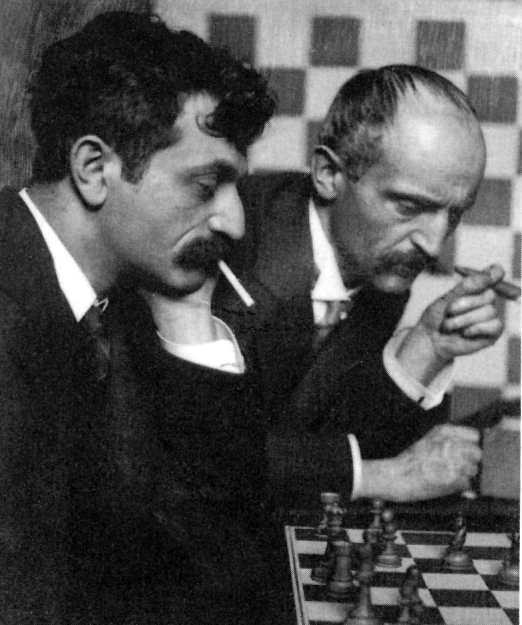
Lasker (left) and his brother

Lasker lost his world title in 1921 to the young Capablanca. There is no doubt that Capablanca was a genius at chess. But it was no so much that Capalanca took the world chess title from Lasker, as it was Lasker gave up the title knowing that Capablanca would win. This may sound like a contradiction, but it seems clear that Lasker had been champion so long and had moved on to other things. He became increasingly interested in the betterment of others and the development of a better world. His humanitarian goals began to outweigh his chess goals. To me this is by far the greater goal than being a chess champion. Though I want my daughter to enjoy playing chess, and if she becomes a great chess player that’s fine to, but I hope that she (and myself) grow to become the kinds of people who love others and seek their good. That is Lasker’s true legacy.


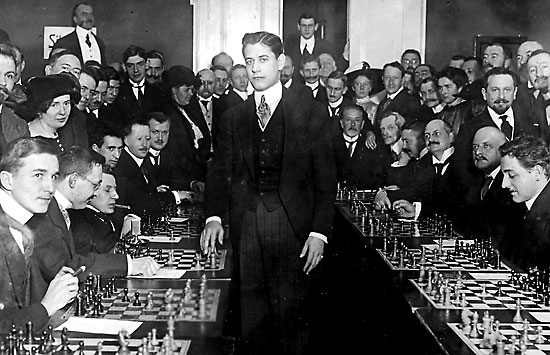
Capablanca giving a simultaneous exhibition

One of Lasker & Capablanca’s great games.

The Chess Player Stripped Bare: Marcel Duchamp (Even)

Chess players are madmen of a certain quality, the way the artist is supposed to be, and isn’t, in general.

~ Marcel Duchamp

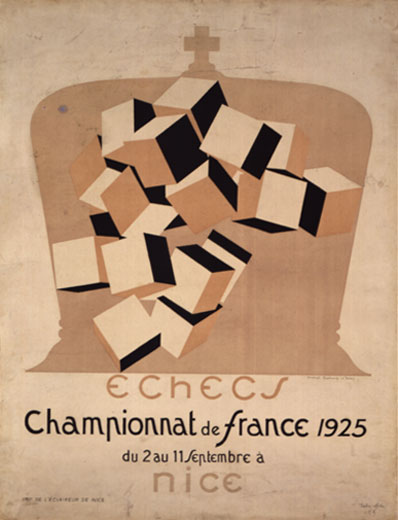
The artist Marcel Duchamp was virtually unmatched in his role in changing the course of art history in the 20th Century. I’m inclined to believe he was even more important, in the long run, than Picasso. Duchamp was brilliant, innovative, avant-garde, challenging, and extremely witty. And yet, at the peak of his art career he decided to walk away from the life of the artist and dedicate his life to playing chess. He was on the French team for the chess Olympiads of 1928-1933. He designed the poster for the French Chess Championship of 1925 (below). He was gaga over chess.

I find it no wonder that Duchamp’s art had such an analytical and intellectual bent. Much of the art that preceded him, like the Fauves and Blaue Rider group, or the French post-impressionists, or even, to some degree, the Futurists, relied on a more visceral and emotional response. Duchamp’s work was emotional, certainly, but he also was a challenger to received ideas, including the very idea of Art itself. He expected the viewer to use her brain as well as her heart as she engaged with the work. Those who took up the challenge were never quiet the same. I find it no wonder that his art was such because I now know of his passion for chess, a game that obviously places demands on the brain, and yet is also an art. Art is an idea, and chess is an art.

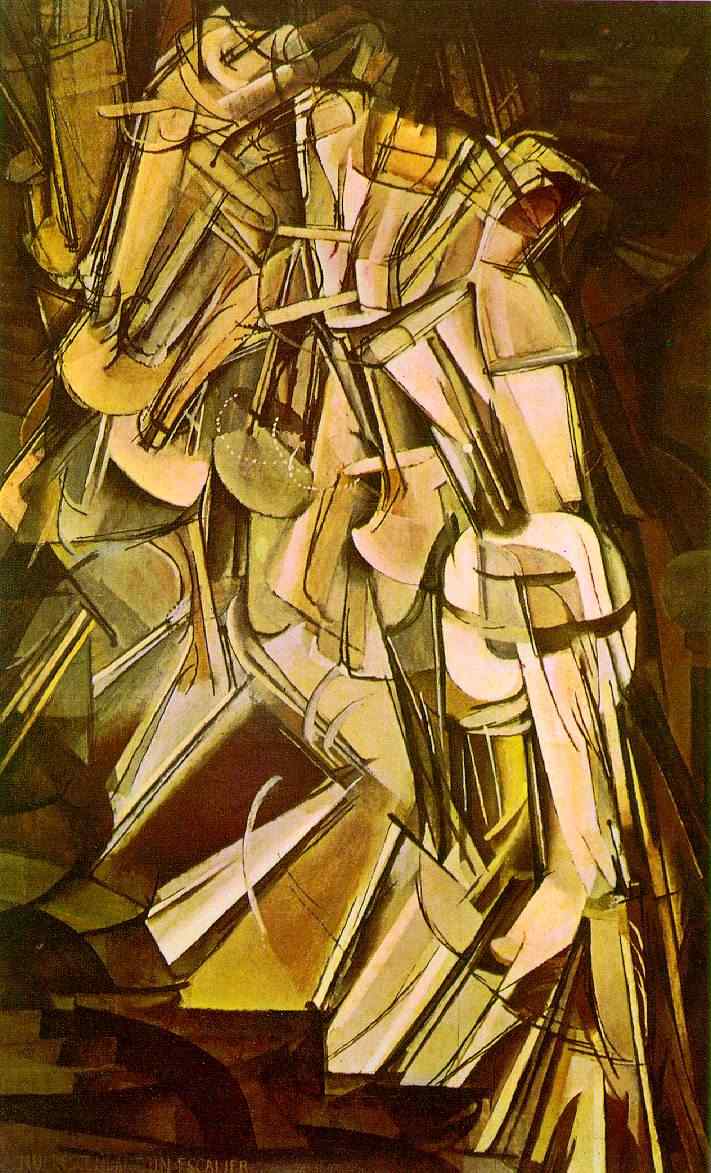
The earliest of Duchamp’s famous works, Nude Descending a Staircase, one sees the intellectual tendency in full. In the same vein as the cubists, Nude Descending calls on the viewer immediately to analysis, and not just of the work as a work, but to what it is doing in the larger context of art.

Later Duchamp to this thrust further with his readymades. With his readymades Duchamp moved art into the almost entirely conceptual. He was moving away from the visual, or “retinal” kind of art, to the mental. “…it was always the idea that came first, not the visual example”, he said, “…a form of denying the possibility of defining art.” (from Wikipedia)

I would argue that Duchamp’s love of chess fueled his interest in the mental aspect of art for two reasons. One: Chess is very much a challenge of the brain, and yet chess has a broad cultural and historical pedigree, like art. Two: I see Duchamp looking at the art world, at the machinations of style and theory and money and self-satisfaction, and he saw all the pieces interlocking like a chess board. I imagine he was looking for that move that puts his opponent back on his heels through cleverness and surprise. Art, even it all its seriousness, is a game. We are still living in the aftermath of how Duchamp envisioned and played that game.


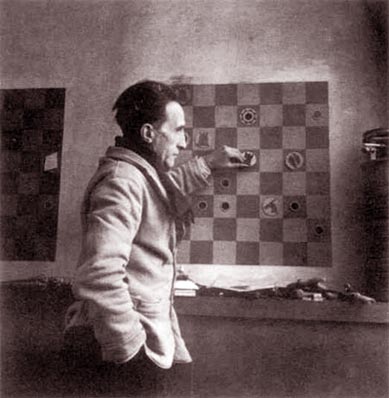
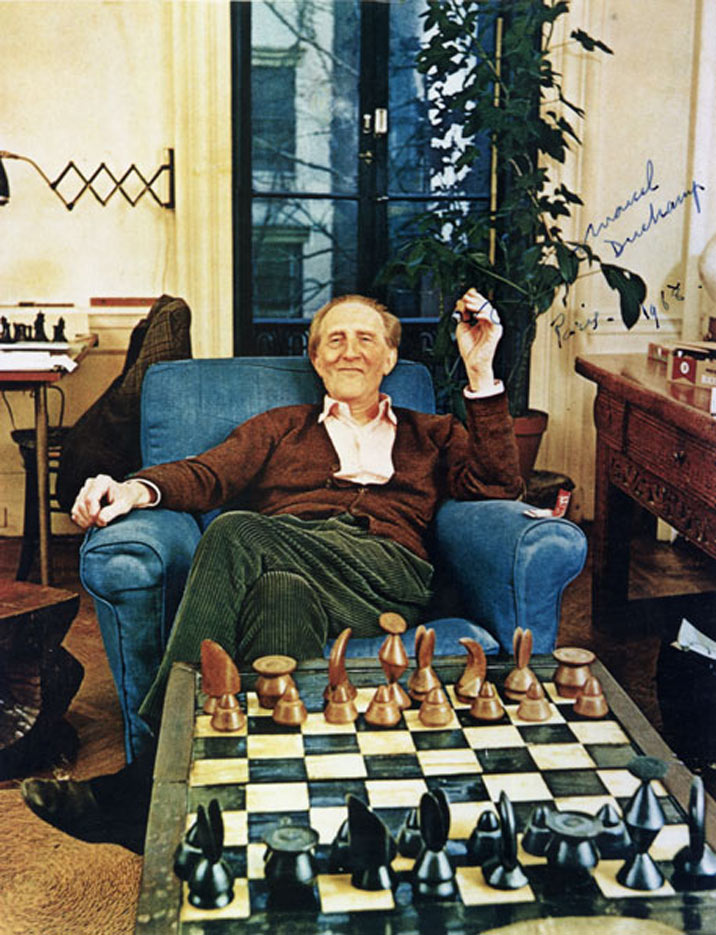
Duchamp, in his later years, smug and happy with his chess set.

>training the brain | teaching the heart

>We homeschool our kids. This is not an easy task. It takes a lot of work and a lot of patience, and most of the burden falls on my wife’s shoulders. As much as I can I try to do my part. One thing I’ve started doing is teaching my seven year old how to play chess. I am not a gifted, or even a good, chess player. And I can’t say I’m that good of a teacher. But I know how the pieces move and I love playing the game. So far my daughter seems to like chess as well.

Chess is one of those interesting mental games that is both fun and educational. Just like playing sports is a more enjoyable way to get exercise than going to the gym, so playing chess is a more enjoyable way to exercise the brain than some other kinds of mind-training.

But all this chess playing has got me thinking: What is the relative value of educating a child from the perspective of well-roundedness versus specification? In other words, is it better to “create” a well-rounded person, or a person with great abilities in a specific area, such as chess or ballet? Why am I asking this question? In part because of my own personal discovery of László Polgár and his daughters Zsuzsa (Susan), Zsófia (Sofia), and Judit, and their incredible abilties at the chess board.

In reseatching this topic I came across this fascinating film clip, which focuses on Susan Polgar. The film provides some insight to the idea of specializing a child’s education and how it affects the brain:

http://video.google.com/googleplayer.swf?docId=-6378985927858479238&hl=en

In general I have always been a fan of the liberal education, and have sought that for myself. But, strangely, I have always been extremely fascinated with the so-called genius. I am amazed by the abilities of the great athlete, the great musician, the great mathematician, the great architect, etc, etc. And very often the genius is not the product of a liberal education, rather a specialized education. Most individuals who achieve some level of greatness in one thing do so by an intense single-mindedness applied over a lengthy period of time in such a way that the rest of us rarely experience. This seems to be true of just about any area of achievement.

Recently I have some across this “magic” number of 10,000. That number refers the amount of hours of practice the typical expert has to do to become an expert. In an article on the Polgar sisters the author cites some important research on the topic of “creating” a genius by Anders Ericsson:

[…]Ericsson is only vaguely familiar with the Polgars, but he has spent over 20 years building evidence in support of Laszlo’s theory of genius. Ericsson, a professor of psychology at Florida State University, argues that “extended deliberate practice” is the true, if banal, key to success. “Nothing shows that innate factors are a necessary prerequisite for expert-level mastery in most fields,” he says. (The only exception he’s found is the correlation between height and athletic achievement in sports, most clearly for basketball and volleyball.) His interviews with 78 German pianists and violinists revealed that by age 20, the best had spent an estimated 10,000 hours practicing, on average 5,000 hours more than a less accomplished group. Unless you’re dealing with a cosmic anomaly like Mozart, he argues, an enormous amount of hard work is what makes a prodigy’s performance look so effortless.

This makes sense to me. When I was an undergrad I knew a young woman who, as a first year student, qualified to be the second chair violinist in the university’s orchestra. She was an amazingly talented violinist. She was also someone with limited social skills, though she was a nice person. I once asked her to tell me what she did for practicing. She said she would go out to an empty room in the back of the building she was living in as a student, set up her music stand, a chair, and a timer. She would stand and practice for exactly 55 minutes, then sit down and rest for 5 minutes, then stand and practice another 55 minutes, etc. This would go on for anywhere between 3 to 6 hours at a time depending on her other schoolwork. She also said that ever since she was a young girl she had always practiced for hours at a time and often her parents would have to curtail how many hours in a day she could practice. In some ways she was socially and interpersonally naive, she also did not convey a sense of much knowledge outside of music, but she was brilliant at violin. After two years at the state university she received a full-ride scholarship to Juilliard.

The simple fact is there are no natural prodigies. All are created through hard work. One hopes that as a child takes on the hard task of practicing something that the child also truly loves the subject at hand and enjoys seeing the results of hard work. But, as I hear the girl in the following video speak I can’t tell if she is happy or not, and I am a little concerned about her social and intellectual life beyond music:

At the same time I know that in many societies parents emphasize their desire for their children to succeed, and in the U.S. parents emphasize their children’s happiness. One is a focus on doing and the other is a focus on being. I don’t know which is better. I do know that I want my children to grow up and be good, that is, of good character rather than merely good at doing something, or even just good mannered. Overarching the question of liberal versus specialization is the fundamental goal that education is primarily about character development rather than knowledge or action.

Another factor is the strangeness of even thinking about raising and training our children to be truly great at one thing. Neither my wife or I grew up in families that had that kind of focus. Sure, there was pressure to do well in school, but neither of us were driven to excel at any one thing the way we witness a few others excelling at what they do. We watch the Olympics, or listen to a concert, or hear about the next youngest chess champion, and we are amazed at the stunning accomplishments of those involved. And then we turn away, possibly assuming that that level of accomplishment is not for us or our kids. I don’t think turning away is necessarily a bad thing, but I wonder if we turn away too easily. I don’t have an answer.

So now we are trying to create the best, well-rounded, liberal education for our children while wondering about the values of specialization. I am going to continue to teach my kids chess, and they will continue to take ballet and swimming, learn math and science, reading and writing, art and history, piano and soccer, and hopefully they will also grow to be good people. My hope is that we will know when we should push and when we should step back. Most importantly, we must keep in perspective the very relative benefits of being great at any one thing. Even the genius has achieved very little if she has a heart of stone.
>teaching my daughter chess (and learning from Karpov)

>I am teaching my daughter how to play chess. She is seven and seems to love the game so far, but I can’t claim to be a good teacher. Chess is a great learning tool on many levels, including for me learning how to teach.

As I study the game I am learning about the great players (but not yet understanding their games in detail). One of those great players is former world champion Anatoly Karpov.

Here Karpov plays against a young chess player and, because Karpov is a good natured person, he gives her some chess tips along the way.

For some reason I love this little home video showing the kindness of the grand master. It reminds me to be kind in my teaching of my daughter. I also wish my daughter could be so lucky to play such a notable player as Karpov. Maybe someday.

>Triumph & Tragedy: Bobby Fischer (1943-2008)

>You have heard by now that former World Chess Champion Bobby Fischer has died. There probably has never been a chess player to generate as much discussion and opinion as Fischer. He was the most controversial of the great chess players, and his life was a case study of genius meets paranoia.

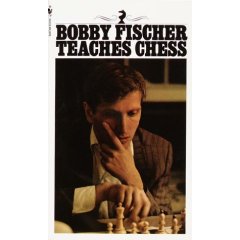
When I was a boy I had a copy of Bobby Fischer Teaches Chess.

This book became a favorite of mine, and Fischer loomed large in my psyche as both a chess player (and all that implies) and as an enigma. I was not a particularly good chess player, but I thought the game was interesting (still do), and I found the end-game puzzles in Fischer’s book very fun.

Fischer’s story is a tragic one in my opinion.


Fischer still remains the youngest ever U.S. Open Champion

The details of Fischer’s life have been well documented. His brilliance in chess is undisputed. But his personal life, especially in the decades since he won the world championship in 1972, spiraled downhill into self-absorbed, narcissistic, anti-semitic, paranoia. He was the kind of person who couldn’t make the distinction between minor and major offenses, every offense to himself was major, and he perceived offenses everywhere. He was a person who never forgot a wrong and saw himself in the victim role often. And he rarely seemed to understand the value of others.

And yet, those who knew him said he was honest and straightforward. Chess players still marvel at his abilities on the chess board. Boris Spassky, whom Fischer beat to win the world championship, remained his friend until the end.

I sometimes wonder if Fischer would have become a more gracious and savvy person if he had finished high school and gone to college. There is something about the process of going to, and finishing, school that stretches and, for lack of a better word, “socializes” a person. I would hazard a guess that the percentage of individuals prone to conspiracy theories and martyr-complexes drops among the more educated. I must admit I say this as someone who has spent a lot of time in college, so I have some personal investment in the matter. I also cannot guarantee that I’m not paranoid.


Fischer discusses chess and life

Without a doubt, in life and in death Fischer’s ghost will continue to loom large in the world of chess. His games will continue to be studied, his life will continue to be debated, and chess will never be the same.


The scraggly Fischer in later years: Never afraid to speak his mind.

History turned on game three of the 1972 World Championship. Fischer lost game one, didn’t show for game two, and many thought he was through. He played brilliantly in game three for his first ever win against Spassky. If he hadn’t won that game history, and Fischer himself, might have turned out differently.

Game three analyzed by kingscrusher at ChessWorld.

No matter how great one is at doing something – chess, sports, the arts, politics, etc. – what matters most is one’s character. Bobby Fischer was great at playing chess. He was lousy at life. More importantly, he harbored a lot of resentment and fear in his heart. I don’t know the reasons why, we all have complicated stories to tell, but I pray for his soul because he was, first and foremost, just a man full of weaknesses like me.