theology and the narrative arts

[In this post I ruminate on the relationship of art to our belief, or absence of belief, in God, god, or gods. As is typical for me, my train of thought is more lurching than steady, and my end goal is more personal than pedagogical.]

Our lenses
I love Pasolini’s seminal filmIl Vangelo secondo Matteo (1964). It is a work of great and simple beauty. It is also a powerful film that flies in the face of the overly sentimentalized and often lifeless versions of Jesus’ life that came before. And yet, Pasolini, though he seems to be taking the story directly from the words on the page (the Gospel of St. Matthew), understands Christ through his own political and personal commitments. In other words, Pasolini, the devout Marxist, unabashed homosexual, and hater of the Catholic Church, saw a Christ that was thoroughly materialist (philosophically) and politically radical (of the socialist ilk).
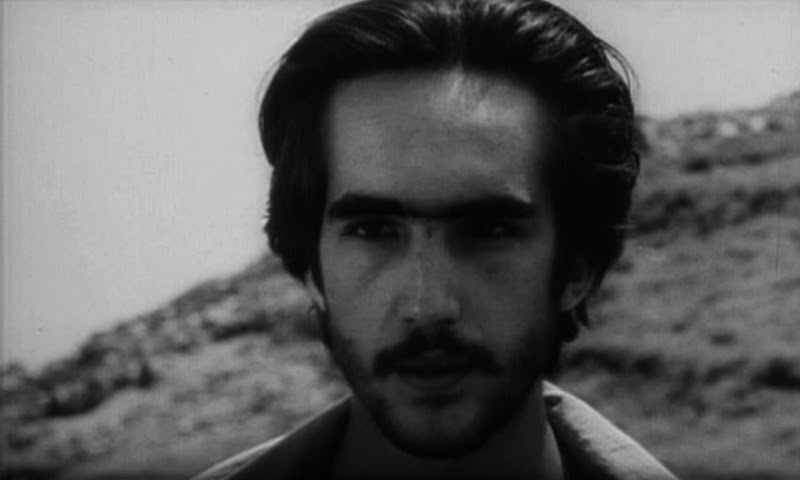

An earthy, socialist Christ
Enrique Irazoqui as Jesus
from
Il Vangelo secondo Matteo (1964)

As I understand it, for Pasolini, Jesus was a kind of pre-incarnate Karl Marx (rather than the incarnate God) who challenged the status quo of his day, and died as the earliest socialist martyr. Pasolini’s belief in the non-existence of God played a big part in how he saw Jesus and why he made the film. In a sense one could say Il Vangelo secondo Matteo is a kind of materialist corrective to the church’s position.

As I said, I love Pasolini’s film, but he got it wrong. I say this because of my own beliefs about God and about Jesus which, though personal on the one hand, I believe are also objectively true. My understanding of God is integral to the set of the “lenses” through which I look at the world. In other words, the difference between me and Pasolini is not really about any of his films, rather our differences go back to our presuppositions about God, truth, and the goals of human existence – even if we may agree on many things, and no doubt I am generally in awe of him as an artist.

Certainly great works of art are not, in our experience, predicated on any particular belief about God.

The God Who Is There
I have been thinking lately (and off and on for a long time) of the role that theology plays, or does not play, in how one approaches watching a film, looking at a painting, listening to a piece of music, or reading a book. So much of what we get out of a work of art comes from what we are able to bring to it, especially what it is we want from that particular work of art, and of art in general. What we want, I believe, is deeply affected by, and even grows out of, whether or not we are convinced of the existence of God, or god, or many gods, or none at all. So much depends on whether we are convinced of some ultimate meaning in the Universe, or whether we believe there is no ultimate meaning. And so much depends on how honest, even ruthlessly honest, we are with ourselves about these issues and their implications.

I use the word theology specifically. The term “theology” is a compound of two Greek words, θεος (theos: god) and λογος (logos: rational utterance). What I am interested in is a reasoned and rational examination of God, not merely of some vague spirituality (but that’s another presupposition isn’t it). What I find critical is the blunt question: Do you (do I) believe in God? How one answers that question has profound implications.

But the question is already on the table. We have inherited it. We can’t get away from it, just as we can’t get away from a myriad of other questions. And how we live our lives, including the art we make, is directly related to our answer. Art is a part of how we live our lives and, in many ways, emerges from the very heart of the matter. This is as true for Pasolini as it is for Spielberg as it is for Tarantino.

Often a work of art has, embedded within it, the answer to the question. Sometimes that answer is obvious. More often the answer is like backstory, a kind of presupposition that sits in the background and informs the art out front, as it were.

Moral Objects
A work of art is, in some ways, a mysterious thing. Like love, we know what art is, but we can’t always nail it down and give it a clear definition and well defined boundaries. Art emerges from deep within our humanness. Every culture and society has organically produced art, that is, art which emerges naturally from withing that culture or society. When I was an art history major many years ago I was introduced to many ancient works of art, via slides of course, like this exciting number:


Seated female, Halaf; 7th–6th millennium B.C., Mesopotamia or Syria
Ceramic, paint; H. 5.1 cm, W. 4.5 c
m
Metropolitan Museum of Art

This little statuette dates from nearly nine thousand years ago. Most likely it is a symbol of fertility. And most likely it was part of the symbolic rites and proto-religious system of that time. Many thousands of figures like this one have been unearthed. This little object speaks volumes about what was important to that ancient culture, like the importance of fertility to agrarian societies, and the importance of sexuality, and the very human need to supplicate before a god for one’s well-being. It also speaks of the human tendency to create symbols and to understand the world in terms of abstractions.

What I find interesting is how ancient and deeply ingrained is the human need to grasp at metaphysical solutions to the everyday muck of life problems, fears, and desires. I also find it fascinating that humans have to make physical objects that express the metaphysical, the ontological, the teleological, etc.

Even the Israelites, who had seen the ten plagues on Egypt, who had witnessed the parting of the Red Sea, who had the pillar of fire and the pillar of smoke in the wilderness, who had seen the walls of Jericho miraculously fall, and who had seen many other wonders of Yahweh, still created the golden calf, and still kept idols of other gods in their houses, and still built or maintained the high places (religious sites on hilltops to worship gods other than Yahweh). Today we have our idols and gods too – witness the way we worship our sports teams, or entertainers, our possessions, ourselves, for example.

Moral Stories
What humans have always seemed to enjoy are stories of moral dilemmas played out in both mundane and fantastical ways. Consider the medieval mystery plays. These were more than merely pedagogical in nature, they were social events that brought people together and incorporated some audience participation, including talking back to the characters during the performance, etc.

I hear that in some movie theaters in other countries (I write from the U.S.) audiences are very vocal and even talk to the screen, as it were, and critique out loud the actions of the characters while the film is playing. Regardless, quiet or vocal, we all seem to gravitate toward the moral. We like passing judgment, we like justice, and, interestingly, we like wickedness too. However, without some kind of absolute from which morality emanates, having a moral opinion is, in final terms, as much comic as it is tragic.
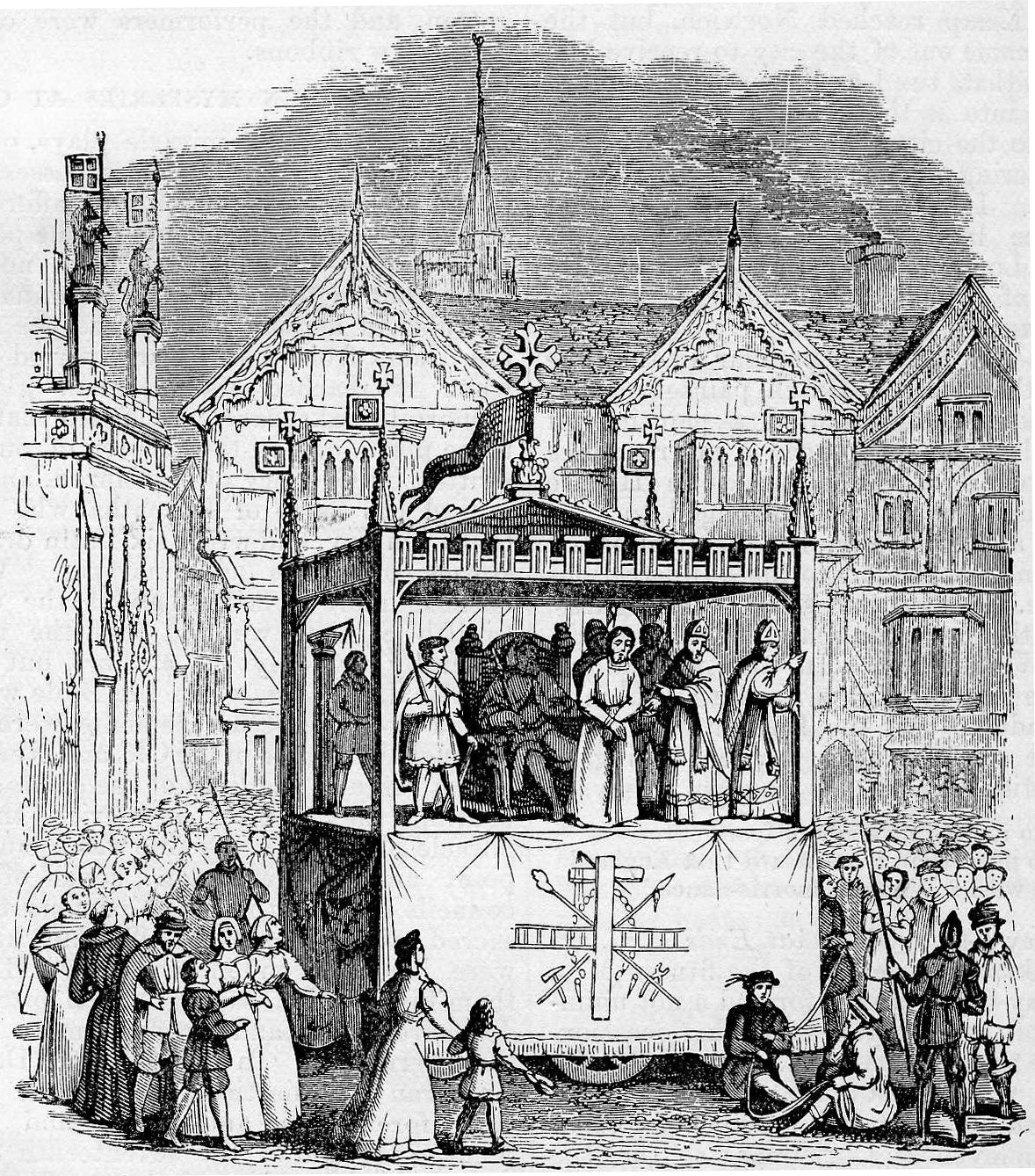

Medieval Mystery Play

So why do we continue to hold moral positions in a morally relativistic and credulistic world? If I had a clear answer I could probably chair some philosophy or psychology department somewhere. My guess, though, is that we will invent an absolute if we can’t find one. In other words, if one doesn’t believe in moral absolutes, or in something big enough (God for example), then one will invent a substitute absolute, for example: an economic or political system, or a biological and physical set of laws, or maybe an absolute that claims there are no absolutes. Regardless, the moral story still digs deep into our souls.

Even the most mundane and vapid kinds of films have some moral content which can be understood within a larger framework of meaning. Consider this audio review of the recent film Tranformers by a pastor at Mars Hill Church in Seattle. (The review is at the end of that post.)

Only Physical, or Metaphysical?
As I take a look at the popular art of today, that is, television shows (i.e. CSI, Survivor, et al) and film (i.e. Michael Clayton, Enchanted, et al), I see worlds presented that do not include God, or any so-called traditional god, that is, a creator deity with whom our destiny lies. These are materialistic worlds, worlds in which stuff is the ultimate reality, no final truth, and no source of meaning. Interestingly, the goals of the characters are all about meaning, and soul searching, and truth.

The characters or contestants are driven forward by things or ideas that they deem important. This is basic story telling. This is fundamental script writing. But it doesn’t make sense if there is no final meaning in the universe, otherwise it’s just a cruel game. Why should we care that someone is searching for something that doesn’t exist? Or even if, for some untenable reason, we do care, why should they search? Consider this quote regarding the modern predicament:

The quality of modern life seemed ever equivocal. Spectacular empowerment was countered by a widespread sense of anxious helplessness. Profound moral and aesthetic sensitivity confronted horrific cruelty and waste. The price of technology’s accelerating advance grew ever higher. And in the background of every pleasure and every achievement loomed humanity’s unprecedented vulnerability. Under the West’s direction and impetus, modern man had burst forward and outward, with tremendous centrifugal force, complexity, variety, and speed. And yet it appeared he had driven himself into a terrestrial nightmare and a spiritual wasteland, a fierce constriction, a seemingly irresolvable predicament.

~Richard Tarnas, The Passion of the Western Mind
What does one do with this? How does one come to terms with a spiritual wasteland, or an irresolvable predicament? Is it so that rational human beings must suffer the conflict of a great desire for meaning in a world that has no ultimate meaning? Is religion an answer or a placebo? No matter what we do we do not get away from these questions. How we solve them, or come to terms with them, is a big deal (or maybe it is also meaningless). My contention is that there is a God, that that God is there, and that that God is knowable. But am I deluded? I don’t think so. And the person who thinks I am deluded believes from a place of conviction as well. I find this more than fascinating.

Michael Clayton

What most recently sparked my thinking about all this God and art stuff was a recent viewing of Michael Clayton. The story in this film plays itself out in a Western (geographically & conceptually), materialistic world where there is no transcendent god. It is a thoroughly modern view of human existence. There are no moral absolutes. And yet, Clayton is a man in search of himself. He is in desperate need of a positive existential moment. He needs to make a self-defining, self-actualizing choice so that he can move beyond his cliff-edge existence and become who he should be. He needs to make the right choice even if it is difficult and painful, even if it means giving up who he has been. There is nothing narratively original in this aspect of the story. It is as timeless as a Greek tragedy.

The story revolves around a legal battle in which a company is being sued for its harmful actions. Arthur Edens (Tom Wilkinson) is the attorney working the case. Unfortunately for his law firm and for his client he is deeply troubled by the case. He feels he is defending murder, in a sense. The firm sends Michael Clayton (George Clooney) to talk with Edens. Part of that conversation goes like this:

Michael Clayton: You are the senior litigating partner of one of the largest, most respected law firms in the world. You are a legend.
Arthur Edens: I’m an accomplice!
Michael Clayton: You’re a manic-depressive!
Arthur Edens: I am Shiva, the god of death
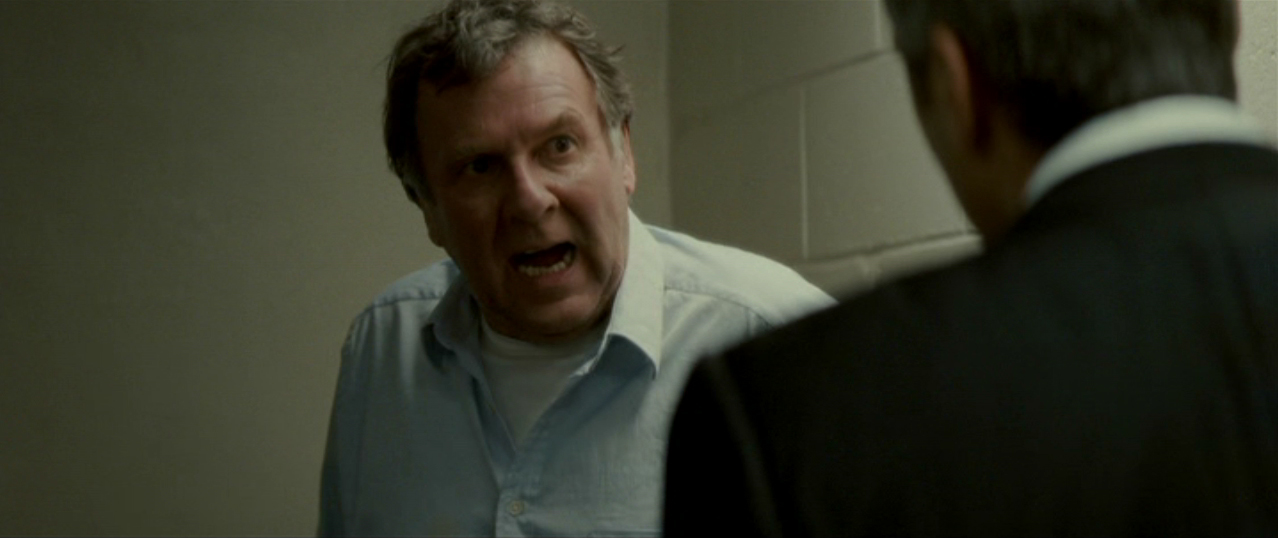

“I am Shiva, the god of death.”

Wow. Where did that come from? Shiva, the god of death? It certainly grabs one’s attention, and it sounds rather cool, but why, in this film, out of nowhere make a reference to one of the principal deities of Hinduism? I say “nowhere” because there is no indication throughout the film that any of the characters believe in any kind of god or religion. In fact, it could be argued that the problem facing all the characters is that, because there is no god, no ultimate reality to which they are finally accountable, they are lost in a sea of moral floundering. Morality becomes personal preference, personal conviction, and power.

Making a reference to Shiva, the destroyer and transformer Hindu god, makes some sense then. First, Edens feels like a destroyer, or at least one who defends the destroyer. He has personal convictions of wrongdoing and it is eating away his soul. Second, in a world personal morality one can choose, as one needs or sees fit, any god that works for the moment, so why not Shiva? Shiva becomes Eden’s god of choice because the concept of Shiva explains his convictions somehow. Shiva is his self-image for the moment. Tomorrow it might be a different god. Maybe Vishnu or Brahma. Or maybe a Sumerian god.

Interestingly the reference to Shiva comes up again. Once Clayton confronts Karen Crowder (Tilda Swinton) with the fact that he has carried out Eden’s plan to expose the company, we get this bit of dialog:

Karen Crowder: You don’t want the money?
Michael Clayton: Keep the money. You’ll need it.
Don Jefferies: Is this fellow bothering you?
Michael Clayton: Am I bothering you?
Don Jefferies: Karen, I’ve got a board waiting in there. What the hell’s going on? Who are you?
Michael Clayton: I’m Shiva, the God of death.


“I am Shiva, the god of death.”

Again it’s Shiva, the god of death, and this time the line is used as a final punctuation to the film’s climax. However, unlike Eden, Clayton uses the line more for its effect on Crowder and Jefferies than from a sense of personal identification. What might that effect be? Within the context of the film, and within the context of a largely non-Hindu society, this line comes as a kind of shock, a non-sequitur of sorts, that specifically draws attention to itself. I imagine the filmmakers intend the line to read something like “I am the fictional, mythological god Shiva (in a metaphorical sense of course) who is bringing about a kind of death to you, a death that you are powerless to avoid.” In other words, we are not to assume that the filmmakers or the characters actually believe in the existence of Shiva, rather the idea of Shiva is appropriated in order to convey something meaningful.

To the person who does not believe in Shiva, such a line might merely have a kind of cool factor. To a devout Hindu this line might be somewhat disconcerting – I don’t know because I am not a Hindu. What is interesting is that none of the characters have made a conversion to any religion, or even gone through any particularly religious experience. Edens has had mental breakdown because of deep moral tensions. Clayton has crossed over into a personally powerful existential decision. But neither have obviously embraced Hinduism. (If I missed something, let me know.)

Interestingly, the narrative arc of Michael Clayton follows a traditional Western style morality tale. And yet, one could say the characters, who do not overtly believe in any god, still wrestle with issues that derive their moral content from a Judeo-Christian heritage, and then, ironically, symbolically claim a Hindu god as justification for their actions. I find this both puzzling and not surprising. It is exemplary of the pluralistic/post-modern society that I live in.

In the film’s final shot we see Clayton riding alone in the back of a taxi. It is a meditative shot. He does not look happy or fulfilled. Maybe he is, but his countenance is rather sullen. Has he saved himself by his actions? Has he found redemption for who he was? How can he be sure he has actually changed as a person? None of these questions are answered. One could say that finally he made the right decision after a life of bad ones, and that is good. But one could say that he still has not solved the deeper question of his existence.

The radical truth is that in a world without a God that stands as an ultimate source of meaning then any decision made by Clayton does not really have any meaning. His final decision, though it may resonate powerfully within us the viewers, doesn’t really matter, no matter how personally, existentially transforming it may be for him. At best one can say he made his decision, so what. Any decision would have had the same value. But, of course, we know deep down that can’t be true. We live knowing there is right and wrong, and what we believe we believe to be true.

Crimes and Misdemeanors
Consider the film Crimes and Misdemeanors, Woody Allen’s brilliant 1989 film about morality, choice, and justice. In this film Allen explores how morality flows from where one begins, that is, from the set of presuppositions one claims about God, the universe, our existence, meaning, etc. He also seriously toys with our expectations (our need) for justice to win out.

The film is also very much about the existence, or non-existence, of God, and what that means. I love this quote from Judah Rosenthal:

I remember my father telling me, “The eyes of God are on us always.” The eyes of God. What a phrase to a young boy. What were God’s eyes like? Unimaginably penetrating, intense eyes, I assumed. And I wonder if it was just a coincidence I made my specialty ophthalmology.

There is something both sinister and humorous about it. It also represents our modern tendency to analyze ourselves and mistrust our motives.

But there is so much more to consider in this quote and in this film. The following two part video analysis is an excellent overview of the film’s themes:

When I first saw Crimes and Misdemeanors I was both stunned and thrilled. At the end I thought “perfect”, that’s how it should end, with him getting away with murder, not because I wanted him to, but because I so expected him to get caught and I liked the irony. Allen turns everything on it head and gets us to think. Thinking is a good thing, especially about truth and morality.

Our view of God has a great deal to do with how we understand and appreciate Crimes and Misdemeanors. If there is no God are the characters and their actions meaningless? Is our desire for justice merely a temporary chemical reaction to a situation that emerged from the chance combination of sub-atomic particles? Or do we live as though our desire comes from someplace more profound?

[Side note: In Star Wars, when the Death Star blows up the planet Alderaan, do we merely observe the rearranging of material particles (something of ultimate inconsequence), or do we assume that blowing up a planet and its inhabitants is an act of evil? Get over it old man Kenobi, you moralist! That was no tremor in the force. Probably just gas.]

Finally

I am inclined to think there is no such thing as a narrative without some moral content.
Either a series of events are purely a-moral, an arbitrary grouping of cause and effect acts without meaning, or they are, in some way, the result of decisions. If decisions are involved then those actions have meaning and therefore have a moral dimension. I see narrative as being fundamentally the result of decisionsand therefore fundamentally moral.

But as soon as well make a moral claim we assume an absolute. We might say our claim is purely cultural or situational or merely a personal decision, but we don’t really live that way. When we say war is wrong, or rape is wrong, or Nazi death camps are wrong, we assume a universal. And if we claim universals then what is our foundation? This is the very point at which our belief or non-belief in God, god, or gods, has the most gravity.

Woody Allen leaves the question open in Crimes and Misdemeanors, but he is relying on the fact that we cannot. He creates in us a tension, and something to talk about. Michael Clayton leaves us somewhat satisfied, yet under its surface there is no final meaning, its only opinion. What is great about both of these films is how they tap into the very human predicament of having to sort out the deep questions of how we are to live our lives and upon what are we going to base our choices.

I can be in awe of an artist even though our beliefs about God may differ. What we have is a common humanity, which is a truly profound connection. Even so, it is worth calling out our differences as well, not for the sake of creating divisions, but of understanding each other and seeking the truth. For we are, by nature, truth seekers. But then that’s another universal I am claiming.
100 Spiritual Films

When I was a boy I went to a summer camp that was run by the Baptist church of which my family was a part. At that camp I saw the famous/infamous Christian exploitation (christploitation?) film A Thief in the Night (1972). I say exploitation film for two reasons: (1) the film has that kind of low-budget, relentless, somewhat campy style one finds in other exploitation films, and (2) the film clearly falls into the category of the “scare them to Jesus” works of “art.” Certainly I was a scared little boy. For years I was haunted by that film. Fortunately I have grown up and only carry the scars.

When I was in college I lived in a couple of different co-op living places (20-25 students, loosely managed, trying to get along, etc.). I remember some of the the best times were watching great films and then having long discussions after. What I discovered during that time was the spiritual nature and power of films. A power, and I should say truth, significantly deeper and more profound than with films such as A Thief in the Night. In particular, I remember some great discussions around Grand Canyon (1991), Mindwalk (1990), Henry V (1989), The Last Temptation of Christ (1988), and Drugstore Cowboy (1989).

Recently I came across the Art & Faith forum site and noticed the biggest category of discussion centers around film. They even have a Top 100 Spiritual Films list, which I have reproduced below. The link for each film will take you to the Art & Faith write-up of that film. As one would expect from a Christianity-based site called Art & Faith, there are some particularly “christian” films, like the obvious films about Jesus and saints (some of which are excellent – Pasolini’s version of the Gospel story, for example). But there are also some films one might not expect, like those by Kieslowski, or by Rossellini, or films from Japan, etc. For me, I don’t see any contradictions, but for some Christians this list might be a bit of a shock. That is one reason I list the Top 100 Spiritual Films list here:

1 Ordet (aka The Word)
2 Le Fils (aka The Son)
3 The Miracle Maker (aka The Miracle Maker: The Story of Jesus)
4 The Gospel According to Matthew (aka Il Vangelo Secondo Matteo)
5 The Diary of a Country Priest (aka Le Journal D’un Curé De Campagne)
6 The Passion of Joan of Arc (aka La Passion De Jeanne D’arc)
7 The Decalogue (aka Dekalog)
8 Babette’s Feast (aka Babettes Gæstebud)
9 A Man Escaped (aka Un condamné à mort s’est échappé ou Le vent souffle où il veut)
10 Andrei Rublev (aka Andrey Rublyov)
11 Balthazar (aka Au Hasard Balthazar)
12 The Seventh Seal (aka Det Sjunde Inseglet)
13 Ikiru (aka To Live)
14 Winter Light (aka Nattvardsgästerna)
15 The Mission
16 The Apostle
17 Three Colors Trilogy
18 Jesus of Nazareth
19 Jesus of Montreal (aka Jésus De Montréal)
20 The Flowers of St. Francis (aka Francesco, giullare di Dio)
21 Dead Man Walking
22 Stalker
23 Magnolia
24 La Promesse
25 Sunrise: A Song of Two Humans
26 Tender Mercies
27 A Man for All Seasons
28 Wings of Desire (aka Der Himmel über Berlin)
29 Day of Wrath (aka Vredens dag)
30 Yi Yi: A One and a Two (aka Yi yi)
31 The Hiding Place
32 Wild Strawberries (aka Smultronstället)
33 Rosetta
34 After Life (aka Wandafuru raifu)
35 The Sacrifice (aka Offret – Sacrificatio)
36 To End All Wars
37 Chariots of Fire
38 Shadowlands
39 The Big Kahuna
40 Not of This World (aka Fuori dal mondo)
41 Schindler’s List
42 Millions
43 The Straight Story
44 A Taste of Cherry (aka Ta’m e guilass)
45 The Passion Of The Christ
46 Becket
47 Wit
48 Open City (aka Roma, città aperta)
49 Nazarin (aka Nazarín)
50 Secrets & Lies
51 Romero
52 Places in the Heart
53 It’s A Wonderful Life
54 Ponette
55 Les Misérables
56 Luther
57 Tokyo Story (aka Tokyo Monogatari)
58 Hell House
59 Breaking The Waves
60 Crimes And Misdemeanors
61 To Kill a Mockingbird
62 The Mirror (aka Zerkalo)
63 The Last Temptation Of Christ
64 The Gospel of John
65 Hotel Rwanda
66 Fearless
67 Solaris (aka Solyaris)
68 The Night Of The Hunter
69 Cries and Whispers (aka Viskningar och rop)
70 Stromboli
71 Stevie
72 Dogville
73 My Night at Maud’s (aka Ma nuit chez Maud)
74 Black Robe
75 Close-Up (aka Nema-ye Nazdik)
76 The Apu Trilogy
77 Werckmeister Harmonies (aka Werckmeister harmóniák)
78 Waking Life
79 Koyaanisqatsi (aka Koyaanisqatsi – Life Out of Balance)
80 Peter and Paul
81 13 Conversations About One Thing
82 The Sweet Hereafter
83 Dersu Uzala
84 Trial of Joan of Arc (aka Procès de Jeanne d’Arc)
85 Summer (aka Le Rayon vert)
86 Fiddler on the Roof
87 The Bicycle Thief (aka Ladri di biciclette)
88 The Year Of Living Dangerously
89 Money (aka L’Argent)
90 The Elephant Man
91 Faust
92 Molokai: The Story of Father Damien
93 A Moment of Innocence (aka Nun va Goldoon)
94 Jean de Florette / Manon of the Spring (aka Jean de Florette / Manon des Sources)
95 Sansho the Bailiff (aka Sanshô dayû)
96 Lilies of the Field
97 The Wind Will Carry Us (aka Bad ma ra khahad bord)
98 The Addiction
99 The Song of Bernadette
100 Tales of Ugetsu (aka Ugetsu monogatari)

I have not seen all the films of this list, in fact there are a lot I have not seen. But I will say that the ones I have seen are all great for those late-night discussions around the core issues of living and being human. And some of the films offer great opportunities to discuss the power of art and film – as a kind of bonus. In general, I think this is a great list.

>little boats & troubled dreams

>I am drawn to mystery.


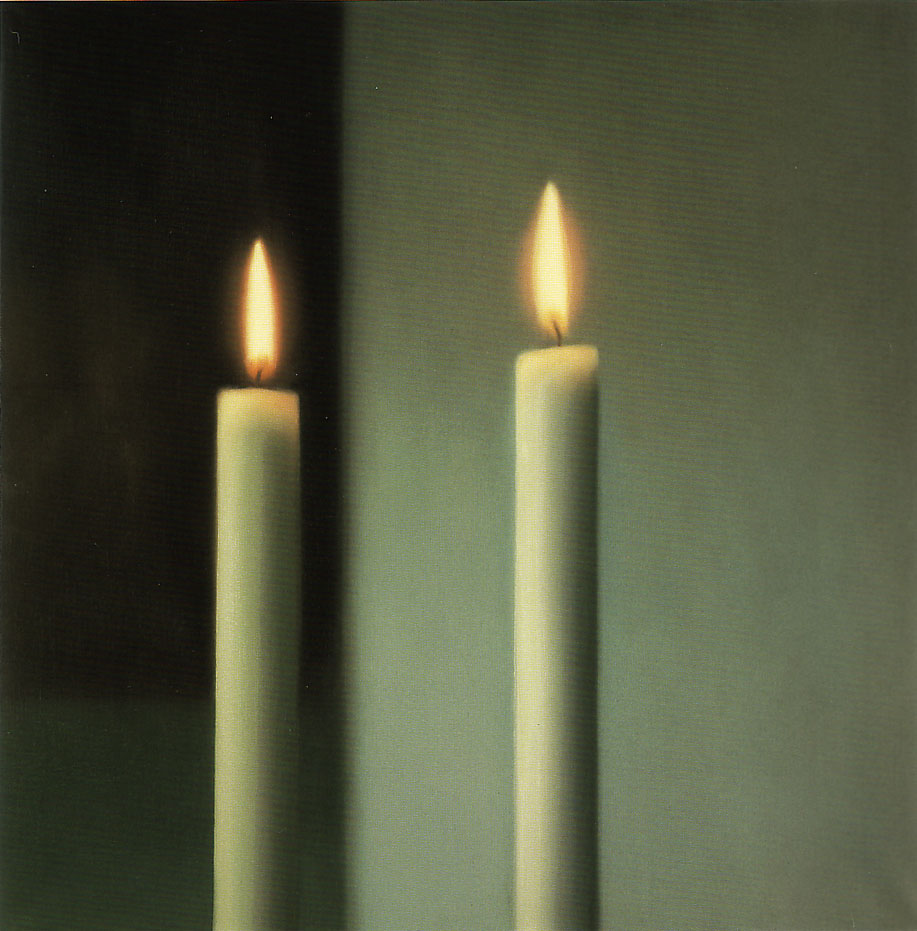
Gerhard Richter Two Candles 1982 Oil on canvas
55 1/8″ x 55 1/8″ (140 x 140 cm) Private collection

I have often wondered what it is about films that I love so much, and what it is that draws me towards particular films. I believe that the kinds of films one seeks out and enjoys is directly related to why one watches films in the first place. In other words, for some watching films has everything to do with lighthearted, end-of-the-day escapism. For others it may be a kind of testosterone drug fix. And for others it might be some kind of romantic battery re-charging. And, of course, for most of us it is a combination of many reasons. But I have to say that over and over I find myself seeking certain kinds of films and certain kinds of films experiences. Much of the time these experiences, at least the ones that stay with me long after the immediate viewing is over, are what I might call earthily transcendent, or sublime. Another way of saying it might be the more one digs into the realities of life, death, love, and suffering, the more one keeps coming up against mystery. This mystery is not a Gnostic sort of knowledge only for a select few, only for those with the “secret knowledge,” rather the mystery is there for everyone to experience and contemplate; it is fundamentally human.

Some might say this mystery is the experience of getting a kind of translucent glimpse of the hand of God creating everything, including us, moment by moment. Others might say it is the place where the limits of reason and emotion converge at a kind of metaphysical precipice. Or it could be the place where one has the feeling of overshooting one’s rationality only to discover rationality is a bigger thing than one previously imagined. And maybe, finally, the goal is about arriving where one started and knowing that place as though for the first time.


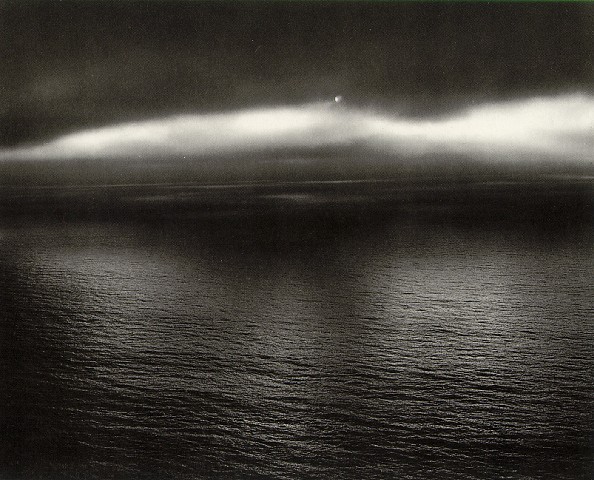
What fascinates me is the ability of artforms, in particular cinema, but also poetry, photography, music, etc., to evoke mystery. Some examples for me include the painting by Gerhard Richter at the beginning of this post and the photograph below by Minor White. But there really are countless examples. Why is it that certain images can bring about deep, almost indescribable emotions from within my soul?
Minor White Pacific, Devil’s Slide, California 1947

In my opinion a great example of a film that does this for/to me is Tarkovsky’s Andrey Rublyov (1969). There are so many powerful images from that film, and so many moments that produce powerful feelings that I will just encourage watching or re-watching the film. This post is not a review of Rublyov. My point is to say that art works can evoke strong feelings of mystery that seem to point to more important aspects of human existence, but do so via a kind of internal mystery, a mystery inherent within art itself. Again, that mysteriousness one finds in certain films is one of the powerful cinematic draws for me.

I am troubled, I must say, at trying to explain this sense of mystery in art. I have come to believe, however, that maybe it arise from the tension between life and death, and the reality that life comes from death. In art we often refer to beauty. But what is beauty and does it have a place anymore in art? As a kind of doorway to an answer, I like this quote from an interview with Andrei Tarkovsky about his, as then yet to be made, film Andrey Rublyov:

I am not going to say anything directly about the bond between art and people, this is obvious in general and, I hope, it’s obvious in the screenplay. I would only like to examine the nature of beauty, make the viewer aware that beauty grows from tragedy, misfortune, like from a seed. My film certainly will not be a story about the beautiful and somewhat patriarchal Rus, my wish is to show how it was possible that the bright, astonishing art appeared as a “continuation” of the nightmares of slavery, ignorance, illiteracy. I’d like to find these mutual dependencies, to follow birth of this art and only under those circumstances I’d consider the film a success. (from Nostalghia.com)

Maybe it is only through suffering that mystery in or through art appears. I don’t know.
If I could point to an artwork that, at least for me, offers one of the best examples of the mystery of art, the feeling of mystery in the receiver of that art work, and also describes the feeling of overshooting one’s rationality or coming into contact with some kind of cosmic mystery, it would be from a tiny section from William Wordsworth’s great autobiographical poem, The Prelude. The first time I read this section I was floored. I continue to be floored each time I read it, but I also recognize that my response is a personal one. And so will be yours.

One summer evening (led by her) I found
A little boat tied to a willow tree
Within a rocky cave, its usual home.
Straight I unloosed her chain, and stepping in
Pushed from the shore. It was an act of stealth
And troubled pleasure, nor without the voice
Of mountain-echoes did my boat move on;
Leaving behind her still, on either side,
Small circles glittering idly in the moon,
Until they melted all into one track
Of sparkling light. But now, like one who rows,
Proud of his skill, to reach a chosen point
With an unswerving line, I fixed my view
Upon the summit of a craggy ridge,
The horizon’s utmost boundary; far above
Was nothing but the stars and the grey sky.
She was an elfin pinnace; lustily
I dipped my oars into the silent lake,
And, as I rose upon the stroke, my boat
Went heaving through the water like a swan;
When, from behind that craggy steep till then
The horizon’s bound, a huge peak, black and huge,
As if with voluntary power instinct,
Upreared its head. I struck and struck again,
And growing still in stature the grim shape
Towered up between me and the stars, and still,
For so it seemed, with purpose of its own
And measured motion like a living thing,
Strode after me. With trembling oars I turned,
And through the silent water stole my way
Back to the covert of the willow tree;
There in her mooring-place I left my bark,–
And through the meadows homeward went, in grave
And serious mood; but after I had seen
That spectacle, for many days, my brain
Worked with a dim and undetermined sense
Of unknown modes of being; o’er my thoughts
There hung a darkness, call it solitude
Or blank desertion. No familiar shapes
Remained, no pleasant images of trees,
Of sea or sky, no colours of green fields;
But huge and mighty forms, that do not live
Like living men, moved slowly through the mind
By day, and were a trouble to my dreams.
from The Prelude
William Wordsworth
first published in 1850

I can think of no better way to express why it is I am drawn towards some kinds of films more than others, why it is I love the mystery of art, and why it is I come away from some films with the film still burning in my soul.

Cinema Sublime: considering contemplative cinema’s relationship to the infinite

Okay, the contemplative cinema blogathon is voodoo. I mean, I have been thinking about it too much when I should be working on my thesis. Bad, bad, bad. So here are more of my thoughts:

Contemplative cinema seems to have certain aesthetic traits. An excellent overview of the most obvious traits can be found at The Listening Ear: Defining Contemplative Cinema (Bela Tarr). I have also tried to triangulate somewhat on the traits with these posts on “Art Cinema” Narration: Part One, Part Two, and Part Three. Then I tried, somewhat unsuccessfully, to describe the distancing aspect of contemplative cinema by way of contrast here. And finally, I tried, feebly, to find some links to 20th century painting and contemplative cinema here. In some ways I feel my posts have only been scratchings at the surface and not really getting at the heart of the matter. I anticipate this post will also add to the scratching. Probably because I do not see a “solution” to the question of contemplative cinema, merely a myriad of signifiers in an ever expanding galaxy of meaning.

I firmly believe that contemplative cinema is not the sum of a set of unique traits – the long shot, narrative in the background, etc. – although there certainly are unique traits. Contemplative cinema must, I believe, come from a set of ideas – loosely organized and very arguable for sure. What those ideas are is too big of a topic for this post, but I have an idea that the ideas behind and underneath contemplative cinema are complex, very human, and have deep roots planted long before cinema was born.

Here’s just one possible approach to one kind of contemplative cinema.

The concept of the sublime and contemplative cinema
In the 17th and 18th centuries our (richer) predecessors trudged through Europe on their grand tours seeking that fullness of experience that would round out their lives and, if young, complete their educations. When confronted with the awesome grandeur of the Swiss Alps, these trekkers gaped in fearful admiration at nature’s terrifying and beautiful power. Trying to give name to the strange and conflicting experience of fearfulness and mutual attraction, philosophers gave it the name “sublime,” and then set out to argue about it from then until now. Edmund Burke and Emmanuel Kant both dove masterfully into the subject, but it is Schopenhauer who may have clarified it best for us when he listed off the stages of going from mere beauty to the fullest feeling of the sublime (taken from Wikipedia):

Feeling of Beauty – Light is reflected off a flower. (Pleasure from a mere perception of an object that cannot hurt observer).

Weakest Feeling of Sublime – Light reflected off stones. (Pleasure from beholding objects that pose no threat, yet themselves are devoid of life).

Weaker Feeling of Sublime – Endless desert with no movement. (Pleasure from seeing objects that could not sustain the life of the observer).

Sublime – Turbulent Nature. (Pleasure from perceiving objects that threaten to hurt or destroy observer).

Full Feeling of Sublime – Overpowering turbulent Nature. (Pleasure from beholding very violent, destructive objects).

Fullest Feeling of Sublime – Immensity of Universe’s extent or duration. (Pleasure from knowledge of observer’s nothingness and oneness with Nature).

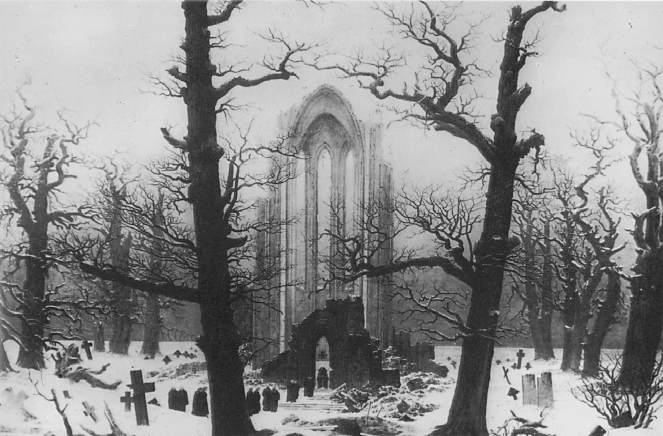
For examples in painting we might look at Caspar David Friedrich’s Cloister Cemetery in the Snow (1817-1819)…


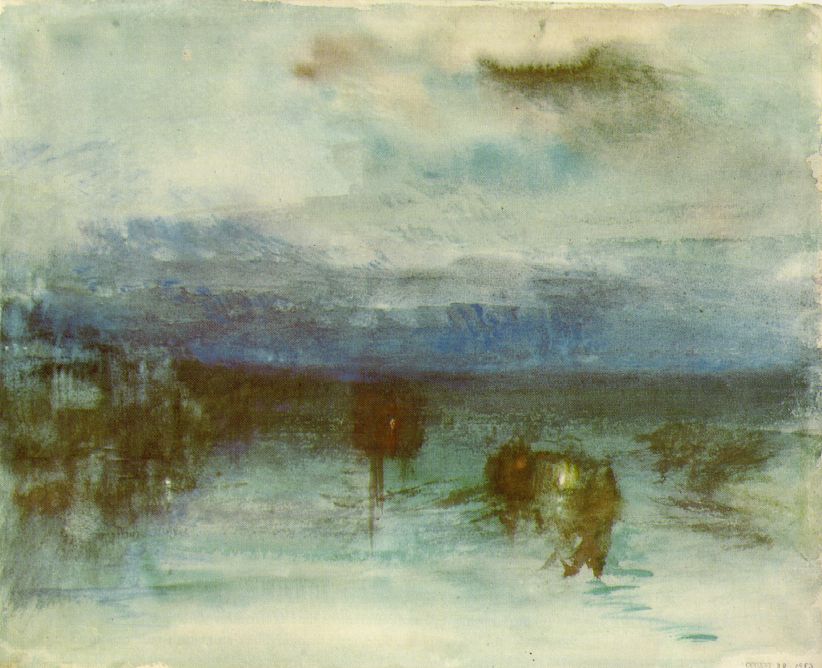
…or at JMW Turner’s Moonlight (1840)

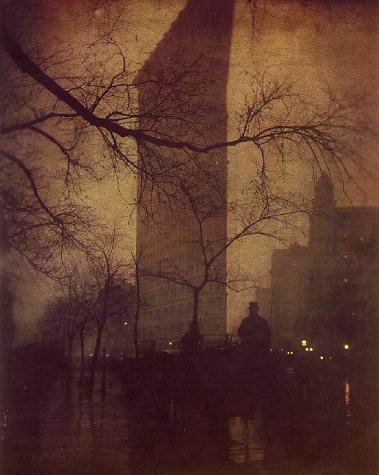
In photography we might consider Edward Steichen’s The Flatiron (1905)…

…or Minor White’s Pacific, Devil’s Slide, California (1947)


I believe we can use these examples from other arts as part of the groundwork in understanding how the sublime might function within contemplative cinema.

Prior to the 20th century the sublime was found mostly in nature, which, for all its potential danger, is fundamentally morally neutral. But in the 20th century unimagined horrors were foisted on humankind – trench warfare in WWI, the Nazi genocide of European Jews, the atomic bombs dropped on Japan, and the list continues. I would argue that a shift occurred in the concept of the sublime to include the fact that human beings commit such horrors, both consciously and subconsciously, and that that inclusion has had a significant affect on the arts including cinema. In other words, one could extend concepts of turbulent nature, overpowering turbulent nature, and the immensity of the universe’s extent to the apparently overpowering aspects of human desire, the power of technology, and human evil. A fully engaged response to this reality could include a scientific approach where one just has to face up to the emptiness of human existence in a world created by time + matter + chance, or it could explore the soul as though on a sea of meaning both frightening and hopeful.

What I am saying is nothing new. However, I think the modern concept of the sublime, with its roots going back to 17th century, may offer pointers towards an understanding of contemplative cinema. For example, it is obvious the Bergman’s The Silence or Resnais’ Hiroshima mon amour are artistic explorations of a human response to the modern world from within a position of the nihilistic universe, but a more sublime film, such as Tarkovsky’s Stalker, might address the same concerns, but from a different vantage point. I would argue that that vantage point is not the scientific perspective of the individual in a cold universe, but the soul in relation to the infinite. This is not to say the Bergman or Resnais (in these examples) did not make contemplative films, but they do so by rooting the viewer in the narrative process and therefore in a materialistic world. I propose a sublime contemplative film calls the viewer beyond the narrative – and to me this seems to be a higher level of contemplation.

Another angle on the sublime might be:
The experience of the sublime involves a self-forgetfulness where personal fear is replaced by a sense of well-being and security when confronted with an object exhibiting superior might, and is similar to the experience of the tragic. The “tragic consciousness” is the capacity to gain an exalted state of consciousness from the realization of the unavoidable suffering destined for all men and that there are oppositions in life that can never be resolved, most notably that of the “forgiving generosity of deity” subsumed to “inexorable fate”. (also taken from

Wikipedia )

In this sense the sublime is an almost religious concept – one might think of the concept of fearing God (a combination of love, reverence, and trembling), for example. A contemplative film which has its roots in the sublime might then call on the viewer to transcend narrative construction (mentally speaking) in order to enter into a feeling of the “tragic consciousness” of the universe, and thus transcend narrative climax. The potential issue with this way of thinking, however, is the reality that the viewer’s response is personal, which is unique for each viewer. That is why I cannot go so far as to say the characteristics of contemplative cinema are a set of particular visual or narrative cues. But there may be characteristic goals.

Does it make sense to see contemplative film, then, as primarily non-narrative? One might consider Love Song (2001) by Stan Brakhage, an abstract, undulating, “hand-painted visualization of sex in the mind’s eye.” No doubt this short, purely abstract film seeks to produce an effect within the viewer. No doubt it calls of the viewer to be open to exploration of the self in some capacity. But what can we really say about it? In my opinion, sublime contemplative film still needs something more tangible to hang on to, and part of that tangibility is narrative, even while seeking to transcend narrative.

Love Song (2001)


Of course, a question raised by considering a film such as Love Song is whether or not sublime contemplative cinema succeeds by accurately representing something that is already sublime, or whether by using cinematic means, however so, to induce a feeling of the sublime in the viewer.

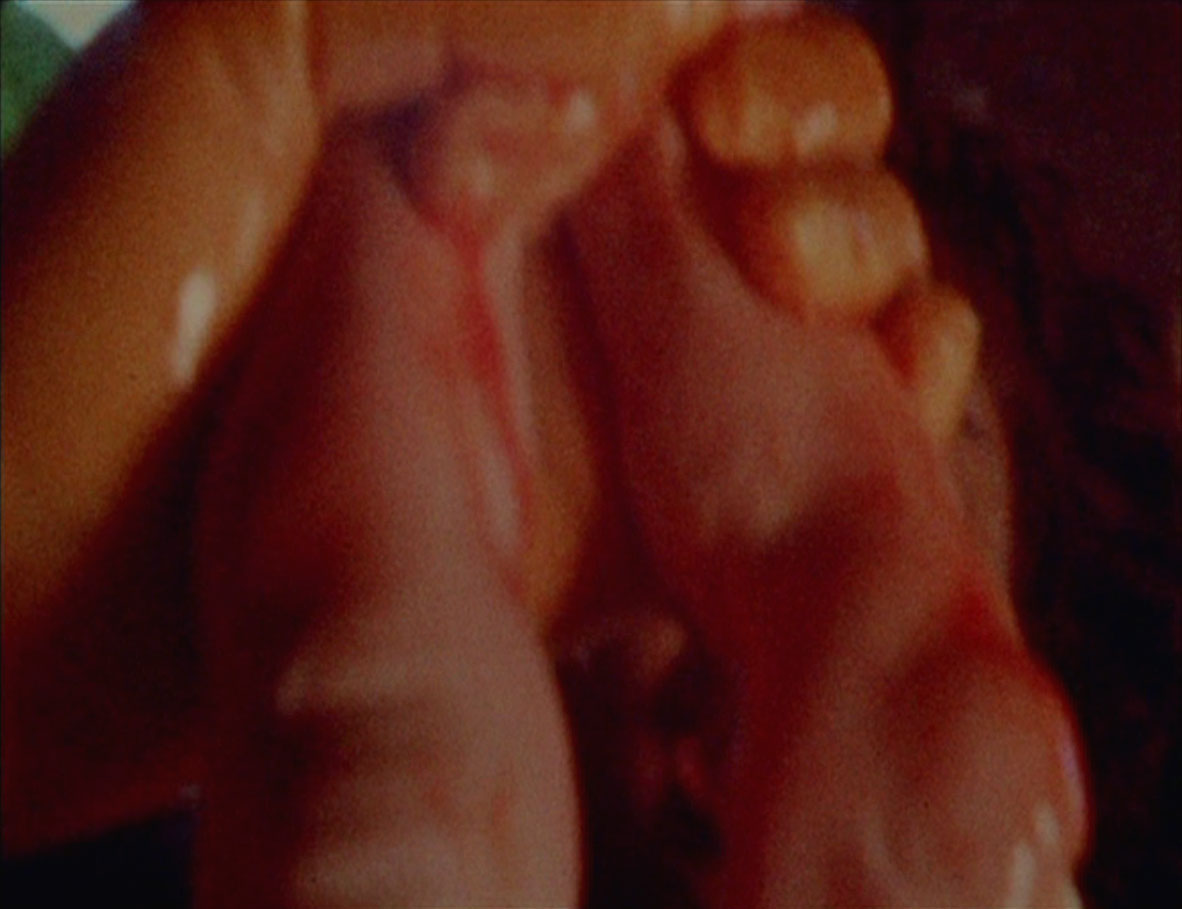
A better option may be to consider another Stan Brakhage film, Window Water Baby Moving (1962). In this powerful short film about the birthing process there is the natural narrative of the birth. Although told unconventionally, there is enough of a narrative, and just enough balance between abstraction and reality, that one can “enter” into the film more fully. This entering process then allows the transcending process to be more substantial, that is, it seems more likely that the viewer will end up in a different place at the end than at the start, psychologically and spiritually speaking. The sublime nature of the piece shines through in the combination of the beauty of body, life, and love with the graphic intensity of actual birth in bloody closeup.

Window Water Baby Moving (1962)

Interesting, Window Water Baby Moving is constructed via the often rapid juxtaposition of many different images, and thus potentially subverts the idea that contemplative film is necessarily and characteristically made of lengthy shots in which very little action takes place.

Finally, a cinema of the sublime is not a genre or style or even a set of aesthetic choices so much as it is a particular attitude to the place of human beings in the universe. How this plays out in the arts can be varied and fascinating. I believe the concept of contemplative film includes the concept of the sublime whether is is of primary emphasis or resides in the background. I’m sure much more can be said, but I will leave it there.

“Art-Cinema” Narration: Part Two

This is part of a three-part posting taken from a brief lecture I gave during a film class.

“Art-Cinema” Narration

Part Two: The Background
In order to understand art-cinema narration, and the underlying post-Enlightenment project, one needs to grasp the historical and philosophical pressures that gave it birth.

The coming of the 20th Century, bringing with it so many new technological changes, and dragging along with it the those 19th Century harbingers of new ideas: the industrial revolution, Darwin, Marx, and Freud, seemed, in many people’s minds, to have changed everything.

The path of the 20th Century, with the devastation of the First World War, the horror of the Holocaust, both the reality and threat of nuclear weapons, and the waning of Christianity in the West, gave impetus to new challenges. Human beings now struggled with the loss of God, of place, of self, of truth, even of time thanks to Einstein. This has been called, amongst many other things, the “crisis” of modern man. It is also, as some have said, the burden of freedom.

Dostoyevsky pointed this out, when he wrote in the Bothers Karamazov, that if there is no God then everything is permitted. Some saw this as their salvation, some saw it as their undoing.

People began to question everything once taken for granted and to see life as much a struggle to find oneself, to understand the nature of love and sexuality, to discover meaning, and to mourn the evaporation of Truth, as it is a struggle over the more common difficulties of living – like saving the world or saving the farm. In fact, it all gets turned on it head so that saving the farm (and even saving the world) seems so trivial compared to the inner turmoil now plaguing modern man. Why bother with saving the farm if you can’t even save yourself?

The questions, as really they have always been, are:
“Who are you?”
“Why do you exist?”
“Where is you hope?”

Of course, it’s not all doom and gloom, at least in terms of how people live their lives. There are still a lot of life affirming choices people make, but underlying it all, especially from a Christian perspective, is a great sense of loss and uncertainty.

And of course, from a Christian perspective, the problems of human beings are not ultimately the result of mere historical forces, but arise from the deeply profound tensions between being made in the image of God (and all the glory that that means) and being burdened and affected by the corrupting nature of our inherent sinfulness (and all the difficulties that that means).

Cinema, then, confronted these changes and perspectives by challenging conventional wisdoms of narrative structure and subject matter. Art-cinema narration can then be understood as a response to a post-industrial, post-Christian, post-Enlightenment world.