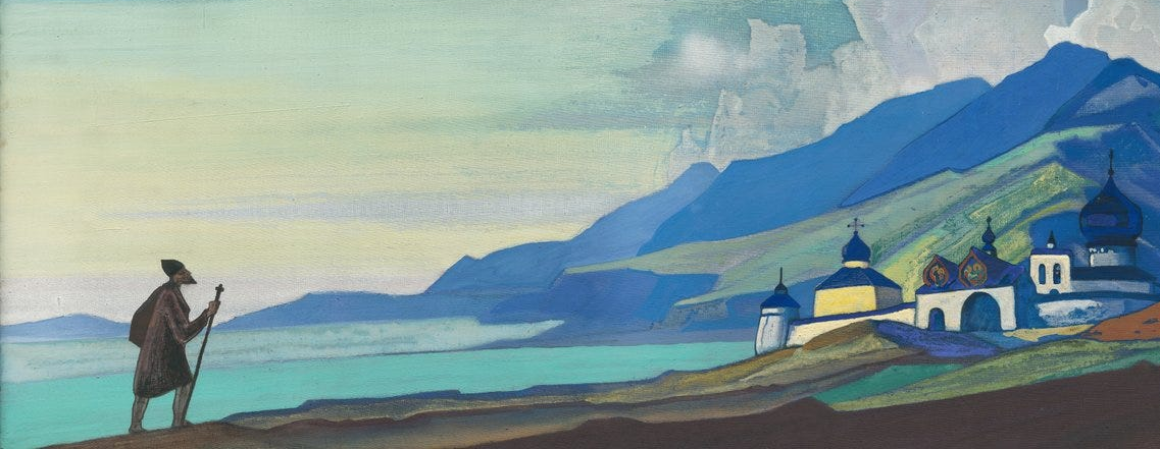
>I hope I shall not forget from where we Americans have come when I look at where we are and where we as yet might be.
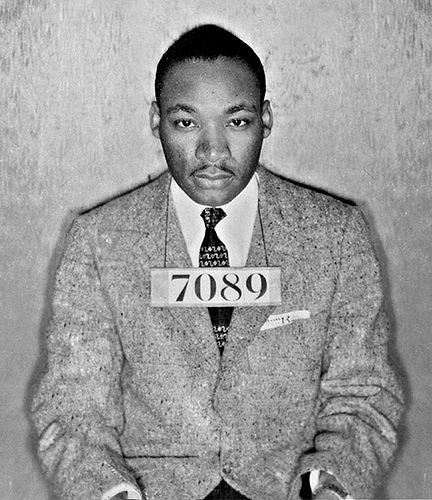
Have a great Dr. Martin Luther King Jr. day and a wonderful inauguration eve!
>I hope I shall not forget from where we Americans have come when I look at where we are and where we as yet might be.
Have a great Dr. Martin Luther King Jr. day and a wonderful inauguration eve!
Andrew Newell Wyeth (July 12, 1917 – January 16, 2009)
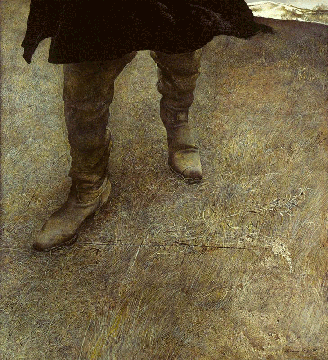
Trodden Weed, 1951 tempera on panel.
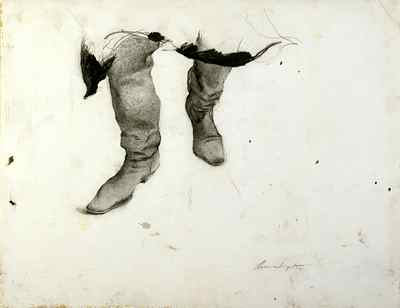
Drawing for Trodden Weed
>I am fascinated by what the world is thinking about the outcome to the U.S. presidential election. There have been many reports of people celebrating from around the world, which is rather amazing. Those celebrations should remind us of how important the U.S. and it’s foreign policies are to people everywhere. I find it both remarkable and sobering.
There are also concerns from various quarters. Does an Obama presidency truly mean change? What about the Palestinians when Obama selects a hard-line Zionist as his chief of staff? Is he really going to end the war in Iraq or develop diplomatic ties with Iran? Is it even possible to fulfill those promises? Below is a four part discussion from Al Jaeera that looks at U.S. foreign policy, Obama as president, and the future from the outside. I found it fascinating and worth taking the time to watch.
Part 1
Part 2
Part 3
Part 4
>There are so many things that can be said about any election and this one in particular. Now that the dust has settled slightly and Obama is putting together his cabinet and planning the transition it is worth stepping back a bit, look at the sweep of history, and consider what this change really means for the U.S. A lot of issues were on the table from the economy to terrorism, but in truth those are merely details, important as they are. What is far bigger, far more reaching and profound, is the cultural sea change this presidency may represent. An African American president is a stunning example of something deeper going on in this country than mere politics. An African American president at this point in our history says something about our collective soul, about our character as a nation. Obama may turn out to be a good president and not a great one, he may be challenged in ways that shake his resolve or push him in directions he did not intend to go, he may become mired in some of the lousy politicking that is our government’s tendency, but he will always be our first African American president. That is a remarkable achievement. He is our generation’s Jackie Robinson and more. And he just might turn out to be a great president too. I pray that he does.
I say all this as a white guy who has never directly felt the affects of racism or bigotry. I live in a largely white city far from the streets of Chicago or the burrows of New York or any of the former slave states. My knowledge of race related struggles comes mainly from documents like Eyes on the Prize and books. I could be considered an unlikely Obama supporter. Even so I was eager to vote for Obama. Time came to realize the importance and rightness of that vote, and I am glad I did. I believe this nation will be glad it did too. Obama is not a savior, there are no saviors in politics, but he is a good man with a good heart who inspires, and this country’s greatest moments have always been the products of inspiration.
I have always thought that the American dream was not economic opportunity but the possibility of freedom and the multitude of opportunities that come with freedom. I have believed that this country’s greatest assets are not its natural resources or it labor force but its underlying ideas and ideals. My desire is that my children see that as well. I desire they see being an American is not a chance to get something but to give, not a chance for the wealth of things but the wealth of goodness and character. This election has been a chance to more fully put those ideas on the table and talk about them. Having Obama in the race has heightened it even more. Freedom is also a responsibility, but that responsibility is not merely a burden but another opportunity. Freedom is an opportunity to do what is right, to live a life of service, to give. These are rather starry-eyed words, and much of Obama’s rhetoric soars in that direction, but inspiration is good. It is a worthy thing to ask not what your country can do for you but what you can do for your country – to quote another American president.
Without illusions I see those words “President Obama” as signaling once again a chance to check our cynicism at the door and work together in doing good. That chance has always been there, of course, but now there is a new spirit in the air. As I see it, it is not ultimately about what we accomplish but who we are. I believe that is true for us a nation as much as it is true for each individual.
Naturally there is a lot of excitement and joy in this country and around the world about Obama’s election. Here are couple of well-made videos that unpack some of those emotions and what this election means to a lot of people:
>
>Below are amateur videos of people going to vote today, and I find them both fascinating and inspiring. I used to stand in such lines before Oregon went to an all mail-in voting system. My wife and I voted on Sunday and dropped off our ballots yesterday. Our daughter Lily watched us vote (she asked us to make sure she didn’t miss the process) and then she put the ballots in the drop box for us.
I get a bit emotional seeing these lines. In many places voting is a real chore today. Some people are standing in lines for hours. In some places there are problems with machines, registrations, and even locations being moved at the last minute. Knowing that most people are toughing it out and getting their votes in regardless of rain or long lines or general wrestling with the system makes me proud to be a citizen and participate. In fact it’s a real honor. The next step is to continue to live out the commitments we make on the ballot by living lives of genuine citizenship.
Video the Vote report from Brooklyn:
Students in Pittsburgh voting:
Long lines in Virginia:
Super long lines in Maryland:
If you haven’t voted, GO VOTE! It’s a good thing.
>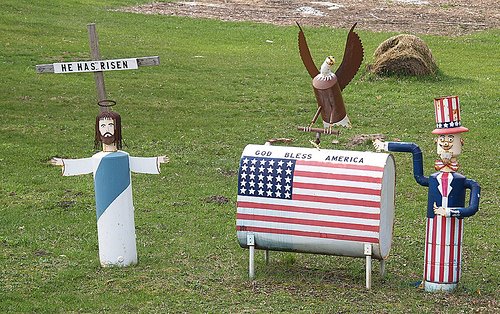
The lawn art Jesus and Uncle Sam want you to vote.
>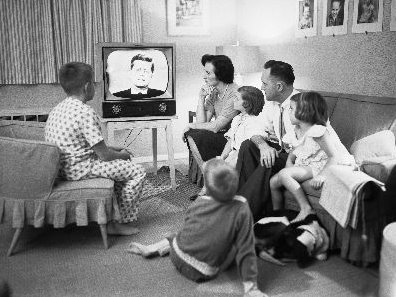
Once upon a time…
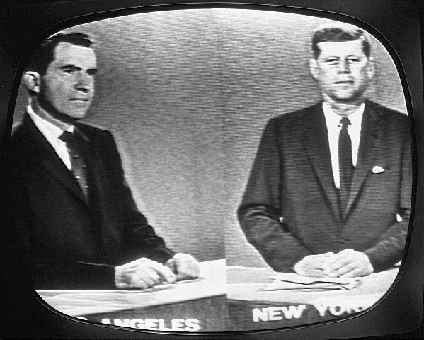
..the big talk about political campaigns was about television. Kennedy looked better than Nixon in the 1960 television debate. Of course Kennedy looked better than Nixon period, but television was now king.
Today it’s not so much about television. The candidate who wins will need to garner positive “youtube points.” But it’s more than that. It’s not so much how one looks in online video clips. Certainly many people watched recorded excerpts of the debates and various speeches, but now one also has to be extremely careful not to be recorded saying or doing anything incriminating that can then be watched over and over online. And yet, the real issue may be the comedy clips that have been springing up since the campaigns began.
Sara Palin was skewered by her interviews with Katie Couric, but it is likely everyone will remember Tina Fey’s portrayal of Palin even more. It is the comedy clips that get forwarded ad nauseum. I speculate that it is more likely that a McCain supporter will watch a clip that humorously makes fun of McCain than watch a serious clip of an Obama speech. Comedy cuts through a lot of bias. Speaking of these creative comedy clips, why is it that most are coming from the left? Is it that there is a natural link between artistic creativity and a liberal temperament?
Will these comedy clips sway the vote? Or just reaffirm already held beliefs?
And just in case you missed any of those clips, here are some of my favorite:
I would like to think there is a link between creativity and more progressive leanings. But that’s just my bias. Anyway, I’m voting for comedy.
As a final note, Nixon did finally get his day. I guess looking back this is comedy too:
And maybe a little bit of tragedy as well.
>
the politicians all make speeches
while the news men all take notes
and they exaggerate the issues
as they shove them down our throats
is it really up to them
whether this country sinks or floats
well I wonder who would lead us
if none of us would vote~ Larry Norman, from The Great American Novel
I’ve heard it said about every presidential election I can remember.
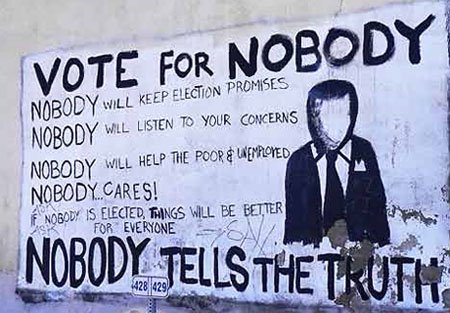
Along with saying they might not vote at all, I have heard a number of people refer to voting the lesser of two evils in this upcoming election. This seems to be said mostly in reference to voting for Barack Obama. I tend to agree, but not because I think Obama merely represents a lesser evil*, but because voting is largely about voting for which elite do I want to be in power. I want to pick the elite that will do the most good over time for the country – even though I don’t really want to pick any elite.
I don’t like the idea of this thing we call democracy being about elites ruling the masses. It doesn’t sound right. But it’s what we got. It was built into our system by the “founding fathers.” That may be why so many people feel disconnected from being able to affect much change – it’s because we are. But not entirely. Voting does matter, and voting for the lesser of two evils does matter. In fact, it’s a good thing.
For a little perspective here’s Noam Chomsky talking about choosing the lesser of two evils, and why this is the system we have:
http://therealnews.com/permalinkedembed/mediaplayer.swf
This clip is from The Real News Network
So, if I can help it (read: do my homework and make an informed choice), I will try to NOT vote for the greater of two evils. I am disinclined to vote outside the two most prominent choices because to do so is to inadvertently support whoever wins, and that could be the greater of the two evils. And yet I believe one should vote one’s conscience, so I consider all candidates as my potential choice.
* I want to be clear. This is not about which person is the lesser of two evils. I don’t think Obama or McCain are personally more or less evil than anyone else. What we have is a system of slight, but ultimately significant differences. Which faction of of the “business party” is in power is important – over time.
>
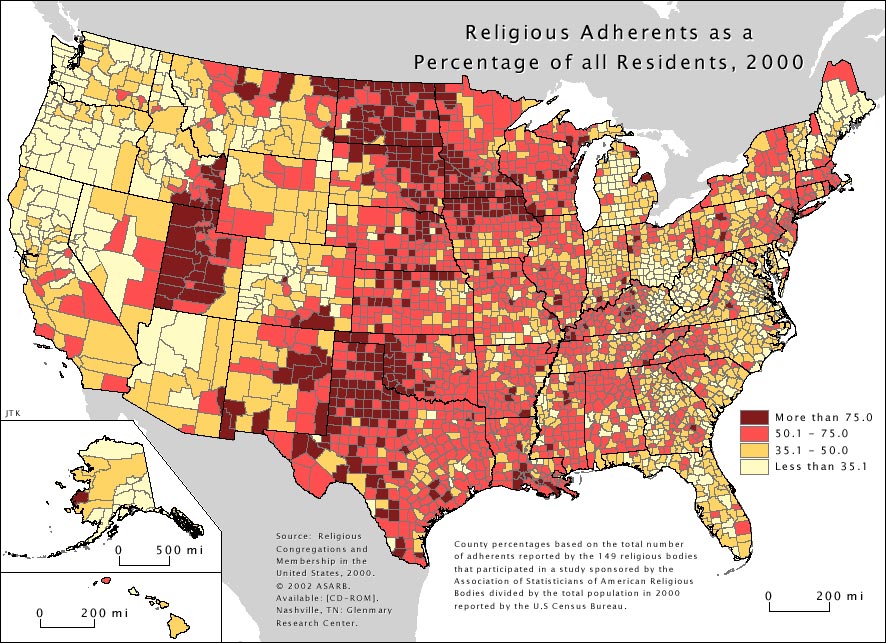
The map above (click to enlarge) is from a 2000 study of religious population densities in the U.S. I live in the upper left area, the Northwest, which has the largest percentage of “un-churched” people per-capita in the country. Because I have, for the most part, lived my entire life in this area of the country I am curious as to how the religious make-up of my regional culture has played a part in my formation as a thinking/feeling person. I have always thought of myself as a person of faith, even propositional faith, but not as particularly religious in an external sense. Regardless, I think I would be called religious in light of these demographics. But I find myself to be rather un-dogmatic as well as prone to questioning even long-held Christian doctrines – not because I think they are necessarily wrong, but because I value critical thinking and I don’t place much value in tradition when it comes to truth, except as a catalyst.
Then I look at the rest of the country and I wonder what set of beliefs, what religious and philosophical values I would have if I had lived elsewhere. Look at those red and deep red areas of the map. What kind of choices, what kind of pressure would I have experienced if I had grown up there. I don’t know. Maybe you know. What I do know is that in the West and Northwest there is a trend toward “missional” churches, that is churches who are built around the idea that the very cities in which they exist are every bit as much mission fields as anywhere else in the world. Mars Hill Church in Seattle is particularly committed to reaching out to its un-churched city (I don’t attend Mars Hill, but I listen sometimes to their podcasts).
What is remarkable is how religious, and in particular how Christian, is the U.S. Not long ago many predicted the collapse of religion in the U.S., instead it has flourished. I wish I could say Christianity has always been a source of light in this country, but that has not been the case. The present political season is evidence enough. But Christians are really no different than anyone else who holds to a set of beliefs about the world, about right and wrong, and about the future. What is all to evident, however, is the fact that Christians are specifically called to love their neighbor as themselves and they fail in big ways. Of course, so does everyone else. You can certainly count me in that number.
Here’s another map I find interesting. Of those who are religious, and again its mostly Christian in this country, this is how they break down geographically by basic religious groups:
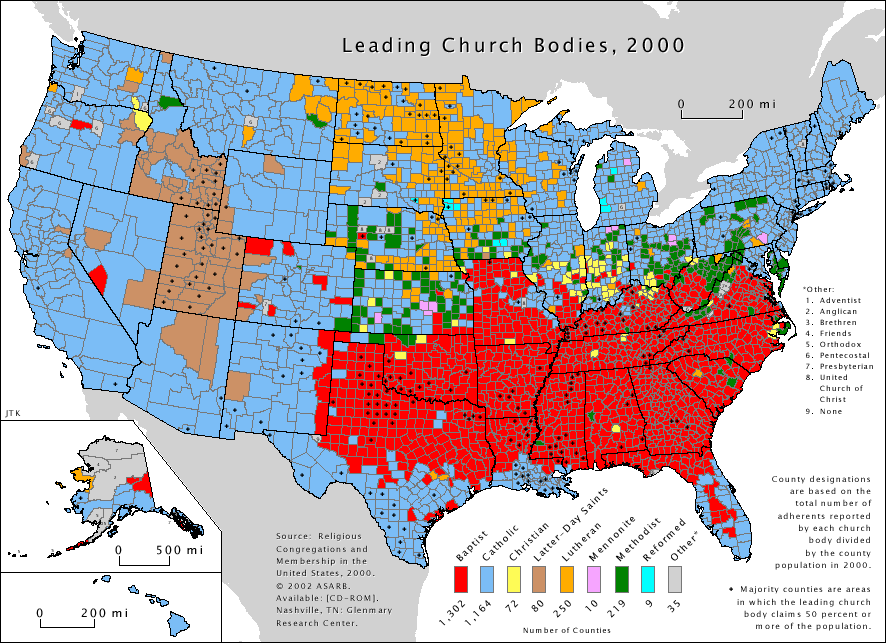
What is interesting for me is that I grew up a red (Baptist on the map) but not in the Southeast. Later in college I left “redworld,” but my faith deepened and grew as I became, for lack of a better description, a non-denominational Christian. I began residing at McKenzie Study Center, which was conveniently close to the campus (I was an undergrad), but was also a place that allowed me to ask tough questions about my faith. I was given room to actually think outside the box. Far too often one is only allowed to lightly question approved doctrines in traditional churches as long as there is no chance that one will actually disagree with those doctrines. Freedom to think is often perceived as a threat to religion, but it is central to faith. 20 years later, and a lot of water under the bridge, I am still plugging along, sorting out my faith (with fear and trembling) and seeking to love others regardless of what or who the maps say I am.
 pilgrimakimbo