>improving a corner of town (hopefully)

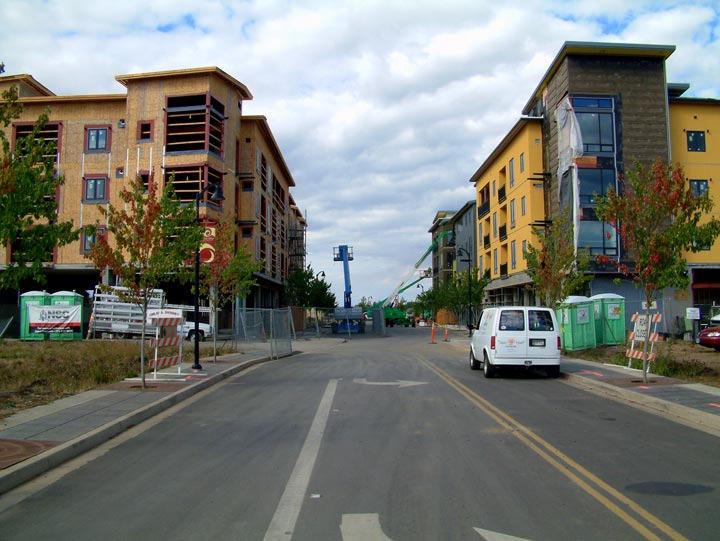
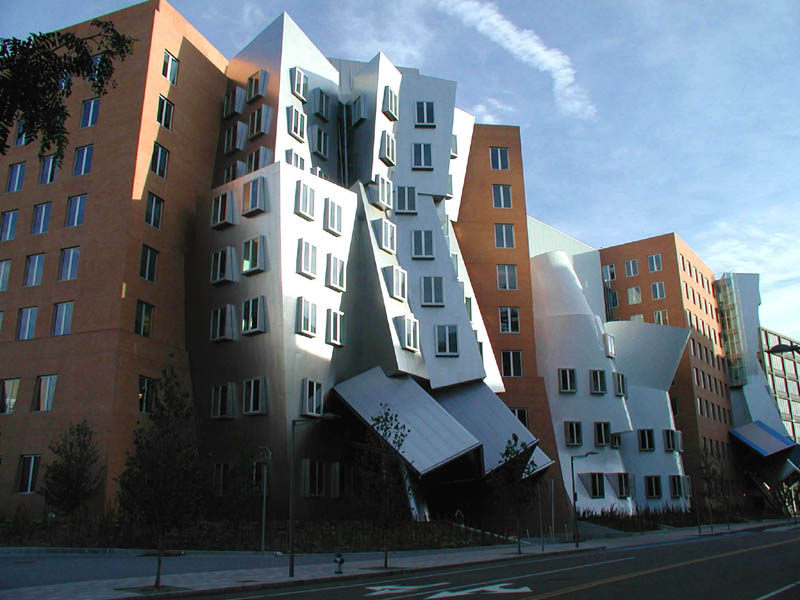
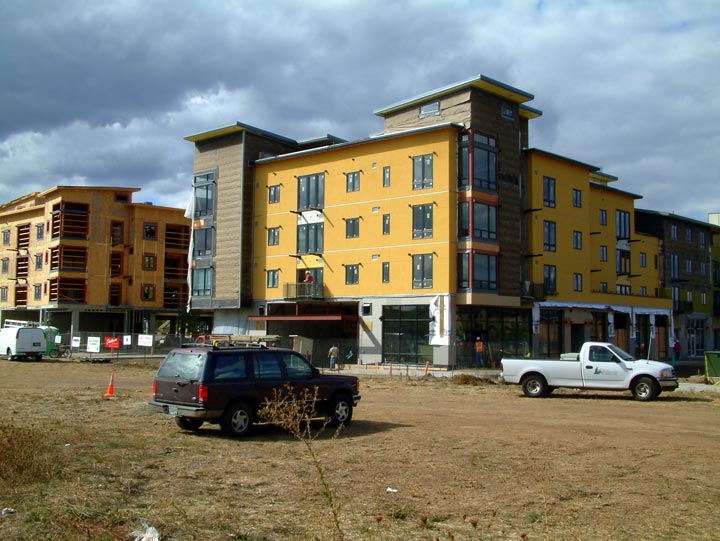
>In an old farmer’s field some new development has been raising buildings along a route I often take from work when I want to drop off my dry cleaning. Years ago this part of town was in the country. Now it is a growing area with a Costco nearby and new houses springing up. I find it amazing how building can completely transform a piece of land, and by how much I often like the transformation.

I am an advocate for more concentrated urban development and less sprawl, that is, development that brings together working and living spaces into near proximity while discouraging the growth of suburbia. But I also believe mere concentration is not enough. People need good design, which includes both well-thought functionality and beauty. So my eye has been caught by this new construction, which seems to border on sprawl, but is far more concentrated and aesthetically pleasing than most of its surroundings.

I felt not a little conspicuous walking around the construction site snapping a few pictures, so I only took a handful and left quickly. But I think these will provide enough of an idea and to what is going on.


On the one hand there is nothing very special about these buildings. Exciting and daring design doesn’t happen around these parts very often, and this is not particularly exciting and daring. But there is something about the design that has a post-modern-lite feeling, which is basically a simple modernism with post-modern trim (although I make no claims to really know what I am talking about). Regardless, this is a good thing. Most of the construction nearby is either concrete-tilt-up boxes (Costco, etc.) or 1960s suburbia houses.

The buildings are also multi-use: stores below, offices and apartments above. Plus, by creating nearly identical structures on both sides of the street, they approximate a classic-style “strolling” street with a slight European flare. I wish the street was narrower. That would make it a little more human in scale, rather than scaled for autos. But if they did that it would be downright un-American.

As part of the overall development, there is a row of new houses going up as well.

If you want one, they start at $475k. Which means you won’t see me lining up just yet.

My hope, as it is with all new construction around these parts, is that it elevate the prevailing assumptions about how people can live and work. We’ll see. My curiosity is piqued. Now they just have to make it more affordable.

the art of a "limited means" life

We live is an age of great abundance for many. And yet, so many struggle for basic things, like shelter. Many of us, though not particularly wealthy by Western/Northern standards (I live in the U.S.), still live like kings compared to much of the rest of the world. And yet, sometimes we still know (I still know), at times, the struggle just to get by, especially those of us who have tried to support a family on a meager paycheck.

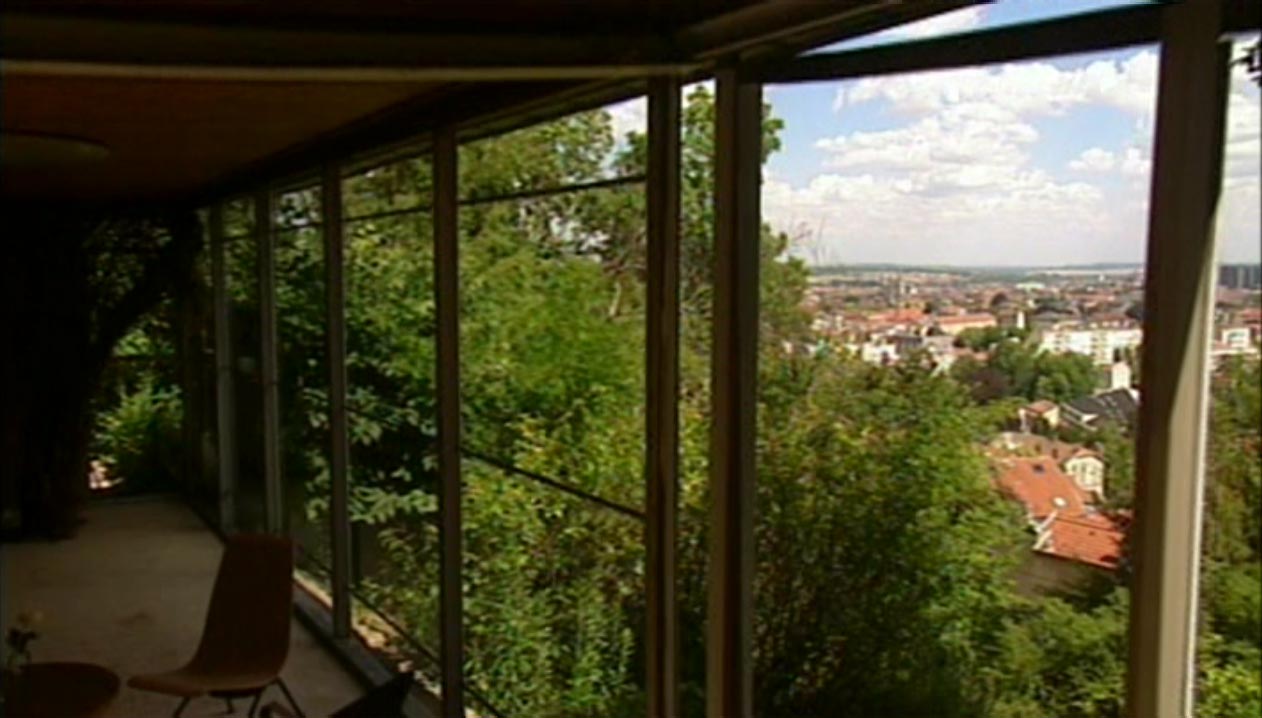
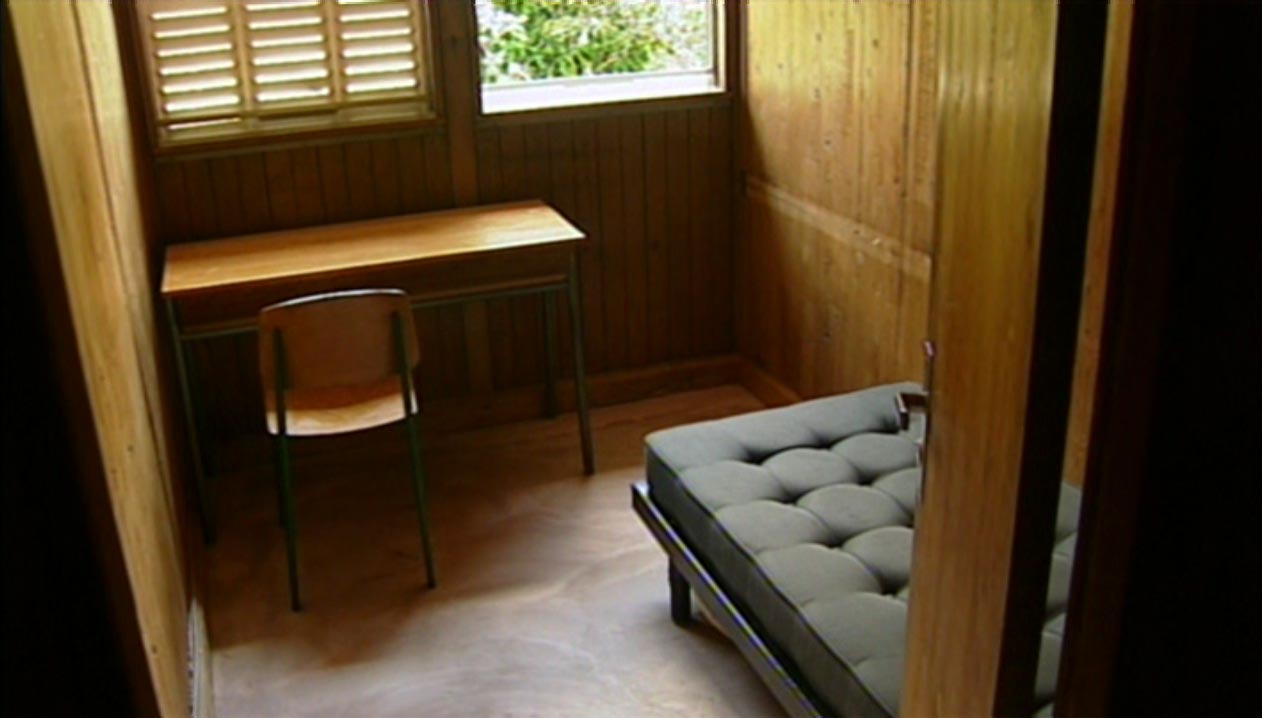
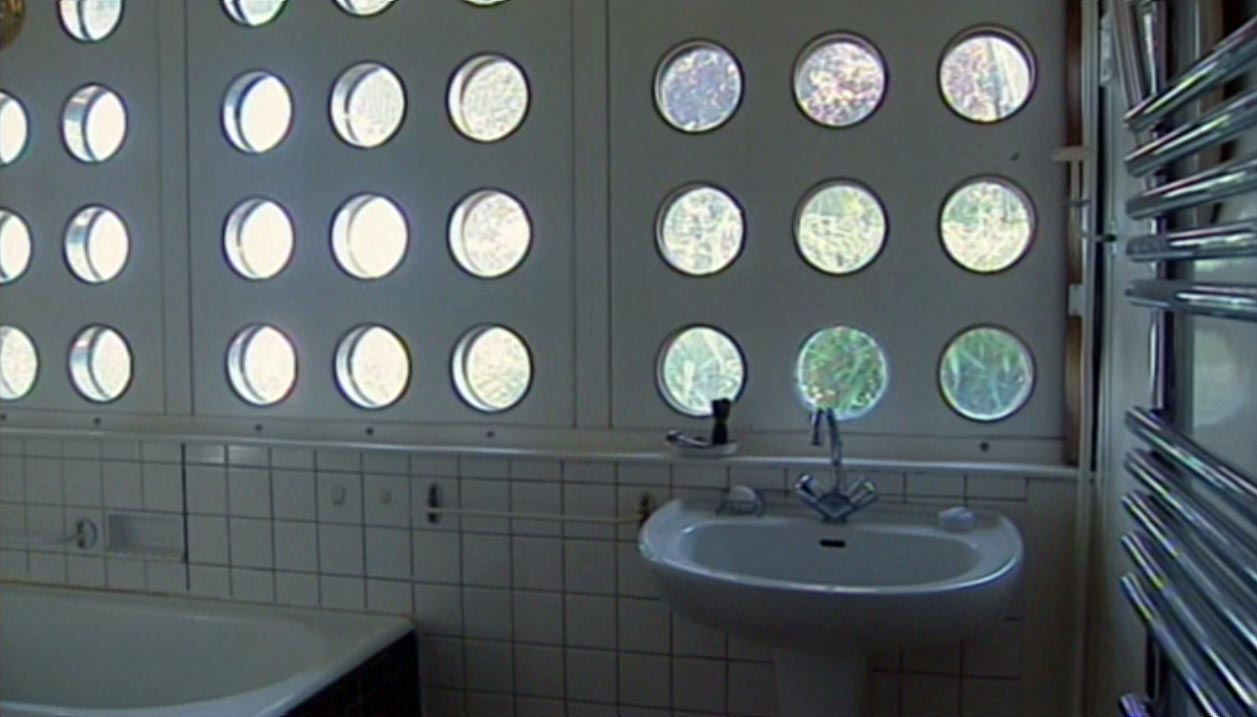
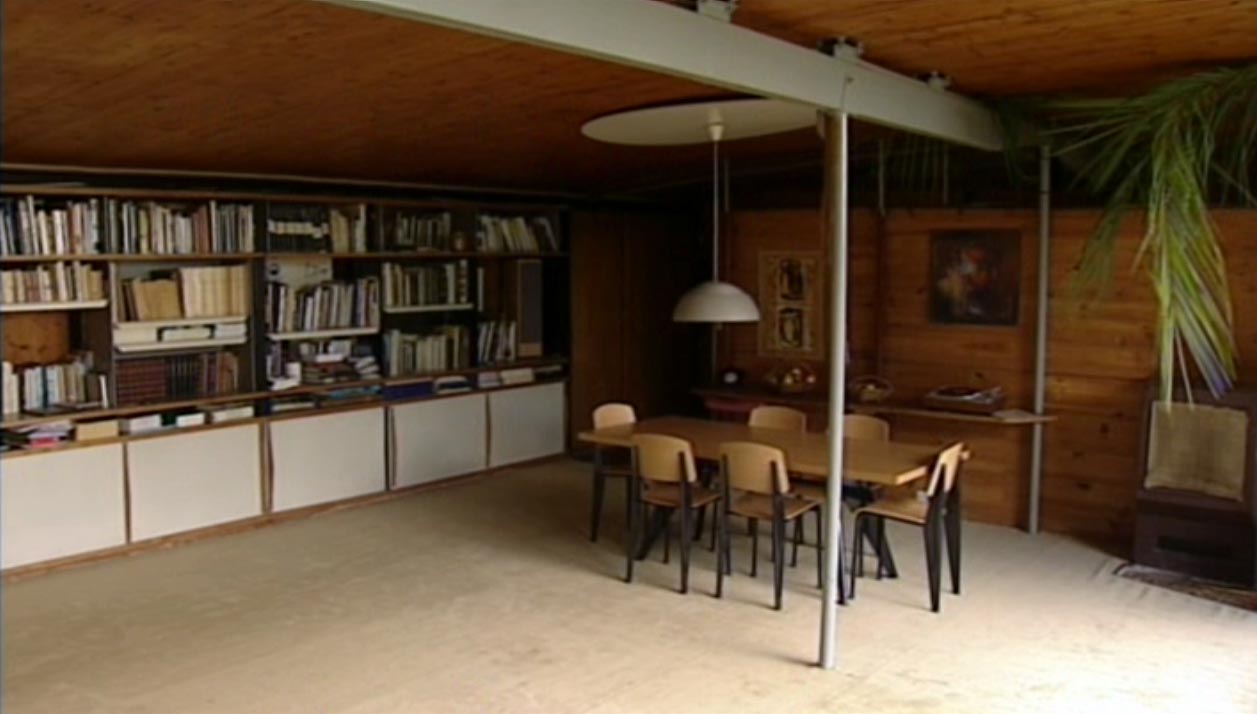
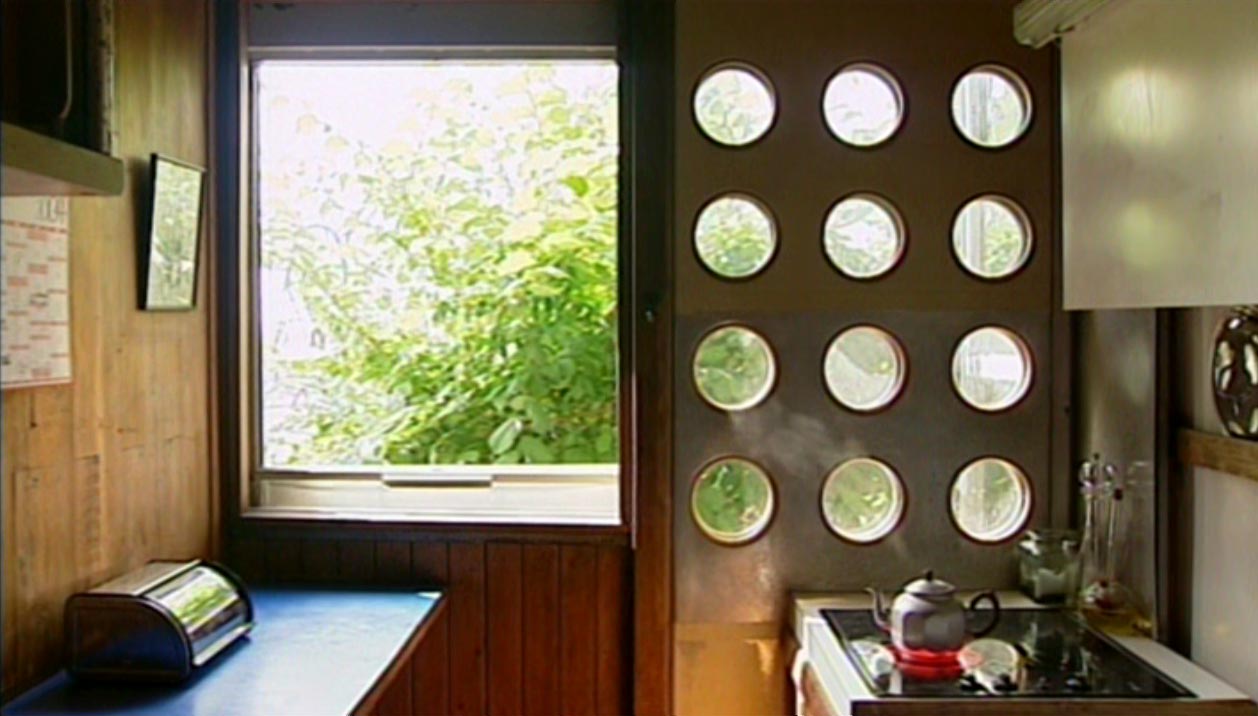
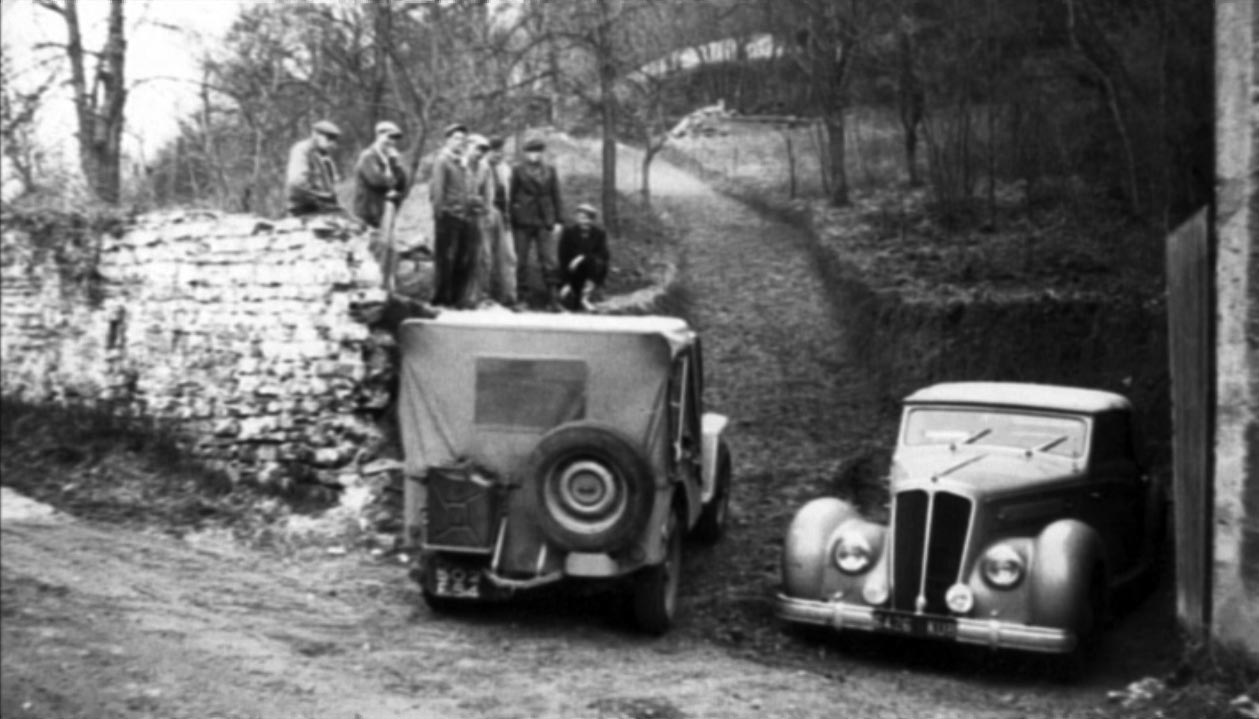
With those thoughts/experiences in mind (sometimes buried, sometimes glaring) I watched a fascinating documentary on La maison de Jean Prouvé (part of a great 4 DVD series called Architectures by ARTE France, distributed in the U.S. by Facets Video). I was struck by the simple story of a man who lost his business, faced into a difficult financial crisis, and had to then find appropriate shelter for his large family. His solution was to build on land others said could not be built on, use prefabricated pieces, ask his friends for help, and do it quick and cheep. What Prouvé created became one of the most famous, yet modest dwellings of the 20th century. The house is also both a challenge and an inspiration to me and my aspirations for someday designing my own house. But it is more than merely a question of design.

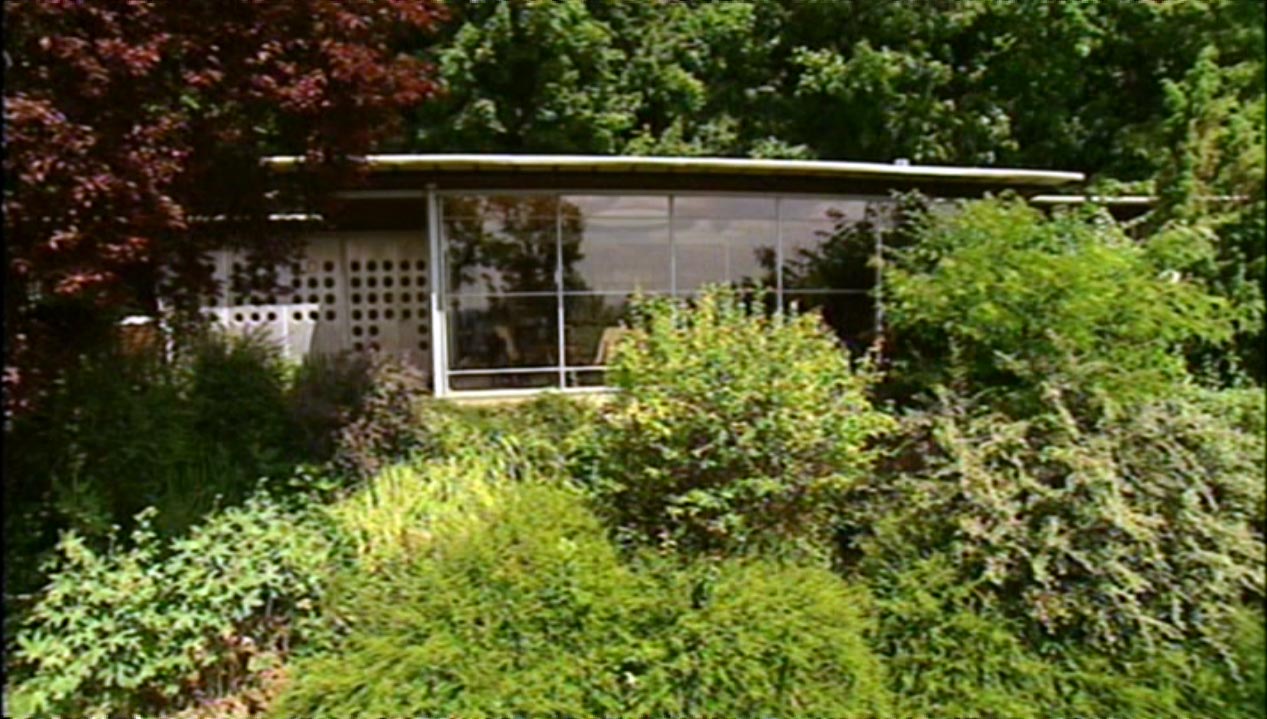
A few pictures will give some idea of the concept by way of the reality.

Front exterior
Looking out the front windows
One of the kid's rooms
The bathroom
The living room
The kitchen

As one can tell, the house is simple, though not exactly austere; the design is modern, though far from being overrun with ideology; and the space is very economical, giving what needs to be given without giving too much. It is truly an economy of means.

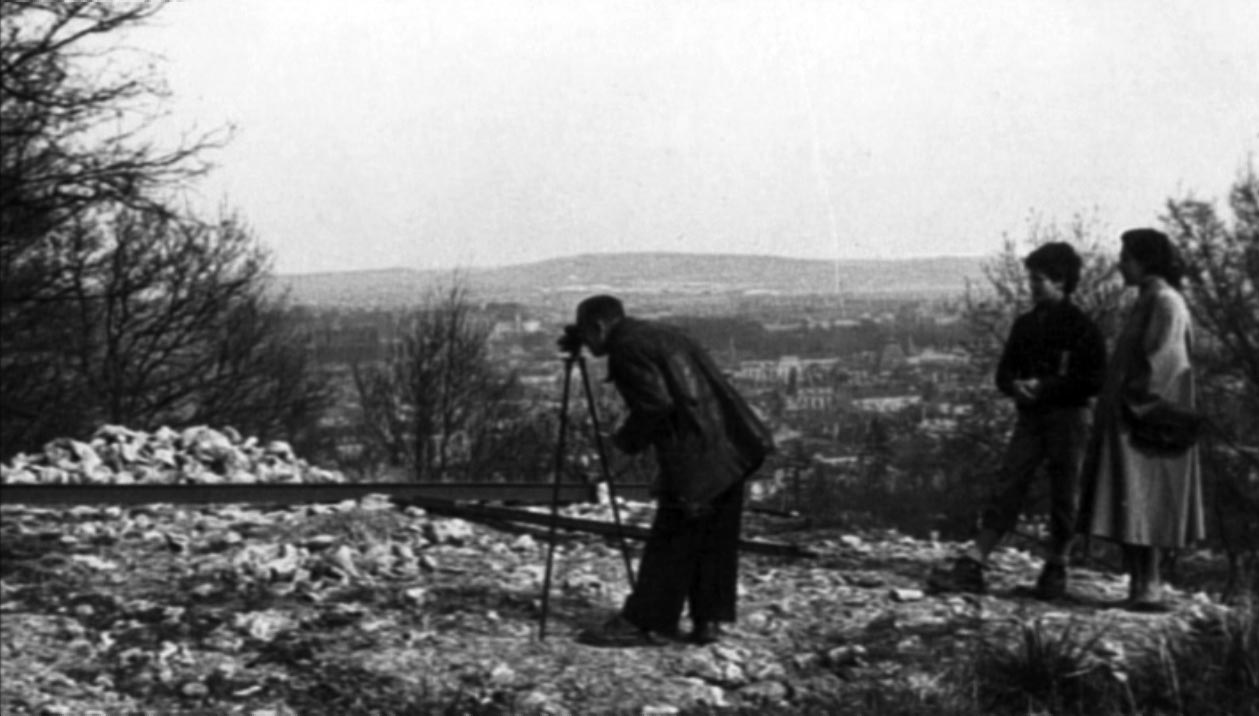
What I also like was how communal and personal the building became, and how it became that way out of necessity. Photos show the Prouvés and their friends hauling materials up the steep hills, laying foundations, putting up walls, and helping the Prouvés reach their goals.


My own philosophy, though still rather unformed, ranges toward the modern and the simple. I love quality and innovation. I also love the challenge, but so too do I love the finished product that can then be enjoyed. Although there are many aspects of Prouvé’s house I would do different, I often think about how much I have and want in contrast to what I actually need.

I believe design and art are central to the human spirit. I am only willing to give up beauty when it is absolutely necessary, and only for temporary periods, for beauty is like air. Some will not find Prouvé’s house to be a work of beauty. To each her/his own. For my part I find tremendous beauty in the simplicity and design of this house, but I also see an acceptance of one’s place in the world. Prouvé was able to achieve both. Live within your means, that is a kind of beauty too.

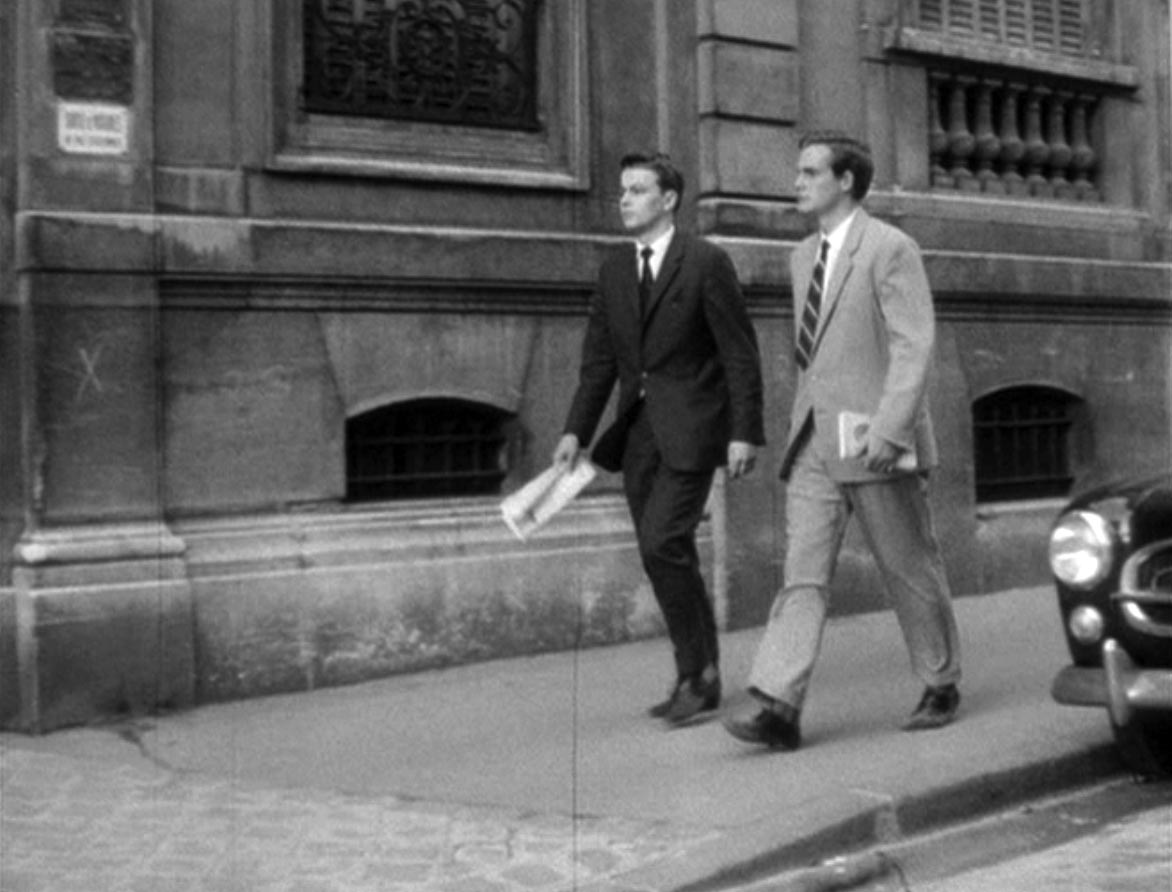
Jean Prouvé built his house in 1953. I find it an interesting coincidence that I began recently watching Eric Rohmer’s Six Moral Tales. Rohmer began directing the loosely connect series in 1962. I won’t attempt an overview of Rohmer’s life or a critique of his films, but I will say that I find his circumstances of production to be equally as fascinating at those of Jean Prouvé.

In the beginning Rohmer had no money to make films. He had written one novel and then some stories. He was unhappy with how the stories turned out and he felt he needed to make them into films to adequately get across his ideas. Eventually he got what he needed, but only just. His films, especially the early ones, are excellent examples of an economy of means. He shot on a shoestring budget, often using small crews and working with friends. He also tended to shoot in limited takes and tended to prefer first takes. He rehearsed his actors relentlessly and then tried to not let them ask for more takes. Sometimes he used improvisation during rehearsals, but rarely in production. His first feature-length film, La Collectionneus (1967), was shot at less than a 2:1 ratio, which means that most of the takes were at most done twice, and many only once.

Rohmer’s first of his moral tales, La Boulangère de Monceau (1963), was shot MOS (silent), dubbing the audio in later and relying mostly on voice-over, on 16mm format, using found locations. Never released in theaters, this 20 minutes film was almost more of an experiment in style and production, but it clear set the tone for the later films.

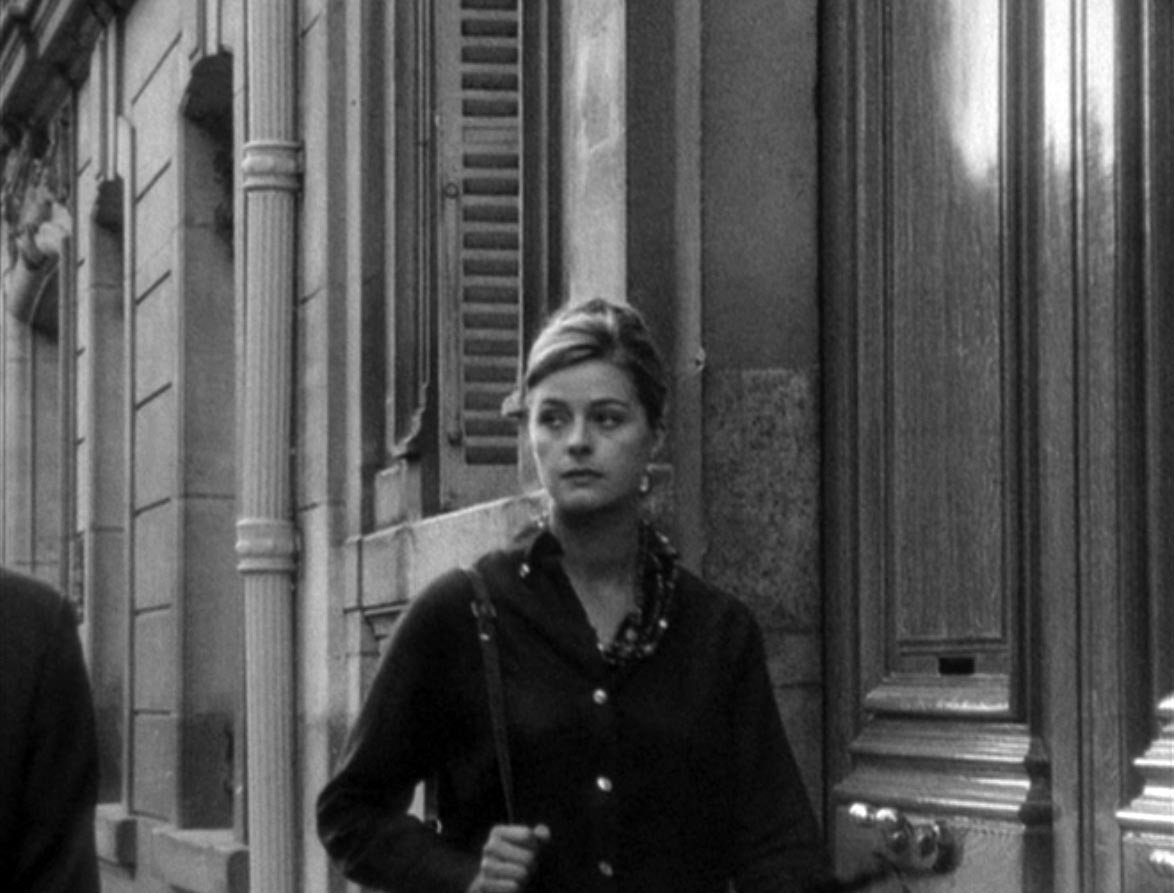
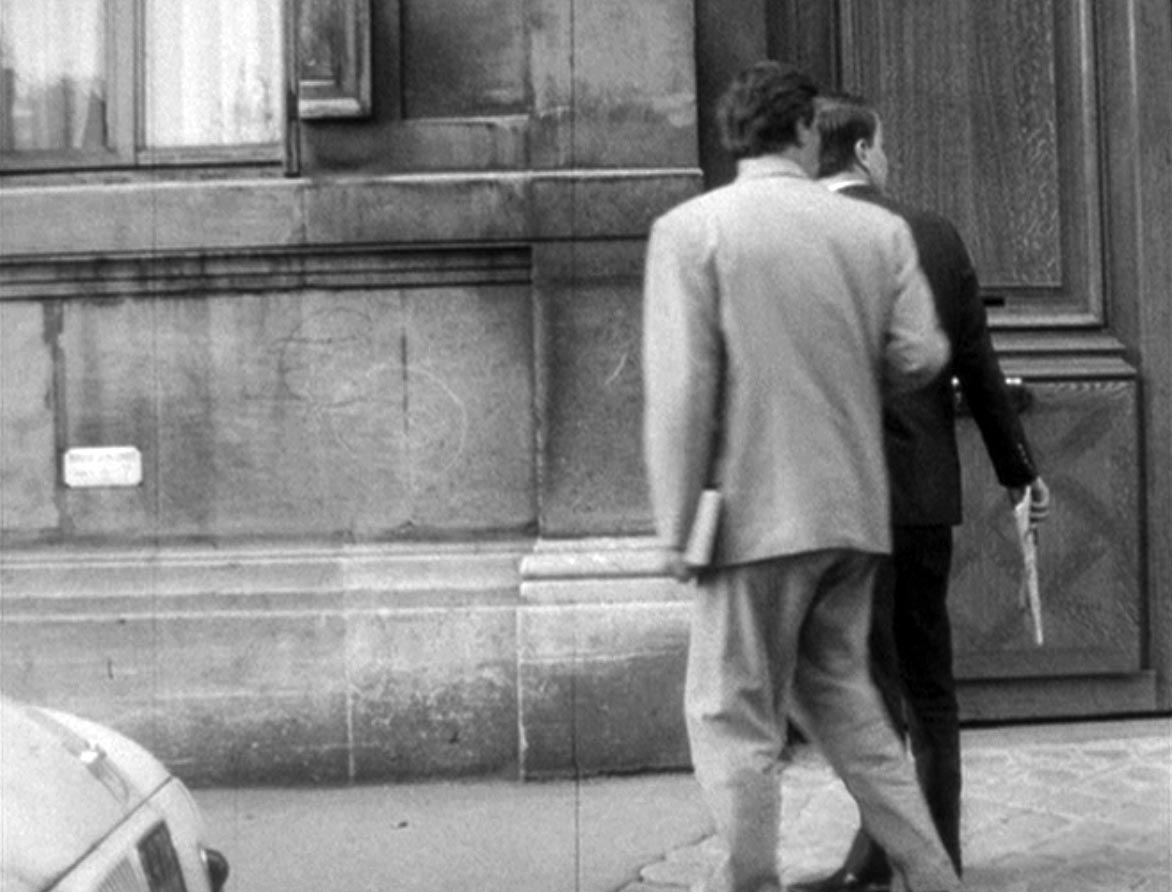
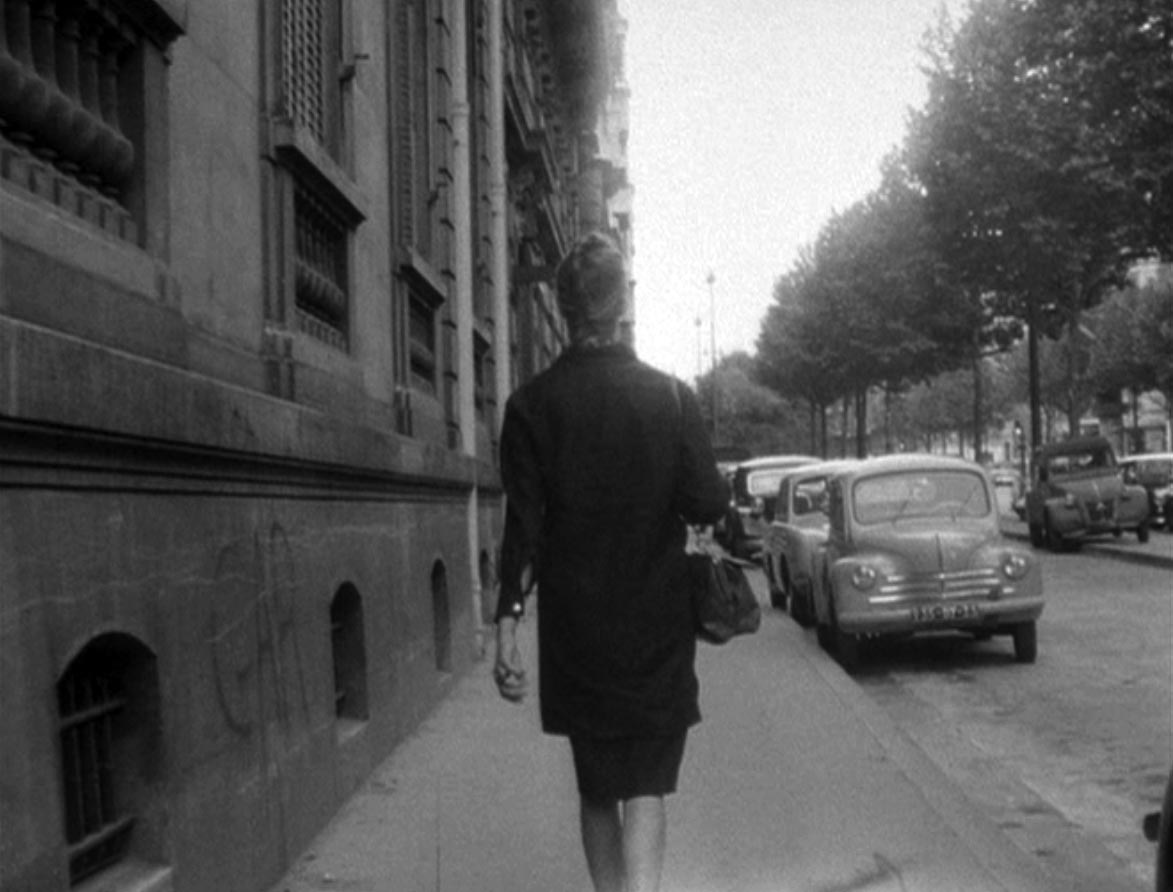
Here is a brief look at the filming/story telling style of Rhomer. While we hear a voice-over we watch a simple moment based mostly on looks and glances that are fuller of meaning than the rather unemotional surface gloss might suggest.

When I compare Rohmer and Prouvé I see two driven men, singular in their ideas and ideals, producing great artifacts within strenuous limitations. I also see a mode of production, whether by choice or by acceptance, that is truly independent from larger financial/corporate interests. No one is completely independent, but smaller scales of production, working with friends and colleagues, forced to stay focused on the end goal, and beholden more to one’s own vision than to those of others, makes Rohmer’s moral tales and Prouvé’s family dwelling about as independent as one could hope for.

Some might say that Prouvé’s home is too simple and lacks too much. Some might say that watching Rohmer’s films is like watching paint dry. I know it is a matter of taste, but sometimes I would like to believe that not all taste is equal. Certainly, I find the final products of these two men more satisfying than so much else in this world. And that is what I look for in my own “limited means” life.

Boudu

Man is the servant of nature, and the institutions of society are grafts, not spontaneous growths of nature. ~Napoleon

The quote above is taken from the introduction of Honore de Balzac’s The physiology of marriage; or the MUSINGS of an eclectic philosopher on the happiness and unhappiness of married life. Balzac, who was the great recorder of the emerging bourgeois class of French (and European) society, and who cast his powerful gaze upon the vagaries of the human soul, plays a part, albeit through his literature, in Jean Renoir’s Boudu sauvé des eaux (1932). The idea that society has rules, and that humans are always trying to break them while judging others by those same rules, is central to understanding Boudu – both the film and the character.

In the story of Boudu, the bookshop owner M. Lestingois (Charles Granval), an example of this new bourgeois male, gets upset when he discovers that Boudu has spat in his copy of The physiology of marriage. “The man who spits in Balzac’s ‘Physiology of Marriage’ is less than nothing to me,” he says. Both comically and symbolically this moment is a nice touch. Renoir is drawing comparisons and contrasts through the film, and especially is poking fun at this new French middle class and all its trappings.

In this sense, though Boudu is the clown, the true comedy is with everyone else.

But Renoir, who, like Luis Buñuel frequently satirized the bourgeois, is ultimately much grander in his scope than mere satirization. I would certainly characterize Renoir’s project as parading before his audience the comical foibles of human beings, and therefore the list of Renoir’s films can, for the most part, be classified as la comédie humaine. But this is not a new insight on my part. What makes Renoir so great (and likely my favorite director), is that he shows humans in all their selfishness, pettiness, and ugliness (he is not afraid to do so), and yet he gets away with it because he has forgiven his characters before the story ever begins. We are watching characters who show us what we are, and yet they have been forgiven by the filmmaker, by their creator, and therefore we can find forgiveness too (for the characters and, by implication, for ourselves). Therefore, we love these characters. With Renoir there is no black and white, and not even grey, there is only the vibrant color of existence and human interaction – something that gets fuller treatment when Renoir begins later shooting his films in color.

For me, having just seen Boudu twice this past weekend was a revelation. It had been around 23 years since I last saw the film. The Criterion Collection DVD is a wonderfully produced copy of the film. But it is not the quality of the DVD that got to me. And it was not merely the incredible performance by Michel Simon as Boudu, as well as the rest of the cast. No, what got to me was the boldness of Renoir – both in terms of the story’s subject matter and of his directorial choices.

We all know Boudu, so I won’t go into plot synopsis, or produce a review. Thematically, Boudu is decades ahead of classical Hollywood cinema, not merely in terms of the sexual content of the film, but also in terms of class consciousness. I’m sure this is not entirely true, and Boudu is probably also ahead of much of French cinema of the era as well, and yet, while U.S. cinema dealt with class distinctions by thumbing it nose at them (think Fred Astaire – working class hoofer in his tuxedo wise cracking his way through high society, showing us the democratic worldview in action), in Boudu we have carefully drawn out and accepted social lines based in class, possibly democratically organized, but certainly socially stratified. And yet, Renoir is such a lover of people, of humanity, that his class distinctions ultimately get played out as comedy and we see his characters as real people filling the role of their class.

Another great element of Boudu is the use of exteriors and natural sounds. Lest we forget, 1932 was very early in the development of sound-recording technology for cinema. [And really the film is copyrighted in 1931.] Shooting talkies was not easy, and shooting exteriors with natural sounds and large group shots was often very difficult. Scenes tended to be shot in studios, and cameras were rendered almost immobile by placing them in sound booths. Typically, multiple cameras had to be used in order to shoot a scene with cutaways and reverse angles because the audio had to be recorded on one track at the time of the shooting – no sound editing later if one had characters talking. Music typically was included at the time of shooting as well. This has all been well documented by many historians. Renoir is using the latest knowledge of sound recording and finding ways to make it work for him.

In Boudu we have both interiors and exteriors. I find the easy transitions between internal and external to work extremely well, including the difficult process of recording and matching the audio. The exteriors seem to almost prefigure the kind of exteriors one will find with the Nouvelle Vague directors of the later 50s and early 60s. In fact, having just seen a couple of early Rohmer films, Renoir does a better job of capturing and mixing exterior audio for effect than does Rohmer 30 years later. In particular, I’m comparing Boudu with La Carrière de Suzanne (1963) because I just saw it as well (ah, thank you DVD player!). Of course Rohmer was doing something different than Renoir.

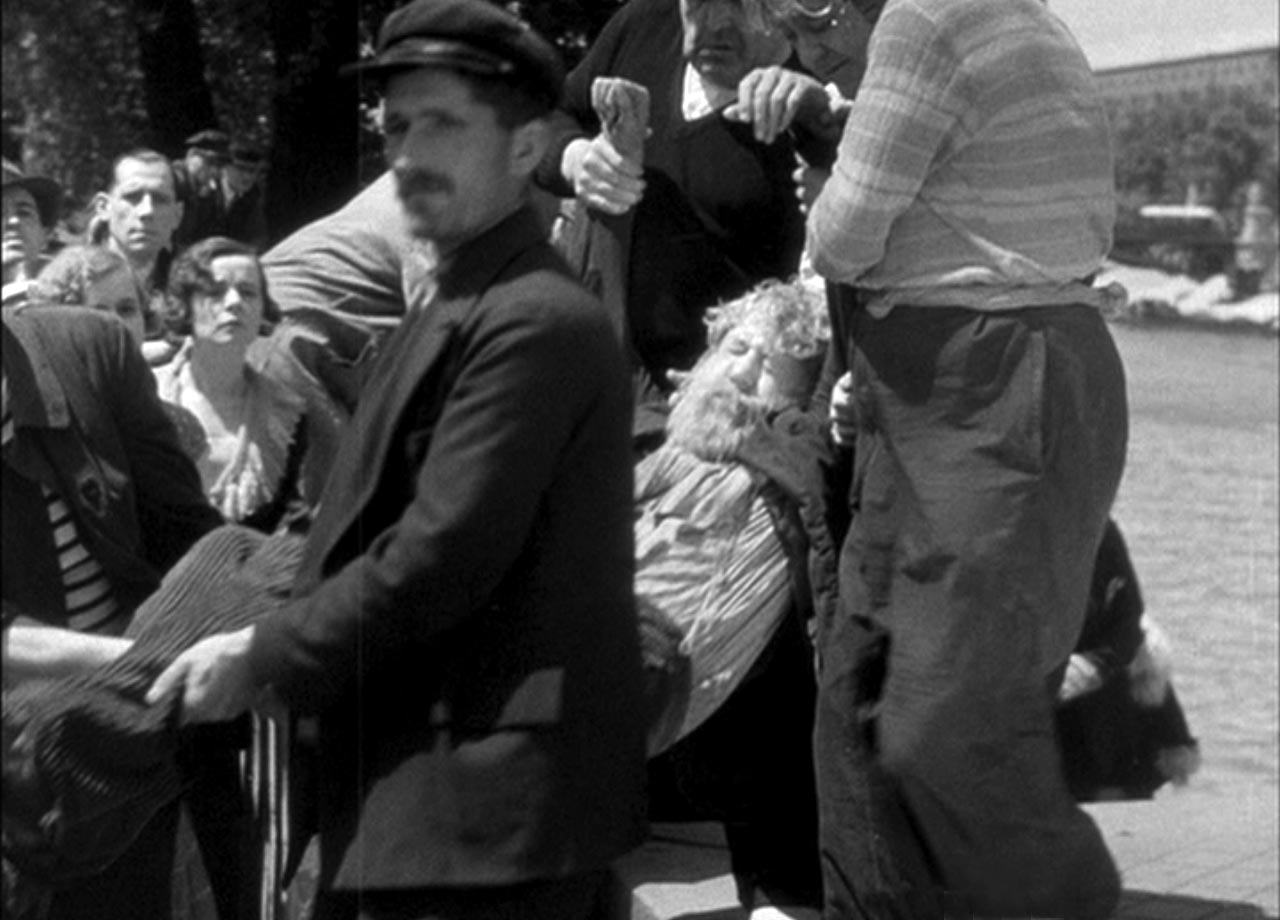
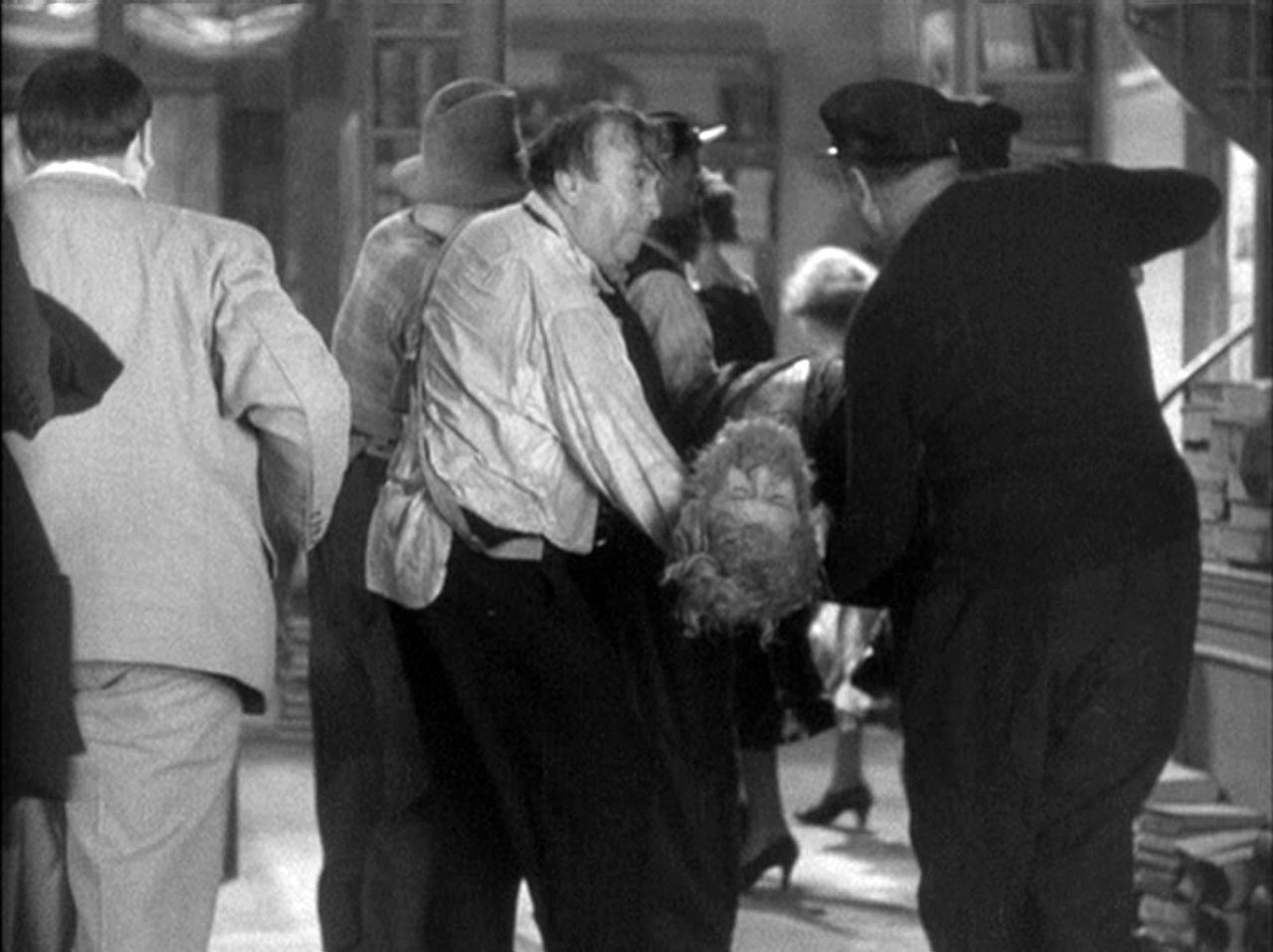
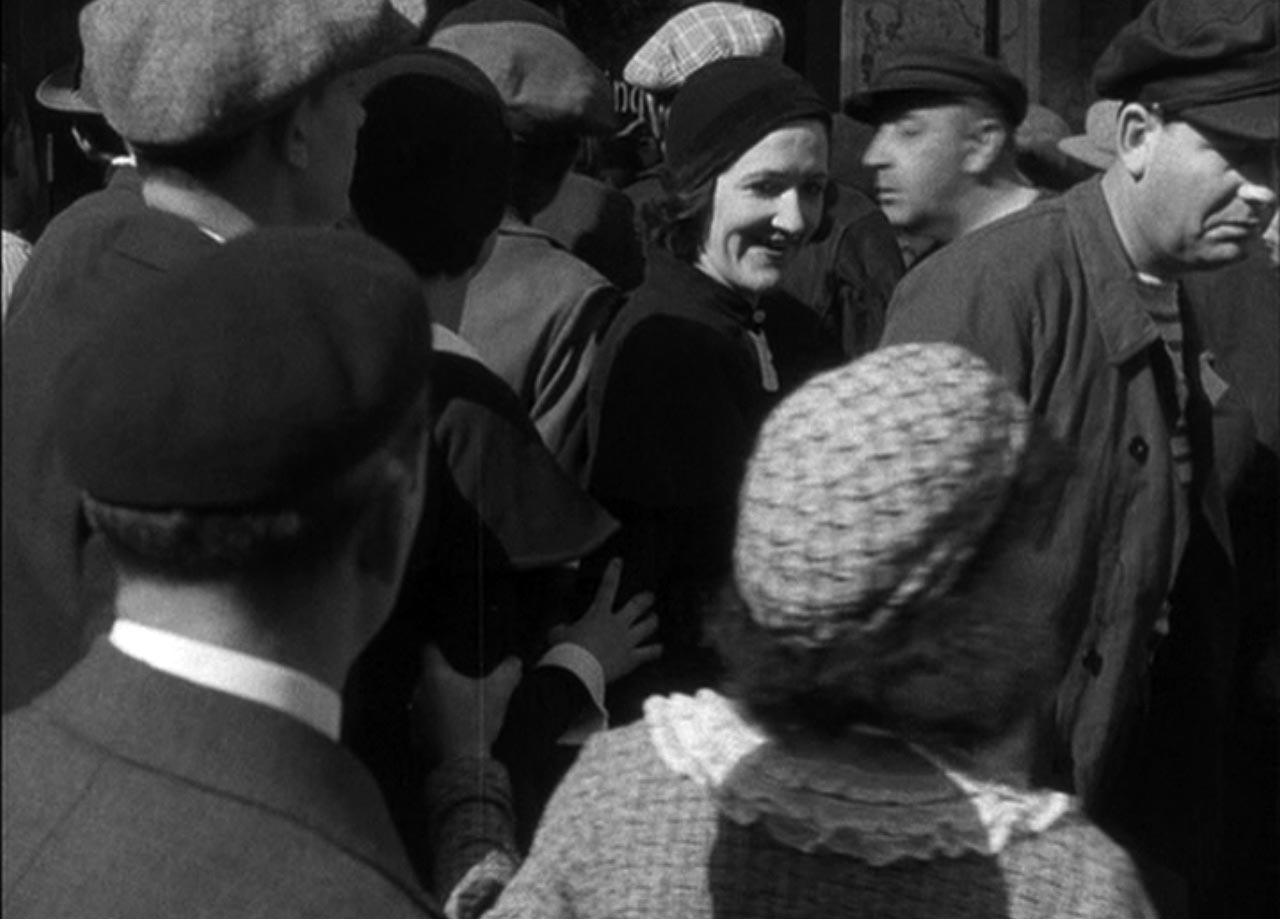
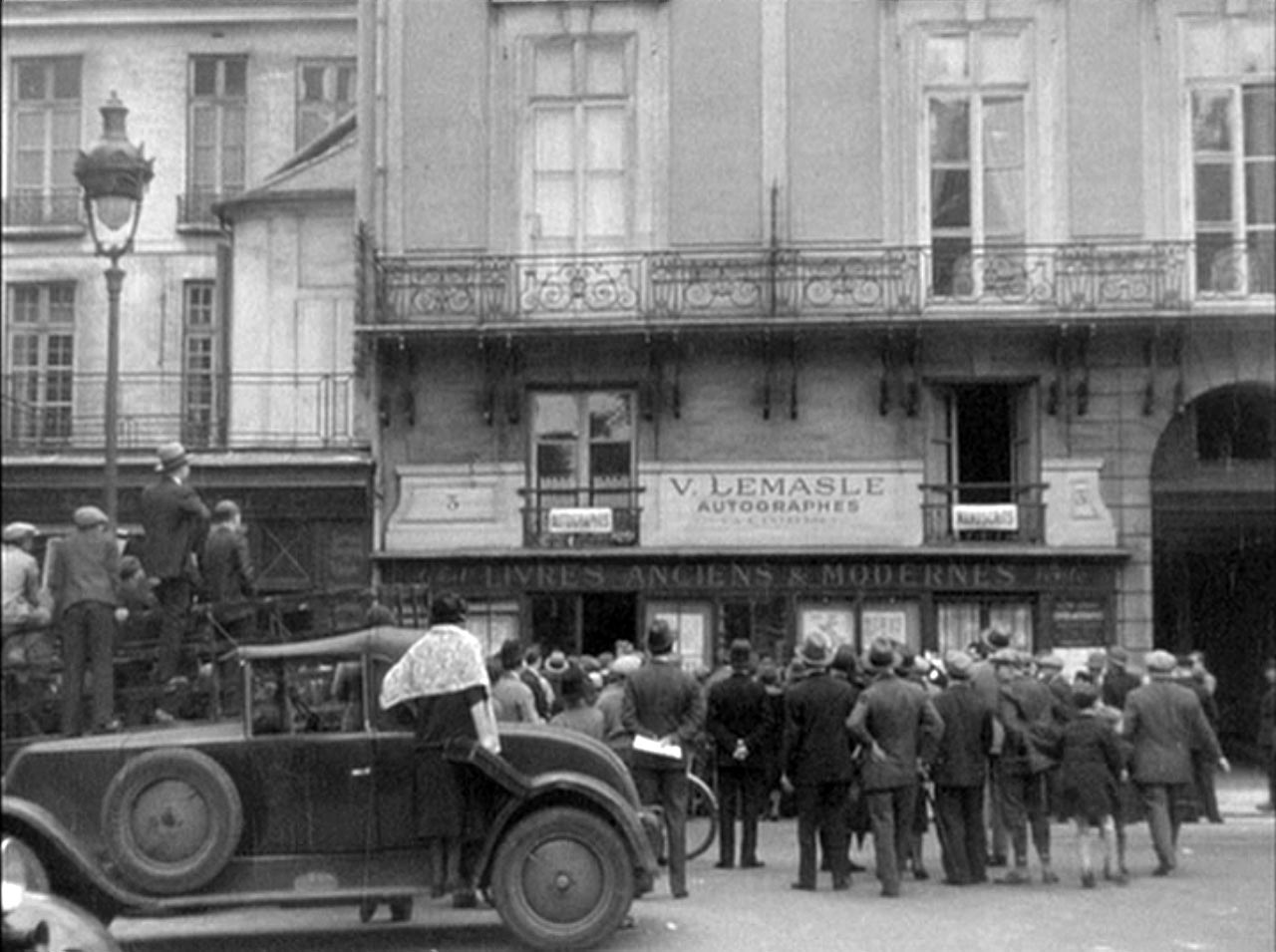
Now here is an exterior/interior transition moment that uses great natural audio and also shows Renoir staging his action along the z-axis. Boudu has just been rescued from the river (in a wonderful exterior rescue sequence with great crowd shots and use of extras) and he is being carried to the Lestingois book shop.
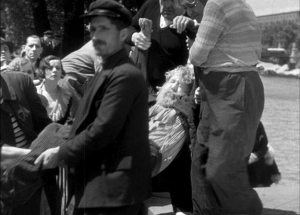
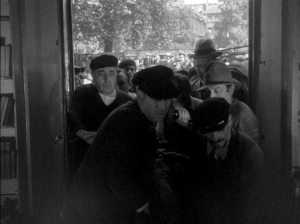
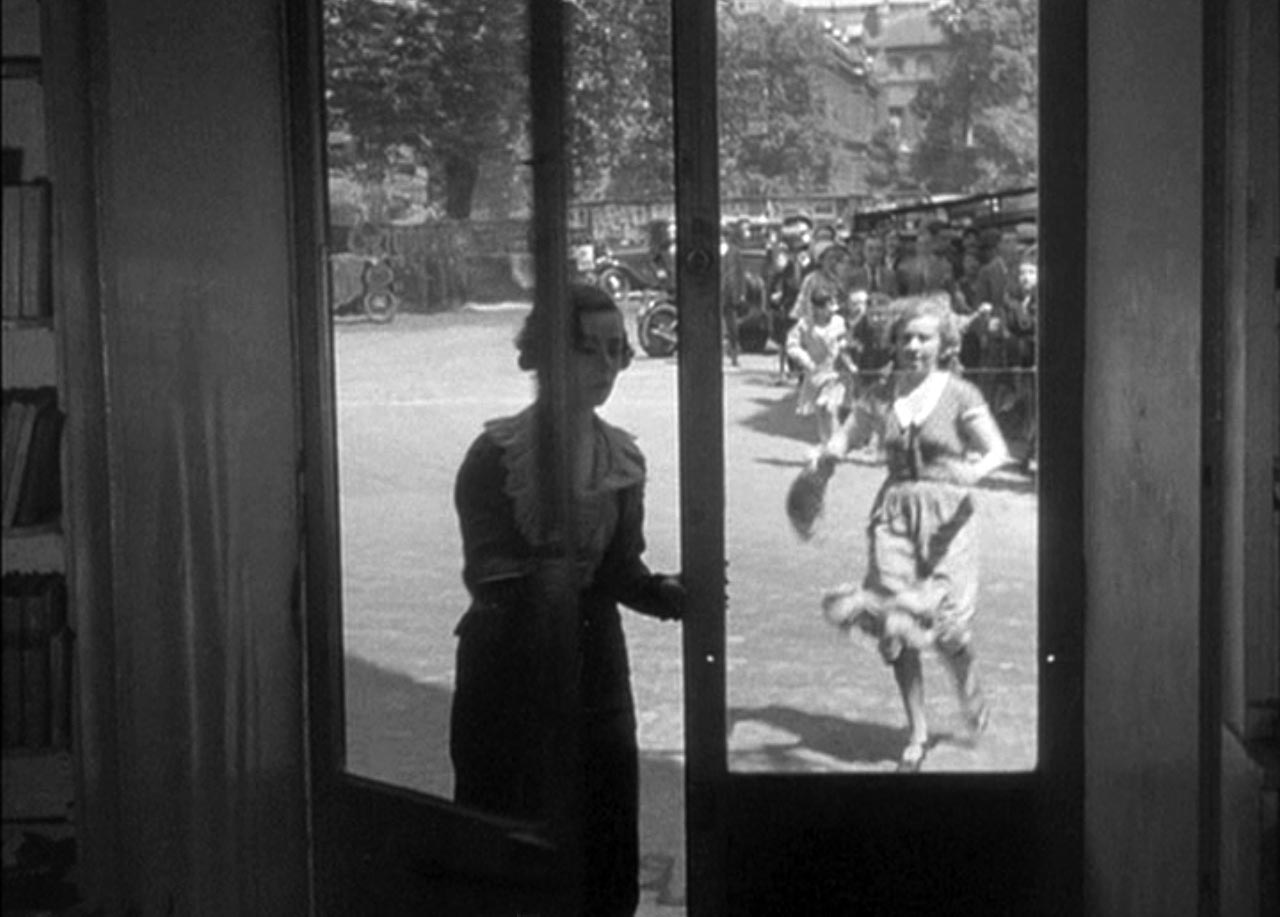
As the crowd moves forward, Mme. Lestingois and the maid rush ahead to open the shop door. The camera has now jumped from exterior to interior, looking through the shop doors.

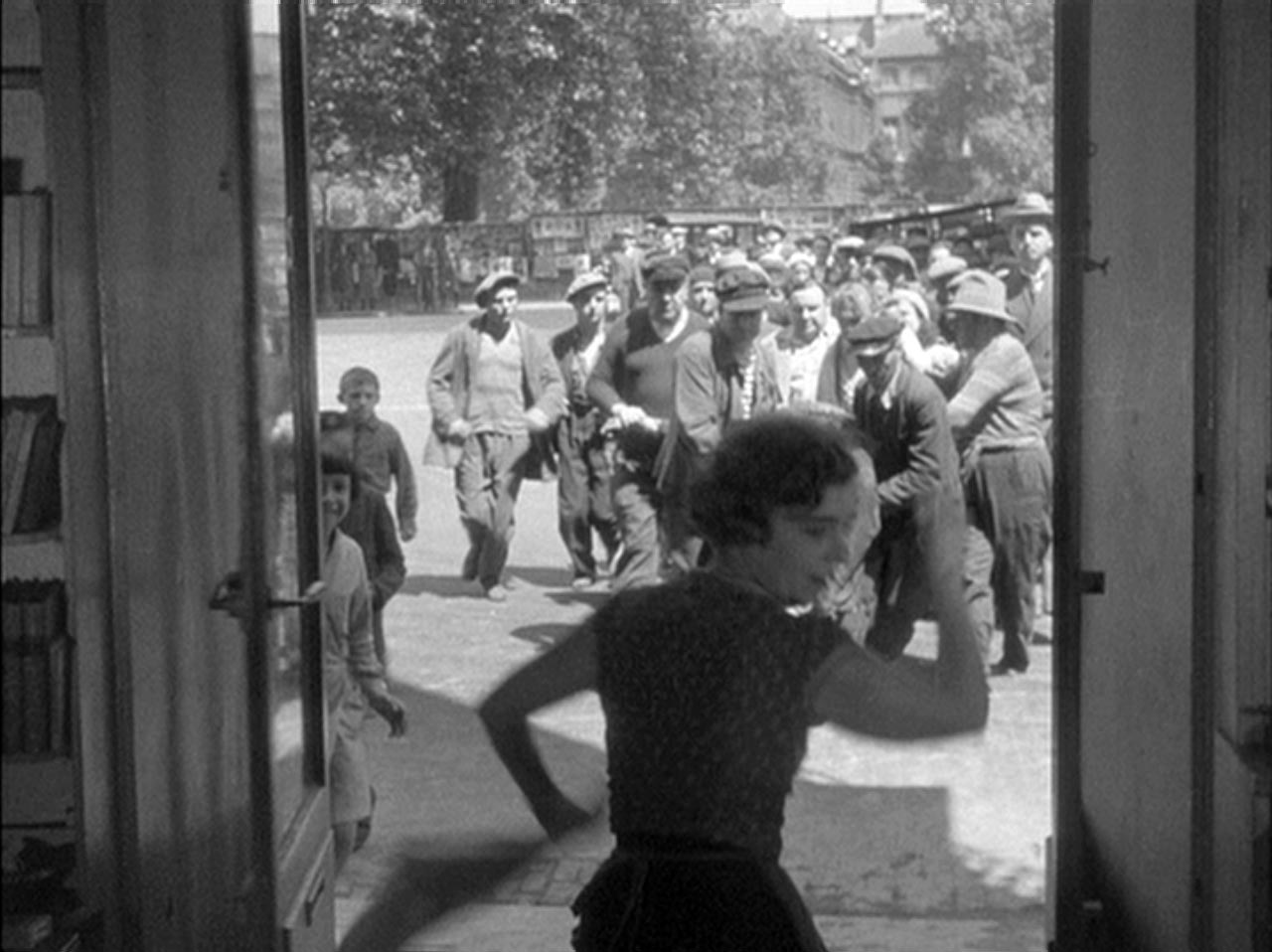
Up to this point the shot from this angle has been in one take with the action coming towards the camera. Now the camera cuts 180° and we see the action moving directly away from the camera.
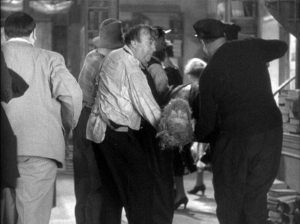
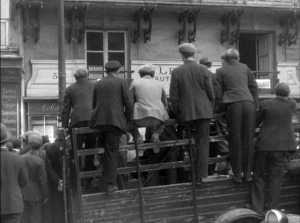
They set Boudu down on a bench and then we get several exterior shots of the curious crowd outside.
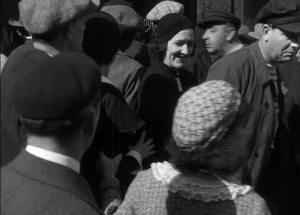
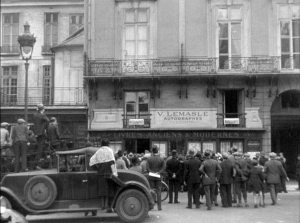
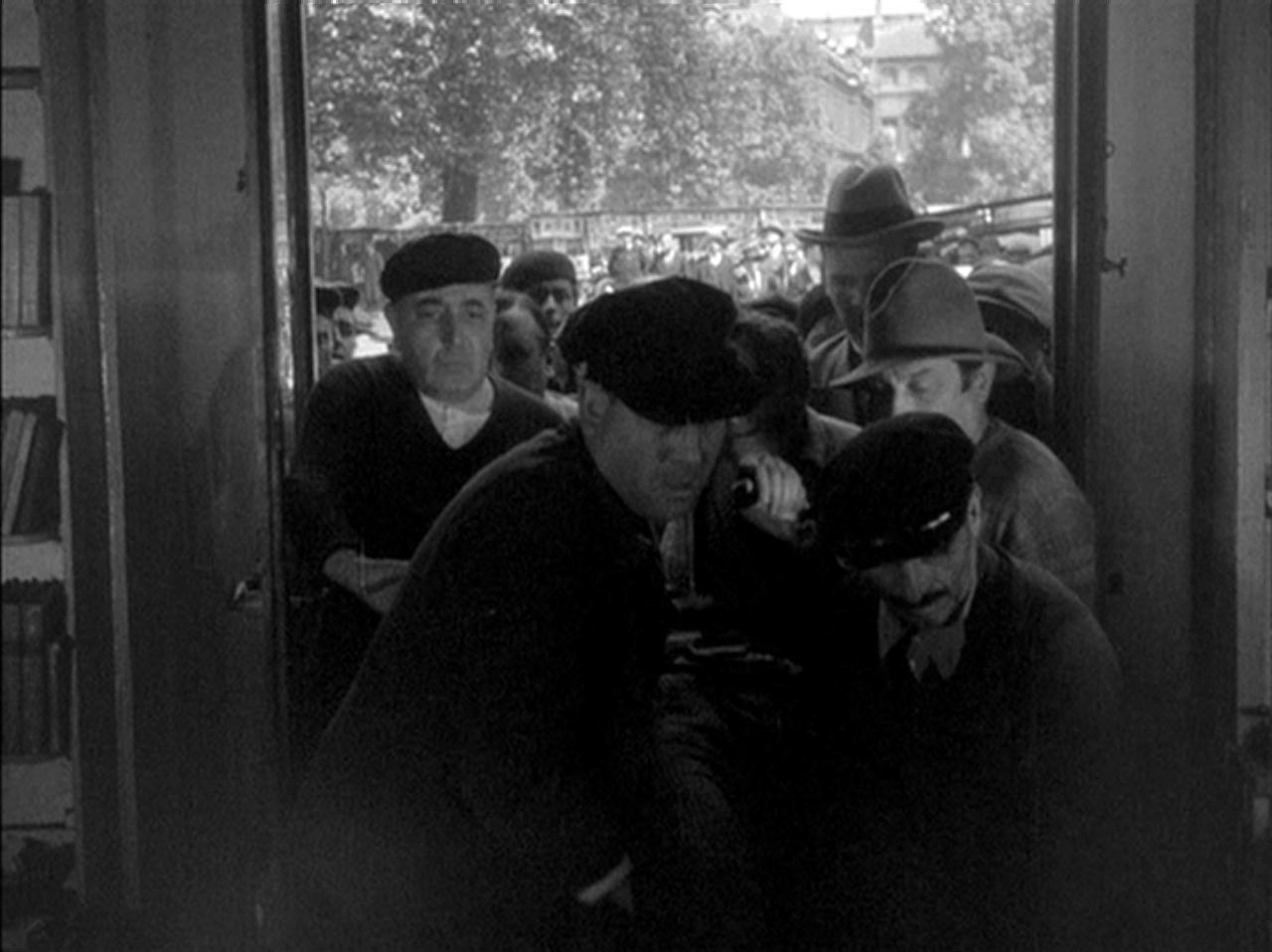
And then we cut back to an interior shot, this time a medium shot, and slightly different angle than before.


What I like about this little sequence is the ease with which Renoir uses a combination of exteriors and interiors, cuts naturally between the two, and stages his action along the z-axis, thus giving the scene a dynamism that is both inherent and fitting to the story. Renoir is also a master at working with crowds. His ensemble staging and use of the natural energy that crowds provide allows him to more deeply examine human nature because of the interplay among his characters.

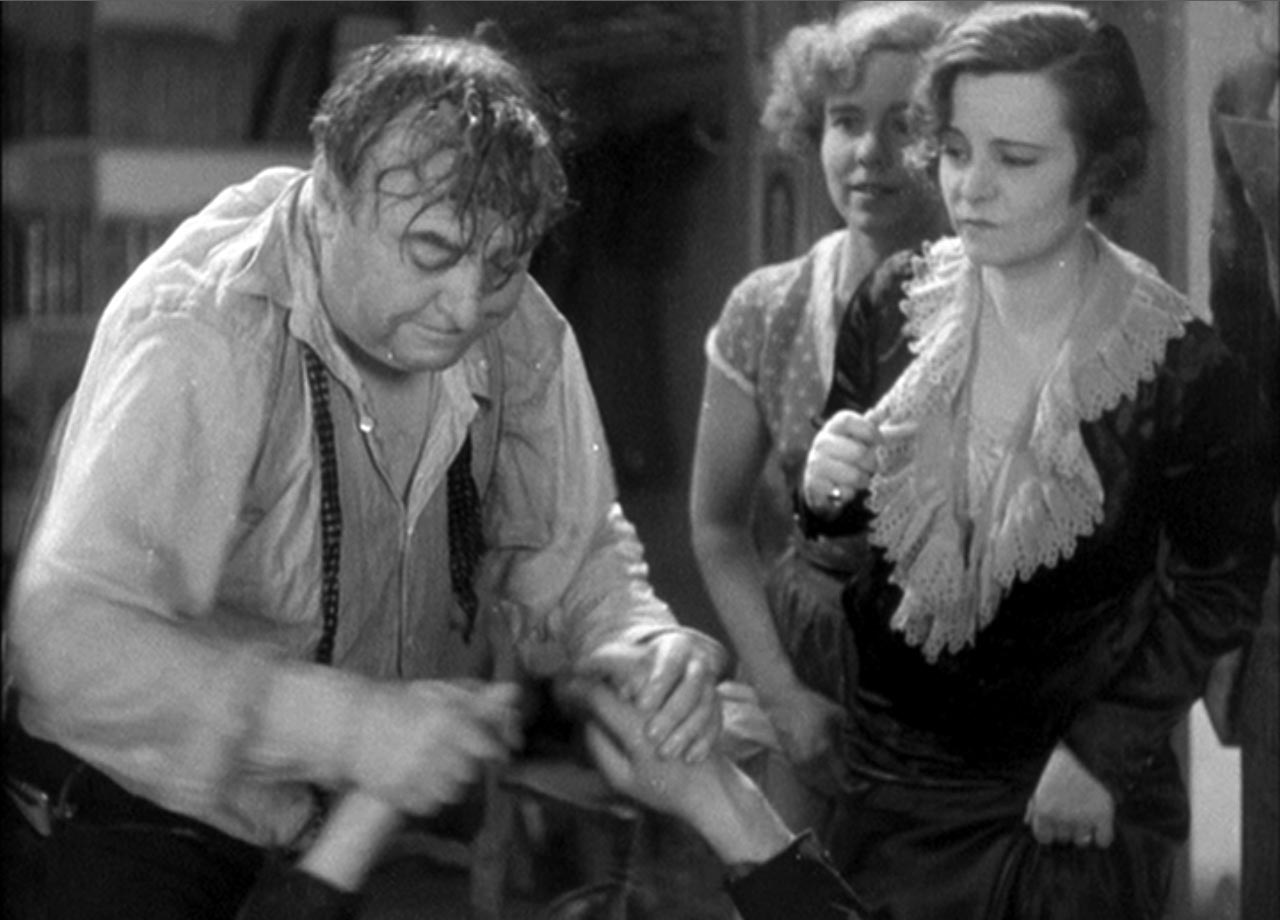
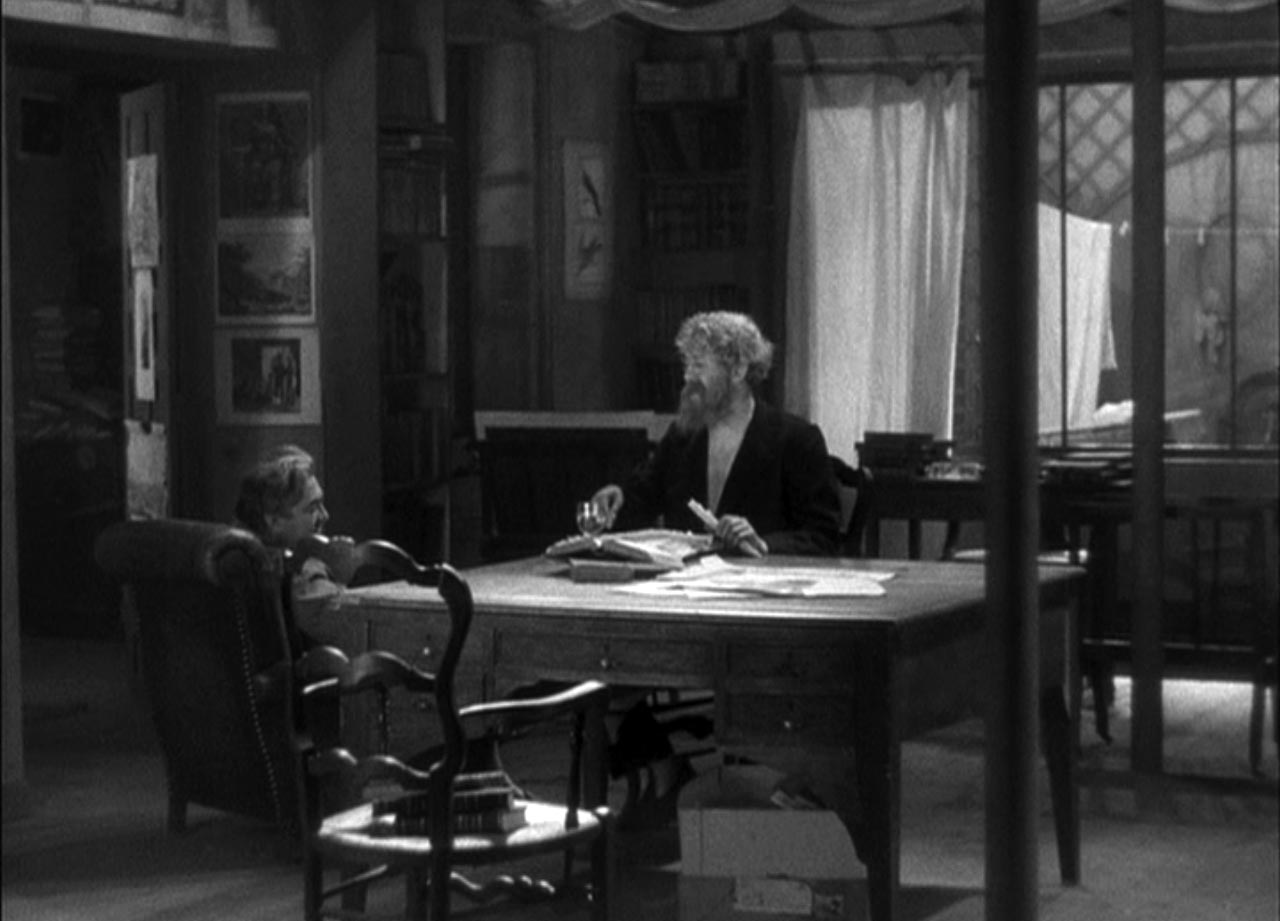
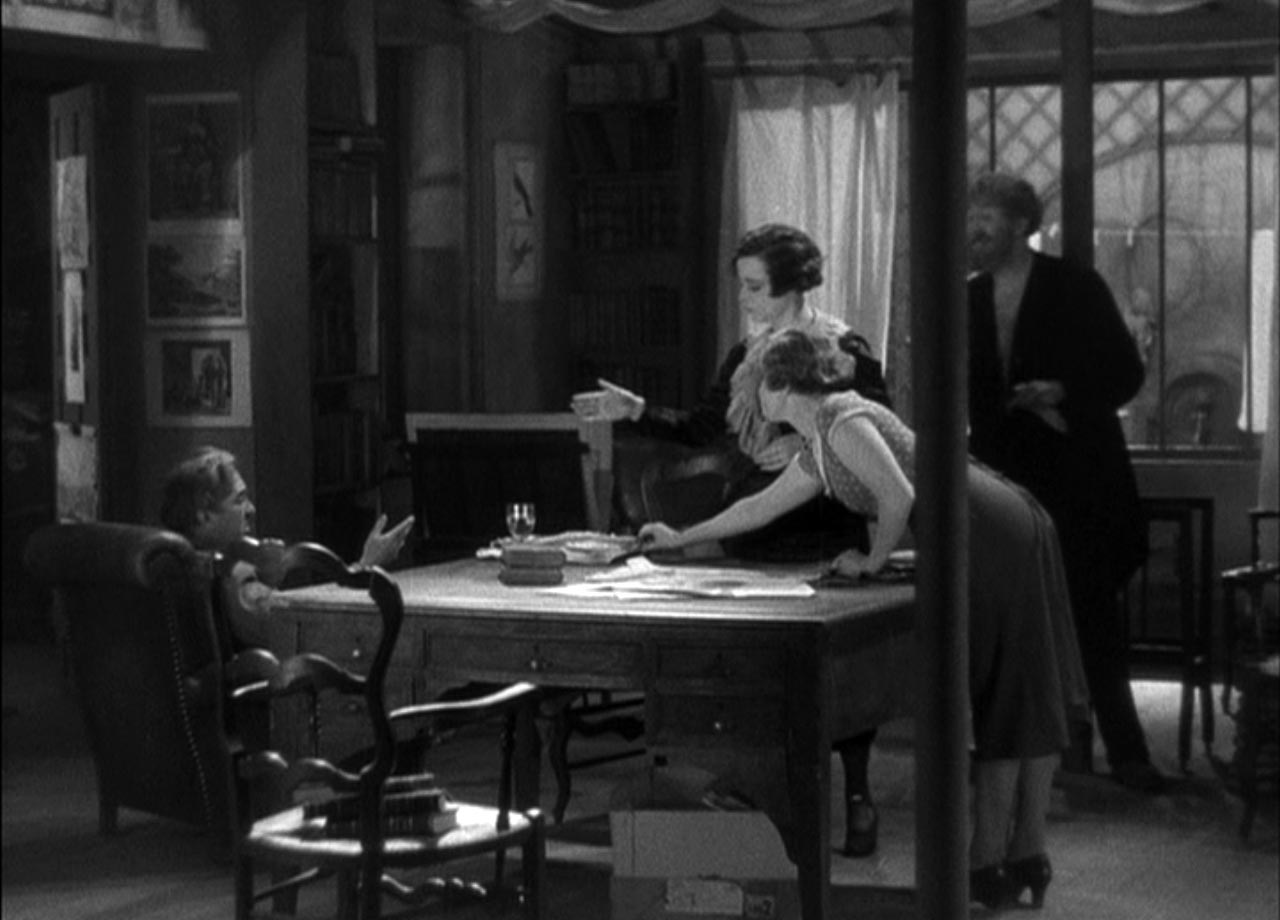
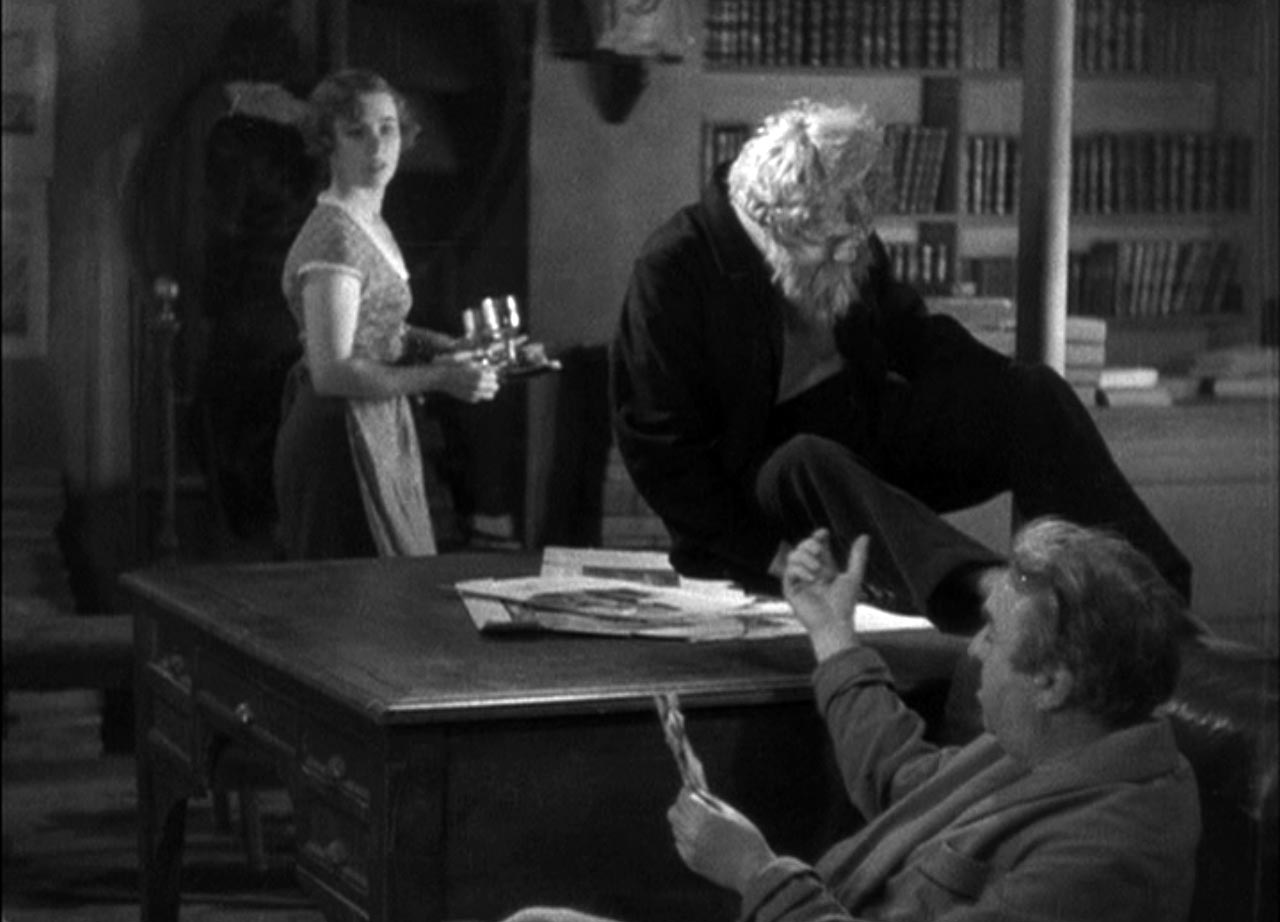
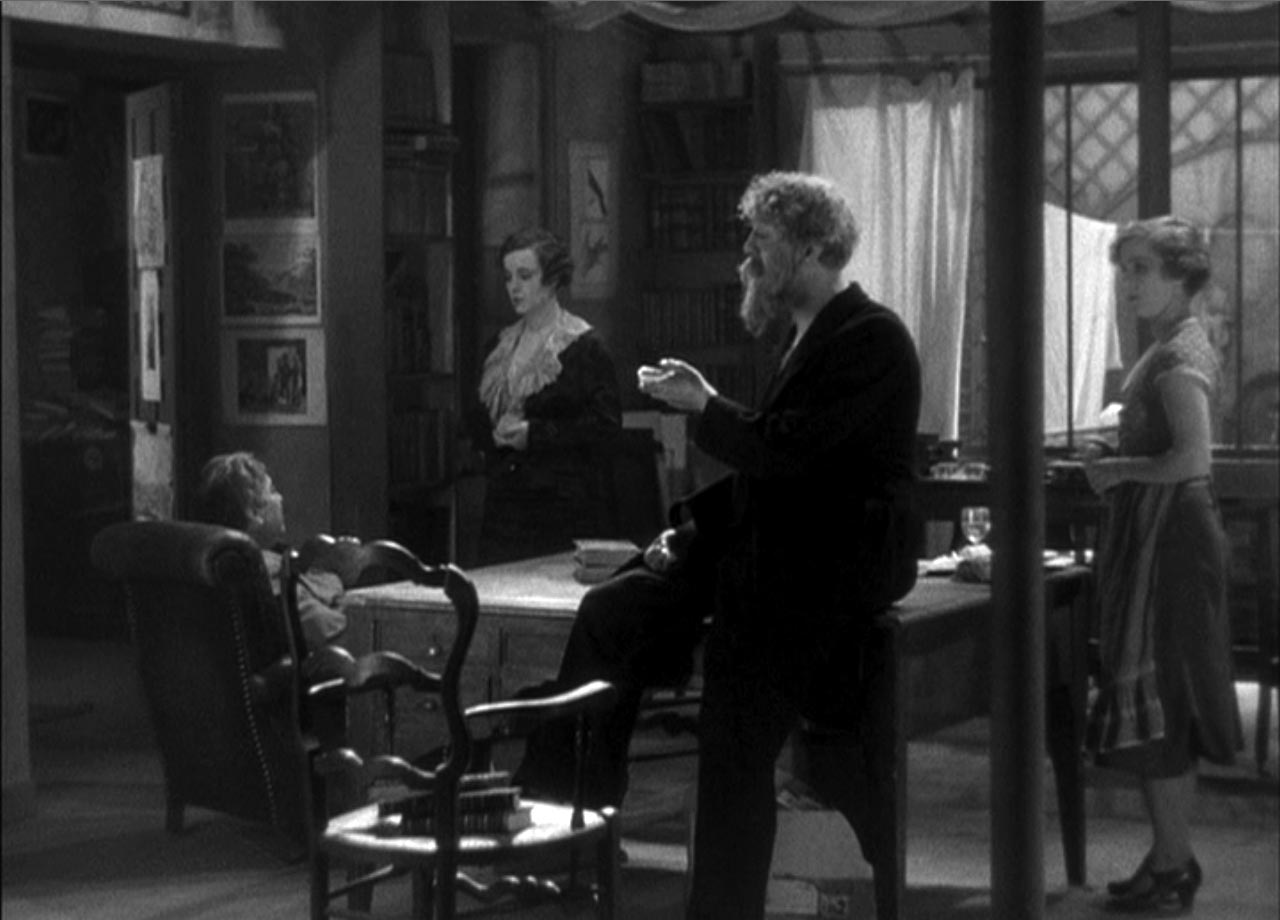
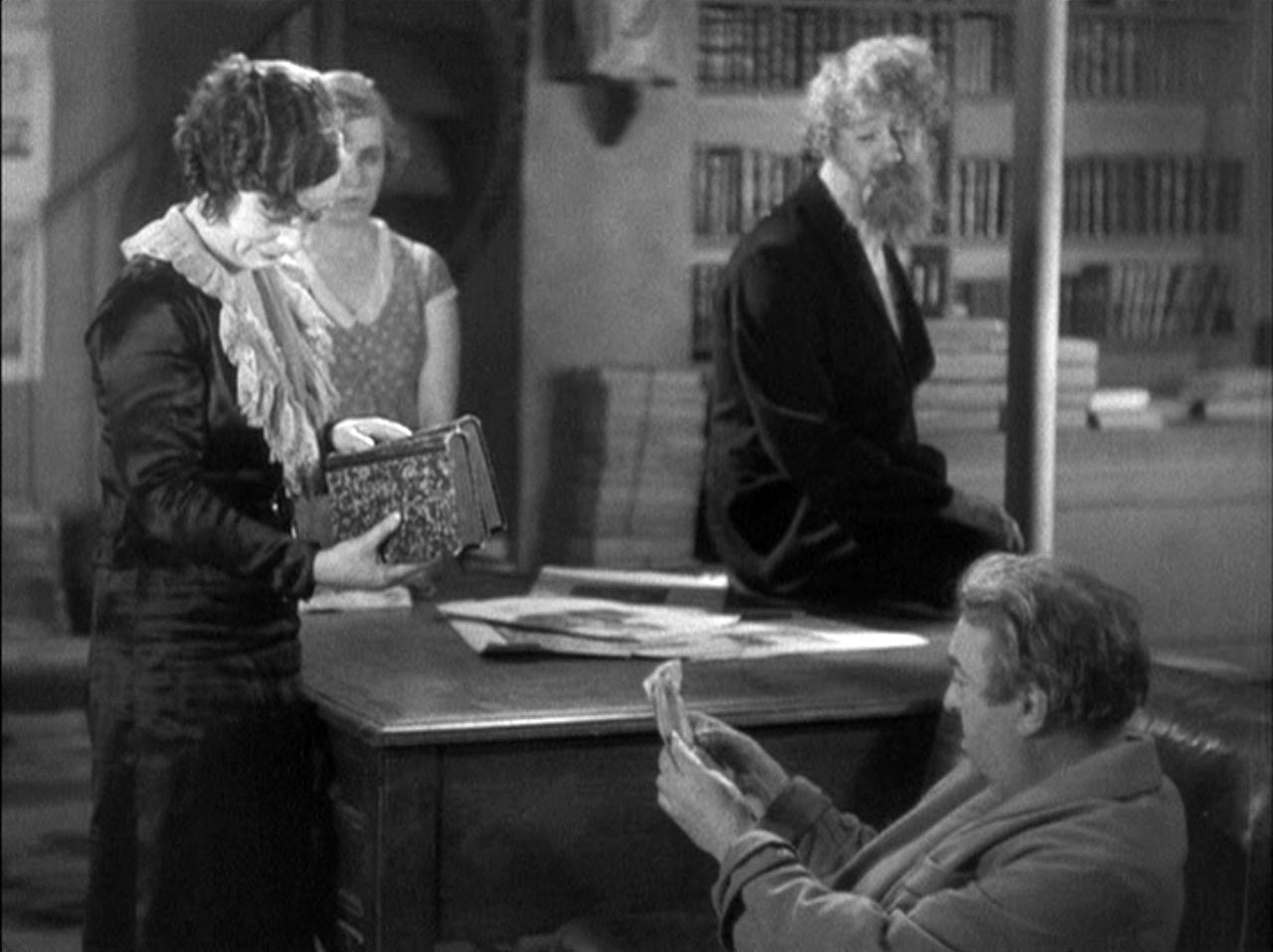
To watch older films is to engage in an act of archaeology. Boudu is an old film that offers evidence of another time and place (even another place for modern Parisians). One aspect of Boudu is the arrangement and development of action in dynamic space through ensemble staging and longer takes. I imagine that the average shot length (ASL) for Boudu is around 15 seconds, much longer than the ASL of most films today. Here we have a scene in which Renoir plays with the arrangement of the characters (four characters) in space (a single room) over the course of a complete scene.
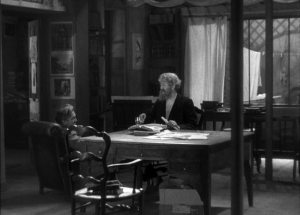
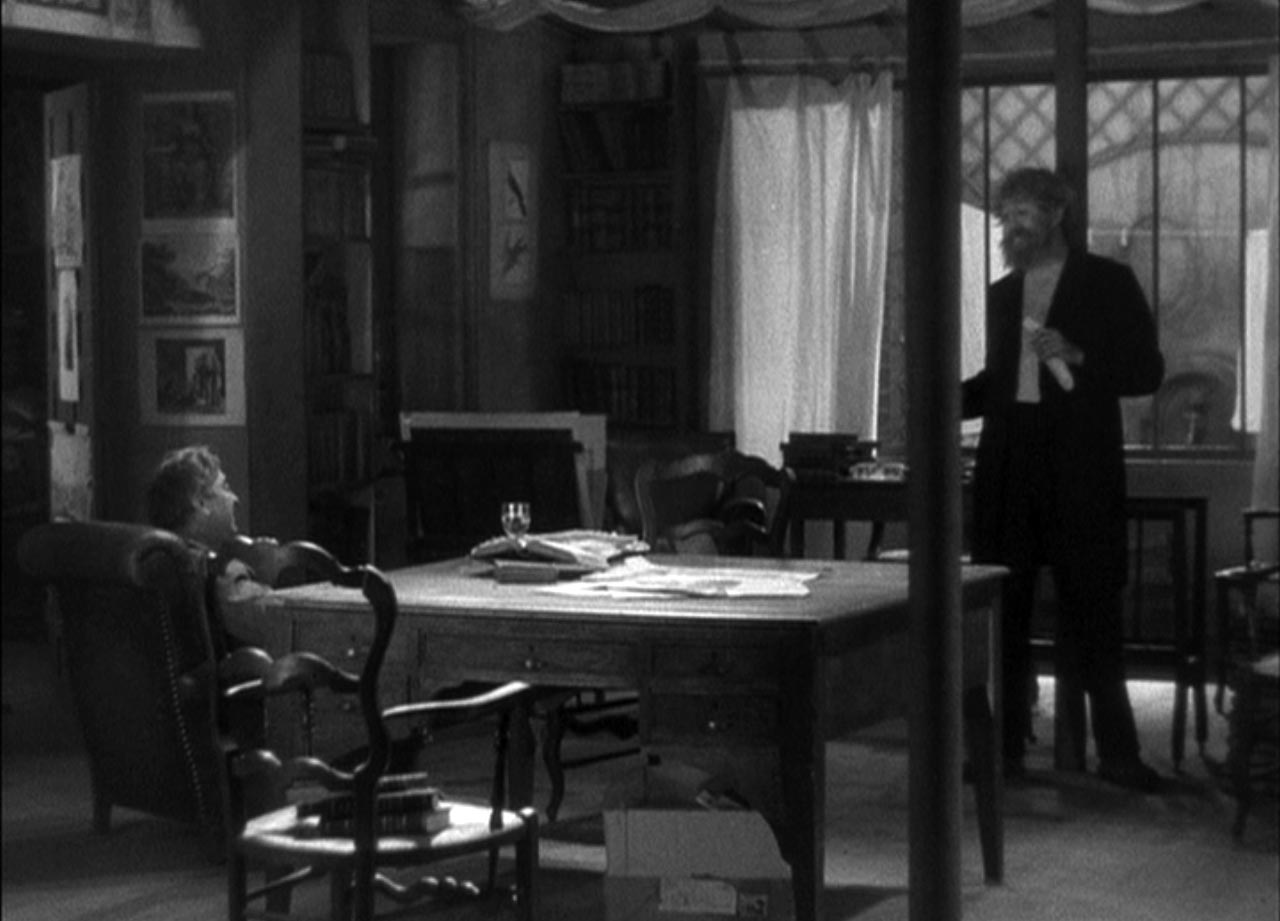
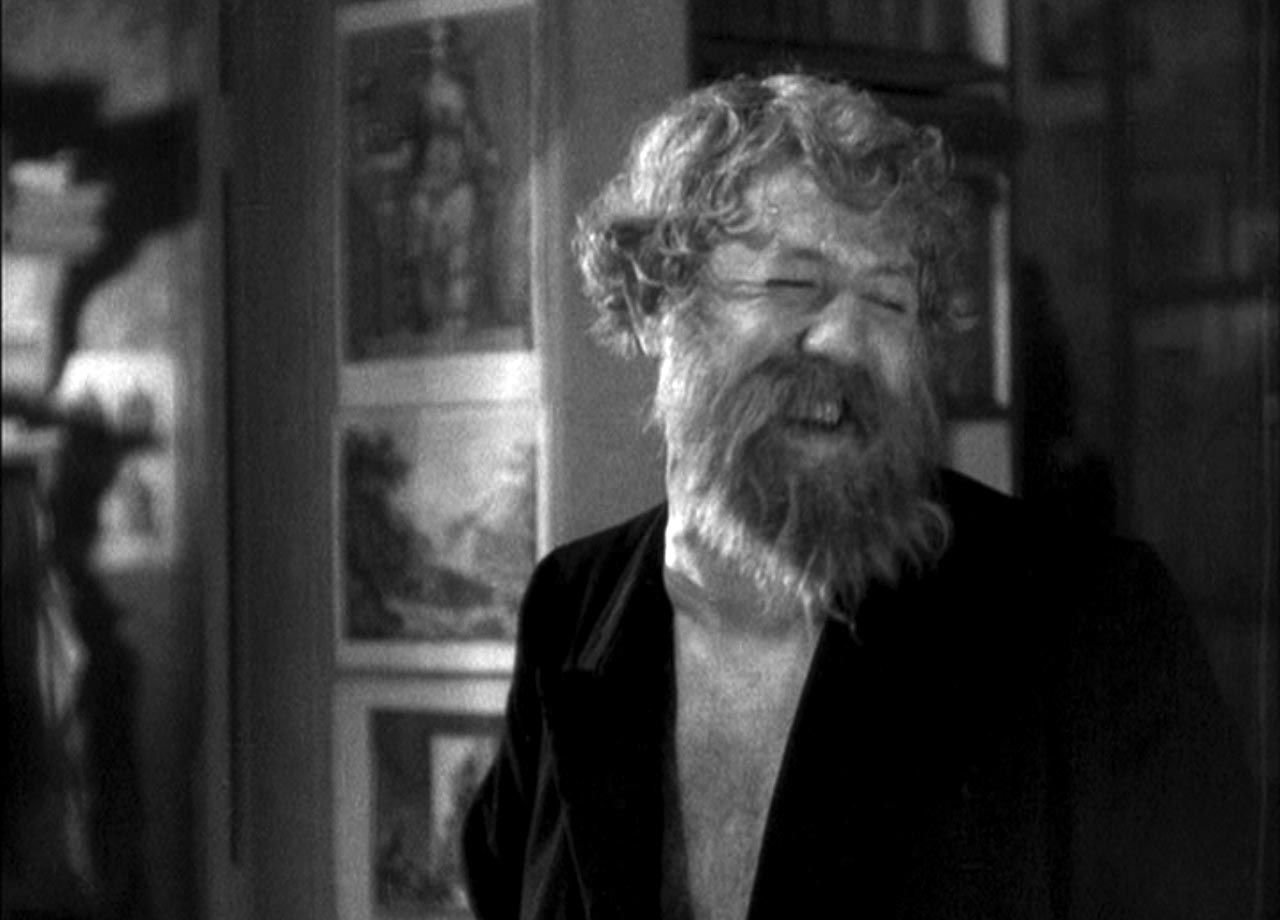
In a wide shot (WS) M. Lestingois and Boudu talk at the table. Boudu gets up and walks over to a post and leans against it.
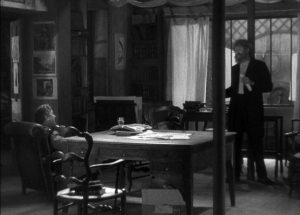
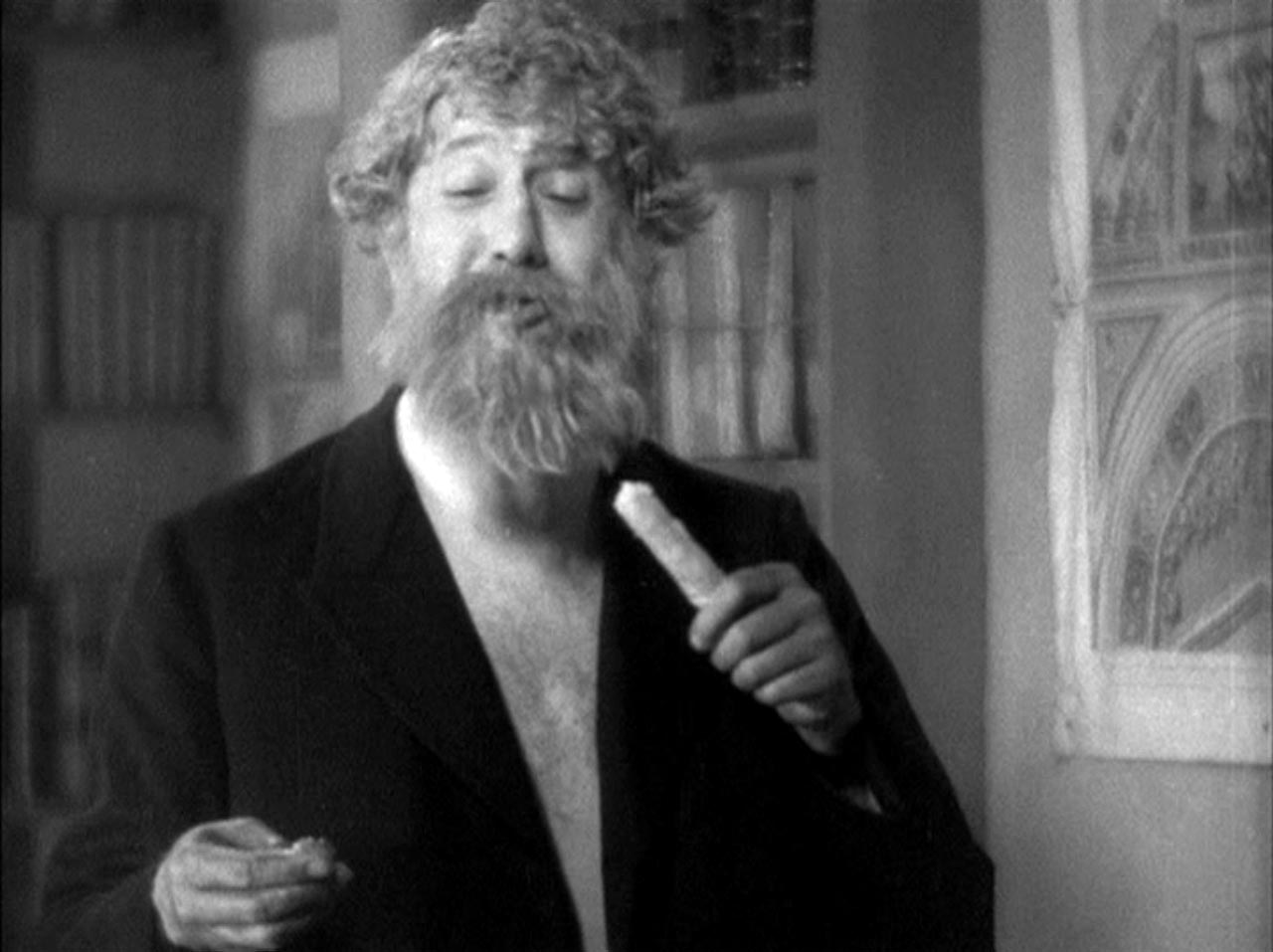
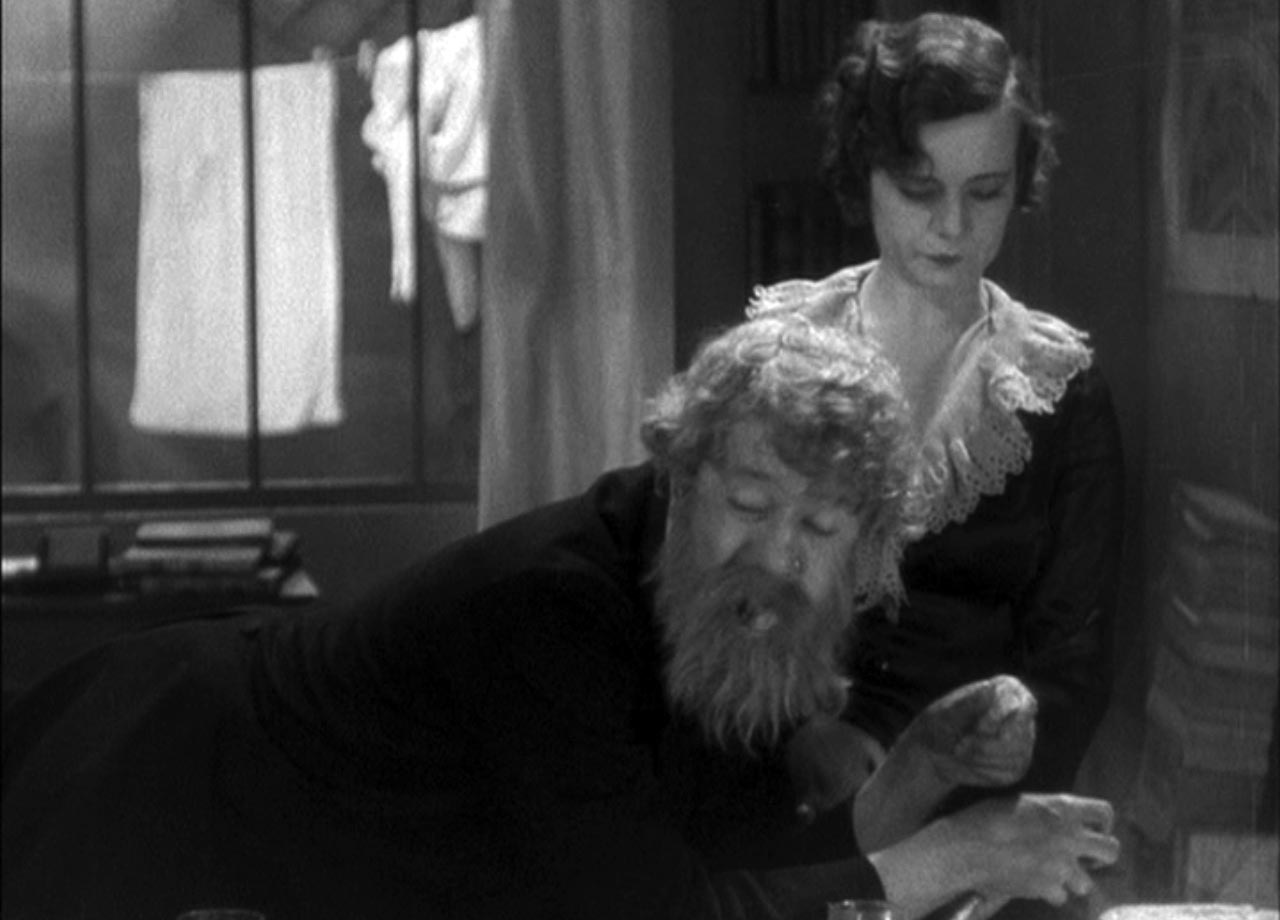
We cut to a medium close up (MCU) of Boudu. This edit, as are all the others in this scene, are both large jumps from WS to MCU and yet are fully beholden to the rules of continuity. In other words, although the edit suddenly brings us in close, we accept it as a seemless moment of the film.

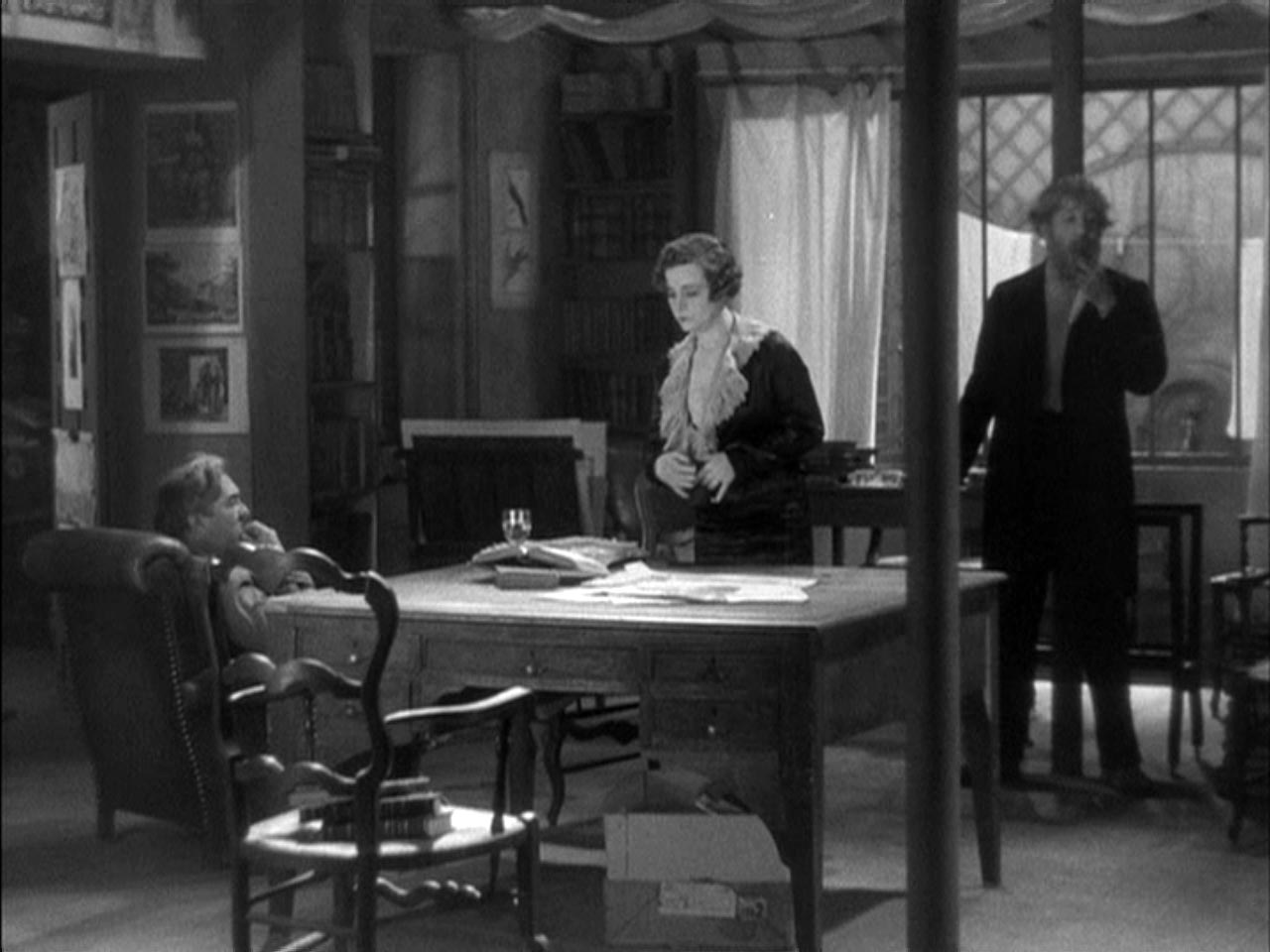
Now the camera is back at the WS and Mme. Lestingois enters.
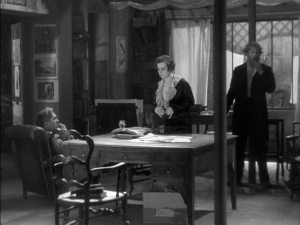
Then the maid enters.
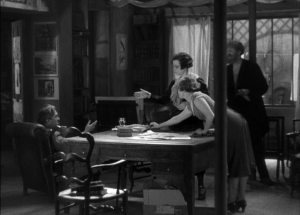
Boudu walks around the far side of the table and leans on it. We cut to a medium shot (MS) showing Mme. Lestingois behind Boudu. This offers a nice opportunity for Boudu to express his thoughts and Mme. Lestingois to show us her reactions. There is also a nice sense of depth in the framing.
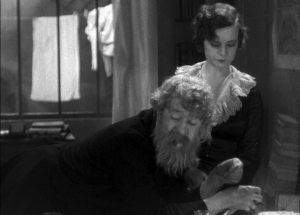
Now back to the WS.
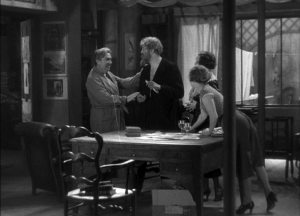
Then another big jump to an MCU to focus our attention on the interplay between M. Lestingois and Boudu.


Boudu now walks around to the front of the table and we are back to the WS.
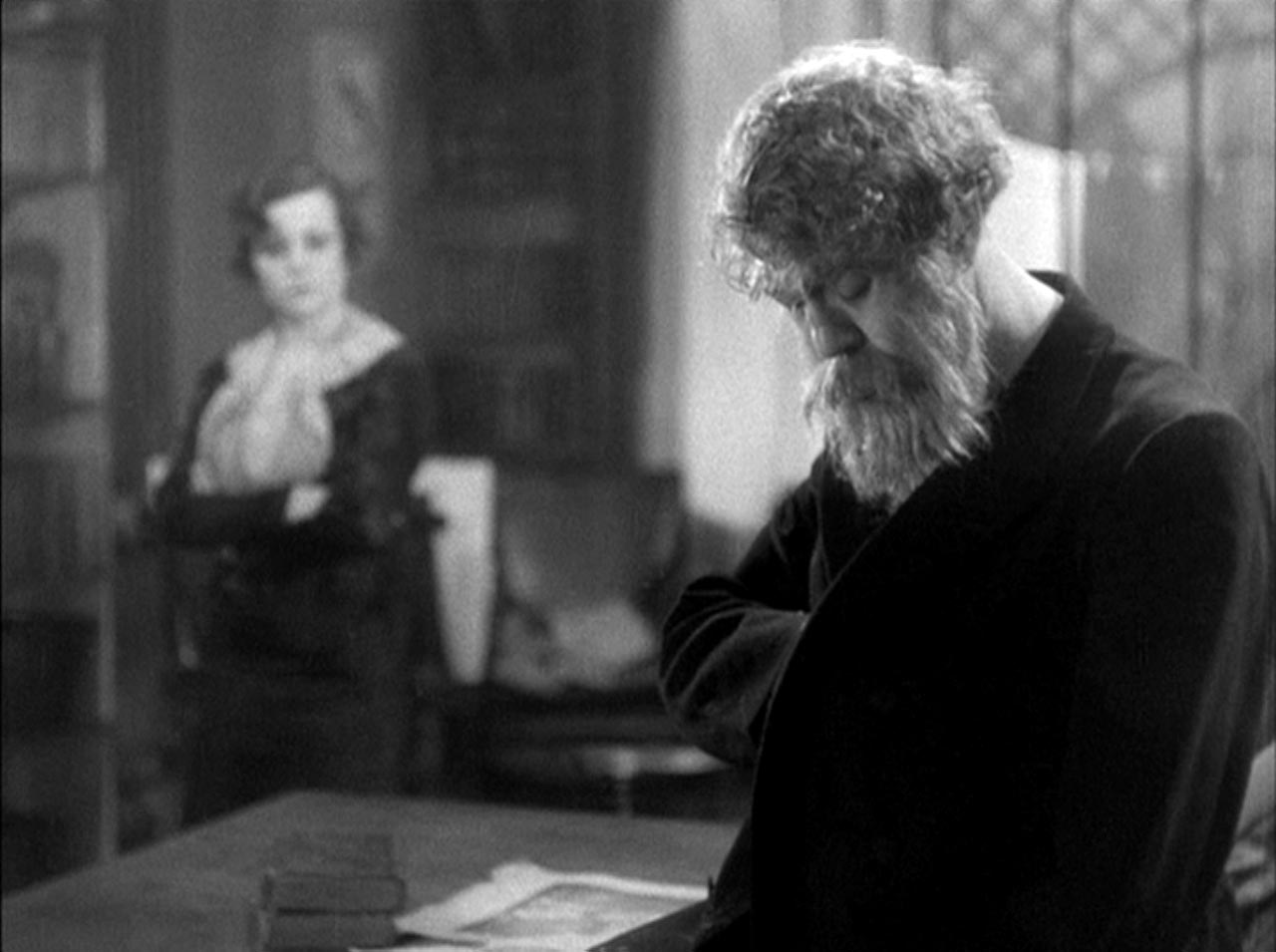
Then we go to a wonderful shot-in-depth of Boudu in the foreground and Mme. Lestingois in the background. What is interesting about this shot is the edit takes us in closer but does not change angle, so it works by being a match-on-action and match-on-dialogue cut so that continuity is not sacrificed. And again we get to see Boudu behave and Mme. Lestingois react.
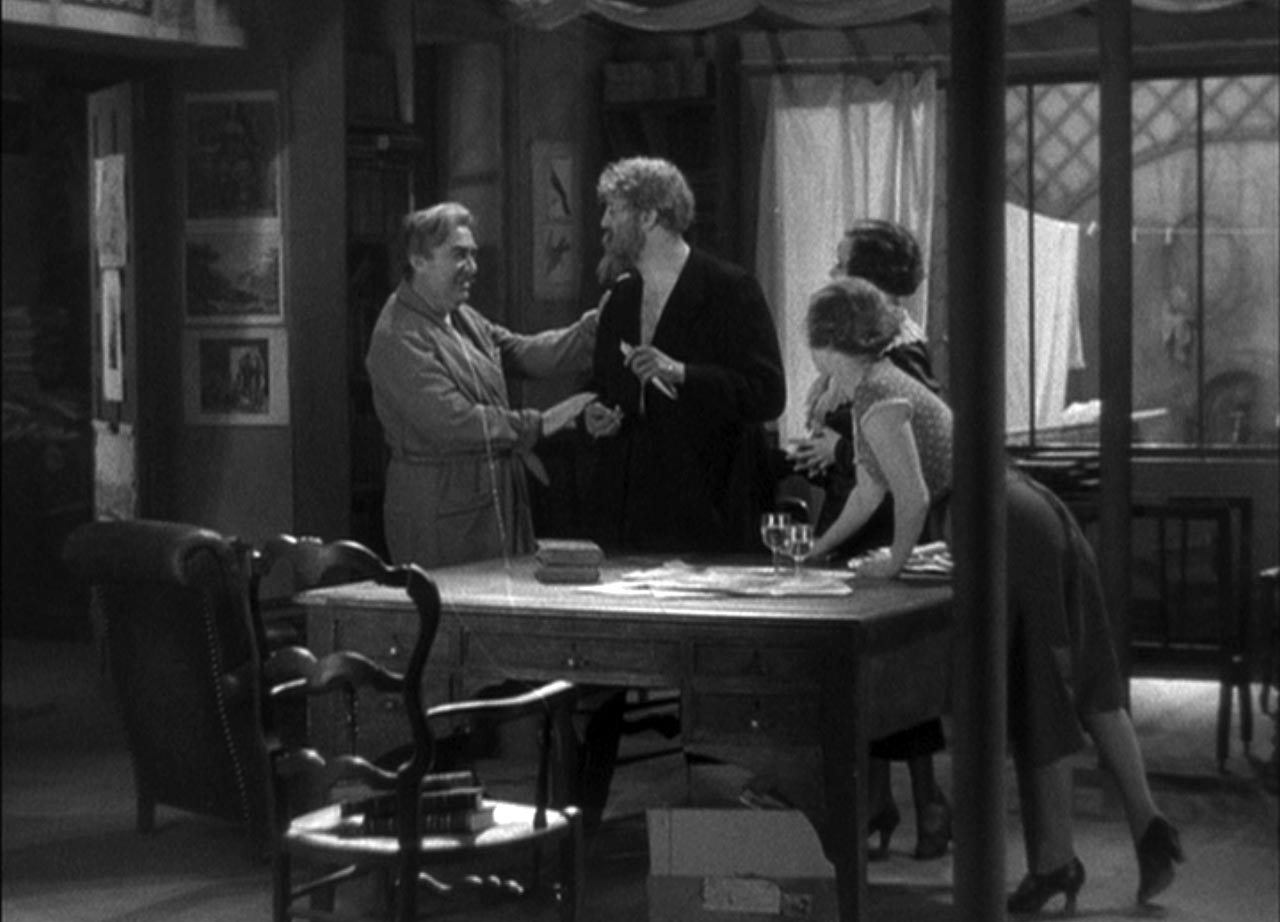
Then we cut to a revers angle medium wide shot (MWS) showing all four characters.
At this point, even with the various edits jumping us from shot to shot, the scene is clearly playing out as a nice ensemble staging, with each character playing their part in relationship to the others and that relationship is clearly defined for us.
Mme. Lestingois leaves the room. And the maid briefly interacts with M. Lestingois.
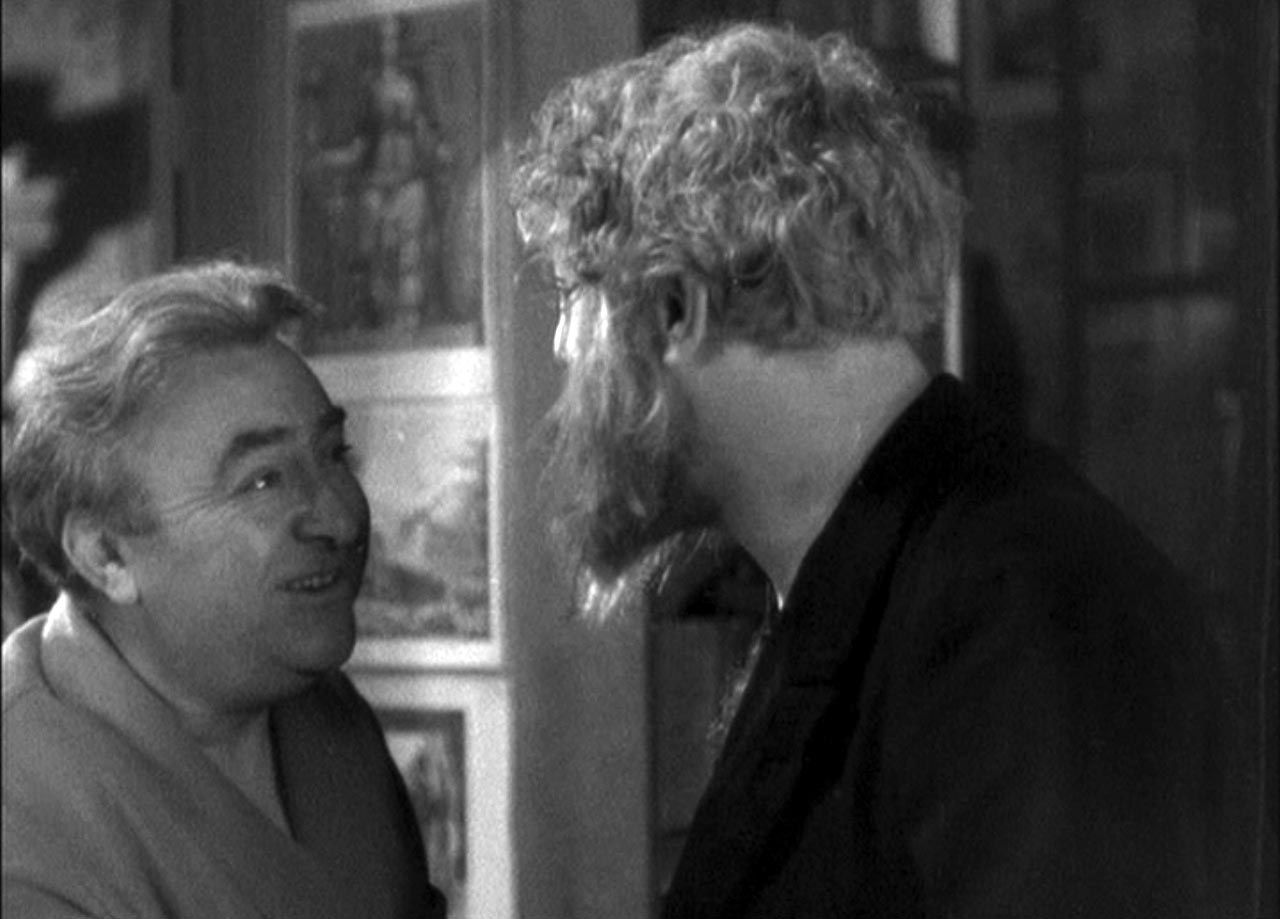
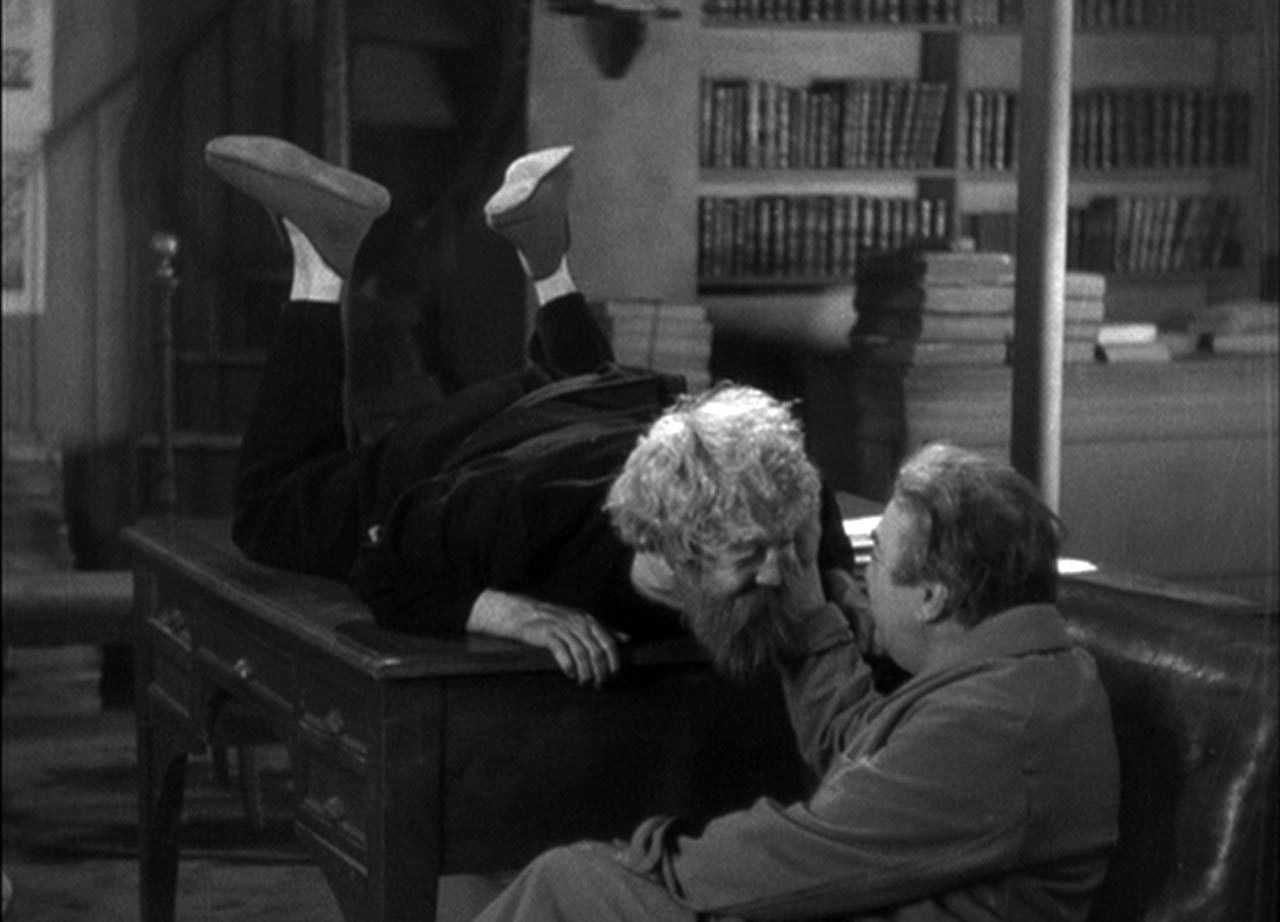
The maid leaves. Boudu and M. Lestingois have a moment.
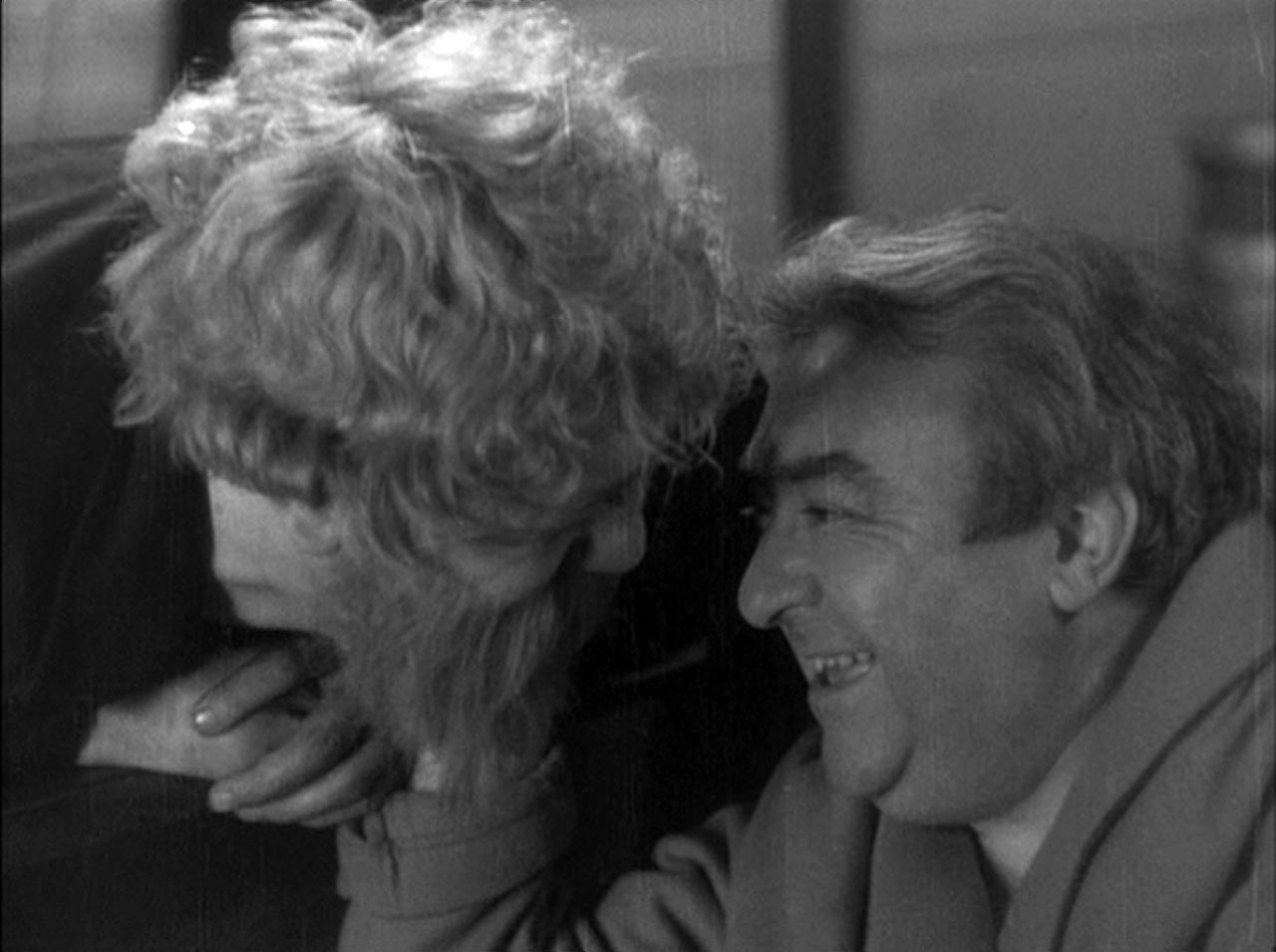
We cut to a close up (CU) of Boudu and M. Lestingois.
Scene ends.

According to Bordwell (The Way Hollywood Tells It, 2006), as cinematic techniques and practices changed over time, past techniques and practices have been lost. Bordwell argues for what he calls intensified continuity where the ASL has dramtically shortened and where action moves forward through editing rather than developing through space over time. What we have lost is the tendcy to stage action with an ensemble of of characters, each playing off each other, editing and shot framing emphasizing the action/reaction between characters, and even gradation or levels of meaning with each shot. Here in Boudu we see Renoir following the older techniques, one might say more theatrical techniques, of a more static camera, longer takes, ensemble staging, and a clearly defined space in which the action can take place. For better or for worse, rarely do filmakers shoot this way anymore.

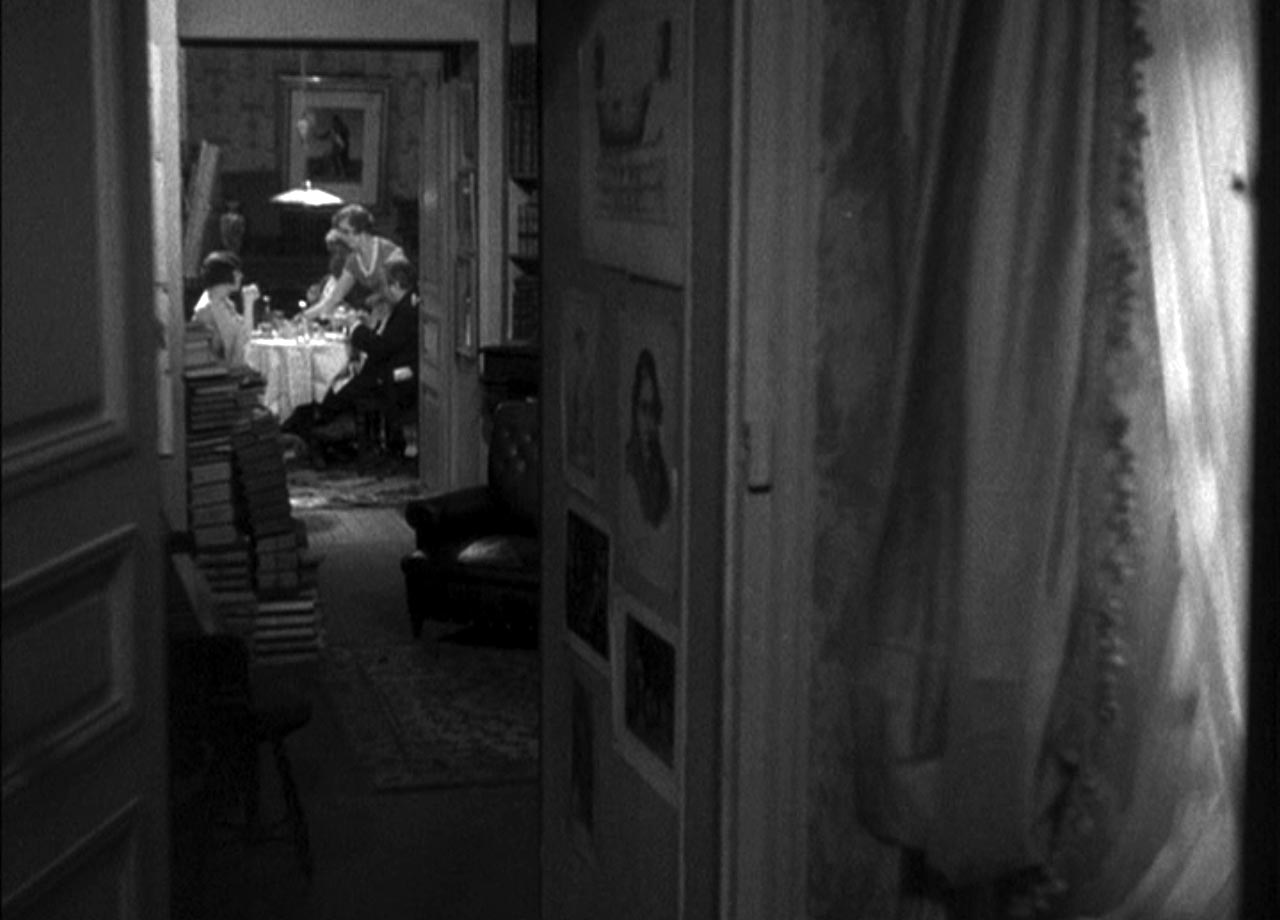
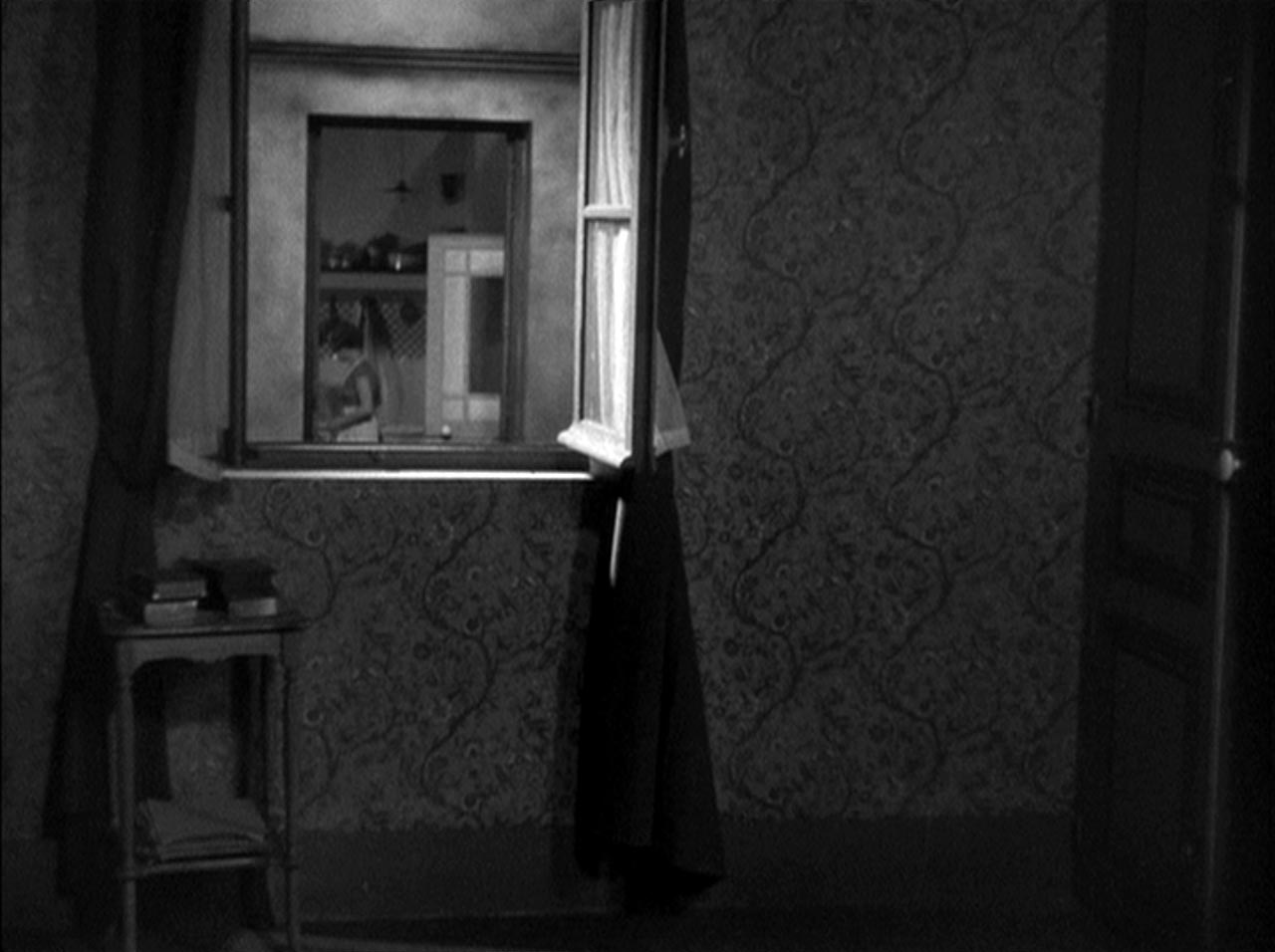
Another great little moment in Bouduis this dinner scene in shich the action is down the hall from the camera. Here the maid leans over the Lestingois’ table and picks up a plate. The camera begins to truck left as the maid also walks to our left.

The maid briefly stops at the end of another hallway while the camera continues to truck past the doorway to the hall. (At this point the image is rather dark because this part of the house is not as well lit.)

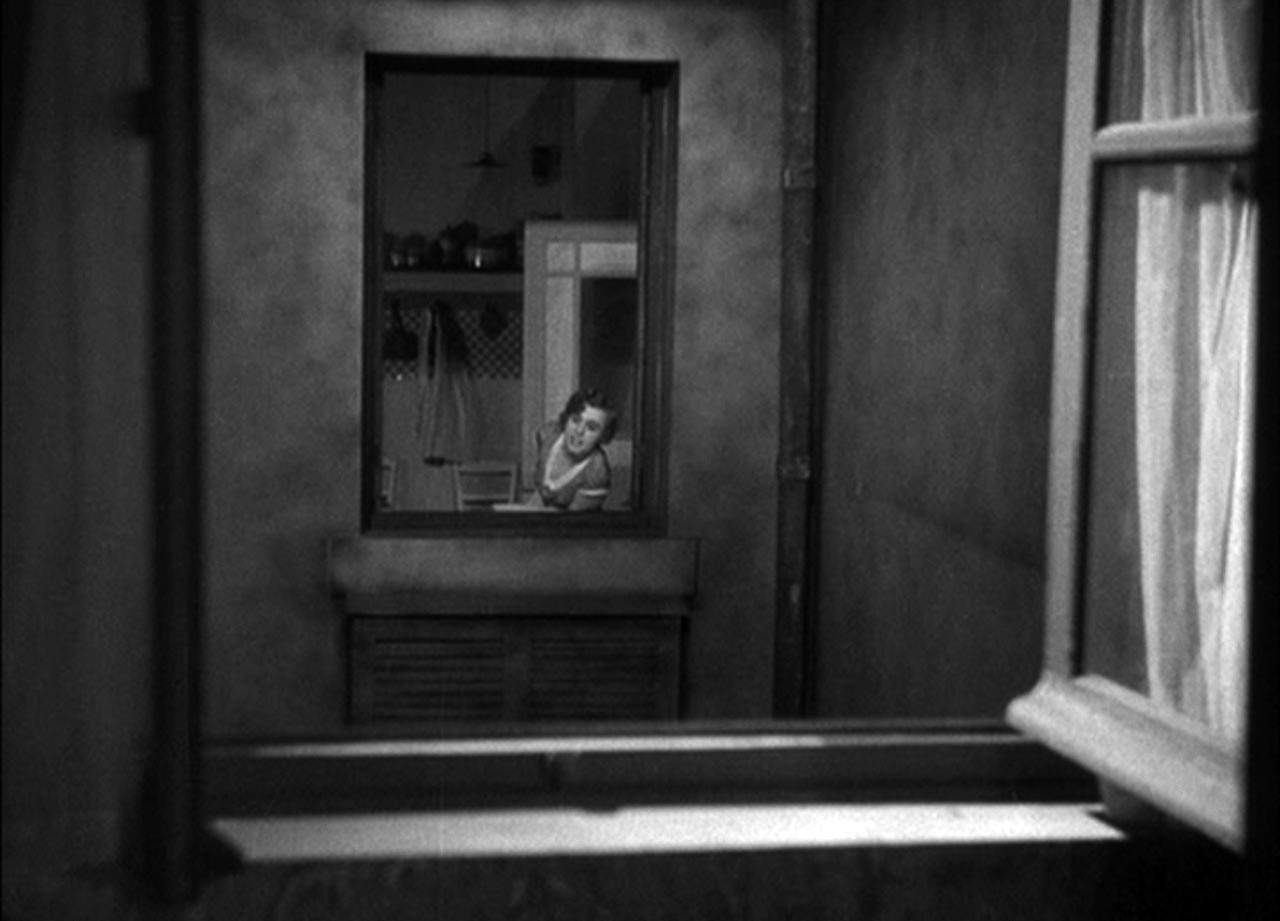
And then the maid stops in the kitchen and takes off her appron. We see here through two indows that look out onto a courtyard.

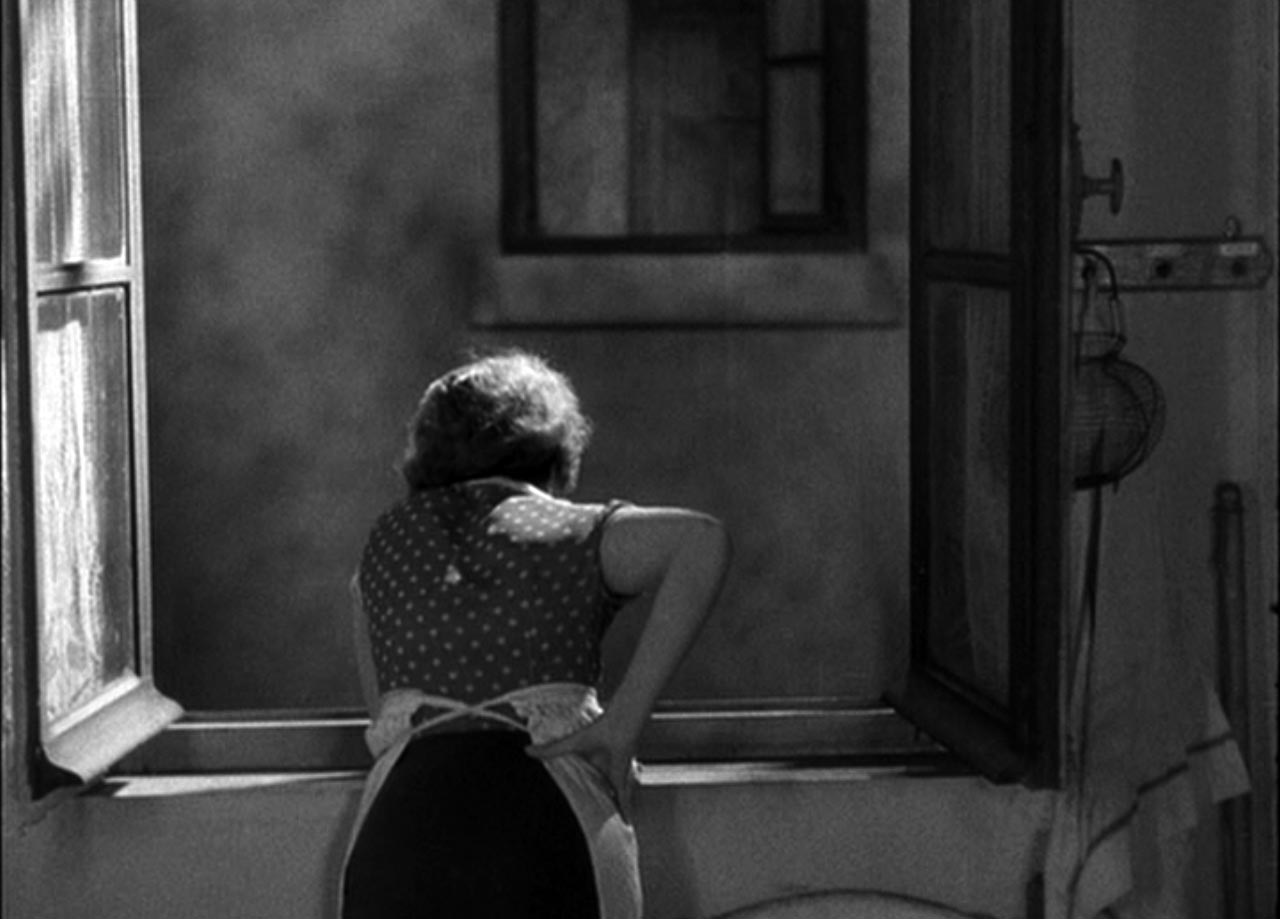
The camera then dollies in to the foreground window. The maid leans out and calls out to someone down below.
The, with a nice match-on-audio, we cut to the far room, from behind the maid as she calls out again.
There is something so simple about this transition scene. Renoir shoots in depth, giving us a a greater sense of the appartment and does so with the simplest of camera movements. The cut to the maid’s side is so effortless and seemless that it displays Renoirs’ masterfull capability with continuity. The scene also evokes a sense of our voyeurism into this little domestic scene. For me, I love these kinds of scenes because I love watching how people lived from other times and places. Although Boudu is not a true ethnographical document, it does provide us with lots of information about that world, which is both so different and so similar to our own.

We also have a glimpse into the way people (or some people) thought (I use that term in the widest sense) in 1931, at least into how they told stories and what stories they told. Renoir, for all his “master” status, was also a man of his times and created films that were both innovative and in the vernacular. We don’t see films such as Boudu being created anymore for many reasons. But we can become explorers, as it were, and look into our cinematic past, much as we look at ancient artifacts or 19th century architecture or Rennaisance painting, and still be amazed by what we find.
Finally, though I’m sure this is old news, I was pleasently surprised to discover that Boudu’s first name is Priape (translated at Priapus in the subtitles, and I know I had seen it before, but just not noticed it). Priapus was a minor god in the Greek mythology. Read about it here. I will not go into “unpacking” what this might mean for understanding the film, but I feel that it might help explain the role Boudu plays in this bourgois morality play (including his spitting in Balzac), and also help explain the odd little Greek theatrical moment at the begining of the film. I would say this also goes to the boldness of Renoir and Boudu’s themes.
>through a day slowly

>Today I ran my first 10k road “race.” For me it was not a race, just something to finish without walking. Which I did. The beginning of the race was rather comical for me. I intended to start slow, and I did, but I felt as if everyone was running away from we, which they were. So there were only a small handful of people who finished later than me. At least I accomplished two goals: (1) run the race without resorting to walking at any time, and (2) run the race at a better than 12 min per mile pace. For those of you who are runners you will know that a 12 min pace is very, very slow, but at least I achieved both goals. So I am feeling good about that.

Part of my inspiration for doing this run comes from the book: No Need for Speed: A Beginner’s Guide to the Joy of Running.

Now, this race is called the Scandia Run and it is related to the annual Scandinavian Festival here in Oregon. So I, being part Swedish by ancestry, was glad I was running in a Scandinavian kind-of-thing, and to top it off I decided to watch Through a Glass Darkly (1961), by I. Bergman of course.


Another way I can tie this film to my day, other than the Swedish angle, is that when I was in the middle of the run I found myself crying out to God too.

But for dinner I made Chicken Cacciatore – which is decidedly not Scandinavian.


I got the recipe from a book called The Pleasures of Slow Food: Celebrating Authentic Traditions, Flavors, and Recipes.

>Regardless of my opinion…

>can a movie be good, I mean really good?

Or is it a matter of taste?

I have come to the conclusion that the single biggest issue regarding film criticism has to do with the subjective/objective split. In other words, can we say meaningful statements about a given film that are not ultimately subjective, and therefore just a matter of opinion? Much of the debate around how criticism should be done stems from issues regarding this split. And it is an age-old split. In particular because when it comes to art what we all want to know, at some deep level, is whether the work is any good.

We can describe the characteristics of a film all we want, and that is a fundamental part of criticism, but finally we want to know if all that description points to something of value, or not. And if one makes the case that a film has value, is good and not bad, then we want to know the criteria being applied. Or, maybe more commonly, we assume that the criteria doesn’t really matter because film criticism, no matter how detailed, educated, in depth, and carefully referenced, is still merely a matter of personal taste. But is this true?

I plan on writing about this topic in greater detail in the future, but I have been curious about the objective/subjective split elsewhere. At the Amateur Gourmet there is a similar debate going on regarding food. I am interested in what people think, after reading that piece, if the same issues apply to film. Is the objective/subjective split hopelessly unresolvable? Is film criticism really just about carefully crafted opinion?

>Film Music & Architecture (metaphorically)

>

Preface: I had anticipated this to be a much longer and more involved posting for the Filmmusic blog-a-thon over at Damian’s great blog, Windmills of My Mind. But alas, life does not permit me, so I’ve decided to post more of a question than a statement. I will formulate my half-baked ideas as I go. And, of course, in typical PilgrimAkimbo style I will use the Filmmusic blog-a-thon to write about something other than film music.

* * * * * * * * * *

If you are not a true film music aficionado, as I am not, I would guess you do not select your films primarily based on who created the score. And yet, if you find a film compelling, if you become emotionally involved watching a film, if a film haunts you or stays with you, very likely the film’s music played a significant role in helping you to end up where you did. We all know this to be true. It may also be true that a film’s musical soundtrack actually helps one to merely understand the film at all.

I want to propose a very simple metaphor for considering the role that film music plays in our experience of films. I propose that film music is like architecture. My question: does this make sense? When I say architecture, I do not mean the structural aspect of a film, such as editing, rather I am thinking of the way the design of a building or house or room affects one as one enters that room and lives out the story of one’s life. Maybe a better way of saying it is that film music is architectural. And maybe there’s a better word.

My argument:
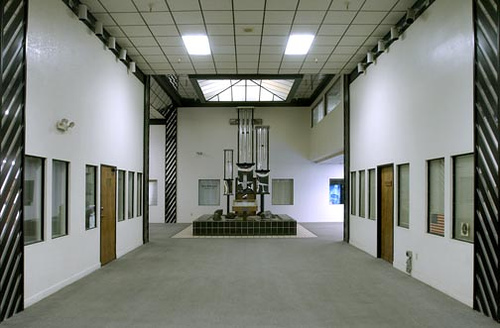
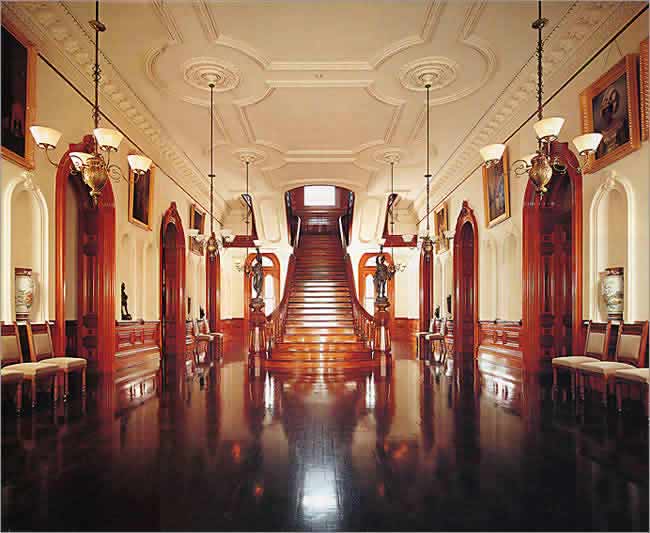
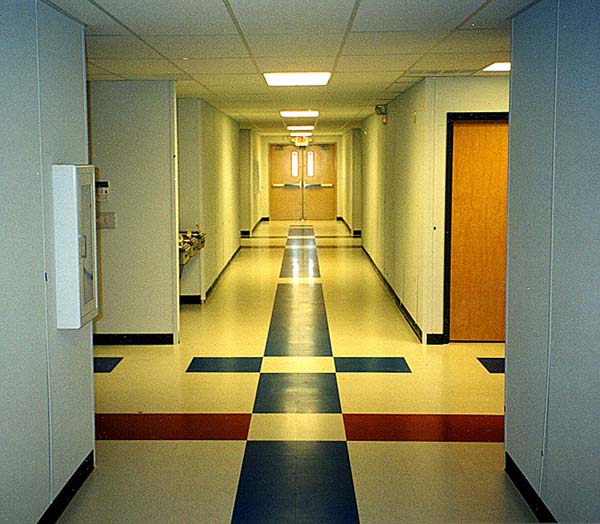
Consider these three images of three very different interior spaces:

I have no idea where these interiors come from other than random images I gathered from the Internet. But it is clear that each are of clearly defined interior spaces, and that each space, though photographed from essentially the same angle, produce very different feelings. One can imagine a story taking place in each one, for example a scene of a father and son arguing over an inheritance, or a romantic kiss, or a burglary – it doesn’t matter. But more importantly, if one were to visit these places one would expect different things. In other words, the spaces themselves convey meaning about their use and their purpose. They would imply different narratives.

Now, if one were to meet someone and have a conversation in each of these spaces, though the denotative content of each conversation would be the same, the connotative meanings might take on slightly different shades due to the context of the rooms. This is one of the things film music can do for a film.

This point, though I admit it is meager, just might be more profound than it appears to the casual observer. To emphasize this point a little more, I like the following quote (from The most Beautiful House in the World by Witold Rybczynski) about how architecture speaks to us and guides us:

The symbolic meaning of architecture can be profound, as it is in the case with places of worship and important public monuments. But the language of buildings can also convey more mundane messages: where to go, what is important, how the building is to be used. It is easiest to discern this function if it absent or if it is misinterpreted. The stock scene in movie comedies in which a flustered visitor wishing to leave a strange home finds himself in the clothes closet illustrates precisely such a confusion. Like all humor, it is an exaggeration of the familiar; we have all had frustrating encounters with doors – not only identifying the right one but opening it once we found it. There is a bank entrance that I go through frequently but which always manages to confound me. The door is made of plate glass, and its pristine beauty is unsullied by visible hinges or pillars; the elegant handle extends the full width of the door. I always have a small struggle going through that door – sometimes I pull instead of push, sometimes I push against the hinge. I feel like taping a sign to the door – PUSH HERE.

Could we then think of film music as being, at least in part, like the sign that says “push here”? In other words, film music is an integral part of guiding us, like architecture does in the physical world, through the mental world of film perception. In a sense, film music can tell us “how to use” a film.

Architecture, that is, the aesthetic design of the spaces we live in – not merely their structural dimensions, produces an often taken-for-granted effect on our lives. In other words, the design of the buildings we inhabit affects the way we live, the way we think, our emotions, and the way we relate to others, and it does these things in often quiet and subtle ways, and sometimes in obvious and loud ways. As we act out our lives in and around man made structures we act within a kind of context circumscribed, and even proscribe to some degree, by these structures. They give us a context within which to act. I argue that film music performs much the same function. Like the overwhelming feeling one gets when first entering a cathedral so are the opening chords of John Williams’ Star Wars theme. The music not merely gets one’s emotions going, but it also tells us a lot of critical information about what we are about to see and how we should think about/approach the story.

If this is true, then film music is not merely an add-on to dress up a film, though it can be that for some films. Rather, film music is an integral part of how a film, as a whole, conveys its meaning(s). As one’s brain engages with the constructive nature of piecing together the film’s narrative from the various clues provided, the music colors that narrative and provides a kind of context for the descriptive, interpretive, and evaluative processes. But, because film music is typically not central to the story in the same way as is the acting or the cinematography, and because film music is typically non-diegetic (not really part of the story at all), that is why I am using the metaphor of architecture. Film music acts as a kind of “space” in which a story is played out. Change the music and you affect the story.

One could say that film music, though typically non-diegetic and non-visual, is similar to the film’s mise-en-scène. Visually films cue the viewer to mentally construct the story from all the visual clues presented. Do not films also do this with music? Of course they do. But the musical soundtrack does more than merely cuing the viewer to think of a particular scene as being romantic or frightening. Music can play a role in the overall “sense” of a film, such as time period, genre, etc. And like many other things in a film, music can act like a relatively open ended set of “codes” that both support and work counter to the desires of the filmmaker.

Once, when my wife took me to see a film of her choosing, one that I did not know about, I had a strong sense of what the film was going to be about from the moment of the opening chords of the film’s musical soundtrack. I leaned over to my wife and said something like: “Okay, so I can tell this film will be about X, and then X will happen, and then X and X and X, and finally it will end with X.” All that from the film’s music combined with the opening credits. And I was right.

Maybe the most fundamental aspect of music is its connection with human imagination. Music can enlarge the imagination by drawing out of it intuitive connections to the world and experience. To keep with the architecture analogy, consider the following two images of famous architectural settings:

Both of these constructions are highly evocative. They draw one into their spaces and they draw out of one’s mind certain emotions and feelings. A film’s camerawork can do the same thing, but so can its music, maybe more so. Now imagine having a conversation with a friend in either of these locations. The same conversation would not be the same given the change in surroundings, even if the differences are subtle. It is this way because of our “aesthetic sense”, that is, our innate ability to respond, even sub-consciously, to aesthetic objects and nuances.

About 13 years ago I wrote these words:

To say that the couch in your living room or the pictures on your walls have a profound effect upon your life may sound strange. But they do. The things we surround ourselves with, from the films we watch to the color and texture of our bathroom tile, influence the way we think and feel. The nature of this influence may be enigmatic, but we know it is there. We know that the aesthetics of MTV, its look and feel, influence the youth of our world. We know that the aesthetics of an art gallery encourage quiet contemplation, whereas the aesthetics of a video arcade do not. And we know that living in an apartment with dark brown walls has a decidedly different feel than living in an apartment with white walls. The look, texture, and sound of our surroundings influences us because of our aesthetic sense.

I believe that in the mental world of film watching, the film’s musical score can be much like that art gallery or those apartment walls. If this is true, then the decisions facing the filmmaker regarding the musical score are critical.

I am sure there are some who might consider non-diegetic film music to be nothing more than a kind of wallpaper – something to pretty up a film, to give it that extra something. For some films this may be true I have no doubt, but in general I think this position is wrong, for fimmakers and for viewers. On the other hand, film music is there to serve the film. For most films the story comes first and all the rest follows, often with the music being included last. I personally believe that filmmakers should not think of music as an “add on” to a film. Film music should do more than merely prop up existing scenes. Rather, film music should be a fundamentally integral part of film. Maybe directors should have the composers be a part of the scriptwriting process. I’m sure some do.

And there it is as promised: some half-baked ideas on architecture for the film music blog-a-thon. I only hope it isn’t so half-baked as to be like a pancake that is burned black on the outside and still runny gooey on the inside. But maybe it’s still just a pancake nonetheless.

untitled film post


I was always glued to the television when I was a kid, and I loved movies. There was one show, The Million Dollar Movie, that played the same film over and over every night for a week, so you could really know it by heart. I remember stumbling across a bizarre futuristic film that was made up of nothing but still images except for one of the final scenes, which moved: it was Chris Marker’s La Jetée, which must have been on PBS when I was a teenager. I didn’t know it was meant to be science fiction, it was just very weird. Another time I had to go with my parents to a dinner party and wound up watching TV in the basement, eating my little dinner alone watching Hitchcock’s Rear Window while the adults partied upstairs. I loved all those vignettes Jimmy Stewart watches in the windows around him–you don’t know much about any of those characters so you try to fill in the pieces of their lives.

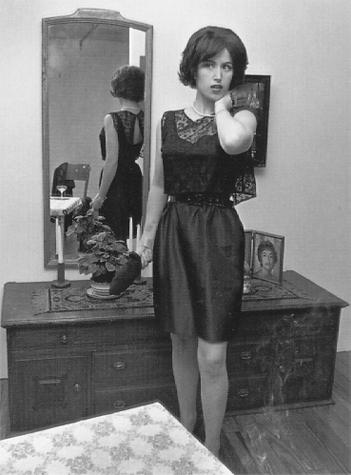
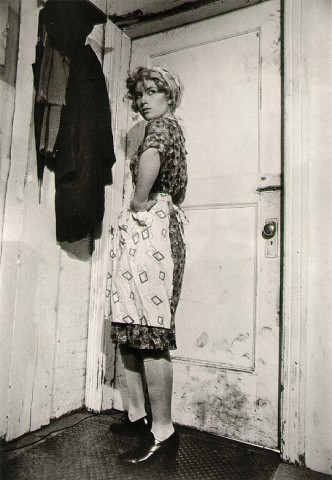
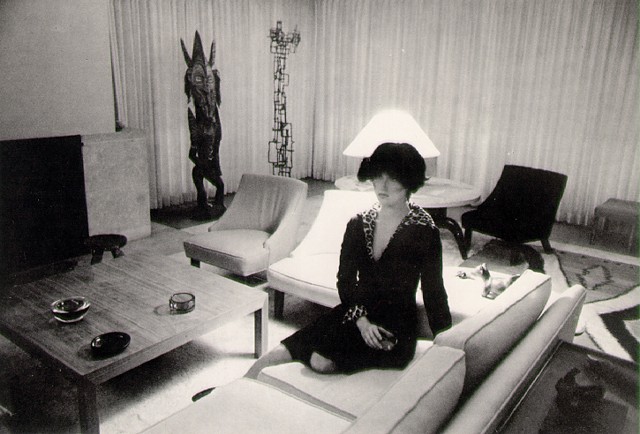
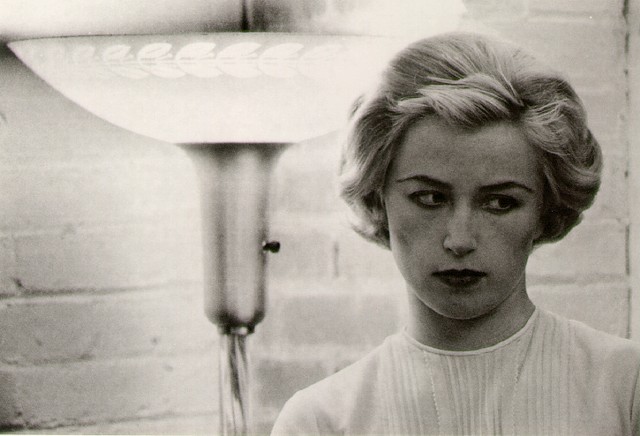
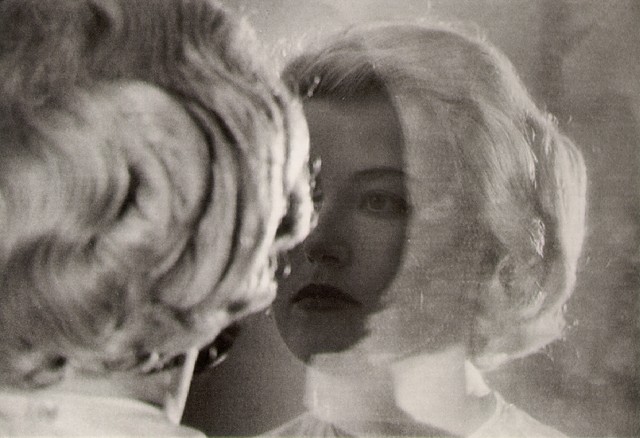
Cindy Sherman, The Complete Untitled Film Stills, MoMA 2003


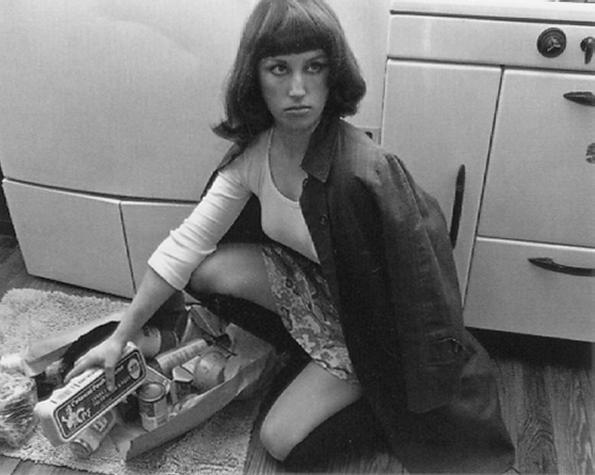
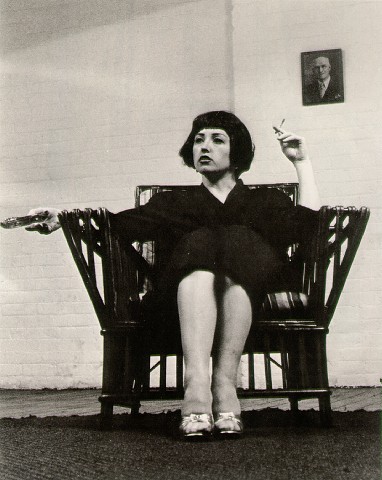
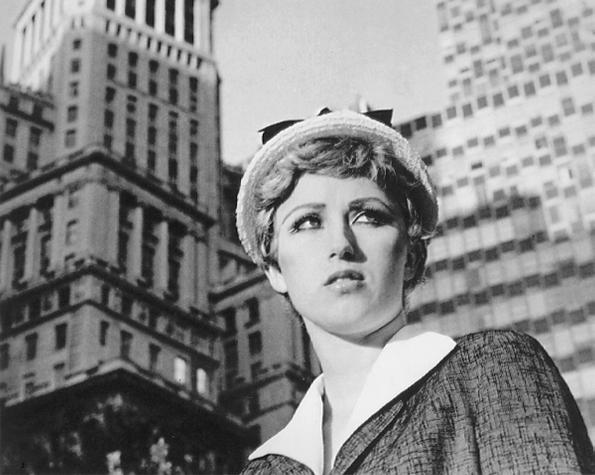
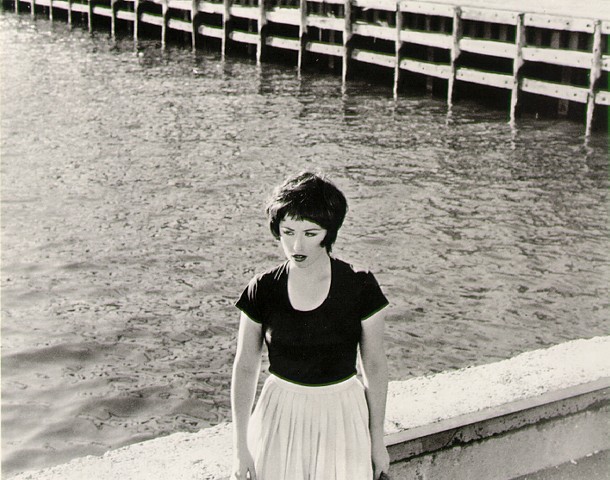
For years I have been fascinated by Cindy Sherman’s famous/infamous Untitled Film Stills series of photographs. I am still fascinated.


#7, 1978


I have wondered if the pictures truly represent established stereotypes of female identity and societal norms for some serious artistic purpose, or are really the end-product of just having fun. I am inclined to think that they really are about having fun, about dressing up, about the strange joy of having one’s picture taken, and about having some control over that picture taking, and, of course, about pretending to be someone else. I am inclined to think the pictures do invite a more contemplative attitude, but are first and foremost about play. Then again, I might be wrong.

#10, 1978

A gang of artists would converge there to watch Saturday Night Live or Mary Hartman, Mary Hartman. I’d be in my studio making up a character and then go out in character to join the party. I’d have put in all this energy into the makeup and I’d think, Why waste it. There’s a photo of me as Lucille Ball from that time: I had a wig that reminded me of her hairstyle.

Cindy Sherman, The Complete Untitled Film Stills, MoMA 2003

Then again, I might be right.

#13, 1978

Her fascination with self-transformation extended to her frequent trips to thrift stores, where she purchased vintage clothes and accessories, which suggested particular characters to her: “So it just grew and grew until I was buying and collecting more and more of these things, and suddenly the characters came together just because I had so much of the detritus from them.” Sherman began wearing these different costumes to gallery openings and events in Buffalo. For example, to attend a gallery opening, she dressed up as a pregnant woman. While there was an obvious performative element to this practice, Sherman never considered these outings “performances” in an artistic sense because she was “not maintaining a character” but simply “getting dressed up to go out.”

Amada Cruz, Movies, Monstrosities, and Masks: Twenty Years of Cindy Sherman, (2003)


#14, 1978

I didn’t want to make “high” art, I had no interest in using paint, I wanted to find something that anyone could relate to without knowing about contemporary art. I wasn’t thinking in terms of precious prints or archival quality; I didn’t want the work to seem like a commodity.

Cindy Sherman

#15, 1978


Ultimately, as I have experienced it, Sherman’s practice participates in what I have argued to be the opening of the subject to otherness (the baring of the circuits of desire connecting self and other in a dynamic of intersubjectivity) that gives what we might call postmodernism its most remarkable and particular antimodernist thrust. In feminist and phenomenological terms, the body, which instantiates the self, is a “modality of reflexivity,” posing the subject in relation to the other in a reciprocal relationship; through gendered/sexual performances of the body, the subject is situated and situates herself through the other.

Amelia Jones, Tracing the Subject with Cindy Sherman (2003)

#16, 1978

The subject, then, is never complete within itself but is always contingent on others, and the glue of this intersubjectivity is the desire binding us together (the projective gaze is one mode of intersubjectivity but functions specifically to veil this contingency by projecting lack onto the other rather than admitting its own). It is the intersubjective dimension of Sherman’s work that has largely been ignored (not surprisingly, since it exposes the investedness and contingency of every reading of her pictures – including this one).

Amelia Jones, Tracing the Subject with Cindy Sherman (2003)

#21, 1978


The work is what it is and hopefully it’s seen as feminist work, or feminist-advised work, but I’m not going to go around espousing theoretical bullshit about feminist stuff.

Cindy Sherman

#25, 1978


The still must tease with the promise of a story the viewer of it itches to be told.

Cindy Sherman

#35, 1979

I find it interesting that many of Sherman’s Untitled Film Stills do not follow any standard film aspect ratios: #35 above for example. I believe that one might almost not notice this fact because of the naturally evocative power of the image, and all her images. We are given the title and accept it as though it were from a film. We know it is not; we know it is entirely contrived; but then again, we know that all film is entirely contrived, that images of women (and men, and of ethnicity, etc.) are all contrived, all reductions in one sense of another. Sherman is giving us our stereotypes, our comfort and our curse. While we are looking at her, at her dressing up before the camera as though she were not herself, we are looking at ourselves. It does not matter whether one is a woman or a man, when one looks at the image, one is looking at oneself. That is why we do not see the faulty aspect ratio. There is nothing more fascinating to oneself than oneself.

#48, 1979

Why do images #48 and #50 remind me so much of David Lynch?

#50, 1979

The text between these images you can take it or leave it. If the images contradict the text, the images win.


#53, 1979

Men look at women. Women watch themselves being looked at.

John Berger, Ways of Seeing (1972)

I always though Berger was right. But I’m no longer so sure. And yet, I don’t doubt Berger.

#56, 1980

Not a final word: What is it I see in myself when I look at Sherman’s Untitled Film Stills?

I see myself looking at myself looking at a photograph of a woman knowing that I am looking not at herself, but at her creation. I see my psychologiocal self swimming in a sea of signifiers. I see myself as a moral agent who makes choices to believe, or not believe. I see that I, as a singular individual, am plural.

Before and After: A Sample

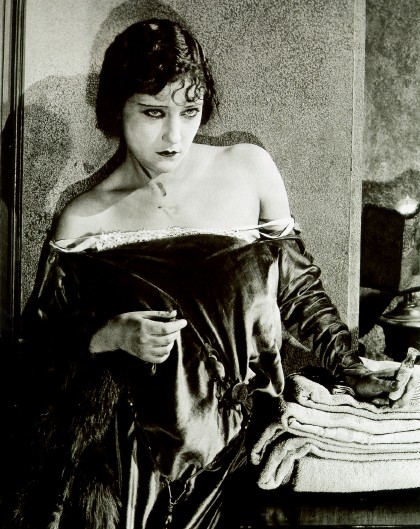
Gloria Swanson: before

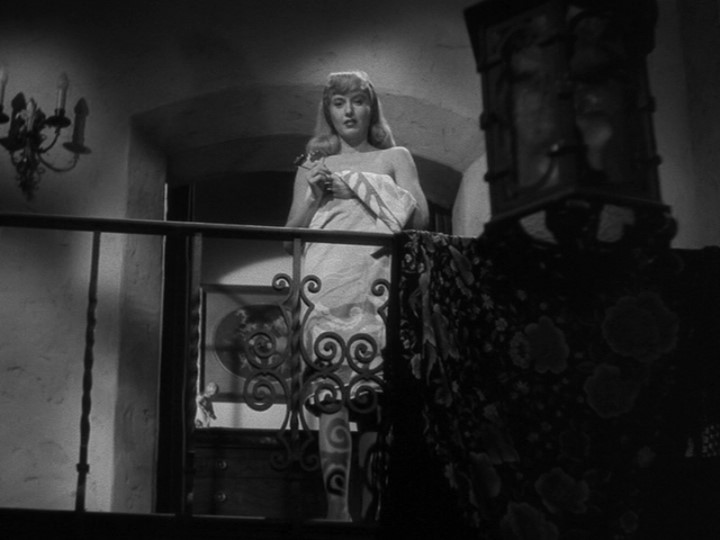
Barbara Stanwyck: before
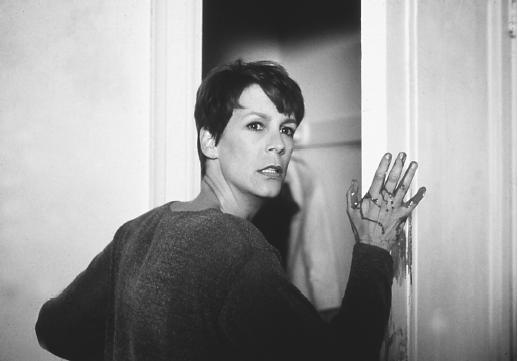
Jamie Lee Curtis: after


You know the rest.

>a couple thoughts on poetry & cinema

>I have a fondness for poetry. I used to read it a great deal, even reading collections of poems much like I read novels, beginning at the front of the book and plowing through to the last page, although my version of plowing is rather slow going most of the time. A couple of my favorite collections are Selected Poems 1966-1987 by Seamus Heaney and The Collected Poems by Czeslaw Milosz. Maybe what draws me most to a given poem is much the same thing that draws me to a great film or photograph.

Cinema can have a poetic quality, tapping into a part of one’s brain and calling forth certain emotions or ideas that don’t typically emerge in the normal course of the day. Some filmmakers naturally get tagged with the “poetic” label, for example Tarkovsky. But I would contend that we find elements of the poetic in cinema in many films, even if only for a few moments here and there.

I like to think of poetry as being the art of the unsayable (among other things). In other words, whatever it is about poetry, it taps into and expresses something that cannot be expressed directly, or denotated with words, but can only be hinted at, suggested, or connotated. In the same way cinema has the ability to connote, to suggest, to hint at. I am drawn to that quality of cinema, to those moments within films that, while transitioning us from one plot point to the next, take the time to elicit from within us something unsayable but real.

I have to say that this post came about by my re-reading an old poem of mine that someone once told me has certain “cinematic qualities” – whatever that means.

independence day

a simple breeze brings
the scent of summer fields
below a starless sky.
along the country highway
the night is cooling comfortably.
I walk in the dry grass
toward the lights.

I move quietly through the crowd;
weird, immobile, sentinel,
like reeds in a frozen lake
gathered in subjective silence.

I can feel myself
beginning to move in slow-motion,
almost floating, almost absent;
my body and mind slowly separating
like the tide receding from the shore.

what remains of the two cars
is a sculpture of brutality;
a performance piece of abject fury
staged without intention or wit,
a muricated death posing for no one,
visceral and empty.

I can see myself observing the accident
as though I’m hovering overhead.
my mind remains transfixed,
like the raised hand of the hypnotized.
there is the bloody head,
the motionless body.
(I am taking notes)
there is the twisted coffin
the thumping of a compressor,
an infant crying.

my body keeps moving around the vehicles;
spotlights casting ghostly silhouettes,
paramedics waiting for the
mangled door to be pried away,
and vapor floating skyward
like spirits escaping.

there are more people now
and Maricel has found me.
we see the crooked form
loaded on the gurney,
crippled legs illuminated
in a multicolored glow,
accompanied by the wails
of distant sirens,
and police radios,
and diesel fumes.
there is little we can say.
it is getting late
so we take another road home.
in bed I cannot sleep,
my mind is elsewhere.

the morning paper will say,
‘youths fall asleep at wheel
just miles from home.’
others will say ‘tragic,’
and still others will ask,
‘how can this happen?’
and I? sinner among sinners,
I am thinking of poetry.

– July, 1998

>little boats & troubled dreams

>I am drawn to mystery.


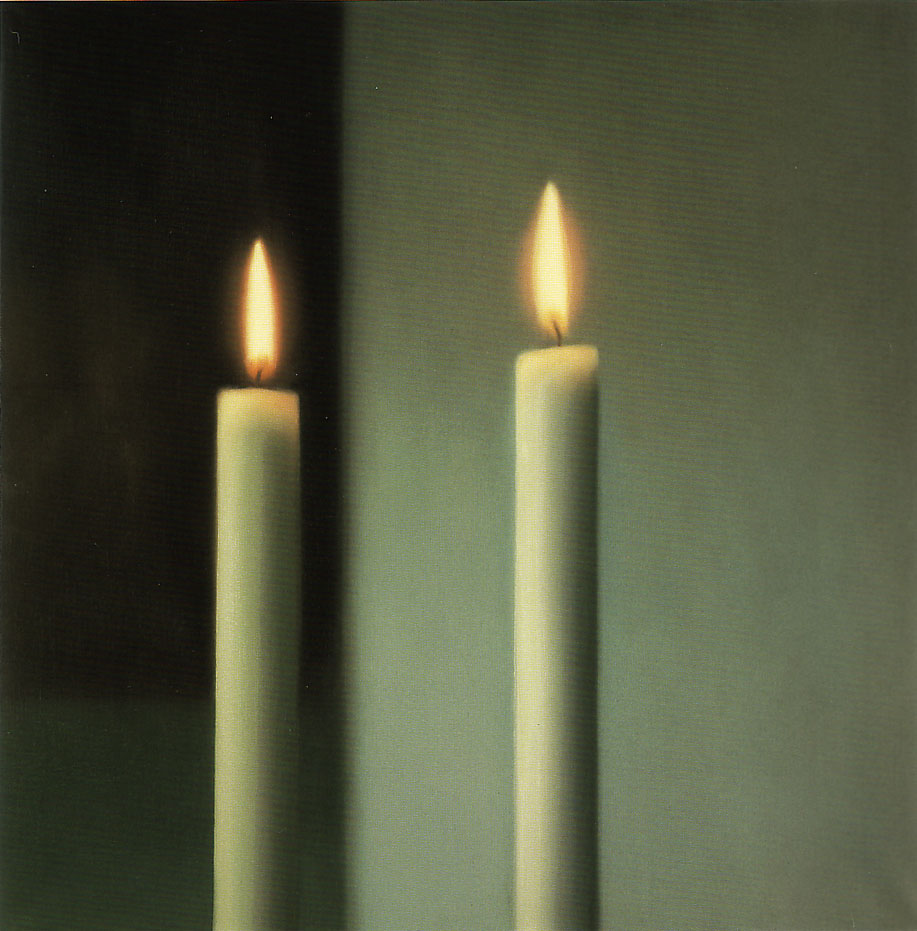
Gerhard Richter Two Candles 1982 Oil on canvas
55 1/8″ x 55 1/8″ (140 x 140 cm) Private collection

I have often wondered what it is about films that I love so much, and what it is that draws me towards particular films. I believe that the kinds of films one seeks out and enjoys is directly related to why one watches films in the first place. In other words, for some watching films has everything to do with lighthearted, end-of-the-day escapism. For others it may be a kind of testosterone drug fix. And for others it might be some kind of romantic battery re-charging. And, of course, for most of us it is a combination of many reasons. But I have to say that over and over I find myself seeking certain kinds of films and certain kinds of films experiences. Much of the time these experiences, at least the ones that stay with me long after the immediate viewing is over, are what I might call earthily transcendent, or sublime. Another way of saying it might be the more one digs into the realities of life, death, love, and suffering, the more one keeps coming up against mystery. This mystery is not a Gnostic sort of knowledge only for a select few, only for those with the “secret knowledge,” rather the mystery is there for everyone to experience and contemplate; it is fundamentally human.
Some might say this mystery is the experience of getting a kind of translucent glimpse of the hand of God creating everything, including us, moment by moment. Others might say it is the place where the limits of reason and emotion converge at a kind of metaphysical precipice. Or it could be the place where one has the feeling of overshooting one’s rationality only to discover rationality is a bigger thing than one previously imagined. And maybe, finally, the goal is about arriving where one started and knowing that place as though for the first time.


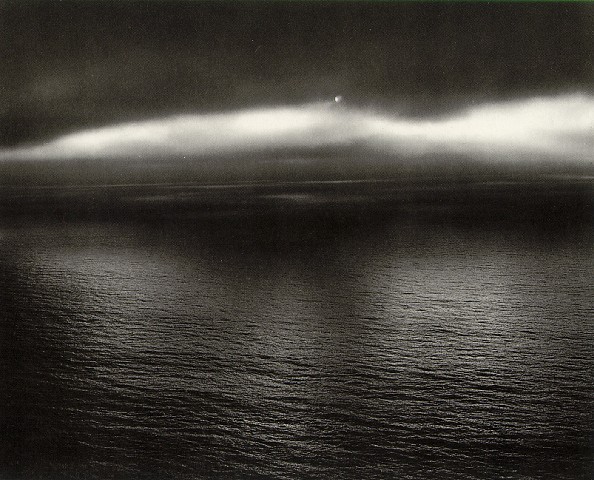
What fascinates me is the ability of artforms, in particular cinema, but also poetry, photography, music, etc., to evoke mystery. Some examples for me include the painting by Gerhard Richter at the beginning of this post and the photograph below by Minor White. But there really are countless examples. Why is it that certain images can bring about deep, almost indescribable emotions from within my soul?
Minor White Pacific, Devil’s Slide, California 1947

In my opinion a great example of a film that does this for/to me is Tarkovsky’s Andrey Rublyov (1969). There are so many powerful images from that film, and so many moments that produce powerful feelings that I will just encourage watching or re-watching the film. This post is not a review of Rublyov. My point is to say that art works can evoke strong feelings of mystery that seem to point to more important aspects of human existence, but do so via a kind of internal mystery, a mystery inherent within art itself. Again, that mysteriousness one finds in certain films is one of the powerful cinematic draws for me.
I am troubled, I must say, at trying to explain this sense of mystery in art. I have come to believe, however, that maybe it arise from the tension between life and death, and the reality that life comes from death. In art we often refer to beauty. But what is beauty and does it have a place anymore in art? As a kind of doorway to an answer, I like this quote from an interview with Andrei Tarkovsky about his, as then yet to be made, film Andrey Rublyov:

I am not going to say anything directly about the bond between art and people, this is obvious in general and, I hope, it’s obvious in the screenplay. I would only like to examine the nature of beauty, make the viewer aware that beauty grows from tragedy, misfortune, like from a seed. My film certainly will not be a story about the beautiful and somewhat patriarchal Rus, my wish is to show how it was possible that the bright, astonishing art appeared as a “continuation” of the nightmares of slavery, ignorance, illiteracy. I’d like to find these mutual dependencies, to follow birth of this art and only under those circumstances I’d consider the film a success. (from Nostalghia.com)

Maybe it is only through suffering that mystery in or through art appears. I don’t know.
If I could point to an artwork that, at least for me, offers one of the best examples of the mystery of art, the feeling of mystery in the receiver of that art work, and also describes the feeling of overshooting one’s rationality or coming into contact with some kind of cosmic mystery, it would be from a tiny section from William Wordsworth’s great autobiographical poem, The Prelude. The first time I read this section I was floored. I continue to be floored each time I read it, but I also recognize that my response is a personal one. And so will be yours.

One summer evening (led by her) I found
A little boat tied to a willow tree
Within a rocky cave, its usual home.
Straight I unloosed her chain, and stepping in
Pushed from the shore. It was an act of stealth
And troubled pleasure, nor without the voice
Of mountain-echoes did my boat move on;
Leaving behind her still, on either side,
Small circles glittering idly in the moon,
Until they melted all into one track
Of sparkling light. But now, like one who rows,
Proud of his skill, to reach a chosen point
With an unswerving line, I fixed my view
Upon the summit of a craggy ridge,
The horizon’s utmost boundary; far above
Was nothing but the stars and the grey sky.
She was an elfin pinnace; lustily
I dipped my oars into the silent lake,
And, as I rose upon the stroke, my boat
Went heaving through the water like a swan;
When, from behind that craggy steep till then
The horizon’s bound, a huge peak, black and huge,
As if with voluntary power instinct,
Upreared its head. I struck and struck again,
And growing still in stature the grim shape
Towered up between me and the stars, and still,
For so it seemed, with purpose of its own
And measured motion like a living thing,
Strode after me. With trembling oars I turned,
And through the silent water stole my way
Back to the covert of the willow tree;
There in her mooring-place I left my bark,–
And through the meadows homeward went, in grave
And serious mood; but after I had seen
That spectacle, for many days, my brain
Worked with a dim and undetermined sense
Of unknown modes of being; o’er my thoughts
There hung a darkness, call it solitude
Or blank desertion. No familiar shapes
Remained, no pleasant images of trees,
Of sea or sky, no colours of green fields;
But huge and mighty forms, that do not live
Like living men, moved slowly through the mind
By day, and were a trouble to my dreams.
from The Prelude
William Wordsworth
first published in 1850

I can think of no better way to express why it is I am drawn towards some kinds of films more than others, why it is I love the mystery of art, and why it is I come away from some films with the film still burning in my soul.

A personal response to Children of Men

Another movie night with the family. So, every time a dog barked in the film, which seemed to happen frequently, our dog barked, and the baby, our baby, had a hard time getting to sleep and kept crying. That was part of my experience in watching Children of Men (2006) for the first time the other night. I keep running into people who either have seen the film or have been planning to see the film and just haven’t got around to doing so. I think that is true of many “must see” films. People often intend to see them but don’t do so for a long time. Maybe it’s the felt pressure of knowing one is going to see an “important” film that such films get temporarily pushed aside for lighter fair. My wife rented it and, although I had planned on finishing Viridania (1961), we watched Children of Men. Anyway, I finally saw the film and I liked it very much, although I was not “blown away” as I thought I might be.

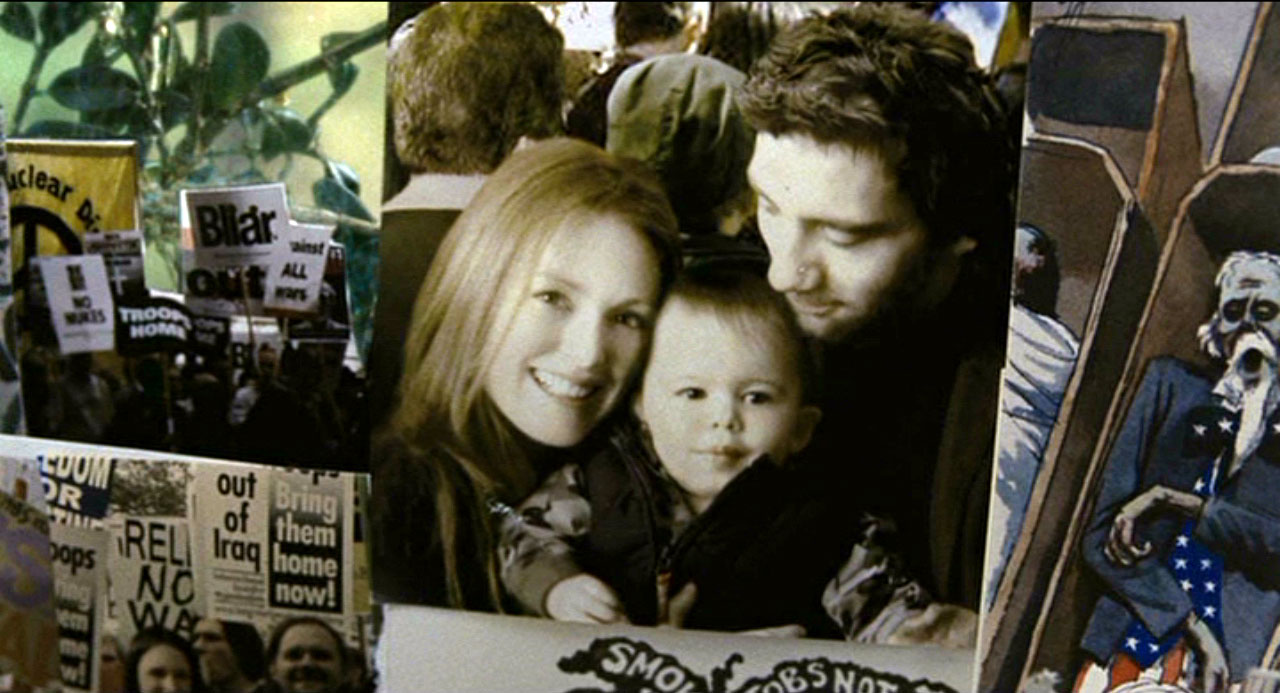
Rather than a review I want to make a couple of observations. The first has to do with fascism. I am inclined to think Children of Men has less to do with science fiction or infertility than it has to do with the human heart and humankind’s tendency towards fascism in the face of dire social conditions. The story in the film takes place in the future, but there are visual references to our own time and then to another darker period in our not too distant past. In a very visual and layered film, such as Children of Men, one often finds many interesting juxtapositions and subtle references. That is certainly the case here. Take for example this image:

Here we have the final image of a series of images that has told us a fair amount of backstory, especially regarding Jasper Palmer’s (Michael Caine) past as a political cartoonist, and the torture (by the British government) of his war photographer wife, who is now catatonic. The camera has been panning across these visual nuggets as the camera did in Rear Window showing us who Jimmy Stewart’s character was. But with this image we now see something of Theo Faron’s (Clive Owen) past life – namely his wife and child. But notice the references to Tony Blair and to the protesting of the Iraq war. One wonders if Alfonso Cuarón is intending for us to make a connection with the world we live in now, including the choices of our governments, and this grim world of the future. I cannot help but think that is the case.

Next consider this image:

Here our hero, and somewhere ahead the woman Kee with her miracle baby, are being herded towards the Bexhill refugee internment camp. Notice the sign above Owen’s head. It reads Homeland Security. I believe this reference is not a cheeky wink wink to the audience, but a chilling statement (in the context of the film) on what the present U.S. (I don’t know if there is a British equivalent) version of Homeland Security fundamentally is based on and where it will logically lead. I remember when the name “Homeland Security” was first rolled out publicly. My first thought was, “Doesn’t that sound a little too close to ‘fatherland’? And wasn’t that a favorite invocation made by Hitler and his cronies?” My second thought was a sinking feeling in my gut. But again, I digress.

I must say that none of this information is hidden within the film. It is designed to be noticed. I am also not the first person to comment on these things. (see the Children of Men link above)

Then consider this image:

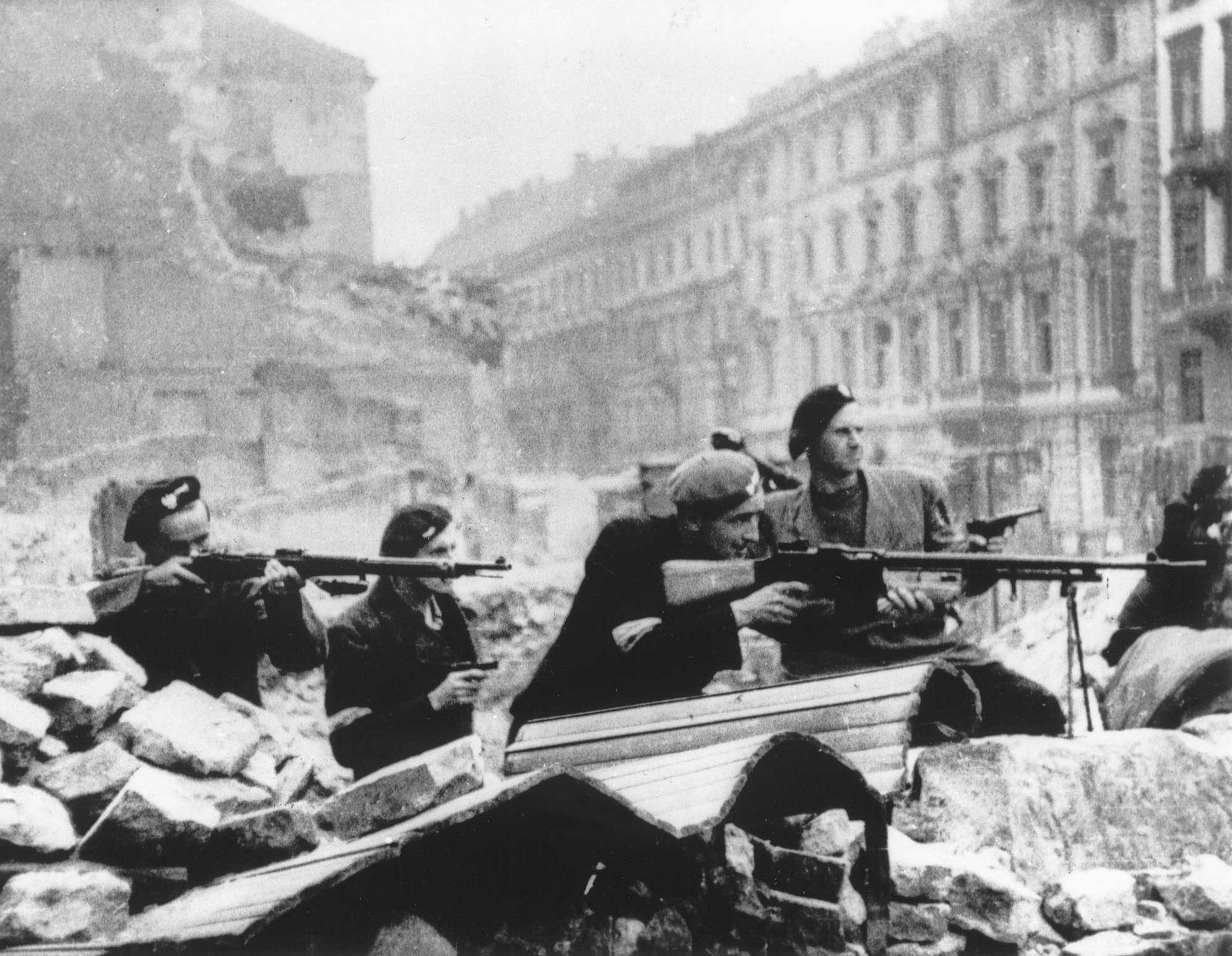
Here we are now in the Bexhill refugee internment camp. Bexhill-on-Sea, or just Bexhill, is the name of a sea-side retirement community in Southern England, actually having the highest retired population of any town in the UK today. In the film Bexhill is a town/city that has been converted into a prison for immigrants, somewhat invoking Abu Ghraib prison or Guantánamo Bay detainment camp, as some have argued. In an extremely nationalistic country being an immigrant is not a positive situation. Bexhill, in this context, makes sense given a world in which no one has been born in 18 years. If it is a retirement community today, it may likely be a largely unpopulated community in two decades. But I digress. Notice the graffiti on the wall: “THE UPRISING.” Immediately I thought of another walled off city (or portion of a city) used to imprison unwanted foreigners and one that had its own uprising. I am thinking of the Warsaw Ghetto during WWII. Modern references to Abu Ghraib prison and Guantánamo Bay make some sense, but not as much as the Warsaw Ghetto, which was an even fuller expression of fascist terror (assuming Abu Ghraib prison and Guantánamo Bay are examples of modern fascism, which they may be), and included a brave uprising on the part of the few remaining Jews. I see the image below of the Jewish fighters (soon to all be dead) and the next image of German soldiers standing watching the buildings of the Warsaw Ghetto burning and I see something much more like the ghetto in Children of Men than a modern political prison.

So here we have references to a growing fascism today and a full-blown fascism of our past within a story set in a possible(?) future. The question for me is, what am I to make of this? I believe Cuarón is asking me to make these kinds of connections, to see that the future is born out of the present, and to be aware of the darker implications of the choices we make or accept today. I fear the world we live in is bordering on fascism again. Remember fascism as we think of it – Hitler, Mussolini, etc. – was not a local thing. Fascism was popular around the world in those days. It was popular in the U.S. as well, especially before it was “tainted” with associations with our enemies and later with the Shoah. But fascism is not all Nazi flags and jackboots. Fascism tends to emerge when times are tough, when economies are poor, when immigrants pose a threat, when nationalism and patriotism seem noble, and when the world seems out of control and scary. One of the biggest boosts to a growing right-wing fascism in the U.S. was 9/11. But, let us not forget that the threat to jobs from immigration is a boost to a kind of left-wing fascism. Some have said fascism is neither right or left politically, but is proposed as an alternate third way. Regardless, fear and uncertainly is as much a tool in the hands of political opportunists as it is something to solve. I am reminded of that famous quote from Nazi leader Hermann Goering: [T]he people can always be brought to the bidding of the leaders. That is easy. All you have to do is tell them they are being attacked, and denounce the peacemakers for lack of patriotism and exposing the country to danger. It works the same in any country.

The ideas in that quote were, in a sense, famously (and earlier) countered by FDR in his first inaugural address in 1933, made during a time of great fear and uncertainty. In that speech he had the line: The only thing we have to fear is fear itself. FDR helped to keep fascism somewhat at bay in the U.S. while it flourished in Europe and elsewhere. Fear is a powerful corrosive. People often make decisions out of fear that they regret later – like locking up people without charges, without representation, and even without a trial. Or throwing away habeas corpus. Or like going hastily to war and then denouncing those who oppose the war as being unpatriotic and unsupportive of the troops.

As I see it, if the fundamental elements of fascism are nationalism, authoritarianism, militarism, corporatism, collectivism, totalitarianism, anti-communism, and opposition to economic liberalism and political liberalism, then only an opposition to economic liberalism is absent from U.S. society. And even that is not entirely true. Economic liberalism largely means free trade and open markets in order for the haves and have-nots to grow farther apart. It is also a foundation of the modern form of aristocracy known as the divine right of capital. I don’t mean to rant, but to me this is all rather frightening. It is no wonder that the rebels portrayed in the film look somewhat like some of the protesters we saw in Seattle in 1999, and at other similar protests around the world. I fear the crazy future world depicted in Children of Men is not as far fetched as it seems. My desire is that I don’t let my fear rule my choices, and that I don’t cavalierly throw the word “fascist” around without truly considering its meaning and implications.

So, back to the film…

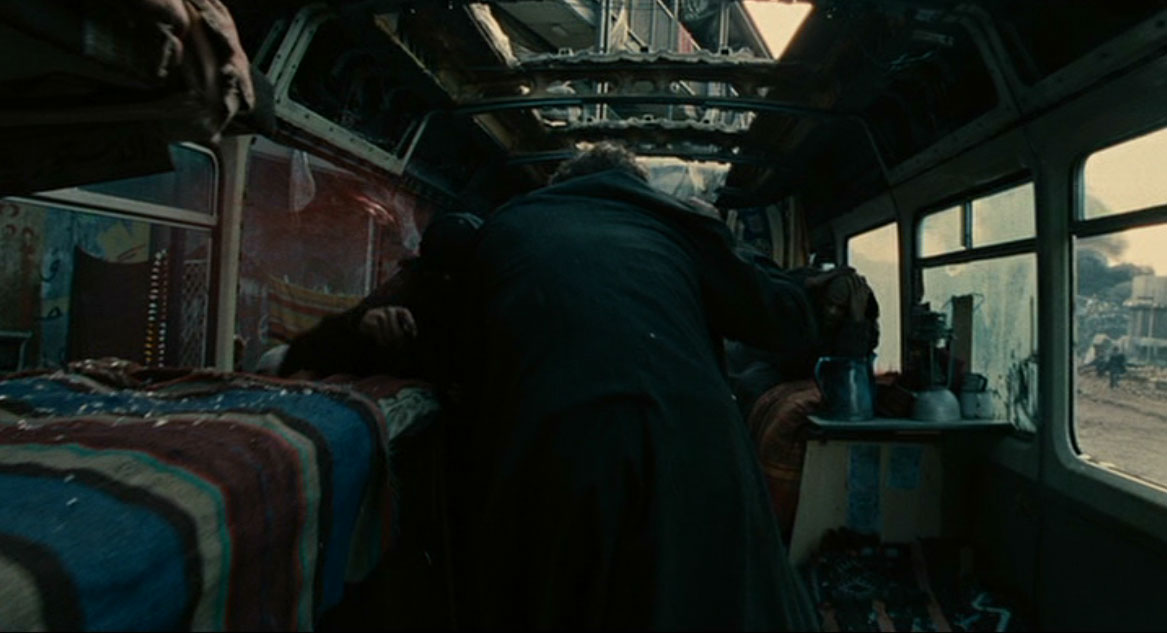
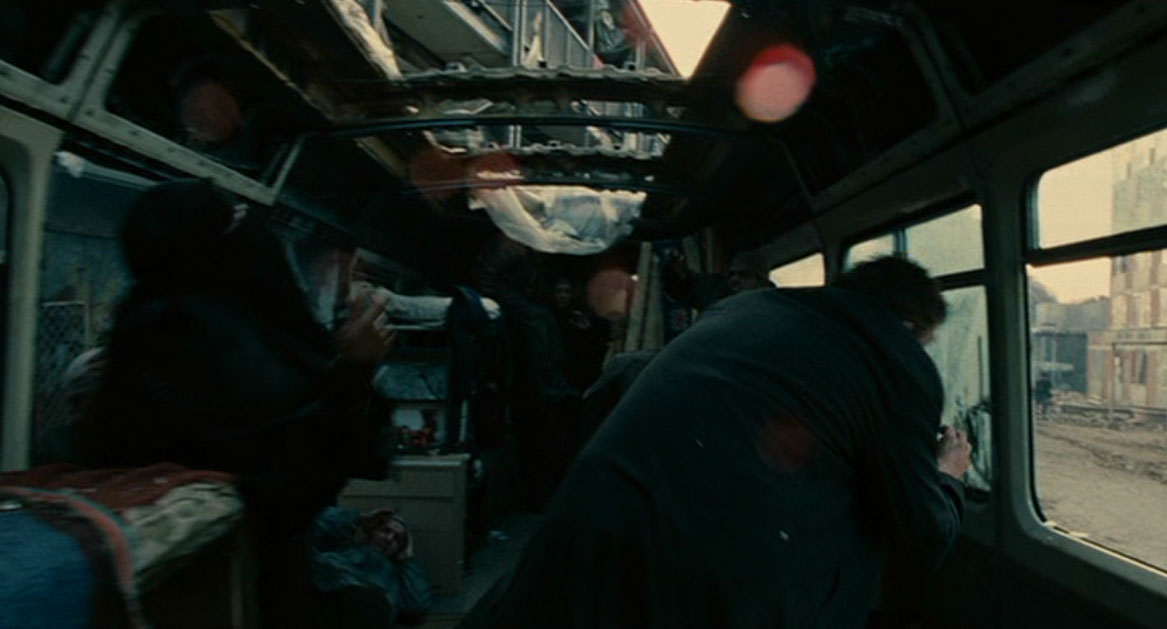
The second observation I want to make has to do with cinéma vérité and camera/digital trickery. Children of Men is a wonderfully photographed film. Much has been made of the virtuosic use of camera, staging, and mise en scene. One scene in particular is the long, uncut episode where Theo is working his way through the rubble and gun fire of the Bexhill uprising to try and find Kee and the baby. This scene is several minutes long (I did not count) and is presented as though it was shot in one long take. In fact it “was filmed in five separate takes over two locations and then seamlessly stitched together to give the appearance of a single take.” (from Wikipedia) If this is true, that is just about as remarkable as if it was actually filmed in a single take. But what I want to discuss is the blood splatter on the camera lens. It begins here:

Theo has just run into a broken down bus to avoid gun fire, but the shooters see him and spray the bus with bullets. A person next to Theo is hit and blood sprays (à la Kurosawa in Seven Samurai) from the bullet wound. The spray of blood is barely visible in the left half of the image above.

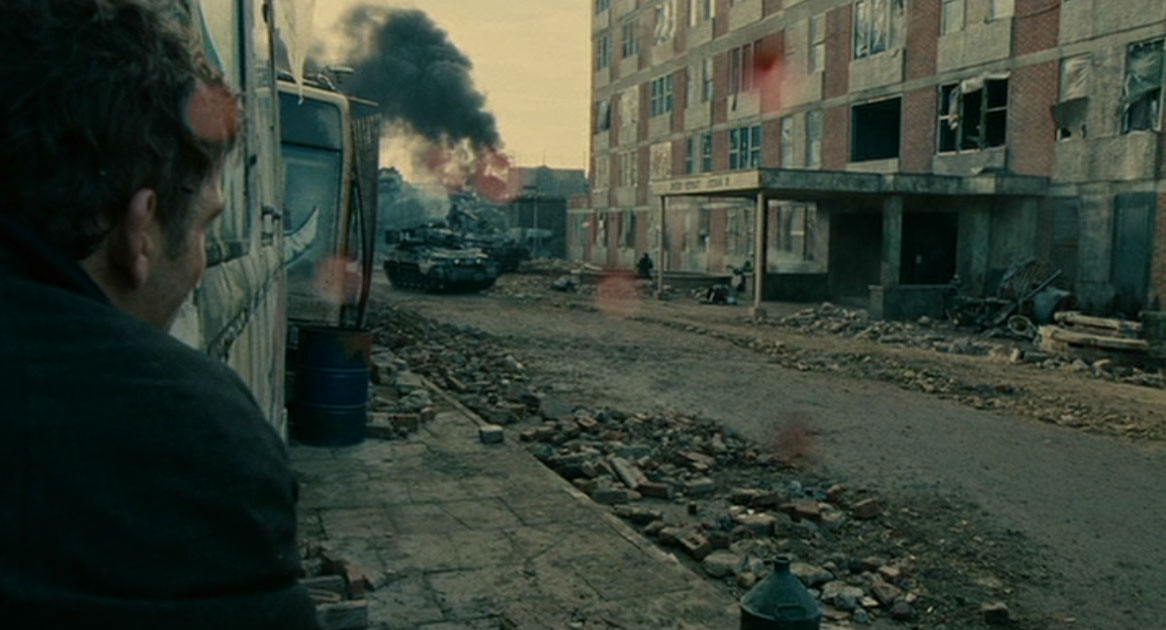
Then we get this image:

Droplets of blood are now visible on the camera lens. And those droplets remain on the lens as the camera follows Theo through the war torn landscape:


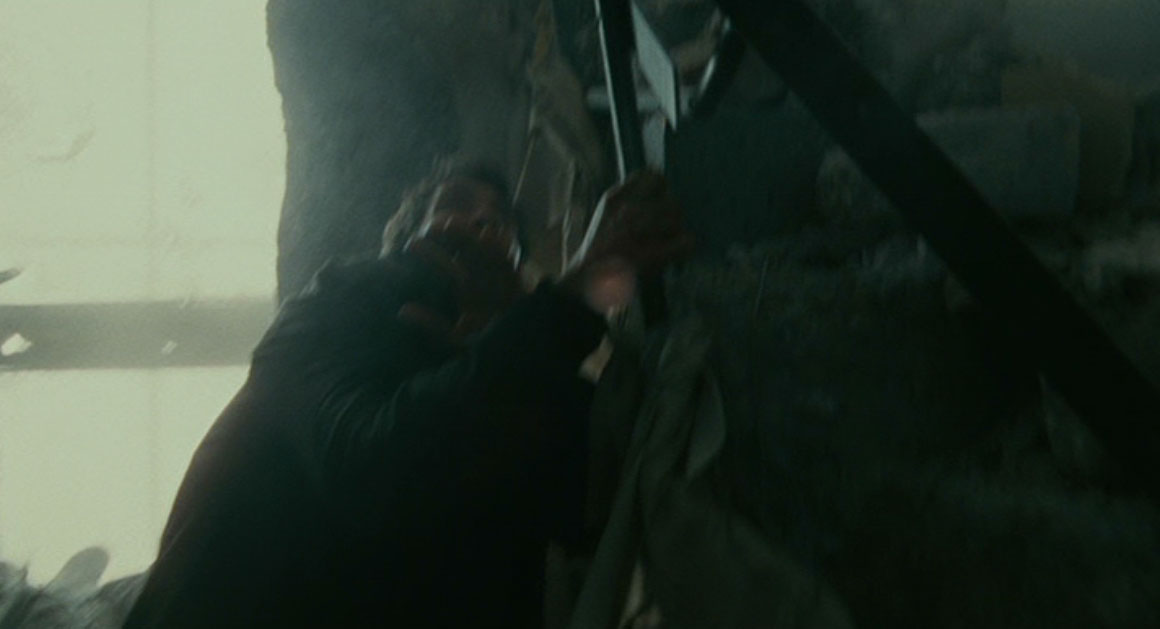
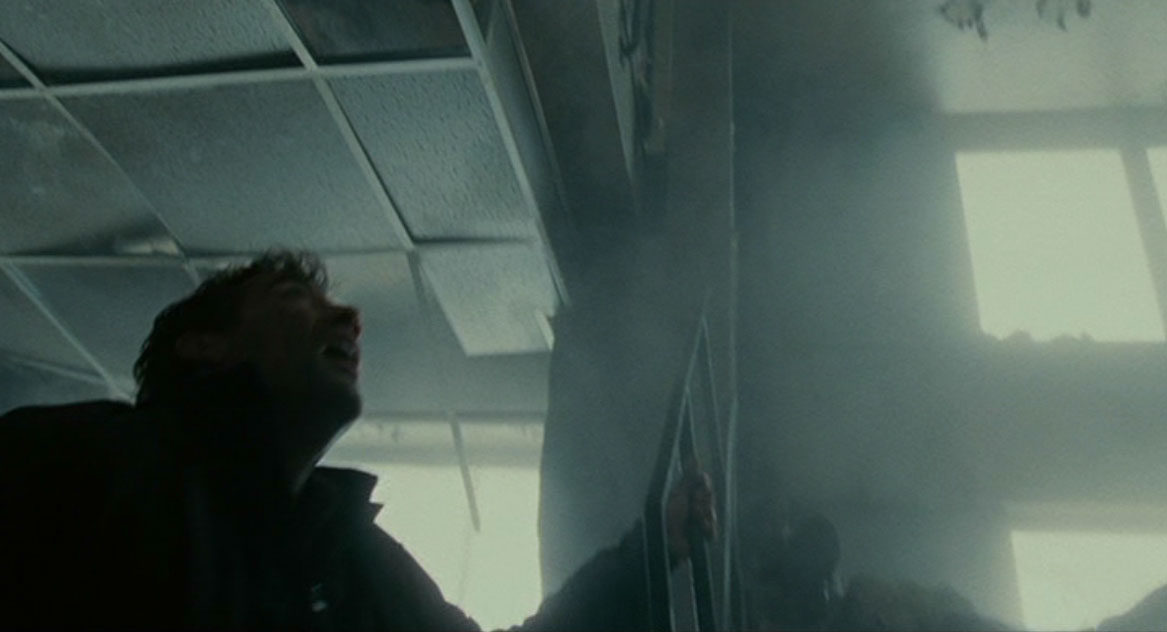
Eventually (minutes later, blood still on the lens) Theo enters a building. Bullets are still flying and he cowers momentarily near a stairwell:


You can still see a drop of blood on the lens. All this you have likely noticed.

I am a big fan of cinéma vérité in general. I should note, however, that nowhere in Children of Men do we see any “complete” use of cinéma vérité, but we do see strong elements, not least of which is the brilliant use of hand-held camera and, in this scene, blood splattered on the lens. My first impression was “that’s cool!” Later I had second thoughts. Sometimes it makes a lot of sense for a film to draw attention to itself; think of Don’t Look Back (1967) or Harlan County U.S.A. (1976) – both used cinéma vérité techniques to underscore the intrusion of the filming process into the world of their subjects. This makes sense in some documentary filmmaking – a tilt of the hat, so to speak, to Heisenberg’s uncertainty principle put into ethnographic terms. But cinéma vérité is a little more tricky in fictional narratives. Here, in Children of Men, the filmmakers have gone a little to far. The blood on the lens only draws attention to the fact that someone is holding a camera on their shoulder (or a steadycam) and following Clive Owen as he follows the complicated stage directions. Now this would not be such a bad thing if the rest of the film had the same aesthetic. But it doesn’t. At times the films is quite conventional. But in this scene suddenly we are watching a “documentary” that draws attention to its own existence. The audience is now not in the film with Theo, they are watching a film being filmed, they are “unsutured.” In other words, this little piece is “coolness” helps to undercut an otherwise brilliant and almost uncanny bit of filmmaking.

But that’s not all. Notice the last image above. Why does it have less blood splatter than the previous images? Where have those other blood droplets gone? Interesting the blood droplets have been gradually and subtly disappearing from the lens as the scene has progressed.

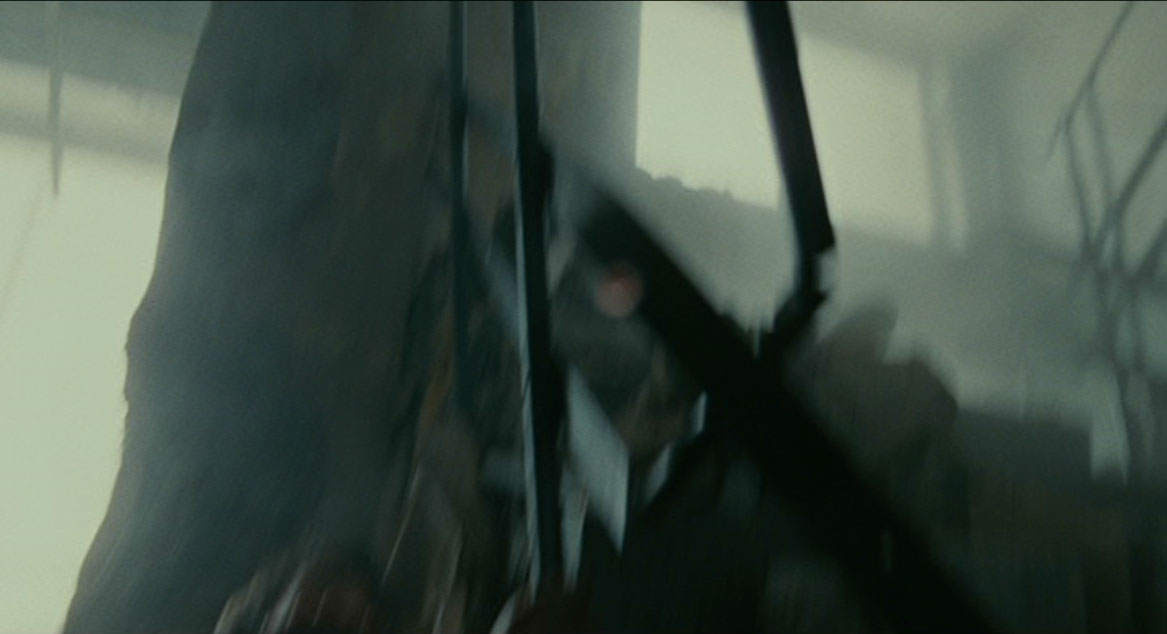
Now consider this image:


Notice the one last blood spot just slightly off-center right. This shot is in the middle of a whip-tilt up from Theo to the stairwell.

Now look at this image:


About one or two frames later the blood spot has disappeared. It disappears when the spot passes in front of the dark line of the handrail. Then we pan back to Theo:


Not a single blood spot left. This got my attention and it got me wondering. Were these spots added in later for effect? Were they digital creations? Or did they start as real splatter, then gradually get changed, maybe digitally, over the course of the scene until they are conveniently “disappeared” so as not to interfere with the remainder of the scene (when Theo finally finds Kee and the baby). I find it interesting that this change is the opposite of cinéma vérité.

So what does this all mean? Obviously no film exists apart from its creation. Films are created artifacts, and questions of truth, reality, verisimilitude, artifice, etc., abound. Films are also spiritual to the degree that they tap into and reflect both the spirit of the age and the human spirit. In narrative film there is always a tension between what is up there on the screen (the plot) and what is going on in one’s head (the story). Stories are universal, to some degree, but films as artifacts are particular. Children of Men tells a universal story of fear, cruelty, the will to survive, hope, and salvation (Theo, Kee, and the baby are a kind of futuristic Holy family. The birth scene is powerfully remeniscient of classic Nativity stories). In this sense the film is spiritual. Sure, the film is a fantasy about the future, but it also highlights important ideas about our present and our past, issues that are more important than this particular film. The film, as plot, however, presents that story in such a way that questions are raised regarding the honesty of the film’s (or filmmaker’s) intentions. I say this because I am always suspicious of communication that is full of rhetorical and stylistic flourishes.

Children of Men may be a film as much about virtuosic filmmaking (and about drawing attention to itself as such) as it is about deeper themes of fasiscm and fear. My contention is that the film’s deeper messages may have become clouded in the whirlwind of intense faux vérité and the foregrounding of its own artifice. In other words, just at the moment when the viewer should be thrust into the film’s thematic climax, a little flag (read: blood splatter on the camera lens) is waved saying “don’t forget how brilliant this filmmaking is and who made it!” For me that is why, when the credits rolled at the end of the film, I felt the film had let me down, just a little.