Go West Trapper Nelson

Good weather is here at last and I have hiking/camping/climbing on the brain.

When I was a youth I started hiking and camping with my parents in Oregon. Usually we hiked to our camp sites, sometimes we rode horses. Once in a while we did car camping. Some of the best times I remember were sleeping under the stars in the high Cascades, then waking in the middle of the night and staring in awe at a sky of stars like one never sees in the city.

Oregon is a beautiful state and this time every year I start dreaming of getting immersed in the outdoors. Now that I have kids I want to get them outdoors too.

I reminisce…
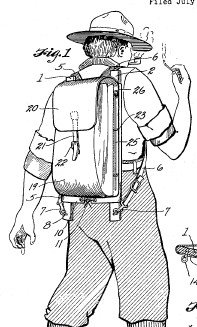
As a young camper I often had hand-me-downs. My first pack was one my dad used when he was a boy scout. The pack was known as a Trapper Nelson. By today’s standards a Trapper Nelson pack is a kind of torture device. However, when it was invented 80 years ago it was better than anything else on the market. By the time I began carrying one the design was very outmoded, but the pack was free.

The Trapper Nelson pack consisted of two wooden planks with canvas stretched between them, thin canvas shoulder straps, and a canvas bag on the back. The color was classic drab. Fortunately, kids tend to be resilient. I survived and had many happy camping trips.

Why is it that we like to go camping? Often I struggle to get motivated and out the door to commune with nature. But once I am outside I love it. Each time I have gone camping (except for once or twice) I think to myself I should do this more often. There is something about getting away from the city, from civilization, and into the wilderness that feeds a deep part of the soul. It’s almost as though we are made to be close to nature, and that the walls with which we surround ourselves offer false comfort and place a damper on something that could be thriving. This week I started riding my bike to work. It’s not easy to ride in the cold morning so early, but I love it. The simple act of feeling the air on my face is enough to remind me of how good it is to be outside and alive.

* * * * * * * *
Related…
My wife and I have decided we will try to climb a mountain later this summer. We have picked the South Sister in the Cascade Range. I have climbed it twice, but that was more than twenty years ago. It’s not a technical climb, but it does take a lot of stamina. We’ll see how it goes. At least it’s motivating me to get in better shape.


The South Sister’s snow capped peak looms majestically
over the Oregon countryside.

>modern agitprop and youtube

>From the words “agitation” and “propaganda” we get agitprop. Because this word first showed up in connection with the Bolsheviks it has always had a leftist sense about it. But it really can be applied to just about anything that is about disseminating ideas with the desire to change consciousness and encourage action against the forces of power, blah, blah. From what I can tell today most agitprop, though often leftist in tenor, is mostly about challenging dominant paradigms of power and hegemony. That I can get behind.

It also seems today YouTube is becoming the location of much agitprop.

Here is a provocative and fascinating juxtaposition of images and stereotypes of women and cultures that confront our assumptions of dangerous differences, amongst other things:

Who can forget this amazing anti-war video (a great example of détournement) produced by the Guerrilla News Network only a year into the Iraq War. It is still powerfully relevant and devastating today:

The Billboard Liberation Front “improves” an AT&T advertisement in 2008:

Or this video made by anarchists on how to get the message out (agitprop about doing agitprop):

The question, of course, is how much actual action do things like these produce? For the most part I hope a lot (at least non-violent action), but I fear that YouTube clips may, in fact, exacerbate inaction. It may be “the medium is the message” kind of problem. Sitting at one’s computer and surfing video clips, even agitprop pieces like the ones above, is not the same as doing something. It’s too easy to go to the next clip.

And it’s often unclear what one’s actions should be. This is where the third clip above might be the most effective in encouraging action. People often already have strong emotions about the world they live in, but they don’t always know what to do. Of course, not just anyone is going to be swayed by anarchists and their ilk.

Regardless, getting “the message” out, whatever that message is, is important for the grand dialog. YouTube (and all Internet media) has been affecting the landscape of ideas for a while now. Feel free to add your thoughts.


* * * SPECIAL BONUS * * *

A trip down agitprop memory lane provided at no extra charge.

An excerpt from Ant Farm’s 1975 performance of Media Burn. The original “kill your t.v.” message:

1998 performance of the end of Orwell’s “1984” by The Surveillance Camera Players:

>Global Supply Chains and the Commandment to Love One’s Neighbor as Oneself

>The title of this post is also the title of my thesis which I wrote for my Masters of Business Administration program, which I just completed. To get some idea of what sparked my thinking and led to my thesis topic you can watch the video clip below about workers in developing countries as they support the demands of the developed world. You have already heard about sweat shops in third world countries. Here is what they look like:

…or this parody from The Onion brings up the issue in its way:
http://www.theonion.com/content/themes/common/assets/videoplayer/flvplayer.swf

What are we, those of us in the most powerful nations on earth, going to do about the globalization of capital and corporate power? The world may be becoming increasingly, economically “flat”, as Tom Friedman says, but is it becoming morally flat as well?

It may sound strange to ask what we are “going to do” about globalization. Isn’t it a good thing? Isn’t it about the expansion of wealth and freedom? Isn’t it about the Internet and better communication? What we don’t typically hear about is the hidden costs of globalization, or about what that word conjures up in the minds of those in the developing world. For much of the world globalization includes the realities in the video above. For the rest of us that reality is often hidden.

I am, by nature, a rather conservative type. I don’t get easily bent out of shape over issues. I don’t seek revolution at the drop of a hat. I also grew up a Christian and was, until a few years ago, a registered Republican. I am still a Christian, and because of taking my faith seriously I could no longer be a Republican. Now I am an independent. But it’s not really about politics. It’s about a perspective on the world, on how I want to live. It’s about what kind of person I want to be and where I want to end up. And it’s also about the kind of world I want for my children and their children.

When it came time for me to choose a topic for my MBA thesis I felt the need to tackle something to do with ethics. I felt I needed to address, for myself, the underlying moral issues inherent in business and economics before I went out from my schooling into more business adventures. So I picked the topic of the treatment of women workers in global supply chains and the ethical implications for businesses that rely on the benefits from those supply chains (like lower costs and faster delivery, etc.). My thesis became, for me, a kind of introduction to the larger topic of ethics and, more specifically, how should someone who claims to be a Christian act in the world.

The following is from Chapter One of my thesis:

Consider this scenario: when a shopkeeper opens her doors in the morning and hangs out the welcome sign it is time to get to work. The pressures of the day quickly crowd in as she must meet the demands of her customers and her business’ bottom line. She must manage her time and her employees, deal with suppliers, and try to make plans for the future while also trying to fully understand the past. Questions of ethics are considered, if considered at all, largely in the immediate context of the day-to-day routine. Our shopkeeper will have to decide where she stands on being truthful and honest with those whom she works; she will make ethical decisions around how she manages her accounting and pays her vendors; she may even face moral questions about what products she sells and whether they are good for her community.

Now let’s assume this shopkeeper is also a Christian, one who makes claims to be a follower of Jesus Christ, and one who participates in the life of Christian culture. The ethical issues for the shopkeeper will not be any different from any other shopkeeper. However, she now carries the burden of having to follow some explicit commands with regard to the world, most notably to love her neighbor as herself. And who is her neighbor? Is her neighbor only the immediate customer or vendor with whom she does business? Or, given that she lives in an increasingly globalized world, does her neighbor include those with whom she now has connections, even though they may be on the other side of the planet and at the distant end of her supply chains?

If our shop keeper then decides that she does want to build her business around the idea of loving her neighbor as herself, and then apply that philosophy to her dealings with her supply chains, she must decided how to do that. What options are available to her? Does she choose servant-leadership as a leadership style? That is, will she seek to be a servant first and, as Greenleaf (1991) says, “to make sure that other people’s highest priority meeds are being served” (p. 7)? Does she choose to buy only from suppliers that treat their employees well? Does she seek to instill corporate social responsibility into her business practices?

These kinds of questions might be of little importance if it were not for two realities. The first is that the world is more connected than ever before. The second is that many workers in global supply chains, particularly those in developing countries, often have few of the rights or freedoms those in Western and Northern societies take for granted and may even assume to be inalienable. This is not to say that the benefits of free-market capitalism have not brought greater wealth to many developing countries, nor that many of the world’s poor have not seen at least some economic improvement to their way of life. However, as the gap between the world’s poor and the world’s rich gets bigger, and as facts continue to come out regarding the all too often harsh treatment of laborers, including women and children, within global supply chains, one cannot help but ask whether a laissez fair, free-market philosophy is the best approach for creating a fair and just system that benefits all stakeholders appropriately.

A Christian business person must ask these kinds of questions, not merely because economic systems come with their own set of moral presuppositions about human nature and human needs, but also because in the day-to-day world of business, as it is in life, one’s actions flow from one’s beliefs. If a Christian is to take seriously the commandment to love her neighbor as herself, then it only makes sense that that command, that challenge, would raise such questions. Maybe one of the great historical ironies is the interconnectedness of free market capitalist thinking and Christian theology; ironic because one system is based on self-centeredness for its success and the other is based on other-centeredness. Our shopkeeper will have to decide if this interconnectedness is both useful and valid.

I go on to describe how global supply chains work, including the fundamental pressures they impose, such as cheaper labor and fast delivery. I then describe how those pressures necessarily create negative conditions for many workers. I then describe the common conditions of working women in those supply chains. (I chose women workers because of the data available and because they represent more than half of the global workforce while often being in the weakest position with regards to labor rights and fair treatment.) Finally I examine how some have sought solutions, for example the concepts of corporate social responsibility (CSR), fair trade, and servant leadership.

I also examine how Christianity has shifted away from social concerns by becoming a personal/private faith thing rather than an “all of life” thing. This shift has led many Christians for forsake the requirements of their faith, that is, to be “salt of the earth” as it where. Too many Christians, I argue, see their faith as a purely private matter, except for a small handful of political issues.

I do not see globalization as a specifically “Christian issue.” There are many perspectives and answers available. But I find narrowing the scope down a bit helps to crystallize the issue for me. I do not see in the Bible anything specifically about free trade, but I do see a lot about feeding the hungry and helping the poor. Recently a professor of mine related a story where he was teaching about globalization and one of his students, a man from Africa, said that when he hears the word “globalization” he knows it to mean Western imperialism. There is something that rings true for me about that student’s perspective, and that bothers me.

Much of my thinking has shifted over the past several years as I have tried to take seriously the teachings of Jesus. The irony is that the teachings of Jesus contradict much of modern, popular Christianity in both its focus and its call to action. I have become convinced that mainstream, right-wing (and many left-wing) Christians just may have become the new Pharisees – the pious religious types who Jesus railed against and who eventually killed him. They do church really well, but their hearts have become hard – and I know what I’m talking about because I am one of them. Because of this I chose to focus on the implications of the commandment to love one’s neighbor as a foundational challenge. I figured that commandment cuts through a lot of garbage.

This video interview with Tony Campolo offers some idea of what I am talking about:

I won’t say that I am in Campolo’s camp entirely, and I don’t cite him in my thesis. However, I will say that his teaching challenges me deeply.

I am also challenged by numerous other thinkers, most of whom are not Christians, and some are even anti-Christian. But I believe truth can be found just about everywhere. The following video clips further pad out the topic.

Christian “progressive” Jim Wallis talks about living out one’s faith:

Left-left-wing academic and leading progressive thinker Michael Parenti on globalization and what it really means:

Parenti is no fan of Christianity by any means, or any religion really, but he is a very sharp thinker and erudite historian.

Brilliant and exacerbating Noam Chomsky on globalization:

I find myself more and more fascinated with Chomsky’s work. Years ago I read a book of his on linguistics for my MA thesis. Since then I have most only heard him speak. His observations on power politics are illuminating. Chomsky and Parenti do not see eye-to-eye on several issues.

Naomi Klein, author of The Shock Doctrine speaks on the topic of global brands, the topic of her famous book No Logo:
http://video.google.com/googleplayer.swf?docid=2343596870021245516&hl=en

Famous activist, historian, and progressive thinker Howard Zinn on American Empire (a topic related to globalization):

Not all is doom and gloom. Consider the Tony Campolo and Jim Wallis clips above and the clip below.

Towards a solution – Fair Trade:

I have to say the process of writing and defending my thesis was longer than I anticipated, but it has bee a very rewarding process. I am glad I finished school and I am excited about my future career. I will say, however, that I have not, for me personally, solved the issues raised in my thesis. I still struggle to fulfill the commandment to love my neighbor, and I’m sure I always will.

References
Greenleaf, R. K. (1991). The servant as leader. Westfield, IN: The Robert K. Greenleaf Center.

In Memoriam

War is a nasty business. This Memorial Day gives us a chance to remember those U.S. soldiers who have died fighting in wars. This is important. The sacrifice of a life for any cause is a substantial tear in the fabric of creation. Death affects many, and not only those who die. Death affects families, friends, co-workers, and communities. Death affects us all. Death is ugly, horrible, detestable. Let us then commemorate the sacrifice innumerable soldiers have made over the years.

Let us also remember that the reasons soldiers go to war and are willing to lay down their lives are often very different reasons than of those who send them to war. This is not to say every soldier has pure and righteous motives, but the glory of the soldier often hides the duplicitous and dubious goals of the political and economic motivations that seem to underlie every war. Let us not forget the difference.

And then we have the great burden on all of humanity that are wars. That soldiers die is terrible, but non-soldiers die too, and in often far greater numbers. These other members of humanity include children and other innocents. Let us remember them too.

And let us remember that wars are no grounds upon which to build mythologies.

My desire is to know truth, to understand the consequences, and to act in whatever way I can in light of that truth. My hope is that this Memorial Day is more than just remembering, rather I hope we honor the dead by creating a world in which the soldier is a thing of the past.

Death of even one affects us all.

No man is an island, entire of itself; every man is a piece of the continent, a part of the main. If a clod be washed away by the sea, Europe is the less, as well as if a promontory were, as well as if a manor of thy friend’s or of thine own were: any man’s death diminishes me, because I am involved in mankind, and therefore never send to know for whom the bell tolls; it tolls for thee.

~John Donne, from Meditation XVII
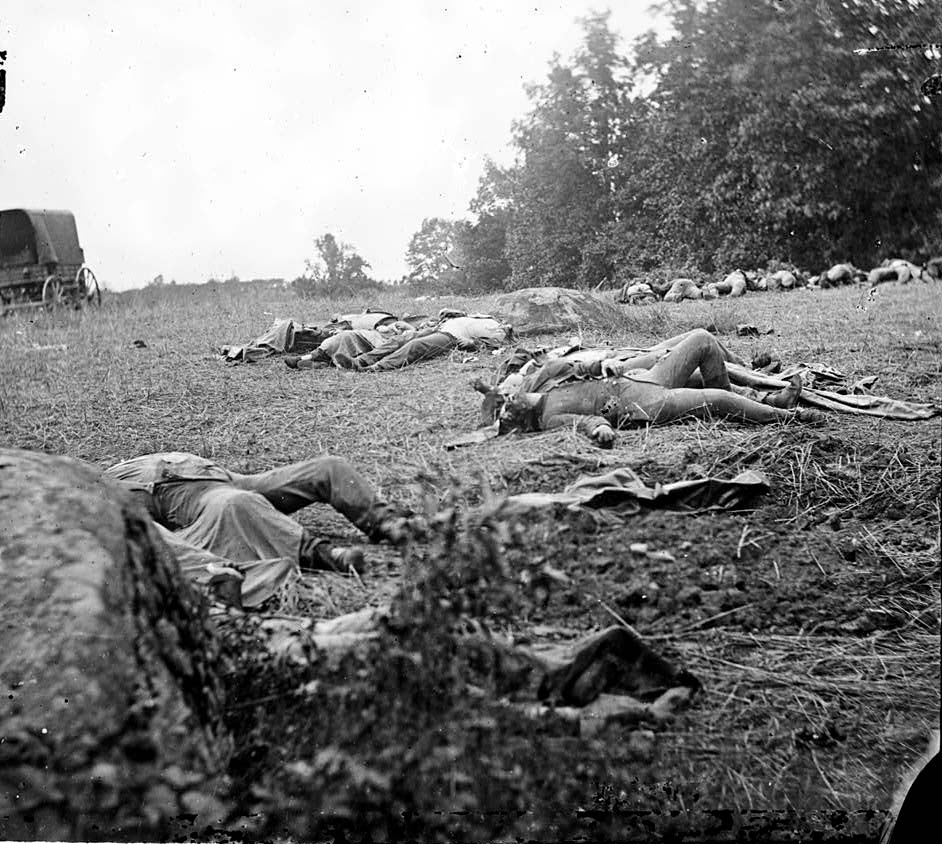
Memorial day was first enacted to commemorate Union soldiers who had died in the bloody American Civil War.

Battle of Gettysburg aftermath. Dead soldiers in the
wheatfield near the Emmittsburg road; 1863 July.
Photograph by Alexander Gardner.

As I get older I have a harder time seeing war as an adventure to be enveloped with brass bands and waving flags, and my simplistic reverence for war heroes is being replaced by a deeper sense of the tragedy of war and the stunning sacrifices made by those who have fought and are currently in war zones.

>some videos by bill viola

>below are works by video artist Bill Viola

Migration, 1976

http://video.google.com/googleplayer.swf?docid=-4498864086957786589&hl=en
The Reflecting Pool, 1977-79

http://video.google.com/googleplayer.swf?docid=5465661880359138467&hl=en
Anthem, 1983

Thoughts: The moving image is one of the most powerful and most malleable of mediums for artistic expression. The tragedy (and the triumph) of mainstream cinema is its slavish acceptance of little else outside a set of limited conventions. Videos, like the ones above, remind us of other possibilities.

>hazmat

>

Fortunately I had already left the building before the fun began. A couple days ago someone at my work received a letter that was intended as a threat (or maybe a joke, but if so, it was a dumb joke). Apparently the letter claimed to contain anthrax. It turned out to be granulated sugar, but until that was confirmed the situation was taken very seriously. The building was locked down. About 800+ employees still in the building had to remain until 8:00 PM. The local hazmat team (pictured above – taken by a co-worker) arrived and did their thing. The FBI showed up too, as well as police. The whole thing was on the local news. No one yet knows who sent the letter or why.

Advice: Leave work before the mail is delivered.

no country for classical narrative

Without an element of cruelty at the root of every spectacle, the theater is not possible. In our present state of degeneration it is through the skin that metaphysics must be made to re-enter our minds

~Antonin Artaud, Theatre and its Double (1938)

To interpret a text is not to give it a (more or less justified, more or less free) meaning, but on the contrary to appreciate what plural constitutes it.

~Roland Barthes, S/Z, (1970, trans. 1974)

You have seen No Country for Old Men and you liked it. You have read the reviews and their obligatory references to Javier Bardem’s hairdo. You may have even noticed how much this film draws from all the other Coen brothers’ films, both stylistically and thematically. But what is most interesting to my limited sensibilities is the film’s ability to give us something that seems entirely new while yet existing within the conventions of classical Hollywood narrative.

And then, on the other hand, No Country for Old Men gains power by thwarting classical narrative through subversions to plot expectations, through dreams, and through the character of Anton Chigurh (Javier Bardem). Chigurh is a driving force, like the character of Frank Miller in High Noon (1952) who is coming to bring death upon the marshall, or General Zaroff in Connell’s The Most Dangerous Game (1924) who relentlessly hunts his human prey, or the terminator in The Terminator (1984) bent only on the destruction of Sarah Connor. Chigurh is also a psychological enigma, like Norman Bates of Psycho (1960) or Michael Myers in Halloween (1978). It is this second aspect, that of the psychological enigma, that thwarts the narrative.

For classical narrative to function it requires characters who can be understood, both in terms of their psychologies and in terms of their actions. According to Bordwell (1985):

The classical Hollywood film presents psychologically defined individuals who struggle to solve a clear-cut problem or to attain specific goals. In the course of this struggle, the characters enter into conflict with others or with external circumstances. The story ends with a decisive victory or defeat, a resolution of the problem and a clear achievement or nonachievement of the goals. The principle causal agency is thus the character, a discriminated individual endowed with a consistent batch of evident traits, qualities, and behaviors. (p. 157)

Llewelyn Moss (Josh Brolin) is our protagonist. He is the most specified character and the primary causal agent. He is who the audience identifies with, and for whom the audience roots. His actions, that of finding the satchel of drug money and deciding he could take it and get away with it, are what compel the story forward. His hold on the satchel is not unlike the monkey who puts his hand in the jar, grabs the shiny object, and then cannot get his fist out of the narrow opening. Chigurh is the antagonist. He exists to thwart Moss. He is the relentless, unstoppable force. But his psychological makeup is a mystery. We have trouble guessing what he might be thinking. As sheriff Ed Tom Bell says, Chigurh is more like a ghost than anything.

After we have been introduced to the landscape via the beautiful opening shots of the film, and after we have been introduced to the killer Chigurh, we are introduced to Llewelyn Moss. The landscape proscribes the stage on which the action begins. It also functions as the “undisturbed stage” (Bordwell, 1985, p. 157) from which “the disturbance, the struggle, and the elimination of the disturbance” issue forth. Chigurh has, so far, only been shown as a killer. As he strangles the deputy we see Chigurh’s face ecstatic to the point of rapture. One might conclude Chigurh’s ecstasy is psychologically defining, that may be, but he remains, in narrative terms, a simple character. Llewelyn Moss, on the other hand, is given carefully determined narrational moments that flesh out who he is, what kind of person he is, and define him as more fully human rather than as a stock protagonist.

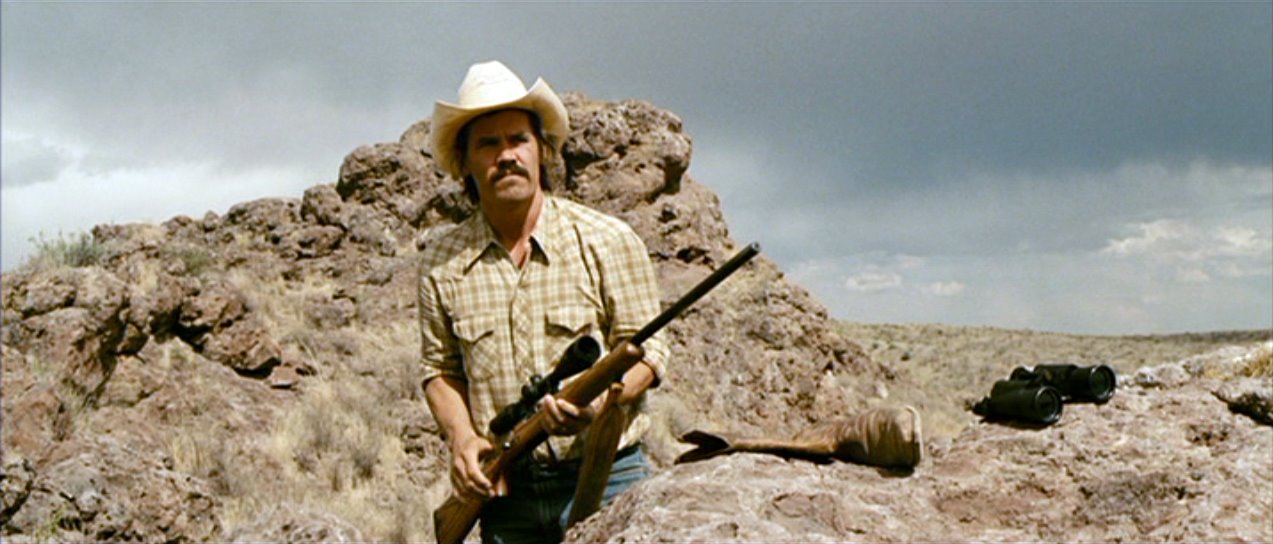
When we first see Llewelyn Moss he is hunting antelope. This is how the film introduces us to Moss:

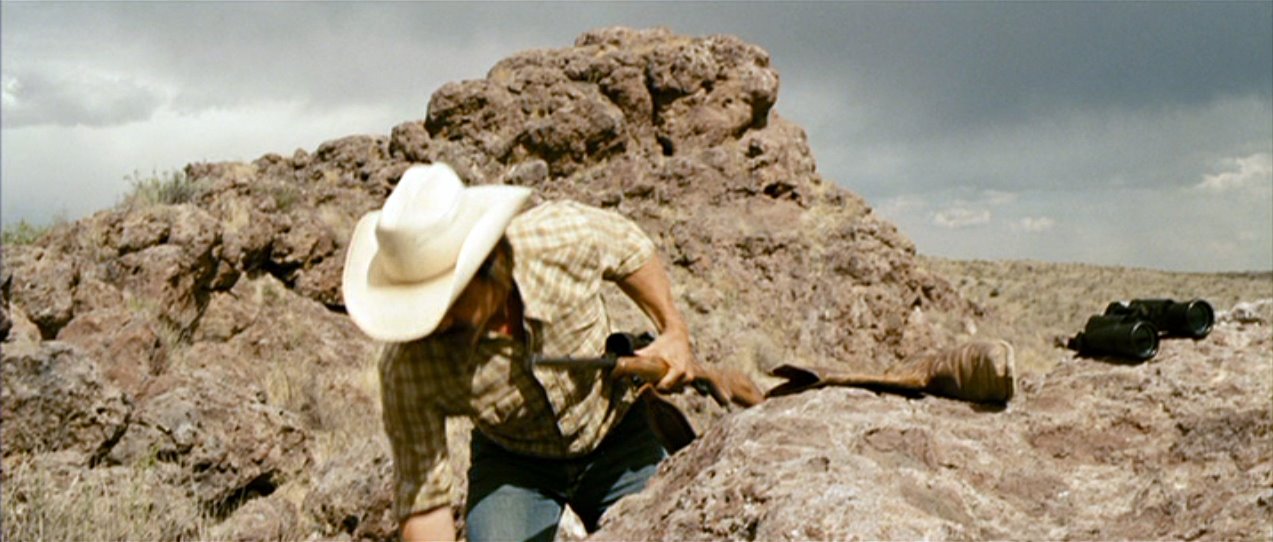
Moss looks through the scope of his hunting rifle. He has a seriousness about him. He is a hunter. He aims for the largest of the male antelopes. He shoots, but the animals run away. Now he has to track them.

The fact that he is using a traditional hunting rifle says a lot. In our world of available hi-tech weaponry where men are typically fascinated with military-style armaments, Moss caries a rifle from another world. This rifle has a wood stock, is bolt action, and mounts a typical hunting scope. It is also a .270 caliber, which is a classic round for antelope hunting.

Here is the description from the book by Cormac McCarthy:

The rifle strapped over his shoulder with a harnessleather sling was a heavybarreled .270 on a ’98 Mauser action with a laminated stock of maple and walnut. It carried a Unertl telescopic sight of the same power as the binoculars. The antelope were a little under a mile away.

Moss wears a plaid shirt with sleeves rolled up. He is working class in appearance. The color of his shirt, skin, and rifle blend in with the light brown of the desert landscape. He is a man in his element. There is something about him and this desert environment that are similar.

He also wears a white hat. In the tradition of the western genre there is no wardrobe choice more conspicuous than the white hat for the good guy and the black hat for the bad guy. Ghigurh does not wear a hat, but he sports and undeniably conspicuous hairdo that effectively functions as a “black hat.”

The hat (hats have played significant roles in other Coen films) situates Moss in the mythological West. Moss is presented as a kind of cowboy. Chigurh is presented as something other. This contrast will feel a little like that of the old world versus the new world in Lonely are the Brave (1962) and, like the story in that film, the cowboy loses.

It must be highlighted that our first glimpse of Moss has him with a gun. This denotes him as a killer. Moss “as killer” is a critical characteristic. The contrast between the killer Moss and the killer Chigurh will become the ground for the narrative’s causality.

This scene also denotes Moss as hunter, which is different than killer. The story will turn this characteristic on it head and makes Moss the hunted. We might assume, then, that Moss will become something like Rambo in First Blood (1982).

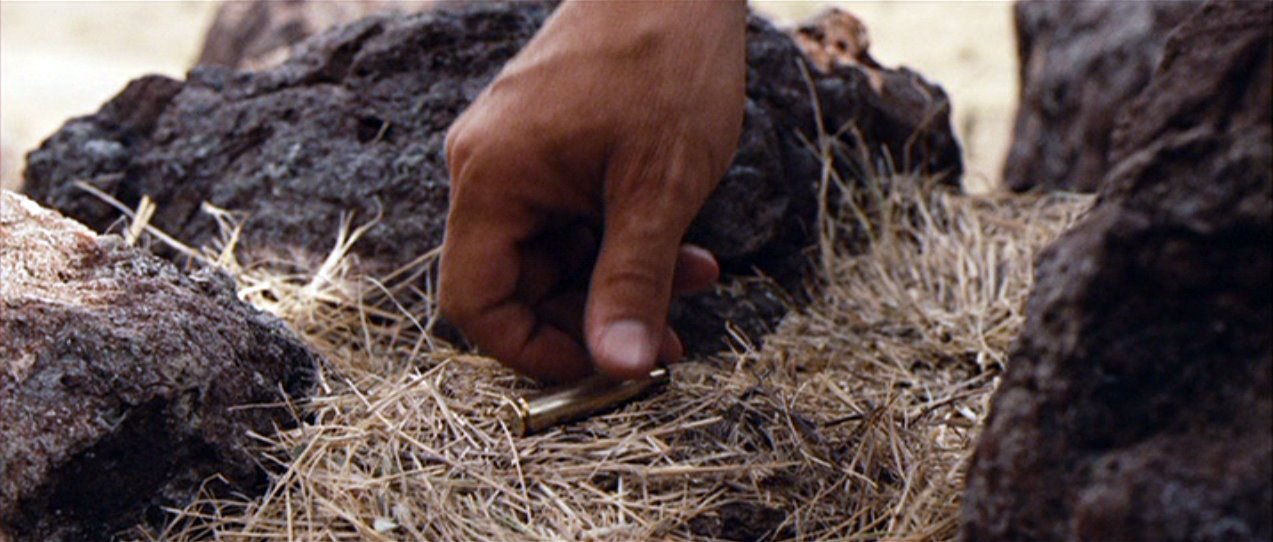
After Moss fires his shot the antelope run away. He stands up and watches them run off. He then does something interesting. He bends over, picks up the empty shell from his expended round and puts the shell in his shirt pocket.

My father is a hunter. I grew up hunting with him, although I personally haven’t hunted in years. My father is the kind of hunter who likes tradition and economy. He likes true hunting rifles rather than the popular militaristic styles. He saves his shell casings so he can reload his own rounds. He will carefully measure the gunpowder into each shell casing and then seat a particular bullet into the shell. Notes are taken for future adjustments. Quality and exactness are critical. Different kinds of bullet and powder combos are tested. Choices are made based on what game will be in the sights. It is a kind of primal craft, something from the past. My father has often said he was born a hundred years too late.

Moss represents that past. He is the archetype of the self-sufficient, frontier man who can live off the land, live by his wits, and take care of himself no matter what comes. He is the man’s man of the Zane Grey novel or John Ford film. He is the dream of the West. He is an incarnation of John McClane (Die Hard). His character remains consistent throughout the film to that archetype.

The simple detail of Moss picking up the shell and putting it in his pocket tells us a lot about him. He is a kind of craftsman. He is thoughtful and meticulous. He lives out a kind of economy of not wasting even the littlest thing. This economy will make him a formidable foe for Chigurh. Unfortunately for him, his wife, and others, Chigurh is more than just a bad guy – he is a force of nature, like the coming of darkness or the second law of thermodynamics.

But what makes up this darkness? Death eventually comes to all. Chigurh does not increase death, for death is total for every generation. But Chigurh is relentless. He is, in Lyotard’s words, a monad – a self-contained entity only aware of his own concerns. Lyotard (1991) says of the monad: “When the point is to extend the capacities of the monad it seems reasonable to abandon, or even actively to destroy, those parts of the human race which appear superfluous, useless for that goal. For example the populations of the Third World” (p. 76-77). In this sense Chigurh might be seen as symbolic of larger cultural forces, such as the ruthless drive of capitalism or empire. Or he might be just a tornado.

It is not merely that Chigurh is a bringer of death. Or even that he is like the character of Death in Bergman’s The Seventh Seal (1957), which he also is. Chigurh represents the deep human fear of chance as destiny. With Chigurh every choice becomes and existential choice, and the chooser never has all the information. Characters have choices, but those choices, like all choices, are ultimately about who one is and who one will be. However, those characters don’t always realize the profound nature of their choices. All to often human beings live their lives as though in a dream. Consider this famous scene:

Anton Chigurh
Call it.

Gas Station Proprietor
Call it?

Anton Chigurh
Yes.

Gas Station Proprietor
For what?

Anton Chigurh
Just call it.

Gas Station Proprietor
Well, we need to know what we’re calling it for here.

Anton Chigurh
You need to call it. I can’t call it for you. It wouldn’t be fair.

Gas Station Proprietor
I didn’t put nothin’ up.

Anton Chigurh
Yes, you did. You’ve been putting it up your whole life you just didn’t know it. You know what date is on this coin?

Gas Station Proprietor
No.

Anton Chigurh
1958. It’s been traveling twenty-two years to get here. And now it’s here. And it’s either heads or tails. And you have to say. Call it.

Gas Station Proprietor
Look, I need to know what I stand to win.

Anton Chigurh
Everything.

“You’ve been putting it up your whole life you just didn’t know it.” That just might be the most important line of the film. A man’s life is a story, true, but it is a mix of choice and chance. Like the journey of the coin, and of what the coin represents: a choice between heads or tales. But what kind of choice is that? One chooses, but chance decides. The gas station proprietor chooses heads and it is heads. He gets to keep on living for now. Does he know the nature of his choice? Do we know the nature of our choices? Of course, like Lazarus being raised from the dead, the gas station proprietor has not been save from death, it will still come, it is inevitable.

So where does this leave us? No Country for Old Men gives us a story of characters, of the choices they make, of the consequences of those choices, all set within a consistently circumscribed world. And yet, at the end, where are we?

Sheriff Ed Tom Bell is our narrator. Llewelyn Moss is our protagonist. Anton Chigurh is our antagonist. The stage was undisturbed, a disturbance occurred, and struggle ensued. But the classical narrative runs dry; it does not seem to be able to sustain itself. Why? There are at least three reasons.

1) Moss, rather suddenly, ends up dead. After following his struggle so closely and with so much detail the narration leaves out his last struggle. We do not see him die. His corpse lies on the floor of his hotel room before the film is finished with its story. This death, though later in the story than the death of Marion Crane in Psycho (1960), still comes too early to be a climax. And yet it would seem the final confrontation between Chigurh and Moss was what the film was building up to. But no, the audience is left hanging, as it were, in the wind.

2) Chigurh is a cypher, a ghost. We know he is odd, probably psychotic. We know he is a ruthless killer. We know he is tough and maybe impossible to kill. But what do we really know about him? Almost nothing. What is his motivation? Money? No. Power? Maybe. Principles? We are told yes, but are we sure, and what principles exactly? And is he really a part of the world as presented to us? Or is he part of a different world? On more than one occasion the lives of those who come in contact with Chigurh depend on whether they “see” him.

Nervous Accountant
Are you going to shoot me?

Anton Chigurh
That depends. Do you see me?

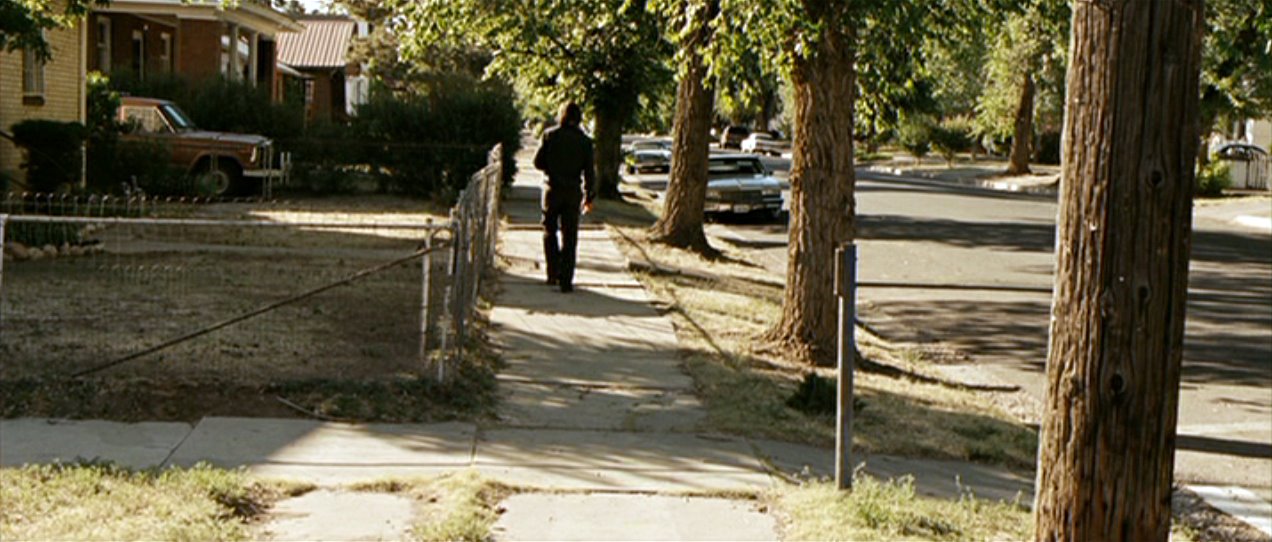
One could take this to mean that if one does not talk one lives. On the other hand, to see Chigurh is to believe in ghosts. The last shot of him shows him walking away down a sidewalk. We know he is sure to get away, he always does.

What an interesting shot. It is so bland, so ordinary, just an ordinary street. He is the figure of death resuming his journeys. This last image of Chigurh then slowly dissolves to a profoundly troubled and puzzled Ed Tom Bell.

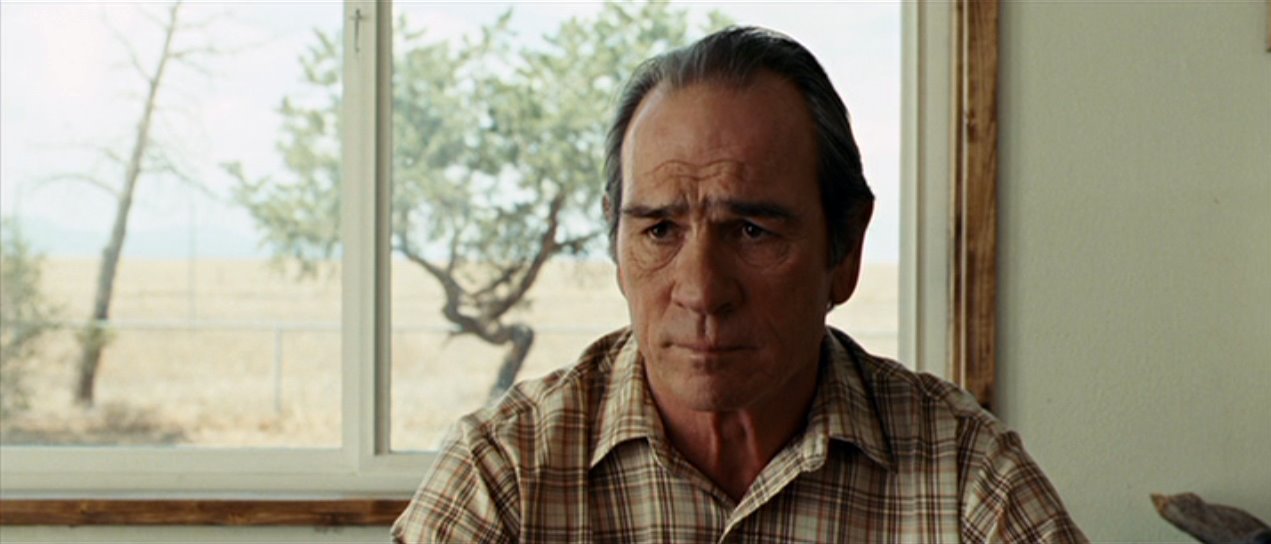
3) Ed Tom Bell’s has two dreams. It is possible that just about anything is easier to interpret and understand than a person’s dreams. Ending the film with two (not just one) dreams produces a number of potentialities of meanings upon meanings. Certainly there is a weight to the dreams, but they are naturally vague and open. The film stands at the precipice of being plural, that is, it hinges on the possibility of an infinity of meanings, which means it could have no meaning. Consider the dreams:

Loretta Bell
How’d you sleep?

Ed Tom Bell
I don’t know. Had dreams.

Loretta Bell
Well you got time for ’em now. Anythin’ interesting?

Ed Tom Bell
They always is to the party concerned.

Loretta Bell
Ed Tom, I’ll be polite.

Ed Tom Bell
Alright then. Two of ’em. Both had my father in ’em . It’s peculiar. I’m older now then he ever was by twenty years. So in a sense he’s the younger man. Anyway, first one I don’t remember to well but it was about meeting him in town somewhere, he’s gonna give me some money. I think I lost it. The second one, it was like we was both back in older times and I was on horseback goin’ through the mountains of a night. Goin’ through this pass in the mountains. It was cold and there was snow on the ground and he rode past me and kept on goin’. Never said nothin’ goin’ by. He just rode on past… and he had his blanket wrapped around him and his head down and when he rode past I seen he was carryin’ fire in a horn the way people used to do and I could see the horn from the light inside of it. ‘Bout the color of the moon. And in the dream I knew that he was goin’ on ahead and he was fixin’ to make a fire somewhere out there in all that dark and all that cold, and I knew that whenever I got there he would be there. And then I woke up.

What do we have here? I believe there is meaning here. I believe that we can tease out what McCarthy and what the Coens are getting at. But we do so without finality. We find layers, complexity, multiplicities, and contradictions. In other words No Country for old Men ends but it does not resolve. Lack of a clear resolution saws off, as it were, the possibility of a classical narrative ending.

In structure No Country for Old Men proceeds largely by way of a classical narrative, but it also has elements of, and ends by way of art-cinema narration. These two narrational modes are logically at odds with each other. According to Bordwell (1985):

For the classical cinema, rooted in the popular novel, short story, and well-made drama of the late nineteenth century, “reality” is assumed to be a tacit coherence among events, a consistency and clarity of individual identity. Realistic motivation corroborates the compositional motivation achieved through cause and effect. But art-cinema narration, taking its cue from literary modernism, questions such a definition of the real: the world’s laws may not be knowable, personal psychology may be indeterminate. (p. 206)

Ed Tom Bell’s confusion at the end is also our confusion. What disturbs him is not merely the extreme violence he has witnessed. He is confounded by his inability to understand the world anymore. He has assumed, and been hoping for, a clear resolution to life. He has taken for granted a meaning to the universe and come up woefully short.

“And then I woke up.” Ed Tom Bell is how awake. He has been living in a kind of dream his whole life. He has been wagering his existence his whole life and he just didn’t know it. Now he knows it, but he has no answers. His eyes are finally open but the scene before him is indecipherable. The extreme violence he has witnessed compares to the narrative violence, that is, to the deep rupture to the classical narrative expectations he was expecting. These two violences have caused metaphysics, as it were, to re-enter his mind. His presuppositions have been stripped. He sees life for what it is not. He is lost in a world of choice and chance.

. . . and that’s one way of looking at this polysemous film.

References:
Bordwell, D. (1985). Narration in the fiction film. Madison, WI: The University of Wisconsin Press.

Lyotard, J. F. (1991). The inhuman: Reflections on time. (trans. G. Bennington & R. Bowlby). Oxford: Blackwell.
>our shore

>

gentle, go gentle
breeze across my face
in the sweet heat of
early Summer

river rocks, smooth,
laid down in age
upon age,
ring the banks
of this glowing
lake

and we, family,
take our rest
in the sanctuary
of time and cool ripples
on our shore

our shore,
claimed like a friend,
but not for keeps,
like a handshake
or a kiss
on the cheek,
is our shore

and this begins,
again and again
and new all the same,
our Summer

~May, 2008

>to blog . . .

>My own observations tell me one of the most common topics amongst those who blog is the question “why blog?”. I ask myself this question. I see others doing so. I see some questioning the validity of blogging, some quiting their blogs, some taking extended breaks from blogging, and many writing about their reasons for blogging as though they are justifying their actions. I also see many expressing a kind of obligation to provide blog content; they apologize for not having posted in a few days or a few weeks. I see some stating they are re-committing themselves to their blog. Some of those do, and some do not. I frequently see blog posts explaining why other things, mostly life, crowd out the time otherwise used for writing blog posts. Some of those life “things” are big things, like a death in the family, or a birth. Other times those things are rather ordinary, like a busy week at work or preparing for final exams at school. And I see many blogs continue to exist largely because those who provide their content do so out of a kind of obsession; those blogs exist because, in some deep way, they must.

So why blog? Blogging is a somewhat new thing. Writing and journaling is not new, but in historical terms blogging, and its technological underpinnings, are very new. On the other hand, blogging is just another form of personal expression, and there are few things in all of human existence as old as that. The reasons people blog are as numerous as those who blog. And yet, the reasons are universal as well: humans need to, and will, express themselves, extend themselves into the world, seek meaning for their existence, and connect with others. If not blogging then something else will fill the gap. When bloggers give up blogging they do not give up expressing themselves. They go down new routes, other pathways of expressing. But blogging is a great path, and so many blog.

For those with an aesthetic sense, which includes everyone but in some it is more pronounced, blogs allow for some design around the verbiage. In some cases blogs will consist only of images with almost no words. For others, blogs are about the words and the ideas they can express. In any case, blogs are generally about ideas, about existence, about the present, about being human. A catalog of blogs would show, most likely, a rich cross-section of all that it means to be human, both specifically/uniquely and universally. Blogs breathe and bleed our humanity.

Why do I blog? Like most people there is a story behind my decision to begin blogging, and the reasons I continue are also drawn from my life. I came to blogging by way of curiosity and a “need” for some creative outlet. I put need in quotes because I can also say blogging became a diversion from what I truly needed to be doing a the time I started blogging, that is, writing my thesis and getting myself graduated. Regardless, I wanted to do something that was more creative and connected myself to others in some way. Fortunately I also finished school.

But there was a bigger reason for my starting to blog. In January 2006 my second child died. We had spent a great amount of time in hospital caring for her. Months had been devoted to her life, and then there was nothing more we could do. This was a crisis for me, and my family. The process raised a lot of personal issues and question, not least of which included questions of who I was and who did I want to be? I realized I had gone down pathways that, step by step, moved me away from my love of the arts, and more specifically, cinema. This may seem like a lightweight realization in such a context, but it reached all the way back to my childhood and brought up a host of deeply personal issues. It was not, needless to say, the only realization I experienced, but I digress.

I had studied art history, film history, and film production at university. I received two undergraduate degrees and one graduate degree in those fields. I had planned on getting my PhD and then becoming a professor at a film or media studies department somewhere. As the saying goes, if you want to make God laugh tell him your plans. So there I was, a long way from my old plans, working at a software company, reacting to the loss of a child, and wondering who I was. I wanted to start connecting to like minds, reconnect myself to my love of cinema, and learn more about on-line communities. Mostly I just wanted a creative diversion that might also mean something.

I began with MySpace. I created a page and used their blog tool. I grew tired and frustrated with MySpace for a host of reasons and switched to Blogger. Sometimes I am frustrated with Blogger too, but here I am almost a year and a half later. I am considering switching to something like WordPress. It may not be worth the trouble, or it may.

Like many bloggers I wonder if I have anything to say, if what I have to say is worth the fuss of creating and maintaining a blog, if blogging is worth the time and effort when I could be doing other things, and I wonder just how permanent is my blog. The click of a button could take it all down in an instant. So far I feel that blogging has been mostly good for me, but I also am thinking of moving somewhat away from it and try to channel my energies more toward action rather than words. I would rather my daughters know me as a father who interacts more often with them more than the father who is always at the computer. I also want to be a more active person, get outside more, do more of the things I dream of, like climb mountains, go snow camping, take my kids to ball games, hang out with my wife, etc. Regardless I do know this, in one way or another, I will continue to express myself.

For now, PilgrimAkimbo continues on. I have begun to include other topics of interest to me beyond cinema. I see this blog as becoming my public journal more than merely my way to connect to the on-line cinephile community. My desire is still for a creative outlet, but my needs have been changing. I do hope this blog continues to be a means of enriching my life, and I hope, in some small way, it might actually enrich the lives of others. And yet, who knows what tomorrow may bring.

Wilder says, get outside!


Wilder at the park while her papa keeps her swinging.

>Rauschenberg dies, his art lives

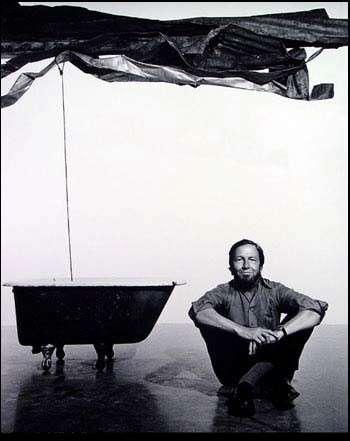
>I just saw that Robert Rauschenberg died on May 12th. He was one of the giants of 20th Century American art. He was also one of my “art” heroes.

Rauschenberg reminisces about his seminal “combine” artwork Monogram (1955):

Rauschenberg discusses his famous artwork, Erased de Kooning Drawing (1953), that consisted of erasing an artwork of another famous artist:

Excerpt from Rauschenberg’s 1967 film Linoleum:

Rest in peace.