>a curious absence

>I am curious and concerned about the popular reaction in the U.S. to the economic crisis. The reaction seems to be a combination of moral outrage and complete acquiescence to the “current financial situation,” or whatever we’re calling it. The American people (including myself) are complaining a lot and doing little.

Publicly protesting is not a complete solution by a long shot, but it can be an important element in changing our society for the better. In numerous places around the world over the past several months there have been protest and strikes in response to the global economic meltdown and various governments’ actions. Here are some:

Protests in Eastern & Central Europe

Protests in France

Protests in Greece

So where are the protests in the U.S.? This is the country most responsible for the problem. This is the country doling out the largest dose of corporate welfare (in an already corporate welfare state) in world history to those companies most culpable. This is the country in which those government leaders and those captains of Wall Street who created the policies that made the collapse as easy as possible, are the same one’s now hired to fix the problem. There is a lot of outrage for sure, and many ordinary Americans have played their part in the mess as well, but it seems everyone is just sitting by hoping things will get better.

It appears to me the fundamental issues underlying the problem are moral and systemic. Both of which should send people into the streets. But, so far, not in this country. Any thoughts?


>Reading Marx’s Capital with David Harvey

>For forty years David Harvey has been teaching Karl Marx’s Das Capital. Recently his 13 part (two hours each) lecture series has been made available through iTunes. [Go to iTunes/iTunes Store and search for either “Reading Marx’s Capital” or “David Harvey.” You can choose either the video version or the audio only version.]

Harvey’s goal is to truly understand what Marx was saying rather than preach some standard line about Marx. He is a fan of Marx and so one could label him a Marxist, but his studies often end up undercutting the popular myths about Marx. As one would expect, that undercutting is one of the benefits of a close reading.

The first 5 or 6 of the lectures are also available on Google video. Here’s #1:

http://video.google.com/googleplayer.swf?docid=-5820769496384969148&hl=en&fs=true

>waxing and waning

>
The states of affairs these days has led me to post less – about half as much as in the past. I have ideas, and even started some posts, but each time I just feel too tired to carry it through.

I have also noticed a number of the blogs that I’ve followed over the past two-plus years have decreased their posts. Maybe there is a general waning in the blog world. I love to blog, but the urge is less than it was. How about you?

>Terry Eagleton – brilliant!

>If you have spent any time in post-baccalaureate English/cultural/media-studies environs then you know of the brilliant Terry Eagleton – that noted literary critic and author of the beloved grad-school crutch, Literary Theory: An Introduction (1983). Recently Mr. Eagleton gave four lectures at Yale University. For most Americans these lectures will both fascinating and seemingly impenetrable. We are not so used to the higher levels of British academia. But they are worth taking the time, and ultimately thoroughly enjoyable – not least of which because Eagleton has a wry sense of humor.

These lectures are probably most famous for the term “Ditchkins.”

“…someone like Richard Dawkins or Christopher Hitchens, a couplet I will henceforth reduce to the solitary signifier Ditchkins…”

Of course there is much more than that in the lectures. Below are video versions, but they are also available through iTunes.

just another word of encouragement

A few days ago I had some fun posting and commenting on various “alternative” images of Jesus that have become increasingly popular on the Internet. I titled that post another jesus. If you follow this blog at all you know I occasionally write on religious topics, mainly because I am a Christian trying to sort out the differences of my cultural Christianity from my faith. This is part of my overall journey in search of Truth, wisdom, and an authentic Christianity. So with that in mind, I had a recently amusing and disconcerting experience the other day which has prompted me to change my comments policies for now (they’re now moderated).

On that “another jesus” post I got the following comments (I made some slight changes to make it less offensive. I apologize if any here are offended.):

Hello i dont know who ur but i warn u if u display such kind of pictures and if u display jesus in very wrng ting…if u do this i will kick ur a** through visiting ur place ur mother f**ker….jesus is real son of a god he cures us and he helps every moments and loves us all the times…..f**k i kill u …ur a** f**ker….contact me if u have guts rohith_fancy25585@yahoo.com

Apart from the fact that this is actually a death threat if taken seriously, there are a lot of things one could say about these comments. At first I thought it might be a joke. In my experience such comments are so the opposite of what a Christ follower would say or do that I just new they couldn’t be serious. But then I realized, no, this commenter thinks he/she is defending Jesus. I could be wrong – maybe someone knows different.

Regardless, this commenter’s thoughts/assumptions/insults have given me some pause. Here are some attempts at understanding this helpful soul:

  • The commenter means to be giving me a word of encouragement, but the only English he knows was learned from watching Quentin Tarantino films. I realize Rohith is an Indian name. It could just be a “cultural divide” kind of thing. I need to be more sensitive to these things.
  • Maybe I should have known that “jesus is real son of a god he cures us and he helps every moments and loves us all the times” means we personally don’t have to worry about curing, helping, or loving – since he does that for us. That must be why he can immediately follow that sentence with “f**k i kill u.” It’s because of the freedom he has in Christ.
  • But then, he does say “son of a god” – a god. Which god does he mean? How many gods are we talking about here? I will try to keep an open mind.
  • If I don’t email him back do I not “have guts”? Is that what it takes these day to be evangelized? To “have guts”? I’m assuming here that what he really means by wanting me to contact him is so he can let me know God loves me and has a wonderful plan for my life.
  • It could be that he really is not a Christian (surprise) but is, in fact, a new-age dialecticist who is hoping to create some new religious synthesis through confrontation and this is just his way of inviting me to his new religion. So this could be a very sophisticated Hegelian tactic, just cleverly disguised as something opposite.
  • Grammatical clarification: Can “ur” mean both “you are” and “your” in the same comment? Is that legal? It certainly makes it difficult to understand what exactly he means by “ur a** f**ker.” Of course, if I had guts I would just ask him.

Maybe you have some additional thoughts. Maybe you “have guts” to contact Mr. Fancy25585 and carry on a meaningful dialog. Let me know how it goes. As for my part, I’m already on to other things.

>Peter Rollins interview

>Peter Rollins is one of the most interesting leaders in Christianity today. But his Christianity is not the typical Sunday School version I was taught (which is a good thing). At times he can be exasperating, at other times brilliant, and he’s always provoking. Trained as a philosopher, at every turn he seems to turn Christianity on its head. Of course, discussing religion and faith with Rollins would be better over a few pints than on the set of a rather staid religious interview show as is here, but this is still good (and the questions are great too).

http://vimeo.com/moogaloop.swf?clip_id=2752277&server=vimeo.com&show_title=0&show_byline=0&show_portrait=0&color=7a012e&fullscreen=1
Explaining Emergent Churches – Inner Compass
from
Calvin College on Vimeo.

>The Larry Seigel Show

>http://mediaservices.myspace.com/services/media/embed.aspx/m=11149903,t=1,mt=video

Some great little-known Rick Moranis from the SCTV days.

>bird feeder

>We have a bird feeder in our front yard. Two weekends ago we finished putting in three raised garden beds. Last weekend we bought some plants to put in the beds, and we picked up a bird feeder as well. Since last weekend I have kept my eye on the feeder looking for birds. I was getting discouraged that no birds seemed to find our feeder alluring. Today was the first day I saw birds at the feeder. I had to call my wife and let her know.

Consequently I made my first ever bird identification. What I mean is I used my Peterson Field Guide to determine one of the birds that I didn’t know. That bird is the Dark-Eyed Junco, or more specifically the Oregon Junco – Junco hyemalis oreganus.

A few years ago, maybe 15 or so, I thought I might do some bird watching. I bought the Peterson Field Guide. I went on a few walks with binoculars around my neck. But birdwatching didn’t pan out. Finally, today the guide came through. There were at least three other birds I saw that I still have to identify, but one is fine for now.

another jesus

If you search for images of Jesus on the Internet you will find an unending supply of everything from the serious to the comic, pious to the sacrilegious, realistic to the saccharine. Jesus has always been an appropriated figure by different Christian groups, but now it seems everyone appropriates Jesus for any reason, group, or perspective. Or, to put it another way, Jesus is increasingly seen as a non-religious figure who can be anything you want him to be. I think this can be seen as both a bad thing and a good thing.

Bad because Jesus was and is who he was and is. Any other perspective or viewpoint is not true. That would hold true for our perspective of anyone. But it’s good because so many traditional images of Jesus are just as wrong headed as the many non-traditional. It is a good thing to have our assumptions challenged, and to be reminded that we may not know as much as we think we do. If we don’t take Jesus seriously then, I suppose, anything goes. But if we do take him seriously then it makes sense to find out who he really was – and is. I would expect non-Christians to have fairly limited knowledge of Jesus but, ironically, many Christians do as well.

I saw a lot of politicized images of Jesus. One of the biggest debates going on today (consciously and unconsciously) is whether Jesus was a political figure with a political agenda and whether that political agenda was conservative or liberal. I am inclined to think Jesus was more of a political figure than I have been taught, and I am inclined to see the more liberal side of his politics. However, I think his politics were far more radical than either left or right.

As for those images, here are some of the least offensive, but still non-reverent, images I found in just a few minutes:


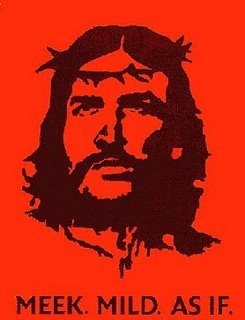
The not-meek, not-mild Jesus. Sure he’ll die for your sins, but he’s still as tough as a Chevy truck.


No comment needed – except – reminds me of the ‘who would Jesus bomb’ slogan.


The kind, teaching non-non-violent Jesus.


The Jesus for whom there will be no cross, I suppose. Lookout Romans, it’s smackdown time.


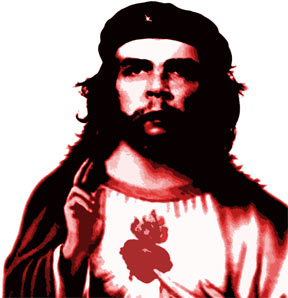
The radical leftist Jesus. “After fasting for forty days, Jesus put on his beret and returned to the collective.”


The twitter gospel Jesus. But why does “sins” have to be spelled with a “z”? It’s not any shorter or easier to type on your blackberry.


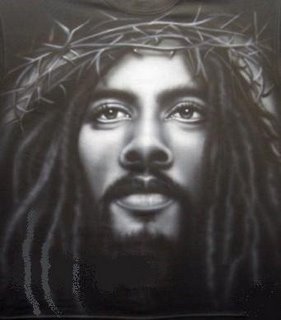
The Rastafarian Jesus (I suppose). Is he actually looking at anything?


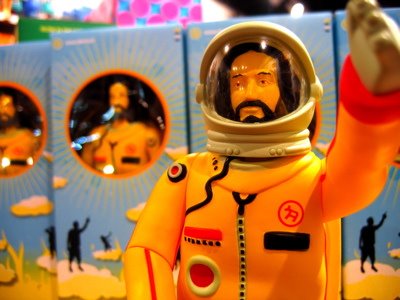
The astronaut Jesus. He’s in orbit and he’s coming back!


And ironically, maybe the most scriptural of all, the un-dead Jesus. He lives!

Now I recognize how goofy these images of Jesus are, but so are classic Victorian ones like this:

And yet, we have this one in our house and I like it. Hmm.

L’amour est un oiseau rebelle

Three images that say just about all you need to know bout the story of Bizet’s Carmen:


And yet, there is so, so much more.

We just finished watching Carmen the other night. This is the 1984 version with Julia Migenes and Plácido Domingo, directed by Francesco Rosi, and filmed on locations in Spain. I recommend this version, though I sometimes found the use of locations and lip-syncing to be a bit distracting.

We are beginning to love opera. My girls think opera is great – they want to see more. Next might be Verdi’s La traviata. We’ll see.