>oysters and friends and april (is national poetry month)

>This past weekend we were in Seattle visiting friends and family. We wish we could have spent more time and visited more friends. On Saturday we had lunch down at Pike Street and our friend ordered oysters in the half-shell. You could smell the ocean and taste the salt water when you ate them, even minutes later. Just glorious. Reminded me of one of my favorite poems by Seamus Heaney.

Oysters

Our shells clacked on the plates.
My tongue was a filling estuary,
My palate hung with starlight:
As I tasted the salty Pleiades
Orion dipped his foot into the water.

Alive and violated,
They lay on their bed of ice:
Bivalves: the split bulb
And philandering sigh of ocean
Millions of them ripped and shucked and scattered.

We had driven to that coast
Through flowers and limestone
And there we were, toasting friendship,
Laying down a perfect memory
In the cool of thatch and crockery.

Over the Alps, packed deep in hay and snow,
The Romans hauled their oysters south of Rome:
I saw damp panniers disgorge
The frond-lipped, brine-stung
Glut of privilege

And was angry that my trust could not repose
In the clear light, like poetry or freedom
Leaning in from sea. I ate the day
Deliberately, that its tang
Might quicken me all into verb, pure verb.

– Seamus Heaney

>What is Democracy? Beyond Elections documentary

>Democracy is one of those words, like love or justice, that we all know intuitively what it means, but then again we don’t really know as well as we think. I am often surprised by how much I don’t understand democracy and its implications, let alone how it plays out in different parts of the world. Below is the the first part of a documentary on the topic of democracy in the Americas. This might be a good place to start re-examining what democracy is all about.

You see the rest of the documentary here.

>blogging questions

>I am wondering about the future of this blog and its place in the blogosphere. Thoughts of redesigning it float through my head. I have some questions:

1.
Should I use tags for my posts? I did at one point, but then they became unwieldy. I could try again with better rules on how & when to use them. Should I bother? Do you like/use tags?

2.
Is there a point in having a long blog roll, or several semi-long blog rolls on one’s blog. I’m thinking of pairing down. Should I? Do you pay much attention to blog rolls?

3.
Do you find yourself either blogging or reading blogs more or less than you were before? If less are you doing other things – like Facebook – instead?

>God help us to be human: Happy Birthday Cesar Chavez

>

Today is the birthday of activist Cesar Chavez.

>Capitalism Hits the Fan

>Professor Rick Wolff is a passionate and animated lecturer. He is also a Socialist. With all the discussion these days about the supposed Socialist solution proposed by the Bush/Obama power brokers, it might be worth understanding what an actual Socialist perspective is all about. (This video was recorded before Obama was sworn in as president.) I have to say Wolff’s analysis is, at least, fascinating and worth thinking about. Truth is, Karl Marx’s understanding of Capitalism is a powerful critique and possibly more important than ever.

http://vimeo.com/moogaloop.swf?clip_id=1962208&server=vimeo.com&show_title=1&show_byline=1&show_portrait=0&color=00ADEF&fullscreen=1

As with most Socialist/Communist proposed “solutions” to things like economic crises, labor issues, government regulations, market fluctuations, and the like, I am not sure where I stand. I am not yet a Socialist, but can’t say I’m a Capitalist either. Wolff’s conclusions in this video also seem somewhat simplistic to me, but that might be because he had limited time to speak. My guess is that given more time he could give much more detail and answer objections.

Outside looking at another outside: Thoughts sparked by Wajda’s Man of Marble

In the middle of Andrzej Wajda’s Man of Marble (1976) there is a brief moment when the young filmmaker Agnieszka (played by Krystyna Janda in her first film role) is chastised by her producer (played by Boguslaw Sobczuk in his first film role). Agnieszka has been trying to do an investigative piece on a once praised bricklayer, Mateusz Birkut – the man of marble – who was hailed in the 1950s as an example of the communist ideal and then fell out of favor with the government and has since disappeared. Agnieszka has had some difficulty getting the footage and information she needs to tell the story, so she has reverted to subversive techniques – hidden camera and microphone – for an interview with a strip club manager to get material for her film. In the process she is caught and loses her film from that interview. Her producer argues with her about her lack of material and includes the comment: “Besides, this isn’t America, these aren’t the methods to use…”

For some reason this comment seemed to jumped out at me on this second viewing (not so 20 years ago). I have come across similar comments from other Soviet bloc films and books. Maybe my interest was piqued because I’ve grown more sensitive to historical and political issues. Maybe it’s because I’ve read Russian artists who chaffed under the Soviet system, yet they still expressed disdain for the U.S. system and the ugly realities of capitalism. If you are a U.S. citizen of long standing then, like me, you were well trained to despise everything Soviet, to see the CCCP as wildly oppressive, to know the Russians stood against “everything we hold dear”, and tag them as the evil empire (as one populist demagogue once put it).

I am glad I did not grow up anywhere in the Soviet bloc. But I also see the game. We are trained to fear other political and economic systems by those who have a vested interest in us being fearful. I think this is true in many countries. Power seeks to remain in power, and does so in part by being the controller of ideas. Even a person such as myself who tries to think critically about these things is still like a fish trying to see the water – I am profoundly influenced by the limited world in which I live. We like to think the world of ideas is unlimited, that we have equal access to any idea or concept, but unless we do the hard work of seeking out alternative ideas, and then really digging deep into them with the goal of understanding, we will tend toward uncritically believing the ideas which are closest and most prevalent.

So it is interesting to me to hear a line spoken in a 1976 Polish film (a film made by a director who’s own career shortly came to a standstill because of support for the solidarity movement) by a government authority holding the high ground morally regarding U.S. society. I don’t know if the producer’s opinion was right or wrong, or if Wajda intended this as a joke, but it is interesting to get a glimpse from the other side as it were. What we sometimes find when we pull back the curtain on communist countries is not always a longing for western style capitalism and U.S. style democracy, but either a desire for their own government to behave rightly in light of the stated goals of their own system, or for the system to change to a more democratically oriented socialism with improved human rights. I found similar sentiments from Tarkovsky in his diaries. That surprised me given my ideological training.

By the end of the film’s story the investigative implications point to a dark end for Agnieszka’s subject. Mateusz Birkut ended up in Gdańsk working at the Lenin Shipyard, where he died. Those shipyards were the birthplace of the solidarity movement. They were also the place where many were killed by the secret police and one of the locations of the infamous 1970 protests. Very likely Mateusz was killed by the secret police in Gdańsk, this would have been something the audience would presumably understood, but Wajda leaves that an open conclusion – but not entirely open as he took up the story again in Man of Iron (1981) in which the protagonist is Birkut’s son.

I don’t typically give reviews, and this isn’t one, but I will recommend this film. Man of Marble has two qualities: 1) The film is clearly the work of a master filmmaker who has developed into a mature storyteller, and 2) The film feels like a rough around the edges independent film that vibrates with life. It is not like American films, and therefore worth seeing for that reason, but it is more. Man of Marble is a window into another world, two worlds in fact. But it is also a kind of window into our world, for it raises universal questions of official truth and the value of investigative journalism, two things we could use more of today.

West Side Story & The Tragedy of Not Practicing Peace

The other night I introduced my daughters to the film version of West Side Story (1961). In so many ways this is a great film, not least of all because it is a great American sociological document of sorts. The story revolves around the big gang fight, or rumble. Everything leads up to it and then reacts to it. The rumble is not only the central event, but it also contains the key defining moment. That moment is the movement from wanting peace to using violence – the quintessential movement that produces the “how could this have happened” scenario.

Here’s how it plays out: The two gangs, Sharks & Jets, meet under the overpass to fight it out. What they are fighting about is really anyone’s guess – territory, honor, hormones, it’s hard to tell. Tony (a.k.a. Romeo), the former leader of the Jets, but now a guy with a job and a love interest (Maria, a.k.a. Juliet), shows up just as the rumble is getting started. He tries to stop the fight. He pleads, pushes gang member apart, gets mocked and hit, but to no avail.

Here he pleads with Bernardo, the Sharks’ leader, to stop the rumble:
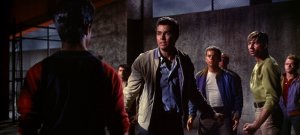
Bernardo has no interest in not fighting. He is there to fight. He calls Tony chicken. Tony is not phased by this. He lets the others mock him, but he cannot let them fight. But then, as Tony tries to keep Ice from fighting Bernardo, Riff strikes Bernardo in the face. The knives come out. Then Riff gets stabbed and killed by Bernardo. Tony, in a moment of rage, picks up the knife and lunges at Bernardo.

With almost identical angle and framing we go from an image moments earlier (the shot above) of attempted reconciliation to this moment on rage and murder:
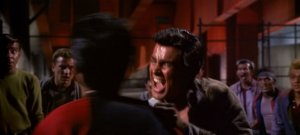
What happened in those few moments between these two shots? How could Tony have gone from seeking peace to vengeful murder in less than three minutes? What caused this movement from peace to violence? One answer is that peace was fundamentally foreign to him. In his life he had gone from being a young man of violence as the leader of the Jets to a slightly older, but still young lowly worker in the same neighborhood. But it’s not just that his environment has not changed much. He hasn’t really changed much. Although his job had begun to civilize him a bit, his problem is that he has not consciously sought peace, or a life of peacefulness, until a girl enters his life. Love is a strong motivator for many things, but not enough to overcome deeply ingrained habits on such short notice.

Practicing peace is a conscious effort to form new habits as well as to engage one’s mind towards peaceful solutions. We not only live in a violent world, but we Americans are trained by our culture to think and behave violently. Our culture provides us with constant justifications for using violent means to “solve” our problems and deal with our enemies. Our country was formed through bloodshed, slavery was overcome through bloodshed, the Westward expansion was accomplished through bloodshed, and it goes on and on. We call heavily armed soldiers paroling the streets of other people’s countries “peacekeepers.” Our nuclear arms policy is “mutually assured destruction.” We believe we can establish democracy in various parts of the world at the end of a gun. These things are reported daily by our popular news outlets and rarely do we cringe. To live in such a world will inevitably train us into people who consider violence a normative option for achieving our goals. Violence is always “on the table” as our politicians are fond of saying – and it’s as old as Cain and Able. It doesn’t take much to encourage and reinforce the violence that is already in our hearts.

Peace is not a state of being as much as it is a way of life. Peace takes courage and creativity. The tragedy for so many people is that peace is something one hopes for after the dust has settled. But peace is not some languid, passionless rest. Peace is the activity of loving our neighbors as ourselves, of loving our enemies, of being servants, and of holding each other accountable. In a violent world peace requires thinking out of the box, out of bounds, charting unfamiliar territory, and being willing to keep asking questions that seem to have already been answered. Peace is something we need to practice everyday, both for today and for tomorrow. Tony did not practice peace and was unprepared at the moment he most needed a creative solution. More than that, he had not been working toward peace in his neighborhood all along. He had no foundation, no authority.

There is a moment late in the film when Doc asks the Jets, “When do you kids stop? You make this world lousy.” And one of the Jets replies, “We didn’t make it, Doc.”

This line could be seen as an indictment of our society. In other words, how else could or should these kids behave when the world given to them is so lousy? But Doc, rather than being silent at that moment, could have answered, “No, we all make this world. With every choice and every action you are making this world just like the rest of us in this neighborhood. You can choose peace or violence, love or hate, but whatever you choose and whatever you do, you are making this world too.” Doc’s lack of a proper response indicts him as well in this mess. The real tragedy of West Side Story is the profound lack of wisdom from every character.

Using West Side Story to discuss the concept of practicing peace may seem a bit strange. West Side Story is a big , colorful, sappy, song and dance spectacle. It is nearly fifty years old and in many ways it is dated, though still a great evening of entertainment. However, sometimes watching films that are outside our own period make it easier to see what is going on. Storytellers rely on conflict to drive a story forward. In fact, I cannot think of a single film that does not have conflict somewhere in the story. Audiences lose interest quickly if there is no conflict. More than that, if there is great conflict with stunning violence and massive destruction, audience flock to the theaters. In West Side Story it is easy to think these characters should just get over it, move on, get jobs. It is easy to ask what is wrong with these kids, why don’t they stop fighting? But in films of our own period (think of all the blockbusters of the last ten years) it can be more difficult to see because we are enjoying them so much.
>emotions and economics: real sackings at bmw

>Here is a video (in two parts) of a large group of workers at the BMW Mini factory in Oxford being given one hour’s notice of the termination of their employment in February of this year. The workers don’t like it, understandably, the union leaders get an earful, and management can only say they’re real sorry. This has got to be one of the most interesting examples of what this economy is doing to people. I also find it heart rending and frustrating to watch.

Note: The camera is quiet shaky most likely because the meeting was not to be recorded and the camera had to be hidden, at least until the emotions ran high.

In a sense this video is a bit voyeuristic – we are looking in on people in a personally troubling situation (a kind of tragedy). However, if we pause a moment, we realize we are those people. In the world we live, the economic and political system we’ve inherited, and with the way businesses tend to do business, life is often tenuous for the vast majority of humanity. We all feel the closeness of the precipice, and many have already been tossed off. Although we may never do away with many of the harsh realities of life, it seems we could do much better with our economics than we have been. At least we should be careful when we use phrases like “the current economic conditions” because those conditions are merely the most visible representation of an entire system that has many deep flaws.

>20 years ago today…

>…the Exxon Valdez ran aground.

http://vimeo.com/moogaloop.swf?clip_id=3213063&server=vimeo.com&show_title=1&show_byline=1&show_portrait=0&color=ff0179&fullscreen=1

Some questions:

  • What is the relationship between capitalism and the well being of us all?
  • Can an economic system that relies on the fundamental self-interest of us all be considered good?
  • What is my role in the system?

>Margot and the Nuclear So & So’s

>Here’s a band I hadn’t heard of, but now want to see real bad.

http://vimeo.com/moogaloop.swf?clip_id=2399745&server=vimeo.com&show_title=1&show_byline=1&show_portrait=0&color=&fullscreen=1

http://vimeo.com/moogaloop.swf?clip_id=2398667&server=vimeo.com&show_title=1&show_byline=1&show_portrait=0&color=&fullscreen=1

http://vimeo.com/moogaloop.swf?clip_id=2397829&server=vimeo.com&show_title=1&show_byline=1&show_portrait=0&color=&fullscreen=1

I swear I see Ben Bridwell of Band of Horses in the crowd.