Speaking of Christ and Communism in Nicaragua: Meditations on an excerpt from “The Gospel in Solentiname”

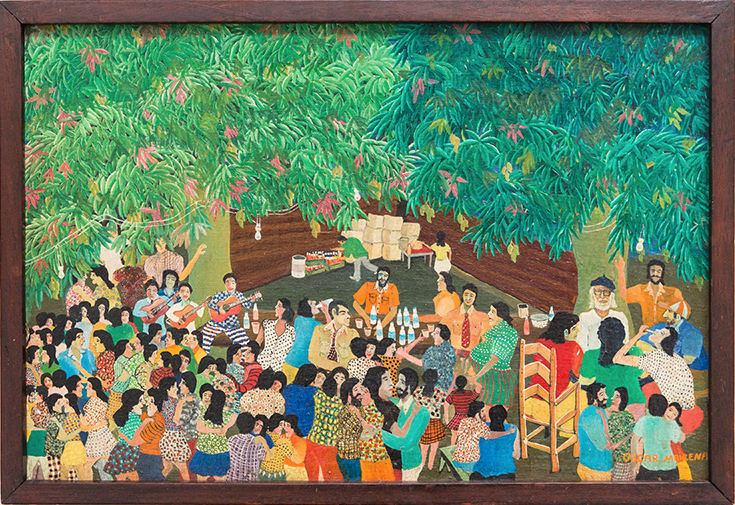
“Mango tree in front of the church,” by Oscar Mairena, 1975, Oil on canvas. Ernesto Cardenal is depicted in his typical black beret and white shirt on the right leading a discussion. (source)

In the mid-to-late 1970’s, over a period of years, a group of campesinos (peasant farmers) in Solentiname, an archipelago in Lake Nicaragua, gathered together to read and discuss the teaching of Jesus. They focused on the beatitudes from the Gospel of St. Matthew. Below is a small excerpt from their larger discussion, facilitated by Ernesto Cardenal. This discussion occurred during the brutal dictatorship of the Somoza family and the long Nicaraguan civil war. In the end the Sandinistas overthrew the Somoza dictatorship.

Let’s go now to the southern islands of Lake Nicaragua and read from The Gospel in Solentiname.1

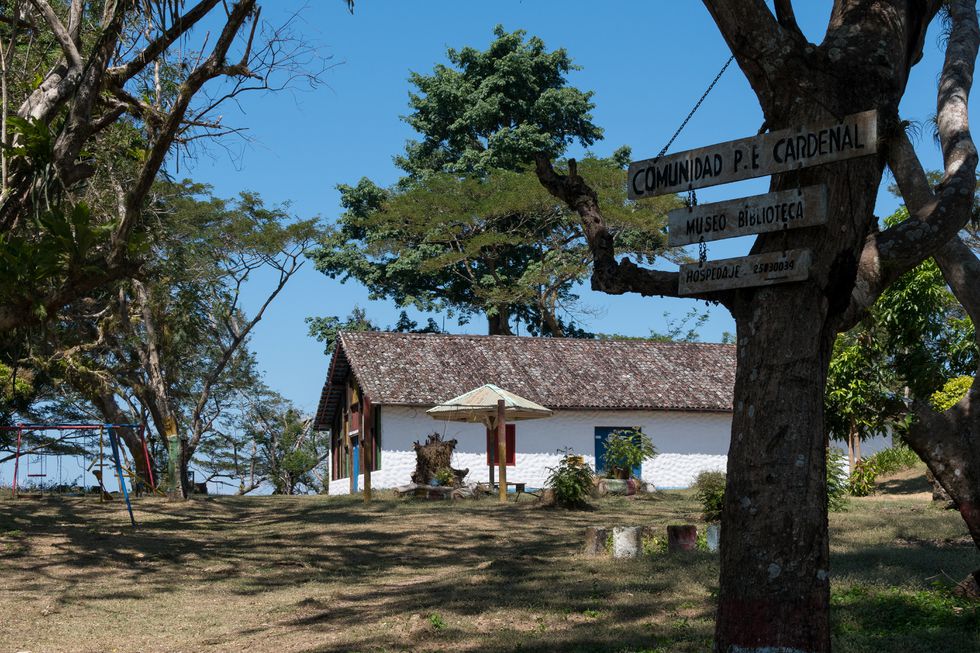
Comunidad fundada por Ernesto Cardenal en Solentiname (source)

Dichosos los que tienen espíritu de pobres,
porque de ellos es el reino de los cielos.

Blessed are the poor in spirit,
    for theirs is the kingdom of heaven.

ALEJANDRO: “[…] The poor who are bourgeois, who are opposed to revolutionary changes, they do not have compassion in their hearts, and they are not the poor of the Gospel.”

LAUREANO: “A perfect communism is what the Gospel wants.”

PANCHO, who is very conservative, said angrily: “Does that meant that Jesus was a communist?”

JULIO said: “The communists have preached what the Gospel preached, that people should be equal and that they all should live as brothers and sisters. Laureano is speaking of the communism of Jesus Christ.”

And PANCHO, still angry: “The fact is that not even Laureano himself can explain to me what communism is. I’m sure he can’t.”

[Ernesto Cardenal] said to PANCHO: “Your idea of communism comes from the official newspaper or radio stations, that communism’s a bunch of murderers and bandits. But the communists try to achieve a perfect society where each one contributes his labor and receives according to his needs. Laureano finds that in the Gospels they were already teaching that. You can refuse to accept communist ideology but you do have to accept what you have here in the Gospels. And you might be satisfied with this communism of the Gospels.”

PANCHO: “Excuse me, but do you mean that if we are guided by the word of God we are communists?”

[Ernesto]: “In that sense, yes, because we seek the same perfect society. And also because we are against exploitation, against capitalism.”
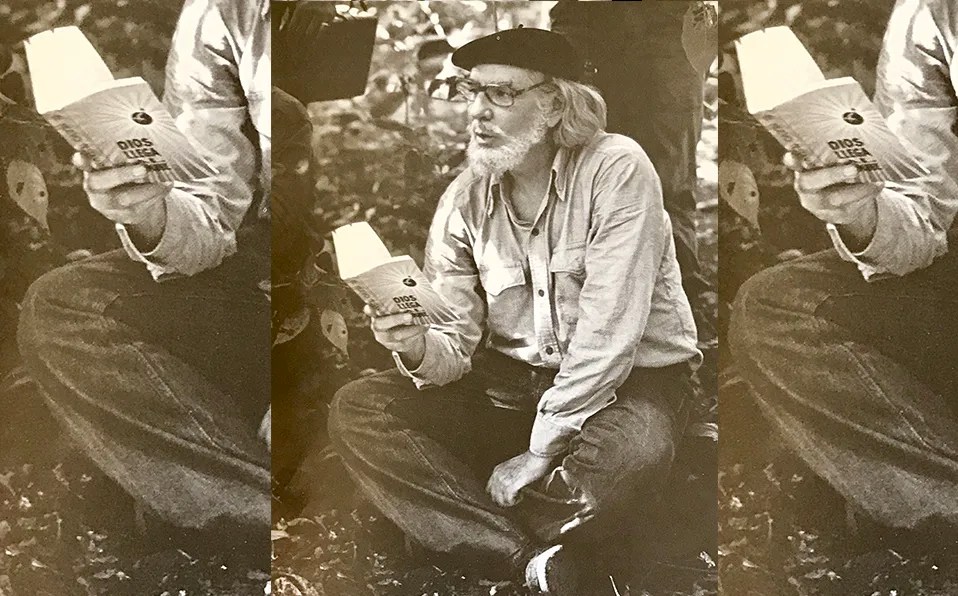
Ernesto Cardenal: poet, revolutionary, priest, sculptor, and activist (source)

REBECA: “If we come together as God wishes, yes. Communism is an equal society. The word ‘communist’ means community. And so if we all come together as God wishes, we are all communists, all equal.”

WILLIAM: “That’s what the first Christians practiced, who had everything in common.”

PANCHO: “I believe that communism is a failure.”

TOMAS: “Well, communism, the kind you hear about, is one thing. But this Communism, that we should love each other…”

PANCHO: “Enough of that!”

REBECA: “It is community. Communism is community.”

TOMAS: “This communism says: Love your neighbor as you love yourself.”

PANCHO: “But every communist speaks against all the others. That means they don’t love each other.”

ELVIS: “No, man. None of them talk that way, man. They do tell us their programs. And they’re fine.”

Increasingly, I’ve come to see the Gospels in a way similar to these Nicaraguans do. I used to think somewhat similarly to Pancho, who can only see equating Christianity and communism as outrageous. But I now see there is a kind of communism at the heart of the good news of Christ. In fact, I’m inclined to think it’s the communism; all others are imitations in degree, some very dark indeed, but others have been closer to the Gospel. But Christ must be the center and all other things ordered to Him, that is, to love itself. And unlike some Catholic apologists who publicly argue that a person cannot be both Catholic and a socialist (which is provably false), I’m inclined to go the other way – to be Catholic is to be, in one way or another, a socialist and perhaps even more specifically a communist (a distinct form of socialism). One can argue that without Christ at the center any form of communism will fail, but also one can argue that with Christ at the center then communism is inevitable. In this I empathize with Cardenal who did not waver in his conscience or commitments after being publicly reprimanded by Pope John Paul II:

“Christ led me to Marx,” Father Cardenal said in an interview in 1984. “I don’t think the pope understands Marxism. For me, the four gospels are all equally communist. I’m a Marxist who believes in God, follows Christ, and is a revolutionary for the sake of his kingdom.”2

Although I don’t call myself a Marxist (yet) because I don’t like overly loaded terms and I don’t want to be labeled an “ist” anything, I do find the use of Marxism as a social science useful in helping us get at the roots of economic inequalities and forms of alienation that both plague our societies today and are what Jesus preached against. And I find many of the core goals of communism at least interesting in the light of the Gospel. Long before communism came into existence as an ideology, I find Scripture pointing in that direction, especially in terms of liberation and freedom. In short, “liberation theology is nothing other than theological reflection on oppression and on the people’s commitment to freedom from this oppression[.]”3 I find this a fundamental and essential Catholic pursuit. But who am I? I’ve still got so much to figure out.

The Gospel in Solentiname has been a revelation for me. Jesus and His disciples were more like the Nicaraguans in Solentiname than the Americans in my neighborhood or parish. The insights from these campesinos, I believe, are closer to the kinds of insights one would expect from those listening directly to Jesus, or those of William Herzog in his book, Parables as Subversive Speech, than those spoken in a homily on the beatitudes in the tradition of Christendom. They are earthy, human, sensitive to the struggles of liberation, arising from a place of poverty, and more concerned with how to love one’s neighbor than in one’s interior spiritual attitude or a personal psychological definition of faith. In other words, they don’t overly “spiritualize” the Gospels but, in fact, more clearly preach the Gospel as it was delivered and heard two thousand years ago.

I am not willing to say the insights found in The Gospel in Solentiname are unproblematic, but they are refreshing in their frankness and challenging in their non-bourgeois perspective. They also highlight something important that I think many of us have lost—that basic human need to read and discuss the Scriptures with others in a kind of dialectical circle of interpretations. We Catholics tended to be trapped in a prison house of pedigreed teaching and official interpretations that we fear stepping out and taking the risk of speaking our own interpretations born from our own lives. But if we step back we discover the Church (if not, for example, Catholic Twitter) has a rich tradition of multivalent perspectives and rarely provides singular interpretations of Scriptural passages. Personally, I long for a Solentiname discussion group. What a joy it would be.

Finally, the last member of the group to speak was a person named Elvis. I believe this is Elvis Chaverría, a member of the Solentiname community and a revolutionary guerrilla in the fight for freedom. On October 13, 1977…

Nicaragua’s leftist guerrillas, the Sandinista National Liberation Front (F.S.L.N.), thought to have been decimated by years of repression, launched a new military offensive against the Somoza regime, attacking National Guard barracks at Ocotal in the north and San Carlos in the south, losing two rebels but killing two dozen soldiers.4

One of those two rebels killed was Elvis Chaverría who was involved in the attack at San Carlos. He “was captured during the raid on San Carlos, taken up the Río Frío, and shot in the head.”5 That attack precipitated the beginning of the end for the Somoza regime. Elvis is remembered as a hero and a martyr of the revolution. He gave his life in the struggle to bring about a more just society for his neighbors.


1Ernesto Cardenal, The Gospel in Solentiname, trans. Donald D. Walsh (Maryknoll, NY: Orbis Books, 2010), 122-123.

2Elia E. Lopez, “Ernesto Cardenal, Nicaraguan Priest, Poet and Revolutionary, Dies at 95,” The New York Times (The New York Times, March 1, 2020), https://www.nytimes.com/2020/03/01/world/americas/ernesto-cardenal-dead.html.

3David Inczauskis, “Once I Discovered Liberation Theology, I Couldn’t Be Catholic without It,” America Magazine, June 4, 2021, https://www.americamagazine.org/faith/2021/06/04/liberation-theology-catholic-faith-240599.

4“National Mutiny in Nicaragua,” The New York Times (The New York Times, July 30, 1978), https://www.nytimes.com/1978/07/30/archives/national-mutiny-in-nicaragua-nicaragua.html.

5Sarah Gilbert, “Revolutionary Trails in Nicaragua,” Wanderlust, accessed July 6, 2022, https://www.wanderlust.co.uk/content/travels-in-nicaragua/.

Leaning Left Towards Christ

I asked what they thought Herod would have said if he had known that a woman of the people had sung that God had pulled down the mighty and raised up the humble, filled the hungry with good things and left the rich with nothing.

NATALIA laughed and said: “He’d say she was crazy.”

ROSITA: “That she was a communist.”

LAUREANO: “The point isn’t that they would just say the Virgin was a communist. She was a communist.”

“And what would they say in Nicaragua if they heard what we’re saying here in Solentiname?”

Several voices: “That we’re communists.” *

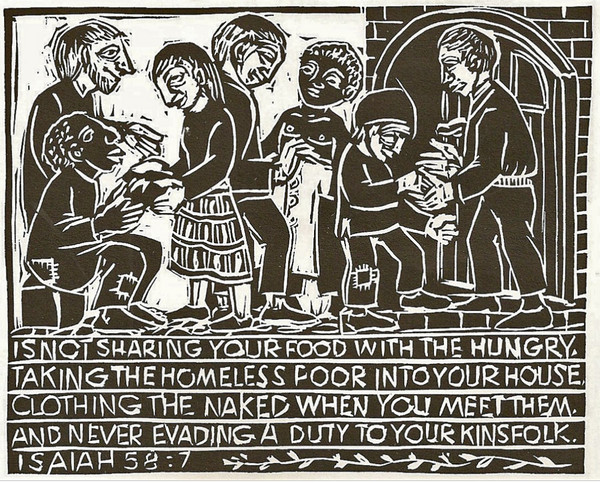
Isaiah 58:7, Woodblock print by Helen Siegl (1924-2009)

Maybe you or someone you know has followed a path analogous to mine.

On January 16, 1991—a Wednesday, if I remember—I walked across the university campus to my cinema discussion group. I was a graduate student pursuing my first Masters degree. When I arrived the classroom was nearly empty and dim. A boombox sat on a table airing an NPR radio newscast. The bombing campaign had just begun for what was officially called Operation Desert Storm and which would eventually be called the First Gulf War. Put simply, my class was spontaneously cancelled because war had started. The few students that showed up milled around gloomily and then left one by one. It was the first time in my life I could recall war having a direct impact on me, and the first time I experienced people emotionally distraught from such an event.

The actual impact to me was objectively almost nothing—class was cancelled—but I was quietly shocked and didn’t know what to do with my feelings. My feelings, however, were not about the war itself but about not feeling what the others were feeling. The other students were upset and I couldn’t understand why. I knew something was wrong with me, and I knew this because I claimed to follow Christ. Should not I too be weeping?

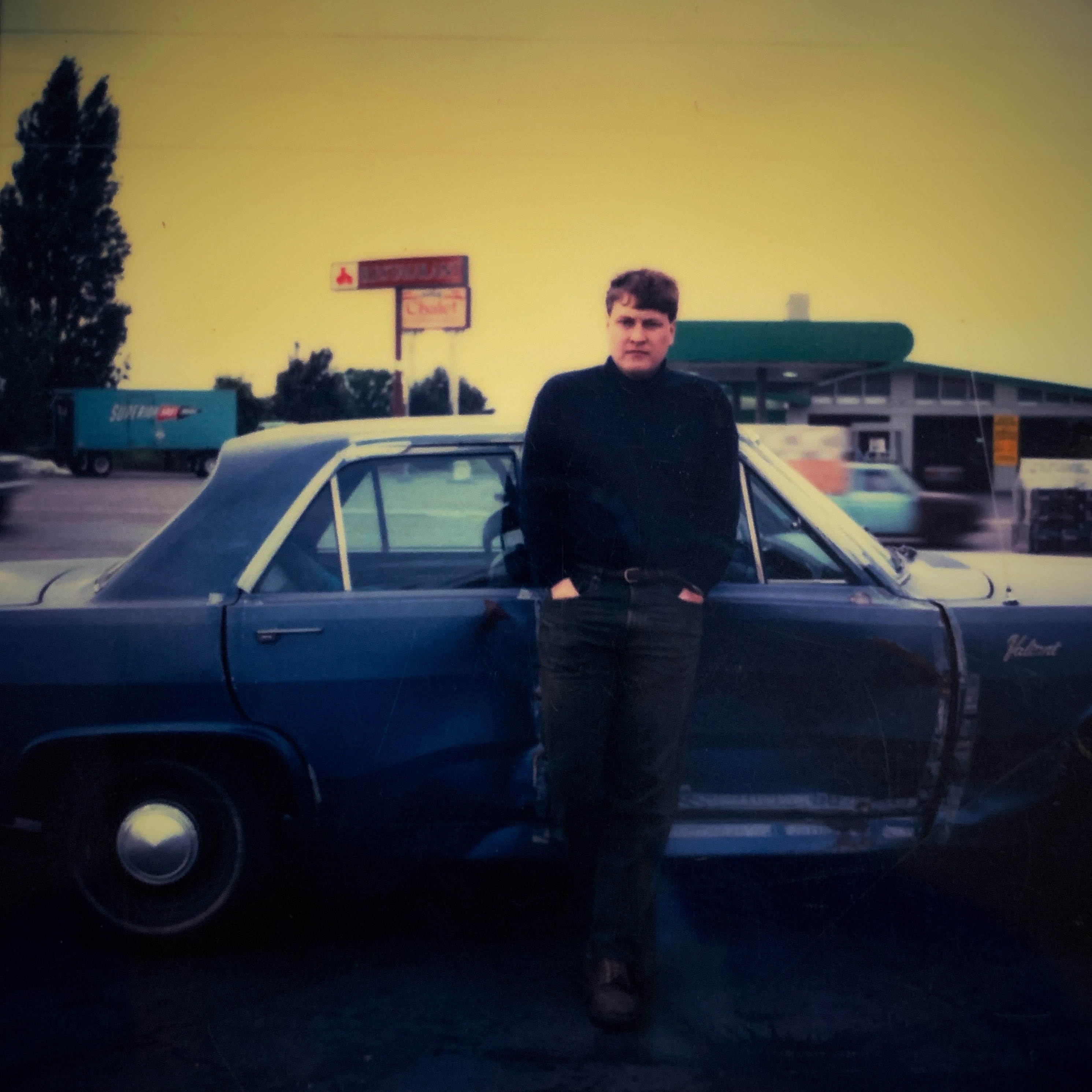
My student card photo, circa 1990

I realized I knew almost nothing about politics, or contemporary world events or having (let alone airing) opinions about any of that. I knew nothing about how my thinking about being an American was largely formed by others intent on shaping the world according to their image. My family never talked about politics. In fact, I can’t remember ever having a truly serious conversation about anything like this with my family. We just didn’t go there. I had a feeling I was somehow very late to the discussion and everyone else seemed to know something I didn’t. I wasn’t prepared to learn much from this event but that feeling stuck with me. I also wondered why no one in my Christian social group had a similarly distraught reaction to the war as did my classmates. All the Christians I knew either were excited about the war or didn’t care. I wondered if something was deeply wrong with the Christianity I inhabited. And then I forgot about it.

I forgot about it but I can trace the beginning of my slow conscientization, coming to realize I had uncritically and happily accepted the dominant paradigm of the ruling class.

Ironically, in grad school (and even as an undergraduate) I was being introduced to Feminism and Critical Theory, to Structuralism, Post-Structuralism, Semiotics, and Deconstructionism, as well as to various Marxist concepts of power structures and superstructures, and of the manipulation of media by the ruling class. I read the Frankfurt School authors, also Jakobson, Gramsci, Parenti, Chomsky, Foucault, Derrida, Barthes, Ecco, Berger, and others. And I loved it. I still do, reading them from time to time. In a sense my head and my heart, both formed by my love for Christ and the Scriptures, were becoming informed by (pulled towards) a Marxist/Leftist/Socialist way of thinking, but I didn’t really grasp that was happening at the time. I didn’t even pick up on that fact that most of those authors were either Marxists or were writing in response to Marxism. I can just kick myself now for wasting that opportunity.

I was also a “good Christian boy” raised as a Baptist who voted Republican because that’s what my parents and all their Christian friends did. I was fundamentally clueless about politics or the “big picture.” Rather, I was enjoying being in the weeds of film and art theory, not realizing many of its political orientations. My focus was aesthetics not politics. Real world implications did tug at me but subconsciously knew (trained to “know”) the radicality of Leftist thinking and I retreated. I had been formed to believe there could never be any sympathies between the Christianity I knew (presented in culturally, nationally, and ethnically circumscribed forms as timeless and natural Truth) and Socialism (always presented as gravely evil and stupid).

Much of my formation came in the form of everyday conversations and actions from those in my social group. One’s beliefs are often carried along by the pervasive but subtle subtexts of conversations, social groups, unspoken presuppositions, and cultural aesthetics. I was careful not to take a misstep. Belonging and being accepted is a powerful drug.

Me in 1992, Portland, OR, on the way to see filmmaker Jon Jost at the NW Film Center where he showed a film and lectured. The car is a late 60s Ford Valiant with the passenger doors crushed in. We called it the batmobile. I was writing my MA thesis on Jost and independent filmmaking.

A decade or so later I followed the Iraq War (the Second Gulf War) with far more curiosity. My initial interests in both the first and second gulf wars arose from a fascination with how powerful the United States military is and how was the rest of the world going to acquiesce. Military might in action is powerful stuff—shock and awe. It was exciting and excellently choreographed theater viewed from my television and computer screens. But soon my personal views began to change. The more I learned the more I became deeply skeptical of the narrative. I could no longer accept U.S. politics. I did not trust or respect our leaders who were clearly lying, even the “good ones.” I searched out alternative news sources, different perspectives, and a few voices I had listened to before. I learned of various anti-war positions and Leftist critiques, and I discovered for myself an entire area of Christianity I didn’t know existed. In short, I learned about anti-war and pacifist Christianity and Liberation Theology. I learned about American Christians who sharply criticized the pro-war, flag waving, God bless America version of Christianity. And it all rang true for me. It took a while, though. This is the short version, the reality was a complex, back-and-forth process. A lot of people have taken this journey I’ve learned.

I left the Republican Party. I came to believe I could no longer continue as a member of that party and be a faithful follower of Jesus Christ. But I could not see how I could be a member of the Democratic Party. So I became an Independent. I wanted no requirements placed upon me to acquiesce to any party platform. This seemed like the right choice both in terms of my faith and for my own intellectual integrity. I still hold these views today (though at times I toy with the idea of joining an alternative party).

Eventually, and through a lot of twists and turns, I became a Catholic, in part, because the Catholic Church is a “big tent.” One finds a multitude of perspectives and proclivities in the Church. I wanted to be where I could continue to explore my ideas and thoughts on politics, economics, sociology, and more. I was attracted to Catholic Social Teaching, to people like Dorothy Day, and to papal encyclicals criticizing capitalism all within the boundaries of an orthodoxy going back to apostles. I also love how truly global the Catholic Church is compared to the myopic, self-absorbed, geographically limited, socially stunted, and often nationalistically American cul-de-sac Christianity within which I was struggling. I also wanted a Church that would allow me to explore Socialism, or any other politics, from within a Christian framework, encouraging me in my freedom to do so, but also providing some guardrails and cautions along the way.

I suppose this post is one where I get myself in trouble (with myself mostly) for finally admitting something I’ve wanted to admit for twenty-plus years in one way or another.

I am still figuring things out for myself, still on this journey. But when I look at the social and economic options available in the world, when I look at the example of the early Church, when I take seriously the commandments of Christ, what I find is that Liberation Theology strikes me as the most Gospel-oriented, most Christ-centered socially, most humanitarian economic and political position to take. And with Liberation Theology one gets a rich interaction with Marxist ideas and Socialist praxis, both of which are merely subservient tools of the ultimate Truth of Christ who is the standard. If we insist on using the very limited terms of Right and Left, then I would say the Gospel of Christ, arising from and rooted in the very person of Christ Himself and in the ultimate goal of divinization, leans politically, economically, and socially more Left than Right, more to the future than the past, more to love of neighbor than protection of the self. **

Fiddler on the roof? Living in the PNW, singing ♫ If I was a rich man…♫

Responding to real-world situations of colonialism, capitalism, authoritarian violence, exploitation, and foreign influence in Latin America, Liberation Theology sought to address these evils from a truly Catholic perspective, rooted deeply in Christ, rooted deeply in Scripture, rooted deeply in Vatican II, ever seeking the examples of those who have struggled before, and helped by cautiously leveraging the tools of Marxist critique and communist praxis. [Queue the bourgeois American eye roll.] Ironically, by focusing on the unique historical situation of Latin America, Liberation Theology addresses the universal situation of humanity—bondage and suffering across the globe because of sin, the poor besieged by the rich, labor unfairly exploited by capital, lack of democracy, propaganda promoting ideologies of oppression, social and legal systems in place to ensure the poor and weak are perennially oppressed and their own human flourishing suppressed, and finally, Christian/Catholic pastors turning their backs to the poor and preaching in support of the ruling class and a bourgeois church.

Beginning with Christ, Liberation Theology seeks to fashion a Gospel response to the evils of the world, and it did so, in part, by finding truth in the fundamental insights of scientific Marxism (not unlike Thomas Aquinas finding truth in Aristotle). But the Church hierarchy has, since Constantine, sided with the ruling class and with capital, thus the work of Liberation Theology tends to fall on the shoulders of a few theologians, priests, and ordinary Catholic laity willing to take the risk and put in the labor out of love and necessity. Carrying the gospel and Catholic social teaching to their proper and logic ends, Liberation Theologians found connections with the goals of many Leftists. Consequently, and employing various tactics, the Church denounced Liberation Theology. But I find Liberation Theology both true and refreshing. I am convinced by its understanding of the gospel, and I am moved deeply by the martyrdom of many faithful Catholics, including laity, bishops, priests, and nuns, at the hands of evil men merely because they stood for the poor against the rich as Christ commands us. I am disgusted by the efforts of Catholic prelates to squash Liberation Theology, denouncing saints such as Oscar Romero (but now they can’t because he’s finally and properly declared a saint) and supporting evil structures of power. The church is peopled with many who hate Christ in the name of Christendom and national politics; this even includes bishops. Sadly, much of this vilification is as much about race as it is about class.

So here I am, a devout Christian, a white middle-aged American working class man with inherited bourgeois values, a husband and father, a happy convert to the Catholic Church, leaning fairly hard to the Left and thinking maybe I should lean harder, and finally realizing that much of Christendom probably was and still is largely a human construct designed to “protect” the Church and the ruling classes from the convicting nature of the Gospel, from the internal revolutions of the Holy Spirit, and from the burdensome cries of the poor. Will I be marching in the streets waving a red flag? Will I be joining DSA, wearing a Karl Marx t-shirt, calling my friends comrades? Not likely, but I do want to be more sensitive to the liberating and this-world message of the Gospel. I want to be a follower of Christ.

A crazy journey I guess. I hope yours is going well. God be with you.


* Quoted from The Gospel in Solentiname by Ernesto Cardenal from the chapter on the Magnificat. This book is a collection of discussions of Gospel passages that happened in the artist/peasant community on the big island of Solentiname in Nicaragua between 1976 and 1982.
Cardenal, Ernesto. Gospel in Solentiname. REV One-Vol ed., ORBIS, 2010.

** I hope the reader understands that Right and Left in the US does not map to Republican and Democrat. Rather, Democrat and Republican are center-Right and further Right. The Democrats are arguably the primary nemesis of the Left.

Number One Enemy: Liberation Theology

The Jesuits of UCAII watched television in amazement one night as Molina made a campaign broadcast on behalf of the PCN “candidate” General Romero. The president stood before a large blackboard with a piece of chalk in his hand. Then he slowly drew a line down the middle and announced that on one side of the line were to be found the enemies of El Salvador, and on the other, the friends. “Starting with the enemies,” he went on, “number one: liberation theology.” 1

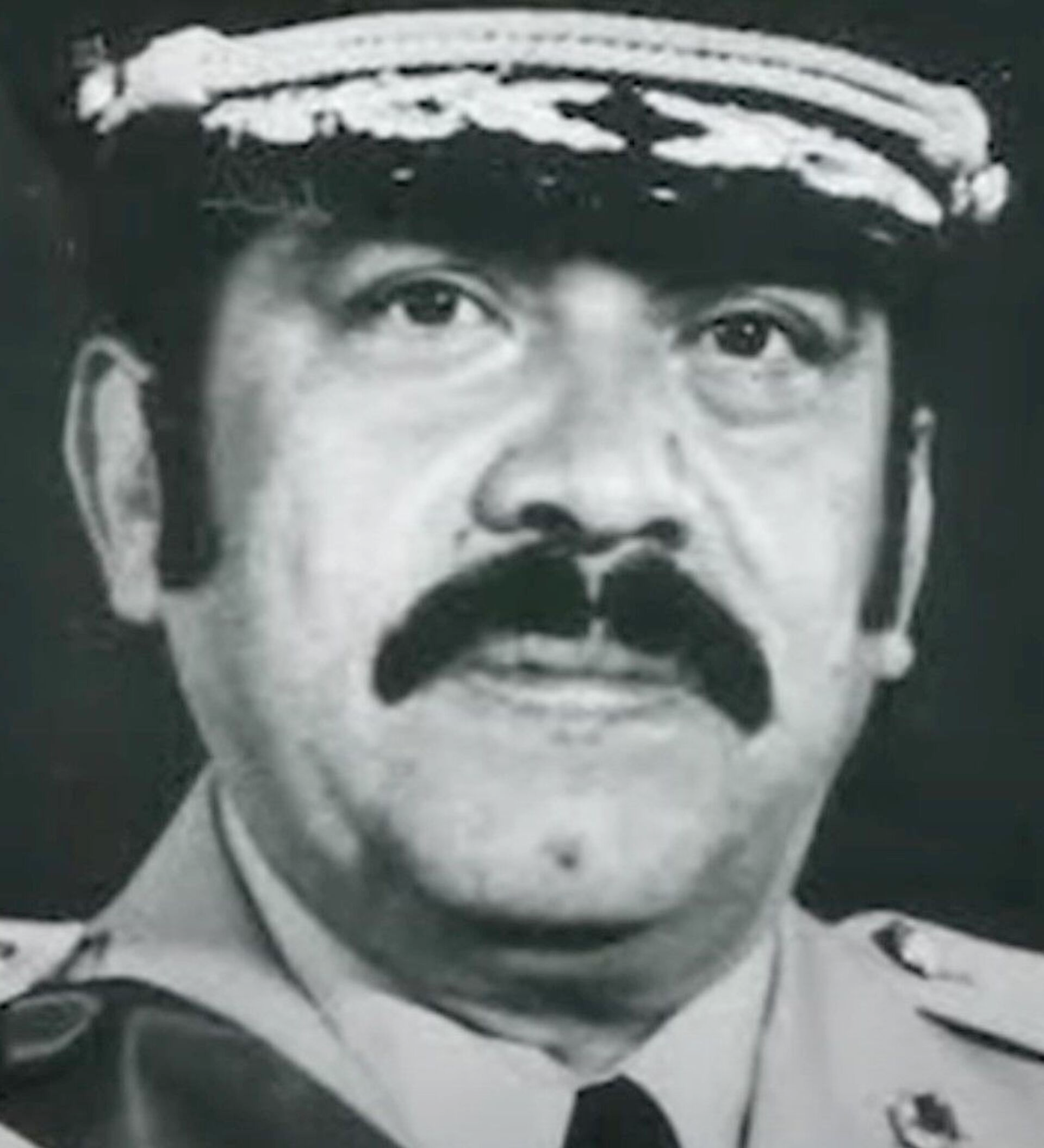
Arturo Armando Molina was president of El Salvador 1972-1977 and was a murderer, including overseeing the assassination of political opponents, students, and priests.

The quote above references the 1977 presidential election in El Salvador. Liberation Theology, and many other forces, were at play in that country. Opposition to the murderous thugs who ruled the country and their oppressive policies was growing. The Vatican sided with the government. Many of the priests in El Salvador sided with the people and especially with the poor.

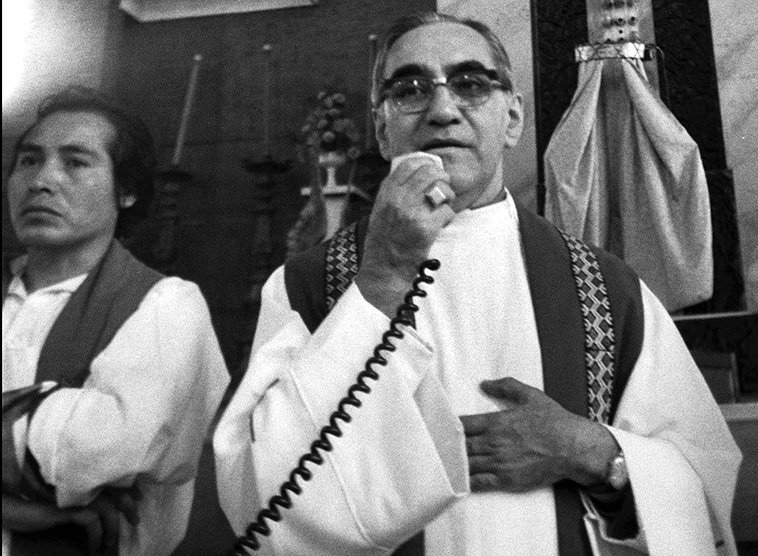
I think about the opposition to the beatification of the martyred Archbishop Óscar Romero by men such as Archbishop Emanuele Gerada because he disapproved of Romero’s breaking with the El Salvadoran government.2 I also think of Pope John Paul II’s disregard of Romero’s warnings, a disregard that arguably3 contributed to the Archbishop’s death. I think of these things and I cannot help but believe fear of the radical Gospel of Jesus Christ is an underlying constant in the life of the Church and especially of powerful men of the cloth. Of course, I cannot pass judgement on others if I don’t also pass judgement on myself. I know of no one more fearful of the demands of the Gospel than myself. It is a fear that plagues all human beings, perhaps Christians most of all.

But under that fear is a deep longing; a longing for true and complete liberation. This is why Liberation Theology increasingly reveals itself as one of the truest expression of the Gospel in our world today. However, I do recognize many claim Liberation Theology is too interested in Marxist ideas at best or outright leftist ideological heresy at worst. I would counter by saying if someone such as Molina publicly states Liberation Theology is enemy number one, maybe that’s because the darkness hates the light and Liberation Theology deserves a more honest look than many are willing to give.

Liberation Theology has not only been a threat to the sin of oppression and arrogant rulers who grind the poor into subservience, and to governments who prop up dictators, it has also been felt as a threat by many in the Church who sadly fear a truly integral salvation. Fortunately not all are threatened.


1 Teresa Whitfield, Paying the Price: Ignacio Ellacuria and the Murdered Jesuits of El Salvador (Philadelphia, PennsylvaniaPA: Temple University Press, 1995), 100.

2Carlos Dada, “The Beatification of Óscar Romero,” The New Yorker, May 19, 2015, https://www.newyorker.com/news/news-desk/the-beatification-of-oscar-romero.

3 Claire Saldana, “Oscar Romero: The Fight for Beatification,” STMU research scholars, April 5, 2022, https://stmuscholars.org/oscar-romero-the-fight-for-beatification/. I must also note that Saint John Paul II has been a kind of hero of mine and his example played a role in my becoming Catholic. And yet, the more I learn of his pontificate the less I can stomach some of the hagiographies of him. Nonetheless, I think he was a generally good pope and a very good and holy man. I do believe, however, the Church should not have rushed his canonization for sainthood.

Exploring the Salvadoran Civil War and the Martyrdom of Óscar Romero (and remedying my ignorance of a great saint)

NOTE: An earlier version of this post first appeared on my other blog. For various reasons I want to post it again here, not least because Saint Romero is increasingly becoming one of my heroes and a true inspiration.


Jimmy Carter was the U.S. president (pres. 1977-1981) that oversaw the giving of military aid to the government of El Salvador during the bloody Salvadoran Civil War. Carter was the first American president that I became aware of as I began to pay attention to the news as a boy. The first American president I voted for was Ronald Reagan (pres. 1981-1989), who came immediately after Carter. The Reagan administration increased the giving of military aid and support to the Salvadoran government, a practice begun by Carter. In 1980 the Salvadoran government, supported by the US government under Carter, was behind the brazen assassination and martyrdom of the then archbishop of El Salvador, Óscar Romero, now a saint of the Catholic Church. Thus, my first vote as an American citizen, though not for Carter, and actually for Reagan’s second term which happened years after Romero’s death, is nonetheless indirectly but forever linked to the death of a saint. Unfortunately, this is the reality of being an American voting for candidates who then go on to promote questionable and sometimes terrible foreign policies (and in my lifetime they all have). Of course I plead ignorance, but we’re all ignorant of many things, and that doesn’t mean we are not complicit at some level, even if not actually guilty. Perhaps its “structural complicity?”

I am learning more about one of the Church’s most recent saints, Óscar Romero. I believe Romero’s concerns were ultimately spiritual and heavenly which, as I am coming to learn, includes the social and political. Sadly, his Christian concerns played out within a volatile political context, and he was martyred for them.

The battle lines of politics are always much more than politics. Narratives compete with narratives, ideologies with ideologies, and nearly always class struggle. US culture discourages talking about class struggle and the structures of economic inequality. If one is so bold she or he is immediately labeled a socialist or communist. There’s a cultural narrative in that labeling, a culture of small-mindedness especially suited for the simpletons over populating America, and that narrative with its hegemonic forces behind it drive a great many other narratives.

Human beings, being sinners and fearful, will all too readily kill other human beings for the sake of the narrative they hold dear, and often for very selfish and ignorant reasons. From Cain until now we have been killing our brothers. But Christ calls us to love our brothers, our neighbors, and even our enemies. Saint Paul tells us our battle is not against flesh and blood, but is against spiritual forces of darkness. The entire narrative of salvation being written by God in the very fabric of creation tells us to trust in Him and that He will fight our battles. We forget this every day. I certainly do. They forgot that in El Salvador too. But many, including and perhaps especially Óscar Romero, did not forget it.

I know very little about the Salvadoran Civil War, but that is the historical context of Saint Romero’s assassination. I perhaps know only a little more about Saint Romero than I do about the war, which is to say almost nothing. Here are three contemporary news reports on the war, its brutality, and role of faith and the Church:

Some of the following videos must be watched on YouTube because of content restrictions.

This 1983 documentary takes a look at both sides of the war and provides an intimate overview of the attitudes and perspectives of each side:

Made by the same filmmakers as the above film, this is an excellent documentary from 1983 on the religious aspects of the war, in particular the ideas of Liberation Theology:

Here is an in-depth documentary about the Salvadoran civil war and the life of Óscar Romero. It was made before he was canonized a saint.

Here is a great lecture by Michael Lee (Fordham University) on the life, legacy, and meaning of Saint Romero’s martyrdom and case for sainthood:

I suppose little seeds were planted in my life along the way to prepare my heart and mind for caring for and wondering about the life, legacy, and meaning of Saint Romero’s martyrdom and case for sainthood.

In 1984 (the same year I voted for Reagan) a largely unknown, but with a passionate fanbase, Canadian singer-songwriter and brilliant guitarist released a song that became a surprise hit. I vaguely remember that song, but I was so politically, geographically, historically, and socially unaware that I didn’t get what the song was about, except for the fact that I felt as much as anybody that we all need a rocket launcher sometimes. But the song was specifically about the brutal wars in Central America, the dictatorships that promoted and leveraged them, the support those dictatorships received from the U.S. government, and the terrible havoc they wrought on the lives of the people. Here is Bruce Cockburn, 30 years later, performing live and acoustically his song If I had a Rocket Launcher:

Integral Salvation

Jesus came to bring integral salvation, one which embraces the whole person and all mankind, and opens up the wondrous prospect of divine filiation.1

I’ve always been told that being a Christian isn’t and shouldn’t be merely a personal affair, internally oriented, guided by feelings, and concerned only with one’s own final destination. Instead, Christians ought to follow Christ by loving and helping others in need, including the poor of this world. But this view gets powerfully challenged when one grows up in a version of Christianity that’s almost entirely oriented towards a personal relationship with Jesus, focused on the final escape from this world into the next, and carried along with praise songs and emotional sermons, and not come away thinking Christianity is a kind of group-think subculture crafted with sophisticated marketing techniques (often poorly executed) centered around a chosen local church that suits one’s fancy, is populated with people just like oneself (social class, race, tastes), and where one gets one’s personal spiritual “batteries recharged” each Sunday.

It’s also easy and fun to point a judging finger like I am doing now, but probably of limited value. I have to say this version of Christianity—both Protestant and Catholic—has been very convenient for me. But I’m sorely found wanting when it comes to actual Christ-following, red-letter, biblical Christianity.

I am challenged by the realities of the Gospel—challenged to the point of utter failure. The love of God comes to us through His Son, bringing total and complete salvation to each person, to each group, to each nation, to the whole world and to the world as a whole. It is an integral salvation as the quote above states. It is a salvation that embraces the whole person, in totality, including their social, economic, and cultural contexts. And one of the great joys is that we not only are offered salvation but also bring about salvation through our actions. We participate in God’s salvation of our neighbor. But I consistently retreat into my private personal relationship with Jesus, failing my neighbor and the Gospel.

But who is this whole person? Naturally we assume it’s me for me, and you for you; I focus on myself and my relationship with Jesus and you do the same for yourself, and we meet at church on Sunday (or we don’t) and feel good that we’re on the same, winning team. But I am bothered by this. Christ preached the kingdom of God as a present reality and not merely a future hope. The kingdom is at hand, He said. He then explained it in terms of love, forgiveness, service, humility, peacemaking, feeding the hungry, giving up our lives for others, and caring for the needy and the poor. It is a tangible kingdom. Consistently He did not describe faith the way we do—feelings and fundamental tenets—but focused on how we relate to others. The test at the end is not a theology exam but an accounting of how we related to others.

The social doctrine of the Catholic Church teaches this. The whole person is the other person as much as it is you or I. The whole person isn’t merely one’s set of beliefs or psychological needs or feeling like one has a personal relationship with Jesus. The whole person is the person in entirety, including all their basic needs, all their needs above that, and even their potential for human flourishing and becoming the creature God intends. The whole person is the human creature in the world, in society, in relationship.

[T]he Church does not tire of proclaiming the Gospel that brings salvation and genuine freedom also to temporal realities.2

Quickly one realizes, that although the best one might be able to do is give alms, salvation for the whole person requires more than giving alms, it requires a society different than what we have. It requires a society built on love and justice, on sacrifice and trust in God, on forgiveness, meekness, empathy, and long suffering. It demands dealing with temporal realities. I hope we all see this and know that each of us can personally do better, but I also hope we look at our world and see that it does not evidence these traits and that it ought to change. Our politics, our economics, our social structures, and our multitude of prejudices seem mostly to serve the rich and the ideologies of the rich. Just one example: there are Christians who honestly dismiss systemic racism when our faith says we should expect it everywhere. Another: great numbers of Christians claimed a moral reprobate and billionaire thug was this nation’s savior, God’s hand-picked chosen one. The spirit of anti-Christ is alive and well in much of Christianity today.

Our world is corrupt with sin and we ought to be about changing that, living lives of love and actively battling sin in the world as we do in ourselves. Loving our neighbors includes levels of intimacy because it requires knowledge and empathy, and it includes addressing the prejudices, the bad laws, the bad politics, the ideologies of the rich, and the economic forces that are allied against human flourishing for all, especially including the “least of these.” It is all too easy to praise a court ruling that protects the unborn, it’s another thing to actively work towards overcoming the sin that rules this world and produces concrete and structural forces that compel women to see abortion as a necessary option in the face of such social, political, economic, and interpersonal cruelty. Salvation is physical and spiritual, now and future, of the body the soul and the mind. Salvation is God saving us. Salvation is us loving our neighbor, helping those in need, overcoming oppression, seeking the kingdom which is at hand, which is within us.

I grieve how bad I am at these things. I am a poor example of a Christ follower. I sit here typing what we all ought do and I do nothing.


1 John Paull II, Encyclical Letter “Redemptoris Missio,” paragraph 11.

2 Pontifical Council For Justice And and United States Conference of Catholic Bishops. Compendium of the Social Doctrine of the Church. 1st: USCCB Publishing, 2005, page 1.

My Growing Curiosity about Liberation Theology

Liberation Theology: Birth of the New Man, Managua, Batahola Community Center, Nicaragua. Showing the Magi as Carlos Fonseca, Che Guevara, Sadino and Archbishop Romero. [source]

NOTE: This is a repost from my other blog. I am reposting it here because the topic of Liberation Theology continues to change my way of thinking and, I hope, my life. I plan on exploring it more on this site. Since it was first published my thinking has continued to evolve as well. I am now much more in the Liberation Theology camp than this post might suggest.


I have become increasing curious about Liberation Theology. As I continue to become disillusioned by the state of politics in the U.S., including the politics of the Church (or certain prominent sections of the Church), and as I learn more about Latin America and its rich, but also violent, history, and as I have become increasingly curious about Saint Romero and the modern history of El Salvador, I find myself confronted with Liberation Theology. Can Liberation Theology teach us, perhaps even provide a way, for the Church seeking to follow Christ is a deeply broken and anti-Catholic world?

Almost immediately I find vociferous Liberation Theology antagonists. These are primarily conservative and/or traditionalist Catholics. Liberation Theology, they say, is merely Marxism dress up in some Catholic vestments. Ironically, while many of the conservative Catholics revere Saint John Paul II, it this quote from that dynamic and “muscular” anti-communist pope that sparks my interest:

Insofar as it strives to find those just answers – penetrated with understanding for the rich experience of the Church in this country, as effective and constructive as possible and at the same time consonant and consistent with the teachings of the Gospel, of the living and the everlasting Tradition Magisterium of the Church – we and you are convinced that liberation theology is not only timely but useful and necessary. It must constitute a new stage – in close connection with the previous ones – of that theological reflection initiated with the Apostolic Tradition and continued with the great Fathers and Doctors, with the ordinary and extraordinary Magisterium and, in more recent times, with the rich heritage of the Doctrine Church, expressed in documents ranging from Rerum Novarum to Laborem Exercens . ( Emphasis added. Full text here)

Is this not an endorsement of Liberation Theology? Those who say it is actually just Marxism with a Catholic veneer seem to lack understanding. Or do they? I’m still learning.

I am reading Gustavo Gutiérrez‘ classic work, A Theology of Liberation: History, Politics, and Salvation. In it I find an excellent explanation of the Catholic faith. Thus far I find no overt Marxist ideology (thus far) and, in fact, I find a challenge to such ideas. I ought to be clear at this point for the sake of honesty: I am not against all Marxist ideas, nor am I against all aspects of socialism. I am against all the evils done in the name, or using the name, of Marxism and socialism, just as in a similar way I am against all the evils done in the name of capitalism, republicanism, democracy, anarchy, fascism, and any other ideologies or systems of political and economic organization that men use against others. Men are wicked and they will wrap their intentions and deeds in whatever language is most convenient to “justify” their actions of power over others. Men will also quickly and effortlessly excuse evils done in the name of their own systems (those they accept) and their own cultures (those in which they were raised, or into which they were adopted, and in which they find acceptance). Thus, I am still cautious. I have studied the evils of man and the systems he builds. I am not yet convinced that socialism, and there are many versions and definitions of socialism, is or must be inherently evil, or must produce evil men. I am also not convince Liberation Theology is or must be fundamentally socialist, even if it informed by Marxist methods of social and political critique.

So I proceed with my research. I am curious.

Cardinal George was once asked about Liberation Theology and he gave a quick answer. It think his answer represents a kind of thoughtful middle ground that I feel I can get behind. However, I also wonder if he, and Cardinal Ratzinger whom he references, had an adequate understanding of Liberation Theology. Thus, I don’t completely buy into it, yet.

I do not think modern Americans (U.S. citizens) can quite fathom the context in which Liberation Theology developed. I certainly have never lived within a context like those in which Liberation Theology developed, arguably, out of necessity. In fact, U.S. citizens are rather notorious for having strange and perverted ideas about Latin American and its history, including U.S. foreign policy towards that Latin America, its governments, its resources and, more importantly, its people. We are also formed through decades of propaganda (for better or worse) to believe anything that is in any way associated with socialism or Marxism must be gravely and irredeemably evil. For most Americans this is an objective and unquestionable dogmatic truth. I am not convinced, but I am not wary either.

If we, for a moment, set aside the wrangling over theories, over political and economic systems, and about the examples of evil men, and simply consider what we Christians are called to do as we live out the Kingdom of God in tangible actions, we might find a calling to change the world. Pope Paul VI gave us some perspective in his encyclical Populorum progressio, an encyclical that informed Liberation Theology’s development, in which he wrote:

It is not just a question of eliminating hunger and reducing poverty. It is not just a question of fighting wretched conditions, though this is an urgent and necessary task. It involves building a human community where men can live truly human lives, free from discrimination on account of race, religion or nationality, free from servitude to other men or to natural forces which they cannot yet control satisfactorily. It involves building a human community where liberty is not an idle word, where the needy Lazarus can sit down with the rich man at the same banquet table. [full text here]

Liberty must not be an idle word. Is that not the foundation of Liberation Theology? Of course, people will argue over that notorious and wonderful word: liberty.

But when politics and faith become entangled, it can be hard to know if one is talking about one or the other. And yet, how can the gospel not also be political? In God there is no separation, is there? In this world there is truth, there is heresy, there are lies, there is evil, and there is love. These things are present in all aspects of human life. Does not the gospel speak to all of that? Are not politics also under the reign of Christ? And what happens when we open our eyes beyond narrow, single-issue, lesser-of-two-evils, U.S. politics and begin to wonder if others, in others places also have eyes to see and hearts that long for justice? What do we do when they see things differently than we do and speak in foreign tongues and use words that frighten us and yet still call us brothers and sisters in Christ? What ought we to do then?

Still, the history of Liberation Theology and its proponents is interesting and, at times, perhaps troubling even for many in Latin America. But it is also fascinating. And there are, naturally, different perspectives.

This short Religion and Ethics piece gives a brief overview and some perspective, and not without moments that will give a traditionalist Catholic conniptions, make a conservative Catholic cringe, and make a liberal Catholic pause:

Is the Church today under Francis more attuned to Jesus? I don’t believe it is. But I also cannot buy in its entirety the critique of traditionalist Catholics (mostly Americans) who demonize Francis and the Church hierarchy today. There is so much that is bad, but there is so much that is good, and there is much good (I firmly believe) going on in the world beyond the horizon of American Catholics and their limited understandings and their historical prejudices. Perhaps that is where most of the good is happening.

One aspect of Liberation Theology, or at least as something clearly linked to it, is the fact of Catholic priests and bishops renouncing their vocations for political action in the name of Liberation Theology. For example, Fernando Lugo, who was a Catholic priest and bishop, then became president of Paraguay, gave up the priesthood for politics:

Lugo resigned his ordinary from the Diocese of San Pedro on 11 January 2005. He had requested laicization in order to run for office. However, the Holy See refused the request on the grounds that bishops could not undergo laicization, and also denied him the requested canonical permission to run for civil elected office. However, after Lugo won the presidential election, the Church granted his laicization on 30 June 2008. [from Wikipedia]

This bothers me a great deal. Why must they do this? I don’t know. Have they lost the faith, turned from God, or have they made the right choice? I have my opinions, but I’m holding off judgement until I know more. I first came across Lugo in Oliver Stone’s fascinating documentary film, South of the Border. I have a hard time faulting Lugo for making his decision, though i’m bothered by it. I am in no place to criticise him. I also sense that his position became somewhat untenable as he found himself between the Church that tends to side with those in power and Christ’s call to help the poor. And yet, I don’t like the decision he made and I am curious about his eternal destiny. What will Christ do with him and others like him?

Similarly, one of the more prominent theologians of the Liberation Theology movement is Leonardo Boff. Also a former priest and a sharp critic of the Church, he gave up the priesthood for social activism. This documentary gives a rather good picture of Boff and his views:

I am not sure what to do with this. Is Boff’s direction the right one? I’m inclined to think not, and I feel about him much as I feel about Fernando Lugo. And yet, I do agree with the general direction of some of his views, up to a point. I am also concerned about any movement where men give up the priesthood for the movement, or stop wearing traditional clerical clothing. However, I don’t know enough about Latin American history and culture to know the meaning of all that. I also think there is a generational element to it. Older, baby-boomer, 1960’s radicals might have thrown off their religious garb because that was the spirit of that age, whereas younger priests and religious today might insist on wearing more traditional religious clothing for, ironically, similar reasons. I can’t say, but it would make some sense to me. We are all far more children of the zeitgeist than any of us want to admit.

Still, I firmly believe that it’s all too easy to get pulled away from Christ and His kingdom by the enticements of the world and worldly politics, and thus lose one’s soul. I believe Liberation Theology is, at its heart, an attempt to avoid that, but clearly many questions still remain about many of its adherents. I am inclined to read some of Boff’s books eventually.

[source]

In summary, I know very little at this point, but I am inclined to believe Liberation Theology is a good thing and ought to be taken seriously, perhaps re-thought and re-addressed, by more Catholics. I also am beginning to think the Church (once again) dropped the ball in a big way by not more fully embracing it and thereby helping guide it rather than leave priests and faithful Catholics essentially on their own, sometimes feeling abandoned by the Church. This, I think, was a huge missed opportunity at a crucial time in Latin America. In a sense, I believe the Church “lost” Latin America, in a sense, because of this.

I welcome any comments pointing me to more resources.

A nihilist

I want to start with three quotes all from the same person. I will say who it is after the quotes. As you read them, ask yourself what kind of person this is:

Human existence is a brutal experience to me…it’s a brutal, meaningless experience—an agonizing, meaningless experience with some oases, delight, some charm and peace, but these are just small oases. Overall, it is a brutal, brutal, terrible experience, and so it’s what can you do to alleviate the agony of the human condition, the human predicament? That is what interests me the most.
[…]
Everybody knows how awful the world is and what a terrible situation it is and each person distorts it in a certain way that enables him to get through. Some people distort it with religious things. Some people distort it with sports, with money, with love, with art, and they all have their own nonsense about what makes it meaningful, and all but nothing makes it meaningful. These things definitely serve a certain function, but in the end they all fail to give life meaning and everyone goes to his grave in a meaningless way.
[…]
I was with Billy Graham once, and he said that even if it turned out in the end that there is no God and the universe is empty, he would still have had a better life than me. I understand that. If you can delude yourself by believing that there is some kind of Santa Claus out there who is going to bail you out in the end, then it will help you get through. Even if you are proven wrong in the end, you would have had a better life.

There is something heroic in not allowing oneself to be deluded by fantasy in the face of meaninglessness, to stand before the great emptiness and accept it for what it is, to not live a lie. Unless, of course, one is merely self-delusional about the so-called meaninglessness in the face of overwhelming evidence that there is, in fact, meaning.

Arguably there is no more untenable position than nihilism, for it is the greatest lie. Nihilism is the claim that existence has no meaning. It is the claim that anyone who claims meaning is deluded. In his heart, the nihilist like a fool, says there is no God. It’s not really a philosophy as much as a stance, a cry, a shrug, a prejudice. In other words, the nihilist hero is really a fool, an unhappy fool surrounded by a world overflowing with meaning. And some of those fools are great artists.

If you have not guessed already, these quotes are all by Woody Allen, from an interview he gave in 2010 for Commonweal magazine. Allen has been in the news a lot the past few years regarding accusations of child molestation. It’s a lot of he said, she said, and most have already made up their minds about it. This post is not really about all that, at least not directly.

Woody Allen was one of my favorite filmmakers once I discovered his films in college. Although his life and career has been tarnished by those accusations, as an artist he is (or was) brilliant, witty, serious, and often very funny. Many of my Christian friends have loved his films as well. And as Christians we have all been of two minds about his films.

But I can’t help but look back on those films that I loved, some I still do I suppose, and not see them as ultimately empty. I also can’t help but think if one truly believes the world has no ultimate meaning and human existence is pointless, how can one live except by the mindless inertia of seeking the next “oases, delight, some charm and peace?” And finally, in the end, nothing.

I pray Allen turns to God who is love and who seeks him.

restart

I’m restarting this blog. It’s not the first time.

Whatever happened to blogging? I got on Facebook and my blogging slowed. I guess I just needed an outlet and FB did it. I left FB and got on Twitter. Love Twitter. I hate Twitter; 240 characters but you can string tweets together forever if you want. Some do, in fact.

And that ended my blogging basically. My attention span shriveled.

My first blog was this one, pilgrimakimbo. Mostly I wrote about film and art and some family stuff. When I began to write about my faith journey I lost some followers, got some new ones, and thought I should have a separate blog for that. That one is satillitesaint.

But I stopped writing that one too.

Twitter scratched my itch and longer-form writing (more than 240 characters, complete thoughts, arguments even) became too much effort. But I missed it.

So I’m trying a restart (my blogging & myself in a way), going back to this blog because I like the title better; it suits my mood a bit more. I’ll probably write, ruminate really, about anything that tickles my fancy, but lately I’ve been interested in the interface between faith and politics; reorienting my thinking actually. Still might write about movies and art too.

We’ll see if this is a good idea.

[Photo: Filipe Braga/Serralves]

So here’s to my first post on this blog in eight years.

Cheers

Catholic Cultus / Catholic Culture: Thoughts on Building a Catholic Church

I think it is fair to say that I read my way into traditional orthodox Catholicism but then, to my surprise and chagrin, I ended up somewhat disappointed in modernist Catholicism. How can this be you ask? I am a convert to the Catholic Church. I came from a very non-Catholic “version” of Christianity (anti-Catholic really), and I felt nervous going to Mass on my own (and I knew no Catholics at all to hold my hand and guide me). So I didn’t go the Mass. Rather, over a period of several years I read my way closer and closer to entering the Church. I read books, blogs, and articles. I also listened to podcasts and interviews. Again and again the theological answers given to my questions made sense. I also heard many attractive things about the Church.

procession
Tradition is not a fad (source)

I heard of the magnificent history or the Church, and of the glories of Catholic art and architecture. I knew something about that already because I had been an art history major in college, and in those courses I studied some of the great paintings and cathedrals of Europe. I heard of the glories of Catholic music. I heard of the Church’s amazing intellectual history. I read more amazing histories of the Church, its battles, its saints, its universities and how it created what we today call science and modern medicine, and I was amazed at all that it has done in the world.

I also studied its theology, comparing it to the Protestant theology in which I was raised. I grew to love the doctrine of the Real Presence. I learned about the sacraments, the role of priests, the value of Tradition, and more. Again and again I was overwhelmed at the riches that had been kept from me by my ignorant Protestant culture, and at just how ignorant I myself had been. I came to see the Catholic Church had better answers to my questions, and a better grasp of Scripture. I also came to see that the Catholic view of man corresponded to both scripture and my experience than what had previously been articulated to me. I began to shift towards a sacramental view of reality. I began to long deeply for the Eucharist. A song was singing to my soul, calling me to the Church. I knew the Church was the home I longed for.

tourisme_mont_saint_michel_aeroport_dinard_2
Mont Saint Michel. We still look at this with awe. And rightly so.

In my mind had growing visions of cathedrals and richly decorated churches. In my mind I heard chant and I smelled incense. I saw old manuscripts and ornate vestments. I sensed history, depth, and a profound connectedness to a cloud of witnesses. This was not a longing for merely a different style or for some medieval live action role playing experience. I longed for an antidote to the ravages of modernity and the false, modernist view of man. And the Church seemed to offer just that. Noted apologists for the Church would tell me to look at the riches of the Church, and I did.

high altar
Why can’t all churches have this kind of beauty? This is, I believe, a legitimate question and deserves a reasonable, thoughtful, and theologically sound answer.

But I also heard stories of clown Masses, and terrible music, including playing bongos in Church. I heard about the indifference and even anger of some Catholics towards their rich heritage. I heard about the focus of the new Mass being on the priest rather than on Christ. I did not really know what “new Mass” meant, but I thought it couldn’t possibly be so bad. I read that some Catholics didn’t like to hold hands during the Our Father, or didn’t like to receive the Eucharist in their hands while standing, or even refused to sing some of hymns because those hymns were terrible musically and, gasp, theologically bankrupt or even heretical. How could this be I thought? I didn’t know a thing.

All of this I heard about and I knew nothing of the debates about Vatican II. I knew nothing of the traditionalists and the radtrads. I knew nothing of Marian apparitions and her prophecies. I just didn’t know much at all. I really had just fallen off the turnip truck in front of the Catholic Church and thought this is the place.

Blessed-Virgin-Mary-at-St.-Margaret-Mary-Catholic-Church-Wichita-Kansas
Kitsch in Wichita (source)

Then I started going to Mass. And there, at my first Mass, was literally a bongo player amongst the guitarists and bassist. And everyone held hands during the Our Father. Parishioners walked all the way across the nave to hug people during the Peace of Christ (sometimes it seemed this was the moment that brought them to Mass). And the music was terrible, terrible, terrible. And the neighborhood Novus Ordo church building was anything but beautiful and glorious. Everything was so ho-hum, so bourgeois and American, so suburban, so blah. And I knew it wasn’t just a question of money. Like when we see a person who decides to buy ugly clothing for the same price as beautiful clothing because they have bad taste, what I saw seemed a reflection of something wrong at the heart of the Church and culture.

And then I looked around some more. I came to realize that all those Catholic glories of art, architecture, music, and all that culture building of Christendom, and all the influence in the sciences and education, were essentially historical realities of past ages and no longer contemporary activities of the Church. The Church had become a poor shadow of its past.

And yet I still loved it. Once I came into the Church I fell even more in love with Catholicism. I love the Eucharist. I love the Real Presence. Sunday Mass is the highlight of my week. But it was still hard. Hard for me and hard to drag my family along to the sappy Mass in the ugly church with of lousy music. I sometimes felt embarrassed and self-conscious about having them with me and knowing I had been promoting the Catholic Church for several years and now abject mediocrity is what they were getting. (Eventually they all entered the Church as well, thanks be to God.)

So I fell back on two things. First, I still got the Eucharist. That, I have to say, has been my sustenance. Second, I thought a lot about a recommendation from J. R. R. Tolkien. I took solace in the reality that most of us live humdrum lives anyway, that Mass is about Christ and the Eucharist, that we shouldn’t get caught up too much in seeking some kind of perfectly celebrated Mass with dynamic homilies and gorgeous music, and that I just needed to do my best to trust in the Church. We also began attending a more conservative Catholic parish (with more traditionally minded priests) that, while still Novus Ordo, nonetheless sought greater reverence in worship — and has a much more traditionally beautiful building, one that is inescapably a church.

IMG_0606

I have also met a number of Catholics who have had similar experiences as I have, and are now working towards changing the Church by incrementally steering it back to the traditions of centuries past. This encourages me.

But, the truth remains: Modern (modernist) Catholic culture is radically devoid of almost all of its great riches and depth that, perhaps, were taken for granted in those past centuries. What greatness is still there is like a dwindling bank account of an inheritance assumed to be inexhaustible. But this modernist church’s art, its modernist church buildings, its modernist worship, even its prayers, are poor copies, and at times outright repudiations, of past riches. Modernist Catholicism does not create a true Catholic culture. In fact, it tends to create a somewhat bland culture that does not propagate itself very well. It is only by reaching into the past and bringing forward those riches that we have any at all with us today. This is why, I believe, Traditional Latin Mass parishes (SSPX, FSSP, especially those with no Novus Ordo option available) tend to create richer, more integrated and more complete local social cultures than the modern Novus Ordo parishes. Or so I’ve heard, I have yet to witness that first hand. But I wrote something about it here, based on what I saw in the video of a Traditional Latin Mass in Paris. And I’ve heard others say it is true. This is what I hope. Show me that I am wrong.

When I say integrated and complete I mean more than social programs and a “happening” Sunday evening “youth” Mass. I mean an alternative way of life that sees the family as the domestic church and the fundamental unit of society, the parish as an actual community made of and for believers, the Mass as the central activity of that community, and an unabashedly Catholic aesthetic permeating every aspect of the parishioners’ lives that is born out of a shared way of worshiping rooted in deeply orthodox Catholicism expressed in timeless praxis. I also mean a recognition that Catholicism and the world are inherently incompatible, and thus the culture of the parish must act in light of that truth, forming good Catholics, supporting the struggle of parishioners to be in the world but not of it, and creating meaningful alternatives to the allures and seductions of the secular society that pervades nearly every aspect of our lives.

But all too often we instead get namby pamby bishops talking psychobabble, “listening” rather than preaching the Truth with which they have been entrusted, swooning over an emotions-based modernist faith and the possibilities of a youth-led Church, and making the social-crisis-du-jour their primary concern. Far too often the hierarchy seems to live in a self-congratulatory bubble while showing almost no regard, let alone recognition, of the profound destruction the Church has experienced in the past 50 years.

awful vestments
Aesthetically nauseating vestments for the 2018 World Meeting of Families. If you want bishops to look like the silly gumdrops so many have chosen to be, have them wear these.

Perhaps I’m dreaming. But here’s a basic fact: Adults who come into the Church, whether from Protestantism or something else, are often looking for a way of living that is distinctly (historically, traditionally) Catholic, and instead they all too often find something rather thin and bland; aesthetically more like a half-hearted 1970’s experiment to which the person in charge hasn’t had the courage (or balls) to say “times up;” and which is often more an expression of a culturally bourgeoise Americanism (or western Europeanism) than authentic Catholicism. And what’s perhaps most disheartening is that so many Catholics don’t see this. But I think more are beginning to. I hope so. I pray every day we all see it more clearly.

Descent_of_the_Modernists,_E._J._Pace,_Christian_Cartoons,_1922
You’ve seen this image before. It seems so simple and obvious, but is it really? Modernism is more than a logical set of steps, it is now our culture, and culture is more powerful and slippery than we think. Modernism is the leaven of our age, and our Church.

The simple truth is we are going to have to create the culture we want, by God’s grace. It is going to take effort, and some hard choices, and tenacity. It’s going to be a battle just like it was for the early Church. We are going to have to root out modernist ideas and presuppositions. This will be harder than we think. In many way modernism is essentially invisible to us. And if we want a Catholic culture with depth and longevity and substance beyond our own whims, we are going to have to get at it with a vengeance. But also with joy. We must always keep before us that one does not start building a culture by trying to build a culture. Rather, we begin with what (or who) we love, and with how we worship. Culture is the product of cultus, and cultus is not merely a Sunday thing, not merely a TLM thing, although that’s huge for many reasons. It’s a totality that encompasses our whole life in one way or another. Let us then turn our hearts and minds towards God and worship Him as we ought. Let us pray in the manner of the historical and orthodox Church. Let’s live as Catholics are called to live.

So, let’s get to work. Consider this, and this, and this, and this, and this, and this, and this. And remember, the Traditional Latin Mass is not great so much because it is traditional, but because it is timeless. Maybe we should call it the Timeless Latin Mass. Also, I hear often of bishops not supporting the TLM, and even trying to shut it down in many parishes. But many bishops are vain and may succumb to increasing pressure if enough Catholics make enough noise. In my parish some parishioners organized a 40-hour adoration event and got good support in our community and from our priests. We also have a great bishop who gets it. There are many things to do other than strictly the TLM. Bit by bit, inch by inch we can take back the precious ground that had been tilled and planted in centuries past.

Of course it is God who creates the culture ultimately. We just do the best be can in fear and trembling, and He does the real work. We, the Church, are His handiwork, and He honors those who honor Him.

Saint Francis, pray for us that we might rebuild the Church.

Saint Francis
Saint Francis of Assisi by Frank Cadogan Cowper (1877-1958)

The way of Nature, the way of Grace

Grace is a gift from God. And so is Nature.

TOL 0

TOL 1

TOL 2

TOL 3

At the beginning of Terrence Malick’s masterpiece, THE TREE OF LIFE, we hear Mrs. Obrien’s voice speaking these words:

The nuns taught us there are two ways through life … the way of Nature… and the way of Grace. You have to choose which one you’ll follow. Grace doesn’t try to please itself. Accepts being slighted, forgotten, disliked. Accepts insults and injuries. Nature only wants to please itself. Get others to please it too. Likes to lord it over them. To have its own way. It finds reasons to be unhappy… when all the world is shining around it… when love is smiling through all things. They taught us that no one who loves the way of grace… ever comes to a bad end. I will be true to you. Whatever comes.

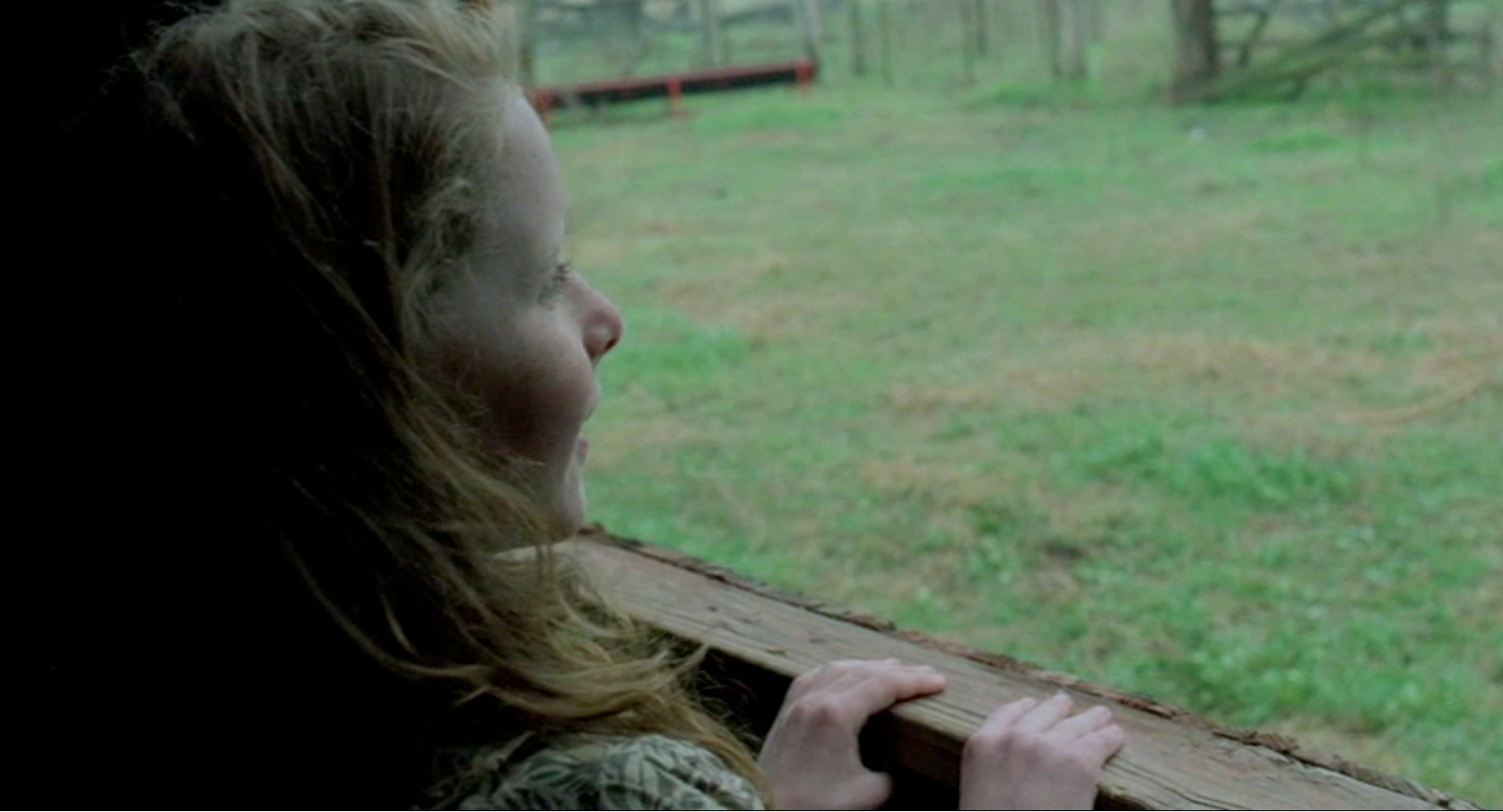
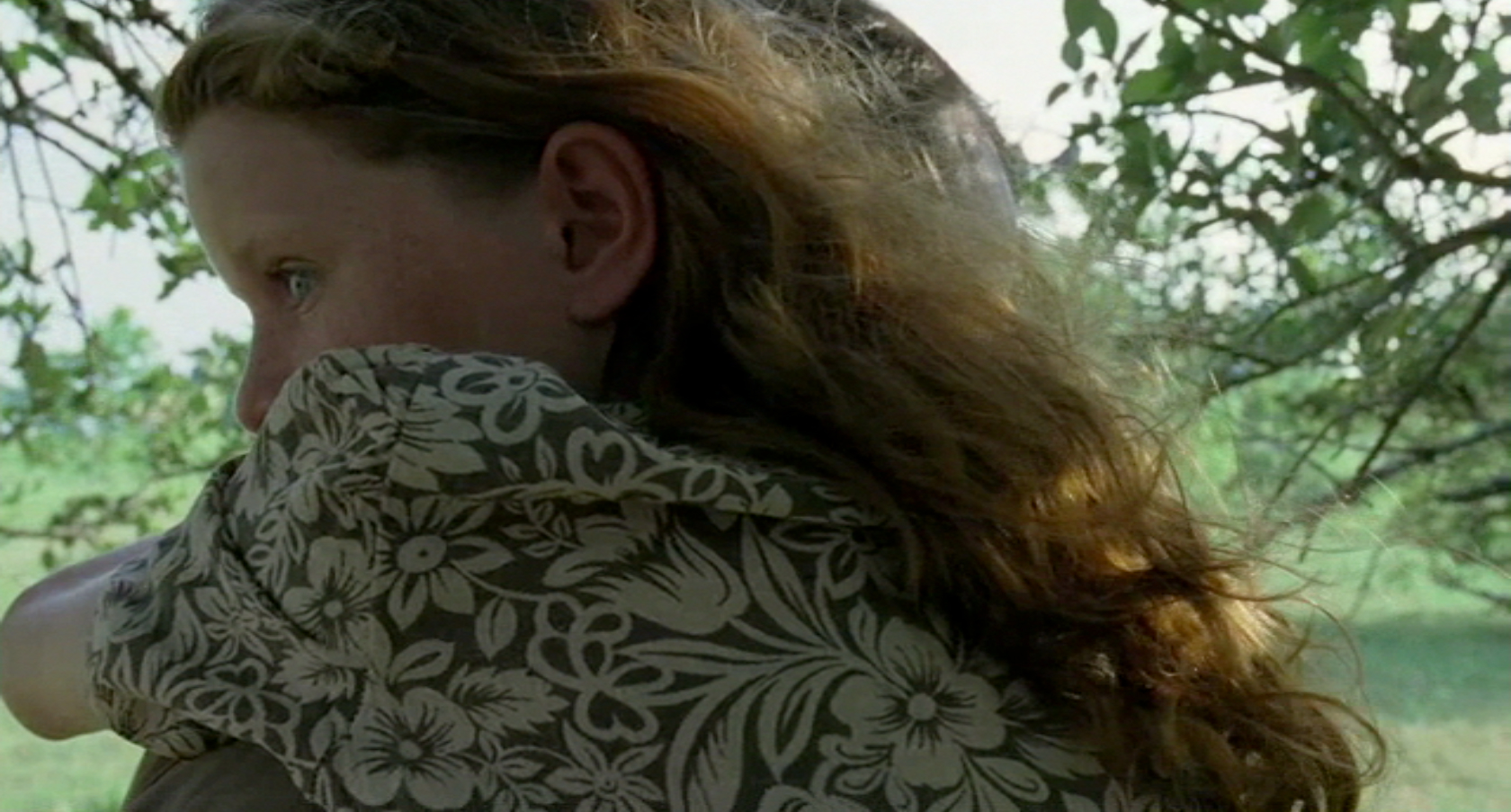
These words come over images of a young girl (images above), the young Mrs. Obrien, as she interacts with Nature, and also with her father. We don’t really see her face much, we don’t see her father except for his hand and shoulder. Instead we see the world as the girl sees it, big, wonderful, full of life – and she is safe in the arms of her father.

Naturally these words set up a kind of interpretive lens through which we might analyse the film. As we follow the story we can’t help but think in terms of nature and grace. In these words we find a perspective of life held on to by Mrs. Obrien, a perspective that she learned as a child, taught to her by nuns presumably at a parochial school. Perhaps Malick is hinting at the kind of spiritual education common to Catholic schools seventy five plus years ago, and maybe he is commenting on that teaching. What is interesting, however, is how the film seemingly undercuts this philosophy. Although one is tempted to say Mrs. Obrien (in her softness and beauty) is grace and Mr. Obrien (in his hardness and anger) is nature, it is amazing how much nature permeates the film in the most loving and awesome ways. Even the film’s title, The Tree of Life, speaks of nature in connection with life. We might be tempted to see grace as the way to life, and yet we are continually being drawn back to images of nature, and in particular the tree the boys climb in the film, and by which the vision of their mother dancing in the air appears.

An interesting question is who is the protagonist in this film. Most are likely to see Jack as the protagonist. But is he? Might not Mrs. Obrien be the protagonist. If the film is a meditation on the book of Job (it opens with the book’s most famous verse), then we see both Jack’s and his mothers struggles in that light. When a boy dies in the story, a young Jack asks of God, “Where were You? You let a boy die. You let anything happen. Why should I be good when You aren’t?” This is a big moment, and a huge question for Jack. But similarly, after Jack’s brother R.L. dies (which we do not see, but only hear that he died at age 19), Mrs. Obrien cries out to God, “Lord, Why? Where were you? Did you know what happened? Do you care?” It is arguable that Mrs. Obrien’s struggle and final acceptance is the greater arc. If so, then it is possible that the film is about her coming to terms with the ideas taught to her when she was a kid, held dear for many years, and only later in life revealed to her (perhaps because of her willingness to see) as being false, or at least not entirely true.

Though my inclinations are that Jack is protagonist #1, it could be argued that the story, with all it sweeping and ephemeral qualities, is entirely in Jack’s head, being essentially his memory. If that’s the case, then it could be argued that Mrs. Obrien is the protagonist in the story going on in Jack’s head, or perhaps a co-protagonist.

Other interesting questions include which son is Mrs. Obrien giving to God at the end of the film? We assume it must be R.L., but could it be Jack? And who are the women with her at the end? We might think they are angels, but the one on the right is the girl Mrs. Obrien we saw at the film’s beginning. Might she represent the previous and less mature understanding of nature and grace? She is, after all, representing a more innocent time before adulthood, child rearing, marriage struggles, and the death of a child. And is the other woman an angel, or might she be the personification of grace itself?

TOL 4

I am inclined to think the trouble many people have with watching Terrence Malick’s films, especially the later ones, is that we are a culture that no longer reads poetry. Reading poetry alters the mind to think in different ways. Poetry is the highest form of writing, and thus taps into parts of us that other writing does not, or not as well. Secondly, we do not read the classics enough, especially theology. A good dose of St. Augustine wouldn’t be bad. I’ll leave it at that.

Finally, an interesting connection is that Mrs. Obrien’s verbiage is very similar to that of Chapter 91 of The Imitation of Christ by Thomas à Kempis, quoted here in it entirety:

On the Contrary Workings of Nature and Grace (found here)

My son, carefully observe the impulses of nature and grace, for these are opposed one to another, and work in so subtle a manner that even a spiritual, holy and enlightened man can hardly distinguish them. All men do in fact desire what is good, and in what they say and do pretend to some kind of goodness, so that many are deceived by their appearance of virtue.

Nature is crafty, and seduces many, snaring and deceiving them, and always works for her own ends. But Grace moves in simplicity, avoiding every appearance of evil. She makes no attempt to deceive, and does all things purely for love of God, in whom she rests as her final goal.

Nature is unwilling to be mortified, checked or overcome, obedient or willingly subject. Grace mortifies herself, resists sensuality, submits to control, seeks to be overcome. She does not aim at enjoying her own liberty, but loves to be under discipline ; and does not wish to lord it over anyone. Rather does she desire to live, abide and exist always under God’s rule, and for His sake she is ever ready to submit it to all men.(I Pt.2:13)

Nature works for her own interest, and estimates what profit she may derive from others. Grace does not consider what may be useful or convenient to herself, but only what may be to the good of many.(I Cor.10:33) Nature is eager to receive honour and reward : Grace faithfully ascribes all honour and glory to God .(Ps 26:2:96:7) Nature fears shame and contempt: Grace is glad to suffer reproach for the Name of Jesus.(Act 5:41) Nature loves ease and rest for the body ; Grace cannot be idle, but welcomes work cheerfully.

Nature loves to enjoy rare and beautiful things, and hates the cheap and clumsy. Grace takes pleasure in simple and humble things, neither despising the rough, nor refusing to wear the old and ragged. Nature pays regard to temporal affairs, takes pleasure in this world’s wealth, grieves at any loss, and is angered by a slighting remark. But Grace pays attention to things eternal, and is not attached to the temporal. The loss of goods fails to move her, or hard words to anger her, for she lays up her treasure and joy in Heaven where none of it can be lost(Matt.6:20)

Nature is greedy, and grasps more readily than she gives, loving to retain things for her personal use. But Grace is kind and generous, shuns private interest, is contented with little, and esteems it more blest to give than to receive.(Acts 20:35) Nature inclines a man towards creatures – to the body, tovanities, to restlessness. But Grace draws a man towards God and virtue. Renouncing creatures, she flees the world, loathes the lusts of the flesh, limits her wanderings, and shuns public appearances. Nature is eager to enjoy any outward comfort that will gratify the senses. Grace seeks comfort in God alone, and delights in the Sovereign Good above all visible things.

Nature does everything for her own gain and interest; she does nothing without fee, hoping either to obtain some equal or greater return for her services, or else praise and favour. But Grace seeks no worldly return, and asks for no reward, but God alone. She desires no more of the necessaries of life than will serve her to obtain the things of eternity.

Nature takes pleasure in a host of friends and relations; she boasts of noble rank and high birth; makes herself agreeable to the powerful, flatters the rich, and acclaims those who are like herself. But Grace loves even her enemies,(Matt.5:44; Luke 6:27) takes no pride in the number of her friends, and thinks little of high birth unless it be allied to the greater virtue. She favours the poor rather than the rich, and has more in common with the honourable than with the powerful. She takes pleasure in an honest man, not in a deceiver ; she constantly encourages good men to labour earnestly for the better gifts, (I.Cor.12:31) and by means of these virtues to become like the Son of God.

Nature is quick to complain of want and hardship ; but Grace bears poverty with courage. Nature, struggling and striving on her own behalf, turns everything to her own interest: but Grace refers all things to God, from whom they come. She attributes no good to herself; she is not arrogant and presumptuous. She does not argue and exalt her own opinions before others, but submits all her powers of mind and perception to the eternal wisdom and judgement of God. Nature is curious to know secrets and to hear news; she loves to be seen in public, and to enjoy sensations. She desires recognition, and to do such things as win praise and admiration. But Grace does not care for news or novelties, because all these things spring from the age-old corruption of man, for there is nothing new or lasting in this world.

Grace therefore teaches us how the senses are to be disciplined and vain complacency avoided ; how anything likely to excite praise and admiration should be humbly concealed ; and how in all things and in all knowledge some useful fruit should be sought, together with the praise and honour of God. She wants no praise for herself or her doings, but desires that God may be blessed in His gifts, who out of pure love bestows all things.

Grace is a supernatural light, and the especial gift of God,( Eph. 2:8) the seal of His chosen and the pledge of salvation,(Eph.1:14) which raises man from earthly things to love the heavenly, and from worldly makes him spiritual. The more, therefore, that Nature is controlled and overcome, the richer is the grace bestowed, while man is daily renewed by fresh visitations after the likeness of God .(Col. 3:10)