>
>so you know how to ride a bike… do you?
>
>
>
sorry about the music on this one
>Deep within the American psyche is a pond.
That pond is called Walden and it was, as we all know, made famous in a book called Walden by the ubiquitous American writer Henry David Thoreau.
Here is a wonderful photo essay (if that’s the right word) on Walden Pond in a year.
And here’s a video piece on Walden Pond with the words of Thoreau:
I live in the Northwest where we have many lakes and ponds as or more beautiful than Walden, but none so important.
I post this because I am thinking about nature, and getting into nature, more and more now that it is Spring and my kids need to get out as much a me.
>On this day in 1963 Mount Everest was submitted for the first time by an American.
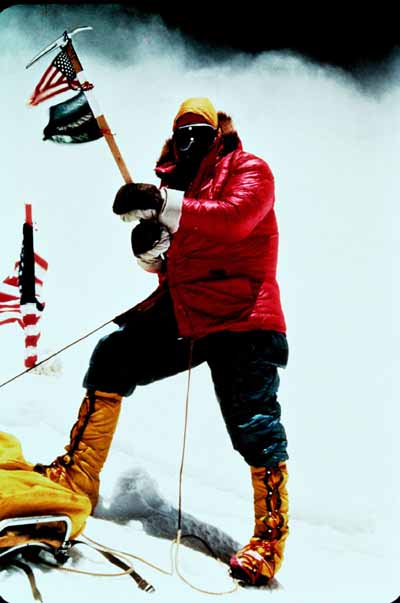
I find this interesting in part because of how times have changed since then. That year there was only one expedition on the mountain. Today there may be many, with a thousand climbers on its slopes. No longer do climbers plant their country’s flag on the summit, and many since have reached the summit without the use of bottle oxygen. Expeditions are typically much smaller than they used to be, and many climbers are actually clients who have paid their way onto a climbing team. Also, the typical location for base camp is now considered the world’s highest garbage dump, from past expeditions leaving their used equipment, and is often packed with people. In 1963 there would have been few places on earth as wild and pristine.
I first became aware of the 1963 American expedition by reading a copy of Everest Diary John D. McCallum, based on the diary of Lute Jerstad. I mentioned this in an earlier post. For me those early Everest expeditions have a wonderful romantic quality. Although I have climbed several minuscule mountains by comparison I used to think maybe someday I would climb in the Himalayas. Alas, now I hope maybe I will someday get a chance to just see them for myself.
Here is the first three minutes of the documentary made of the expedition:
http://video.google.com/googleplayer.swf?docid=-3937648226832477292&hl=en&fs=true
>Fear of heights is a good thing. It’s kinda like fear of great white sharks. If you are in the ocean swimming near great white sharks it does not mean you are going to be eaten. But your chances of being eaten are probably greater than if you are swimming with some otters.
Climbing shear cliff faces without using any ropes or other safety equipment is a little like saying, “Hey look, there’s a whole bunch of great white sharks in the water. I’m going swimming!” If you don’t get eaten still no one will praise you for making a good decision to go swimming. If you do get eaten, well… I guess you won’t care what they say.
Still there is something thrilling about watching someone free solo El Capitan, a 3,000 foot cliff of polished granite. 3,000 feet is really high up. If you want to see what it looks like to look down from about 2,000 feet on El Capitan, click here. If you want to watch Dean Potter free solo El Cap, watch this video:
Now if you think free soloing is just something one or two people do, then watch this video about a Siberian community where everyone does it.
Some people go on nature walks, some bird watch, others paddle around in small boats, and others take the family to the cliffs and say, “Okay kids, up you go!”
>Consider the following paragraph below. It is from an introduction to Karl Marx’s Capital Volume 1. It was written in 1976 by Ernest Mandel. I was struck by how much it describes our current day.
Periodically the bourgeois class and its ideologues have thought they have found the stone of wisdom; have felt able, accordingly, to announce the end of crises and socio-economic contradictions in the capitalist system. But despite Keynesian techniques, notwithstanding all the various attempts to integrate the working class into late capitalism, for over a decade now the system has appeared if anything more crisis-ridden than when Marx wrote Capital. From the Vietnam war to the turmoil on the world monetary system; from the upsurge of radical workers’ struggles in Western Europe since 1968 to the rejection of bourgeois values and culture by large numbers of young people throughout the world; from the ecology and energy crises to the recurrent economic recessions; there is no need to look very far for indications that capitalism’s heyday is over. Capital explains why the sharpening contradictions of the system were as inevitable as its impetuous growth. In that sense, contrary to a generally accepted belief, Marx is much more an economist of the twentieth century than of the nineteenth. Today’s Western world is much nearer to the ‘pure’ model of Capital than was the world in which it was composed.
Of course, capitalism has had a few more years of its so-called “heyday” since 1976. But maybe we are seeing bigger cracks in the system today than in the past. And yet I don’t think we’ve seen the last of capitalism for a long time now. Marxists have been saying for more than 150 years that capitalism is going to collapse any day now, but it keeps trudging along – making some rich beyond measure.
I must also say that it was fun typing this up while listening the the soundtrack from Repo Man.
>I have to say I really like Greenpeace.
Needless to say, the Greenpeace protesters were arrested.
>Here are a couples on links regarding the changing landscape of Christianity in the U.S. The first is a video clip with Tony Jones speaking of the Emergent Church. The second is a recent link to Tony’s blog regarding some new statistics about religion in the U.S.
This video first aired in 2008.
http://video.google.com/googleplayer.swf?docid=-1959894145232313198&hl=en&fs=true
From Tony’s bog: The Rise of the “Nones”
1
Along the shiny edge of a scar
There are no nerve endings.
Along the desert road
There is only the desert and the road.
I rose to standing in the still air;
Blue sky, circling hawk,
The smell of pine trees and gasoline,
The dust slowly settling.
Silence.
Watersheds come like the molting of birds
And snake skins,
Like pulling teeth and peeling scabs.
Sometimes they come slowly
Like the blue ice of a glacier.
Sometimes they come quickly
Like flames leaping to touch a hand.
Later we calculated the distance.
Thirty paces in the air,
Then another ten.
How fast had I been going?
The impact still hides in shadows,
Memories concealed like a hilltop in fog.
But there,
Eighty feet from the half buried stone
I stood,
Traces of a struggle before me,
A vivid recollection without images,
A dream in darkness.
There is no moment
Like the moment you can’t remember,
Like the mind waking from
The anesthetic, alone, with
Only white sheets and stitches.
I leaned over,
Lifted the motorcycle
To its proper position.
Blood coming through my shirt sleeve,
Adrenaline rushing away in waves,
My broken foot
Secretly swelling inside my boot,
Still days from home and hospital.
2
The severed tails of lizards grow back
And shoots sprout from old roots
And some things never return.
The clouds finally cleared,
Emerald valley pulsing with music and incense,
Trampled grass, the smell of oils,
Burnt shoulders gyrating by the stage,
Honey colored sun reflecting
On drums.
I balanced carefully,
Blue bike handlebars,
Left tennis shoe, aluminum crutch,
Evening light in the trees,
A landscape lush with life,
And the two of us
Pedaling to the campus festival.
How far from here to the desert road,
Now glowing in moonlight,
To the place where it curves right, then left,
Under a sky now filling with stars?
How far back to the hilltop in fog,
Through the shadows of fragility and anguish
And mortality?
Recklessly I danced on one foot
the other turning black, purple, yellow,
Mottled image across tight skin,
The misshapen appendage
Now a symbol of transition,
Suspended above the earth.
Leaves turn in the wind
Like faces turn from suffering,
Like water turning into wine,
Like a young man, turning in the rhythm
Faces the sky’s constant rotation
And a childhood turning into memory
Like dust settling on a desert road.
June 1998
>If you have red Jack Kerouac’s The Dharma Bums then you know a little something about Gary Snyder. Here Snyder reads and discusses his poetry at a lunch time gathering. He is introduced by Robert Hass
Here’s an image of Snyder in his younger days when he traveled to India with Allen Ginsberg and Peter Orlovsky.
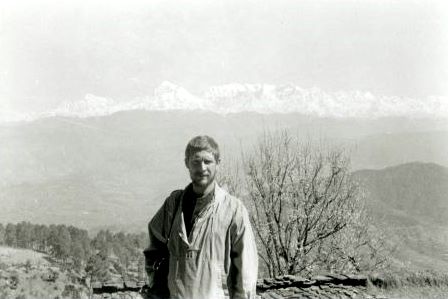
I post this because this is National Poetry Month.
 pilgrimakimbo
