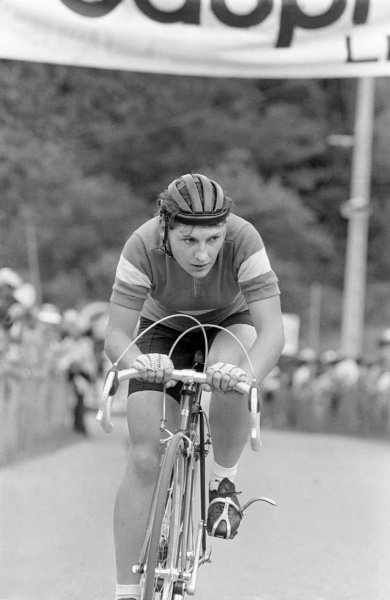
>An inspiration: Jeannie Longo at 50

>In 1979 began one of the most remarkable sports careers of all time. That is the year Jeannie Longo established herself as a cyclist to be reckoned with by winning the French road race Championship. She was 21 years old.

Yesterday she won the French national time trial for the eighth time. She is now 50 years old.


Longo in 2009, winning the
French national time trial
.

Longo’s cycling career is stunning, not merely for her staggering number of wins and top finishes (see below), but also for her tireless longevity. She also has a B.S. in mathematics, an MBA, and a PhD in sports management.


Longo in 1980 winning the French
Road Race Championship
.

According to her Wikipedia entry, Longo competes both in road and track bicycle racing events, and is an Olympic gold-medalist and twelve-time world champion. Her impressive palmarès include:

  • Olympic Games road race: Gold Medal/Champion (1996); Silver Medal (1992)
  • Olympic Games time trial: Silver Medal (1996); Bronze Medal (2000)
  • 5x UCI Road Race World Championship: Gold Medal/Champion (1985, 1986, 1987, 1989, 1995)
  • 4x UCI Time Trial World Championship: Gold Medal/Champion (1995, 1996, 1997, 2001)
  • 4x UCI Track World Championship: Points Race: Gold Medal/Champion (1989); 3 km Pursuit: Gold Medal/Champion (1986, 1988, 1989); Silver Medal (1984, 1985, 1987); Bronze Medal (1981, 1982, 1983)
  • UCI Mountain Bike Championship: Silver Medal (1993)
  • 15x French Road Race Champion: 1979 to 1989, 1992, 1995, 2006, 2008
  • 8x French Time Trial Champion: 1995, 1999, 2001, 2002, 2003, 2006, 2008, 2009
  • 3x Tour Cycliste Feminin / Grande Boucle: 1987, 1988, 1989
  • 2x Women’s Challenge: 1991, 1999
  • Set Hour Record (45.094 km/h) in 2000 in Mexico City (14 years after setting the best hour performance record)

Only the great Eddy Merckx comes to mind as having an equally impressive career, but he finished competing when he was 33 years old.

>trying out the modern defense

>Here is a win from two days ago. My opponent was rated at 1615 and I at 1461, so it was a good win for me. I was also playing black. As usual, this game was played at ChessWorld.

I used this game to try the Modern Defense, a defense I have used several times. This strategy is all about attacking and undermining “White’s “ideal” position without directly attempting to occupy the center.” But I can’t say I really know the Modern. After the first several moves I’m just flying by the seat of my pants.

1.e4 g6
2.d3 Bg7
3.Qf3 e5
4.Be2 Nc6
5.c3 Nge7
6.h4 d6
7.b4 Be6
8.Bg5 h6
9.Bxe7 Qxe7
10.a4 O-O
11.Qg3 d5
12.exd5 Bxd5
13.h5 e4
14.hxg6 fxg6
15.d4 Rae8
16.Qxg6 Rf6
17.Qg3 Ref8
18.Nh3 Qd6
19.Qxd6 cxd6
20.Nd2 b6
21.c4 Bf7
22.Nxe4 Re6
23.Bf3 Nxd4
24.Rc1 Re5
25.O-O Bh5
26.Nxd6 Nxf3+
27.gxf3 Rxf3
28.b5 Rxh3
29.Nc8 Rg5+ {White king mated} 0-1

>homeschooling and the world

>There is a trend within the subculture of homeschooling* that is all about separation from society at large. This makes some sense. Homeschoolers are often defined, in part, as people who want to pull their children out of mainstream society and protect them from “the world.” Certainly not all homeschoolers are this way, and I hope we are not, but it has some appeal given the many troubles this world presents.

Recently we attended a Christian homeschooling conference. As you might imagine we saw all kinds of Christians, from the young hip couple with their cool glasses and lattes to the families with 6+ children all wearing 19th century prairie outfits. The conference had numerous speakers and work sessions. One of the keynote speakers struck me as the kind of homeschooler parent I don’t want to be. I don’t mean to be unduly harsh, and I only heard the one talk (or I should say over-the-top performing-preacher show), but I was encourage by his talk to more clearly define an aspect of why we homeschool and why some of our reasons stand in contradiction to his.

He began by lauding his father for taking his family to an island away from “the world” and homeschooling them. In other words, our keynote speaker was raised on an island cut off from the taint and spoilage of the wider world. He went on to say that that was a great thing and we should not be afraid to separate our children from the world on “islands” where they can be protected and safe. If you are like me you might be chafing at this idea, but it is not unwarranted, and I want to give the idea its due.

This world we live in full of may horrible things – war, famine, crime, and all kinds of ugliness. There are also many competing ideas that challenge one’s own beliefs. A Christian parent who is interested in their children knowing God as they know God may want to protect them from those competing ideas for as long as possible. The same goes for any parent who has a worldview to which they cling. I can understand the desire to keep one’s children away from the corrosive influence of the world. To do so feels like being responsible, and in some cases it certainly is. So I know where our keynote speaker is coming from. I know that feeling. But there is more to the picture.

The concept of “the world” is a big deal in Christian teaching. Jesus said his kingdom is not of this world. John the Apostle said “Do not love the world nor the things in the world.” Paul the Apostle said “do not be conformed to this world.” There is a lot more to be said, and I do not intend to unpack the biblical concept of the world here, but most Christians know there is this thing called the world which they must avoid in some way. Christian homeschoolers might see pulling their kids out of public school as pulling them out of the world. Christian families who move to the country far from urban areas may believe they are removing themselves from the world in some fashion. Certainly to raise one’s family on an island would feel like the world is far away.

However, when John says “For all that is in the world, the lust of the flesh and the lust of the eyes and the boastful pride of life, is not from the Father, but is from the world,” we see that the world is not so much a physical entity as it is a heart condition or a spirit. Also, when Jesus said, “While I am in the world, I am the Light of the world,” it appears his intention was not fleeing the world but to bring it light. Elsewhere in scripture Christ followers are called to be light in the world and salt of the earth. And when we read that “God so loved the world that he gave us His son,” we get the idea that our stance towards the world may not be so simple. We may not be able to separate ourselves from the world as easily as we think for “lust of the flesh and the lust of the eyes and the boastful pride of life” comes with us wherever we go, even to an island. Also, we cannot be light or salt to the world if we decide to have nothing to do with the world. And we certainly cannot love the world as God loves the world if our stance is to flee the world which, as we have seen, may not be so easy anyway.

At that homeschoolers conference it became clear that the world could be seen most clearly in such things as 1) cities, 2) public schools, 3) government, and 4) anything other than far right politics. If one didn’t know better one could conclude that homeschooling is all about 1) getting out of the city to the country – a kind of “back to the garden” idea, 2) avoiding any kind of public education, including any education or activities that has public monies attached to it, such as a city funded soccer league, 3) having nothing to do with government or public service unless it is to defend against liberals who want to impose laws on homeschooling, and 4) assuming a political stance and championing the values of such organizations as the Christian Coalition. I may be taking a somewhat extreme critical view here, but I don’t think so. This is what I see coming from much of the Christian homeschool subculture and from our keynote speaker. But those are not our reasons.

One of the great blessings of Christian truth is the incredible freedom we have. As we love God and His values we find ourselves marveling at this world He created. This world of His includes all that we find, including the incredible variety of humanity and human creativity. We might and should grieve at the evil we see in the world, but we should also love the world. We should love the cities and the arts and the culture and the governments. Wisdom dictates that we do not love folly or evil or rebellion against God. On the other hand this world is full of God’s creative work, it is His sovereignty manifest in all things everywhere, and this world is full of the people He loves – which includes all people. We have the freedom to engage in this world head on. We also have the opportunity to be light and salt. This opportunity is a great privilege. As a parent I can chose to model light and salt, or I can model the act of withdrawal.

Another great blessing is that because I know God is sovereign I can engage in this world without fear. I can live in the city or in the country, work in private business, ministry, government, or public schools, listen to Christian or secular music, visit art galleries and museums, watch popular movies, and even drink, smoke, play cards and cuss, without fear. If Jesus is my example then I can eat dinner with the most worldly people. If Paul’s theology is correct then I can eat meat sacrificed to idols. Wisdom will dictate that I consider the weaker brother (and I too am a weaker brother), so I may chose not to do some of these things at times, but there is no need for fear. But I must say that having no fear is not the same as not being scared. A man may say he is not scared of the world, and that may be true, but he may still live in fear of the world. To take one’s family away from the world and live on an island because the world is a bad place is to live in fear of the world.

There is another kind of separation – the separation through ideology and stereotypes. On our keynote speaker’s website promoting his daily radio program he touts the following: “There are no psychiatrists, professional counsellors, bureaucrats, and seminary professors. But you will find fathers, mothers, grandparents, pastors, and friends.” Other than spelling counselors wrong this quote says a lot. There is an attitude within some quarters of Christianity that sees psychiatrists, professional counselors, bureaucrats, and seminary professors – along with scientists, social workers, and anyone from Hollywood – as being other than fathers, mothers, grandparents, pastors, and friends. Not only is this a wrongly prejudiced perspective more indicative of a passionate narrow mindedness than of wisdom, it is also a perspective indicative of fear. There has always been a class of persons who claim victim status though they are not victims in a meaningful sense. This class is also easily manipulated by those who point to the educated, or those in government, or big city dwellers, or those in the entertainment industry, as the victimizers. Some politicians can be quite good at doing this, and so are many preachers. Our keynote speaker not only claims the victim status but uses his talents to fan the flames of fear. Fear thrives in the world of stereotypes. And just like the religious leader who prays to God, thanking God that he is not like other people, we can all fall prey to a profound blindness. What we see in Jesus is someone hanging out with the sinners. We see someone not only reaching out to everyone, but doing so without fear, and not drawing lines between himself and the rest of humanity. And, ironically, it is the religious leaders – the upstanding citizens, moral agents, family lovers, Bible teachers – who criticized Jesus for just such activities.

Where does this leave us? Our confusion, like so much in Christianity, is to make the wrong distinctions and then fall into the pit of religion and self-righteousness. We confuse the world with superficial distinctions as “psychiatrists, professional counselors, bureaucrats, and seminary professors” rather than with a heart rooted in “lust of the flesh and the lust of the eyes and the boastful pride of life.” The world, in this bad sense, is as much alive in Christianity as it is anywhere else. When it comes to worldliness there is no distinction between the Hollywood movie star and the megachurch pastor. In fact we bring the world with us where ever we go – wherever there is humanity. Only through the grace of God do we have any hope to be free of the world – and that freedom can come to a professional counselor/psychiatrist working for a government agency while moonlighting at a seminary and living downtown in the biggest city as it can come to the man barricading his family against the evils of the world in some distant wilderness. Grace be to God for our hope and freedom.

But what about my charge as a parent? It is one thing to be an adult confronting the ugliness of this world, it is another for a child. As a parent I must protect my children when appropriate. I must also guide them in wisdom. I would rather my children face into the harshness of reality, guided by my example, sometimes stumbling and struggling, but learning to see themselves for who they truly are and learning to love others where they are. I also want my children to grow up without fear. If we can walk through this life together, confronting the variety of human experience and choice, and do so hand in hand, I think my children might have a decent chance of knowing good from evil, of learning humbleness, of appreciating all that God has created, and learning that goodness comes not so much from trying to avoid the stain of the world as turning to God in genuine repentance. We have come to realize that fleeing the world and taking one’s family to an island, even if those actions are clothed in the finest Christian robes of piety, could very well be an act of rebellion against God. Not necessarily, but could be.

This is one reason we homeschool, and we do so within a city context, and we listen to all kinds of music and study all kinds of art, and we are interested in politics beyond narrow “Christian” agendas, and we appreciate MLK and Gandhi, and we appreciate revised histories when they offer clarity and truth, and we don’t believe one can homeschool true faith into any child. And we also don’t think we’ve got it all right. All we can do is move forward in humbleness (which itself is a gift), looking to God for grace and mercy, and seeking goodness the best we can.

* Like many different elements of our society, homeschoolers represent a kind of subculture. However, it would be incorrect to think of it as a single or homogeneous subculture. At best it is a subculture of subcultures, and may be better described as an eclectic group of families that have a rather unique similarity regardless, and sometimes in spite, of their many dissimilarities.

>Noam Chomsky: The Stony Brook Interviews Part Two

>

>Noam Chomsky: The Stony Brook Interviews Part One

>

>we homeschool

>We homeschool our kids. I have not written much about it here, but it is a big deal to us and part of the very fabric of our family. It is not easy. It takes a lot of work, most of which falls on my wife’s shoulders. I have been realizing more and more that I need to sort through my thoughts on homeschooling, why we made the choice, and what it means to us.

There may be as many different reasons to homeschool as there are families who homeschool. But I would hazard a guess that most families who homeschool do so for many of the same reasons. They want their kids to be better educated, better socialized, safer, more well-rounded, and closer to the family. There has been a deeply rooted idea is Western culture, from Plato to Rousseau to Marx and onwards, that the best way to educate children is to get the parents out of the picture as soon (and as much) as possible. This idea is rooted in the other idea that the individual is primarily beholden to the state, especially within ideologies where the state is elevated as the primary social group. Homeschoolers tend to take exception to both of these ideas and go in a different direction. And yet, probably most homeschoolers do not choose to homeschool because they take exception to such ideologies, rather they homeschool because they see their local public education, and much private education, to be less than what they want for their children. This is not to say public or private education is always wrong – I am a product of both – but that public and private education is often a lesser education rife with conflicting issues, stultifying bureaucratic “requirements”, unnecessary compromises, and various dangers on many levels. We know that children are natural learners. That a student becomes educated within traditionally and culturally accepted environments (public and most private schools) is often in spite of those environments as much or more than because of them. That was very much true for me and, in fact, I had a lot of catching up to do. Only because I am a little obsessed with constant learning in my own life have I managed to become an educated adult and make up for much of my elementary and secondary education. But I am still behind where I should be.

And yet homeschooling is not all about academics. There is probably no more important element of becoming an educated person as that of one’s character. In public schools one learns basic character traits as standing in line without pushing, or not hitting other students, or not stealing, or how to stay awake in class, or how to take standardized tests. Of course, mostly one learns that to behave well is all about “getting along.” The goal is to follow the rules and to avoid anarchy. This is driven, in large part, by the needs of the teachers who must maintain order in classrooms with too many children. Cooperation, as we are told from Sesame Street and reinforced in public school, is the highest good. Goodness, as an end in itself, is not the focus of public school character development. Nor is much directed character development possible at all. In our local school district the ratio of students to teachers is 20+ to 1. There is no way that a teacher, no matter how “qualified” can truly develop and nurture the individual characters of 20+ students. In fact they can barely teach them. Certainly they cannot uniquely customize their instruction to the unique needs of each individual child. But that is exactly what homeschooling does do. Our kids get teachers who truly know them, who love them, will even lay down their lives for them. There are many excellent teachers in public and private schools (and know that I am a supporter of public education both in principle and with my tax dollars), but none know or love my children the way I do.

In short, we believe that we can give our kids a better education because we can customize the education for each child uniquely, tailoring our teaching to their learning styles and capabilities. We can give our kids a better education because we can better focus on their individual characters and help them grow into the kind of people they were made to be. And we can better educate our children because we are deeply committed to them for who they are – we love them like none other can.

I will write more here on why we homeschool and what it means to us in the future, but I am still sorting out my thoughts. I also realize there are many stereotypes about homeschooling and the strange people who make such choices. I will address some of that too. And I want to examine the idea of being “qualified” to teach and why we think we are qualified. But know this, homeschooling is no formula for success. We take each year, even each day to some degree, as an experiment. It is working so far, but who knows what the future will bring.

>the modern (neophyte) defense

>Below is a recent game of mine on Chessworld.net. My opponent is the highest rated player that I have beat by checkmate. At the time he was rated 1577 and I 1435 on Chessworld, which puts both of us in the strong beginner classification. I was playing black. (You can flip the board to see the game as I saw it.)

http://www.chessworld.net/chessclubs/PGNViewer/pgnboard.asp?from=489318&bv=1&bgcolor=000000&fontcolor=ffffff&PgnMoveText=%5B%5B1.e4%20g6%202.d4%20Bg7%203.c3%20Nc6%204.Nf3%20e6%205.Bc4%20Nge7%206.O-O%20O-O%207.Nbd2%20b6%208.e5%20f5%209.Ng5%20Bh6%2010.Bxe6+%20Kg7%2011.Bxf5%20Nxf5%2012.Nde4%20Ba6%2013.Re1%20Nh4%2014.Nf3%20Nxf3+%2015.gxf3%20Bf4%2016.Bxf4%20Rxf4%2017.d5%20Nxe5%2018.Qd4%20d6%2019.Qe3%20Nxf3+%2020.Kg2%20Qh4%2021.Qd4+%20Kh6%2022.h3%20Raf8%2023.Qa4%20Rg4+%2024.hxg4%20Qh2+%5D

We started with 1.e4 g6 2.d4 Bg7. My goals here was to try and learn what is called the Modern Defense. So I followed the book, as it were, for the first several moves. I allowed* him to advance quickly and gain valuable territory, but my defenses were still relatively strong and I ended up capturing a number of his pieces – frequently as trades – which changed his position somewhat. At 10.Bxe6 I feel he began to blunder a bit, advancing his Bishop without a clear strategy. He was hoping that my d pawn would take him, setting up for his knight to fork my Queen and rook. All I had to do was not fall for it. And then, by bringing my knight deep into his territory, I was able to open up the g file, which became his undoing. Not that I had a clear strategy at this point either. The end, however, took a fair amount of thinking on my part in terms of move order.

* At this stage in my development I can’t really say the I “allow” my opponent to do anything. I don’t have that much power on the board.

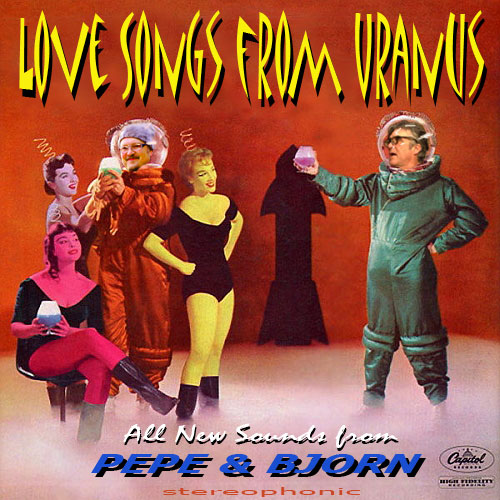
>Classic Pepe & Bjorn – from the swingin’ big band period

>

More Pepe & Bjorn here.

>tinkering & puttering with chess & computers

>I have been tinkering a bit with the computer chess game pychess Philidor 0.8.1, which runs on Linux (I’m running Ubuntu). I then tried loading in some chess engines (Fruit 2.1, Glaurung 2.0.1, etc.). I can’t say that I have achieved actually loading the chess engines. The game might still be using the built in engine from pychess. Anyway, I tried a quick game at the beginner level. Then I saved the game as a PGN file. And then I searched for a PGN viewer (I chose Chessflash for now) that would allow me to upload it as HTML to this blog. My results are below.

As you can see the beginner level is hopelessly terrible as an opponent. But that might be the pychess engine, so I have to figure that out.* And I don’t exactly like the Chessflash graphics, but it’s free. Anyway, puttering around with both chess and computers is kinda fun at times.

* Figured it out. I was still using the pychess engine. When I try the Fruit 2.1 engine at beginner level it suddenly starts playing like it’s trying to win.

>an agreable kind of horror: the sublime

>A couple year’s ago I wrote a post looking at contemplative cinema’s relationship to the infinite. That post has received over 700 visits since published. The idea of the sublime in film has always intrigued me, and many of my favorite films and film moments include the sublime. In particular I love the German concept of sublime as expressed in the paintings of Caspar David Friedrich.

Here is a wonderful little discussion of one of Friedrich’s paintings by the crew at smarthistory:

There is probably no characteristic of art that draws me in more than the sublime. It has the key elements of both Modernity and Romanticism. I wrote specifically about that here, and in that post you will find one of my most favorite poems – a selection from Wordsworth’s The Prelude – to me a great example of confronting and expressing the sublime.

The sublime is also one of the characteristics that draw me to the mountains. I am convinced that people who cannot fathom why someone would want to risk their life (even a little so) in pursuit of climbing a mountain are also those who have little time for the sublime in art. According to Wikipedia: ‘Joseph Addison embarked on the Grand Tour [of Europe] in 1699 and commented in Remarks on Several Parts of Italy etc. that “The Alps fill the mind with an agreeable kind of horror”.’ And that about sums it up in a nutshell.