A Young Marx in Paris, French Communist Christians, and Thoughts from a Nicaraguan Poet

38 Rue Vaneau, Paris – Where Karl Marx lived between 1843 and 1845

In 1843, at the age of 25, Karl Marx arrived in Paris and tried to start a political journal. At this early point in his life he was forging a career as an editor and was not yet much of a communist, at least not yet the universal symbol of communism he would become. He was still exploring and formulating his ideas, reading a tremendous number of economic texts, and getting to know Friedrich Engels. He was also trying to find writers for the journal he and a collaborator were trying to start. Being a radical German in France, this was not always easy…

Language problems were not the only issue, since they had the help of Moses Hess, who spoke better French from a previous stay in Paris, as a translator. There were also political and intellectual differences that made cooperation difficult. Most of the French socialists the German editors met rejected political action as a means to bring about their new society, counting instead on the voluntary formation of communes, without the need for subversive activities or revolutionary struggles. These socialists also understood their social and economic plans in religious terms: communism was the authentic realization of the ideals of Christianity [emphasis added]. The radical, atheist German intellectuals, subversives in trouble with the Prussian authorities, were not at all congenial to these French socialists.1

I find this observation about the French socialists fascinating. First, it highlights that socialist and communist thinking was already in the air and had been in the air for a while. Marx of course did not invent communism, he embraced it. (Again and again whenever communism comes up it is assumed this means “Marx.” But there are other options, other histories, and multiple “communisms.”) Second, it is a good reminder of the fact that communism and Christianity have been understood by some as not only compatible with each other, but tightly bound for a long time—perhaps inevitably so.

A man walks by a small shrine with a picture of Jesus Christ next to a local office of the Italian Communist party Rifondazione Comunista in Venice, Italy. | Domenico Stinellis / AP (source)

The idea that Communism is the embodiment, in some way, of the Gospel is a more commonly held belief than most from the U.S. might realize or even be capable of comprehending. As I have been studying Liberation Theology, and going down various related paths, I keep coming across this idea. It seems throughout much of the world the idea that communism and Christianity are or could be compatible is not a surprising position to hold. We can see it with the French socialists above, and I have come across it reading about Italy and Germany and, of course, we find it in Latin America. For example, this nugget from The Gospel in Solentiname, when Coronel (José Coronel Urtecho) turned to Ernesto Cardenal during a discussion on the Gospels and said:

“With regard to Christianity and communism, some thoughts on the subject occurred to me recently and I intended to tell them to you, and I’ll tell them now to the whole community. Here they are: communism cannot absorb Christianity without ceasing to be completely communist and changing into Christianity, whereas Christianity can absorb communism (Marxism–Leninism) and continue to be Christianity and even be more Christian. To put it another way, the communist cannot become a convert to Christianity without ceasing to be exclusively communist and becoming a Christian, whereas the Christian can become a communist (Marxist–Leninist) and be even more of a Christian.”2

I am fascinated by this idea. The concern, as always, is that “importing” something other than Christianity into Christianity will eventually and inevitably skew Christianity. But if, as the French socialists in the mid-nineteenth century thought, that “communism was the authentic realization of the ideals of Christianity,” then communism isn’t an import into Christianity but resides already within it, perhaps waiting to be accepted and embraced. Huge if true, as the kids say.

Nicaraguan poet, translator, essayist, critic, narrator, playwright, diplomat and historian, José Coronel Urtecho (image source)

I expect my dear reader to balk at the possible insertion of ideology into Christianity. I too do not want to warp or water down the faith with ideology. But, while trying to avoid “whataboutism,” I can’t help but highlight the fact that bourgeois and imperialist ideologies (and earlier feudal ideologies) have been so deeply inserted into Christianity for so many centuries such that most Christians call those ideologies the faith itself. In the U.S., “Americanism” reigns supreme as the Christian worldview. The fact that there are some ideologies that are considered totally off limits, such as communism, and others that are considered nearly sanctified, such as capitalism and nationalism, might have more to do with factors of cultural hegemony than faith. In other words, if one has to have the right kind of Christianity to get to heaven then probably most Americans aren’t getting there. Perhaps “unlearning” needs to be at the top of the U.S. Church’s agenda. In short, only by the grace of God… etc.
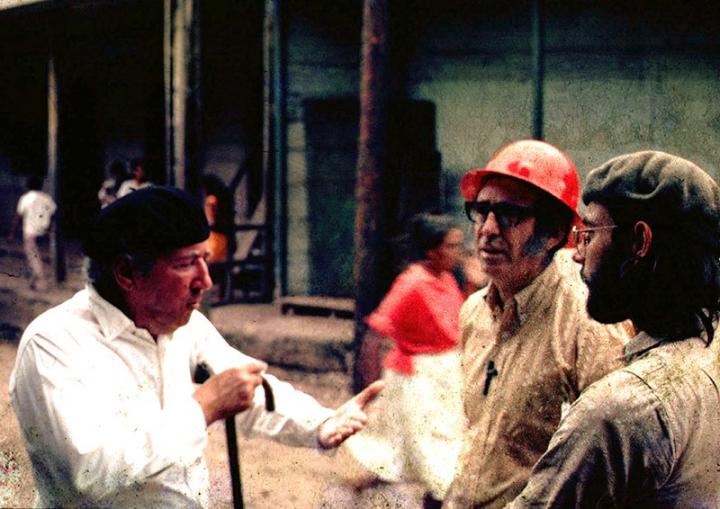
José Coronel Urtecho (left) with Fr. Fernando Cardenal (in hard hat) and young seminarian, Toño Cardenal.3 (source)

So, let’s assume the Christianity handed to us is not as pure as our preachers want us to believe. In fact, let’s assume a great deal of what most of us have been taught from our parents and the pulpit is a false gospel designed to obfuscate the true Gospel for the purposes of promoting and protecting other agendas. (I believe this is at least likely, given human nature, but the evidence seems overwhelming.) Regardless, if we take ideology to be a system of ideas and ideals, such that they form the basis of economic or political theory and policy, then we can’t help but bring ideology into Christianity. We don’t have a choice. The peril of insisting we will not bring ideology into the interpreting and the living of our faith is that we will bring ideology into our faith whether or not we are aware of it. The question is not one of ideology yes or no, for it is always yes, but of which ideology best helps us to extend the Gospel into personal, public, social, and political praxis. I have not settled the issue for myself about communism, and I certainly believe the Lenin/Stalin/Mao forms of communism profoundly misguided and prone to all kinds of evil, but I find the assumptions of those French socialists and the ideas of Coronel from Nicaragua at the very least intriguing.


1Jonathan Sperber, Karl Marx: A Nineteenth-Century Life (New York, New York: Liveright Publishing Corporation, 2014), 118.

2Ernesto Cardenal, The Gospel in Solentiname, trans. Donald D. Walsh (Maryknoll, NY: Orbis Books, 2010), 232-233.

3A word about Toño Cardenal (aka Comandante Jesus Rojas): “Born in Nicaragua to a prominent family, Cardenal was one of the ten children of Julio Cardenal and Indiana Caldera. His father’s cousins included Ernesto Cardenal and his brother Fernando, both priests who adhered to liberation theology. Cardenal decided to pursue a career in the Jesuit seminary. After being sent to El Salvador as a priest, Cardenal was profoundly impacted by the anti-Jesuit violence he witnessed perpetrated by the Salvadoran government. Due to these events, he went underground as a rebel leader of the FMLN movement, in which he led the FPL (Fuerzas Populares de Liberación) for several years. He was a major proponent of the peace talks with the government in the early 1990s, and worked towards a negotiated peace for both sides. On April 11, 1991, Cardenal was assassinated by a group of Army troops attempting to sabotage the peace process. However, the FMLN leadership decided to proceed with the talks at the expense of one of their commanders.” (From Wikipedia) Also, his aunt, Violeta Chamorro, was the president of Nicaragua from 1990 to 1997.

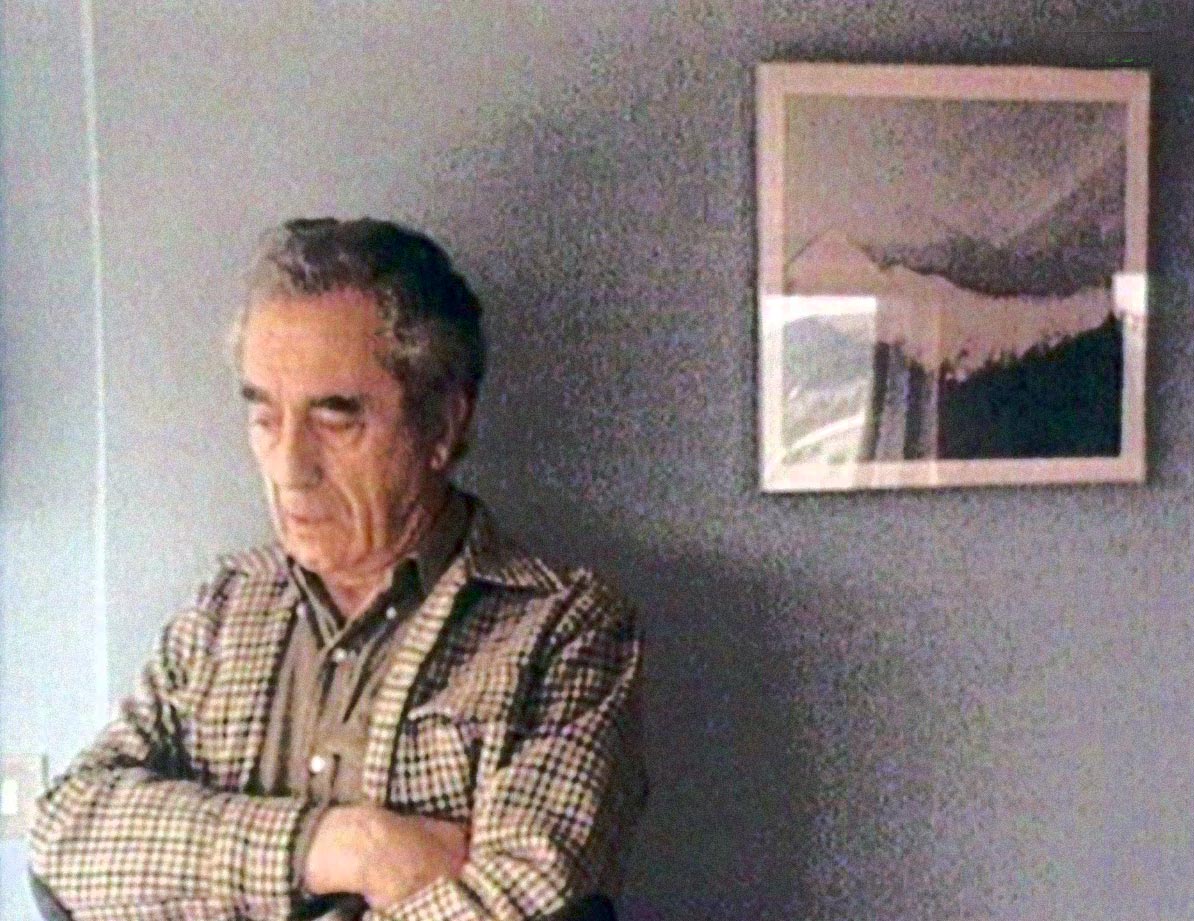
ennui the door

This post was first published August 6th, 2007, shortly after two of the greatest filmmakers who every lived died on the same day. In many ways the sentiments of hopelessness are just as much with us now, haunting our world, as then. I feel this post still resonates. Therefore, I am republishing it again.

If I should cast off this tattered coat,
And go free into the mighty sky;
If I should find nothing there
But a vast blue,
Echoless, ignorant—
What then?

– Stephen Crane

The recent deaths of Michelangelo Antonioni and Ingmar Bergman, on the same day no less, highlighted two realizations for me: 1) I am, in many ways, a “high modernist” in my aesthetic tastes and passions, and 2) the prevalent and particular questioning of the concepts of truth and hope found in high modernism seems to have disappeared as a noble pursuit. In other words, I long for the days (which were before my time) when artists and filmmakers saw the modern, industrialized, nuclear world as harsh and bleak, but believed that art could truly change that world for the better – even if only by asking the tough questions. (Of course we all imagine the past as we wish.) Today, artmaking is too often viewed cynically, that is, there is no point in tackling the grander themes, rather art is merely about what is only personal and private, and therefore essentially non-transferable, and therefore merely kitsch. That filmmaking can no longer change the world seems to be the prevailing perspective.

There was a kind of hopelessness in both Bergman and Antonioni, but there was also a sense that at least art and human creativity meant something, and therefore it was worth giving it a try anyway. It was also true that each of them, in their own ways, saw that the big questions of life – is there a god? what does it mean to be human? is there a viable salvation for humankind? etc. – were worth asking and pondering and turning inside out. I believe those are still live questions. I am inclined to think, however, that for the most part, filmmakers (except maybe some at the fringes) today do not see those questions as worth being asked.

Consider Antonioni.

Maybe no other filmmaker captured the alienation of humanity in (and to) the modern world as well as Antonioni. He cut to the heart of the difficulty of people loving each other, and finding authentic love, within the world that humanity had created for itself. According to Stephen Holden:

He was a visionary whose portrayal of the failure of Eros in a hypereroticized climate addressed the modern world and its discontents in a new, intensely poetic cinematic language. Here was depicted for the first time on screen a world in which attention deficit disorder, and the uneasy sense of impermanence that goes with it, were already epidemic.

This condition has not left us. In many ways we are still profoundly alienated from this world and from each other. The alienation may even be greater now than when Antonioni first portrayed it on screen. And although he did not give us an outright solution, the response should not be to throw up one’s hands, exclaim life is just absurd and devoid of answers, and then fall into hedonism, consumerism, narcissism, or suburban apathy.
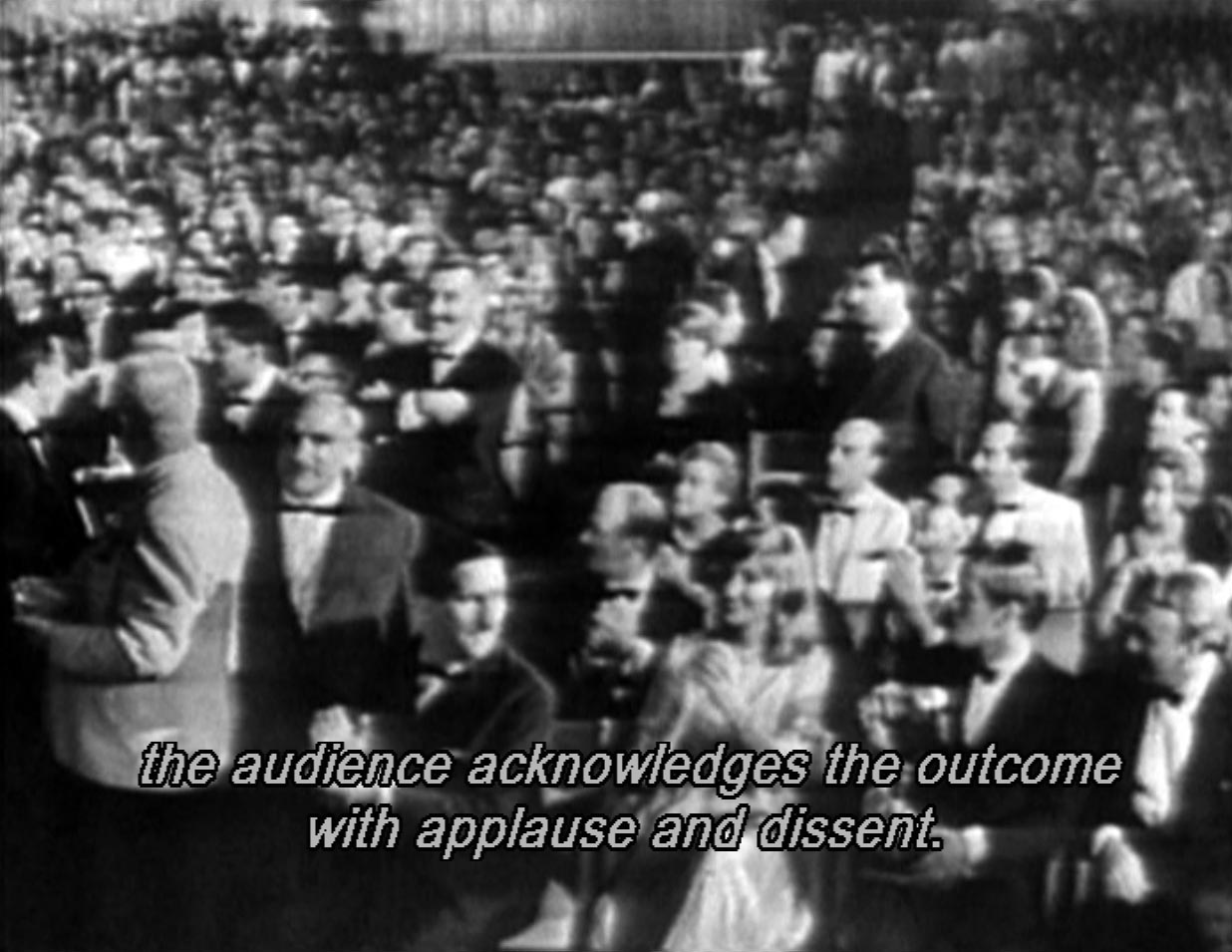
When Anotnioni won the Golden Lion award at the 1964 Venice Film Festival for The Red Desert (1964), the crowd had mixed feelings.

 
What is great about such contrasting responses is that it signals that people cared about the outcome, that what Antonioni was creating had meaning, that he was saying things that required a response – love them or hate them. Four years earlier he was also booed at Cannes for L’Avventura. But that was then.
 
Rosenbaum, in his piece on L’eclisse for the Criterion Collection release of that film, states:
 

This was a time when intellectual activity about the zeitgeist could be debated, if not always welcomed, with Godard and Antonioni the two most commanding figureheads. L’eclisse (1962) appeared the year after Chronicle of a Summer, Last Year in Marienbad, and Paris Belongs to Us, the same year as The Exterminating Angel and Vivre sa vie, and the year before Contempt and Muriel—a period, in short, when large statements and narrative innovations often came together.

That is my understanding (of course not my experience) of the late Fifties and Sixties. The zeitgeist was critical. Mankind was in a giant philosophical flux, and big issues, existential issues were on the table and debated. Film was seen as important, and film departments were started at universities and colleges. Film festivals were important for political reasons and not merely for the glam. Bergman and Antonioni, among many others, were hotly debated, loved and despised, revered and condemned. And then it seemed like none of that really mattered so much. The mid-1970s arrived and the pursuit of these higher goals began to wane. The great leaders had been shot, Vietnam had “ended”, the counterculture became more and more of a drug culture, humans had already walked on the moon and that wasn’t so exciting anymore, the Beatles broke up, Nixon brought even more shame to government, and a self-absorbed “me” generation began to create a new zeitgeist of cynical pleasure. People didn’t go to the theater to find god anymore, they went to the theater to find a thrill. They didn’t go seeking truth, they went seeking a shark, or a spaceship, or the next escape from reality. I know I did.
 
I, of course, am over-simplifying and romanticizing a bit. People have always sought the thrill and the escape. Truth has always been debated. And some films still stir the soul-searching imagination and foster debate. Plus the 1970s were also an age that started many great things: personal computers, the environmental movement, the slow-food movement, to name just a few. But we are living in an age where the struggle after god and truth are essentially passé. The assumption is that there is no Truth (with a capital “T”), there are no true ethics, there is no God, there are only situations and opinions, and so, for the most part, nobody really cares anymore. The death of Bergman and Antonioni remind us of of a time when cinema was a medium for these pursuits to play themselves out, and people went to the theater to see them played out, and later, over coffee and cigarettes, or walking across campus after the student union showing of a Godard, or later still in bed with one’s lover, debated the meaning of those films and of ourselves.
 
No need to despair, though. The big questions of our existence are still with us, and if we are brave enough we can still talk about them. And film is still of of the great mediums with which to explore who we are.

As for Antonioni, much has been said by those more intelligent than I about his genius. But what is important to separate is the ennui of his characters and his own personal hope – I say this only from watching his films, not studying the man himself.
 
In fact, I think it is important to consider that Anotnioni was no true pessimist. He saw people as being trapped in the world that they have created. But he does not say there is nothing they can do, or that there is no other world. Consider this little scene from L’eclisse:
 
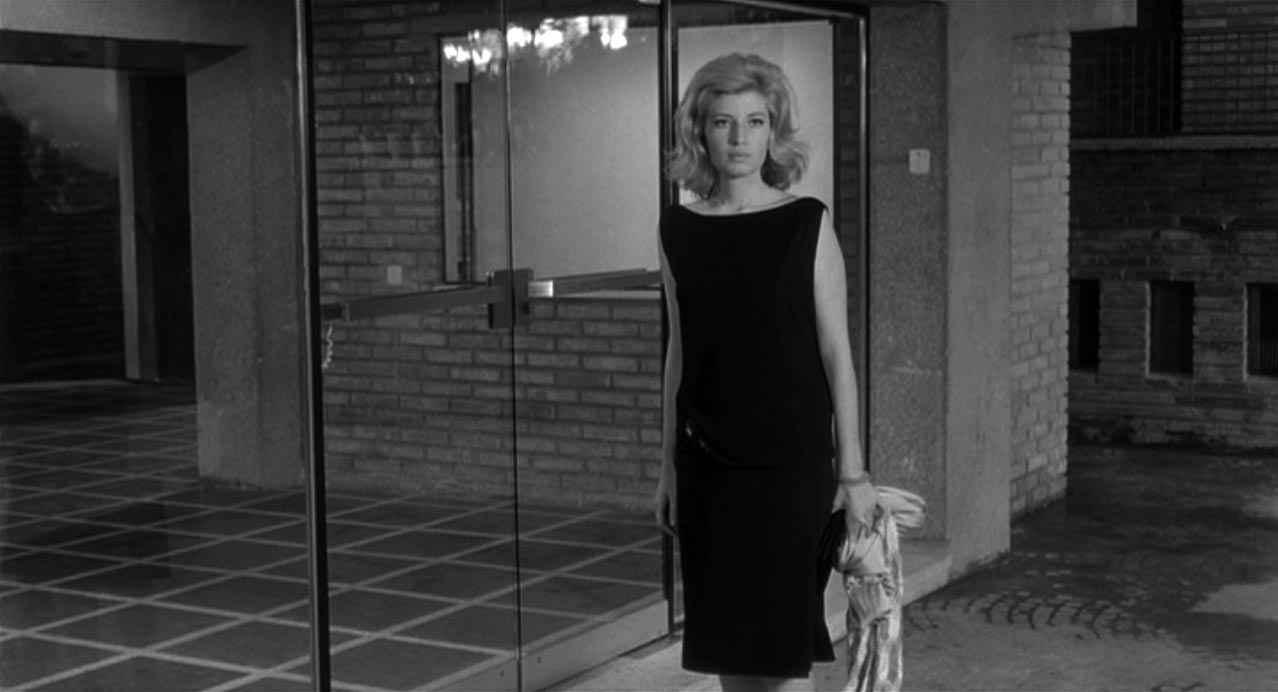
Vittoria (Monica Vitti) has left her lover. The relationship has been empty and she feels the ennui of living in the modern age. Although her feelings may not be entirely clear to herself. She walks back to her apartment.
 
 
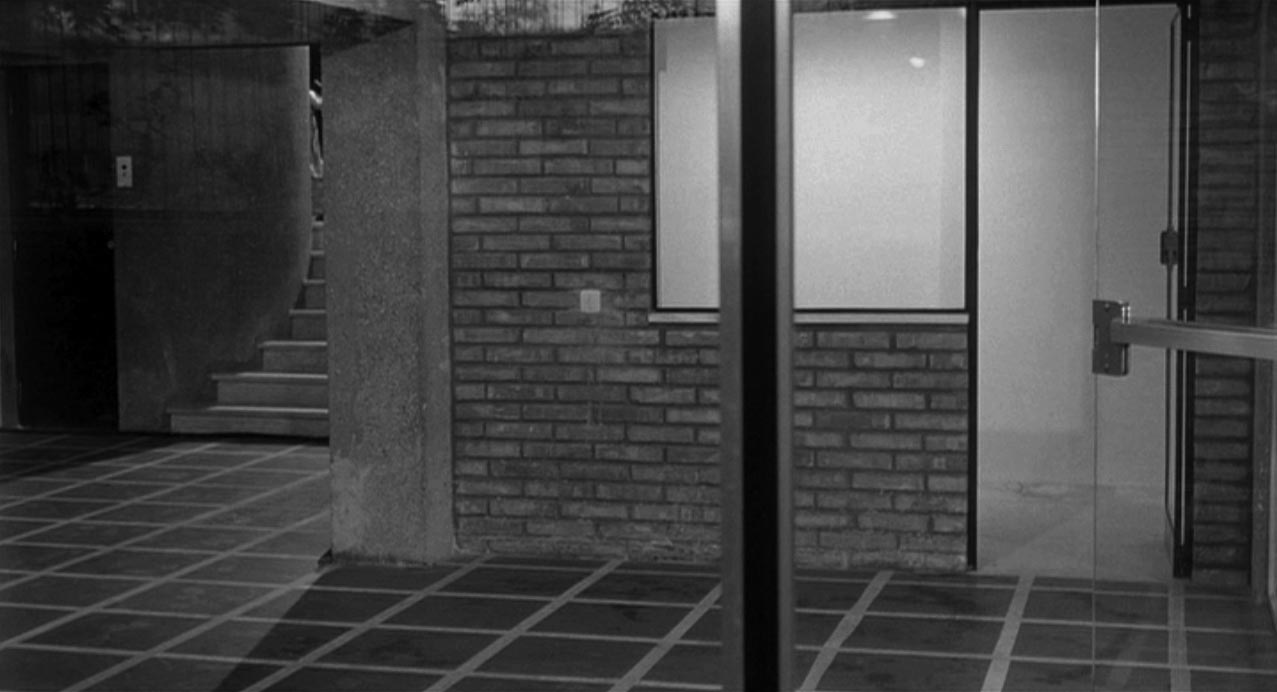
Here she watches her ex-lover walk away as she stands at the entrance of her apartment building. She is visually framed by elements of that building which seems to dominate the scene. There is a kind of hopeless emptiness in her eyes and posture. She does not yet know that it was not that she was trapped in an empty relationship from which she is now free, rather she is still trapped in herself in the modern world. Antonioni uses modern architecture to symbolize the prison of modern society.
 
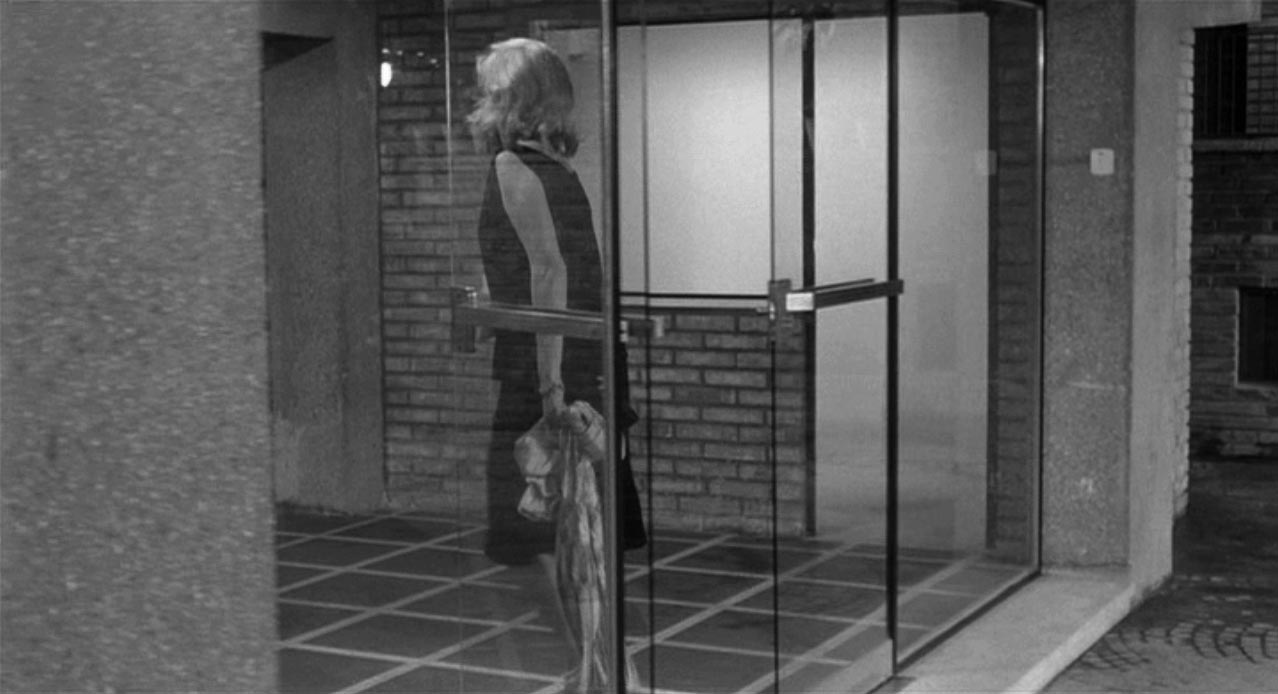
Then Vittoria goes through the glass doors. The camera tracks left to follow her movements.
 
 
In the foreground the corner pillar of the building comes into the frame.
 
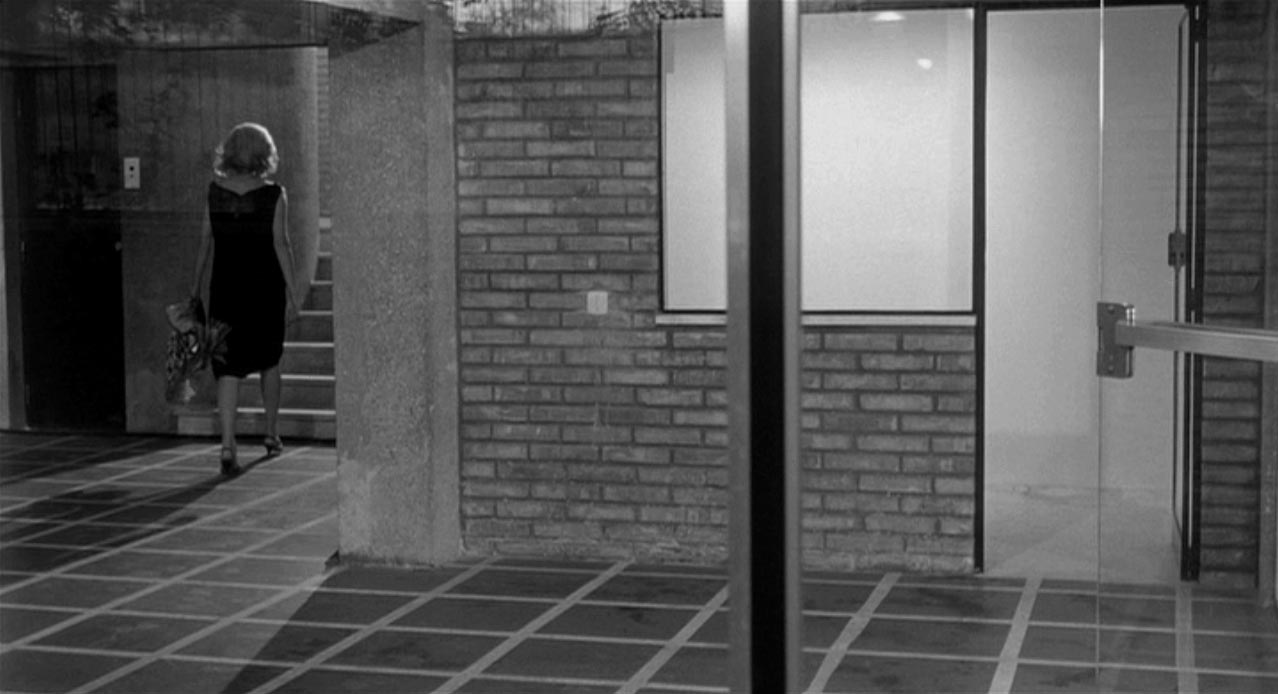
Vittoria walks through the foyer as the camera continues to track left. But then the camera stops so that we see only a sliver of the stairwell.
 
 
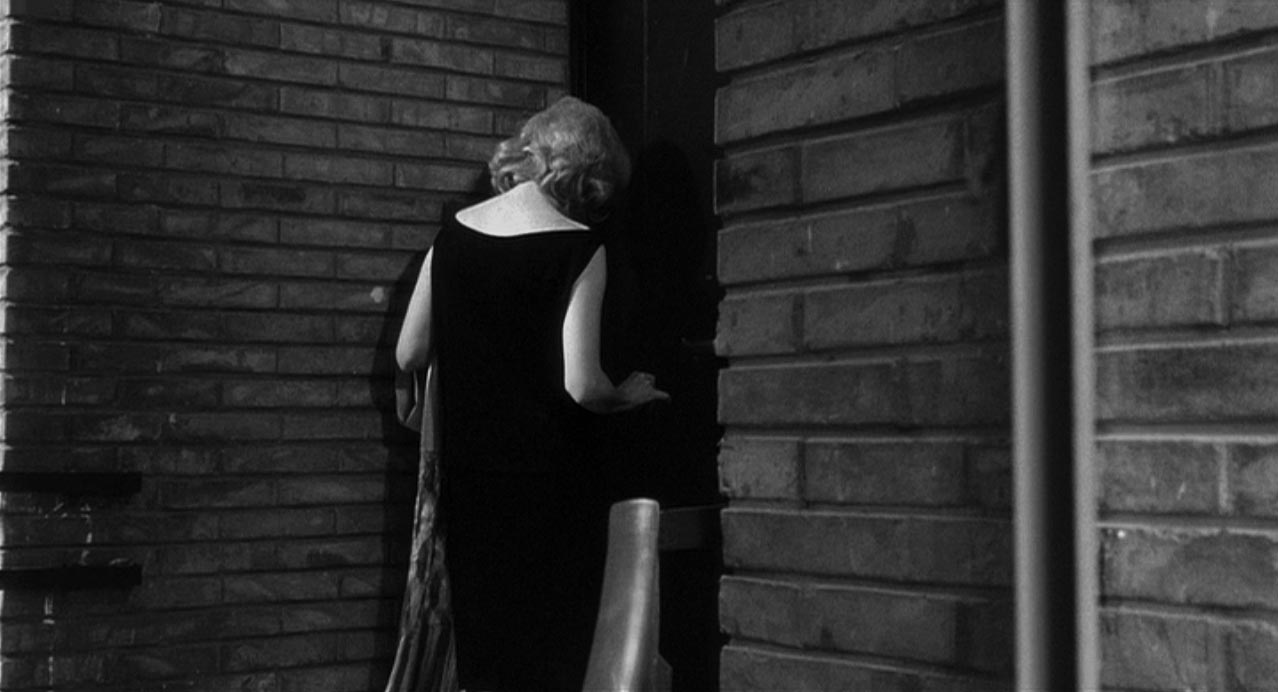
Vittoria walks up the stairwell and disappears around the corner.
 
 
It is as though she has been swallowed by the building.
 
Then we see her at her apartment door. Again she is visually framed by the building’s architecture.
 
 
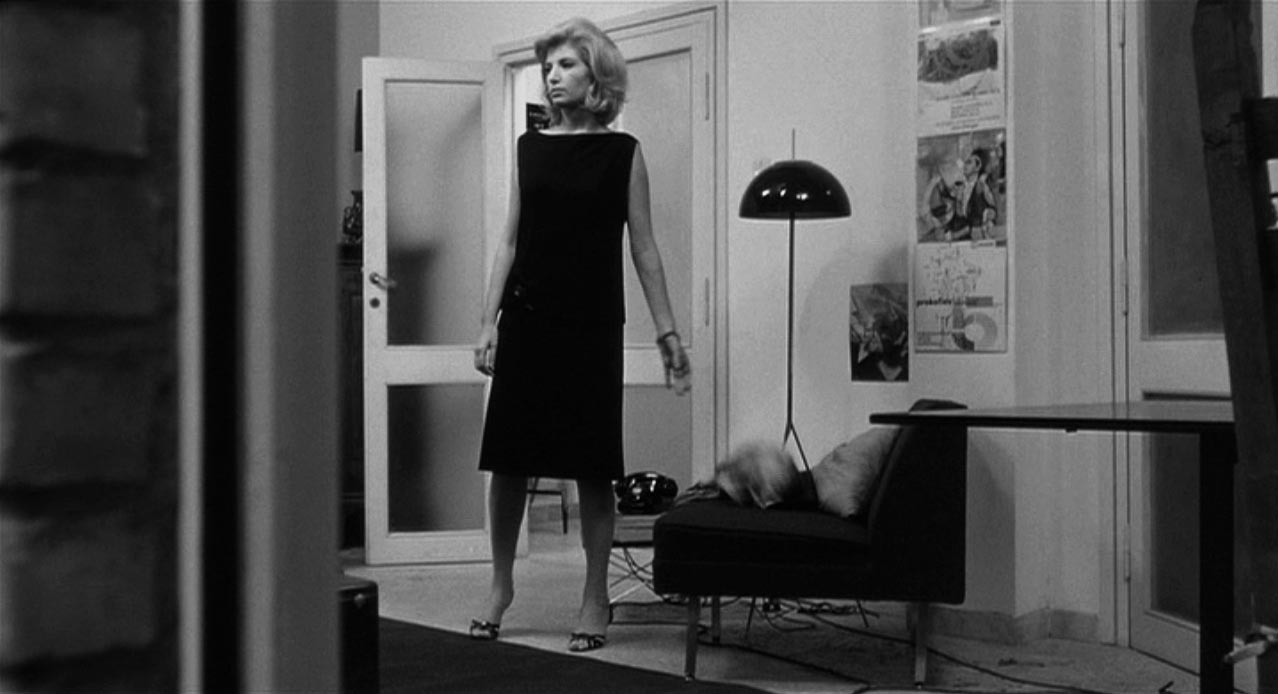
As she enters her apartment the camera is placed outside her windows in such a way as to emphasize that she is inside the building. And again, the architecture dominates, framing her “within” its space.
 
 
It should be noted as well that her apartment is chic and modern. She is a beautiful, rich woman living in a beautiful, richly furnished apartment which surrounds her with the bounty of wealth. She has it good, one could say.
 
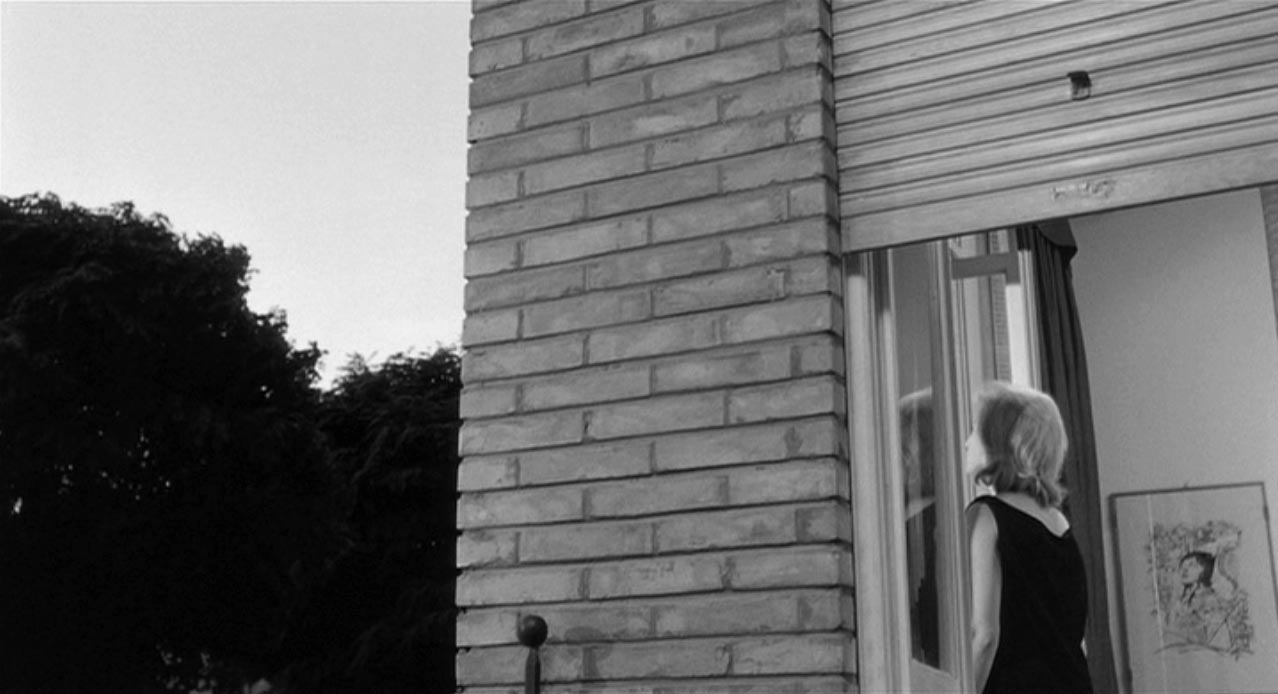
She then walks through her apartment and goes to the window. Outside the wind is blowing the trees.
 
 
The only thing we hear is the wind in the trees. Here we have the modern world set against the timeless natural world. One world is visceral the other is sterile. One world is dead the other is alive.

The final shot of this sequence is critical, and one of the most important shots of the film. Antonioni is setting up a contrast, one that Vittoria sees but does not see. The truth is she is not lost, she is choosing her life.
 
Every pessimist is an optimist, and so was Anotnioni. When Vittoria looks out that window at the trees, she is trapped by her own choosing, but she can still choose. The walls of her chic apartment are a barrier to the life beyond those walls, but the apartment has a door. The question is whether she has the eyes to see that she has a choice.
 
And what is truly important anyway is that we can see, and we can choose. Ennui is a challenge to us, but it is also a door through which we discover ourselves and to understand that we must choose. Antonioni helps us see, and his films are but one doorway to that choice.

The Revolution of the Vernacular: When the Catholic Mass Became an Instrument of Liberation Theology

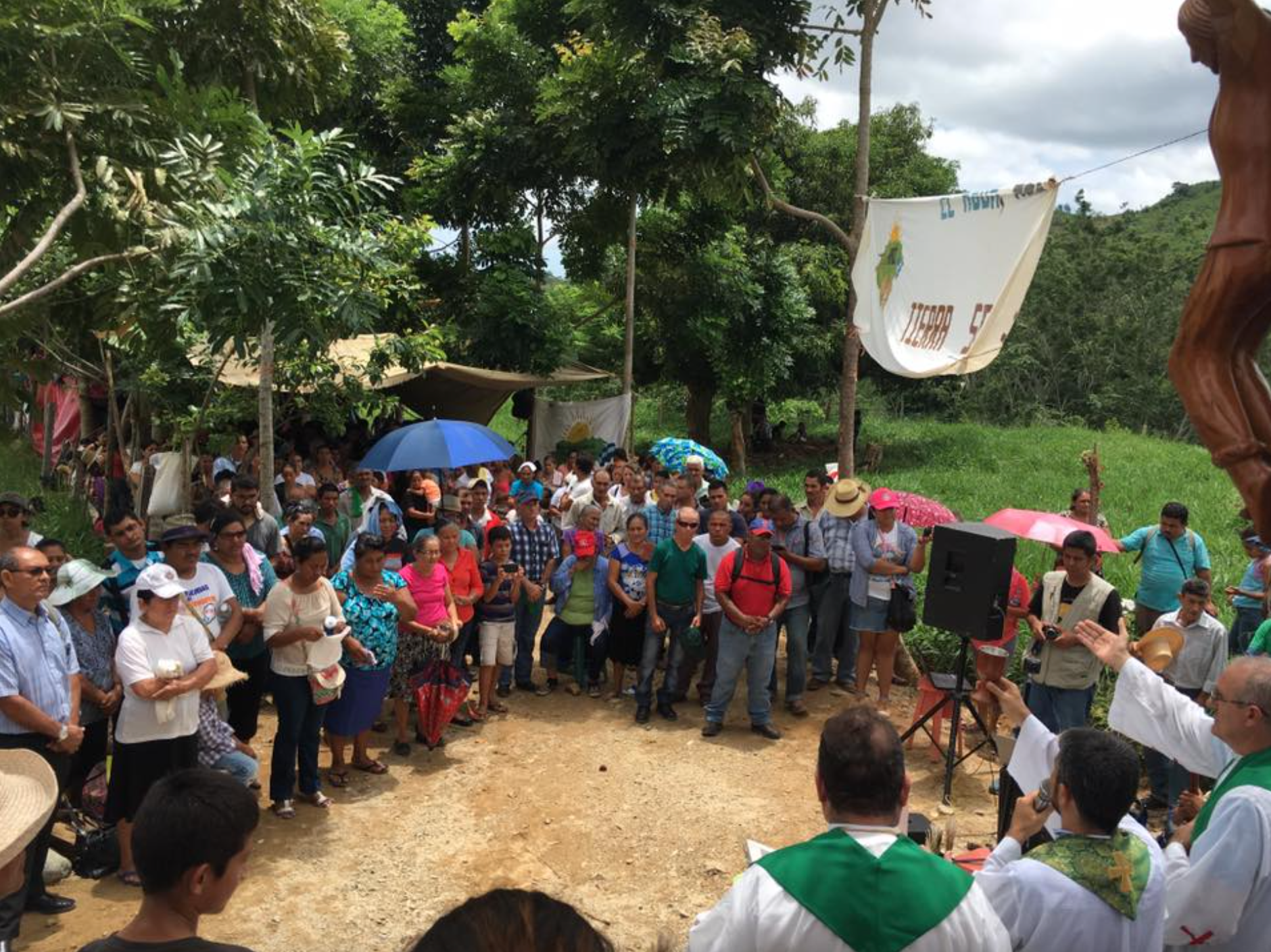
Priests celebrate Mass for protesters in the middle of a rural street in Honduras in 2017 in an effort to block the passage of equipment for a construction project that would be harmful to the environment. (source)

Latin is a beautiful and ancient language. Many consider it a sacred language as it is one of the three languages used for the inscription Pilate had affixed to the Cross declaring Jesus king of the Jews (the other two being Hebrew and Greek). Latin was also the language used for centuries for the Roman Rite Mass. Of course, few people, including Catholics, know Latin well (even the U.S. bishops who participated in Vatican II famously struggled with the Latin documents). 1969 was perhaps the most pivotal year for many decades for the Church, for the Mass was changed and the vernacular, which was now allowed, soon became the dominant language, in some cases entirely replacing Latin. The flood gates were opened for the vernacular.

For many Catholics around the world, this was the first time they had heard the Mass in their own tongue. Think about that—the first time hearing the prayers, the chants, the creed, and especially the readings in one’s own language. Not only does that mean they could understand what they were hearing, they now could, in a sense, own it. There was no longer a distance, a gulf between the laity and the Mass.The Mass became their own, not a foreign thing.

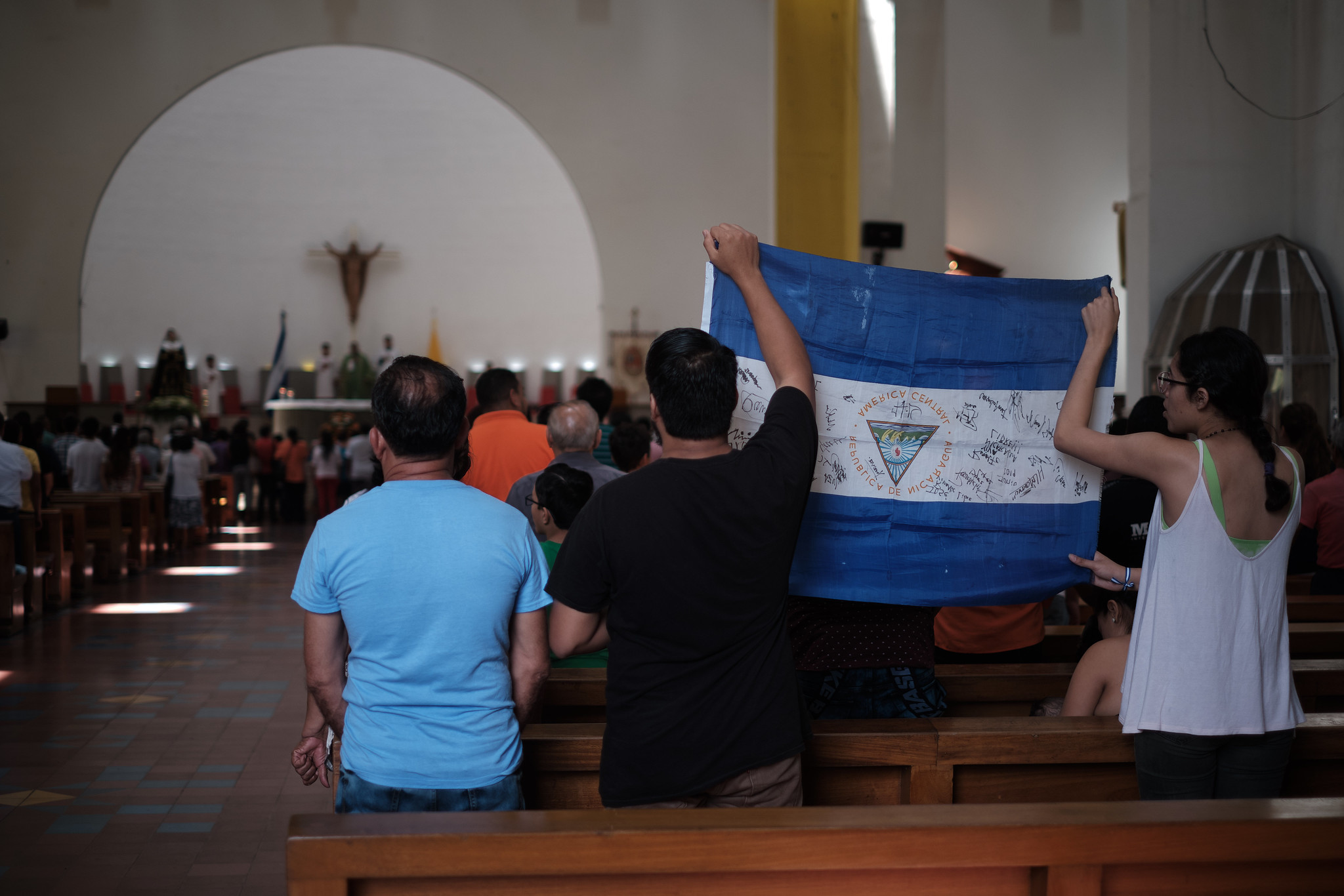
Citizens raising the Nicaraguan flag upside down as a way to protest at the Managua cathedral. Photo: Carlos Herrera (source)

There has been a consistent lament about the loss of Latin from some corners of the Church since 1969 but, for the most part, use of the vernacular was fully embraced and celebrated by most Catholics and remains their preference. This is true for both laity and priesthood. The distance shrinking between the two was a welcome change. Something surprising also happened. When Catholics began hearing the Gospels read in their own language—and remember many around the world cannot read or don’t have the means to afford a Bible, thus the Mass is where they heard the Gospels—they heard the radical nature, the explosive content of Holy Scripture no longer hidden behind a veil. They could also begin to judge the homilies as they compared the preaching to the words of the Gospels, and in some cases they began to see a disparity between the two. For some, that disparity shone a light on the dichotomy between rich and poor, oppressor and oppressed, and between the earthly kingdom and the Kingdom of God.

Roman Catholic pilgrims travel in a boat as they accompany the statue of Our Lady of Conception during an annual river procession and pilgrimage along the Caraparu River in Santa Izabel do Para, in the Amazon jungle December 8, 2012. The statue is transported by boat along this small Amazon tributary to a small chapel in the village of Cacoal, where a mass is held. Picture taken December 8, 2012. REUTERS/Paulo Santos (source)

We have all heard of people who once denigrated Christianity only to later change their views because they read the Bible for themselves rather than receiving it through the filter of organized religion. Consider this passage from The Gospel in Solentiname in which some poor folks (campesinos), who have been reading and discussing the Gospels, point out a fascinating fact:

[Ernesto Cardenal] said: “I’ve just had a visit from a young fellow from the north, from Estelí, from a poor town. He is a campesino like yourselves, and he was saying that there, to get together for their Masses first they have to ask permission from the police, and the police captain said that those gatherings were dangerous. The captain is right, for they gather to talk about the Gospels.” […]

TOÑO: “That didn’t use to happen here because the Masses were in Latin. The priest read these things but he read them in Latin, and he didn’t explain them to the people. So the Gospels didn’t bother the rich or the military.”1

Now that the Mass was celebrated in the vernacular the reality of the Gospel frightened the earthly rulers and the rich who oppressed the poor. All saw the possibility of revolution. Some were afraid and others found joy.

Christ made it clear that one of the fundamental enemies of the Gospel are the rich. The Church has spent nearly two thousand years trying to downplay and obfuscate that clear truth. But there’s only so much evasion one can get away with once the Gospels are read or heard as they are. Fortunately, there have been many in the Church who didn’t play along with the dominant ideologies. Some became well known—Saint Francis comes to mind, and so does Óscar Romero—but most are not, such as the many priests, religious, and even more laity killed in Latin America at the hands of US-backed governments because they defended the suffering poor against the oppressive rich. All were marked by a direct confrontation with the Gospel.

Vatican II and the Mass of Pope Saint Paul VI which flowed from the council took the bold step to get the Gospels more directly into the hands of the faithful.

In Latin America the vernacular Mass began to appear even earlier than 1969, such as the Misa típica panameña de San Miguelito (Panamanian Folk Mass of San Miguelito, 1966).2 Of course, when we refer to the Mass we refer not merely to the readings, homilies, and spoken prayers but also to the chants, songs, and creeds. Spanish language Masses began to be written and even recorded and spread via LPs. For example, the Misa Campesina Nicaragüense (“Nicaraguan Peasants’ Mass”) with words and music by Carlos Mejía Godoy, and incorporating liberation theology and Nicaraguan folk music. It was inspired by the faith community in Solentiname and was first celebrated in 1975. Here is the entrance hymn from the Misa Campesina Nicaragüense:

Notice the addition of liberation-themed images in the video above. The use of the vernacular encouraged the development of folk Masses and thus reached the hearts of the people more readily—those people included priests as well. The writing and recording of these Masses, in forms that could be easily sung by the faithful, and with the fundamental Gospel theme of liberation, contributed to the spread of liberation as a social and political force in Latin America and, not only that, linked that liberation to the saving work of Christ and the faithful life Christians are called to live. Liberation, as a political force, was seen as a call to the faithful, thus countering the over-spiritualization of the faith, of interpretations of Scripture, and even of worship itself.

Bernard Gordillo writes of the power of the new Mass settings in Latin America and how they helped change the culture and enriched the faith [emphasis added]:

The Catholic Church underwent profound renewal during the 1960s. The bishops of the Second Vatican Council elected to engage the modern world in response to its social and political challenges. Catholics saw the church acknowledge them and adapt to their realities. The once steadfast celebration of the liturgy, a bedrock of sacred rituals, now addressed local or regional identity. Latin and plainsong gave way to vernacular languages, musics, and performance practices. Taking inspiration from this wave of change, Catholic musicians, writers, and artists created diverse musical settings and textual translations of the liturgy, in addition to innovative visual art. These developments took on particular resonances in Latin America, where the bishops of CELAM sought to confront systemic poverty and injustice by affirming the experience of the poor, as well as the social and political processes that would give rise to a theology of liberation. Singing was an abiding collective expression wherever concientización took place, not as a secondary feature, but as part and parcel of a ritual whole, forming a circular relationship between concientización, prayer, and song. This uniquely Latin American postconciliar ritual (concientización-prayer- song) was the fundamental building block of the liberation method for the Familia de Dios movement. The vernacular masses that emerged from San Miguelito, San Pablo Apóstol, and Solentiname musically embodied the community in reflection of its collective identity. They accompanied the transition of liberation practices from internal community building to outward social and political engagement, as enacted by postconciliar priests, religious, and lay people. If the origins of liberation theology lie in the experiences and critical awakening of the poor, they also lie in their expressions— spoken and sung. The Familia de Dios masses were thus musical emblems of this process within their respective popular church communities. They were liberation masses that sang of faith, hope, and struggle in a post conciliar world.3

Consider, that after centuries of Christendom and the Church, in collusion with governments and ruling powers, seeking worldly power, after centuries of the Church protecting itself from the challenges and judgements of the Gospel and the often frightening workings of the Holy Spirit, a council, a new Mass, and a group of Latin American bishops took the risk and sought to allow worship that might address local and regional identity, getting the Gospel into the vernacular, and promoting the radical message of liberation. No wonder Liberation Theology took root in Latin America.

The Gospel is like a hidden treasure because nobody used to understand it, right? They used to read it to us in Latin, and they preached on it in a way that wasn’t even close to the true Gospel. And now we’re discovering it, as you might say: we’re finding a treasure.4


1Ernesto Cardenal, The Gospel in Solentiname, trans. Donald D. Walsh (Maryknoll, NY: Orbis Books, 2010), 122-123.

2Note: I have no personal history or real connection with Latin American histories or cultures. I am merely at the beginning of my own journey of discovery arising from my interest in Liberation Theology. My own background includes being a descendent of mixed European origins and having benefited from an American society whose economic opportunities, of which I have enjoyed somewhat, are connected to the plundering of Latin America.

3Bernard J. Gordillo, “Vatican II, Liberation Theology, and Vernacular Masses for the Family of God in Central America,” EliScholar, 2021, https://elischolar.library.yale.edu/yjmr/vol7/iss1/3/, 81.

4Ernesto Cardenal, The Gospel in Solentiname, trans. Donald D. Walsh (Maryknoll, NY: Orbis Books, 2010), 237.