>just another week in pepper spray history

>I’m getting a kick out of watching the “other” news of the RNC, that is, the protests outside the convention that are not really being covered much by the mainstream news. But first, here’s a recruitment video made by the RNC Welcoming Committee (an anarchist/anti-authoritarian organizing body) prior to the convention:

http://video.google.com/googleplayer.swf?docid=1982101605603600567&hl=en&fs=true

I love it. Fun, goofy, and it indicates a major aspect of the protests, that is, they’re thrilling to do. In other words, being a protester, though driven by apparently deeper meanings, is also something people do because it’s an exciting form of entertainment – like playing sports, but more important. I have to say that after watching the following videos I would much rather be with the protesters than inside the convention, though I am not so anarchist in my philosophy, or so anti-authoritarian in my reactions – though I am a little of both.

This video also highlights the reality that contemporary political/social movements are leveraging new media forms with aplomb. Modern protests are far more organized and prepared than they used to be, but so is the response.

[Side Note: So far eight members of the RNC Welcoming Committee have been arrested and charged as terrorists. Plus the I-Witness Video Collective has been evicted from their offices after police raided their building on what look to be trumped up charges. That group was responsible for videotaping much of the 2004 RNC protests and those videos led to most of the cases against the arrested protesters to be dropped. Apparently case after case the videos showed the police officers had lied. That may be why the police don’t want cameras taping them this time around.]

Now that it’s been a couple of days since the initial protests outside the RNC a number of videos have been appearing online. The first three below are video/photo collages that offer some overview of what is going on. There is some overlapping content between the three videos. At a minimum these collages offer some interesting psychological and sociological data to consider.

Finally, here is one of the most interesting, entertaining, and low quality (read verité) videos from the protests. I love the personal commentary.

Of course, one has to ask if any of these protests, violent or peaceful, have any objective value beyond the personal sense of making a statement. It is important to make statements, to carry signs and rant, to march and, hopefully, get on the news, but what is actually accomplished? The RNC continued on as though no one is protesting, as though the protests are so insignificant and inconsequential as to not even warrant a sideways glance. I also believe some of the same protests were deserved at the DNC, but I don’t remember if there were any.

I am reminded of two quotes by Mahatma Gandhi:

“It is better to be violent, if there is violence in our hearts, than to put on the cloak of nonviolence to cover impotence.”

“Victory attained by violence is tantamount to a defeat, for it is momentary.”

These quotes underline the balancing acts in both effective protesting and in cracking down on protesters. Both sides have to live with the consequences of their actions, and ask the question “what really was accomplished.” I cannot help but think the actions and the style of the police will only lay the foundation for more of the same, and then bigger and more substantial protests. In the end the police, and those who back them, will likely lose the battle. In the mean time I fear many citizens will be hurt.
>Democracy at a Crossroads: Structures of Power Outside the RNC

>We know this country has become polarized on multiple levels. We know that a thriving democracy is a struggle. But we also know that there is a difference between the messiness of democratic action and the actions of heavy handed social control. Sometimes (usually) messiness is better, though it is unpredictable.

With this in mind I have been curious about the two big political party conventions and the manner in which those with the guns and body armor are going to support democracy. The Democratic National Convention seemed to go off without a hitch. They even opened up a giant stadium to let in everyone they could. The Republican National Convention (RNC) is another story. So far there have been numerous riots, police violence, and arrests.

Question: Should police use force against peaceful political protesters? I can understand trying to stop violent protesters from hurting others or damaging property – though property is not so nearly as sacred as human life or well being. Although I am against violence I am not against being rowdy and noisy for important social and political concerns. Consider this video* of police attacking apparently peaceful protesters at the RNC:

What you see in this clip are people walking along a street. What you also see and hear are heavily armored police officers shooting some of the walkers with rubber bullets, which is even more aggressive than hitting someone with a baton in my opinion. The police also use tear gas to split up the crowd. I cannot tell exactly what is was these particular walkers were doing that was so bad, but I doubt rubber bullets and tear gas was necessary… unless the goal is to make sure, with complete certainty, that the hierarchies of power remain intact and understood.

Or consider this video clip that hearkens back to those flower-power protest images from the 1960s:

http://www.indybay.org/js/flowplayer/FlowPlayer.swf?config=%7BvideoFile%3A%27http%3A%2F%2Fwww%2Eindybay%2Eorg%2Fuploads%2F2008%2F09%2F01%2Fpepper%2Empg%5Fpreview%5F%2Eflv%27%2CsplashImageFile%3A%27http%3A%2F%2Fwww%2Eindybay%2Eorg%2Fim%2Fplay%2Dbutton%2D328x240%2Ejpg%27%2Cloop%3Afalse%2CautoPlay%3Afalse%2CautoBuffering%3Afalse%2CbufferLength%3A5%2CinitialScale%3A%27fit%27%2CbaseURL%3A%27http%3A%2F%2Fwww%2Eindybay%2Eorg%2Fjs%2Fflowplayer%27%2Cembedded%3Atrue%7D

I cannot say the woman in the green tank-top is acting in the most wise manner (at least for her own safety), but take a moment to compare the dress and collective action of the two different kinds of people in this video. One group seems rather loosely organized at best, wearing ordinary street clothes, and looking much like you and your friends. The other group is clad head-to-toe in black armor (rainbow plaid armor is not nearly as menacing), is fully organized into a phalanx, and is looking like extras from a Robocop movie. Honestly, I bet they love putting on that stuff.

Democracy is messy. Protest are necessary. Violence should be avoided. And people should be able to march up and down the streets without fear of tear gas, rubber bullets, or menacing storm troopers inciting violence. (I say inciting because their very presence, demeanor, and visual appearance is designed to be threatening.) I cannot help but think of some police officer yelling “This is no time for democracy, this the the Republican National Convention!” Or, the police thinking these protesters are stupid idiots for showing up with flowers to a tear gas fight.

But other interesting things have been happening related to the RNC. These include the raiding of homes of “suspected” protesters, such as in this video:

In light of that video remember these important words:

The right of the people to be secure in their persons, houses, papers, and effects, against unreasonable searches and seizures, shall not be violated, and no Warrants shall issue, but upon probable cause, supported by Oath or affirmation, and particularly describing the place to be searched, and the persons or things to be seized. (Amendment 4 to the U.S. Constitution)

Has line been crossed here? I can’t say for sure, but seems likely. I doubt there was probable cause.

And there was the raiding of homes of “suspected” journalists (who WERE journalists), such as in this video:

In light of this raid consider these important words:

Congress shall make no law respecting an establishment of religion, or prohibiting the free exercise thereof; or abridging the freedom of speech, or of the press; or the right of the people peaceably to assemble, and to petition the Government for a redress of grievances. (Amendment 1 of the U.S. Constitution)

Has line been crossed here? Looks probable.

Police also confiscated citizen journalists’ cameras and computers, as described in this video:

What is going on here? What is the answer to the question: Why are these police actions necessary? What is being protected? What is gained?

Not necessarily more important than the above situations and police actions, but certainly very critical when it comes to the importance and necessity of a free press in a democracy, here is a clip of the intrepid Amy Goodman of Democracy Now being arrested for investigating the brutal arrest of her producers Sharif Abdel Kouddous and Nicole Salazar:

And here is the video taken by Nicole Salazar as she was beaten and thrown to the ground by police even though she was telling them she was Press and was clearly wearing her Press card around her neck.

One can only conclude one of three things: 1) The safety of the police and of others was so grave that the police had no other choice but to treat her that way, 2) the police became so angry that their emotions made them act irrationally, or 3) there is a planned and concerted effort to intimidate and control any media that does not conform to the predictable and safe (to the established hierarchy of power) norms as exhibited by the major networks. The first choice is, at best, a stretch, and mostly likely ludicrous. The second choice is probably partly true, but too many law enforcement individuals were involved for it to merely be runaway emotions. The third is the most likely scenario, and is born of fear. And fear is one of the greatest threats to democracy.

A whole lot of questions are raised by these video clips, and there are many more videos of the same. I would argue that we are witnessing a time in which a sector of the population is living in fear that their world will not last, and that sector are those currently in positions of power. This may or may not be true. I also believe, however, that this is really nothing new. We have seen this many times before in this country in many different forms. In fact, that is part and parcel of the story of humankind.

Keep this in mind, if a free press is critical for a thriving democracy then it will, by definition and implication, be a threat to someone. If a democracy is threatening to those who need predictable power to get and keep what they want, then, logically a free press is a threat to those people. What do we have if we don’t have a free press? Do we have a democracy?

* Several of the video clips above were produced by The Uptake.

In Memoriam

War is a nasty business. This Memorial Day gives us a chance to remember those U.S. soldiers who have died fighting in wars. This is important. The sacrifice of a life for any cause is a substantial tear in the fabric of creation. Death affects many, and not only those who die. Death affects families, friends, co-workers, and communities. Death affects us all. Death is ugly, horrible, detestable. Let us then commemorate the sacrifice innumerable soldiers have made over the years.

Let us also remember that the reasons soldiers go to war and are willing to lay down their lives are often very different reasons than of those who send them to war. This is not to say every soldier has pure and righteous motives, but the glory of the soldier often hides the duplicitous and dubious goals of the political and economic motivations that seem to underlie every war. Let us not forget the difference.

And then we have the great burden on all of humanity that are wars. That soldiers die is terrible, but non-soldiers die too, and in often far greater numbers. These other members of humanity include children and other innocents. Let us remember them too.

And let us remember that wars are no grounds upon which to build mythologies.

My desire is to know truth, to understand the consequences, and to act in whatever way I can in light of that truth. My hope is that this Memorial Day is more than just remembering, rather I hope we honor the dead by creating a world in which the soldier is a thing of the past.

Death of even one affects us all.

No man is an island, entire of itself; every man is a piece of the continent, a part of the main. If a clod be washed away by the sea, Europe is the less, as well as if a promontory were, as well as if a manor of thy friend’s or of thine own were: any man’s death diminishes me, because I am involved in mankind, and therefore never send to know for whom the bell tolls; it tolls for thee.

~John Donne, from Meditation XVII
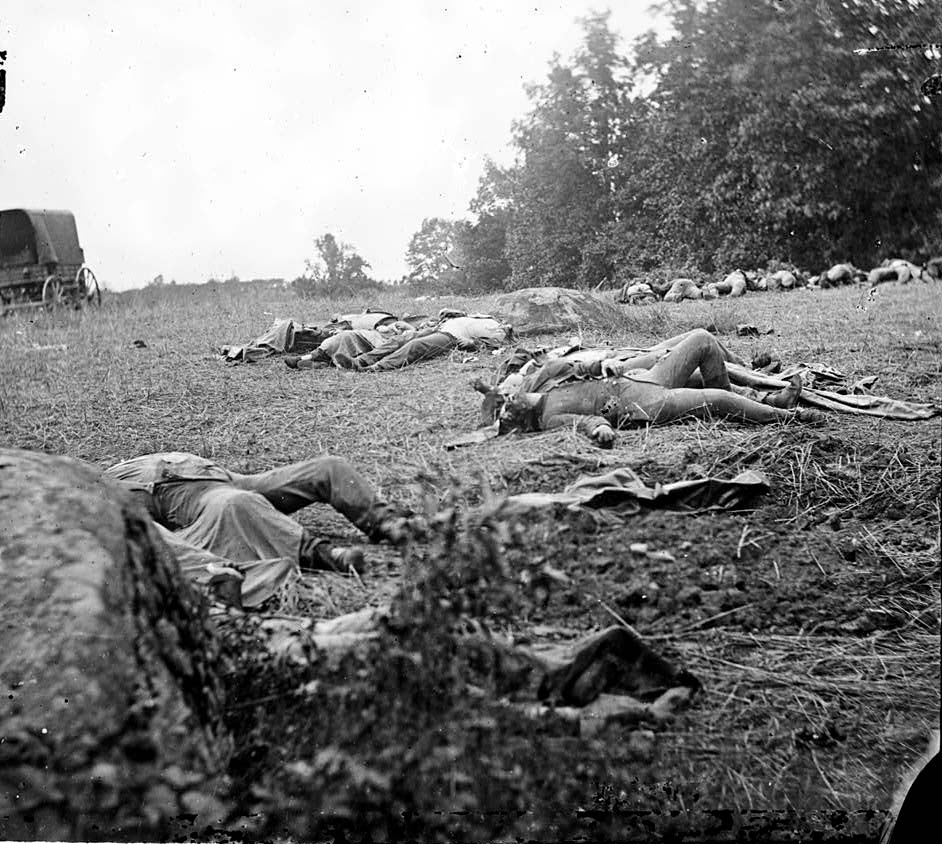
Memorial day was first enacted to commemorate Union soldiers who had died in the bloody American Civil War.

Battle of Gettysburg aftermath. Dead soldiers in the
wheatfield near the Emmittsburg road; 1863 July.
Photograph by Alexander Gardner.

As I get older I have a harder time seeing war as an adventure to be enveloped with brass bands and waving flags, and my simplistic reverence for war heroes is being replaced by a deeper sense of the tragedy of war and the stunning sacrifices made by those who have fought and are currently in war zones.

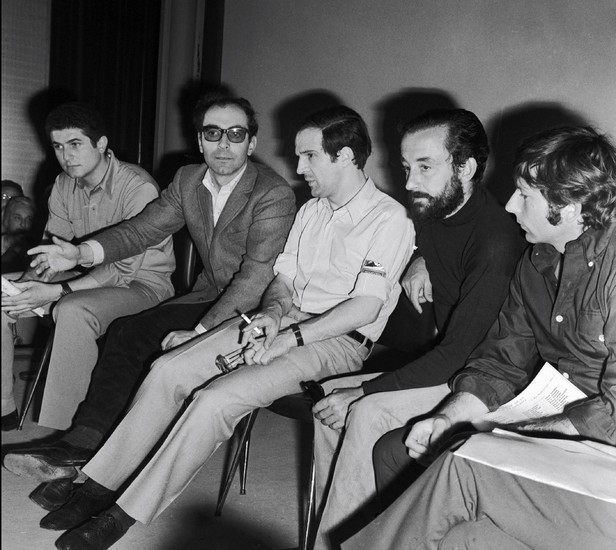
Mai 68

Lest we forget, 40 years ago this month it was “Mai 68”, that is, it was May 1968.

For most Americans (like me) the protests and riots that raged in France in 1968 are largely unknown. Like many protests of the 1960s there are questions as to their ultimate effectiveness. Certainly de Gaul was eventually pushed out, signaling a change from conservatism to liberalism. And, of course, Langlois was restored to his position, which was a part of the whole Mai 68 thing, though protests on his behalf started even earlier than May. But who really knows if any particular protest changed anything that would not have inevitably been changed anyway. And yet, those were glorious days, so I have read.

Here is a nice overview of some key elements of Mai 68:

My français is a bit rusty, but this is a nice retrospective timeline from French television:

There is a part of my soul that loves those protests in France, much like I love the protests in the U.S. in the 60s, or the anti-war protests and anti-globalization protests in recent years. Protesting is so romantic. Many cinephiles may not know that filmmakers shut down the Cannes festival (mentioned in the overview piece above) in 1968 as well.


The gang’s all here. Can you name each filmmaker in the photo?

This is a wonderful verité piece showing the debates among the filmmakers at Cannes deciding what their protest was going to mean and what actions that would require:

The fact that Cannes was closed down in 1968 shows that, as a film festival, it had clout, that it was important, and that films were important. I would love to see the Oscars shut down in protest to any number of things, such as the war in Iraq. But that would mean the Oscars are important and are we ready to admit that?

Special bonus: Captain Beefheart live in 1968 on the beach in Cannes.

*Filmmakers in the photo, left to right: LELOUCH, GODARD, TRUFFAUT, MALLE, POLANSKI