The Three-Act Story Structure

Once again I am diving into the struggle to write screenplays. In the past I got all snobby and looked down on the typical Hollywood story structure. I saw it as too conventional and I wanted to be artsy. Well, that got me a long ways.

In the mean time I have learned a thing or two, and have come to understand the conventions that drive Hollywood storytelling are, in fact, ancient paradigms that fit with human nature. In other words, the basic three-act structure (and it variations) was built into the human design by God. Sure, many have exploited it, have misused it, have done bad things with it – including making just plain schlock – but that does not nullify the fundamental character of the structure and how it engages with our minds.

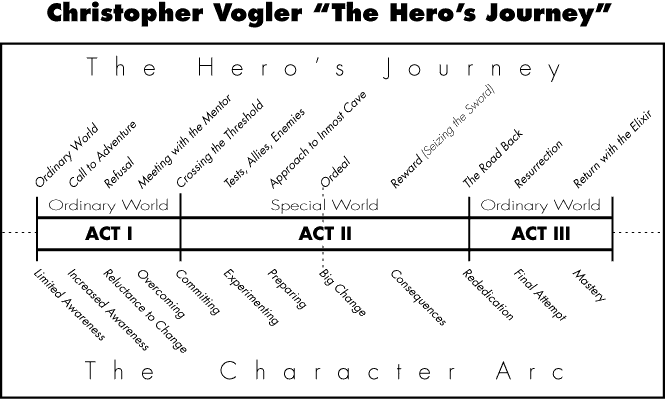
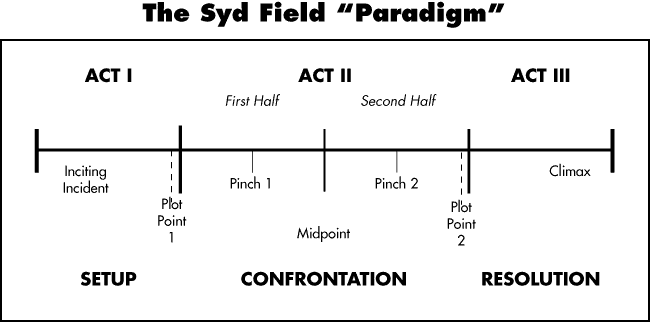
With that I am trying to teach myself the structure, and how to use it to my advantage. Here are some examples:
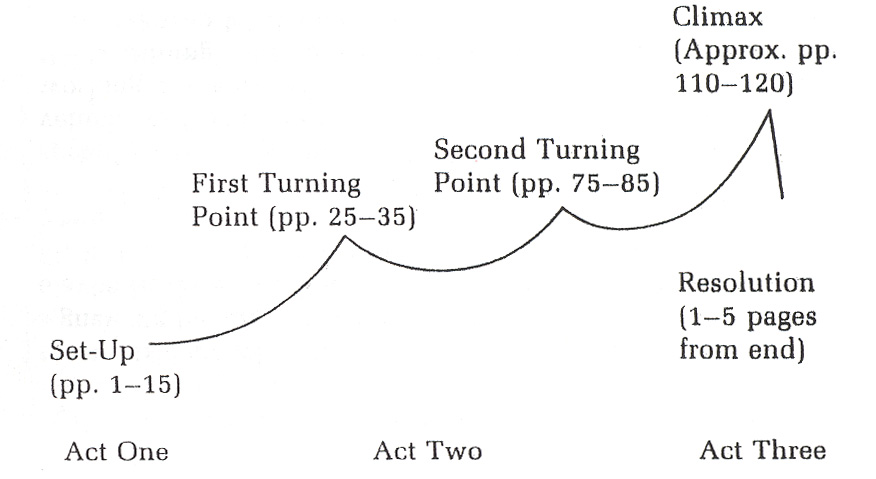
3-Act story Structure

syd-field

how-and-why-vogler-journey

I know that none of us work in a vacuum. We do not create ex nihilo. We work with what is given, and it is in our manipulations of forms that we discover new nuances. Structure is one of the great givens. I have decoded to use the three-act paradigm as strictly as I can and see what happens.

A couple vids on the topic:
Elliptical Editing in Vagabond

Back in 2008 I wrote a little post on Agnes Varda’s Sans toit ni loi (1985), or Vagabond. Recently David Bordwell and Kristin Thompson put together a video short on Elliptical Editing, and they used Varda’s film as the example. Bordwell and Thomspon have been important in my own thinking about film.

Elliptical editing is one relatively common characteristic of what we might call “art films” that distinguish them from more traditional or “classical” films. I find it’s often a matter of taste; some love this kind of storytelling and some are annoyed by it. I love it. But one can also find elliptical editing in any genre; it just depends on the needs of the filmmaker.

Vintage psychedelia by Ryan Larkin

Two more psychedelic classics from animator Ryan Larkin. As I watch these pieces I can’t help but think how wonderful it is that Larkin turned his amazing artistic talents to the hard work of animation. I wish more artists would do so.

Walking (1968)

Street Musique (1975)

These films bring back many vague but good memories of the aesthetics of my youth, that is, I seem to remember the cool, funky, colorful, and exploratory art of the late sixties and early seventies that these films exemplify. I miss that period, but I also am glad we have moved on. I am also reminded that Larkin did these films by hand: each frame is an actual drawing or painting on paper or canvas—no computers, no cgi, just one photograph taken for every 1/24 of a second of finished film.

Syrinx (1965)

Syrinx, 1965: The first film by Ryan Larkin, student of Norman McLaren.


I post this because it is beautiful, but also because it seems important to me to know Larkin and McLaren.

Night Mayor by Guy Maddin

More about the film and it’s filmmaker here.

Maddin was influenced by the beautiful 1953 Paul Tomkowicz film, Street-railway Switchman.

The Stars Are Beautiful

The Stars Are Beautiful (1974) 19 min 16mm, by Stan Brakhage (1933-2003):

Part 1

Part 2

More on Brakhage at Senses of Cinema.

I find this kind of non-narrative experimental filmmaking wonderful. When I studied film in college my interests gravitated to this kind of art. Maybe it was because I was also studying art history and had a fondness for modern art. Maybe also because I love poetry. I think any work of art is a kind of test of what we bring to it. That test is not only of us, but of the artist and his/her work of art. A kind of dialogue ensues if we pursue it. Brakhage worked with a language, at least on its surface, that is foreign to most people. One could say it is abstract, I prefer poetic. However, I think there is a universal resonance within his best films that makes them work at a deeper level than is possible with more common forms of film language. I also had the privilege of attending a two evening presentation and discussion with Brakhage where he talked of his processes, inspirations, showed a number of his films, and introduced us to other filmmakers. It was revelatory.

Stan Brakhage

Peter Greenaway is wrong

Peter Greenaway lecture: “New Possibilities: Cinema is Dead, Long Live Cinema”


Is Peter Greenaway correct in both his assessment and prescription for cinema? No. His call for a new cinema is like saying we need a new kind of painting, one that does away with brushes, with the canvass and its tyrannically limiting edges, with paint, with the subject, with even the typical displaying of paintings. We did that, remember? It didn’t work that well; what we generally got was academic, “meaningful” meaninglessness. I understand each of the four cinematic tyrannies Greenaway decries (people have been decrying them for decades), but I think Greenaway is wrong, not in his observations per se, but in his approach. Greenaway’s approach is very much within a Cartesian/Enlightenment Project vein. He is mired in the analytical, in particulars, in a world without ultimate, normative positions. In fact, one can easily say his entire talk, though fascinating and entertaining, is a kind of extended opinion piece delivered with pomposity and dry humor, but no more.

This is not to say that his ideas are not insightful or helpful. They are, and he certainly is a filmmaker who is exploring cinema and its possibilities more than some filmmakers today. However, the real need, the real requirement regarding cinema (and any artform), is not to begin with an examination of the particulars and the technologies of the form, or even the history or the form, but with the question: What is Man? This is the great lost question of our age. Instead, what we get with Greenaway, as evidenced in his various examples of his own work, are ever more complicated, lengthy, and virtually un-watchable mashups of techno-cinema musings (no matter how philosophical they may appear) providing ever more information, ever more detail, ever more cinema-of-attractions juxtapositionings, but less and less essential humanity. In short, Peter Greenaway’s message is ontologically and teleologically dead; an empty and vain promise. Greenaway’s position is, before he even begins, one of hopelessness–and he revels in being the ring master.

Still, and from an entirely different direction, I will proclaim: Long live cinema!