“Art-Cinema” Narration: Part Three

This is the last part of a three-part posting taken (reworked) from a brief lecture I gave during a film class years ago.

The other posts are Part One and Part Two. The main purpose of these posts is so that I can clarify some of my thinking on cinema – I’m sure my posts will shorten over time. I imagine that most of those blogging on film these days will find this rather pedantic and abecedarian. And I will also make a disclaimer that virtually all of “my” ideas come from other sources, not least of which are the writings of David Bordwell, esp. Narration in the Fiction Film. My lack of proper citations is due my having lost my notes from that class.

I must say that the ideas in these three posts provide some foundation for the concept of “contemplative cinema” which is the subject of an upcoming blogathon at Unspoken Cinema here: Unspoken Cinema: BLOGATHON. I plan on putting together my own specific thoughts for the blogathon, but I think this post may stand as my entryway into the subject, even if only obliquely.

Art-Cinema Narration and its goals.

Compared to Classical Hollywood Narration, the goals of Art-Cinema Narration are quite different.

Just a few distinctives:
Characters focus on the existential choice:

  • That choice which is about one’s very existence and very reason for existence.
  • Character(s) struggle at the crux between meaning and meaninglessness.
  • Or between expectations imposed externally (society, religion, school, etc.) and one’s desires.
  • These struggles are very much within the struggles of the 20th and 21st Century’s individual as described in the previous posts.

Focus on the interior life of the character:

  • The mental world trumps the mere overcoming of external obstacles. This is often played out narrationally as “psychological effects in search of their causes”
  • A searching for answers to one’s mental state, etc., but of course they might be presented in a very subtle way; it is hard to show what is interior.
  • Often the littlest, most insignificant things can be what triggers a wholesale reexamination of one’s life.

Redefinition of “Reality” and “Truth”:

  • Acceptance of coincidence, randomness, “and plausible improbabilities” as the ground of daily life.
  • The anomaly is normal, the clear causal chain of events something to question.
  • Characters search for truth while believing there is no such thing.
  • “[T]he world’s laws may not be knowable, personal psychology may be indeterminate.”
  • Foregrounding the problem of subjectivity: both within the story being told (subjectivity of the characters) and the very process of telling that story (subjectivity of the filmmakers).

And, as you can imagine, compared to Classical Hollywood Narration, the cinematic results are going to be different. One could argue that Art-Cinema Narration is really just a way of making films that remain “true” to the modernist mindset.

Some observations on how these goals are played out:

  • Often “looser” more ambiguous plot constructions.
  • Plots are less “neat”, less clearly motivated. Classical Holly Narration usually has characters who know what the problem is – the building is going to blow, the terrorists are going to do something bad, the mystery needs to be solved, the misunderstanding needs to be resolved, etc. Art-Cinema Narration may not have such clear-cut problems and therefore may have rather diffused goals – such as fighting boredom, or finding oneself, or finding meaning, or just existing.
  • Plots are not always logical or fulfilling of viewer’s expectations. Asks the viewer to do more. May be subject to question: “are we seeing the truth?” What is the truth?
  • Characters are often less clearly defined Ambiguous, may not fit into traditional stereotypes, inner turmoil, may change.
  • Self-conscious narration: The film “knows” it is a film and is not afraid to let you know that it knows. This can be done numerous ways, for example: characters talking to the camera, overt narration, breaking film “rules” etc. The film may even “show its cards”; may reveal the camera in a mirror, etc.

I must stress, however, that even with the seriousness the many of the ideas underlying art-cinema narration, many so-called art films are no more profound than any classical narrative films. And art films can fall prey to the same shallowness and overt “posing” that affects much of the art world as a whole.

One of the more interesting things, in my mind, about the history of cinema is the existence of both kinds of narration – Classical Hollywood and Art-Cinema – side be side throughout most of the last one hundred years. And certainly they have had influence upon each other.

As for contemplative cinema…
According tot he folks at Unspoken Cinema, contemplative cinema is the kind “that rejects conventional narration to develop almost essentially through minimalistic visual language and atmosphere, without the help of music, dialogue, melodrama, action-montage, and star system.” It seems clear to me that contemplative cinema then may be considered a sub-set of Art-Cinema Narration.

kiss me deadly apocalypto


(yes, I shamelessly grabbed this promo image online)

>>>some personal thoughts – not reviewing<<<


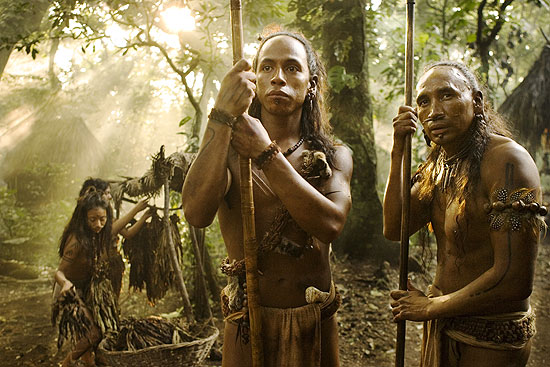
So yesterday afternoon I snuck out of work and saw Apocalypto – finally! I found it rather good. Probably what I like most about the film, and what stuck me as soon as it finished, was that the film comes across as though it is going to be heavy handed and preachy (esp. with the Will Durant quote at the beginning and the hype surround it’s build up), but in fact it only leaves one wondering just what it is saying – in a good, thoughtful kind of way. I believe this would be a great group discussion film. There is a lot to think about, from issues of violence and cruelty to issues of internal societal corruption, from normative cultural stereotypes to universal themes of familial devotion, faith, and fear. I am not sure if I think it is a great film (probably not quite), but it is a good film in many respects, not least of which is its ability to tell an interesting story chiefly through images – you could get rid of the subtitles and still understand 95% of the tale. To me that is one of the signs of a good director.

Also, Rudy Youngblood as Jaguar Paw does a great job, as do much of the rest of this unknown cast. Maybe that is because Gibson is first an actor himself.

So then I get home, the rest of my family was to be out for the evening (to a baby shower – a non sequitur compared to my day), and I needed something to do. So I put in Kiss Me Deadly (1955) and sat down to watch with a plate of nachos. With full disclosure I admit I had not seen it before (I know, shame on me! And I call myself a fan of film noir!). At about an hour into the film I realized I needed some good scotch, in which I indulged (Oban, if you want to know), and that set off the film just perfectly. I have to say what a wholly wonderful film, and a great “chaser” after Apocalypto. That might sound strange, but it had a refreshing quality for me after the heaviness of the jungle story.

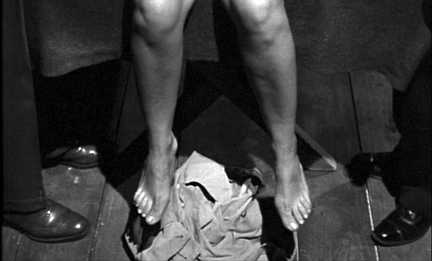
I was particularly struck by the image of the dangling legs of the character Christina Bailey (Cloris Leachman – wow, did the credits say introducing Cloris…?) as she is being tortured to death.


You hear her screams and see her legs shaking and that’s all – except for seeing the shoes of the two men. To me this is a haunting image and it comes only a few minutes into the film. At that point I knew I was watching something rather remarkable. Some other parts of the film are a bit dated – but I love those parts too – yet scenes like this have a timeless quality, if that’s the right word.

As I continued to watch the film I thought again of the quote by Will Durant: “A great civilization is not conquered from without until it has destroyed itself from within.” hhmmm

Finally, my uninventive conclusion is that it’s better late than never to see a good film. I know I will be seeing Kiss Me Deadly again.

>R is for Rubik, F is for Fake

>For some reason I love this kind of thing…

Michel Gondry, filmmaker and music video director, known for such films as The Science of Sleep (2006) and Eternal Sunshine of the Spotless Mind (2004), recently made a video in which he deftly solves a Rubik’s Cube with his feet and posted it to YouTube. See Video 1:

Video 1

I really enjoy seeing filmmakers being a little weird of goofy in their “spare” time. I am not surprised the person who directed Eternal Sunshine of the Spotless Mind would be able to solve a Rubik’s Cube with his feet.

And then someone noticed… (that someone being Scott Macaulay at Filmmaker http://www.filmmakermagazine.com/ magazine) and created a video response to Gondry’s video, and posted it on YouTube. See Video 2:

Video 2


I have to say that I love what Gondry has done even more. This is just pure fun. It’s great to see a feature filmmaker having fun. It also humorously highlights that fact that all filmmaking is a kind of illusion in one way or another.

How to begin an epic (nello stile di Visconti)

[Note: I am writing this rather long post as a personal exercise in narrative elucidation. If you find it interesting, then I am glad. If you decide to pass over it for better things, I am also glad. Life is too short!]

It is well known that Luchino Visconti was both an Aristocrat (Duke of Modrone) and a life-long communist. Having directed preter-neo-realist (Ossession) and classic neo-realist (La Terra trema) films, he also directed lavish films about the aristocratic class, such at Senso – for which he was criticized for having abandoned neo-realism (though it’s arguable he did not). Visconti was a man of contrasts and, at least from the outside, of contradictions. A highly cultured aristocrat and an avowed communist, his filmmaking was the ground on which he worked out these tensions, often to stunning effect.

How then might one, Visconti of course, criticize the class from which he came? He does so in his magnificent film The Leopard (1963), based on Giuseppe Tomasi di Lampedusa’s novel of the same name. However, the criticism is done, not harshly, but lovingly and with great insight. The opening sequence, what I want to look closely at here, sets the stage for both the themes in the film and the method of articulation.

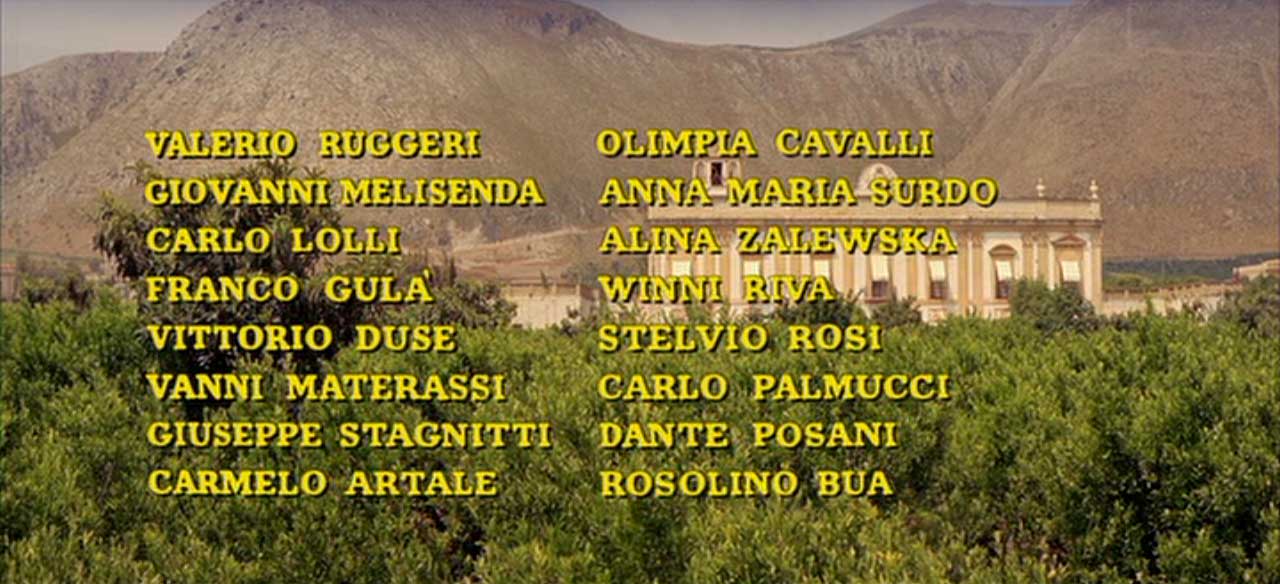
The opening shot of The Leopard begins as the backdrop for the opening titles. The film is a vast, sweeping portrayal of the Italian unification period (Risorgimento) of the 19th century, shot (stunningly by Giuseppe Rotunno) in Super Technirama (aspect ratio of 2.21:1), so it is interesting that the first shot has the camera stuck in the trees with the leaves hiding the view. (figure 1) [note: my screen grab for figure 1 is not exactly 2.21:1, but the rest are correct]

figure 1
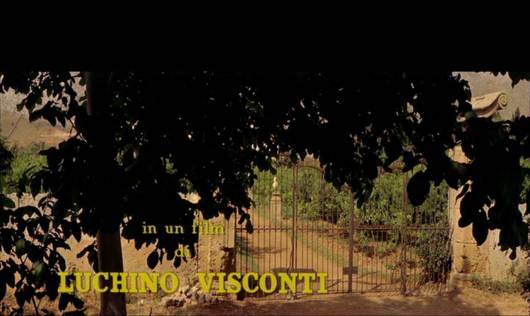
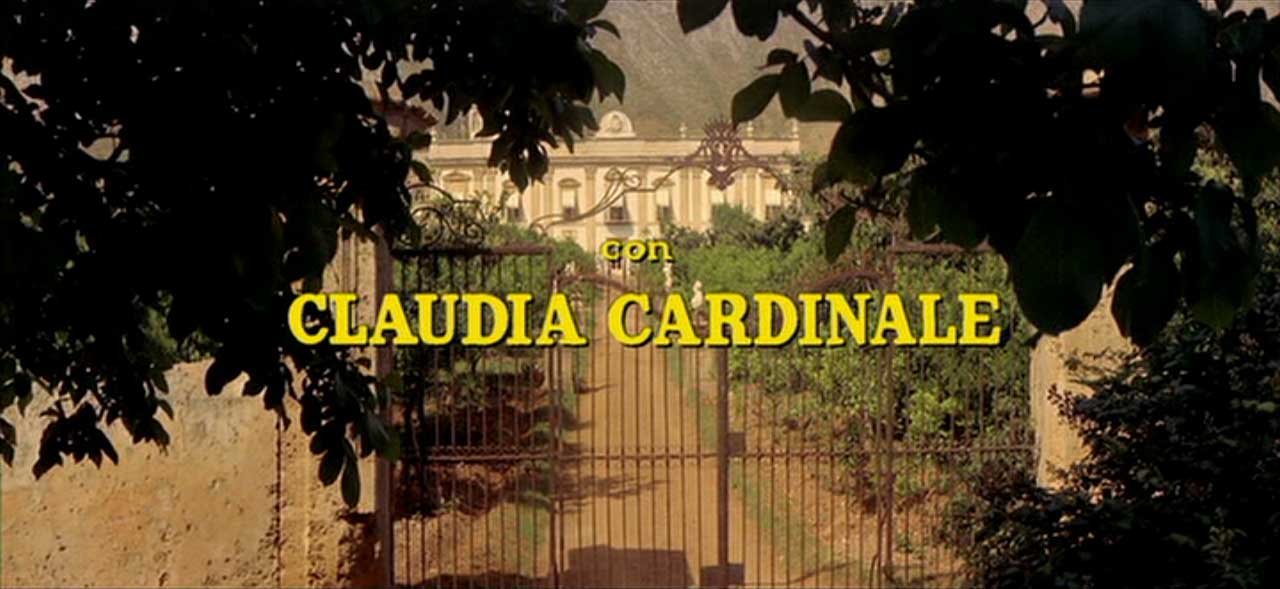
But then the camera begins to move to the right to reveal a building in the distance, carefully framed by the branches, enveloped in green olive trees, and secured behind a wrought iron gate. (figure 2)

figure 2

The camera continues to move to the right, still with its focal point the building in the distance. When the camera comes to a stop the building, now visually framed by ancient carved stone pillars, is still viewed from behind the gate, and seemingly to be both emerging from and sinking into the vibrant green foliage of the surrounding olive trees and other plants. (figure 3)

figure 3
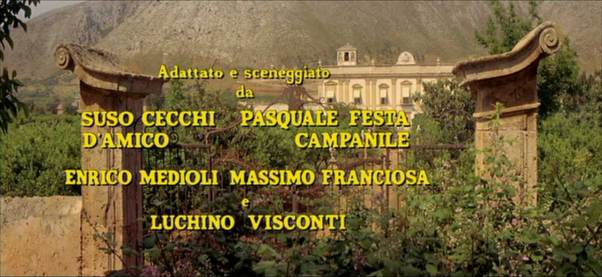
The wrought iron gate, with the estate securely ensconced behind it, connotes the similar kind of beginning one finds in Citizen Kane. The reference suggests that this story, for all its historical grandeur and Super Technirama visuals, is going to center around one singular, powerful figure who will fall, not really because of outside forces, but of internal corruption and self-delusions.

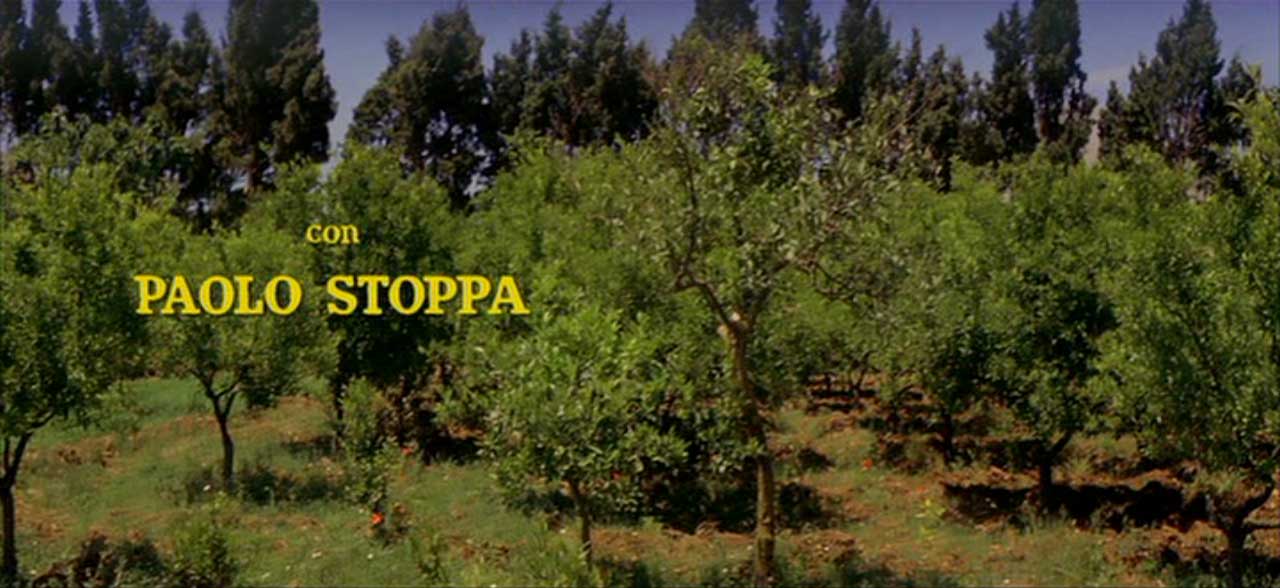
The next shot begins with a shot of the trees in the field. (figure 4)

figure 4
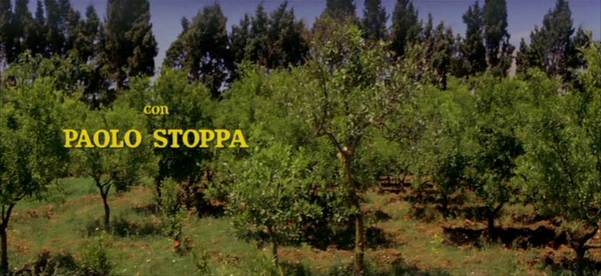
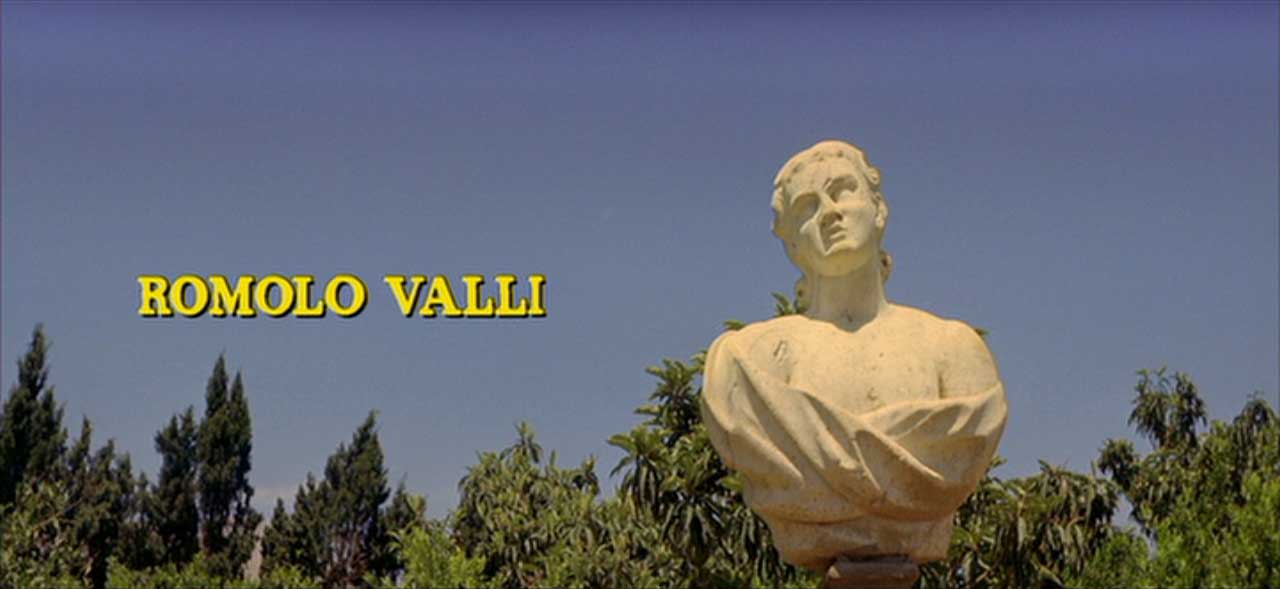
Then the camera moves in a sweeping motion up and to the right to reveal an ancient bust (statue) from some apparently glorious past age. (figure 5)

figure 5
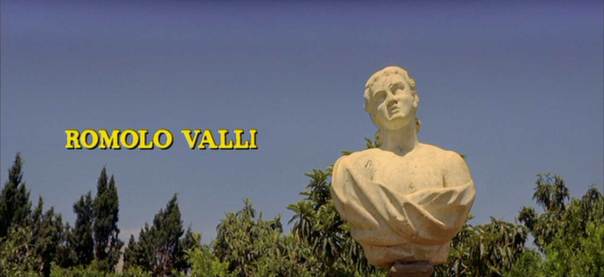
Italy is a country of multiple glorious and inglorious pasts. Which means that it is also a country of change, even while things stay the same. The verdant and vibrant growth of the trees (something new and growing up from the earth) connotes the changes taking place at the foot of the statue. The statue, a majestic and dilapidated figure, beautiful and impotent, hovers pointlessly over the field. Yet, for how pointless it is, the statue still captures our attention, for the trees are mere trees, but this figure says something about where we (humanity) have come from, who we are, or are capable of having been. What then of this contrast? Certainly, if the contrast is a political contrast, it is a gentle and beautiful reference – something akin to a kind of sentimentally of a forever lost past.

The next shot also begins with the trees. (figure 6)

figure 6
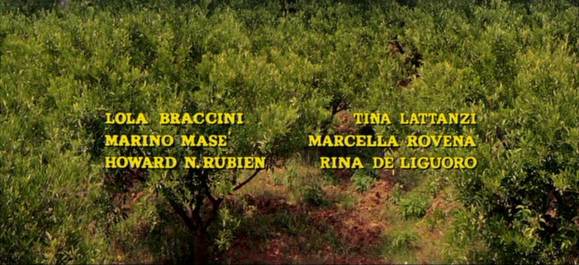
And again the camera sweeps up and right, but this time instead of a statue we see the building again. (figure 7)

figure 7

Now the connection has been made more concretely between the old and new, the natural beauty of the new and the ancient beauty of a man-made past, an ancien régime. Should we see, then, that this building, this beautiful Italia villa as standing for a kind of impotency?

More to the point, and in keeping with what is obvious in the film, this dichotomy between and ordered and structured world on the one hand and a natural and wild world on the other, symbolically prefigures the clash between the established order and revolution. Architecturally the villa is, from a distance at least, simple and box-like. Its windows are uniformly spaced and it lines are clear. The olive orchard, on the other hand, juts up toward the villa like a crowd massing around a palace in protest. And yet, what is so interesting about this film, and Visconti in general, is the lack of any obvious animosity. The scene, the juxtaposition is beautiful, as is the entire film, including the battle of Pamplona with its stunningly beautiful representation of the hysterical brutality of war.

Visconti had the ability to tell stories of both beauty and ugliness. In this sense he saw political struggles to be like human beings: glorious and corrupt at the same time. For, although Visconti was an aristocrat and a communist, he was first and foremost a humanist with a deep empathy for human weakness.

As an American I have to admit a certain perspective. Born in a country born of revolution I have an affinity for the revolutionary thrust of the (Risorgimento. As a person somewhere between proletariat and petit-bourgeoisie I easily believe I can identity with the ruling class – especially if it is royalty. (Identifying with the struggles and desires of the aristocracy – especially that of western mythology – has always been a pastime of the middle class.) And, as a person from the “new world” I have a tendency toward romanticizing the “old world.” When I see the image of the villa I do not first see an image of the aristocratic class that must be, or has been, done away with. What I see is something like what Frances Mayes describes in here book Under a Tuscan Sun when she was contemplating buying the house Bramasole – a house that has a name no less!:

“On the other hand, a dignified house near a Roman road, an Etruscan (Etruscan!) wall looming at the top of the hillside, a Medici fortress in sight, a view toward Monte Amiata, a passageway underground, one hundred and seventeen olive trees, twenty plums, and still uncounted apricot, almond, apple, and pear trees. Several figs seem to thrive near the well. Beside the front steps there’s a large hazelnut. Then, proximity to one of the most superb towns I’ve ever seen. Wouldn’t we be crazy not to buy this lovely house call Bramasole?”

Wouldn’t everyone? Visconti’s villa is still a dreamy object of desire while representing an object (the ruling class) to overturn.

Visconti, I believe, has thus far given us clues to the nature of this story, yet he has done so in a subtle way such that one could easily be pulled in to the luscious grandeur of the ruling class, to see Prince Don Fabrizio Salina (played wonderfully by Burt Lancaster) as a good man, and to miss the fact that we have fallen for Visconti’s little trap. The prince is not a good man, but reviewers of The Leopard have pointed out Visconti’s empathy toward the prince; something not lost on Visconti’s critics who believed he had abandoned the precepts of neo-realism and its political foundations. But, of course, we have not yet seen this prince.

Not every shot from the opening sequence is discussed here, but it is clear that the villa is the centrally denoted object of the title sequence. Eventually the camera begins to dolly closer to the villa as though being drawing toward the building by an unseen force. Finally the camera is at the villa, no trees blocking our view. (figure 8)

figure 8

What is interesting from all these shots is the absence of any human beings. The story is not yet a story, rather, we have a kind of preamble of contrasts; a preparing for the contrasts between order and revolution that is to come.

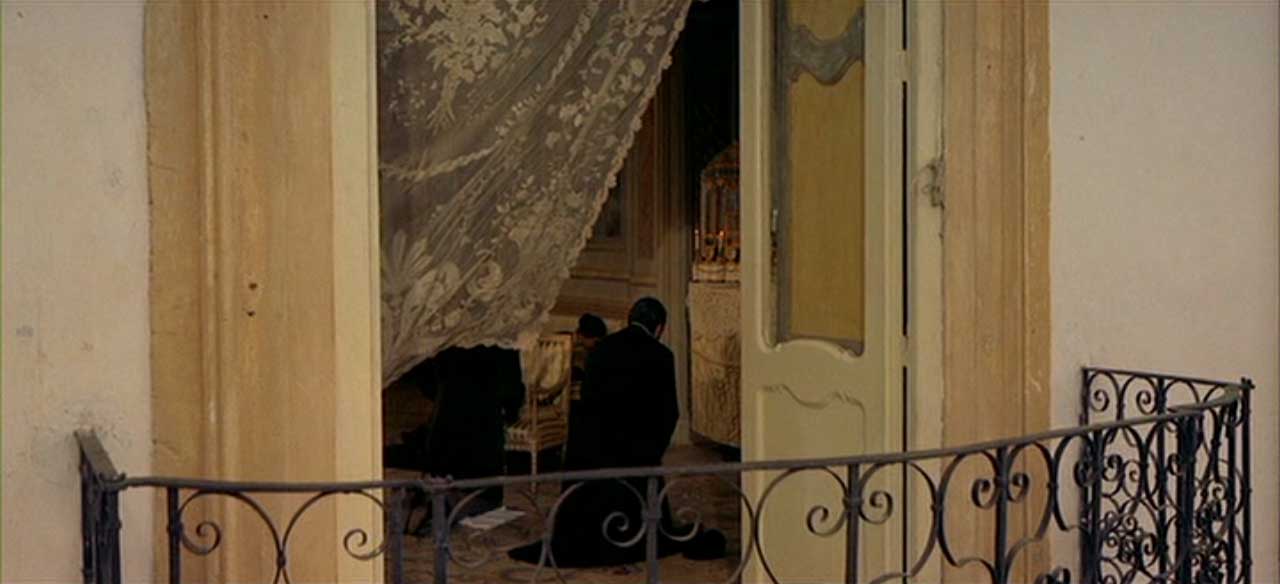
This shot is also the first time that human activity (finally) begins to intrude into the scene. We hear voices, somewhat indistinct, reciting the rosary in Latin. The camera begins to track along the outside of the house, passing the curtained windows, until we arrive at this window and see the first person we’ve seen in the film; a kneeling, praying person. (figure 9)

figure 9

Wind blows the curtain which partially blocks our view of the room and those in it. Then we cut to the interior of the villa. (figure 10)

figure 10

Again the curtain partially blocks the room and its inhabitants until the camera pans slowly to the right to reveal a room full of people kneeling, praying the rosary in unison.Curtains have played interesting roles in film history, often signifying the limits of what is revealed and what cannot be revealed. [I remember as a child watching films at a local theater where a large red curtain opened to reveal the screen, signaling the begining of the film. That was always a momentous moment for me.] In this case the window curtain may function as a means by which the play begins, like a curtain rising in the theater. Or, it may act as a kind of ephemeral threshold over which we cross to enter the story. However, it is interesting to observe the fact that the curtain is being blown by the wind. The wind is a part of nature, like the trees in the orchard, and we (via the camera’s movements) enter the room on the wind, as it were. Here is a room full of the ruling class (interesting to those who know of Visconti’s aristocratic heritage and communist commitments), praying the rosary in Latin (a fact not lost on post Vatican II Italian audiences I’m sure), and we enter through a window (rather Brechtian if you ask me) on a revolutionary wind. To seal the thrust of this opening sequence, and to officially begin the story, the rosary is interrupted by the shouts of the estate’s workers who have found a body of a dead soldier in the orchard. Again, the wild world of the orchard competes with the established order of the villa.

This series of opening shots are, in my opinion, the work of a master filmmaker who knows where he is going and from where he has come. If we do not pay attention me might assume these opening shots are just functional establishing shots acting as a mere backdrop for the film’s credits. Instead, we get a vision of how one might invite a viewer into the grand world of a human-scaled epic.
watching movies at home

I have a family. My wife and I have some similarities in our movie preferences, and some real differences (no surprises among the married crowd). I have a six year old daughter who is not likely to, as yet, enjoy watching many of the films I find interesting. And, with a family (who I love more than all the films in the world), I don’t get out to the local theater as much as I might like, and when I do, it is usually with my family. So I find myself trying to eke out a few viewings of “my” movies at home in between family time, home projects, work, homework (‘cause I’m back in school again), downtime, and whatever else pulls at my time; all of which are good, even if I don’t always manage my time very well.

The process of watching movies at home goes something like this: when I feel I have some time I put “my” film into the dvd player, my daughter asks what I am watching, I pause the opening credits and explain it to her, then she settles down next to me as we begin watching the film, soon she begins asking questions like – what language is this? What are they talking about? What is that? etc. – I try to explain, frequently pausing the film, occasionally I read her the subtitles as we watch the film, I pause the film again when my wife asks a question from the computer room, I pause the film again to let the dog outside for a potty break, my daughter then plays with her Legos as I resume the film, occasionally my daughter (who is half-paying attention) asks a question about the film or wants to show me what she has created, the dog wants up on the couch (we have a pug, who can jump up himself, but insists that one of us lift him to the couch), my wife asks if I have paid a particular bill or called someone like I had promised, then, about half-way into the film it is time to put my daughter to bed, once that is done I am too tired to continue my film, so I go to bed. The next evening (or two, or three) I try to finish the film to much the same scenario. And please know that I am not complaining.

All this is affected by a bad habit I got into years ago when I worked at a video store where I could take home any film I wanted after work. During that time I watched the first third of many, many films, but never finished most of them. So now, I have to force myself to get beyond the moment of tension I begin to feel at about a third of the way into any film – that is, the feeling that the other films in the stack next to the tv might be worth a looking at. I am getting better at finishing films, though.

I like the comfort of watching films at home. I like having the kitchen nearby. I like being able to pause the film to take care of business. I also love my family and would generally rather spend time with them than with a movie. But, I have to say, seeing a film in a theater has great advantages. One of which is the unstoppable momentum of the film. Unless you leave the theater you will see the film with relatively few distractions. It is like going to school. You could study a subject on your own, but school adds a level of impetus that carries one along. My suggestion to those who have a deeply abiding interest in film, who are developing their own ideas about film, and who are single (or relatively so), is to take this opportunity see as many films as possible so as to develop a foundation of knowledge and experience while you can.

One final word: Recently I have seen some sections of some great films with my daughter, these include The Seventh Seal, La Terra Trema, The Bicycle Thief, and others. I read the subtitles out loud and she asks questions. We have had some great times, and I believe she is getting introduced to some great works of art (to go along with the history of great painting that her mother is teaching her). She recently told me that when she grows up she wants to live on a farm and write books.

“Art-Cinema” Narration: Part Two

This is part of a three-part posting taken from a brief lecture I gave during a film class.

“Art-Cinema” Narration

Part Two: The Background
In order to understand art-cinema narration, and the underlying post-Enlightenment project, one needs to grasp the historical and philosophical pressures that gave it birth.

The coming of the 20th Century, bringing with it so many new technological changes, and dragging along with it the those 19th Century harbingers of new ideas: the industrial revolution, Darwin, Marx, and Freud, seemed, in many people’s minds, to have changed everything.

The path of the 20th Century, with the devastation of the First World War, the horror of the Holocaust, both the reality and threat of nuclear weapons, and the waning of Christianity in the West, gave impetus to new challenges. Human beings now struggled with the loss of God, of place, of self, of truth, even of time thanks to Einstein. This has been called, amongst many other things, the “crisis” of modern man. It is also, as some have said, the burden of freedom.

Dostoyevsky pointed this out, when he wrote in the Bothers Karamazov, that if there is no God then everything is permitted. Some saw this as their salvation, some saw it as their undoing.

People began to question everything once taken for granted and to see life as much a struggle to find oneself, to understand the nature of love and sexuality, to discover meaning, and to mourn the evaporation of Truth, as it is a struggle over the more common difficulties of living – like saving the world or saving the farm. In fact, it all gets turned on it head so that saving the farm (and even saving the world) seems so trivial compared to the inner turmoil now plaguing modern man. Why bother with saving the farm if you can’t even save yourself?

The questions, as really they have always been, are:
“Who are you?”
“Why do you exist?”
“Where is you hope?”

Of course, it’s not all doom and gloom, at least in terms of how people live their lives. There are still a lot of life affirming choices people make, but underlying it all, especially from a Christian perspective, is a great sense of loss and uncertainty.

And of course, from a Christian perspective, the problems of human beings are not ultimately the result of mere historical forces, but arise from the deeply profound tensions between being made in the image of God (and all the glory that that means) and being burdened and affected by the corrupting nature of our inherent sinfulness (and all the difficulties that that means).

Cinema, then, confronted these changes and perspectives by challenging conventional wisdoms of narrative structure and subject matter. Art-cinema narration can then be understood as a response to a post-industrial, post-Christian, post-Enlightenment world.

>Il Mio viaggio in Italia

>

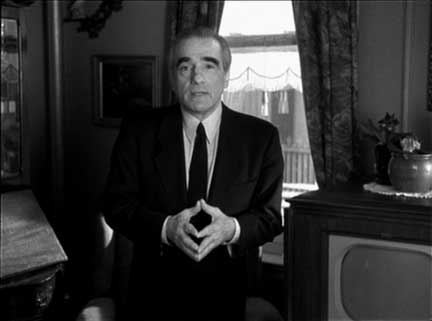
I’m a sucker for movies about the history of film. I just finished watching Il Mio viaggio in Italia (My Voyage to Italy) by Martin Scorsese. Essentially it is a personal and nostalgic look at the Italian films that influenced (and still influence) Scorsese as both a filmmaker and as a person. My Voyage to Italy is also a testament to the powerful effect that cinema can have on all of us.

Structurally the film is simple. Scorsese walks the viewer through the history of Italian cinema up to Fellini by way of his personal experience of those films. It is as though a good friend who, as a deeply passionate connoisseur of great art, is giving you a personally guided tour through his favorite museum. What is particularly interesting to me are his descriptions of watching many of those films as a child on a 16″ black & white television screen, often with several generations of his family around him, and often watching very poor quality prints of the films. And yet, those films still had a powerful effect on him.

I have to admit my favorite section of the film is Scorsese’s description of Italian Neo-Realist cinema.

He says:
“If you ever have any doubt about the power of movies to effect change in the world, to interact with life, and to fortify the soul, then study the example of neo-realism. So what was neo-realism? Was it a genre, was it a style, was it a set of rules? Or, more than anything else, it was a response to a terrible moment in Italy’s history. The neo-realists had to communicate to the world everything their county had gone through. They needed to dissolve the barrier between documentary and fiction, and in the process they permanently changed the rules of moviemaking.”

I have had the pleasure of seeing many of the films he discusses, yet there are many more I have not seen. My own personal response to Scorsese’s own personal journey is to consider doing my own close examination of neo-realism, beginning with the earlier films and working my way forward. All in all, I recommend the film.

>top ten film lists

>I don’t have any particular reason for posting these lists, other than curiosity. Personally I find these kinds of list interesting, even though they may not mean a lot. If they say anything, it is about the different reasons people vote for their top films. Although we cannot delve into the psychology of the voters, I believe directors pick films they wish they had directed, critics pick films they wish they had had the chance to write about when they first appeared, and the IMDb highlights the tendency to pick audience favorites and recent films. It would be interesting to have some demographics to go with these lists.

Assuming there is any level of objectivity in such lists, a question I have is, who might the better person be to create a top-ten list: the professional filmmaker, the professional critic, or the avid fan? Is this even a fair question?

Internet Movie Database top ten film – based on users’ votes
1. The Godfather
2. The Shawshank Redemption
3. The Godfather: Part II
4. The Lord of the Rings: The Return of the King
5. The Good, the Bad, and the Ugly
6. Casablanca
7. Schindler’s List
8. Pulp Fiction
9. Seven samurai
10. Star Wars: Episode V – The Empire Strikes Back

Sight & Sound Critics Top Ten List
1. Citizen Kane
2. Vertigo
3. Rules of the Game
4. The Godfather & Godfather part 2
5. Tokyo Story
6. 2001: A Space Odyssey
7. Battleship Potemkin
8. Sunrise
9. 8 ½
10. Singing in the Rain

Sight & Sound Director’s Top Ten List
1. Citizen Kane
2. The Godfather & Godfather part 2
3. 8 ½
4. Lawrence of Arabia
5. Dr. Strangelove
6. Bicycle Thieves
7. Raging Bull
8. Vertigo
9. Rashomon
10. Rules of the Game
11. Seven Samurai

“Art-Cinema” Narration: Part One

This is part of a three part posting taken from a brief lecture I gave during a film class.

“Art-Cinema” Narration

Part One: Introduction

As I have been doing, I want to talk in very broad categories, recognizing the reality of many exceptions to the “rule.”

Classical Hollywood Narration presents rather clearly defined individuals struggling toward rather clear-cut goals. These characters move and have their being within clearly presented worlds according to clearly understood time and space norms. And when all is said and done, when the story has finally concluded, these characters have unambiguously either reached their goals or not reached their goals. Typically causality, that thing that keeps the story moving forward and gives a reason to do so, is also unambiguous – such as the solving of a crime, saving the world or saving a private, falling in love, wining a race, escaping death, killing a giant shark, blowing up a deathstar, running from dinosaurs, throwing a ring into a volcano, disarming a bomb, bending it like Beckham, and finding a Nemo, etc.

Life, that great big thing that we are all doing, is typically presented as coherent and free of ambiguities – at least true ambiguities. Characters do have decisions to make – and even decisions are between right and wrong itself. But the characters are understood, the decisions are understood, the world is understood, and we are along for a story that rests upon, and works within this clarity. Of course there might be moments of confusion, but that is part of encouraging tension in the viewer for the purpose of moving the narrative to its climax. In the Classical Hollywood Narrative those moments of confusion are never too long and ideally are not left unresolved at the end of the film.

And an incredibly large number of films have been exceedingly successful within these parameters.

But is life always neatly arranged, clearly understood, free of ambiguities, plainly motivated, distilled into lucid and obvious choices?

If the Classical Hollywood narrative film has it roots in 19th Century drama and short stories (with Edgar Allan Poe being a prime example), then what is often called Art-Cinema Narration has it roots clearly in the 20th Century (with writers such as Anton Chekhov being a prime example). Art-Cinema is firmly a 20th Century phenomena.

These two kinds of narrative structures can be simplistically summed up this way:

  • 19th Century drama is about characters, who in the midst of life, are confronted with some external situation (maybe rather ordinary or rather extraordinary) which they must resolve or come to terms with. An internal, spiritual, mental struggle might play into the larger goal of the external struggle, but is ultimately subservient to it.
  • 20th Century drama is about characters, who in the midst of life, are confronted with some internal, spiritual, mental struggle with which they must resolve or come to terms with. An external situation may play a significant part in the larger, internal struggle, but is ultimately subservient to it.

Remember, there are many exceptions to this division. The 19th Century writer Fyodor Dostoyevsky being just one.

Other influential writers – along with Chekhov:
James Joyce (Ulysses, etc.)
Ernest Hemingway (The Snows of Kilimanjaro)
Virginia Wolf (The Voyage Out, etc.)
Thomas Mann (The Magic Mountain, Death in Venice, etc.)

>Peter Boyle 1935 – 2006

>

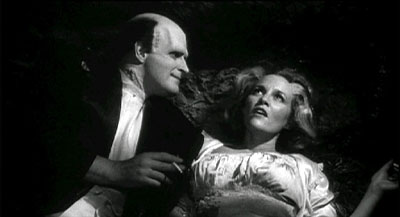
Peter Boyle died this week. Of course, most people certainly remember him from Everybody Loves Raymond. I first saw him in Young Frankenstein (1974) and a small role he played in Taxi Driver (1976) – both on video in the mid ‘80s. He was one of our more interesting, and funny, character actors. Now I will need to watch Young Frankenstein again.

Woody Allen is famously quoted as saying, “I don’t want to achieve immortality through my work. I want to achieve it through not dying.” However, I find it interesting (if that is the right word) that when an film actor or filmmaker passes away, one can remember them by viewing their work. Peter Boyle left a significant body of work behind him for us to enjoy.

Some interesting information about him from CNN.com:
Educated in Roman Catholic schools in Philadelphia, Boyle would spend three years in a monastery before abandoning his studies there. He later described the experience as similar to “living in the Middle Ages.”

He explained his decision to leave in 1991: “I felt the call for awhile; then I felt the normal pull of the world and the flesh.”

He traveled to New York to study with Uta Hagen, supporting himself for five years with various jobs, including postal worker, waiter, maitre d’ and office temp. Finally, he was cast in a road company version of “The Odd Couple.” When the play reached Chicago he quit to study with that city’s famed improvisational troupe Second City.

Upon returning to New York, he began to land roles in TV commercials, off-Broadway plays and finally films.

Through Alterman, a friend of Yoko Ono, the actor became close friends with John Lennon.

“We were both seekers after a truth, looking for a quick way to enlightenment,” Boyle once said of Lennon, who was best man at his wedding.

In 1990, Boyle suffered a stroke and couldn’t talk for six months. In 1999, he had a heart attack on the set of “Everybody Loves Raymond.” He soon regained his health, however, and returned to the series.

From Wikipedia:
His first starring role was as the title character in the movie Joe which was released in 1970, in which Boyle played a hardhat bigot to wide acclaim. The film’s release was surrounded by controversy over its violence and language. Ironically, it was during this time that Boyle became close friends with the actress Jane Fonda, and with her he participated in many protests against the Vietnam War. After seeing people cheer at his role in Joe, Boyle refused the lead role in The French Connection (1971) as well as other movie and TV roles that, he believed, glamorized violence.