>Once, in the early ’80s (probably around the time of the ’81 NYC marathon) when working out at my highschool track after school (I competed in shotput/hammer/javelin/discus for the team) Salazar came by to do some laps. We watched him run faster than anyone on our team could possible run lap after lap. After about 25 laps he left. We thought it was cool. Needless to say he was one of the greats.
Category: memory
>brother can you spare a taser?
>We glorify the protests of the past. We have seen (or remember) the civil rights marches, the sit-ins and other actions. We remember the anti-war movement. We remember May 1968 and other important dates. But where are we today? Remember the huge global anti-war protests just prior to the invasion of Iraq. Or the mass protests at the Republican convention. Remember the police crackdown on the protesters? It was like clockwork, surgical, carefully crafted like extraordinary rendition. But it also got violent at times – the anti-riot police were the ones who typically led with the violence. And recently we saw the same thing at the G20 protests in Pittsburgh. But, like the protests of the romantic past, we once again wonder at the role of the police and the individual choices of each officer.
Check out this video and ask yourself what is really going on.
Now read this excerpt from a news report on National Public Radio regarding the G20 summit and, specifically, the protests outside the summit.
ROBERT SIEGEL (host): And have the protests been going on throughout the entire city?
SCOTT DETROW (on scene reporter): They have. After the tear gas, the march broke into many small groups. It stayed out of downtown, from what we can tell. Police are responding by breaking up these clumps of protesters. I saw one after the tear gas was fired. They were peacefully marching down the street and police officers swarmed the block from all directions. They got out of the car and they just pushed the protesters into side streets, and that’s what they’ve been doing. There have been arrests here and there, we’re hearing from other news outlets. But that seems to only be happening when marchers are directly confronting police officers. For the most part, police are just trying to show a presence and trying to get these marchers to break up on their own.
I find both the video clip and the NPR report fascinating, not because they are anything special, but because they say a lot about the structures of power that we have come to view as normal. But should they be normal? Consider the situation: A group of representatives from the richest and most powerful nations on earth come together to discuss the future for all of us. But the the G20 has been around for some time already and the world is in trouble with widening gaps between rich and poor, increasing corporate control over such basic things as water rights, food distribution, farmer’s crops, and of course the economy. In fact, it could be said the recent bailouts of large companies around the world represent a kind of coup d’état. It may just be that the current economic crisis (and the steps to remedy it with tax dollars) is evidence of the increasing loss of real power on the part of the government (a government of the people) over the economic/big business sector.
Consider this exchange from Michael Moore’s Capitalism a Love Story:
MICHAEL MOORE: We’re here to get the money back for the American People. Do you think it’s too harsh to call what has happened here a coup d’état? A financial coup d’état?
MARCY KAPTUR (Representative from Ohio): That’s, no. Because I think that’s what’s happened. Um, a financial coup d’état?
MICHAEL MOORE: Yeah.
MARCY KAPTUR: I could agree with that. I could agree with that. Because the people here really aren’t in charge. Wall Street is in charge.
Given our democratic ideals the situation looks grim. One could easily see the recent election as a kind of sham (as are most elections but especially this one), a game those in power managed in order to help all of us feel like we participated in their power play. Maybe democracy as it’s been sold to us is a way to tie us up with mythological fairly tales so that the powerful few remain in power. So why would not people peacefully (or even angrily) march down the streets where the G20 is being held to protest? And why wouldn’t those marchers see the police as something like turncoats?
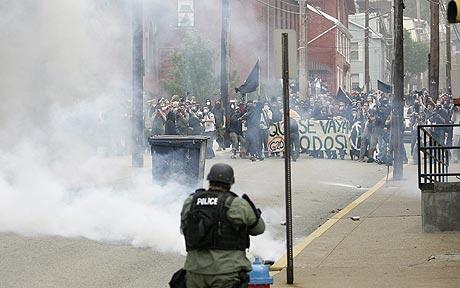
And this brings me to more questions: Why do police (working class men and women apparently there to uphold basic freedoms of speech, especially when it is most needed) seem to automatically view protesters and demonstrators as enemies and radical provocateurs? Are they trained to think that way? Or is it something closer to social influence and group think? Why, when anti-riot forces come out in overwhelming force, they end up being the group most prone to violence? Could it be something like the old adage, ‘to the man with a hammer every problem looks like a nail?’
Why does our society accept as normal such activities as the use of tear gas, batons, knocking people to the ground, tasers and rubber bullets, and now anti-riot siren devices, by police against weaponless, non-violent protesters? What is the psychology?
I won’t pretend to have the answers to these questions. However, when I see the way the police in this country deal with protesters I cannot help but be reminded of some very famous sociological studies, horrific events, and historic observations. My point here is not to equate actions so much as highlighting the way the human mind works in various situations.
- Milgram experiment: Showing that people will do terrible things as long as someone (preferably someone “official”) tells them to.
- Stanford prison experiment: Demonstrated the impressionability and obedience of people when provided with an apparently legitimizing ideology along with social and institutional support.
- My Lai Massacre: Showing that individuals are capable of anything when part of a group, following orders blindly (as soldiers and police are trained to do), and operating in a tense situation outside of normal experience.
- Banality of evil: Hannah Arendt’s observation that evil acts are most typically carried out by ordinary people viewing their actions as normal.
- Social influence: How we are all greatly influenced by others around us, the situation we are in, and tendencies we have toward self preservation, being liked, and not being stigmatized.
I have come to believe the actions of police toward protesters reflects aspects of all these sociological and psychological characteristics found in the list above – though to a substantially lesser degree in some cases. But there is one other factor that possibly plays to largest role, that of hegemony.
Now hegemony is a good college level word for why people acquiesce, and even embrace, the power structures that control, and even sometimes enslave, them. If you did not study the word in college you may remember when Hugo Chavez touted the book Hegemony or Survival: America’s Quest for Global Dominance by Noam Chomsky when he spoke at the U.N.

Chavez aside, the concept of hegemony, first proposed by Antonio Gramsci as a way of trying to understand why the working classes did not rise up against their oppressors as the Marxists predicted, is a way to understand how the powerful persuade the less powerful to adopt the values of the ruling class. We live in a country that denies the existence of class structures in terms of power. We speak of middle class or working class merely as sympathetic terms used by politicians to manipulate votes. We do not accept the concept of a ruling class, but maybe we should.
In the videos on this page look at the faces of the police (the ones not wearing Darth Vader masks). There is a lot of anger in their eyes. I wonder if the anger comes from an internal struggle. I can only hope. I imagine the police feel a tension between the hierarchies of power they have come to believe must be protected (of which they are sworn to uphold) and their deeply internal sense of humanity and their belief in democracy (an understanding of which was probably formed in grade school like it was for most of us). They are caught in the clash of values, but they are a group operating with broad impunity and supported by the social dynamic of being able to hide within the apparent pawnship of their job. So they continue to manhandle, arrest, and attack the protesters. But their anger gives them away. They are alienated from the power they protect, and suppressing the very voices that are pointing out that alienation. That would make just about anyone angry.
Consider this video of another protest. If not for the police intervention it would almost be humorous.
I cannot imagine a less threatening protest. In fact I find it almost comical. Why then the overwhelming police force? Are they afraid of another Battle in Seattle? Clearly this is an example of those in power acting out of fear, but what do they fear? In fact, the whole thing has a kind of choreographed arc that not only speaks of a profound lack of imagination on both sides, but indicates the protest may be as much a product of hegemony as the police presence.
What do we do with all this? First, we should not romanticize the past. The efforts of the civil rights and anti-war movements of the past were often heroic, but they were also brutal and scary at times. People were seriously hurt and some died. Many went to prison. And we should know that external actions come from what is inside, but also know that one’s external actions affects one’s soul. The police who give in to the psychosis of power, abuse other humans, act out of anger, and stand in the way of freedoms that are not given by governments but only taken away, those police are damaging their own souls. And they are human just like me – frail, prone to delusion, living in a powerful culture, needed to be loved, and wanting to do what is right. We should not feel sorry for them, but we should empathize.
The fact is many of the above sociological/psychological concerns raised about police action can apply to the protesters. At times it appears some of the protesters are seeking to recreate a May ’68 kind of experience for their own pleasure. I wonder how many made the effort to reach out to the police in the days or weeks prior to their marches. I wonder how many pre-judged the police as irredeemable, in part because it is both the easier route and less romantic than manning the barricades. This is one reason that, while I support the protesters in general, I think the predictable protests outside every G20, G7, World Bank, etc., meeting may be as much a symbol of failure as righteous anger. We need more than theater, we need transformation.
Finally, we are all in this thing called life together, whether we want to admit that or not. It’s easy to march, easy to crack skulls, and very easy to write blog posts, and it’s difficult to love, forbear, and forgive.
>Mary Travers may you forever rest in peace
Goodnight September Eleventh
“In a Parish” by Czesław Miłosz, trans. from the Polish by Miłosz and Robert Hass. Read by Haas on Fresh Air on NPR remembering 9/11.
Were I not frail and half broken inside I wouldn’t be thinking of them who are like me half broken inside. I would not climb the cemetery hill by the church to get rid of my self pity. Crazy Sophies, Michaels who lost every battle, self-destructive Agathas lie under crosses with their dates of birth and death. And who is going to express them. Their mumblings, weepings, hopes, tears of humiliation in hospital muck and the smell of urine with their weak and contorted limbs and eternity close by, improper indecent like a dollhouse crushed by wheels, like an elephant trampling a beetle, an ocean drowning an island. Our stupidity and childishness do nothing to fit us for this variety of last things. They had no time to grasp anything of their individual lives. Any principiam individuaisonous(ph) nor do I grasp, yet what can I do enclosed all my life in a nutshell trying in vain to become something completely different from what I was. Thus we go down into the earth, my fellow parishioners, with the hope that the trumpet of judgment will call us by our names instead of eternity, greenness and the movement of clouds they rise then thousands of Sophies, Michaels, Matthews, Marias, Agathas, Bartholomews so at last they know why and for what reason.
>Happy Labor Day
>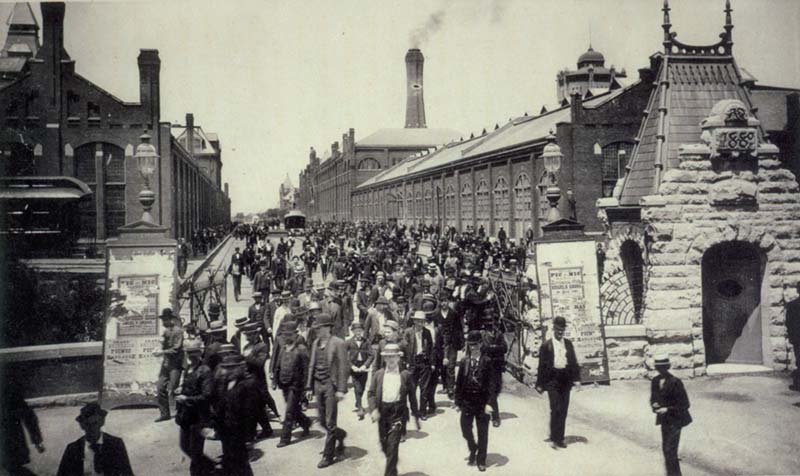
Pullman workers leaving factory, c. 1890s
Think about working at a job where management treats it employees poorly. Think about very unsafe working conditions or being required to work overtime without pay or you lose you job. Imagine yourself in such a job and then getting together with other employees and protesting to management. You protest because deep down you believe that, as a human being, you are really no different than those humans running the company and that all humans should be treated with at least a minimum level of honor and respect, plus you like having a job and want to keep working.
Then imagine management does not listen so you go on strike. And then imagine soldiers and police officers come in and shoot you and others dead. Your family, your children hear the news. The soldiers and police are lightly reprimanded (but also receive praise from the non-working classes) and politicians makes a few speeches about how things should change. But you are dead, or you spouse is dead, or your friends are dead and the company makes promises to change, and the captains of industry confer in the back rooms of their exclusive clubs, and 30 years later things have not really changed.
I am not a Luddite, or an anti-capitalist, or a unionist per se. But I am a student of human nature and I know that power seeks more power, and that any system that is powered by human greed and self preservation is destined for trouble. Sometimes I want to smash the machines, and distribute the wealth, and call all workers to unite. But, in truth, I know there is no structural solution, there is only the radical solution of the human heart changing from death to life. However, one can still fight for what is good. And that might mean structural change.
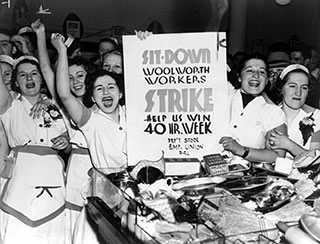
1937 Woolworth Strike for 40 Hour work week
Labor Day was a little bone tossed by big government to the working classes as part of an appeasement for the Pullman Strike debacle of 1894. It’s really not much on the one hand, but we can make it what we will. I am choosing to remember that we live in a world of imbalances, where those in power all to often wield it unfairly over those without power, and that tragedies of labor are now being offshored and therefore unseen by so-called more advanced societies like ours. Let us remember that many of the “rights” we enjoy – 40 hour work week, fair wages, paid overtime, health and safety standards, equal opportunity, etc. – were pushed into existence by the working class and resisted all along the way by the capitalist class. This is not a judgment, just the documented facts of history, and something we should remember. And we should remember that there is a lot of work to be done.
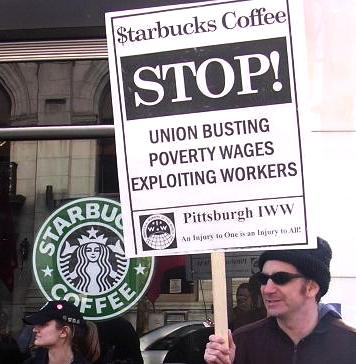
At Starbucks protesting for Union, 2009
Happy Labor Day!
>The Crisis Now: Harman & Harvey on our (re)current economic troubles
>Given our current economic crisis (haven’t we been here before?) maybe this would be a good time to see what the communists have to say.
Here is Chris Harman speaking on how we got into this stinking mess:
Harman references several times the talk given by David Harvey. Here is Harvey:
I have to say I like a lot of what they say (in fact I think they are often spot on), but at times they come across a little too simplistic and a little too much like they are preaching to the choir (but Harman is a hoot, ain’t he). This is where some good reading will help. This last weekend I spent about ten hours on American Airlines reading Das Capital. It’s both great and a slog. Many pages left to get through that beast. Then on to other books and more perspectives. Bye for now comrades.
>40 years ago today…
>
Apollo 11 left the Earth and entered the history books as the first mission to put a man on the moon. Still staggering after 40 years.
The launch of Apollo 11:
The casualties of Operation Overloard
One of the truest clichés is that war is hell.

New Zealand Commandos ready to hit the beach
Today is 65 years since Operation Overlord began – also known as D-Day. This day stands as one of the great moments of triumph in the wars of good versus evil that are seared into our consciousness. I have always viewed the actions of the soldiers who landed on the beaches to be nothing short of heroic, and I still do, but I am burdened by the casualties from the event. I wrote a post recently on my attitude towards war and I must confess I have difficulties bringing together my hatred of war and my thanks for the heroes of D-Day.

British commandos in a ruined French town, Normandy.
Consider the casualties from Operation Overlord. This is taken directly from Wikipedia and it bears reading and pondering:
The cost of the Normandy campaign had been high for both sides. From D-Day to 21 August the Allies had landed 2,052,299 men in northern France. The Allies lost around 209,672 casualties from June 6 to the end of August, around 10 % of the forces landed in France. The casualties breaks down to 36,976 killed, 153,475 wounded and 19,221 missing. Split between the Army-Groups; the Anglo-Canadian Army-Group suffered 16,138 killed, 58,594 wounded and 9,093 missing for a total of 83,825 casualties. The American Army-Group suffered 20,838 killed, 94,881 wounded and 10,128 missing for a total of 125,847 casualties. To these casualties it should be added that no less then 4,101 aircrafts were lost and 16,714 airmen were killed in direct connection to Operation Overlord. Thus total Allied casualties rises to 226,386 men. 78 Free French SAS (Special Air Service) killed, 195 wounded in Brittany from 5 June to the beginning of August. For Allied tank losses there are no direct number. A fair estimate is that around 4,000 tanks were destroyed, of which 2,000 were fighting in American units.
The German casualties remains unclear. The estimates of the German casualties stretches from 288,000 men to 450,000 men. Just in the Falaise Gap the Germans lost around 60,000 men in killed, wounded and captured. The majority of the German casualties contained of POWs as nearly 200,000 were captured during the closure of the battle. The Germans committed around 2,300 tanks and assault guns to the battle in Normandy, and only around 100 to 120 were brought back across the Seine. The overwhelming majority of the German tanks destroyed were put out of action by the Allied airforce, while very few of the Allied tank losses were inflicted by the Luftwaffe.
19,860 French civilians were killed during the liberation of Normandy, and an even greater number were wounded. The number excludes the 15,000 civilians killed and the 19,000 wounded in the bombings of Normandy in preparation of the invasion. Many cities and towns in Normandy and northern France were totally devastated by the fighting and the bombings. As many as 70,000 French civilians may have been killed during the liberation of France in 1944.
These numbers are staggering. Keep in ming that is for less than two months of fighting and such losses are entirely unbelievable by today’s expectations.

Dead U.S. soldier, Omaha beach
D-Day is considered a great triumph. It was the first major stake through the heart of European fascism and Nazi ambitions. We use the words “saved the world from fascism” and “liberated Europe” when we talk about D-Day and its heroes. I have always had strong emotions about WWII and D-Day. The opening sequence of Saving Private Ryan truly chokes me up. I spent hundreds of hours as a kid pouring over my WWII book collection, closely examining photographs, reading the stories, and wishing I had been there. However, D-Day can also be seen a part of a huge failure. A failure not merely because there where many political options not exercised by the Europeans and Americans all through the 1930s that could have dealt with the rise of Hitler and fascism and avoided war altogether, and not merely because one source of WWII was the WWI (the war to end all wars) which also could have been avoided but was entered into with relish by all sides, but D-Day is a failure because all war is failure. War is a powerful and profound testament of human evil. To seek war, whether from selfish ambition, glory, or even from a felt obligation is, to use an old but still valid term, sinful.

Dead German soldier, Normandy.
More than ever on days like this one, where we appropriately remember the sacrifices of so many human lives for causes that we believe in, I am in conflict. Should those soldiers have stormed the beaches in Normandy 65 years ago to save the world? Maybe not, for war is wrong. And yet they did and I am grateful they did. So today I will remember what those soldiers did and what they gave (in fact I am in awe of their service), but I will also remember and grieve the casualties on all sides, including the civilian casualties, and I will remember that the human tendency to war and glorify war is my tendency too because I am a sinner.
>Americans summit Everest
>On this day in 1963 Mount Everest was submitted for the first time by an American.
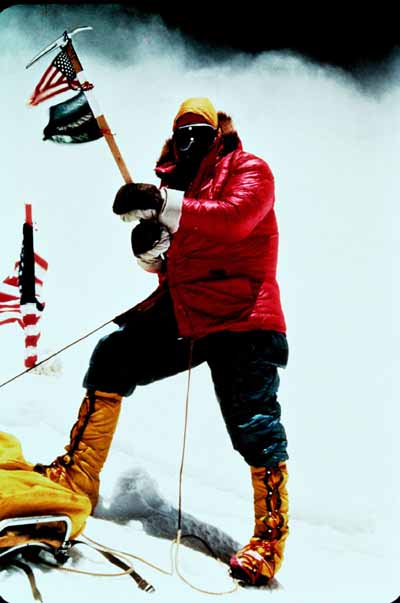
I find this interesting in part because of how times have changed since then. That year there was only one expedition on the mountain. Today there may be many, with a thousand climbers on its slopes. No longer do climbers plant their country’s flag on the summit, and many since have reached the summit without the use of bottle oxygen. Expeditions are typically much smaller than they used to be, and many climbers are actually clients who have paid their way onto a climbing team. Also, the typical location for base camp is now considered the world’s highest garbage dump, from past expeditions leaving their used equipment, and is often packed with people. In 1963 there would have been few places on earth as wild and pristine.
I first became aware of the 1963 American expedition by reading a copy of Everest Diary John D. McCallum, based on the diary of Lute Jerstad. I mentioned this in an earlier post. For me those early Everest expeditions have a wonderful romantic quality. Although I have climbed several minuscule mountains by comparison I used to think maybe someday I would climb in the Himalayas. Alas, now I hope maybe I will someday get a chance to just see them for myself.
Here is the first three minutes of the documentary made of the expedition:
http://video.google.com/googleplayer.swf?docid=-3937648226832477292&hl=en&fs=true
Turning
1
Along the shiny edge of a scar
There are no nerve endings.
Along the desert road
There is only the desert and the road.
I rose to standing in the still air;
Blue sky, circling hawk,
The smell of pine trees and gasoline,
The dust slowly settling.
Silence.
Watersheds come like the molting of birds
And snake skins,
Like pulling teeth and peeling scabs.
Sometimes they come slowly
Like the blue ice of a glacier.
Sometimes they come quickly
Like flames leaping to touch a hand.
Later we calculated the distance.
Thirty paces in the air,
Then another ten.
How fast had I been going?
The impact still hides in shadows,
Memories concealed like a hilltop in fog.
But there,
Eighty feet from the half buried stone
I stood,
Traces of a struggle before me,
A vivid recollection without images,
A dream in darkness.
There is no moment
Like the moment you can’t remember,
Like the mind waking from
The anesthetic, alone, with
Only white sheets and stitches.
I leaned over,
Lifted the motorcycle
To its proper position.
Blood coming through my shirt sleeve,
Adrenaline rushing away in waves,
My broken foot
Secretly swelling inside my boot,
Still days from home and hospital.
2
The severed tails of lizards grow back
And shoots sprout from old roots
And some things never return.
The clouds finally cleared,
Emerald valley pulsing with music and incense,
Trampled grass, the smell of oils,
Burnt shoulders gyrating by the stage,
Honey colored sun reflecting
On drums.
I balanced carefully,
Blue bike handlebars,
Left tennis shoe, aluminum crutch,
Evening light in the trees,
A landscape lush with life,
And the two of us
Pedaling to the campus festival.
How far from here to the desert road,
Now glowing in moonlight,
To the place where it curves right, then left,
Under a sky now filling with stars?
How far back to the hilltop in fog,
Through the shadows of fragility and anguish
And mortality?
Recklessly I danced on one foot
the other turning black, purple, yellow,
Mottled image across tight skin,
The misshapen appendage
Now a symbol of transition,
Suspended above the earth.
Leaves turn in the wind
Like faces turn from suffering,
Like water turning into wine,
Like a young man, turning in the rhythm
Faces the sky’s constant rotation
And a childhood turning into memory
Like dust settling on a desert road.
June 1998
 pilgrimakimbo