>why I write this blog (in part)

>


If PilgrimAkimbo was a band it would not be a blog.

I cannot say exactly why I write this blog, and when someone tells me, in an off-hand manner, why they write their blog I don’t entirely believe them. Not because they’re wrong, but because personal, non-corporate, non-fake blogs exist for deep and complex reasons, and reasons are always being born and always expiring. But still, I feel I must, for deep and complex reasons, sort out my thoughts about PilgrimAkimbo, at least just this once.

There is a little man inside my gut that jabs a stick at my heart every once in a while, reminding me that I need to grow up and be a kid again. There are many pressures placed on adults, good pressures like being faithful to your relationships, paying your bills and, if you have them, raising kids with love and mercy. But along the path from the city of destruction to the celestial city (if you get my drift) one is easily convinced to give up on those things one loved as a child – to put away childish things and grow up.

What are these “childish” things? In particular I am referring to those unique personal aspects of one’s subjective nature that make up who one is, that come so freely when one is a child, and that often get pushed aside by outside pressures as one matures. Maturity is a good thing, but maturity is a tricky slope. I have been too quick to measure my maturity by common cultural standards and thus have often gravitated towards a false maturity, one that is more about conforming and putting on airs than it is about true maturity. And thus I have trapped myself – not a trap I cannot get out of – but a trap nonetheless.

What is this trap I am suggesting? The trap is believing that a childhood passion for something (be it cinema or baseball, poetry or wanderlust) must be suspect merely because it is a childhood passion. Take, for example, a passion for artmaking. Many children have this passion, for some it is only temporary, but many, I suspect, have this passion as a inherent and indelible characteristic of their soul. However, as they get older they will inevitably hear that artmaking is a nice hobby, but certainly not something to be taken too seriously, especially if one wants to grow up and get on with life – you know, get a real job, support a family, do something important, be like everyone else. Those pressures to set aside artmaking may come from parents, teachers, the youth-group leader at church, friends, anywhere.

Now, I do believe it is important to grow up, but I think we have these deep passions because that is who we are. What were your passions as a child? Do you still follow them? If you do, that’s great. For me, my love of film and filmmaking got set aside, in part for good reasons, in part for other reasons. This blog is an attempt to re-engage with those passions. But why now?

That I can only partly answer. Suffice it to say that my love of cinema has re-welled up within me at a time when I have also been reconsidering my life. A little over a year ago my wife, my eldest daughter, and myself were reeling from the death of our second daughter, Coco Madalena. That “event” and subsequent sorting out gave me new eyes on the world. Not angry eyes, but a realigned perspective. I began to see the value once again in being true to oneself, to not get hung up on little things, to seek honesty and love rather than surface level respectability and corporate success, to love what you have, and to find value in being who you are, to trust in my creator. Since that time we have been blessed with another, beautiful, amazing little girl, Wilder Rose. And her existence in my life has only fueled my passion for the wonder of being human.
That is why I am reaffirming my love, my childhood love, for cinema and why I write this blog – in part of course, for there are really many reasons.

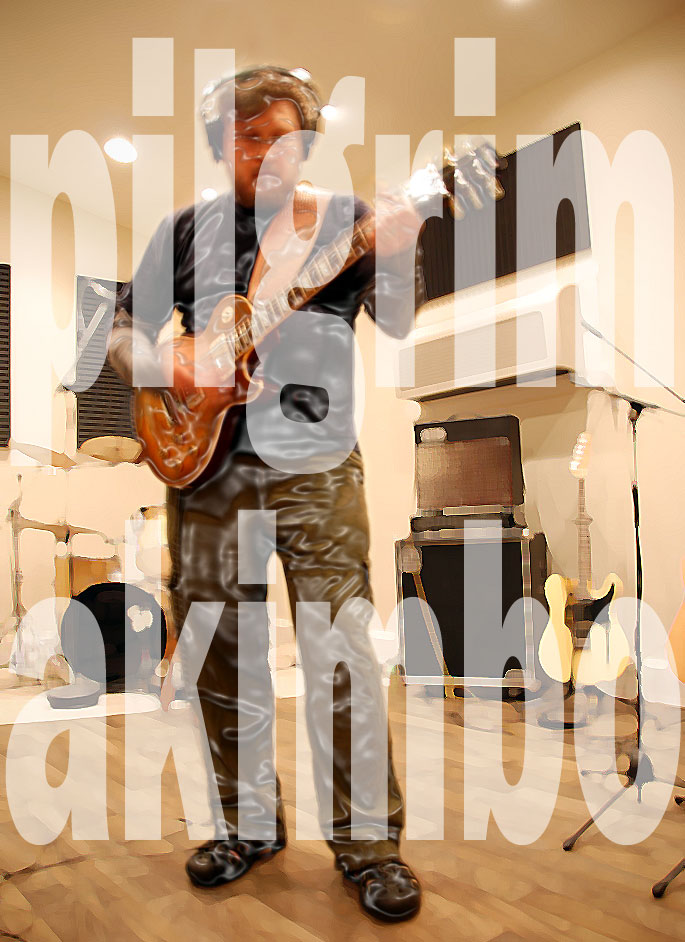
So why the pic at the top? A friend of mine has a passion for making music to which he is staying true. That’s me with his guitar, in his studio, pretending to know what I am doing. So, if PilgrimAkimbo was a band… Ah, now that’s another dream.
>I “love” that dog wherever he is

>“For some reason I’ve just remembered how I lost the script of Rublyov (when I had no rough draft). I left it in a taxi at the corner of Gorky Street (opposite the National). The taxi drove off. I was so miserable I went and got drunk. An hour later I came out of the National and went towards the All-Union Theatre Society. Two hours after that, as I came down again to the corner where I had lost the manuscript, a taxi stopped (breaking the law) and the driver handed me my manuscript through the window. It was miraculous.”

6 April 1973


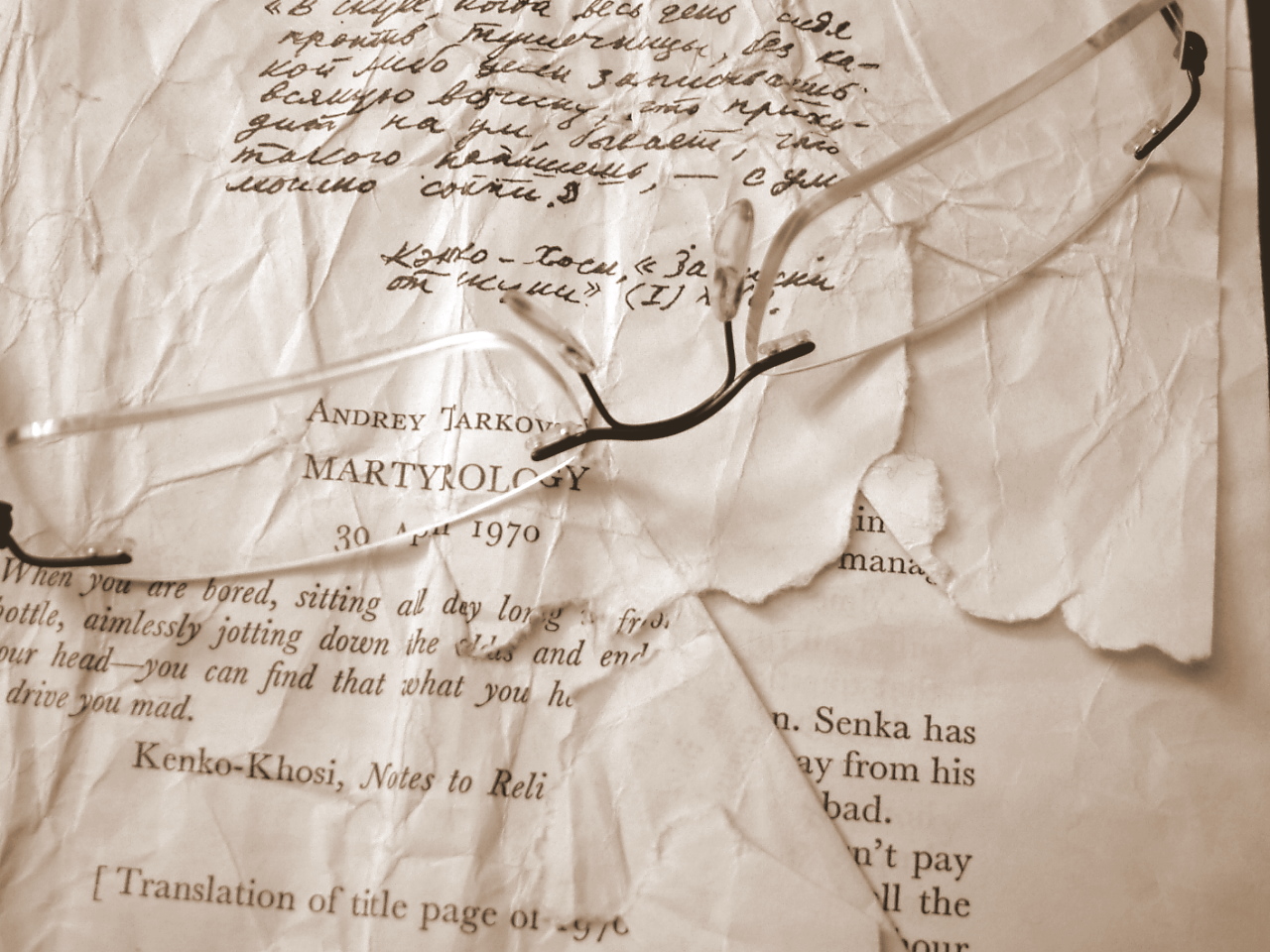
I’m looking over at a copy of Tarkovsky’s diaries (Martyrology), or what’s left of it. Years ago I purchased a used hardbound version of the book. Reading it was a kind of revelation for me. Although Tarkovsky complains mostly throughout the book, something I related to being a frustrated artist myself, I found the book to be a delight. Like any collection of journal entries the book is frustratingly incomplete regarding the kinds of information one might want to know, like insight into the directing or editing processes of specific films, etc. But one gets something better. [If one wants to know the process of making a work of art then one needs to make a work of art, and then do it again, and then again. The knowledge comes with doing because making art is like a spiritual practice in that sense.] What Tarkovsky gave us in his diaries is a view into his humanity. He was a remarkable man, but just a man like me. That kind of perspective is infinitely more valuable than “what were you thinking when you made that shot?”


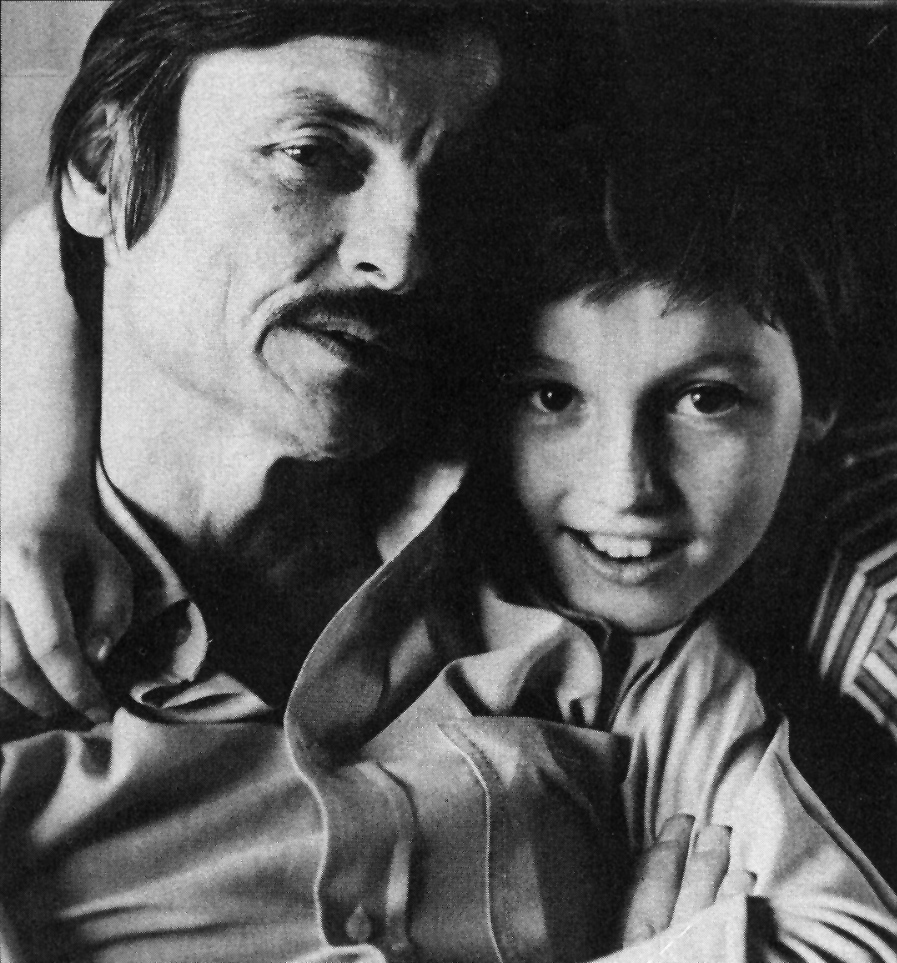
father and son

So the book. Well (and this was a few years ago), I had not read the book in quite a while so I decided to pull it off the shelf, dust it off, and put it on the coffee table to remind myself to pick it up when I came home from class. I was gone for only about a hour, came back and the book was not on the coffee table any longer. Hhhmmmm. Then I saw it. Across the room was the book, but now missing its cover. Remember, it was a hardbound book. After I began to investigate and put 2 and 2 together, I realized that the dog, a Labrador of course, had ripped off the cover and completely consumed it – later to end up in the yard (I’ll save you the description). Boy was I mad. And yet, how fitting. In a small way I was subjected to a “Tarkovsky moment” that is, a moment where all is not lost, but the path one is on has just taken a turn for the worse and one has to look inside to find the deeper value of the moment.
Now the book, coverless and a little tattered, lies on the bookshelf, the dog really belonged to some friends after all and is now somewhere I don’t know, and I’m thinking of pulling that book off the shelf and putting it on the coffee table to remind myself to pick it up again. And this time we have a Pug, so it’ll be alright. Then again, that little dog does get a sneaky gleam in his eye from time to time.

>The Mayflower and the Life of Cinema

>If I remember correctly the summer of 1977 was rather hot. This was also the year that Star Wars was released in theaters. I mention this because the only theater in the thriving metropolis of Eugene, Oregon that had Star Wars was the (now gone forever) Mayflower, and the Mayflower did not have air conditioning. Good riddance I say.

The Mayflower was right across the street from the run-down frat house used in Animal House the next year – also gone. Why it was called the Mayflower I do not know, but rumor had it that it was slated for demolition, but the revenue generated from Star Wars kept it standing for another couple of years. Good riddance, yes, but not without some sense of loss. I mean those were the days. The next year – 1978 – I would sneak into the same theater with a friend and watch Hooper three times back to back – hiding under the seats between shows – and dreaming of becoming a stuntman. Yes, good times for a kid.

In 1977 I was eleven going on twelve and that was the year in which another movie patron told me to shut up – actually told me and my friend to shut up (yes, the same friend I saw Hooper with). I was so mortified that no one has ever told me to shut up in a theater again, as far as I can recollect. But I cannot take all the blame. Some of the blame goes to Star Wars. You see, Once I had seen Star Wars that first time, I had to see it again. In fact, I saw Star Wars six times the first week of its release – and twelve times that year (all at the Mayflower). By the fifth or sixth viewing my friend and I had most of the dialogue memorized. From the first moments of the 20th Century Fox logo I would feel giddy with anticipation, and at some point during one of those viewings my friend and I just couldn’t keep ourselves from quoting out loud each line. Needless to say some of the other filmgoers were not amused.

Why do I say this? Sometimes I get annoyed going to the movies; People talking, cell phones ringing, not being able to pause the movie if nature calls, having to see the film at a particular time decided by someone else, bad reel changes, bad odors, poor wine selection, etc. You know what I mean. However, I have to say that, for the most part, the multi-plex for all its crass commercialism is an improvement over the single screen theaters of the past – at least for those films that would have already been coming to town, since multi-plexes still don’t show many truly independent or foreign films. The seats are better, the projectors are better (the projectionists are not, however), the sound is better, etc. You know what I mean. So the reason I bring this up is that it has become a common move to periodically decry the death of cinema, even from it’s birth. Louis Lumière once said, “The cinema is an invention without a future.” It would be easy for me to long for those golden days of my youth when I could watch films in rickety theaters with bad pictures, bad sound, bad odors, and annoying patrons (including myself I guess). But that would be like longing for the good old silent film days, or the good old days when the screens were smaller, or the good old smoke filled theater days, or the good old pre-steadycam days, whatever. One might as well long for the good old pre-film days when the cinema was just a wonderful dream, just a twinkle in the eye really – think of all the possibilities.

In a recent piece for the New Yorker (Big Pictures), David Denby writes about how cinema as we know it, or have known it, is changing, and probably not for the better. I can’t say that I disagree with much that he writes, and I won’t pretend to have a tenth of his knowledge, but I don’t have the same fear that he expresses. He describes the (mostly past) utopian vision of seeing a film at the local neighborhood theater:

[W]e long to be overwhelmed by that flush of emotion when image, language, movement, and music merge. We have just entered from the impersonal streets, and suddenly we are alone but not alone, the sighing and shifting all around hitting us like the pressures of the weather in an open field. The movie theatre is a public space that encourages private pleasures: as we watch, everything we are—our senses, our past, our unconscious—reaches out to the screen. The experience is the opposite of escape; it is more like absolute engagement.

Denby then contrasts that cinematic utopia with this description of seeing a film in a modern multi-plex:

The concession stands were wrathfully noted, with their “small” Cokes in which you could drown a rabbit, their candy bars the size of cow patties; add to that the pre-movie purgatory padded out to thirty minutes with ads, coming attractions, public-service announcements, theatre-chain logos, enticements for kitty-kat clubs and Ukrainian bakeries—anything to delay the movie and send you back to the concession stand, where the theatres make forty per cent of their profits. If you go to a thriller, you may sit through coming attractions for five or six action movies, with bodies bursting out of windows and flaming cars flipping through the air—a long stretch of convulsive imagery from what seems like a single terrible movie that you’ve seen before. At poorly run multiplexes, projector bulbs go dim, the prints develop scratches or turn yellow, the soles of your shoes stick to the floor, people jabber on cell phones, and rumbles and blasts bleed through the walls.

My thought is this: Denby’s utopia does sometimes exist, especially at the few remaining art-house theaters and at some college campus or film festival screenings. I also think it exists when a group of friends gather around the flat panel HDTV at someone’s home, after a great meal and good wine, crank up the surround sound, pause the film half way for potty breaks and glasses of good scotch, and then follow the film with a discussion. In fact, Denby’s dour description of the multi-plex experience is really no different than the theater experiences we had in the “good old days.” Communal cinematic experiences are always fraught with potential problems as well as potential joys. Today, however, we have more viewing options available to us. Certainly I decry Denby’s imaginary experience of watching Lawrence of Arabia on a video iPod just as much as he does, but that’s just it, it’s an imaginary experience. The films being watched on video iPods today are Pirates of the Caribbean (another Denby example) and frankly I couldn’t care less if someone watches it on a two inch screen. I am inclined to believe that films will find their most appropriate presentation options and people will seek out those options with some films gaining a large audience through video iPods and other films through other means.

So finally, I wouldn’t give up the summer of 1977 and my twelve times watching Star Wars at the lousy Mayflower. I also wouldn’t give up the 16mm screenings of the cinematic cannon in those cold lecture halls I frequented in college. If I have the time to get to the multi-plex or the local art-house theater I will. And if could afford to buy a video iPod I would. Cinema is not dead. The movies keep moving. In fact, I’m inclined to think that motion pictures are as alive today as ever before. What I do see changing is the almost hegemonic power of Hollywood and the limited methods of delivering movies to all of us. Old cinema gets old (and sometime better with age), just like we all do, and new cinema is born. This is not a value judgment. It’s just life. And we all know how life is.

>the newbie blogger’s New Year’s Resolutions

>

I really don’t think New Year’s Resolutions mean a whole lot, and they are mostly personal anyway. But in the spirit of blogging, and a giddy year-end state of mind, I will submit my list.

Spend more time with my family. We have a baby due in late January, so I will soon enter the no-sleep zone, but as far as I am concerned, that’s great with me. Of course, the no-sleep zone may mean more time to be up late writing my blog, or it may mean less (probably less).

Finish my MBA program. I should be done sometime in mid-2007. Of course, writing my thesis will conflict with writing my blog and, I have to say, the thesis will win out if push comes to shove. Of course, I still have my full-time job, so I’m asking God for two extra days to be created each week, just until the dust settles.

Watch more movies. What else can I say. Over the past few years I have not seen nearly as many films as I would like to. In my post watching movies at home I highlighted some of the challenges I face in trying to watch films at home (which is where I do most of my film watching these days), or even at all. So I figure I will never reach the number of films I did in my younger days, nonetheless, I will make a more concerted effort to fit in more films.

Write more. Blogging is rather new to me, so I’m still learning what it will mean for me, both in terms of content and overall commitment. However, I think it is a good thing to attempt to articulate one’s thoughts in writing. So, write more, and I should add, write better.

Finish my next script. I have been working for the past few years on film scripts as both a personal exercise and with a view to a possible future career. We’ll see how that goes. Along with this, I have a desire to take our little video camera and make some videos with my daughter (six going on seven) so she begins to understand more fully that movies are made and that she too can make them. Plus, I hope she will understand and appreciate movies better through the process.

Read some great film-related writing. I have David Bordwell’s The Way Hollywood Tells It on my list, as well as Jonathan Rosenbaum’s Movie wars: how Hollywood and the media conspire to limit what films we can see. I am looking for more suggestions – so let me know what you think I should be reading!

Oh yes, and these: exercise more, eat better, sleep more, spend more time with friends, stay on top of the bills, keep practicing my guitar and write more songs, teach my daughter to ride a bike, be more loving and romantic to my wife, get back into mountain climbing, learn to golf, etc. etc.

That’s all for now. HAPPY NEW YEAR y’all! Blessings all ’round!