>why is a long movie?

>This article Long flicks: To cut or not to cut? got me thinking.

I am curious as to why, when discussing the length of movies, 2 hours seems to be the key marker. In other words, a film that is over 2 hours automatically becomes a target for questioning the validity of its length while a film shorter than 2 hours rarely comes under such scrutiny. I understand the argument that theaters can get in more screenings per day with a shorter film, but a typical critique of film length rarely includes theater owners. Most of the time it is a critic who argues that a film is too long, and not for financial reasons, of course, but on the film’s artistic merits. But why is 2 hours the demarcation point? Why not 3 hours? Or 4? Is it the momentum of tradition, the weight of expectation, cultural conditioning, the limits of the human psyche or attention span?

I find this topic interesting because I tend to like lengthier films. I also like slow moving, contemplative films. Therefore, a film that I find just perfect may be far too long for another viewer. I also like tightly crafted shorter-length films. However, I am more likely to criticise a film for not taking the extra time to properly develop the story or key characters than argue a film is too long. Those who see films with me may notice that when it comes to films I really like I will often say I would have liked the film to be longer, to keep going. Maybe I’m just quirky.

One maybe-not-so-serious thought: I wonder if the length of films is more closely tied to biological reasons, such as the average size of the human bladder, than anything else. Isn’t that the real reason for those big epic films of yesteryear providing the audience with an intermission? (Also, so the filmgoers might purchase more concessions?) If a film is dragging a bit and you’ve consumed all your Pepsi, you’re probably more likely to become frustrated with the filmmaker for making you suffer. If that is true, then I think an interesting study would take a look at the perceptions of appropriate film length between those who watched a film in the theater and those who watched the same film on DVD (where you can pause the film for various reasons).

So what then is a long movie? Is there a “magic” length? Does length have a bearing on a film’s quality?

>love film love film criticism love

>I have been thinking lately of the responsibility of film criticism. In regards to film (and other arts), my own training includes both criticism and production. So when it comes to thinking about film criticism I find myself often of two minds. I love to examine, think about, discuss, and write about works of art. I also know a little of what it is like to produce works of art and present them to the world (mine is a rather small world at this point) for examination, thought, discussion, and whatever else. There is a certain amount of vulnerability in being an artist, or creating a film, or singing a song. And yet, I believe works of art (film included, of course) should be critiqued. I believe this because it is, or can be, good for the artist, good for the critic, and good for anyone else who participates. Art criticism is a natural, human endeavour that is a vital part of how we “make” the world in which we live. I also believe that criticism is, or should be, a part of how we do something else that is vital to our existence, that is, to love each other.

To love each other, that is the underlying, fundamental, deeply purposeful project of criticism – even though it may not look that way on its surface.

Love, in this context, is not necessarily emotional, nor is it a cheap sentimentality, and certainly it is not romantic love. This kind of love comes from the realization that to love each other, that is, to care for the well being, the goodness, the growth of another person (of all persons) is the right thing to do. It is a way of behaving, a way of considering, a choice. All too often film criticism, and just about any kind of criticism, emerges from a desire to be clever, or witty, or an intellectual, or just plain right. All of these desires are not wrong in and of themselves, but they can have negative ramifications when uncoupled from a desire for the progress and betterment of the artist, the reader, and even of oneself (the critic). Remember each film, each work of art, is a manifestation of a moment in the artist’s ongoing process as an artist (and as a human being). Consider the following quote from Art & Fear: Observations on the Perils (and Rewards) of Artmaking by David Bayles & Ted Orland:

Filmmaker Lou Stouten tells the painfully unapocryphal story about hand-carrying his first film (produced while he was still a student) to the famed teacher and film theorist Slavko Vorkapitch. The teacher watched the entire film in silence, and as the viewing ended rose and left the room without uttering a word. Stouten, more than a bit shaken, ran out after him and asked, “But what did you think of my film?” Replied Vorkapitch, “What film?”

The lesson here is simply that courting approval, even that of peers, puts a dangerous amount of power in the hands of the audience. Worse yet, the audience is seldom in a position to grant (or withhold) approval on the one issue that really counts – namely, whether or not you’re making progress in your work. They’re in a good position to comment on how they’re moved (or challenged or entertained) by the finished product, but have little knowledge or interest in your process. Audience comes later. The only pure communication is between you and your work.

I am sure Stouten’s experience is rather common, in one way or another. I am also sure that the advice given by Bayles and Orland is a typical defense mechanism born out of numerously painful experiences. The truth is, Vorkapitch had an opportunity to take this young filmmaker and help him grow into a better filmmaker, but Vorkapitch chose to love himself, his status, or whatever, rather than Stouten. What Vorkapitch failed to realize is that it is not the film that matters, not really, it is people that matter. Even if Vorkapitch felt he had wasted and hour or two of his life watching a film that he thought was terrible, he still had the responsibility to act as he should, and he didn’t.

To be a loving critic may require one to say hard things, to point out that a work of art is quite bad (and why), to get in an artist’s face and and say she is wrong. Honesty is fundamental to love. But there is a big difference between saying such things as a means of truly participating in an artist’s process, and saying such things as a way to place oneself “above” the artist. Filmmaking (and art-making) is a truly great thing – a kind of gift as it were – and no critic would have a film to judge were it not for the difficult labor of the filmmaker. I frequently need to remind myself of this. I also need to remember that the critic provides (or has the opportunity to provide) an invaluable service to the artist and the art making process. If we want to speak of the responsibility of film criticism, let’s begin with that.

Cinema Sublime: considering contemplative cinema’s relationship to the infinite

Okay, the contemplative cinema blogathon is voodoo. I mean, I have been thinking about it too much when I should be working on my thesis. Bad, bad, bad. So here are more of my thoughts:

Contemplative cinema seems to have certain aesthetic traits. An excellent overview of the most obvious traits can be found at The Listening Ear: Defining Contemplative Cinema (Bela Tarr). I have also tried to triangulate somewhat on the traits with these posts on “Art Cinema” Narration: Part One, Part Two, and Part Three. Then I tried, somewhat unsuccessfully, to describe the distancing aspect of contemplative cinema by way of contrast here. And finally, I tried, feebly, to find some links to 20th century painting and contemplative cinema here. In some ways I feel my posts have only been scratchings at the surface and not really getting at the heart of the matter. I anticipate this post will also add to the scratching. Probably because I do not see a “solution” to the question of contemplative cinema, merely a myriad of signifiers in an ever expanding galaxy of meaning.

I firmly believe that contemplative cinema is not the sum of a set of unique traits – the long shot, narrative in the background, etc. – although there certainly are unique traits. Contemplative cinema must, I believe, come from a set of ideas – loosely organized and very arguable for sure. What those ideas are is too big of a topic for this post, but I have an idea that the ideas behind and underneath contemplative cinema are complex, very human, and have deep roots planted long before cinema was born.

Here’s just one possible approach to one kind of contemplative cinema.

The concept of the sublime and contemplative cinema
In the 17th and 18th centuries our (richer) predecessors trudged through Europe on their grand tours seeking that fullness of experience that would round out their lives and, if young, complete their educations. When confronted with the awesome grandeur of the Swiss Alps, these trekkers gaped in fearful admiration at nature’s terrifying and beautiful power. Trying to give name to the strange and conflicting experience of fearfulness and mutual attraction, philosophers gave it the name “sublime,” and then set out to argue about it from then until now. Edmund Burke and Emmanuel Kant both dove masterfully into the subject, but it is Schopenhauer who may have clarified it best for us when he listed off the stages of going from mere beauty to the fullest feeling of the sublime (taken from Wikipedia):

Feeling of Beauty – Light is reflected off a flower. (Pleasure from a mere perception of an object that cannot hurt observer).

Weakest Feeling of Sublime – Light reflected off stones. (Pleasure from beholding objects that pose no threat, yet themselves are devoid of life).

Weaker Feeling of Sublime – Endless desert with no movement. (Pleasure from seeing objects that could not sustain the life of the observer).

Sublime – Turbulent Nature. (Pleasure from perceiving objects that threaten to hurt or destroy observer).

Full Feeling of Sublime – Overpowering turbulent Nature. (Pleasure from beholding very violent, destructive objects).

Fullest Feeling of Sublime – Immensity of Universe’s extent or duration. (Pleasure from knowledge of observer’s nothingness and oneness with Nature).

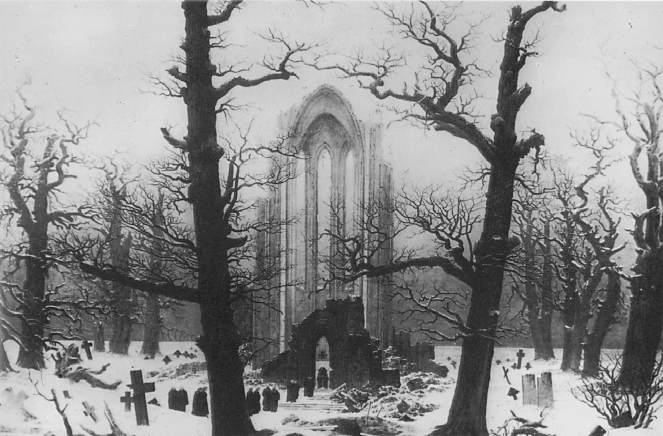
For examples in painting we might look at Caspar David Friedrich’s Cloister Cemetery in the Snow (1817-1819)…


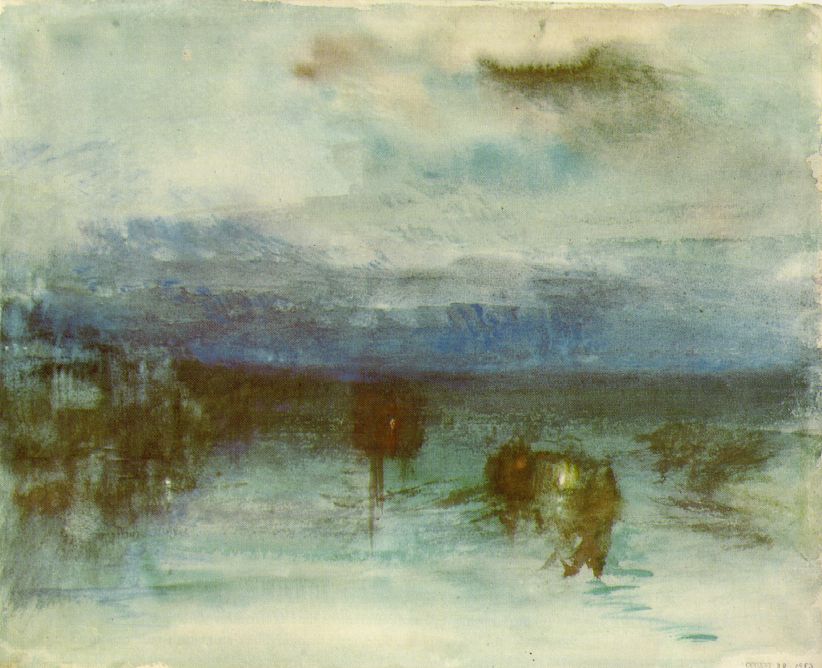
…or at JMW Turner’s Moonlight (1840)

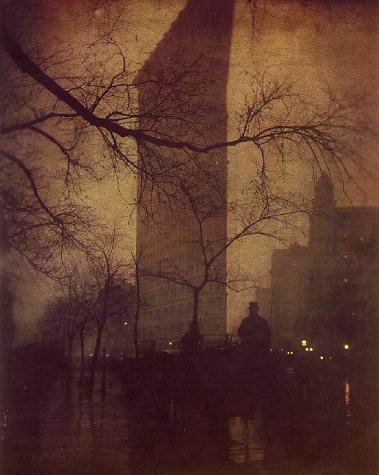
In photography we might consider Edward Steichen’s The Flatiron (1905)…

…or Minor White’s Pacific, Devil’s Slide, California (1947)


I believe we can use these examples from other arts as part of the groundwork in understanding how the sublime might function within contemplative cinema.

Prior to the 20th century the sublime was found mostly in nature, which, for all its potential danger, is fundamentally morally neutral. But in the 20th century unimagined horrors were foisted on humankind – trench warfare in WWI, the Nazi genocide of European Jews, the atomic bombs dropped on Japan, and the list continues. I would argue that a shift occurred in the concept of the sublime to include the fact that human beings commit such horrors, both consciously and subconsciously, and that that inclusion has had a significant affect on the arts including cinema. In other words, one could extend concepts of turbulent nature, overpowering turbulent nature, and the immensity of the universe’s extent to the apparently overpowering aspects of human desire, the power of technology, and human evil. A fully engaged response to this reality could include a scientific approach where one just has to face up to the emptiness of human existence in a world created by time + matter + chance, or it could explore the soul as though on a sea of meaning both frightening and hopeful.

What I am saying is nothing new. However, I think the modern concept of the sublime, with its roots going back to 17th century, may offer pointers towards an understanding of contemplative cinema. For example, it is obvious the Bergman’s The Silence or Resnais’ Hiroshima mon amour are artistic explorations of a human response to the modern world from within a position of the nihilistic universe, but a more sublime film, such as Tarkovsky’s Stalker, might address the same concerns, but from a different vantage point. I would argue that that vantage point is not the scientific perspective of the individual in a cold universe, but the soul in relation to the infinite. This is not to say the Bergman or Resnais (in these examples) did not make contemplative films, but they do so by rooting the viewer in the narrative process and therefore in a materialistic world. I propose a sublime contemplative film calls the viewer beyond the narrative – and to me this seems to be a higher level of contemplation.

Another angle on the sublime might be:
The experience of the sublime involves a self-forgetfulness where personal fear is replaced by a sense of well-being and security when confronted with an object exhibiting superior might, and is similar to the experience of the tragic. The “tragic consciousness” is the capacity to gain an exalted state of consciousness from the realization of the unavoidable suffering destined for all men and that there are oppositions in life that can never be resolved, most notably that of the “forgiving generosity of deity” subsumed to “inexorable fate”. (also taken from

Wikipedia )

In this sense the sublime is an almost religious concept – one might think of the concept of fearing God (a combination of love, reverence, and trembling), for example. A contemplative film which has its roots in the sublime might then call on the viewer to transcend narrative construction (mentally speaking) in order to enter into a feeling of the “tragic consciousness” of the universe, and thus transcend narrative climax. The potential issue with this way of thinking, however, is the reality that the viewer’s response is personal, which is unique for each viewer. That is why I cannot go so far as to say the characteristics of contemplative cinema are a set of particular visual or narrative cues. But there may be characteristic goals.

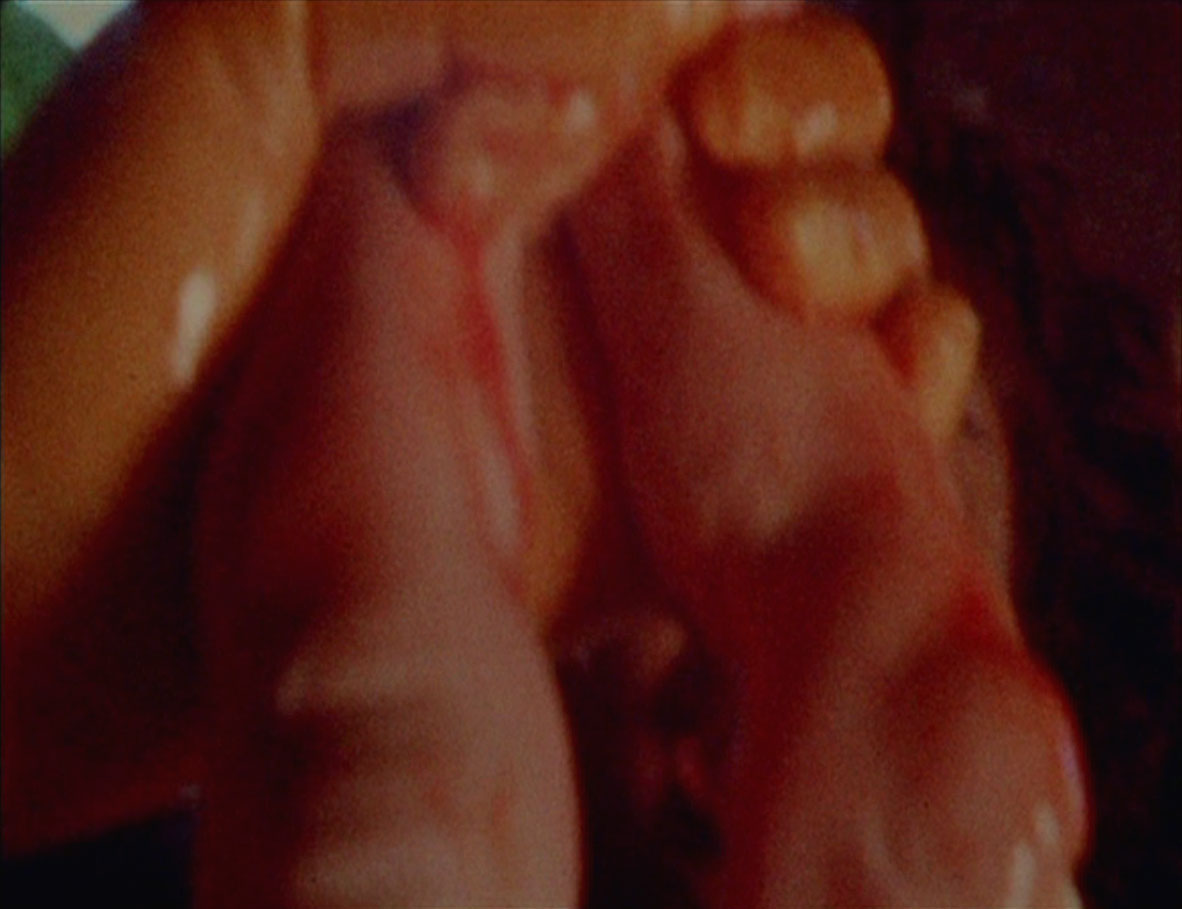
Does it make sense to see contemplative film, then, as primarily non-narrative? One might consider Love Song (2001) by Stan Brakhage, an abstract, undulating, “hand-painted visualization of sex in the mind’s eye.” No doubt this short, purely abstract film seeks to produce an effect within the viewer. No doubt it calls of the viewer to be open to exploration of the self in some capacity. But what can we really say about it? In my opinion, sublime contemplative film still needs something more tangible to hang on to, and part of that tangibility is narrative, even while seeking to transcend narrative.

Love Song (2001)


Of course, a question raised by considering a film such as Love Song is whether or not sublime contemplative cinema succeeds by accurately representing something that is already sublime, or whether by using cinematic means, however so, to induce a feeling of the sublime in the viewer.

A better option may be to consider another Stan Brakhage film, Window Water Baby Moving (1962). In this powerful short film about the birthing process there is the natural narrative of the birth. Although told unconventionally, there is enough of a narrative, and just enough balance between abstraction and reality, that one can “enter” into the film more fully. This entering process then allows the transcending process to be more substantial, that is, it seems more likely that the viewer will end up in a different place at the end than at the start, psychologically and spiritually speaking. The sublime nature of the piece shines through in the combination of the beauty of body, life, and love with the graphic intensity of actual birth in bloody closeup.

Window Water Baby Moving (1962)

Interesting, Window Water Baby Moving is constructed via the often rapid juxtaposition of many different images, and thus potentially subverts the idea that contemplative film is necessarily and characteristically made of lengthy shots in which very little action takes place.

Finally, a cinema of the sublime is not a genre or style or even a set of aesthetic choices so much as it is a particular attitude to the place of human beings in the universe. How this plays out in the arts can be varied and fascinating. I believe the concept of contemplative film includes the concept of the sublime whether is is of primary emphasis or resides in the background. I’m sure much more can be said, but I will leave it there.

more fun with contemplative cinema


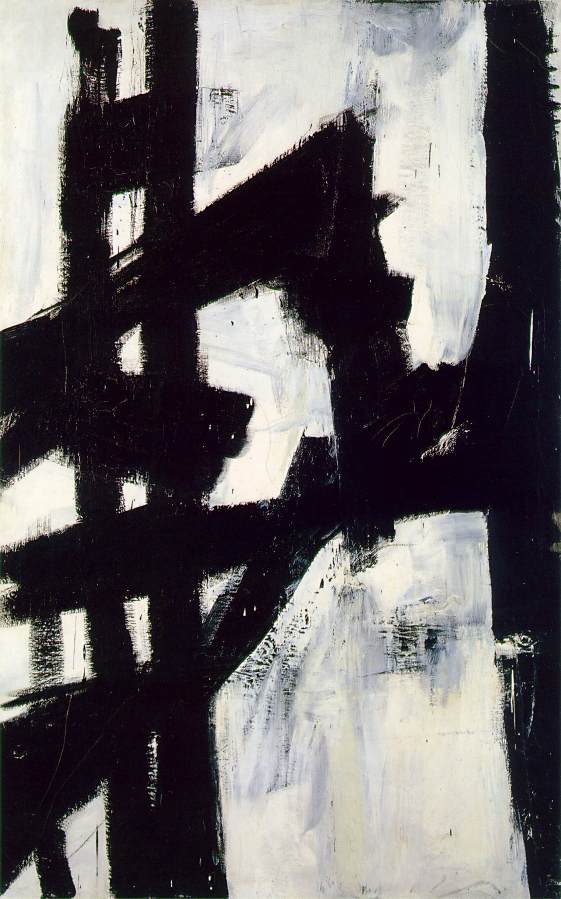
New York, N.Y.
Franz Kline, 1957


Takka Takka
Roy Lichtenstein, 1962

A thought experiment on “contemplative cinema.”

As I mentioned in my previous post (towards an exploration of contemplative cinema) on the subject, I see contemplative cinema producing a distancing effect, but not in terms of the politics of the image, as one finds with Godard. In other words, not in terms of power. I see the distancing effect being much more subtle and ultimately inviting – a kind of drawing one into the subtext of the film by way of “asking” the viewer to contemplate the object (film, image, etc.). Contemplative film is, in this way, highly connotative. The reason I bring up Godard by way of comparison is because his work is such a good example of one kind of of disanciation, and I want to foreground the other. One side of distanciation pushes the viewer back, making her aware of the contingent and contrived nature of cinema, of the power of the cinematic image, and the ability (even necessity) of subverting that image by the viewer. The other side is to see the process helping the viewer to more fully and consciously participate in the philosophical and artistic implications of the cinematic image. For the contemplative film I believe those implications are frequently grounded in the sublime rather than the political.

[Note: I use the term “political” in a structuralist/post-structuralist sense developed within screen theory which treats filmic images as signifiers encoding meanings but also, thanks to the apparatus through which the images are projected, as mirrors in which, by (mis)recognizing themselves, viewers accede to subjectivity. In my view, contemplative cinema is concern with other things.]

In this light, I wonder what connections to other arts can we make. I believe that comparisons can be a good way to zero in on the topic. One thought is in the comparison we can create by placing two painting genres side by side: abstract expressionism and pop art. I see these two painting genres to be somewhat similar to the differences we find between contemplative cinema and what we might call, more or less, political cinema. It seems to me that New York, N.Y. by Franze Kline (1957) can be compared with Takka Takka by Roy Lichtenstein (1962) along similar lines as one might compare, for example, The Mirror by Tarkovsky (1975) and Deux ou trois choses que je sais d’elle by Godard (1967). I don’t have the time at this point to go into a full analysis (I would love to if I could), but I think there are a few salient points. I think it is fair to say that both paintings call attention to themselves, that both point to something beyond the obvious features of each, and that Takka Takka sets one back on one’s heels bit while New York, N.Y. calls for attentive, yet quiet contemplation. That is the difference, as I see it, between two possible intentions of distanciation.

This kind of comparison seems valid to me, but I am curious as to how others see it. I am also curious as to other contemplative cinema comparisons with non-cinema stuff, such as landscape archtecture or poetry. I welcome your comments.

towards an exploration of contemplative cinema

Here are some of my thoughts on the concept and/or reality of contemplative cinema. I am writing this in response to the contemplative cinema blogathon . I must include that I don’t know if I will produce any clarity around the subject. I merely hope to explore some possibilities for approaching the topic.

The folks at the blogathon are loosely defining contemplative cinema thus:
contemplative cinema: the kind that rejects conventional narration to develop almost essentially through minimalistic visual language and atmosphere, without the help of music, dialogue, melodrama, action-montage, and star system.

Or, one could say “boring art films,” as so many do.

And so I dive (or flop) in…

What is going on in a film in which nothing is going on? As I ponder this question I cannot help but ponder a seemingly unrelated question, but one which is actually fundamental: Where is the film?

The contemplative film is, as it is with any film, both up there on the screen and in here – inside my head, and inside yours. That is why we can have very different subjective experiences of a very real aesthetic object – even disagreeing about seemingly basic aspects of the object itself. So, while we are conversing about those specific contemplative films out there in the world in which we can all share, we are also talking about the contemplative films which we construct in our heads. [Note: I won’t pretend to be either a seasoned film critic or professional philosopher, but I will try to make myself clear as best I can.]

In other words, a film is a complex combination of a number of things: images, sounds, editing, beginnings and endings, scenes, characters, music, etc. These complex combinations are organized in such a way that the viewer is encouraged to create a mental construction that is, in a sense, a mental version of the film, or what we might call the “true” film. This so called “true film” or mental film is the goal of the creator (or creators) of the film that is up on the screen. And films are made knowing that you the viewer have the capacity to “put it all together.” [It should be obvious on this point that I am siding with the Russian constructivist theorists via David Bordwell’s great book Narration in the Fiction Film (1985).]

An obvious question, then, is what are the cues being given us by contemplative films that other films do not provide, or provide differently? I believe the answer to this question could be long and debatable, even more so than a list of typical genre characteristics. However, I will posit that what makes a contemplative film one as such, is that the process of cueing the viewer is for producing two effects: (1) break the tendency to forget the brain is constructing the film – an act of distanciation, and (2) with a view to effect number one, to encourage the viewer to go beyond narrative construction into a higher plane of self-awareness. The first is about inviting the viewer to move beyond expectations of mere narrative construction, and the second is about inviting the viewer to become a conscious and personal participant in the film experience.

That’s all fine and good, but one could say the same thing about some of the not-so-boring art films, say Weekend by Godard (at least I don’t find the film boring or slow). Having the film push one away from itself, so to speak, for the purpose of thinking about something other than an imaginary story one can escape into, is a fundamental characteristic of modern art as a whole – to make strange, the “shock of the new,” etc. What then makes contemplative cinema unique? Or, maybe a better question is: What is it that we are contemplating? The film, ourselves, a cosmic spiritual dimension, the nature of film itself? In this sense I believe that intent comes into play, but I do no propose that we try to read any director’s mind. No, I believe that the intent of a film will emerge from its own qualities to suggest and imply a certain approach. Contemplative cinema, it seems to me, calls us to a mental state that is not always easy to clearly defined, yet we know it when we experience it, like love or ennui.

So then, what is going on in a film in which nothing is going on? A great deal. First, the mind is fully capable of being as active as it is with any other film regardless of pace or general “boringness.” However, with a contemplative film one might ask if a greater burden (or a more substantial request) is being placed on the constructive activities of the mind. This may be so. Certainly it appears that less is present on the screen so the brain may have to work harder (that is debatable). Second, one might ask if a contemplative film relies on more than just the mind to do the constructive task. This is the key question, I believe. In other words, might the intent of a contemplative film be to activate the soul as well as the mind?

So then, where is the film? It is up there on the screen, in my head, and, if I let it, in my soul. [Note: I am using “soul” rather loosely. I do not intend to dive deeper into a discussion of metaphysics per se.] Contemplative cinema is a cinema of the soul. That is its intent.

Of course, watching some contemplative films may feel a little like staring at one’s navel. And yet, a powerful film in this vein may, in fact, produce a powerful and profound spiritual experience for the viewer. [I am using “spiritual” rather loosely as well.] One might say that a “successful” contemplative film moves along a path from objective film to subjective film to spiritual film. But I want to be careful with the term “spiritual.” I do not mean to imply that such films transport one to a different plane, or that one, via the film, will somehow transcend this existence. No, contemplative film is not about an “out there” or “up there” or even cosmic gesture. I see the soul as being deeply rooted in this existence, in this world. In fact, one could say the intent of contemplative film is to strip away much of the artificiality found in mainstream cinema in order to encourage the viewer to more fully engage with reality.

Finally, if what I have laid out (and I admit not very well) is true, then what one brings to the film at hand is paramount – and I’m not talking about the popcorn. On the other hand, I don’t believe there is a formula or list for what one should bring. But it seems to me that a person who is inclined to explore deeper existential questions, who is inclined to see life as a journey, and who finds the quieter moments in life to be valued, may have brought the right things.

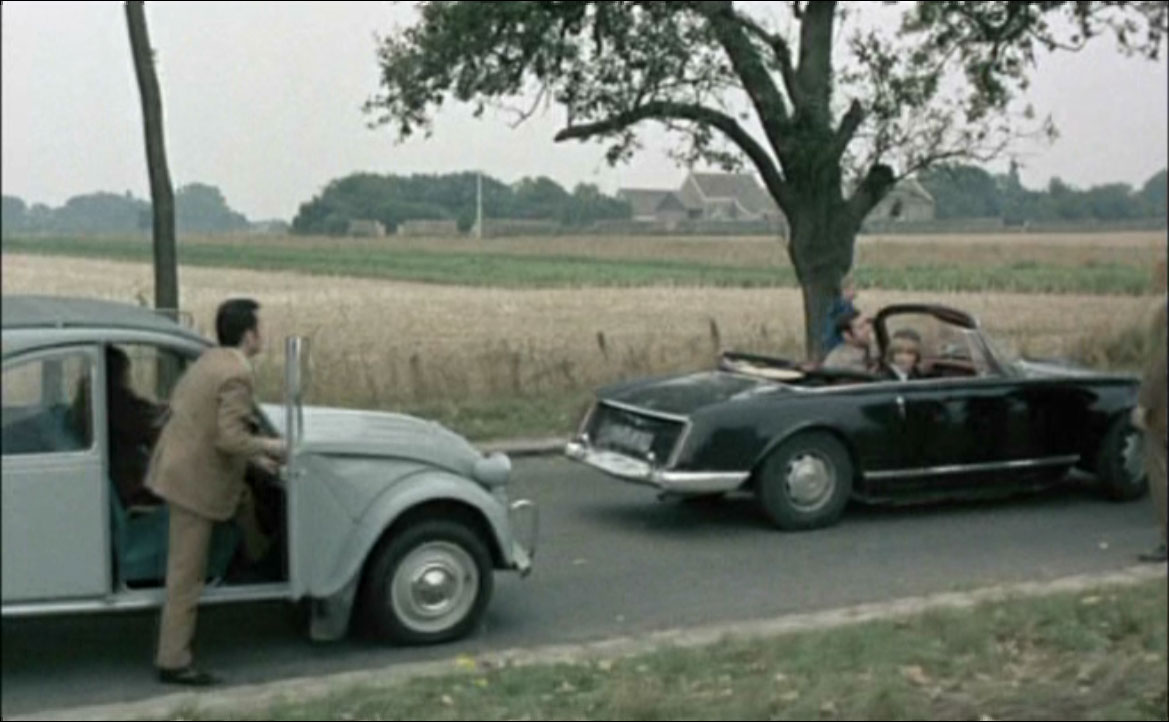
By way of example, a comparison might be in order – in this case Godard and Tarkovsky. I have already mentioned Weekend as a film which has some qualities found in contemplative cinema, yet does not, in my opinion, qualify as a contemplative film. In Weekend there is a famous tracking shot that follows a car driven by the two main characters as they try to pass a long line of cars on a country road.
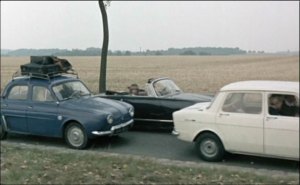
The camera follows the progress of the car as it passes the other cars in the traffic jam…
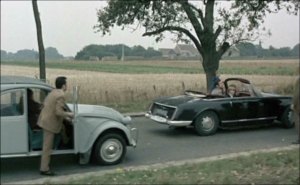


…and continues past a number of social vignettes…
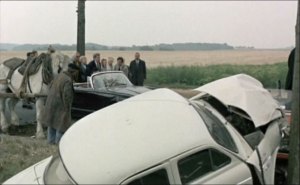


…plus a couple of titles…

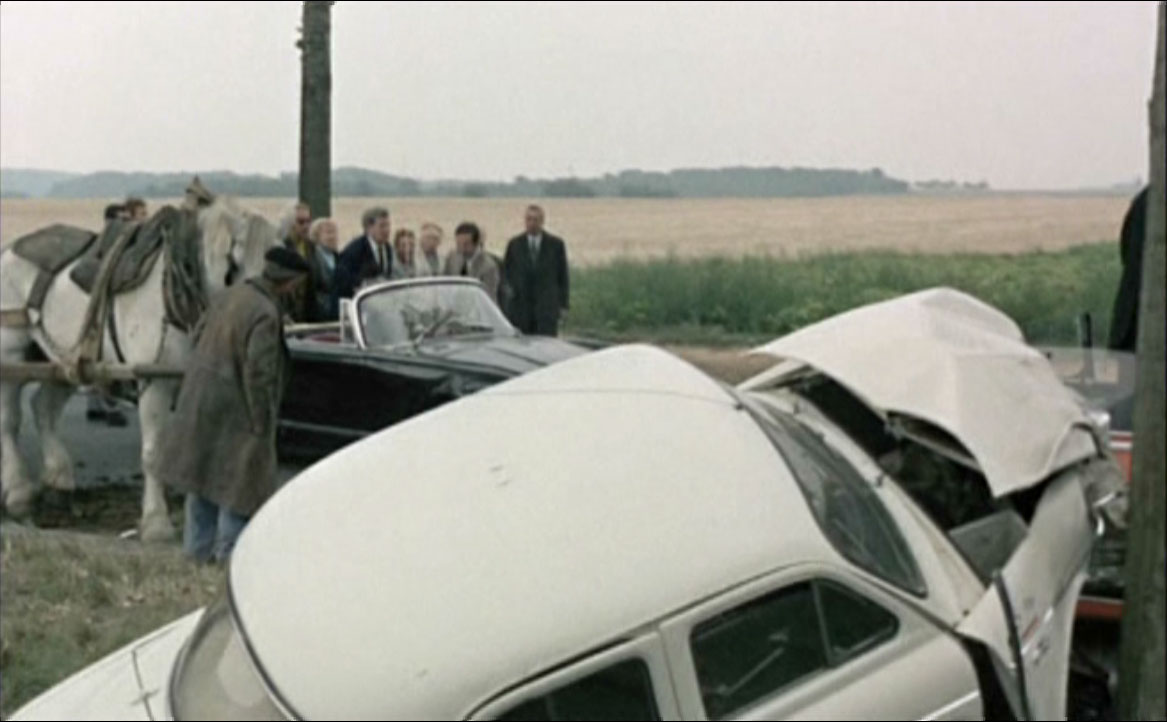
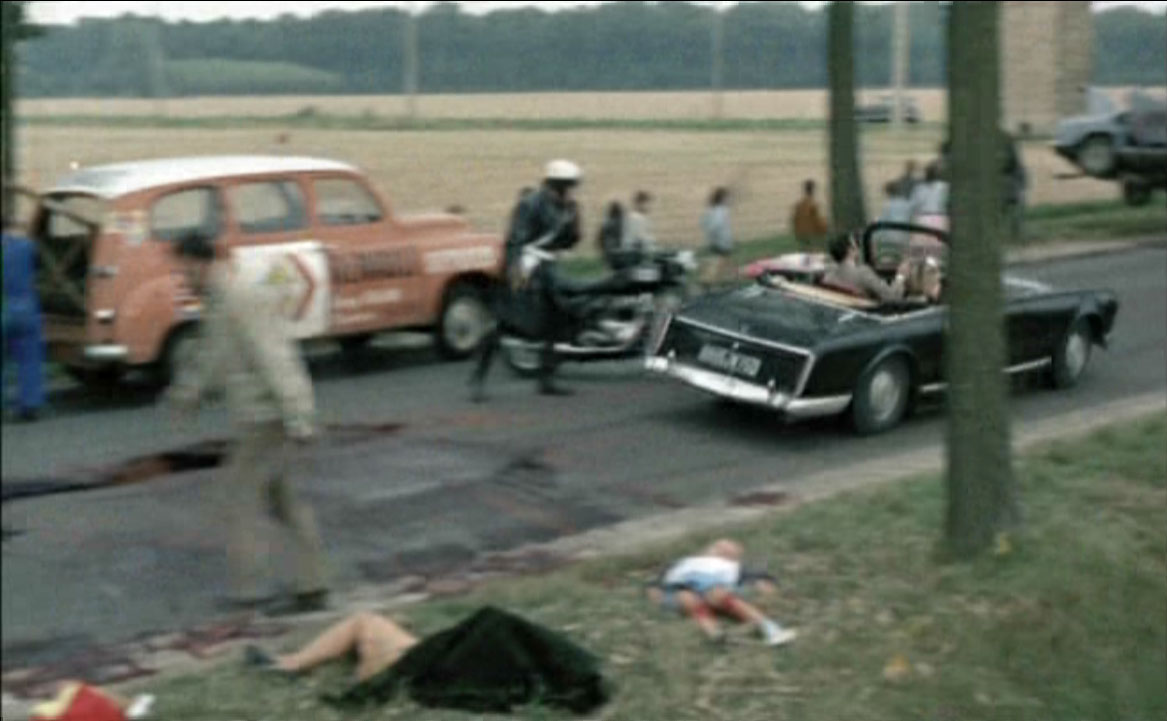
…until we see the reason for the traffic jam, a bloody, gruesome accident…
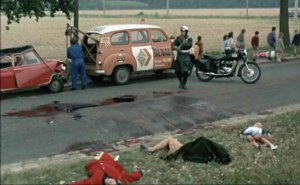
…which our characters speed by without a care.
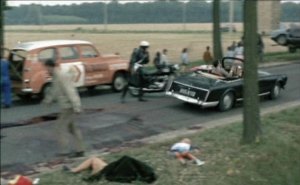
This shot takes up around 9 minutes (if I am not mistaken) and feels longer. Clearly the viewer is asked to consciously participate in the film in a way different from a more typical, seamless narrative structure. Godard does not seem to care if one becomes more attuned to one’s soul, he is concerned about the viewer being more aware of the film in the world (and the viewer in the world). This has a more critical arch to it and less of a contemplative arch as I am describing above

On the other hand, another film and another wonderful tracking shot. Stalker by Tarkovsky has this long and contemplative scene in which “nothing happens”:
There is a rhythm to this scene that is entirely different to the one from Weekend. Here we have three men – one could say three souls – traveling into The Zone for personal reasons of discovery (I will not try to explain the film here). The qualities of this scene draws the viewer into a more contemplative mode. As the scene goes on for several minutes the viewer may begin to feel the sense of “watching” the film, and yet there is not the same kind of distance one gets from Godard. Here Tarkovsky is, in fact, inviting us to put aside our sometimes frenetic need for narrative and remember the deeper rhythms of the soul.

…and so I humbly submit
“Art-Cinema” Narration: Part Three

This is the last part of a three-part posting taken (reworked) from a brief lecture I gave during a film class years ago.

The other posts are Part One and Part Two. The main purpose of these posts is so that I can clarify some of my thinking on cinema – I’m sure my posts will shorten over time. I imagine that most of those blogging on film these days will find this rather pedantic and abecedarian. And I will also make a disclaimer that virtually all of “my” ideas come from other sources, not least of which are the writings of David Bordwell, esp. Narration in the Fiction Film. My lack of proper citations is due my having lost my notes from that class.

I must say that the ideas in these three posts provide some foundation for the concept of “contemplative cinema” which is the subject of an upcoming blogathon at Unspoken Cinema here: Unspoken Cinema: BLOGATHON. I plan on putting together my own specific thoughts for the blogathon, but I think this post may stand as my entryway into the subject, even if only obliquely.

Art-Cinema Narration and its goals.

Compared to Classical Hollywood Narration, the goals of Art-Cinema Narration are quite different.

Just a few distinctives:
Characters focus on the existential choice:

  • That choice which is about one’s very existence and very reason for existence.
  • Character(s) struggle at the crux between meaning and meaninglessness.
  • Or between expectations imposed externally (society, religion, school, etc.) and one’s desires.
  • These struggles are very much within the struggles of the 20th and 21st Century’s individual as described in the previous posts.

Focus on the interior life of the character:

  • The mental world trumps the mere overcoming of external obstacles. This is often played out narrationally as “psychological effects in search of their causes”
  • A searching for answers to one’s mental state, etc., but of course they might be presented in a very subtle way; it is hard to show what is interior.
  • Often the littlest, most insignificant things can be what triggers a wholesale reexamination of one’s life.

Redefinition of “Reality” and “Truth”:

  • Acceptance of coincidence, randomness, “and plausible improbabilities” as the ground of daily life.
  • The anomaly is normal, the clear causal chain of events something to question.
  • Characters search for truth while believing there is no such thing.
  • “[T]he world’s laws may not be knowable, personal psychology may be indeterminate.”
  • Foregrounding the problem of subjectivity: both within the story being told (subjectivity of the characters) and the very process of telling that story (subjectivity of the filmmakers).

And, as you can imagine, compared to Classical Hollywood Narration, the cinematic results are going to be different. One could argue that Art-Cinema Narration is really just a way of making films that remain “true” to the modernist mindset.

Some observations on how these goals are played out:

  • Often “looser” more ambiguous plot constructions.
  • Plots are less “neat”, less clearly motivated. Classical Holly Narration usually has characters who know what the problem is – the building is going to blow, the terrorists are going to do something bad, the mystery needs to be solved, the misunderstanding needs to be resolved, etc. Art-Cinema Narration may not have such clear-cut problems and therefore may have rather diffused goals – such as fighting boredom, or finding oneself, or finding meaning, or just existing.
  • Plots are not always logical or fulfilling of viewer’s expectations. Asks the viewer to do more. May be subject to question: “are we seeing the truth?” What is the truth?
  • Characters are often less clearly defined Ambiguous, may not fit into traditional stereotypes, inner turmoil, may change.
  • Self-conscious narration: The film “knows” it is a film and is not afraid to let you know that it knows. This can be done numerous ways, for example: characters talking to the camera, overt narration, breaking film “rules” etc. The film may even “show its cards”; may reveal the camera in a mirror, etc.

I must stress, however, that even with the seriousness the many of the ideas underlying art-cinema narration, many so-called art films are no more profound than any classical narrative films. And art films can fall prey to the same shallowness and overt “posing” that affects much of the art world as a whole.

One of the more interesting things, in my mind, about the history of cinema is the existence of both kinds of narration – Classical Hollywood and Art-Cinema – side be side throughout most of the last one hundred years. And certainly they have had influence upon each other.

As for contemplative cinema…
According tot he folks at Unspoken Cinema, contemplative cinema is the kind “that rejects conventional narration to develop almost essentially through minimalistic visual language and atmosphere, without the help of music, dialogue, melodrama, action-montage, and star system.” It seems clear to me that contemplative cinema then may be considered a sub-set of Art-Cinema Narration.