
This spring one of our local wineries (King Estates) hosted a Wine Country Run (5K). This was the inaugural event and a friend of ours ran it. So we tagged along, brought the kids, and I brought my little Canon G11 camera and shot some video. I hope this video expresses the great, laid back atmosphere and beautiful country. We had a great time. Maybe we’ll run it ourselves next year.
Author: Tucker
Workhorse
I don’t own a fancy bike—no carbon, no aero wheels, no high price tag. What I own is a basic workhorse commuter/touring bike. And I love it.
I am finally nearing “completion” on my Novara Randonee. Novara is an REI brand, which basically means the bike is mass produced in one of those factories that pump out bikes for just about everyone. So it’s not that expensive or particularly desirable, but it is good, and just right for me. I purchased the bike in 1995, that’s sixteen years ago! Time flies. The Randonee model is designed for touring. I bought it for commuting with the hopes that I would do some touring with it eventually, which I have not yet done. I wrote about taping the handlebars a while ago. Now I finally have the Brooks saddle in place, plus a few other improvements.
Here’s the bike today:
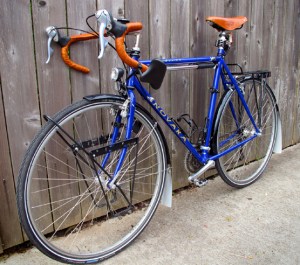
Notice how the bar tape turned out to match perfectly the Brooks saddle. The other improvements include:
- A Spanninga dyno lighting system that I got from Velo Orange.
- Schwalbe Marathon tires (700Cx32) that I got from a new little local shop called Arriving by Bike.
- A Zefal frame pump, also from Arriving by Bike.
- Rainy Day mud flaps that I picked up at REI
- D+D Oberlauda Ultra Light Bike Mirror, also from Arriving by Bike
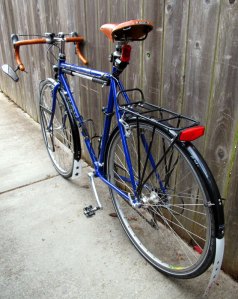
Each of these improvements I am loving. The tires are much better for my kind of riding than my old skinny tires. They roll well and are very stable. As I carry a heavy load sometimes they also give me more confidence that the bike will track properly and not put undue stress on the wheels. The lighting system took a little while to get installed (maybe because I tend to get fussy about those things), but it is light weight and works. I am still figuring out were I want the mirror, but so far it’s great. And I love the Brooks saddle. I can see why they are popular. I used to have one years ago, but I did not appreciate what it was, then that bike was stolen. Maybe the gods decided someone else needed that bike, someone who cold appreciate it better. Or maybe it was just another crackhead on campus.
Other items: I have a tagalong hitch on the seat post for when I tow one of the kids. I use blinking safety front and rear lights when it’s dusk and I don’t need the generator lights. I love the front/rear bike racks. The low rider front rack is the the way to go for panniers. I use a bike bell for the river trail. All in all it’s a great bike.
Andrei Tarkovsky on Art and on Cinema
Two Coppolas…
…and one Letterman, 22 years apart.
Francis Ford Coppola promoting One from the Heart:
Sofia Coppola promoting Lost in Translation:
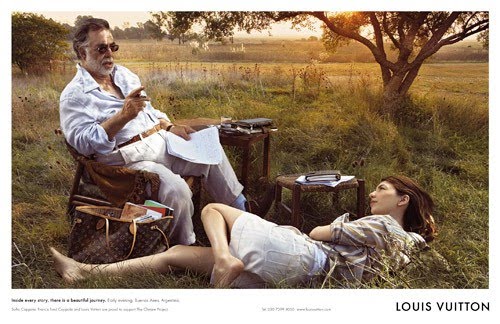
As a father of three kids, two daughters and a son, I am curious, maybe a little frightened by the realities of my influence, intended and unintended, upon them. I am fascinated by the relationship of Francis and Sofia Coppola. There is something really great there. I realize that their relationship is mostly unknown by me and everyone else. But the public image, and what we can infer, suggests that they have a good relationship, that Francis has been a good father, and that Sofia has been willing to be influenced and guided by her father while also forging her own, unique life.
Finally, I love this image:
Jean Renoir parle de son art
“…the arrival of perfect realism coincided with perfect decadence.”
“…whether man’s gift for beauty isn’t in spite of himself.”
“I don’t believe we create our lives. Our lives create us.”
Rusty dollies and floating cranes: Bergman on making films in Sweden
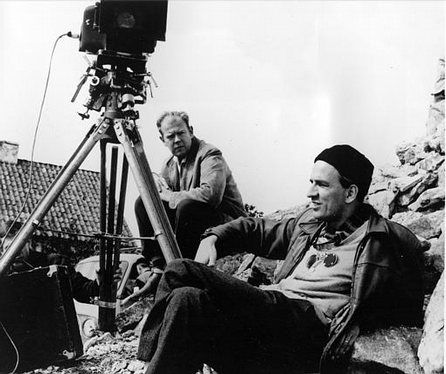
“During the shooting of The Virgin Spring, we were up in the northern province of Dalarna in May and it was early in the morning, about half past seven. The landscape there is rugged, and our company was working by a little lake in the forest. It was very cold, about 30 degrees, and from time to time a few snowflakes fell through the gray, rain-dimmed sky. The company was dressed in a strange variety of clothing—raincoats, oil slickers, Icelandic sweaters, leather jackets, old blankets, coachmen’s coats, medieval robes. Our men had laid some ninety feet of rusty, buckling rail over the difficult terrain, to dolly the camera on. We were all helping with the equipment—actors, electricians, make-up men, script girl, sound crew—mainly to keep warm. Suddenly someone shouted and pointed toward the sky. Then we saw a crane floating high above the fir trees, and then another, and then several cranes, floating majestically in a circle above us. We all dropped what we were doing and ran to the top of a nearby hill to see the cranes better. We stood there for a long time, until they turned westward and disappeared over the forest. And suddenly I thought: this is what it means to make a movie in Sweden. This is what can happen, this is how we work together with our old equipment and little money, and this is how we can suddenly drop everything for the love of four cranes floating above the tree tops.”
– From the introduction to Four Screenplays of Ingmar Bergman, 1960, Simon and Schuster
The Politics of Gender in French Cinema
French professor Geneviève Sellier (Université de Caen–senior member, Institut Universitaire de France) gave a lecture “The Politics of Gender in French Cinema” at New York University’s La Maison Française on April 14th, 2010. Sellier is the author of Masculine Singular: French New Wave Cinema (Duke University Press, 2008; translated by NYU Professor Kristin Ross).
Here is the audio of that lecture:
“This is the enemy” — Godard on the disgusting culture of…
Jean-Luc Godard in 1988 at a press conference in Cannes after the first screening of the first two episodes of his very personal documentary, Histoire(s) du Cinema.
This video clip from Godard, which is not altogether clear, but which nonetheless resonates for me, reminded me of Neil Postman’s 1985 book Amusing Ourselves to Death in which he states:
[W]hat I am claiming here is not that television is entertaining but that it has made entertainment itself the natural format for the representation of all experience. Our television set keeps us in constant communion with the world, but it does so with a face whose smiling countenance is unalterable. The problem is not that television presents us with entertaining subject matter but that all subject matter is presented as entertaining, which is another issue altogether.
To say it still another way: Entertainment is the supra-ideology of all discourse on television. No matter what is depicted or from what point of view, the overarching presumption is that it is there for our amusement and pleasure. That is why even on news shows which provide us daily fragments of tragedy and barbarism, we are urged by the newscasters to “join them tomorrow. What for? One would think that several minutes of murder and mayhem would suffice as material for a month of sleepless nights. We accept the newscaster’ invitation because we know that the “news” is not to be taken seriously, that it is all in fun, so to say. Everything about a news show tells us this—the good looks and amiability of the cast, their pleasant banter, the exciting music that opens and closes the show, the vivid footage, the attractive commercials—all these and more suggest that what we have just seen is no cause for weeping. (p 87)
Contrarian Criticism in the Round
“What distinguishes modern art from the art of other ages is criticism.”
~ Octavio Paz
What is the role or the function of the film critic today? At the International Film Festival Rotterdam (IFFR) several film critics discussed the roll of film criticism and, in particular, the contrarian roll (or possibilities) that can be a kind of stance one takes, or might take, as a critic. The most important topic in this discussion, however, is on authority. It is an old topic and it is just as relevant as it has always been. If this discussion suffers, which it does, it is from the problem that always arises in rountable discussions: lack of focus combined with insufficient time allotted to any one thought. Still, it is an interesting look into the interests and ideas which motivate some film critics today.
In this roundtable the idea of authority is most closely linked to expertise. Film critics should be experts in film; they should know the obvious and the arcane, the new and the historical, the depth and the breadth. However, there are other ways that one can be an authority. For example, I would rather a film critic be wise, knowing philosophical (yea even theological) issues that trouble humanity, than merely a fanatical film goer who has seen everything three times. I would rather a critic be able to draw connections between cinema, the other arts, politics, sociology, and home economics than give me tantalizing gossip or merely personal reflections. I thing these critics would agree. Still, authority is ultimately something given rather than taken, and film critics these days tend to live in a tenuous state of existence as our society continues the march away from the idea that cinema is truly important or that critiquing a film is anything more than gossip or personal reflections. In other words, one has to truly love being a professional film critic to be a professional film critic.
>Two JLG interviews from 1980
>I used to be so non-plussed whenever I heard Godard speak. Now he makes more sense to me. In fact, he’s one of the few voices that seem to cut through much of the blather so typically understood as “talking about film.”
I like Dick Cavett, but I find his questions here to be only okay. Still, it is interesting to hear Godard talk about his work, etc.
This video is a bit more pedagogical and Godard is a bit more commanding. Still, it is quite interesting. Godard typically makes statements that are clearly designed to be slightly shocking, and he does that here, but I find his statements to ring truer now than I once did. Not sure why.
 pilgrimakimbo