>Advent: Oh come, Oh come, Emmanuel

>
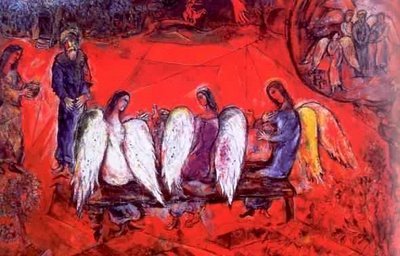
Three Angels, from Marc Chagall’s advent series.

Advent is a time of looking to the future with hope as we look back to the birth of Emmanuel (a.k.a. Jesus). This hope was described by the Apostle Paul in his letter to the Christians in Rome. He says:

For I consider that the sufferings of this present time are not worthy to be compared with the glory that is to be revealed to us. For the anxious longing of the creation waits eagerly for the revealing of the sons of God. For the creation was subjected to futility, not willingly, but because of Him who subjected it, in hope that the creation itself also will be set free from its slavery to corruption into the freedom of the glory of the children of God. For we know that the whole creation groans and suffers the pains of childbirth together until now. And not only this, but also we ourselves, having the first fruits of the Spirit, even we ourselves groan within ourselves, waiting eagerly for our adoption as sons, the redemption of our body. For in hope we have been saved, but hope that is seen is not hope; for who hopes for what he already sees? But if we hope for what we do not see, with perseverance we wait eagerly for it.

In light of those words I think of one of my favorite Christmas hymns:

Oh come, Oh come, Emmanuel,
And ransom captive Israel,
That mourns in lonely exile here
Until the Son of God appear.

Rejoice, rejoice Emmanuel
Shall come to thee, Oh Israel.

Oh come, Oh come, Thou Lord of Might ,
Who to Thy tribes, on Sinai’s height,
In ancient times didst give the law,
In cloud, and majesty, and awe.

Rejoice, rejoice Emmanuel
Shall come to thee, Oh Israel.

Oh come, Thou Rod of Jesse, free
Thine own from Satan’s tyranny;
From depths of hell Thy people save
And give them victory o’er the grave.

Rejoice, rejoice Emmanuel
Shall come to thee, Oh Israel.

Oh come, Thou Dayspring, come and cheer
Our spirits by Thine advent here;
Disperse the gloomy clouds of night,
And death’s dark shadows put to flight.

Rejoice, rejoice Emmanuel
Shall come to thee, O Israel.

Oh come, Thou Key of David, come,
And open wide our heavenly home;
Make safe the way that leads on high,
And close the path to misery.

Rejoice, rejoice Emmanuel
Shall come to thee, Oh Israel.

Oh come, Thou Wisdom from on high,
And order all things, far and nigh;
To us the path of knowledge show,
And cause us in her ways to go.

Rejoice, rejoice Emmanuel
Shall come to thee, Oh Israel.

Oh come, Desire of nations, bind
In one the hearts of all mankind;
Bid Thou our sad divisions cease,
And be Thyself our King of peace.

Rejoice, rejoice Emmanuel
Shall come to thee, Oh Israel.

I too long for Emmanuels’s return and to leave the sufferings of this world behind. For this reason, and others, I love this time of year.

Chinatown and the Rule of Thirds

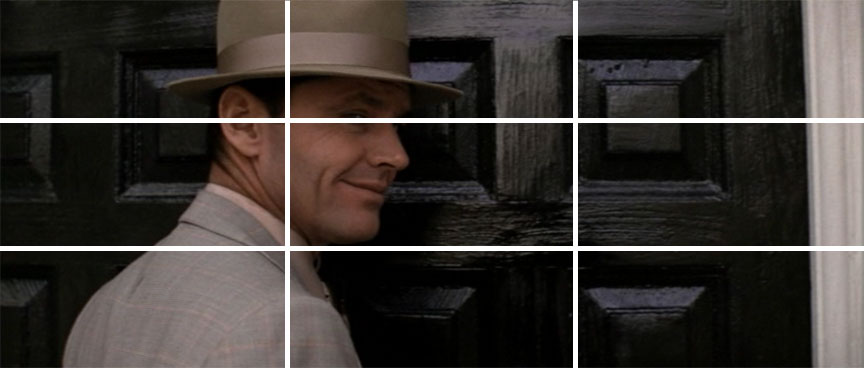
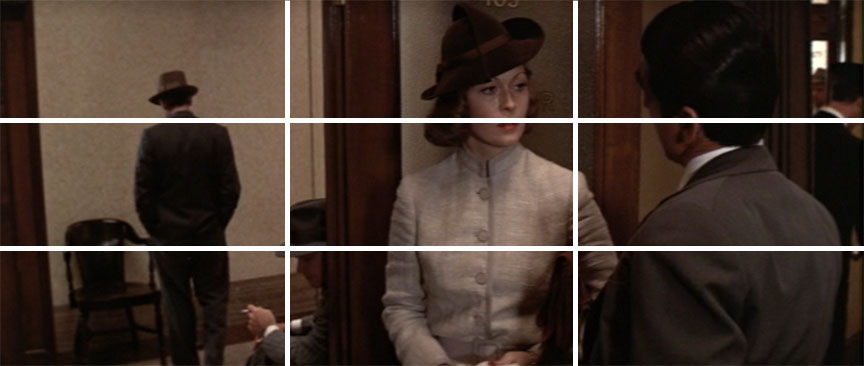
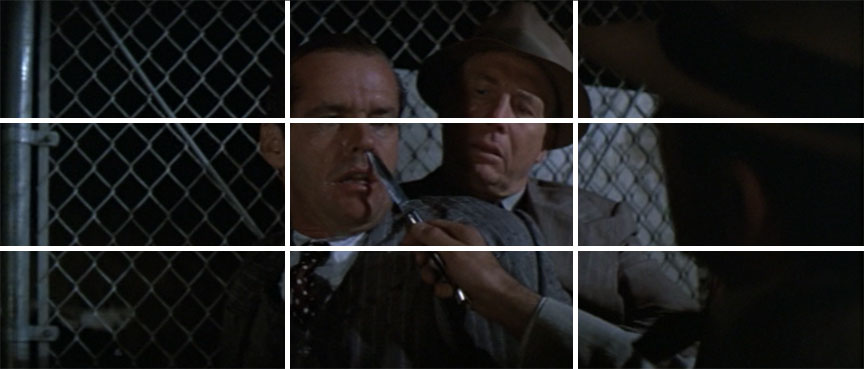
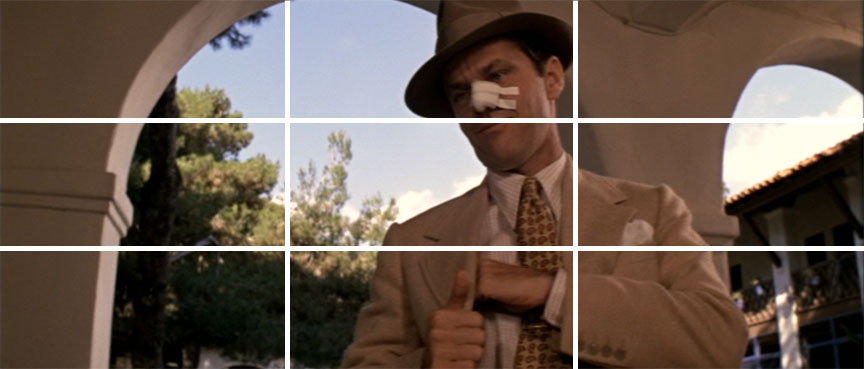
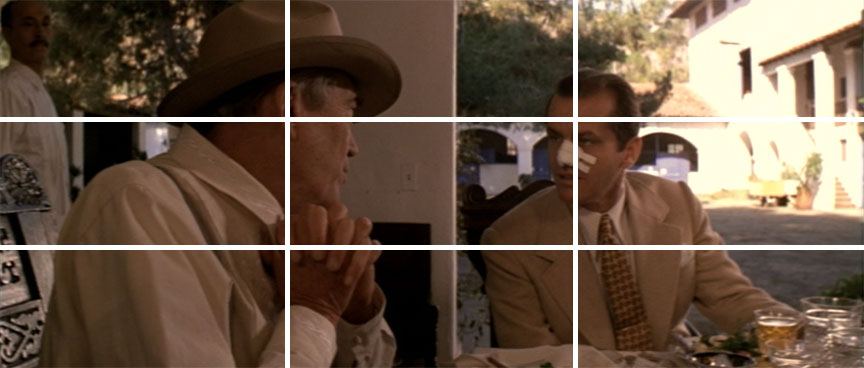
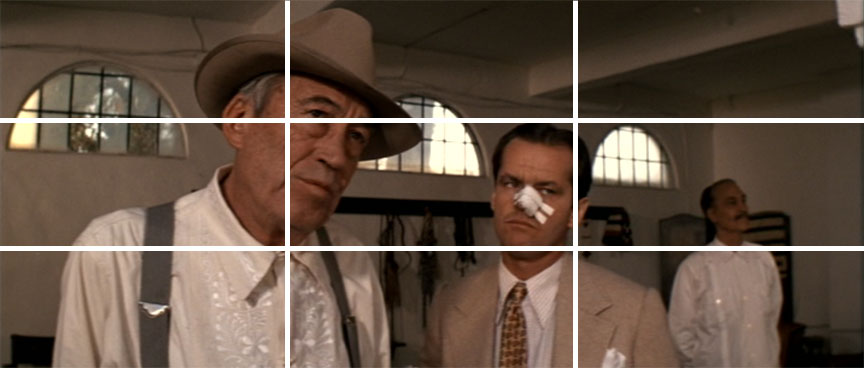
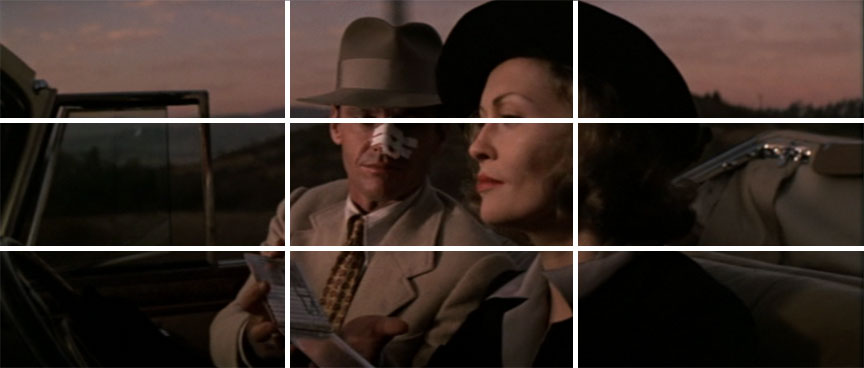
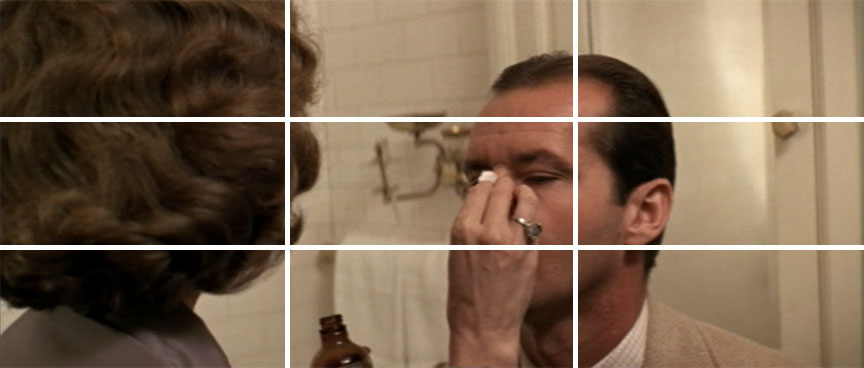
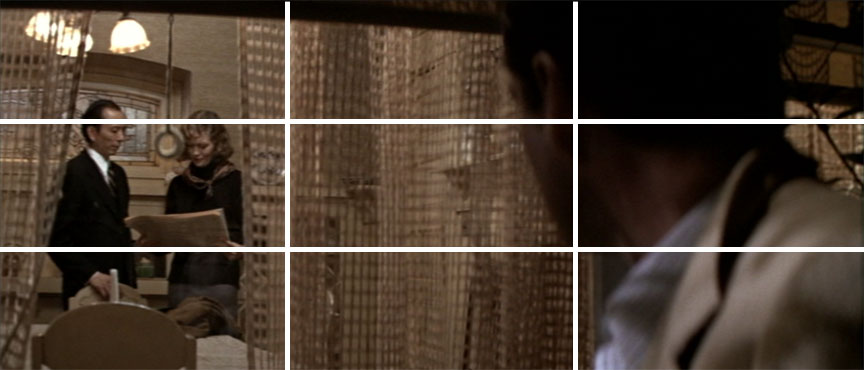
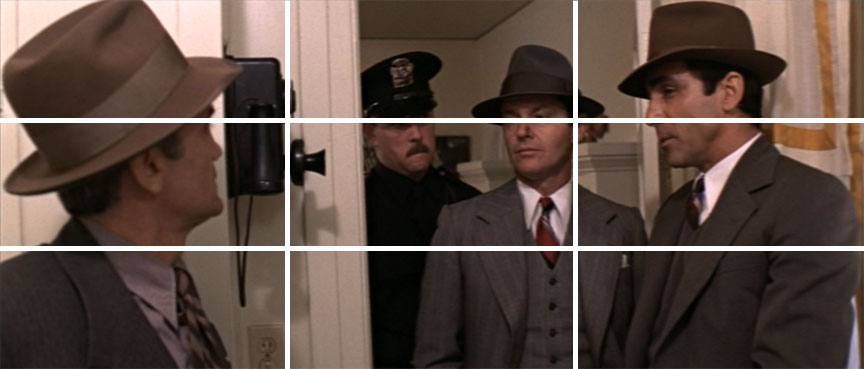
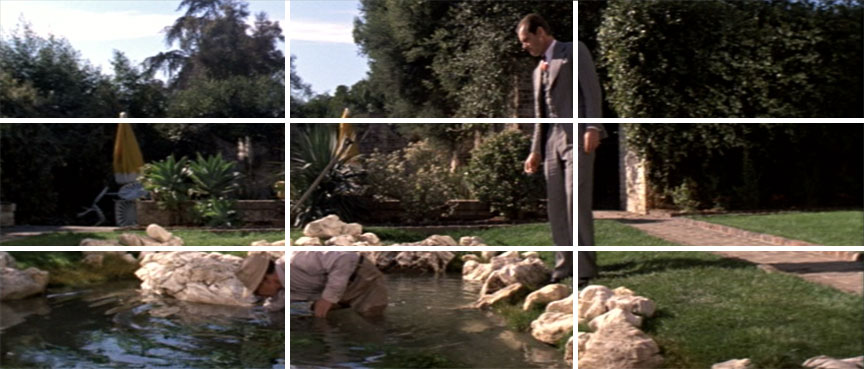
Many films are beautifully shot. Few, though, are as consistently well composed as Chinatown (1974)*. Shot in Panavision (anamorphic) format with a 2.35:1 aspect ratio the somewhat extreme rectangular image would seem to offer significant challenges to effective image composition. As I was pondering this challenge I was struck by how much I loved the images in Chinatown, which I just watched again the other day. That’s when I went back to basics and considered that even with widescreen images there are still fundamentals of composition at play. In this case I figured I would grab a few images from the film and apply the Rule of Thirds to each image.

The Rule of Thirds is simply as follows:

Divide the image into thirds, both horizontally and vertically, then put the focus of the image either one third across (from either side) or one third up or down the screen. Those lines, and the points at which they intersect, are the strongest invisible forces in an image.

In Chinatown the images are constructed around those lines and intersecting points. By doing this the aspect ratio becomes a relatively mute point as the human brain automatically takes in the whole image, mentally divides the image into thirds, and finds pleasure as key visual elements are constructed around those thirds. Of course, deviation from the power of the thirds creates visual tension, which is an additional tool in the filmmaker’s toolbox.

Chinatown was shot by John A. Alonzo. Here are the images from film (I, of course, added the white lines):

This is a simple process of analysis. More involving would be to examine how the rule applies to changing composition withing shots as they are re-framed or the actors move about. One thing I noticed was that all the extreme close-ups put the object of focus directly in the center of the middle square. Placing visual elements along the “third lines” was reserved for medium shots and long shots. Finally, the rule of thirds does not guarantee that an image will be good, or work well for a particular scene. However, fundamentals are fundamentals. Without them one will not only have difficulty maintaining a consistent quality, but one cannot truly “break the rules.” The irony is that fundamentals are what allow filmmakers to innovate and stay fresh.

* This is my opinion, of course, but there is a quality in the film’s imagery that is truly wonderful and yet difficult to pin down.

>Advent

>
St Anne with the Virgin and Child, 1519
by Albrecht Dürer

Advent begins today. This is my favorite time of year. I love getting past Thanksgiving so we can start getting ready for Christmas. Our society has made Christmas all about consuming, but that doesn’t mean we have to follow suit. Nor does it mean we can’t set all that aside and focus on what the birth of Jesus means for us and the world. This is a season to commemorate Christ’s birth and anticipate his second coming.

My religious background does not include Advent, or really much at all of the Christian calendar. Now I am discovering for myself some of those rich traditions. I have no idea how to celebrate Advent in a formal way outside of visiting a church that has Advent services. I remember as a kid getting those Advent calendars with pieces of chocolate for each day of Advent, but having no idea what that was all about.The church I attend doesn’t do anything in particular that I know of for Advent, but we will have a Christmas service. I also know there are differences in the traditions – for example today marks many church’s beginning of Advent, but for others they have a different day.

So how does one celebrate Advent? What are your Advent traditions?

Here is an Advent prayer I found:

Father in heaven, our hearts desire the warmth of your love and our minds are searching for the light of your Word. Increase our longing for Christ our Savior and give us the strength to grow in love, that the dawn of his coming may find us rejoicing in his presence and welcoming the light of his truth. We ask this in the name of Jesus the Lord. Amen.


Finally, a video that is showing up on a lot of blogs today is this one from Advent Conspiracy:

Is your church participating in Advent Conspiracy?

>thanks

>We have a lot for which we are thankful. My family is especially thankful for the blessings God has bestowed on us. We are thankful for the outpouring of love and caring from so many people in recent days. In fact, words cannot describe how kindhearted and sacrificial folks have been for us.

I have already posted some of my thanks on my wife’s blog here.

We have been trough a lot in the past two weeks. I have often thought of the Thanksgiving holiday as a kind of throwaway holiday – a day off work and good food but not much more. I always figured we should be thankful all the time anyway, and I’m not into the traditional American mythologies about its history, etc. My feelings have not changed about most of that, but this Thanksgiving has an added dimension. This year we give thanks while my wife is still in the hospital recuperating from a near death experience – that is, I am thankful she and my daughter are still alive.

I wrote in more detail about the experience here and what it means to us.

I have wondered often how one can sometimes be more thankful when in the midst of suffering than in more typical circumstances. I look back on the time when our little family went on the difficult journey of a hard pregnancy, emergency c-section, heart surgery, meningitis, and then death. I look back with wonder and remember how hard it was and also how I felt so grateful and close to God. I felt close to God because he came close to me when I needed it but did not deserve it. We made some great friendships, had others strengthen and deepen, and came to know ourselves in ways we never imagined. I learned how fierce my wife can be when it comes to her children. I learned how gracious and giving our friends and family can be. And now we are experiencing something similar again. I was and am thankful for that experience even though I would not wish it on anyone.

Why God would have us go through these things I don’t know, except that I know deep in my soul it is because he loves us. At the end of the book of Job God comes to Job and gives his answer. In short God does not say why, only that God is God. We are always looking for the “why.” If the answer is that I come to know that much better the nature of the relationship between me and God I am happy. If I become wiser I rejoice. If I learn to love more fully with a genuine spirit then I know I am that much closer to Heaven and its glories.

In times like these theology seems to take a back seat, but not as much as one might think. Not all is emotion when there is suffering. How we understand suffering is always grounded on how we answer the big questions. Is God all powerful? Is he sovereign over reality? If so, just HOW sovereign? Does life have meaning and purpose? If so, does suffering as well? How we answer these questions profoundly guides our response to suffering. Sometimes we can know where we stand on these questions when we listen closely to our prayers.

When we were in the midst of holding out for hope with our second daughter and she was fighting for her life, the terrible tsunami overwhelmed Indonesia. Many, many thousands of people died in that disaster. We had our one life to worry and pray for, but our suffering was only a fragment of what was happening on the other side of the world. I found myself at that time thanking God that we were not going through what those people were going through. I was actually thankful that our suffering was merely difficult and heartbreaking rather than devastating. We can learn from degrees of suffering. As I write this, and as my wife is in pain, and as our daughters cannot climb easily into her arms, I know that much of the world is starving. I know that millions of children have no parents or clean water or adequate health care. I know that, for all my suffering, I live in relative luxury. Suffering reminds me of these things and shows me how complacent and selfish I have become. I live too much for myself and not enough for others. Jesus is my example and I am not a very good disciple. But I know God is faithful and I trust he will create in me a new heart.

I have much to be thankful for.

The name of this blog is not inspired by the pilgrims who had that first Thanksgiving. Here the word pilgrim has everything to do with the journey I am on. In part it is inspired from Pilgrim’s Progress. In part it is from the idea of going on a pilgrimage. I often feel that I am a sojourner in a foreign land. I long for my true homeland, which is not the United States of America, rather it is someplace infinitely better. But I am still glad I live in this country – but not necesarrilly more glad than if I was living in another good country, of which there are many. So my thanks is not so much that I am an American, but that I have been blessed in so many ways and that God can be trusted.

In closing, I must say I am thankful for my family. My wife is my love and my joy. My kids are wonderful lights that brighten my life. The community in which we live supports and loves us. And God continues to pour out his blessings on us, though we do not deserve them.

God be praised


I love my wife and daughters. I begin this post with one of my wife’s favorite quotes:

This life is not godliness, but growth in godliness; not health, but healing; not being, but becoming; not rest, but exercise. We are not now what we shall be, but we are on the way; the process is not yet finished, but it has begun; this is not the goal, but it is the road; at present all does not gleam and glitter, but everything is being purified.

~ Martin Luther

I decided a couple of weeks ago to stop posting for a while because life has been too busy and more important things needed to be done. Now I think it is time to post again.

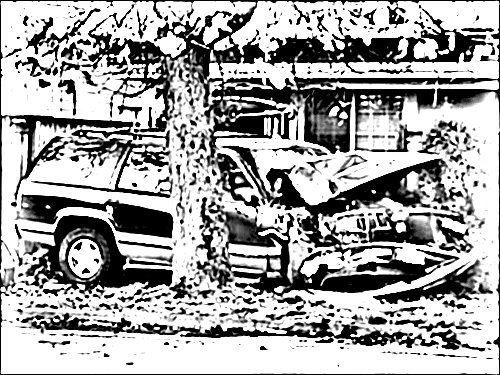
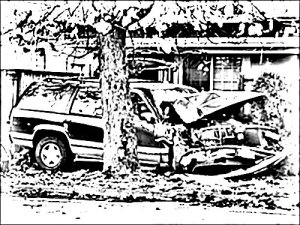
On Monday last my wife was walking our youngest daughter along a sidewalk near our house when a large SUV jumped the curb and struck them. The story is an interesting one that involves a convicted felon fleeing the scene and hiding from police for 24 hours. The local news was all over that. My wife ended up with a fractured pelvis and multiple scrapes and bruises. But the crux of the story is the way death came by so close and did not stay.


It is hard for me to imagine my wife dying. She is in a lot of pain right now, but she is still alive. I praise God every minute for that. We are so fragile and so mortal, and yet life is so powerful and meaningful. When a couple gets married they are theoretically in it for the long haul. Marriage is not a game and it can sometimes bring a lot of heartache, not least when the other suffers. I do not like to see Maricel suffer. We got married just over 17 years ago. Sometimes it seems like a long time somethings its seems like only yesterday. We have lived much of our lives in shared communion and experience. If God were to take her away from me I could not describe the vastness of the hole that would be left in my life.

My daughter Wilder also nearly died. She was in her stroller when it was throw almost 40 feet down the sidewalk. The stroller tumbled but acted like a roll cage and my daughter came away with hardly a scratch. It is also hard for me to imagine her dying. In this case, though, I know what it is like to lose a child. My daughter Coco died in my arms nearly three years ago. I don’t know how I would go through that again. Children are amazing. They are truly gifts that should be loved and cherished at all times. My daughters are brilliant lights in my life. They gleam like stars. I do not want to ever lose one.

My eldest daughter Lily has been through a lot in her 8 years. Her uncle died of cancer, her grandmother was severely burned in a car accident, her baby sister died, her mother and other sister nearly died this week, and her mother is now in the hospital with a broken pelvis. She is a beautiful and tenderhearted girl who can sometimes be too stoic for her own good. I can’t blame her. She has been through a lot.
A friend of mine asked me a couple days ago if I was angry – angry at the driver of the car that struck my wife and child, angry at the situation. I was taken aback because being angry hadn’t even entered my mind, yet I felt at that moment that maybe I should be. Why wasn’t I angry? It’s strange to think about. I certainly don’t think it has anything to do with some kind of moral nobility. I am just like everyone else. I still want justice, I still want the driver to get what he deserves, but I don’t have those burning emotions of anger. And it’s not because I don’t think anger has its place. The only explanation I can come up with is that my experiences have put within me the idea that this is what we should expect from life, the bad with the good, and that people will do bad things because they are sinners like me. If I am mad at anyone else I need to reserve some of that anger for myself too. We are made of the same stuff.

For many the real issue on the table is what to do with all this in light of God. Why would God allow this to happen? Believing that God would actively bring suffering like this into one’s life is not an option for many people. God, they might say, does not create suffering, he only allows it. But God does create suffering, as he creates all things. The question I face is whether I will trust a God who would bring this upon my wife and family. If one does not believe in God then suffering is absurdity. It is when one believes in God that suffering takes on the difficult sheen of meaning and purpose. Suffering glares in one’s eyes. It doesn’t call out to you, it invades your life and, sometimes, it makes itself at home. Suffering forces your hand and makes you lay your cards face up on the table. Suffering tells you what you are made of. Knowing what you are made of is a great gift, and not an easy gift. If God is good, I would expect him to bring suffering into the lives of those he loves. I have struggled with this in my life and I will continue to struggle. But I have come to know that suffering is not the end of life, rather life is the end of suffering.
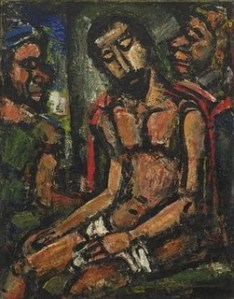
I am not one to quote pithy Bible verses about suffering or the goodness of God. And if someone tells me what stage in the grieving process I am in, or how God must be trying to tell me something, or how everything works for good, etc., I just smile and nod my head. I believe those verses and I know everything works for good, and I appreciate the reminders, but outside voices only go so far compared to the inside groanings. I know it’s not really a matter of the head at this point, it’s a matter of the heart – and I mean that place in the heart where all sentimentality and saccharine spirituality is stripped away. This really has everything to do with who we are and where we are going.

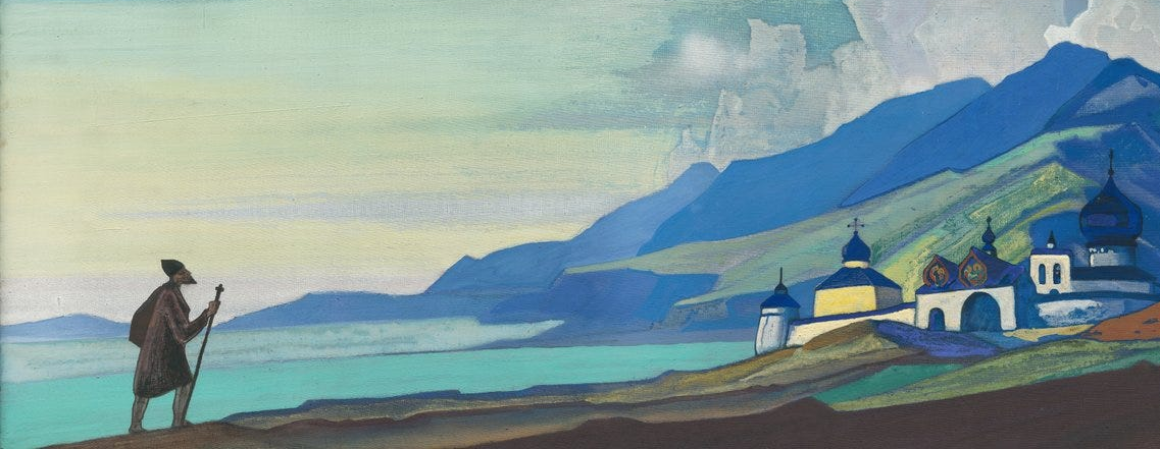
The best I can do is look at the Bible as a whole and wonder at all the suffering between its pages. I don’t see anywhere in the Bible where God says this life will be free from suffering. I don’t see the health and wealth gospel or the prosperity gospel. But I do see that my savior suffered, and that many of the early Christians suffered, and that to be a Christ follower is to take up one’s cross daily. All this does not provide an easy answer to to why we suffer. At least I can say that to suffer is, in some way, to be like Jesus. I can also say that if one is worried if their friendly, easy faith truly has legs then suffering will let them know. But then that faith will no longer be so friendly or easy. Genuine faith lives in that world of both terrifying reality and unfathomable hope. No wonder we are called to love and encourage each other. The more I live the more I know this to be true. When we are told to work out our faith with fear and trembling I know a little more each day about what that means.
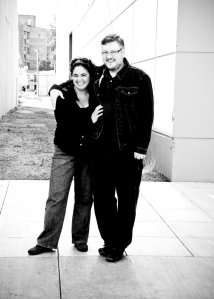

My wife and family have a long road ahead, but don’t we all. I know that God is good, but I also know that God is God and I must ask myself if I still trust God to be good when I, or my family goes through suffering. What I pray for is that God will heal my wife soon and completely. I also pray that God will continue to be faithful to love us and that we will continue to trust in him. What is so amazing is to see my wife go through her ordeal with courage and good spirits. She has had a lot of support from so many people. Her hospital room is filled with flowers and cards. She is an amazing woman. Seeing all the love extended toward her is a testament to that.

I said I am not one for pithy Bible verses, but I have to say that many passages in the Bible take on deeper meanings in light of suffering. I can’t help but be reminded of what Jesus did. And I rejoice in his example, though I fail at living up to it. So I quote a couple verses from Philippians:

Have this attitude in yourselves which was also in Christ Jesus, who, although He existed in the form of God, did not regard equality with God a thing to be grasped, but emptied Himself, taking the form of a bond-servant, and being made in the likeness of men. Being found in appearance as a man, He humbled Himself by becoming obedient to the point of death, even death on a cross.

If Christ be my example, then how can I fear suffering or death? And yet, words cannot describe how grateful I am that death did not stay this week. God be praised.
>hiatus

>I’m taking a few days off from blogging. Just too much going on to blog. I think you know the feeling too.

“Darling, I know you’re having such a nice time with your harp, but doesn’t it look like the house is burning down?”

>Joan Baez in the 60s, in the 70s

>Joan in 1965

Joan in 1966

Joan on Italian TV in 1969

Joan at Woodstock

Joan with Earl Scruggs in the early 1970s?

Joan in 1975

Joan again in 1975 with Bob Dylan

For comparison, Joan again with Bob in 1976

Joan and Mimi Fariña somewhere in the late 1970s?

>The World After Bush

>I am fascinated by what the world is thinking about the outcome to the U.S. presidential election. There have been many reports of people celebrating from around the world, which is rather amazing. Those celebrations should remind us of how important the U.S. and it’s foreign policies are to people everywhere. I find it both remarkable and sobering.

There are also concerns from various quarters. Does an Obama presidency truly mean change? What about the Palestinians when Obama selects a hard-line Zionist as his chief of staff? Is he really going to end the war in Iraq or develop diplomatic ties with Iran? Is it even possible to fulfill those promises? Below is a four part discussion from Al Jaeera that looks at U.S. foreign policy, Obama as president, and the future from the outside. I found it fascinating and worth taking the time to watch.

Part 1

Part 2

Part 3

Part 4

>Post-election thoughts: What "President Obama" means to me

>There are so many things that can be said about any election and this one in particular. Now that the dust has settled slightly and Obama is putting together his cabinet and planning the transition it is worth stepping back a bit, look at the sweep of history, and consider what this change really means for the U.S. A lot of issues were on the table from the economy to terrorism, but in truth those are merely details, important as they are. What is far bigger, far more reaching and profound, is the cultural sea change this presidency may represent. An African American president is a stunning example of something deeper going on in this country than mere politics. An African American president at this point in our history says something about our collective soul, about our character as a nation. Obama may turn out to be a good president and not a great one, he may be challenged in ways that shake his resolve or push him in directions he did not intend to go, he may become mired in some of the lousy politicking that is our government’s tendency, but he will always be our first African American president. That is a remarkable achievement. He is our generation’s Jackie Robinson and more. And he just might turn out to be a great president too. I pray that he does.

I say all this as a white guy who has never directly felt the affects of racism or bigotry. I live in a largely white city far from the streets of Chicago or the burrows of New York or any of the former slave states. My knowledge of race related struggles comes mainly from documents like Eyes on the Prize and books. I could be considered an unlikely Obama supporter. Even so I was eager to vote for Obama. Time came to realize the importance and rightness of that vote, and I am glad I did. I believe this nation will be glad it did too. Obama is not a savior, there are no saviors in politics, but he is a good man with a good heart who inspires, and this country’s greatest moments have always been the products of inspiration.

I have always thought that the American dream was not economic opportunity but the possibility of freedom and the multitude of opportunities that come with freedom. I have believed that this country’s greatest assets are not its natural resources or it labor force but its underlying ideas and ideals. My desire is that my children see that as well. I desire they see being an American is not a chance to get something but to give, not a chance for the wealth of things but the wealth of goodness and character. This election has been a chance to more fully put those ideas on the table and talk about them. Having Obama in the race has heightened it even more. Freedom is also a responsibility, but that responsibility is not merely a burden but another opportunity. Freedom is an opportunity to do what is right, to live a life of service, to give. These are rather starry-eyed words, and much of Obama’s rhetoric soars in that direction, but inspiration is good. It is a worthy thing to ask not what your country can do for you but what you can do for your country – to quote another American president.

Without illusions I see those words “President Obama” as signaling once again a chance to check our cynicism at the door and work together in doing good. That chance has always been there, of course, but now there is a new spirit in the air. As I see it, it is not ultimately about what we accomplish but who we are. I believe that is true for us a nation as much as it is true for each individual.

Naturally there is a lot of excitement and joy in this country and around the world about Obama’s election. Here are couple of well-made videos that unpack some of those emotions and what this election means to a lot of people: