>Mary Travers may you forever rest in peace

>

Story here.

>political map

>So, where do you fit?*

Clearly one could argue with this map, but for the most part it is rather good – and I find it very helpful. I would put the Democratic party at the same level it is, but in the center. I see the Democrats and the Republicans being merely two factions of the same party – the business party. (I don’t see anything that Obama is doing that is even remotely Socialist.)

Where do I fit? I think I tend somewhere toward the upper left, but I am still very much sorting out my thoughts. And I have to say that I like the idea of free markets, if only we had them.

*If you don’t know where you fit you will be assigned a quadrant.

"I Am Your Waiter Tonight, and My Name Is Demetri"

…a poem by Robert Hass. Is this not an example of what a poem should be? If I could write a poem half this good only once in my life I would be pleased.

>The world according to W. E. Deming

>So much has been said about the so-called financial crisis and the bailouts of banks and auto makers. Little focus has been placed on the real roots of the problem, which go back decades and not merely to a few “bad apples” abusing the system in recent years. Some of those roots are the way power seeks power – and all of the human foibles that go along with that. Other roots go back to the reasons Japanese manufacturing taught the U.S. a lesson in quality. The Japanese learned their lesson in quality largely from one man, W. Edward Deming, who was dismissed by U.S. industry, so he went to Japan where they were eager to learn. The rest is history.

I first came across Deming by reading his book, Out of the Crisis, after having read a number of other popular business books. Deming’s ideas rock my thinking and I have been a fan ever since.

Never heard of Mr. Deming? The short documentary below, made in the early 90s, is a great introduction. It is also remarkable in light of what we are going through today. People smashing Japanese cars and products with sledge hammers says a lot about how incapable people are at swallowing their pride and be willing to own up to their own roles in crises.

Goodnight September Eleventh

“In a Parish” by Czesław Miłosz, trans. from the Polish by Miłosz and Robert Hass. Read by Haas on Fresh Air on NPR remembering 9/11.


Were I not frail and half broken inside I wouldn’t be thinking of them who are like me half broken inside. I would not climb the cemetery hill by the church to get rid of my self pity. Crazy Sophies, Michaels who lost every battle, self-destructive Agathas lie under crosses with their dates of birth and death. And who is going to express them. Their mumblings, weepings, hopes, tears of humiliation in hospital muck and the smell of urine with their weak and contorted limbs and eternity close by, improper indecent like a dollhouse crushed by wheels, like an elephant trampling a beetle, an ocean drowning an island. Our stupidity and childishness do nothing to fit us for this variety of last things. They had no time to grasp anything of their individual lives. Any principiam individuaisonous(ph) nor do I grasp, yet what can I do enclosed all my life in a nutshell trying in vain to become something completely different from what I was. Thus we go down into the earth, my fellow parishioners, with the hope that the trumpet of judgment will call us by our names instead of eternity, greenness and the movement of clouds they rise then thousands of Sophies, Michaels, Matthews, Marias, Agathas, Bartholomews so at last they know why and for what reason.


>For your soul: PP&M

>Just as your body needs its fruits and vegetables, and your mind needs a vacation and a good book, your soul needs Peter, Paul and Mary.*

* There is some debate, however, whether PP&M can actually save your soul.

>Happy Labor Day

>
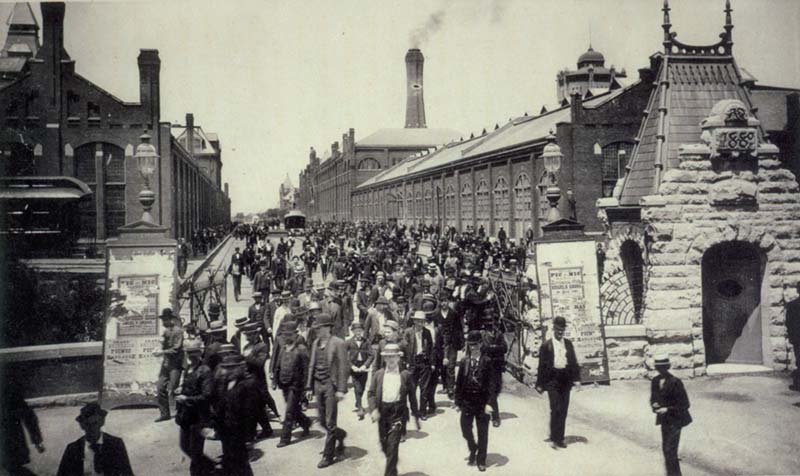
Pullman workers leaving factory, c. 1890s

Think about working at a job where management treats it employees poorly. Think about very unsafe working conditions or being required to work overtime without pay or you lose you job. Imagine yourself in such a job and then getting together with other employees and protesting to management. You protest because deep down you believe that, as a human being, you are really no different than those humans running the company and that all humans should be treated with at least a minimum level of honor and respect, plus you like having a job and want to keep working.

Then imagine management does not listen so you go on strike. And then imagine soldiers and police officers come in and shoot you and others dead. Your family, your children hear the news. The soldiers and police are lightly reprimanded (but also receive praise from the non-working classes) and politicians makes a few speeches about how things should change. But you are dead, or you spouse is dead, or your friends are dead and the company makes promises to change, and the captains of industry confer in the back rooms of their exclusive clubs, and 30 years later things have not really changed.

I am not a Luddite, or an anti-capitalist, or a unionist per se. But I am a student of human nature and I know that power seeks more power, and that any system that is powered by human greed and self preservation is destined for trouble. Sometimes I want to smash the machines, and distribute the wealth, and call all workers to unite. But, in truth, I know there is no structural solution, there is only the radical solution of the human heart changing from death to life. However, one can still fight for what is good. And that might mean structural change.

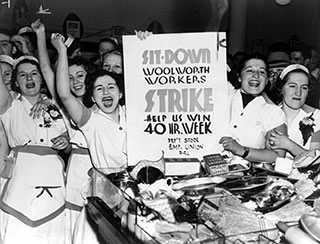
1937 Woolworth Strike for 40 Hour work week

Labor Day was a little bone tossed by big government to the working classes as part of an appeasement for the Pullman Strike debacle of 1894. It’s really not much on the one hand, but we can make it what we will. I am choosing to remember that we live in a world of imbalances, where those in power all to often wield it unfairly over those without power, and that tragedies of labor are now being offshored and therefore unseen by so-called more advanced societies like ours. Let us remember that many of the “rights” we enjoy – 40 hour work week, fair wages, paid overtime, health and safety standards, equal opportunity, etc. – were pushed into existence by the working class and resisted all along the way by the capitalist class. This is not a judgment, just the documented facts of history, and something we should remember. And we should remember that there is a lot of work to be done.


At Starbucks protesting for Union, 2009

Happy Labor Day!
>healthcare and ideologies

>

One of the most common statements made about healthcare in the U.S. is it is the best in the world. Yet both anecdotal evidence and the hard facts say otherwise. It is excellent in many ways but also deeply flawed, often to the points of lunacy and tragedy, in others. Many perspectives (of which there really are just a few recycled over and over) on healthcare, like politics, may be more a reflection of certain external perspectives with questionable provenance expressed as deeply held beliefs, than carefully examined arguments. In other words, for many their personal convictions may, in fact, be merely the unquestioned ideologies absorbed from their culture believed as fact. This is a fault of all of us at some level. The reality that many still cling to their belief that healthcare in the U.S. is the best in the world reminds me of this great and prescient quote:

Conventional opinions fit so comfortably into the dominant paradigm as to be seen not as opinions but as statements of fact, as ‘the nature of things.’ The very efficacy of opinion manipulation rests on the fact that we do not know we are being manipulated. The most insidious forms of oppression are those that so insinuate themselves into our communication universe and the recesses of our minds that we do not even realize they are acting upon us. The most powerful ideologies are not those that prevail against all challengers but those that are never challenged because in their ubiquity they appear as nothing more than the unadorned truth.
~ Michael Parenti

We are living at a time when some unchallenged ideologies on healthcare are finally getting a chance to be challenged. Whether they will be challenged properly and fully will depend a lot of how people, especially politicians, are willing and able to break free from the dominant paradigm. But, then, that is always the issue, isn’t it?

>The audacity of what?!

>Consider this post to be like one of those emails with a subject line something like “Fwd: Fdw: Fdw: YOU MUST SEE THIS.” You know the one you think you are going to delete but then end up reading and then are glad you did.

I offer a slight warning: If you are an American – meaning a citizen of the U.S.A. (as I am) and not the many millions of others living in the Americas – don’t be put off by the fact that the video comes from the Socialism 2009 conference. I say this not merely because you shouldn’t be afraid (a tendency in this country) of political/economic ideologies that are both more democratically minded as well as more committed to social justice & equality than our own current system, but because John Pilger is one of the finest journalists in the world today and has been for many years. His take on Obama, American exceptionalism, propaganda, and current trends is wonderful and, I think, hits the nail of the head.

It is difficult for me to listen to Pilger because he describes exactly what I knew I was going to get when I voted for Obama. I voted with my pragmatist’s hat on, voting against McCain and excited to see change. But I knew in my heart I would not see real change. I knew all that was fundamentally wrong with our current military industrial system, our socioeconomic structures, and our hierarchies of power within and without the borders of this country would remain the same and probably reinforced. That is what we have in Obama, a better politician and president than we have had the previous eight years, but also the same. On the other hand I love hearing Pilger say what needs to be said and to do so in a way U.S. journalists rarely can.

>d’bike d’bike

>Finally, I now know why I like riding bikes.